The Women of Highspire Mill
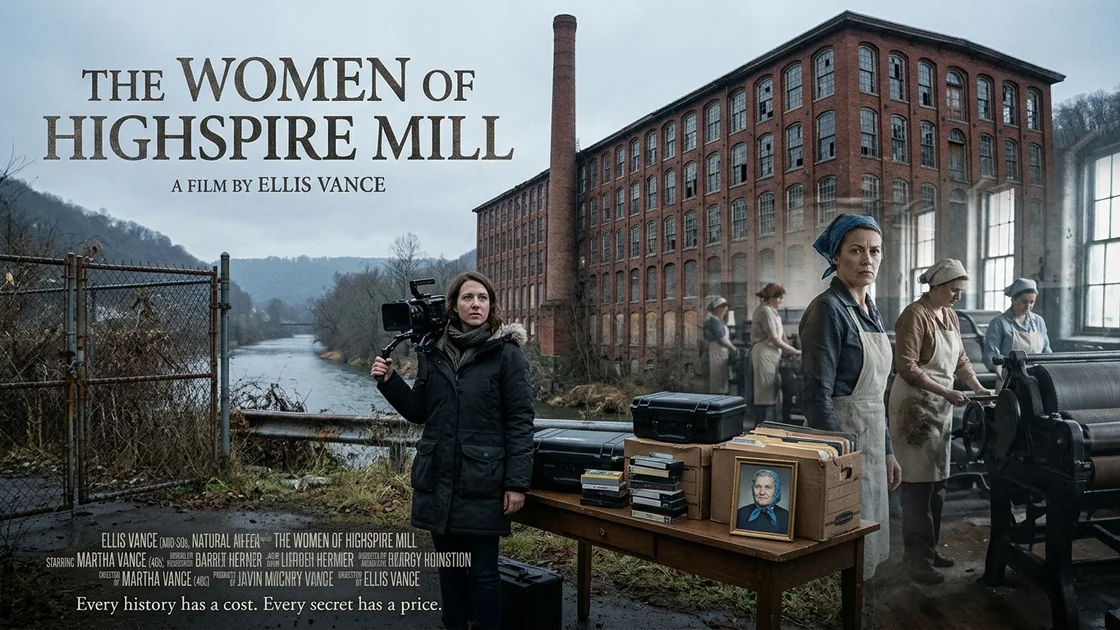
When documentary filmmaker Ellis Vance returns to the decaying rust-belt town of Highspire to record the oral histories of the women who kept the local woolen mill running through its final turbulent decades, she expects to chronicle a familiar story of deindustrialization, labor solidarity, and economic abandonment. Instead, as she sifts through decades of union logs, forgotten company ledgers, and the guarded testimonies of surviving spinners and weavers, Ellis unearths a long-buried industrial catastrophe from the bitter winter of 1974. In piecing together the events that saved eighty families from destitution, Ellis discovers the devastating personal price paid by her own grandmother, Martha Vance, who spent the remainder of her life branded as a coward and a company collaborator in order to shield another woman from prison and keep the mill town alive.
I. The Lens and the Silt
The road into Highspire did not announce itself with a sign so much as an absence of maintenance. Route 422 narrowed from four lanes of divided asphalt into two cracked strips of tar-patched aggregate, hemmed in on either side by sumac, knotweed, and the skeletal frames of billboard structures that had not carried advertisements since the late eighties. The Conemaugh River ran below the road, the color of wet slate under a November overcast, carrying leaves and the persistent chemical iron of acid mine drainage from the hills up near Cassandra.
Ellis Vance rested her hand on the steering wheel, her fingers tapping a rhythm she had learned in film school to calibrate her shutter speeds—one-twenty-fourth of a second, forty-eight, ninety-six. In the passenger seat of her battered Volvo station wagon, two Pelican cases were strapped beneath a ratcheting tie-down: a pair of Sony cinema bodies, three prime lenses packed in closed-cell foam, two carbon-fiber tripods, and a shotgun microphone wrapped in artificial fur that looked like the pelt of an alley cat.
In the backseat lay three cardboard archive boxes Ellis had rescued from her mother’s garage in Toledo. They were filled with cassette tapes, yellowed mimeographs of union grievance forms, and two dozen black-and-white photographs of women in grease-spotted cotton aprons standing between rows of Crompton & Knowles heavy looms.
On top of the boxes lay a single framed portrait of Martha Vance taken in 1968. In it, Martha was forty-two years old, her hair tied severely beneath a blue kerchief, her collarbones sharp as lathe-cut pine, her lips pressed into the thin, unyielding line that Ellis remembered from childhood Sunday dinners. Ellis had spent her childhood believing that line was drawn by religion or naturally sour temper. Her mother had simply said, Your grandmother worked forty years in the carding room, Ellis. You spend forty years breathing pulverized wool and machine oil and see if you smile for strangers.
Highspire appeared around the bend where the valley choked into a gorge: two hundred brick duplexes clinging to the north-facing slope, an abandoned Roman Catholic church whose copper spire had oxidized to the shade of pond scum, and, dominating the river flat, the Highspire Worsted and Woolen Company.
The mill was five stories of dark Pennsylvania red brick, forty bays long, with arched windows that had nearly all been covered with corrugated fiberglass or painted over with thick coats of industrial battleship gray. A smokestack rose from the boiler house like a broken thumb against the ridge. When Ellis had been six years old, visiting her grandmother for two weeks in July while her parents finalized their divorce, the mill had still shaken the valley. You could not hear it as a single sound; it was an infrasonic pulse that came up through the cellar floorboards, through the iron bedframes, through the enamel of your back molars. It was the collective thrash of two hundred shuttle looms, seventy ring spinning frames, and twelve garnett machines tearing dirty fleeces into fiber.
Now, as Ellis killed the Volvo’s engine in front of the gate, the valley was so quiet she could hear the river licking the concrete footers of the railway trestle.
She unlatched her seatbelt, climbed out into the damp chill, and walked to the chain-link fence. A padlocked chain held the double gates shut, but someone had cut an arched doorway through the wire years ago. Teenagers had spray-painted initials on the brick foundations: T.M. + K.R. 1994; NO FUTURE; LOCAL 113 FOREVER.
Ellis lifted her viewfinder to her eye, framing the main entrance where three generations of women had clocked in at 6:45 every morning. Her grandmother had been one of them. For forty-three years, Martha Vance had punched a card into an electric Simplex clock, hung her coat on a numbered hook in the basement cloakroom, and walked up four flights of iron-treaded stairs to the carding floor.
And yet, when the mill had finally shut its doors in the spring of 1991, Martha had not attended the final rally. She had not joined the group photograph on the courthouse steps. She had not accepted her commemorative brass shuttle or the service certificate signed by the union international president. She had stayed inside her small four-room house on Cherry Street, behind the drawn Holland shades, while the town marched past her porch with candles.
Ellis took a slow breath of the cold valley air. It smelled of river mud, wet leaves, and, faintly, impossibly, the sour lanolin reek of raw wool that fifty years of rain had failed to wash from the valley’s soil.
"We’re going to get it right, Grandma," Ellis whispered to the glass of the passenger window. "Every frame."
II. Maeve Higgins and the Spindle Speed
The kitchen of Maeve Higgins smelled of menthol cigarettes, boiled potatoes, and the vinegar she used to clean the linoleum. Maeve was eighty-six years old, with shoulders permanently pitched forward from thirty years spent leaning over the guide-bars of ring-spinning frames, her fingers thick-jointed and purple with nodes of osteoarthritis.
Ellis worked quietly in the corner of the room, setting up her key light—a soft daylight LED through a collapsible silk diffuser—and rigging an omnidirectional lavalier mic to Maeve’s floral housecoat.
"You’re wasting expensive electricity, girl," Maeve said, watching Ellis through the smoke of a Carlton 100. "Nobody wants to watch old biddies talk about wool. Wool is dead. It’s all fleece made out of plastic bottles now. My granddaughter buys jackets made out of milk jugs. Tells me it’s better for the turtles."
"People want to know what it was like," Ellis said, checking the audio levels on her Zoom recorder. "They know the steel towns. They know Pittsburgh and Bethlehem and Homestead. But nobody talks about the textile towns in the mountains. They don't know who worked the shifts."
"The men didn't," Maeve said with a dry, rattling chuckle that ended in a cough. "The men were up at the coal tipple or down at the rail yard until the mines played out in fifty-six. After that, the men sat on the front porches and drank Schmidt’s while the women walked down the hill at six in the morning to keep the electric turned on. We carried this valley in our apron pockets, Ellis. Don't let any historian with a mustache tell you different."
Ellis adjusted her focus ring. Maeve’s face sprang into crisp definition on the small monitor: the deep fissures radiating from the corners of her mouth, the cataract clouding the blue of her left eye, the wild white wisps of hair pinned back with celluloid barrettes that might have been fifty years old.
"Tell me about the sound," Ellis said.
Maeve blew a thin stream of smoke toward the range hood. "The sound. Well. If you took ten freight trains and drove them through a tin barn full of crows, that was the weave room. You couldn't talk. If you opened your mouth to yell, your teeth vibrated until your fillings hurt. You learned to read lips. You could read a woman’s lips from thirty feet across the alley between the spinning frames. You knew who was pregnant before her husband did. You knew who had a black eye under her makeup from a drunk husband. You knew whose boy was getting drafted for Da Nang."
Maeve looked directly into the lens, unblinking.
"Your grandmother Martha was the best card tender in the valley," she said abruptly.
Ellis’s hand paused on the tripod handle. "My mother said she was quiet."
"Quiet outside," Maeve said. "Inside the mill, quiet didn't mean soft. The carding room was on three. That’s where the wool came out of the wash-house—great greasy lumps of it, tangled like briars. The cards were giant cylinders covered in wire teeth, revolving against each other. If you weren't careful, the teeth would take the meat off your forearm like a grater takes the zest off an orange. Martha ran six cards at once. She could tell by the whine of the leather belt if a bearing was dry three minutes before it caught fire."
"Did you like her?" Ellis asked.
Maeve leaned forward, her elbows resting on the oilcloth tablecloth. The cigarette burned down toward her knuckles, forgotten.
"Liking wasn't the currency we traded in, Ellis. We trusted her. Until seventy-four, we’d have followed Martha Vance into the river with our boots on. She was shop steward for the whole preparation department. When the company tried to speed up the garnett feeds in sixty-nine, she just walked over to the main switchboard, pulled the three-hundred-amp knife switch, and stood there with her arms crossed while the super screamed until his ears turned purple. She told him, 'Mr. Alden, you can run those frames at four hundred feet a minute if you want, but you’ll have to drag my corpse out from the cogs first.' He backed down."
"And after seventy-four?" Ellis asked, keeping her voice level, letting the microphone pick up the heavy silence that followed.
Maeve turned her gaze away from the camera, looking out the kitchen window toward the ridge where the brown oak leaves clung stubbornly to the limbs.
"After seventy-four," Maeve said softly, "Martha stopped coming to the union hall. She wouldn't look at us in the market. She took her lunch alone in the fire tower, sitting on an iron step with an apple and a thermos of black coffee. If you said 'Good morning, Martha,' she’d look through your chest like you were a pane of dirty glass."
"Why?"
"Because of the lockout," Maeve said, her voice dropping into a register that had nothing to do with age and everything to do with grievance that had calcified over half a century. "The big freeze in seventy-four. The company wanted forty percent wage concessions and they wanted to cut our health coverage for byssinosis—the brown lung from the card room dust. We voted ninety-eight to two to strike. It was December. Twenty below on the mountain. The company brought in replacement workers from West Virginia on buses."
Maeve’s hand shook slightly as she stubbed out her cigarette in an amber glass ashtray.
"Somebody sabotaged the steam main," Maeve said. "They cut the secondary feed pipe behind the boiler house so the water drained into the alley. In two hours, with the temperature what it was, the boiler jackets cracked. The whole mill froze. Four miles of iron steam pipe split like pea pods from the basement to the roof. The scabs couldn't work. The mill had to shut down for two months."
Ellis felt a cold prickle at the base of her neck. "Was someone arrested?"
"No," Maeve said, her eyes swinging back to Ellis with a look that was hard as an anvil. "The company brought in the State Police and the Pinkertons. They were going to charge the whole strike committee with federal industrial sabotage—conspiracy to destroy interstate commerce. We were looking at five years in the federal penitentiary at Muncy. All seven of us on the committee. Clara Delgado, me, Ruthie Blevins, your grandmother... all of us."
"And what happened?"
"Martha went into the front office alone," Maeve whispered. "On a Sunday night. She had a meeting with old man Sterling himself—the owner. No union lawyer. No witnesses. Nobody knows what was said in that room, Ellis. But the next morning, the state police packed their cruisers and left. The company dropped the charges. They signed a temporary contract that gave us back our old wages."
"Then she saved you," Ellis said.
Maeve gave a short, bitter laugh that sounded like dry gravel sliding down a chute.
"She saved herself," Maeve snapped. "The agreement came with a rider. The sabotage was pinned on an 'unidentified outside radical.' But Martha... Martha received an immediate promotion to head inspector—a salaried job, company payroll, outside the union bargaining unit. And two days later, her husband, your grandfather Paul, who had been blacklisted out of the coal mines for eight years after the sixty-six wildcat, got hired on as a night watchman at the company reservoir with a state pension voucher."
Maeve leaned into the light, her face taut.
"She sold the strike out, Ellis. She traded the committee’s necks to Sterling for a clean house and her husband’s pension. We had to work ten more years in that drafty, patched-together hellhole while your grandmother sat in the warm glass booth at the end of the finishing room, marking our cloth with red chalk whenever there was a broken pick or a slub in the weave. She docked our pay. She became Sterling’s whip."
Maeve pointed a crooked, spotted finger at the camera lens.
"You want to make a movie about heroes, girl? You go find Clara Delgado. She lost her home that winter. Her kids ate lard on toast for six months. Don't come here asking me to put flowers on Martha Vance’s grave."
III. The Architecture of Thread
The archival room of the Highspire Public Library was located in the basement, next to the furnace room, behind three locked doors that the librarian, an austere woman named Miss Hallowell whose mother had been a burler in the mill, opened with brass keys that looked nineteenth-century.
"Everything from the mill closure was dumped here in ninety-three," Miss Hallowell said, her voice hushed by the instinctual reverence of small-town archivists. "The state historical commission took the board minutes and the nineteenth-century daybooks for the archives in Harrisburg. What’s left is the personnel files, the daily maintenance logs, and the yard boss’s diaries. Nobody looks at them except people doing family trees."
Ellis spent three days in the basement under the hum of fluorescent tubes that flickered at sixty hertz, wearing white cotton gloves and sorting through gray legal boxes that smelled of damp starch and sulfur.
She set up her camera on a copy stand, photographing pages with an intervalometer:
Log of the Highspire Worsted Co., Weave Shed #2, October 14, 1971: Loom #42: Broken shuttle spring. Operator: D. Kovacs. Repair time: 1.5 hrs. Loom #88: Warp beam replacement. Operator: C. Delgado. Production: 142 yards fine twill. Note: Operator Delgado docked 40 cents for grease spot at yard 62.
Log of the Carding Dept., December 3, 1974: Cards 1 through 8 shutdown by order of Shop Steward M. Vance. Excessive dust level exceeding state limit. Master mechanic notified. Margin note in red grease pencil: 'Vance warned re: insubordination.'
Ellis turned the pages carefully. The handwriting changed over the years—from the copperplate script of elderly clerks in the forties to the hurried, ballpoint scrawls of the seventies and eighties.
In the sixth box, nestled between invoices for Australian merino grease-wool and boiler inspection certificates, Ellis found a folder labeled simply: SPECIAL INQUIRY – INCIDENT OF DEC. 18, 1974.
Inside were eight typewritten pages on the letterhead of the Pennsylvania State Police, Bureau of Criminal Investigation, along with several polaroid photographs stapled to legal pads.
Ellis leaned over the photographs. They showed the rear of the Highspire boiler house: a narrow alley paved with river cobblestones, now coated in a sheet of glare ice. A thirty-foot fracture ran along a four-inch cast-iron pipe that had been wrapped in ragged insulation. A pair of heavy pipe tongs lay on the stones near an open inspection pit.
Stapled to the back of the report was an inventory of evidence:
1. One (1) 36-inch Ridgid pipe wrench, property of Highspire Worsted Co. maintenance dept. 2. One (1) wool knit cap, dark navy, bearing no labels. 3. Three (3) discharged packings from a master pressure release valve. 4. Note recovered from floor of valve enclosure: illegible pencil fragment.
Ellis read the narrative report, written by an Investigator K. J. Prendergast:
"Pursuant to interview with Mill Superintendent Arthur Sterling Jr. and Chief Engineer Thomas Briggs, it is determined that the catastrophic pressure drop occurring at 0340 hours on December 18 was not the result of mechanical failure due to freezing conditions, but was caused by the manual opening of the main condensate return blowoff line... The opening of this valve caused thirty thousand gallons of treated boiler feed water to empty into the alleyway within twenty minutes, starving the low-pressure fire-tube boilers of makeup water while the coal stokers were firing at full draft. As a consequence, the crown sheets of Boilers #1 and #2 were warped beyond repair, and three major distribution lines burst due to hydro-pneumatic shock..."
Ellis turned the page.
"Initial suspicion centered upon members of the Amalgamated Textile Workers of America Local 113 Strike Committee, specifically:
- Higgins, Maeve (Chair)
- Delgado, Clara (Vice-Chair)
- Vance, Martha (Steward)
On December 22, 1974, upon the presentation of physical evidence recovered from the valve pit, shop steward Martha Vance presented herself at the offices of Mill Management in the company of none. Following a two-hour closed session with Arthur Sterling Jr., management formally notified the Pennsylvania State Police that the incident would be treated as an internal labor-management dispute and declined to file formal criminal complaints, citing 'lack of definitive malicious intent' and attributing the valve discharge to 'procedural error during unauthorized system maintenance.'
Investigation SUSPENDED by order of District Attorney's Office, Cambria County."
Ellis sat back in the metal folding chair. The furnace in the adjacent room kicked on with a low, combustive thrum that rattled the sheet-metal ducts overhead.
Procedural error during unauthorized system maintenance.
Nobody who had worked thirty years in a mill confused a high-pressure condensate valve with an ordinary drain cock. It required a thirty-six-inch wrench and sixty foot-pounds of leverage to turn the brass wheel on a four-inch steam release line. It was an act of deliberate, violent sabotage.
Why would the Sterling family—notorious in the Conemaugh Valley for their ruthless anti-union litigation, a family that had used injunctions and armed guards to crush strikes in 1934 and 1951—suddenly decline to prosecute a woman who had just cost them half a million dollars in plant damage?
Ellis opened her notebook and wrote: Why did Sterling let her off? What was on the illegible pencil fragment?
IV. Clara Delgado’s Hands
Clara Delgado lived in the lower row of company brick houses, down near the river where the morning mist settled thickest and remained longest. Her porch was hung with dried strings of peppers and plastic wind chimes that clattered in the draft from the water.
When Clara opened the door, she looked at Ellis’s camera bag and then at Ellis’s face. She didn't ask who she was.
"You have Martha’s forehead," Clara said. Her voice was deeper than Maeve’s, thick with a gravelly Altoona accent that flattened its vowels. "And her chin. She used to set that chin when things were going bad on the late run. Come inside. I made chicory."
Clara’s house was warm, heated by an ancient cast-iron gas stove that stood in the middle of the parlor on a square of galvanized zinc. The walls were covered with framed photographs: sons in naval uniforms, daughters in confirmation dresses, grandchildren in high school football jerseys.
Ellis set her camera on a tabletop tripod between two porcelain figurines of the Virgin of Guadalupe.
Clara did not smoke. She sat with her hands folded in her lap—hands that were impossibly deformed. The middle three fingers of her right hand were fused at the second knuckle, flattened into a curved paddle of scarred, shiny tissue.
"Nineteen sixty-two," Clara said, noticing Ellis’s gaze. "The loom slammed shut on the shuttle race. The picker stick snapped and jammed my hand into the reed. The super told me if I went to the hospital before the end of the shift, he’d dock the whole battery twenty percent for downtime. So I wrapped it in a kerosene rag and finished the four hours. Martha Vance came down from carding, walked right onto my platform, shut off my loom, and walked me down the middle of the floor by my good arm, straight out the main gate to the doctor’s office on Sixth Street. Arthur Sterling Sr. was standing on the loading dock. He yelled at her, 'Vance, you punch her out, she stays out!' Martha didn't even turn around. She said, 'Shut your face, Artie, or I’ll bring forty women down here with grease-guns to grease your driveway.'"
Clara smiled, a slow, gentle curve of the lips that seemed to draw light into the dark wrinkles of her skin.
"She was magnificent," Ellis said.
"She was like a stone in the foundation," Clara replied. "You don't think about the stones under the dirt until the cellar wall caves in."
"Then why did Maeve say she was a traitor?"
Clara closed her eyes for a long moment. When she opened them, the warmth had vanished, replaced by an exhaustion so ancient it seemed structural.
"Maeve is a Higgins," Clara said simply. "The Higginses have been union since the Molly Maguires. To Maeve, everything is white yarn or black yarn. There is no gray. If you aren't carrying a banner, you’re an enemy. If you don't starve on schedule with the rest of the gang, you’re a scab."
"Did Martha sell out the strike?"
"No," Clara said.
"Then what happened in the boiler alley, Clara? The state police report says Martha went in to see Sterling alone. It says she took a promotion to head inspector and Grandfather Paul got a pension job, and the charges against the strike committee were dropped."
Clara reached out with her mangled right hand and touched the camera lens, lightly, as if testing the focus herself.
"You want to know what your grandmother sacrificed, Ellis? You think it was just her name? You think she just took some money and bought a new stove?"
Clara stood up, her joints cracking like dried twigs. She walked to an oak sideboard that stood against the wall, reached behind a stack of blue willow plates, and pulled out an old tin that had once held English toffees.
She brought it to the table and set it in front of Ellis.
"I kept this forty-nine years," Clara said. "Because Martha told me that if I ever showed it while she was breathing, she’d walk into the river. And she would have. She was a Vance by marriage, but she was a Kunkle by blood. The Kunkles didn't make threats. They just did what they said."
Ellis opened the tin. Inside was no money, no legal contracts, no gold watches.
There was a child’s baptismal certificate, dated March 14, 1954, for a boy named David Delgado.
There was a small brass key with a tag marked Locker 412 – Washhouse.
And there was a piece of cardboard torn from the side of a box of cotton sliver, four inches wide, covered on both sides with Martha Vance’s tight, angular script, written in carpenter’s pencil.
Ellis picked up the cardboard. The pencil was faded, but under the bright light of her LED panel, the words leaped out from the yellowed pulp:
Artie— I have the receipts from the Pittsburgh bank for the second account. I have the manifests for the wool that went out on the Pennsy cars without the excise stamps in sixty-eight and seventy-one. If you put Clara in jail for that pipe, every ledger in your father’s desk goes to the Department of Revenue before the sun comes up tomorrow. You drop the warrants. You sign the wage scale. And you give Clara’s boy his machinist apprenticeship at the Cambria shop. I will take the inspector spot. You can tell the town I sold them out. You can tell them whatever lies you need to keep your face clean with the bank. They will hate me. They will not hate the union. M.V.
Ellis read the lines three times, her breath catching in her throat until she felt lightheaded.
"Clara," she whispered. "The pipe... it wasn't an 'outside radical.'"
Clara sat back down in her chair. She took a sip of the cold chicory, her hand perfectly steady now.
"My boy David was nineteen," Clara said, her voice dropping so low Ellis had to lean forward to catch the words. "He was a hothead. His brother had died in the Delta two years before, and David had come back from the army with a hole in his lung and a rage that never went out. When the company brought those scab buses up the mountain from West Virginia... David said they were taking the bread out of our mouths while we were still bleeding."
Clara looked at her ruined fingers.
"He went down to that alley with his father’s pipe wrench. He didn't mean to break the mill. He thought he was just going to drain the line so the scabs wouldn't have heat in the weave shed for their shift. He didn't understand how steam works. He didn't know that if you drop the pressure on those old Scotch marine boilers too fast, the cold water rushing in hits the red-hot steel and turns the whole thing into a bomb."
Clara covered her face with her hands.
"The wrench slipped," she said through her fingers. "The high-pressure steam caught him across the face and the shoulders. He was lying in that alley, screaming, drowning in boiling water and freezing to death at the same time. Martha was walking the picket line at the front gate. She heard it. She ran back there alone."
"She dragged him out," Ellis said.
"She carried him," Clara said, looking up, her face wet with tears that tracked through the dust of her skin. "She was five-foot-four, Ellis, and she carried a hundred-and-sixty-pound boy three blocks through the snow to her own cellar on Cherry Street. She covered him with lard and lard-oil and old linen sheets so the hospital wouldn't see the steam burns. Because if he went to the hospital in Johnstown with steam burns that night, the troopers would have known he was the one at the valve. They’d have charged him with felony sabotage. With his record from the service, he’d have died in the state prison at Huntingdon."
Clara tapped the piece of cardboard on the table.
"Martha went back to the alley," Clara said. "She picked up David’s wool cap that had fallen in the slush. But she left her own wrench—the one she kept in her locker for the card drives—right by the pit. She laid her own name on the chopping block."
"Why didn't she tell Maeve?" Ellis asked, her voice cracking. "Why didn't she tell the committee? They would have protected David. They were a family."
"No," Clara said fiercely. "Maeve would have made him a martyr. Maeve would have called a press conference. She’d have said, 'Look what the company drove this veteran to do!' And the company would have brought down forty state troopers, canceled the strike insurance, declared bankruptcy, and closed the doors forever. Eighty families would have had no winter work, no coal allowance, no union. The town would have died in seventy-five instead of ninety-one."
Clara leaned across the table, her dark eyes pinning Ellis to the back of her chair.
"Martha knew there was only one person who could carry that weight without breaking the union. A person who had no children at home. A person whose husband was already sick with the miner’s asthma and didn't have long anyway. A person the town already thought was cold."
Clara picked up the tin and held it against her chest like a relic.
"Your grandmother let this whole valley spit on her porch for seventeen years so that my David could live to be an old man with grandchildren, and so that Maeve Higgins could have a pension check to buy her Carlton cigarettes every Tuesday morning."
V. The Finishing Room
Ellis spent the night in the car, parked in the gravel lot outside the Highspire mill gate.
She could not sleep. The wind came down through the gap from the Laurel Ridge, cold and thin, whistling through the rusty stays of the fence. Every few hours, a coal train would rumble past on the opposite bank of the Conemaugh, three locomotives dragging eighty hopper cars of metallurgical coal toward the coking ovens at Clairton, their yellow headlights slicing through the river mist like broadswords.
She sat in the driver’s seat with her laptop open, scrolling through the raw footage she had shot over the last two weeks:
Clip 042: Maeve Higgins, tight shot on hands. "She traded the committee’s necks to Sterling for a clean house..."
Clip 089: Clara Delgado, medium shot, the window behind her. "She was like a stone in the foundation..."
Clip 012: The mill exterior at twilight. The massive brick wall, dark as dried liver, rising up from the slate river.
Ellis clicked on a digitized reel of 16mm silent footage she had found in the library archive. It had been shot by an amateur local historian in the summer of 1972 during the town’s centennial parade.
The camera panned across the union float: a flatbed truck covered in green crepe paper, carrying a portable loom. Standing on the back of the truck were six women in matching white blouses with blue union sashes.
There was Maeve Higgins, young and sharp-featured, waving both arms over her head like a politician. There was Clara Delgado, laughing, holding her small daughter on her hip. And there, standing at the rear corner of the bed, holding the timber frame of the loom with one scarred hand, was Martha Vance.
She was not waving. She was looking out past the crowd, past the brick facades of the butcher shops and the pharmacy, toward the ridge where the timber had been stripped for mine props. Her face was totally still. It was the face of a person who lived in a house where the windows were never opened, watching the weather change from behind the glass.
Ellis paused the playback on Martha’s face.
She zoomed in until the 16mm grain dissolved into a pattern of soft silver clusters.
"You knew," Ellis said to the screen. "You knew they’d never forgive you."
At dawn, Ellis took her Pelican cases, crawled through the hole in the chain-link fence, and walked across the weed-choked gravel to the mill’s main entrance.
The heavy oak doors were unlocked, their bronze latches broken off by scavengers looking for brass. She stepped inside.
The smell hit her instantly—an indoor atmosphere that had been sealed against the sunlight for thirty years. It was not the clean, earthy decay of the woods. It was the smell of grease that had oxidized into varnish; of three floors of southern yellow pine timbers soaked in decades of light machine oil; and the dry, tickling presence of woolen dust that hung in the air like microscopic spiders.
Ellis set up her tripod on the first-floor spinning level.
The floor was three hundred feet long. The machinery had been sold off to a liquidation company from North Carolina in 1992—the spinning frames, the twisters, the automatic winders all ripped from their lag bolts and crated for shipment to mills in Colombia and Pakistan. All that remained were the scars on the floorboards: clean, pale rectangles where the iron legs had stood for eighty years, surrounded by dark wood blackened with tallow and paraffin.
Overhead, hundreds of wooden split-pulleys hung from cold-rolled steel lineshafts that ran the length of the building. The leather belts were gone, but the iron hangers remained, bolted to the heart-pine beams with square nuts the size of fists.
She picked up her gear and climbed the stairwell in the northeast tower. The treads were made of cast iron, worn down in the center into shiny, silver troughs where millions of leather-soled boots had climbed and descended through sixty-hour weeks.
On the third floor—the carding room—the light was different.
The arched windows here faced south, toward the river. The fiberglass panels had fallen away in several bays, and the morning sun was cutting through the dust in long, diagonal shafts that looked like organ pipes.
In the center of the room, alone on the floor, stood a single machine that the liquidators had deemed too obsolete to move: an 1898 Davis & Furber three-cylinder woolen card.
It was a monster of dark cast iron, twelve feet wide and twenty feet long, its cylinders bristling with millions of fine, bent wire teeth. The iron frame was embossed with scrollwork and the name of the makers: DAVIS & FURBER MACHINE CO., NORTH ANDOVER, MASS.
Ellis walked toward it, her boots crunching on fallen plaster.
On the wooden frame that supported the wool feed-apron, someone had written something in blue grease pencil, then tried to scrape it off with a putty knife.
Ellis knelt, setting her camera on the floor, and pulled a soft brush from her lens kit. She gently cleared away thirty years of pigeon droppings and dried soot from the wood.
Under the grime, the faded blue wax remained in the grain:
CARD #4 – M. VANCE – 1941 to 1974 GOOD-BYE OLD GIRL
Ellis pressed her forehead against the cool iron of the main cylinder. The wire teeth were soft under her skin, tiny pins that felt like the prickles of a thistle.
This was where Martha had spent her youth. Here, standing between these cylinders in the suffocating heat of August and the freezing drafts of January, her lungs slowly filling with the fine, invisible fleece-dust that would kill her fifty years later in an oxygen-tented room in an Altoona hospice.
She had stood here while her brothers fought in the Pacific. She had stood here while her husband spat black mucus into the kitchen sink after sixteen hours in the lower vein of the St. Michael shaft. She had stood here while the union was born in blood and tear gas in thirty-seven, and she had stood here when it died of imports and polyester in the eighties.
And when the moment came that required a sacrifice—not a grand, romantic sacrifice with a flag and a bugle, but a dirty, silent, humiliating sacrifice that would make her neighbors turn their backs on her at the post office—she had simply picked up the wrench, walked into the front office, and closed the door behind her.
VI. The Glass Booth
At the far end of the fifth floor was the finishing department, where the woven cloth had been washed, fulled, sheared, and inspected before being packed into cardboard cartons for the garment district in New York.
And there, perched on four iron pillars six feet above the floorboards like an air-traffic control tower, was the inspector’s booth.
It was built of tongue-and-groove beadboard, with four sides of double-strength plate glass set into pine frames. From inside that booth, a single person could look out over the entire two-hundred-foot expanse of the finishing room, watching the forty women who stood at the burl-tables with their tweezers and mending needles, picking out the knots and re-weaving the broken threads with fingers that never stopped moving.
Ellis climbed the narrow wooden ladder that led up to the booth.
The glass door was shut, held by a brass latch. She turned the knob and pushed it open.
The air inside was hot and dry, trapped under the tin roof. A wooden workbench ran along the south-facing windows, its surface worn silky-smooth by the friction of millions of yards of worsted wool sliding over the edge.
On the bench was a brass goose-neck lamp with a green glass shade, a wooden spool-rack holding twenty different shades of gray and black darning yarn, and an inspection ledger with a black oilcloth cover.
Ellis pulled out the high stool—a three-legged oak perch with an iron footrest—and sat down.
From here, Martha had watched them.
For seventeen years, from January 1975 until the mill whistle blew for the last time in April 1991, Martha Vance had sat on this stool for eight hours a day.
She had looked down through these panes of glass at Maeve Higgins, who would not look up. She had looked down at Clara Delgado, whose son David was working forty miles away in the machine shops at Johnstown, whole and free, with a wife and a house on the hill. She had looked down at the younger girls who had never known the strike, who had only been told by their mothers: That woman up in the glass box is Martha Vance. She sold out the strike for twenty dollars a week and a warm room. Don't you ever speak to her.
Ellis opened the oilcloth ledger.
It was not a company log. The pages were not printed with the standard production columns or invoice rubrics.
It was an ordinary composition book, the kind school children used for geography exercises.
On the first page, Martha had written:
Record of Flaws – 1975.
Ellis turned the pages. The entries were all the same, written day after day, month after month, in Martha’s severe, upright hand:
Feb 4, 1975: Loom 12 (M. Higgins) – Heavy pick-up at yd 40. Fixed with needle. Not docked. Feb 11, 1975: Loom 88 (C. Delgado) – Broken warp line at yd 110. Re-woven. Not docked. March 2, 1975: Loom 14 (R. Blevins) – Oil spill on white flannel. Cleaned with benzine. Not docked. April 18, 1975: Loom 12 (M. Higgins) – Tension slack, four yards scalloped. Mended. Not docked.
Page after page. Year after year.
Whenever a weaver’s machine had faltered, whenever a tired woman had closed her eyes for ten seconds at the end of a graveyard shift and let a greasy thread run through the reed, Martha had sat in her glass box with her darning needle and her bottle of solvent, mending the cloth herself.
She had spent seventeen years fixing their mistakes with her own eyes and her own fingers so that the superintendent would never have an excuse to dock their pay.
And she had never told a soul.
She had let them go down the hill every Friday with their full pay envelopes, believing that they were clever enough to fool old lady Vance in her high perch; believing that she was too lazy or too stupid to see the bad picks they had slipped past the rollers.
Ellis turned to the very last entry in the book, dated April 12, 1991:
The whistle blew at noon. Arthur Sterling Jr. came into the room with his lawyer. He said the contracts were canceled by the bank. He said there would be no severence. Maeve cried at the gate. Clara came up the stairs and left an orange on my stool. She did not say anything. The mill is cold now. The river is very high today. Everything that was done, was done. Martha.
VII. The Gathering of Spools
The basement of the Holy Trinity Slovak Lutheran Church had not changed since Ellis had attended her grandfather’s funeral lunch there in 1988. The long tables were still covered in white roll-paper taped down at the corners; the coffee urns were still thirty-cup Wearevers with red plastic indicators that never worked; and the walls were still hung with the framed banners of the church’s defunct fraternal societies.
Ellis had spent three days driving through the valley, from Windber to Nanty Glo, knocking on doors with her camera and her small monitor.
Now, on a Saturday afternoon, seven women sat around the center table.
Maeve Higgins was there, her aluminum walker parked behind her chair, a fresh pack of Carltons sitting on the paper tablecloth next to her teacup. Clara Delgado sat next to her, wearing her Sunday coat with the fake fur collar, her hands resting quietly on her purse. Ruthie Blevins, who had run the spoolers and was now ninety-one, sat in a wheelchair pushed by her daughter. There were four others—women who had been spinners, burlers, and knot-tiers, their faces like different drafts of the same woodcut, all bearing the same watermark of the valley: the thin skin, the high cheekbones, the slight deafness in the left ear from the roar of the gearboxes.
Ellis stood at the end of the table. Behind her, set up on two cafeteria tables, were two large production monitors connected to her laptop.
"I didn't invite you here to make an argument," Ellis said. Her voice was steady, but her hands were cold inside her sweater sleeves. "I’m not a historian from the university. I’m Martha Vance’s granddaughter. Most of you knew me when I was five years old and had scrapings on my knees from the gravel in the churchyard."
Maeve looked at her tea. "Nobody’s blaming you for your kin, Ellis. We told you what happened. That’s all there is to say."
"No," Ellis said. "It isn't."
She clicked the spacebar on her keyboard.
The monitors flickered to life. On the screens appeared the high-resolution photograph of the cardboard fragment Ellis had found in Clara’s tin box.
The pencil handwriting was four feet wide on the screen, every stroke of the carpenter’s lead distinct, every fiber of the gray paper pulp visible.
Artie— I have the receipts from the Pittsburgh bank for the second account...
Maeve Higgins squinted at the monitor. She reached into her pocket, pulled out a pair of horn-rimmed reading glasses with one temple mended with black electrical tape, and put them on.
The basement was completely silent except for the low hiss of the steam radiator in the corner.
Maeve leaned forward, her face three inches from the glass. Her lips moved silently as she read the words:
...If you put Clara in jail for that pipe, every ledger in your father’s desk goes to the Department of Revenue before the sun comes up tomorrow... They will hate me. They will not hate the union.
Maeve straightened up slowly. Her glasses slipped down the bridge of her nose.
She did not look at Ellis. She turned her head, very slowly, toward Clara Delgado, who sat two feet away with her hands still folded on her black purse.
"Clara," Maeve said. The gravel was gone from her voice; it sounded thin and cracked, like dry grass in the wind. "What is this?"
Clara did not look down. She looked directly into Maeve’s good eye.
"It was David," Clara said simply. "My David."
Maeve’s mouth opened slightly. A tiny shudder passed through the loose skin beneath her jaw.
"David broke the valve?" Maeve whispered.
"He was trying to help us, Maeve," Clara said. "He was a boy. He didn't know what he was doing. And Martha... Martha carried him three blocks through the drift with his skin falling off his chest from the steam."
"Why didn't she tell me?" Maeve’s hand went to the collar of her blouse, her fingers clutching the bone button. "I was the chair! I was the one who called the strike! We would have... we would have stood together!"
"And what would have happened to the town, Maeve?" Clara asked, her voice rising slightly, not with anger, but with the implacable weight of fifty years of knowledge. "Tell me. If the troopers came and took David, and Sterling showed the judges that the strike committee was blowing up boilers with pipe wrenches? You think the international would have sent strike relief? You think the banks would have held the mortgages on these houses? You’d have had forty women on the county poor farm before the snow melted."
Clara stood up. She reached out her scarred, fused right hand and laid it on top of the composition book that Ellis had placed in the center of the table—the inspector’s ledger.
"She gave you seventeen years, Maeve," Clara said. "She sat up in that drafty cage and took your spit every shift so you could have a contract. She mended your cloth when your fingers were too swollen to hold the needle. Look at the book. Look at it!"
Maeve did not reach for the book.
She sat motionless, her shoulders curved forward, her face gray under the fluorescent lights. The blue eye and the clouded eye were both wide, staring at the screen where the pencil strokes of Martha Vance’s handwriting seemed to glow like wet iron.
"Seventeen years," Maeve whispered.
She looked down at her own hands—the hands that had carried the picket signs, the hands that had folded the union leaflets, the hands that had refused to take the casserole dish to Martha Vance’s house when Paul Vance died of his black lung in eighty-two.
Ellis watched through the small viewfinder of the camera she had set on a tripod at the corner of the table.
She did not zoom in. She did not change the framing. She let the lens hold them both—the woman who had carried the banner and the woman who had carried the secret—sitting together in the basement of a church whose steeple had lost its cross to the wind twenty years ago.
Ruthie Blevins reached out from her wheelchair and touched Maeve’s sleeve.
"Maeve," the old woman said, her voice like paper rustling in a drawer. "Maeve, honey. We didn't know."
Maeve Higgins took off her glasses. She laid them carefully on the white paper tablecloth, next to her unopened pack of cigarettes.
She reached out her trembling hand, the fingers bent like roots, and pulled the black oilcloth ledger across the paper until it rested against her chest.
She did not open it. She just laid both forearms over the cover, pressed her head down onto the black cloth, and began to weep—not with the loud, performative grief of a funeral, but with the dry, ragged, terrible sound of a pump sucking air from an empty well.
IX. The Splice
The editing room Ellis rented in Philadelphia was three hundred miles from Highspire, located on the fourth floor of an old leather warehouse near the docks where the Delaware River ran brown and broad under the Ben Franklin Bridge.
It was April. Outside, the pear trees on the sidewalk were dropping their white petals into the gutters, but inside the dark room, with the shades drawn and the dual monitors glowing in the cool air, it was still November in the Conemaugh Valley.
Ellis sat with her timeline open before her.
There were seventy-four hours of footage: the drone shots of the rusted roof ridges; the macro shots of the wire teeth on the carding engines; the interviews with the eight women; the archival reels from seventy-two; the police reports; the ledgers.
Her producer in New York had called that morning.
"The rough cut is strong, Ellis," he had said through the speakerphone. "The labor angle is great. The sabotage twist is incredible. But the ending... you need to give us more Martha at the finish. You need to tell the audience how she felt. Did she regret it? Did she feel vindicated? We need an interview with her, or some letters, or something that gives her voice to the resolution."
"I don't have her voice," Ellis had told him.
"You have that audio tape your mother found in the cedar chest," he said. "The one from eighty-five."
"That’s not an interview," Ellis had said. "It’s just... her."
Now, Ellis picked up the cassette. It was a ninety-minute Maxell tape, its gray plastic shell scratched, its paper label bearing only one line written in Martha’s handwriting: Noise tests – Carding 3 – Oct 85.
In 1985, the Occupational Safety and Health Administration had sent field inspectors to Highspire to test the ambient decibel levels on the carding and spinning floors. Because Martha had been the department steward for twenty years before becoming an inspector, the company had given her an old portable cassette recorder and told her to stand at six different points on the third floor for ten minutes each, noting the time and the machine speeds for the state file.
Ellis had listened to it once, two months ago, and found only forty minutes of deafening, metallic hiss—the sound of three hundred gear trains and forty thousand wire teeth revolving against each other at five hundred revolutions a minute.
She loaded the cassette into her deck, patched the signal through an audio restoration plugin on her workstation, and pulled the high-pass filter down to cut out the mechanical rumble of the lineshafts.
She soloed the vocal track.
At first, there was only the sound of Martha’s breathing—heavy, slightly wet, the sound of a woman who was carrying sixty years of cotton and wool fiber in the lower lobes of her lungs.
Then, through the mechanical wash of the cards, Ellis heard Martha’s voice.
She was not talking to the inspector. She was not talking to the state. She was talking to the machine.
"All right, sixteen," the voice said, quiet and flat under the iron thunder. "You’ve got a loose tooth on the doffer. I hear you clicking. Don't you throw that wire into the web. You hold on until four o'clock. You hear me? Just hold on until the whistle."
A pause. The sound of Martha’s boots shifting on the oily yellow-pine boards.
"They think I don't know what you’re doing," she said. The voice was so close to the tiny condenser microphone on the cassette deck that Ellis could hear the dry click of Martha’s tongue against her teeth. "They think because you’re iron, you don't wear down. They think because you don't complain, you like the grease. They don't know nothing about it, do they, old girl? Not a damn thing."
The machine roared on, a white, continuous wall of percussion that filled the headphones until Ellis’s ears rang.
Then Martha began to hum.
It was not a church hymn. It was the tune that Maeve Higgins had sung on the picket line in fifty-one—an old song brought over from the textile mills in Dundee by the Scotch-Irish grandmothers who had built the stone houses along the creek:
Oh, dear me, the mill’s goin' fast, The shifts are so long, I’m fair beat at last, Tearin' our hair out and scrubbin' the floor, And waitin' for payday to come to the door...
Martha did not sing the words. She just hummed the air, her voice staying on one low, unmoving note whenever the melody climbed too high, keeping time with the three-beat slap of the wide leather belt that ran the main drive-wheel.
Ellis sat in the dark editing suite, her hands resting on the keyboard.
She didn't add any title cards. She didn't add an explanatory voiceover about deindustrialization or the decline of the labor movement in the rust belt. She didn't put a photograph of Martha Vance’s headstone on the screen.
She cut the video track to black.
Over the blackness, she laid the sound of the mill—not the silence that sat in the valley now, but the full, terrifying, beautiful roar of the carding floor in the winter of eighty-five: the iron, the belts, the wire teeth, the forty thousand threads being pulled straight through the teeth of the combs.
And underneath the roar, barely louder than the hum of the cooling fan in the computer tower, Martha’s breathing.
Hold on until four o'clock, the voice said from forty years away. Just hold on until the whistle.
Ellis pressed the export key.
The progress bar began to creep across the lower monitor, one percent at a time, rendering the frames: the red brick by the cold river, the warped floorboards with their pale rectangular scars, Clara Delgado’s fused fingers touching the white paper tablecloth, and Maeve Higgins’s gray head resting on the black oilcloth ledger.
Every frame accounted for. Every thread pulled through the reed.
Ellis leaned back in her chair and pulled the woolen kerchief—the blue one she had taken from the cedar chest in Toledo—from her pocket. She held it against her face.
It still smelled of the valley: of river water, iron rust, and the sour, indestructible grease of the sheep that had fed the looms before the cold came down from the mountain and took the valley’s voice away.