The Winter Estate of Ardnamara
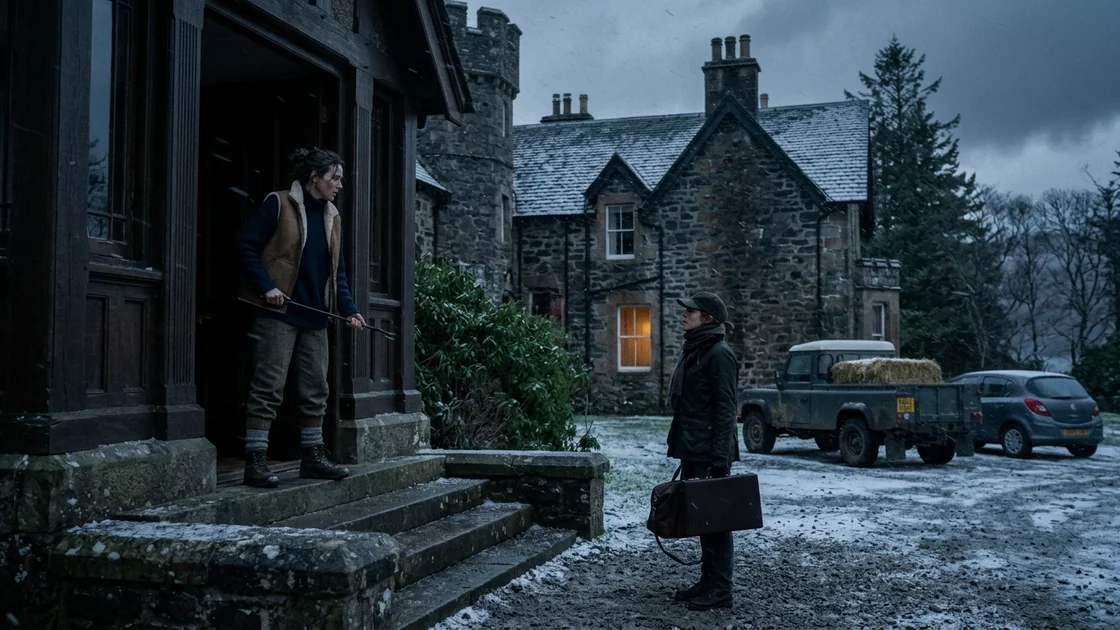
When the sudden death of patriarch Hector MacIntyre leaves the sprawling and debt-laden Scottish Highland estate of Ardnamara caught between a contested will and a forgotten deed of transfer, his estranged city-bred granddaughter Isla MacIntyre and his longtime live-in estate conservator Moira Campbell both travel to the remote property two days before Christmas to take inventory for their rival legal teams. What begins as a bitter standoff between two women harboring generations of familial resentment turns into a desperate struggle for warmth and survival when a historic blizzard barrels down from the Atlantic, cutting the power, blocking the single mountain pass, and trapping them inside the freezing granite halls where the ghosts of their family's past refuse to stay buried.
Chapter One: The Road to the Loch
The windshield wipers of the rented Vauxhall beat a frantic, uneven rhythm against the thickening sleet, dragging greasy crescents across the glass. Isla MacIntyre gripped the steering wheel until her knuckles ached white, her eyes strained against the encroaching purple gloom of the Scottish afternoon.
According to the dashboard clock, it was barely three in the afternoon, but in the western Highlands two days before Christmas, the light did not depart so much as it was drowned by the sky. The clouds hung so low they seemed snagged on the jagged peaks of the mountains that walled the glen. Below them, visible only in glimpses through the skeletal birch woods, Loch Namara lay like a slab of cold lead.
Isla checked the printout lying on the passenger seat for the fifth time, though she already had the solicitor’s instructions memorized. Follow the A830 past the rail viaduct, turn south at the ruined croft, proceed four miles along the unclassified single-track road until the iron gates of Ardnamara House. Mr. Urquhart had warned her about the road. He had also warned her about the weather. Most of all, he had warned her about Moira Campbell.
"She has lived under your grandfather’s roof for nine years, Miss MacIntyre," Urquhart had said across his tidy, warm Edinburgh desk, tapping a manicured finger against a thick manila folder. "In her mind, possession is nine-tenths of the law. She believes she kept the old man alive, kept the roof from collapsing, kept the bailiffs from the door. She does not view your claim with sympathy."
"My grandfather signed a deed of entailment to my mother in 1988," Isla had replied, her voice clipped, professional, armor-plated against the memory of her mother’s bitter, penniless death in a Leith flat. "He never revoked it. He didn't have the legal right to bequeath the estate to a distant cousin's ward on the back of a shortbread tin."
"A legal formality," Urquhart had sighed. "The courts will decide in February. But until the hearing, both parties have the right of entry to document the contents of the house. Do not provoke her. Document the heirlooms, take the photographs, check the boundary markers, and leave before the holiday sets in."
Isla had intended to do precisely that. She was an archivist by trade; she understood paper, provenance, and the cold truth of records. She did not believe in sentiment, and she certainly did not believe in the romantic myth of the MacIntyres of Ardnamara.
The iron gates appeared suddenly through the storm, hanging askew between two moss-mottled granite pillars topped with weathered stone eagles, both missing their beaks. A handwritten wooden sign had been wired to the iron bars: NO TRESPASSERS. NO PRESS. PRIVATE TIMBER ACCESS ONLY.
Isla put the car into low gear, bumped over the cattle grid with a violent shudder of the chassis, and began the climb up the private drive. The rhododendrons had grown wild, their leathery leaves slapping wetly against the car’s doors like dark hands trying to turn her back. When the drive curved through a stand of towering, wind-whipped Scots pines, Ardnamara House finally emerged from the gray mist.
It was an imposing, irregular pile of dark Lewisian gneiss and slate, part seventeenth-century peel tower, part rambling Victorian hunting lodge. Its chimneys stood like blackened teeth against the skyline. Only one window on the ground floor showed a flicker of amber light. Parked in the gravel court was a battered, mud-splattered Land Rover Defender with a bale of hay half-unloaded in the flatbed.
Isla cut the engine. The sudden silence was vast and oppressive, broken only by the tick of the cooling engine and the deep, bass roar of the wind coming off the Atlantic across the headland. She pulled on her wax-cotton jacket, wrapped her scarf tightly around her throat, grabbed her briefcase and her overnight bag, and stepped out into the freezing slush.
Before her boots had made it halfway across the gravel, the heavy oak front door groaned open.
A woman stood in the threshold, silhouetted against the dim glow of the hall. She wore heavy work boots, thick tweed trousers tucked into woolen socks, and a sheepskin gilet over an oversized navy fisherman's sweater. Her dark hair was pulled back into a careless knot, escaping in wind-frayed tendrils around a face that was all sharp cheekbones and weathered grace. In her right hand, she held a heavy iron fireplace poker.
"The gate was closed for a reason," Moira Campbell said. Her voice was low, carrying effortlessly over the wind, its West Highland cadence sharp with warning. "Turn the car around, whoever you are. The road will be buried by nightfall."
Isla stopped at the foot of the wide stone steps, water dripping from the brim of her cap. She drew a steadying breath, feeling the arctic chill bite her lungs.
"I am Isla MacIntyre," she said clearly. "I am Hector MacIntyre’s granddaughter. And this is my house."
Moira’s eyes, pale gray as the loch, narrowed. Her gaze swept over Isla’s Edinburgh boots, the neat leather luggage, the carefully composed mask of urban authority, and her mouth twisted into a humorless smile.
"Your house?" Moira said, stepping back just an inch into the shelter of the porch, not lowering the poker. "Your mother spent thirty years spitting on that name, and you didn't set foot in this glen once while the old man was dying in his own filth. You’re three weeks late for the funeral, Miss MacIntyre, and about twenty years late to claim the stones."
Chapter Two: The Great Hall
"I have a court-sanctioned warrant of entry," Isla said, refusing to flinch, holding up a plastic-sleeved document like a shield against the biting rain. "Signed by the Sheriff Court in Fort William. If you refuse me access, you are in contempt."
Moira stared at the paper, then let out a dry, rasping laugh that was swept away by a gust of sleet. "Contempt? In this weather? The sheriff’s officers are sitting in a pub in Spean Bridge, Isla. If you think a stamp from a clerk will keep you warm tonight, you’re welcome to sleep in your rented hatchback."
For a long, agonizing moment, neither woman moved. The wind screamed through the bare branches of the horse chestnuts near the stables, and the first true snowflakes—large, wet, and heavy—began to swirl between them.
Moira turned her back and walked inside, leaving the massive door standing open. "Wipe your boots," her voice echoed from the gloom. "The hall floor was scrubbed yesterday, and I’m not doing it again for a tourist."
Isla climbed the steps, her jaw tight, and crossed the threshold into Ardnamara.
The cold inside was different from the cold outside. Outside was wind and movement; inside was the still, bone-deep, ancient chill of five-foot-thick stone walls that had not absorbed sunlight since September. The smell hit her immediately: damp plaster, dry rot, woodsmoke, sheep tallow, old paper, and the bitter tang of stale whisky.
The Great Hall rose two stories to a vaulted timber ceiling darkened by two hundred years of peat soot. Along the walls hung rusty broadswords, tarnished targe shields, and the mounted heads of red deer stags, their glass eyes milky with dust. At the far end, a massive cavern of a stone fireplace housed a sluggish fire of damp birch logs, which sputtered and hissed without offering any discernible heat beyond a two-foot radius.
Moira was leaning the poker against the hearth. On a long trestle table of split pine sat a tin mug, an open tin of condensed milk, and a scattering of handwritten estate ledgers with frayed cloth covers.
"You shouldn't have driven up," Moira said without turning around. She picked up the mug and wrapped both hands around it. "The radio said the front is stalling over the Great Glen. The pass at Glenfinnan will be closed within two hours. We’re forty miles from the nearest open shop, the landline went dead at noon, and the generator is running on half a tank of red diesel."
Isla set her bag down on the flagstones. "I had no intention of staying more than an hour. I came to secure the library, inspect the deed chest, and verify the inventory for Urquhart & Campbell."
"Campbell," Moira murmured, turning slightly, her eyebrows raised. "No relation. Thank God."
"I assume you have the keys to the library desk and the charter room?"
"The charter room?" Moira looked at her with an expression that was half-mockery, half-disbelief. "The roof in the west wing came down during the November gales, Miss MacIntyre. The charter room is currently home to two barn owls and four inches of standing water. If you want the old man’s papers, they’re in cardboard boxes in the scullery, right next to the sacks of turnip."
Isla felt a hot spike of anger pierce her practiced professional detachment. "Those records are historical documents. Hector’s great-grandfather was an archivist for the Highland Society. There are seventeenth-century tenancy rolls—"
"Those rolls didn't pay for his insulin," Moira cut in, her voice suddenly flat and hard as slate. "They didn't buy the roofing felt to keep the rain off his bed while he lay there forgetting his own name. I burned two boxes of sheep receipts from 1922 to keep the kitchen warm when the coal delivery couldn't get through last January. If you want to sue me for it, add it to your solicitor’s letter."
Isla swallowed hard. Her mother, Margaret, had told her many stories about Ardnamara, but they had all been stories of tyranny and pride: a grandfather who disowned his only daughter for marrying an engineer from Glasgow; an old man who sat in an ancestral fortress surrounded by silver plate while his daughter worked two jobs to buy school uniforms. Isla had grown up on those grievances. They were her inheritance.
Yet looking around the hall, there was no silver plate. The sideboard was bare. The curtains were moth-eaten velvet, pinned together with safety pins to cover gaps where the fabric had rotted away.
"I need to see the inventory," Isla said, keeping her tone strictly level.
"Help yourself," Moira said, gesturing vaguely toward the stairs and the dark corridors beyond. "Everything that hasn't rotted, rusted, or been sold to pay the death duties is right where he left it. But if I were you, I’d turn your Vauxhall around right now. The wind has shifted to the north. When the wind comes off the Minch like that, the glen fills with drift snow like a bucket under a pump."
Isla glanced toward the tall mullioned window beside the door. Through the diamond-shaped panes, the world was no longer gray. It was white. The driveway had disappeared. The Land Rover was already an indistinct mound of downy snow, and the gale was howling against the stones with a sound like a freight train.
As if on cue, the single bare bulb hanging from the vaulted ceiling flickered once, twice, and died.
A click echoed from the depths of the house, followed by the deep, dying groan of an electrical pump.
Silence fell, thick and suffocating, punctuated only by the scream of the blizzard outside.
Moira didn't curse. She merely set her mug down on the table, pulled a box of cook’s matches from her pocket, and struck one with a sharp rasp. The yellow flare lit the hard planes of her face, the shadows deep under her eyes.
"Well," Moira whispered, staring into the flame. "That’s the mains gone from the village line. The storm has caught us."
She blew out the match.
"Welcome to Ardnamara, cousin."
Chapter Three: The Iron Stove
The realization of entrapment settled over Isla not with panic, but with a creeping, paralyzing cold.
Within forty-five minutes, the temperature in the Great Hall plummeted. The stone floor seemed to radiate frost through the soles of Isla’s leather boots. The vast room, designed for medieval retinues huddled around roaring bonfires of whole oak trunks, was utterly uninhabitable with a mere grate of damp birch.
"Grab your bag," Moira commanded, her voice cutting through the gloom. She had lit a heavy brass storm lantern that cast leaping, cage-like shadows across the timber walls. "We can’t heat this barn. We’re moving to the old kitchen."
Isla did not argue. The pride that had sustained her during the four-hour drive from Edinburgh was rapidly giving way to basic biological survival. She hoisted her overnight bag, her fingers already stiff, and followed Moira through a labyrinth of stone-flagged corridors that seemed to wind endlessly into the older, seventeenth-century foundation of the house.
The kitchen was a vaulted room with walls six feet thick, sunk half a level below the ground. In the center of the far wall stood a massive, four-oven Aga cooker, its black enamel scarred and chipped by decades of heavy pans. A faint, miraculous warmth radiated from its iron hotplates.
"Thank God," Isla breathed, stepping toward it involuntarily, holding her gloved hands out to the metal.
"Don't thank God, thank the oil tanker driver who risked his neck three weeks ago," Moira said, hanging the lantern from an iron hook above the scrubbed timber worktable. "The Aga runs on kerosene from the gravity tank on the terrace. As long as the line doesn't freeze, this room stays above zero. Nothing else in this house will."
Isla looked around. The kitchen was crowded with the paraphernalia of a working croft: drying fleeces piled on an old settle, pairs of green rubber wellingtons lined against the skirting board, strings of onions hanging from the ceiling, and stacks of yellowed books on every available flat surface. In the corner sat a narrow iron cot made up with wool blankets and a faded patchwork quilt.
"You sleep down here?" Isla asked, realizing the cot was not a temporary camp.
"I moved down in October," Moira said, pulling a cast-iron kettle over the hotplate. "Hector couldn't manage the stairs after his stroke. I set up a bed for him where that table is, and I slept on the cot. It was the only way to keep him warm without burning furniture."
She turned, leaning her hips against the edge of the range, studying Isla with unsparing scrutiny. "Take those boots off. They’re wet through. If you get chilblains, you’ll be whining about it until the plow comes, and I have enough to do."
Isla stiffened. "I don't whine, Miss Campbell."
"We’ll see. There are wool socks in that wicker basket by the dresser. Clean, even if they’re coarse. Put them on."
Isla hesitated, her instincts rebelling against taking orders from the woman she had spent six months preparing to evict. But her toes were numb, tingling with that sickening, nauseous ache that precedes frostbite. She sat on a wooden bench, pulled off her soaked leather boots, and peeled away her damp cotton socks. Her feet were corpse-pale.
She pulled on a pair of thick, hand-knitted gray wool socks from the basket. The lanolin in the wool was greasy and smelled intensely of sheep, but the warmth was immediate and shocking.
"Tea?" Moira asked, her hand on a brown earthenware pot.
"Please."
They sat on opposite sides of the long kitchen table, a single enamel mug between each of them, the storm lantern hissing gently between them. Outside, the blizzard beat against the small, deep-set kitchen window, packing the sill with a wall of white drift that rose inch by inch before their eyes.
"So," Moira said, taking a sip from her mug. "Tell me about the legal strategy, Isla. Are you going to sell the land to a timber consortium, or are you turning it into holiday lodges for bankers from London?"
Isla held her mug with both hands, letting the steam warm her face. "My mother died in a council flat in Leith, Moira. She worked thirty years as an accounts clerk. When she was eighteen, Hector threw her out because she fell in love with a man who didn't have a title or an estate. He told her she was dead to him."
"I know," Moira said quietly.
"You know?" Isla’s head snapped up.
"He told me. He told me every story fifty times before the end. When the vascular dementia took over, the old memories were the only ones that had any color left. He didn't talk about his cousins, or his father, or the clan. He talked about Margaret."
Isla felt a sudden, sharp constriction in her chest, as if she had taken in a mouthful of snow. "If he cared so much about her, he could have answered her letters. She wrote to him when I was born. She wrote to him when my father died of mesothelioma. The letters came back unopened."
"He was a stubborn, cowardly, ruined old bastard," Moira said. Her tone was neither angry nor defensive; it was simply a statement of geological fact, like saying the granite of the mountains was hard. "I'm not defending him. But he kept those unopened letters, Isla. They’re in his tin dispatch box under the bed in his study. Every single one of them. He used to sit and hold them in the dark when the sun went down."
"Then why didn't he leave her the estate?" Isla demanded, the bitter, unresolved anger of her entire childhood rising in her throat. "Why did he sign a deed of trust naming you as the beneficiary of the house and the home farm?"
Moira looked down into her tea, the lantern light carving deep hollows beneath her cheekbones.
"Because," Moira whispered, "he knew that if he left it to Margaret, she would sell it to spite him. And if he left it to you, you would sell it because you don't know what it is."
"It’s real estate!" Isla cried out, gesturing around the dark, stone-walled room. "It’s dry rot! It’s three million pounds in debt and a collapsing roof! What else is there to do with it?"
"It’s eight hundred years of people," Moira said, her gray eyes locking onto Isla’s with an intensity that made the younger woman recoil. "It’s twenty crofting families who still hold grazing rights on the north ridge. It’s the oak wood by the river that’s the last remnant of the Caledonian forest in this watershed. If a timber company buys this estate, they’ll clear-cut the hillsides, plant sitka spruce in regimented rows, spray the heather with glyphosate, and evict the MacLeans and the Frasers. This house is a tomb, Isla. But the land is alive. And I swore to Hector I would die before I let it be auctioned off to satisfy an Edinburgh ledger."
Chapter Four: The Peat Stack
Night fell completely, burying Ardnamara in an abyss of howling white. The temperature inside the house continued to drop. By eight in the evening, the frost had crept across the stone floor of the kitchen, stopping only three feet from the front of the Aga.
Moira stood up, pulling on an ancient sheepskin coat and heavy leather mittens.
"Where are you going?" Isla asked, looking up from the kitchen table where she had been reviewing the bundle of land registry filings by lantern light. Her breath was now misting in the air before her.
"The peat stack," Moira said, pulling a wool balaclava over her head. "The gravity feed for the Aga is working, but the wind is driving down the flue. If I don't bank the fire in the scullery stove, the pipes to the water tank will freeze solid by midnight. Once those lead pipes burst, this whole level will flood, and we won't have drinking water until the thaw."
Isla stood up, her instincts as an archivist giving way to a basic sense of utility. "I’m coming with you."
"Stay here. You don't know the yard."
"I’m thirty-four, not eighty, and I’m not sitting here while you break an ankle in a snowdrift," Isla said firmly. She reached for her coat and pulled her cashmere scarf around her face. "Show me what needs carrying."
Moira looked at her for a beat, the corner of her mouth twitching with the barest hint of reluctant respect. "Put on Hector’s old oilskin over your coat. Your fancy city jacket won't stop the gale out there. It’ll cut through the seams like a razor."
Isla obeyed, pulling a heavy, stiff, oil-soaked canvas coat from a peg beside the door. It smelled overwhelmingly of old tobacco, lanolin, and wet dog. The hem brushed her ankles, and the sleeves swallowed her hands, but when she folded the cuffs back, the canvas felt impenetrable as sheet metal.
Moira handed her an empty zinc washtub with iron handles. "Two blocks at a time, no more. The snow will be up to your knees by the stable arch."
Moira unbolted the heavy back scullery door.
The force of the storm hit them like a physical blow. The door was ripped from Moira’s grip, slamming violently against the stone wall with a crash that rattled the jambs. The air outside was not just cold; it was a screaming, horizontal vortex of needle-sharp ice particles that stripped the breath from Isla’s throat instantly.
The courtyard had ceased to exist. In its place was a landscape of sculpted dunes, white and alien under the starless sky. The Land Rover was completely buried, visible only as a soft, undulating swell in the snow.
"Stay behind me!" Moira shouted, but the wind tore the words away so that Isla only saw her lips moving beneath the woolen mask.
Moira stepped out into the drift, plunging thigh-deep into the powder. Isla followed, stepping directly into Moira’s churned footprints. Even with the oilskin, the cold struck her legs with the force of an electric shock. The snow found its way over the tops of her borrowed wool socks, biting her skin.
They fought their way twenty yards across the courtyard to the low, slate-roofed outbuilding that served as the peat shed. Moira threw her shoulder against the timber door, clearing the ice from the threshold with the heel of her boot, and wrenched it open.
Inside, the roar of the wind was suddenly muffled. The shed was dry, smelling intensely of dried moss, earth, and ancient bogs. Stacked from floor to ceiling were thousands of dark, rectangular blocks of cut peat, black as coal and light as balsa wood.
Moira slumped against the stack for a moment, her chest heaving, her breath pluming white in the darkness. "Good crop," she gasped, her voice muffled by the wool. "Cut from the high moss behind the crag in May. Dried through July."
She began tossing the fibrous, chocolate-colored blocks into the zinc tub. "Take twelve. No more. The footing is treacherous."
Isla helped, her gloved fingers fumbling with the rough, fibrous blocks. They felt organic, porous, like pieces of dried history. "How long does this burn?"
"A block an hour if the draft is throttled," Moira said. "Hector cut peat until he was seventy-eight. Used an old tochar iron his grandfather forged. He said a man who cuts his own peat is warmed twice: once when he digs it, and once when he burns it."
"My mother said he had twelve crofters cut it for him while he watched on a pony," Isla countered, lifting her end of the zinc tub.
Moira paused, a block of peat in her hand, looking across the dim shed at Isla. A wry, sad smile touched her eyes. "Both are true, Isla. That was Hector. When the world was looking, he was the Laird of Ardnamara with an ivory-headed crop and a silver flask. When the world looked away, he was an old man on his knees in the mud, crying because he couldn't afford new shoes for the plough horses."
She tossed the last block into the tub. "Ready?"
"Ready."
They carried the tub between them, each gripping an iron handle. The return journey across the courtyard was an ordeal of blind, staggering effort. The wind had already filled their previous tracks, and the blizzard beat directly into their faces, blinding them with freezing needles. Isla’s thighs burned with the strain of lifting her legs through the compacted snow. At one point, her foot caught on a hidden cobblestone, and she stumbled, her knee plunging into the drift.
"Hold the tub!" Moira roared through the wind, leaning her weight against Isla’s shoulder to keep them both from tumbling over. "Don't drop the fuel!"
Isla gritted her teeth, tasted salt and ice on her lips, and forced herself upright. She did not drop the handle. Together, leaning into each other like two draft animals in a harness, they breached the back door of the scullery, hauled the tub inside, and slammed the heavy oak door shut against the screaming night.
Moira threw the iron bolt with a resounding clang.
Both women collapsed against the scullery wall, sliding down to sit on the flagstones, their chests heaving, their faces encrusted with white rims of rime frost.
For nearly two minutes, the only sound was their ragged breathing and the thrum of the blizzard against the stone.
Then Isla looked down at the absurd, enormous oilskin coat she was wearing, at her hands covered in brown peat dust, and at Moira Campbell, whose woolen balaclava was frozen into a comical, lopsided mask of ice.
A sound escaped Isla’s throat—a short, involuntary gasp.
Moira turned her head, her gray eyes widening in surprise.
Isla tried to suppress it, but the exhaustion, the terror, the sheer absurdity of the Edinburgh corporate archivist carrying prehistoric turf through an arctic gale with her legal adversary broke through her defenses. She began to laugh. It started as a breathless chuckle and erupted into a deep, helpless, tear-streaked laugh that echoed off the damp stone walls.
Moira stared at her for a second, then her own shoulders began to shake. She pulled off the frozen balaclava, her dark hair tumbling wild around her ears, and let out a rich, ringing laugh of her own.
"You should see yourself," Moira gasped, pointing at Isla. "Hector’s coat looks like a bell tent on you. You look like a drowned crow in an oil slick."
"And you look like a polar bear with a hangover," Isla shot back, wiping ice from her eyelashes with the stiff canvas cuff.
They sat on the freezing scullery floor and laughed until their sides ached, the twenty years of cold legal briefs and family poison melting away, if only for an instant, in the shared absurdity of staying alive.
Chapter Five: The Dispatch Box
By ten that night, the kitchen had become a small island of life in a continent of ice.
The scullery stove was banked with peat, its iron belly glowing a deep, reassuring crimson, sending a ribbon of sweet, earthy smoke up through the stone chimney that smelled of autumn bogs and ancient earth. The Aga hummed with its steady, low kerosene pulse.
Moira had produced a half-loaf of dense soda bread, a slab of yellow farm cheese wrapped in greaseproof paper, and an unlabelled green glass bottle filled with clear liquid.
"What is that?" Isla asked, eyeing the bottle as Moira set it between two chipped teacups.
"Poitín," Moira said. "Or Highland moonshine, if you prefer the polite term. Angus MacPhail distills it up in the high corrie behind the estate. Hector traded him two bags of feed oats for three bottles last harvest. Drink it slow. If you take a gulp, it’ll take the varnish off the table."
Isla took a tentative sip. The liquid tasted of copper, rainwater, and liquid lightning. It scorched its way down her esophagus and exploded into an astonishing, radiating heat in the pit of her stomach. She coughed, gasped for air, and felt her frozen toes suddenly throbbing with returning circulation.
"Christ," Isla wheezed.
"Told you," Moira said, taking a healthy swallow without blinking. "Better than paracetamol for a cold night."
She reached down beside the cot and lifted a battered, green-painted tin box with the initials H. M. stenciled in yellow across the lid. The paint was scratched, revealing dark iron beneath, and the brass clasp was secured with an ordinary luggage padlock.
Moira pulled a small brass key from the pocket of her gilet and tossed it across the table. It landed with a soft chink against Isla’s teacup.
"What’s this?" Isla asked, her hand hesitating over the key.
"The inventory you came for," Moira said quietly. She leaned back against the kitchen wall, her legs stretched out before her, her hands curled around her cup. "You want to know what this estate is worth, Isla? You think Urquhart knows? Urquhart knows the market value of the deer forest if an oil sheikh wants to shoot stags. That box has the true balance sheet."
Isla picked up the key. It was warm from Moira’s pocket. She slipped it into the padlock, turned it, and felt the mechanism give with an oily click.
She opened the lid.
Inside, there was no silver, no stock certificates, no title deeds to forgotten Caribbean islands.
On top lay a bundle of letters tied with a frayed blue silk ribbon. Isla recognized the handwriting on the envelopes immediately: the round, neat, slightly schoolmarmish cursive of her mother, Margaret. Every envelope was addressed to Hector MacIntyre, Esq., Ardnamara House. The postmarks spanned twenty-five years—from 1989, when Margaret had first fled to Glasgow, to 2014, three months before she died of breast cancer.
None of the envelopes had been opened. Their seals were intact.
Beneath the letters lay a stack of small, leather-bound pocket diaries, their edges swollen with moisture. And beneath those lay a single, large parchment sheet folded into four.
Isla reached for the letters first. Her fingers trembled as she touched the ink her mother had penned decades ago. "Why?" she whispered, the question torn from her. "If he kept them, why didn't he read them?"
"Because he was terrified," Moira said softly. The lantern light caught the sorrow in her eyes. "He told me once, when he was very drunk on Angus’s poitín, that if he opened one of Margaret’s letters and found she had forgiven him, he wouldn't be able to bear the shame of what he’d done. And if he opened one and found she still hated him, he would blow his brains out with his twelve-bore. So he kept them unopened. A coward’s middle ground."
Isla set the bundle down carefully, her heart hammering a slow, painful rhythm against her ribs. She picked up the folded parchment at the bottom of the box.
"What is this?"
"Look at it," Moira said.
Isla unfolded the heavy cream paper. It was a legal document, but not one drafted by an Edinburgh firm. It was drawn up in 1994 by an old country solicitor in Oban, long since dead.
It was an indenture of trust for the land of Ardnamara.
Isla’s archivist eyes scanned the archaic legal phrasing, parsing the clauses with practiced speed. Her breath caught in her throat.
"This... this isn't an inheritance deed to you," Isla murmured, looking up, bewildered.
"Keep reading," Moira said.
"It’s an irrevocable covenant of preservation," Isla read aloud, her voice dropping to a whisper. "'The said lands of Ardnamara, including the tenant holdings of Glenmora, the ancient woodlands of Glenfinnan, and the water rights thereof, shall not be alienated, divided, or sold for commercial development... but shall be held in joint trust for the benefit of the native inhabitants, with stewardship vested in the surviving lineal descendants of the bloodline MacIntyre, provided they reside upon the soil for not less than three months of the calendar year...'"
Isla stopped. Her hands were shaking violently.
"He never disinherited Margaret," Isla said, staring at the faded ink. "He never disinherited me."
"He tried to protect it from himself," Moira said, her voice heavy with the weight of years. "Hector ran up debts playing the laird. He lost forty thousand pounds on a fraudulent hydro-electric scheme in the seventies. He lost another fifty thousand on bad cattle futures. He knew his own vanity was destroying the glen. So he locked the land away in that trust."
"Then why the legal dispute?" Isla asked, her voice rising with sudden, fierce confusion. "Why the will leaving everything to you? Why did Urquhart spend six months telling me you were trying to steal the estate?"
Moira looked away, staring toward the dark window where the blizzard continued its relentless assault.
"Because," Moira said, "the trust document requires a lineal descendant and an approved steward. The court has to confirm both. When Hector died, his will left the personal property—the house, the debts, the furniture—to me, because he thought your mother was dead and you were gone forever. He didn't think you’d ever come back, Isla. He thought you were a lawyer in London or Edinburgh who would look at this pile of stones and laugh."
Moira turned back, her eyes shining with unshed tears. "And I didn't contest your claim because I wanted to be a lady of the manor. I contested it because I knew the debts on this house are seven hundred thousand pounds. If an heir claims the estate through an ordinary probate, the bank can seize the whole glen to pay the house’s overdraft. But if I held it as an agricultural conservator under the tenant rights laws, the banks couldn't touch the land."
She leaned forward, her face inches from Isla’s across the timber table.
"I wasn't trying to rob your mother’s memory, Isla. I was trying to keep the bailiffs from chopping down the forest to pay Hector’s whisky bills."
Chapter Six: The Freezing Night
The revelation hung between them in the kitchen, heavier than the cold air sinking from the ceiling.
Isla sat motionless, her fingertips resting on the parchment. Her entire world, constructed over thirty years on the solid foundation of her grandfather’s absolute villainy, had developed a web of deep, irreparable cracks.
Hector had been vain. He had been proud. He had been an impossibly cruel father who let his daughter live in poverty rather than admit his own failure. But he had not been the cartoon monster of corporate greed she had envisioned. He was a small, broken, frightened man who had barricaded himself inside a decaying fortress, clinging to his land while everything else crumbled through his fingers.
"The debts," Isla said, her voice hoarse. "How bad are they?"
"Bad enough," Moira said, standing up to check the Aga’s oil flow with an iron rod. "The roof on the east wing is eighty thousand pounds alone. The heating system is condemned. The home farm barely breaks even on blackface sheep. The only reason we haven't been foreclosed is because the Royal Bank of Scotland knows that trying to sell a listed ruin in a remote Highland glen with twenty protected crofters is an administrative nightmare."
She wiped her hands on a rag and tossed it aside. "It’s midnight. Christmas Eve is gone. It’s Christmas morning, Isla."
Isla looked toward the window. The snow was now halfway up the panes, sealing them into a white tomb. The wind had not diminished; it had found a higher, shriller register, shrieking through the chimneys like a chorus of dying animals.
"Merry Christmas," Isla whispered numbly.
"Aye," Moira said. "God rest ye merry, gentlemen. Let nothing you dismay."
She pulled two heavy army surplus blankets from the wicker chest and threw them onto the cot, then dragged a second, smaller mattress of horsehair and ticking from behind the larder door, setting it down on the floor right beside the warm iron skirt of the Aga.
"You take the cot," Moira said. "The mattress is harder, but it’s off the floor."
"No," Isla said, shaking her head. "This is your room. You’ve earned the cot."
"Don't be a martyr, Isla. You don't have the wool fat in your blood yet. You sleep on the floor tonight, you’ll have pneumonia by Boxing Day, and I’ll have to dig your grave with a peat spade."
Isla did not have the strength to fight her. She kicked off her borrowed wool socks, slid under the heavy blankets on the iron cot, and pulled the wool up to her chin. The linen was rough, smelling faintly of lavender and sheep tallow, but the radiant heat from the Aga washed over her like a gentle tide.
Moira blew out the storm lantern.
The room plunged into darkness, save for the crimson seam of light along the bottom of the scullery stove and the faint, blue glow where the blizzard pressed against the snow-covered window.
For a long time, neither woman spoke. The only sound was the howling of the gale and the slow, rhythmic ticking of an old brass mantle clock on the dresser.
"Moira?" Isla’s voice was small, stripped of all its Edinburgh polish.
"Aye?"
"Why did you stay?"
The silence stretched so long Isla thought the other woman had fallen asleep.
"My father was Hector’s second cousin," Moira’s voice came from the floor, low and level in the dark. "He died on a trawler off Barra when I was sixteen. My mother couldn't manage. Hector took me in. He was an arrogant, impossible old tyrant, but he paid for my agricultural college fees in Aberdeen. When I finished, I came back here to manage the sheep."
She paused, and Isla heard the rustle of the wool blankets as Moira shifted.
"Then my mother died, too. And Hector got old. And I realized that if I left, there was no one else. Everyone else had moved to Glasgow, or Inverness, or Australia. The glen was empty, Isla. The houses where fifty people lived when Hector was a boy were just mounds of nettles and sheep droppings. I stayed because... because if I left, the last light in the glen would go out. And I couldn't bear to look across the loch and see nothing but dark hills."
Isla stared up into the blackness of the timber ceiling. Tears, silent and hot, gathered in the corners of her eyes and slipped down into her temples.
She thought of her mother, who had died in a hospital bed overlooking the cranes of Leith docks, listening to the traffic on the bypass. Her mother had hated this house, but on the day she died, her last confused, morphine-clouded words had not been about Edinburgh. She had asked if the rowan tree by the burn at Ardnamara was in berry yet.
"She missed it," Isla whispered into the dark. "Every single day."
Moira did not answer, but in the dim crimson glow of the stove, Isla saw her hand reach out from the edge of the mattress, resting for a moment on the cold iron frame of the cot before pulling back into the blankets.
Chapter Seven: The Breaking of the Ice
A terrifying sound tore Isla from sleep.
It was not the wind. It was a sharp, explosive crack, like a rifle shot indoors, followed instantly by the sickening, rushing roar of high-pressure water.
Isla bolted upright, her heart hammering against her ribs. The room was freezing—far colder than it had been when they went to sleep. The crimson glow from the scullery stove was dead.
Moira was already on her feet, swearing with a ferocity that could have stripped paint from the walls. She struck a match, her hands shaking with cold, and lit the lantern.
"The water tank!" Moira yelled, her voice urgent. "The attic pipe has burst!"
They rushed into the corridor. The cold there was staggering, an arctic wall that hit them like plunging into a frozen loch. From the top of the Great Hall stairs, a torrent of brown, freezing water was cascading down the steps, turning the stone staircase into a roaring waterfall that crashed into the Great Hall below.
"The stopcock!" Moira shouted over the roar of the water, her breath billowed in thick white clouds. "It’s in the cellar under the gun room! If we don't shut it off, it’ll empty the entire five-thousand-gallon reserve into the hall! It’ll bring down the plaster ceilings in the drawing room!"
She sprinted through the water, her bare boots splashing through two inches of icy flood on the hall floor. Isla did not hesitate. Forgetting her slippers, forgetting the cold, she plunged into the freezing flow behind Moira, her woolen socks soaking up the glacial water instantly.
The cellar door was wedged shut by the damp. Moira threw her entire weight against it, but the ancient oak did not budge.
"Help me!" Moira cried, her shoulder slamming into the wood.
Isla joined her, their bodies colliding with the timber in unison. One, two, three—heave!
With a screech of rusted iron hinges, the door burst inward.
The cellar was a black pit, smelling of coal dust and stagnant water. Moira held the lantern high, revealing a stone staircase leading down into three feet of black, swirling water. Floating on the surface were empty wine crates, broken wicker hampers, and shards of rotting timber.
At the far end of the cellar, half-submerged beneath the surface, was a massive, corroded brass wheel valve.
"The valve is down there," Moira said, her teeth chattering so violently she could barely speak. "The water is run-off from the mountain spring. It’s thirty-two degrees, Isla. If you go in there, you have two minutes before your muscles seize."
"I'll go," Isla said, stepping forward.
"No, I know the valve—"
"You’re broader than me, you’ll get stuck between the timber frames!" Isla yelled, the adrenaline overriding every instinct of self-preservation. "Give me the wrench!"
Moira looked at her, saw the absolute, stubborn MacIntyre iron in Isla’s jaw, and shoved an eighteen-inch pipe wrench into her hands. "Turn it clockwise! Three full turns! If it sticks, hit the flange with the heel of the tool!"
Isla stepped down the stone stairs.
The cold hit her calves, and she gasped—a short, violent intake of air that nearly choked her. It felt like walking into liquid glass. By the time the water reached her waist, the pain was blinding, an excruciating, white-hot agony that made her limbs feel leaden and detached.
"Keep moving!" Moira shouted from the stairs, holding the lantern out over the water, her face white with terror. "Don't stop!"
Isla waded through the floating debris, her boots slipping on the slimy stone flags of the cellar floor. Every step was an agony of resistance. The water was rising fast, fed by the split main above.
She reached the valve. The brass wheel was green with verdigris and coated in slime. She threw her weight onto the wheel, trying to turn it with her bare, numb hands.
It didn't budge. It was frozen solid in its seat.
"The wrench!" Moira screamed. "Lever it against the spokes!"
Isla’s fingers were so cold she could barely feel the steel handle. She wedged the jaw of the heavy pipe wrench between two spokes of the brass wheel, hooked her arm over the handle, and threw her entire body weight downward.
Nothing.
"Come on!" Isla screamed, her voice cracking into a ragged sob. "Turn, you bastard, turn!"
She threw herself against it again, the pain in her ribs screaming, thinking of her mother, thinking of the four hundred years of stones above her head, thinking of the stupid, magnificent, dying ruin of Ardnamara.
With a sickening, metallic screech, the valve broke its rust seal.
The wheel turned half an inch.
Isla gripped it with both hands, ignoring the skin peeling from her frozen palms, and hauled the brass rim around. One turn. Two turns. The water spraying from the broken pipe overhead began to slacken. Three turns.
The wheel jammed tight against the brass seat.
The roar of rushing water died, replaced only by the sluggish, echoing drips from the vaulted ceiling and the sound of Isla’s ragged, sobbing gasps.
She stood waist-deep in the black cellar water, shivering so violently she could not hold the wrench. It slipped from her numb fingers and vanished beneath the dark surface with a dull splash.
Then hands were under her arms.
Strong, calloused hands hooked beneath her armpits, hauling her backward through the water with ferocious strength. Moira dragged her up the submerged stairs, step by agonizing step, until Isla’s knees hit the dry flagstones of the gun room.
Moira pulled her into the hall, kicked the cellar door shut, and collapsed beside her on the floor.
Both of them were soaked to the bone, shivering with such violent tremors their teeth clicked like dice in a cup. Isla could not feel her feet at all. Her hands were gray, the fingernails a terrifying shade of bruised purple.
"Kitchen," Moira gasped, her voice barely a croak. "Now. Move. If we don't... we die."
Chapter Eight: The Heat of the Hearth
They did not walk; they crawled.
Tearing off their water-logged outer layers with frantic, clumsy fingers, they dragged themselves back down the long corridor toward the single red eye of the kitchen stove. The floor was an endurance test of freezing stone, but the memory of the Aga’s warmth pulled them forward like a beacon.
Inside the kitchen, Moira kicked the door shut with her heel.
"Clothes off," Moira ordered. She wasn't asking. Her voice was cracked, shivering, but entirely commanding. "Everything. Strip it all off."
Isla’s fingers were useless wooden pegs. She could not undo the buttons of her woolen shirt. Moira crawled over, her own hands trembling uncontrollably, and tore the buttons open with desperate efficiency, stripping the sodden, freezing flannel from Isla’s skin. Isla helped her peel away Moira’s soaked navy sweater, their skin slick and freezing to the touch.
Within two minutes, they were stripped down to their bare, shivering skin on the floor beside the iron range.
Moira reached up with a groan of agony, dragged all four heavy woolen blankets down from the cot, and wrapped them around both of their bodies, cocooning them together in a single, massive ball of wool.
"Lean against the iron," Moira choked out, her teeth rattling against each other. "Not too close—don't burn your back—just... get the heat."
They sat pressed against each other on the horsehair mattress, their backs inches from the radiating enamel of the Aga, the heavy wool blankets pulled over their heads like a tent.
The heat was an assault. It was agonizing at first—the return of blood to their frozen extremities felt like thousands of red-hot needles being driven beneath their skin. Isla let out a low, strangled cry of pain, burying her face into Moira’s bare shoulder.
Moira did not pull away. She wrapped her arms around Isla, pulling the younger woman tight against her chest, sharing her own core heat, their wet hair tangling together under the blankets.
"Breathe," Moira whispered, her own body shaking with massive, shuddering spasms against Isla’s ribs. "Just breathe, Isla. The pain means the blood is moving. It’s alright. You turned the valve. You saved the house."
Isla wept. She could not stop. The tears poured hot down her cheeks, soaking into Moira’s collarbone. She wept for the cold, she wept for the agony in her hands, she wept for her mother who had died three hundred miles away from this kitchen, and she wept for the strange, fierce woman holding her in the dark like a sister.
"I hated you," Isla sobbed into Moira’s skin. "I wanted you to be a thief. I wanted you to be a monster so I could hate you for what happened to my mother."
"I know," Moira breathed, her cheek resting against Isla’s wet hair, her breath warm against her temple. "I know. And I wanted you to be a vulture. It was easier to fight a vulture than to face Hector’s granddaughter."
They sat in the dark, pressed together inside the wool cocoon, while the Aga hissed and the blizzard spent its fury against the ancient stones outside.
Gradually, minute by minute, the shivering began to subside. The agony of the returning blood turned into a deep, heavy, throbbing warmth. The smell of wool, sweat, and woodsmoke enveloped them. Their breathing slowed, falling into an identical, synchronized cadence.
Isla lifted her head from Moira’s shoulder.
In the faint, blue light leaking through the snow-drifted window, Moira’s face was very close. Her pale gray eyes were soft, stripped of all their sharp, defensive mockery. A bruise was forming on her cheek where she had slammed against the cellar door.
Isla reached up with a hand that still trembled, her fingers rough and red, and touched the bruise with infinite gentleness.
"Thank you," Isla whispered. "For pulling me out."
Moira caught Isla’s wrist. Her grip was warm now, strong and steady. She did not let go.
"Thank you for going down there," Moira said, her voice dropping to a low, quiet murmur. "No one has fought for this house like that since your mother left."
They looked at each other in the stillness of the kitchen. Outside, the wind seemed to have lost its shriek, dropping to a low, mournful moan as the center of the storm began to drift south across the peaks of Argyll.
Neither woman moved to separate. The cold in the rest of the house was absolute, but inside the wool, their shared warmth was an unassailable fortress.
Moira slowly pulled one of the blankets higher, tucking it securely behind Isla’s neck. "Sleep now, Isla. The valve is shut. The fire is holding. There’s nothing left to break."
Isla closed her eyes, rested her forehead against the curve of Moira’s throat, and let the exhaustion pull her down into the first dreamless, peaceful sleep she had known since her mother died.
Chapter Nine: The White Glen
When Isla woke, the silence was total.
It was not the heavy, suffocating silence of the storm, but the vast, radiant, ringing silence of a world transformed.
A rectangle of brilliant, blinding sunlight fell across the kitchen floor, illuminating the dust motes dancing in the air like flakes of gold. The window was no longer blocked by drift; the snow had settled, and the glass was rimed with exquisite, crystalline ferns of frost that glowed like diamonds in the morning light.
Isla shifted. She was lying on the horsehair mattress, wrapped in two thick blankets. Moira was already up.
The smell of brewing coffee—real coffee, dark and rich—filled the small, warm room.
Moira stood by the Aga, fully dressed in dry tweed trousers and a clean gray fisherman’s sweater. She was watching an old tin percolator bubble on the hotplate, her hands in her pockets. When she heard the rustle of the blankets, she turned, a faint, tentative smile touching her mouth.
"Merry Christmas, Isla," she said softly.
Isla sat up, pulling the wool blanket around her shoulders. Her body ached in every muscle, her hands were stiff and raw, but her mind felt clear—scrubbed clean like the flagstones after a tide.
"Merry Christmas," Isla replied, her voice raspy from sleep. "What time is it?"
"Ten in the morning," Moira said, pouring the dark coffee into two clean mugs. "The storm broke around five. The wind has backed to the east. It’s ten below zero out there, but the sky is clear as crystal."
She brought a mug over and handed it to Isla, then sat down on the wooden bench opposite the mattress.
Isla took a sip. It was hot, bitter, and glorious. "How is the Great Hall?"
"A mess," Moira said wryly. "Two inches of slush and a ruined plaster rosette from the ceiling. But the timbers held. The cellar is half-drained through the old foundation run-off. And the drawing room ceiling didn't fall."
She looked down into her coffee, her expression turning serious. "The road won't be cleared for two days. The council plow from Mallaig will have to cut through four-foot drifts in the glen pass. We have two days before the world comes back."
Isla held the warm mug between her palms, looking at the pool of golden sunlight on the stone floor. "I’m not going back to Edinburgh, Moira. Not right away."
Moira raised her head, her gray eyes watchful, guarded, yet carrying a spark of something that had not been there twenty-four hours before. "What about your solicitor? What about your job?"
"Urquhart works for me; I don't work for him," Isla said, the old corporate decisiveness returning, but transformed now, rooted in something far deeper than an office filing cabinet. "And my firm gives four weeks of leave for family estate administration. I have twenty-two days left."
She set the mug down on the floor and looked Moira straight in the eye.
"Hector’s trust requires a lineal descendant and an approved conservator. It requires someone who understands the deeds, the registry, and the tax exemptions, and someone who knows which sheep belong on which ridge and how to bank a peat fire when the Atlantic freezes over."
Moira was silent, her fingers tightening around her mug. "That trust is sixty pages of legal quicksand, Isla. The banks will fight it. They want their money."
"Let them fight," Isla said, a slow, grim smile spreading across her face—the true MacIntyre smile, proud, stubborn, and entirely fearless. "My mother spent fifteen years working for the largest commercial tax chancery in Scotland. She taught me how to read every loophole those Edinburgh bankers think they invented. If the Royal Bank of Scotland wants to take this glen, they’re going to have to do it through every appellate court in the United Kingdom. And by the time they get a hearing, we’ll have registered the ancient woodland as a national biodiversity heritage site. They won't be able to touch an acorn without an Act of Parliament."
Moira stared at her. A low, slow chuckle began in the back of her throat, rising until it broke into that same ringing, brilliant laugh that had filled the scullery the night before.
"By God," Moira said, shaking her head in wonder. "Hector was right. You really are your mother’s daughter."
"And you," Isla said, leaning back against the warm flank of the Aga, "are an impossible, stubborn woman who needs a junior partner."
"A partner?" Moira raised an eyebrow. "Is that what you are now, Miss MacIntyre?"
"If the conservator will have me," Isla said quietly.
Moira looked at her across the pool of winter sunlight. The hard, lonely pride that had guarded Ardnamara for nine bitter years seemed to soften, settling into something like peace.
"Aye," Moira said, her voice dropping to a low, warm hum that matched the vibration of the iron stove. "The conservator will have you."
Chapter Ten: The Rowan on the Burn
An hour later, bundled in dry wool, oilskins, and heavy boots, the two women stepped out through the front door of Ardnamara House.
The world took Isla’s breath away.
The storm had buried the Highlands in a pristine, blinding blanket of absolute white. The jagged, terrifying peaks that had looked like blackened fangs the day before were now sculpted domes of dazzling pearl, rising into a sky of pale, cloudless turquoise. Below them, Loch Namara was a mirror of still, sapphire ice, catching the low winter sun so brilliantly it burned the eyes.
The air was pure, sharp as crushed glass, smelling of snow, sea salt, and distant birch smoke.
They walked side by side down the front steps, their boots crunching in rhythm through the fresh, powdery crust. At the bottom of the terrace, where the garden met the rough hill ground, a frozen burn tumbled down from the crags through a gorge of granite boulders.
Beside the water stood a solitary tree.
Its twisted branches were bowed under the weight of the snow, but clinging to the dark twigs, bright and defiant against the white waste, were clusters of brilliant scarlet berries.
Isla stopped.
"The rowan tree," she whispered.
Moira stood beside her, her hands buried in the pockets of her sheepskin coat, her breath pluming white in the crystal air. "It was your mother’s favorite. Hector planted it the day she was born. In the old days, they said a rowan tree by the gate keeps the winter away."
Isla stepped forward, her boots sinking deep into the virgin snow. She reached out, brushed the white cap from a cluster of scarlet berries, and cupped them in her bare hand. They were firm, cold, and red as blood.
She did not cry. The grief was still there, but it was no longer an open wound; it was an anchor, holding her to these stones, to this glen, to the long line of stubborn, flawed, enduring people who had looked at this beautiful, terrifying wilderness and called it home.
"She knew," Isla said softly, looking across the sapphire expanse of the loch toward the distant mountains. "She remembered."
Moira stepped up beside her, their shoulders touching through the thick wool of their coats.
"Now you do, too," Moira said.
Far off down the glen, twenty miles to the east through the mountain pass, came the faint, rhythmic rumble of a heavy diesel engine—the council snowplow, crawling through the drifts, bringing the world back to Ardnamara.
Neither woman turned to look.
They stood together on the snow-covered terrace, watching the scarlet berries catch the low Christmas sun, while the great house of stone and slate stood silent behind them, cold and scarred, but standing still.