The Wildflower Brief
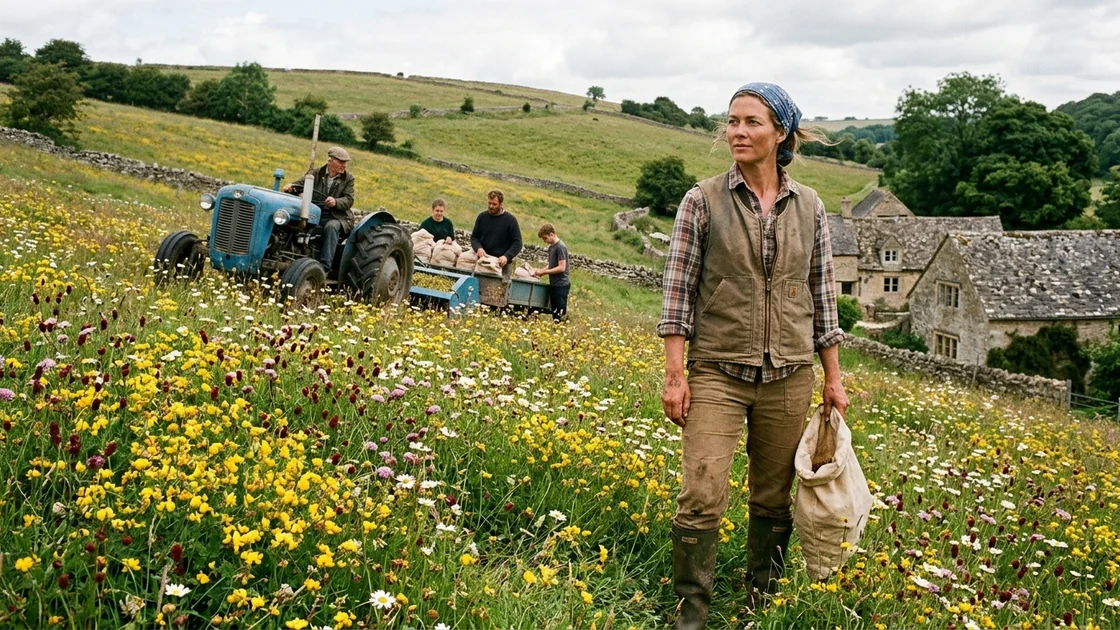
Clara Sterling spent fifteen years climbing the ranks of London corporate law until the sudden death of her eccentric Aunt Iris left her with an ancient stone cottage and twenty acres of failing wildflower meadows in the heart of the Cotswolds. Exchanging bespoke Italian wool suits and eighty-hour billable weeks for rubber boots and weathered ledger books, Clara discovers that her aunt's beloved conservation sanctuary is drowning in debt and targeted by an aggressive land developer. As she fights to save the farm through a mixture of grueling physical labor, botanical science, and ruthless legal acumen, Clara uncovers the quiet rhythms of the English countryside and reclaims a life she had long forgotten how to live.
Chapter One: The Billable Hour
The air on the forty-second floor of the glass tower on Bishopsgate smelled of chilled ozone, recirculated nitrogen, and expensive wool. It was seven o’clock on a Tuesday morning in late March, and Clara Sterling was already three double espressos into a day that promised to last eighteen hours.
Her desk, a vast expanse of polished ebonized oak, held three twenty-seven-inch monitors displaying interlocking drafts of a cross-border acquisition scheme worth seven hundred and eighty million pounds. Clara’s fingers danced across the mechanical keyboard with the rhythm of an automatic weapon. She was thirty-seven years old, a equity partner at Vance, Sterling & Hargreaves, and widely regarded as the most terrifying commercial litigator within two miles of the Bank of England.
Her life was measured in six-minute units. Every phone call, every email, every tactical hesitation before an adversary’s deposition was logged, codified, and monetized. Her apartment in Barbican was an exercise in monastic luxury: concrete, grey linen, chrome, and a refrigerator that contained only sparkling water, cold-brew coffee, and lemons.
Then her desk phone chimed—a low, discreet purr reserved for direct internal transfers.
"Clara," said Julian Vance, the senior managing partner, his voice sounding uncharacteristically thin through the speaker. "Could you step into my office? Bring your coffee."
Clara smoothed the lapels of her bespoke midnight-navy charcoal suit, tucked her tablet beneath her arm, and walked down the carpeted gallery. The glass-walled offices she passed were filled with bleary-eyed associates who tracked her passage with the wary respect granted to a predatory reef shark.
Julian was standing by the panoramic window, his hands clasped behind his back, looking down at the slow-moving grey thread of the River Thames. On his mahogany side table sat a buff-colored envelope tied with green ribbon, looking completely alien against the sleek glass and chrome.
"Sit, Clara," he said gently.
She didn't sit. "If this is about the petrochemical antitrust filing in Brussels, the brief is finalized. We file before noon."
"It isn't about Brussels," Julian said, turning around. He had known Clara since she was a pupil barrister, brilliant and ferocious. "A letter arrived this morning by courier from a firm in Cheltenham. Penhaligon & Sons."
The name stirred a faint, dusty chime in the vaults of Clara’s memory. Cheltenham. Gloucestershire.
"My aunt," she said, her voice dropping half an octave, losing its percussive edge.
"I’m sorry, Clara. Iris passed away on Friday evening. Peacefully, according to the executor. In her garden room."
The silence in the room stretched until Clara could hear the faint, high-frequency whistle of the building's climate system. Iris. Her mother’s younger sister, the woman who had worn emerald silk kimonos while baking soda bread, who had sent Clara envelopes stuffed with dried lavender heads and pressed buttercups during her bar exams, who had laughed down the phone whenever Clara complained about a eighty-hour week and said, The stones don't care how fast you run, darling.
Clara had not seen her in four years. Not since Iris’s seventieth birthday, when Clara had spent half the luncheon on the stone terrace taking calls from a Tokyo private equity syndicate.
"The letter?" Clara asked, gesturing toward the green-ribboned envelope.
"It contains the notice of death, a preliminary summary of the estate, and a personal letter to you," Julian said. "Penhaligon indicates that you are named the sole executor and universal legatee of Highfield Meadow Farm."
"Sole legatee," Clara repeated. "There's no one else. My mother passed five years ago. There are no cousins."
"She left you the land, Clara. All forty acres of it, the house, the barns, and the seed bank." Julian paused, his gaze sympathetic yet analytical. "She also, it seems, left a substantial morass of agricultural liens, deferred tax obligations, and a notice of foreclosure from a regional development syndicate called West-Cotswold Land Holdings."
Clara looked at the envelope. Her hand, which could draft a freezing injunction in forty-five minutes without referencing a textbook, trembled slightly as she took it.
"Take two weeks," Julian said. "We can reassign the Brussels filing to Marcus."
"Marcus will fumble the competition arguments," Clara said automatically.
"Then let him fumble them," Julian countered, his tone hardening into paternal authority. "Go to the country, bury your aunt, sign the deed over to an auctioneer to clear the liens, take whatever residual capital is left, and come back. You look like a ghost, Clara. You haven't taken a Saturday off since the Lehman merger."
Three hours later, Clara was sitting in her silver coupe, driving west along the M40. The grey corporate towers of London yielded gradually to the rolling chalk hills of Oxfordshire, then to the deeper, older, heavier greens of Gloucestershire. Beside her on the passenger seat lay Aunt Iris’s letter, unopened.
Chapter Two: The Valley of Yellow Rattle
The Cotswolds did not welcome Clara with picturesque sunlight. Instead, as she turned off the A40 onto the single-track lanes winding between high hazel hedgerows, a low, wet mist clung to the limestone walls. Bramblecote was a village tucked into an incised combe, its cottages built of oolitic limestone that glowed the color of wet honeycomb in the afternoon drizzle.
Meadowsong Farm sat three miles beyond the village, up a track rutted with deep tractor tracks and choked with wild brambles. As the car’s suspension complained over the stones, Clara caught her first glimpse of the property in nearly a decade.
It was both larger and more ruinous than she remembered. The main farmhouse was a seventeenth-century yeoman’s dwelling with stone-mullioned windows and a steep roof covered in weathered stone slates, mottled with patches of golden lichen. Two large timber barns with corrugated iron roofs stood across a yard of cracked flags where dandelions forced their way through every seam.
Beyond the farmyard, the land rose dramatically in an amphitheater of undulating slopes, hemmed in by ancient, sprawling hedgerows of blackthorn, field maple, and hawthorn. But the meadows were not green lawns; they were wild, tangled, and grey-brown from the winter deadwood, dotted here and there with the pale, tender spears of early spring growth.
Clara parked beside an ancient, blue Massey Ferguson tractor that looked as though it had been holding up a corner of the hay barn since the Suez Crisis. When she turned off the engine, the sudden absence of mechanical sound was almost violent.
There was only the drip of rain from the eaves, the wet rasp of wind through the skeletal branches of an ash tree, and the harsh, rhythmic clatter of a magpie from the dry-stone wall.
She stepped out into the damp air, her thin-soled Italian leather loafers instantly sinking two inches into dark, cold clay.
"Dammit," she muttered, pulling her wool trench coat tight against a wind that carried the sharp, ferrous smell of wet limestone and decomposing leaf litter.
"You won't get far in them dancing shoes, Miss Sterling."
Clara spun around. Standing in the entrance of the larger barn was an elderly man in a faded waxed jacket that smelled powerfully of lanolin, damp straw, and rolling tobacco. His face was a map of deep-cut creases, framed by a shock of white hair that stuck out beneath a battered tweed flat cap. In his hand he held a heavy iron-headed ditching spade.
"Arthur Finch," Clara said, the name surfacing from childhood memories of summer holidays. "You were Aunt Iris’s tenant."
"Was," the old man said, resting his hand on the top of the spade handle. "Now I suppose I'm yours, until the bailiffs come with the red notices."
"No one is coming with bailiffs," Clara said with her customary courtroom chill.
Arthur spat into the mud with practiced nonchalance. "That so? You might want to look at the kitchen table before you start handing out legal guarantees. The tea's cold, but the paperwork is fresh enough."
He turned and shuffled into the shadows of the barn without another word.
Clara took a breath, hoisted her leather overnight bag, and climbed the worn stone steps to the heavy oak front door. The key, left according to instructions under an inverted terracotta flowerpot by the boot scraper, turned in the brass rim lock with a heavy, satisfying clunk.
The interior of the cottage smelled of dried herbs, woodsmoke, old paper, and beeswax. It was warm—Iris had kept the oil-fired Aga burning in the kitchen, a hum of domestic continuity that made Clara’s throat tighten unexpectedly.
The kitchen was long, low, and beamed with blackened oak. Bunches of dried herbs—yarrow, meadowsweet, wild marjoram—hung from iron hooks in the ceiling. On the scrubbed pine table sat a neat stack of cream-colored envelopes, a half-empty tin of Earl Grey, and a glass jar containing a single sprig of budding blackthorn blossom.
Clara set her bag down, pulled out a high-backed Windsor chair, and sat.
She picked up Aunt Iris’s letter, slipped her finger under the wax seal, and unfolded the heavy rag paper.
My dearest Clara,
If you are reading this, I have finally succeeded in becoming compost. Do not mourn me with long faces and black silk; I have had seventy-four years of sunshine, cold cider, and the exquisite joy of watching the bee orchids return to the lower combe.
I leave you the farm because you are the only one who has enough steel in your spine to fight the men with the clipboards. You think you are a creature of the city, my dear, because you have spent fifteen years learning to speak their dead language of clauses and indemnities. But you have my grandmother’s hands—broad across the palm, stubborn at the thumb. You were made for things that grow, even if you’ve buried that under three layers of Savile Row tailoring.
The farm is broke, Clara. I never was much good at the double-entry bookkeeping, and the subsidies were stopped when I refused to spray the field margins with their dreadful chemicals. West-Cotswold Land Holdings has bought up the bank’s debt. They want to turn Highfield into twenty-four executive lodges with manicured lawns and gravel drives. They will scrape away the topsoil that took ten thousand years to form, and with it, the last reservoir of pure unimproved calcareous downland seed in this parish.
Save the seed, Clara. Even if you have to burn the barn to do it.
With all my love and wild expectations,
Iris
Clara lowered the letter. Her eyes stung, but she blinked the sensation away with fierce discipline. She opened the cream-colored envelopes.
The picture they painted was catastrophic.
The mortgage had been assigned to West-Cotswold Land Holdings six months prior. Iris had defaulted on three consecutive quarterly balloon payments of twenty-two thousand pounds each. A final notice of foreclosure lay at the bottom of the stack, giving forty-five days to settle the outstanding balance of two hundred and fourteen thousand pounds, plus costs, before an application for summary possession would be heard at Gloucester County Court.
Clara pulled out her smartphone. There was no signal. Only the pale grey message: No Service.
She let out a short, dry laugh that echoed in the quiet kitchen. "Forty-five days," she whispered to the empty room. "Iris, you absolute lunatic."
Chapter Three: The Herbarium and the Apiarist
The rain stopped toward twilight, replaced by a crystalline cold that turned the puddles in the yard into sheets of blackened glass. Clara had found a pair of Iris’s old green Hunter wellingtons in the scullery; they were two sizes too large, but with three pairs of thick wool walking socks she managed to wedge her feet inside them. She traded her cashmere trench for an oversized canvas barn coat that smelled of damp fleece.
She crossed the farmyard to the smaller outbuilding, which Iris had always called the Seed Loft.
Inside, the atmosphere was markedly different from the damp decay of the hay barn. The air was bone-dry, aromatic, and cold. Floor-to-ceiling wooden racks held hundreds of shallow canvas trays, each meticulously labeled in Iris's looping script: Centaurea nigra (Lesser Knapweed) – Compartment 3, August 2021; Leucanthemum vulgare (Oxeye Daisy) – Church Bank, July 2022; Lotus corniculatus (Bird's-foot Trefoil) – Upper Terrace.
At the back of the room stood an old Victorian winnowing machine, its cast-iron flywheel painted faded vermilion, beside a series of hand-cranked brass sieves used for grading wild seed.
"It’s an heirloom bank," said a voice from the doorway.
Clara turned quickly, her hand instinctively dropping to her phone before she remembered it was useless.
A tall man in his late thirties stood silhouetted against the indigo twilight. He wore a heavy fisherman’s sweater of undyed cream wool, corduroy trousers tucked into scuffed work boots, and carried a galvanized steel honey can in each hand. His hair was dark, curling untidily around his collar, and his eyes, when he stepped into the light of the bare bulb hanging from the rafters, were an inquisitive, sea-glass green.
"You must be Clara," he said. He set the honey cans down with a soft metallic thump. "I’m Giles Thorne. I keep bees on the upper bank. Iris let me use the southern slope in exchange for pollination records and two dozen jars of comb honey every Michaelmas."
"Mr. Thorne," Clara said, her voice snapping back into its polished professional cadences. "I assume you know the legal status of this property?"
Giles smiled faintly, a slow, unhurried expression that Clara found immediately irritating. "I know Iris was about three steps ahead of the bailiffs for five years. And I know you’re the London niece who wins arguments for a living."
"I litigate complex commercial cross-border disputes," she corrected flatly. "I don't 'win arguments.'"
"Same difference, isn't it?" Giles leaned against the frame of the seed rack, looking around with familiar affection. "This room is worth about a quarter of a million pounds to the right people, you know."
Clara stiffened. "The seed?"
"Not as bulk grain, no," Giles said, crossing over and running his long fingers through a tray of dark, teardrop-shaped seeds labeled Rhinanthus minor. "This is Yellow Rattle. It's hemi-parasitic on vigorous grasses. Without it, you can't establish a true species-rich wildflower meadow; the rye and the cocksfoot choke out everything else. Iris spent thirty years collecting and multiplying ecotypes specifically adapted to the thin Cotswold brash—the limestone soil here. Modern commercial wildflower mixes are mostly bred from Dutch or Polish stock. They don't survive three winters on these slopes."
He looked at her directly. "Iris’s seed has ninety-four percent viability on alkaline downland. The National Trust, Natural England, half the private estate restoration projects from here to the Mendips—they all buy from this loft. Or they did, until Iris got too ill to manage the winnowing."
Clara stepped closer to the trays, looking at the tiny seeds. To her, they looked like specks of sand, detritus, dead dust.
"If the business was viable, why was she defaulting on her mortgage?"
"Because you can’t run twenty acres of hand-harvested wild meadow with an eighty-year-old tractor and a seventy-three-year-old woman with failing hips," Giles said softly. "Arthur Finch did what he could, but he's seventy-four himself. Last summer, two of the main harvest windows were washed out by the July rains. The seed dropped before they could get the brush harvester through. She couldn't fulfill the contracts. The bank didn't care about the rain; they just saw the red ink."
"And West-Cotswold Land Holdings bought the note," Clara murmured.
"Run by a man named Gregory Vane," Giles nodded. "Local boy made good in regional shopping centers and out-of-town retail parks. He’s been buying up the hill farms one by one. He doesn't want the soil for farming, Miss Sterling. The combe has planning potential under the new rural leisure development guidelines. Twenty luxury holiday homes, a central clubhouse, an artificial lake where the lower marsh sits. He’s already got three members of the district planning committee in his pocket."
Clara’s mind shifted into gear, the familiar machinery of legal strategy clicking into place behind her eyes. "A private developer cannot simply bulldoze an ancient habitat if it has protective status. Is Highfield an SSSI? A Site of Special Scientific Interest?"
Giles’s expression turned grim. "Iris wouldn't let them designate it."
Clara stared at him in disbelief. "Why on earth not? An SSSI designation would have made development virtually impossible under the Wildlife and Countryside Act."
"Because," Giles said, "she didn't trust the government inspectors any more than she trusted the developers. She said if you let the bureaucrats draw a red line around your fields, they tell you when you can cut, when you can graze, and what you can sow, until your farm becomes an outdoor museum run by people who’ve never held a scythe. She wanted to keep it working land. A farm, not a sanctuary."
"Then she played directly into Vane’s hands," Clara said bitterly. "Without statutory environmental protection, this is just twenty acres of agricultural land with an overdue mortgage and a developer holding the charge."
"Maybe," Giles said, picking up his honey cans. "Or maybe she just figured that when the time came, her niece would find another way to skin the fox."
He walked toward the door, then paused, looking back over his shoulder. "Arthur’s coming up to the yard at six tomorrow morning to service the brush harvester. If you want to see what your aunt actually did with her life, you ought to put some grease on your hands."
Chapter Four: The Ecology of Poverty
Clara slept that night in Iris’s bedroom beneath three heavy wool blankets, listening to the unfamiliar, unsettling absence of traffic. Several times she woke, reaching for her phone to check overseas markets, only to find the cold, dark screen reminding her of her isolation.
At five-thirty, the alarm on her watch chirped. The house was freezing; the Aga had died down to a dull glow, and frost was feathered across the inside of the stone-mullioned bedroom windows.
She dressed in layers: two silk undershirts, a cashmere rollneck, her oldest pair of jeans, and Iris’s oversized barn coat.
When she stepped into the yard, the dawn was breaking through a bank of violet clouds over the eastern ridge. The valley was washed in cold, pale silver. Every stem of dry grass on the hillside was rimmed with hoarfrost, glittering like crushed quartz.
Arthur Finch was already inside the machinery shed, swearing rhythmically at an ancient diesel generator. A single halogen lamp threw stark, yellow light over a bizarre-looking contraption hitched to the back of the tractor: a framework of tubular steel supporting a revolving cylindrical brush made of stiff nylon bristles, suspended above a canvas hopper.
"That’s the brush harvester?" Clara asked, her breath rising in a white plume.
Arthur didn't look up from his socket wrench. "Logic MSP 120. Bought it second-hand off an estate in Wiltshire twenty years ago. It strips the ripe seed heads off the stems without cutting the stalks down. Leaves the shelter for the field mice and the ground-nesting birds."
"Does it work?"
"It works when the pulley don't slip, the brushes don't bind, and the belt don't snap," Arthur grunted. He stood up, wiping his grease-blackened hands on a rag. "Which is about half the time."
"Show me," Clara said.
For the next four hours, Clara received an education that had never been offered at the London School of Economics or Gray’s Inn.
Arthur did not indulge her. He made her climb beneath the tractor to hold a rusted retaining nut with a seventeen-millimeter spanner while he torqued the drive shaft from above, cold oil dripping onto the sleeve of her cashmere sweater. He showed her the differences in the seed collection hoppers, how the fine seeds of the Campanula rotundifolia—the harebell—could escape through the slightest tear in the canvas seam, and how damp seed would spoil in twenty-four hours if it wasn't spread across the drying racks immediately after collection.
"Why does this land matter so much, Arthur?" Clara asked at mid-morning, leaning against the tractor's massive rear tire, her face smudged with carbon and grease. "There are green fields all over England. The whole country looks like a golf course from the train."
Arthur looked at her with pity. He reached down, scooped up a handful of earth from the edge of the track, and held it out to her. It was thin, pale, and full of flat limestone pebbles—what the locals called cornbrash.
"A golf course is rye grass and nitrogen fertilizer, Miss Sterling. Green desert. Nothing lives in it except worms and leatherjackets. To make a lawn, you have to kill everything else."
He pointed his thumb toward the hillside. "That hill hasn't seen an artificial chemical since the Romans were digging stone out of the quarry at the top. It’s starved. That's the secret. Wildflowers don't want rich dirt. You put rich fertilizer on that slope, and the nettles, docks, and rye grass take over in two summers, choking everything out. But you starve it, keep the sheep on it in the winter to graze it down to the bone, pull them off in March, and by June you've got seventy species of herb per square yard. Rock rose, wild thyme, horseshoe vetch, orchids that smell like vanilla. Iris didn't grow flowers because they were pretty; she grew 'em because once they're gone from a valley, you can't just buy a packet of seeds from a garden center and bring 'em back. The soil forgets."
The phrase struck Clara with the force of an injunction: The soil forgets.
She thought of her own life in London—her apartment that looked like an architectural render, her calendar divided into fifteen-minute performance intervals, her acquaintances who disappeared when their deals collapsed. She had spent fifteen years pruning away every variable that could not be quantified, every attachment that did not yield interest. She had sterilized her own soil so thoroughly that nothing could grow there except billable hours.
The sound of a heavy diesel engine crunching up the gravel drive shattered the quiet.
A sleek, metallic-grey Range Rover pulled into the farmyard, its paintwork immaculate despite the mud on the lane. A man stepped out, wearing an expensive tailored tweed field coat that had clearly never seen a day’s manual work, accompanied by a woman carrying a leather-bound folio.
"Clara Sterling," the man said, extending a gloved hand with a broad, practiced smile. "I’m Gregory Vane. We spoke with your firm’s managing partner yesterday. I didn't expect to find you actually... hands-on."
Chapter Five: The Adversary
Clara wiped her grease-stained palm on her canvas coat, ignored Vane’s outstretched glove, and looked him up and down. She knew his type intimately; London was infested with them. Middle-tier capital looking for aristocratic pretensions, smooth-tongued, predatory, and impatient.
"Mr. Vane," she said evenly. "You're trespassing on private property."
"Hardly trespassing," Vane said, his smile remaining fixed. "As the holder of the senior charge on Highfield Meadow Farm, I have a statutory right of inspection under Section 103 of the Law of Property Act. This is my development director, Miss Albright."
The woman nodded curtly.
"You have a right of inspection upon seven days' written notice to the resident occupier," Clara replied without missing a beat. "You served notice to Aunt Iris two months ago, but that notice lapsed upon her demise. Under Section 109, you must issue a fresh notice to the executor. I am the executor. You haven't served me. You have thirty seconds to return to your vehicle before I call the constabulary in Stow-on-the-Wold and report an aggravated trespass under the Criminal Justice and Public Order Act."
Vane’s smile tightened at the edges. "Always the barrister, Miss Sterling. Your reputation precedes you. But let’s be practical. Your aunt was a sentimentalist, but you’re a commercial realist. The farm owes my company two hundred and fourteen thousand pounds. The interest is compounding at nine point five percent above base. Every day you sit here holding an oily wrench, that number swells."
"The redemption period has forty-three days remaining," Clara said.
"And where will you get two hundred thousand pounds in forty-three days?" Vane stepped closer, lowering his voice to a tone of confiding intimacy. "The seed loft is an obsolete curiosity. The house needs sixty thousand pounds of structural underpinning—the south wall is settling into the combe. Even if you sold the land at agricultural auction tomorrow, you wouldn't clear the charge after the back taxes are settled."
He gestured to Miss Albright, who opened the folio and extracted a document.
"This is an offer of purchase by private treaty," Vane said. "Three hundred and fifty thousand pounds. That clears the debt in full, pays off the outstanding estate taxes, and leaves you with a clean ninety thousand pounds in cash. No court hearings, no public auctions, no mess. You can sign the memorandum of understanding right now, get back into your sports car, and be back in your office in London by dinner."
Clara looked at the document. It was a standard, predatory distress-purchase contract. At the bottom was a blank line for her signature.
She looked past Vane, toward the upper slopes of the meadow. The mist was clearing now, revealing the immense, curving bowl of the land. High up on the crest, a solitary pair of red kites wheeled against the pale blue sky, their notched tails tilting as they caught the thermal draft.
She remembered Iris’s letter: Save the seed, Clara. Even if you have to burn the barn to do it.
"Your offer is rejected, Mr. Vane," Clara said, her voice dropping into the quiet, lethal register she used when she was about to dismantle an opposing expert witness.
Vane frowned. "Miss Sterling, don't let sentimentality cloud your financial judgment. You have no cards to play."
"I have forty-three days," Clara said. "Now, take your shiny car and your derivative contract off my property. If I see this vehicle on Highfield land again without twenty-four hours' prior judicial leave, I will obtain an ex-parte injunction against you personally in the High Court, and I will ensure that the costs of that application are charged against your legal counsel. Have a pleasant drive back to Cheltenham."
Vane’s face darkened, the veneer of regional charm vanishing entirely. "You're out of your depth, Clara. This isn't the Commercial Court in the Strand. This is Gloucestershire. The district council has already designated this valley as a priority tourism development zone in their preliminary local plan. When the forty-three days are up, I won't offer you three hundred and fifty thousand. I’ll buy it on the courthouse steps for the value of the charge, and you’ll walk away with nothing."
He turned on his heel, slammed the Range Rover’s door, and reversed down the muddy track with an angry spray of gravel.
Arthur Finch stepped out from behind the brush harvester, holding his ditching spade. He spat into the dirt once more.
"Well," he said. "You've got Iris's tongue, right enough. Now what the devil are we going to do about the two hundred thousand quid?"
Chapter Six: The Botany of Hope
Clara did not return to London that evening. Instead, she took her laptop into the kitchen, set it beside the warm Aga, and plugged it into a mobile hotspot device she had rigged near the attic skylight, where she had found a single, fragile bar of cellular data.
First, she sent a brief, uncompromising email to Julian Vance: Personal leave extended by thirty days. Distribute the petrochemical brief to Hargreaves. I am not available for consultation.
Then she opened three windows on her screen: the Land Registry portal, the Cotswold District Council planning portal, and the financial accounts of Highfield Meadow Farm for the past seven years.
By midnight, Giles Thorne had joined her. He had brought two large jars of amber honey, a loaf of dark sourdough bread, and a stack of Iris’s personal field notebooks dating back to 1988.
"If we want to raise capital quickly," Clara said, pointing her pen at the ledger, "we have to look at the inventory. Giles, what is the actual commercial value of the seed currently in the loft?"
Giles spread out an inventory sheet. "About thirty thousand pounds' worth of dry-stored meadow mix from two years ago. It’s clean, it’s tested, and it's ready for sale. But nobody buys seed in March for immediate planting; the sowing season for calcareous meadow is late summer and autumn, August to October. In spring, people only buy small quantities for overseeding."
"What about specialized contracts?" Clara leaned forward. "Look at this ledger from three years ago. There’s an entry for fifty thousand pounds from the 'Highways and Infrastructure Agency.'"
"The A417 bypass project," Giles explained, buttering a slice of bread. "They needed thirty miles of road verge hydro-seeded with native species to meet their environmental mitigation targets. Iris had the only seed stock within fifty miles that met the genetic provenance criteria."
"Provenance criteria?"
"Under Natural England rules, if you're restoring a public site or mitigating a major infrastructure project, you can't just throw down generic wildflower seed. It has to come from the same National Character Area—the same geographic and geological sub-region. Seed from the Cotswolds has adapted to our specific rainfall and limestone brash for eight thousand years. Highfield is the primary 'donor site' for Character Area 107."
Clara’s eyes lit up. The lawyer had found her statute.
"So anyone building a road, a pipeline, or a major development within this seventy-mile zone must use this specific seed provenance to satisfy their environmental impact assessments?"
"In theory, yes," Giles said. "If the local planning authority enforces the condition. But developers usually apply for a variance. They claim local seed isn't commercially available in sufficient quantity, so they get permission to substitute cheap commercial rye mixes with five percent cornflower thrown in for color."
"Because Iris wasn't there to supply it," Clara said, her mind racing. "Or because Vane and his allies on the council made sure the developers were granted variances."
She grabbed Iris’s field notebook from 2019. Iris had written: March 14 – Surveyed combe slopes. First basal leaves of Orchis simia (Monkey Orchid) showing on Compartment 4. Must ensure the sheep stay off until July.
Clara looked at Giles. "The Monkey Orchid. Is it rare?"
Giles stared at her. "Rare? Miss Sterling, there are only three known colonies of Orchis simia in the entire south of England. Highfield has the second largest. Iris discovered it fifteen years ago."
"Why isn't it registered?" Clara demanded, her voice rising in frustration. "Why wasn't an interim protection order slapped on this valley the second she found it?"
Giles looked down at his tea. "Because the last time someone found a rare orchid colony in this county, fifty botanical tourists trampled the entire bank to dust trying to photograph it, and two weeks later someone came in the middle of the night with a trowel and dug the tubers up to sell on the European black market. Iris kept it secret. Only Arthur, me, and Iris knew."
"And Gregory Vane?"
"Vane doesn't know an orchid from an onion," Giles said. "All he sees is sixteen acres of prime hillside with a view of the Malvern Hills, perfect for eight-hundred-thousand-pound weekend homes."
Clara closed the notebook with a sharp snap. "Tomorrow morning, Giles, you and I are going up that hill. And then I’m going to have a very interesting conversation with the District Planning Officer."
Chapter Seven: The Scarification
Before she could fight the council, Clara had to learn to work the ground.
Spring in the Cotswolds does not arrive with a gentle whisper; it arrives in fits and starts, days of blinding, pale sunlight followed by nights of vicious frost and biting sleet. For three weeks, Clara did not look at a legal brief. Her hands, once smoothed with almond-oil lotions and manicured to perfection, became rough, calloused, and stained with dirt that no amount of scrubbing could fully dislodge from around her fingernails.
Her expensive wardrobe remained hanging in Iris’s wardrobe, untouched. She lived in thick corduroy trousers, flannel shirts, and an oiled canvas smock she had found in the scullery.
Her alarm rang at five every morning.
First came the feeding: three aging Jacob sheep that Iris had kept as living lawnmowers to crop the winter grass down to the roots. Clara learned to haul forty-pound bales of hay on a pitchfork without straining her lower back, to check the water troughs for ice, and to identify the sour, dangerous smell of hoof rot.
Then came the mechanical purgatory.
Arthur Finch had decided that if Clara was going to stay, she would not be a passenger. Together, they took the brush harvester apart in the freezing barn, cleaning every nylon bristle, replacing four worn bearings with parts Arthur had bartered from a blacksmith in Moreton-in-Marsh, and re-tensioning the massive drive belts.
"You're not as soft as you look, Miss Sterling," Arthur remarked one afternoon, watching her use an iron lever to force a tensioner pulley into alignment while grease dripped down her cheek.
"I spent twelve years surviving partners’ meetings at Vance, Sterling & Hargreaves, Arthur," Clara grunted, straining against the steel bar until her knuckles turned white. "Compared to a corporate restructuring committee, this tractor is remarkably honest. If you hit it with a hammer, it actually reacts."
Arthur chuckled, a sound like gravel sliding down a chute. "Aye. Machinery don't lie. Neither does the soil. You cheat a field, it gives you docks and thistle. You give it what it wants, it feeds you."
In the second week of April, Giles arrived with his seed drill.
"We need to scarify the lower pasture," he announced. "Iris left five acres that were overrun by cock’s-foot grass last year. If we don't open up the turf, the Yellow Rattle seed we have in the loft won't make contact with the soil, and the grass will kill off the orchids by June."
Clara rode on the back of the small Massey Ferguson, standing on the footplate of the chain harrow as it rattled across the stony slope. The iron tines tore through the dense green thatch of grass, gouging grooves into the thin earth, exposing the pale, crumbly limestone beneath.
The wind screamed across the combe, bitter and smelling of snow from the Welsh mountains to the west. Clara’s ears burned with the cold; her boots were crusted with three inches of clay. Yet as she looked back down the slope at the scored earth, ready to receive the seed, she felt an unfamiliar, electric clarity.
In London, her work had been vapor. She had moved millions of pounds between accounts that existed only as glowing pixels on servers in Zurich and Delaware; she had dissolved companies that had never produced a physical object; she had settled arguments between men who cared only about the trailing decimal points on their bonus pool. At the end of a seventy-hour week, nothing existed to prove she had lived through it except an entry on a billing sheet and an exhausted headache that three martinis couldn't cure.
Here, she could look back and see the furrow. She could see where the ground had been choked, and where it was now open to the sky.
In the afternoons, Giles taught her the seed loft.
They stood side-by-side at the wooden grading tables, the windows open to let the crisp air carry away the chaff. They passed the harvested material through copper-mesh sieves of increasing fineness, separating the black, round pellets of wild vetch from the feathered darts of the knapweed and the microscopic, golden dust of the cowslips.
"Listen," Giles said one afternoon, holding up a handful of Rhinanthus pods that had dried on the stem over winter.
He shook his hand. A dry, miniature rattling sound filled the quiet room—like fifty tiny castanets.
"The old farmers called it the Haymaker’s Rattle," Giles said. "When the seed rattles in the pod, the hay is ready to cut. It’s the clock of the meadow."
Clara held out her hand, and Giles poured the seed into her palm. It felt weightless, cool, and dry.
"How many plants in here?" she asked softly.
"In that handful? Three hundred. If half of them take, they’ll suppress two hundred square feet of aggressive grass and allow forty species of wildflower to breathe. It’s an ecological lever. Small thing, huge fulcrum."
Clara looked up from her hand. Giles was standing close to her, the pale spring light catching the lines around his eyes. He didn't move away, and for a long moment, the only sound in the loft was the gentle rustle of the seed trays as the wind stirred through the eaves.
"Clara," he said gently. "Vane’s planning application goes before the district sub-committee on Thursday. He’s applied for an accelerated certificate of development."
The spell broke. Clara stepped back, her eyes hardening once more into the litigator's focus.
"Then Thursday is when we drop the hammer," she said.
Chapter Eight: The Tithe Map and the Law
Clara did not attend the planning committee meeting in her muddy corduroys.
On Thursday morning, she dressed with deliberate, theatrical precision. She put on her bespoke charcoal suit, her crisp white silk shirt, and her black leather pumps. She pulled her hair back into an immaculate, razor-sharp chignon. She applied her lipstick—a decisive, boardroom red—and picked up her black leather briefcase.
When she walked down the stone stairs, Arthur Finch was waiting in the kitchen, holding a mug of tea. He took one look at her and slowly shook his head.
"Lord help 'em," the old man muttered. "The shark's got her teeth back."
"This isn't about teeth, Arthur," Clara said, checking the documents in her case. "This is about statutory interpretation. The most dangerous weapon in England isn't a tractor or a shotgun; it's a junior minister's poorly drafted administrative circular."
Giles drove her to the Cotswold District Council offices in Cirencester in his battered Land Rover.
The committee room was packed. It was a classic scene of English rural governance: six local councilors sitting behind a horseshoe-shaped laminate desk, looking bored and slightly defensive; a dozen local residents in waxed jackets murmuring in the public gallery; and Gregory Vane, flanked by two junior solicitors from a regional commercial firm and an architect with an expensive foam-board model of the proposed development.
The model showed "Highfield Luxury Eco-Resort": twenty glass-fronted timber pavilions surrounding a turquoise ornamental pond, with tennis courts, a gravel helicopter pad, and rolling lawns where the species-rich combe currently lay.
"Agenda Item Four," the committee chairman announced, glancing at his watch. "Application CD/4092/B. Outline planning permission for change of use from agricultural land to holiday accommodation and leisure facility, Highfield Meadow Farm, Bramblecote."
Vane’s solicitor stood up. He gave a slick, ten-minute presentation emphasizing "rural economic diversification," "sustainable timber construction," and the creation of fourteen seasonal jobs in the hospitality sector. He presented letters of support from three local business associations and concluded by noting that the agricultural holding was "demonstrably non-viable," burdened with irrecoverable private debt, and characterized by "degraded pasture."
The chairman nodded. "Thank you, Mr. Prendergast. Are there any registered objectors wishing to address the committee?"
Clara stood up.
The heels of her shoes clicked with crisp authority against the linoleum floor as she walked to the presentation podium. She didn't look at Vane, who was watching her from the front row with a smug, dismissive smile.
"My name is Clara Sterling," she said, her voice filling the room effortlessly without the aid of the microphone. "I am a partner at Vance, Sterling & Hargreaves, London. I appear today as the owner and executor of the estate of Highfield Meadow Farm."
The committee chairman blinked, suddenly sitting up straighter. The name of her firm was legendary in administrative law circles; it was the firm that had recently taken the Department of Transport to the Supreme Court over airport expansion and won forty million pounds in costs.
"Miss Sterling," the chairman said, clearing his throat nervously. "We... ah... understand this is an emotional time, following your aunt's passing. But the committee must focus strictly on material planning considerations."
"I am delighted to hear it, Mr. Chairman," Clara said, opening her briefcase and extracting six identical, blue-bound bundles of documents. "Because material planning considerations are all I have brought you."
She handed the bundles to the committee clerk, who distributed them to the councilors.
"Tab One," Clara commanded, her tone that of a High Court judge instructing a room of slow-witted pupils. "You have before you an extract from the Enclosure Award of 1794 for the Parish of Bramblecote. You will observe that Compartments Three through Six of Highfield Farm were not enclosed by private treaty, but were established under an ancient parochial trust as 'Common Herbary and Turbary' for the collection of medicinal simples and winter fodder by the cottagers."
Vane’s solicitor jumped to his feet. "Mr. Chairman, this is completely obsolete! The Law of Property Act 1925 extinguished all such archaic rights unless specifically registered under the Commons Registration Act 1965!"
"A brilliant point, Mr. Prendergast," Clara said, not even turning around to face him. "Which brings us directly to Tab Two. The Commons Registration Act of 1965, Register of Common Land, Entry Number CL-412. Registered by my great-grandfather, Edward Sterling, on October twelfth, 1967. The common rights were never extinguished; they were simply held in dormancy under the stewardship of the primary holding."
She paused, letting the silence settle over the room. The councilors were frantically thumbing through the parchment reproductions in their binders.
"What this means in law, gentlemen," Clara continued smoothly, "is that this council has zero statutory authority to grant outline planning permission for permanent structures on this land. Any such grant would be ultra vires—beyond your legal powers—and subject to an immediate application for Judicial Review in the Administrative Court in London. I have already drafted the claim form. It names each member of this planning sub-committee in their personal capacity for misfeasance in public office should you act in knowing breach of the registered commons restriction."
Two of the councilors blanched and pushed their chairs back from the table as though the planning application had caught fire.
"Furthermore," Clara said, turning the page, "Tab Three contains an interim biological survey completed forty-eight hours ago by the Botanical Society of Britain and Ireland. It confirms the presence of eighty-four mature, flowering specimens of Orchis simia—the Monkey Orchid—on the southern combe. Under Schedule 8 of the Wildlife and Countryside Act 1981, it is a criminal offense to intentionally pick, uproot, or destroy any plant listed on that schedule."
She turned her gaze directly upon Gregory Vane. Her eyes were as cold and sharp as polished flint.
"An offense punishable, Mr. Vane, not by a civil fine, but by an unlimited statutory penalty and up to six months' imprisonment for every individual director of a corporate entity that authorizes such destruction. I have already served notice of these findings upon Natural England. A team of crown biological inspectors is arriving at Highfield at nine o'clock tomorrow morning to begin formal designation proceedings for a Site of Special Scientific Interest."
The public gallery erupted into an undignified cheer led by three elderly women in quilted jackets.
Vane was on his feet, his face the color of a bruised plum. "This is an ambush! This planning application was submitted three months ago!"
"Then you should have hired better lawyers, Mr. Vane," Clara said, closing her briefcase with a clean, definitive snap. "Mr. Chairman, I move that this application be dismissed with prejudice."
The chairman looked at his council's legal advisor, who gave him a terrified, frantic nod.
"Application... application CD/4092/B is hereby refused," the chairman stammered. "On... on statutory conservation grounds."
Chapter Nine: The Seed Contract
The victory in the council chamber was magnificent, but as Giles drove the Land Rover back along the winding lanes toward Bramblecote, Clara felt no elation.
She sat with her head resting against the passenger window, looking at the stone walls blurring past.
"You took his skin off," Giles said, a wide grin spreading across his face. "Did you see Prendergast’s hands shaking? He looked like he was about to wet his trousers."
"The planning refusal stops him from building," Clara said quietly. "It doesn't pay the debt, Giles. The foreclosure notice is entirely separate from planning permission. Vane still holds the mortgage charge. He has twenty days left before he can take possession of the land through the county court. He can't build luxury chalets, but he can still seize the farm, evict Arthur, clear the seed loft, and sell the whole place to an institutional forestry fund to be planted with monoculture sitka spruce."
Giles fell silent. The Land Rover rumbled up the long, rutted drive to Highfield.
When they entered the kitchen, the smell of fresh coffee greeted them. Sitting at the scrubbed pine table, looking utterly out of place in a bespoke three-piece charcoal suit and silk pocket square, was Julian Vance.
Clara stopped in the doorway. "Julian?"
The senior managing partner looked up from Iris’s field notebook, which he had been browsing with genuine curiosity. He set his porcelain cup down.
"You don't return your telephone calls, Clara," Julian said mildly. "Marcus had to fly to Brussels himself. He surrendered three critical concessions on the petrochemical merger within fifteen minutes of sitting down with the European Commission. It cost our client twelve million Euros."
"I told you I was on leave," Clara said, stepping into the room.
"Yes. You did." Julian stood up. He walked over to the window, looking out at the sweeping amphitheater of the combe where the afternoon sun was beginning to break through the cloud cover. "A remarkable place, Clara. Your aunt was quite extraordinary. When I was a young pupil, she once sent a box of fresh field mint to the Lord Chief Justice during a particularly dry maritime insurance trial, with a note saying his courtroom smelled like an unventilated crypt."
He turned back to face her. "I had a visit yesterday from the general counsel of the National Infrastructure Bank. It seems they are overseeing the ecological restoration budget for the new Great Western Rail electrification corridor. Three hundred miles of railway cuttings and embankments between Paddington and Swansea."
Clara’s heart gave a sudden, hard thud against her ribs.
"They have a statutory legal mandate," Julian continued, "under the new Environment Act, to source eighty metric tons of native limestone grassland seed of certified local provenance. They had reserved forty percent of their procurement budget for a supplier in Oxfordshire, but that supplier’s crop failed due to root rot."
Julian picked up his leather attaché case from the floor, set it on the table, and opened it. He pulled out a heavy document bound in blue ribbon—the hallmark of Vance, Sterling & Hargreaves’ commercial contracts department.
"They need a supplier who can provide ten tons of certified Bromopsis erecta and Rhinanthus minor mix by September, with options for the subsequent four years. The contract value is four hundred and fifty thousand pounds, payable fifty percent upon execution of the master agreement, twenty-five percent upon inspection of the seed bank, and the balance upon delivery."
Julian looked at Clara over his tortoiseshell glasses. "I told them our firm represented the premier wild seed conservation estate in the west of England. I drafted the supply agreement myself. All it requires is the signature of the managing director of Highfield Meadow Seed Limited."
Clara looked at the document. Then she looked at Giles, who was standing in the scullery doorway, his mouth slightly open.
"Julian," Clara said, her voice catching. "The seed loft currently has inventory worth about thirty thousand. To fulfill a contract of that size, we would have to harvest every square yard of this combe, restore the Victorian winnowing plant, and contract every registered brush harvester within thirty miles."
"Can you do it?" Julian asked.
Clara looked through the kitchen window.
Out in the yard, Arthur Finch was sitting on the tongue of the blue tractor, smoking a cigarette in the afternoon sun. Above him, on the stone crest of the hill, the ancient limestone meadows were beginning to turn from winter grey to the first, soft, shimmering green of mid-April. In three months, the combe would be an explosion of purple, gold, and white—a living carpet that had survived three ice ages, Roman quarries, and medieval enclosure.
She looked at her hands. The grease had worked its way into the whorls of her fingerprints; the skin of her palms was hard and tough.
"Yes," Clara said. "We can do it."
Julian smiled. He slid the fountain pen across the scrubbed pine table. "Then sign the brief, Clara. And then you and I need to have a conversation about your partnership status."
Chapter Ten: The Resignation
Clara did not sign the contract immediately. She picked up the pen, held it above the parchment, and looked at Julian Vance.
"I’m not coming back, Julian," she said.
The silence that followed was different from the silence of the forty-second floor on Bishopsgate. It was warm, full of the low murmur of the Aga and the soft, rhythmic ticking of the longcase clock in the corner.
Julian didn't look surprised. He sighed, reached into his waistcoat pocket, and pulled out an antique silver pocket watch. He checked the time, then closed it with a soft click.
"I knew it the moment I walked into your yard, Clara," he said softly. "You look... awake. For fifteen years, you’ve been the most efficient machine I’ve ever seen. But machines don't care about anything. They just execute code until their bearings burn out."
"I was good at it," she said.
"You were magnificent at it," Julian agreed. "You made the firm twelve million pounds last year alone. But you were also slowly turning into a piece of office furniture. If you stay in the City another five years, you’ll have a townhouse in Belgravia, an art collection you don't have time to look at, and a coronary bypass before you’re forty-five."
He leaned forward, his expression softening into an affectionate sadness. "Your aunt Iris wrote to me, you know. Two months before she died."
Clara stared at him. "She wrote to you?"
"She told me that she was leaving you a financial and ecological catastrophe," Julian said, his eyes crinkling at the corners. "And she asked me to ensure that when you came down here to clean it up, I didn't let you run away back to the office before the soil had a chance to work on you. She said, 'Julian, the girl has an engine that can pull a train, but she's spent her life driving it around in a circle. Give her a hill to climb.'"
Clara felt a single, hot tear escape and track down her cheek. She didn't wipe it away.
"I need an of-counsel arrangement," she said, her voice regaining its steady, analytical clarity. "I won't manage deals anymore. But I will handle environmental litigation, planning inquiries, and agricultural land disputes from here. Twenty hours a month. No more."
"Ten," Julian countered with a thin smile. "And you provide the firm’s boardroom with twenty jars of Iris’s honey every Christmas."
"Done," Clara said.
She pressed the fountain pen to the parchment and signed her name with a flourish: Clara Sterling, Managing Director, Highfield Meadow Seed Conservation Ltd.
Julian stood, took the signed document, and slid it into his briefcase. He extended his hand, and this time Clara took it—a firm, dry grip between two people who understood each other perfectly.
"Good luck, Clara," he said. "Don't let Arthur Finch drive that tractor into the pond."
Chapter Eleven: The Midsummer Harvest
Three months later, Highfield Meadow Farm was transformed.
The summer of that year broke records for sunshine, but unlike the parched, dead-yellow lawns of the suburban gardens in Cheltenham, the combe of Highfield was a riot of layered, living color.
In mid-July, Clara stood at the crest of the hill, leaning on a hazel walking stick.
The valley below her was an impressionist masterpiece. The lower slopes were an undulating sea of golden-yellow bird's-foot trefoil and yellow rattle, punctured by the deep, wine-red pom-poms of great burnet and the dazzling white discs of thousands of oxeye daisies. Higher up the slope, where the limestone brash was thinnest, the ground was a haze of mauve field scabious and wild marjoram, humming with a sound so loud it was audible from a quarter of a mile away.
It was the bees.
Giles had expanded his apiary to thirty hives, and the air was thick with the droning, industrious vibration of two million pollinators working the calcareous flowers. In the air above, common blue butterflies fluttered through the grasses like flakes of falling sky, their larvae feeding on the abundant horseshoe vetch that covered the rocky outcrops.
Beside Clara, the old Massey Ferguson tractor was idling with a low, rhythmic thrum. Arthur Finch sat at the wheel, his cap pulled low over his eyes, watching the revolving nylon brush of the Logic harvester as it skimmed across the tops of the flower heads.
The brush did not cut; it caressed. As it spun, it gently whipped the dry, ripe seeds out of their pods, flinging a golden-brown cloud of seed into the canvas hopper while leaving the green stems, the leaves, and the resting insects entirely untouched.
Behind the tractor walked four young people—botany students from the University of Reading whom Clara had hired for the summer harvest, paid twice the agricultural minimum wage from the mobilization funds of the National Rail contract. They carried shallow canvas sacks, carefully emptying the hopper as it filled and carrying the raw seed down to the yard.
In the seed loft, the old Victorian winnowing machine was clattering steadily. Giles stood at the hopper, feeding the raw chaff through the air blast, while the brass sieves shook back and forth with a rhythmic, hypnotic rattle.
Clara walked down the slope, her boots moving easily over the uneven ground. She didn't look like a London partner anymore. Her skin was a deep, sun-cured bronze; her arms were corded with functional muscle from hauling seed sacks and turning compost; her hair was tied back with a blue handkerchief.
She entered the cool, aromatic darkness of the barn.
"Purity test on Compartment Two," Giles called out over the rattle of the winnower. He held up a small glass petri dish containing a sample of the cleaned seed.
Clara took the dish, set it beneath an inspection lamp, and pulled out a brass-rimmed magnifying glass. She examined the sample with the same ferocious, microscopic attention to detail she had once applied to twenty-million-pound indemnity clauses.
"Purity is ninety-eight point two percent," she said, looking up with a wide, bright grin. "Inert chaff is less than one point five percent. Weed seeds: nil. We beat the contract specification by nearly four percent."
Giles turned off the winnower’s electric motor. The machine wound down with a long, musical hum, until the barn was quiet once again, filled only with the smell of dried grass, mint, and sunshine.
He wiped his brow with the back of his hand, looked at her, and smiled. "That means the first shipment of four tons is ready for the inspection team on Monday."
"And the second installment of one hundred and twelve thousand pounds hits the farm account on Wednesday," Clara said. "The bank debt is cleared, Giles. The mortgage is redeemed. The deeds are in the safe upstairs, unencumbered."
Giles leaned against the grading bench, looking at her with an expression that made the breath catch in her throat. "So you won your argument, Miss Sterling."
"We won the brief, Mr. Thorne," she corrected softly, stepping closer to him. "There's a difference."
"And what happens now?" he asked, his voice low in the quiet barn. "The harvest finishes in three weeks. The rail contract will run for four years, but it doesn't need eighty hours a week of legal fire-breathing. What does Clara Sterling do when there are no more developers to terrify?"
Clara looked through the open double doors of the barn.
Across the yard, Arthur Finch was helping one of the Reading students adjust the tension on the seed elevator, his weathered face patient and animated as he explained the craft. Beyond them, the slopes of Highfield rose toward the summer sky, alive with seven thousand species of plant, insect, and bird, safe within a web of common law covenants, statutory protections, and loving labor that no developer could ever unravel.
She looked down at her hands, broad across the palm, stubborn at the thumb, covered in the pale, fine dust of the wild meadow seeds.
She reached out and took Giles’s hand, lacing her fingers through his.
"Now," Clara said, "we prepare the ground for the autumn sowing."