The White Orchid of Asteris
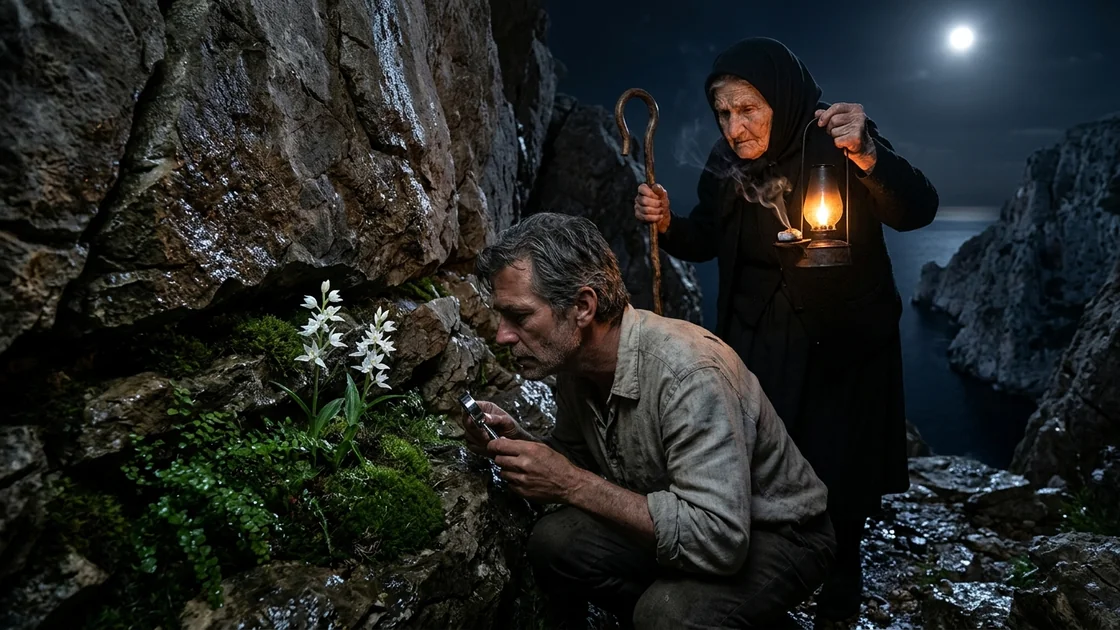
Dr. Julian Scott, an English botanist grieving the untimely death of his wife, journeys to the rugged and windswept Greek island of Asteris in pursuit of a near-mythical nocturnal orchid known to bloom only once a year on isolated limestone cliffs. Sheltered in the crumbling mountain village of Pyrgos, Julian finds an unexpected companion and guide in Kyria Calliope, a ninety-six-year-old matriarch who has outlived empires, wars, and her own children. Through their quiet days among the wild herbs, sun-bleached crags, and long-held silences of the Aegean, Julian is forced to confront the limits of his empirical science and the stubborn endurance of grief, ultimately discovering that what is buried in the dark can still offer life to the living.
Chapter I: The Ash and the Salt
The ferry from Piraeus did not so much arrive at Asteris as abandon its passengers to the swell.
Julian Scott stood by the rusted railing on the lower deck, his hands gripped around the salt-pitted ironwork until his knuckles shone white beneath the skin. The boat, an ancient roll-on roll-off vessel named the Agios Nektarios, heaved with a low, metal groan as it churned against the surge of the southern Aegean. Julian was fifty-one, though for the past fourteen months he had felt entirely uncoupled from any calendar that measured human vitality. His tweed jacket, entirely inappropriate for the Mediterranean summer, was limp with salt spray; his shoulders carried a stoop that had begun in hospital corridors in Edinburgh and had hardened into permanent posture.
Ahead, Asteris rose out of the cobalt water like a molar yanked from a giant’s jaw. It was not one of the painted postcards of the Cyclades with their sugar-cube houses and blue-domed basilicas. Asteris belonged to the Dodecanese archipelago’s barren fringe—a mass of tilted grey limestone, scarred by old fault lines, covered in a scrub of spine-heavy phrygana that smelled, even miles out to sea, of dry sage, asphalt, and goats. The sun was slipping westward, casting shadows the color of bruised plums across the eastern precipices.
In his breast pocket, pressed flat against his ribs, was the canvas-bound field journal that had belonged to his late wife, Helen.
"Look for the shade in the scar," Helen had written in pencil seven years ago, transcribing an entry from an obscure 1894 monograph by the Austrian naturalist Theodor von Heldreich. "The plant relies on an obligate mycorrhizal association unique to the fissures of the high karst. Local name: To Asteri tis Nychtas. The Star of the Night. If Heldreich was not hallucinating in the midsummer heat, it is a terrestrial orchid of the genus Cephalanthera, perhaps a relict species spared by the last glaciation, adapted entirely to the dark."
Helen had never reached Asteris. Her life had closed around a series of sterile rooms, IV stands, and the terrible, gradual dimming of a mind that had once known every lichen from Caithness to Crete. When the funeral had receded and the condolence letters had piled up like dead leaves in the hall of their drafty stone house in East Lothian, Julian had looked at his Herbarium cases at the Royal Botanic Garden and realized he could no longer bear the sight of pressed, dead flowers. If he were to continue drawing breath, he had to see something that was still alive and hidden where nothing had any right to survive.
The ferry lowered its ramp with a concussive clang against the concrete pier of the harbor, a settlement named Skala that consisted of little more than six shuttered tavernas, three yellow fishing caïques rocking nervously against tire bumpers, and a lone diesel pump.
A young man with sun-darkened skin and hair like black sheep’s wool approached him as Julian shouldered his rucksack and lifted his aluminum field cases.
"You the Englishman?" the young man asked in heavily accented, sharp English. "The teacher?"
"Dr. Scott," Julian said, clearing his throat of salt dust. "Julian Scott. You must be Michalis."
"I am Michalis," the boy said, taking the heavier of the cases without asking. "My uncle sent me with the truck. But the truck does not go to Pyrgos. Only to the saddle. From the saddle, you walk, or you take the mule. My uncle says you have too many metal boxes for a mule."
"I can carry what is necessary," Julian said. "The rest can remain in the harbor if there is a dry shed."
Michalis looked at Julian’s scuffed leather walking boots, his thin wrists, the dark hollows below his eyes where sleeplessness had made its home. The boy spit tobacco juice onto the hot concrete. "There is no dry shed, Kirie. On Asteris, everything is either wet with salt or burning with the sun. Put the boxes in the bed of the Datsun. We go before the wind climbs."
The Datsun was held together by rusted welds, wire, and sheer prayer. They ground up the coastal switchbacks in first gear, the radiator screaming as the sea fell away below them, flattening into a vast sheet of beaten brass under the dying sun. The scrub gave way to sheer scree. There were no trees here, only stunted junipers that clung to the crevices of the cliffs, twisted by centuries of the Meltemi into agonizing, crouching shapes.
"Nobody goes to Pyrgos now," Michalis shouted over the roar of the exhaust. "Only three old ones left. And Kyria Calliope."
"Kyria Calliope?" Julian asked, his voice snatched by the wind whistling through the missing passenger window.
"Glynos," Michalis said, crossing himself quickly with his right thumb while his left hand wrestled the steering wheel around a hairpin turn that hung out over a thousand-foot drop. "The old mother. She is older than the road. She was old when the Germans came. She was old when the Italians came. My mother says she was born before the Greeks knew the island was Greece. If you stay in her house, you listen to her. You do not touch the icon in the corner, and you do not leave the door open at night. The wind takes everything."
"I am only renting the storeroom," Julian said. "The university arranged it through the council in Rhodes."
"The council in Rhodes knows nothing about Pyrgos," Michalis barked with a laugh. "The council sits in an office with air conditioning and drinks iced coffee. Pyrgos belongs to Calliope."
They reached the saddle—a bleak, wind-scoured gap between two grey peaks where the dirt road simply dissolved into a goat path of shattered limestone. Michalis cut the engine. The silence that rushed in was absolute, save for the rhythmic, dry rattling of dried thistle stalks and the far-off, hollow chime of a single bronze bell tied around the neck of a stray goat.
Julian stepped down into the dust. The air here was ten degrees cooler than at the port, smelling acutely of mountain savory, honey, and the cold minerals of stones that had baked for twelve hours and were now surrendering their heat to the evening sky.
Across the valley, clinging to an amphitheater of grey rock like a cluster of barnacles, was Pyrgos. It was a settlement built of dry stone, unwhitewashed, indistinguishable from the mountain itself except for the square geometry of its lintels and the dark gaps of empty doorways where roofs had long since fallen in.
"Two kilometers," Michalis said, setting Julian’s bags down upon a flat boulder. "Follow the red paint on the rocks. I come back in three weeks. If you die of the heat, make sure you die near the path so we do not have to carry you out of the ravine."
Before Julian could answer, the boy had hopped back into the truck, reversed it with terrifying casualness on the edge of the chasm, and rattled back down the slope, leaving a plume of ochre dust that hung motionless in the thinning twilight.
Julian stood alone. He picked up his rucksack and the case containing his lenses, his drying papers, and his botanical press. The weight was familiar, yet it felt heavier now, as though he were carrying not merely instruments, but the calcified remains of an ambition that had died with Helen. He adjusted the straps, looked at the faint splashes of faded red paint marking the limestone trail, and began to walk toward the silent village.
Chapter II: The House of Dry Stones
The path was an ancient kalderimi, a paved mule track whose stones had been polished smooth by centuries of hooves until they were as slick as wet lard. Julian’s breath came in ragged gasps; his lungs, pickled by decades of northern damp, burned against the sharp mountain air.
By the time he reached the outskirts of Pyrgos, the last bruised streak of orange had vanished from the western horizon. The sky had inverted into an indigo dome so dense with stars that the landscape was illuminated by a cold, metallic starlight. There were no electric wires here; no hum of transformers, no streetlamps. The village was dark, its alleys narrow corridors between high, crumbling stone walls designed in the Middle Ages to confuse corsairs.
He found the house Michalis had described: the only one with a blue-painted wooden door intact and an ancient carob tree spreading its crooked boughs over a low-walled courtyard.
Julian hesitated. The silence of the mountain seemed to demand that one should not knock, that knocking was an act of violence against the stillness. He lifted his hand and let his knuckles fall twice against the wood.
A dog did not bark. There were no dogs. Instead, after a long pause, he heard the dry rasp of an iron bolt being drawn back.
The door swung inward.
In the gloom stood a woman who appeared to have been hewn from the very rock on which the village rested. She was tiny—her head barely reached the level of Julian’s sternum—and she was draped entirely in black: a black wool headscarf (mandili) tied tightly under her chin, a black vest over a black dress that smelled faintly of woodsmoke, laurel, and rancid tallow. Her face was an intricate cartography of wrinkles, so deeply grooved that they seemed to follow the geological fissures of the crags outside. But her eyes, sunken beneath heavy, hooded lids, were a sharp, wet black, like water standing in a deep well.
"Kalispéra," Julian murmured, searching for his modest store of Modern Greek. "I am... Julian Scott. The botanist."
The old woman did not move. She inspected him from his dusty boots to his collarbone, her gaze lingering on the field case he held in his right hand. Her eyes were neither welcoming nor hostile; they possessed the cold, impartial evaluation of an owl perched on a beam.
"Skottis," she said. Her voice was surprisingly low, dry as autumn leaves, with the broad, archaic cadence of the southern islands. "O daskalos."
"Yes. The teacher."
She stepped back from the lintel, a wordless invitation that left no room for gratitude. Julian stepped over the threshold, dipping his head to avoid the low stone arch.
The interior of the house was a single cavernous room, divided by a soaring limestone archway (kamariko) that supported a flat roof made of juniper beams and packed earth. In the corner, an oil lamp (kantili) burned with a tiny, steady flame before an icon of the Panagia, its silver riza tarnished black with age. The floor was crushed plaster and stone, swept so clean that not a single grain of dirt remained. A wooden table of scrubbed pine sat near a low fireplace, flanked by two stools. In the rear, up three stone steps, was a platform bed piled with woven blankets of rough grey wool.
Calliope Glynos walked without the aid of a stick, though her back was bent into a permanent crescent. She pointed a gnarled, liver-spotted finger toward a low doorway at the side of the room.
"Ekei," she said.
Julian set his gear down and peered through the opening. It was a vaulted storehouse, cool and smelling of dried onions, olive oil in terracotta jars, and the bitter tang of sulfur used to cure skins. A simple iron cot with a mattress stuffed with dried seaweed stood against the far wall. A single, glassless window aperture looked out into the black void of the gorge below the village.
"Eucharistó," he said, turning back to her. "Thank you. It is... it is very fine."
She did not acknowledge the compliment. Instead, she moved to the small hearth, where a clay brazier still held a bed of red-orange coals. With movements so practiced they had the weight of ritual, she set a battered briki of water on the embers, tossed in a spoonful of dark coffee and another of sugar, and stirred it with a splinter of olive wood.
She did not ask if he wanted it. She simply made it.
Julian stood awkwardly in the middle of the room, feeling oversized, pale, and intensely foreign. In Edinburgh, in the lecture halls, he was a man of precise taxonomies; he could identify eight hundred species of moss by their spore-capsules alone; he knew the subtle chromosomal shifts that separated one Mediterranean bulb from its continental cousins. But here, before this woman who looked as though she had been sitting by this hearth when the Venetians ruled the archipelago, his learning felt like a bundle of dry sticks.
She placed the tiny, handleless ceramic cup on the pine table and gestured for him to sit.
He sat. She remained standing, leaning one hand against the cool stone of the central arch.
Julian took a sip. The coffee was scalding, sweet, and thick as silt at the bottom.
"You look for the grass," she said. She spoke Greek, but she used an old word—hortari—which could mean herb, weed, or green thing, spoken with the dismissive brevity of people who knew that only three things mattered: wheat, oil, and water.
"An orchid," Julian said carefully in Greek. "A flower. Anthos. It blooms... only at night."
Calliope’s mouth, sunken where her molars were missing, tightened slightly. Her eyes moved from his face to the window, through which the night wind had begun to enter, bringing with it the distant, rhythmic drumming of the sea against the base of the cliffs three thousand feet below.
"The flower of the dead," she said.
Julian paused, the cup suspended midway to his lips. "What did you say?"
"The white one," she whispered. Her voice dropped into a register that was almost lost beneath the wind. "The one that smells like lemons when the sun is gone. It does not grow for you, daskalos. It grows in the holes where the earth breathes out its coldness. It has no blood."
"You have seen it?" Julian’s heart gave an involuntary, painful lurch against his ribs. In all his research, von Heldreich was the only Westerner who had recorded its existence, and even his account had been dismissed by modern authorities at Geneva and Kew as a misidentified variant of Cephalanthera epipactoides or a phantom of an exhausted collector's sunstroke. "You know where it is?"
Calliope looked down at him. In the flickering, amber light of the oil lamp, her face seemed carved from the same limestone that formed the foundations of the house.
"Go to sleep, daskalos," she said, turning her back on him to tend the dying embers of the hearth. "The night here is not for looking. The night here is for remembering what you have thrown away."
Chapter III: The Geometry of Absence
Sleep, when it came to Julian on that first night in Pyrgos, was not rest; it was an immersion in a dry, reverberating silence that seemed to have physical weight. The seaweed mattress smelled of old tides and brine, a scent that had once belonged to holidays in the Hebrides with Helen, when they would pitch their small tent among the machair and spend eighteen hours a day on their bellies with hand-lenses, searching for the micro-orchids that hid in the dune slacks.
He woke before dawn, his mouth tasting of copper and dust.
Through the unglazed aperture in the storeroom wall, the sky was changing from slate to a pale, luminous violet. He rose quietly, not wanting to disturb the old woman, and stepped to the window.
The village of Pyrgos was perched on the knife-edge of a monumental cirque. Below him, the rock plunged in vertical steps toward a canyon that wound like an open wound toward the sea. The sheer magnitude of the landscape made him dizzy. In the grey dawn, the limestone cliffs were not white, but the color of bone—dry, ancient, stripped of all vanity. There was no soil here, only the detritus of pulverized rock, and yet, out of every crack and crevice, life asserted itself in tiny, stubborn explosions of grey-green foliage: the tight, aromatic mounds of Coridothymus capitatus, the spiny domes of Pimpinella tragium, and the leathery rosettes of mullein clinging to perpendicular drops with roots like wire cables.
He pulled Helen’s journal from his rucksack and opened it on the rough sill.
Her handwriting was small, disciplined, but full of quick, impatient upward strokes:
Asteris is an anomaly. The island was isolated from the Anatolian mainland during the Messinian salinity crisis, five million years ago, when the Mediterranean dried to a basin of salt. When the Atlantic broke through Gibraltar and the waters returned, these high limestone peaks remained as sky-islands. If the nocturna survives, it survives because it found a microclimate that does not belong to the Mediterranean at all—a sinkhole, a cave-mouth, a fissure where cold air pools and subterranean condensation mimics the conditions of an older, wetter world.
Beside her notes were her sketches: cross-sections of an orchid's column, the delicate geometry of the pollinia, the spurless lip (labellum) that distinguished this hypothetical ghost from every other species in the eastern Mediterranean. Helen had drawn three petals—narrow, lanceolate, pure white—converging around an interior that was tinged with the faintest wash of sulfur-yellow.
Julian touched the pencil lines with the tip of his thumb. The graphite was slightly smudged where her wrist had rested on the paper.
When Helen had been dying, in the third week of the final month, she had stopped speaking of the hospital, of the garden in Scotland, of their unfinished joint papers on the flora of the Cairngorms. She had spoken only of Asteris. She had never been there, yet she described the smell of the sage and the quality of the light with a lucidity that had frightened him.
"You must go, Julian," she had whispered, her skin already taking on the translucent, yellowed tone of old parchment. "Don't leave it in the books. If it’s there, it blooms in June, on the dark of the moon. If you don't go, it will only ever be an idea. And an idea cannot be saved."
He had promised her, as one promises anything to a dying person, merely to ease the passing of an hour. But after the earth had been shoveled over her casket in the churchyard at Haddington, the promise had become a hook embedded deep in his throat.
He heard a movement behind him.
Calliope stood in the doorway of the storeroom. She had not made a sound. In her hands, she held a round wooden bowl containing two black figs, a crust of barley bread as hard as slate, and a wedge of goat’s milk cheese so white it seemed to glow in the half-light.
"Fae," she commanded, thrusting the bowl toward him. "Eat."
"Thank you, Kyria Calliope," he said, taking the bowl. "You should not have troubled yourself."
"A man who does not eat is a ghost," she said, her eyes sweeping over his thin ribcage visible through his unbuttoned shirt. "I have enough ghosts in this village. I do not need an Englishman dying in my storeroom."
Julian smiled faintly—the first time his facial muscles had made such an effort in over a year. "I assure you, I have no intention of dying."
"Nobody intends it," she remarked, turning back toward the main room. "My husband, Nikos, did not intend it when he put his caïque out from the harbor in the November storm of the year the King died. He had six sacks of potatoes on board. He was going to Rhodes to trade them for flour. The boat came back in pieces. The potatoes did not come back. Nikos did not come back. The sea does not ask what you intended."
She walked to the hearth and began to sweep the cold white ash from the stone base into an iron shovel. Julian followed her, holding the hard bread in his hands.
"How long have you lived here alone?" he asked.
She did not look up from her sweeping. "Since everyone else became stupid. My son went to Athens. He works in a room with a machine that makes noise all day. My daughter went to Australia—to a city where the sun is upside down. They write me letters. The boy from the harbor brings them up once a year. I do not read them. What should I read? That they are still away? I know they are away."
She tipped the ash into an earthenware crock by the door.
"You have a wife?" she asked suddenly, her back still turned.
Julian froze. The question, delivered without preface, felt like a blunt instrument against his ribs.
"She died," he said quietly.
Calliope paused. Her small, bent shoulders seemed to settle an inch deeper into the black wool of her bodice. She set the shovel down against the wall, took her time wiping her hands on her apron, and then turned to face him.
Her dark eyes were steady, stripped of all sentimentality, but in their depths, Julian recognized something that had been entirely absent from the well-meaning glances of his colleagues and friends in Edinburgh: an absolute, familiar absence. She did not look at him with pity; she looked at him as one traveler on an abandoned road looks at another whose horse has also broken its legs.
"When?" she asked.
"A year ago. In the spring."
Calliope nodded once, a sharp jerk of her chin. "The spring is bad. In the spring, everything pretends it will not die. It is a lie. Autumn is more honest."
She walked to the pine table, sat down on one of the low stools, and gestured to the other.
"Sit, daskalos. Eat the bread. You must dip it in water first, or it will break your teeth. Then you will tell me about this weed you want to find."
Chapter IV: The Language of Thorns
The botanical survey began that morning under a sun that ascended the sky not like a lamp, but like a furnace door swinging wide.
Julian had mapped the island into five distinct zones based on the admiralty charts and the rough geological sketches he had obtained from the Institute of Geology in Athens. Asteris was composed almost entirely of Senonian limestone—dense, highly fractured, and subject to intense karstification. The northern slopes fell away in sheer cliffs that terminated directly in the sea; the southern slopes were marginally gentler, broken by terraced ravines that had been abandoned seventy years ago when the island’s population had begun to drain toward the factories of Piraeus and the docks of Melbourne.
He spent the first four days systematically exploring the lower reaches of the gorge beneath Pyrgos, known locally as the Farangi tou Harou—the Ravine of Charon.
He moved with the slow, pedantic cadence of his training. Every fifty paces, he stopped, dropped to his knees, and recorded the microflora in his notebook:
14 June. 450m elevation. Eastern exposure. Soil pH 8.2 (calcarenite wash). Dominant association: Sarcopoterium spinosum, Euphorbia acanthothamnos, Ballota acetabulosa. Scattered specimens of Campanula laciniata adhering to north-facing crevices. No terrestrial Orchidaceae observed in open phrygana. Substrate desiccated to a depth of 25cm. Ground temperature at 11:00 hours: 44°C.
His hands were soon scored with dozens of fine, red scratches from the thorny burnet and the wicked needles of the wild asparagus. The sweat ran into his eyes, stinging with salt, and his skin, despite the broad-brimmed hat he wore, took on the angry red hue of a boiled lobster.
Every evening, when the sun dipped behind the western ridge and the wind began its long, cooling sigh from the north, he returned to the house under the carob tree.
Calliope would be sitting on the low stone bench beside her door, shelling dried lentils or stripping the bitter leaves from wild chicory (stamnagathi) she had gathered with an old knife from the margins of the path. She would watch him approach—limping slightly, his shirt white with dried rings of salt, his field case clanking with useless samples of rocks and dried seed-pods.
She never asked if he had found it. She already knew he had not.
On the fifth evening, she did not wait for him to sit. She pointed with her knife toward his hands.
"You look like a dog that has been in a bramble patch," she said in her dry, clicking Greek. "Why do you walk where the goats do not even go?"
Julian set his rucksack down on the flagstones and sank onto the edge of the terrace wall. His head was thumping with a mild heat-headache.
"The orchid needs shade," he said, rubbing his temple. "It needs moisture. The bottom of the ravine has shade for half the day."
"The bottom of the ravine has nothing," she said, tossing a handful of stripped chicory into a wooden trough. "In the winter, the water comes down from the mountain like a wall of horses. It washes everything into the sea—trees, rocks, goats, everything. No flower lives there. A flower is not an idiot."
Julian let out a dry, exasperated breath. "Heldreich said it grew on the cliffs. 'In the limestone fractures of Asteris.'"
"Heldreich was a Frank," she said, using the ancient, dismissive term for Western Europeans. "He had big shoes and a red mustache. My grandfather remembered him. He walked through the village with three mules and a man to hold an umbrella over his head. He did not know this mountain. The mountain showed him what it shows to children: stones and sun."
Julian looked at her, his curiosity cutting through his exhaustion. "You said on the first night that you knew it. The white one. You said it was the flower of the dead."
Calliope stopped her work. Her fingers, dark and twisted like carob roots, remained still in the wooden bowl.
"My sister," she said, her voice dropping into that flat, uninflected tone with which the mountain people spoke of disaster. "Eleni. She died when she was twelve. It was the bad winter—the year the snow stayed on the top of Mount Profitis Ilias for forty days. We had no oil. We had no flour. Only carobs and dried mountain tea. She took the cough. Her chest sounded like a dry pump."
The old woman did not look at Julian; she looked across the gorge, where the shadow of the western peak was already swallowing the lower cliffs.
"Our mother," Calliope continued, "did not go to the priest. The priest was in the harbor, and the snow had shut the path. She took me by the hand, in the middle of the night, three days before Eleni stopped breathing. It was the dark of the moon. She had an iron lamp with a wick of sheep’s wool. We went up—not down into the ditch where you go like a mole, daskalos. Up. To the throat of the mountain."
"The northern face?" Julian leaned forward, his fatigue instantly forgotten.
"To the place where the mountain broke," she said. "The Chasma. The great crack where the north wind goes to sleep. There is a cave there. It is not a cave where a man can live—it goes down into the belly of the stone. Cold air comes out of it, even in the middle of August. It smells like wet dirt. Like the earth in a graveyard after rain."
She turned her dark eyes upon him.
"There," she said. "In the mouth of that coldness. They grew in the moss. Not many. Five. Maybe six. They were as white as sheep’s tallow, but when you brought the lamp close, they had no color at all. They were like ice. My mother did not pick them. She made the sign of the cross three times and laid three grains of incense on the rock before them."
"Why?" Julian whispered. "Why incense?"
"Because they are the souls of the children who died before they were baptized," Calliope said simply. "They have no names. They cannot live in the sun. The sun would burn them to water in one hour. They bloom only in the dark, when the mountain is cold, to see if the world has become kind enough for them to come out. And then they shut their mouths and wait another year."
She picked up her knife and resumed stripping the chicory leaves.
"My sister died the next night," she said. "We buried her under the floor of the church of Saint George. But when I go up to the high terraces to look for the goats, I do not go to the Chasma. It is not good to look at things that belong to the earth's belly."
Julian felt a strange, cold tremor run through his limbs. It was not scientific; it was the visceral, primeval thrill that comes when an ancient oral tradition suddenly locks into place with an empirical puzzle.
A cave-mouth with cold-air drainage. The microclimate Helen had predicted. A blowhole connected to a deep, phreatic karst system. In such places, subterranean air currents create a perpetual inversion layer: humid, cold air pouring out over the surface, condensing on the rocks, lowering the local temperature by twenty degrees and maintaining a pocket of moisture amidst an ocean of drought.
"Can you show me the way?" Julian asked.
Calliope looked at him with an expression that was almost sorrowful.
"You have no eyes, daskalos," she said. "You have books, but you have no eyes. If I show you, you will want to put it in a box. You will want to take it away to your cold country and make it dead so you can look at it."
"No," Julian said, his voice rising with an intensity that surprised himself. "No, Calliope. I don't want to pick it. I swear to you on my wife's life—on her memory. I don't want to take it."
"Then why do you want to see it?"
Julian looked down at his scarred, sunburnt hands. He saw the red scratches, the salt under his fingernails, the silver wedding band that was now two sizes too loose for his finger.
"Because Helen saw it," he said, his voice cracking slightly. "In her mind. Before she died. She looked for it for twenty years, and she never came here. I need to know that it is not an idea. I need to know that something that fragile can still live in this stone."
Calliope was silent for a long time. The wind picked up, rustling the leaves of the old carob tree above them with a sound like dry parchment turning.
Finally, she stood up, gathered her bowl of greens, and turned toward the door.
"Tomorrow," she said without looking back, "it is the festival of the Prophet Elias. No one goes to the mountain on the Prophet’s day unless they want to be struck by lightning. The day after, if you have not died of the sun, we will see."
Chapter V: Bread, Oil, and Bones
The festival of the Prophet Elias brought no rain, but it brought the Meltemi with the fury of a siege engine.
By dawn, the Aegean had vanished beneath a wilderness of white foam. The wind did not arrive in gusts; it was a solid, continuous river of air that poured over the jagged spine of Asteris from the north-northwest, shrieking through the dry stone walls, ripping the loose slate from the roofs of Pyrgos, and bending the stunted junipers until their branches scraped the scree. The sky was an unnatural, polished azure, scrubbed clean of every molecule of haze until the distant, uninhabited crags of Karpathos stood out on the horizon like cardboard cutouts.
To venture out onto the exposed ridges in such a gale was suicide. A man could be plucked from the kalderimi like a dry cicada husk and dropped into the sea two thousand feet below.
Julian remained inside the stone house.
For the first time in eighteen months, he did not open his botanical manuals. He did not write in his field notebook. He sat on the low stool by the pine table, watching the way the dust-motes danced in the single beam of hard sunlight that penetrated the window slit.
Calliope did not observe the gale with any anxiety. She treated the wind as she treated the drought, the sun, and the government in Athens: as an ancient, slightly tedious nuisance that must be out-sat.
She had lit a small fire in the corner hearth using dried roots of gorse (afana) and dead olive branches that had been stored for years in the back of the storeroom. The smoke did not rise up a chimney—there was none—but found its way out through the chinks in the slate roof and the gaps between the juniper beams, filling the upper half of the cavernous room with a fragrant, blue haze.
"Today we bake," she announced.
Julian watched as she hauled a massive trough made from a single hollowed trunk of chestnut wood from the corner. It was nearly five feet long and black with age.
"You," she said, pointing a flour-dusted finger at him. "Wash your hands. The water is in the jar. Do not use more than one ladle."
Julian did as he was told. He poured half a gourd of cold, rainwater from the subterranean cistern over his fingers, scrubbing away the dust of the gorge.
Calliope emptied two sacks of coarse, yellow flour—stone-ground barley mixed with a little durum wheat—into the trough. She added three handfuls of coarse grey salt that she had chipped herself from the coastal rocks the previous autumn.
"The yeast," she said, "is thirty years old. My neighbor Maria gave it to me before she died. Maria got it from her mother-in-law when the Turks were still in Rhodes. If you let it die, the bread tastes like dirt."
She dropped a grey, sour-smelling ball of fermented dough into the center of the flour, added lukewarm water from a clay jug, and began to work it with her knuckles.
Julian stood beside her, unsure of his role.
"Well?" she barked, not looking up. "You have two arms, daskalos. Do they only work to hold a magnifying glass? Knead."
Julian leaned over the trough. He plunged his hands into the warm, sticky mass. The dough was heavy, resistant, full of coarse bran that bit into the skin of his palms. At first, his movements were clumsy, tentative; he was accustomed to the delicate manipulation of micro-scalpels and the adjustment of fine micrometer screws.
"No, no," Calliope muttered with disgust, pushing his hands aside with her elbows. "You do not tickle the dough. You kill it. Like this."
She drove her fists into the mass with an astonishing, rhythmic ferocity, using the weight of her tiny, bent torso to double the dough over on itself, punch it flat, fold it, and drive it down again. Her breath came in short, sharp hisses through her nose.
Julian matched her rhythm. He took the left half of the trough; she took the right.
For an hour, in the blue, woodsmoke-filled twilight of the stone room, while the Meltemi screamed outside against the cornerstones of the house, the Scottish academic and the ninety-six-year-old Greek matriarch labored together over the chestnut trough. Julian’s shoulders began to burn; sweat dripped from the tip of his nose into the flour. There was something primitive, hypnotic, and utterly restorative in the labor. In the laboratory in Edinburgh, every action was designed to isolate, to extract, to preserve in formaldehyde or dry between sheets of blotting paper. Here, the action was additive; it was the mingling of water, grain, salt, and ancient bacteria to sustain a life that had only a few days of fuel remaining.
When the dough was smooth, elastic, and warm as living flesh, Calliope stopped. She made three deep cuts across its surface with the tip of her knife—the sign of the Trinity, or perhaps an older, forgotten ward against the bad air—and covered the trough with two heavy woolen blankets.
"Now it sleeps," she said. "And we eat."
She brought out a small earthenware bowl of black olives, preserved in sea-salt and wild fennel seeds, a piece of hard, sour goat's curd, and a tin cup of dark, unresinated wine that smelled of raisins and iron.
They sat opposite each other at the pine table.
"Your wife," Calliope said, chewing slowly on an olive. "Did she have children?"
"No," Julian said. "We... we waited too long. We were always in the field. First the Pyrenees, then Anatolia, then the Western Isles. We thought there was time."
"There is never time," Calliope said, spitting a pit cleanly into her palm. "Time is a thief that comes while you are counting your copper coins. I had five. Two died before they had teeth. One died at twenty—in the war, in the mountains of Albania. He froze to death. The lieutenant sent me his belt-buckle. A piece of brass with an eagle on it. What does an old woman do with a brass eagle? Can it milk a goat? Can it carry wood from the ravine?"
Julian looked at her face. In the dim light, the lines around her mouth were carved with an indifference that was more devastating than any display of weeping.
"And you stayed here?" he asked. "Alone?"
"Where should I go?" she asked, turning her palms upward. "To Athens? To live in a cement box with my son and watch him look at his watch every ten minutes? To be an old coat hung behind the door? Here, the house is mine. The carob tree was planted by my grandfather when he was a boy. The bones of my mother are in the ossuary behind Saint George. Every three years, the priest takes them out, washes them in red wine, and puts them back in the wooden box with her name on it. Who will wash my bones in wine if I go to Athens? A nurse? A machine?"
She took a sip of the dark wine.
"When you leave this place, daskalos, where do you go?"
"Back to Scotland," Julian said. But the word sounded hollow, like a label attached to an empty specimen jar.
"To the house where she died?"
"Yes."
Calliope leaned forward, her wet, dark eyes locking onto his with an intensity that made him want to look away.
"You carry her like a stone in your belly," she said softly. "You think you are being good to her. You think, 'If I am sad, she is not forgotten.' It is a sin, daskalos. It is a pride."
Julian felt a hot, defensive flare in his chest. "It isn't pride. It's... it's all that's left."
"It is pride," she repeated, her voice rising with the crack of a snapped branch. "You think your grief is bigger than the mountain. You think your sorrow is a special thing that no one else has tasted. Look at these stones! Every stone in this wall was carried by an old man who had buried his sons. Every terrace you walked on was built by a woman whose husband did not come home from the sea. The mountain does not care about your sorrow. The flower does not care. It blooms because it must bloom, and when it is finished, it drops into the dirt and lets the worms eat it."
She reached across the table and struck his knuckles with two fingers—hard, bony, like the rap of a schoolmaster’s ruler.
"You look for this flower to find her," she whispered. "Find it, then. Find it and see that it is only a weed. And then let her go to the earth, where she belongs."
Chapter VI: The Ghost on the Limestone
On the seventh day, the wind died.
The cessation of the Meltemi was as sudden as its arrival. By three in the afternoon, the sea had smoothed into a vast, milky mirror that reflected the white glare of the sky with blinding intensity. The heat returned, but it was a different heat now—heavy, humid, stagnant, the kind the islanders called chafki, the breath of the Libyan desert creeping up from the south.
At four in the afternoon, Calliope came into the storeroom. She was wearing her heaviest wool headscarf, a pair of ancient, home-made pigskin moccasins (tsarouhia) tied with strips of goat leather around her ankles, and she carried a shepherd’s crook of split wild-olive wood, its tip capped with a rusted iron shoe.
"Get your boxes," she said.
Julian did not hesitate. He packed his hand-lens, his millimeter rule, his collection notebook, a mechanical pencil, two vials of silica gel for tissue preservation, and his Zeiss binoculars. He left the heavy plant press behind. He did not know why, but Calliope’s words had taken root: he had no intention of picking anything.
They left Pyrgos by the upper path, climbing through the ruined terraces of the village’s abandoned vineyard.
Julian had feared that the old woman’s pace would be painfully slow, that he would be forced to constantly check his stride. He was mistaken. Calliope did not walk; she seemed to lever herself upward with an uncanny, mechanical rhythm, using the crook not for support, but as a third leg that found purchase in the narrowest fissures of the limestone with absolute certainty. She did not look at the view; she looked three feet ahead of her toes, her breathing slow, rhythmic, nasal, never breaking into the ragged panting that Julian could not suppress.
They climbed out of the inhabited amphitheater of the village and crossed the crest of the ridge.
Instantly, the character of the island changed.
The southern face, where Pyrgos sat, was harsh, but it was humanized by the ancient terraces, the dry stone sheep-pens, and the white markers of distant chapels. The northern face was an abyss.
Here, the island fell away in a series of titanic, sheer escarpments toward a sea that lay four thousand feet below, so blue it was almost black. The cliffs were rent by immense vertical chasms—fault lines created when the Aegean plate had ground its way over the African crust. The rock here was not grey; it was white, bleached by the northern salt spray and the wind into the appearance of frozen foam.
The cold air hit Julian like a wet towel.
It was impossible, yet it was there: despite the midsummer heat of the afternoon, a steady, cool draft was rising from the great fissures in the rock, carrying with it a smell of damp moss, cellar-rot, and cold limestone water.
Calliope stopped on a narrow shelf of rock that hung out over the gulf.
"The Chasma," she said, pointing with her crook.
Before them opened a colossal rift in the mountain—a trench no more than ten feet wide, but plunging down into depths that the afternoon light could not reach. It looked as though a giant had driven a broadaxe into the skull of the island and left the wound to gap.
Julian approached the lip with caution. He knelt on the rock, clutching a stunted juniper root for anchor, and peered over.
The temperature dropped instantly. The air rising from the depths was at least fifteen degrees cooler than the ambient air on the ridge. Through his binoculars, he could see that the vertical walls of the fissure were not bare; they were carpeted with dense, dark cushions of moss—Adiantum capillus-veneris (Maidenhair fern), an impossible species in this arid landscape—and massive, dripping curtains of liverworts.
"How deep is it?" he asked, his voice hushed.
"It has no bottom," Calliope said, standing erect on the very edge of the void, her skirts fluttering in the rising cold draft. "My grandfather let down a rope of two hundred fathoms with a lead weight on the end to see if there was water. The rope came up dry, but the lead was cold as snow. It goes to the roots of the world."
Julian scanned the moss-covered ledges fifty feet below the rim.
He saw nothing. There were ferns, there were the pale rosettes of saxifrages, there were the dried stalks of spring-flowering bulbs long since gone dormant, but there was no sign of an orchid.
"Calliope," he said, lowering the glasses. "There is nothing here. Only the ferns."
The old woman spat into the abyss. "You have no patience, daskalos. Did I say it was in the sun? Did I say it sits like a whore in the window waiting for you to look at it? The sun must die. The moon must come out. It opens when the mountain is asleep."
She turned away from the lip, walked to a small natural hollow in the limestone where the rock formed a shallow overhang, and sat down on the dry scree. She drew her wool shawl around her shoulders, rested her chin on her hands over the crook, and closed her eyes.
"We wait," she said.
Julian looked at his watch. It was half-past five. Sunset would not come until after eight; the moon, three days past full, would not rise over the eastern ridge until nearly ten.
"We will be out here in the dark," he said.
Calliope did not open her eyes. "The dark is not your enemy, daskalos. The stones do not move in the night. Only men move, and they usually go where they have no business going."
Julian sat down a few paces from her.
The hours passed with a glacial, mineral slowness.
The light changed. The white limestone of the northern cliffs softened into pale gold, then into a luminous rose, and finally into an unearthly, lavender grey. The sea below lost its detail, turning into a flat, boundless sheet of pewter that seemed to merge with the horizon until there was no sky and no earth, only an infinite, blue-grey void.
Julian watched the old woman. She did not fidget. She did not shift her weight. Her breathing was so shallow that several times he leaned forward to assure himself that her chest was still rising. She seemed to have the capacity, entirely lost to the modern world, of entering into a state of suspended animation—a stone-like patience that was not boredom, but a complete alignment with the non-human tempo of the mountain.
In that silence, Julian’s mind began to clear.
The manic, frantic cataloging that had driven him for fourteen months—the desperate need to fill every empty hour with botanical monographs, with Herbarium sheets, with the obsessive re-reading of Helen’s journals—began to loosen its grip. He felt the cold air rising from the chasm, smelling of ancient water and earth that had never seen the sun. He felt the rough limestone beneath his palms, still radiating a faint, dying trace of the day's heat.
For the first time since Helen had closed her eyes in that high-ceilinged room in Edinburgh, he was not thinking about her death. He was thinking about her life.
He remembered her not as the skeletal, translucent invalid of the oncology ward, but as she had been on the moors of Sutherland: thirty years old, her hair tied back with a piece of dirty twine, laughing with fierce, profane delight when they had found three tiny spikes of Hammarbya paludosa hiding in a bog of sphagnum moss no bigger than a dinner plate.
"Look at it, Julian!" she had shouted against the Scottish rain. "It’s so small it has no right to be here! It’s an impertinence!"
He bowed his head. A single tear, cold and heavy, ran down the furrow of his sunburnt cheek and dropped into the grey dust between his boots.
He did not wipe it away.
Beside him, in the deepening dusk, Calliope spoke without opening her eyes.
"Good," she said. "The stone is beginning to crack."
Chapter VII: The Night of the White Crown
The moon rose at twenty minutes past ten.
It was not the pale, romantic moon of the north, but a huge, bronze shield that dragged itself out of the Anatolian sea, turning the water into a road of beaten copper before rising into the sky and bleaching the cliffs into a stark, terrifying landscape of bone and coal. The shadows in the Chasma were absolute—deep, vertical slits of blackness that seemed cut into the core of the rock with a diamond knife.
Calliope stood up. She did not use her crook to rise; she simply unfolded herself, her joints cracking like dry kindling.
She took an old iron oil lamp from beneath her shawl—an ancient, open-wick vessel of a pattern that had not changed since the Roman occupation of the Dodecanese. She struck a sulfur match against the stone, touched it to the sheep’s-wool wick, and sheltered the tiny, orange flame with her cupped palm.
"Come," she said.
Julian followed her.
She did not go to the lip where they had stood that afternoon. Instead, she led him fifty paces along the rim to a place where the chasm narrowed to a width of barely four feet, and a natural limestone bridge—a fallen megalith that had wedged itself between the two walls ten thousand years ago—spanned the gap.
On the other side of the bridge was a blind pocket in the cliff face: an amphitheater no larger than a shepherd’s hut, completely invisible from the path, protected from the north wind by an overhanging brow of rock, yet open to the cold chimney of the subterranean chasm below.
Calliope stepped onto the stone bridge without hesitation.
Julian felt his gorge rise. On either side of the three-foot-wide block of stone, the blackness was bottomless; he could hear the distant, hollow suck of the sea through some unseen cavern miles below.
"Do not look at the water," she said, her voice floating back through the dark. "Look at my back. I am too old to fall. If you fall, you will make a mess, and I have no shovel here."
Julian swallowed his terror, fixed his eyes on the greasy black wool of her mandili, and stepped onto the bridge.
The crossing took four strides. They were the longest strides of his life.
When his boots hit the solid ledge on the opposite side, the air changed completely. It was like stepping into an alpine ice-house. The temperature was barely eight degrees Celsius. The rock walls were slick with a heavy, cold condensation that gathered in beads and ran down into cushions of dark, velvety moss.
Calliope held the lamp high.
The tiny, smoking flame flickered against the wet limestone.
"There," she whispered.
Julian looked. At first, his eyes, dazzled by the moonlight on the cliffs outside, saw only the dark green mantle of the liverworts and the grey sheen of the wet stone.
And then, his focus shifted.
Growing out of a horizontal fracture in the rock, two feet above the mossy ledge, were three spikes.
They were not tall—perhaps nine inches from the base of their narrow, dark-green leaves to the apex of the inflorescence. But the flowers were unlike anything Julian had ever seen in thirty years of botanical expeditions across five continents.
There were seven blooms on the central spike, four on the others. They were pure, unblemished, luminous white—not the dull, greenish-white of Cephalanthera damasonium, nor the waxy, yellowish tone of the common helleborines. They were the white of newly calved sea-ice, of fresh bone, of magnesium light. The petals were long, lanceolate, spreading wide in a tripartite star, while the central lip—the labellum—was cupped like a tiny, shallow chalice, its interior dusted with a crest of golden, glandular hairs that held tiny, glistening globules of nectar.
The flowers were open. Wide open.
As Julian took a step closer, the cold draft rising from the chasm carried their scent to his face.
It was not the heavy, indolic, rotting-fruit odor of tropical nocturnal species that attract beetles and carrion flies. It was sharp, cold, and intensely clean: the scent of lemon zest crushed on ice, mingled with the bitter-almond fragrance of wild cyclamen and the metallic tang of wet stone.
"O Theos," Calliope murmured softly behind him, crossing herself.
Julian sank to his knees on the wet, icy rock.
His hands shook as he unzipped his pocket and drew out his hand-lens. He did not touch the plant. He knew, with the instinctive terror of a botanist who understands the precarious balance of relict populations, that the oils from a human finger could cause the delicate tissues of the perianth to necroticize within hours.
Through the 10x triplet lens, the anatomy was revealed in all its impossible, evolutionary elegance.
It was not a variant. It was a distinct, isolated, paleo-endemic species. The column was elongate, curved slightly forward over the nectary; the pollinia were not granular, but consolidated into two golden, crescent-shaped masses on a distinct viscidium, perfectly positioned for the proboscis of a nocturnal hawkmoth.
"Heldreich," he whispered, his voice catching in his throat. "Cephalanthera nocturna."
"No," Calliope said quietly from behind him, her lamp casting long, swaying shadows of the flower spikes against the dripping wall. "I told you. It is To Asteri tis Nychtas. The Star of the Night. It does not belong to your German."
Julian did not answer. He lowered the lens.
He looked at the flowers with his naked eyes, under the mingled light of the bronze moon and the tiny, guttering oil lamp.
In their absolute, functional perfection, growing out of a hairline crack in four thousand feet of vertical limestone, fed only by the cold breath of an underground world and visited only by moths that flew in the dark, they possessed a beauty that was entirely indifferent to human presence. They did not exist to be found. They did not exist to be cataloged. They did not exist to confirm Helen’s hypothesis or to provide Julian with a reason to endure his retirement.
They simply were.
Beside him, Calliope set the lamp down on a flat stone. She reached into her apron pocket, drew out a tiny twist of paper, and opened it. Inside were three small grains of frankincense, dark and translucent as amber.
With a movement that was ancient before the first gospel was written, she placed the three grains onto the hot iron rim of the lamp.
A thin, sweet thread of white smoke rose into the cold air, mingling with the lemon-ice scent of the orchids.
The old woman looked down at Julian, who remained on his knees before the rock, his head bowed, his hands resting empty on his thighs.
"Now you have seen it," she said.
Julian took a long, deep breath. The cold air filled his lungs, clearing away the last lingering taste of the Edinburgh ash, the hospital disinfectant, the sourness of his long isolation.
"Yes," he whispered. "I have seen it."
"Is it enough?" she asked.
Julian looked up at the three white stars blooming in the dark, and then at the old woman whose face was carved by eighty years of salt and loss.
"It is enough," he said.
He did not reach for his pencil. He did not open his notebook. He left the collection tubes in his pocket, undisturbed.
Chapter VIII: The Anatomy of Living
They remained in the amphitheater of rock until the moon had climbed to the zenith and begun its slow descent toward the western horizon.
As the moonlight shifted, leaving the narrow ledge in total shadow once more, Julian watched a single hawkmoth—an immense, grey-bodied Sphingidae with a wingspan of four inches—drop out of the upper darkness. Its wings beat with a low, barely audible hum, hovering before the lowest flower on the central spike. For three seconds, its long, thread-like proboscis uncoiled, entering the narrow canal of the labellum. When it pulled away, Julian saw, caught in the faint orange glow of Calliope’s lamp, the two tiny golden commas of the pollinia adhering neatly to the base of its eyes.
The moth vanished into the blackness of the chasm.
The cycle was complete. The flower had done what it had survived five million years to do.
They crossed the stone bridge in the pre-dawn cold, when the world was at its lowest ebb and the stars seemed to crackle with frost in the high, dry air.
The descent to Pyrgos was silent.
Julian walked behind Calliope, but he did not feel the bone-grinding fatigue that had plagued him for the past week. His boots found the flat surfaces of the kalderimi with an ease that felt new; his lungs drew the thyme-scented air without burning. The knot in his chest—the iron fist that had gripped his throat since the day Helen’s monitor had flattened into a single, unending tone—had not disappeared, but it had loosened. It had become something that could be carried, like a necessary weight in a rucksack, rather than an obstruction that prevented movement.
They reached the house under the carob tree just as the eastern sky was turning the color of an apricot skin.
The village was waking to its ancient, sparse rhythms. A rooster crowed from behind a ruined stable; down in the gorge, the faint, wooden clop of a goat's bell drifted up through the warming air.
Calliope blew out the oil lamp, set her crook against the doorpost, and untied her headscarf. For the first time, Julian saw her hair: it was not white, but a strange, steely silver, thick and coarse, braided into two tight plaits that were coiled around her skull like hemp rope.
She looked at him with her sharp, wet eyes.
"The bread is baked," she said. "The tea is on the hearth. Today, you help me fix the wall of the goat-pen. The winter storm brought down the lower corner, and the stones are too heavy for me."
Julian did not think of his flight from Rhodes. He did not think of his unfinished manuscripts at Kew or the administrative meetings awaiting him at Edinburgh in the autumn.
"I will get my boots changed," he said.
"Do not take all day," she replied, turning into the kitchen. "The sun will be on the pen by noon, and after that, only an Englishman is stupid enough to carry stones."
For the next ten days, Dr. Julian Scott did not look at a single plant through a lens.
He worked.
He learned the physics of dry-stone masonry—the way a foundation stone must be laid with its "heart" sloping slightly backward into the hill; the way small, flat stones (vismata) must be hammered into the interstitial gaps to wedge the great boulders immovable without a single grain of mortar. His hands, which had been soft and white from thirty years of library desks and herbarium cabinets, hardened. The skin of his palms turned the color of walnut husks, thick with calluses and scarred with the grey dust of the limestone.
He ate what Calliope gave him: wild greens boiled with bitter oil and the juice of tiny, wild lemons; dried split peas (fava) mashed with raw onions; sea salt and barley rusks that had to be softened in cold water from the cistern.
In the evenings, they sat on the stone bench beneath the carob tree.
They did not speak of the orchid again. It did not need to be spoken of; it was there, three miles away, on the cold ledge of the Chasma, blooming its three nights in the dark and then folding its petals into the silence of another year.
Instead, Calliope spoke of the island.
She told him of the great famine of 1942, when the Italian garrison had eaten all the mules, and the women of Pyrgos had walked thirty miles across the spine of the mountain to the eastern coves to gather sea-grass and limpets to keep the babies alive. She told him of her grandmother, who had remembered the pirate raids from the Barbary Coast, when the village had kept watch day and night from the summit of Profitis Ilias, and the children had been hidden in the dry cisterns with cloth stuffed in their mouths so they would not cry.
And Julian, haltingly at first, and then with a fluency that astonished him, told her of Scotland.
He told her of the high, wet plateaus of the Cairngorms, where the snow never melted entirely from the deep corries; of the rowan trees that grew out of the river cliffs with berries as red as drops of blood; of Helen, and the way she could name every moss on an ancient wall by running her fingers over it in the dark.
Calliope listened, her dark eyes reflecting the amber flame of the oil lamp.
"She was a mountain woman," the old matriarch said one night, after he had finished describing Helen’s stubborn refusal to leave a high ridge in Skye during a November sleet storm because she was tracking the spore-capsules of an arctic liverwort. "She had stones in her head, like you. But she knew that the earth does not belong to people. People belong to the earth, for a little while, and then they pay their rent with their bones."
She reached out and took his hand. Her palm was as hard and dry as a piece of dried cod, but her fingers were warm.
"You are a good boy, daskalos," she said, using the diminutive paidi mou for a man with grey hair at his temples. "A little stupid, but good. Now go to sleep. Tomorrow the boy comes with the truck."
Chapter IX: The Salt Remains
Michalis was early.
The blue Datsun ground its way to the saddle at eight in the morning, its radiator hissing like an angry viper. Michalis climbed out, kicked the front left tire to check the pressure, and looked up the path toward Pyrgos.
Julian was already walking down the kalderimi.
He carried his rucksack on his back and his aluminum cases in his hands. His tweed jacket was packed away at the very bottom of the bag; he wore an old, faded linen shirt that Calliope had found in an ancient chest in the storeroom—it had belonged to her son forty years ago—and his skin was the color of a hazelnut shell. His posture had changed; the stoop was gone, replaced by the long, balanced, low-center-of-gravity stride of a man who had learned to walk on scree.
Michalis stared at him as he approached the truck.
"You look different, Kirie," the boy said, taking the smaller case. "You look... like you live here. Did you find your grass?"
Julian swung the heavy rucksack into the bed of the truck.
"No," he said, looking back across the saddle toward the grey, amphitheater-like cluster of Pyrgos clinging to the mountain. "There was no grass. Only stones."
Michalis laughed, a sharp, barking sound. "I told you! Asteris has nothing. Only stones and old women. Why people come here from England, I will never understand."
Julian climbed into the passenger seat. The interior of the truck smelled of old vinyl, spilled gasoline, and dried sage.
Before Michalis could start the engine, Julian reached into his shirt pocket and pulled out Helen’s canvas-bound notebook.
He turned to the last blank page at the back.
With his mechanical pencil, he did not write the coordinates of the Chasma. He did not record the elevation, the pH of the limestone wash, the associated species, or the morphological dimensions of the column.
He wrote only four words in Helen's small, disciplined hand:
Seen. Left in peace.
He closed the notebook, slipped it back into his pocket, and patted it once.
From the saddle, as the Datsun turned its nose down the switchbacks toward the harbor of Skala, Julian looked up one last time at the high, jagged spine of the island.
The sun was climbing, high and white, scouring the mountain with an unbearable, clarifying brilliance. The cliffs of the northern face were hidden behind the wall of the ridge, but he knew they were there: the great vertical wounds, the cold breath rising from the deep, phreatic channels, the moss cushions wet with the earth’s hidden condensation.
And there, in the cold dark of the fissure, sheltered from the burning light of the Mediterranean noon, the three white stars would be closing their petals, folding their golden pollen into the shadows, waiting for the dark of the moon to come again.
Down at the harbor, the ferry was already blowing its horn—a long, melancholic blast that echoed against the barren cliffs of Asteris, rolled out across the whitecaps of the Aegean, and dissolved into the infinite, salt-scented air.