The White Needle
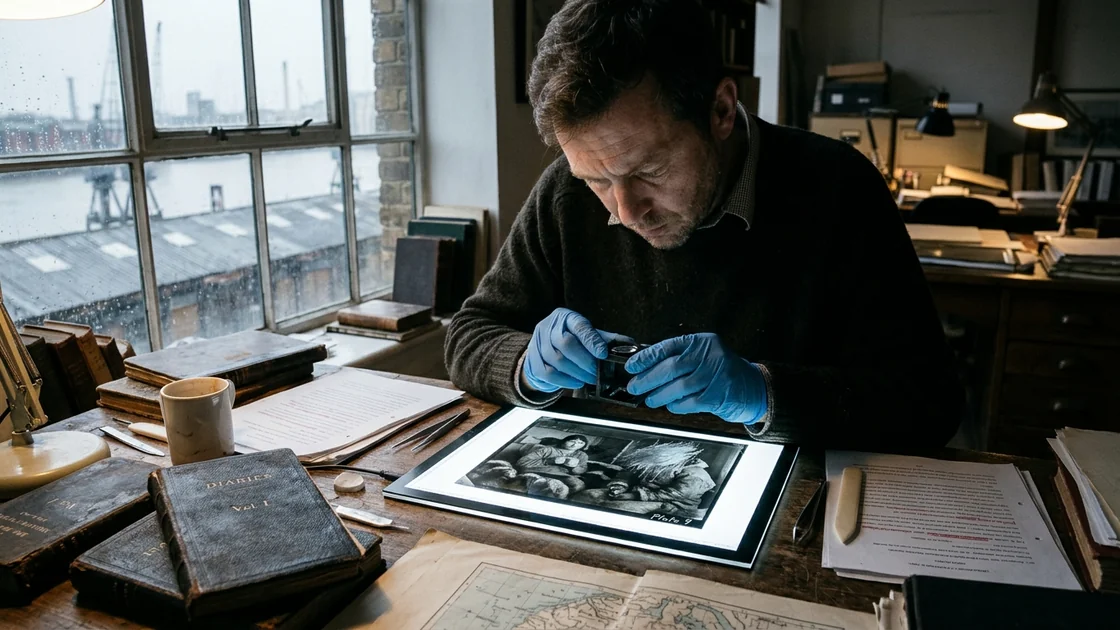
Nicholas Thorne, an archivist and linguistic translator specializing in twentieth-century subarctic orthographies, accepts a lucrative commission to transcribe the unredacted field diaries of Dame Evelyn Brand, celebrated for her miraculous fifteen-month solo survival in the Canadian High Arctic in 1928. As Nicholas deciphers Brand's idiosyncratic shorthand and phonetic Inuktitut transcriptions, he discovers that the explorer never lived in isolation at all, but survived entirely through the ingenuity, endurance, and quiet mastery of an Inuvialuk woman whose presence was systematically expunged from the published record to satisfy imperial expectations of British heroism.
I. The Cedar Box
The cedar box smelled of three separate centuries: the nineteenth, which had manufactured the brass hasps and the lead-lined corners; the twentieth, which had sealed it shut in paraffin wax and cedar sawdust; and the present, which arrived in the basement office of the Scott Polar Research Institute in the form of sterile nitrile gloves and dehumidified air.
Nicholas Thorne cut through the wax using a flat-bladed bone folder. He did not use a scalpel; steel was too hungry, too ready to bite through parchment if a hand slipped. The paraffin yielded in thick, amber curls that smelled faintly of kerosene and dead bees.
"Be careful with the binding on the third folio," David Fairbairn said from the doorway. Fairbairn was the institute’s keeper of manuscripts, a man whose skin had the translucent gray quality of salt beef left too long in the brine. "The Brand Trust is paying for the translation and the critical edition, but they are not paying for restorative rebinding. If an endpaper cracks, it comes out of our operating grant."
"The spine is already broken," Nicholas said without looking up. He lifted the lid. The interior of the chest was lined with green baize that had rotted into constellations of moth-eaten powder. Resting inside were six volumes bound in blackened morocco leather, their surfaces scarred by water, salt, and the oily smudge of seal blubber that no amount of English dry-cleaning could ever wholly pull from hide.
"Evelyn Brand’s solitary year," Fairbairn murmured, lingering with his cup of chicory-heavy coffee. "Nineteen twenty-eight to nineteen twenty-nine. The crown jewel of British female exploration. The lone woman against the polar night. The Geographical Society wants the commemorative volume ready for the centenary of her return. The centenary will be huge, Nicholas. Prince William will likely write the foreword."
"She wasn't British," Nicholas remarked, picking up the smallest notebook with two gloved fingers. "She was born in Halifax."
"Her father was the third son of an earl, which makes her British enough for the postage stamp," Fairbairn replied. "Just translate the shorthand. You are the only person between here and Copenhagen who can read both Pitman’s 1890 stenography and inter-war Mackenzie Delta phonetic transcriptions. Make sure her Latin tags are correct. She had a habit of quoting Horace when she was freezing to death."
Nicholas did not answer. He set the smallest notebook—labeled Vol. I: August 1928—Melville Sound—onto the velvet-lined foam cradle on his desk. Under the harsh halogen lamp, the leather looked less like an artifact of Victorian gentility and more like a slab of dried meat.
Evelyn Brand was one of those figures who had occupied the periphery of Nicholas’s entire education. In the standard biographies, she was the "Maiden of the Ice": an austere, square-jawed woman who, at the age of thirty-one, accompanied the ill-fated Haze-Cartwright Expedition to Prince Patrick Island. When Captain Haze and his six men died of what was officially certified as acute scurvy and botulism from contaminated tinned pork in October 1928, Brand had refused to crawl into the tent and wait for spring to kill her. According to her bestselling 1931 memoir, Solitary Meridian, she had buried the men under stone cairns, taken two sledges, four surviving dogs, and six months of rations, and marched three hundred miles south toward Cape Kellett, where she wintered in an abandoned trapper’s hut before making contact with the Hudson’s Bay Company post at Baillie Island the following July.
The book had been a sensation. In an era when Great Britain was nursing the psychological hemorrhages of the Somme and watching its imperial borders fray, Evelyn Brand was proof that the Anglo-Saxon constitution possessed an inherent, divinely ordained resistance to dissolution. She had lived on boiled tallow, biscuit fragments, and the sheer, iron discipline of the King’s English. Her book contained maps drawn with geometric certainty, sketches of wind-scoured basalt, and transcriptions of her thoughts on Marcus Aurelius, whom she claimed to have read aloud to the polar bears to keep her sanity.
Nicholas opened the cover of Volume I.
The title page did not say Solitary Meridian. It said, in an unruly, violently pressured hand: Waste Book. Begun in the month of the dog’s death.
Beneath that, written not in the neat longhand of the Royal Geographical Society’s archives, but in the dense, crabbed strokes of Pitman shorthand, was a line that Nicholas read aloud, haltingly, as his mind dragged the symbols back into phonetic sounds:
The dead are easy. It is the living mouth that frightens me.
II. The Double Voice
A translator of dead languages is, by necessity, a specialist in omissions. Nicholas had spent ten years translating Moravian missionary reports from Labrador and the logbooks of Danish whalers who had traded needles for walrus ivory in Disko Bay. He knew that what men wrote down was usually a clean bandage laid over an open wound; the real story was the seepage around the linen.
For the first three weeks, Nicholas worked in twelve-hour shifts, sitting in the basement with a magnifying lens, a light box, and a dictionary compiled in 1912 by an Anglican deacon named Peck.
Brand’s field journals were not the clean, literary manuscripts her publishers had possessed in London. Those had been fair copies, rewritten on vellum paper in a Kensington townhouse after months of hot baths and beef tea. These notebooks were physical records of violence. The pages were swollen from moisture, then dried until they crackled like fried lard. In many places, the pencil had torn through the paper, driven by fingers so stiff with cold that the writer could only move her shoulder to form the characters.
By the end of the second notebook—covering November 1928, the onset of the sunless period—the Pitman shorthand began to fray.
Shorthand is an efficiency designed for the parlor and the courtroom; it relies on smooth curves and shallow angles. It assumes a warm room, a sharpened pencil, and a wrist that can pivot on an mahogany desk. When the temperature drops to forty below zero inside a canvas shelter, graphite does not slide across paper; it drags, snaps, and powders.
Brand had abandoned standard shorthand. In its place, she had invented a hybrid script. She used Pitman characters for English verbs, but for nouns, she used something else: an orthography based on the syllabics introduced by the missionaries, interleaved with Romanized phonetic approximations of an uncatalogued dialect.
On page forty-two of the second volume, Nicholas encountered a sentence that derailed his progress for three days:
T. brought two ptarmigan today. I could not skin them; my thumbs have no skin left between the first and second joints. T. took them by the legs and pulled the feathers down like stockings. We ate the entrails warm. The fat behind the eyes is sweetest.
Nicholas leaned back from his microscope. His tea had gone cold; a skim of milk dust sat on the dark surface like grease on bilge water.
T.
He pulled his copy of Solitary Meridian from the reference shelf. He turned to Chapter Six: "The Long Night on the Ridge." He found the corresponding date: November 14, 1928.
In the published book, Brand wrote:
The silence of this wilderness has a voice, if one has the Christian fortitude to attend to it. Today I succeeded in bringing down two rock ptarmigan with my small-bore rifle. My fingers were excessively painful from the frost, yet I was able to prepare the flesh using my pocket-knife. A meager supper, yet sanctified by the knowledge that Providence does not abandon the solitary traveler who keeps her purpose clear.
Nicholas returned to the manuscript. He placed his finger on the pencil stroke that represented T.
It was not an English letter T. It was an Inuktitut syllabic character—ti or te—with an idiosyncratic flourish at the tail, shaped like an open bone-needle.
Two pages later, the shorthand broke into long, unpunctuated lines of raw description:
T. says the ice is speaking. She says the pressure from the south will break the cache before the moon clears the bluff. She wanted to move the meat into the snow-house. I told her the wolves would get it if we left the stones. She laughed at me. She has a way of laughing that makes me feel like an infant who has wet her flannel. She did it anyway. She carried two hundred pounds of frozen blubber on her forehead with the chest-strap. When I tried to take one of the iron pemmican tins, I dropped it on my foot. The bone cracked. I knew it cracked by the sound, like dry willow snapping underfoot. I did not feel it until two hours later when the heat of her lamp reached the toe.
T. was a woman.
The pronoun used throughout the shorthand entries was she, rendered in the standard Pitman stroke: a light, downward diagonal with a small hook at the crest.
She took my boots. She chewed the heel until the hide was soft enough for my heel. She spat the blood into the fire-pot. She said my boots were the boots of a dead man.
III. The Vanishing
The Brand Trust had strict parameters for the commemorative volume. Nicholas had signed an agreement that ran to fourteen pages, printed on heavy legal bond with the seal of a prestigious firm in Lincoln’s Inn. He was employed to "transcribe, annotate, and provide linguistic translation for the private notebooks of Dame Evelyn Brand, D.B.E., with specific regard to her geographic and meteorological observations."
On Thursday morning, Nicholas took the District Line to the Royal Geographical Society in Kensington.
The Society’s library was quiet with the peculiar, expensive quiet of places that have never lacked for coal or coats. Portraits of men with mutton-chop whiskers and frostbitten ears gazed down from the oak paneling, their eyes fixed on horizons where empires were claimed by the simple act of naming an inlet after an under-secretary of the Admiralty.
Nicholas met with Eleanor Finch, the Society’s assistant archivist for the Arctic collections. Finch was forty, with hair cut as straight as an iron rule and a pencil tucked behind her ear that she used to tap against her teeth when she was annoyed.
"We have the complete accession from the Brand estate," Finch said, leading him through the stacks where the boxes were stored in blue solander cases. "Nineteen thirty-one. Her sister, Lady Margaret, deposited the papers after Evelyn’s death in thirty-four. You know she never really recovered? Her lungs were scarred by the coal-oil fumes and the dry frost. Died of pneumonia at forty-four in a nursing home in Bath."
"Did she deposit everything?" Nicholas asked.
"Sixteen box files. The drafts of Solitary Meridian, her communications with the Admiralty, her correspondence with Lord Curzon, and the lecture slides. The magic lantern slides are marvelous. Hand-colored. Evelyn Brand in her caribou parka, looking like an ancient Viking queen."
"Are there any photographs from the field?"
Finch stopped between two ranges of metal shelving. "A few. Most of the glass plates were lost when the sledge broke through the lead at Banks Island. Only twelve plates survived. They’re in Box Nine."
Nicholas spent an hour with Box Nine.
The plates were four-by-five-inch glass negatives, kept in acid-free envelopes. He laid them one by one across a portable light pad.
Plate One: The H.M.S. Resolute II frozen in the pack at Prince Patrick Island. A cluster of figures in heavy mackinaws, their faces lost in the grain of the silver gelatin.
Plate Two: Captain Haze standing next to a dead muskox. The animal’s belly was split, a dark trough in the snow.
Plate Three: Evelyn Brand on the deck, wearing an officer’s wool watch-cap, her arms folded across her chest, staring directly into the lens with a look of furious, concentrated intelligence.
Plates Four through Eight: Landscape studies. Sea-ice ridges like ruined cathedrals of chalk. Flat, wind-picked tundras under skies that were either white or gray, with no gradation between the two.
Plate Nine was different.
It had been taken inside a shelter—a low, dome-shaped space lit from below by a small flame. In the foreground was an iron stove, but the stove was cold; there was no soot on its chimney pipe. On the platform behind it, sitting on a spread of muskox robes, was Evelyn Brand.
She was not looking at the camera. Her face was gaunt, the skin over her cheekbones stretched so tightly that the bone seemed about to slice through the epidermis. Her lips were cracked, cross-hatched with black crusts of frost-burn. She was holding a tin pannikin in both hands, her head bowed over it as if in prayer.
To the right of the frame, half-cut by the edge of the glass plate, was another figure.
It was an arm and a shoulder. The shoulder was covered in an amauti—the wide-shouldered, hooded skin coat of the north—sewn from the hides of ringed seal, the hair running downward to shed the water. The stitching was extraordinarily fine, fifteen or twenty stitches to the inch, using what Nicholas recognized as split sinew.
The hand attached to the arm was holding a small wooden spatula, tipping a piece of black fat into the stone dish of a qulliq—the crescent-shaped seal-oil lamp that the Central and Western Arctic peoples used for heat, light, and life.
The hand was small, the skin dark, with three vertical lines of indigo tattoo running down the back of the wrist, disappearing into the cuff of dog-fur.
Nicholas brought his linen-tester lens down until it rested directly on the glass.
The negative had been scratched.
Not by accident. Someone had taken a steel point—a needle or an etching tool—and had systematically scraped the emulsion away from the right side of the plate. The hand remained, and the edge of the sleeve, but where the face and head of the woman should have been, there was only a violent, silvery gouge in the gelatin, exposing the clear, green-tinted glass beneath.
Below the glass, written in the ledger of the accession book in Brand’s own handwriting, was the caption:
Plate 9: The Author at the Winter Quarters. The shadow of the stove-pipe appears upon the wall.
Nicholas looked at the gouge. The width of the iron stove-pipe was four inches. The gouge was the shape of a woman’s head, wearing the high, rounded hood of the Copper Inuit.
IV. The Grammar of Needles
In the third week of October, Nicholas hired an office on the fourth floor of an old warehouse near the docks in Wapping, where the light was cold and gray and came off the river through windows that had not been washed since the blitz. He brought his notebooks, his transcriptions, and three cases of photocopies. He could not work at the institute any longer; Fairbairn had taken to dropping by twice a day to ask if he had found "the Marcus Aurelius passages" yet.
"The Trustees want to use her quotation about the soul being an unassailable citadel for the brochure," Fairbairn had said. "It’s very evocative."
Nicholas had found the Marcus Aurelius passage that morning in the fourth notebook.
Brand had indeed written it. She had written it on the back of a receipt from the Hudson’s Bay Company for three bags of coarse flour and two pounds of tobacco. But she had not written it as a meditation on imperial stoicism.
She had written:
M. Aurelius says the soul is a citadel which nothing can conquer from without. M. Aurelius never had the water run out of his nose while he tried to shit at fifty below zero. If he had, he would have known the citadel is made of lard and caribou guts, and when the lard is gone, the citadel falls down in an hour. T. did not let me die today. I had the shits so hard I could not stand. She pulled my trousers up. She wiped me with moss she had dried inside her own shirt next to her breasts. She does not read Marcus Aurelius. She told me I am like a dog that has been kicked in the spine: all mouth and no legs.
The woman’s name was not T.
As Nicholas worked through the fourth notebook, the hybrid script settled into a rhythm. Brand had abandoned English grammatical structures almost entirely by the deep winter of December 1928. She was writing in an English vocabulary forced into the polysynthetic architecture of Inuktitut.
In English, one says: I am cold. In Brand’s notes, she wrote: I-am-becoming-like-the-bottom-of-the-sea-ice.
The woman’s name was Tigullaq. Or perhaps Tigullak.
Nicholas found the full name on the twentieth of December, written phonetically in the margins of an entry concerning the measurement of the sun’s absence:
T-i-g-u-l-l-a-q. She says her name means 'the one who takes hold.' She took me by the coat when the ice opened under the sledge. The lead was six feet wide, black as an ink-well. I was looking for the stars to take an altitude with the sextant. I had the sextant in my brass case. I thought if I dropped the case, the Society would never give me another grant. She did not care about the sextant. She threw the sextant onto the pan behind us and grabbed my hood. She broke the bone button at my throat. She dragged me out like a sack of turnips. When we were on the firm ice, she hit me across the ear with her flat hand. She hit me three times. My ear bled. She said: 'You white-skin fool, the stars do not feed your belly.'
Nicholas spent four days in the library of the School of Oriental and African Studies, comparing the dialect in Brand’s phonetic notes with the linguistic surveys of Diamond Jenness and Knud Rasmussen.
The woman was likely an Inuvialuk from the mouth of the Coppermine or the coast of Victoria Island. She had not been part of the Haze expedition’s official roster. The roster listed four British officers, two Canadian seamen, and "one native boy, Peter," who had died of the same tainted pork that took Haze in September.
Where had Tigullaq come from?
The answer came on page seventy of the third volume, buried in an accounting of biscuit rations:
She was left behind by the whaler 'Karluk' three summers ago. Her husband died of the coughing-sickness at Herschel Island. She walked across the sea-ice from Banks Land because she thought her uncle was hunting on Prince Patrick. There was no one on Prince Patrick. Only the stones and our camp. When she found our tent, Haze was already black in the face and screaming about his mother’s garden in Kent. She did not come into the tent. She waited behind the ridge until the shouting stopped and the dogs were quiet. She knew that white men who are dying will shoot at anything that moves because they think everything that has dark skin is an animal.
She came down when she saw the smoke from my stove. She did not speak English. She pointed at the stove and then at her feet. Her boots were made of bearded seal skin, sewn with stitches so small they looked like the teeth of a saw. My boots were English leather from Fortnum & Mason. The soles had separated from the welts, and my socks were frozen to my heels with pus.
She sat down on the box of pemmican. She took a small bone awl from her hair. She did not ask my leave.
She began to take me apart.
V. The Technology of Skin
In the official record, Evelyn Brand was an exemplar of what the papers called "The New Feminism": an educated woman of the upper classes who could operate a theodolite, calculate a lunar distance, and command men through moral authority.
In the notebooks, the reality was a slow, humiliating education in the total uselessness of European civilization north of the sixty-eighth parallel.
Nicholas sat at his desk in Wapping, with three electric heaters glowing red against the damp fog that seeped from the Thames, and watched the myth dissolve stroke by stroke.
Evelyn Brand had not known how to keep an oil lamp from smoking. For three weeks in November, she had breathed soot until her sputum was black as chimney-sweepings, because she had trimmed the moss wick of the qulliq with scissors instead of her fingers, leaving ragged edges that sucked up more oil than the flame could consume.
It was Tigullaq who showed her how to shape the fat.
She took my hand, Brand wrote in January 1929. She is thirty years older than I, her teeth are worn down to the red gum from chewing hides, but her fingers have no tremor. She forced my thumb along the lip of the soapstone. 'Pikunani,' she said. 'Not like that. Like this.' She made me feel the grain of the stone. She said that if the flame is too high, the house weeps. A house that weeps will kill you in the night. The water runs down the snow blocks, touches your furs, and once the fur is wet, you are already a corpse that has not yet stopped complaining.
Brand could not sew.
This was the central revelation of the fourth notebook. To the Royal Geographical Society, sewing was an accomplishment of the drawing room—an ornamental waste of time practiced by vicar’s daughters with embroidery hoops.
In the Arctic, sewing was the primary technology of life. It was more critical than the rifle, more critical than the chronometer, more absolute than any doctrine of navigation.
A man cannot hunt if he cannot walk, Brand transcribed from Tigullaq’s instruction. A man cannot walk if his kamiks are stiff. If his boots let in one drop of salt-water, the foot becomes like a turnip left in the ground after the hard frost. Then the toes turn blue. Then the foot must be cut off with the curved knife. Who will cut the foot? Will the stars cut the foot? Will your King in London come with his little scissors and cut the foot?
Nicholas read through forty pages detailing the preparation of bearded seal skin (ugruk).
Tigullaq had taught Brand how to scrape the blubber from the skin without piercing the thin membrane beneath; how to soak the hide in urine to remove the hair; how to hang it in the frost until it bleached white as parchment; and then, the most terrible lesson of all, how to take the stiffened leather between her incisors and chew it, inch by inch, hour after hour, until the hard, fibrous tissue yielded to saliva and pressure, becoming as supple as kid gloves.
My jaw aches until the teeth feel loose in their sockets, Brand wrote on January 14. This morning my gums were bleeding so freely that the white leather was stained pink. Tigullaq looked at it. She nodded. She said: 'Now it is yours. The boot knows who chewed it. It will not freeze so quickly now.'
I looked at her hands. Her knuckles are swollen to the size of walnuts. Her fingers are curved like the roots of the dwarf birch. She has chewed five hundred boots in her life. She has chewed the boots of two husbands, four sons, and three daughters. All of them are dead. Some of them died of the cough; some went out on the ice when it broke away in the spring gale; one was born dead in a snow-house when the caribou did not come. She told me this while she was cutting the sinew from a reindeer back. She spoke of them with no more sorrow than one speaks of the wind that blew yesterday. 'The ice does not keep what it does not want,' she said.
I asked her if she thought God had taken them.
She looked at me for a long time. She had a piece of blubber between her teeth. She said: 'Your God must have a very cold house if he needs so many people to go there to keep him warm.'
VI. The Red Pen
By mid-November, Nicholas had reached the fifth notebook: March to May 1929. The sun had returned, a thin, orange blister on the southern horizon that brought no warmth, only a clarity that was more terrifying than the darkness because it revealed the true extent of the pack-ice—miles of shattered, up-ended slabs, tilted like gravestones in an abandoned churchyard.
It was here that the archival mystery took a darker turn.
In this volume, Nicholas began to find lines that had been crossed out not with the pencil Brand had used in the field, but with thick, crimson ink.
The ink was modern—or at least, it was modern compared to the pencil. It was iron gall ink of the kind favored by British government offices and London publishers between the wars.
Nicholas took the fifth volume to the conservation laboratory at University College London, where he had a friend named Marcus Bell who had access to a multi-spectral scanner.
Bell was a young man with a beard like an Elizabethan pirate and an obsession with pigments. He placed the notebook under the high-resolution ultraviolet camera.
"The pencil is graphite with clay binder, standard nineteen-twenties field stock," Bell said, adjusting the wavelength on his monitor. "The red ink is carmine and iron sulfate. Waterman’s 'Post Office Red.' It was introduced in nineteen twenty-four. It was the standard editorial ink used by Mount-Cairn & Sons, the publishers of Solitary Meridian."
"Can you drop out the red?" Nicholas asked.
"I can strip it like wallpaper," Bell said.
He clicked three keys. On the monitor, the thick red slashes that obscured the lower half of page one hundred and twelve faded to a ghostly gray, then vanished altogether. The original pencil script emerged beneath it, sharp and raw.
Nicholas read the resurrected text directly from the screen:
March 28. The sledge is finished. Tigullaq made the runners from our iron ration tins. She hammered them flat between two stones, then lashed them to the drift-willow with seal-thong. We have only twelve pounds of flour left and one tin of cocoa. My fingers are better, but the two small toes on the left foot are black as charcoal and have begun to separate at the joint. Tigullaq took them off this morning with her little knife. She heated the blade in the lamp. She gave me a piece of dried meat to put between my teeth. She did not say a prayer. When it was over, she threw the pieces of bone into the lamp-flame. She said if we left them on the snow, the foxes would follow us. She said: 'You do not want a fox to have your feet. If a fox eats your feet, you will run after him in your sleep until you fall into a hole.'
I cried for two hours. Not from the pain—the pain was only like a burn from a hot kettle—but because I realized that I will never walk like an Englishwoman again. I will limp like an old crone. I will have to wear special boots with wool stuffed into the toe.
Tigullaq said: 'Stop that noise. The dogs think you are dying. When the dogs think you are dying, they will not pull for you. They will wait until you fall and then they will eat the grease out of your coat.'
Beneath this entry, the red editorial ink had returned, not merely crossing out words, but providing instructions in a cramped, clerkish English hand:
Omit entire incident. Unbecoming to the dignity of the narrative. No mention of surgery by native woman. Retain the detail about the sled runners made of biscuit tins, but attribute the invention to Miss Brand’s resourcefulness.
In the margin of page one hundred and fourteen, opposite a description of Tigullaq stalking a ringed seal at its breathing hole (aglu) through fourteen hours of sub-zero wind, the red pen had written:
Delete native character entirely. Lord Mount-Cairn is clear: the market will not tolerate a companion. The entire moral force of the book resides in the single English maiden against the element. If she was accompanied by an Eskimo, it becomes merely an anthropological expedition gone wrong. If she was preserved by an Eskimo, it becomes absurd.
Nicholas felt a cold, sour prickle of nausea at the back of his throat.
"Can you do the whole volume?" he asked Bell.
"It will take three days to process the image stacks," Bell said, looking sideways at Nicholas. "Who is the editor? The red pen?"
"Arthur Mount-Cairn," Nicholas said. "He was the junior partner in nineteen thirty. He became Chairman of the Board of Governors for the BBC in nineteen fifty-two."
"He was thorough," Bell remarked. "He didn't just cross it out. Look here at page one hundred and twenty. He took a safety-razor blade and scraped the surface of the paper until the pencil was gone. He actually lifted the fibers."
"Can the scanner read the indentation?"
Bell smiled, a small, cold twitch of his lips. "The scanner can read the impression of a thumb on a peach three days after it was picked, Nicholas. Come back on Friday."
VII. The Meat-Cache
On Friday, Nicholas did not go back to University College. He was summoned to the offices of the Brand Trust in Mayfair.
The Trust was housed in an eighteenth-century townhouse in Queen Anne’s Gate, where the staircases were wide enough for three duchesses to walk abreast and the air smelled of floor wax and old government money.
He was received by Julian Brand, the explorer’s great-nephew. Julian was sixty, with the same broad, high-bridged nose that Evelyn had possessed in her youth, though his cheeks were soft and veined with the claret of three decades of benchers' dinners at the Middle Temple.
"Fairbairn tells me you’re making splendid progress, Thorne," Julian said, motioning Nicholas to a leather armchair beside a coal fire that was entirely real and excessively hot. "Splendid. The Society wants to launch the centenary edition at the Royal Festival Hall in November. We’re having an exhibition: her sledge, her rifle, the original Union Jack she carried to Cape Kellett."
Nicholas held his briefcase on his knees. He did not open it.
"Her sledge didn't reach Cape Kellett," Nicholas said.
Julian paused with his silver cigar cutter poised over a torpedo-shaped Havana. "I beg your pardon?"
"The sledge in the Society’s collection is an English pattern sledge, made of ash and hickory by the Army and Navy Stores," Nicholas said quietly. "It was abandoned on the pack-ice eighty miles north of Banks Island on the fourth of April, nineteen twenty-nine. It broke its back over a pressure ridge."
Julian smiled, though his eyes remained as flat and hard as gray slate. "My dear chap, the sledge is in the museum. It has an ivory plaque on it. 'Presented to the Royal Geographical Society by Dame Evelyn Brand, 1931.'"
"It’s a replica," Nicholas said. "Made by a carpenter in Grimsby after she came home. The sledge she traveled on for the last four hundred miles was seven feet long, made of pieces of drift-willow held together with seal-skin thongs, with runners cut from sheet-iron pemmican tins and shod with a mixture of moss and frozen urine."
Julian set the cigar down without cutting it. "Thorne. Are you having some sort of difficulty with the text? I know the Pitman can be trying. We had an archivist five years ago who had a nervous turn while working on her letters from the Sudan. These high-strung, scholarly temperaments—"
"Why was Tigullaq erased?"
The room became very quiet. The only sound was the flutter of the coal fire and the muffled thrum of a cab turning from Birdcage Walk.
Julian Brand picked up a gold fountain pen and rolled it between his palms. "I see you have found the Mount-Cairn annotations."
"You knew about them?"
"Of course we knew about them," Julian said, his voice dropping the hearty, club-room cadence and becoming dry, neutral, and forensic. "The Trust has had custody of the family papers for sixty years. My grandfather was Arthur Mount-Cairn’s brother-in-law. We are not illiterate, Thorne. We know what Evelyn was like."
"She wasn't solitary," Nicholas said. "She was helpless. Without that woman, she would have been dead three days after Haze died. She didn't know how to cut snow blocks. She didn't know how to find the breathing holes. She didn't even know how to dry her socks without burning them to ash over the lamp."
"And what of it?" Julian leaned forward, his elbows on the mahogany desk. "Do you think the public in nineteen thirty-one wanted to hear that the daughter of an English earl was dragged across three hundred miles of pack-ice by an Eskimo who chewed her boots for her and cut off her gangrenous toes with a fish-knife? Do you think the Empire, which was falling apart in India and bankrupt in Manchester, needed a lesson in native technical superiority?"
"It’s the truth," Nicholas said.
"It is a truth," Julian countered. "It is the truth of the dirt, the fat, and the chamber-pot. Evelyn Brand gave them another truth. She gave them the truth of the human will. She showed that a woman of refinement could endure the worst that nature could throw at her and return with her reason intact, her modesty unblemished, and her loyalty to the Crown undiminished. That book funded three expeditions to the Antarctic. It inspired an entire generation of girls in the public schools to take up geography, medicine, and field sciences. What does your truth do? It turns a national monument into an imperial embarrassment."
"It restores an historical subject who was robbed of her life," Nicholas said. He could hear his own voice shaking; it was the thin, dry voice of a man who spent his life among papers, totally unsuited to the heavy, bludgeoning politics of family trusts and public monuments.
Julian looked at him with an expression that was almost pitying.
"You have a contract, Thorne. The contract specifies that the transcription and the translation are the property of the Brand Trust. You are an employee of the Institute. If you attempt to publish so much as a single syllable of those notebooks without our imprimatur, we will obtain an injunction in the High Court within forty-eight hours. We will ruin you professionally. You will not get another fellowship, you will not get another translation grant, and you will spend the next five years of your life paying our legal costs from whatever pitiful salary the University of London sees fit to pay a lecturer in dead dialects."
Julian stood up. He smoothed his waistcoat.
"Fairbairn will expect your completed typescript by the end of the month. Make sure the Marcus Aurelius passages are prominent. The Prince is very keen on the Marcus Aurelius."
VIII. The Translation of Ice
Nicholas did not return to the Scott Institute. He did not return to his flat in Camberwell.
He went back to the warehouse in Wapping. He took the six morocco-bound volumes from his safe. He had not signed a receipt for them that morning; Fairbairn had been at a conference in Cambridge, and the junior librarian had merely nodded when Nicholas carried the green baize-lined box out to his car.
Technically, it was theft. In the language of the law, it was conversion—the unauthorized assumption and exercise of the right of ownership over goods belonging to another.
Nicholas sat at his long deal table. Outside, the rain was coming down horizontally across the brown reach of the river, beating against the iron cranes and the wet roofs of the bonded warehouses.
He turned to the final notebook: Volume VI.
This was the volume that covered June and July of 1929—the arrival at the coast, the approach to the Hudson’s Bay Company post at Baillie Island, and the encounter with the schooner Baymaud.
In the published edition of Solitary Meridian, this chapter was titled "The Haven Under the Hill." It was five pages long. It described Brand’s sighting of the white-painted flagpole of the post, her Christian thanksgiving behind a screen of dwarf willows, and her triumphant march down the gravel spit into the arms of the astonished Factor, Mr. Kenneth MacLeod.
I had come through the furnace, she wrote in the book. The solitude had been my monastery, the ice my cloister. I was thin, I had lost the nails from seven fingers and two toes from my foot, but my soul was my own, clean as the white gale that blows from the Pole.
Nicholas opened the field notebook.
The final pages had not been crossed out with red ink. Mount-Cairn had not needed to cross them out; he had simply cut them from the binding with a razor.
Three stubs of paper projected from the stitching, their edges clean and straight.
Nicholas took his magnifying glass. He looked at the gutter of the book, where the thread of the binding met the paper.
The razor had been sharp, but it had not been set close enough to the thread. A strip of paper two millimeters wide remained attached to the binding.
On this strip were several small, disjointed pencil strokes.
Nicholas took a high-intensity cold lamp and brought it within an inch of the stub.
A stroke. An angle. A dot.
Pitman shorthand: The boat—she—
And then, on the second stub, three syllables written in the Inuktitut orthography:
...lik-tuq.
Nicholas reached for his lexicon.
Naluktuq? He swims? Tikit-tuq? She arrives? Tunit-tuq? She gives?
Or Aullaktuq—she departs.
Nicholas sat in the failing light. The heaters clicked as their bi-metallic strips expanded and contracted.
He realized that he had spent six months reading Evelyn Brand’s words, but he had never once looked for Tigullaq’s family.
To an English archivist, an Eskimo had no surname, no address, no legal status; she was a seasonal phenomenon, like the drift-ice or the run of char. She appeared from the white space of the map and vanished back into it when the chapter ended.
He pulled his telephone toward him. He dialed the international operator.
It took forty minutes to connect with the government administrative office in Ulukhaktok—the small settlement on the west coast of Victoria Island that had once been known to whalers as Holman.
The connection was poor; the satellite link had the hollow, watery echo of a voice shouting down an oil drum.
"Community Liaison," a woman’s voice said. She sounded twenty-five, her English flat, northern, with that light, rhythmic cadence Nicholas had learned to recognize from recorded tapes.
"My name is Nicholas Thorne," he said. "I am an archivist calling from London. I am working on the expedition records from nineteen twenty-eight. Prince Patrick Island."
"Nineteen twenty-eight?" The woman laughed; it was a quick, dry puff of breath. "My grandfather wasn't even born then. You want the elders' committee. They meet on Tuesdays at the hamlet office."
"I am looking for a family," Nicholas said, his mouth close to the receiver. "A woman who was on Banks Island and Prince Patrick in nineteen twenty-eight and twenty-nine. Her name was Tigullaq."
There was a silence on the line. The satellite hiss surged and retreated, like the sound of gravel being dragged back by a wave.
"Say that again?"
"Tigullaq. She would have been an adult woman in nineteen twenty-eight. Perhaps forty or fifty years old. She might have come from the Coppermine people, or the Kangiryuarmiut."
"Wait a minute," the woman said.
He heard the sound of a coffee mug being set down on a desk, the rustle of papers, and then the muffled sound of a hand over the mouthpiece. A conversation was taking place in the room behind her—rapid, low-pitched, in the language that Evelyn Brand had spent six months trying to twist into Pitman stenography.
The woman came back on the line.
"Who are you working for?" she asked. Her voice was no longer casual. It was guarded, cold as a dry bone.
"I was working for the Scott Polar Institute," Nicholas said. "And the Brand Trust. But I have left them."
"Evelyn Brand," the woman said. It was not a question.
"Yes."
"The one who wrote the book about the ice."
"Yes."
"My great-grandmother had that book," the woman said. "A missionary gave it to her in nineteen fifty-five at Aklavik. She couldn't read the words. But she knew the picture on the front. She took her skinning knife and she cut the woman’s face out of the cover. She used the paper to light her pipe."
Nicholas felt the hair on the back of his neck rise.
"What was your great-grandmother’s name?"
"Her name was Mary Tigullaq," the woman said. "Her English name was Mary. Her real name was Tigullaq. She died in nineteen seventy-one at the nursing station in Inuvik. She had no toes on her left foot."
Nicholas gripped the edge of his table. "Did she leave anything? Notes? Letters?"
"Letters?" The woman laughed again, and this time there was no humor in it at all. "She couldn't write, Mr. Thorne. She didn't have an office in London. But she had a box. An old Hudson’s Bay lard tin. It’s in the cultural center here. My auntie takes it to the school sometimes to show the kids the old-time sewing."
"What is in the box?"
"Some bone awls. A couple of iron scrapers made from old barrel hoops. And a gold watch."
"A watch?"
"A pocket watch," the woman said. "It doesn't work. The face is broken. On the inside of the back cover, there’s some writing scratched into the brass with a needle. My auntie asked me to read it once, but it’s old English, all curly and strange."
"Can you remember what it said?"
"I don't have to remember," she said. "I took a photo of it on my phone. Wait."
Nicholas waited. He could hear the rain against the glass of the Wapping warehouse. He could hear his own heart, small and frantic, pumping blood through the fragile citadel of his chest.
The woman’s voice returned:
"It says: To Evelyn, from her loving Father. June 1914. Keep the path. And then underneath that, someone took a knife and scratched four words in big capital letters. Real rough, like they were cutting them into frozen liver."
"What are the four words?" Nicholas whispered.
The woman read them slowly:
"THE PRICE OF MEAT."
IX. The Living Mouth
Nicholas did not sleep that night. He spent the dark hours between two and six in the morning at his light-table, with the high-resolution scans Marcus Bell had made for him.
Bell had succeeded. He had stripped away the Waterman’s Post Office Red ink from every page of the fifth and sixth notebooks.
Nicholas was now reading what no human eye had seen since Arthur Mount-Cairn had sat in his office in Albemarle Street in the spring of nineteen thirty with a red pen and a cigarette between his yellowed fingers.
He came to the entry for July 12, 1929—the day before they reached Baillie Island.
We could see the white schooner through the glass, Brand had written in her rapid, sloping pencil hand. The mast looked like an embroidery needle stuck into the salt-marsh. Tigullaq stopped the sledge three miles out on the shore-ice. She would not come any further.
I asked her why. I told her the Factor would give her flour, tea, and three pairs of wool blankets. I told her the Government would give her a medal. I said: 'You saved the life of an English lady. You will be famous in London.'
She looked at me with her little eyes, which are surrounded by wrinkles so deep that they look like the tracks of birds in the mud. She spat on the ice. She said: 'They will not give me a medal. They will put me in the kitchen. They will make me wash the grease out of their shirts. And the white men who have been on the ship for two years without women will come to the door at night and knock with their boots.'
I told her I would protect her. I told her I was Evelyn Brand.
She laughed at me for the last time. She said: 'You are Evelyn Brand because you have your boots on. I chewed those boots. If I take those boots back, you are nothing. You are a dead white thing lying in the gravel for the gulls to pick.'
She reached into her coat. I thought she was going to take her knife. I was afraid—I admit it here, God help me, I was afraid she would strike me down there on the ice, so close to the flag, so close to my people. I reached for my small revolver in my pocket.
She saw me reach. She did not stop. She pulled out the gold watch my father had given me when I passed the Oxford Locals. She threw it into the slush between my feet.
She said: 'Take it. I do not want your little sun that lives in a tin. It does not tell when the seals come. It only tells when the white men want to eat.'
She turned the dogs. She had two dogs left—the gray one that had lost an eye to the wolf, and the little bitch that had pulled at the front. She did not have a whip; she made a sound in her teeth—'Tuk-tuk-tuk'—and the dogs leaned into the seal-skin traces.
I called after her. I shouted her name: 'Tigullaq! Tigullaq!'
She did not look back. She went north along the spit, where the ice was still hard under the shadow of the bluffs. The mist was coming down from the lead—that thick, cold sea-smoke that tastes of iodine and rotten kelp. She walked into it with her head down, her amouti wide at the shoulders, looking like a great brown bird that had dropped from the cliff and was running on the sea before it could take wing.
I stood by the sledge. I waited ten minutes until the smoke had covered the trail. Then I took the rope in my own hands. I pulled the sledge fifty yards until I was within sight of the storehouse. Then I let the rope drop. I sat down on the stones and waited for the Factor’s dog-team to find me.
I took my journal from my pocket. I began to write what I will say to the reporters at Edmonton.
Beneath this, Arthur Mount-Cairn had written in his red ink:
Good. Very dramatic. Let the discovery be made by the Factor himself while out looking for driftwood. It gives a much better impression of her modesty if she does not announce herself.
And then, in Evelyn Brand’s own hand—written not in pencil, not in red editorial ink, but in a brown, oxidized fluid that Nicholas recognized with a sudden, sick certainty as dried blood—was a single line at the very bottom of the page, nearly lost in the fold of the leather:
I have sold her for two thousand pounds and a portrait by John.
X. The White Needle
On Monday morning, Nicholas Thorne did not go to the Scott Polar Research Institute.
He went to the Canadian High Commission in Trafalgar Square.
He carried the six volumes in his leather bag, along with forty-eight high-resolution multi-spectral scans, his complete transcription of the unredacted shorthand, and the audio recording he had made of his conversation with Mary Tigullaq’s great-granddaughter in Ulukhaktok.
He sat in a small interview room on the second floor, looking out at the bronze lions and the statue of Nelson, whose empty sleeve was pinned to his chest in the eternal, dignified silence of imperial sacrifice.
Across the table sat a third secretary named Catherine Plimpton, an Inuk woman from Iqaluit who wore a blazer over a silk blouse and had three degrees from McGill in international law.
"This is property of the Brand Trust, Nicholas," she said, her fingers resting lightly on the black morocco leather of Volume I. "You know what the legal department in London will do to you."
"They will sue me," Nicholas said. He had not shaved in four days; his eyes were ringed with the yellowish-gray shadow of extreme fatigue, but his hands were steady. "They will obtain an injunction. They will prevent the publication of the commemorative edition."
"They will try to seize the originals," she said.
"The originals were written on Canadian Crown land," Nicholas said. "In nineteen twenty-eight, the Arctic Islands Game Preserve regulations required all expedition field records to be deposited with the Northwest Territories Council in Ottawa. Captain Haze signed the permit. Evelyn Brand never submitted them; she took them to England on a merchantman from Montreal. In Canadian law, they are stolen state documents. They have been stolen for ninety-six years."
Catherine Plimpton looked at him for a long time. Her eyes were very dark, the pupils invisible against the brown iris.
She reached out and pulled the smallest notebook toward her.
"Do you know what Tigullaq means in our dialect?" she asked.
"Brand said it means 'the one who takes hold,'" Nicholas replied.
Catherine shook her head slightly. "Not just that. It is the name for the handle of a woman’s knife—the ulu. It is the part of the tool that fits into the palm. Without the tigullaq, the blade is just a piece of sharp iron that cuts the fingers of the person who tries to use it. It is the part that does the work without being seen."
She turned the volume over. She ran her thumb along the edge of the leather, where the blubber-grease had soaked into the hide ninety-six years ago.
"The Trust has already issued the press releases for the centenary," she said. "The Prince is scheduled to unveil the bronze statue at the Geographical Society on the twelfth of November. It shows Evelyn Brand alone on the ridge, looking through her sextant."
"I know," Nicholas said.
"What do you want us to do with these?"
Nicholas stood up. He walked to the window. Outside, the London pigeons were wheeling in the gray air around Nelson’s column, rising and falling on the warm thermal currents that came up from the tube stations and the asphalt.
"I want you to send them home," Nicholas said. "Not to Ottawa. To Ulukhaktok. To the school."
"And the transcription?"
"The transcription will be on the open-access server of the University of Copenhagen by six o'clock this evening," Nicholas said. "I have seven mirror sites ready in Tromsø, Fairbanks, and Nuuk. If Julian Brand wants an injunction, he will have to serve it on the Internet."
Catherine smiled. It was the first time he had seen her smile; it was wide, clear, and very dangerous.
"And what will you do, Nicholas? They will revoke your fellowship."
Nicholas looked down at his own fingers. They were long, pale, ink-stained at the knuckle of the second finger—the typical, useless hands of an English translator who had lived his whole life on the crumbs dropped from the tables of other men’s expeditions.
He remembered the entry from the twenty-eighth of March: Tigullaq gave me a piece of dried meat to put between my teeth. She did not say a prayer.
"I have four months of my grant left," he said. "And I think I should like to learn how to sew."
XI. The Postscript
In the archives of the Prince of Wales Northern Heritage Centre in Yellowknife, there is an accession recorded under the number 2024.112.01.
It consists of six small volumes bound in morocco leather, eight glass photographic plates, and a brass pocket watch with a broken crystal.
The watch is not displayed in the gold-lit cases where the Royal medals and the ivory-handled theodolites are kept. It sits in a flat drawer lined with black felt, beside an ulu with a handle carved from the jawbone of a ringed seal, its blade worn down by three generations of scraping to a crescent no wider than a thumbnail.
If one visits the gallery on a winter afternoon, when the sun disappears behind the Great Slave Lake by three o'clock and the frost forms thick, feathery forests of ice on the triple-glazed windows, one can read the digital transcript of the sixth notebook on an interactive screen.
The final page does not end with the arrival of the Factor.
It ends with three lines that Nicholas Thorne translated from the Inuvialuktun syllabics, written in the margins of the page where the paper was scraped raw:
I am going back to the place where the ice does not crack. I am taking the needle. Let the white woman tell her father that she built the sky herself.