The Weight of Wood and Bone
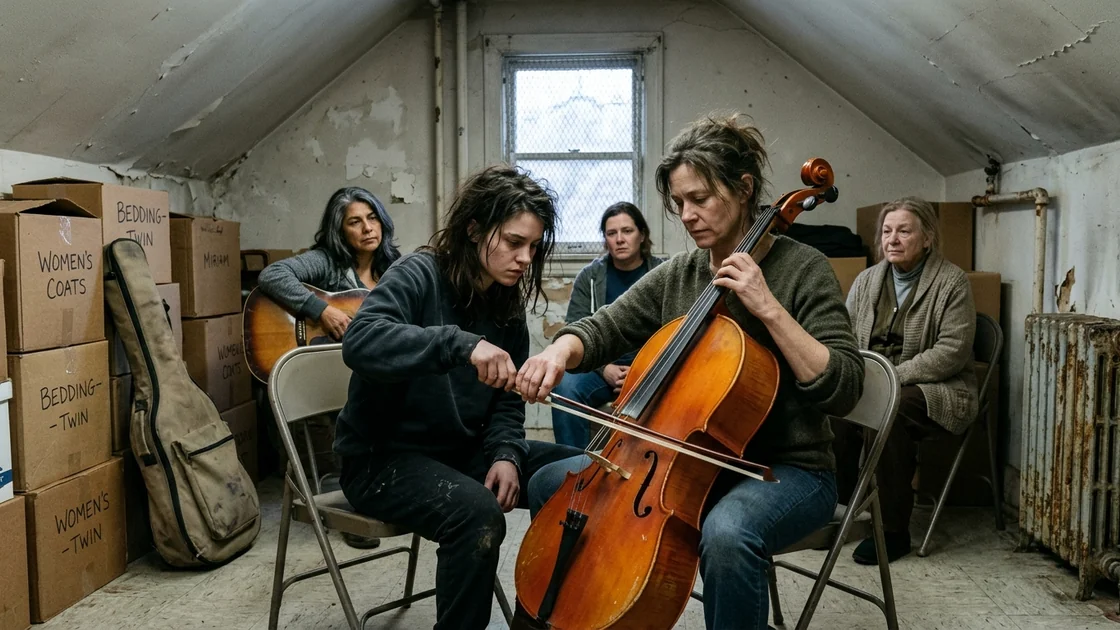
After a devastating highway collision on an icy mountain pass crushed the nerves in her right hand, concert cellist Claire Holbrook believed her life was permanently emptied of meaning, retiring into an isolated, silent apartment where her five-hundred-year-old Montagnana sat shrouded like an exhumed corpse. Desperate to satisfy a court-mandated community involvement initiative or simply fleeing the suffocating quiet of her own grief, Claire takes an unpaid, hesitant position running an afternoon music circle at the Harbor View Shelter for Women, a battered brick refuge on the edge of the industrial canal. There, confronted not with the polished halls of European conservatories but with women navigating violence, addiction, homelessness, and profound personal erasure, she discovers that music was never merely an exercise in athletic technical perfection. Through teaching women who hold instruments with calloused, trembling, and defensive hands, Claire is forced to abandon the bow she can no longer clasp, learning instead to listen through the bone, reinventing her relationship to sound, and guiding both herself and the shelter residents toward a collective, fragile restoration.
Chapter One: The Phantom Arpeggio
The numbness was never quiet. That was the first lie the neurologists had unwittingly told her when they folded away the electromyogram printouts and spoke of permanent motor loss in the soft, modulated tones reserved for the catastrophically diminished. They had said the hand would feel distant, like a limb sleeping beneath heavy wool.
Instead, Claire’s right wrist sang a constant, sour discord. The severed median and ulnar nerves, stitched back together with microscopic silk into a thick knot of dead ends, hissed like an unplugged amplifier. In her mind’s ear, the fingers were still locked around the frog of a Tourte bow, suspended two inches above the C-string of an Elgar concerto she had been rehearsing forty months ago outside Zurich. Her forearm still tensed for the down-bow; the ghost of her knuckles still anticipated the bite of Pernambuco wood against horsehair, the micro-flexion required to pull twenty-four ounces of pure, aching resonance from spruce and maple. But when she looked down, her actual hand sat curled on her lap, pale and sleek with disuse, the skin smooth as candlewax where the calluses had long since peeled away.
Her apartment on the fourth floor of a pre-war brownstone smelled of steeped sencha and unwashed linen. It was a space designed for someone who existed entirely in transit between airport gates, green rooms, and hotel suites overlooking gray European rivers. Now, the grand high ceilings merely trapped the draft from the harbor.
In the corner, by the leaded bay window, stood her cello case. It was a flight-tested fiberglass shell of matte charcoal, locked with three heavy brass latches. Inside lay the 1711 Matteo Goffriller, an instrument she had purchased with three separate bank loans and the sponsorship of a Swiss pharmaceutical trust. She had not opened the latches since the transport van brought her belongings home from the rehabilitation hospital in Basel. To open it would mean breathing the cedar, the amber rosin, and the cold metal of the Larsen strings; it would mean seeing her own reflection in the deep, reddish-brown varnish, warped and useless against the scroll.
The envelope from the municipal arts outreach committee had sat on her galley counter for seventeen days, slowly collecting grease from the stovetop where Claire boiled her nightly potatoes.
It was signed by Eleanor Vance, an administrator Claire vaguely remembered from a lifetime ago—an era when Claire had served as the ceremonial guest of honor at city arts galas, accepting bouquets of white peonies while patrons in silk shantung wrote checks to underwrite inner-city violin programs. The letter was not a summons; it was an act of pity. A weekly circle, Eleanor had written in a clean, looping hand. Two hours on Tuesday afternoons. No performance demands, Claire. Simply an ear. The women at Harbor View have so little that belongs to them.
Claire had crumpled the letter once, dropped it into the wastepaper basket, and then retrieved it three hours later when the silence in the apartment became so loud she could hear the water dripping behind the plaster in the bathroom wall.
She took the crosstown bus because she could no longer drive. She carried no instrument. The thought of bringing a cello onto public transit without the ability to lift it with her dominant arm was impossible; even her shoulder slumped inward, guarding the dead weight of the right side like a mother covering a sickly child.
The bus dragged itself east, away from the limestone facades and the brick-paved university squares, descending into the flats where the warehouses had teeth of broken glass and the air carried the sulfurous, oily reek of the salt marsh and the container ship docks. Harbor View Shelter occupied a three-story municipal building that had once been a tuberculosis ward. Its yellow brick was scarred by decades of soot from the coal yards that used to flank the train spur. A chain-link fence, topped with curled loops of razor wire that had caught stray black plastic shopping bags, encircled a patch of trampled crabgrass.
Claire stood on the cracked asphalt of the apron for nearly ten minutes, the collar of her wool coat pulled up against the November wind. Her right hand was tucked into her pocket, fingers curled around a smooth river stone she carried to give the dead digits something solid to rest against.
Through the double glass doors, reinforced with chicken wire, she could see a woman in a high-visibility vest checking IDs behind a desk of scratched Plexiglas. A toddler in a winter coat three sizes too large was sitting on a plastic floor mat, methodically bashing a red plastic fire truck against a radiator.
I cannot do this, Claire thought, her stomach pulling tight into a knot of cold bile. I have spent thirty-five years learning the exact weight of a vibrato in a hall with a two-second reverberation time. I know nothing about women who sleep with their shoes tied to their wrists so they aren't stolen.
She turned to leave, her boots crunching on the road grit, when the door swung open behind her.
"You the music woman?"
The voice was raspy, scored by decades of cheap tobacco, but carrying the unmistakable carry of an old sergeant. Claire stopped. Standing on the threshold was a woman in her late fifties, wearing an oversized cable-knit sweater dyed an aggressive turquoise. Her hair was cropped close, the color of wet iron, and she held a metal clipboard against her ribs.
"Claire Holbrook," Claire said, the name sounding foreign, like a currency that had been demonetized.
"I’m Martha," the woman said, squinting through the wind. "Eleanor said you’d probably look like you were waiting for an executioner. Come inside before you let the heat out. The boiler has an ulcer today."
Chapter Two: The Third Floor Attic
The room assigned to them was not a music studio; it was an auxiliary storage space beneath the gables of the third floor that had once been used for sorting donated winter clothing. Cardboard boxes labeled WOMEN’S COATS – S/M and BEDDING – TWIN were stacked four high against the peeling plaster of the northern wall.
In the center of the linoleum floor stood six folding metal chairs arranged in an uneven circle around a scratched laminate folding table. On the table lay an assortment of instruments that Eleanor’s outreach foundation had dredged from school basements and church donations: an acoustic guitar with three rusted steel strings and a split soundboard; a pair of wooden tambourines with dulled brass jingles; a high school student-grade flute missing its head-cork; and, leaning against the far radiator in a bruised canvas bag, an instrument that made Claire’s ribs ache.
She did not need to unzip the bag to know what it was. The outline—the wide lower bout, the long, slender neck terminating in that familiar spiral—was unmistakable. A three-quarter-size student cello, probably laminate plywood, varnished in that dreadful orange-tinted polyurethane common to mass-produced East German imports from the nineteen-seventies.
"We get what people leave behind when their kids give up," Martha said, leaning against the doorframe, chewing on an unlit matchstick. "The church down on Fourth Street brought the cello three weeks ago. Belonged to a girl who went to college in Michigan and didn't want it taking up closet space. You want coffee? It’s instant, but it’s hot."
"No," Claire said quietly. Her voice sounded thin even to herself. "Thank you. Just... this is fine."
"Don't expect the Philharmonic, Holbrook," Martha said, her eyes dropping briefly to Claire’s right hand, which remained wedged firmly into her coat pocket. "Half these girls haven't had four consecutive hours of uninterrupted sleep in six months. Two of them have court appearances tomorrow morning. If they sit here for an hour and nobody throws a chair, that’s an A-minor in my book."
The women drifted in over the next fifteen minutes, their arrivals heralded by the heavy clank of the fire-door latch down the hall.
First came Beatriz, a short, round-shouldered woman with silver-streaked black hair pulled into a knot so tight it smoothed the skin over her high cheekbones. She walked with an economy of movement that Claire recognized instantly—the hyper-awareness of a person who has lived in rooms where any sudden gesture might provoke a strike. She carried a plastic grocery bag containing two worn paperbacks and an empty Tupperware container.
Behind her came Sera. She was younger, perhaps twenty-four, though her skin had the gray, translucent quality of someone who had spent long stretches living under fluorescent lights or bridge footings. Her knuckles were raw, scabbed at the joints, and her eyes moved constantly, cataloging the corners of the ceiling, the position of the fire escape outside the window, the distance between Claire and the door.
Finally, guided by Martha’s hand on her elbow, came Miriam. Miriam was sixty, perhaps older, wrapped in three separate cardigans despite the dry, radiator-driven heat of the room. She was entirely silent, her face lined with deep, symmetrical fissures that ran from the corners of her nostrils to the edge of her jaw, giving her the appearance of a terracotta sculpture that had dried too quickly in the kiln.
They sat down without looking at one another. The chairs groaned on the cheap linoleum.
Claire remained standing, her coat still buttoned. For thirty years, her entrance onto a stage had been dictated by ritual: the walk across the oiled hardwood of the platform, the brief bow to the concertmaster, the deeper acknowledgment of the conductor, the settling of the spike into the floor-anchor, the collective intake of breath from two thousand patrons waiting for her to establish the tempo.
Here, there was no breath. There was only the sound of a truck down-shifting on the truck bypass two streets over, and the wet, rattling cough of Miriam deep in her chest.
"I’m Claire," she said. Her tongue felt dry.
Beatriz looked down at her own knees. Sera picked at the hem of her sleeve, where a thread had worked loose from the cuff. Miriam simply stared through Claire’s midsection, toward the cardboard boxes behind her.
"Eleanor Vance told me..." Claire began, then stopped. Told me what? That you were a project? That I was a charity case? "Eleanor asked if we might look at some music. Together."
"Ain't no music here," Sera said. Her voice was surprisingly deep, cracked at the lower register. She didn't look up from her thread. "Just junk."
"It isn't junk," Claire found herself saying, though she knew the guitar was unplayable and the flute was an insult to metallurgy. "It’s... material."
"Look, lady," Sera said, her gaze finally lifting. Her pupils were wide, dark, and defensive. "They told us downstairs if we came up here we got an extra laundry voucher. That’s why I’m here. I ain't singing in no choir. My voice sounds like an iron rake on concrete."
"I don't sing," Claire said.
"Then what do you do?"
Claire hesitated. Slowly, with an effort that felt like dragging an anchor through mud, she pulled her right hand out of her pocket and laid it on the laminate table. The hand rested there like an abandoned tool—the wrist curled slightly inward, the fingers lax, the long scar running from the base of the thumb through the carpal tunnel showing pale lavender against the winter-white skin.
"I used to play that," Claire said, nodding toward the bruised canvas bag by the radiator. "Now I don't."
The room grew very still. Beatriz’s gaze shifted from her knees to the table, her dark eyes resting on Claire’s scar with the cold, practiced evaluation of an emergency room nurse.
"Car?" Beatriz asked.
"Truck," Claire answered. "On the highway outside Bern. Ice."
Beatriz nodded once, a sharp down-jerk of the chin. "Mine was a kitchen table. Iron skillet." She did not elaborate. She turned her hands over on her lap; the ring finger of the left hand was bent permanently sideways at the second joint, like a twig that had healed after being snapped by a heavy boot.
Miriam made a small, wet sound in her throat. Slowly, with an infinite, trembling deliberation, she reached out one gray-knuckled finger and touched the wooden rim of the smallest tambourine on the table. She didn't pick it up. She just touched the bare, untreated calfskin head.
"It’s cold," Miriam whispered. It was the first time she had spoken.
"Yes," Claire said, pulling her chair out with her left hand and sitting down among them. "It takes a long time for wood to warm up."
Chapter Three: The Resonance of Open Strings
In the third week, Claire brought a block of Pirastro amber rosin and a clean linen rag.
She had not touched the three-quarter cello during the first two sessions. They had spent those hours in a strange, disjointed pantomime—tuning the guitar’s three remaining strings to an open D, showing Beatriz how to lay her palm flat across the steel to kill the ring, letting Sera hammer out jagged, syncopated rhythms on the rim of the tambourine with the heel of her boot. It was chaotic, loud, and ugly. It sounded like an ironworks at shift change.
Yet, they had come back. And two more had joined them: Maya, a nineteen-year-old with bruised rings beneath her eyes who held a three-month-old infant in a sling against her ribs; and Claudette, a tall woman from Martinique who worked night shifts cleaning the municipal courthouse and whose English was so thick and rapid it sounded like river stones tumbling in a current.
Claire dragged the student cello into the center of the circle. The canvas zipper was stiff with road salt. When she pulled it down, the teeth made a sound like tearing canvas.
The instrument inside was worse than she had imagined. The varnish was that cheap, glossy orange she had feared, thick as industrial shellac. The bridge had leaned forward under the tension of the steel strings, its feet partially lifted from the belly. The tailpiece was stamped metal, with four integrated fine-tuners that had rusted in their threads.
And yet, as she lifted it out by the neck with her left hand, her body remembered.
Her spine straightened automatically. Her pelvis shifted forward to receive the lower bout; her left knee moved out to bracket the rib. Even with her ruined right arm hanging slack against her ribs, the cello settled against her breastbone with the terrible, unyielding familiarity of an old bed.
The wood was dead cold against her sweater.
"It’s smaller than yours," Beatriz said, leaning forward, her elbows on her knees.
"It’s a three-quarter," Claire said. "For children. Or people with small frames."
"Play it," Sera demanded. She was sitting back, her chair balanced on two legs against the coat boxes, her arms folded tightly across her chest. "Show us what you did when you were the big shot."
"I can't play it, Sera," Claire said evenly. "I have no bow."
"You got fingers on that hand," Sera pointed at Claire’s left hand, which was curled around the neck, the thumb resting firmly behind the second finger in a classic, textbook position.
"Pizzicato," Claire murmured.
"What?"
"Pizzicato. It means plucking."
Claire looked down at the four strings: C, G, D, A. Cheap, nickel-wound strings that had lost their brilliance years ago. She had no right hand to reach over the fingerboard.
She looked at Beatriz.
"Beatriz. Stand up."
The older woman froze, her dark eyes darting toward the door as if looking for an exit, before she mastered herself and stood. Her movements were stiff, her chin tilted up defensively.
"Come here," Claire said gently. "Stand on my right."
Beatriz hesitated, then stepped across the linoleum, her sneakers squeaking on the wax. She smelled of institutional floor soap and menthol cigarettes.
"Take your right index finger," Claire instructed, keeping her own left hand fixed on the neck, her fingers hovering above the ebony board. "Not the nail. The pad. The soft part on the side."
Beatriz held up her hand. It was rough, the skin around the nails split from washing dishes in water that was too hot.
"Now," Claire said, "reach over the wood. Here. Two inches from the end of the fingerboard. Don't touch the face of the cello. Just find the thickest string. The one on the left."
Beatriz’s finger touched the low C. The cold steel made her flinch slightly.
"Hook your finger around it," Claire whispered. Her heart was beating with an absurd, rhythmic intensity against the back of the instrument. "Just three millimeters. Don't pull it away from the wood. Pull it to the side. Toward the door."
"I’m gonna break it," Beatriz muttered.
"You won't break it. Steel can bear five hundred pounds of tension. Pull."
Beatriz pulled. Her finger slipped off the wire.
THUM.
The sound was not the rich, chocolate-dark boom of Claire’s Goffriller. It was dry, boxy, constrained by the plywood plates and the heavy lacquer. But it was low—thirty-two cycles per second, a pitch that did not live in the ear so much as it settled into the floorboards, into the cast-iron radiators, into the hollow behind the pubic bone where fear lives.
Maya’s baby, sleeping against her chest, stirred and let out a small, milky sigh.
Beatriz remained frozen, her finger still curled in the air where the string had released it. Her eyes were wide, fixed on the vibrating wire, which had blurred into a gray shimmer between the nut and the bridge.
"Again," Claire whispered.
THUM.
"Now," Claire said, her own left hand shifting. Her index finger—strong, calloused, thirty-five years of muscle memory intact—dropped onto the C-string at the first position, pressing the wire down against the ebony until it met the wood. "Pull it again, Beatriz."
Beatriz pulled.
DOH.
A whole tone higher. The D. The note was rounder, steadier.
"Again," Claire commanded. Her second finger came down. E-flat. Then the third: E-natural. Then the fourth: F.
Claire’s left hand began to move with a sudden, desperate fluency, running up the neck through the positions she had practiced six hours a day since she was seven years old. Shift to fourth position: G, A, B-flat, C. Her thumb hooked into the saddle of the neck. Beatriz, caught in the momentum, was plucking with a rhythmic, mechanical urgency, her face flushed, her breath coming through her teeth in short, audible puffs.
Thum—thum—thum—thum.
They were making a scale. Not a concert piece. Not Bach, not Haydn, not the towering architecture of the Dvořák. Just the fundamental, mathematical ladder by which human beings have climbed out of noise for three thousand years.
When they reached the octave, Claire’s left hand stopped, vibrating slightly on the high C, holding the wire against the fingerboard until the sound died away into the dry hiss of the radiator.
Beatriz let her hand drop to her side. She was trembling.
"My god," she whispered.
"That was two people," Sera said from the corner. Her chair had come down on all four legs with a sharp clack. She was leaning forward, her elbows on her knees, her eyes fixed on Claire’s fingers. "That wasn't one of you. That was two of you."
"Music is never one person," Claire said. She looked down at her left hand. The deep groove left by the steel wire was white, then pink, then red as the blood returned to the skin. For the first time in three years, the hissing phantom in her right wrist was silent.
Chapter Four: The Geometry of Scars
By the sixth week, the room beneath the gables had acquired an order that none of them had negotiated.
They arrived at two o’clock sharp. Beatriz had taken it upon herself to bring a thermos of hot water and a box of chamomile tea bags she had obtained from a food pantry on Grand Avenue. Sera, whose hands shook severely during the first thirty minutes of every session—a tremor Claire never questioned and never mentioned—spent the time before they began tuning the instruments.
She had developed an uncanny, intuitive ear. Sera could not read a note of notation; when Claire showed her a sheet of staff paper with its neat rows of minims and semibreves, the girl looked at it with the cold, hostile blankness of a illiterate handed a legal summons. But she could listen to the hum of the fluorescent tube in the ceiling—which buzzed at an approximate B-flat—and tune the guitar’s low string to an octave below it without looking at the pegs.
"You have perfect pitch, Sera," Claire had said one afternoon, watching the girl twist a rusted machine head with a pair of pliers she had borrowed from the maintenance closet.
"I got good ears," Sera had spat back, defensive as always. "You sleep in an alley behind a fish market, you better hear who’s coming around the corner before they see you. It ain't talent. It’s not getting your head kicked in."
Claire had accepted that without correction. She was beginning to realize that her conservatory training—the rigorous, German-derived discipline that treated music as a cathedral of pure intellectual form—was absurdly narrow. In Basel, her teachers had talked about the "purity of the tone," as if sound were an abstract chemical compound created in a sterile laboratory.
Here, sound was an extension of meat, iron, and injury.
They had abandoned the flute. The head-cork was indeed rotted beyond repair, and none of them had the breath to waste on an instrument that gave so little back. Instead, they had gathered more stringed things.
A local pawnshop, approached by Eleanor Vance with the shelter’s tax-exemption certificate, had surrendered two more guitars: an old Framus with high action that cut into the fingers like cheese wire, and a nylon-string classical instrument whose back was held together with strips of brown packing tape.
Claire sat in the center with the student cello between her knees.
She had devised a harness. Using an old leather luggage strap she had found in her brownstone’s cellar, she had buckled her right forearm to her ribcage. It kept the dead hand from swinging, from getting in the way, from distracting her. It made her look like an amputee from an antique war, but it freed her torso to rotate, to use her core to brace the cello against her sternum.
"We aren't going to play songs," Claire said.
The group looked at her. Miriam was sitting next to Beatriz, holding an autoharp they had found in a cardboard box behind the twin bedding. It was missing half its damper felts, so when Miriam pressed the button marked C-MAJOR, several foreign strings chimed along with it, creating a hazy, shimmering cloud of overtones like a church bell heard across a wide lake.
"Why not?" Sera asked. "What’s the point if we don't play a song? Beatriz wants to play that Mexican ballad her grandmother used to sing."
"Because songs have endings," Claire said. "And endings make you nervous. You spend the whole time waiting for the mistake that ruins it."
"I make mistakes every five seconds," Sera muttered.
"Exactly," Claire said. "So we are going to play a drone."
"A what?"
"A drone. A single sound that does not move. The bagpipe does it. Indian music does it. Medieval monks did it. Before people thought music had to go somewhere—before it became a story with a beginning, a middle, and an end—it was simply a space you went inside to rest."
She looked around the circle.
"Beatriz, you have the low G on that guitar. The third string. You don't press anything with your left hand. You just strike it with your thumb. Every time your breath goes out, you strike it once."
Beatriz rested her thumb on the nylon.
"Miriam," Claire continued, "you have the C-chord on the autoharp. You don't strum it fast. You drag your plastic pick across it like you’re pulling a rake through dry leaves. Very slow. One second from the bottom to the top."
Miriam nodded, her dry lips moving silently as she counted something only she could see.
"Sera," Claire said. "You take the cello."
Sera froze. "No. That’s yours."
"I can't bow it," Claire said. "And plucking it doesn't sustain the sound. We need the bow."
"I don't know how to use that stick," Sera said, her voice rising, the skin beneath her eyes darkening with sudden blood. "I’ll break the damn thing. I told you, my hands don't work right today."
"Your hands work well enough to pick a lock," Claire said softly.
Sera glared at her, then looked away. "That was one time. And the lock was broken anyway."
"Come here."
Sera didn't move for several seconds. Then, with an exaggerated roll of her shoulders meant to convey total indifference, she crossed the circle and stood where Beatriz had stood weeks before.
Claire did not surrender the instrument. She remained seated, her knees holding the cello’s body, her left hand resting on the neck. She had wedged the Pernambuco student bow—which she had re-haired herself using a bundle of coarse white Mongolian horsehair she’d ordered through the mail, working the wedge with her teeth and her functional left hand—into Sera’s right fist.
"Don't hold it like a club," Claire said.
"You said hold it."
"Hold it like you’re holding a small bird that you don't want to fly away, but you don't want to crush."
Sera’s fingers were stiff, scarred at the knuckles from some violence she had never detailed. She tried to soften her grip, but her thumb kept locking straight, the tendon standing out like a guitar string under her wrist.
"Look at me," Claire said.
Sera looked down. Claire reached up with her left hand—her only hand—and touched the side of Sera’s wrist. The skin was burning hot, the pulse beneath it rapid as an engine idling too high.
"Drop your shoulder," Claire said. "The weight doesn't come from your fingers, Sera. It doesn't come from your wrist. It comes from the floor. Through your boots, through your hip, down your shoulder blade. Your arm is just an iron pipe that lets gravity fall through it."
Claire guided the bow to the G-string.
"Now," Claire said. "Don't push. Just let the wood sink into the hair. Pull toward the window."
Sera pulled.
The sound that emerged was not smooth. It had the raw, gravelly scratch of rosin biting into cold nickel. It shrieked slightly at the tip, then settled into a low, resonant groan that smelled of pine sap.
"Keep it moving," Claire whispered. Her left fingers were hovering an inch above the wood, not touching it, simply feeling the vibration travel up the neck into her own palm. "Now push it back toward the wall. Don't stop. Don't lift it."
Sera reversed the stroke. Her teeth were clenched, her shoulder still hitched up near her ear, but the sound didn't break. It grew thicker, warmer.
"Beatriz," Claire called out without looking. "Now. The breath."
From across the circle came the low, dry thump of the guitar’s open G.
Thump.
Then Miriam’s pick began its slow, glacial crawl across the autoharp’s thirty-six wires. Zzzzzzhhh-innnng. A cloud of silvery, ungrounded frequencies rose into the rafters, mingling with the soot that coated the window glass.
Claire leaned her forehead forward until it rested directly against the maple scroll of the cello.
Through the bone of her skull, the sound was monstrously loud. It was not music as the world understood it; it had no melody, no rhythm that could be danced to, no clever counterpoint to be praised in the pages of the Neue Zürcher Zeitung. It was a single, massive pillar of vibration that shook the dental fillings in their jaws.
Sera was no longer looking at the room. Her eyes were fixed on the point where horsehair met steel. Her breathing had slowed, synchronizing with the stroke of the bow: six seconds down, six seconds back. Her shoulder had finally dropped. The line of her neck, usually curved like a defensive question mark, had lengthened.
They stayed inside that single G for twenty minutes.
Nobody spoke. Nobody shifted in their chairs. In the corner, Maya had laid her sleeping child on a nest of coats from the donation boxes, and the girl’s head was tipped back against the wall, her mouth slightly open, her eyelids smooth and untwitched by bad dreams.
When Sera finally stopped, her hand did not drop immediately. The bow remained suspended two inches above the string, trembling slightly, catching the gray winter light that fell through the chicken-wire glass.
The silence that followed was not the cold, dead silence of Claire’s apartment. It was a vacuum created by the sudden departure of a weight, the way a room feels after a great clock has stopped ticking—clean, vast, and expectant.
Miriam sat with her pick resting on the cedar wood of the autoharp. A single tear, thick and slow as birch syrup, had worked its way out of the corner of her left eye and hung in the deep trough of the wrinkle beside her mouth. She didn't wipe it away.
"That felt," Miriam whispered, her voice like paper rubbing together, "like being under water without drowning."
Chapter Four: The Cartography of Winter
December brought the salt trucks. They roared along the perimeter avenue all night, their yellow beacons sweeping across the cracked plaster of Claire’s bedroom ceiling like rotating searchlights.
Her life had contracted to an improbable geography: the grocery store where she bought bread and cabbage with coins she counted out using her left thumb against her palm; the bus stop where she stood with her chin buried in her scarf; and the third floor of Harbor View.
The brownstone felt increasingly like a museum dedicated to a dead woman. One evening, after drinking three cups of black tea that had gone cold, she walked over to the charcoal fiberglass cello case by the window.
She knelt before it. Her right arm, bound inside its leather sling, was cold against her ribs. With her left hand, she popped the latches. One, two, three. The brass sounded like small caliber rifle shots in the empty room.
She lifted the lid.
The Montagnana lay within its bed of forest-green crushed velvet. It was a wide, masculine instrument, built in Venice in 1711, its wood harvested from the forests of the Val di Fiemme that had supplied Stradivari. The varnish was a miraculous thing—a deep, translucent oxblood that seemed to hold liquid light beneath its surface even in the gloom of a winter twilight.
She reached out with her left hand and touched the scroll.
The wood was silent. It was not cold like the student cello at the shelter; it had been kept at an exact fifty-five percent relative humidity by three internal vapor tubes she refilled every Sunday. It was perfect. It was worth more than the building she was sitting in. It was worth more than the lives of all five women who sat in her circle combined, if measured by the ledger of the insurance adjusters.
And it was completely useless.
She tried, once, to lift it. She hooked her left fingers beneath the neck and tried to lever it up onto her knee. But without the right arm to balance the lower bout, the five-hundred-year-old instrument wobbled, its heavy ebony fingerboard tipping dangerously toward the baseboards. She caught it against her breast with an undignified, scrambling lurch, her heart leaping into her throat, her dead right hand banging against the rib of the cello with the hollow, wooden knock of a prosthetic.
A small scratch—no longer than a pine needle, but white and raw—had appeared on the edge of the C-bout where her belt buckle had grazed the varnish.
Claire looked at the scratch for a long time. Then she laid the cello back down in its velvet trough, closed the lid, and did not fasten the latches.
The next day at the shelter, the atmosphere was sour.
A cold front had pushed through from Canada, and the boiler had finally succumbed to its chronic complaints. The radiators gave off only an occasional, tepid burp of iron-scented air. Everyone kept their coats on.
Maya had not come. Word from Martha was that the baby had a bronchial cough and the city welfare office had demanded Maya appear in person down on Tenth Street to recertify her emergency housing stipend, baby or no baby.
Sera sat on the laminate table, her boots swinging, kicking the metal legs with an irritating, rhythmic ting-ting-ting.
"We ain't doing no drone today," Sera said before Claire had even untied her scarf. "It’s too cold to sit here and hum like a bunch of dead people."
"What do you want to do, Sera?" Claire asked, hanging her coat on the doorknob.
"I want something with some teeth," the girl said, her jaw working. Her pupils were pinpoint small today; she hadn't slept, or she had found something in the alley behind the fuel depot that she shouldn't have touched. "I’m sick of that church shit. That resting shit. I feel like my skin’s too small for my meat today."
Beatriz sat in her usual chair, her plastic bag between her feet. She was wearing thin woolen gloves with the fingertips cut out so she could touch the guitar strings.
"She’s in a state," Beatriz said quietly to Claire. "Leave her alone."
"Don't talk about me like I’m a dog under the porch," Sera snapped, jumping down from the table. She landed heavily, her army-surplus jacket swishing. "You think you know me, Beatriz? You don't know nothing except how to take a beating and keep your mouth shut."
Beatriz didn't flinch. She simply looked at the floor between her boots. "I know both those things," she said, her voice completely flat. "And that’s why I’m still here at fifty-two, and you’re gonna be in a pine box by twenty-five if you don't watch who you run your mouth to."
"Enough," Claire said.
The word was not loud, but it had the sharp, percussive bite of a conductor’s baton tapping a music stand. Both women stopped.
Claire walked over to the canvas cello bag. She did not use the leather sling today; her right arm hung loose, the pale hand protruding from her sweater cuff like an unfinished sketch.
"You want teeth, Sera?" Claire asked.
"Yeah. I want some goddamn teeth."
"Take the cello."
"I told you—"
"Take the cello," Claire repeated, her voice dropping an octave, cold and level. "Sit in the chair. Beatriz, take the Framus. Not the nylon. The one with the steel strings."
Sera hesitated, her mouth twisted in an ugly sneer, but the sheer momentum of Claire’s instruction carried her forward. She grabbed the cello by the neck with more force than was necessary, dragging it into the center of the room. She dropped into the metal chair, spreading her knees wide, slamming the peg into the linoleum.
"Give me the bow," Sera said.
"No," Claire said. "No bow."
"You said—"
"Use your thumb. Both of them. Clasp your hands together."
Claire stepped behind Sera. She did not ask permission. She leaned down, her chest pressing against Sera’s thin, sharp shoulder blades, reaching around the girl with her left arm while her dead right arm brushed against Sera’s hip.
"Clasp your hands," Claire ordered into Sera’s ear. "Interlock your fingers. Make one fist out of two."
Sera, stiffening at the contact, did as she was told. Her fingers knitted together, white and tight.
"Now," Claire said, her left hand coming down over both of Sera’s clasped hands, pressing them down toward the lowest string, down near the bottom of the fingerboard where the wire was thick as clothesline. "This is Bartók. He was a Hungarian who collected the songs of peasants who had their lands stolen by emperors. He didn't want the cello to sing. He wanted it to strike like an axe."
Claire pulled Sera’s clasped hands backward, pulling the C-string with the combined strength of both their arms—not parallel to the wood, but straight up, away from the ebony, until the tension was so great Claire could feel the wire cutting through Sera’s skin and into her own palm.
"Let go," Claire whispered.
CLACK-WHACK.
The string snapped back against the fingerboard with the sound of a pistol shot. The wood groaned, a hollow, concussive thwack that was followed by an angry, metallic buzz as the string slapped the wood four times in a fraction of a second.
Sera jumped. Her whole body jerked against Claire’s chest.
"Again," Claire hissed. "Pull it until it screams, then drop it."
CLACK.
"Beatriz!" Claire shouted over Sera’s shoulder. "The low E. Don't pick it. Hit the wood with your palm. On the off-beat. One—TWO—three—FOUR."
Beatriz, her eyes wide, brought the heel of her hand down on the lower bout of the guitar. THUMP.
CLACK—THUMP—CLACK—THUMP.
It was not a drone. It was an assault.
Sera was laughing now—a wild, ragged sound that came from the back of her throat like barking. She didn't need Claire’s hand anymore. She was pulling the heavy C-string with her two-handed fist, hauling it up three inches from the fingerboard and letting it whip back against the ebony with a violence that made the whole body of the plywood cello shudder.
CLACK. THUMP. CLACK. THUMP.
Miriam had stood up. She did not touch the autoharp. She had taken two empty metal soup cans from the windowsill—left behind by the church lunch program—and was striking their bottoms together with a hard, tinny clink-clink-clink that sat on top of the rhythm like teeth chattering in the cold.
They were making an astonishing, terrifying noise.
The door to the third floor flew open. Martha stood on the threshold, a heavy winter coat over her cardigan, her eyes wide, her unlit matchstick falling from her mouth.
"What in the holy hell is going on up here?" Martha roared over the din. "They can hear you down in intake! They think the roof is coming down!"
Nobody stopped.
Sera was sweating now, her greasy hair plastered to her temples, her thumbs red and swollen from the snap of the wire. Her face was transformed; the pinched, sullen grayness had been blasted out by a surge of dark, furious blood. She looked thirty years younger and ten years older all at once.
"It’s Bartók!" Sera yelled through the noise, her voice cracking with wild, manic delight. "He’s a Hungarian!"
CLACK.
Claire stepped back from the circle. She leaned against the stacks of coat boxes, her good hand tucked into her pocket, her breath coming in ragged white plumes in the freezing air of the attic.
Her right hand—the dead, silent thing—was throbbing. Not with the phantom hiss of the severed nerves, but with a deep, visceral heat that seemed to come from the floorboards themselves. She looked at Beatriz, whose gray-streaked hair had come loose from its tight knot, falling across her face as she hammered the heel of her palm into the guitar’s spruce face. She looked at Miriam, whose soup cans had found a strange, syncopated rhythm that sounded like an old train crossing a trestle bridge.
This was the music she had spent her life avoiding.
She had spent three decades in search of balance, of intonation so pure it was bloodless, of that crystalline Swiss perfection where not a single horsehair was out of place, where the audience sat in their three-hundred-dollar seats like frozen statues, terrified to clear their throats between movements.
Here, they were breaking the instruments. They were bruising their thumbs. They were screaming into the rafters of an old tuberculosis hospital while the river wind blew the smell of low tide through the window cracks.
And for the first time since the truck’s grille had smashed through the windshield of her sedan on the pass above Bern, Claire felt her lungs fill all the way to the bottom.
Chapter Five: The Architecture of Winter Solstice
The week before Christmas, the city was buried under fourteen inches of wet, heavy snow that turned the salt marshes into an undulating sheet of lead-colored ice.
The outreach foundation sent another letter. This one was delivered by hand by a courier in an all-wheel-drive sedan who had to be helped out of the Harbor View parking lot by two maintenance men with coal shovels.
Eleanor Vance wanted a demonstration.
The board needs to see outcomes, Claire, the letter read, printed on high-rag cream paper that smelled faintly of lavender. With the municipal budget cuts scheduled for January, community partners must justify their allocation. Just fifteen minutes before the holiday luncheon. A carol, perhaps. Something recognizable to show that the funds are bearing fruit.
Claire stood in the shelter director’s office on the ground floor. The room was suffocatingly warm; Martha had supplemented the dying radiator with two electric space heaters that hummed like angry hornets on either side of her metal desk.
"She wants a carol," Claire said, dropping the paper onto Martha’s blotter.
Martha looked up over her reading glasses, a half-eaten ham sandwich in her hand. "Eleanor Vance has eighty thousand dollars in discretionary grants that she hasn't distributed yet. If she sees something that makes her board members feel like they’re doing God’s work, she writes a check that keeps our night-manager on payroll through June. If she doesn't, we close the third floor on weekends."
"We don't play carols, Martha," Claire said. "You’ve heard us. We sound like an iron foundry."
"Then you better make the iron foundry sound like Jesus was born in it," Martha said, chewing deliberately. "Look, Holbrook. I like you. You don't talk down to them, and you don't look at them like they’re stray dogs with the mange. But this ain't your private therapy group. This is a shelter. Everything here is for sale if it pays for fuel oil. You want these girls to have a place to sit on Tuesdays? You play Eleanor’s tune."
Claire walked up the three flights of stairs slowly, her boots heavy on the iron treads.
When she pushed open the door to the gables, the women were already there. They had pulled their chairs close to the single radiator that was working, their knees almost touching. Maya had returned; the baby was asleep in a cardboard laundry basket lined with clean fleece blankets, his tiny pink fists tucked under his chin.
"We got a gig?" Sera asked. She was cleaning the grime from beneath her fingernails with the corner of a plastic ruler.
"Not a gig," Claire said, sitting down. "An inspection."
She explained Eleanor’s letter. She did not sugarcoat it; she used the words funding, justification, and cancellation.
Beatriz spat into her paper cup of cold tea. "Typical," she said. "They give you five dollars and then they want you to dance on a table to prove you didn't buy liquor with it."
"I ain't singing 'Silent Night,'" Sera said, her voice dropping into that dark, dangerous register Claire had learned to recognize. "My mother used to sing that when she was loaded. I’d rather choke."
"We aren't playing 'Silent Night,'" Claire said.
"Then what are we playing?"
Claire looked at the student cello. Over the past three weeks, the orange polyurethane had taken a beating. There were three distinct, white crescent-shaped dents near the C-bout where Sera’s belt had struck it during their Bartók sessions. The bridge was slightly crooked, pulled toward the tailpiece by the violence of their plucking.
"We are going to play a piece about water," Claire said.
Miriam looked up from her cardigans. "The canal?"
"No," Claire said. "Ice. How it holds everything still until the spring breaks it up."
She looked at Beatriz. "You remember the rhythm from two weeks ago? The three against two?"
Beatriz nodded slowly, her fingers twitching against her thighs. "The one that feels like you’re limping."
"Yes," Claire said. "The limp. That’s the ice cracking. Miriam, you don't use the major chord. You use the one marked A-MINOR. But only three strings. The highest ones. The ones that sound like frost."
She turned to Sera. "You have the melody."
Sera’s head snapped up. "I don't know no melody. You said melodies make you nervous."
"This one won't," Claire said. "Because there are only four notes. You can't miss them. If you hit the wrong one, we’ll just stay on it until it becomes the right one."
"That’s cheating," Sera said, but her eyes were already darting toward the canvas bag.
"That isn't cheating," Claire said, standing and unbuckling her coat. "That’s composition."
Chapter Six: The Winter Solstice
The holiday luncheon was held in the shelter’s dining hall—a vast, rectangular basement room with cinderblock walls painted the institutional sea-foam green common to municipal facilities built during the Truman administration.
Long tables of folding plastic were covered with paper tablecloths patterned with red holly berries. At the far end, beneath a banner that read HARBOR VIEW CARES: PEACE ON EARTH, stood three women from the outreach committee. They were dressed in tailored wool coats of camel hair and charcoal, their silk scarves knotted with effortless symmetry, their leather boots spotless despite the slush outside.
Eleanor Vance stood between them, holding a small ceramic plate containing two finger sandwiches and a cluster of red grapes. She was a woman of sixty-five with silver hair cut into an immaculate architectural bob, her face preserved by expensive creams and an untroubled conscience.
When Claire entered through the kitchen double doors, Eleanor’s eyebrows lifted in that specific combination of concern and social calculation that Claire remembered from the green rooms of Symphony Hall.
"Claire, darling," Eleanor said, crossing the linoleum with small, neat steps, her hand outstretched. "We are so thrilled. The board members were simply fascinated to hear you were working here. Such a... restorative use of your time."
Claire took Eleanor’s hand with her left. Her right hand remained pinned against her waist inside her sling, hidden beneath an oversized black fisherman’s sweater she had bought thirty years ago in Galway.
"Eleanor," Claire said. "Thank you for coming down."
"Of course! We wouldn't miss it. The ladies are ready? We have about fifteen minutes before the city council representative arrives for the check presentation."
"They’re ready," Claire said.
The circle of five chairs had been set up not on the raised platform where the shelter director usually made morning announcements, but in the drafty corner near the tray return, where the floor drains smelled faintly of dishwater and bleach.
The shelter residents—forty women in various states of exhaustion, carrying plastic trays with turkey roll and canned green beans—sat at the long tables, their chatter a dull, continuous rumble that competed with the hum of the industrial dishwashers behind the wall.
Sera came down the kitchen stairs first, carrying the orange cello by the neck like an umbrella. She was wearing a clean black sweatshirt Martha had found for her in the donations bin, but she had refused to take off her combat boots, which were crusted with gray salt rings.
Beatriz followed, her Framus guitar slung over her shoulder with an old piece of clothesline. Her hair was combed back, wet and dark, pinned with two plastic barrettes shaped like butterflies.
Then Miriam, clutching the autoharp against her three sweaters like an infant, her eyes fixed entirely on the back of Beatriz’s shoes.
And Maya, who had left the baby with a volunteer in the office, her hands empty, carrying only two wooden spoons she had found in the soup kitchen pantry.
Eleanor Vance and her two board members pulled three metal folding chairs into a neat row eight feet away, sitting with their ankles crossed, their leather handbags resting on their laps like shields.
"Whenever you’re ready, Claire," Eleanor said, smiling with the patient indulgence of an adult waiting for a child to recite a nursery rhyme.
Claire did not sit. She stood between Sera and Beatriz, her weight shifted onto her left hip, her good hand resting lightly on the scroll of the student cello.
"This," Claire said to the room, her voice carrying through the low-ceilinged basement without effort—a trick of projection she had learned in the Teatro La Fenice—"is not 'O Holy Night.'"
A few women at the nearest lunch table stopped their forks halfway to their mouths and looked over.
"This is called 'The Break-Up,'" Claire said. "It has no words."
She nodded to Beatriz.
Beatriz did not look at Eleanor Vance. She looked down at the thumb of her right hand, where the nail had been filed down to the quick. She took a breath—a long, shuddering inhalation that made her shoulders rise beneath her cardigan—and struck the low E-string.
THUM.
The sound was dead, flat, and dry. It had none of the warmth of a concert hall. It hit the cinderblocks and dropped straight to the linoleum.
Two seconds later, she struck it again. But this time, Maya brought the two wooden spoons down onto the edge of her metal chair—not on the beat, but just after it, a dry, clicking tack that sounded like an icicle snapping off an eave.
THUM—tack.
THUM—tack.
Eleanor Vance’s polite smile tightened slightly at the corners. Her eyes flickered toward the board member on her right—a woman in a mink-trimmed coat who was already checking the screen of her smartphone beneath the table’s edge.
Then Miriam entered.
She did not use the plastic pick. Claire had shown her how to use the fleshy pad of her thumb, dragging it across the high steel strings of the A-minor chord with a pressure so light it produced almost no fundamental pitch—only the dry, whispering shhhhhh of steel wire rubbing against skin, like snow blowing across an asphalt parking lot.
THUM—tack.
Shhhhhh.
THUM—tack.
Shhhhhh.
The conversation in the dining hall began to die down. It was not a sudden silence; it was a slow, contagious turning of heads. The women with the plastic trays stopped eating. The sound was strange—it didn't belong to the radio, it didn't belong to church, and it certainly didn't belong to the city arts council. It sounded familiar in a way that made people look toward the windows to see if the weather had changed.
Then Claire touched Sera’s shoulder.
Sera did not use the Bartók slap today. She had spent the last five days practicing the bow stroke until her knuckles had bled into her sleeve.
She brought the Pernambuco bow down onto the G-string.
The note was an A. Not the open string—she had her second finger pressed down into the ebony, her short, bitten nail digging into the wood with a desperate, white-knuckled pressure.
The sound that came out was cracked, raspy, full of air and rosin, but it was huge. It had the terrifying, unvarnished weight of a voice that had not spoken in six months and was suddenly forced to cry out in a crowded room.
She held the note for six seconds, her bow arm trembling, the horsehair shuddering against the nickel wire.
Then, without looking at Claire, she shifted her finger up two inches.
C-natural.
The interval—a minor third—was so raw, so nakedly mournful, that the board member with the mink coat stopped looking at her smartphone and let her hands drop into her lap.
Sera didn't vibrate the note. She didn't possess the technique for vibrato; her wrist was too rigid, her fingers too locked. The pitch sat there, stark and unadorned, like a dead branch against a gray sky.
A... C... B-flat... F-sharp.
The four notes Claire had given her. The ancient, modal lament that belongs to no nation and every nation—the sound of people who have left their homes in the middle of the night with everything they own wrapped in a sheet.
Beatriz’s thumb kept the pulse. THUM—tack. THUM—tack.
Miriam’s thumb kept the snow falling across the autoharp. Shhhhhh.
And Sera pulled the sound out of the three-quarter plywood box until the wood began to answer her. The orange varnish didn't matter anymore; the crooked bridge didn't matter. The body of the instrument was vibrating with such violence that Claire could see the dust shaking loose from the f-holes, rising into the cold light of the basement like motes of mica.
Sera was crying.
She wasn't sobbing; her face remained fixed in that hard, angry mask she had worn since the day she arrived at Harbor View, her jaw set, her eyes wide and dry. But the tears were leaking out of the corners, running down her jawline and dripping off her chin onto the spruce belly of the cello, leaving dark, round spots on the wood beside the bridge.
She didn't stop. She played the four notes again, then dropped down to the low C, pulling the bow with the whole weight of her back, her shoulder dropping exactly as Claire had taught her, the sound dropping into the sub-basement, into the earth beneath the foundation, shaking the salt in the shakers on the tables.
And then, Claire did something she had not planned.
She stepped forward. With her left hand, she reached across the fingerboard from the opposite side, her fingers dropping into the fifth position on the A-string—high above Sera’s hand.
She didn't have a bow. She used her left thumb to pluck the high harmonic—the touch-fourth that produces a sound like a glass bell ringing from the top of a steeple.
PING.
The note hung in the air above Sera’s low groan, perfectly clear, perfectly cold, lingering with an uncanny, whistling sustain that silenced the last dishwasher behind the partition.
PING.
THUM—tack.
A... C...
PING.
They held the final C together—the low, gravelly rasp of Sera’s bow and the high, whistling diamond of Claire’s harmonic—until Sera’s bow reached the very end of the horsehair, the screw tapping against the nickel winding with a tiny, dry tick.
Then Beatriz stopped.
Miriam’s hand rested on the wood.
The silence in the dining hall was total.
For seven seconds, nobody moved. A woman at the second table, whose left arm was in a plaster cast, sat with a plastic cup of fruit punch suspended two inches above her tray, her mouth slightly open.
Eleanor Vance looked as if someone had thrown a glass of cold harbor water into her face. Her hands were still folded over her leather bag, but her knuckles were white. Her architectural hair seemed slightly out of place, as if a draft had caught it.
Then, from the back of the room, near the dish return, a woman started clapping.
It wasn't the polite, synchronized patter of a concert audience. It was slow, heavy, the sound of two work-hardened palms coming together with the force of wooden boards. Another woman joined in. Then Martha, leaning against the kitchen doorframe with her arms crossed, began to applaud, her rough hands making a dull, booming sound against her ribs.
Within ten seconds, all forty women in the dining hall were on their feet, some of them whistling through their teeth, some of them banging their plastic spoons against the laminate tabletops, creating a wild, deafening clatter that shook the holly-berry paper cloths.
Eleanor Vance blinked, stood up quickly, and began to clap with rapid, fluttering movements of her ringed hands, her face fixed in a bright, bewildered smile that didn't know where to look.
Sera didn't look at the audience. She didn't bow.
She turned around, her face blotched with red and gray, and looked at Claire. Her hands were shaking so violently she could barely keep the cello upright; the neck was wobbling in her grip like a sapling in a gale.
"We did it," Sera whispered. Her voice was cracked, almost gone. "We didn't hit no wrong notes."
"There were no wrong notes to hit, Sera," Claire said.
She reached out with her left hand—her strong, functional, beautiful hand—and laid it flat against Sera’s cheek. The girl’s skin was burning, wet with salt, her pulse pounding against Claire’s palm like a trapped bird.
Sera didn't flinch. She didn't pull away. For three seconds, she leaned her head sideways, letting the weight of her skull rest entirely in Claire’s hand, before she straightened up, wiped her nose with the greasy cuff of her sweatshirt, and grabbed the cello by the neck to drag it toward the stairs.
Chapter Seven: The Weight of Wood
In late January, the temperature rose five degrees—not enough to melt the snow, but enough to turn the surface of the drifts into a gray, granular crust that crunched beneath Claire’s boots like coarse sea salt.
A man came to Claire’s apartment on a Tuesday morning before her shift.
He was an appraiser from an auction house on East 72nd Street, dressed in an immaculate charcoal overcoat with a velvet collar, carrying an aluminum caliper case and a leather-bound notebook. Eleanor Vance had arranged the introduction, though Claire had not asked her to.
"The market for Matteo Goffriller has never been stronger, Miss Holbrook," the man said, kneeling on the parquet floor beside the bay window. He had laid the 1711 cello across two velvet bolsters on the floor, his fingers—slender, manicured, wearing a thin gold signet ring—turning the pegs with infinite, delicate care. "Particularly instruments with this provenance. The tone is legendary. We have a private collector in Tokyo who has been waiting for an example from this specific decade."
Claire stood by the galley counter, a mug of black tea in her left hand. Her right arm hung at her side, out of the sling today, the wool of her sleeve loose around the wasted wrist.
"He doesn't play?" Claire asked.
"The collector?" The appraiser smiled without looking up, his magnifying loupe hovering two inches above the f-hole. "No. He’s a logistics magnate. He keeps his acquisitions in a climate-controlled vault beneath his corporate headquarters in Ginza. It’s an asset class, Miss Holbrook. An extraordinary one. We anticipate the reserve would be met within four minutes of the opening bid."
Claire looked at the instrument.
In the pale, horizontal light of the January morning, the oxblood varnish looked darker, almost black around the purfling. It was an object of terrifying, aristocratic beauty. It had survived the Napoleonic wars, the bombing of Dresden, three generations of German virtuosos, and forty years of Claire’s own obsessive, solitary labor.
And yet, as she looked at it, she felt nothing.
It was not hers. It had never been hers. She had merely been its servant, its high-strung, nervous custodian, starving herself of sleep and human contact so that she might present its voice to rooms full of people in black tie who smelled of dry-cleaning and mints.
She walked over and stood above the appraiser.
"Put it away," Claire said.
The man looked up, his loupe still in his eye, making his left pupil look enormous and monstrously curious. "I’m sorry?"
"Put it back in the case," Claire said. Her voice was completely steady. "Close the latches."
"Miss Holbrook, I haven't completed the report on the interior ribs. The label—"
"The label is original," Claire said. "The condition is fine. But it isn't for sale."
"Eleanor indicated—"
"Eleanor is mistaken," Claire said, setting her mug down on the windowsill with a small, sharp click. "I’m keeping it."
"May I ask... are you planning to return to the concert platform? The rumors about the nerve damage—"
"I am never going to play a concert again," Claire said. She leaned down, took the scroll of the Goffriller in her left hand, and lifted it from the bolsters with a smooth, effortless strength that surprised even herself. She laid it into the forest-green velvet bed of the fiberglass case, pushed the lid down, and snapped the three brass latches shut.
Clack. Clack. Clack.
"Good morning, Mr. Crane," she said, holding the front door open for him.
When he had gone, his leather shoes clicking away down the communal stairs, Claire picked up the heavy fiberglass case by its side handle with her left hand.
It was heavy—thirty pounds with the case—and the balance was awkward, but she braced her hip against the shell, using her core, exactly as she had taught Sera to use hers. She carried it down the four flights of stairs, through the small vestibule, and out into the gray, salt-crusted street.
She did not wait for the bus.
She walked east, toward the canal, the cold wind blowing off the salt marsh stinging the skin of her throat. Her left arm burned with the strain, the handle cutting into her calloused fingers, her right arm tucked into her wool pocket, her fingers curled around the smooth river stone.
She walked past the scrap yards, past the empty brick warehouses with their teeth of broken glass, past the railway spur where the rusted boxcars sat waiting for scrap metal that never came.
When she reached the Harbor View Shelter, Martha was standing outside the front doors, smoking half a cigarette down to the filter, her high-visibility vest flapping in the gusts.
Martha looked at the charcoal case, then at Claire’s red, wind-burned face.
"What’s that?" Martha asked, squinting through the smoke. "The church bring another one?"
"No," Claire said, stopping on the cracked asphalt, her breath coming in heavy white clouds. "This one belongs to me."
"We already got the orange one," Martha said. "The girls are upstairs. Sera found a set of drumsticks in a dumpster behind the bowling alley. She’s currently trying to put a hole through the floor."
"Good," Claire said.
She hoisted the case with her left hand, kicked open the heavy chicken-wire door with the toe of her boot, and walked inside.
The smell was the same: boiled cabbage, industrial bleach, damp wool, and the faint, sweetish reek of old radiators. From the third floor, through the open stairwell, came the rhythmic, concussive thump-thump-thump of Sera’s drumsticks beating against an empty coat box, followed by Beatriz’s sudden, high, defensive laughter, and the dry, silver shimmer of Miriam’s autoharp.
Claire began the climb.
With every flight of stairs, the dead nerves in her right wrist hissed and pulled, singing their sour, phantom chord. But she did not tuck the hand away. She let it swing at her side, loose and heavy, keeping time with the iron treads, moving upward toward the attic where the women were waiting to make a noise.