The Weight of Paper and Rain
At forty-five years old, Martha Vance had spent her entire youth and adult life serving as the quiet, indispensable caretaker for her ailing father, her financially chaotic brother, and her demanding extended family in suburban Ohio, having long ago set aside her own ambitions in fine art. When she secretly applies for and wins a prestigious six-month fellowship in traditional Japanese papermaking and ink installation at an arts center in Kyoto, she shatters her family's expectations by refusing to stay behind, navigating their resentment, guilt, and panic as she boards an international flight toward her first taste of absolute autonomy. In the quiet machiya and cold-water studios of northern Kyoto, Martha discovers both the profound terror and exquisite beauty of living solely for herself, ultimately reconstructing her identity and reshaping the terms of her return home.
Part I: The Pill Organizer on the Breadbox
The pill organizer was translucent blue plastic, divided into twenty-eight compartments that snapped shut with the dry, brittle sound of a beetle’s wing breaking. Every Sunday evening at precisely seven o'clock, Martha Vance sat at the kitchen table beneath the hum of a flickering fluorescent tube and filled it.
To her left sat the amber bottles, their white child-proof caps lined up like little tombstones: lisinopril for her father’s blood pressure, atorvastatin for his plaque-gummed arteries, donepezil for the cloudy edges of his memory, and the small, peach-colored tablets of duloxetine that kept his late-life weeping spells at bay. To her right was a cup of lukewarm tap water and a legal pad covered in her own tight, disciplined cursive.
"Martha?"
The voice rasped from the den, dry and thin as parchment.
"Just finishing the medication, Dad," she called back, her voice instinctively pitching upward into that bright, neutral cadence she had adopted sometime in her late thirties—the vocal equivalent of a nurse’s rubber-soled clog.
"Did the boy come by with the grass cutter?"
"It’s November, Dad. There’s no grass to cut. It’s raining."
There was a long silence, punctuated only by the wet ticking of the kitchen clock shaped like an owl—a thrift-store relic her mother had hung on the wall in 1986 and that neither Martha nor her father had ever found the heart or energy to take down.
"Thought I heard a motor," Arthur Vance muttered from his recliner.
"Just the oil furnace kicking on," she said.
She pressed down the lid on Saturday Night. Snap.
Martha was forty-five years old. In the bathroom mirror down the hall, she had the kind of face that clerks at grocery stores and pharmacists at the corner drive-thru looked through rather than at: gray-blue eyes framed by wire-rimmed glasses, dark blonde hair gathered into a low, sensible clip, and shoulders that pitched slightly forward, as if permanently bracing to lift a grown man out of an armchair or steady a swaying hip on the way to the commode.
Her life had not stopped all at once; it had been shaved away in translucent slivers.
At nineteen, when her mother was first diagnosed with non-Hodgkin lymphoma, Martha had deferred her second year at the Cleveland Institute of Art. Just for the fall semester, she had told her advisor, a kindly printmaker who had smelled of linseed oil and American Spirit tobacco. Just until the first round of chemo is done.
Then the lymphoma had gone into remission, but her mother’s heart had weakened. Then her younger brother, David, had totaled his car and moved back into the basement with credit card debts and a series of weeping, volatile girlfriends. Then her mother’s cancer returned with the stubborn fury of an underground root fire. For seven years, Martha had bathed her mother, administered subcutaneous injections, managed hospice nurses who smelled of mint gum and spoke in hushed condolences, and held her mother’s cool, waxy hand when her lungs finally shuddered to their final stillness on a sleety Tuesday morning in 2012.
Martha had thought, in the hollow weeks following the funeral, that she might breathe. She had even walked into the local community college and picked up a brochure for an adult bachelor’s completion program in visual arts.
Two months later, Arthur had dropped his morning mug of coffee on the linoleum and collapsed against the kitchen sink. An ischemic stroke. It took the strength from his right side, twisted his mouth into a perpetual frown, and reduced his world to three rooms: the bedroom, the bathroom, and the oversized brown microsuede recliner facing a television that played cable news at deafening volume for fourteen hours a day.
David had wept at the hospital, kissed their father’s forehead, declared that family was everything, and then vanished back into his life of sporadic contracting jobs, three broken engagements, and an estranged twelve-year-old daughter named Chloe who spent alternate weekends at Arthur’s house because David was "between apartments."
Martha stayed. She had stayed for twenty-six years.
She walked out of the kitchen, carrying Arthur’s evening dose in a tiny fluted paper cup, alongside a tall glass of tap water with three ice cubes.
The den smelled of old flannel, wool slippers, and the peppermint throat lozenges Arthur sucked to stave off his chronic dry cough. The television bathed his slack, lined face in a harsh cerulean glow. On screen, pundits argued over a map of electoral districts.
"Pills, Dad."
Arthur didn’t turn his head, but his left hand reached out, shaking slightly. He took the paper cup, dumped the four tablets onto his tongue, and swallowed them with a single, practiced gulp of water. He wiped his chin with the back of his hand.
"David called while you were at the grocery," Arthur said, his speech slurred on the dental consonants.
"Did he?"
"Said his transmission is making a whining noise. Said he might need to borrow the Buick on Thursday."
"He can’t have the Buick on Thursday," Martha said, picking up an empty lozenge wrapper from the side table. "You have your podiatrist appointment at ten, and then we have to go by the medical supply place to get new rubber tips for your walker."
Arthur scowled, his good eyebrow drawing down like an awning over his watery eye. "He’s trying to get to a job site in Akron, Martha. A man needs to work."
"I’ll call him," she said softly.
"You’re always so hard on your brother. He’s had a rough patch."
"It’s been an eleven-year rough patch, Dad."
"He’s your brother," Arthur snapped, though the anger had no teeth in it; it was just the reflex of an old man who knew he was helpless and resented the hands that kept him alive.
Martha did not reply. She smoothed the blanket over his knees, checked that the emergency call button was within reach of his good fingers, and reached for the remote to lower the volume by two notches.
"Leave it," he commanded. "Can’t hear what the fellow’s saying about the border."
She left it.
In the basement, behind the rattling furnace and the steel shelves lined with canned crushed tomatoes, extra paper towels, and boxes of Arthur’s adult diapers, sat a heavy oak table Martha had dragged in from a garage sale fifteen years ago.
Above it, two shop lights hung from chains, their cold white light spilling over sheets of handmade paper Martha had gathered or made over the course of two decades.
This was her secret kingdom.
It was small, cold, and smelled of wet cellulose, sizing, and clove oil. While the rest of the house smelled of slow, organic decay, the basement table smelled of beginnings. Here, Martha worked with plant fibers—kozo, abaca, flax, milkweed she harvested from the drainage ditches along Route 42. She soaked them, beat them with an old meat tenderizer and a wooden mallet until the fibers separated into a pale, cloudy slurry, and formed sheets on a crude deckle and mould she had built from scrap lumber and window screening.
Over the sheets, once dried, she worked with sumi ink and horsehair brushes she ordered through a specialty catalog out of San Francisco. She didn't paint pictures of barns or flowers; she painted weight. She painted the heavy, dense opacity of obligation, layers upon layers of dark ink bleeding into translucent paper until the sheets buckled, torn between transparency and absolute blackness.
No one in her family came down here. To David, it was "where Martha keeps her crafts." To her father, it was just the place where the washing machine groaned through its spin cycles.
Underneath a stack of heavy cotton blotters, resting inside an archival folder she had purchased with money saved from clipping grocery coupons, lay an envelope.
It was made of cream-colored paper, crisp and deckled at the edges, postmarked from Kyoto, Japan. Inside was a formal letter from the Kitano Foundation for Contemporary Arts, signed by a curator named Aoi Takahashi.
Dear Ms. Vance, it read in elegant, precise English. We are pleased to inform you that the selection committee has awarded you the 2024 Kitano Fellowship in Traditional Craft and Contemporary Installation. This six-month residency provides studio space at our facility in northern Kyoto, housing in a restored traditional townhouse, material stipends, and mentorship with Master Papermaker Kenzo Noguchi. The fellowship period commences on January 15th.
Martha pulled the letter from its sleeve. The paper was cool beneath her fingertips.
She had applied on a whim, during a feverish night in August when Arthur had been hospitalized with a urinary tract infection that had turned into sepsis. Sitting in the vinyl armchair in Room 412 of St. Luke’s Hospital, listening to the rhythmic bleep of the vitals monitor while her father drifted through hallucinations of his long-dead parents, she had stumbled across the fellowship call on a paper-arts blog she checked on her cracked iPhone.
The application had required five images of recent work, an artist’s statement, and an explanation of how a study of classical Japanese bast-fiber preparation would transform their practice.
She had uploaded photos of the layered paper sculptures she had made in the middle of the night while the house slept: intricate, fragile webs of beaten mulberry, stretched over wire armatures that resembled rib cages, suspended in mid-air, casting enormous, complex shadows. For her artist’s statement, she had written with a blunt, desperate clarity she had never used in her life:
I have spent twenty-six years managing the deterioration of bodies. My work is an inquiry into tensile strength: how much weight a single organic fiber can bear before it ceases to hold its shape, and what light is allowed through the tears when it inevitably breaks.
She had submitted it at 3:14 in the morning, her finger trembling as it tapped the glass screen, feeling a flush of shame and absurdity. She was an untrained, middle-aged woman in Wadsworth, Ohio, whose only art credit was three semesters at a regional institute twenty-six years ago. They would throw it in the trash.
The letter had arrived three weeks ago.
She had not told a soul. She had hidden it beneath the blotters. Every night, after Arthur was tucked into bed, after the dishwasher was emptied and the doors bolted, she came down here, took the letter out, read it once, and put it back.
Tomorrow was Sunday dinner. David was coming, bringing Chloe.
Martha folded the letter along its existing creases, returned it to the folder, and turned off the shop lights. The furnace groaned, a deep, metallic shudder that rattled the floorboards above her head, and the basement plunged into the heavy, familiar dark.
Part II: The Sunday Roast
The pork loin had been rubbed with dried rosemary, garlic powder, and coarse salt. It sat in the center of the dining room table, surrounded by a ring of wrinkled, roasted potatoes that had soaked up the pale fat.
David arrived forty minutes late, smelling of cheap cologne and the vape pen he kept tucked into the breast pocket of his denim jacket. He was forty-two, with Arthur’s jawline and their mother’s pale, nervous eyes, though his hair was thinning at the crown in a way he tried to disguise with pomade.
Chloe trailed behind him, sixteen years old, wearing oversized black cargo pants and an expression of profound, terminal boredom. Her thumbs moved across her phone with the mechanical speed of an insect’s legs.
"Smells good, Mart," David said, dropping a kiss on the crown of Martha’s head as she carried in a bowl of steamed green beans. "Sorry we’re late. Traffic on Route 76 was a nightmare. Construction near the bridge."
"There’s no construction on Sunday, David," Martha said evenly, setting the bowl down.
"Well, they had cones out," he said, pulling out a chair and sitting down without waiting for their father to be seated. "Hey, old man. How’s the ticker?"
Arthur shuffled into the dining room, his right foot dragging slightly against the patterned carpet, both hands clamped onto the foam grips of his aluminum walker. Martha hovered two inches behind his left elbow, her hands curved into ready hooks should his balance tip.
"I’m still above ground," Arthur grunted, sinking into his chair with a heavy, wheezing exhale. "Though nobody tells me anything. Your sister says I can’t have the Buick Thursday."
"Aw, Mart, come on," David said, immediately reaching for the carved pork before anyone else had touched their napkins. "I told you, it’s a big estimate. Guy wants a full deck rebuild in Bath. If I roll up in my truck with the bumper hanging off, looks like I don’t know what I’m doing. The Buick looks respectable."
"The Buick is dad’s handicap-accessible transport," Martha said. She sat down, her hands resting flat on her linen napkin. "And he has a podiatrist appointment at ten. His toenails are curling into the skin again, David. He can barely put on his shoes."
"Can’t you reschedule it?" David asked, his mouth already full of pork. "Just bump it to Friday."
"The clinic is booked out six weeks. If we cancel, he waits until January."
"Martha," Arthur said, his voice hard with patriarchic authority that his trembling jaw betrayed. "Give your brother the keys. I can walk around in my slippers for another couple of weeks. It doesn't kill anybody."
Chloe slumped in her chair, her screen casting a blue glare on her cheeks. "Can someone pass the rolls?"
Martha looked at the table.
She looked at her father: the yellowed collar of his button-down shirt that she had bleached twice, the tiny dried crust of foam in the corner of his mouth, the fierce, petty stubbornness in his watery eyes.
She looked at David: the grease under his fingernails, the slight sweat on his forehead that always appeared when he was about to ask for two hundred dollars to cover his mobile phone bill, the casual, unquestioning assumption that food would appear, the car would be gassed up, and his laundry would be folded if he dropped it off in the hall.
She looked at Chloe: who had never once asked Martha what she did when she wasn't driving her to school or making grilled cheese sandwiches, who viewed Martha as an appliance—a refrigerator that occasionally spoke.
Martha felt something inside her chest give way. It was not a violent snap; it was the quiet, structural failure of a thread that had been pulled taut through twenty-six years of winter rain.
She did not reach for the rolls. She kept her hands flat on the table.
"I have an announcement," Martha said.
Her voice was quiet, but it had a strange, flat grain to it that cut through the sound of David chewing.
David stopped, a potato halfway to his mouth. "What? You get a new dishwasher?"
Arthur didn’t look up from his plate; he was trying to spear a green bean with his left hand, his fork clattering against the china. "Pass the salt, Martha."
Martha did not pass the salt.
"In two months, on January tenth, I am leaving for Japan," she said.
The silence that followed was not dramatic; it was bewildered. A potato slid off David’s fork and landed with a small, greasy thump on his plate.
Chloe looked up from her phone for the first time since walking through the front door. "Japan?"
Arthur’s fork froze against the porcelain. He frowned, turning his stiff neck toward her. "What are you talking about? What Japan?"
"Kyoto," Martha said, her eyes fixed on the silver pepper shaker between the butter dish and the pork. "I was awarded an arts fellowship. It’s six months long. It starts on the fifteenth of January and runs through the middle of July. It covers my living expenses, my studio, and housing."
David let out a short, barking laugh, the kind of sound a man makes when someone tells a joke that doesn't quite make sense. "A fellowship? Martha, what are you talking about? You’re forty-five. Fellowships are for college kids."
"It's for practicing artists," she said.
"Practicing artists?" David repeated, his voice climbing an octave, laced with mocking incredulity. "Since when are you a practicing artist? You make paper in the basement with old leaves!"
"David," she said, her voice dropping into a register he had never heard from her before—a cold, subterranean stillness that made his jaw click shut. "I was selected from eight hundred applicants. I accepted the position yesterday morning."
Arthur’s face was turning the mottled, purplish red that usually preceded his blood pressure spiking. His left hand gripped the edge of the dining table so hard the knuckle turned white.
"You accepted?" Arthur’s voice cracked. "Without asking me? Without talking to your family?"
"I don't need your permission, Dad."
"Who’s going to take me to the doctor?" The question was not an inquiry; it was an accusation, an outrage that bordered on fury. "Who’s going to do the groceries? Who’s going to change the sheets when I have an accident at night?"
"You'll have to hire someone," Martha said. "Or David will have to move back into the house."
David literally recoiled, his back hitting the slats of his dining chair. "Whoa, whoa, whoa! Back up! I can't move in here, Martha! I’ve got my business. I’ve got Chloe every other weekend. I have a life!"
"So do I," Martha said.
"You live here!" David shouted, gesturing around the dining room with his fork. "You've always lived here! This is your house!"
"This is Dad's house," Martha corrected him. "And I have given twenty-six years of my life to it. Mom died twelve years ago. I stayed. You went to Florida, you went to Columbus, you got married, you got divorced, you started three businesses that failed, and I stayed here and washed Dad's underwear and crushed his pills."
"Because you wanted to!" David yelled, his face now matching their father's in flushed indignation. "Nobody forced you, Martha! You didn't have a husband, you didn't have a career—you were just here!"
The words hung in the dining room, sharp and ugly, smelling of old grease and cold gravy.
Chloe looked between her father and her aunt, her phone held loosely in her fingers, suddenly unnerved by the total absence of tears on Martha's face. Usually, when voices were raised in this house, Martha became a flutter of conciliatory gestures: clearing plates, apologizing, making fresh coffee, smoothing things over until the air was thick with swallowed resentment.
Now, Martha was entirely still.
"You're right, David," Martha said, her voice level, almost clinical. "Nobody forced me. I chose to do it because I loved Mom, and I loved Dad, and I thought—foolishly—that if I carried the weight, someone might eventually notice that I was breaking under it."
She stood up. She had not eaten a single bite of pork.
"The arrangements have to be made by January first," she said, looking down at Arthur. "There is sixty-two thousand dollars in the home-equity line that we haven't touched. That is more than enough to hire an agency—Visiting Angels or Home Instead—to come in for eight hours a day. David can take the evenings and the weekends. Or you can use that money to put you in an assisted living facility in Medina."
"Assisted living?" Arthur roared, tears of rage finally springing to his rheumy eyes. "You’d put me in a home? After everything your mother and I did for you? We gave you a roof over your head! We fed you!"
"I paid for my own food from my remote transcription work for fifteen years, Dad," she said. "And I paid the property taxes in 2018 when David borrowed five grand from you that he never paid back."
David flushed dark crimson. "That was an investment!"
"I don't care what it was," Martha said.
She picked up her water glass, carried it to the sink, and set it down with a soft, clean clink.
"My flight leaves Cleveland Hopkins at six in the morning on January tenth. I suggest you two start interviewing home health aides tomorrow."
She walked out of the kitchen, down the short carpeted hallway, and into her bedroom. She closed the door, turned the brass lock until it clicked, and sat on the edge of her single bed.
From the dining room, she could hear them: David's voice, high and panicked, sputtering about her being crazy, about midlife crises, about women losing their minds; and her father's voice, thick and slurred, cursing her name, demanding to know where his dessert was, asking how he was supposed to get his socks on in the morning.
Martha looked down at her hands. They were raw and dry from dishwater and bleach. They were shaking violently.
She pressed them into her lap, bent her head, and listened to the rain lashing against the Ohio storm windows. She did not cry. She felt, for the first time in twenty-six years, the cold, terrifying draft of an open door.
Part III: The Mechanics of Severance
The six weeks that followed were an exercise in low-grade siege warfare.
Arthur attempted silence first. For ten days, he refused to speak to her directly. When he needed a glass of water, he banged his metal cane against the radiator pipes until she appeared. When she set his lunch tray on the table beside him—tuna salad on white bread, crusts removed, three dill pickles—he turned his head toward the wall, letting it sit until the bread curled and hardened in the dry furnace air.
Martha did not plead. She did not coax. When he didn't eat, she removed the plate after two hours, wrapped it in plastic wrap, put it in the fridge, and went down to the basement to pack her tools into a wooden crate.
When silence failed, weaponized illness took its place.
In mid-December, Arthur developed a sudden, dramatic dizziness that he claimed made it impossible for him to be left alone for five minutes. He demanded she call an ambulance at two in the morning.
The EMTs—two young men with wide shoulders and weary eyes who knew the Vance house well from three previous falls—checked his vitals, ran an EKG on the living room rug, and found his blood pressure slightly elevated but his rhythm regular.
"His heart looks steady, ma'am," the younger one, a kid named Tyler with a buzz cut, told Martha in the kitchen while his partner packed up the leads. "Might just be a little dehydration. Or anxiety."
"Thank you, Tyler," Martha said.
When the ambulance pulled away, Arthur sat in his recliner, his chest bare, the little circular adhesive patches from the EKG still stuck to his gray, hairless skin.
"You see?" he gasped, his voice trembling with theatrical frailty. "I’m slipping away, Martha. My heart's giving out. You're going to get to your fancy art school and get a telegram that your father’s in a pine box."
Martha walked over to him with a wet washcloth. She gently peeled off the adhesive patches, one by one, wiping the sticky conductive gel from his skin.
"If you die while I’m in Kyoto, Dad, David will arrange the funeral," she said quietly. "The cemetery plot next to Mom is already paid for. The paperwork is in the blue file cabinet in the office."
Arthur stared at her, his jaw dropping open. For the first time, a genuine, uncalculated terror flickered behind his anger. He realized she was not playing a game of chicken. She was not trying to extract an apology or an increase in affection.
She was simply leaving.
"You're a monster," he whispered.
"No," Martha said, rinsing the washcloth in the bathroom sink. "I’m a person. It took me forty-five years to figure that out."
David's strategy was administrative sabotage.
He volunteered to coordinate the home health agencies, then failed to return their calls. When Martha scheduled three interviews with candidate caregivers from an agency in Fairlawn, David didn't show up to meet them, leaving Martha to explain why the family was divided.
The third candidate was a woman named Evelyn—a stout, calm Ghanaian woman of fifty with hands like warm loaves of bread and eyes that had seen every permutation of human decay and family pettiness.
Evelyn sat at the kitchen table, her coat still on, looking at Arthur, who sat in the corner glaring at her like an imprisoned general, and then at David, who had finally strolled in forty-five minutes late, smelling of cigarette smoke.
"I charge twenty-eight dollars an hour," Evelyn said, her voice rich and melodic, utterly unaffected by the sour tension in the room. "I do eight-hour shifts, Monday through Friday. I prepare three meals. I manage the bath. I do light laundry. I do not do yard work, and I do not take verbal abuse."
"Twenty-eight dollars?" David balked. "That’s over four grand a month! We can't afford that!"
"The line of credit covers it for eighteen months, David," Martha said without looking at him.
"And what happens to the house when that money’s gone, Martha? That’s our inheritance you’re burning through so you can go draw pictures in Japan!"
Evelyn looked at David, then at Martha. A small, knowing smile touched the corners of her mouth.
"I like the daughter," Evelyn said to Arthur. "She has done good work here. The house is very clean. You are well-cared for, Mr. Vance. You have been spoiled."
Arthur puffed his cheeks. "I don't need a babysitter."
"You need someone to help you off the toilet so you don't break your hip," Evelyn said cheerfully. "I start January eighth. That gives me two days to shadow Miss Martha."
David threw his hands up and walked out, slamming the screen door behind him.
On the night of January ninth, Martha’s bedroom was stripped down to bare boards and an empty mattress.
Her entire life for the next six months had been compressed into two bags: an olive-green rolling suitcase and a hard-sided wooden crate containing her horsehair brushes, her favorite bone folders, three pounds of dried milkweed fiber, and her horn scrapers.
She went through the house with a roll of blue painter’s tape and a black Sharpie, labeling everything with the obsessive thoroughness of an archivist preparing for an evacuation.
FURNACE FILTER: CHANGE FIRST OF EVERY MONTH (EXTRA IN BASEMENT RAFTERS). ARTHUR’S PODIATRIST: DR. KOWALSKI, 330-555-8921. CIRCUIT BREAKER: LABELED ON INSIDE DOOR. IF MICROWAVE TRIPS, PUSH SWITCH 4 HARD TO LEFT THEN RIGHT. EMERGENCY CONTACT: EVELYN (PRIMARY), DAVID (SECONDARY).
At 4:30 in the morning, the yellow headlights of a taxi swept across the living room ceiling.
Arthur was awake. He was sitting in his recliner in the dark, the television off for once. The only light came from the orange digital clock on the cable box.
Martha walked into the den, wearing her winter coat, her purse slung across her chest.
"The cab is here, Dad," she said.
He did not look at her. His hands were tucked deep into the pockets of his cardigan.
"Evelyn will be here at seven," she continued. "I left your morning pills in the blue cup on the breadbox. The oatmeal is already measured out in the pot; she just has to add water and turn on the burner."
Arthur’s throat worked. A dry swallow clicked in his neck.
"If you walk out that door," he said, his voice flat, stripped of its bluster, hollowed out by pure, bitter stubbornness, "don't expect this house to be open to you when you come crawling back."
Martha felt a sudden, sharp pang in the center of her diaphragm—an old, ancient ache, the ghost of the little girl who used to bring him drawings of horses from third grade, hoping he would look up from the evening newspaper and say she was clever.
She walked across the carpet, stopped two feet from his chair, and hesitated.
She did not bend down to kiss him. To kiss him would be an apology, and she had nothing left to apologize for.
"Goodbye, Dad," she said. "Take your water pills with breakfast, or your ankles will swell."
She turned, picked up her bags in the foyer, pulled the heavy front door shut behind her, and stepped out into the freezing Ohio dark.
The air was four degrees above zero. The ice on the driveway crunched like broken glass beneath her boots. She threw her bags into the trunk of the taxi, climbed into the back seat that smelled of damp upholstery and pine air freshener, and said to the driver, "Hopkins Airport, please."
As the car backed down the drive, Martha looked out the window.
Through the front bay window, behind the sheer lace curtains, she could see the faint orange glow of the cable box, and the dark, motionless silhouette of her father, sitting alone in his chair, waiting for the sun to rise.
Part IV: The Architecture of Cold Water
The bullet train from Shin-Osaka to Kyoto was so quiet that Martha could hear the faint, papery rustle of the train conductor’s white-gloved hand adjusting his cap three rows ahead of her.
Outside the window, Japan blurred past in a monochrome wash of slate roofs, winter-bare persimmon trees hung with shriveled orange fruit, and narrow ribbons of asphalt squeezed between mountains that looked as though they had been drawn with a dry sumi brush on wet silk.
She had not slept in thirty-four hours.
Her body was a bundle of raw nerves and jet-lagged nausea, her eyes gritty behind her glasses. Every time she closed her lids, she saw the kitchen breadbox in Wadsworth. She saw the pill organizer. She felt the phantom vibration of her cell phone against her ribs—the dread of David’s name flashing on the screen with news of a catastrophe: Dad fell. Dad's in the ICU. The basement flooded. How do you turn on the hot water?
She had turned the phone to airplane mode when she boarded the Boeing 777 in Chicago, and she had not turned it back on.
Kyoto Station was a cathedral of steel and glass, an echo chamber of chimes, announcements in four languages, and thousands of people moving with purposeful, synchronized grace. Martha stood on the platform, gripping the handle of her wooden crate, feeling like a gray moth that had accidentally fluttered into a clockwork engine.
A woman was waiting for her at the central exit, holding a small cardboard sign with MARTHA VANCE written in ink wash.
She was sixty, perhaps sixty-five, with cropped iron-gray hair, an oversized navy boiled-wool coat, and round tortoiseshell glasses.
"Vance-san?" the woman asked, bowing slightly from the waist.
"Yes. Martha," she said, her voice croaking from disuse.
"I am Aoi Takahashi. Welcome to Kyoto."
Aoi took Martha’s rolling bag before Martha could protest. They walked out of the station into the damp, biting chill of a Kyoto January. Unlike Ohio’s dry, brittle cold that froze the nostrils, this cold was wet, seeping through Martha’s wool coat and clinging to her skin like river mist.
They drove north in a tiny white box-like car that hummed like a sewing machine, winding through increasingly narrow streets where wooden houses leaned toward one another across stone gutters filled with rushing, crystal-clear water.
The residency was located in Kamigamo, a quiet residential district tucked near the foot of the northern mountains, just beyond the ancient Kamigamo Shrine.
It was an old textile merchant’s compound: a cluster of long, low wooden buildings with blackened cedar walls, paper shoji screens, and heavy gray tile roofs that curved up at the corners like the tips of skis. A courtyard garden sat in the center, dominated by a gnarly Japanese maple, its bare branches wet with rain, and stones covered in thick, emerald-green moss.
"This was a yuzen dyer’s workshop in the Meiji period," Aoi explained as she slipped off her leather shoes in the genkan entry hall, stepping up onto the polished cedar floorboards in warm woolen socks. Martha quickly fumbled with her laces, trying not to show the holes in the heels of her socks that she had never had time to mend.
"The air is cold here," Aoi said, leading her down a long veranda lined with glass sliding doors that looked out onto the garden. "In Kyoto houses, we do not heat the whole building. We heat the person. You will have a kotatsu table in your room, and a kerosene stove. You must be careful with the stove; turn it off before you sleep, or you will not wake up."
Martha’s room was twelve tatami mats wide. It smelled intensely of dried rush grass, raw cedar, and the faint, sweet trace of burned incense.
There was no furniture except for a low wooden table covered with a heavy quilted blanket, a flat floor cushion (zabuton), and an alcove (tokonoma) containing a hanging scroll with a single, sweeping calligraphic character and a plain ceramic vase holding a bare winter camellia branch with one tightly closed red bud.
In the corner sat her futon, folded neatly in three sections against the wall, topped with a heavy down duvet encased in crisp white linen.
"Your studio is across the courtyard," Aoi said, resting her hands on the edge of her sleeves. "Master Noguchi works from seven in the morning until four in the afternoon. He does not speak English, but his assistant, Kenji, speaks some. Noguchi-sensei expects fellowship holders to be present every morning to help scrape bark. Is this acceptable?"
"Yes," Martha said. "I want to scrape bark."
Aoi looked at her for a long moment. Her eyes were sharp, evaluating the deep circles under Martha’s eyes, the tension in her jaw, the way she stood with her weight shifted slightly, as if prepared to run back out the door at any moment.
"You look very tired, Vance-san," Aoi said softly. "In Japan, we have a phrase: hitori-shizuka. It is the name of a small white flower that blooms in deep shade, but it also means 'quiet alone.' For forty-five years, I think you have never had hitori-shizuka."
Martha felt a sudden, dangerous tightening in her throat. She looked down at the pale straw patterns of the tatami mats. "No," she said. "I haven't."
"Sleep now," Aoi said. "Tomorrow, the cold water begins."
Martha woke at 4:45 AM, her heart hammering against her ribs like a trapped bird.
The medication.
She threw off the heavy duvet, her bare feet hitting the freezing floorboards, her hands instinctively reaching for the plastic pill compartments, the water glass, the flannel blanket—
She stopped.
The room was pitch black, save for the faint gray rectangle of the garden sliding door. The only sound was the drip of melting frost from the eaves and the distant, resonant toll of a temple bell—a low, bronze vibration that seemed to travel through the earth itself, vibrating up through the floorboards and into the soles of her feet.
She was not in Ohio.
There was no pill organizer. There was no television muttering about the border. There was no old man wheezing in an armchair, waiting to be wiped, waiting to be fed, waiting to die.
The silence was immense. It was not the hostile silence of her father's resentment; it was the vast, indifferent silence of a city that had stood for twelve hundred years, indifferent to the small, noisy panics of human families.
Martha walked to the sliding glass door and pushed it open two inches.
The garden was dusted with frost. The moss had turned a pale, crystalline green. The air tasted of pine needles, wet clay, and cold river water.
She sat on the edge of the veranda, pulled her coat around her shoulders, and for the first time since she was eighteen years old, she simply watched the light change.
She watched the shadows under the maple tree dissolve from blue-black to violet, then to pearl-gray. She watched the frost on the stone lantern melt into beads of moisture that gathered and dropped into the moss with tiny, rhythmic clicks. She did not make coffee. She did not check a clock. She did not anticipate the needs of another human body.
She existed. She was a point in space, taking up room, breathing air that belonged to no one else.
At seven o’clock, she crossed the frozen courtyard to the papermaking studio.
The studio was an open-sided pavilion paved with smooth river stones. Water ran through it continuously in stone troughs, channeled from the nearby Kamo River, clear and icy cold.
Master Noguchi was already there. He was seventy-eight years old, his spine curved like a bow, wearing high rubber boots, dark indigo cotton pants, and a faded rubber apron. His hands were extraordinary: huge, wide-palmed, with skin the color and texture of walnut shell, scarred by decades of working with wet fiber in freezing winter conditions.
Beside him stood Kenji, a young man of twenty-five with a mop of shaggy hair and rubber gloves that reached to his elbows.
Noguchi-sensei did not look up when Martha entered. He was standing over a wooden board, holding a curved iron draw-knife. On the board lay a long strip of kozo—mulberry bark—steamed and peeled from the branches, its outer black skin rough and mottled.
With swift, rhythmic strokes, Noguchi scraped the knife along the bark. Scrape. Scrape. Scrape.
The black outer layer peeled away in curls, revealing the green middle layer, and then, beneath that, the pure, ivory-white inner bast fiber—the living heart of the mulberry that would become washi.
Kenji bowed to Martha. "Good morning, Vance-san. Sensei says: cold water makes best paper. Winter water has no bacteria. Fiber does not rot. It stays tight and clear. So we work in winter."
He handed her a curved knife and a rubber apron.
"Take off rings," Kenji instructed gently. "Take off watch. Your hands must feel the bark."
Martha took off her cheap gold-plated watch—the one Arthur had given her for high school graduation—and set it on a dry wooden shelf.
She stepped to the trough. The water was so cold it made her teeth ache instantly.
She picked up a strip of soaked kozo. The fiber was slimy, stubborn, smelling of wild riverbanks and wet dirt. She braced the wood against her thigh, took the iron knife, and pulled it down the length of the bark.
She pressed too hard; the blade bit deep, gouging the white fiber, tearing it.
Noguchi-sensei made a sharp clicking sound with his tongue. He stepped behind her, reached his massive, calloused hands around hers, and adjusted her grip.
His hands were wet and freezing, but his touch was surprisingly gentle. He did not speak. He simply guided her wrists: not pressing down into the wood, but skimming the surface, letting the edge of the blade shear away the dead, blackened husk while leaving the pale, tensile life beneath untouched.
Scrape. Scrape. Scrape.
They worked for four hours in silence.
Martha's fingers went numb, then burned with a deep, throbbing fire, then settled into a dull, rhythmic ache she had never felt before. It was an ache born of production, not maintenance. In Ohio, her labor was entirely subtractive: she removed dirt, she wiped away grease, she slowed down the clock of her father’s decay, only for the dirt and the decay to return the next morning. It was Sisyphus with a sponge.
Here, her labor was additive.
Behind her, the basket of scraped white fiber grew. It was clean. It was pure potential. It had been pulled from the wild hillside, stripped of its rot, and laid bare, waiting to be beaten into pulp, waiting to catch ink, waiting to be transformed into something that could outlast the hands that made it by five hundred years.
When Noguchi-sensei called a break at noon, Martha looked at her hands.
Her knuckles were red, swollen, and scraped. Her fingernails were lined with green botanical residue. She could barely close her fists.
Noguchi walked over, carrying two steaming ceramic mugs of roasted green tea (hojicha). He handed one to her.
She took it with both hands, pressing her freezing palms against the hot earthenware, inhaling the rich, nutty steam of toasted leaves.
The old man looked at her hands, then looked into her face. He gave a single, curt nod.
"Yoshi," he grunted.
"He says 'good,'" Kenji translated from across the trough, grinning. "Sensei thinks American artists are too soft for winter scraping. He says you work like a farmer's wife from Tohoku."
Martha drank the tea. It burned her tongue, hot and bitter and alive. She smiled—a real, wide smile that stretched muscles in her cheeks that had been dormant for a decade.
"Tell him," Martha said to Kenji, "that I have been doing heavier work than this for twenty-six years."
Part V: The Ghost in the Signal
By the third week of February, the plum blossoms at Kitano Tenmangu Shrine had burst into violent, fragrant life: petals of pale pink and deep carmine shivering against the dark, wet wood of the temple gates.
Martha’s life had settled into an austere, monastic rhythm that felt like oxygen entering starved lungs.
From seven to noon, she worked in the wet studio with Noguchi and Kenji. After scraping came the beating: taking the boiled fibers, laying them on heavy granite blocks, and pounding them with wooden mallets (kizuchi) for hours until the tough threads surrendered, breaking down into a silky, cloud-like slurry that floated in the vats like dissolved clouds.
In the afternoons, she worked in her own studio space—a high-ceilinged room with white plaster walls that had once been the textile merchant’s weaving shed.
Her fellowship was not merely to learn craft; it was to create an installation.
She had begun to build something massive, something terrifying.
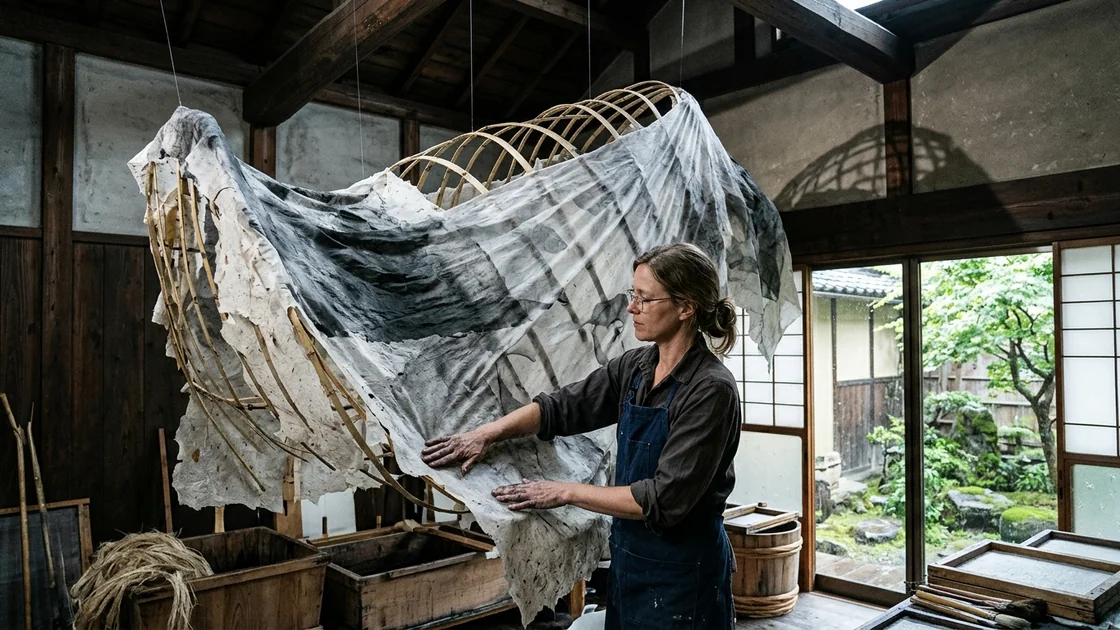
She used thin, flexible strips of split bamboo to construct an enormous, undulating rib-like skeleton that suspended from the heavy pine rafters by invisible monofilament lines. Over this skeleton, she was applying sheets of her own paper—not smooth, pristine sheets, but raw, heavy paper made from kozo she had scraped herself, mixed with fibers of abaca and Ohio milkweed she had carried across the Pacific in her crate.
She worked the paper while it was still wet, layering it over the bamboo bones, allowing the fibers to dry and shrink around the armature, puckering, tearing, and creating translucent membranes that caught the shifting light from the high north-facing windows.
Then came the ink.
She ground her own sumi ink every afternoon on an ancient, hollowed slate stone, adding drops of spring water, moving the solid ink stick in small, patient circles for forty minutes until the liquid was thick, oily, and smelled of pine soot and animal hide.
With broad horsehair brushes, she applied the ink to the drying paper membranes. She did not paint figures or calligraphy. She painted the record of pressure.
Some sheets were saturated until they turned a deep, lightless obsidian, bowing under the weight of the water and carbon. Others she touched with only the faint, watery ghost of gray—the color of morning frost in Wadsworth, the color of an empty bedroom, the color of a telephone that wouldn't stop ringing.
And the telephone did ring.
She had bought a Japanese SIM card for emergencies, giving the number only to Evelyn and David with strict instructions: text only, emergencies only.
For the first month, David had bombarded her.
Jan 18: Dad is refusing to let Evelyn make the eggs. He wants his poached eggs the way you do them. Call him. Jan 22: The garage door opener broke. Who was the guy who fixed it in 2021? Jan 29: Evelyn is asking for a tax form. I don't know where Mom’s old tax folders are. This is ridiculous Martha. Feb 04: Chloe has a track meet in Barberton on Friday. I have to work. Can you call Aunt Sarah to drive her?
Martha had looked at each message, felt the cold, familiar knot tighten in her belly, and then she had done something that felt like cutting off a finger:
She deleted them without replying.
She had told them what would happen. She had set the boundary with the precision of a surveyor’s laser. Every time she stepped in to solve an Ohio problem from northern Kyoto, she pulled the leash around her own neck.
On February 14th, the phone rang. A voice call. Not David.
Evelyn.
Martha picked it up, stepping out into the cold corridor overlooking the moss garden.
"Martha?"
"Hello, Evelyn. Is everything alright?"
There was a pause on the other end, the hollow transatlantic delay filled with oceanic static.
"Your father had a fall yesterday evening," Evelyn said, her voice measured, calm, refusing to participate in drama. "He tried to get out of the chair by himself to reach the remote control. He bruised his hip. No fractures. We took him to Wadsworth-Rittman Hospital for x-rays. He is back home now."
Martha leaned her forehead against the cool wooden post of the veranda. The scent of rain was rising from the garden stones.
"Did David come?" Martha asked.
"He came to the emergency room," Evelyn said, with a delicate inflection that told Martha everything. "He stayed forty minutes. He yelled at the triage nurse because the wait was two hours. Then he said he had a drywalling job and left. He told me I was being paid to stay the night, so I stayed."
"Thank you, Evelyn," Martha said, her voice shaking slightly. "The extra hours—put them on the invoice. Draw from the line of credit."
"I have already done so," Evelyn said. "Martha?"
"Yes?"
"Your father is very angry. He tells the doctors that you ran away with a cult. He tells the neighbors that you abandoned him to die in the snow."
A dry, bitter laugh escaped Martha’s lips. "Sounds like he’s recovering well."
"He is an old lion whose teeth are gone," Evelyn said softly. "He roars because he has nothing else. But you should know: he does not take the evening soup unless I sit where you sat. He misses you, though he would rather choke on his tongue than say the word."
Martha looked at the garden. A single camellia petal, deep red and thick as velvet, detached from a branch and fell into the wet moss below.
"I can't come back, Evelyn. Not yet."
"I did not ask you to come back," the African woman said firmly. "I raised four children and buried two husbands in Kumasi before I came to this country, Martha. I know what a sacrificial lamb looks like. You gave him twenty-six years. If you come back now, you will bury him, and then you will bury yourself. Stay where you are. Make your art. I will keep him alive until July."
Tears, hot and sudden, spilled over Martha’s lower lids, running down her cold cheeks and dropping onto the cedar deck.
"Thank you," Martha whispered.
"Send me a picture of the cherry blossoms when they come," Evelyn said, and hung up.
Part VI: The River and the Bone
Spring in Kyoto did not arrive as a calendar date; it arrived as a physical transformation of water and air.
The Kamo River, swollen with snowmelt from the northern mountains, rushed past the city bridges in a pale, turquoise torrent. Along the banks of the Shirakawa canal, the weeping willows turned an electric, yellow-green, their fronds trailing in the clear water like the hair of drowned girls.
Then came the sakura.
It was not the gentle, polite spring of Ohio, where dandelions speckled the crabgrass. In Kyoto, the cherry blossoms were a cataclysm: millions of pale, ivory-pink blossoms exploding across the temple hillsides, drifting through the air like warm, perfumed snow, coating the stone gutters, settling into the hair of commuters, floating on the surface of every cup of tea left by an open window.
In the residency, other artists had arrived for the spring term: Clara, a German textile weaver who worked with copper wire; and Julian, a conceptual artist from Montreal who spent his days recording the sound of rakes moving across the gravel of Ryoan-ji.
They invited Martha to join them for evening drinks at the tiny izakayas along Pontocho Alley, where skewers of chicken skin sizzled over binchotan charcoal and cold draft beer flowed in thick, sweating steins.
At first, Martha had declined, intimidated by their youth, their art degrees from prestigious European academies, their fluent command of contemporary critical theory. They talked of "relational aesthetics," "spatial interventions," and "the post-human landscape."
Martha knew only about the tensile strength of boiled mulberry and how to change an adult diaper without getting feces on the bedframe.
One evening in April, Clara had cornered her in the residency kitchen, pressing a glass of dry sake into her hand.
"Stop hiding in your studio, Martha," Clara said, her blue eyes flashing behind thick round frames. "You work like a demon. Noguchi says you have better hands than any fellow they’ve had in five years. Come drink with us. You are allowed to have fun. It is not against the residency contract."
Martha went.
Sitting in a smoky, subterranean tavern in Kiyamachi, tucked between Clara and Julian, Martha drank dry sake from a cedar box that smelled of forest floor. She listened to them argue about art, she laughed until her stomach ached at Julian's impression of an uptight Swiss curator, and she realized something astonishing:
They did not see a middle-aged drudge from Wadsworth, Ohio.
They saw an artist. They saw a woman with scarred, ink-stained hands who worked twelve hours a day building an installation of breathtaking scale and structural daring. They treated her ideas with respect; they asked for her opinion on fiber behavior; they listened when she spoke.
Later that night, walking home along the Kamo River beneath a moon half-veiled by cherry blossoms, Clara linked her arm through Martha’s.
"Your installation," Clara said, her breath smelling of roasted hojicha and plum wine. "The bones... they are a rib cage, yes? But not of a beast."
"No," Martha said, watching the river water break around a white stepping stone shaped like a turtle.
"A rib cage for a house?" Clara asked.
"For an invisible person," Martha said softly. "The person who holds up the roof, but whose name is never on the mortgage."
Clara squeezed her arm. "When the paper dries, it pulls the bamboo, yes? It bends it. It is under tension."
"If it doesn't bend, it breaks," Martha said. "The strength isn't in resisting the pull. The strength is in yielding just enough that the structure can bear its own weight without snapping."
Clara looked at her in the moonlight, her expression serious. "And you, Martha? Are you yielding, or are you breaking?"
"I’m drying," Martha said, listening to the rushing river. "I’m finally drying out."
In late May, the fellowship reached its fifth month. The rainy season (tsuyu) descended on the Kansai basin.
The rain was relentless, heavy, and warm. It drummed on the gray roof tiles for days on end, turning the moss garden into a shimmering, emerald lake. The paper in the studio took twice as long to dry, breathing in the humidity, swelling with moisture like a living lung.
Martha spent three weeks working exclusively on the skin of her installation.
She had abandoned the traditional brushes. She began to use her bare hands, dipping her palms into the vats of pure carbon ink, pressing them against the enormous hanging sheets of translucent kozo paper.
She left impressions: not clear palm prints like a child playing with finger paint, but smeared, dragging gestures—the marks of hands lifting, hands steadying, hands scrubbing, hands reaching for a doorknob that wouldn't open.
Over these handprints, she layered thin, veil-like sheets of bleached gampi paper—a paper so fine and lustrous that it was known in Japan as torinoko, "egg paper."
The effect was hypnotic and ghostly.
When the light passed through the installation from the garden windows, the dark, struggling handprints seemed buried deep beneath layers of pale, translucent ice. They were visible, undeniable, but transformed: no longer raw wounds, but fossilized labor, suspended in an amber of pure, quiet light.
Noguchi-sensei came into her studio on the last Friday of May.
He had never entered her personal studio space before. He had remained in the open-air pavilion, the master of the vats, maintaining a formal, professional distance.
He stood in the doorway, his rubber boots squeaking on the polished cedar boards, his old eyes sweeping over the massive, suspended paper monument that filled the room.
The installation was twelve feet tall, twenty feet long, curving through the center of the hall like the skeletal hull of a stranded ship, or the spine of a great white whale, floating two feet above the floorboards, anchored by invisible lines to the roofbeams.
Noguchi walked around it slowly. His walnut-shell hands were clasped behind his back.
He stopped beneath the main arch, where the Ohio milkweed fiber met the Japanese mulberry—a seam where the coarse, dark American weed had been beaten and woven into the luminous, silky Japanese bark, bonded together by nothing more than water, pressure, and the natural entanglement of cellulose.
He reached up. With a single, scarred forefinger, he touched the paper.
He felt the tension. He felt the balance between the pull of the bamboo ribs and the shrink-wrap grip of the drying bast fiber.
He closed his eyes for a moment, his finger resting on the seam.
Then he turned to Martha, who stood by the worktable, her heart in her throat, feeling like a schoolgirl awaiting judgment.
The old master bowed.
It was not the perfunctory nod he gave his assistants in the morning. It was a formal, ninety-degree bow from the hips, deep and solemn.
"Anata wa honmono da," he said in a low, gravelly voice.
He turned and walked out, his boots squeaking down the veranda.
Kenji, who had been watching from the doorway, had eyes as wide as saucers.
"What did he say?" Martha breathed.
"He said..." Kenji swallowed hard, looking at Martha with open reverence. "He said: 'You are the real thing.'"
Part VII: The Call in the Green Season
The exhibition opened on the first of July.
The residency opened its heavy cedar gates to the public for the Kitano Fellowship Summer Exhibition. Curators from Tokyo, gallerists from Osaka, tourists from France, and elderly Kyoto women in summer silk kimonos walked through the compound, their wooden geta clacking against the stone paths.
Martha’s installation was titled: The Weight of Paper and Rain.
The room was kept dark, save for the natural light filtering through the shoji screens on the courtyard side, and three low, floor-mounted spotlights that cast the shadows of the paper membranes onto the white plaster walls.
The shadows were vast. They looked like clouds, like mountain ranges, like the slow, seismic shifting of continents.
People stood inside the rib cage in silence.
A young Japanese woman in an olive linen dress stood beneath the central arch for fifteen minutes, her head tilted back, tears quietly streaming down her face, without making a sound.
When she stepped out, she bowed to Martha, who sat quietly on a low bench near the exit.
"Arigatou gozaimashita," the woman whispered in broken English. "It feels... like my grandmother’s house. But also... like being born."
Martha nodded. "Thank you."
At five o’clock, while the courtyard was still filled with visitors sipping cold barley tea, Martha’s phone vibrated in her pocket.
She slipped away into the quiet preparation room behind the studio.
It was David.
She looked at the screen. She hadn't spoken to him in six months. Their only communication had been terse, functional emails regarding the balance of the home-equity line and health insurance forms.
She pressed Accept.
"David."
"Martha?"
His voice sounded strange. It was stripped of its usual brash, grievance-laden speed. It sounded small. It sounded tired.
"What happened?" Martha asked, her body bracing automatically for the blow: Arthur was gone.
"Dad's in the hospital," David said.
Martha closed her eyes. She leaned against a shelf of dry washi sheets. "What is it?"
"Aspiration pneumonia. He had trouble swallowing his lunch on Tuesday. Evelyn caught it right away, called the paramedics. They have him on IV antibiotics."
Martha listened to the hum of the transformer on the residency wall.
"Is he in the ICU?"
"No," David said. "He’s on the regular floor. Room 314. But Martha... the doctor says his swallow reflex is failing. It’s part of the stroke damage progressing. They want to talk about a feeding tube."
Silence fell over the line, eight thousand miles wide.
"What did Dad say?" Martha asked.
"He can't talk very well with the oxygen mask," David said, his voice breaking suddenly, a raw, jagged sob tearing through his throat that startled Martha down to the bone. "He... he wrote something on a legal pad, Martha. With his left hand. It took him twenty minutes."
Martha gripped the phone. "What did he write, David?"
"He wrote: NO TUBES. CALL MARTHA."
David was crying now—openly, clumsily, like the twelve-year-old boy who used to scrape his knees on the concrete driveway and come running to her for iodine and gauze.
"Martha, I don't know what to do," David wept. "The doctors are asking all these questions about living wills and durable power of attorney, and the house smells like bleach and old soup, and Chloe won't come out of her room because she’s scared of how he looks, and I... I don't know how you did this. I’ve only been doing the nights and the weekends with Evelyn, and I feel like I’m losing my mind. I’m so tired, Mart. I’m so sorry. I didn't know."
Martha stood in the quiet room in Kyoto, looking down at her hands.
The calloused skin, the green-stained cuticles, the scars from the draw-knife.
She did not feel anger. She did not feel the sweet, petty rush of vindication she might have imagined six months ago.
She felt only an enormous, bottomless sorrow—and beneath the sorrow, an unshakeable, granite-like clarity.
"Listen to me, David," she said. Her voice was not the high, frantic chirp of the domestic servant, nor was it the icy wall of her December departure. It was calm, deep, and steady—the voice of a woman who had pulled strength from stone and cold water.
"I’m listening," he snuffled.
"Dad has a Do Not Resuscitate order. It is signed, notarized, and in the blue folder in the metal cabinet in the basement. It includes a specific refusal of permanent artificial hydration and nutrition. Do you understand?"
"He... he doesn't want the tube?"
"He told me ten years ago, when Mom was dying, that if he couldn't eat an ear of sweet corn or drink a cup of black coffee on his own, he didn't want to be tied to a machine. He was very clear, David. We honor his wishes."
David took a shuddering breath. "Okay. Okay. But... are you coming home?"
Martha looked through the high window.
The rain had stopped. The clouds over the northern mountains were breaking, shot through with beams of late-afternoon sunlight that turned the wet temple roofs of Kamigamo into plates of beaten gold.
Her fellowship ended on July fifteenth. It was July third.
"My flight arrives in Cleveland on July seventeenth," Martha said.
"July seventeenth?" David’s voice climbed into panic again. "Martha, that’s two weeks! What if he... what if he doesn't last two weeks?"
"Then tell him I love him, and hold his hand," Martha said gently. "And David?"
"Yeah?"
"You are forty-two years old. You are his son. You can do this. You have to do this."
She did not wait for his answer. She pressed End Call, slipped the phone into her linen apron, and walked back out into the gallery.
Part VIII: The Kintsugi of Return
Arthur Vance did not die.
Stubborn to the marrow of his bones, he survived the pneumonia, coughed up the fluid from his lungs, and by the second week of July was sitting up in his hospital bed, drinking thickened apple juice through a plastic straw and swearing at the physical therapist who was trying to make him squeeze a rubber ball.
When Martha walked into Room 314 on the afternoon of July eighteenth, the room smelled of floor wax, industrial chicken broth, and the faint, citrus scent of hand sanitizer.
David was sitting in the vinyl chair in the corner.
Her brother looked different. He had lost ten pounds. The pomade was gone from his hair, which was graying visibly at the temples, cut short and neat. He wore a clean flannel shirt and was reading a paperback book—an actual book, not scrolling on his phone.
When the door clicked open, David looked up.
He stared at his sister for three full seconds without speaking.
Martha had changed. She had lost weight, but her shoulders were pulled back, her spine straight as a bamboo spar. Her hair was cut into a sharp, chin-length bob that revealed the strong line of her jaw. Her face was tanned from walking through Kyoto’s summer sun, her wire-rimmed glasses replaced by a pair of simple tortoiseshell frames she had bought in a shop off Sanjo Street. She wore a simple charcoal-gray linen dress and leather sandals.
"Martha," David said, standing up.
He didn't make a joke. He didn't ask for keys. He walked across the room, wrapped his arms around her, and buried his face in her shoulder.
He was shaking.
Martha held him. She patted his back with her strong, ink-stained hands—firmly, three times, the way she used to when he was eight and had fallen out of the sycamore tree.
"Alright, David," she said softly. "Alright."
From the bed, a voice rasped:
"Look what the cat dragged in."
Martha stepped back from David and looked at her father.
Arthur was smaller. His skin had that translucent, paper-like fragility of men who have stepped to the very edge of the precipice and looked down. His right cheek drooped further, his eyes watery and red-rimmed.
Martha walked to the bedside rail.
"Hello, Dad."
Arthur glared at her, his jaw working, his mouth twitching as he searched for an insult, an accusation, a thunderbolt of fatherly condemnation that would re-establish the old order of the world.
"You took your time," he croaked.
"I had an exhibition," she said, pulling a wooden chair up to the bedside and sitting down.
Arthur looked at her clothes, her hair, the strange, calm stillness in her hands that rested loosely on her knees. He looked for the flinching, apologetic daughter who would jump if he dropped his spoon. She was not there.
"They had me on an IV," he grumbled, though the bluster was paper-thin now, an echo of an echo. "Felt like poison. Food here isn't fit for a dog."
"I know," Martha said. "Evelyn said you’re being discharged on Thursday."
Arthur looked away, out the window toward the gray parking deck of the hospital.
"David says you’re moving your stuff out," Arthur muttered, his voice dropping into the bedsheets.
Martha looked at David, who gave her a small, solemn nod.
"I’m renting the second-floor apartment above the bakery on Main Street," Martha said. "It has north-facing windows and high ceilings. I’m turning the living room into a papermaking and print studio."
Arthur’s hand gripped the hospital sheet. "And who’s going to live in my house?"
"David is," Martha said.
Arthur snapped his head around, looking at his son in genuine shock.
"Chloe’s moving in too," David said, stepping up to the other side of the bed. "She starts at Wadsworth High in the fall. It makes sense, Dad. I’m five minutes from the shop. Evelyn stays on for the mornings, I take the evenings. Martha comes on Sundays."
"Sundays?" Arthur repeated, as if the word were an insult. "Just Sundays?"
"Every Sunday," Martha said, reaching out and taking her father’s left hand—his good hand.
Her grip was firm, cool, and dry. It was not the desperate clutch of a servant seeking approval, nor was it the cold withdrawal of a runaway. It was the grip of an equal.
"I’ll come at noon," she said. "I’ll bring fresh bread from the bakery. We will have lunch. I will fill your pill organizer for the week. And then, at three o'clock, I will go back to my studio."
Arthur stared at their joined hands.
His thumb—thick, yellow-nailed, wrinkled—moved slowly across her knuckles. He felt the hard, raised calluses on her palms, the scars where the draw-knife had slipped on the winter mulberry bark.
"What did you do over there?" he asked, his voice cracking, the anger finally dissolving into a child’s bewildered curiosity. "In that Japan?"
Martha smiled. She looked out the window, past the parking deck, past the suburban telephone poles, seeing for a fleeting second the moss garden at Kamigamo, the cold river water rushing through the stone troughs, and the vast, white rib cage of paper floating in the dark shed, holding its own shape against the earth’s heavy pull.
"I learned how to make things that don't break when you bend them, Dad," Martha said.
She squeezed his hand once, then released it, resting her own hands comfortably in her lap, waiting for the afternoon sun to cross the floor.