The Weight of Ashes and Keepsakes
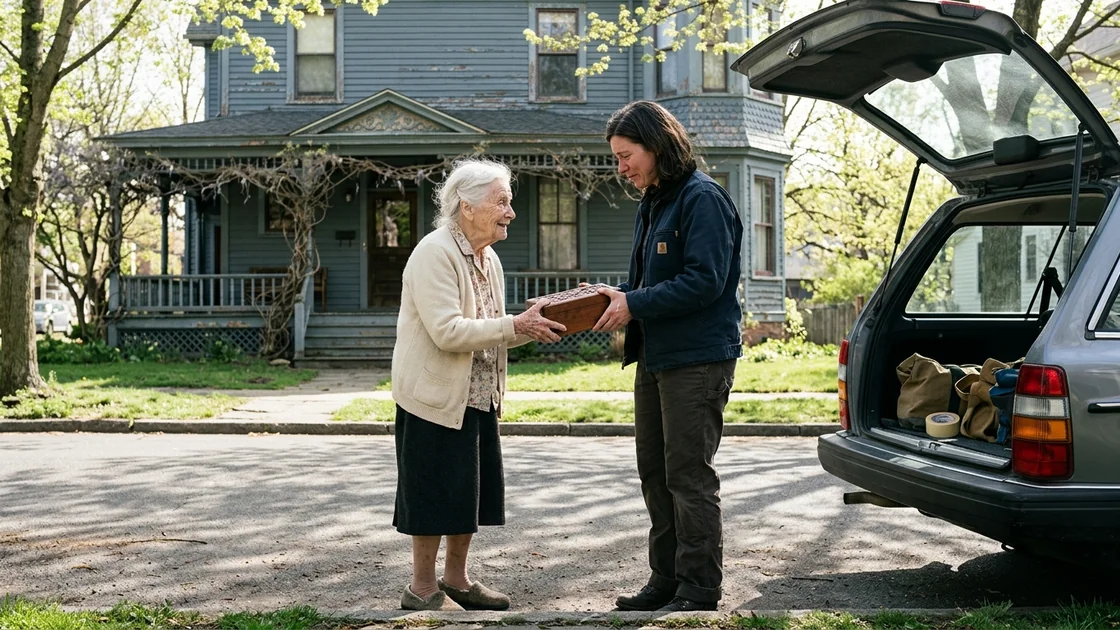
Clara Finch spent seven years learning how to exist in the wake of total absence after an electrical fire destroyed her home and every physical artifact of her past in twenty-four minutes. Instead of retreating from the material world, she turned her trauma into a vocation, establishing a decluttering practice that treated domestic accumulation not as household junk, but as the complicated architecture of human grief and memory. When she is hired by an anxious daughter to empty a rambling, three-story Victorian house in the historic district of Oakridge, Clara meets Martha Holloway, an eighty-two-year-old widow who has spent eighteen months frozen inside fifty years of her late husband's possessions. Over the course of four intense weeks, as the two women sift through geological layers of topographic maps, vintage clothing, handwritten correspondence, and forgotten family relics, Clara helps Martha navigate the agonizing boundary between remembering and drowning, while Martha quietly forces Clara to confront the unhealed phantom pain of the life she herself lost to the flames.
The fire had not made a dramatic sound at first. There had been no shattering explosion, no cinematic burst of timber, only a sound like dry leaves being crushed beneath a heavy boot on an autumn morning. When Clara Finch woke at three in the morning seven years ago, the hallway outside her bedroom was already filled with a dense, oily fog that tasted of scorched synthetic carpet and baked plaster. She had fled into the damp November night wearing only a cotton nightshirt and mismatched wool socks, carrying neither her telephone nor her purse, nor the wooden jewelry box her mother had carved from cherry timber before her hands grew too stiff with arthritis to hold a gouge.
By sunrise, the roof had collapsed into the basement, leaving behind a smoking chimney stack and a cellar hole filled with six feet of blackened sludge. The fire investigator had pointed a soot-stained gloved finger toward the charred remnants of the kitchen wall and spoken of arc faults, ancient aluminum wiring, and insulation rendered brittle by half a century of summer heat. Clara had stood on the opposite curb, wrapped in a blanket offered by an EMT whose name she never remembered, watching the water from the fire hoses freeze into gray rime upon the wreckage of thirty-four years of collected existence.
Every photograph of her childhood had vanished. Her grandmother’s recipe cards, handwritten in faded sepia ink with notes in the margins concerning almond extract and lard, were smoke. Her university diplomas, the dried carnation from her first dance, the sketchbooks filled with charcoal studies of the Atlantic coast, the blue ceramic bowl she had bought on an impulse during a rainy weekend in Vermont—all of it had returned to carbon in under an hour.
In the months that followed, friends and well-meaning relatives had offered platitudes that felt like blows. At least you got out, they said. Things are just things. You can replace possessions, but you can’t replace a life.
Clara had nodded politely, but she knew the platitudes were a defense mechanism against a terrifying truth: we anchor our identities to the tangible world. When an object vanishes, the memory attached to it becomes unmoored, drifting into the fog of the mind where it slowly loses its edges, its colors, and its weight. Without her books, Clara struggled to remember what she had believed at twenty-two. Without the worn linen napkins her aunt had given her, she could no longer summon the exact pitch of her aunt’s laughter. She had experienced the terrifying weightlessness of the unburdened.
Yet, as the years passed, an unexpected shift occurred within her. She lived in a sparsely furnished apartment where every item was chosen with deliberate, almost surgical precision: one iron skillet, two porcelain mugs, a single linen throw blanket, a shelf containing twelve books she read and re-read until the spines broke. She discovered that while the sudden loss of everything had nearly crushed her, the subsequent emptiness possessed a peculiar, austere peace. She did not fear empty rooms. She understood the language of space. When she started her business, which she named Finch Estate Logistics, she avoided the sunny, pastel-hued branding of television organizers who promised that clear plastic bins could cure the human condition. Clara did not sell aesthetic minimalism. She offered psychic demolition and historical preservation. She was an archaeologist of domestic ruins.
Her telephone rang on a Tuesday in late March. The voice on the other end belonged to a woman named Abigail Holloway, calling from an office in Chicago.
"My mother is eighty-two," Abigail said, her tone a brittle composite of exhaustion and thinly veiled exasperation. "My father died eighteen months ago. His name was Arthur. He was a civil engineer, an amateur surveyor, a collector of antique instruments, and a man who literally never discarded a receipt, a newspaper, or a broken brass screw in his entire life. The house is four thousand square feet. My mother cannot walk down the center hall without turning sideways. She’s sleeping on a sofa in the back den because his clothing is still piled on their bed. The city inspector came by last week about a code complaint regarding the porch, looked through the side window, and issued a warning about safety hazards. If I can't get that house cleared out by the end of April, Adult Protective Services or the municipal board will step in. I can pay whatever your rate is, Miss Finch. Just… bring a crew and a dumpster. Empty it."
"I don't bring dumpsters on the first day, Mrs. Holloway," Clara said, leaning back in her austere desk chair. "And I don't empty houses without the person who lives there."
"You haven't seen it," Abigail said with a dry, humorless laugh. "My mother will defend a broken pencil sharpener like it’s the Ark of the Covenant. If you wait for her permission to discard anything, you'll be there until the next century."
"Then we will start by looking at the pencil sharpener," Clara replied evenly. "If you want someone to haul your parents' lives to a landfill while your mother sits in a car weeping, you’ve hired the wrong firm. But if you want the house made safe and your mother treated like a human being who has survived an earthquake, I can be there Thursday morning."
There was a long silence on the line before Abigail let out a ragged breath. "Thursday. At nine. Her name is Martha. Don't let her offer you peppermint tea. She’s had the same tin of it since 1994."
Hawthorne Terrace was a street that time had treated with an ambivalent hand. Once the premier residential avenue of Oakridge, lined with towering American elms that had succumbed to blight in the late twentieth century, it was now shaded by unruly silver maples whose roots buckled the slate sidewalks. Number 414 was a towering Queen Anne Victorian painted a weathered slate-blue, its decorative gingerbread trim peeling in scalloped flakes like dried skin. The porch was broad, shaded by overgrown wisteria vines whose woody, serpentine trunks had begun to wrench the balusters out of alignment.
Clara parked her modest gray station wagon at the curb. She sat for a moment with the engine idling, watching the windows. In the second-floor dormer, a lace curtain twitched, then fell still.
Clara opened her kit in the back of the wagon. Her tools were simple: cotton inspection gloves, a heavy-duty tape gun, several rolls of acid-free tissue paper, a notebook with gridded pages, a fountain pen filled with permanent black ink, and a small brass plumb bob she carried like an amulet—a physical reminder of true verticality in crooked spaces.
She walked up the wide porch steps, her boots sounding hollow on the painted floorboards. The bell was an old twist-chime set into the center of the oak front door. When Clara turned the brass handle, it gave a muffled, metallic clatter inside the house, like a spoon dropped into an iron kettle.
Minutes passed. Clara waited patiently. One of the first lessons of her trade was that hurry was an act of violence against the grieving.
A bolt scraped back with the sound of metal groaning through years of accumulated grease. The door swung open six inches, restrained by a heavy brass chain. In the aperture appeared an eye—pale, milky blue, surrounded by a spiderweb of fine wrinkles—and a tuft of uncombed white hair.
"I am not buying magazines," a voice said. It was dry, raspy, and carried the brisk, sharp cadence of someone who had spent decades correcting grammar. "Nor do I require salvation from the Seventh-day Adventists, though if you happen to have a crowbar, you might assist me in prying my recycling bin away from the raccoons."
"Mrs. Holloway? I’m Clara Finch. Your daughter Abigail arranged for us to meet this morning."
The eye shifted. The chain rattled, then fell slack as the door opened another foot.
Martha Holloway was a small woman, no more than five feet tall, but she held her shoulders with a rigid, defensive dignity. She wore an oversized olive-drab cardigan with leather buttons—plainly a man’s sweater, its sleeves rolled up three times to reveal wrists as thin and white as birch twigs. Beneath the cardigan, her blouse was buttoned to the throat, patterned with faded yellow sprigs of lavender. Her slippers were felt, worn down at the heels.
"Abigail sent you," Martha said, her gaze raking over Clara’s canvas trousers, dark work jacket, and boots. "The executioner arrives in sensible footwear. Did she tell you I was mad? She uses the word 'hoarder' when she speaks to her brother on the phone. She thinks I can't hear her because my right ear is failing, but I hear quite well enough to know when my children are measuring me for a pine box."
"She told me you were eighty-two, that your husband Arthur passed away eighteen months ago, and that the house has become dangerous to navigate," Clara said softly. "She didn't say you were mad. She said you were grieving."
Martha snorted, though her fingers tightened around the wool hem of the cardigan. "Grief doesn't fill a hallway with three decades of the Journal of Applied Geodesy, Miss Finch. Gravity and inertia do that. Well, don't stand out there letting the damp into the foyer. Come in, if you can squeeze through the breach."
Clara stepped across the threshold, and the smell of the house enveloped her like an old coat that had hung too long in a root cellar. It was a complex, layered atmosphere: dried paper, floor wax, the faint rancid grease of cold mutton, lavender soap, mouse droppings, and behind it all, the sweet, heavy, unmistakable odor of dry rot and dust mites.
The entrance hall was a canyon. On either side, stacks of magazines, banker’s boxes, and cardboard cartons from long-defunct grocery stores rose to shoulder height. Narrow passages had been carved through the sediment, barely wide enough for a human pelvis. On the wall above the paper strata, the original hand-blocked William Morris wallpaper—a pattern of acanthus leaves and pomegranate blossoms—peered out like ancient frescoes revealed in an excavation trench.
"We don't go into the double parlor," Martha remarked casually, shuffling ahead of Clara with a hand lightly grazing the wall for balance. "The floorboards in the center of the room have an alarming amount of give. Arthur always meant to sister the joists from below, but then he got his hip replaced in ninety-nine, and one thing led to another. Mind that carton on your left—it contains Arthur’s glass lantern slides from the river basin survey of seventy-two. If you step on them, they make a terrible crunching sound that sets my teeth on edge."
Clara followed the small woman down the corridor, her trained eyes noting the hazards: a stack of yellowed National Geographics leaning precariously toward an exposed baseboard heater; an antique floor lamp with a frayed silk cord running beneath a threadbare runner; stacks of opened correspondence balanced on the seat of a carved walnut hall chair.
They emerged into the kitchen, which appeared to be the operational headquarters of Martha’s life. Here, the accumulation took a different form. The kitchen table, a massive porcelain-topped dropleaf from the 1940s, had only a ten-inch square cleared at one corner, where a single ceramic mug and an open box of saltine crackers sat beside an electric kettle. The rest of the table was buried beneath plastic pill bottles, rubber bands looped around old wooden spools, coupons clipped from newspapers that had ceased publication a decade prior, and dozens of glass jars filled with dried beans, buttons, rusty washers, and peach pits.
"Sit," Martha commanded, gesturing vaguely toward a ladder-back chair whose wicker seat had been reinforced with a piece of corrugated cardboard. "I don't have milk. The milkman stopped coming in eighty-six, and I find the modern grocery store an assault on the senses. Too many bright lights. Everyone moves like waterbugs."
Clara did not sit immediately. Instead, she set her kit down on the clear corner of the table, making sure not to disturb the crackers. She took off her jacket and folded it neatly over the back of the chair.
"I don't need tea, Mrs. Holloway," Clara said. "And I'm not here to throw anything away today."
Martha paused, her hand hovering over the kettle’s switch. She looked at Clara with squinted, suspicious eyes. "Abigail told me you were going to bring three large men with shovels and a hydraulic lift."
"Abigail is three hundred miles away and very frightened for your life," Clara said. "When people are frightened, they think in terms of blunt instruments. I don't work with shovels. I work with hands."
"And what, pray tell, do your hands do that my hands haven't managed for fifty-two years?"
Clara held out her palms. They were calloused, the skin along the thumbs hardened from cardboard edges and packing tape. Across the back of her left hand ran a pale, three-inch scar—the legacy of a jagged pane of glass she had broken through on the night her world turned to soot.
"My hands listen," Clara said. "And when something has finished telling its story, they help it go where it belongs."
Martha stared at Clara's hands for a long moment. A muscle in the old woman’s jaw worked, small and stubborn. "A poetic scavenger," she muttered, turning back to the kettle. "Arthur would have hated you. He had an absolute horror of metaphor. When he looked at a hill, he saw forty-two yards of shale, an eight-percent grade, and an adequate site for a culvert. He didn't see poetry."
"Did he see you?" Clara asked gently.
Martha’s back went stiff. The water in the kettle began to hum, a rising whistle of steam cutting through the dense air of the kitchen. "Arthur saw everything," she whispered, her voice dropping into an octave Clara had not yet heard—one stripped of theatrical cantankerousness. "He saw so much of the world that he couldn't bear to let any of it slide into the dark. That was his trouble, you see. He remembered everything. And when you remember everything, you cannot discard a single shred of paper, because to throw it away is to admit that the Tuesday on which it was written is dead and gone forever."
They began not in the attic or the basement—the two traditional poles of accumulation—but in the small library off the entrance hall, a room Martha called "The Map Depository."
"Arthur worked for the Department of the Interior for thirty-five years," Martha explained, standing in the doorway while Clara assessed the room. "Then he consulted for the state highway commission. When the state shifted to computer mapping in the nineties, they were going to pulp five thousand original linen-backed quadrangle maps from the thirties and forties. Arthur rented a trailer. He spent three weekends hauling them here. He said that satellites don't understand the texture of mud. He said a digital map doesn't know where the wild plum trees grow along the creek beds."
The room was suffocating. Flat drawers from surveyor's cabinets had been stacked six feet high, their weight bowing the floorboards until the room seemed to tilt toward the bay window. Between the metal cabinets, rolls of blueprint paper, tied with brittle cotton twine, stood like bamboo groves in tall wicker laundry hampers. Dust lay upon every horizontal surface like velvet, gray and undisturbed.
"Where do we start?" Martha asked, her voice tight, arms wrapped around herself as if facing a cold wind. "I suppose you have colored stickers? Red for the incinerator, green for the salvation army?"
"No stickers," Clara said. She pulled on her thin cotton gloves. "Stickers turn an object into an argument. We start by establishing three categories of truth. The first is The Anchor—items that hold you to the present, things you need to feed yourself, wash yourself, keep warm, and remain safe. The second is The Archive—things that carry genuine historical or personal weight, which must be protected, preserved, and eventually shared. The third is The Wake—the debris left behind by a ship that has already passed. The wake is not the journey, Martha. It’s just the foam on the water."
"Arthur was not a ship," Martha said sharply.
"No," Clara agreed, looking around at the sea of paper. "He was the passenger. And he’s already reached the other shore. This is what was left on the dock."
Clara approached the nearest wicker hamper. She reached into the center of the rolled documents and pulled out a single tube of blue linen. The twine snapped between her fingers like dry grass. She cleared a small space on top of a metal cabinet, using a soft-bristled horsehair brush to sweep away the thick layer of dust into a small copper pan.
She unrolled the sheet. It was a hand-drawn map of the Blackwater River basin, dated October 14, 1958. The ink was India black, the contour lines rendered with a technical pen so fine that the topography looked like the thumbprint of a giant. In the lower right corner, in precise, slanted draftsman’s block lettering, was the signature: A. E. Holloway, Field Surveyor.
Martha leaned in, despite herself. Her spectacles, which hung from a black cord around her neck, were hastily shoved onto her nose. Her breath caught.
"He drew this the month after we were married," she whispered. Her fingers hovered an inch above the ink, not daring to touch the paper. "He was gone for three weeks in the bottomlands. He came home with his legs covered in chigger bites and his boots smelling of river silt. He brought me a wild turkey feather in the pocket of his field jacket. I kept it in a jelly jar on the windowsill until it crumbled to dust."
"Look at the margin," Clara said, pointing a gloved finger.
In the white space beside the legend, Arthur had written three tiny letters in pencil: M. E. H. Below them, a minuscule coordinate: 38°12'N, 84°44'W.
"What is that coordinate?" Clara asked.
Martha closed her eyes. The skin of her eyelids was translucent, crisscrossed with tiny purple veins. "The bluff overlooking the bend in the river. He took me there on a Sunday before the rains started. We had ham sandwiches wrapped in wax paper and an apple we cut with his pocketknife. He told me that if you sat there long enough, you could see the red-tailed hawks catching the thermals off the limestone cliffs."
She opened her eyes, and they were wet with unshed tears. "Is that an anchor, an archive, or a wake, Miss Finch?"
"It’s an archive," Clara said gently. "It is the record of Arthur’s labor and his love. But Martha, does Arthur need fifty copies of the same quadrangle map to keep that memory alive?"
Clara turned to the hamper. She slid out another tube. It was an identical print of the Blackwater River basin, dated 1958. She pulled out another. A third. A fourth. A fifth. In that single basket, there were twenty-two copies of the same survey sheet, all pristine, all untouched since they were bundled sixty-six years ago.
"The state printer made an overrun," Martha confessed, looking away from Clara’s face. "Arthur couldn't bear to see them go into the scrap bin. He said they were works of art."
"They are works of art," Clara said. "And works of art belong where they can be seen. How many regional historical societies or university geography departments do you think have a complete set of Arthur’s original hand-drawn field surveys from the fifties?"
Martha blinked. "The university? In Lexington?"
"Perhaps. Or the state archives. But they don't need twenty-two copies of the Blackwater basin. They need one. The best one. The one with your initials in the margin."
Clara took a flat acid-free cardboard portfolio from her kit. She carefully laid Arthur’s signed map inside.
"This is the Holloway Archive," Clara said, writing Arthur’s name and the date on the exterior of the portfolio with her fountain pen. "This stays with you until we find a permanent home for it where young surveyors can study the precision of his line. Now, what do we do with the twenty-one duplicates?"
Martha looked at the bundle of maps. Her hand reached out and touched the blue linen. Clara saw the struggle played out across the old woman’s face—a silent, visceral war between the terror of letting go and the sudden, sweet relief of purpose.
"The recycling center?" Martha asked, her voice barely louder than the rustle of the paper.
"The recycling center," Clara agreed. "They will be made into new paper. Someone else will write a letter on them, or draw a house, or wrap a gift for a child. Arthur’s ink will be gone, but the trees won't be wasted."
Martha took a deep, shuddering breath. She picked up the bundle of duplicate maps herself. Her arms trembled under the weight, but she held them. She walked to the large canvas laundry cart Clara had wheeled into the hallway. With a deliberate, agonizing slowness, Martha lowered the bundle into the cart.
The sound of the paper striking the bottom of the canvas was quiet, but to Clara’s ears, it sounded like the crack of an ice shelf breaking in the spring thaw.
Martha stood over the cart for a full minute, her head bowed. Then she turned back to the room, pulled her sweater tighter around her chest, and wiped her nose with a linen handkerchief pulled from her sleeve.
"The next drawer," she said, her voice steadier now, "contains the topographic surveys of the Cumberland Plateau from sixty-three. Arthur broke his collarbone during that one. He fell down a scree slope chasing an apprentice who had dropped the theodolite."
By the end of the fourth day, the Map Depository was transformed.
Clara had not worked quickly. She had learned long ago that speed was the enemy of true decluttering; speed produced panic, and panic produced a rebound effect that left clients clinging to their remaining possessions with hysterical ferocity. Instead, they worked for three hours each morning, paused for an hour of lunch—during which Clara insisted that Martha eat actual food, bringing vegetable soups and dark bread from a bakery near her own apartment—and then worked for two hours in the afternoon.
They had filled twelve large canvas bins with obsolete duplicates, damp-damaged drafts, and thousands of blank forms from the Department of Transportation that had yellowed into uselessness. But they had also created five acid-free portfolios containing ninety-four exquisite, hand-rendered cartographic works, each signed by Arthur, each labeled and cross-referenced with his surviving field journals.
On Friday afternoon, the archivist from the regional university library arrived in a van. His name was Dr. Christopher Vance, a man in his forties with thick spectacles and an infectious enthusiasm for pre-digital cartography.
When Martha showed him the portfolios laid out on the newly cleared center table, Dr. Vance had gasped. He had pulled a magnifying loupe from his pocket and spent twenty minutes on his knees, examining the line work of the 1961 Red River Gorge survey.
"Mrs. Holloway," Vance had said, his face glowing with genuine reverence, "this collection bridges the gap between the historic land-grant surveys and modern aerial photogrammetry. We have the state records, of course, but the state records only kept the final printed editions. These field drafts show the decision-making process. The marginalia alone is an extraordinary historical resource. We would be honored to establish the Arthur E. Holloway Collection in our special collections department. He will have a permanent catalogue entry, accessible to researchers worldwide."
Martha had stood beside the table, her hand resting on the corner of the portfolio. Clara watched her profile. The bitterness that had curled the corners of the old woman’s mouth on Tuesday was absent; in its place was a quiet, luminous pride that seemed to smooth away ten years of grief.
"He always said," Martha told the archivist, "that a line on a map was a promise between the surveyor and the man who walked the land after him. He didn't want anyone to get lost because he had been lazy with a transit."
"No one will get lost with these, Mrs. Holloway," Vance said gently.
When the university van drove away with the portfolios secured in padded crates, Martha stood on the porch, watching until the red taillights vanished around the curve of Hawthorne Terrace. The space behind her in the entrance hall was visibly larger; three hampers of blueprints were gone, replaced by a strip of polished parquet flooring that hadn't seen daylight since the Carter administration.
"You tricked me, Miss Finch," Martha said, not looking back.
"Did I?"
"You made me feel as though I were giving a gift, when in reality I was simply taking out the rubbish."
"The rubbish was the twenty-one duplicates that were rotting in the damp," Clara said, leaning against the porch railing. "The gift was the ninety-four maps that are now safe from mice and mildew. You didn't lose Arthur's work today, Martha. You rescued it."
Martha turned around. She looked at the open front door, then at Clara. For the first time, she did not look like an adversary defending a redoubt. She looked like an old woman who was very, very tired.
"The parlor is next, isn't it?" she asked.
"Only if you’re ready," Clara replied.
"I will never be ready," Martha said, her voice dropping into that quiet, desolate hollow. "The parlor is where we kept the music. And Arthur's sister’s things. And the children’s schoolwork. If we open that door, Miss Finch, the house will realize that it is being dismantled, and I am not sure the walls can stand the disappointment."
The second week was the week of textiles and paper.
The double parlor had two sets of pocket doors made of heavy, solid chestnut, but they had been jammed open with wooden wedges thirty years ago and could no longer be moved. The room was long and narrow, featuring two black slate fireplaces with incised floral designs, and three high, arched windows that looked out into the tangled wilderness of the back garden.
Here, the silt of fifty years was different. Arthur had been a musician as well as an engineer. A carved upright Bechstein piano from Berlin sat against the north wall, its mahogany veneer crazed like dry mud, its keys yellowed and sunken in the middle octaves. On top of the piano, sheet music was stacked like shingles on a neglected roof: Bach suites, hymns, arrangements of Scottish ballads, fiddle tunes scribbled on the backs of receipts, and thick, cloth-bound volumes of Beethoven sonatas whose bindings had rotted into reddish powder that smeared on the fingers like dried paprika.
Beside the piano stood two cello cases—one of battered black plywood with rusted iron clasps, the other a modern fiberglass shell covered in luggage stickers from Munich, London, and Edinburgh.
And then there were the boxes.
There were seventy-three cardboard boxes in the parlor, stacked three and four deep against the bookcases. They were labeled in Arthur’s distinctive draftsman’s hand: Letters, 1960–1964; Bank Statements, Old House, 1971; Tax Returns, Discard after 1985 (Keep); Receipts, Lumber and Hardware, 1978–1983; Abigail’s Drawings, Kindergarten; Thomas’s Letters from Camp, 1976.
Clara brought two folding tables into the room, setting them up by the tall windows where the morning light was clearest. She also brought four large plastic tubs labeled with white vinyl tape: Retain, Donate, Recycle, Family Review.
Martha sat in a low armchair by the unlit fireplace, wearing a different man’s shirt today—this one a faded blue chambray with ink stains on the pocket. She held a cold cup of tea in her lap, her eyes fixed on the boxes.
"Arthur’s brother died in sixty-eight," Martha said, her voice flat, conversational, yet brittle as spun glass. "In the Mekong Delta. He was twenty-one. His name was Julian. When Julian died, his mother couldn't bear to look at his footlocker. She sent it to Arthur. Arthur put it in that corner. Then his mother died in seventy-four, and her household goods were shipped here in a moving van. Arthur didn't want to go through them because he was working seventy hours a week on the interstate bypass. So he put them in this room. Then my mother died in eighty-one, and her linens and her silver plate came here. We were going to sort them in the summer. We always said we would do it in the summer, when the days were long and the children were at the lake. But the lake summers were for swimming, and then the children were in college, and then Arthur had his first bypass surgery, and the doctors said he shouldn't lift anything heavy, and he shouldn't be subjected to emotional distress."
She looked at Clara, her chin trembling slightly. "Do you know what emotional distress is, Miss Finch? It’s looking at a box of tea towels that your mother hemmed with her own hands when she was twenty, knowing that if you use them, they will wear out, and if you give them away, someone will use them to wipe grease off an engine, and if you keep them in a box, they will yellow and rot and nobody will ever know that she had the straightest hemstitch in Montgomery County."
Clara did not answer with words. She walked to the stack labeled Linens, Mother, 1981. She used a box cutter to slit the ancient brown paper tape. The flaps lifted with a dry sigh.
Inside, wrapped in layers of tissue that had turned the color of weak cider, were dozens of linen tea towels, tablecloths, damask napkins, and pillowcases with scalloped lace borders. Clara lifted the top towel. It was crisp, white linen, cold to the touch, scented faintly of camphor and lavender.
Clara walked across the room, knelt beside Martha’s chair, and laid the towel across the old woman’s lap.
"Touch it," Clara said.
Martha’s hands, spotted with age and stiff with arthritis, hesitated. Then her fingers sank into the linen. Her thumbs traced the tiny, microscopic stitches along the folded edge.
"She used to sit on the back porch," Martha whispered. "In the late afternoon, when the sun was behind the barn. She didn't use an embroidery hoop. She said a hoop was for amateurs who couldn't control their tension. She did every stitch by eye."
"It’s exquisite," Clara said.
"She’s been dead forty-three years," Martha said, a tear finally escaping her eye and tracking down the deep crease beside her nose. "Forty-three years, Miss Finch. And this towel has spent all of that time in the dark. It hasn't seen the light. It hasn't dried a single dish. It hasn't sat beneath a loaf of fresh bread. What was she saving it for? What was I saving it for?"
"She wasn't saving it for an apocalypse, Martha," Clara said gently. "She made it to be used. When we lock things in the dark because we're afraid of hurting them, we aren't honoring them. We’re burying them alive."
Clara reached into the box and took out five more towels. She set them on Martha’s side table.
"You have six tea towels here," Clara said. "You will use them. Every day. When you wash your teacup, you will dry it with your mother’s stitches. When you spill soup, you will wipe it with this linen. And when it wears thin, and the threads finally break, it will have died an honorable death in the light, doing what it was made to do."
Martha looked horrified and fascinated all at once. "Use them? On everyday messes?"
"Yes."
"And the rest?" Martha looked at the box, which contained at least fifty more towels and three large banquet cloths.
"Abigail has a home. Does she want a tablecloth?"
"Abigail lives in a high-rise condominium with glass tables and stainless steel," Martha scoffed. "She says ironing is a tool of the patriarchy."
"Does Thomas have children?"
"Thomas lives in Seattle. His daughter is getting married in September." Martha stopped. Her pale eyes widened slightly. "A wedding."
"A wedding gift," Clara said. "A cedar chest with twelve of her great-grandmother’s hand-hemmed linens, accompanied by a letter written by you, explaining whose hands made them and why the tension of the stitches matters. That is an archive, Martha. That is a legacy. The remaining thirty towels will go to a women’s shelter in town. Not to wipe engines, but so that a woman who has had to leave everything behind can dry her children's faces with real linen instead of cheap paper."
Martha looked from the towel in her lap to the box, and then to Clara. Her breath hitched in her chest. "You make it sound so… tidy. So simple."
"It’s not simple," Clara said, standing up. "It’s excruciating. It’s like pulling splinters out of your own heart. But if you leave the splinters there, Martha, the wound festers, and eventually you can’t move at all."
They worked through the parlor for eight days.
The boxes of tax returns from the 1970s and 80s were shredded—sixty-two pounds of paper that had outlived every statutory requirement and every person who had audited them. Arthur’s check registers, which recorded the purchase of groceries, gasoline at thirty-four cents a gallon, dental fillings, and plumbing supplies, were recycled.
Martha wept over the receipts from 1974.
"Why are you crying for an oil change from fifty years ago?" Clara asked, sitting beside her on the floor, surrounded by piles of discarded paper.
"Because I remember the car," Martha sobbed, her fingers clutching a faded pink receipt from a Texaco station in Knoxville. "It was a blue Dodge Dart. The driver’s side door handle was loose. Arthur had wrapped it in black friction tape. We drove that car to the Smoky Mountains when Thomas was five and Abigail was three. Abigail threw up in the back seat because she ate too many cherries. Arthur didn't get angry. He stopped by a creek, took the seat cushion out, and washed it in the mountain water with a bar of yellow soap. We sat on the gravel by the water and ate the rest of the cherries while the upholstery dried in the sun."
She squeezed the receipt until it was a tiny wad in her palm. "If I throw this paper away, does that creek stop running? Does Arthur washing that seat disappear?"
Clara reached out and took Martha’s small, cold hand between both of her own. She held it firmly, feeling the thin bones, the paper-like skin, the pulse fluttering at the wrist.
"Martha, look at me."
The old woman looked up, her face blotched and wet.
"Seven years ago," Clara said, her voice steady and clear, "I lived in a white house on Maple Street. I had a cedar chest that my mother had carved. Inside it, I had letters from my father when he was overseas. I had my high school diaries. I had every card my husband ever gave me before he left me. I had photographs of my grandparents sitting on their porch in Maine in 1948. At three in the morning, an electrical wire in the kitchen wall caught fire. In twenty-four minutes, every single one of those things became soot."
Martha’s eyes widened. She stared at Clara’s face, searching it.
"I didn't lose them to a careful decluttering," Clara continued. "I didn't get to choose what was archived and what was recycled. I stood on the sidewalk in my nightshirt and watched them burn until they were grey ash that the wind blew across the neighbor’s lawn. I didn't have a single scrap of paper left. Not a receipt. Not a photograph. Not a button."
"Oh, my dear," Martha whispered, her own grief momentarily suspended by the horror of the narrative.
"I thought I had been erased," Clara said. "I thought that because the physical objects were gone, the memories would starve to death. I spent six months waiting for my past to evaporate. But do you know what happened, Martha?"
Martha shook her head slowly.
"The memories didn't starve," Clara said. "They got sharper. When I stopped leaning on the paper to remember for me, my mind had to do the work. The creek in the Smokies doesn't live in that Texaco receipt, Martha. The receipt is just wood pulp and cheap dye. The creek lives in your head. It lives in the smell of the yellow soap and the cold mountain water and the taste of the cherries. Arthur washing that seat is alive as long as you can see his sleeves rolled up and his hands in the water. The paper isn't the memory. The paper is the tombstone. And you don't need fifty rooms full of tombstones to know who you loved."
Martha looked down at the crumpled pink receipt in her fist. Her fingers slowly uncurled. The paper lay in her palm, wrinkled and insignificant.
She let it drop. It fell into the blue recycling bin between them with a tiny, imperceptible flutter.
"He had broad shoulders," Martha whispered, staring into the bin. "And when he worked with his hands, he always hummed that wretched Scottish tune about the boatman. He was always off-key. He couldn't carry a tune in a bucket, but he played the cello like an angel."
"Then let's look at the cello," Clara said.
The upright Bechstein piano could not stay in the house; the damp had cracked the pinblock, and three independent piano technicians confirmed that it would cost ten thousand dollars to make it hold a tune again. But Clara did not send it to a dump. She found a collective of local artists who converted unplayable Victorian instruments into sculptural shelving and desks for a community art center.
The two cellos, however, were another matter.
Dr. Vance, the archivist, had put Clara in touch with the chair of the music department at the state conservatory. On a Tuesday morning, a young woman named Elena Ramos arrived at Hawthorne Terrace. She was twenty-four, with dark, intense eyes and hands that moved with the disciplined grace of an athlete. She was working on her master’s degree in cello performance, playing on a borrowed, low-grade student instrument that buzzed in the C-string register.
Elena knelt beside the fiberglass case that Clara had laid out on the parlor floor. Martha stood back, leaning heavily on her walking stick, her mouth set in a firm, uncertain line.
When Elena popped the latches and opened the case, the instrument inside seemed to draw the light into itself. It was an early twentieth-century German cello, crafted from deep, reddish-brown spruce and flamed maple. It bore scratches along the lower bouts—scars from Arthur’s cuff links and belt buckles—and the varnish on the back of the neck was worn down to the bare, silky wood where his left thumb had rested for sixty years.
Elena looked up at Martha, her eyes wide with a question she didn't dare articulate.
"Arthur bought it in Munich in 1954," Martha said, her voice trembling despite her effort at detachment. "He was with the Army of Occupation. He spent three months’ pay on it. He didn't have enough money left for a proper winter coat, so he wore two sweaters under his field jacket until the spring. He played in the municipal orchestra for thirty years. Every Thursday night was rehearsal. Every Sunday morning he played the Bach suites while I made pancakes."
"May I?" Elena whispered.
Martha nodded once, stiffly.
Elena lifted the instrument with exquisite care. She sat on the edge of the straight-backed dining chair Clara had brought in. She retrieved Arthur’s bow from the case, checked the tension, touched the rosin cake to the horsehair, and settled the endpin against the bare floorboards.
She closed her eyes. She drew the bow across the open strings.
The sound that filled the high-ceilinged parlor was not the sound of dust and decay. It was a rich, dark, resonant baritone, vibrating through the floorboards, through the soles of Clara’s boots, and through the wooden handle of Martha’s walking stick. The house seemed to hold its breath. The acanthus leaves on the Morris wallpaper, the tall windows, the dark slate mantelpieces—all of them seemed to receive the vibration like an ancient, familiar language spoken after decades of silence.
Elena played the prelude to Bach’s first cello suite. She played it with a hungry, youthful brilliance, but also with a profound reverence for the wood beneath her fingers.
Clara looked at Martha.
The old woman stood perfectly still, her knuckles white upon her stick. Tears were streaming down her face, pooling in the crevices around her mouth, falling unchecked onto the blue chambray shirt. But she was not weeping with the frantic, clawing despair of the first week. Her face was open, unguarded, transfigured by the sound.
When the final G-major chord died away, Elena did not move for several seconds. Her bow hovered above the strings, catching the dust motes that spun in the shaft of sunlight from the south window.
"It has a soul," Elena said softly, her voice shaking. "It’s been sleeping, Mrs. Holloway, but it has the most magnificent soul."
Martha took three slow, deliberate steps forward. Her slippers made no sound on the floor. She reached down and touched the scroll of the cello—the delicate, hand-carved spiral of maple that crowned the instrument.
"Arthur’s fingers were large," Martha said, her voice clear and resonant in the quiet room. "They looked like an engineer’s fingers. Blunt. Strong. You wouldn't think they could find those tiny, invisible intervals on the fingerboard. But when he touched that wood, he was someone else. He wasn't the man who worried about culverts and drainage ditches. He was… free."
She looked down at Elena. "Do you have a cello of your own, Miss Ramos?"
"Only a plywood rental from the department, ma'am," Elena replied honestly. "I can't afford an instrument like this. I won't be able to afford one for ten years."
Martha nodded. She looked back at Clara, a look of profound, unshakeable certainty in her blue eyes.
"The case has two secret pockets," Martha said to Elena. "In the left one, you will find Arthur’s spare mutes and three cakes of rosin he bought in Vienna. In the right one, there is an extra set of gut strings. Gut strings are tricky—they stretch with the weather—but Arthur said nylon strings sounded like telephone wires. You must learn to play on gut."
Elena’s mouth opened, but no sound came out. She looked between Martha and the cello, her eyes filling with tears. "Mrs. Holloway… I can't… this is too valuable. It’s an heirloom."
"It is an instrument," Martha said with that old, sharp authority that Clara recognized from the front porch. "A cello that sits in a closet in Hawthorne Terrace is not an heirloom. It is a hostage. Take it, Miss Ramos. Play your master’s recital on it. And when you play that Bach prelude, play the third measure slightly slower than you just did. Arthur always lingered there. He said that was where the music took its breath."
By the third week, the tide had turned.
The front hall was clear. The parlor was open, its floorboards scrubbed with linseed oil and vinegar until the rich chestnut grain glowed under the arched windows. The grand Bechstein had been moved to the art collective’s studio, but in its place stood a small, round walnut table with a single brass candlestick and a vase filled with fresh yellow daffodils that Clara had brought from the market.
Abigail arrived on Thursday morning.
She drove a rented silver sedan that smelled of new plastic. She walked up the porch steps with her smartphone already in her hand, her expression set in the tense, defensive scowl of a daughter preparing for a domestic war.
When Clara opened the door, Abigail didn't look at Clara; she looked past her into the entrance hall.
The smartphone slid down into Abigail’s palm. Her jaw dropped.
"Where is it?" Abigail whispered.
"Good morning, Abigail," Clara said pleasantly.
"Where is… where are the boxes? The papers? The… the smell?"
"The papers have been sorted," Clara said. "The historical materials are at the university. The duplicates have been recycled. The furniture has been cleaned and rearranged."
Abigail took two hesitant steps into the hall. Her heels clicked on the parquet. She looked up at the Morris wallpaper, which was now fully visible, its pomegranate blossoms winding gracefully toward the twelve-foot ceiling.
"I haven't seen that wallpaper since I was seven," Abigail said, her voice hollow with shock. "I thought… I thought it was destroyed. I thought the house was ruined."
"The house is very strong," Clara said. "It just needed to breathe."
Martha emerged from the kitchen. She was carrying a tray of tea—actual Earl Grey from a fresh tin Clara had brought—in porcelain cups that had been unpacked from her mother’s wedding set. She wore a clean wool skirt and a cream-colored cardigan that fit her small frame properly.
"Close your mouth, Abigail," Martha said, setting the tray on the round table in the parlor. "You look like a bass on a hook. Miss Finch and I have been busy while you were busy having meetings in Chicago."
Abigail walked into the parlor as if walking through a cathedral. She touched the smooth surface of the dining chairs, looked at the empty corners, and then stopped before the window.
"Where is Daddy’s cello?" she asked, her voice suddenly small, child-like.
"Daddy’s cello is at the conservatory," Martha said calmly, pouring the tea. "Being played by a girl who knows the difference between a whole step and a half step. You never practiced, Abigail. You spent three years complaining about your calluses and then abandoned it for the debate club."
"Mother, you gave it away?" Abigail turned, her face flushing with sudden anger. "That was Daddy’s! That was worth thousands of dollars! You could have sold it, or… or kept it for the grandchildren!"
"The grandchildren play video games on their telephones," Martha snapped, setting the teapot down with a firm ceramic clink. "And they live in Arizona. A cello in Arizona would dry up and crack in six weeks. Furthermore, Abigail, it was not yours to keep, and it was not mine to sell. It belonged to the music. It is doing what Arthur wanted it to do. If you had wanted the cello, you should have come here eighteen months ago and held your father’s hand while he died, instead of sending three floral arrangements and an email about your quarterly targets."
The room went dead cold.
Abigail flinched as though she had been struck across the face. She turned away, her shoulders hitching, her hand covering her mouth.
Clara moved quietly between them. She did not touch Abigail, but she stood close enough to create a buffer against the old woman’s fierce, protective counterattack.
"Abigail," Clara said softly. "Come with me for a moment."
Clara led the younger woman into the library—now an airy, quiet study with Arthur’s drafting table set beneath the window, cleared of everything except his brass drafting tools and a single green leather ledger.
"She’s vicious," Abigail whispered, her face buried in a tissue. "I’ve spent eighteen months trying to save her from this house, trying to find her an apartment near me in Chicago, trying to make sure she didn't burn to death or get crushed by a stack of old magazines, and she treats me like an intruder."
"She’s not vicious," Clara said. "She’s terrified. And she’s ashamed."
"Ashamed of what?"
"Of the fact that she let the house become a fortress to keep you out," Clara said. "When someone accumulates things to this degree after a death, Abigail, it isn't because they love the stuff. It’s because the stuff is a physical wall between them and the terrifying reality that they are alone. Every cardboard box was a sandbag against the rising water. When you told her she was a hoarder, when you threatened her with Adult Protective Services, she didn't hear a daughter who loved her. She heard an invading army coming to tear down her sandbags before she knew how to swim."
Abigail sat on the low stool beside the drafting table. She looked at Arthur’s brass compass, its point resting on a piece of clean blotter paper.
"I didn't know what else to do," Abigail cried softly. "I work sixty hours a week. Thomas has three kids and a business that’s failing. We couldn't come here and spend weeks digging through thirty tons of junk. It was making me sick just thinking about it."
"It wasn't junk," Clara said. "Some of it was waste, yes. But much of it was the physical record of your family’s life. Come here."
Clara opened a shallow drawer in the metal map cabinet. Inside lay four large, linen-bound binders.
"What are those?" Abigail asked.
"This is the Holloway Family Archive," Clara said. "Your mother and I spent four days on it. This first binder contains every letter your father wrote to your mother between 1956 and 1958, during his service and his early surveys. The second binder contains every photograph from your childhood, identified, dated, and placed in archival sleeves with notes written by your mother about where they were taken. The third binder contains your schoolwork, your brother’s drawings, and your high school graduation programs. The fourth binder contains your father’s professional citations and the history of the roads he built."
Abigail reached out. Her hand was trembling. She lifted the cover of the second binder.
On the first page was a black-and-white photograph of a three-year-old girl with tangled brown curls, sitting in a wooden wheelbarrow filled with autumn leaves, laughing up at a tall, broad-shouldered man with ink-stained fingers.
Below the photograph, in Martha’s precise, slightly shaky hand, was written: Abigail in the orchard. Arthur had spent three hours raking the leaves, and she jumped into every pile until he gave up and gave her a ride to the cider press. October 1968.
Abigail’s fingers traced the ink of her mother’s handwriting. A quiet sob tore through her chest, followed by another.
"She remembered," Abigail wept.
"She never forgot," Clara said. "She just couldn't find the photograph under the twenty-two duplicate maps of the Blackwater basin. Clutter doesn't preserve the past, Abigail. It buries it. Now it’s found. This binder belongs to you. Take it home to Chicago. Put it on your glass table. Show your children what their grandfather looked like when he was young and smelled of leaf smoke."
The final frontier was the third floor: the attic and Arthur’s private workshop.
The air on the third floor was different from the rest of the house. It was hot in the summer, freezing in the winter, and smelled intensely of old cedar, dry horsehair plaster, and machine oil. The ceiling sloped steeply with the lines of the Queen Anne gables, creating dark, low alcoves beneath the eaves where boxes had been shoved decades ago and never touched again.
Martha climbed the stairs slowly, one step at a time, leaning heavily on the banister and Clara’s arm. Her knees clicked with each rise.
"Arthur spent his evenings up here," Martha said, pausing on the landing to catch her breath. "After dinner, when the children were in bed. He had a lathe. He made furniture. He repaired clocks. He said that a clock was the only machine that possessed a moral compass—it either told the truth or it was an abomination."
The workshop was a long room that ran the entire length of the south side of the house. Along one wall was a thirty-foot workbench built of heavy, three-inch-thick maple planks. Above it, on sheets of pegboard, Arthur’s tools hung in meticulous order: hand planes of varying sizes, chisels with boxwood handles, brass-backed tenon saws, calipers, depth gauges, and hundreds of small baby-food jars with their lids screwed to the underside of the shelves, containing every imaginable size of nail, brad, screw, and washer.
It was remarkably clean compared to the rest of the house. There were no stacks of magazines here, no old tax returns. Arthur had treated his workshop with the disciplined severity of an operating theater.
At the far end of the bench, sitting beneath a bare light bulb hanging from a twisted cloth cord, was an antique grandfather clock movement—an open brass skeleton of gears, escapement wheels, and levers, resting on two blocks of pine.
Beside it lay an envelope.
Martha stopped five feet from the bench. Her hand tightened on Clara’s wrist with surprising strength.
"That clock," Martha whispered.
"Tell me about it," Clara said.
"It belonged to his grandfather," Martha said. "An early nineteenth-century tall-case movement made in Philadelphia. It had stopped running in 1965. Arthur always said he was going to restore it. He bought new brass bushings, he recut the pinions by hand, he polished the escapement. He worked on it for forty years. Off and on. When he was tired, or when the world was too loud for him, he would come up here and take it apart and clean it with kerosene."
She pointed a shaking finger at the bench. "He was up here the night he had the stroke. Eighteen months ago. I was downstairs watching the eleven o'clock news. I heard a sound like… like a box of spoons falling on the floor. When I came up, he was lying there, by the foot of the lathe. He couldn't speak. His right side was already useless. But he was looking at that bench. He was looking at that clock."
Clara walked to the workbench. She looked at the brass movement. The gears were immaculate, bright and gold beneath the light bulb, without a single speck of dust upon their teeth.
She picked up the envelope. It was an ordinary white business envelope, yellowed at the edges. Written across the front in pencil, in Arthur’s slightly shaky, late-life hand, were two words: For Martha.
Clara turned around and held the envelope out toward the old woman.
"No," Martha said, taking a step backward toward the stairs. "No, Clara. Don't open it."
"It’s addressed to you, Martha."
"I know what it says," Martha said, her breath coming in ragged, shallow gasps. "It says he’s sorry. It says he was sorry he spent so much time up here with his back to me. It says he was sorry he couldn't fix the house, that he couldn't finish the things he started, that he was leaving me alone in this… this tomb."
"You don't know that," Clara said gently.
"I do know it!" Martha cried, her voice cracking with an ancient, long-suppressed rage. "He spent fifty years hiding from me in plain sight! He hid behind his maps! He hid behind his cello! He hid behind this damnable clock! Every time I wanted him to talk to me about Thomas, or about Julian dying in the war, or about how old we were getting, he would say, 'I just have to check the leveling on the terrace wall, Martha.' Or, 'I have to true up the escapement on the Philadelphia clock, Martha.' He filled this house with things so that we wouldn't have to look at each other and admit that we didn't know how to stop time!"
She slumped against the doorway, her small frame shaking with dry, terrible sobs. Fifty years of domestic silence, fifty years of polite accommodation, fifty years of living inside the museum of an engineer’s avoidance broke over her like a black wave.
Clara did not argue with her. She did not offer a comforting platitude.
Instead, Clara walked to the stool by the workbench and sat down. She laid the envelope on the clean maple plank. Then she reached up and turned on the small gooseneck work lamp that was clamped to the shelf above the clock movement.
The small pool of yellow light illuminated the intricate brass gear train.
"When my house burned," Clara said into the quiet room, her voice dropping into that calm, flat cadence that was her anchor, "I spent three years being angry at my mother."
Martha’s sobbing paused. She peered through her wet spectacles at Clara.
"Why were you angry at your mother?" Martha sniffed. "She wasn't the electrical wire."
"No," Clara said. "She had died five years before the fire. But she had left me her cherry-wood jewelry box. Inside it, she kept a bundle of letters that my father had written to another woman before they were married. She had kept them for forty years. She never spoke of them. She never confronted him. She just kept them in the dark, under her pearls and her silver brooches. And when she died, she left the box to me without a word. She left me with her suspicion, her silence, and her grievance. And for five years, every time I opened that box to get my own earrings, I had to look at those letters and feel her unhappiness. I wanted to burn them. A hundred times I held them over the kitchen trash can with a match in my hand. But I couldn't do it. I felt that if I destroyed them, I would be destroying her secret life."
"And then the fire did it for you," Martha said quietly.
"Yes," Clara said. "The fire came and took the letters, the pearls, the cherry wood, and the grievance. And do you know what I realized, Martha? The morning after the fire, standing in the ashes, I didn't care about the other woman. I didn't care about my father’s youth. I remembered the day my mother taught me how to make pie crust, how she held my hands in the flour and told me that the butter had to be cold enough to snap between your fingers. That was what remained. The love was what survived the fire. The grievance was just wood pulp."
Clara tapped the white envelope with her index finger.
"Arthur didn't leave you a grievance, Martha," Clara said. "He left you thirty-five years of pension, a collection of historic maps that will educate scholars for a century, a cello that is singing right now in a practice room three miles away, and this envelope. You can leave it here. We can put it in the incinerator box with the old paint cans. Or you can open it and find out whether you've spent eighteen months guarding a tomb or a love letter."
Martha stood by the door for a long time. The clock in the church steeple down the avenue struck eleven, its deep, bronze notes muffled by the slate roof and the thick rafters.
Slowly, her felt slippers shuffling against the wide pine floorboards, Martha walked the length of the workshop.
She reached the bench. Her hand did not tremble this time. She picked up the envelope.
She used the tip of Arthur’s steel marking scribe, which lay beside the movement, to slit the paper along the top edge.
Inside was a single sheet of heavy draftsman’s vellum—the kind Arthur used for his finest survey drawings.
Martha unfolded it.
There was no long, agonizing confession. There was no apology for fifty years of silence.
It was a drawing.
Arthur had drawn the Philadelphia clock, but not as an exploded technical schematic. He had drawn it as it would look fully assembled, housed inside its tall mahogany case. And inside the case, where the pendulum would swing back and forth, he had drawn a small, exquisite portrait of Martha as she had looked when she was thirty—laughing, her hair blown across her forehead by the wind on the bluff above the Blackwater River.
Below the drawing, in his neat, slanted engineering lettering, he had written:
Escapement beat: 60 per minute.
Mainspring torque: 12 foot-pounds.
Martha: The only thing in fifty years that ever kept me on
time.
November 12, 2022. Finished.
Martha stared at the vellum. Her thumb traced the small, delicate profile of her own young face, drawn with forty-weight technical ink that had not faded by a single shade.
"He finished it," she whispered, her voice cracking into a strange, breathy laugh that was half sob. "The old fool. He finished it the night he died."
She looked at the brass movement on the bench.
"Clara," she said.
"Yes, Martha?"
"Is there an anchor in this room?"
"The drawing is an archive," Clara said, smiling faintly. "The clock movement is an heirloom. But Martha, you don't have to keep the clock to keep the time."
"No," Martha said, pressing the vellum against her chest, right over her heart. "Call the clockmaker in the village. The one with the shop near the railway station. Tell him to come get the movement and the lathe and the tools. Tell him they are a gift from Arthur Holloway. But tell him he has to take them this afternoon."
The final day arrived at the end of April.
The spring had fully broken over Oakridge. The overgrown wisteria on the front porch had been pruned back by a local arborist Clara had recommended, letting the warm morning sunlight pour through the front windows of Number 414 Hawthorne Terrace for the first time in thirty years.
The house was not empty.
Clara did not believe in white, sterile voids. The house was now populated by what mattered.
In the double parlor, the polished chestnut floors reflected the sunlight. The walnut table stood between the tall windows, holding Martha’s mother’s silver tea service, which had been polished with cream until it gleamed like liquid mirrors. On the wall above the mantel hung three of Arthur’s original survey maps, beautifully framed under museum-grade glass that cut the glare.
The entrance hall was wide, spacious, and silent. The acanthus leaves on the wallpaper seemed to sway in the fresh breeze that blew through the front screen door.
On the third floor, the workshop was swept clean, the tools gone to the young apprentice clockmaker in town, who had wept when he saw the quality of Arthur’s hand planes.
In the driveway, Clara’s gray station wagon stood with its rear door open. Her kit was packed: the cotton gloves, the tape gun, the brass plumb bob, the fountain pen.
Martha walked down the porch steps. She was not using her walking stick today; she held the wooden railing with one hand and carried a small cardboard shoebox with the other.
"The real estate agent is coming at two," Martha said, stopping beside the wagon.
"Abigail found a nice place for you?" Clara asked.
"A garden apartment," Martha said, looking down the street where the silver maples were budding into bright, electric green. "Four rooms. On the ground floor. A small patio where I can put two pots of geraniums and a bird feeder. It has large closets, but Abigail has already informed me that if I attempt to fill them with old newspapers, she will have me committed to an asylum in Duluth."
Clara laughed. "Abigail has good instincts when she isn't terrified."
"She’s Arthur’s daughter," Martha said with a small sigh. "Rigid as an iron girder until you apply enough heat. Then she bends."
Martha set the shoebox on the tailgate of Clara’s wagon.
"This is for you," Martha said.
Clara looked at the box. It was tied with a piece of faded blue ribbon.
"Martha, you know my rule. I don't accept gifts from client estates. My fee is—"
"Your fee has been paid by my daughter’s credit card," Martha said sharply. "This is not from the estate. This is from me. Open it."
Clara hesitated. Then, with careful fingers, she untied the blue ribbon.
She lifted the lid.
Inside, resting on a bed of clean white tissue paper, was a wooden box about the size of a book. It was made of solid, dark cherry, with brass hinges that had been recessed into the wood with extraordinary precision. The lid was carved with a pattern of wild plum blossoms, their petals rendered with a light, delicate gouge that must have taken hundreds of hours to execute.
Clara’s heart stopped. Her breath caught in her throat like a knot of dry tow.
She did not touch it. She looked at Martha, her face pale, the scar on the back of her hand standing out white against her skin.
"Arthur didn't make this," Clara whispered.
"No," Martha said softly. "I did."
Clara looked back at the box.
"My father was a cabinetmaker," Martha said, her voice dropping into a tender, confidential register. "Before I met Arthur, I worked in his shop. I knew how to sharpen a gouge before I knew how to dance the foxtrot. I made that box when I was nineteen, before my fingers forgot how to hold the wood. I kept my secret things in it for sixty years."
"Martha… I can't take this," Clara said, her eyes stinging with sudden, hot tears. "This is your youth. This is your work."
"My youth is gone, Clara," Martha said, stepping closer and placing her small, warm hand over Clara’s scarred knuckles. "And the work has already taught me what it had to teach. You told me that when your house burned, you lost the box your mother carved. You told me you thought your past had been turned to ash."
Martha reached into the shoebox, lifted the cherry-wood box, and pressed it firmly into Clara’s hands.
The wood was heavy, cool, and silky smooth. It smelled faintly of beeswax and wild cherry timber. It had weight—not the oppressive, suffocating weight of fifty years of unaddressed accumulation, but the solid, grounding, beautiful weight of an anchor.
"A box is just wood, Clara," Martha said, her pale blue eyes clear and steady in the April sun. "Until you put something inside it. Take it home. Put your fountain pen in it. Put your plumb bob in it. Put the memory of this house in it. And remember that you don't have to live in an empty room to be free."
Clara stood by the open wagon, holding the box against her ribs. The tears were running down her cheeks now, silent and unchecked, falling onto the polished cherry wood where they pooled like morning dew on plum petals.
She did not wipe them away.
"Thank you, Martha," Clara whispered.
Martha smiled. It was a wide, brilliant, slightly wicked smile that erased fifty years of shadow from her face.
"Now get out of here, Miss Finch," Martha said, turning back toward the porch where the wisteria was reaching its green shoots toward the sun. "I have to go inside and pack my six tea towels. Abigail will be here in an hour, and if I’m not standing on the curb with my bag, she’ll try to organize my slippers."
Clara watched the old woman walk up the steps, her back straight, her head held high, her hand resting lightly on the railing. Martha reached the front door, turned once to wave, and then stepped inside, leaving the door wide open to let the spring wind blow through the rooms.
Clara set the cherry-wood box gently on the front passenger seat of her car. She closed the rear hatch, got behind the wheel, and turned the key.
As she pulled away from the curb of Hawthorne Terrace, she looked in the rearview mirror.
The house stood tall against the blue sky, its windows clear, its slate-blue paint bright in the morning light, looking less like a fortress built against the world, and more like a ship that had finally unloaded its cargo, ready to sail out into the wide, unmapped ocean of whatever came next.