The Warp and the Weft of Northton
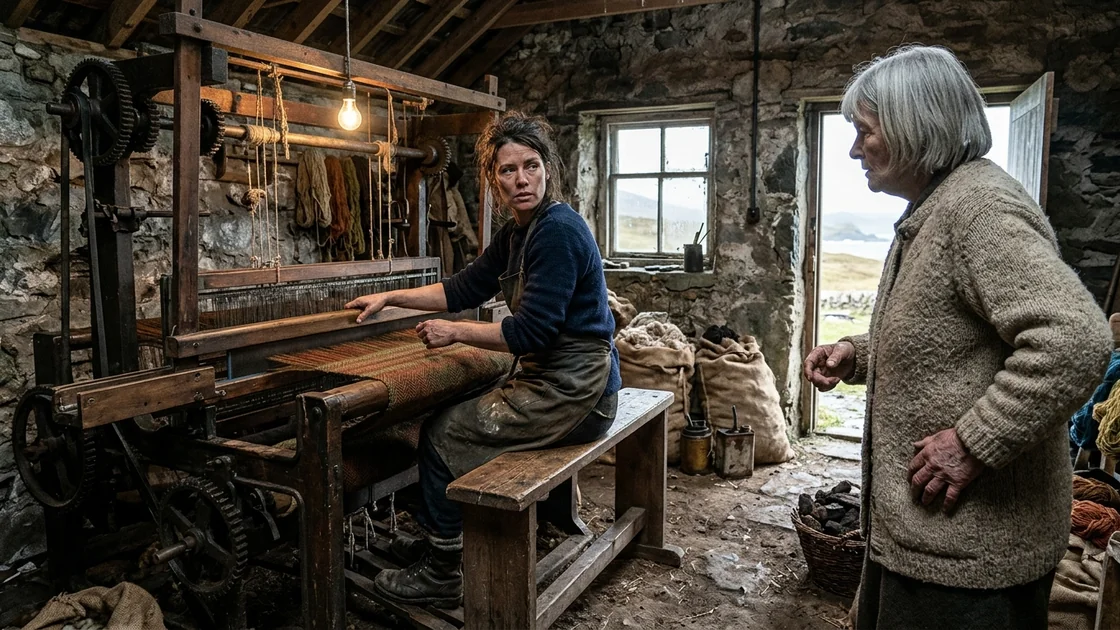
This is the story of Saffron Miller, a disgraced London fashion editor who flees a career-ending media scandal to seek refuge in a remote crofting township on the Isle of Harris. There, amid the harsh winds and Atlantic swells of the Outer Hebrides, she encounters Morag Macleod, an unyielding master weaver guarding generations of island tradition. Through the grueling physical labor of the pedal loom, the alchemy of native dyes, and the slow unraveling of mutual grief, Saffron discovers that true craft cannot be faked, ultimately rebuilding her shattered identity thread by thread alongside an old woman who teaches her how to survive the cold.
Chapter One: The Salt on the Glass
The ferry from Uig slipped through the grey maw of the Minch like a rusted needle through greasy fleece.
Below deck, the air smelled of burnt diesel, damp loden coats, and the sweet, synthetic vinegar of salt-and-sauce crisps. Saffron Miller sat pressed against the salt-encrusted glass of the passenger lounge, her black cashmere coat—a sample from Phoebe Philo’s penultimate Celine collection, now missing a horn button at the cuff—pulled tight around her collarbones. Her fingers, manicured three weeks ago in Mayfair in a shade called Ballerina Slippers, were chipped down to the quick. Beneath her thumbs, the glass hummed with the vibration of twin marine engines fighting a Force 7 westerly.
Every few minutes, her phone would rattle against the laminate table. She had turned off cellular data at Inverness, but cached notifications still surfaced like debris from a sunken barge:
The Cut: "The Fall of Saffron Miller: How Fashion’s Favorite Arbiter Built an Empire on Stolen Labor." Diet Prada: 12 slides detailing the pattern theft, the underpaid Leicester sweatshops disguised as artisanal studios, the leaked voice notes where she called a tearful junior assistant an "ornamental vacuum." WhatsApp: Thirty-four unread messages from her former publisher’s legal liaison.
She did not open any of them. Instead, she stared out into the pale slate void where the Atlantic met the Hebridean sky.
When the headlands of South Harris finally materialized through the rain, they did not look like land. They looked like petrified sea monsters—dark, jagged ridges of Lewisian gneiss stripped down to bone by three billion years of wind and tide. There were no trees. Not a single birch, oak, or willow survived on these slopes; there was only the bruised purple of dead winter heather, the sodden rust of bracken, and the violent white lace of surf chewing against the rocks.
"Tarbert," the tannoy groaned in a clipped Hebridean lilt. "All passengers for the vehicle deck, please make your way down."
Her car, an ancient, low-slung Audi TT with a cracked front bumper that had belonged to her late brother, groaned as it rolled off the steel ramp and onto the slipway. Tarbert was a huddle of white harled cottages, a butcher shop, a church, and a petrol pump. She stopped at the single junction, the wipers thumping an uneven rhythm across the windshield.
Her destination lay twenty miles south, down the single-track spine of the island to the township of Northton, curled at the foot of Mount Chaipaval. Her brother, Rory, had spent his last summer there before the sickness took him, living in a rented stone barn, photographing the empty beaches. In his letters, he had spoken of a woman named Morag Macleod who lived at the end of the machair road—a woman whose wool, he had written, smelled like the beginning of the earth.
Saffron shifted into gear. The clutch shuddered. As she left Tarbert behind, the road narrowed to a strip of tarmac barely wider than a carriage path, punctuated every hundred yards by white-painted passing places. To her left, the mountains rose into the low, weeping clouds; to her right, the sea was an expanse of bottle-green glass breaking over white shell sand so bright it hurt her tired eyes.
She had expected silence. What she found instead was a landscape roaring with sound: the shriek of oyster-catchers, the gravel-throated drag of the Atlantic retreating over shingle, the whistle of gale-force air through the gaps in the drystone dikes.
By the time she reached Northton, the afternoon light was dying into a bruised, metallic pewter. The village was not a village in the English sense—no green, no pub, no village shop. It was a scattering of blackhouses and tin-roofed croft cottages flung across the grassy plain like dice tossed across green baize.
At the furthest edge, where the turf gave way to the dunes of Scarista, stood a long, low-slung cottage built of fieldstone. Its gable end faced the sea, flanked by an outbuilding of corrugated iron painted the color of oxblood. Outside the iron shed, tethered to a timber post by a length of orange binder twine, a weathered sign hung askew in the wind:
HARRIS TWEED. M. MACLEOD. NO COACHES.
Saffron killed the engine. The silence inside the car was immediate, suffocating. Her reflection in the rear-view mirror shocked her: hollow temples, dark bruises beneath eyes that had spent twenty years scrutinizing silk twill under halogen track-lighting, and skin greyed by a month of scotch and panic attacks in her Kensington flat.
She opened the door. The Hebridean wind hit her like a wet wool blanket thrown full in the face, carrying the scent of burning peat, rotting kelp, and something deeply, unmistakably animal.
Chapter Two: The Iron and the Lanolin
The kitchen of the stone cottage did not smell like London. London smelled of roasted coffee beans, car exhaust, luxury candle wax, and dry-cleaned solvent.
This room smelled of boiled cabbage, sweet earth smoke, and wool—dense, unwashed, and pungent with sheep sweat.
Morag Macleod did not turn from the Rayburn when Saffron knocked on the unlocked back door and stepped inside. The old woman was bent over a cast-iron kettle, her shoulders broad and slightly humped beneath a cardigan knitted from coarse, undyed oatmeal yarn. Her hair was the color of zinc wire, cut bluntly at the jaw, and her hands, when she reached for a tea mug, were thick-wristed, the knuckles swollen like hazel burls.
"You’re Rory Miller’s sister," Morag said. Her voice was not welcoming; it was an assessment, dry and flinty, with the hard, rhythmic cadence of the Gaelic tongue beneath her English words.
"Saffron," Saffron said, her voice sounding thin, theatrical, and absurdly out of place. "I wrote to you. In November."
"Aye. You did." Morag turned. Her eyes were small, clear, and pale blue, set deep into skin that looked as though it had been scrubbed with salt and lye. She looked down at Saffron’s feet. Saffron was wearing Italian lambskin ankle boots with three-inch stiletto heels; they were already coated in black peat mud up to the zips. "You're late. The ferry was docked at three. It’s past five."
"The single-track road," Saffron stammered, crossing her arms defensively. "I’m not used to the passing places. People kept flashing their lights at me."
"Because you were hesitating like an idiot," Morag said calmly. "When you see a car coming against you, you pull into the left. If the passing place is on the right, you wait opposite. A child of four knows this."
She set a mug of black tea on the oilcloth table. The tea was the color of ditch water, with a film of oil shimmering on its surface.
"Rory said you had a room," Saffron said, refusing to sit. "In the bothy behind the loom shed. He said you sometimes let people stay if they worked the land."
Morag picked up a pair of steel sheep shears from the sideboard and began wiping the blades with an oiled rag. The rasp of the cloth against the steel sounded like a blade being honed for an execution.
"Rory was a boy who could carry a seventy-pound bag of oats on his shoulder without crying," Morag said, not looking up. "Rory had hands that could hold a wet lamb by the hocks without slipping. Rory died in a hospital in Glasgow with tubes in his neck, and now you come here with shoes made for walking on carpets."
The cruelty of the words landed like a blow to Saffron’s solar plexus. She felt the hot prick of tears—the same humiliated, furious tears she had choked down while the board members of Condé Nast stripped her name from the masthead, while the Twitter threads dissected her cruelty, while her friends deleted their selfies with her from Instagram.
"I don't need your charity," Saffron said, her voice shaking with rage. "I have money."
"You have no money that matters here," Morag replied, laying the shears down with a dull clink. "The shop in Leverburgh takes pounds, not your London checks. And the petrol station shuts at six. If you want the bothy, it’s ten pounds a week for the coal and you work six hours a day in the shed. Not weaving. You don't know enough to touch the wood of a loom, let alone the warp. You carry the wool. You wash the fleece. You pick the dung and the heather twigs out of the staples. If you drop a fleece in the dirt, you wash it twice."
Morag stepped forward, her gaze leveling on Saffron’s face. She was shorter than Saffron, but she carried the physical mass of someone who had hauled wet nets and cut turf since she was twelve.
"I know who you are," Morag added, her voice dropping into a register that made Saffron’s skin prickle. "My nephew in Stornoway has the internet on his telephone. He showed me the pictures. You put your name on things other people made. You told the newspapers you were a genius because you told girls how to starve themselves into little coats."
Saffron stepped back, her hand flying to the neck of her coat. "That was a smear. It was a corporate restructuring—"
"I don't care what name you give your lying," Morag said. "Here, the wool does not lie. You pull the yarn too tight, the selvedge puckers. You treadle out of time, the pattern breaks. The cloth remembers everything your feet and your fingers do. You can’t lie to an iron loom, Saffron Miller. It has no ears for excuses."
Morag took a heavy iron key from a nail beside the door and held it out.
"The bothy is cold," the old woman said. "There is dry drift-timber in the lean-to. If you can’t light a fire, you’ll freeze by dawn. Come to the loom shed at seven o’clock. If you are five minutes late, the door will be bolted from the inside."
Chapter Three: The Greasy Staple
The bothy smelled of cold lime-wash, dry soot, and fifty years of damp sea air trapped between four walls of granite.
That first night, Saffron did not sleep. The cast-iron stove took her two hours to light; she ruined three boxes of matches and half an issue of the Sunday Times before a sliver of dried Scots pine caught the flame, sending a thin, acrid smoke puffing through the cracked seals into the tiny room. She lay on the narrow horsehair mattress in her Celine coat, her cashmere scarves wrapped around her feet, listening to the North Atlantic gale battering the slate roof.
Every blast felt personal, as though the wind were an auditor sent to strip away whatever vestige of vanity remained in her skull.
At 6:45 AM, the world outside was still pitch black. The frost had painted fern-patterns across the single pane of glass. Her breath billowed in white plumes inside the room. Her joints screamed with an ache she had never known—a deep, damp chill that seemed to have settled into the marrow of her pelvic bones.
She dressed in layers: merino leggings, two cashmere crewnecks, an oversized flannel shirt, and a waxed Barbour jacket she had bought five years ago for a weekend shoot in the Cotswolds that she had never actually attended. She swapped her ruined stilettos for a pair of heavy lug-soled leather boots she had found in the bottom of her trunk.
When she pushed open the corrugated-iron door of the weaving shed, the sound stopped her in her tracks.
CLACK-clatter-clatter-CLACK.
The room was illuminated by a single unshaded sixty-watt bulb hanging from a rafter and the blue-orange flare of a twin-burner paraffin heater. In the center of the earthen floor stood a massive machine of black-painted cast iron and polished ash timber: a Hattersley Domestic Loom, its heavy pedals driving a labyrinth of shafts, cogs, and leather pickers.
Morag sat on the wooden bench, her legs moving in a steady, hypnotic pumping rhythm. Her feet, shod in flat leather slippers, hit the two heavy iron pedals—left, right, left, right—with the metronomic certainty of a steam piston. With every depression of the treadles, a wooden shuttle tipped with steel shot across the reed with an explosive thwack, buried itself in the wooden box on the opposite side, and the heavy batten swung forward with a dull, bone-rattling boom to beat the new thread of weft into the warp.
The noise inside the shed was deafening. It was not the clean, automated hum of a modern textile factory; it was a percussive, mechanical roar that vibrated through the soles of Saffron's boots and rattled her jawbone.
Morag did not stop. She didn’t even glance at Saffron. Her hands danced across the loom frame—one hand poised near the shuttle box, the other lightly resting on the batten, her pale eyes tracking the intersection of hundreds of grey, brown, and sea-green wool threads that stretched from the rear beam like the strings of a horizontal harp.
Saffron stood frozen, watching the cloth grow.
With every pass of the shuttle, another millimeter of fabric emerged from the reed. It was a complex, broken twill—a herringbone that mimicked the delicate, jagged structure of a bird’s breastbone. The yarn was not uniform; it was slubbed with tiny flecks of saffron yellow, heather-pink, and pale licheny green, all bound into a base of peat-brown wool.
The beauty of it was startling. It was not the smooth, dead perfection of the Italian silks Saffron had spent her life styling for double-page spreads. This cloth looked alive, heavy with moisture and oil, bristling with coarse hairs, catching the dim bulb-light like the flank of a wet otter.
Finally, Morag took her feet from the pedals. The clatter died instantly, leaving only the soft hiss of the paraffin heater and the distant roar of the surf.
"You’re four minutes early," Morag said, turning her head. "Take those gloves off."
Saffron pulled off her cashmere-lined leather gloves.
"Look at that pile in the corner," Morag directed, pointing with a greasy steel screwdriver toward a mountain of burlap sacks slumped against the north wall. "That’s Cheviot fleece from the south crofts. Unwashed. Unsorted. Take the sacks out to the trestle table by the wash-house. You sort the britch-wool from the blankets."
"The britch-wool?" Saffron echoed.
Morag sighed, a sound like gravel sliding down a chute. She stood up, her joints popping, and walked to the pile. She dragged out a fleece and threw it across the rough timber table. It landed with a wet, heavy thud.
The smell hit Saffron instantly: the eye-watering stench of stale sheep urine, damp dung, grease, and rotting meadow grass.
"This is a fleece," Morag said, digging her blunt fingers into the mass of wool. "This is what people wear when they think they’re wearing something grand. The belly and the tail—here—this is britch. It’s coarse, it’s matted with shite and burrs. You pull it away. You throw it into that zinc tub; we use it for packing the floor-cracks or we bury it in the potato beds. The wool from the shoulders and the flanks—here—this is the prime. It’s long, it’s soft, it has the crimp. Look at it."
Morag took Saffron’s wrist in a grip that felt like a carpenter’s vise and shoved Saffron’s bare palm deep into the heart of the raw wool.
Saffron gasped. The interior of the fleece was warm, almost body-temperature, and coated in a thick, slick, pale-yellow grease that coated her fingers instantly.
"Lanolin," Morag said. "The sheep makes it so the rain doesn't drown it. It’s good for your hands. It’ll cure your London softness. You pull out the kemp—the dead white hairs that won’t take the dye—and you pick out every twig, every seed, every dried clump of dirt. You do five fleeces before dinner. If I find one piece of sheep-dung in the washing tub, you’ll scour the whole batch again."
Morag dropped Saffron's hand and walked back to the loom.
"Get on with it," the old woman said, her feet already finding the iron treadles.
The loom roared to life again. The shuttle leaped like a silver fish across the web. Saffron stood alone at the table, her hands greasy and trembling, the cold Atlantic air biting through her fingernails, staring down at thirty pounds of matted, dung-crusted wool.
Chapter Four: The Alchemy of Crotal
For two weeks, Saffron’s world shrank to the dimensions of grease, water, and pain.
Her hands transformed first. The skin along her knuckles cracked from the icy spring water she hauled from the exterior pump to the copper wash-boilers, then sealed itself shut again under the ceaseless coating of sheep tallow. The lanolin seeped into her pores; no matter how much carbolic soap she used at night, she smelled of wet livestock. When she peeled off her boots by the peat fire, her socks were stiff with dried sweat, and the palms of her hands were scored with tiny, inflamed scratches from gorse thorns embedded in the fleeces.
She learned to sort without thinking. Her fingers, once accustomed to flicking through racks of Saint Laurent garments with critical disdain, developed an involuntary literacy. She could tell by touch alone whether a fleece had come from a sheep that had wintered on the high, salt-scoured hills or down in the sheltered hollows of the machair; the hill-wool was brittle, hard, and lean, while the machair-fleece was dense, oily, and heavy with sand.
On a Tuesday morning when the rain had ceased, leaving the island under a dome of rinsed-blue sky, Morag did not sit at the loom.
"Get your boots," she said, tossing an empty burlap sack at Saffron’s chest. "We’re going to the rocks."
They walked out past the ancient graveyard of Northton, where medieval chiefs lay under moss-grown slabs carved with galleys and broadswords. They climbed the lower flanks of Chaipaval, where the black gneiss cliffs plunged sheer into the turquoise surf of the Sound of Taransay.
Morag carried an old bone-handled knife with a blade ground down to a fingernail's breadth. She dropped to her knees on a shelf of rock above the tide line, pointing with the blade at a circular, crusty patch of grey-brown scurf adhering to the granite.
"Look here," she said.
"It looks like mold," Saffron said, out of breath, her knees shaking from the ascent.
"It’s crotal," Morag spat, using the Gaelic word with reverence. "Parmelia saxatilis. Rock lichen. It takes thirty years to grow a ring the size of your saucer. It only grows where the air has no poison in it. You scrape it from the stone with the blade. Lightly. Don't take the rock with it, or you’ll ruin the dye-bath with sand."
Morag demonstrated: holding the knife at an angle, she peeled the brittle, papery crust of the lichen away from the granite face, letting the brownish flakes fall into the cupped palm of her left hand. The underside of the lichen was a deep, velvet black; the top was the color of a wet winter cloud.
"Smell it," Morag commanded, thrusting her hand toward Saffron’s face.
Saffron leaned down. She expected the sourness of sea-wrack. Instead, she inhaled something profoundly ancient: the smell of damp forest floor, dried mushrooms, old stone, and sun-baked earth, concentrated into an essence so heavy it made her sinuses thrum.
"This is the heart of the Harris cloth," Morag said, her voice unusually quiet against the sound of the Atlantic crashing eighty feet below. "You can buy chemical powders from Germany that turn wool the color of an orange peel or a blue plastic bucket. The mills in the south do it now. They call it efficiency. But when you use the crotal, the color belongs to the rock. It doesn't fade in the sun; it only gets darker, the way an old man’s face gets darker with the wind."
For four hours, they knelt side by side on the cold gneiss, scraping the lichen into their sacks. The wind whipped Saffron’s hair across her eyes until she tasted salt on her lips. Her knees grew numb on the wet rock, but for the first time in five months, the noise in her head—the venomous headlines, the shame of her public humiliation, the phantom voices of people she had flattered and despised in equal measure—faded into the rhythmic, scraping hiss of the steel blade against the stone.
When the sacks were half-full, Morag sat back on her heels and pulled an oily tin of sardines and two dry oatcakes from her smock pocket. She broke an oatcake in half and handed it to Saffron without a word.
They ate in silence, watching three gannets plunge like white spears into the sea half a mile out.
"Why did you let Rory stay here?" Saffron asked, chewing the dry, nutty biscuit. "He wasn't an islander. He didn't know anything about sheep."
Morag chewed slowly, her pale eyes fixed on the horizon where the smudge of the uninhabited island of Saint Kilda lingered like a ghost on the sea-rim.
"He was quiet," Morag said after a long time. "He didn't bring his noise into my shed. He would sit by the loom for three hours and not ask a single damn foolish question. And he looked at the cloth as if he could see the grass the sheep had eaten to make it."
She turned her gaze on Saffron.
"He told me about you," the old woman said flatly. "He said you were like an eagle that had forgotten it had wings and was spending all its time pecking at shiny bits of tin foil in a gutter."
Saffron flinched, looking down at her scraped, soil-stained knuckles. "He was my little brother. He didn't understand what my world was like. You have to fight for every inch in that industry. If you aren't ruthless, someone else takes the chair."
"Then let them take the chair," Morag said with cutting indifference. "Is the chair made of gold? Does it keep you warm when the snow comes down through the chimney? You worked yourself into a fever so people who don't care if you live or die could say your name at dinner parties. And then, when the wind changed, they threw you into the sea like a dead dog."
"I made beautiful things," Saffron whispered, her voice cracking. "I curated collections that will be referenced in fashion history for decades. I worked eighteen hours a day for twelve years."
Morag stood up, brushing crumbs from her skirt, and hoisted her sack of lichen over her shoulder.
"You made shadows," Morag said, turning toward the path down the mountain. "You put pictures in magazines that got thrown into the dustbin the next month. Come along. We have to boil the crotal with the wool before the frost catches us."
Chapter Five: The Architecture of the Warp
By the fourth week, Saffron’s trial shifted from the wash-house to the inner sanctum: the loom shed.
The Hattersley loom was not merely a mechanical apparatus; it was an exacting instrument of mathematical tension. It stood six feet wide and five feet deep, composed of cold cast iron manufactured in Keighley, Yorkshire, in the 1930s. Every bolt, pawl, ratchet, and rod had been adjusted by Morag’s late husband, Calum, forty years ago, and maintained with an obsessive, daily ritual of machine oil and fine steel adjustments.
"Now," Morag said, standing behind the loom's open frame like a general surveying a battery of artillery. "You want to know what cloth is? Cloth is not a picture. Cloth is architecture."
Before them lay the warp beam: a massive wooden cylinder wound with hundreds of yards of two-ply Cheviot yarn, dyed with the crotal they had scraped from the cliffs, now an astonishing, luminous shade of russet that held the warmth of an autumn fire.
"Fourteen hundred threads," Morag said, tapping the beam with her knuckles. "Each one must pass through its own heddle eye. Miss one, and you have a float across the whole bolt. Cross two, and the yarn snaps under the tension of the shed. If you break a thread while we're beaming, I’ll have you re-sley the entire reed from the selvedge."
For three agonizing days, Saffron sat on a low stool at the front of the loom, her face inches from the steel reed—a comb-like frame containing hundreds of paper-thin vertical steel wire teeth called dents.
Her job was to catch the threads as Morag handed them through the heddles from behind the loom, using a flat brass reed hook to draw each pair of threads through the narrow slots.
The work required an unnatural, eye-straining focus. The shed was cold, the single bulb buzzed like a hornet, and Morag’s rhythm was merciless.
"Drop it," Morag would command. "Take it. Next. Missed one. Pull it back. Don't split the ply! Saffron, your fingers are like sausages today. Watch the cross!"
By the afternoon of the second day, Saffron’s neck felt as though hot needles were being driven into the base of her skull. Her eyes watered constantly. Every time she looked away from the reed, the grey walls of the shed seemed to swim with horizontal lines.
"Why do you still do this by hand?" Saffron burst out, slamming the brass hook down on the breast-beam after her third consecutive threading error. "The big mills in Stornoway—they have high-speed rapier looms! They produce hundreds of meters an hour! This is insane. It's nineteenth-century peasant torture!"
Morag stopped her hands. The silence that filled the shed was sudden and terrible. The old woman walked slowly around the iron frame of the loom until she was standing directly over Saffron.
"A mill loom," Morag said, her voice dangerously quiet, "is a machine run by electricity that punches yarn through space without knowing what it's touching. If the yarn is dry, it doesn't care. If the wool is weak from a hard winter, it doesn't care; it just snaps it and keeps moving until an alarm sounds."
Morag reached down, took Saffron’s right hand, and pressed her fingers against the tightly stretched warp threads.
"What do you feel?" Morag demanded.
"Strings," Saffron muttered, trying to pull away.
"Feel them, damn you!" Morag barked.
Saffron closed her eyes, breathing through her teeth. Beneath her fingertips, the fourteen hundred woolen strands vibrated under the immense tension of the cast-iron weights hanging from the rear beam. They were not smooth like synthetic nylon or Mercerized cotton. They were rough, elastic, full of life, humming like the strings of a double bass.
"You feel the oil," Morag said softly. "You feel where the yarn is thick and where it is thin. Every sheep is different. Every hillside is different. A handloom weaver feels the thread through the pedals and the shuttle. When you throw the shuttle, your wrist knows if the bobbin is winding true. If a thread goes slack, your leg feels it in the treadle before your eye even sees it."
Morag leaned down until her face was inches from Saffron's. Her breath smelled of strong tea and peppermint lozenges.
"Under the Act of Parliament," the old woman whispered, each word carved from granite, "Harris Tweed must be handwoven by the islanders at their own homes in the Outer Hebrides. Not in a factory. Not with an electric motor. Here. In these sheds, with our own legs and our own hands. If we lose the hand, Saffron, we lose the soul of the island. We become like you—buying and selling things that have no ghosts in them, made by no one, belonging nowhere."
Saffron sat motionless. Her fingers remained pressed against the warp. For the first time in her career, she did not think of how a garment would look on a runway, how it would photograph under strobes, or how many likes it would garner on an app.
She felt the reality of the work: the grass that fed the sheep, the lichen on the stone, the woman who had spun the fleece, and the iron machine that held it all in a grid of terrifying precision.
She picked up the brass reed hook.
"Next pair," Saffron said, her voice clear and level.
Morag looked at her for a long second, her pale eyes flickering with something that might have been the faintest glimmer of respect. She walked back behind the heddles.
"Number sixty-four," Morag called out. "Cheviot two-ply. Take it."
Chapter Six: The Rhythm of the Feet
Learning to treadle the Hattersley loom was like learning to play a pipe organ while running a sprint.
At the end of the fifth week, Morag finally stepped off the weaver's bench and gestured for Saffron to take her place.
"Sit," she said.
The wooden bench was polished to a silky smoothness by fifty years of Morag’s wool-serge skirts. The pedals below were heavy iron plates, worn bright where the balls of thousands of feet had struck them. In front of Saffron sat the shuttle—a twelve-inch boat of polished persimmon wood, tipped with pointed steel caps, carrying an interior bobbin—a pirn—wound with peat-dyed yarn.
"To start the shed," Morag instructed, standing at Saffron’s shoulder, "you press the left treadle down. Firmly. Don't stomp on it; drive it down through your heel. That raises the first set of shafts and opens the warp. Then you throw the pick."
Saffron pushed down with her left foot. The iron linkages screeched; the heavy harness of heddles clattered upward, splitting the fourteen hundred warp threads into a yawning triangular tunnel: the shed.
"Now," Morag said. "The cord."
Saffron pulled the leather pick-cord with her right wrist.
BANG.
The wooden shuttle shot through the shed like a bullet, slammed into the opposite wooden box with a violent recoil, and bounced back half an inch.
"Batten!" Morag shouted.
Saffron reached out with her left hand, grasped the heavy ash lay, and pulled it toward her chest with all her strength.
BOOM.
The steel reed struck the new line of weft, driving it home against the fell of the cloth.
"Right foot!"
Saffron pressed the right pedal down, her thigh muscles cramping with the unaccustomed resistance. The second set of shafts rose with a metallic clatter.
Pull the cord. BANG. Pull the batten. BOOM.
"Too slow!" Morag barked. "The shuttle lost its momentum! It’s caught in the web!"
Saffron looked down in horror. The shuttle had stalled halfway across the reed, trapped between the crossed warp threads like a fish in a gill-net.
"Gently," Morag growled, pushing Saffron’s hands aside. "Don't yank it, or you’ll strip the teeth off the reed! Release the treadle! Ease the tension!"
They worked for three hours in that first session. Saffron produced exactly two inches of tweed.
It was an unmitigated disaster.
The selvedges—the outer edges of the cloth—looked like the chewed hem of an old sack, puckered and warped where she had pulled the yarn too tight on one side and left giant, loose loops on the other. In the center, she had missed a treadle change, creating a visible "mis-pick"—a horizontal scar across the herringbone pattern where two picks had landed in the same shed.
Morag looked down at the two inches of cloth. She did not raise her voice. She simply picked up a pair of curved embroidery snips.
"Cut it off," she said.
"What?" Saffron gasped, her hair plastered to her forehead with sweat, her chest heaving. "It took me three hours!"
"It’s an insult to the wool," Morag said, her voice flat and cold. "You cannot sell cloth with a mis-pick. You cannot wear cloth that pulls at the selvedge. Cut it out. Unweave it thread by thread back to the solid beam, and start again."
"I am not unweaving this!" Saffron screamed, her temper finally detonating. She stood up from the bench, her boots skidding on the dirt floor. "I have worked my hands raw for you! I have cleaned your disgusting, shit-covered fleeces! I have scraped rocks in the freezing rain! I am an intelligent woman, and you treat me like a half-witted kitchen maid! Look at my hands!"
She thrust her red, calloused, scarred palms into Morag’s face.
"Look at them! I used to sit in the front row at Chanel! Karl Lagerfeld used to send me handwritten notes! Anna Wintour knew my name! And I am sitting here in this miserable, freezing shithole at the end of the world, having an old woman yell at me because two strings aren't straight!"
Morag did not blink. She stood with her arms crossed over her chest, the curved scissors dangling from her index finger like a silver hook.
"Are you finished?" the old woman asked.
Saffron stood there, her chest heaving, the tears she had held back for six months finally burning down her cold cheeks, leaving pale tracks through the grease on her skin.
"Karl Lagerfeld is in his grave," Morag said, her voice dropping into that chilling, ancient register. "And the front row at Chanel does not exist here. The only thing that exists here is the wool, the loom, and the sea. If you want to go back to London and cry to the newspapers about how unfair the world is, the ferry leaves Tarbert at eleven. I will not stop you. But if you sit at that bench, Saffron Miller, you do not weave lies. You weave true, or you don't weave at all."
Morag laid the snips on the wooden breast-beam and walked out of the shed, leaving the corrugated door banging open in the wind.
Saffron stood alone in the center of the shed.
The smell of peat smoke blew in through the open door, mixing with the scent of the lanolin and the machine oil. She looked at the two inches of ruined, knotted cloth. She looked at her hands—broad, dirty, the skin tough and stained brown with crotal dye.
She reached out. Her fingers picked up the snips.
She did not pack her bags. She sat back down on the cold ash bench, leaned over the steel reed, and began, thread by thread, pick by pick, to undo her mistakes.
Chapter Seven: The Ghost of Calum Macleod
Winter deepened into January. The sun on Harris became an afterthought—a pale, lemon-colored sliver that scraped along the southern peaks for five hours a day before sinking back into the iron sea.
The gales were relentless. For three days, a storm from the southwest blew so hard that salt spray encrusted the windows of the cottage four miles inland, turning the glass into opaque, frosted sheets.
Inside the loom shed, Saffron wove.
Something had clicked in her body around the seventh week. The jerky, frantic movements that had exhausted her thighs and shoulders smoothed into a rhythmic, cyclic dance. She stopped thinking about her feet. Her feet became the engine; her hands became the navigators.
Left-treadle. Pick. Beat. Right-treadle. Pick. Beat.
The sound of the Hattersley became her internal clock. The rhythm was 60 picks per minute: a brisk, steady march that generated its own heat, driving the damp chill from her limbs until she was working in just a thin wool jersey, her breath rising in rhythmic white puffs to join the rafters.
Her selvedges were straight now—clean, crisp margins running like drawn ink lines down the edges of the growing web. The pattern, a four-end twill she had designed with Morag’s guidance, was an homage to the winter machair: a ground of sea-slate grey crossed by hairline stripes of dried-bracken rust and pale winter-rye green.
One evening, after the light had died and Saffron was winding fresh pirns on the hand-winder, Morag came into the shed carrying a small stoneware jug and two horn tumblers.
"Rest," Morag said, sitting on an overturned fish crate near the paraffin heater.
She poured two fingers of amber liquid into each tumbler. It was Talisker, distilled sixty miles south on Skye; it tasted of peat smoke, pepper, and copper pennies.
Saffron drank, feeling the fire slide down her throat into her hollow belly. Her legs were trembling with the fatigue of having woven eight yards of cloth that day.
"Calum built that seat," Morag said suddenly, nodding toward the bench.
It was the first time she had spoken her husband’s name without Saffron asking.
"He was twenty when he built it," Morag said, staring into the blue flame of the heater. "He carried the iron castings for the frame three miles across the sands from the pier at Leverburgh because there was no road in 1952. Just the turf and the stones. He had a heart like an ox."
"Did he weave?" Saffron asked softly.
"He wove every day of his life until his hands wouldn't close around the shuttle," Morag said. "Forty years. We wove together in this shed. He had this loom; I had an old wooden loom built from ship-timbers. We could hear each other’s treadles through the wall. If he slowed down, I knew he was thinking of his tea. If I slowed down, he’d throw a wooden pirn at the door."
A ghost of a smile touched the corners of Morag’s mouth, then vanished back into the deep creases of her face.
"He died at the loom," she said simply. "A cold morning in November, ten years ago. I came out with his porridge, and his head was resting on the breast-beam. The shuttle was in his hand. The pick was half-thrown."
Morag took a long drink from her horn cup.
"After that," she continued, "I shut the shed for two years. The sheep got sold off to the mainland dealers. The mice made nests in the heddle strings. People told me to sell the loom to the museum in Stornoway. They said, 'Morag, you’re an old woman; take your pension and watch the television.' But I looked at the machine Calum carried on his back, and I thought: if I let the iron rust, I am letting him die twice."
She looked at Saffron. The hardness in her pale eyes had not softened, but the coldness was gone.
"My daughter lives in Edinburgh," Morag said. "She works in an office with glass walls. She wears suits made of polyester that don't make a sound when she walks. When she visits, she complains that the house smells of sheep. She won't touch the loom. She thinks it's a shameful thing—the work of peasants who didn't have shoes."
Morag leaned forward, her heavy hands resting on her knees.
"You are not an islander, Saffron Miller. You have a wicked, sharp tongue and you spent your life doing things that were foolish and vain. But you have the stubbornness in your bones. When I told you to cut that cloth, I thought you would run away on the evening boat. You didn't run."
Morag raised her horn cup.
"To the cloth," the old woman said.
Saffron raised her tumbler, her throat tight. "To the cloth."
Chapter Eight: The World Across the Minch
The outside world did not stay across the water forever.
In the second week of February, the postman’s red van rattled down the machair track, its tires crunching on the wet shell-grit. The postman, a cousin of Morag’s named Donald John, did not just bring bills; he brought a thick, heavy cream-colored envelope addressed to Ms. Saffron Miller, c/o M. Macleod, Northton, Isle of Harris.
The return address was engraved in raised black lettering: Condé Nast International, Vogue House, Hanover Square, London.
Saffron took the letter to the edge of the dunes, where the machair dropped away into the vast, blinding expanse of Scarista beach. The tide was out, leaving two miles of wet, ribbed sand that mirrored the bruised purple of the winter sky.
Her fingers, rough and stiff from the loom, tore open the thick paper.
The letter was from Julian Vane—her former mentor, the chairman of the publishing group, the man who had stayed silent during her public execution in the press.
Dearest Saffron,
The tempest, as they say, has finally cleared the harbor. The public has moved on to the scandal involving the creative director at Balenciaga, and our analytics show the sentiment metrics around your name have shifted back into neutral territory.
More importantly: British Vogue is undergoing a complete editorial restructuring for the autumn issue. We need someone with your historic weight, your eye, your absolute refusal to compromise on standards. The board has authorized me to offer you the Senior Consulting Editor position—full creative control over the seasonal collections feature, based in Milan and London.
We know you have been 'retreating' in the north. A brilliant PR narrative, by the way—the monastic isolation, the return to roots. We can spin this into a magnificent feature for the September issue: 'Saffron Miller’s Radical Hebridean Renaissance.'
A car will be waiting for you at Inverness airport on Monday if you can catch the morning ferry.
Come home, Saffron. We’ve kept your seat warm.
Julian.
Saffron stood on the crest of the dune, the wind whipping the heavy parchment paper against her fingers.
We’ve kept your seat warm.
She closed her eyes. She saw the office on Hanover Square: the white marble reception desk, the air conditioned to precisely sixty-eight degrees, the assistants moving on silent soles like terrified novitiates, the racks of five-thousand-pound coats destined to be worn once by an influencer and then relegated to an archive or a landfill.
She remembered the feeling of that life: the constant, sour nausea in the pit of her stomach, the panic that someone younger, thinner, and more vicious was whispering about her in the restaurant at the Chiltern Firehouse, the endless hunger for things that vanished the moment they were held.
She looked down at her hands.
The skin around her thumb-joints was permanently stained with the smoky rust of crotal. Under her fingernails was the dark grit of Harris turf. Her thighs were hard as oak planks from seventy thousand strokes of the Hattersley pedals.
She looked out across the Sound of Taransay.
On the far horizon, a squall was moving in from the Atlantic—a grey curtain of rain that swallowed the hills of North Uist one by one. The air tasted of pure, ancient salt, cold enough to cleanse the lungs of twenty years of London soot.
She crumpled the cream-colored parchment in her fist.
She did not throw it into the sea—the island had taught her not to litter the machair with things that didn't rot. She shoved it deep into the pocket of her Barbour, turned her back on the south, and walked toward the red iron shed where the loom was waiting.
Chapter Nine: The Waulking
The sixty yards of tweed were finished on a Thursday.
The web had been cut from the loom beam with Morag’s bone-handled knife—a moment that felt to Saffron like cutting an umbilical cord. The resulting roll of fabric, known as the web, lay on the long trestle table in the wash-house: sixty yards of raw, stiff, greasy wool, four feet wide.
"Now," Morag said, inspecting the bolt, "we must wake the cloth."
"The finishing?" Saffron asked.
"The luadh," Morag said, using the Gaelic term. "The waulking. In the old days, twelve women would sit at a long timber board, soak the cloth in warm, stale urine to set the dyes and cut the grease, and beat it with their bare hands until the weave shrank by a third. We don't use the urine now—we use hot water and soap from the tallow—but the hands must still do the work."
That evening, four women from the neighboring crofts came to the wash-house.
They were women of Morag’s generation: Peigi from Scarista, who had hands like spade-blades; Kirsty from Borve, whose husband had drowned in the crab-boats in the seventies; and Mairi, a tiny, bird-like woman of eighty who arrived leaning on an ash stick and immediately took the center seat at the grooved wooden waulking board.
They did not speak to Saffron. They merely nodded, their eyes darting over her rough woolen clothes, her scarred hands, and the clean edges of the bolt lying in accordion folds along the damp timber table.
A copper cauldron of steaming water, scented with wild mint and soft tallow soap, was poured over the cloth until the wool was saturated, heavy, and hot.
"Sit," Morag commanded Saffron, pointing to the empty space between herself and Mairi.
Saffron sat. The wet wool lay across the board before them like a steaming, undulating serpent.
Mairi struck the timber first.
THUMP.
She took the wet cloth in both hands, threw it forward against the grooved wood, drew it back, and passed it to the left.
THUMP. THUMP. THUMP.
Morag caught it, rubbed it fiercely against the ribbed board, and passed it to Saffron.
Saffron’s hands sank into the hot, sodden mass. The heat was shocking, the lanolin and soap creating a dense, slippery foam that coated her forearms. She caught the rhythm: Push forward, compress, draw back, pass.
Then Mairi began to sing.
The old woman’s voice was cracked, reedy, and high, but it had the carry of a trumpet over water. It was a duan—a waulking song in the old Gaelic, an ancient, hypnotic call-and-response that had been sung in these islands for a thousand years.
Mairi sang a line—a story of a prince crossing the Minch, of a shipwreck off the Butt of Lewis, of a girl waiting on the strand for a lover who never came home.
After each line, the other four women—Morag, Peigi, Kirsty, and now, instinctively, Saffron—roared the nonsense syllables of the chorus in a guttural, percussive harmony:
"I-o-ho, leathag, ho-ro, gheallaidh! Hi-ri, am bo, ho-ro, hù-o!"
THUMP-clack. THUMP-clack.
The rhythm accelerated. The steam rose from the cloth, filling the stone room with the scent of boiled wool, mint, and peat smoke. The sweat ran down Saffron’s temples, dripping into the suds.
Her hands moved with the others—no longer separate, no longer an editor from London observing an exotic native rite, but an organ of the collective machine, beating the disparate threads of warp and weft until the fibers interlocked, felted, and thickened into an impenetrable, wind-proof shield.
They worked for three hours without stopping. As they sang, Saffron felt something cold and hard inside her chest—something that had lived there since she was a lonely, ambitious girl clawing her way through the cut-throat corridors of the publishing houses—finally crack open.
She did not cry. Her face was set, her jaw clenched, her hands driving the wet wool against the board with a savage, joyous strength.
When Mairi finally brought her palms down flat on the wood with a final, shouted syllable, the silence in the wash-house was absolute, broken only by the panting breath of the five women and the drip of soapy water onto the stone flags.
Morag leaned over, took a steel measuring rule from her apron, and laid it across the width of the tweed.
"Thirty-one inches," the old woman said, her voice hoarse from the singing. She picked up a corner of the cloth, held it to her cheek, and then pressed it into Saffron’s face.
The wool was no longer greasy. It was dense, velvety, thick as a winter coat, yet light and springy to the touch. The harsh, separate lines of the herringbone had melted together into a subtle, shimmering landscape of moss, rust, and slate.
"It is cloth now," Morag whispered.
Chapter Nine: The Stamp of the Orb
On a bright, crystalline morning in late February, a silver estate car bearing the logo of the Harris Tweed Authority turned into the croft yard at Northton.
The inspector was a man named Kenneth Morrison—a sixty-year-old native of Stornoway who had spent forty years examining every inch of tweed produced in the Western Isles. He carried a heavy brass-bound magnifying glass, a spring-loaded tension scale, and a wooden box containing the historic iron stamp.
The bolt of tweed lay rolled on the inspection table in the shed, trimmed, pressed, and finished.
Saffron stood in the shadow of the loom, her hands clasped behind her back, her heart hammering against her ribs with more violence than she had ever felt at the opening of Paris Fashion Week.
Morag sat by the Rayburn, smoking an untipped cigarette, her face an unreadable mask of stone.
Kenneth Morrison did not speak. He unrolled the first five yards of the cloth with a practiced flick of his wrists. He bent low, his nose barely an inch from the surface, the brass glass moving over the selvedge like a beetle.
He was checking the warp density: twenty-eight ends per inch.
He was checking the weft count: thirty-two picks per inch.
He ran his flat palm across the face of the fabric, feeling for irregularities, for loose threads, for broken heddles, for uneven tension.
He reached the twenty-yard mark. He stopped.
Saffron’s breath caught in her throat. Her mind raced back to that miserable afternoon in January—had she missed a pick? Had she left a loose float near the selvedge when her foot had slipped on the pedal?
Morrison reached into his waistcoat, pulled out a pair of steel tweezers, and leaned down. He picked out a single, microscopic strand of yellow heather-fiber that had survived the carding process. He held it up to the light, smiled faintly, and flicked it away.
He unrolled the remaining forty yards.
He tested the strength of the selvedge with his tension hook, pulling until the iron scale groaned. The cloth did not yield by a fraction of a millimeter.
Finally, the inspector straightened his back. He took an oily rag from his pocket and wiped his spectacles.
"Whose work?" he asked, looking at Morag.
Morag didn't take the cigarette from her mouth. She nodded toward the dark corner where Saffron stood.
"Hers," the old woman said.
Morrison turned his eyes on Saffron. His gaze was curious, polite, and completely unimpressed by anything that might have existed in her past. He walked to the wooden box on the table, unlatched the brass hooks, and lifted out the heavy, iron-handled stamp and a pad saturated with indelible black vermilion ink.
The stamp bore the historic mark granted by King George V in 1909: the royal Orb, surmounted by a Maltese cross, encircled by the words: HARRIS TWEED.
Morrison pressed the iron into the inkpad, positioned it precisely four inches from the selvedge at the tail of the bolt, and brought his palm down with a single, sharp blow.
THWACK.
The black seal bit deep into the russet fibers.
He moved ten yards down the length of the bolt and stamped it again.
THWACK.
And again, every ten yards, until the sixty-yard length of fabric bore the unmistakable, legally protected guarantee of the Outer Hebrides: handwoven, pure virgin wool, dyed and finished in the islands, untouchable by the machine-mills of the south.
Morrison capped his inkpad and closed the wooden box.
"It’s good cloth, lass," he said to Saffron, his voice soft with the gentle cadences of Lewis. "The selvedge is as clean as any Calum Macleod ever threw off that frame. You have the weight right for the winter trade."
He handed Morag the certification certificate, tipped his tweed cap to Saffron, and walked out into the yard. The silver car purred, backed down the track, and disappeared toward the main road.
Saffron walked slowly to the table.
She looked down at the black Orb stamped onto the russet cloth. The ink was still slightly wet, sinking into the wool, sealing its identity forever.
She had designed dresses that had been sold in Bergdorf Goodman for ten thousand dollars. She had attended private dinners at Versailles where diamonds the size of walnuts glittered beneath chandeliers.
None of it had ever felt like this.
This was not a price tag. It was an imprimatur of truth. It was proof that sixty yards of earth, weather, animal, and iron had been wrestled into existence by her own bone, muscle, and will.
She reached out and touched the black cross with the tip of her scarred index finger.
Behind her, the floorboards creaked. Morag came to her side, her shoulder brushing against Saffron’s Barbour jacket.
The old woman looked down at the cloth for a long time. Then she reached into her apron pocket, pulled out the bone-handled knife, and laid it on the bolt beside the stamp.
"There is an order from a tailor in Savile Row," Morag said, her voice gruff, clearing her throat of tobacco smoke. "They want eighty yards of the herringbone with the blue fleece from the north side. The warp is already spun at the mill in Shawbost. It arrives on Monday."
Morag looked at Saffron.
"I cannot wind eighty yards of warp with my knees the way they are," the old woman said. "I need someone who knows how to hold the reed without shaking."
Saffron looked from the knife to Morag’s face.
She thought of the crumpled letter from Julian Vane sitting at the bottom of the stove in the bothy, its cream-colored ashes long since blown out over the dunes into the Atlantic. She thought of her flat in London—the silence, the dead air, the white walls that held nothing of her own making.
"I’ll need more coal for the bothy stove," Saffron said, her voice steady and clear. "The wind comes through the west window when the tide is high."
Morag picked up her shears and turned back toward the house.
"There’s two bags of anthracite behind the peat stack," the old woman said over her shoulder. "Get them carried before the rain starts. And put some grease on those treadle bearings. They were squeaking like a gannet all morning."
Chapter Ten: The Salt-Stained Selvedge
Spring did not arrive on Harris with flowers; it arrived with light.
By April, the sun lingered until ten at night, painting the wet sands of Scarista in shades of apricot, turquoise, and beaten copper. The machair burst into life—not with imported garden roses, but with millions of tiny, resilient wildflowers: bird’s-foot trefoil, wild thyme, and pale purple orchids that clung to the shell sand beneath the Atlantic wind.
Saffron sat on the weaver’s bench, her bare arms brown from the salt-air, her hair tied back with a strip of wool-waste from the selvedge.
CLACK-clatter-clatter-CLACK.
Her feet moved with effortless power. The loom was singing now—not the violent, terrifying clatter of her first winter weeks, but a deep, resonant, rhythmic heartbeat that filled the shed like music.
The shuttle flew. The persimmon wood had become an extension of her right wrist; she could feel the weight of the bobbin decreasing pick by pick, knowing without looking the exact moment the pirn was about to run dry.
Through the open door of the shed, she could see the white-maned breakers rolling in from the open ocean, crashing against the foot of Mount Chaipaval. In the yard, Morag was hanging a fresh batch of indigo-dyed fleece on the drying lines, the blue wool billowing against the white harled walls of the cottage like pieces of fallen sky.
A black car—a rental from Stornoway—crept down the machair track and stopped at the gate.
A woman got out. She was dressed in an immaculate camel-hair coat from Max Mara, oversized sunglasses, and high-heeled leather boots that sank two inches into the wet machair turf with her first step. She held an iPhone in one manicured hand, holding it high as if searching for a signal that did not exist.
It was Camilla Finch—Saffron’s former features deputy, the woman who had replaced her as creative director at The Silhouette after the scandal broke.
Saffron did not stop treadling.
Pick. Beat. Clatter. Pick.
Camilla picked her way across the muddy yard, wrinkling her small, surgically refined nose at the smell of the sheep-pens. She stopped at the open door of the shed, peering into the dim interior.
"Saffron?" Camilla’s voice sounded impossibly small, thin, and brittle, like cellophane crackling in a gale.
Saffron finished her pass. She caught the shuttle in the box, pulled the lay back to beat the pick home, and took her feet from the pedals.
The silence that followed was immense, filled only by the wind in the corrugated iron and the cry of a curlew out on the sand.
Saffron stood up from the bench. She was wearing an old woolen work smock over an indigo-dyed guernsey, her sleeves pushed up to her elbows, revealing forearms corded with muscle and skin tanned the color of an almond.
"Hello, Camilla," Saffron said.
Camilla lowered her sunglasses. Her eyes darted from Saffron’s un-makeup-ed face to her work-stained smock, to the massive, greasy iron machine dominating the room, and finally down to Saffron’s feet, which were bare and black with machine oil and turf.
"My God," Camilla whispered, a nervous, theatrical laugh escaping her lips. "Julian told me you were here, but I didn't... I thought it was a bit. A performance. Like a Georgia O'Keeffe thing."
"It’s not a bit," Saffron said.
Camilla stepped inside the door, her heels clicking uncomfortably on the earthen floor. She pulled an Italian leather folder from under her arm.
"We need you, Saff," Camilla said, her tone shifting into the rapid, conspiratorial purr of Mayfair boardrooms. "The September issue is a disaster. The advertisers are rebelling; the whole digital-first strategy is cratering because nobody believes the copy anymore. Julian sent me to bring you back. We’ll give you the top of the masthead. Your own column. We can shoot the announcement here—you in the wild, the fallen queen reclaiming her throne. We’ve already cleared the cover with Steven Meisel."
Saffron looked at Camilla.
She looked at the expensive camel-hair coat. She recognized the fabric—it was a synthetic-blend wool manufactured in Prato, brushed with chemicals to look like cashmere, designed to pill and disintegrate after eighteen months so the consumer would buy the next iteration.
She remembered when she had thought that world was the only world that mattered. She remembered the terror of those editorial meetings—the fear of being five minutes late, the fear of wearing the wrong shoe, the poison of living entirely in the eyes of people who did not know how to make anything with their hands.
"I’m not coming back, Camilla," Saffron said, her voice quiet, without anger, without pride.
Camilla stared at her, genuinely baffled. "What are you talking about? You’re going to stay here? In this... this hovel? Making blankets for tourists?"
Morag Macleod appeared in the doorway behind Camilla.
The old woman did not look at the visitor. She carried a basket of dried peat bricks for the shed heater. She set the basket down by the wall, picked up a steel oil-can with a long spout, and stepped up to the loom.
"The selvedge on that blue bolt is three-eighths of an inch wide," Morag said to Saffron, ignoring Camilla as if she were a strand of wind-blown kelp. "The Savile Row man called. He wants thirty yards by the end of May. If you're going to stand around gossiping with tourists, we’ll miss the carrier from Tarbert."
Camilla looked between the two women, her mouth opening and closing like a landed mackerel.
"Saffron," Camilla said, her voice rising in frustration. "You're throwing your career away. You're thirty-nine years old. In five years, nobody will remember who you were!"
Saffron walked past Camilla to the door of the shed.
She leaned her shoulder against the timber jamb and looked out over the Sound of Taransay.
The tide was turning. The Atlantic was coming in—a wall of turquoise water crested with white foam, moving with the irresistible, prehistoric gravity of the moon. High above Mount Chaipaval, a pair of golden eagles circled on the rising thermal, their broad wings motionless against the blue sky.
She looked down at her hands.
The skin was rough, scarred, and strong. She could feel the pulse in her wrists—steady, slow, and true.
"Nobody remembers who we are anyway, Camilla," Saffron said, looking out at the sea. "The only difference is that when I’m dead, this cloth will still be keeping someone warm."
She turned back into the shed.
She did not look at Camilla as her former deputy turned, stumbled on the wet turf, and hurried back toward her rented car with her coat pulled tight against the Hebridean wind.
Saffron sat back down on the polished ash bench.
She took the persimmon-wood shuttle in her right hand. She checked the pirn; it was wound full with yarn the color of deep ocean water, spun from the fleece of sheep that had grazed on the hills behind the house.
She placed her bare feet on the worn iron pedals.
Left. Right.
The iron linkages engaged with a familiar, thunderous clatter. The harness rose. The shed opened like a mouth.
BANG.
The shuttle flew true, disappearing through the web, carrying the thread across the salt-stained stone, weaving the island into the cloth, millimeter by millimeter, until the sound of the loom was the only sound left in the world.