The Unclaimed Gowns
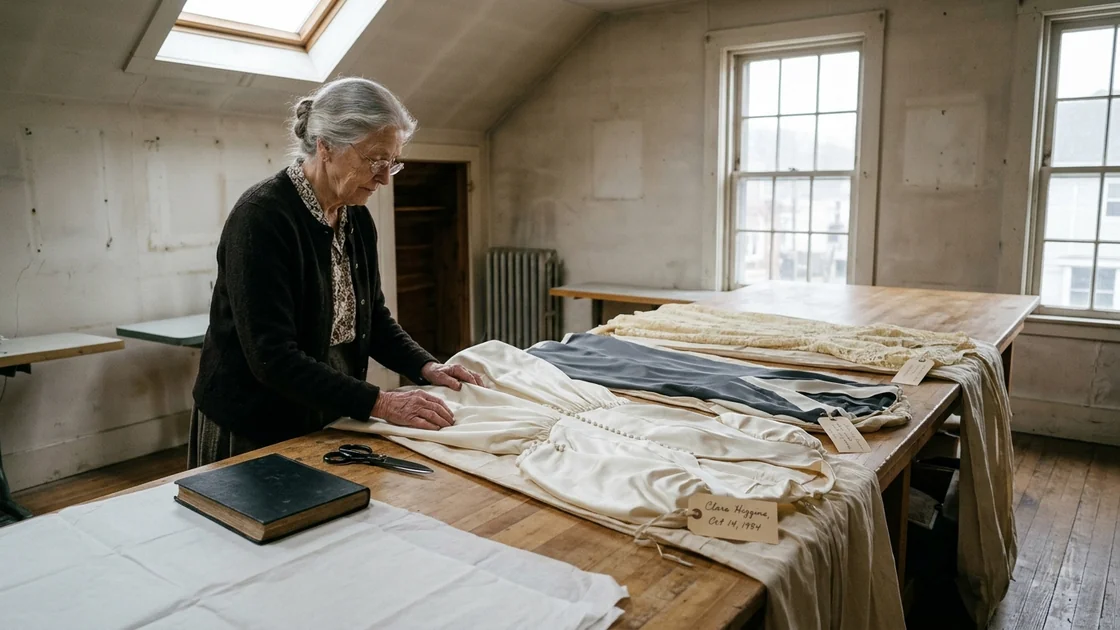
Martha Vance spent forty years operating an alterations parlor in the harbor town of Oakhaven, quietly reshaping the silk, lace, and satin armor worn by generations of women stepping into married life. Upon deciding to shutter her workroom forever, she takes stock of the hundreds of garments that passed through her hands and turns her attention to the small cedar closet in the back. Hanging inside are three dresses that were pinned, fitted, and finished, yet never claimed by the women who ordered them. Rather than donating the garments to an estate clearance or letting them turn to dust, Martha sets out across the backroads and neighboring counties to find the three missing brides, unearthing the unexpected turns their lives took after they walked away from the altar and discovering the quiet truth behind her own lifetime of solitary devotion.
Part One: The Room Behind the Mirror
The brass bell above the door of Vance Alterations had an irregular ring, dull on humid mornings and sharp when the sea freeze drifted off the bay. It had rung for forty years, marking the entrance of breathless girls, sour-faced mothers-in-law, weep-prone aunts, and daughters clutching grandmotherly gowns that smelled of attic joists and mothballs.
Martha Vance knew the human anatomy not by medical terms, but by tensions and grainlines. She knew that a woman carrying a heavy secret dropped her left shoulder by a quarter of an inch. She knew that a bride who felt coerced into her union would instinctively hold her breath during the pinning of the bodice, expanding her rib cage until the stays dug into her skin, as if her lungs were trying to build a fortress against the ring. She knew that the truly eager bride was restless; she shifted on the round wooden pedestal, her toes curling inside her stockings, making it nearly impossible to drop a straight chalk line along the hem.
Now, in the autumn of her sixty-eighth year, Martha’s thumbs were swollen at the basal joints. The chalk she used—hard, triangular wedges of white soapstone imported from a mill outside Lyon—felt heavier than it used to. The municipal council had bought out the row of brick mercantile buildings along St. Jude’s Lane to make way for a concrete promenade and marine administrative offices. Martha had taken the settlement without protest. Forty years of crouching on a kneeling pad with a mouth full of nickel-plated steel pins was enough.
Her workroom was nearly empty. The bolt racks had been sold to a theater company in the provincial capital. The three industrial Bernina machines, their cast-iron bodies gleaming under the north-facing skylight, had been claimed by a vocational institute down the coast. All that remained was her personal cutting table—four inches higher than standard, built from rock maple by her father—and the narrow cedar closet recessed into the lath and plaster beside the iron radiator.
Inside the closet hung three garment bags made of breathable unbleached muslin. They were not marked with computer-printed labels or dry-cleaner slips, but with manila luggage tags tied with twill tape. On each tag, Martha had written a name, a date, and a final balance that had never been settled.
She carried them out one by one and laid them flat across the cutting table.
The first was Clara Higgins, October 14, 1984. Heavy duchess satin the color of fresh cream, twenty-two self-covered buttons down the spine, and an illusion yoke seeded with tiny glass beads that Martha had reinforced by hand when the original factory stitching had pulled loose during the second fitting.
The second was Nadia Morales, November 27, 1999. A bias-cut sheath of silk crepe with an asymmetrical overlay of smoke-toned French organza. It was sleek, severe, and modern, devoid of pearls or lace, possessing a fluid, liquid drape that had required Martha to adjust the side seam three separate times so it would fall over Nadia’s high hip without a single ripple.
The third was Iris Cole, June 8, 2012. Buttercup lace layered over unbleached cotton voile, an empire waist tied with an olive-drab grosgrain ribbon, and a flared, scalloped hem that smelled faintly of the sweetgrass Iris had carried in her wicker basket during the third fitting.
Three women. Three ceremonies that evaporated into silence.
In forty years, Martha had handled four hundred and twelve bridal gowns. Most were carried out the door in triumph, zipped into protective vinyl, loaded into the trunks of station wagons or hatchbacks while bridesmaids held the doors. Martha would receive photographs six months later: glossy prints of women smiling beside cake tables, squinting into afternoon sunlight on country lawns, or dancing beneath paper lanterns in church basements. She kept those cards in a shoebox under her ledger desk.
These three bags, however, had stayed. In the busy rush of seasons—the spring panics, the summer frenzies, the autumn rushes—she had tucked them into the dark, telling herself that the families would eventually call, that someone would come to settle the modest balance or ask for the lace to be recut into a christening gown. But no one came.
Martha ran her fingers along the zipper of the 1984 muslin bag. The metal slider was cold. She could simply take them to the Salvation Army depot on the bypass. She could cut them down for quilt scraps. She could leave them hanging on the bare picture rail for the demolition crew to throw into a skip.
"No," she said aloud to the empty shop. The sound of her voice startled a sparrow that had landed on the outside sill.
She pulled her ledger from the shelf. It was bound in black buckram, its pages lined in blue and red ink, filled with her own precise, slanting handwriting. She turned back thirty-eight years, tracing her finger down the margins until she found the address Clara Higgins had penciled in on a rainy Tuesday afternoon.
Part Two: The Heavy Satin (1984)
The address was a rural route number outside the village of High Ridge, thirty miles inland where the coastal scrub gave way to red clay and commercial apple orchards.
Martha drove her ten-year-old hatchback with both hands firmly at the ten-and-two position. Beside her on the passenger seat lay the 1984 dress, folded into a clean pasteboard garment box lined with acid-free tissue. The sky was the pale, flat grey of galvanized iron, typical of November in this corner of the world, and the wind off the picked fields blew dead stalks of chicory and goldenrod against the drainage ditches.
High Ridge had not changed with the same violent speed as the coast. The harbor had seen its cannery flattened for condominiums, but High Ridge still had a feed store with a rusted tin awning and a municipal hall made of river stones.
Martha parked beside the post office. She did not immediately ask for Clara; she knew better than to barge into a small community demanding the whereabouts of an old shame. She went into the hardware store and bought a roll of florist’s wire and a tin of mints, listening to the two men behind the counter discuss the frost level.
"Excuse me," Martha said, setting her coins on the rubber mat. "I’m looking for the Higgins family. Arthur Higgins, who had the orchard off the old North Spur."
The older clerk squinted through thick bifocals, his spectacles held together at the bridge by a winding of yellowed adhesive tape. "Arthur’s gone twelve years back. The boy took the trees out. Put in high-density pears, then went bust. Clara’s still out there, though. Not on the main farm. She’s in the small house by the drainage pond. Follow the lane until you see the row of silver maples."
Martha thanked him, slipped the mints into her cardigan pocket, and drove toward the maples.
The house was a modest wood-frame bungalow painted the dark, mossy green of hemlock trees. It had a steep metal roof and a porch crowded with plastic tubs of winter squash and firewood stacked under tarpaulins. Behind the house, rows of stunted fruit trees stood bare, their black branches twisted like wire against the grey sky.
Martha stepped out of the car, smoothed her wool skirt, and went up the three steps to the porch. Before she could knock, the storm door opened.
The woman who stood there was tall, with broad, square shoulders and silver hair cut blunt at the jawline. She wore a stained canvas barn coat over denim dungarees, her hands dusted with flour or lime. She looked at Martha with the clear, unblinking grey eyes that Martha remembered from a fitting room mirror when Ronald Reagan was in his first term.
"Clara," Martha said.
The woman tilted her head. A furrow appeared between her eyebrows, not of anger, but of deep, archaeological curiosity. She looked at Martha’s grey chignon, the dark woolen coat, the brown leather handbag held firmly in both hands. Then her eyes widened.
"The shop on St. Jude’s," Clara said, her voice low and raspy, the voice of someone who spent more time with engines and animals than parlor conversation. "Miss Vance."
"Martha," she corrected. "I’m closing the shop, Clara."
Clara did not move for several seconds. A crow called from the dead top of a maple tree. Then she unlatched the aluminum screen door and pushed it open. "Come inside. The kettle’s on the pilot."
The interior smelled of woodsmoke, paraffin, and stewed apples. It was a worker’s house, uncluttered by knick-knacks. A heavy deal table sat in the center of the kitchen, covered in seed catalogs, a ledger of poultry sales, and an oil lamp with a smoky chimney.
"Sit down," Clara said, nodding to a spindle-back chair. She moved to the stove, poured hot water from a speckled enamel kettle into a brown teapot, and set down two thick ceramic mugs without saucers. "I suppose you’ve got it in the car."
"I do," Martha said. "In a conservation box."
Clara sat across from her. Her hands were large, the skin scarred across the knuckles from cold wind and pruning shears. She picked up her tea with both hands, letting the steam rise into her face.
"I owed you eighteen dollars for the final basting," Clara said quietly. "And twelve for the covered buttons. Thirty dollars total."
"Thirty-two," Martha said softly. "You forgot the bias tape for the underskirt."
A dry, cracked smile appeared on Clara’s face, then disappeared just as quickly into the weathered lines around her mouth. "Thirty-two dollars. In 1984, that was three days of sorting apples at the cooperative."
"You never came back for the third fitting," Martha said. "You were supposed to come on a Thursday. October fourth. We were going to set the hem with your low heels. You had ivory pumps with the little square buckles."
Clara turned her gaze toward the window, looking out over the bare orchard toward the ridge where the clouds were dropping lower, threatening sleet.
"I had the pumps," she said. "They were in a box under my bed. My mother had bought them at the department store in the county seat. She’d saved egg money for six months to pay for them. And Arthur—my father—he’d butchered two steers to pay for the tent and the ham dinner."
"David was the boy’s name," Martha remarked, remembering the name entered in her book under Groom. "David Miller."
"David was a good boy," Clara said. There was no bitterness in her tone, only the flat, clean weight of ancient fact. "He had four hundred acres of bottomland that joined ours. He was polite to my mother. He didn't drink, except for a beer on Saturday night after the softball match. Everyone in High Ridge thought it was the most sensible thing that had happened since the rural electrification."
"What happened on October third?" Martha asked.
Clara took a slow sip of her tea. "Nothing happened. That was the trouble. Absolutely nothing happened. David came by the house after supper to show me the brochure for the resort we were going to in the Poconos. He had a pencil behind his ear because he’d been figuring the board-feet of pine he needed to build a machine shed. He sat on the sofa with me, and he smelled like diesel and soap. He laid the brochure on my knee, and he pointed to a picture of a swimming pool shaped like a cloverleaf."
She paused, her fingers tracing the rim of her mug.
"He looked at me, Martha, and he said, 'Clara, once we get the shed up, we can take the two milk cows off your father’s hands, and you can take over the butter-making for both farms. It’ll save us thirty dollars a month.' And I looked at his hands, and I looked at that picture of the cloverleaf pool, and I saw forty years stretching out in front of me like a plowed furrow that never turned. I saw the kitchen. I saw the jars of stewed tomatoes. I saw David sitting across from me, figuring board-feet until his hair turned white."
"You didn't love him," Martha said.
"I liked him fine," Clara replied. "Liking is dangerous. You can live inside of 'liking' until you forget that you’re a living creature. That night, after he went home, I took the ivory shoes out from under the bed. I walked out to the lane in my nightgown, holding those shoes by their heels. I threw them into the slurry pit behind the milking parlor. They went down with a suck, and they never came back up."
Martha listened. In her forty years, she had heard dozens of women weep in her dressing room—over unfaithful fiancés, over impossible mothers, over the sudden terrifying realization of their youth slipping away. But she had never seen Clara Higgins weep. Even on the day of her second fitting, when the dress had been pinned tightly around her rib cage, Clara had been dry-eyed, staring into the triple mirror with an expression that Martha had mistook for solemnity.
"What did you do the next morning?" Martha asked.
"I got on the four-fifteen bus to the state capital," Clara said. "I had twenty-two dollars in my purse and an extra pair of boots in a canvas bag. My father didn't speak to me for seven years. David married a girl from the valley nine months later. She bore him four children, and she ran the butter-making just like he wanted. She died five years ago of cancer. I saw him at her funeral. He was bent over, leaning on an aluminum cane. He looked at me, and he nodded, like you’d nod to a neighbor you hadn't seen since the storm."
"And you?"
"I worked in a commercial nursery in the valley for twenty years. Learned how to graft stone fruits. Learned how to prune so the light gets right into the heart of the wood. When Arthur died, my brother didn't want this scrubby parcel by the pond, so I bought it with my pension payout. I have forty hives of bees and four acres of heritage russets. Nobody tells me when to prune, and nobody asks me to save thirty dollars on the butter."
Clara set her mug down and stood up. "Bring the box in."
Martha went out to the car. The wind had picked up, carrying the sharp, cold smell of salt from the distant sea mixed with the damp rot of autumn leaves. She lifted the long pasteboard box from the passenger seat, carried it up the porch steps, and laid it across the scrubbed pine of Clara’s kitchen table.
Clara did not rush to open it. She stood with her hands in the pockets of her barn coat, looking at the box as if it were an unexploded mortar shell dug up from a turnip patch.
"Open it," Martha said.
With careful, thick fingers, Clara untied the twill ribbons and lifted the lid. The acid-free tissue paper rustled with a crisp, dry sigh. Martha reached in and folded back the paper, revealing the duchess satin.
Even after thirty-eight years in a dark cedar cupboard, the fabric had not yellowed. Martha had treated the silk fibers with a gentle vinegar rinse before storing it, and the cream-colored sheen was as deep and heavy as fresh milk in a pail. The twenty-two buttons down the back stood in a flawless, rigid row, their satin coverings smooth and taut. The small seed pearls at the neckline caught the dull grey light from the window, gleaming like grains of polished rice.
Clara reached out a thumb. She touched the collarbone seam where Martha had reinforced the illusion netting. She did not touch the skirt. She did not lift the hem. She only touched that one small, hidden reinforcement at the shoulder.
"You do fine work, Martha Vance," she whispered.
"I do," Martha said without vanity. "It was basted to your measurements: thirty-four bust, twenty-six waist. You were long in the back, I remember. I had to drop the waist seam three-eighths of an inch so it wouldn't ride up when you sat down."
Clara let out a short, rough breath that sounded almost like a laugh. "I haven't been twenty-six inches around the middle since the Berlin Wall came down."
She looked up from the box, meeting Martha’s eyes.
"Why didn't you sell it?" Clara asked. "Or cut it up for communion veils? Satin like that was worth something. It’s still worth something."
Martha looked down at the pearls. "It wasn't mine to sell. You paid for the cloth. The shop in the city sent the yardage out on the carrier. You paid for the pattern drafting. I only did the cutting and the fitting. Until you told me you didn't want it, it belonged to the girl who walked out to the slurry pit."
Clara stared at the gown for a long time. The sleet had begun now; tiny grains of white ice rattled against the kitchen windowpanes like sand thrown against glass.
"I don't want it, Martha," Clara said gently. "I never wanted the dress. I only wanted the day when I had the courage to leave it behind."
"I know," Martha said.
"What will you do with it?"
"I don't know," Martha confessed. "I have two others. One from ninety-nine, one from twenty-twelve. I made up my mind this morning that I wouldn't leave them for the auctioneer."
Clara went to a tin tea canister on the small shelf beside the stove. She reached inside, pulled out a small bundle of folded banknotes, and thumbed through them with her cracked, scarred fingers. She pulled out two crisp twenty-dollar bills and laid them on top of the acid-free tissue paper, right over the waistline of the duchess satin.
"Forty dollars," Clara said. "Thirty-two for the balance, and eight for forty years of storage."
Martha looked at the money. Her first impulse was to refuse it, to push it back across the table with the polite reserve of an old tradeswoman. But she saw the set of Clara’s jaw, the dignity that resided in those broad, hard shoulders, and she knew that to refuse would be an insult. Clara Higgins was a woman who settled her debts with the world on her own terms.
Martha took the two bills, folded them neatly, and placed them in her coin purse.
"Thank you, Clara," she said.
"You keep the satin," Clara told her, closing the lid of the box with a firm, decisive thud. "Burn it, or give it to some girl who thinks she needs two hundred yards of train to be happy. But don't bring it back here. My house is full enough."
They stood on the porch together for a moment while the hatchback’s engine warmed up. The wind was bitter now, driving the ice sideways through the bare branches of the orchard.
"Did you ever marry, Martha?" Clara asked suddenly, her hand resting against the door jamb.
Martha paused, her hand on the car door handle. She looked out toward the grey line of the highway. "No," she said. "I had the shop. My father took sick after the war, and then the shop was busy. By the time I looked around, the girls I grew up with were grandmothers, and I had a mouthful of pins."
Clara nodded slowly. She did not offer pity; she offered the recognition of one craftsman to another. "There are worse things," she said. "A whole lot of worse things than a mouthful of pins."
Part Three: The Grey Crepe (1999)
The second box was lighter, but the search was harder.
Nadia Morales had not lived in a farmhouse with roots in the dirt. In 1999, she had been a visiting lecturer in comparative literature at the regional university twenty miles up the coast—a tall, restless woman with dark olive skin, hair cut into a severe bob that swept against her cheekbones, and an accent that Martha had never quite placed, somewhere between Madrid and Montreal.
She had come into Vance Alterations with three yards of heavy silk crepe purchased in Paris and a sketch drawn on the back of an exhibition catalog.
"No frills," Nadia had commanded, standing on the pedestal with her chin tilted upward, her arms crossed over her chest. "No bows. No lace that looks like cabbage leaves. I want it to fall like water over a weir. It must be cold and clean."
Martha had appreciated the problem. Satin was cooperative; it held its form, hid internal boning, and forgave an eighth-of-an-inch error with a quick press of the steam iron. Silk crepe had no mercy. It was alive; it stretched on the bias; it clung to the hip bone and revealed every tension in the thread. Martha had spent three nights basting the skirt seams by hand with silk filament thread, working under an incandescent lamp until her eyes watered, ensuring that the slate-grey organza under-layer did not drag against the ivory surface.
The groom had been an older man, a senior professor of medieval history named Julian Vance-Smyth—no relation to Martha, though the coincidence had caused a dry chuckle between them during the first consultation.
In her ledger, Martha had an address for a brick townhouse in the university district, a phone number that had been disconnected since the spring of 2000, and a notation: Deposit paid, $150. Balance outstanding: $110. Wedding set for New Year’s Eve, 1999.
Martha spent two days at the public library in Oakhaven. The librarian, a young man with a silver ring in his nostril and an infinite patience for old microfiche reels, helped her scan through the university faculty gazettes from the turn of the millennium.
"Here she is," the young man said, pointing a pale finger at the monitor. "Nadia Morales. She left the faculty in January 2000. Resigned suddenly. But look here—there was an obituary in 2008 for Julian Vance-Smyth. Survived by his wife, Eleanor, and three children."
Martha leaned in, adjusting her spectacles. "Eleanor?"
"Not Nadia," the librarian said. "Eleanor was sixty-five when he died. They’d been married since 1968."
Martha felt a small, cold drop in her stomach. A common enough story, even in a small harbor town: the visiting scholar, the distinguished chair of the department, the promises whispered in drafty faculty offices, and the sudden, brutal retraction when the family foundations were threatened.
"Can you find where she went?" Martha asked.
The librarian tapped his keys with rhythmic speed. "She published a book of translations in 2014 with an independent press in Montreal. Let me check the author directory."
Two hours later, Martha had a post office box in a northern border town called Saint-Armand, four hours inland through the granite gaps of the northern hills.
She did not take the highway. She drove her small car through the river valleys, where the mountain ash trees held clusters of bitter red berries against the stone cliffs. The conservation box containing the 1999 sheath sat on the back seat, secured by the center seatbelt.
Saint-Armand was a border outpost: a single street of clapboard houses, a general store that smelled of spruce gum and smoked sausage, and an old customs house converted into a public library and municipal hall.
The postmistress at Saint-Armand was an elderly woman with silver-framed spectacles who took one look at Martha’s grey coat and decided she was not an agent from the revenue department.
"Madame Morales?" the woman said in a French-inflected drawl. "She doesn't live in the village. She lives out by the old lime kiln on the border road. She translates German poetry and grows winter cabbage. If you’re selling insurance, don't bother getting out of the car. She has two German shepherds that don't care for strangers."
Martha drove along the border road. The boundary line between the two countries was marked only by a twenty-foot clearing through the birch woods—an endless, straight corridor of grass running over the hills like a surveyor’s scar.
The house by the lime kiln was an old stone cottage with deep-set windows and a cedar-shingle roof mossed over at the eaves. A chimney of river rock puffed a steady plume of grey birch smoke into the November sky.
When Martha pulled into the dirt driveway, the two dogs did not bark; they stood side-by-side on a flat granite boulder beside the well, their ears pricked, their dark eyes watching the tires turn over the gravel.
The door opened. Nadia Morales had not cut her hair in twenty years. It was now iron-grey, pulled back into a thick plait that hung over one shoulder, reaching her waist. She was sixty or more, but her cheekbones were still blades, her mouth wide and iron-firm. She wore an oversized wool pullover that looked hand-spun, charcoal wool trousers, and sheepskin slippers.
She stood on the threshold, watching Martha climb out of the car. She did not squint. She had the gaze of a falcon that had lived on high cliffs.
"You have been driving a long way, Miss Vance," Nadia said across the gravel. Her voice had the same low, musical friction Martha remembered, though the vowels had grown thicker, tempered by two decades of northern winters.
Martha paused by the car’s rear door. "You remember my face?"
"I remember your hands," Nadia said, gesturing toward Martha’s gloves. "You had three needles stuck into the wool of your cuff, and you told me my ribs were too narrow for my height. Nobody had ever spoken to me about my skeleton with such authority."
"Your ribs were standard," Martha said, walking toward the porch. "It was the bias cut that was difficult. It has no structural tolerance."
Nadia stepped aside, holding the door. "Bring the dogs in with you. If you leave them out, they will try to herd your tires."
The cottage was a single long room with a massive hearth at one end and a wall of books reaching to the rafters at the other. A long trestle table was piled with manuscripts, foreign-language dictionaries with split bindings, and small white stones Nadia had collected from mountain streams. A cast-iron pot of yellow lentils simmered on a wood-fired range, filling the room with the scent of cumin and bay.
"Julian is dead," Martha said, standing in the center of the room with her handbag over her arm. She felt no need to circle the subject.
"He died eight years ago," Nadia replied, pouring dark cider from a stoneware jug into two glasses. "Of a stroke while pruning roses in his wife’s garden. It was a very suitable death for Julian. Symmetrical. Orderly. His widow sent me his small desk dictionary of Anglo-Saxon. She was a woman of great civility, Eleanor. Much more civility than Julian deserved."
"Did you love him?" Martha asked.
Nadia handed her a glass of cider. Her eyes were amused, though the lines around them were deep and hard. "Love him? I was thirty-five, Martha. I was a brilliant, foolish woman who believed that an intellect could be a home. Julian knew how to read the Lindisfarne Gospels in the dark. He could tell you the etymology of the word 'sorrow' in seven languages. But he was a coward when the sun came up."
"You ordered the dress," Martha said. "You chose the French organza. It was seventy dollars a yard. I had to send a money order to a merchant in Montreal."
"I wanted to be real," Nadia said softly, turning toward the fire. The two dogs lay down at her feet, their heavy muzzles resting on their paws with a synchronized sigh. "I had spent my whole life in footnotes, in libraries, in other people’s languages. Julian told me we would live in a stone house in Normandy. He told me we would have sheep and an orchard of cider apples. I came to your shop because I wanted to hold something that had weight. That silk was heavy. Do you remember how heavy it was?"
"Six-ply silk crepe," Martha said. "Twelve ounces per square yard. It hangs like lead."
"Yes," Nadia murmured. "Like lead. I went home from your shop after the second fitting, and I went to Julian’s office. It was five o'clock on a Friday. He was grading undergraduate essays on the Venerable Bede. I told him: 'The dress is basted. The seamstress has cut the silk. We must tell your department head on Monday.'"
She took a slow sip of the cider, her throat working.
"And he looked at me, Martha. Not with hatred. Not with fury. He looked at me with weariness. He took off his gold spectacles and laid them on the blue examination books, and he said, 'Nadia, my dear girl, you cannot possibly have taken the Normandy business seriously. Eleanor has just ordered the new winter curtains for the library.'"
Nadia let out a short, clean bark of laughter that made both dogs raise their heads.
"The winter curtains! That was the measure of my great passion. A set of green velvet curtains from an upholstery shop in Boston. I walked out of the faculty building, I went to my flat, I packed two suitcases of books and one of boots, and I drove north until the radio only spoke French. I have been here ever since."
"The dress is in the car," Martha said.
"Bring it in," Nadia commanded.
They brought the pasteboard box inside and laid it across the trestle table, pushing aside a stack of German translations. Nadia did not hesitate as Clara had. She pulled off the box lid with a single, sweeping movement and cast the tissue paper aside.
The crepe was as fluid as mercury. In the firelight, the slate-grey organza took on a strange, violet-tinted depth, shimmering over the ivory foundation like water over river stones. It looked nothing like Clara’s traditional satin; it looked like a modernist sculpture, an architectural study in fall and tension.
Nadia reached out and lifted the hem. The fabric pooled through her fingers, falling back onto the table with a soft, heavy shhh.
"It is magnificent," she said.
"You had a slight hollow below your right collarbone," Martha said, pointing to the neck facing. "I cut a tiny half-circle dart on the inside to keep the neckline from gaping when you leaned forward. You can't see it from the front."
Nadia turned the bodice inside out. There, invisible from the exterior, was a line of hand-stitching so tiny, so uniform, that it looked like the tracks of an ant across snow.
"Why didn't you cut it into scarves, Martha?" Nadia asked, her voice dropping its irony, becoming quiet and grave. "You could have sold fifty silk scarves to the ladies who come to the harbor for the summer."
"It was your line," Martha said simply. "A pattern drafted for one woman’s ribs cannot be worn by another without lying. It would have pulled at the armholes. It would have twisted across the spine. A dress like this only exists for the body it was drafted for. Otherwise, it is just yardage."
Nadia touched the tiny stitches Martha had set by hand on a cold December night in 1999. Her throat moved, but she did not cry. She was a woman who had traded tears for granite decades ago.
"I cannot wear it," Nadia said. "My shoulders are three inches wider now from splitting birch logs. My hips are thick from sitting at this table."
"I didn't bring it for you to wear," Martha said.
"Then why?"
Martha sat down in the heavy ladder-back chair beside the hearth. She looked at her own hands, resting on the worn wool of her skirt. The skin was paper-thin now, the blue veins prominent, the knuckles permanently thickened by the trade.
"Because forty years is a long time to keep other people’s ghosts in a cupboard," Martha said. "When I locked the shop door yesterday, I felt as if the building were full of water, and those three bags were stones holding me to the bottom. I wanted to see if the stones were real."
Nadia looked at her for a long time. The wind began to whine around the corners of the stone cottage, driving a few stray flakes of dry snow against the window.
"You have lived alone, Martha?"
"Always," Martha said.
"Did you want someone?"
Martha leaned her head back against the wood of the chair, feeling the heat from the hearth warm the cold bone of her skull. "When I was twenty-four, there was a boy who worked the timber schooners. Thomas. He had hair the color of wet sand and hands that smelled of pine pitch. He took me to the churchyard behind the lime kilns in Oakhaven and gave me a polished piece of sea glass he’d found in Newfoundland. He told me that when his vessel came back from the spring run, we would talk to my father."
"And the vessel?"
"A squall off Cape Sable," Martha said without inflection. "They found the mainmast and three empty salt barrels. Nothing else. My father was already failing then. The shop needed someone to cut the canvas and baste the linings. So I took up the shears. After ten years, you don't think about the sea glass anymore. You only think about whether the hem is level."
Nadia walked to the table. She lifted the silk crepe dress from the box—not with hesitation, but with a sudden, wild efficiency.
"Come," Nadia said.
"What are you doing?"
"We are not going to leave this for the moths or the mice," Nadia said. She carried the heavy gown toward the stone hearth.
Martha stood up, her hand instinctively reaching out to stop her. "Nadia, no. That is French silk. It is six-ply."
Nadia turned, holding the dress like an armful of white harvest. Her eyes were bright, fierce, and entirely sane. "Martha Vance, look at it. It was made for a lie. It was made for a man who cared more for green velvet curtains than for a human soul. If it stays in this box, it remains a monument to my cowardice and his smallness. It has been waiting twenty-three years for an ending."
With a movement as fluid as the bias cut itself, Nadia laid the ivory silk crepe across the burning birch logs.
Martha caught her breath.
The silk did not burst into flame like paper. Pure silk is protein; it resisted, it curled, it hissed as the heat found the moisture in the fibers. Then, with a sudden, pungent smell—like scorched feathers and burnt hair—the blue-grey organza shrank into tiny beads of black ash, and the heavy cream crepe blackened along the hem, the red embers racing along the grainlines like threads of fire.
Martha stood frozen. For an instant, forty years of instinct—the panic of an iron left too long on a facing, the horror of a dropped match, the sacred preservation of the cloth—surged through her chest. She wanted to snatch the tongs and drag the silk from the grate.
Then the fire took the bodice. The tiny, invisible dart Martha had sewn to protect Nadia’s hollow collarbone glowed cherry-red for three seconds before dissolving into light. The grey smoke rose straight up the stone chimney, clean and strong, carried into the northern air by the birch wood heat.
Nadia Morales stood with her hands on her hips, watching the silk turn to white ash and grey dust. When the last button—the small, unadorned horn button at the neck—cracked in the embers, she turned to Martha.
"There," Nadia said. Her face was flushed with the heat, her eyes clear and untroubled. "Now it is finished. Julian has his curtains, I have my translations, and you have an empty box."
Martha looked into the grate. A few wisps of white ash drifted up toward the flue. The air in the room smelled sharp and real, completely unlike the old cedar cupboard on St. Jude’s Lane.
She felt a strange, light sensation in the center of her chest, as if a stay that had been pulled half an inch too tight had suddenly been clipped with the shears.
"Yes," Martha said, her voice steady. "Now it is finished."
She stayed the night in the stone cottage. Nadia made a bed for her on the sofa with heavy wool blankets that smelled of cedar and snow. They did not talk about men or weddings again. They talked about the difficulty of translating French verbs that had no equivalent in English, and Martha explained how to tell the difference between Italian linen and Belgian flax by the way the thread broke when pulled across the grain.
In the morning, before Martha left, Nadia handed her an envelope. Inside was a single hundred-dollar bill, old and limp from being kept in a book.
"For the basting," Nadia said.
"The balance was one hundred and ten," Martha replied automatically.
Nadia smiled, her dark eyes narrowing with pleasure. "You will have to forgive the ten dollars, Miss Vance. I had to buy firewood."
Martha took the bill and tucked it into her glove.
Part Four: The Guipure Lace (2012)
The third dress was different from the others. It was not a memory from a distant youth; it was a wound that had barely grown its scar.
Iris Cole had been twenty-one when she walked into Vance Alterations in the spring of 2012. She was a girl from the harbor, the daughter of a diesel mechanic who repaired the trawler engines at the government wharf. She had eyes the color of rain-washed slate and hair that she constantly tucked behind her ears with fingers that smelled of salt and outboard oil.
The groom was Liam Kelleher, a boy who had grown up on the lobster boats, whose brothers were all six feet tall and had voices that boomed across the water like foghorns. They had been sweethearts since the eighth grade. The town had considered the wedding as inevitable as the turn of the tide.
Iris had not brought French silk or heirloom satin. She had saved her own wages from the fish processing plant and bought four yards of heavy cotton guipure lace from a shop in Halifax—thick, bold lace with patterns like sea-fennel and wild celery—and had asked Martha to make something she could dance in on the sand at the lighthouse point.
"I don't want a hoop, Miss Vance," Iris had said, her bare feet shifting on the cedar pedestal. She had a bruise on her ankle from a fish tote. "I want to be able to jump off the tail of Liam’s skiff without catching my heels. And I want the hem short in the front, so my boots show, and long in the back like the wake behind a boat."
Martha had cut the asymmetrical hem with a special rotary blade, finishing the scallop by hand with four-ply embroidery floss to keep the heavy lace from unravelling. It had been joyful work. The shop had been full of the young girl’s laughter, her friends tumbling in with paper cups of cider and bags of chips, arguing over whether the groomsmen should wear ties or oilskin suspenders.
The wedding was set for June sixteenth.
On June twelfth, the Marrow Stone, a thirty-two-foot gillnetter belonging to Liam’s uncle, had lost her steerage in a southeast gale off the Black Ledge. Liam had been at the winch. A rogue sea had taken the stern, the cable had snapped under the load of the net, and Liam had gone over the side into forty fathoms of white water.
They found his oilskin jacket three days later, hung up on the buoys of a cod trap. They never found the rest of him.
Iris had not come back to the shop. Her mother had come three weeks later, her face grey and shrunken, offering to pay the balance from her own purse. Martha had refused the money. She had wrapped the buttercup-cream lace in acid-free tissue, zipped it into the muslin bag, and put it in the cedar closet. She had not had the heart to look at the manila tag for ten years.
Unlike the other two, Martha did not need to search far for Iris.
Iris had not fled to the mountains or taken up bees in an inland orchard. She was still in the district, but she had moved out of the town proper. She lived three miles out along the spit, at the mouth of the bay where the lighthouse stood on a knuckle of red sandstone.
Martha drove out to the spit in the late afternoon. The sky had cleared after the sleet, leaving the horizon a cold, sharp line of sapphire blue. The sea was high, dark water rolling in from the north with white combs of froth breaking over the stone breakwaters.
The lighthouse had been automated since the seventies, but the keeper’s dwelling—a squat, square cottage made of whitewashed brick with granite sills—was still rented out by the harbor authority to anyone hardy enough to endure the winter damp and the isolation.
A small wooden skiff was hauled up on the gravel beach above the high-tide line, its bottom freshly painted with copper-red anti-fouling. Beside the skiff stood an open shed with a bandsaw and benches covered in cedar shavings.
Iris Cole was thirty-one now. She wore a heavy navy-blue wool sweater that had belonged to a large man, the cuffs turned back twice over her wrists, and tall rubber boots splattered with mud. She was carrying a bucket of iron drift-bolts toward the shed when Martha’s car stopped at the end of the gravel track.
Iris paused, the heavy bucket hanging from her right arm. She watched Martha get out of the car. She did not have the falcon-glance of Nadia or the hard reserve of Clara; she had the patient, watchful stillness of women who live within sound of the surf.
"Miss Vance," Iris said. Her voice was deeper than it had been at twenty-one, smoothed down by sea wind.
"Hello, Iris," Martha said, pulling her coat around her against the cold breeze coming off the gut.
Iris set the bucket down on the gravel with a dull clink of iron. She looked at the car, then at Martha’s hands, which were empty.
"You’ve still got that shop on the corner," Iris said.
"Closed it yesterday," Martha said. "The town is taking the row down for the new marina."
Iris nodded slowly. "Liam’s brother told me they were building a concrete wharf for the pleasure yachts. Seems like a lot of concrete for people who don't know how to tie a bowline."
She wiped her hands on the thighs of her trousers and looked toward the cottage. "The wind’s coming round to the east. Come in and get warm. I’ve got some coffee on the hotplate."
The keeper’s house was spare, scrubbed clean with salt-soap, and cold. The only heat came from a small cast-iron coal stove in the parlor, its belly glowing a dull, orange-red through the mica panes in the door. The furniture was made of driftwood and salvage: a bench made from a hatch cover, a table built from heavy spruce stringers with the bolt holes still visible. On the wall hung a pair of brass navigational dividers and an Admiralty chart of the bay, the depths marked in fathoms with pencil notations along the three-fathom line.
There were no photographs of Liam Kelleher on the mantel. But on the window sill lay three smooth stones of white quartz and a rusted shackle from a trawl warp.
Iris poured black coffee into a tin mug and handed it to Martha.
"I know what you’ve got in the car," Iris said, sitting on the bench by the stove. She held her own mug with both hands, her knuckles raw from cold salt water.
"It’s in the conservation box," Martha said. "The lace hasn't yellowed. It’s heavy cotton; it holds up better than silk."
Iris looked down into her coffee. "My mother told me she tried to pay you."
"She did," Martha said. "I wouldn't take it."
"Why not? You worked hard on that skirt. I remember you sitting on your little stool with that magnifying glass, cutting round the wild celery patterns so the hem wouldn't fray."
"Because it wasn't finished," Martha said gently. "A gown isn't finished when the last thread is clipped. It’s finished when it’s worn."
Iris shook her head. A lock of brown hair fell across her forehead, and she tucked it behind her ear with that same quick, familiar gesture that Martha remembered from the pedestal.
"Then it’ll never be finished, Miss Vance," she said softly.
"Are you still waiting for him, Iris?"
Iris looked up. There was no grief in her eyes, at least not the wild, drowning grief of a girl who had just lost her sweetheart. There was only the long, flat grey of the bay in winter.
"I’m not waiting for Liam," she said. "Liam’s in the mud off the Ledge. I know that. I helped his brothers haul the gear the next spring. We brought up five miles of trawl, and every hook had sea-lice or dogfish. I know where he is. I’m not crazy."
"Then what are you doing out here on the spit?"
Iris turned her face toward the window, where the light was beginning to fail, the sea turning from grey to the color of ink.
"I tried to live in the town," she said. "I took a room above the bakery. Every time I went down to the post office, someone’s mother would look at me with that look. You know the one? Like I was made of eggshells. Like if they spoke too loud, I’d shatter all over the linoleum. And Liam’s brothers—they’d bring me fish. Cod fillets wrapped in butcher paper, half a lobster, a bucket of clams. They’d stand on the stairs with their hats in their hands, looking at the floorboards, smelling like diesel and bait, and they didn't know what to say to me. And I didn't know what to say to them."
She took a swallow of the bitter coffee.
"Out here," Iris continued, "the wind doesn't feel sorry for you. It blows hard enough to take the skin off your ears, and the sea doesn't care whose boat went down. It’s just water. When I repair a skiff for the weir-men, the wood doesn't ask me who I was going to marry. It just asks if the scarph joint is tight."
"You build boats?" Martha asked, looking toward the shed she had seen through the window.
"Small ones," Iris said with a quiet touch of pride. "Punts. Dories for the hand-liners. Light skiffs for the lobster cars. I learned from old man Miller before he died. My hands are good at it. You can see when an oak rib is true. If it’s not true, you steam it until it bends. If it breaks, you throw it in the stove and start another. You don't have to carry it around in your head."
"The dress is true," Martha said.
Iris fell silent. The coal in the stove shifted with a hollow clink.
"Why did you bring it here, Miss Vance?" Iris asked, her voice dropping until it was almost lost beneath the sound of the surf grinding the gravel outside. "To make me remember?"
"No," Martha said. "To let you forget."
Iris stood up. She walked to the window and pressed her forehead against the glass, looking out toward the light tower. The automated beacon had just begun its cycle: five seconds of white brilliance, ten seconds of dark. Flash. Wait. Flash.
"I was going to wear my red wool socks under it," Iris whispered. Her breath made a circle of fog on the glass. "I had them hidden in my drawer. Liam hated those socks; he said they made my ankles look like fence posts. I was going to pull my skirt up during the first dance just to see him laugh."
Martha set her tin mug on the hatch cover. She stood up, her old knees cracking in the quiet room.
"Get your coat, Iris," she said.
"Why?"
"Bring the box out to the skiff."
Iris turned from the window, her face uncertain for the first time. "What are you going to do with it? Clara Higgins gave you forty dollars, and the foreign lady burned hers. What do you want me to do?"
"I don't want you to do anything," Martha said. "I want you to show me your boat."
They went out into the blue dusk. The wind was stiff and cold, smelling of kelp and salt-ice. Martha carried the pasteboard box, her arms aching with the bulk of it.
Iris led the way down the gravel spit to where the copper-bottomed skiff rested on the skids. It was fourteen feet long, built of white pine over steamed oak frames, its seams payed with grey compound, clean and sweet as an almond shell.
"She’s pretty," Martha observed, running her bare fingers along the gunwale. The wood was cold, but smooth as a polished spoon.
"She’s for young Tommy Kelleher," Iris said. "Liam’s nephew. He’s twelve this winter. His father wants him to have a safe boat for tending the harbor traps."
Martha laid the pasteboard box across the thwarts. She untied the twill ribbons and lifted the lid.
The buttercup lace caught what little light remained in the sky. Unlike the duchess satin, which had the cold majesty of stone, or the silk crepe, which had been fluid and dangerous, the guipure lace was alive with pattern. It looked like the floor of the bay—tangled, intricate, sturdy, full of the shapes of things that grew in the dark salt water.
Iris looked down at it. She did not touch the lace. She put her hands behind her back, her fingers locked together like a child being shown an antique clock.
"It’s too short," Iris whispered. "I’m thicker now. My shoulders are wider from the adze."
"The hem is what matters," Martha said. She reached into her handbag and pulled out her heavy shears—the eight-inch German steel shears with the black-enameled handles that had hung from her wrist by a lanyard for forty years.
Iris’s eyes widened. "Miss Vance, what are you doing?"
"You said Tommy needs a safe boat," Martha said.
"What does a boat have to do with lace?"
"Nothing," Martha said. "And everything."
With a single, decisive motion, Martha drove the shears into the center of the bodice, right through the sweetgrass-stained grosgrain ribbon. The sound of the cotton lace parting under the blades was crisp and loud, like dry twigs snapping underfoot.
Iris gasped, her hand flying to her mouth. "Martha!"
Martha did not stop. She cut with the swift, ruthless economy of forty years of alterations. She cut the straps away from the shoulders. She sheared through the side seams. In thirty seconds, the buttercup gown was no longer a dress; it was four large, clean panels of heavy, scalloped cotton lace.
Martha handed one of the panels to Iris.
"What am I supposed to do with this?" Iris asked, her voice trembling.
"You’re a boatbuilder," Martha said, her face calm in the fading light. "What do you do with heavy cotton when you’re bedding a deadwood or sealing a stem?"
Iris looked from the lace to the skiff, then back to the lace. Her mouth opened, then closed again. A slow, strange light dawned in her eyes—not horror, but a sudden, radical understanding that seemed to clear the shadow from her forehead.
"Canvas," Iris said under her breath. "We soak it in thick red-lead paint or tar and lay it between the oak deadwood and the keel so the worm can't get in through the seams."
"Will cotton lace hold the paint?" Martha asked.
Iris reached out her calloused hand and squeezed the heavy guipure lace. The sea-fennel pattern was thick, open-meshed, three-ply cotton thread, strong enough to tow a hand-line.
"It’ll hold two pints of lead to the yard," Iris said, her voice dropping into the practical, rhythmic cadence of a craftsman. "Better than sailcloth. The paint’ll soak right into the knot-work. It’ll never rot. Not in fifty years."
"Then cut it," Martha said, offering her the shears.
Iris took the heavy shears. Her hands were large, her fingers scarred from chisels, but she took the shears by the black handles with natural balance. She did not hesitate. She laid the long, asymmetrical train across the gunwale of young Tommy’s skiff, lined up the scallop, and cut the lace into straight, three-inch strips.
The sound of the cutting mingled with the sound of the surf breaking on the outer bar. Snip. Snip. Snip.
When she was finished, the pasteboard box was empty, and the thwarts of the skiff were piled with ribbons of buttercup lace, ready for the tar-pot and the lead paint.
Iris stood with the shears in her hand, breathing hard. The cold air blew her hair across her face, but she did not tuck it back. She looked down at the white ribbons, then at Martha Vance.
Suddenly, Iris stepped forward, wrapped her thick, wool-clad arms around Martha’s neck, and buried her face in the shoulder of Martha’s old coat.
Martha did not move for an instant; she was unaccustomed to being held. Her life had been one of touches that were purely professional—measuring the inseam, adjusting the armscye, lifting the train off the dusty floor. But then she lifted her hands, her swollen, arthritic thumbs resting against the rough wool of Iris’s back, and held the girl while the lighthouse beacon swung around overhead, washing them in white light for five seconds, then plunging them back into the honest, salt-dark night.
"He’s gone, Martha," Iris sobbed into her wool collar. It was the first time she had said his name without the hardness of the spit in her voice. "Liam’s really gone."
"I know, my dear," Martha said softly, looking out over the girl’s shoulder toward the black water of the bay. "I know he is. But the boat will be tight."
Part Five: The Final Basting
Martha arrived back on St. Jude’s Lane late the following afternoon.
The town had already placed the orange plastic barricades at the head of the street. A diesel excavator with a massive yellow jaw sat on a flatbed trailer outside the old chandlery, its hydraulic hoses dripping dark oil onto the cobblestones. The demolition would begin on Monday morning at seven.
Inside Vance Alterations, the air was dead and cold. The gas had been shut off that morning, and the iron radiators were as cold as gravestones.
Martha did not turn on the electric light. The grey dusk came through the skylight, illuminating the empty cutting table and the floor where forty years of swept-up pins had left small, dark scratches in the heart-pine boards.
She walked to the back of the shop.
The cedar closet was open. Inside, three wire hangers hung from the galvanized iron pipe, empty.
She set her handbag on the table. From her pocket, she took the forty dollars Clara Higgins had given her and laid them beside the ledger. Beside the bills she placed the limp, old hundred-dollar bill from Nadia Morales. Beside the money she laid the shears, their black handles cold from the drive along the coast.
From the bottom of her leather bag, she pulled out one last thing: a twelve-inch strip of buttercup cotton lace that Iris had cut from the hem of the scalloped train before they had painted the wood. Iris had pressed it into Martha’s glove on the beach.
"For your needle-book," Iris had told her.
Martha smoothed the lace flat on the maple table. The sea-fennel pattern was bold and clean. She took her soapstone chalk and, with a hand that had grown steady again, drew a line across the center of the scrap—not a cutting line, but the straight, true line she used when she was marking the foundation of a garment.
She opened the buckram ledger to the last page. Under the entries for 1984, 1999, and 2012, she took up her pen and dipped it into the small well of black India ink.
Beside Clara Higgins, she wrote: Account settled in full. November 12. Gown retained by owner.
Beside Nadia Morales, she wrote: Account settled in full. November 13. Gown destroyed by mutual agreement.
Beside Iris Cole, she wrote: Account settled in full. November 14. Gown incorporated into the vessel.
She blotted the ink with a scrap of felt, closed the book with a firm, solid thud, and laid the small strip of buttercup lace across the black cover.
For forty years, Martha had thought that her life was what was left over after other women had gone to church. She had believed that she was the frame that held the mirror, the wall that supported the garland, the pair of hands that made it possible for someone else to step into the light and be seen. She had thought of herself as a creature of margins, living between the basting stitch and the final seam.
Now, standing in the silent workroom with the sound of the sea wind rattling the loose skylight pane, she knew better.
She had not been their servant; she had been their witness. She had been the only one who saw the shoulder drop when the heart failed. She had been the one who knew that the satin was too heavy for the girl, that the crepe was too modern for the lie, that the lace was too strong for the grave. She had kept their measurements when the world had forgotten them, and she had returned their choices to them when they were ready to take them back.
Martha took off her hat and coat and hung them on the single remaining peg behind the door.
She walked to the cutting table, reached into the small drawer where she kept her personal belongings, and pulled out a small, flat square of cardboard. Wrapped around it was five yards of unbleached Belgian linen—stiff, cool, and grey—that she had bought from an importer in 1965 and had never found the time to cut.
She laid the linen across the rock-maple table.
She did not use a commercial pattern. She did not use a fashion plate. She took her triangular piece of French soapstone, she stood before the table with her back straight and her shoulders level, and she began to draw for herself.
She drew a simple coat. A long, straight workman’s coat with deep pockets to hold a ball of twine and a small notebook, high armholes that would allow her to reach up without the hem lifting, and five large horn buttons down the front, spaced two inches apart so that no wind could get through the gap.
She picked up the German shears.
The sound of the steel cutting through the raw linen was loud, rhythmic, and clean. It filled the empty workroom, drowning out the whistle of the wind through the eaves and the distant hum of the excavator on the pier.
Martha Vance did not hurry. Her swollen knuckles moved with the ancient, easy certainty of the trade. She cut the back, she cut the fronts, she cut the sleeves with an extra half-inch of tolerance at the elbow so her joints wouldn't bind when she leaned over her garden beds in the spring.
When the pieces were laid out, ready for the thread, she threaded an iron needle with three-ply waxed linen twine. She did not put a thimble on her thumb; the skin was already hard enough to drive steel through canvas.
She took the first stitch at the shoulder, pulled the thread through until the knot caught in the grain, and began to baste.