The Twelve Boxes of Dublin
Maeve Ward leaves behind her unraveling life to claim an unexpected inheritance on the banks of the River Liffey, where an eccentric antiquarian has bequeathed her a centuries-old bookshop. To keep the building and its treasures, she must honor a peculiar condition set forth in his will: every month for one calendar year, she must track down a stranger and hand-deliver a locked oak box containing a carefully chosen volume. As she journeys through the fog, rain, and hidden corners of Ireland, Maeve discovers how these twelve disparate lives are woven into the fabric of the shop and uncovers the quiet truth behind her benefactor's final act of redemption.
I. The Bell and Vellum
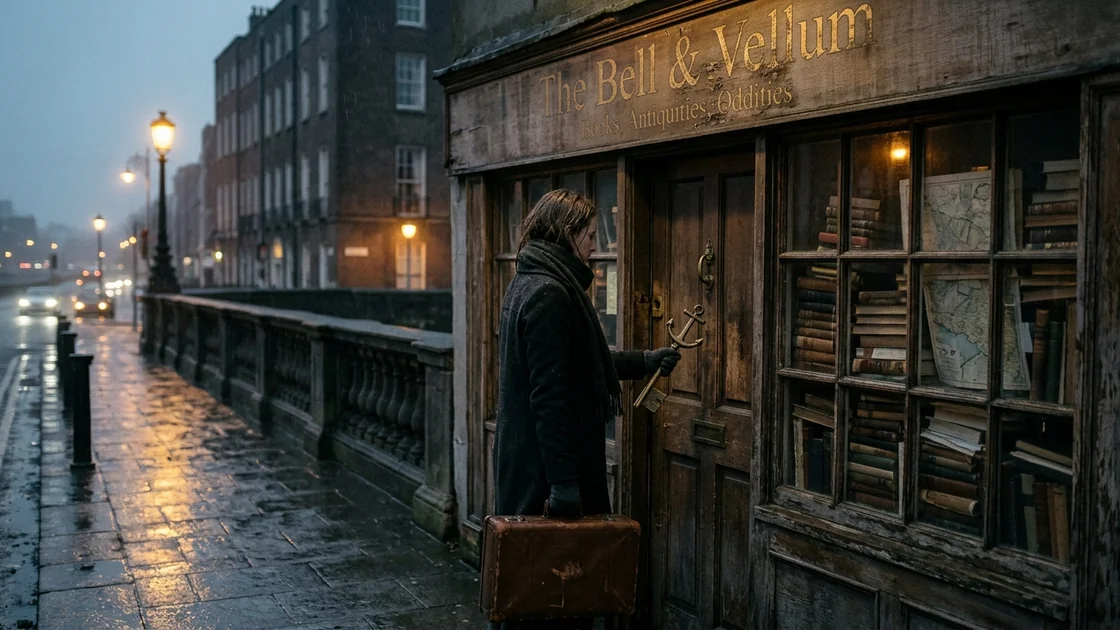
The rain over the Liffey did not fall in drops so much as it drifted in a heavy, cold suspension that clung to eyelashes, wool coats, and the dark limestone parapets of the bridges. Maeve stood on Wellington Quay with a scuffed leather valise in her left hand and an oversized brass key in her right. The key was cold, shaped like an anchor at the bow, its teeth blunt and notched with three centuries of wear.
Before her stood the narrow, five-story Georgian townhouse. The ground floor was occupied by an unpainted wooden shopfront bearing gold-leaf letters so faded they were almost legible only to memory: The Bell & Vellum — Books, Antiquities, Oddities.
Only two weeks ago, Maeve had been sitting in an archival processing dungeon beneath a municipal university in Newcastle, cataloging tax ledgers from nineteenth-century timber merchants while her personal life quietly evaporated into dry rot and broken leases. Then had come the letter on heavy rag parchment, sealed with dark green wax and stamped by the firm of Brogan, Coyle & Hynes, Solicitors, Clare Street, Dublin 2.
The deceased was Mr. Arthur Pendelton. Maeve remembered him only as a tall, bent silhouette who had visited her mother’s terrace in Greystones when Maeve was eight years old. He had brought her a German pop-up book of mechanical birds, smelled faintly of pipe tobacco and winter cloves, and spoken in a dry, musical whisper before vanishing forever from her childhood. Her mother had never spoken of him afterward, except once, when she had looked up from the kitchen table with an old envelope in her lap and murmured, Arthur never could live inside the present tense.
Now her mother was five years buried, and Arthur Pendelton was six weeks in the earth of Glasnevin Cemetery, and Maeve was thirty-two years old, unemployed, unmoored, and holding the deed to three thousand square feet of disintegrating paper.
Inside the office on Clare Street that morning, Mr. Cathal Brogan—a solicitor who seemed himself to have been bound in mottled calfskin and preserved in cedar sawdust—had adjusted his spectacles and pushed a thick codicil across a mahogany desk.
"You are the sole heir to the freehold, Miss Ward," Brogan had said, his voice scraping along like a dry reed. "The premises, the domestic quarters above, the cellar vaults beneath, and all holdings within. There are no mortgages. The rates are paid three years in advance. There is an endowment account with the Bank of Ireland sufficient to maintain the building and provide you with a modest quarterly stipend of three thousand euros."
Maeve had blinked against the office light. "Why me? I met him once. I didn't even send him a Christmas card."
"Mr. Pendelton was a man who measured relationships not by their frequency, but by their weight," Brogan replied smoothly. "He kept track of your studies in bibliography and leather preservation. He was aware of your work at Newcastle. He believed you possessed the only hands in the archipelago capable of treating his collection with the requisite indifference."
"Indifference?"
"He said that lovers of books are dangerous because they hoard them," Brogan explained, tapping the codicil. "Archivists, on the other hand, understand that paper is merely a transient vessel for human vanity, and therefore they let it breathe. But there is, as you might anticipate, a condition."
Maeve let out a long breath. "There is always a condition."
Brogan drew open the deep lower drawer of his desk and lifted out a small, flat brass key attached to a ring of black cord, followed by a heavy ledger bound in pigskin with twelve red ribbon markers trailing from its bottom edge.
"In the strongroom behind the poetry alcove on the ground floor," said Brogan, "you will find twelve iron-banded oak boxes. Each is numbered from one to twelve. Each is fitted with a Bramah lock. The keys to those boxes do not exist in the shop; they are already held by the recipients. Your obligation under the will is simple in formulation, though exacting in execution. On the final day of each calendar month, beginning this January thirty-first, you must personally deliver the designated box into the hands of the individual specified in this ledger. You may not send an agent. You may not use a parcel service. You may not open the boxes by force. If you fail to complete any single delivery before the stroke of midnight on the assigned date, the bequest terminates, the premises will be sold at public auction, and the proceeds will pass to the Commissioners of Irish Lights."
"And if I complete all twelve?"
"Then on the first of January of the following year, the property and all remaining contents become yours unconditionally to keep, to sell, or to burn as you see fit."
Brogan pushed the ledger toward her. Maeve took it. It was heavy, cool to the touch, and exhaled a faint scent of dried lavender and wax.
Now, on the damp quay, she turned the great anchor-shaped key into the shop’s front lock. The bolt slid back with a hollow, brassy clunk that resonated through the floor joists. She pushed the door. A small silver bell overhead gave a flat, musical chime.
The smell hit her instantly: not just old books, but an ecosystem. It was the scent of disintegrated linen rags, oxidized iron-gall ink, animal glue, stone damp, and centuries of turf smoke that had drifted across Dublin’s chimneys and settled into the wallpaper. The narrow shop stretched away into deep, shadowed penumbra. Shelves climbed fourteen feet to a molded plaster ceiling blackened by decades of gas lamps. Books were stacked three deep on the floorboards, leaning in precarious towers that seemed held together only by the friction of their dust.
Maeve set her valise down. The silence inside was absolute, muffling the low rumble of buses out on the quays.
She walked slowly down the central aisle. Her fingers grazed the spines: eighteenth-century Dublin printings of Swift; calf-bound volumes of maritime law; botanical atlases with hand-colored copper engravings; dog-eared nineteenth-century pamphlets on Irish land tenure; three shelves of theological polemics in Latin, their boards warped by humidity.
Behind the narrow counter stood an iron spiral staircase curling up toward the residential floors. Beyond it, tucked into an alcove beneath a sign that read Minor Verse & Curiosa, stood a narrow doorway closed by a heavy oak door reinforced with horizontal iron bars.
She pulled the brass key from her pocket. The lock turned easily.
The strongroom was small, dry, and smelled of cedar shavings. Arranged in two neat rows of six along a slate shelf were the boxes. They were beautifully made: English quarter-sawn oak, dark as stout, their corners protected by polished brass brackets, each with an oval brass plaque screwed to the lid bearing an engraved numeral from I to XII.
Maeve knelt before Box I. It measured perhaps twelve inches by nine, and five inches deep. It was heavy—at least eight or nine pounds. When she shifted it slightly, there was no sound from within; whatever rested inside was held fast by tailored velvet or baize.
She opened Arthur Pendelton’s ledger to the first red ribbon.
Delivery I: January 31. Recipient: Mr. Eamonn Byrne. Location: Number 14, Engine Alley, The Liberties, Dublin 8. Instructions: He will be at his bench until nine o’clock. Do not knock; the latch is lifted. Give him the box without preamble. If he asks if Arthur suffered, tell him Arthur died while reading an uncut copy of Montaigne in his bath, which is only slightly less than the truth.
Maeve looked down at her watch. It was a quarter past seven on the evening of January thirty-first.
II. The Liberties and the Night Clock
Engine Alley smelled of malt from the brewery and frying onions from a nearby chipper. The street was narrow, paved with setts that glistened like wet seal skins under the yellow glare of sodium streetlamps. Maeve carried Box I under her arm, wrapped in a dark woolen scarf to protect it from the mist.
Number 14 was a two-story brick workshop wedged between a scrap-metal merchant and a tenement that had been converted into artists' studios. The front window was small, paned with bottle-glass that distorted the interior into amber swirls. Maeve put her thumb to the iron thumb-latch of the door and pressed down.
The door swung inward with a soft groan.
The room within was dry, intensely warm, and ticking. It sounded like an iron meadow full of mechanical crickets. Clocks of every description hung from the lime-washed walls: Vienna regulators with long mahogany cases, bracket clocks with silvered dials, carriage clocks in brass cages, and skeleton movements whose brass gears whirred and clicked in bare nakedness under glass domes.
At the rear of the shop, illuminated by a single green-shaded lamp suspended from the ceiling by an adjustable pulley, sat an elderly man. He wore a jeweler’s loupe screwed into his right eye socket and a bib of green baize pinned to his waistcoat. His hair was a wild fringe of white wool, and his hands, though veined and liver-spotted, were steady as vices.
He did not look up from the small balance wheel he was nudging with a pair of non-magnetic tweezers.
"You’re fifteen minutes earlier than Arthur said an archivist would be," the man said. His voice was gravelly, steeped in the tobacco of fifty years. "He always claimed your sort couldn't cross town without stopping to inspect the watermarks on the municipal posters."
Maeve halted by a table laden with brass cogs and jars of whale oil. "You knew I was coming?"
"I knew someone was coming on the last night of the month with a box that requires a key I’ve had in my pocket since nineteen-ninety-four." Eamonn Byrne unscrewed the loupe from his eye and let it drop into his palm. His left eye was pale blue, watery, but extraordinarily sharp. "Put it on the bench, girl. Don’t hover. Hovering disturbs the hairsprings."
Maeve set the oak box on the green baize.
Byrne looked at the brass plate with its Roman numeral I. His jaw worked slowly, chewing on a thought or an old grievance. From his waistcoat pocket he produced a tiny steel key with a cylindrical barrel notched in four directions—a genuine Bramah pattern.
He inserted the key, turned it twice to the right until a clean, chime-like snap came from the brass mechanism, and lifted the lid.
Inside, fitted into a bed of deep purple velvet, was not an ancient manuscript or an illuminated bible, but a thick, octavo notebook bound in coarse sailcloth. Its edges were stained with dark green copperas ink.
Byrne did not pick it up immediately. He sat very still, his fingers curling into his palms. "The logbook," he murmured.
"The logbook of what?" Maeve asked quietly.
"Of the Mina Bird," he said, not looking at her. "Arthur and my brother Sean bought her in Arklow in the summer of sixty-nine. They were going to sail to the Azores to buy rare Portuguese editions that had slipped out of the monasteries during the Salazar regime. Sean drowned twenty miles off the Fastnet when a trawler caught their stern in a squall. Arthur survived because Sean threw him the only cork jacket they had."
The old watchmaker reached out and laid his weathered hand flat upon the sailcloth cover.
"Arthur swore he’d lost the log in the surf when the wreckage washed into Baltimore," Byrne whispered. "He spent fifty years pretending he had forgotten Sean’s last coordinates. He thought if I saw the log, I’d see that Sean had tried to turn back for him, and that it was his fault."
"Did Arthur suffer?" Maeve asked, remembering the instruction.
Byrne’s mouth twitched with a grim, dry humor. "Arthur died while reading an uncut copy of Montaigne in his bath, didn't he?"
"That’s what the instructions said to tell you," Maeve admitted.
The old man gave a soft, raspy bark of laughter that ended in a cough. "Liar to the very grave. He died of his own stubborn heart, probably arguing with the priest about whether the book of life was printed on laid paper or wove. Tell me something, Miss Ward."
"Yes?"
"Are you going to keep the shop?"
Maeve looked out through the bottle-glass window into the drizzle of Engine Alley. "I have eleven more boxes to deliver before I can decide."
"Good," Byrne said, his hand still resting on the sailcloth. "The city doesn't need another coffee shop that smells of burnt beans and despair. It needs that old tomb on Wellington Quay. Go home, child. The night is getting wet."
III. The Botanical Ledger
February in Dublin was an exercise in granite and iron. The city shrank beneath an east wind that blew directly off the Irish Sea, carrying the taste of salt and industrial diesel through the river corridors.
Maeve spent her first weeks clearing the back rooms above The Bell & Vellum. The first floor was a high-ceilinged drawing room with a marble fireplace that draftily sucked smoke upward, two horsehair armchairs, and floor-to-ceiling shelves of European literature in original tongues: Dante, Racine, Calderón, Goethe. The second floor was a bedroom with a narrow brass bedstead and a window that rattled in its frame every time the number 79 bus turned the corner.
She found Arthur’s personal papers in an apple crate under the bed. There were no family photographs, no bank cards, no love letters. There were only receipts from book auctions in Paris, Edinburgh, and Leipzig; slips of paper containing catalog notes; and hundreds of small, square slips of blotting paper covered in his tiny, spidery hand, listing titles under dates that spanned four decades.
On the third floor, she found his workshop. It was smaller than Byrne's, but far more orderly: three iron book-presses of varying sizes, bone folders worn smooth as ivory, drawers of calf and goatskin remnants, jars of rabbit-skin glue, wheat-starch paste, and vials of gold leaf so thin that opening the door set them trembling like autumn leaves.
Arthur had been an artisan of the old school. He had not merely traded books; he had mended them, reconstructed their spines, washed their pages of foxing with warm rainwater and alum, and stitched their signatures with linen thread waxed with pure beeswax.
On the twenty-seventh of February, she took down the ledger and opened it to the second red ribbon.
Delivery II: February 28. Recipient: Dr. Siobhan Kearney. Location: The Curvilinear Range, National Botanic Gardens, Glasnevin. Instructions: Enter through the side gate at three o'clock in the afternoon. She will be among the cycads. Do not speak of the weather; she considers human complaints about rain an insult to the plant kingdom. Hand her the box and wait until she turns to page eighty-four.
The Botanic Gardens were desolate and beautiful under an overcast iron sky. Maeve carried Box II inside a canvas knapsack. The air inside the great glass pavilions was startling: damp, thick, smelling of rich leaf-mold, moss, and warm iron heating pipes.
She found Dr. Siobhan Kearney standing on a wooden stepladder inside the Victorian palm house, her fingers delicately pruning a yellowing frond from a tree fern that looked older than the Irish state. She was a woman in her late sixties, with iron-gray hair cropped short as a soldier’s and a green canvas smock smeared with compost.
"You're tracking limestone dust onto my clean flags," the woman said without turning around.
Maeve stopped. "Dr. Kearney?"
The woman descended the ladder with brisk, athletic certainty. She wiped her secateurs with an oily rag, slid them into a leather holster at her hip, and looked Maeve up and down.
"You have Arthur’s eyes," she said flatly. "Not the color—his were like muddy ditchwater—but that look of someone who has spent too much time reading indices and not enough time looking at the light."
"I have something for you," Maeve said, slipping the knapsack from her shoulder and setting Box II on a potting bench between two pots of Orchidea.
Dr. Kearney looked at the brass Roman numeral II. For a brief second, her jaw tightened, an echo of the same ancient tension Maeve had witnessed in the watchmaker's workshop.
From a pocket inside her smock, Dr. Kearney produced a small brass key. She unlocked the box without a word.
Inside lay a thin quarto volume bound in full green morocco, with an intricate blind-tooled border of ferns and shamrocks. Maeve recognized the binding style instantly—it was Arthur’s work, executed with that unmistakable double-blind line along the joints.
Dr. Kearney lifted the book with fingertips that were soil-stained at the nails. She turned the leaves with an expert, gentle rhythm until she arrived at page eighty-four.
There, pressed between two sheets of semi-translucent Japanese tissue, was an intact specimen of Saxifraga hartii—Hart's Saxifrage—a rare Arctic-Alpine plant that grew only on the sea-cliffs of Arranmore Island in Donegal.
Written below the dried specimen in Arthur’s minute script was a single date: June 14, 1974.
Dr. Kearney leaned over the page. Her eyes did not water, but her nostrils flared as if she were breathing in the cold Atlantic wind that had blown across that cliff forty years ago.
"We almost fell into the sea for that," she said, her voice dropping into a register so low it was almost lost beneath the dripping of condensation from the glass roof. "Arthur was terrified of heights. He had vertigo so bad he couldn't stand on the Ha’penny Bridge without clinging to the rail. But I told him there was a colony of Hart's Saxifrage three hundred feet down on the north face, and he let me tie a hemp hawser around his waist and lower him over the edge because he wanted to be the first one to describe the root structure."
She touched the edge of the leaf with the tip of her index finger.
"Did he keep it all this time?" Maeve asked.
"No," Dr. Kearney said. "I kept it. I gave it to him the day we decided not to marry. I told him he was wedded to paper, and I was wedded to soil, and that neither of us was generous enough to let the other take root."
She shut the volume with a decisive, soft thud.
"Tell me, Miss Ward, does the roof on the quay still leak near the Irish history section?"
Maeve started. "There is a damp patch right above the O’Donovan editions."
"He was always too cheap to hire a proper slater," Dr. Kearney said, tucking the book under her arm. "There’s a roofer named Colm Geraghty on Clanbrassil Street. Tell him Siobhan told you to call. He won’t swindle you. Now get out of my glasshouse; you're letting the heat out through the doors."
IV. The Lighthouse at Howth
By March, the city was stirring. Daffodils thrust their yellow heads through the sodden grass of St. Stephen's Green, and tourists began to trickle into Temple Bar, peering through the diamond-paned windows of The Bell & Vellum with bewildered fascination.
Maeve had begun to open the shop three afternoons a week.
She did not do it for money—the endowment covered her bread, tea, and coal—but because the books seemed restless behind the drawn blinds. Old books, she realized, were like clocks that had stopped; they required the vibration of human steps to keep from seizing completely.
A regular clientele quickly established itself: an elderly Jesuit from Milltown who bought seventeenth-century theological pamphlets to check for heretical printing variants; an art student who bought damaged leather bindings to carve into jewelry; and an old woman who lived on Liffey Street and bought six-penny paperbacks of romantic thrillers, insisting that Maeve tell her whether the hero died before she would hand over her coins.
On March thirty-first, a ferocious spring gale swept into Dublin Bay from the northeast. The Irish Sea looked like boiling porridge, hurling sheets of gray spray over the south wall and rattling the tram cables along the coast.
Box III was the largest yet: fourteen inches by eleven, bound in dark bog-oak that felt like stone, fitted with massive brass hinges.
Maeve took the DART train out to Howth. The carriage was almost empty, smelling of damp mackintoshes and ozone. At Howth station, she buttoned her coat to the chin, tucked Box III into an oilskin rucksack, and began the long climb up the cliff path toward the Baily Lighthouse.
The wind on the headland was so violent it pushed her sideways into the gorse bushes. The heather was flattened, and below, the cliffs plunged into white, roaring foam that thundered against the rocks like artillery.
The lighthouse sat perched on its rocky spur like an ivory chess piece. The instructions had directed her not to the lighthouse itself, but to a stone cottage tucked into a hollow of the cliff three hundred yards before the gate—a low-roofed, whitewashed dwelling with walls three feet thick, its slate roof secured with iron netting against the winter gales.
A plume of blue turf smoke flattened itself instantly against the cliff face as it emerged from the chimney.
Maeve reached the porch, her face numb with salt and cold, and hammered on the low door.
It was opened by a man who looked as though he had been carved out of salt-pork and driftwood. He was broad-shouldered, with a thick beard peppered with white, wearing an Aran sweater so heavy it looked bulletproof.
"You're insane," he said by way of greeting. "No one walks the headland in a gale like this unless they’re looking for a drowned brother."
"Mr. Lorcan Teeling?" she shouted over the roar of the wind.
The man stared at her, then down at the rucksack. "Arthur's girl."
"Arthur's heir," she corrected, panting. "And I have four pounds of oak that belongs to you."
He stepped back and pulled her inside, slamming the heavy door against the storm. The sudden warmth and quiet were dizzying. A cast-iron stove glowed dull red in the center of the flagstone floor. A kettle hissed softly on its trivet.
Teeling did not offer her tea. He pointed to a low table beside a shelf lined with brass sextants, mariner's compasses, and bound volumes of the Nautical Almanac.
Maeve set Box III down. Her hands were shaking with the cold.
"Sit down by the fire before your fingers drop off," he grunted.
He took a key from a leather cord around his neck. The key was unusual—it had an iron shaft with a brass bit, heavily notched. He turned it in the Bramah lock of Box III with an easy familiarity, as if he had performed the motion a thousand times in his dreams.
When the lid swung back, Maeve smelled brine, tar, and tallow.
Inside was a massive manuscript portfolio, its sheepskin covers darkened by oil and salt water. Teeling did not open it immediately. He stood looking down into the box, his chest rising and falling beneath the thick wool of his sweater.
"The Baily charts," he said.
"Maps?"
"Not maps," he said. "Depths. Arthur’s grandfather was the harbor pilot for the Port of Dublin in eighteen-seventy. For forty years, the old man kept a private lead-line sounding of every sandbank between the Kish Bank and the mouth of the Tolka. The Admiralty charts said one thing; old Captain Ward knew the sand moved every time a winter gale blew out of the south."
Maeve went completely still. "Captain Ward?"
Teeling looked at her, his brows knitting together. "Your great-grandfather, girl. Didn't Arthur tell you that?"
The room seemed to tilt slightly, echoing the motion of the train on the curves at Killiney. "Arthur told me nothing. My mother never spoke of her family. She said they were all dead before she was born."
"They were dead to each other, which is the Dublin way of being dead," Teeling said gruffly. He opened the sheepskin portfolio. Inside were magnificent, large-scale drawings in sepia ink and indigo wash, showing cross-sections of Dublin Bay’s floor, with annotations in a bold, cursive hand recording currents, shipwrecks, and shifting gravels.
"Your mother’s father and Arthur’s father had a partnership in a coastal shipping line," Teeling explained, his voice softening slightly against the background rattle of the windowpanes. "The Ward & Pendelton Line. Two schooners and a steam tug. In nineteen-twelve, the tug foundered off Lambay Island. Six men drowned, including your grandfather. The lawsuit destroyed both families. Arthur’s father went to the debtor’s prison; your mother’s family sold their home in Dun Laoghaire and vanished into rental rooms in Rathmines."
Maeve looked at the drawings. The signature in the corner of the title page read: Drawn by the hand of Cormac Ward, Pilot to the Port of Dublin, 1878.
"Why did Arthur give this to you?" she asked.
Teeling touched the edge of the paper with a thumb scarred by fishhooks. "Because my grandfather was the man at the helm of the tug when she hit the reef. Arthur and I spent thirty years looking for the reason she went down. Arthur found it in these charts three years ago. The reef wasn't where the Admiralty said it was; the shifting sands had moved the channel eighty yards to the north during the Great Frost of eighteen-ninety-five. The captain wasn't drunk, and the pilot wasn't blind. It was just the sea doing what the sea does."
He closed the portfolio with a sigh that seemed to come from the soles of his boots.
"Your mother never forgave the Pendeltons," Teeling said, looking straight into Maeve’s eyes. "She thought they were thieves who took her father’s name and left her with nothing. Arthur tried to see her three times before she died. She closed the door in his face every time."
Maeve remembered the tall, bent man standing on the porch in Greystones when she was eight years old. She remembered the German pop-up book of birds. She remembered her mother’s white face at the kitchen window, watching his cab pull away into the rain.
"He didn't give you the shop to be kind, Miss Ward," Teeling added quietly. "He gave it to you because it was half yours to begin with. The shop was bought with your great-grandfather’s insurance money. Arthur was just holding the keys until someone came along who had Cormac Ward's ink in their blood."
V. The Cellist of Henrietta Street
April brought the cherry blossoms to the grounds of Trinity College and a soft, deceptive warmth that filled the quays with the scent of blossoming gorse drifting down from the Dublin mountains.
Maeve worked through the shop with a feverish intensity. She spent her mornings repairing the leather bindings in the Irish history section, using neat’s-foot oil and paste to supple the parched goatskin. Every book she touched now felt different; she searched the endpapers for names, signatures, ownership inscriptions that might connect the books to her own bloodline.
She found several. In an eighteen-forty edition of The Annals of the Four Masters, she found the small, oval armorial bookplate of Cormac Ward, Mariner. In a battered pocket atlas of the Irish counties, she found her mother’s name written in a round, schoolgirl hand: Fiona Ward, Form IV, Loreto Abbey, Dalkey, 1968.
Arthur had not merely gathered books; he had gathered the scattered debris of her mother’s childhood, buying them back piece by piece from pawnshops, house clearances, and second-hand dealers across the province of Leinster.
On April thirtieth, she unlocked Box IV.
Delivery IV: April 30. Recipient: Miss Nora Blake. Location: Third Floor, Number 7, Henrietta Street, Dublin 1. Instructions: Climb to the top floor. The door will be open an inch. Do not interrupt the music. Wait on the landing until the movement is concluded. Hand her the box and do not comment on the condition of the house.
Henrietta Street was a street of ghosts. Once the grandest residential address in Dublin, where peers of the realm and bishops had built palatial stone townhouses in the seventeen-thirties, it had spent the twentieth century as the most crowded tenement street in Europe. Number 7 was a colossal pile of dark calp limestone, its door surround surmounted by a broken pediment, its windows blind with decades of grime.
Maeve stepped through the unlocked front entrance into an echoing entrance hall large enough to maneuver a stagecoach. The grand staircase was a ruin of carved balusters and peeling lime-wash; plaster had fallen from the ceiling, exposing the hand-split laths beneath like the ribs of an ancient galley.
Yet through the drafty silence of the cavernous stairwell drifted the deep, resonant lament of a solo cello.
It was Bach’s Cello Suite No. 5 in C Minor—the Sarabande. The music did not ring; it breathed, rising and falling through the hollow stairwell with a dark, mournful gravity that made Maeve halt on the second-floor landing, Box IV held against her chest.
She waited. The notes fell one by one, slow as droplets of oil into cold water, each one carrying the weight of an unresolved grief.
When the final C trailed away into the damp air, leaving a silence that hummed like a struck bell, Maeve climbed the final flight of stairs.
The door to the front room stood ajar.
Inside, the room was vast, bare, and flooded with the cold northern light of an April evening. There was no furniture except for a camp bed in one corner, an iron kettle on an electric ring, and a folding music stand. In the center of the bare floorboards sat a woman in her late forties, her dark hair streaked with silver and tied back with a velvet ribbon. Between her knees was a cello of pale maple, its varnish worn where her wrist and thighs had touched it for thirty years.
She did not look up as Maeve entered.
"Set it on the case," Nora Blake said. Her voice was cool, cultured, but carrying an edge like a newly honed scraper.
An open fiberglass cello case lay on the floor near the window. Maeve approached quietly and set Box IV beside it.
"He told me he would send it when the season changed," Nora said. She laid her bow across her knees and looked at the box. "He was very particular about seasons. He said music played in the wrong month was like planting tubers in the frost."
She produced a small steel key from a silver chain around her wrist and opened the lock.
Inside Box IV, wrapped in black China silk, was a small, oblong manuscript book bound in limp vellum. Maeve leaned in slightly; she could see that the staves had been hand-ruled with a five-nibbed pen in brown ink that had faded to amber.
"Is it a score?" Maeve asked.
"It is the only score," Nora replied. She did not touch it; she merely looked at it with an expression of profound, exhausted relief. "Arthur’s sister, Clara, was a composer. She studied in Leipzig under Reinecke in the eighteen-nineties. When she came back to Dublin, the men who ran the Academy told her that women did not possess the intellectual architecture necessary for counterpoint. They told her to teach piano to the daughters of brewers."
Nora lifted the silk with two fingers.
"Clara wrote this suite for two cellos during the winter of nineteen-sixteen, while the city was burning down around her ears," Nora said. "She died of the influenza two years later. Arthur locked this manuscript in his vault and swore he would never let the Dublin musical establishment touch it until he found a cellist who didn't care about their honors or their concert halls."
"And you are that cellist?"
Nora looked up at Maeve, her gray eyes clear and utterly devoid of vanity. "I haven't played in a concert hall in fifteen years, Miss Ward. I play for these walls. They don't applaud, but they don't lie either."
She picked up the manuscript. "Tell Arthur... tell him the fifth movement has an error in the bass register that only an archivist would fail to notice."
"Arthur is dead, Miss Blake," Maeve said gently.
Nora Blake froze for a moment, her fingers resting on the yellowed vellum. Then she lowered her head, and for a long minute the only sound in the vast Georgian room was the distant hiss of traffic from the quays.
"I know," she whispered. "He told me he would die before the fifth box was delivered. He said death was merely an inconvenient erratum slip tipped into the final signature of life."
She took up her bow again.
"Leave the door open on your way down, Miss Ward. Clara’s music needs room to climb."
VI. The Baker’s Night Bread
May brought the lilacs to the garden squares of Dublin and the smell of roasting hops from the St. James’s Gate brewery, heavy and sweet as burnt toast.
Maeve had settled into a rhythm. Every morning at seven, she swept the stone flags outside The Bell & Vellum. At eight, she made a pot of strong black tea in Arthur’s chipped enamel pot. By nine, she was at the restoration bench, cleaning modern tape from the margins of eighteenth-century prints with lighter fluid and cotton buds.
The fifth box was small, square, and surprisingly heavy for its size. It was made of walnut, with brass inlays at the corners shaped like wheat ears.
The ledger for May thirty-first read:
Delivery V: May 31. Recipient: Mr. Malachy Higgins. Location: Higgins & Sons, Bakers, Cross Guns Bridge, Phibsborough. Instructions: Arrive at two o’clock in the morning. Knock on the iron delivery shutter four times. He will be setting the morning sourdough. Do not refuse the buttermilk.
Maeve walked through the silent city under a full moon that turned the waters of the Royal Canal into a ribbon of mercury. Dublin at two in the morning was stripped of its modern veneer; without the buses and cars, the brick terraces and granite bridges felt older, closer to the centuries when night belonged only to the watchmen, the ghosts, and the bakers.
At Cross Guns Bridge, the smell reached her two blocks away: the incomparable, ancient scent of fermenting flour, yeast, and the sweet, dry heat of an anthracite-fired peel oven.
The iron shutter of the bakery was down. Maeve took a stone from the gutter and knocked four times: rap-rap, rap-rap.
A bolt slid back. The shutter rolled up three feet, and a face emerged from the cloud of flour dust within. It was a man of sixty, with flour dusting his eyebrows, his forearms like sides of bacon, wearing a striped butcher’s apron over a gray singlet.
"The book woman," he said. He did not sound surprised; he sounded like a man whose timetable was regulated by the rising of dough and the setting of stars, neither of which ever varied.
"Mr. Higgins?"
"Duck your head," he said, stepping back. "Mind the bag of rye."
Maeve crawled beneath the shutter into a world of white powder, heat, and rhythmic slapping sounds. Three long wooden troughs stood along the wall, filled with pale, bubbling masses of dough. In the corner, the great iron mouth of the oven glowed through its ventilation grates like a furnace in a steamship.
Malachy Higgins did not wipe his hands. He took a heavy iron key from a nail driven into the doorframe beside the oven.
"Put it on the flour bin," he said.
Maeve set Box V on the polished pine lid of a bin that held two hundredweight of stoneground wheat. Higgins turned the key. The walnut lid clicked open.
Inside lay a thick, square book with wooden boards covered in rough, untanned calfskin that still bore patches of red hair. It had no title on the spine, only three brass bosses on each cover to protect the leather from damp surfaces.
Higgins looked at it, his face softening beneath its mask of white flour.
"My great-uncle’s receipt book," he said.
"A cookbook?" Maeve asked.
"A survival book," Higgins corrected. He lifted the heavy volume with surprising tenderness. His thick, rough fingers turned pages covered in a bold, irregular script that used words from both English and Irish: measurements in pecks, bushels, and handfuls; notes on how to keep yeast alive through an eight-week frost; receipts for making edible loaves from ground acorns, dried nettles, and pea-meal when the flour ships failed to arrive from Liverpool during the hungry years of the eighteen-forties.
"Arthur bought this at an auction in Navan forty years ago," Higgins said. "My father had to sell it when the bakery went bust in the thirties. Arthur told my father he was only minding it until the family had paid off their debts and had their hands in the flour again."
"Did your father pay him back?"
Higgins shook his head, a wry smile cutting through the flour on his cheeks. "My father died with sixpence in his pocket and a bill from the miller for fifty bags of white flour. Arthur never asked for a penny. Every Christmas, Arthur would walk in here at two in the morning, buy a loaf of soda bread, leave a five-pound note on the counter, and say, 'Malachy, the dough is still rising; the book is still safe.'"
The baker turned to a page near the end. There, pinned to the margin with an iron seamstress’s pin, was a handwritten receipt on the letterhead of The Bell & Vellum, dated May 12, 1982.
Received of Higgins & Sons: One loaf of crusty bread, well-fired. Payment in full for all debts, real or imaginary.
Higgins looked up at Maeve. "He was a strange creature, your uncle."
"He wasn't my uncle," Maeve said. "He was my mother’s... he was my great-grandfather’s partner's son."
"He was Dublin," Higgins said simply. "That’s what he was. The old sort. The kind that remembered who owned what before the banks came along and told everybody that paper was money instead of just an agreement between neighbors."
He reached into a wooden cooler and pulled out a heavy earthenware bottle. He splashed four inches of thick, white liquid into a chipped mug and handed it to her.
"Drink that," he commanded. "Real buttermilk from a churn in Meath. It’ll wash the dust of those books out of your lungs."
Maeve drank. It was tart, cold, rich, and tasted of grass and salt. When she set the mug down, Higgins was already back at his trough, his great forearms plunging into the sourdough with a rhythmic, wet heave that sounded like the pulse of the sleeping city.
VII. The Curragh and the Travelling Box
June arrived with long, pale twilights that never truly turned to night. From the window of her bedroom above the shop, Maeve could see the gulls wheeling over the river until after eleven o'clock, their white wings catching the orange glow of the northern sky long after the sun had sunk behind the Phoenix Park.
Box VI was different from its predecessors. It was not made of polished cabinet wood, but of beaten sheet iron, reinforced with copper rivets, with a handle of twisted wire. It looked like an engineer’s tool-chest or an ammunition crate from the Civil War.
The ledger entry was terse:
Delivery VI: June 30. Recipient: Mr. Colm Devlin. Location: The Donnelly’s Hollow, The Curragh of Kildare. Instructions: He will be camping with two piebald horses on the south ditch. Give the box to him before the horses are watered at sunset. If he offers to tell your fortune, tell him your fortune is already locked in twelve boxes and you don't need another one.
Maeve took the morning bus from Busáras out to Kildare. The Curragh was an ocean of short, sweet turf, rolling away to the horizon under a sky piled with massive, luminous summer cumulus. Sheep with red markings on their fleeces moved across the green expanse like slow clouds.
She found the camp in a hollow near the monument to Dan Donnelly, the bare-knuckle boxer. A traditional bow-topped wagon, painted in bright yellow and vermilion, was pitched beside a ditch of flowering hawthorn. Two piebald vanners grazed peacefully on long tethers.
Beside a fire of dry ash-wood sat a man of seventy, his skin the color of an old hazelnut, wearing a waistcoat with silver buttons shaped like four-leaf clovers. He was heating a copper rivet in a small charcoal brazier and hammering it into the bottom of a milk churn.
The metallic clink-clink-clink echoed across the silent plains.
Maeve approached across the short grass, the iron box heavy in her hand.
The man ceased hammering. He laid his hammer across the anvil-block and looked at her with eyes that were black, bright, and completely unreadable.
"You're late," he said. His voice had the flat, hard lilt of the Kildare plains. "The horses want their water in twenty minutes."
"I took the bus," Maeve said, setting the iron box on the turf. "The bus doesn't consult the horses."
A flash of white teeth appeared in the dark thicket of his beard. "Arthur Pendelton wouldn't have taken the bus. He’d have walked out from Rathcoole with his boots tied together with hemp and his pockets full of dry biscuits."
"Arthur Pendelton was twenty years older than me and considerably more eccentric," Maeve retorted, wiping sweat from her forehead.
Colm Devlin knelt beside the iron box. From his waistcoat pocket he drew a heavy iron key with a circular bow, so worn that the iron looked like greasy gray wax.
He turned the key. The iron lid lifted with a stiff, rasping shriek.
Inside lay three thick rolls of vellum, tied with strips of cured deerskin. Devlin did not untie them; he simply touched the edges of the vellum with the backs of his fingers, his eyes drifting away toward the horizon where the Dublin mountains met the sky in a haze of summer blue.
"The patterns," he whispered.
"What patterns?"
"The patterns for the tinker's tins," Devlin said. "My great-grandfather, Peadar Devlin, drew them for the antiquarians in eighteen-eighty. Every brazier's mark, every traveling tinsmith's crest, every punch-mark for lanterns and churns from Malin Head to Cape Clear. Arthur bought them when the bailiffs cleared my grandfather out of his forge in Kilcock."
He looked up at Maeve. "He told me he’d give them back when there was no one left who knew how to use an iron swage."
"Do you know how?" Maeve asked.
Devlin held up his hands. His palms were scarred with white lines where hot metal had bitten them; his thumbs were broad and flattened from fifty years of shaping cold copper against iron stakes.
"I’m the last man on this plain who can make an iron kettle that doesn't leak without using solder," he said quietly. "Arthur knew that. He didn't want these drawings in a museum where some professor with spectacles could write a book about the dying arts. He wanted them where the horse manure was."
He looked into her face, his gaze searching. "He was a good man, Arthur. A hard man to talk to, because he always spoke like he was quoting from an uncut quarto, but he never cheated a man on the road."
Devlin reached into his pocket and produced a small piece of dark, polished bog-oak, carved into the shape of a wren with its wings folded.
"Take that," he said, pressing it into her palm. "Hang it above the shop door. It keeps the woodworm out of the pine boards."
"Does it?"
"No," Devlin said, his grin returning. "But it makes you feel like you've done something about them. Go on now, girl, before the horses start whinnying."
VIII. The Girl of Ballyfermot
July was hot, airless, and smelled of the Liffey mud at low tide. Dubliners sat along the river walls eating ice cream while the gannets dove into the basin near the Custom House, hunting the summer sprats.
Maeve spent her afternoons sitting on the front step of the shop, reading through Arthur’s private catalog of the collection. It was a masterpiece of bibliographic pathology. Arthur did not merely record editions and printings; he recorded the emotional histories of the volumes.
Item 412: Keats, Poems, 1817. Boards detached. Some water-staining to sig. C. Bought from a clerk in the South Dublin Union whose sister had died of the decline. He wept on the counter; I gave him two pounds more than the book was worth, which was an error in trade but perhaps an erratum in charity.
Item 894: The Parliamentary Debates, Vol. XIV. Calf rubbed. Contains two pressed poppies between pages 112 and 113, picked on the Somme by Lieutenant E. Ward, July 1916. He did not return; the book was sold by his widow to buy coal in the winter of 1921.
Maeve realized that Arthur had not been a collector; he had been a sin-eater for the city’s grief, buying up the paper remnants of broken families, failed rebellions, and abandoned loves, storing them in the dark vaults of Wellington Quay until their weight could be distributed back to those who possessed the right to mourn them.
On July thirty-first, she opened Box VII.
Delivery VII: July 31. Recipient: Miss Róisín Darcy. Location: Number 42, Decies Road, Ballyfermot, Dublin 10. Instructions: She will be home from the municipal laundry at six o’clock. If she is sitting on the wall, do not give the box to her mother. Give it directly to the child. Tell her that the blue bird does not die in the end.
Maeve took the 79 bus out past Kilmainham Gaol toward the red-brick council estates of Ballyfermot. The evening was close, thick with the sound of children playing football in the cul-de-sacs and the thrum of radios from open kitchen windows.
Number 42 was a small, neat terrace with a pocket-sized front garden filled with marigolds and plastic windmills.
Sitting on the low front wall, swinging her legs against the rough concrete, was a girl of about eleven. She had red hair pulled into two fierce plaits, knees covered in green grass-stains, and an expression of profound, defiant boredom.
Maeve carried Box VII in a cardboard grocery bag. The box was small, light, made of pale boxwood with an inlaid border of ebony.
She stopped at the garden gate. "Róisín?"
The girl’s legs stopped swinging. Her eyes, gray-green and suspicious, narrowed. "Who's asking? Are you from the social?"
"I’m from a bookshop on the quays," Maeve said. "Arthur sent me."
The girl’s face transformed instantly. The boredom vanished, replaced by an electric, ferocious curiosity. She jumped down from the wall, her cheap sneakers squeaking on the pavement.
"Did he bring it?" she whispered, looking at the grocery bag. "The one with the glass ship?"
"I don't know what’s inside," Maeve admitted. "He gave me the box, but he told me you had the key."
Róisín reached down into her sock and pulled out a tiny, silver-plated key attached to an elastic band. "He gave me this when he came to see my granddad in the hospice. He told me to keep it dry and not let my brothers see it, or they’d use it to pick their ears."
Maeve set the boxwood chest on the concrete wall between them.
The girl turned the silver key. The lock opened with a tiny snip.
Inside lay a small, octavo volume bound in full sky-blue morocco, its edges gilded on the rough, with a circular gold illustration on the cover showing a girl sitting on a crescent moon with an owl on her wrist.
It was an original nineteen-twenty edition of The Blue Bird for Children, illustrated with twelve tipped-in color plates by Harry Clarke—the greatest of Dublin’s stained-glass artists and illustrators.
Róisín opened the book. The gold edges flashed in the evening sun. She did not read the words; she stared at the illustration—a magnificent, swirling fantasy of midnight blues, emerald greens, and figures with long, ethereal fingers that looked like stained-glass figures come to life.
"He told me the bird was blue," the child murmured.
"He told me to tell you," Maeve said, "that the blue bird does not die in the end."
Róisín looked up at Maeve. Her eyes were immense, luminous with the sudden discovery that the world contained objects of absolute, terrifying beauty that belonged to no school, no church, and no council.
"My granddad said Arthur was the only man in Dublin who knew that children don't want nice stories," the girl said, her voice dropping to a conspiratorial whisper. "He said children want stories with teeth in them, so they know what to do when the dark comes."
She shut the book with a sharp snap and hugged it to her thin chest.
"Tell him I didn't lose the key," she said.
"He knows," Maeve said.
As she walked back toward the bus stop on the Ballyfermot Road, Maeve felt an unfamiliar lightness in her chest. For the first time in five years, the Newcastle archives felt like something that had happened to another person in another century.
IX. The Harbor Master’s Log
August in Dublin was the month of horse shows, rain that came in warm, tropical downpours, and the return of the mackerel to the bay.
Box VIII was long and narrow, made of pitch-pine with heavy iron bands, smelling strongly of wood-turpentine and Stockholm tar.
The ledger directed her to the East Pier at Dun Laoghaire on August thirty-first, at six in the evening.
Recipient: Captain Diarmuid Vance. Location: The Old Watch House, end of the East Pier. Instructions: He will be watching the Holyhead ferry through a brass telescope. Do not ask him about nineteen-sixteen; he was six years old and only remembers his aunt making him eat boiled mutton while the shells were falling on the Post Office.
The East Pier was crowded with walkers eating soft-serve ice cream and avoiding the spray that broke over the granite seawall. Maeve carried the long box under her arm like a surveying instrument.
At the very end of the pier, beyond the Victorian bandstand, stood the small, octagonal granite watchhouse.
Leaning against the wall was an old man with a flat tweed cap pulled low over his eyes, looking through a three-draw brass telescope mounted on a wooden tripod. His skin was cross-hatched with wrinkles like dried cod, and he wore a heavy navy blue reefer jacket that smelled of tobacco and damp wool.
"She’s eight minutes late leaving Anglesey," the captain said without moving his eye from the glass. "The master of that ferry is a Welshman who thinks a three-foot swell is a reason to reduce revolutions by ten percent. Cowardice, that’s what it is. Pure Welsh cowardice."
Maeve set the pitch-pine box on the granite coping beside the telescope.
Captain Vance straightened up slowly. His spine made three distinct popping sounds. He looked at the box, then at Maeve.
"The girl with Arthur’s chin," he said.
"Everyone in Dublin seems to have known Arthur Pendelton’s physical defects," Maeve said dryly.
"He was an awkward man to avoid," Vance said. "He had a way of standing on the corner of Westmoreland Street that made you feel you had either dropped your handkerchief or stolen his umbrella."
From his pocket, Vance drew an old-fashioned bone-handled pocketknife. He opened a small steel pick from the back of the knife and inserted it into the Bramah lock of Box VIII. With a practiced, delicate flick of his wrist that revealed fifty years of maritime tinkering, he tripped the tumblers.
The lid swung open.
Inside lay a heavy folio volume bound in dark blue buckram, stamped in gold on the front cover: Log of the Asgard, July 1914.
Vance’s face hardened. He did not touch the book.
"Arthur bought that from a cousin of Erskine Childers in nineteen-fifty," Vance said. His voice had lost its humorous edge; it was flat, deep, as cold as the water under the pier.
"The gun-running log?" Maeve asked, a tremor of recognition passing through her. Every schoolchild in Ireland knew the story of the Asgard—the small white yacht that had slipped through the British naval patrol to land nine hundred German rifles at Howth for the Irish Volunteers.
"The pilot's copy," Vance said. "My father was the fisherman who led them through the rocks at the Kish. The official history doesn't mention him because he had a court-martial on his record from the Royal Navy for striking an officer who had insulted his mother. Childers knew who did the work; he gave this log to my father on the quay at Howth while the soldiers were marching from Dublin."
Vance reached out and touched the buckram.
"Why did Arthur keep it?" Maeve asked.
"Because my father spent twenty years trying to sell it to buy whisky," Vance said without bitterness. "Arthur bought it from him for fifty pounds—enough to keep him in lodging and tobacco for a year—and told him that when his son was harbor master, the log would come back to the pier."
The old captain looked out toward the horizon where the smudge of smoke from the incoming ferry was just visible against the gray sea.
"Arthur wasn't a collector, Miss Ward," Vance said. "He was a lighthouse. He just sat there on the quays, flashing his little red light into the fog, waiting for the wrecks to drift into his cove so he could pull them out of the surf before the breakers smashed them to flinders."
He picked up the heavy folio and tucked it under his arm with a natural, unconscious authority.
"Tell me something, Miss Ward. What are you going to do with that shop when the year is out?"
Maeve looked back down the long granite curve of the pier toward the church spires of Dun Laoghaire and the blue line of the Dublin hills beyond.
"I’m going to replace the lead flashing on the roof," she said. "And then I’m going to catalog the Irish history section."
Captain Vance gave a single, satisfied nod. "Good. A ship without a log is just a log of firewood. Keep the bearings true, girl."
X. The Blind Professor of Trinity
September was the month of return. The students came back to the city, their voices filling the coffee shops of Grafton Street with bright, shallow chatter, their scarves trailing behind them as they cycled across the cobbles of Trinity College.
Maeve had begun to understand the geography of Arthur’s heart.
Every delivery had been an act of restoration—not of paper, but of contracts. Contracts of love, of debt, of grief, of honor. He had used the shop as a great sorting office for the unfinished business of three generations of Dubliners.
Box IX was made of dark pearwood, polished until it reflected the light like obsidian.
The ledger read:
Delivery IX: September 30. Recipient: Professor Tadhg Moran. Location: Rooms 4, New Square, Trinity College Dublin. Instructions: Knock once. Enter immediately; he cannot reach the door quickly. He is blind, but his hearing is sharper than an owl’s. Do not wear shoes with rubber soles; he despises the squeak.
Maeve wore her leather-soled boots. Her footsteps clicked cleanly on the granite stairs of the seventeenth-century building in New Square.
The door to Rooms 4 was solid oak, unpainted, with the name Prof. T. Moran, Regius Professor of Greek painted in black letters that had cracked with age.
She knocked once and pushed the door.
The room smelled of pipe smoke, old apples, and cold tea. The walls were lined with thousands of classical texts—Greek, Latin, Hebrew, Sanskrit—their gilt spines dulled by seventy years of coal dust.
In a high-backed leather wingchair beside a cold grate sat a man of eighty-five. He was completely blind; his eyes were covered by dark, horn-rimmed spectacles with thick side-shields. His fingers, long and knobby as vine roots, were dancing across the raised dots of a massive volume of Braille on his knees.
"You have Cormac Ward's stride," the old man said without looking up from his dots. "Long, slightly irregular, with a tendency to favor the left heel. Your grandfather had that limp after he fell from the spar of the Ariel in nineteen-ten."
Maeve stopped in the center of the Persian rug. "Did everyone in this city know my grandfather?"
"Only those who were interested in men who knew the difference between a diphthong and an anchor-chain," Moran replied. His voice was high, clear, with the dry, diamond-edged articulation of a classicist who considered the modern English language an uncouth dialect of Low German.
"I have Box Nine," Maeve said.
"Bring it here. Don't knock against the small table; there is a fifth-century lekythos on the corner that does not care for modern clumsiness."
Maeve skirted the table and set the pearwood box on his knees, on top of the Braille volume.
Moran did not need a key from his pocket; he reached out his hand, felt the side of the box, and pressed his thumbnail into a hidden seam in the brass corner bracket.
A secret catch released with a soft click.
Maeve caught her breath. "Brogan told me they all had Bramah locks."
"Brogan is a solicitor," Moran said with immense contempt. "He believes that what is written on sheepskin is the limit of reality. Arthur and I designed these boxes in the winter of nineteen-sixty-eight. This one was fitted with a spring from a French chronometer."
The professor lifted the pearwood lid.
Inside lay a small, thick octavo volume bound in simple gray linen, without lettering or decoration.
Moran did not open the book; his hands passed over the coarse linen cover with an intensity that was almost painful to watch. His fingertips traced the weave, the thickness of the boards, the slight indentation along the front joint where the sewing cord had been pulled tight.
"Arthur’s Braille transcription of the Phaedo," Moran whispered.
"He transcribed it himself?"
"In nineteen-seventy-five," Moran said, his voice losing its haughtiness, softening into something fragile and ancient. "When my retinas detached during the Trinity term. The doctors told me I would never read Plato again. Arthur spent three months in the cellar of Wellington Quay with a stylus and a zinc slate, punching out every letter of the Greek text into raised phonetic dots so that I could teach my autumn seminar on the immortality of the soul."
The old professor bowed his head over the linen volume.
"He told me it was an exercise in bibliography," Moran murmured. "He said that Greek looked better when felt with the fingers than when seen with the eyes, because the eyes are easily deceived by modern typography, whereas the fingers cannot be lied to."
He reached out and caught Maeve’s wrist. His grip was surprisingly firm, like the clasp of an old branch.
"He loved your mother, girl," Moran whispered.
Maeve stood very still. "My mother never spoke of him."
"Of course she didn't," Moran snapped, though his fingers remained gentle on her arm. "She was proud. She was a Ward. When the money was gone and her father was dead, Arthur offered to settle the estate on her. She told him that she would rather scrub the floors of the Richmond Hospital than live on Pendelton charity. He had to wait until she was in her grave before he could give her daughter what belonged to her."
He released her wrist and turned his blind face toward the window, where the autumn leaves were drifting down onto the cobbles of New Square.
"Go back to your shop, Maeve Ward. The books are waiting for you. And tell that fool Brogan that if he charges you five percent for the probate transfer, I will personally come down to Clare Street and beat him with my cane."
XI. The Walled Garden of Rathmines
October brought the scent of woodsmoke, wet leaves, and the first hard frosts that silvered the slate roofs of the south city.
Box X was made of sweet-smelling cedarwood, bound with silver wire, and had no brass plate—only the Roman numeral X carved directly into the lid with a gouge.
The ledger instructions for October thirty-first were the most specific yet:
Delivery X: October 31. Recipient: Mrs. Evelyn Connolly. Location: The Walled Garden, rear of Number 12, Palmerston Park, Rathmines. Instructions: Enter through the green door in the lane at dusk. She will be burning apple leaves. Give her the box. Do not look into the box after she opens it. If she cries, hand her the linen handkerchief that is folded inside the back cover of this ledger. Do not speak of Arthur’s death; she already knows.
The lane behind Palmerston Park was narrow, bordered on both sides by ten-foot granite walls overhung with ivy and the yellowing boughs of horse chestnut trees. Maeve found the weathered green door, its paint blistered and peeled by forty years of rain.
She pressed the iron latch. The door opened with a soft scrape against gravel.
Inside was a secret world: a two-acre Victorian walled garden that had been allowed to run half-wild. Old espaliered pear trees clung to the brick walls, their branches heavy with brown, winter fruit. In the center of the garden, beside an empty stone fountain where a lead cupid stood knee-deep in fallen leaves, a small bonfire of apple twigs was burning, sending a pencil-thin column of sweet, white smoke straight up into the cold twilight air.
Beside the fire stood a woman in an old tweed coat that reached almost to her ankles, her silver hair coiled into a loose knot at the back of her head. She was leaning on an iron rake, watching the flames with the still, contemplative gaze of an old gardener.
"Maeve," she said before Maeve had taken three steps onto the gravel path.
Maeve stopped. "You know my name?"
The woman turned. She had a face of extraordinary, delicate beauty that age had not destroyed, only refined into something clear and translucent as porcelain.
"Arthur wrote to me every Sunday for forty-two years," Evelyn Connolly said. Her voice was like water falling over smooth stones in a mountain stream. "The last letter arrived three days before he died. He told me you had your mother’s stubborn walk and your great-grandfather’s hands."
Maeve carried Box X toward the fire. The cedarwood smelled warm in the chill air.
"He told me to give this to you," Maeve said.
Mrs. Connolly did not use a key. She laid her palm on the lid, and Maeve saw that the box was not locked at all; the Bramah lock was a dummy, its mechanism removed and replaced with a simple wooden dowel.
The old woman lifted the lid.
Maeve, remembering the instruction, looked away toward the pear trees. But she could not help hearing the soft, dry rustle of paper—hundreds of thin, lightweight sheets of airmail paper, the kind that had been used for international correspondence in the fifties and sixties.
There was no sound from Mrs. Connolly for several minutes, except the crackle of an apple twig collapsing into the white ash of the fire.
Then came a soft, sharp intake of breath—not a sob, but the sound a person makes when they step into cold water after a long run.
Maeve reached into her coat pocket, drew out the white linen handkerchief from the back of Arthur’s ledger, and held it out without turning her head.
Mrs. Connolly took it. Her hand was warm, smelling of woodsmoke and dried lavender.
"He kept them," the old woman said softly.
"The letters?"
"My letters to him," Mrs. Connolly said. "I was married, you see. In nineteen-sixty-one. To a man who owned three drapery shops on Henry Street and thought that poetry was an affectation practiced by men who were too lazy to measure flannel."
She touched the pile of airmail paper.
"Arthur could not take me," she whispered. "He was too honorable, and I was too frightened. So we met once a year, on the first of November, at the tea rooms in the Shelbourne Hotel. We sat at the corner table, drank one pot of Earl Grey, spoke for exactly one hour about what books he had bought and what roses I had pruned, and then he paid the bill, kissed the back of my glove, and walked back across the bridge to his shop."
She picked up a small bundle of letters tied with pink silk ribbon.
"He told me he would return them when he was sure he would never be tempted to read them again," she said.
With a slow, deliberate movement, Evelyn Connolly laid the bundle of letters onto the heart of the apple-wood fire.
The dry paper caught instantly. A bright, yellow flame leaped up, illuminating her pale face, her clear blue eyes, and the silver threads in her hair. The ink flared violet for an instant as the iron-gall oxidized in the heat, then dissolved into black, curling flakes that drifted upward into the autumn night like a flock of small, dark birds.
"Why are you burning them?" Maeve cried, her archivist’s instinct rising in involuntary horror.
Mrs. Connolly looked at her with a gentle, pitying smile.
"Because paper is not love, Maeve," she said softly. "Paper is only the shell that love leaves behind when it has to travel through the post. The fire is the only clean place for things that were said in secret."
She closed the empty cedar box and handed it back to Maeve.
"Keep the box, child. It smells of cedar. It’s good for keeping the moths out of your winter woolens."
XI. The Old Feud of the National Library
November was a month of fog. It rolled up the river from the Irish Sea like cold cotton wool, swallowing the ships at the North Wall, blotting out the four courts, and muffling the chime of the city’s bells until they sounded like they were striking from beneath twenty feet of water.
Box XI was large, flat, and made of heavy lead-lined oak, like a reliquary intended to survive a siege.
The ledger read:
Delivery XI: November 30. Recipient: Mr. Padraig Keogh. Location: The Manuscripts Department, The National Library of Ireland, Kildare Street. Instructions: Arrive at half-past five, after the public reading room is closed. He will be sitting in the cataloger’s alcove behind the domed room. Tell him the debt is canceled. Do not accept his apology; he does not mean it.
The National Library was deserted. The great horseshoe-shaped reading room, with its soaring blue dome and oak desks where Joyce and Yeats had worked, was dark, illuminated only by the security lights along the walls.
Maeve found Padraig Keogh in a narrow, high-ceilinged room at the back of the building. He was seventy-five, thin as an iron poker, with silver-rimmed spectacles perched on the tip of an aristocratic, aquiline nose. He was wearing a black alpaca clerk's jacket that looked as if it had been made for an uncle in nineteen-twenty.
He looked up from a stack of eighteenth-century estate papers as Maeve entered.
"The usurper," he said. His voice was like dry paper being cut with a bone folder.
"Mr. Keogh?"
"You have Arthur’s shop," Keogh said, rising with stiff dignity. "A shop that should have been bequeathed to the nation. A collection that contains the only complete copy of the O’Clery Genealogies outside of Brussels, left in the hands of an archivist who was trained in... where was it? Newcastle? Some provincial swamp where they think a binding is something you do to bacon."
Maeve set the heavy, lead-lined box on his desk with a thud that set his inkpot jumping.
"Arthur Pendelton left me the shop because he knew I wouldn't let the State bury it in a cellar where no one could see it without three letters of introduction from a parish priest," she said with sudden, icy fury.
Keogh stared at her, taken aback by the venom in her voice. Then his eyes dropped to Box XI.
His mouth twitched. A deep, long-buried shame seemed to pull at the corners of his lips.
From a drawer in his desk, he took a key. It was a modern Chubb key, entirely out of keeping with the Bramah locks of the other boxes.
He opened the lead-lined lid.
Inside lay a single, folio leaf of vellum, mounted between two sheets of non-reflective museum glass. It was covered in two columns of dense, magnificent Irish script from the fourteenth century, illuminated with interlaced birds and serpents in vermilion, orpiment, and verdigris.
It was a leaf from the Book of the Dun Cow—one of the foundational manuscripts of Irish literature, thought to have been destroyed in a fire in the eighteenth century.
Keogh did not look at the leaf. He looked down at his own blotter.
"He found it," Keogh whispered.
"Where?" Maeve asked.
"In the binding of an eighteen-twelve edition of the Statutes at Large," Keogh said, his voice cracking. "In nineteen-sixty-four. I was a junior assistant here. I told the Director that Arthur had stolen it from the collection. I was jealous. I had been looking for that leaf for ten years; Arthur bought the volume for three shillings off a barrow on Grand Canal Dock."
He touched the glass frame with a trembling finger.
"The police came to Wellington Quay," Keogh said. "They searched his shop. They turned his boxes upside down. They found nothing, of course; Arthur had already hidden it inside the lead lining of this box. But the scandal destroyed his credit with the London dealers. He was blacklisted by Sotheby's for twenty years."
"Why did he send it to you?" Maeve asked, remembering the instructions.
Keogh looked up, his old eyes watery with a grief that had fermented for half a century into sour regret.
"Because he knew that I was the only person in the world who would know that the third word in the second column is misspelled," Keogh said. "A scribal error made by a monk in Clonmacnoise in thirteen-hundred. We argued about that word in the Russell Hotel in nineteen-sixty-two until the manager threw us out into the rain."
He looked at Maeve, his hands clasping together. "Tell him..."
"He told me to tell you," Maeve interrupted, "that the debt is canceled. And that I was not to accept your apology, because you don't mean it."
Keogh stared at her for a long moment. Then a dry, rasping sound emerged from his throat—a sound that might have been a sob or a laugh, but settled into a long, quiet sigh.
"He was right," the old librarian whispered. "I’m not sorry at all. I’m only sorry he didn't live to see me hold it."
XII. The Winter Solstice
December came with days so short they seemed barely to happen at all: a pale, gray dawn at half-past eight that faded into a purple twilight by four in the afternoon.
The shop was transformed. Maeve had spent two months sorting, cleaning, and cataloging. The Bell & Vellum was no longer a tomb; it was a sanctuary. She had installed a small cast-iron stove in the poetry alcove, and its warmth drew people in from the freezing quays: students, old priests, dockers, collectors from London who walked in with skepticism and walked out with brown-paper parcels tied with rough hemp string.
On the morning of December thirty-first, the city woke beneath a heavy blanket of snow—the deepest Dublin had seen in thirty years.
The Liffey ran black between white banks. The stone bridges were capped with six inches of pristine snow, and the statues of O’Connell and Burke wore white cowls like medieval monks.
Maeve went down into the strongroom.
Only Box XII remained.
It was the smallest of all—no larger than a jewel case, perhaps six inches by four, and three inches deep. It was made of simple, unvarnished Irish oak, grown in Wicklow, its surface smooth and tactile as river stone. It had no brass plate, no numerals, no lock.
It was sealed with three wafers of red sealing wax, each stamped with the seal of her mother’s family: an anchor surmounted by a star.
Maeve opened the ledger to the final red ribbon.
Delivery XII: December 31. Recipient: Maeve Ward. Location: The Bell & Vellum, Wellington Quay. Instructions: Open the box at midnight before the hearth on the first floor. If you have kept the shop, the shop will keep you.
Maeve carried Box XII up the spiral stairs to the drawing room.
She built up the fire with blocks of dried turf until the sweet, pungent smell of the bog filled the room. Outside, through the rattling Georgian sashes, she could hear the snow falling into the black water of the Liffey with a faint, continuous hiss.
She sat in the horsehair armchair Arthur had used for fifty years.
The city’s bells began to toll for midnight: the heavy, iron resonance of Christ Church Cathedral tumbling down the hill, answered by the bells of St. Patrick’s, the bells of the Pro-Cathedral across the river, and the distant, tinny chimes of the harbor buoys in the bay.
With a bone paper-knife, Maeve broke the three red wax seals.
The lid of Box XII lifted easily.
Inside was no book.
There was only a thick brass key—the key to the front door of The Bell & Vellum—and a small, oval silver locket on a fine chain.
Maeve took the locket. Her fingers were trembling. She pressed the tiny catch on the side.
The locket clicked open.
Inside, on the left, was a miniature photograph of her mother, Fiona Ward, aged nineteen, sitting on the rocks at Greystones with the sea wind blowing her dark hair across her face.
On the right was a photograph she had never seen before: Arthur Pendelton, forty years younger, his face lean, humorous, and beautiful, standing beside a tall, broad-shouldered man in a harbor pilot’s uniform—her grandfather, Cormac Ward.
Between the two photographs, folded into a square no larger than a postage stamp, was a slip of thin rag paper.
Maeve unfolded it near the firelight.
Arthur’s handwriting was different here—not the spidery, ironic hand of his catalog notes, but the bold, clear script of a young man who had not yet learned to conceal his heart behind footnotes.
Dear Fiona, I could not give your father his ship back, because the sea does not return what it takes. But I have built a house of paper on the quays that will outlast the stone piers. If your child has your eyes, she will know what to do with the keys. If she has your heart, she will give the books to those who need to remember that nothing is ever truly lost that was once loved. Arthur.
A soft, clear chime sounded from the ground floor.
Maeve rose, the silver locket cold against her throat.
She took the oil lamp from the mantelpiece and descended the iron spiral staircase into the darkness of the shop. The floorboards creaked beneath her feet—a familiar, friendly sound that seemed to welcome her weight.
At the front door, standing outside in the swirling snow on the quay, was the silhouette of a young woman with a canvas rucksack over her shoulder, peering through the bottle-glass window into the shadowed aisles of books.
Maeve walked toward the door.
She reached out her hand, turned the anchor-shaped key in the three-hundred-year-old lock, and opened the door to the city.