The Tenth Feast of Strangers and Kin
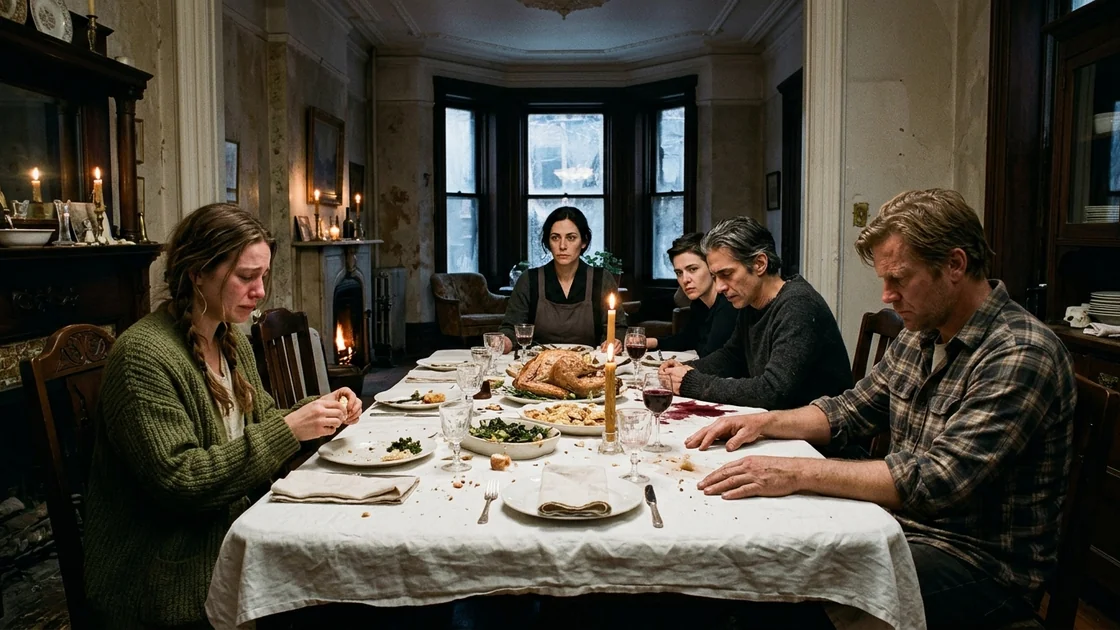
This is the story of Nora Vance, who for ten years has opened her brownstone to an intimate circle of friends with nowhere else to go on Thanksgiving, building a sanctuary out of shared loneliness and ritual. On this milestone anniversary, as autumn frost gathers on the windows and a familiar feast is served, the unspoken truths they have harbored to protect their fragile chosen family finally rupture the surface. Over wine, carved meat, and the quiet hours before midnight, each guest lays bare a life-altering confession, dismantling the comfortable myths of their decade together and forcing them to discover whether their love can survive absolute honesty.
Part I: The Architecture of Welcome
The salt had to be Maldon, flaky and clean, resting in the small stoneware pinch pot her grandmother had brought over from County Clare, though Nora had long since ceased to believe in family heirlooms as talismans. They were just objects that had survived the people who dropped them.
Nora stood at the zinc island in the kitchen of her Cobble Hill brownstone, her thumbs coated in a fragrant film of duck fat and bruised thyme. Outside, the light was doing that brutal November thing—collapsing from a pale, watery gold into a flat, bruised violet behind the chimneys of Henry Street before four in the afternoon. The wind off the East River carried the smell of cold harbor iron and dead sumac leaves, rattling the loose wooden sash in the dining room bay window. She would need to wedge a folded matchbook under the frame before the others arrived; otherwise, Julian would sit with his coat across his knees and pretend he wasn't shivering, his classical-musician stoicism an unbearable form of politeness.
Ten years. A full decade of basting, peeling, pouring, and setting out extra linen napkins for people who had nowhere else to turn when the fourth Thursday of November came around to demand an accounting of kinship.
In the beginning, it had been an act of triage. Ten years ago, the house had been an echo chamber. Nora’s fiancé, Arthur, had packed two canvas duffels and walked out the door at six in the morning on Thanksgiving Day, leaving behind a half-defrosted supermarket turkey and an apartment that smelled like cold plaster and panic. Nora, then thirty-two, with her parents seven years dead and an estranged sister lost somewhere in the sovereign desert of New Mexico, had stood in this very kitchen and felt her ribs cave in. She had called Ben, who was then just an architect she shared studio space with, because Ben’s parents were dead too and his quiet was the only kind she could tolerate. Ben had shown up with a four-pack of bitter IPA and two store-bought rotisserie chickens. Then Ben had called Julian, who had been thrown out of his family’s house in Portland, Maine, for reasons that were whispered about but never spoken of plainly. Julian had arrived with his cello and a bottle of gin. They had eaten cold chicken with their fingers on the subflooring of Nora’s half-renovated parlor, while a late-season nor'easter drove freezing rain against the glass.
They had not called it an "orphans' Thanksgiving" then. That term had come later, adopted half-ironically by Mira, who joined them during Year Three after fleeing a catastrophic divorce that had stripped her of her friends, her apartment, and her green card sponsorship, which Nora’s lawyer had spent six months sorting out pro bono. Chloe had arrived in Year Four, a breathless twenty-one-year-old apprentice at the ceramic studio down the block whose parents had moved back to Taipei and left her behind with a drafty loft in Bushwick and a profound, bewildered loneliness.
Five people. An accidental archipelago of the solitary. Over ten years, they had become an institution to themselves. They knew the contours of each other’s miseries, or so Nora had believed. They had evolved elaborate protocols: Mira always brought the bitter greens and the political fury; Chloe brought the sourdough and the pastries she had spent thirty hours proofing; Julian brought the wine and the chamber music playlists; Ben arrived early to chop the hard root vegetables and fix whatever latch or pipe had broken since October; and Nora provided the bird, the room, and the gravity that held them in orbit.
Nora wiped her hands on her apron and checked the bird. A heritage bronze, twenty-two pounds, dry-brined for three days with juniper berries and bay leaves. It was blistering properly, the skin taut and darkening to the color of polished mahogany.
The downstairs buzzer sounded, a sharp, two-tone chime that cut through the low murmur of the Schumann trio playing from the shelf speakers.
Nora smiled, though a faint, unexpected tremor seized the center of her chest. Her stomach felt hollow, as if she had forgotten to eat breakfast, which she had. She took a breath, smoothed her linen apron down over her wool trousers, and pressed the talk button.
"The doors are unlatched," she said into the grille. "Wipe your feet, Julian. I waxed the pine."
It was always Julian first. He lived in Ditmas Park and suffered from an obsessive, almost neurotic terror of being late.
A moment later, the heavy oak door at the top of the brownstone’s stoop clicked open and clicked shut. Julian’s boots squeaked softly against the floor runner. He appeared at the kitchen archway, tall, reed-thin, his silver-threaded dark hair swept back from a forehead that seemed perpetually furrowed in deep, contrapuntal thought. He was wearing a charcoal lambswool sweater that was starting to fray at the left elbow, and he carried a battered wooden crate containing six bottles of wine, along with an arrangement of dried seed pods and winterberries wrapped in craft paper.
"You look like a seventeenth-century Dutch painting," Julian said by way of greeting, setting the crate down on the bench by the coat hooks with agonizing care. "All game fowl and tallow."
"I smell like lard," Nora said, leaning in to kiss his cool, dry cheek. "Take your scarf off. It’s warm in here."
"The air outside has teeth," he replied, unwinding a long length of forest-green cashmere. "The wind is backing to the north. We’ll have ice on the roads before nine."
He took off his coat, and Nora noticed, with the sharp, maternal watchfulness that was both her gift and her curse, the way his right hand dropped into his pocket immediately. He didn't use it to unbutton his collar; he used his left, awkwardly crossing his chest.
"What happened to your finger?" she asked, gesturing toward the hidden hand.
"Nothing," he said smoothly. "Caught it in the case hinge. Clumsy. Cellists shouldn't be allowed to handle hardware."
"Did you bring the 2015 Rioja?"
"Three of them," he said, pulling one from the crate by its neck, his left hand firm, his right hand still nestled deep in the pocket of his trousers. "Along with two bottles of a dry Riesling from the Finger Lakes that will make Mira stop complaining about global supply chains, at least through the soup course."
"God forbid Mira stop complaining," Nora muttered, but she took the bottle he held out and felt the cool, familiar weight of the evening beginning to settle around her like an old cloak.
"Is Ben here?" Julian asked, looking around the kitchen.
"He called from the hardware store. He was looking for some specific brass shims for the cellar hatch. He said he’d be here by four-thirty."
Julian nodded, though his gaze drifted past Nora, toward the dining table that stretched through the long central room. The table was set with ten places, though only five would be occupied. That was another rule, born of some superstitious refusal to crowd the room: they always set the table for ten, leaving five empty chairs scattered among them for the ghosts, for the people who weren't there, for the versions of themselves that had failed to materialize over the decade.
"Ten years, Nora," Julian said quietly. He was looking at the small place cards Chloe had hand-lettered on heavy rag paper.
"Don't get sentimental yet," Nora said, turning back to her roasting pan. "Wait until the port. If we start now, we’ll be weeping into the cranberry sauce by six."
"I am not prone to weeping into sauce," Julian said, though there was an edge in his voice—thin and brittle, like the ice forming on the stoop—that made Nora look back at him. His face was gray at the temples, older than forty-four had any right to look. There were violet hollows under his eyes, and his shoulders had an inward curve, as if he were guarding something fragile inside his ribcage.
Before she could ask him about his conservatory schedule—he had been preparing for an audition with the Boston Symphony, a final, late-career push they had all celebrated two months ago—the buzzer went again, followed by three sharp raps on the outer door that could only belong to Mira.
Part II: The Gathering of the Archipelago
Mira Patel did not enter rooms; she breached them.
She came in trailing a gust of frigid air, a massive army-surplus duffel bag slung over one shoulder, and a shallow wooden crate filled with bitter greens—escarole, dandelion, treviso—that looked as though they had been pulled violently from frozen soil by her bare hands. She was thirty-eight, with thick, unruly black hair cropped close at the nape of her neck, dark eyes that had spent fifteen years staring down corrupt city commissioners and timber barons, and an abrasive, cigarette-husk laugh that she used like a shield.
"The B63 bus is an insult to civil society," she announced, dropping the duffel with a heavy, metallic clatter onto the hall floor. "A man on the corner of Atlantic was handing out tracts about the end of days, and frankly, his infrastructure policy was more coherent than the MTA's."
"Happy Thanksgiving, Mira," Nora said, emerging with a damp towel to wipe down the hall floor where Mira's boots had tracked in gray slush.
"Don't give me that domestic gaze, Nora. I come bearing radishes that cost more than my first car." She caught Nora in a fierce, one-armed embrace that smelled of tobacco, damp down feathers, and vetiver. She pulled back, her eyes narrowing as she scanned Nora’s face. "You look tired. Did you sleep?"
"I woke up at five to brine the bird."
"You obsess. That’s your flaw. You curate reality so tightly that when a speck of dust lands on it, you think the world is ending." Mira tossed her coat onto the bench next to Julian’s, her movements jerky and over-caffeinated. "Julian. You look like you need a transfusion."
"A pleasant evening to you as well, Mira," Julian murmured from the kitchen doorway, raising his wineglass with his left hand. "Your charm remains an absolute constant in an uncertain universe."
"Screw you, Croft. What’s to drink?"
Chloe arrived ten minutes later, her entrance the exact inverse of Mira’s. She slipped through the door like a shadow seeking warmth, balancing a wide wicker basket covered with an indigo-dyed cloth. Chloe was thirty-one now, but there remained about her an aura of permanent adolescence—an unhurried, wide-eyed stillness that made people speak to her more softly than they did to others. Her black hair was tied in two loose braids, and she wore an oversized, moss-green hand-knit cardigan that swallowed her small frame.
"I brought the milk bread," Chloe said in her light, flute-like voice, setting the basket on the island with the reverence due to an altar piece. "And persimmon tarts. With ginger and black pepper."
"Oh, thank god," Mira said, leaning over the basket and lifting the linen. "Real sugar. Nora probably made something virtuous with parsnips."
"Parsnips are a root of great historical dignity," Nora defended herself, but she reached out and tucked a stray wisp of hair behind Chloe’s ear. "Are you frozen, little one?"
"The bridge was windy," Chloe said. She took off her mittens, and Nora noticed that her fingers were raw, the knuckles red and swollen from handling wet clay in her unheated studio. Chloe leaned into Nora’s shoulder for a second longer than usual, a heavy, sinking lean that felt less like affection and more like an anchor being dropped into silt.
"Everything okay at the kiln?" Nora asked quietly.
"It’s fine," Chloe whispered. "Everything is fine."
The word fine hung in the kitchen air like grease.
Then came Ben.
Ben did not ring the bell. He had his own key, a brass Yale cylinder Nora had given him eight years ago when her pipes had burst while she was at an antiquarian book fair in Philadelphia. He came up the stairs with the steady, unhurried tread of a man who measured structures for a living. He was forty-three, broad-shouldered, with hair the color of wet sand and hands that were always calloused from woodworking. He wore his heavy shearling jacket, and under his arm he carried a long, flat package wrapped in brown butcher paper, tied with green gardener’s twine.
"I have the shims," Ben said, stepping into the warm kitchen. His gaze flicked over the room, taking in Julian by the counter, Mira picking at the persimmons, Chloe warming her hands against the kettle, and finally Nora.
His eyes lingered on Nora. They always did. It was a look that had neither advanced nor retreated in ten years—a steady, companionable regard that carried so much unspoken history it functioned as a piece of furniture in their collective life.
"Did you get the three-eighths?" Nora asked, taking his coat.
"Three-eighths and half-inch. That cellar sill has dropped another quarter-inch since the spring. Frost heave." Ben rubbed his hands together, his breath smelling faintly of peppermint and winter air. "Happy tenth, Nora."
"Happy tenth, Ben."
They stood for a moment in the kitchen entryway, the four of them watching Nora, and Nora watching them back. For a brief second, the room felt balanced, a mobile suspended on invisible wire. Ten years of shared meals, shared flu bouts, shared moving days, shared funerals for people none of the others had ever met. They had survived three presidential elections, two apartment evictions, Mira’s brief and bitter marriage, Julian’s long, solitary tenure at the conservatory, Chloe’s quiet transitions from girl to woman, and Ben’s steady, unchanging presence at Nora’s flank.
"Right," Nora said, clapping her hands together to dispel the sudden, thick stillness that had descended upon the room. "The table needs water. Julian, open that second bottle of white. Mira, wash those weeds. Ben, check the fire in the front parlor. Chloe, sit by the radiator until your lips turn pink again."
They moved. The choreography was ancient, perfected through repetition. The sound of running water, the scrape of cedar logs being turned on the parlor grate, the sharp pop of a cork, the rustle of paper.
Yet underneath the motion, Nora felt the hum. It was like the low-frequency vibration of a faulty transformer somewhere in the basement—an electric tension that she hadn't noticed until the house was full.
Julian was not using his right hand. He was keeping it curled against his hip, using his forearm to steady the bottle while his left hand drew the cork with an awkward, strained violence.
Mira was staring at her phone on the edge of the sink, her face pale, the screen reflecting two small, cold rectangles in her pupils before she shoved the device into the back pocket of her jeans as if it had burned her.
Chloe sat by the cast-iron radiator, her knees pulled up to her chest inside her wool skirt, staring at the five empty chairs in the dining room with an expression that looked shockingly like terror.
And Ben was standing in the parlor, not building the fire, but standing with his hands flat against the cold marble of the mantelpiece, staring up at the empty space above it where Arthur’s portrait—a charcoal study Nora had drawn in their second year together—had once hung, long before Ben had quietly taken it down and carried it to the trash bins on that freezing morning a decade ago.
Part III: The Ritual of the Empty Chairs
The table groaned under the weight of the silver and the earthenware.
Nora had spent two days preparing the feast. There was the bronze turkey, resting on a bed of charred bay laurel and rosemary; a gratin of celery root and Yukon gold potatoes swimming in gruyère and heavy cream; Mira’s bitter greens wilted with smoked bacon fat and cider vinegar; Chloe’s golden milk bread, pull-apart tender and glossy with salted butter; roasted delicata squash crescents tossed with toasted pumpkin seeds and pomegranate molasses; and a tureen of wild mushroom soup made from dried chanterelles Nora had gathered in the Catskills the previous September.
The dining room was illuminated only by the fire from the parlor and eight tall beeswax tapers set in heavy brass candlesticks. The yellow light flickered across the crown moldings and softened the angles of their faces, turning them into a company of pilgrims huddled inside a cave of warm wood and dark wallpaper.
Julian sat to Nora’s right; Ben sat to her left. Mira sat beside Julian, and Chloe sat beside Ben. Across from them, and between them, stood the five empty chairs, each set with an empty plate, an empty wine glass, and a folded white napkin.
"A toast," Ben said, raising his water glass. He didn't drink wine before seven; it was one of his peculiarities. "To the tenth."
"To the tenth," Julian echoed, lifting his glass of Rioja with his left hand.
Mira raised her glass without looking up, her fork already poised over the greens. "To survival. The most overrated of all human endeavors."
"Don't be bleak, Mira," Chloe said softly. Her voice sounded frayed, like linen rubbed against gravel. "It’s nice. It’s always nice."
"It’s not just nice, Chloe," Nora said, settling into her chair at the head of the long table. "It’s a record. Ten years is an epoch. In New York, ten years is three lifetimes. Businesses open and close in ten years. People have children who learn to read and write in ten years. We have stayed."
"Stayed what?" Mira asked, chewing a piece of escarole with deliberate slowness. "The same? God, I hope not."
"Stayed together," Nora said firmly. She looked around the table, willing them to meet her eyes, but they seemed collectively possessed by an evasive gravity. Julian was studying the label on the wine bottle. Ben was adjusting the alignment of his fork against the linen. Chloe was shredding a piece of milk bread into tiny, doughy pellets.
"You know the rule for the tenth year," Nora continued, trying to inject lightness into the air. "We decided this five years ago. On the tenth anniversary, we don't do the gratitude round. Gratitude is cheap. It’s what people say when they don't want to talk about what they've lost."
Julian made a small, dry sound in the back of his throat. "What was the alternative, Nora? Remind us. My memory has been entirely replaced by Bach partitas and the cost of dental work."
"The Reckoning," Ben said. His voice was lower than the others, resonant and flat. "We agreed that on the tenth year, everyone had to name the thing they had surrendered to stay at this table."
A silence dropped over the table, sudden and heavy as a wet wool blanket. The clatter of Mira’s fork against her stoneware plate sounded like a gunshot.
"That was a stupid idea," Mira said, reaching for the wine bottle Julian had set between them. She poured herself three fingers of the dark Spanish red, not waiting for him to pass it. "Five years ago we were all drunk on that sparkling Vouvray Ben brought. We were feeling poetic. Nobody wants a reckoning, Nora. We want turkey and we want pie, and then we want to fall asleep on your rugs while the football game plays on mute."
"No," Chloe whispered.
The word was so small it almost disappeared into the hiss of the radiator, but it carried an unexpected weight. Chloe had stopped shredding her bread. Her hands were flat on the white tablecloth, pale against the cream linen.
"No?" Mira looked at her, her eyebrows arched. "No what, Chloe?"
"We promised," Chloe said. She looked up, her dark eyes wide and glassy in the candlelight. "We made a promise that we wouldn't let this turn into a lie. That was the whole point of not having real families, wasn't it? Real families lie to each other so they can get through the dessert without someone calling the police. We weren't supposed to do that."
"Chloe," Julian said, his voice unusually gentle, almost pleading. "The distinction between a lie and an omission is the foundation of civilized society. Don't tear down the walls just because you like the look of the ruins."
"He’s right," Mira scoffed, though her fingers were gripping the stem of her glass so tightly the tips were white. "Let’s not perform some bourgeois group therapy session. Nora, pass the celery root. It looks magnificent."
Nora didn't pass the dish. She sat with her hands folded in her lap, looking at the five empty chairs.
"I surrendered Arthur," Nora said quietly.
The name hit the table like a lead sinker dropped into a pond.
Ben stopped moving. His knife remained hovering an inch above his turkey breast.
"Nora," Ben said, warning in his tone. "Don't."
"Ten years," she said, her gaze steady on the empty chair directly across from her—the chair where Arthur had sat during their only joint dinner in this house, two weeks before the first Thanksgiving. "Ten years I’ve told the story that he walked out because he was a coward who couldn't face marriage. That he left me on Thanksgiving morning with an empty refrigerator and a broken heart. That was the foundational myth of this dinner, wasn't it? The great desertion that made me open the door to the rest of you."
"Was it a myth?" Julian asked, his brow creased. "I saw you that day, Nora. You looked like you had been hit by a freight train."
"He didn't walk out," Nora said.
Her voice was utterly devoid of drama. It had the dry, administrative tone she used when cataloging nineteenth-century ledgers at her shop.
"I threw him out," she said. "I threw him out at five in the morning because I found out he had taken thirty thousand dollars from my father’s trust—the money that was supposed to replace the brownstone's roof and keep the foundation from settling into the marsh. He spent it on an options trade that went to zero in forty-eight hours. And I told him if he didn't disappear before the sun came up, I would call his father, who was the senior presiding judge of the appellate division, and tell him his son was a thief."
She took a slow sip of her water.
"I didn't tell you," she continued, "because I wanted to be the victim. If I was the victim, my grief was pure. If I was the victim, this house was a sanctuary for the wounded, not a crime scene where I had traded my pride for thirty thousand dollars of dead equity. I let you all believe I was the one who was abandoned, so that you would feel safe letting me take care of you."
The fire popped in the parlor, a sharp crack of pine sap.
Mira stared at Nora, her lips slightly parted. "Nora Vance. You calculating, magnificent bitch."
"It wasn't magnificent," Nora said. "It was lonely. Because every time you praised me for being so generous, so selfless, so hospitable to the wandering souls of Kings County, I knew that I had built this entire institution on a foundation of spite and cover-up."
She looked at Ben. "And Ben knew."
Every face turned toward Ben.
Ben didn't flinch. He slowly laid his knife and fork down, parallel to each other, on the rim of his plate. He didn't look at Nora; he looked down at his own calloused hands.
"I helped him pack his bags," Ben said. His voice was steady, but there was an unfamiliar gravel in it. "I drove him to the Greyhound station on 34th Street. Nora called me at four in the morning, before she called anyone else. I carried his duffels down the front stairs so she wouldn't have to hear his footsteps on the pine."
"Why didn't you say anything?" Mira demanded. "For ten years? You sat there every November while Nora told the story about the empty refrigerator!"
"Because she needed to tell it," Ben said simply. "And because I had my own reasons for wanting Arthur gone."
The silence returned, thicker now, altered by the admission. It was no longer the silence of polite friends; it was the heavy, pressurized quiet that precedes a structural collapse.
Part IV: The Hands of the Musician
Julian reached for his wineglass with his right hand.
It was an instinctive gesture—his mind had forgotten the discipline his body had maintained all afternoon. His fingers closed around the crystal stem, but as he lifted it, the third and fourth fingers suddenly curled inward, clamping down into the palm in an uncontrollable, claw-like spasm. The glass tipped.
A dark wave of Rioja surged across the white linen, pooling instantly around the base of the brass candlestick and spreading toward the empty plate set for Year Seven.
"Damn it," Julian hissed.
He didn't reach for a napkin with his left hand. He just sat there, staring at his right hand as it twitched on the table, the fingers curled like dried fern fronds, locked against the pad of his thumb.
"Julian," Chloe said, reaching out to touch his arm.
"Don't," he snapped. The word was cold, venomous, unlike anything they had ever heard from him. He pulled his arm back, tucking the hand beneath the table, his breath coming in short, ragged hitches.
Nora rose immediately and moved to the sideboard, returning with a clean linen cloth. She didn't look at his face; she worked with quiet efficiency, pressing the cloth into the stain, watching the red wine bleed into the white weave.
"Focal dystonia," Julian said into the quiet.
He said it to the empty chair across from him.
"What is that?" Mira asked, her voice dropping its combative edge.
"It’s an assassin," Julian said. He gave a dry, humorless bark of laughter that sounded like dry sticks breaking. "It’s a neurological movement disorder. Task-specific. It only happens when I do the one thing I have spent forty years learning to do."
He brought his right hand out from beneath the table and laid it on the cloth Nora had just used. The hand looked normal—long, elegant fingers, pale skin, clean nails. But as they watched, the ring finger began to tremble with a minute, frantic oscillation.
"If I hold a fork, it behaves," he said, demonstrating by picking up his fork with a steady grip. "If I write a letter, it obeys. But the moment my fingers touch the neck of a cello, the brain sends the wrong signal. The muscles contract simultaneously. The fingers clench into a fist. They will not open."
He set the fork down. His hand curled again, stubborn and ruined.
"When did it start?" Nora asked, her hand resting on the back of his chair. She felt the rigid tension in his spine.
"Sixteen months ago," he whispered. "A slight drag on the shift in the Elgar concerto. I thought it was tendonitis. I spent five thousand dollars on physical therapy, three thousand on acupuncture, two thousand on a German specialist who injected Botox into my forearm to paralyze the flexor muscles. Nothing worked. The brain simply decided that the cello is a foreign object that must be crushed."
"The Boston audition," Ben said, his eyes fixed on Julian’s ruined posture. "You told us last month you were in the final round."
"I withdrew three days before the preliminary," Julian said. "I didn't even get on the train. I sat on a bench at South Station for four hours, watching the departures board, and then I took the subway back to Ditmas Park."
"Julian," Nora breathed, her heart tightening. "Your classes at the conservatory?"
"I resigned on Tuesday," he said. He looked around the table, his gray eyes wide, glistening with an unshed moisture that made them look like wet slate. "My last student was a nine-year-old girl who can play the first movement of the Saint-Saëns better than I can right now. I listened to her play the opening arpeggio, and I realized that if I stayed in that room another week, I would begin to hate her. And I won't do that. I won't become the bitter old man who despises children because their nervous systems still function."
"Why didn't you tell us?" Chloe cried, tears finally breaking over her lashes. "Julian, we’re your family! Why did you have to sit alone in Ditmas Park?"
"Because you couldn't fix it, Chloe!" Julian's voice cracked, rising in volume until it reverberated against the high plaster ceiling. "None of you could fix it! You would have brought me casseroles! You would have looked at me with those soft, pitying eyes, the way people look at an animal that’s had its legs broken by a car! I didn't want your casseroles! I wanted my hands!"
He buried his face in his left hand, his shoulders shaking, but no sound came out. It was a silent, dry weeping, more terrible than wailing.
"And that’s not all of it," Julian said after a long moment, his voice muffled behind his palm. He dropped his hand and looked at Nora, his expression hollowed out. "The Reckoning, right? That’s what we’re doing. You surrendered Arthur. I surrendered the only thing that made me human. But that’s not what I surrendered to sit at this table."
He reached for the wineglass Nora had replaced, picked it up with his left hand, and drank the entire contents in one long, desperate swallow.
"I surrendered my brother," Julian said.
Mira blinked. "You told us your family disowned you because you were gay. You told us your father was an elder in that Calvinist church in Maine and he threw you out when you were twenty."
"My father was an elder," Julian said, setting the glass down with a sharp click. "And he was a monster. But he didn't throw me out. I left."
He turned to look at the empty chair beside him—the one set for Year Two.
"My brother, Samuel," Julian said, the name sounding foreign on his tongue, like a word from an extinct language. "Samuel was seventeen. I was twenty-two, home from Juilliard for the summer. Samuel was... he was driving the car. We had been drinking cider behind the gravel pit. He was seventeen, Nora. He hit a boy on a bicycle on the county road. A twelve-year-old boy named David Miller."
The room seemed to drop ten degrees. Nora stopped breathing.
"David didn't die immediately," Julian said, his voice flat, drained of all inflection. "He was in the ditch. Samuel was hysterical. He was screaming that his life was over, that our father would kill him, that he would go to the state prison in Thomaston. And our father... our father arrived in his truck five minutes later. He looked at David Miller in the ditch, and then he looked at me. And he said, 'Samuel has a future in the ministry. You have a fiddle.'"
Julian looked down at his locked fingers.
"I took the wheel," Julian whispered. "I sat in the driver's seat and waited for the state troopers. Samuel and my father drove away in the truck. I spent eighteen months in the Kennebec County jail for vehicular assault and leaving the scene of an accident. When I got out, my father handed me five hundred dollars and a one-way bus ticket to Port Authority, and he told me that if I ever set foot in Sagadahoc County again, he would tell the Miller family that Samuel had seen me drinking gin before I got in the car."
"Jesus, Julian," Ben said, his face white as plaster.
"I let you think I was a martyr for love," Julian said, looking around the table with eyes that were entirely empty. "I let you think I was the noble artist cast out by religious bigots. It was much cleaner that way, wasn't it? It made for a much better story over the cranberry sauce. But the truth is, I’m an accessory to a hit-and-run, I let a twelve-year-old boy die in a ditch while my father negotiated my brother's soul, and now God has finally reached into my right forearm and turned the key."
He leaned back in his chair, his arms falling limp at his sides.
"There," he said, nodding toward the red wine stain spreading through the linen. "That’s my reckoning. Who’s next?"
Part V: The Paper and the Soil
Mira did not reach for her wine. She was staring at Julian with an expression that Nora had never seen on her face before—not anger, not cynicism, but a profound, sickened recognition.
"Mira?" Nora said softly, terrified of what the room was becoming, yet unable to arrest the momentum of the slide.
Mira reached into the duffel bag beside her chair. She didn't pull out another jar of pickled vegetables or a loaf of bread. She pulled out a thick, legal-sized manila envelope, sealed with red string, and tossed it into the center of the table, where it landed with a dull thud against the wood between the butter dish and the carving platter.
"You want to talk about stories?" Mira said, her voice dropping into a register that was almost inaudible. "You want to talk about the comfortable little myths that keep us warm while the city freezes?"
She looked at Nora, her eyes burning with an accusatory light that made Nora draw back.
"For seven years," Mira said, "I’ve been the crusader. The fearless independent journalist who lives on cold lentils and moral superiority while exposing the real estate syndicates that are turning this city into an offshore holding company for Russian oligarchs and private equity gougers."
"You are that," Chloe said, her voice trembling. "Mira, you won the Polk Award three years ago. You saved those tenants on 4th Avenue."
"I took a payout," Mira said.
The words were so small they barely cleared the rim of her plate.
"What did you say?" Ben asked, his head turning slowly toward her.
"I took a payout," Mira repeated, louder this time, her voice cracking on the syllables. "Eighteen months ago. The Crown Heights redevelopment project. The one that cleared out three hundred West Indian families to build those luxury towers with the rooftop dog parks and the simulated speakeasies."
She pointed a finger at the manila envelope.
"I had the documents," she said. "I had the emails showing that the development corporation had bribed the city planning board to alter the zoning maps. I had the building inspection reports showing that they intentionally cut the heat during the polar vortex of 2021 to force the rent-stabilized tenants out. I was forty-eight hours away from filing the piece with the Times."
"What happened, Mira?" Nora asked, though she felt a cold dread rising in her throat, knowing the answer before it was spoken.
"My sister called," Mira said.
She stopped. She closed her eyes, her throat working as she swallowed against a sudden, violent spasm of nausea.
"The sister you haven't spoken to since your mother died?" Julian asked, his voice drained of its earlier fury, replaced by a quiet, horrified curiosity.
"Asha," Mira whispered. "She had stage-three inflammatory breast cancer. It had spread to her lymph nodes. Her husband’s insurance had dropped them through some technicality about preexisting conditions—some corporate loophole that meant she was going to die in a public ward in Queens because they couldn't afford the monoclonal antibody therapy. The treatment was four hundred thousand dollars."
She opened her eyes, and they were wild, bloodshot, and dry.
"The developer's attorney," Mira said, "approached me through a shell LLC three days after I sent my list of fact-checking questions to their press office. They didn't threaten me. They didn't have to. They just offered to buy my research. Not to kill it—officially, they were buying the exclusive rights to a book proposal that would never be published. Five hundred thousand dollars. In an escrow account in the Caymans, transferable to a medical trust in Zurich."
She picked up the envelope and dropped it again.
"I signed the non-disclosure agreement," she said. "I deleted the files from my drive. I watched the bulldozers roll into the Crown Heights lot from the window of the cab while I was taking Asha to her first infusion at Memorial Sloan Kettering."
"Mira," Nora said, reaching across the corner of the table toward her, but Mira pulled her hand away violently.
"Don't touch me, Nora! Don't you dare look at me with that Saint Teresa face! Asha died anyway! She died in August! The cancer was already in her liver by the time the Swiss drugs cleared customs! She died, and the money was spent, and three hundred families are living in shelters in East New York because Mira Patel decided her sister's life was worth more than her integrity!"
Mira’s voice broke into a harsh, dry sob that rattled the glasses on the table.
"And do you know who the lead architect was on that project?" Mira spat, turning her head with sudden, vicious speed toward the left side of the table.
She wasn't looking at Nora. She wasn't looking at Julian.
She was looking at Ben.
Ben did not look up from his plate. His face was entirely still, carved out of dry wood.
"Tell them, Ben," Mira whispered, her voice shaking with rage. "Tell them who signed the architectural certifications that declared those buildings uninhabitable so the city would issue the emergency vacate orders."
Nora’s gaze snapped to Ben. "Ben? What is she talking about?"
Ben slowly raised his head. He looked older than Julian. His skin had a gray, waxy sheen under the candlelight, and his blue eyes were clouded, as if he were looking at the room through frosted glass.
"She’s right," Ben said.
"Ben, no," Nora said, her voice rising in protest against the collapse of her world. "You don't do that kind of work. You design libraries. You do historic preservation."
"The historic preservation firm went bankrupt in 2020, Nora," Ben said, his tone shockingly flat, stripped of all resonance. "I had seven employees with families. I had six hundred thousand dollars in commercial debt on the studio lease. The Vanguard Group offered us the master contract for the Crown Heights parcel. All I had to do was inspect the load-bearing masonry and confirm what their structural engineers had already reported."
"You knew the walls weren't failing," Mira hissed. "I saw the original blueprints from 1924, Ben. Those buildings were built with reinforced clinker brick. They would have stood for another century."
"I knew," Ben said. He did not look at Mira; he looked directly at Nora. "I signed the condemnation certificates on December 14th. The vacate notices were posted on the 16th. My firm made eighty thousand dollars on the contract. It was enough to pay my staff’s severance and close the doors without filing for personal chapter seven."
He paused, his breath rattling faintly in his chest.
"And with that money," Ben added, "I paid for the copper flashing on your roof, Nora. And the four steel lally columns that are currently keeping this dining room floor from dropping into your cellar."
Nora pulled her hands back from the table as if the linen had caught fire. She looked down at the floor beneath her feet—the floor she had polished with beeswax, the floor that felt so solid, so eternal.
"You did what?" she whispered.
"You were going to lose the house, Nora," Ben said, his voice finally showing a fissure of emotion—a deep, desperate strain that made his words sound like they were being dragged through gravel. "Three years ago. You didn't tell the others, but you told me. The bank was calling the balloon mortgage on the renovation loan Arthur had signed. You needed sixty thousand dollars in seven days, or the sheriff was going to put the notice on the front door. Where did you think that money came from? Did you really believe an anonymous preservation grant had miraculously materialized from the state historical commission?"
Nora felt the air leave her lungs in a long, cold rush.
She remembered that morning. She remembered sitting on the kitchen floor, the foreclosure notice in her hand, the radiator cold, the realization that her father’s legacy was about to be auctioned on the courthouse steps. And she remembered Ben walking in with an envelope from an Albany foundation, telling her that her work on the nineteenth-century ledger conservation had qualified her for an emergency historic preservation stipend.
She had wept on his shoulder. She had called him her savior.
"You lied to me," Nora whispered.
"I saved your house," Ben said, his voice rising, the anger finally breaking through his granite surface. "I saved this table! I saved the only place in this godforsaken city where I could sit down and feel like a human being for five hours a year! I sold out three hundred strangers so that you wouldn't have to pack your grandmother's salt cellar into a cardboard box and move to an apartment in Queens!"
"That wasn't your choice to make!" Nora cried, rising to her feet, her chair scraping violently against the floorboards. "You made me a thief! You made me an accomplice to what you did to those people!"
"We’re all accomplices, Nora!" Ben yelled, standing up to face her across the table, his broad shoulders hunched, his fists planted firmly on the linen. "That’s what you don't understand! You sit at the head of this table and play the benevolent mother to the lost and the broken, but the bread you feed us was bought with dirty money, the roof over our heads was paid for with stolen equity and condemned tenements, and every single one of us is here because we did something so vile we couldn't bear to sit in a room with our own blood!"
"Stop it!"
The scream was high, sharp, and shattered like glass against the walls.
It was Chloe.
Part VI: The Child at the Edge
Chloe had stood up.
She was small, her frame dwarfed by the massive green cardigan, but her face was transformed by a rage so pure and terrifying that both Nora and Ben froze, their words dying in their throats.
Chloe’s hands were shaking, not with the delicate tremble of a frightened girl, but with the violent vibration of an engine coming apart at the bearings.
"You think you’re monsters?" Chloe screamed, her voice cracking, tears streaming down her face in silver tracks that caught the dying candlelight. "You think you’re so special because you’re ruined? Because you’re tragic? Because you have these grand, literary crimes you can confess over your five-hundred-dollar wine?"
"Chloe," Julian said, his voice weak, his hand still curled against his chest. "Sit down, please."
"No!" she shouted, turning on him with bared teeth. "Don't tell me to sit down, Julian! Don't you dare use that conservatory voice on me! You all look at me like I’m a child! You’ve looked at me like I’m a child for seven years! 'Little Chloe. Quiet Chloe. Chloe who makes the pretty pots and brings the sweet bread and doesn't understand the world!'"
She reached into her skirt pocket and pulled out a small, crumpled piece of paper, smoothing it frantically against the edge of the mahogany table with the flat of her palm.
"My parents didn't move back to Taipei because they missed home," Chloe sobbed, her words tumbling out in a torrent that sounded like water bursting through a dam. "They moved back because the FBI came to our house in Flushing. My father wasn't an import-export clerk. He was running a laundering service for human smuggling syndicates out of the Fujian province. He was moving women, Nora. Young women. Girls younger than me. They were locked in basement apartments in Sunset Park, making garments twelve hours a day to pay off sixty-thousand-dollar transit debts!"
Nora’s hand went to her mouth.
"They left in the middle of the night," Chloe said, her voice dropping into a rhythmic, horrifying monotone. "They left me three thousand dollars on the kitchen table and two tickets to Taipei. And I didn't go. Do you know why I didn't go?"
She looked at Nora, her eyes wide, wild, and pleading.
"Because I took the other ticket," Chloe whispered. "The ticket that belonged to my younger sister, Mei. She was sixteen. She wanted to stay. She was terrified of going back to Taiwan because she knew what my father was. And I... I told the federal agents where to find her."
The room went dead. Even the wind against the bay window seemed to hold its breath.
"I gave them her address in Flushing," Chloe said, her fingers tearing small shreds from the paper she had flattened on the wood. "I told them if they took her, they wouldn't look for me. I told them she was the one who kept the books. She was sixteen, Nora! She didn't know anything! She spent three weeks in an immigration detention center in New Jersey before they deported her alone. She’s in an industrial dorm in Taoyuan right now, assembling circuit boards for eleven hours a day, and she hasn't answered a letter from me in seven years."
Chloe looked down at her hands—her red, swollen, clay-stained hands.
"I didn't come to this dinner because I was an orphan," Chloe whispered, her voice shrinking until it was barely more than the flutter of a moth’s wing. "I came because I was a Judas. I came because when Nora took my coat that first year and asked me if my hands were cold, I realized that if I stayed in this house, nobody would ever ask me about Mei. You all had your own ghosts. You were so busy staring at your own empty chairs that you never looked into mine."
She dropped the shredded paper onto her plate. It fluttered down like gray confetti, settling into the congealed gravy and the cold meat.
"And now I’m pregnant," Chloe said.
The silence that followed was different from the others. It was not the silence of shock or anger; it was the silence of an abyss opening beneath the floorboards.
Chloe looked across the table at Ben.
Nora saw the look.
It was a fraction of a second—a single, reflexive alignment of gaze that passed between Chloe and Ben like an electric spark. It was so fast that if Nora hadn't spent ten years watching the two of them pass butter, adjust chairs, and share quiet jokes while washing dishes, she would have missed it entirely.
Nora looked at Ben.
Ben did not look back. He slowly lowered his head, his chin resting against his chest, his eyes closed.
"In August," Chloe said, not looking at anyone now, staring down at the wine stain Julian had made. "When the studio roof leaked and the kilns were flooded. Ben came to help me rebuild the shelves. We stayed late. We were drinking whiskey from coffee mugs. We were both so tired. We were so damn tired of being the ones who survived."
Nora did not scream. She did not throw her plate.
She stood at the head of the table, her hands hanging loose at her sides, and felt the ten years she had constructed—the ten years of roasted birds, polished silver, fresh linens, and carefully chosen music—evaporate into the smell of cold duck fat and sour wine.
The sanctuary was not a sanctuary. It was a holding pen. It was a room where five people had gathered once a year to perform their innocence for one another, trading counterfeit redemption like prisoners swapping cigarettes in an exercise yard.
"I see," Nora said.
Her voice was very quiet. It was the quietest thing in the house.
She looked at Julian, whose right hand was still locked into a useless claw against his ribs.
She looked at Mira, who had traded three hundred families for three months of her sister's dying breath.
She looked at Chloe, who had bought her Brooklyn studio with her sister's freedom and was now carrying the child of the only man Nora had ever truly trusted.
And she looked at Ben, who had signed the orders to destroy those families so that he could buy the steel that kept Nora from falling into the dark.
"Dinner is over," Nora said.
Part VII: The Anatomy of Ruin
Nobody moved.
The tapers had burned down to their brass sockets, the tallow pooling on the wood, the flames sputtering and hissing as they reached the wick ends. The room smelled of hot brass, burnt wax, and the cold iron draft that had finally forced its way past the loose sash in the bay window.
"Nora," Julian began, his voice cracked and hollow. "Let us—"
"No," Nora said. She didn't turn around. She walked into the kitchen, picked up the large zinc dishpan from under the sink, and brought it back into the dining room.
She began to clear the table.
She did not do it gently. She took Arthur’s plate—the empty plate that had sat across from her for ten years—and scraped the cold fat from the carving platter onto it with a heavy silver spoon. She took the linen napkins from the empty chairs and tossed them into the dishpan. She took the half-empty bottles of Rioja and Riesling and set them on the sideboard with sharp, echoing clatters.
"Nora, stop," Ben said, reaching out to catch her wrist as she reached for his plate.
She stopped. She looked down at his hand—the broad, strong fingers with their clean-cut nails and the small scar across the knuckle from a chisel slip eight years ago. She remembered him holding a flashlight between his teeth while he patched her boiler in the middle of the blizzard of Year Five. She remembered him bringing her soup when she had pneumonia during Year Eight, sitting in the armchair in her bedroom for three nights, reading aloud from old architectural treatises until she fell asleep.
"Take your hand off me, Ben," she said.
Her voice had no anger in it. That was what broke him. If she had screamed, he could have defended himself; he could have invoked the ten years of loyalty, the hours spent in her cellar, the quiet devotion that had never asked for a name. But her voice was flat, level, and cold as river ice.
He released her wrist. His hand fell back to the table, heavy as a stone.
Mira stood up, her movements jerky and stiff. She walked over to the front window, pulled the heavy velvet drape aside, and stared out into the darkness of Henry Street. The snow had started—not the romantic, large-flaked snow of holiday postcards, but a fine, sharp sleet that hissed against the glass like sand thrown from a bucket.
"The wind has turned," Mira said to the pane. "The bridge will be iced over."
"You can take the subway," Nora said from the table, stacking Chloe’s plate on top of Julian’s.
"Nora," Chloe sobbed, burying her face in her oversized green cardigan. "I’m sorry. I’m so sorry. I didn't want to tell you. I was going to leave. I have a ticket to San Francisco for Tuesday. I wasn't going to make you live with this."
"You’re not going to San Francisco," Ben said, his voice dead. "You don't have any money, Chloe. And you have an eight-thousand-dollar tax lien on the studio."
"How do you know that?" Chloe’s head snapped up, her face blotchy and swollen. "Did you look through my mail?"
"I didn't have to look through your mail," Ben said, staring at the salt cellar. "The city marshal came to my office last week looking for your landlord's contact. I paid the lien, Chloe. Just like I paid Nora’s flashing. Just like I pay for everything."
"Stop it!" Nora slammed a heavy earthenware platter down onto the zinc tray with a force that chipped the glaze. A white shard flew across the table and struck Julian’s wineglass, producing a clear, high, singing tone that vibrated in the room for several seconds.
"Stop being the providence of this house, Ben!" she yelled, her control finally shattering, the heat rising into her throat. "You’re not God! You’re just a man with a checkbook and a guilty conscience! You bought my house, you bought Chloe’s studio, you bought your way out of the Crown Heights shame, and you think that makes you a martyr? You think that gives you the right to sleep with a girl twenty years younger than you because you were both tired?"
Ben flinched as if she had struck him across the mouth with a piece of pine. He looked up at her, his jaw set, his eyes hard and shiny with tears that would not fall.
"I loved you, Nora," Ben said.
He said it simply, right there in front of the others, in the cold, tallow-smelling dining room, between the congealed turkey and the shredded paper.
"I loved you for twelve years," Ben said. "Before Arthur. While Arthur was here. After Arthur left. I waited. I sat on your stoop. I fixed your sash windows. I cleared your gutters. I listened to you talk about your books, your prints, your parents, your grief. I waited for ten years for you to look across that table and see that the person who stayed wasn't staying because he was an orphan. He was staying because he was a fool."
He stood up, towering over the table, his shearling coat already half-buttoned.
"And you knew it," Ben whispered, leaning toward her, his voice shaking with a rage that matched her own. "You knew it every single day of those ten years, Nora Vance. You knew that if you never gave me hope, I would never leave. You kept me around like an old dog that you could feed with leftovers and rely on to guard the door. And when I finally broke—when I finally looked at someone who didn't look at me like an unpaid handyman—you look at me like I’m a monster."
Nora stared at him, her chest heaving, her fingers gripping the edge of the zinc tray until the metal cut into her skin.
She wanted to deny it. She wanted to say that it wasn't true, that she had seen him only as a friend, a brother, an equal. But the truth was a cold, sharp blade that had already entered her heart.
She had known.
She had known every time he lingered by the door; every time he brought her coffee from the roaster in Red Hook that he had to go three miles out of his way to visit; every time he refused to date the women Mira tried to introduce him to. She had held his devotion in reserve, like a bond that paid steady interest, never cashing it, but never letting it lapse. She had used his love to stabilize her life the same way she had used his stolen steel to stabilize her dining room floor.
"Get out," Nora whispered.
Ben didn't blink. He nodded once, slowly.
"Happy tenth anniversary, Nora," he said.
He turned and walked toward the hall. The front door clicked open. The sound of the freezing wind off Henry Street roared through the corridor for a brief, violent second, and then the heavy oak door slammed shut with a concussive boom that rattled the frames on the stairs.
Part VIII: The Cold Scullery
By eight o’clock, the house was silent, but it was not empty.
Mira had not left. She had gone into the kitchen, taken off her boots, and was standing at the double sink in her gray woolen socks, her sleeves rolled up past her elbows, scouring the copper roasting pan with steel wool and coarse kosher salt. Her movements were rhythmic, fierce, and unrelenting.
Julian had not left. He was sitting on the horsehair sofa in the front parlor, his cello case standing beside him like a black coffin. He had not taken out the instrument; he was simply sitting in the dark, watching the dying embers of the birch logs turn from orange to gray, his right hand resting flat on his knee, motionless as a carved relief.
Chloe had locked herself in the second-floor bathroom. Nora could hear the sound of the old pipes groaning as the clawfoot tub filled with hot water, followed by the muffled, rhythmic sound of a woman crying into a bath towel.
Nora sat alone at the dining table.
She had cleared everything away. The white linen tablecloth was gone, folded into the hamper, stained with Rioja, cranberry, and grease. The bare mahogany of the table stretched between the chairs—dark, scarred, and cold. In the center of the wood sat the paper envelope Mira had left behind, sealed with red string, and the crumpled piece of paper Chloe had dropped, which Nora had smoothed out with the palm of her hand.
It was an old photograph.
It was a Polaroid, faded and yellowed at the borders. It showed two girls in identical red nylon parkas standing on the boardwalk at Coney Island, eating fried dough. The younger one, who couldn't have been more than ten, had her arm thrown around Chloe’s neck, her head thrown back in a wide, gap-toothed laugh that filled the small square of film with a ferocious, innocent delight.
Across the bottom, in blue ballpoint ink that had begun to bleed into the chemical paper, was written: Mei and me, 2011.
Nora picked up the photograph and held it by its edges.
How had they managed it? For ten years, they had looked at each other across this mahogany surface and seen only what they needed to see. They had constructed a pantheon of harmless wounds: the abandoned fiancé, the disowned musician, the radical journalist, the stoic architect, the wandering artisan. They had built a dollhouse of grief and called it a chosen family.
And yet, as Nora looked down at the paper, she knew that the dollhouse was the only thing that had kept them alive.
Without this room, Julian would have spent the last ten Thanksgivings in a rented room in Flatbush, staring at his dead hands until he found a bridge high enough to jump from.
Without this room, Mira would have drowned in the bile of her own compromise, poisoned by the five hundred thousand dollars that couldn't buy her sister a single extra sunrise.
Without this room, Chloe would have disappeared into the gray anonymity of the city, consumed by the ghost of the sister she had surrendered to save herself.
And without them, Nora would have become a ghost in this brownstone, rattling around in eleven rooms of decaying plaster, guarding her grandmother’s salt cellar until the city came to carry her out in a pine box.
She stood up, her knees cracking in the cold room, and walked into the kitchen.
Mira did not turn around. She was rinsing the salt from the copper pan, the hot water sending clouds of steam up into the dark air beneath the open beams.
"The pan is clean," Mira said to the grease-spotted tile.
"It’s an old pan," Nora said, coming to stand beside her at the sink. "It takes a lot of salt to clear the copper."
Mira turned off the tap. She leaned her forearms against the rim of the porcelain sink, her head hanging between her shoulders, her dark hair falling forward to conceal her face.
"I hate this holiday," Mira whispered. "I have hated it every day of my life since I was seven years old."
"I know," Nora said.
"My mother used to make us eat in silence if my father had been drinking," Mira said. "We would sit at the laminate table in the apartment in Jackson Heights, and we would chew dry turkey while my father stared at the wall and told us how much we cost him. Every year, Nora. Every single year until he had the stroke."
She wiped her face with the back of her forearm, leaving a streak of gray dishwater across her cheek.
"And then you came along," Mira said, turning to look at Nora with eyes that were raw and furious. "With your linen napkins and your heritage birds and your Schumann trios. And I wanted to spit on it. I wanted to tell you that you were a sentimental, privileged dilettante who didn't know what real hunger looked like."
"Why didn't you?" Nora asked.
"Because the bread was warm," Mira said, her voice dropping into a harsh, cracked whisper. "Because the room was warm. And because when you asked me if I wanted more greens, you didn't look at me like I was a bill that had come due."
She turned her back to the sink, her hips pressed against the porcelain, looking out through the kitchen archway toward the dark parlor where Julian sat.
"What are we going to do with Chloe?" Mira asked.
"What do you mean?"
"She’s thirty-one, Nora. She has no money, she has no family, her sister is in an industrial park in Taiwan, and she’s carrying Ben’s child." Mira looked at Nora, her dark eyes penetrating and fierce. "Are you going to throw her out the way you threw out Arthur?"
Nora looked down at her hands. The duck fat had washed away, leaving her skin dry and smelling faintly of metal and salt.
"Arthur stole my father’s money to bet on gold futures," Nora said. "Chloe gave up her sister because she was a frightened child who had never seen an FBI badge in her life."
"And Ben?" Mira asked.
Nora closed her eyes.
The image of Ben standing in the parlor twelve years ago—holding the first cedar logs he had ever brought into this house, his hair wet with November sleet, looking at her with that terrifying, patient gravity—rose up behind her eyelids.
"Ben is gone," Nora said.
"Ben is down on the corner," Julian said from the archway.
Part IX: The Man on the Corner
Nora and Mira turned.
Julian was leaning against the door jamb, his wool coat on, his scarf wrapped around his neck. He was holding his right hand tucked firmly into his pocket, but his face had lost the gray, hollow look of an invalid. His jaw was set, and his eyes, though red-rimmed, were clear.
"He’s been standing beside the mailbox on the corner of Henry and Amity for forty-five minutes," Julian said. "He hasn't moved. His coat collar is up, but he doesn't have a hat. The sleet is freezing on his hair."
Nora walked past them, through the central room, and into the parlor.
She went to the bay window, carefully avoiding the cold draft from the loose sash, and looked down Henry Street.
The street lamps were halos of amber light in the thickening storm. The cobblestones were slick with gray slush, and the parked cars were covered in a thin, crystalline crust of frozen sleet.
And there, forty yards away, beneath the green cast-iron post of the mailbox, stood Ben.
He was not walking away. He was not looking for a cab. He was just standing there, his hands deep in the pockets of his shearling jacket, looking up at the second-floor windows of the brownstone—at the warm, yellow light leaking through the curtains of the bathroom where Chloe was weeping in the tub.
"He won't leave," Julian said, coming to stand behind Nora, his voice quiet in her ear. "Ben is an engineer, Nora. When a building settles, he doesn't walk away from the site. He stays until he knows whether the walls are going to hold or whether they’re going to fall into the cellar."
"He lied to me for ten years, Julian," Nora whispered, her forehead resting against the cold pane of the window. "He let me live on money that came from evicted families."
"Yes," Julian said. "And I let a twelve-year-old boy die in a ditch in Sagadahoc County. And Mira took five hundred thousand dollars from a developer to buy her sister three months of chemotherapy. And you lied about Arthur because your pride was too large to let us see you bleed."
He reached out his left hand—his good hand, the hand that had held the scroll of a hundred-thousand-dollar Montagnana cello for thirty years—and laid it gently on Nora’s shoulder.
"We didn't come here because we were good people, Nora," Julian said. "We came here because we had failed at being good people everywhere else."
The sound of footsteps on the pine stairs broke through the parlor.
Chloe came down. She was wearing an old flannel shirt of Nora’s and a pair of gray sweatpants that dragged on the floor. Her face was clean, scrubbed raw with soap, and her dark hair was wet, combed back from her forehead. She looked very small, very young, and utterly exhausted.
She stood in the archway between the parlor and the dining room, looking at the bare mahogany table, at the five empty chairs, at the red wine stain that had soaked deep into the grain of the wood where Julian had tipped his glass.
"Is he still out there?" Chloe asked, her voice barely louder than the hissing sleet against the glass.
"He’s out there," Nora said, turning from the window.
Chloe walked slowly to the table. She reached out and touched the white scar in the wood where Nora had chipped the platter—the small, pale crescent that exposed the raw grain beneath the dark stain.
"I’m sorry, Nora," she said.
"Stop saying you’re sorry," Nora said.
She walked across the room, her boots clicking softly on the floorboards, until she was standing two feet from Chloe. She looked down at the younger woman—at the hollows beneath her cheekbones, at the dry lips, at the slight, almost imperceptible curve of her belly beneath the oversized flannel.
"Did you eat anything?" Nora asked.
Chloe shook her head. "No."
"There is wild mushroom soup on the stove," Nora said. "And half a turkey in the larder. And Julian brought a persimmon tart that looks like it took three days to bake."
"Nora—"
"Go into the kitchen, Chloe," Nora said, her voice firm, the administration of welcome returning to her like a forgotten dialect that came back with the movement of the tongue. "Get two bowls. Fill them with soup. Mira, turn the gas back on under the kettle. Julian, go into the hall closet and get my father’s oilskin coat and the heavy wool mittens my sister sent from Santa Fe five years ago."
Julian looked at her, his eyebrows arched. "The oilskin?"
"The wind has turned north," Nora said, looking back toward the dark window where the sleet was turning into thick, wet snow. "The air has teeth. If he stands out there another ten minutes, his fingers will be as useless as yours."
Part X: The Second Gathering
The front door opened, and the cold harbor air surged into the hall once more, carrying with it the smell of dead sumac, river salt, and wet wool.
Ben walked into the kitchen.
He was dripping. His hair was plastered to his forehead with gray slush, his cheeks were the color of raw beef, and his shearling coat was heavy and dark with frozen moisture. He stood in the kitchen archway, his boots leaving dark, wet ovals on the pine, his hands hanging limp at his sides.
He looked at Nora.
He did not apologize. He did not explain. He stood there like a man who had survived a shipwreck and had washed up on the only shore that would have him, waiting to see if the natives were going to spear him or give him water.
Nora walked over to him. She did not kiss him. She did not take his coat.
She handed him a thick, dry cotton towel.
"Wipe your hair," she said. "You’re dripping on the wax."
Ben took the towel with fingers that were red and stiff from the cold. He pressed it to his face, his shoulders shaking once—a single, massive convulsion that was either a shiver or a sob—before he lowered it and looked around the room.
Mira was at the zinc island, slicing the cold turkey breast into thick, irregular slabs with Nora’s carving knife.
Julian was sitting on the bench by the coat hooks, his left hand holding a mug of black tea, his right hand resting quietly in his lap, not hidden now, just still.
Chloe was sitting at the kitchen table, her hands wrapped around a shallow bowl of chanterelle soup, the steam rising into her face, her eyes fixed on the small stoneware pot of Maldon salt that sat between the butter and the milk bread.
"Sit down, Ben," Nora said, pointing toward the empty chair at the kitchen table—the small, round table where she usually ate her toast alone on Tuesday mornings. "There are no empty chairs in this room. We don't have room for ghosts in here."
Ben slowly took off his heavy coat, hung it on the hook beside Julian’s frayed charcoal sweater, and sat down in the wooden spindle-back chair beside Chloe.
He did not touch her. He did not look at her with romantic longing or guilt. He laid his large, rough hand flat on the butcher-block table, palm up, open and empty.
Chloe looked at the hand for a long moment. Then, with an unhurried, deliberate motion, she reached out and laid her smaller, clay-stained fingers into his palm, closing her hand around his thumb.
Ben’s fingers curled inward, gently, holding her tight.
Nora watched them from the stove. She took the wooden ladle, dipped it into the heavy enameled pot, and filled another bowl with the dark, fragrant broth of the Catskill chanterelles—the mushrooms she had gathered herself from the rotting logs of hemlocks that had fallen fifty years before she was born.
She set the bowl down in front of Ben, along with a slice of Chloe’s pull-apart milk bread and a small silver spoon.
"Eat," Nora said.
Ben picked up the spoon with a hand that was still shaking from the cold. He took a sip of the broth, his eyes closing as the heat reached his throat.
"The salt is good," Ben whispered.
"It’s Maldon," Nora said, leaning her hips against the counter, her arms folded across her linen apron, her gaze drifting over the five of them huddled in the warm, bright square of the kitchen while the storm battered the nineteenth-century brick outside.
It was not the dinner she had planned.
The beeswax tapers in the dining room had burned out, leaving behind only the smell of tallow and cold mahogany. The white linen tablecloth was stained beyond repair, marked forever by Julian’s ruined hand, by the grease of their confessions, by the tears of an exile that had lasted ten years too long. The floor beneath their feet had been paid for with the ruin of people whose names they would never know, and the child who was coming would be born into a family that had no ancestors, no shared blood, and no clean hands.
Yet as Nora looked around the room—at Mira chewing her bread with the fierce, stubborn hunger of a survivor; at Julian listening to the hum of the kettle with the patient ear of a musician who had begun to learn a new kind of silence; at Ben and Chloe holding each other's hands across the butcher block like two people clinging to the same spar of timber; and at herself, forty-two years old, standing in the kitchen she had lied to keep—she felt a strange, terrifying peace settle into the room.
They were not a family. They were something stranger, harsher, and far more durable.
They were five people who had looked into the pit of each other's crimes and had decided, despite the cold, despite the dark, despite the ice forming on the harbor, that they would still pass the bread.
"Julian," Nora said, without turning around.
"Yes, Nora?"
"The wine in the cellar," she said. "The 2010 Barolo Arthur left behind. The one I told you we were saving for my wedding day."
Julian looked up, a faint, crooked smile touching the corners of his dry lips. "What about it?"
"Go down and get it," Nora said, reaching into the pocket of her apron and tossing him the brass key to the cellar door. "Use the flashlight by the stairs. And watch your step on the landing. Ben says the sill has dropped another quarter-inch, and the floor isn't as level as it used to be."