The Studio on Calle del Forno
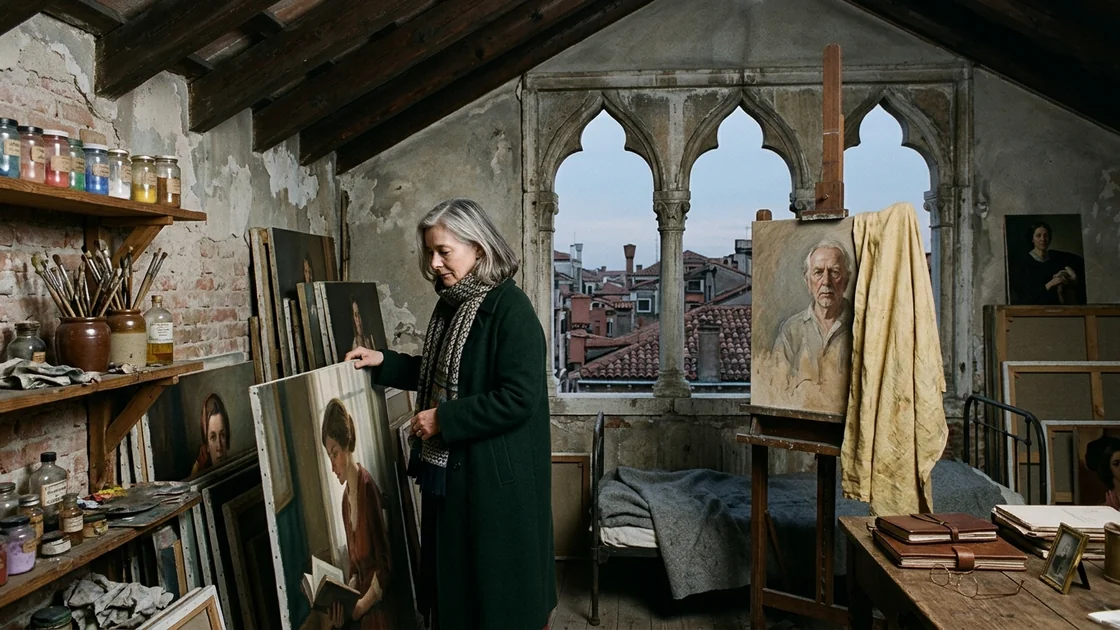
When sixty-two-year-old Elena Vaughan discovers a twenty-year record of secret monthly rent payments among her late husband Julian's estate papers, she leaves her quiet home in Sussex for Venice to confront the hidden life he kept behind the door of an attic studio overlooking a forgotten canal in the San Polo district, only to unearth an unexpected sanctuary where art, memory, and the unspoken fractures of their marriage were quietly preserved in oil and silence.
The solicitors in Lewes occupied a Queen Anne townhouse whose floorboards groaned beneath three centuries of probate and property disputes. Julian had been buried for six weeks, his grave settled beneath the dripping yews of St. Michael’s churchyard, when Arthur Hallowell finally smoothed out the ledger sheets upon his mahogany desk. Outside, a sharp November rain stripped the last russet leaves from the lime trees along the High Street.
"There is, of course, the matter of the Coutts sub-account," Mr. Hallowell said, peering over his half-moon spectacles. His voice had the dry, rustling quality of parchment stored in an attic. "I assumed Julian had discussed it with you, Elena. It has been active since the autumn of 2004."
Elena pulled her wool coat more tightly across her shoulders. The room smelled of wet mackintoshes and central heating that had been turned on too late in the year. "Julian discussed the household accounts," she replied evenly. "He discussed the endowment for the library and the roof repairs for the conservatory. He was an archivist, Arthur. He discussed everything down to the price of brass carpet rods."
"Quite." Hallowell hesitated, his pen hovering above the balance sheet. "This, however, was drawn from his personal discretionary fund—the legacy left to him by his maternal aunt, Lady Beatrice. It did not touch your joint assets. But the instruction was remarkably specific. Six hundred and fifty euros, transferred on the first Tuesday of every month, to an account at the Banca Mediolanum in Venice. The beneficiary is a Signora Francesca Moretti."
The name struck the room like a cold draft beneath an ill-fitted sash. Francesca Moretti. It was musical, Mediterranean, and entirely alien to the life Elena had shared with Julian for thirty-one years in their flint cottage near Ditchling.
"A pension?" Elena asked, though she felt the blood receding from her fingers. "A retainer for archival research? Julian went to Italy occasionally for the Ruskin Society."
"The reference line on the transfer never changed," Hallowell murmured, reading from the printout. "Affitto: Studio Mansarda, Calle del Forno, San Polo. Rent for an attic studio. For two decades, Elena. Over one hundred and fifty thousand pounds in total."
The solicitor did not look up immediately. He allowed the silence to do its cruel work, turning his gaze toward the sodden lime trees outside. In the small, polite circles of Sussex intellectuals, silence was a courtesy extended to those whose lives were quietly disintegrating.
Elena took the paper from his desk. The ink was crisp, black, and definitive. Julian’s signature—that neat, calligraphic script honed by decades of cataloging Victorian illuminated manuscripts—authorized the standing order on September 14, 2004. Two months after her father had died. One month before Julian had taken that long, solitary sabbatical to northern Italy, ostensibly to transcribe John Ruskin’s marginalia in the Marciana Library.
"Did you know about this, Arthur?"
"On my honor, Elena, no," Hallowell said softly. "The mandate was lodged directly with the London branch. We only received the reconciliation upon the formal closing of the estate. If you wish, I can write to the bank and cancel the instruction immediately. Legally, the tenancy agreement—if that is what it is—terminates with his death."
"No," she said. The word was out before she had calculated its weight.
"Elena—"
"Do not cancel it yet." She folded the sheet into quarters, pressing the crease with her thumb until the edge was razor-sharp. "Give me the address. Give me the name of the bank and the landlady."
"You could engage an Italian notary," Hallowell suggested, his brow furrowed with genuine concern. "There is no need for you to subject yourself to... whatever might be there. Men of Julian's temperament sometimes harbor complicated arrangements. If there is another party involved, an emissary might spare you unnecessary distress."
Another party. The phrase hung between them, delicate and obscene. A mistress who had grown middle-aged on his stipends. A child born of some brief, rain-soaked encounter along the Grand Canal, now twenty years old, living in an attic with Julian’s gray eyes and Julian’s silence.
"I am sixty-two years old, Arthur," Elena said, rising from the leather chair. Her knees felt stiff, but her spine remained straight. "I have spent thirty years cataloging the lives of the dead for the county records office. I know how to read an inventory. I would prefer to see the ledger for myself."
Venice in late November was stripped of its carnival gilding. The city lay under a ceiling of white, unmoving mist that smelled of salt brine, rotting sea cabbage, and the sulfurous exhaust of delivery barges.
Elena arrived by water taxi from the airport, refusing the enclosed cabin to stand at the stern, her woolen scarf whipped back by the damp wind. The lagoon was the color of zinc. Wooden mooring poles emerged from the gray water like the forgotten markers of a drowned forest. As the boat turned into the mouth of the Grand Canal, passing the shuttered palazzi whose marble skirts were stained black by centuries of high tides, she felt an unbearable tightness in her ribs.
Julian had loved this place with an intensity that had always faintly alarmed her. When they traveled together—rarely, for Elena suffered from chronic inner-ear vertigo that made long journeys an ordeal—he had walked with a feverish, almost predatory pace, dragging her down blind alleys and across bridges until her ankles throbbed. "Look at the lime wash, El," he would urge, his voice dropping to that hushed, breathless timbre he reserved for church interiors. "Look how the damp eats the brick from behind, leaving only the skin of color. It isn’t decay. It’s an exposure of the bone."
She had smiled and nodded, longing for the tea rooms of Lewes, for the predictable flint hills where the earth stayed where it belonged beneath one’s boots. She had thought him merely romantic. Now, the city felt like an enormous labyrinth designed specifically to swallow twenty years of his truth.
The taxi dropped her at the San Silvestro landing in the San Polo sestiere. The water was high, lapping against the stone riser of the pier, soaking through the soles of her leather walking shoes. Dragging her solitary rolling case over the arched footbridges, she navigated by a map clipped from a guidebook she had bought at Gatwick.
Calle del Forno was not listed in the index. It was an offshoot of an alleyway, scarcely wider than an umbrella, tucked between a shuttered bakery and the moldering wall of an eighteenth-century convent. The air here was colder, trapped between four-story facades where damp laundry hung on sagging wires like surrender flags.
Number 1442 was a narrow doorway framed by Istrian stone, its lintel chipped and darkened with grime. Beside the heavy oak door hung three brass buzzers, their labels oxidized into illegibility, save for the middle one, which bore a small slip of plastic: Moretti.
Elena stood before the door for several minutes. A church bell began to chime five o'clock from somewhere nearby—perhaps the Frari, heavy and bronze, reverberating through her chest. Her breath formed faint, ragged plumes in the freezing mist.
She reached out and pressed the buzzer.
A mechanical rasp answered, followed by a long silence. Then the scratch of an intercom speaker: "Chi è?"
"Signora Moretti?" Elena spoke clearly, using the phrase she had rehearsed for three days. "My name is Elena Vaughan. I am... I was Julian Vaughan’s wife."
The static crackled. For five seconds, ten seconds, there was no sound except the distant thrum of a marine engine out on the canal. Then came the harsh buzz of the electronic latch.
The inner hallway was damp and flagged with uneven slabs of red Verona marble. An elderly woman stood at the top of the first flight of stone stairs, holding a heavy wool cardigan closed at her throat with one liver-spotted hand. Her hair was dyed the harsh, uncompromising black favored by Venetian women of a certain generation, pulled back into a severe comb.
"Signora Vaughan," the woman said. Her English was slow, heavily accented, but clear. She looked Elena up and down, taking in the sensible British raincoat, the silver-streaked hair, the pallor of her mouth. "You are alone."
"Yes," Elena said, stepping onto the bottom stair. "Julian died six weeks ago. Heart failure. It was very sudden."
Signora Moretti did not gasp or cross herself. Her dark eyes, recessed beneath heavy lids, merely darkened further, taking on the opacity of canal water at dusk. "Ah," she said quietly. "The heart. Yes. He always carried it too fast."
She turned and climbed the stairs with a slow, rhythmic shuffle. "Come. I have coffee on the stove. My knees do not like this rain."
Elena followed her up three flights of stairs. The staircase narrowed as they climbed, winding past closed doors behind which she could hear the clatter of cutlery and the blare of an Italian news broadcast. On the third floor, Signora Moretti led her into a small, overheated kitchen that smelled of chicory, old upholstery, and fried onions. A framed print of Padre Pio hung above a Formica-topped table beside an ancient gas range.
"Sit," the woman commanded, gesturing toward a vinyl chair. She poured dark coffee into a tiny porcelain cup without asking and pushed it across the table.
"Did you know?" Elena asked, before the cup had even touched the table. "Did you know he had a wife?"
Signora Moretti sat down heavily, resting her thick forearms on the oilcloth. "Of course I knew. He spoke of you often. Elena. The librarian who loved the chalk downs. He had your photograph on the shelf."
Elena’s hand jerked, slopping black liquid into the saucer. "My photograph?"
"From when you were young. On a bicycle with a basket of apples."
Elena closed her eyes. The photograph had been taken in the autumn of 1994, on their honeymoon in Herefordshire. She had thought the picture lost; Julian had told her years ago that he must have misplaced the negative when they moved house from Oxford to Sussex.
"Signora Moretti, I do not understand," Elena said, her voice shaking despite her efforts to keep it level. "Why was he paying you for twenty years? Was there... is there someone living up there?"
The old woman looked at her with a mixture of pity and dry amusement. "Someone? No. No one lives up there. Only the dust. And the birds on the roof."
"Then why?"
Signora Moretti picked up a metal key from a small dish on the sideboard. It was long, wrought of dark iron, its teeth intricate and worn smooth by years of use. Beside it lay a modern brass Yale key.
"Your husband was a strange man, Signora Vaughan," she said, pushing the keys across the oilcloth toward Elena. "Every year he came for two weeks in November, and one week in March. Sometimes only for three days. He arrived with one small bag. He bought bread, fruit, and turpentine from the shop near San Tomà. He went up the stairs. He did not make noise. Sometimes I heard the radio playing classical music late at night. Sometimes the water pipe would sing when he washed his brushes."
"Brushes?" Elena repeated, the word catching in her throat like a dry crumb.
"The paints," Moretti said, tilting her head. "He did not tell you?"
"Julian was an archivist," Elena said, though the words sounded hollow even to her own ears. "He restored sixteenth-century paper bindings for the university press. He did not paint."
Signora Moretti sighed, a long, rattling breath that seemed to come from the depths of her wool sweater. "Then you should go up, Signora. The attic is the fourth floor, under the rafters. The iron key is for the outer latch. The brass one is for the deadlock. Be careful with the top step. The wood has rotted from the leak in ninety-six."
The final flight of stairs was little more than a steep wooden ladder pinned against the damp plaster of the hallway. At the summit, the ceiling sloped down so sharply that Elena had to lower her head.
The smell hit her before she even turned the key in the lock.
It was not the smell of an adulterous retreat—no stale scent of perfume, no musk of closed bedrooms. It was the sharp, mineral tang of rectified turpentine, cold linseed oil, chalk, and dried animal glue. It was a smell she had not encountered in their Sussex cottage since the very early days of their courtship, when Julian had kept a tiny studio in an outhouse at the bottom of his mother's garden—a studio he had abruptly cleared out and burned the contents of in the winter of 1993, declaring himself a mediocrity who had no right to waste good canvas.
Her hand trembled as she fitted the iron key into the escutcheon. It turned with a dry, grinding click. The modern deadlock gave way smoothly.
Elena pushed the heavy oak door inward.
The studio was large, occupying the entire footprint of the narrow palazzo's attic floor. The roof rafters dipped low on three sides, held aloft by rough-hewn beams of dark larch that smelled of ancient pitch. A magnificent, arched tripartite window—a classic Venetian trifora with pointed Gothic arches—dominated the northern wall, looking out over the tiled rooftops of San Polo toward the distant, gray line of the Cannaregio canal.
The late afternoon light was fading rapidly, casting a cold, pearlescent glow across the room.
There was very little furniture: an iron cot tucked into the lowest corner of the eaves, made up with a military-issue gray wool blanket; a single deal table; two wooden Windsor chairs; and a small cast-iron stove with an exhaust pipe that pierced the roof tiles.
The rest of the room was consumed by work.
Dozens of stretched canvases—scores of them—stood stacked against the plaster walls, three and four deep. Shelves constructed from rough pine boards were crowded with hundreds of glass jars containing powdered pigments: raw umber the color of dry soil, glowing mounds of lapis lazuli, poisonous cinnabar red, bone black, and golden ochre. Bundles of hog-bristle brushes, their hairs stiffened and stained, stood like miniature thickets in earthenware crocks.
On an easel near the northern window sat an unfinished canvas, three feet across, draped in a piece of yellowed linen.
Elena stood frozen on the threshold. Her chest heaved as if she had climbed not four flights of stairs, but a mountain. The stillness was absolute, save for the muffled cry of a gull banking over the tiles outside and the steady drip of condensation somewhere along the guttering.
She stepped forward, her shoes clicking on the wide floorboards of unvarnished larch.
She did not go to the easel first. She went to the table.
Upon it sat a neat row of leather-bound notebooks—identical to the ones Julian had used for his archival records in Lewes. Beside them lay a pair of his reading glasses, identical to the ones currently resting on his bureau in Sussex, their wire frames slightly crooked at the left hinge. Next to the glasses was a small brass oval frame.
Elena picked it up.
It was indeed the photograph of her from Herefordshire: twenty-eight years old, her hair wild from the wind, her sleeves rolled up, laughing over her shoulder as she balanced a basket of Russet apples on the handlebars of her bicycle. Her own youth looked back at her with an innocent, uncomplicated radiance that made her eyes sting with sudden, vicious tears.
Behind the photograph lay a key ring with a small brass tag, on which Julian had scratched a single word: Tolleranza.
"Why?" she whispered into the cold air of the room. "Why here, Julian? Why not at home?"
She moved to the stacks of canvases leaning against the brickwork.
With slow, careful movements, treating them with the professional deference she had used for fragile estate deeds, she turned the first canvas around.
It was a painting of a kitchen window. Outside, through rain-streaked glass, one could see the distinctive outline of the South Downs—the long, whale-backed ridge of Firle Beacon under an iron sky. On the windowsill inside sat a blue earthenware mug containing three dried honesty pods.
Elena gasped. The mug was hers. The window was the scullery window of their cottage in Ditchling.
She turned the next canvas.
It was a portrait of a woman's hands, resting in her lap over an open book. The veins along the knuckles were rendered with a precision that was almost painful in its intimacy; the small scar on the left index finger, where Elena had slipped with a paring knife while peeling quinces twenty years ago, was painted with a single, translucent stroke of vermilion and zinc white.
She turned another. And another.
They were not landscapes of the Grand Canal. There were no gondolas, no gilded domes of the Basilica, no masked figures or romantic vistas of the lagoon.
There were paintings of her.
Elena reading by the green shaded lamp in the study. Elena sleeping on her side, the curve of her hip beneath the white linen sheet described with a tender, agonizing clarity. Elena standing in the hallway at Lewes, her profile silhouetted against the morning mail dropping through the slot.
And interspersed among these domestic visions were paintings of the room itself: the northern window at dawn, the play of gray winter light across the empty boards, the reflections of the canal dancing upon the larch-wood rafters like watery ghosts.
The work was extraordinary. It had nothing of the hesitant, derivative stiffness of the early watercolors Julian had burned in the garden thirty years before. This was mature, ferocious painting—built up in dense, luminous glazes that seemed to hold their own source of light, heavily influenced by Tintoretto’s muscular shadows and the quiet, domestic divinity of Chardin.
Elena sank onto one of the wooden chairs, her gloved hands pressed against her mouth.
He had not come here to escape to another woman. He had not come here to father a secret dynasty or squander his family's money on vice.
He had come here to paint her.
And he had spent twenty years pretending to her that he was nothing more than an archivist who spent his evenings watching television and cataloging the municipal leases of East Sussex.
Night fell over Venice like a drop of ink in water. Elena did not turn on the bare electric bulb that hung from the center beam. Instead, she found a box of wax matches and lit a stub of paraffin candle resting on the sill of the great window.
The chill deepened until she could see her own breath rising in rhythmic white clouds. Her fingers were stiff with cold, but she could not bring herself to leave.
She opened the first of the leather-bound journals.
The handwriting was Julian’s, but it lacked the formal, restrained precision of his Lewes ledgers. Here, the ink was dark, rushed, the letters leaning forward with an urgent, almost violent momentum.
The first entry was dated October 12, 2004:
The light in San Polo is flat today, like wet zinc. It is the light I need. In Sussex, everything is too domestic, too green, too full of the small, reasonable duties of being a husband. If I pick up a brush there, Elena looks at me with that gentle, terrified pity she has had ever since the breakdown in ninety-three. She thinks painting will make me mad again. She thinks every mark on the canvas is a symptom of the fever that nearly destroyed me.
She does not understand that the fever never left. It merely found nowhere to go.
When I am in Lewes, I love her so much that I am afraid of myself. I am afraid of the black temper that comes when the color won't hold, when the perspective lies, when the form refuses to breathe. If I bring that madness into our house, it will eat her up. She is too fragile for my failures. Her father died only three months ago; she needs stone walls and regular trains and a man who does not scream at three in the morning because the yellow ochre has turned to mud.
So I have taken this room under the roof of Francesca Moretti’s palazzo. Six hundred euros a month for the privilege of being a lunatic where no one who loves me can see the wreckage.
I have bought forty yards of Belgian linen and twenty pounds of lead white. God forgive me for the lie. But if I do not do this, I will drown in her quietness.
Elena let the journal fall against her knees.
A tear slipped from her lash, cold against her wind-burned cheek.
The breakdown in ninety-three.
She remembered it with an awful, crystalline precision. They had been married only two years. Julian had been working toward an exhibition at an obscure gallery in Cork Street. He had stopped sleeping; he had stopped eating; his weight had dropped until his collarbones jutted from his shirts like knife edges. One morning in November, she had gone out to the garden shed to bring him a pot of tea and found him sitting on the dirt floor, sobbing hysterically amidst the slashed remnants of twenty-four canvases, his hands bloody from the palette knife he had used to gut them.
He had spent six weeks in a clinic near Haywards Heath. When he came home, pale and sedated, he had gathered every tube of paint, every easel, every sketchbook, and carried them to the bonfire at the end of the vegetable plot.
"I am done with it, Elena," he had told her, kneeling by the smoke, his voice dead and dry. "It's an infection. I am an archivist. I am a man of paper and glue. I will not put you through this again."
She had held his head against her breast, weeping with relief. She had thought she was saving him. She had spent the next thirty years guarding his quietness—smoothing out the rough edges of their daily life, keeping their domestic routine as steady and unruffled as a pond, shielding him from stress, from excitement, from anything that might ignite the dry timber of his mind.
She had built him a prison of gentle kindness. And he had rented an attic in Venice to break out of it.
Elena stood and walked to the easel.
Her fingers found the hem of the yellowed linen cloth that covered the unfinished canvas. Slowly, with the care of a priest lifting a shroud, she drew it away.
It was a self-portrait.
Julian was sitting in the very chair she had just occupied, illuminated by the northern light of the trifora. But he was old—he had painted himself as he was only months ago, his hair silver-white, the skin beneath his eyes bagged with exhaustion, his shoulders slightly hunched.
He was looking out of the frame, directly at the viewer. His expression was not one of pride or mastery; it was a gaze of terrifying, unvarnished confession. In his right hand, he held a brush poised over an empty patch of raw linen on a painted easel within the painting.
And behind him, floating in the dark umber background of the studio, was the ghostly, faint outline of Elena herself, rendered not as a photograph, but as a presence—a wash of pale gold and cerulean blue that seemed to envelop his shoulders like an aura.
In the bottom right corner, scratched into the wet paint with the wood of his brush handle, were two dates:
1994 – 2024.
It was completed up to the hands. The fingers holding the brush were only blocked out in burnt sienna ground. He had run out of time. His heart, that unreliable muscle Signora Moretti had spoken of, had given out in the garden at Ditchling while he was raking the autumn leaves, three weeks before he was due to catch his flight back to Venice.
Elena stood before the canvas until the candle guttered, flickered, and drowned in its own melted tallow, leaving her in the cold, blue gloom of the Venetian night.
She did not return to the hotel by the Rialto where she had booked a room. She slept on the iron cot in the studio, wrapped in her winter coat and the coarse wool blanket that smelled of him.
The night was full of the sounds of the water: the slap of waves against the foundations of the palazzo four stories below, the distant horn of the night vaporetto rounding the bend toward Ca' Foscari, the sudden clatter of rain upon the roof tiles.
For the first time in thirty years, she felt Julian’s presence not as the quiet, slightly apologetic companion of her domestic life, but as an enormous, towering entity whose true dimensions she had never known.
She woke at dawn. The light that entered through the arched window was the light he had written of: flat, silver-gray, an unsparing northern glow that revealed every crack in the lime plaster, every fleck of dust dancing in the cold air.
She rose, her joints aching with the damp, and descended the ladder stairs to the third floor.
Signora Moretti’s door opened before Elena had reached the landing. The old woman was dressed in a clean apron, holding two warm brioches in a paper bag.
"You stayed," Moretti said, nodding once, as if a test had been passed.
"I stayed," Elena said. "May I use your stove? I would like to make tea."
They sat together at the Formica table while the water boiled in an old tin kettle.
"Tell me about his visits," Elena said.
Signora Moretti set down the bread. "He was not happy when he arrived, Signora. Never. He would come from the airport looking like a man who was running from an executioner. His face was gray. He would carry that small suitcase up the stairs and he would not come down for two days."
"And when he left?"
"When he left, he was... light," the old woman said, gesturing with her fingers like a bird taking flight. "His shoulders were down. He would sit in my kitchen and drink a glass of grappa with me. He would show me pictures of your garden in Sussex. He told me about the roses you planted by the wall. He said you were the finest woman in England."
Elena felt a sharp, bitter lump in her throat. "Then why could he not tell me?"
Moretti looked at her with the ancient, unsparing practicality of the Venetian poor. "Because men are cowards, Signora. And because they believe that if they show a woman their hunger, she will be frightened by it. He thought his painting was a sickness. He told me once: 'Francesca, if Elena sees what I do here, she will think I have betrayed our peace.' He valued your peace more than his honesty."
"That was not his choice to make," Elena said fiercely.
"No," Moretti agreed softly. "It was not. But he made it anyway. For twenty years."
She stood up and went to a drawer beneath the dresser, taking out a small stack of receipts and a bank book.
"There is something else," Moretti said. "Two years ago, your husband brought a lawyer here. An avvocato from Dorsoduro. He made a paper."
"What paper?"
"The studio does not belong to me, Signora. My family owned the building, but during the crisis after the flood of 2018, I could not pay the roof tax. Julian bought the top floor from me. He paid the repair of the beams. The rent he sent every month—it was not for the room. It was my pension. He called it rent so I would not feel like a beggar."
Elena stared at the older woman. The tea sat untouched between them, cooling into an amber film.
"He owned the attic?"
"It is in your name now," Moretti said simply. "The avvocato has the papers. Julian registered the deed in the name of Elena Mary Vaughan in 2021. He said: 'When I die, Francesca, she will come. Give her the keys and let her see what I made.'"
Elena spent five days in the studio.
She went down into the alleys of San Polo only to buy bread, hard cheese, and oil for the cast-iron stove. She bought a paraffin heater from an ironmonger near the Campo San Polo and lugged it up the stairs herself, refusing the help of the boy who ran the delivery cart.
She bought firewood from a coal merchant on the Rio Marin, carrying the split logs in heavy canvas sacks until her palms were blistered and her coat was black with soot.
She lit the stove. The iron groaned and ticked as it took the heat, filling the attic with the dry, comforting smell of burning pine.
Then, methodically, she began the inventory.
She had spent her entire working life creating indexes of manor records, tithe maps, and parish registers. She brought that same relentless, dispassionate order to Julian’s secret life.
She took one of his clean notebooks and sat at the deal table with a fountain pen.
Item 1: Canvas, oil on linen, 60 x 80 cm. Portrait of E.V. reading in the garden, circa 2006. Heavy application of Naples yellow and raw umber. Condition: sound.
Item 2: Canvas, oil on board, 40 x 50 cm. Interior of the studio, looking out toward Cannaregio under snow. March 2008. Signed on reverse: J.V.
Item 3: Twelve preliminary sketches in red chalk. Studies of E.V.'s hands holding garden twine.
She worked for hours, moving from stack to stack. As she handled the canvases, the initial sting of betrayal began to change its chemical nature, shifting into something stranger and more profound.
She was seeing herself through the eyes of a man who had observed her with the ferocious, devotional attention of a medieval monk. Every small domestic gesture she had performed in their thirty years together—gestures she had thought invisible, lost to the drift of ordinary days—had been captured here, preserved in oil, analyzed with an intensity that bordered on adoration.
He had painted her when she had been ill with pneumonia in 2011: the hollow of her collarbone, the dry skin of her lips, the pale, exhausted tilt of her neck against the pillows.
He had painted her when she was joyful: laughing across a picnic blanket on the South Downs, her hair tangled with wind-blown clover.
He had painted her as she aged. He had not softened the lines around her eyes; he had not concealed the slackening of the throat or the graying of her temples. He had painted those changes with a kind of holy wonder, as if the physical record of their time together was the only scripture he believed in.
And between the portraits of her were the journals.
She read them by the light of the paraffin heater, wrapped in the wool blanket as the bells of Venice marked the passing hours.
March 18, 2012:
Elena thinks I am at the Marciana checking references for the Ruskin monograph. I spent four hours today trying to get the turn of her ankle right in the large study. My hand was shaking so badly I had to tie the brush to my finger with a piece of string. The fear came back—that cold, oily panic that I will never reach it, that I am only smearing mud on linen.
I wanted to throw the canvas from the window into the canal. I wanted to hear it splash.
Then I thought of how she walked down to the mailbox this morning in Sussex, carrying her green umbrella, taking small, deliberate steps so as not to slip on the gravel. The sanity of her. The quiet grace with which she meets the day. If I can put that grace onto this cloth, even five percent of it, my life will have been something more than a clerk's ledger.
October 29, 2016:
The knee is bad now. Climbing the ladder to the mansarda takes twenty minutes. Francesca heard me groaning on the landing and brought up an ointment made of lard and rosemary. We laughed like two old crows.
I painted the window again today. The water was emerald green from the algae. I realized that for twenty-two years I have been painting two things only: the light that comes into this room, and the woman who stays in that house.
They are the same thing. The room is where I burn; the house is where I live.
If she finds this when I am gone, will she hate me for the lie? Or will she understand that I lied to keep the fire from burning down the walls that sheltered her?
On the fourth afternoon, the weather broke.
A sharp wind blew in from the Dolomites, sweeping the gray mist out into the Adriatic and leaving the sky a vast, transparent bowl of cold, cobalt blue.
The light that struck through the tripartite window of the studio was blinding. It hit the stacked canvases, setting the pigments ablaze—the cinnabar glowed like hot coals; the lapis lazuli looked as deep as the sea beyond the Lido; the raw umbers took on the warmth of sun-baked earth.
Elena stood in the center of the attic, her breath caught in her throat.
The room was not a place of shame. It was a cathedral.
She heard a heavy step on the ladder stairs. Signora Moretti appeared through the trapdoor, carrying a basket covered with a checked towel.
"The lawyer is downstairs," Moretti said, pausing to catch her breath on the top rung. "Signor Busetto. He has the inventory documents from the city registry. He asked if you are ready to sign the transfer."
Elena did not turn away from the northern window. Through its arches, the terracotta roofs of Venice stretched out toward the blue lagoon like the scales of an enormous, sleeping dragon.
"What would happen to this room if I sold it, Francesca?"
The old woman stepped off the ladder and came to stand beside her, her small, dark eyes reflecting the sharp winter light. "A German would buy it. Or an American. They would paint the beams white. They would put in a glass shower and an air conditioner. They would rent it on the internet to tourists who stay for three days and leave their plastic bottles in the well."
"And the paintings?"
"There are dealers in Milan," Moretti said softly. "Busetto knows them. Julian was not unknown in London before he stopped. If they know he worked in secret for thirty years... they would make a big exhibition. Much noise. Much money."
Elena looked down at her hands. The skin was rough from the firewood, stained with faint smears of soot and raw umber from the canvases she had shifted.
She thought of the cottage in Sussex: the quiet rooms, the ticking grandfather clock in the hall, the garden where Julian had raked the leaves until his heart had stopped. She thought of the thirty years she had spent protecting him from his own soul, believing that safety was the highest form of devotion.
She had been wrong. Safety was merely an agreement to survive.
He had paid her the terrible, magnificent compliment of hiding his madness so that she could live in peace, while pouring the entirety of his life’s blood into a secret monument to her existence.
"Tell Signor Busetto to wait," Elena said.
"Signora?"
Elena walked to the deal table. She picked up Julian’s wire-rimmed glasses, folded them carefully, and placed them into the leather case he had carried in his pocket.
Then she picked up the unfinished self-portrait and set it back upon the easel.
"The paintings will not go to Milan," she said, her voice steady and clear in the cold, bright room. "And this floor will not be sold to tourists."
She turned to Francesca Moretti.
"Julian left the studio to me. Can we establish an archival foundation here? A place for young painters from the academy—one at a time, for six months? They can sleep on the cot. They can use the northern light. They can paint without having to prove their sanity to anyone."
The old woman looked at her for a long moment. A slow, rare smile cracked the leathered skin of her cheeks, revealing two gold teeth at the corner of her mouth.
"And his work?" Moretti asked.
Elena reached out and touched the raw edge of the linen on the easel, where Julian’s brush had stopped just short of finishing his own hand.
"His work stays here," she said. "On these walls. So that whoever comes up that ladder will know what it costs to love something enough to hide it."
Three days later, Elena stood on the stone riser of the San Silvestro pier, waiting for the water taxi that would carry her back to the airport.
The rain had returned, but it was no longer the heavy, suffocating mist of her arrival. It was a light, silver drizzle that dimpled the surface of the Grand Canal, turning the reflections of the palazzi into wavering ribbons of ochre and rose.
In her leather handbag, she carried the brass key tagged Tolleranza and the first volume of Julian’s Venetian journals. The rest of the notebooks were locked in the cedar trunk in the studio, along with his brushes and his pigments, waiting for the spring.
She had signed the papers in Signor Busetto's office that morning. The Fondazione Vaughan was established. Signora Moretti was appointed its lifetime custodian, with a salary that would ensure she never had to worry about the roof tax again. The first scholar—a quiet girl from Bologna who painted portraits on discarded panels of packing crates—would arrive in February.
Elena looked back across the rooftops toward San Polo.
She could not see the tripartite window from here; it was hidden behind the bulk of the church of San Cassiano. But she could see the smoke rising from the cast-iron stove’s slender pipe, climbing thin and straight into the wet Venetian air.
She remembered the final entry in the journal she had placed in her bag—written only three days before Julian had boarded his last flight back to Gatwick:
I am leaving tomorrow. The light is turning to winter. Elena wrote that the Bramley apples have fallen in the orchard and need gathering before the frost.
I am coming home to her. I will put on my tweed jacket and my clean boots, and I will carry the baskets into the shed. I will be the man she needs me to be.
But if you are reading this, my girl—if you have finally climbed the stairs and opened the door—look at the wall by the window. That is where I kept you while I was away. That is where you will always be, younger than the light, and more enduring than the stone.
The water taxi pulled alongside the pier, its diesel engine throbbing beneath the floorboards. The driver, an athletic young man in a yellow slicker, jumped ashore and reached out a hand to assist her.
"Going to the airport, Signora?" he asked in English.
"Yes," Elena said, stepping onto the wooden gunwale with a balance that surprised her. Her inner-ear vertigo, which had haunted her for thirty years, was entirely gone. "To London. But only for the winter."
She sat at the stern as the boat backed away from the stone wall, churning the canal into a froth of green and white. The city began to slide past—the shuttered windows, the water gates green with slime, the ancient Istrian arches holding up their impossible burdens of marble and brick.
Elena did not look away. She sat upright in the damp wind, watching the salt water rise and fall against the stone, her hand resting quietly upon the leather bag in her lap, carrying his secrets back into the world not as a burden of betrayal, but as a weight she had finally learned how to hold.