The Stitches of Marrow Cove
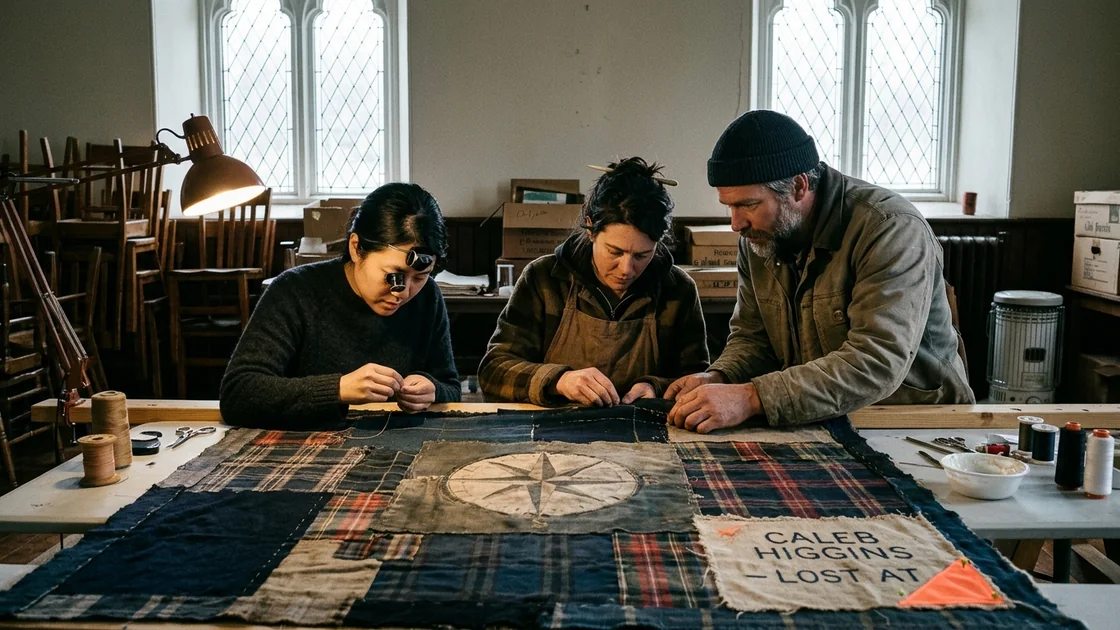
Three childhood friends who drifted apart in the wake of a coastal tragedy return to their windswept hometown of Marrow Cove, Nova Scotia, where the impending bicentennial festival demands the restoration of a two-hundred-year-old community quilt. Over fourteen days in a drafty church basement, Maeve Higgins, Finian Wallace, and Nora Chen-Leblanc must confront the decayed silk, waterlogged wool, and frayed seams of an artifact that charts their ancestors' survival against the North Atlantic. As needles pass through antique sailcloth and tea-stained muslin, the unresolved grievances of their youth, the weight of rural abandonment, and the ghost of a lost fisherman emerge from the dark backing of the textile. Through meticulous stitches and painful honesty, they discover that mending an inheritance requires not only preserving its fragile history, but allowing the tears in their own lives to be joined anew.
Chapter One: The Salt in the Attic
The wind off the Cabot Strait did not blow through Marrow Cove so much as it inhabited it, leaning against the cedar shingles of the fish stores and scouring the salt-white paint from the trim of St. Jude’s by the Sea until the boards wept red iron from their square-headed nails. It was a cold wind even in late June, smelling of bladderwrack, low tide, and diesel exhaust from the lobster boats idling at the government wharf.
Maeve Higgins climbed the pull-down stairs into the attic of the town hall with a flashlight wedged between her teeth and a pair of dry-cleaned cotton gloves tucked into her back pocket. The hatch smelled of bat droppings, dried balsam fir from three Christmases past, and the peculiar, vinegar tang of decomposing cellulose.
"Mind the third joist, Maeve," shouted Angus MacAulay from the foot of the ladder. His voice was sixty years of Benson & Hedges and sixty winters of hauling traps off the eastern shoals. "The roofers didn't sister that timber back in ninety-eight. Put your boot through there and you’ll drop right onto the council table while they’re debating the parking bylaw."
"I know where the joists are, Angus," Maeve called down, spitting the metal barrel of the flashlight into her hand. "I’ve been stepping over them since before you had the second bypass."
She clicked the light on. The beam cut through a suspended galaxy of insulation dust and wool lint.
There, beneath the eaves where the dormer leaked every time a southeaster blew the surf over the breakwater, sat the pine sea-chest. It was four feet long, bound in hand-forged strap iron that had rusted into velvety cakes of orange oxide. The lock was missing, replaced long ago by an oiled cedar peg shoved through the hasp.
Maeve knelt on a square of plywood. Her knees made a sound like dried kelp popping underfoot. At thirty-six, she already carried the damp ache of the Atlantic in her patellas, a gift from her mother’s people, who had salted cod in the outports before Newfoundland joined the Dominion. She drew the gloves over her hands, the knit white cotton snug against her short, unvarnished nails, and pulled the cedar peg.
The lid groaned. When it tipped back against the hemlock rafters, the smell that rose was not must alone, but something heavier, more ancient: sheep’s suet, bog-myrtle dye, woodsmoke from long-extinct hearths, and the unmistakable, oily iodine of raw sea-island fleece.
The Bicentennial Quilt lay beneath a sheet of yellowed butcher paper that had stuck to the outer borders like dry skin.
Maeve lifted the paper with a surgeon’s breath.
"Well, damn it all to hell," she whispered.
The center medallion was intact—a bold, geometric compass rose cut from the indigo-dyed wool of an officer’s coat salvaged from an 1824 wreck off the Ragged Islands. But the northeastern quadrant, where the historic families had stitched their panels during the Victorian jubilee of 1897, was drowned. A brown watermark, rimmed with the pale green fur of Aspergillus glaucus, had crept across five square feet of embroidery. The silk floss of the Chen family’s merchant brig had rotted into gray hairs; the Wallace clan’s red tartan had bled into the adjacent white linen ground like fresh venous blood; and the Higgins square—a rough, unbleached flour sack embroidered by Maeve’s great-grandmother with the names of six drowned brothers—was cockled and split down its grain line.
Angus’s heavy boots creaked below. "Is it there, Maeve? The mayor’s got the woman from the Halifax newspaper coming on Tuesday. He wants it hung behind the fiddlers on the main stage."
Maeve touched the border. The wool was brittle as communion wafers. If they tried to lift it by its edges, the whole northern coast of the town’s memory would shear away under its own dead weight.
"Tell the mayor," Maeve said, leaning over the hatch so her voice dropped down into the warm, fluorescent glare of the town office, "that if he touches this with bare hands, he’ll have two hundred years of dead fishermen falling into his soup. It’s rotting, Angus. It’s half-drowned."
A silence followed, broken only by the hum of the soft-drink machine in the entryway.
"Can you fix it?" Angus asked.
Maeve looked down at her gloved fingers resting on the torn flour sack. Her thumb found the corner where her brother Cal’s name had been added to the margin in 2011, thirty years after the last major border had been completed, worked in crooked, hurried split-stitch with thread bought from the pharmacy rack.
"No," Maeve said, her throat tightening against the dust. "Not by myself. I can’t."
She descended the ladder, pulled off her gloves, and took her phone from her mackinaw pocket. She had two numbers saved under names she had not dialed since the November the sea took the Margaret H., twelve years ago come autumn.
Chapter Two: Arrival at Low Tide
The regional bus from Halifax did not come all the way down the neck to Marrow Cove; it dropped its passengers at the highway junction beside an abandoned Irving station whose sign had been stripped to an empty yellow shell.
Nora Chen-Leblanc stood beside her two aluminum Rimowa cases on the shoulder of Route 3, watching the fog roll across the scrub spruce. Her trench coat was tailored, charcoal-grey wool that she had bought during her residency at the Victoria and Albert Museum, and it was entirely useless against the salt mizzle that came off the bay like atomized grease. Her shoes—calfskin loafers she had forgotten were leather-soled—had already absorbed a skin of ditch water.
A horn sounded three sharp, impatient barks.
An ancient Ford F-150, its wheel wells framed in pop-riveted sheet metal and black asphalt sealer, rattled around the turn from the cove. It pulled up with a shriek of ungreased brake pads, the passenger door swinging open on its hinge with a metallic pop.
Finian Wallace looked across the cab. His beard was trimmed close, silvered at the chin in a way that seemed less like aging and more like salt-spray that wouldn't brush out. He wore a dark navy knit cap rolled above his ears and a faded canvas work jacket with grease stains across the belly.
"You’re thirty minutes late, Nora," he said. His voice was lower than she remembered, scraped raw by years of working shipyards in Saint John and the south shore.
"The bus had an oil leak in Musquodoboit," Nora said. She picked up her cases, their hard shells gleaming absurdly against the crushed granite of the shoulder, and swung them into the bed of the truck among spare fan belts, a bucket of hydraulic oil, and two coiled lobster ropes. "You haven’t changed the shocks on this wagon since we were nineteen, Finn."
"Shocks cost money that isn't made on herring," he said as she climbed into the passenger seat. The interior smelled of spruce gum, wet dog, and tobacco, though there was no dog and Finn hadn't smoked since high school. "Maeve’s at the vestry. She’s already hauled it down."
Nora pulled her door shut with a heavy slam. The latch didn't take until the third attempt. "Did she tell you what condition it’s in?"
"She said it looked like something the gulls fought over behind the fish plant." Finn shifted into second, the transmission grinding in its gate. "She sounded like she wanted to shoot me for answering the phone."
"She didn't want to call us," Nora said, staring out through the sweep of the single functional wiper blade. The landscape was widening as they dropped down the neck: gray granite outcrops covered in reindeer moss, salt marshes cut by black tidal creeks, and then the harbor itself, a leaden sheet enclosed by two arms of spruce-covered rock that held twenty white-and-red dories swinging at their moorings like tethered geese. "She had no choice. There isn't another textile conservator within three hundred miles of this point, and you’re the only person who knows how to build an expandable tension frame without splitting century-old ash."
"Don't flatter me, Nora," Finn said softly. He didn't look at her; his eyes were fixed on the narrow asphalt, where the frost-heaves made the truck leap like a dory on a short sea. "You came back because your exhibition in Montreal fell through. Don't pretend you were on a mercy mission."
Nora’s fingers tightened on the strap of her handbag. Her knuckles went ivory. "My gallery closed, Finian. There is a distinction."
"Aye," he said. "The distinction is you had somewhere else to go until you didn't. Maeve stayed. I stayed—until I went to the yard. You’re the one who cleared out before the wreaths had even rotted on the water."
"Cal wasn't your brother," Nora hissed.
"No," Finn said, his jaw tightening until the muscle bulged like an acorn under his skin. "He was my partner on the deck. Which means I’m the one who should have had the gaff in my hand instead of the winch control when the swell caught him."
They reached the foot of the hill where the harbor road met the gravel apron of St. Jude’s. The church was an 1870s Gothic Revival barn of spruce and cedar, its spire tipped with an iron codfish instead of a weathercock. Behind it, the graveyard sloped directly down to the high-tide line, where the gray slate headstones were so worn by salt-wind that half of them looked like teeth rising from the fescue.
Maeve was waiting on the vestry steps. She had her sleeves rolled to the elbows, revealing forearms corded like a rower's from years of hefting bolts of heavy duck canvas and dry goods at the shop she’d taken over from her father. Her hair, thick and dark as peat, was dragged back into a knot secured with a carved bone bodkin.
She watched the truck stop. She did not wave. She stood with her arms crossed over a brown linen apron, watching them through the light rain like a customs officer waiting for an unregistered cargo.
"You took your time," she said as Finn killed the engine.
"Nora had matching luggage," Finn said, stepping out into the mud.
Nora climbed down, her loafers sinking two inches into the rain-soaked gravel. She looked at Maeve; Maeve looked back. For a second, the twelve years between the present afternoon and the cold, tea-dark parlor where they had sat together after Cal’s memorial service seemed to evaporate, leaving only the raw smell of cut chrysanthemums and damp wool.
"Nora," Maeve said.
"Maeve."
"The water got to the 1897 panels," Maeve said, turning her back on them and pushing the vestry door open with her hip. "The iron gall ink on the roster ribbon has eaten through the linen, and the back-cloth is rotten with mildew. If we don't have it flat and stabilized by the tenth, the whole thing will shear when they hoist it. Take your boots off in the porch. I scrubbed the boards this morning."
Chapter Two: The Anatomy of a Relic
The vestry of St. Jude’s smelled of paraffin floor wax, old Sunday school hymnals, and the sweet, resinous scent of unvented kerosene heaters. Maeve had cleared three long trestle tables, usually reserved for the annual parish bake sale and the fall turkey supper, and pushed them together in the center of the hall.
On top of them lay the quilt.
It was nine feet square. In the cool, flat light from the high church windows, it looked less like a blanket and more like an aerial map of a kingdom that had sunk beneath the sea.
The foundation was coarse, hand-loomed flax—grown, retted, and spun in the settlement's first decade by women who had lived through the winter of 1824 on dried pollock and potatoes boiled in seawater. Onto this ground, successive generations had sewn their pieces, not in the orderly, decorative patterns of the Pennsylvania Dutch or the Baltimore album quilts, but in the rough, practical manner of the North Atlantic coast: log-cabin blocks made from coats whose owners had died; crazy-quilt patches of silk brought home from the West Indies trade; thick, dense squares of hooked wool showing gannets, dories, capelin, and anchor flukes.
Nora approached the table slowly, her professional detachment dropping over her face like an archivist’s veil. She reached into her pocket, pulled out a jeweler’s loupe, and screwed it into her eye socket.
"It’s not just Aspergillus," she murmured, leaning within three inches of the Victorian border. "The iron mordant in the black silk has oxidized. It’s acid-burned the surrounding ground. Look here—the threads haven't snapped; they’ve disintegrated. It’s turned to soot."
"Can it be stabilized?" Finn asked. He stood six feet back, his broad hands hanging loose at his sides, looking at the quilt with an uneasy mixture of reverence and suspicion. To him, old things were either seaworthy or they were kindling; there was rarely a middle ground.
"Stabilized? Yes," Nora said, her fingers hovering a millimeter above a patch of purple velvet that had faded to the color of wet sand. "Replaced? No. We don't have the materials. You can’t buy 1890s Lyons silk at a dry goods shop in Bridgewater."
"We don't replace it," Maeve said sharply. She was leaning against the table’s edge, a bone-handled seam ripper balanced between her fingers. "The town didn't ask for a new quilt. They asked for this one. Every scrap in that border belonged to somebody who lived between the gut and the headland. That purple velvet was part of Martha LeBlanc’s wedding dress. She lost four sons in the August Gale of twenty-seven. You don't throw Martha LeBlanc in the rag-bag because her silk’s gone soft."
"Maeve, conservation isn't about sentiment," Nora said, her voice dropping into the cool, measured cadence she used with museum boards. "If the fiber has lost its tensile strength, it cannot bear tension. If we stitch new thread through that velvet, the new thread will simply act as a cheese-wire. It will cut the old cloth to ribbons the moment Angus hoists it up the hall wall."
"Then we couch it," Maeve countered, stepping forward until she was across the table from Nora, the two of them separated by five feet of faded maritime history. "We lay it down on new linen backing and we couch over it with fine silk thread, four stitches to the inch, zigzagged across the grain. It stays where it was put. It holds its place."
Nora took the loupe from her eye. "Couching nine square feet of rotten silk and cockled wool will take two hundred hours of hand sewing. There are three of us. The festival is in thirteen days."
"Then Finian better get the frame built before sundown," Maeve said, not looking at Finn. "And you better remember how to hold a needle without a gallery assistant threading it for you."
Finn sighed, a heavy, rattling breath that set the papers on the side table fluttering. "Where's the timber, Maeve?"
"In the woodshed behind the rectory," she said. "Four lengths of clear three-inch white pine, kiln-dried, that my dad put away twenty years ago for dory gunnels. And the old wooden screw-clamps from the cooperage. If you can make a four-way expansion frame with mortise-and-tenon corners, we can stretch the ground without piercing the selvedge."
"White pine isn't ash," Finn said, turning toward the door. "It'll bow if the humidity rises."
"Then you’ll bridge it with spruce struts, won't you?" Maeve’s eyes didn't leave Nora’s face. "You were always good at reinforcing things after they started to crack."
Finn paused at the porch door. His back was to them, a broad wall of navy wool. "Some things crack because the timber was green when it was framed, Maeve. Not because the carpenter was lazy."
The door clicked shut behind him.
The two women remained in the quiet room. Outside, the rain had turned into a steady, gray fog that pressed against the high diamond panes of the church windows, blurring the spruce trees and the slate crosses into soft smudges of India ink.
"He looks tired," Nora said quietly.
"He looks like a man who works sixty hours a week in a dry dock and drinks his tea out of a tin mug," Maeve said. She picked up a bundle of unbleached Irish linen she had ordered from Montreal three weeks before. "He looks like everyone else who stayed on this coast."
"I stayed for five years after, Maeve."
"You stayed until you got the grant to Paris," Maeve said. Her voice wasn't angry; it had the flat, stony certainty of a tidal ledge. "And then you came back for two weeks in the summer, took pictures of the drying flakes and the lobster traps for your modern collages, and left again before the mackerel run. Don't talk to me about staying, Nora. Staying isn't something you do between plane tickets."
She threw the bolt of linen onto the center table. The heavy, raw fabric rolled out with a dull thud, covering the worst of the watermarks like snow falling over an open grave.
"Let’s get the vacuum on it," Maeve said, reaching for a soft-bristled sable brush. "Before the mold spores wake up in the heat."
Chapter Three: The Flannel Square
By three o'clock the next afternoon, the vestry had been transformed into a workshop that smelled of cedar shavings, damp wool, and the sharp, medicinal vapor of ethanol.
Finn had set up his sawhorses in the porch. The rhythmic snick-shuck of his wooden smoothing plane was the heartbeat of the hall, punctuated by the dull tap of his mallet on a mortise chisel. He had found the pine dry and straight, though twenty years in the rectory shed had left it with a case-hardened skin that took the edge off his irons every twenty minutes.
Inside, Nora and Maeve worked on opposite sides of the trestle table.
Nora had rigged an articulated lamp with a daylight bulb to the back of a church chair, its stark white glare illuminating the minute geography of the quilt’s central rosette. With a micro-suction nozzle shielded by fine nylon mesh, she was lifting eighty years of coal soot and skin cells from the 1860s panels.
"This red," Nora said, her voice small under the hum of the pump. "It’s not madder."
Maeve looked up from her bench, where she was pinning washed muslin to the underside of the frame with stainless-steel insect pins. "It’s cochineal. Captain Elisha Wallace brought it back from Pernambuco in sixty-three. He traded four barrels of salt pollock for a sack of dried bugs the size of bird-shot. His sister dyed the yarn in an iron kettle behind the fish house."
Nora touched the fiber with the tip of her tweezers. "The color hasn't shifted an octave. It’s still pure carmine. It has that cold, bluish undertone you only get from the female insects."
"His sister was seventeen," Maeve said. "She died that next spring of the lung rot. Her name was Keziah. If you look at the corner of the square, she worked her initials in hair-work. Her own hair. Red hair."
Nora adjusted her loupe. There, in the tight corner where the red log joined a strip of gray pilot-cloth, was a tiny, coiled letter K, no larger than an apple seed, stitched from five strands of coarse, copper-colored human hair.
"It’s beautiful," Nora whispered.
"It’s not beautiful," Maeve said, shoving a pin through three layers of cloth with an audible pop. "It was what she had. People in Marrow Cove didn't make things to be beautiful, Nora. They made them because they were cold, or because they had twenty yards of skirt left over from a woman who was three months in the ground and couldn't wear it no more."
"You can do both," Nora said. "You can keep warm and still care about the balance of the red against the grey."
"Maybe if you have the time," Maeve said.
Finn came in from the porch, carrying the first of the four frame members. It was eight feet of white pine, two-by-four inches, planed so smooth its grain had the waxy sheen of pork fat. At each end, a double tenon was cut with crisp, hand-sawn shoulders.
"The wood's good," he said, setting the timber on the floor. He wiped his brow with the cuff of his sweater, leaving a smudge of white pine dust across his temple. "No twist in it. If we peg it with dry birch dowels, it’ll hold three hundred pounds of tension without racking."
He walked over to the table and looked down at the section Nora was working on. His eye, trained on the fair curves of boat hulls and the structural joinery of engine beds, traveled across the irregular grid of the patches.
"That's my great-grandfather's patch," he said, pointing a blunt finger with a purple nail bed—the mark of an old hammer blow—at a square of coarse, heavy wool that had faded to the color of wet slate.
"The pilot-cloth?" Nora asked.
"Aye. From the coat he wore when the Vesper broke her back on the Sisters. He was three days on the rock with two other men. They ate raw limpets and drank the water that collected in the hollows of the granite. When the schooner from Port Mouton took them off, his coat was frozen so stiff they had to cut it off him with a gutting knife to get him into the stove-room."
Finn reached down, his thumb hovering over the rough nap of the wool, but he didn't touch it. His finger dropped back to his side.
"He wouldn't wear another coat like that," Finn said. "He gave the pieces to his mother. Said he didn't want nothing on his shoulders that smelled like salt when it got wet."
"He was Cal's great-grandfather, too," Maeve said from her corner. Her voice was flat, level, dangerous.
Finn didn't move. "I know whose grandfather he was, Maeve."
"Do you?" Maeve set her seam ripper down on the bare wood. The metal gave a small clink. "Because Cal remembered. When the Margaret H. lost her rudder in that gale, Cal didn't jump into the liferaft first. He stayed by the wheelhouse trying to get the sea-anchor over the bow so the stern wouldn't broach. Because he was a Higgins, and a Higgins stays with the boat until the deck goes under."
"Maeve," Nora said, her voice tight. "Don't."
"No, let her speak," Finn said. He turned to face Maeve, his shoulders hunching slightly under his work jacket, like a man bracing himself to take the weight of a falling spar. "She’s been saying it into her apron for twelve years. She might as well say it to my face."
"You were on the throttle, Finn," Maeve said. She didn't raise her voice; she didn't need to. The small, bare vestry held the words like an echo chamber. "You were thirty feet from him. You had the survival suit on. Cal was still in his oilskins because he’d given the second suit to the boy—to young Dougie, who wasn't sixteen years old and hadn't been past the whistle buoy before."
"I told him to get into the dory," Finn said. His voice was cracked, dry as pine shavings. "I screamed at him until my lungs were bleeding, Maeve. The painter parted. The dory was gone before I could get a line to it. If I hadn't hit the throttle when the breaker came over the house, the boat would have rolled over both of us right there on the bar."
"And you lived," Maeve said. "And Cal’s name is on that flour sack in the corner, written in six-strand embroidery cotton I bought at the Rexall in Lunenburg because we didn't even have an official town record to cut a patch from."
Finn looked down at the quilt. His eyes settled on the unbleached flour sack in the lower right quadrant. The cloth was coarse, printed with the faint, faded red circle of the Purity Flour trademark, and across it, in dark blue thread that had begun to rot from the salt air, were the words:
CALEB HIGGINS — LOST AT THE WHITE ISLANDS — NOV 12, 2011 — AGED 24 YRS.
The stitches were uneven, heavy-handed, the work of someone whose fingers were trembling or unused to fine work.
"I built his coffin, Maeve," Finn said softly. "There wasn't nothing to put in it but his spare boots and a bible, but I planed every board of that pine by hand in my father’s shed. I drove every brass screw myself. Don't tell me I didn't remember him."
He turned on his heel and walked back out to the porch. A moment later, the harsh, dry rasp of the plane began again, faster now, cutting through the knotty pine with an aggressive, tearing hiss.
Chapter Four: The Chemistry of Decay
The third day brought heat—a strange, unseasonable mugginess that drifted off the land, bringing the smell of baking spruce needles and inland peat fires into the cove.
In the vestry, the humidity was an enemy. Nora had set up an array of small desk fans she had borrowed from the school library, their plastic blades whirring as they circulated the air across the trestles.
"We can't use modern synthetic adhesives," Nora said, her fingers carefully positioning a sheet of silicone-coated release paper beneath the 1897 floral wreath. "No Beva, no Lascaux. The climate in this hall swings thirty degrees between noon and midnight. If we use a thermoplastic resin, it will become brittle in December and shear the silk right off the ground."
Maeve was sitting across from her, a bowl of warm, translucent paste between her knees. She was stirring it with an old silver butter knife.
"Wheat starch," Maeve said. "Pure precipitated starch, cooked down with distilled water until it ribbons off the blade. That's what my grandmother used when she mounted the botanical prints for the academy in Truro back in the thirties."
Nora dipped the tip of a fine sable brush into the paste, tested its tack between her thumb and index finger, and nodded reluctantly. "It’s reversible. That’s the first canon. Anything we do to this cloth must be capable of being undone a hundred years from now by someone who knows more than we do."
"Nobody’s going to be looking at this a hundred years from now, Nora," Maeve said, her needle rhythmically piercing the edge of a wool block. "In a hundred years, Marrow Cove will be three dozen summer cottages owned by dentists from Boston and an interpretive center with a plastic lobster in the lobby."
"Is that why you’re still here?" Nora asked. "To guard the ruins until the dentists arrive?"
Maeve stopped her needle. She looked at Nora through the gray-streaked strands of hair that had slipped from her bodkin.
"I stayed because somebody had to take the shop," she said. "When Dad had his stroke after Cal went, he couldn't tell a spool of nylon thread from a coil of hemp. He’d sit behind the till with tears running into his mustache because he couldn't remember how to make change for a twenty-dollar bill. Was I supposed to put him in the home in Shelburne and go off to study textile history in Edinburgh?"
"I didn't go to Edinburgh to spite you, Maeve," Nora said. She laid down her brush and looked directly into the daylight lamp, her eyes watering slightly from the glare. "I went because every time I walked down the harbor road, Mrs. MacAulay would look at me and say, 'Oh, Nora, it’s a shame your father didn't live to see you settle down with a nice boy from the neck.' My father spent thirty-five years listening to this town’s chests through a stethoscope, Maeve. He knew who had the bad blood, who had the consumption, whose grandfather was found in the bilge of a rum-runner. And when he died, they treated my mother like she was an outlander who’d just arrived on the packet from Boston because her name was Chen and not Rhuda or Nickerson."
"Your mother was the only person in this cove who had an account at the bank in Halifax," Maeve retorted.
"My mother was lonely," Nora said, her voice dropping into a register that made the fans seem loud. "She died in that house on the point with nobody in the room but me and the Victorian Order of Nurses. And when the minister came to do the service, he called her 'Mrs. Leblanc' through the whole sermon because he couldn't bring himself to pronounce her maiden name, even though it had been over the doctor’s dispensary door for forty years."
Nora picked up a pair of curved micro-scissors. With two quick, vicious snips, she excised a knot of blackened, rotten thread from the border of the 1920s panel—a patch showing the local branch of the Women’s Institute.
"We all have our graves here, Maeve," Nora said. "Yours are just wetter than mine."
The door from the porch opened, and Finn carried in the corner frame. He had assembled the sides with mortise joints, secured with octagonal locust pins he had whittled himself from an old fence post.
"The frame is ready," he said, looking between the two women, sensing the ozone in the room. "We need to lace the backing canvas on before we lay the quilt down. Nora, you have the herringbone twill?"
"It’s washed," Nora said, clearing her throat and reaching for a roll of heavy cotton tape. "Boiled twice in soft water to take the sizing out. It won't shrink."
The three of them moved around the long trestles with an awkward, practiced synchronization. It was the same rhythm they had possessed as children when they had built dory-forts out of driftwood on the gravel spit: Finn measuring and holding with his heavy, sure grip; Maeve driving the fasteners with quick, decisive movements; Nora adjusting the margins, her eye detecting a thirty-secondth of an inch of skew in the weave that neither of the others could see.
They worked until the daylight faded from the church windows, leaving the vestry illuminated only by the harsh white cone of Nora’s conservation lamp and the warm, yellow glow of the kerosene heater in the corner.
As they lifted the heavy quilt by its new unbleached linen lining, sliding it over the pine frame like a sail being bent onto a boom, Finn’s fingers brushed Maeve’s.
Neither of them pulled away. For five seconds, their hands remained together on the unbleached hem—his skin dark, calloused, scarred across the thumb by a slip of a draw-knife; hers pale, freckled, needle-pricked along the index finger until it looked like a thimble.
"It’s heavy," Finn said softly.
"It’s two hundred years of salt," Maeve answered, but her voice was no longer hard.
Chapter Five: Lichen, Madder, and Salt
By the end of the first week, a crisis developed in the center of the medallion.
The original 1824 wool ground—a piece of hand-spun, twill-woven broadcloth that had once formed the skirt of a Highland settler’s great-kirtle—had split under the tension of the new backing. The fiber had become so desiccated that even the mild humidity of the church was causing the warp threads to snap with tiny, dry pings that Nora could hear through her loupe.
"It needs an infill," Nora said, her face pale under the white lamp. "We can't just draw the edges together. There’s a three-inch gap where the cloth has turned to dust. If we don't insert a matching fabric to stabilize the perimeter, the compass rose will tear itself apart when we tighten the corner wedges."
Maeve looked at the gap. The wool was an extraordinary color: not the flat, chemical black of modern cloth, but a deep, golden bronze-brown, like peat water running over granite in an autumn bog.
"Crottle," Maeve said.
Nora looked up. "What?"
"The dye," Maeve said. "It’s Parmelia saxatilis. The rock lichen that grows on the erratic boulders back in the barrens. The Highland women brought the recipe with them from the islands. They scraped the lichen off the granite with an iron spoon, layered it with fleece in an iron pot, and boiled it with stale urine for three days."
"Well," Nora said, a small, wry smile touching the corner of her mouth, "we can probably skip the urine if we have some household ammonia, but where are we going to find raw fleece that matches that twist?"
"Mrs. MacAulay’s sister has two Cheviot sheep she keeps for wool down at the head of the cove," Finn said from the corner, where he was repairing a split foot on one of the trestles. "She shears them herself with the old hand-clippers. The wool’s coarse, but it’s got the same long staple as the old sheep."
Maeve took her apron off and hung it on the back of the vestry door. "Finn, get the truck. Nora, get your field bag and a couple of bread knives."
"Bread knives?" Nora asked.
"To scrape the stone," Maeve said. "You wanted to be an authentic conservator, didn't you? Let’s go see what’s left of the barrens."
They drove north, away from the harbor, climbing the narrow logging roads that led into the high granite country behind the town. Here, the forest of black spruce had been cleared two generations ago for pulpwood and had never recovered; in its place lay miles of low blueberry heath, dotted with giant, house-sized boulders dropped by the glaciers ten thousand years before.
The salt wind was different up here; it was thinner, cooler, smelling of sweet-fern and wet peat.
They parked on an old skidder trail and walked into the rocks. Maeve led them to a north-facing bluff where the boulders rose out of the heath like the backs of surfacing whales. Their gray granite skins were encrusted with circular colonies of lichen—pale sea-green, sulfur-yellow, and, in the damp hollows beneath the overhangs, the thick, ruffled rosettes of the stone-crottle, dark as dried blood.
"Scrape it clean," Maeve directed, handing a serrated knife to Nora. "Don't take the stone with it. Just the dry crust. We need at least two pounds of it if we’re going to get enough depth of shade."
The three of them knelt against the rough stone. The sound of their knives was dry and scratchy in the wide silence of the barrens: scritch, scritch, scritch.
Nora worked carefully, her fingers, accustomed to the delicate instruments of the lab, quickly adapting to the broader, scraping stroke. The lichen had a smell she hadn't encountered in fifteen years—musty, ancient, like earth that hadn't seen the sun since the ice retreated.
"I used to come up here," Finn said suddenly. He was working three feet above them, his boots wedged into a crack in the granite. "When the yard in Saint John laid us off during the shipyard strike in ninety-six. I’d spend all day sitting on this rock watching the container ships go down the channel toward New York. You could see their masts over the spruce if the fog was off the water."
"Why didn't you go on one?" Nora asked, her face close to the rock.
"Because they were going to New York," Finn said simply. "What was I going to do in New York? Build yachts for stockbrokers? I know how to frame an oak dory and I know how to weld a double-bottom on an icebreaker. There aren't many icebreakers docking in the Hudson."
"You could have gone to the Lakes," Maeve said, her knife never pausing. "They’re always looking for shipwrights in Collingwood."
"It’s freshwater," Finn said, with a quiet contempt that only a salt-coast man could manage. "Freshwater rots hemlock twice as fast as the sea. And there’s no tide. A man who lives where the water doesn't rise and fall six feet every twelve hours is living in a pond."
Nora laughed. It was the first true laugh Maeve had heard from her since they were girls, a clear, high sound that startled a pair of gray jays from the scrub spruce.
"You’re an impossible man, Finian Wallace," Nora said.
"I’m an ordinary man," Finn replied, scraping a large ruffle of lichen into his palm and dropping it into the canvas bucket. "The world just got very strange while I was looking down at my adze."
Maeve stopped her work. She looked at the two of them—Finn perched on the rock above, Nora kneeling in the reindeer moss below, both of them flecked with gray lichen dust and smelling of the damp woods.
"It didn't get strange," Maeve said softly. "It just got large. Too large for three people to fill up like we used to."
She reached down, took a handful of the lichen from Nora's bucket, and rubbed it between her palms. The dry scales crumbled into a coarse, cinnamon-colored powder that drifted away on the north wind.
"Let’s go get the wool," she said. "The tide’s turning, and the sheep will be up in the lane."
Chapter Six: The Square of Cal Higgins
The ninth day was the day they reached the flour sack.
They had successfully stabilized the central rosette. The new wool, dyed with the crottle they had boiled on a two-burner Coleman stove in the churchyard, had matched the 1824 ground so perfectly that even Nora had to search for the fine, couched borders with her loupe. The room smelled of the dye-bath—a warm, earthy, vegetable stench that lingered in the woolen runners of the church aisle.
Now, only the lower right corner remained unsecured.
Maeve stood over the square of Purity Flour. The linen backing had been laced onto the pine expansion frame, but this particular block had been sewn into the original quilt with heavy, nylon fishing line—monofilament that had shrunk over the years, puckering the unbleached cotton until it looked like an old scar.
"The monofilament has to come out," Nora said, her voice cautious. She had her small, surgical snips in her hand. "It’s cutting through the weave of the flour sack. If we leave it, the weight of the quilt when it’s hung will rip Cal’s name right off the border."
Maeve didn't answer. She had her hands buried in the pockets of her apron.
"Maeve?" Nora said.
"I put that line in," Maeve said. Her voice was thin as greaseproof paper. "The day before the memorial. Angus had told me the quilt had to be shown at the service because Cal was the fifth generation of Higgins men on the water. I didn't have no linen thread. I didn't have no silk. I went down to the shed and cut twenty feet of thirty-pound test off his cod line. His cod line, Nora. It was still wet from his last trip to the shoals."
Finn walked over from the door, where he had been oiling the corner screws of the frame. He set the oilcan on the table with a firm, deliberate click.
"I’ll cut it, Maeve," he said.
"No," she said.
"Maeve, you can’t leave it," Finn said, his voice dropping into that deep, patient tone he used when he was handling green timber that wanted to split. "The monofilament is sixty-pound test. It’s stronger than the cloth. The cloth will give way before the line does. It’s what’s destroying the patch."
"I know what it’s doing," Maeve cried. She turned on him, her face flushed red, the small vein at her right temple pulsing like a worm under the skin. "Everything from that boat is gone, Finn! The hull is in fifty fathoms off the Sisters. The engine is rusted into a block of iron. His clothes were given to the Salvation Army in Yarmouth because I couldn't bear to see his shirts hanging on the line behind the shed! That piece of flour sack is the only thing in this whole damned county that his hands were on!"
"His hands weren't on it, Maeve," Finn said, stepping closer, his boots loud on the floorboards. "Your hands were on it."
"He carried that sack up from the boat the week before he drowned!" she shouted, her voice breaking into a harsh, ragged sob that seemed to tear at her throat. "He had twenty pounds of salt cod in it for old man Rhuda! He dropped it on the kitchen table and he laughed because the flour dust got on his nose, and he said, 'There, Maeve, that'll keep the old bugger from starving till the spring!' And then he went out that door and he never came back through it!"
She leaned over the table, her fists clenched against the unpadded wood, her head down between her shoulders. Her whole body shook with a dry, violent convulsion that had no tears in it—the kind of grief that had stayed in the cellar too long to have any water left.
Nora didn't speak. She set her snips down on the table, walked around the frame, and put her arms around Maeve’s shoulders.
Maeve stiffened. For three seconds, she stood rigid as an oak knee, her hands balled into white knots. Then, with a long, shuddering gasp that sounded like water rushing into a sunken hold, she turned her face into Nora’s neck.
Nora held her. Her fine wool sweater, brought from a shop on the Boulevard Saint-Germain, absorbed the salt and the grease from Maeve’s forehead. Over Maeve’s shaking hair, Nora looked at Finn.
Finn was standing with his head bowed, his hands hanging loose at his sides, his eyes fixed on the ragged, blue-stitched letters of his dead partner’s name.
"I was the one who told him to take the trip," Finn whispered. The words were so small they barely reached the two women. "He was going to stay ashore to fix the roof on the fish store. I told him the mackerel were running thick off the White Islands. I told him we’d make two thousand dollars each if we had the nets out before the southeaster came up."
Maeve’s weeping slowed. She didn't lift her head from Nora’s shoulder, but her breathing changed, growing deeper, more ragged.
"He wouldn't have stayed anyway, Finn," Maeve said into Nora’s collar. "He was a Higgins. He never stayed ashore when the boats were going out."
She pulled back slowly, wiping her cheeks with the rough hem of her apron. Her eyes were red-rimmed and swollen, but the stony, locked look that had lived in her jaw for twelve years had cracked open, revealing the tired, frightened woman underneath.
"Cut the line, Finn," she said. She reached out and picked up Nora’s surgical snips, holding them out to him by the loops. "Cut the line before it tears the name out."
Finn took the scissors. His fingers were too thick for the finger-holes, so he held the tool like a small knife, using the very tips of the blades.
Snip.
The first loop of monofilament parted with a tiny, musical twang. The unbleached cotton of the flour sack relaxed instantly, the puckered wrinkles smoothing out under the tension of the frame like water after a breeze dies.
Snip. Snip. Snip.
One by one, the twenty-year-old fishing knots were severed. Finn pulled the clear nylon strands through the fabric with his fingernails, laying them on the table like discarded whiskers.
When the last stitch was out, the patch lay flat against the new linen backing, its raw edges frayed, its ink faded, but its square form true to the geometry of the whole.
"Now," Nora said, her voice shaking slightly as she picked up a bobbin of fine, unbleached silk thread that had been waxed with local beeswax. "We couch it down. Four stitches to the inch. All three of us."
Chapter Seven: The Midnight Needles
On the eleventh night, thirty-six hours before the bicentennial procession was to form at the government wharf, the fog came in so thick that the horn on the White Island lighthouse sounded like a bull groaning in the vestry porch.
The church was cold. The oil in the space heater had burned low, leaving an oily soot on the iron draft-plate, but none of them wanted to take the time to refill it from the drum behind the shed.
They sat on three wooden chairs pulled tight against the expansion frame, their knees almost touching beneath the pine stretchers. A single two-hundred-watt bulb hung directly over the center of the quilt on an extension cord, casting their three shadows out across the empty church hall like the spokes of a great wheel.
Maeve had brewed a pot of tea so strong it left a brown rim on the inside of the mugs within five minutes. On an enamel plate between them lay four thick slices of molasses bread, spread with salt butter that had come from the creamery in Tatamagouche.
"My hands are stiff," Nora said, dropping her needle into her lap and blowing on her fingers. Her knuckles were red, the skin around her nails dry and split from the salt-wool.
Finn reached into the pocket of his work coat, pulled out a small flat bottle of dark Demerara rum, and poured an inch of it into Nora’s tea mug. Then he did the same for Maeve, and finished by tipping the last half-ounce into his own.
"Drink it," he said. "It’s what the shipwrights used in the winter when they were caulking the schooners on the slip. It puts the oil back in the grease-boxes."
Nora took a sip. The heat of the alcohol hit her throat, followed by the rich, burnt-sugar taste of the rum and the bitter tannin of the tea. She closed her eyes. "Good God, Finian. That could take the paint off a bulkhead."
"It’s seventy-five proof," Finn said with a faint grin. "My uncle brought it home from Barbados on the Lady Hawkins before she was torpedoed. It’s older than the three of us put together."
Maeve drank hers in two long swallows. A faint color rose in her cheeks, softening the gray hollows under her cheekbones.
"We’re not going to finish the scallop border," she said, looking at the outer edge, where eighty small, half-moon patches were supposed to represent the shell-heaps left by the Mi'kmaq who had summered on the cove for a thousand years before the Scots arrived.
"We don't need to finish all of them," Nora said. She picked up her needle again, her waxed thread drawing through the linen with a faint, clean shhh-shhh sound. "We finish the ones that have names. The decorative borders can be stabilized with open-mesh netting. The Halifax curator won't know the difference."
"To hell with the Halifax curator," Maeve said, but there was no venom in it now. "I’m thinking about Mrs. Rhuda. She’s ninety-two. She was carried into this hall in a laundry basket to see the centennial quilt in nineteen twenty-four when she was six months old. She told me last week at the post office that if her mother’s scallop wasn't on the frame, she wouldn't eat a bite of the festival cake."
"Which one was her mother’s?" Finn asked.
"The green one," Maeve pointed with the eye of her needle. "The dark bottle-green serge with the brass button in the center. Her father cut it off his uniform when he came back from Vimy Ridge."
Finn reached across the frame, took the green serge patch from the basket of fragments, and laid it down in its empty niche. His large, thick-skinned fingers handled the small scrap of Great War wool with an absurd, improbable gentleness.
"Hold the top corner, Nora," he said. "Maeve, give me three inches of that waxed thread."
They worked in silence for the next hour, their needles crossing and recrossing the linen ground. Outside, the tide was coming to the full, the long, slow swells from the open Atlantic breaking with a heavy, hollow whuff against the shingle beach behind the vestry. With every wave, the small leaded panes of the windows rattled in their frames, a small, sympathetic vibration that seemed to run through the floorboards and up into the legs of the trestles.
"I’m not going back to Montreal," Nora said. The words fell into the quiet room like pebbles dropped into a cistern.
Maeve’s needle didn't stop. "Where are you going, then?"
"Halifax, maybe," Nora said. She didn't look up from her stitching. "There’s a small conservation studio at the Maritime Museum. They’ve been advertising for an assistant conservator for six months. The pay is half of what I was making in the city, but... they have five thousand square feet of old sailcloth and iron-fastened timber that needs someone who knows how to keep salt from eating flax."
Finn looked across at her. The harsh overhead light caught the fine lines around her eyes, lines that hadn't been there when they were twenty, but which gave her face an architectural balance it had lacked in her youth.
"It’s sixty miles from here," Finn said.
"Seventy," Nora corrected. "An hour and a half if the road isn't iced."
"The road is always iced after November," Maeve said. She reached for the butter knife and took a corner of the molasses bread. "You’ll need a vehicle with four-wheel drive and some weight in the bed. Finn’s got an old Dodge behind the shed with a good transfer case. If he isn't too lazy to change the brake lines, it’ll get you through the drifts on the neck."
Finn looked at Maeve, his eyebrows rising slightly above his dark eyes. "That Dodge hasn't run since twenty-fifteen, Maeve."
"Then you’d better get the wrenches out tomorrow morning after the parade, hadn't you?" Maeve said, chewing the crust with a slow, deliberate rhythm. "Because I’m not having her hitchhiking on the highway with two suitcases that cost more than a dory."
A soft, thin sound came from Nora—half-snort, half-sob. She reached out with her left hand and caught Maeve’s wrist, holding it against the cold pine of the frame.
"Thank you, Maeve," she whispered.
Maeve looked down at her wrist, caught in Nora’s slender, pale fingers. For a second, she looked as if she might shake it off, but then her hand turned over, her fingers curling around Nora’s thumb, squeezing it with the hard, calloused grip of a woman who had hauled three hundred lobster traps a day when her brother was down with the mumps.
"Stitch your scallop, Nora," Maeve said, her voice rough as dogfish skin. "You’ve got three more to do before the church bells go at seven."
Chapter Eight: The Scraps of the Living
The morning of the bicentennial broke without fog—a rare, brilliant, diamond-hard Nova Scotia day where the sky was an intense, pale turquoise and the sea was royal blue, flecked with sharp white horses from a northwest breeze.
At eight o'clock, the vestry door did not open with its usual cautious creak; it was banged wide by Angus MacAulay, who was wearing his dark blue Legion blazer with six medals clinking against his pocket, followed by three other elders of the village in clean flannel shirts and pressed trousers.
Behind them stood half the women of the harbor road, carrying covered dishes, iron teapots, and bundles of clean tea towels.
"Is it done?" Angus barked, stepping into the hall with his peaked cap under his arm. "The pipers are already tuning up down at the fish plant, Maeve. The mayor’s got his chain on and he’s sweating through his collar like a bull in a clover patch."
Maeve, Nora, and Finn were standing together by the high window. None of them had slept. Nora’s hair was pinned up with wooden toothpicks she had found in the vestry pantry; Finn had grease on both sleeves and a dark circle of tea-stain on his knee; Maeve’s eyes were shadowed with purple rings that made her look like her grandmother in the 1930s portrait in the town hall.
"It’s done, Angus," Maeve said.
The four men walked up to the long trestles. They did not speak.
Angus stopped two feet from the pine frame. His gnarled hand, missing the top joint of the left ring finger from a longline winch in seventy-eight, rose slowly, hovering over the central medallion.
"Lord God," he muttered. "The compass rose."
"It’s the original cloth," Nora said, her voice hoarse from the long night. "We infill-dyed the losses with rock crottle from the barrens."
"I don't know about crottle," Angus said, his eyes traveling down the long diagonal of the log-cabin squares until they stopped at the green serge scallop with the brass button. His throat made a dry, clicking sound. "My mother’s button."
"She’ll see it from the front row," Maeve said.
Angus stood straight. His Legion medals gave a thin, silver rattle. He turned to the two men behind him—younger men, in their fifties, with the thick necks and wide wrists of seine-haulers.
"Take the corners," Angus commanded. "Use the cotton slings Maeve’s laid out. If any man puts a dirty thumb on that white linen, I’ll take him off the crew for the fall herring."
They lifted it.
The pine frame, which Finn had bored and pegged with such precision, rose from the trestles without a single groan. The three hundred pounds of seasoned white pine, balanced by the tension of the unbleached linen and the two hundred years of historic cloth, hung perfectly true in the morning light that streamed through the Gothic windows.
As the frame rose, Maeve saw the underside for the first time.
There, across the new, unbleached Irish linen backing that Nora had laid down, were thousands upon thousands of tiny, regular stitches—white silk, brown linen, yellow cotton, and the faint, red traces of the cochineal thread. They formed an inverted, ghostlike image of the front, but simplified, stripped of names and borders, showing only the structural skeleton of the human effort that held the whole thing together.
"Wait," a voice said from the porch.
It was Mrs. Rhuda. She was leaning on two aluminum canes, her tiny, bird-like frame swathed in an ancient wool coat of Black Watch tartan that smelled powerfully of mothballs. Behind her was her great-granddaughter, a girl of fourteen with the same dark, wild Higgins hair that Maeve possessed.
The old woman shuffled across the scrubbed boards, her rubber cane-tips squeaking with every step.
"Maeve," the old woman said, her voice high and thin, like wind through telephone wires.
"Yes, Mrs. Rhuda?"
The old woman reached into the pocket of her coat and brought out a small, triangular scrap of cloth. It was modern, cheap, synthetic material—a piece of bright, fluorescent orange ripstop nylon, cut from a lifejacket.
"You didn't put the boy on," she said.
Maeve froze. "Mrs. Rhuda, Cal’s on the flour sack. His name is there."
"Not Cal," the old woman said. "Young Dougie. Dougie MacAulay. He was fifteen when he went over with Cal on the Margaret. He wasn't old enough to have a flour sack. He wasn't old enough to have a coat of his own. His mother cut this off the vest they found on the beach at Port Mouton three weeks after."
The old woman held the bright, terrible triangle of neon orange out in her spotted, shaking hand.
The hall went dead quiet. Even Angus lowered his head, his chin sinking into his Legion tie.
Nora looked at Maeve. Maeve looked at Finn.
To add a modern, fluorescent synthetic scrap to an archival conservation piece was an act of historical vandalism. It violated every protocol of the Canadian Conservation Institute; it would off-gas; its dye was unstable; it was an aesthetic blister on the muted, salt-cured face of the nineteenth-century textile.
Nora stepped forward. She didn't look at her professional hands; she looked at Mrs. Rhuda’s face.
"Give it to me," Nora said softly.
She took the orange nylon. From her pocket, she produced the silver bodkin and a length of the coarse, unbleached linen thread they had used to couch the backing.
She walked to the lower right corner, where the flour sack of Caleb Higgins lay secured. Right beside his name, in the empty margin of raw flax that had remained bare since 1824, Nora pressed the bright orange triangle flat against the ground.
"Maeve," Nora said, not looking back. "The needle."
Maeve came. She did not use the thimble. She took the three-inch curved upholstery needle, pushed the unbleached thread through the modern nylon and the ancient flax, and drew it tight.
"Finn," Maeve said. "Hold the timber so it doesn't swing."
Finn stepped up to the corner. His broad, blackened thumb pressed down on the bright orange cloth, holding it firm against the wood while Maeve drove the needle through five, six, seven times, working the coarse running stitch that every girl in Marrow Cove had learned before she could read the primer.
DOUGLAS MACAULAY — 2011
She didn't stitch the name; there wasn't time. She simply stitched three bold, parallel bars across the orange triangle—the sign that every fisherman on the coast knew as the mark of a buoy that had been set adrift by a broken line.
When she cut the thread with her teeth, she looked up at Mrs. Rhuda.
The old woman nodded once, a single, decisive dip of her chin. "Now," she said to Angus, "you can take it to the stage."
Chapter Nine: The Bicentennial Tide
The procession down the harbor road was not grand, but it was long.
First went the two pipers from the high school band in Shelburne, their kilts swinging against their wool-socked shins, the pipes skirling out The Mist Covered Mountains with that raw, reedy wail that sounds less like music and more like an argument between the gulls and the rocks.
Then came Angus and the three elders, carrying the Bicentennial Quilt high on its pine frame. The northwest wind caught the nine-foot square of cloth like a spinnaker, belly-out toward the harbor, so that the four men had to lean their bodies back against the gusts, their boots digging into the gravel shoulder.
In the brilliant, sea-washed light, the quilt did not look old; it looked alive. The cochineal reds pulsed like fresh blood; the crottle-dyed wool of the center medallion glowed with the rich, peat-fire gold of the high barrens; and the bright orange scrap beside the unbleached flour sack caught the Atlantic sun like a distress flare burning on a distant shoal.
Behind the frame walked Maeve, Nora, and Finn.
They did not walk in rank; they walked as they had when they were twelve, three abreast, their shoulders occasionally bumping as they navigated the washouts and the lobster crates stacked along the margins of the road.
The people of Marrow Cove—the five hundred who still lived there, and the three hundred who had come back in camper-vans and rental cars from Calgary, Toronto, and Boston—lined the ditch. They did not cheer; this was not a place that cheered things that came out of the sea or out of the past. They touched their caps; the women lifted their aprons to their eyes; and old men who hadn't spoken to each other since the school consolidation vote of 1984 stood together with their hands behind their backs, watching the names of their grandmothers go by on the wind.
They mounted the platform that had been built of rough hemlock planks behind the government fish shed.
The frame was hoisted to the back wall of the stage by two block-and-tackles that Finn had rigged to the building’s rafters. As the ropes groaned through the ash sheaves, the quilt rose twenty feet into the air, hanging against the weathered gray cedar shingles like a great, heraldic banner.
The mayor spoke, his words mercifully short, lost mostly to the wind that whipped around the corner of the cold-storage plant. A minister gave a prayer that mentioned the deep waters and the souls that wait for the sea to give up its dead.
Then the fiddlers began.
It was not the polite, museum Celtic music of the radio, but the hard, driving, down-bow rhythm of the shore—music designed to be heard through three inches of pine decking over the sound of a six-cylinder diesel.
Finn stood at the edge of the stage, leaning against an upright spar, a paper cup of cider in his hand.
Nora came and stood beside him. She had changed out of her fine loafers into a pair of dry rubber boots Maeve had lent her from the shop, and she had a thick wool cardigan thrown over her grey coat, its bone buttons fastened crookedly.
"Your frame didn't rack," she said, looking up at the high pine beams.
"It won't rack," Finn said. "The locust pins will swell with the salt air. In two weeks, you couldn't get them out with a sledgehammer."
"Is that a good thing?"
"It’s good if you want it to stay where you put it," he said. He looked down at her, the corners of his eyes crinkling against the glare from the water. "I talked to Angus about the Dodge. We’re going to tow it down to the shop after the dance tonight. The transmission’s sound. It just needs new seals and some copper line."
Nora looked out across the harbor. The tide was at the slack now, that five minutes of miraculous stillness where the sea stops breathing before it begins its long, gray withdrawal toward the shoals.
"I haven't lived within seventy miles of a boat in fifteen years, Finn," she said.
"You’ll smell it when the wind’s out of the south," he said. "Even in Halifax. You can’t get far enough inland on this peninsula to get the salt out of your teeth."
Maeve came up the steps behind them. She had two plates of salt-fish cakes and chow-chow balance on her palms, and a bottle of ginger beer tucked under her arm.
"The mayor wanted to give us each an envelope," she said, setting the plates down on a clean fish box between them. "Fifty dollars from the historical society."
Nora laughed. "What did you tell him?"
"I told him to give it to Dougie MacAulay’s mother for the fuel-oil fund," Maeve said. She sat down on the box, her knees wide, her linen apron still gray with the dust of the 1890s panels. "We don't need fifty dollars from him. We took five years of dirt out of his grandfather’s square; that’s payment enough."
She picked up a fish cake with her fingers, broke it in half, and handed the larger piece to Nora.
The three of them sat on the fish box while the fiddles sawed through The Marquis of Huntly and the gulls wheeled in great, screaming circles over the offal chute of the fish plant.
Above them, the quilt took the full strength of the sea wind.
The antique silk of Martha LeBlanc’s wedding dress, couched down with eight hundred stitches of waxed thread, rippled like water but did not tear. The 1824 crottle-dyed wool held its peat-gold ground against the sky. And in the lower corner, the unbleached flour sack and the bright, neon triangle of ripstop nylon lay side by side, bound to the same unyielding flax by the same three pairs of hands.
"Look at that," Finn said, pointing his paper cup toward the harbor mouth.
A lobster boat was coming in around the breakwater, its diesel exhaust puffing white against the dark spruce of the neck. It was returning late from the deep sets, its deck stacked high with empty traps, its hull low in the water under the weight of its catch.
As it passed the stage, the skipper—a young man with red hair who could have been Cal Higgins’s son or his cousin—reached up and pulled the lanyard of the air horn.
Two long, deafening blasts rolled across the water, bouncing off the granite ledges, shaking the diamond panes of St. Jude’s, and dying away into the spruce barrens where the lichen grew upon the stone.
Maeve did not turn her head. She kept her eyes on the quilt, her fingers chewing the salt bread, her shoulder pressed hard and steady against Nora’s, with Finn’s broad shadow falling over both of them like a roof built to take the winter gale.