The Sound of Ink on Rue Servandoni
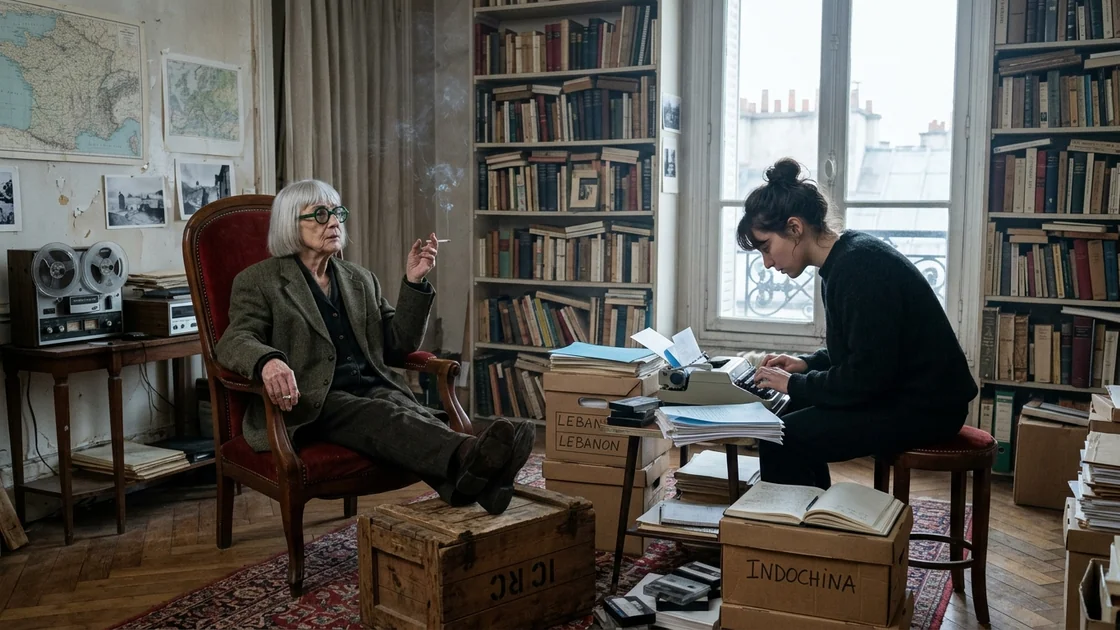
When Clara Ellis arrives at an echoing fourth-floor apartment off the Jardin du Luxembourg to serve as reader and amanuensis to Genevieve Marchand, a ferocious and newly blinded veteran of twentieth-century frontlines, she expects nothing more than clerical drudgery and acidic critique. Instead, she enters an arena of stubborn memory, where the elderly correspondent has stalled at the threshold of her memoirs' final chapter—a missing account of the 1982 siege of Beirut and the photographer she left behind in the ruins of the Commodore Hotel. Over months of damp Parisian winter, through combative mornings over burnt chicory, tedious cassette cataloging, and walks through the Luxembourg fog, Clara coaxes the older woman out of her protective cynicism, forcing them both to confront what it costs to witness disaster and what remains when the eyes can no longer look away.
I. The Audition
The brass knocker was cast in the shape of a Gorgon’s head, worn smooth at the brow and jaw where seventy years of delivery boys, concierges, and foreign editors had rapped against the dark oak. Clara Ellis let the heavy ring fall twice. The sound hit the courtyard of the Rue Servandoni like a pistol shot, flat and hard in the damp November mist that rose off the stones of Saint-Sulpice.
She waited. Behind her, Paris smelled of wet limestone, roasted chestnuts from the cart on the corner of the Rue de Vaugirard, and the sour diesel fumes of a passing Renault van. She was twenty-six, carrying two suitcases, a portable Olivetti typewriter in a cracked vinyl case, and four hundred francs left over from an aborted postgraduate year studying the syntax of French diplomatic correspondence at the Sorbonne. She had run out of both money and ambition at roughly the same hour three weeks prior, when her supervisor had informed her with an apologetic shrug that her prose was "far too dramatic for historiography, mademoiselle, and entirely too indifferent to structuralism."
The door creaked inward. It was not Madame Marchand who opened it, but a woman in an apron of rough grey linen with fingers stained violet by artichoke hearts.
"You’re the American," the woman said in the raspy, rhythmic patois of the Auvergne. She did not open the door wider than six inches.
"Clara Ellis. For the reading post."
The housekeeper looked Clara up and down, noting the salt rings on her leather boots and the frayed velvet collar of her coat. "She has already dismissed two. One had a voice like a wet towel slapped against a zinc counter. The other read the sports pages as though they were liturgical prayers. Don't take off your gloves in the hall. It’s freezing. The radiators are coughing up rust."
Clara stepped into a vestibule that smelled distinctly of three things: cedar shavings, Turkish black tobacco, and decaying paper. It was a vast, sprawling flat with herringbone parquet that had long since surrendered its wax to fifty years of impatient pacing. Down the central corridor, past towering shelves of buckram-bound ledgers and international directories, light gathered in a square pool from tall French windows overlooking the chimney pots of the sixth arrondissement.
Sitting in a high-backed armchair of crimson velvet, her feet resting on an upturned wooden crate stenciled with the logo of the International Committee of the Red Cross, was Geneviève Marchand.
Even sitting, she seemed constructed entirely of sharp angles and dried tendons. She wore a heavy tweed jacket that had clearly belonged to a broad-shouldered man, its sleeves rolled twice at the wrist to reveal hands like bird claws, corded with prominent veins and scarred across the right knuckle by a pale, jagged crescent. Her hair was a shock of nicotine-silver, cut straight across the chin with kitchen shears. Over her eyes she wore round, bottle-green spectacles, thick as paperweights.
"Don’t hover," the old woman said before Clara’s foot had touched the threshold of the salon. "You walk on the balls of your feet like someone who expects to be struck from behind. Are you a shoplifter or a nun?"
"Neither," Clara said, steadying her voice. "I was told you were expecting an amanuensis."
"I was expecting an amanuensis three weeks ago. Instead, the agency sent me a series of sentimental schoolgirls who wept whenever we reached the retreat from the Drina. Come here. Sit on the stool by the radiator. No, not that one—it’s missing a castor. The mahogany one."
Clara crossed the room, carefully avoiding a low table stacked high with yellowing copies of Le Monde, The Guardian, and several issues of Paris Match from the mid-seventies. She sat. The wood was cold through her skirt.
"Now," Geneviève said, turning her blank, green lenses directly toward Clara’s face. "The voice. Read to me. On the desk behind you there is a copy of this morning's Le Figaro. Turn to page four. Read the piece on the dockworkers' strike in Marseille. Do not interpret. Do not color the nouns. I do not care about your emotional response to the syndicates. I want the figures, the names of the union secretaries, and the tone of the minister’s denial. Go."
Clara picked up the paper. The newsprint was cold and slightly damp from the morning air. She cleared her throat once, pitched her voice low, and began. She read cleanly, clipping the final consonants as she had been taught by her mother in Lyon, keeping her cadence steady through the thickets of acronyms and parliamentary figures.
For three minutes, the only sound in the high-ceilinged room was Clara’s voice, the steady tick of an ornate marble mantel clock that was ten minutes slow, and the dry, rasping breath of the old woman.
Geneviève held up a single, nicotine-stained finger. Clara stopped mid-sentence.
"Your vowels are slightly Lyonnaise," Geneviève said, her head tilted toward the ceiling. "Your mother's family?"
"Yes."
"Bourgeois. Silk merchants or pharmacists?"
"My grandfather was a magistrate."
"Explains the rhythm. You read like an indictment. That’s better than an elegy, at least. Can you type?"
"Eighty words a minute on an Olympia or an Olivetti. Sixty if the ribbon is dry."
"Can you make coffee that does not taste like dishwater or an apology?"
"I lived in Naples for eight months."
Geneviève snorted, a sharp, barking sound that rattled the green lenses against the bridge of her hooked nose. "Then you know that sugar is an insult to the bean. Good. Madame Dupin will show you the maid’s room under the eaves. It has a radiator that clinks like an iron foundry and an iron bedstead that belonged to my late sister, who died of pleurisy in 1944. If you leave the cold tap dripping in the basin, it won't freeze. The rent is free. The food is edible. The wage is eight hundred francs a week, paid every second Friday provided you have not made me lose my temper before Thursday noon."
"And the work?" Clara asked.
Geneviève reached into the pocket of her tweed jacket, pulled out an amber-colored box of Gauloises Caporales, extracted one with practiced efficiency, and felt along the edge of the side table for an iron box of Swedish matches. Clara moved instinctively to strike one for her, but the old woman’s hand snapped out with shocking speed, swatting Clara’s wrist aside.
"Never do that," Geneviève hissed, striking the match against the box herself with a single, sharp stroke. The sulfur flared, illuminating the yellow skin of her temples and the white hair at her ears. She drew the smoke deep into lungs that sounded like dry leaves in a gutter. "I am blind, Mademoiselle Ellis, not paralyzed. I lost my retinas to an eighty-two-millimeter mortar in the Bekaa Valley fourteen years ago, not my arms. You are here because I have two hundred thousand words of my life rotting in nine cardboard archive boxes, and the house of Gallimard is threatening to sue me for the return of my advance if they do not have the complete manuscript by the first of March."
She blew a plume of thick, grey smoke toward the tall windows, where the rain was beginning to patter against the leaded panes.
"Eleven chapters are done," Geneviève continued, her voice dropping into a register that was flat, cold, and entirely devoid of theatricality. "They are typed, corrected, retyped, and sealed in wax paper. They cover Indochina, Algeria, the Six-Day War, Cyprus, and the fall of Phnom Penh. They are full of blood, stupidity, geography, and famous men who were cowards in hotel bathrooms."
"And the twelfth chapter?" Clara asked.
Geneviève turned her face back toward the window, her lips pressed into a thin, white line that seemed to vanish into the wrinkles around her mouth.
"The twelfth chapter does not exist," the old woman said softly. "And that is why you are going to sleep under the eaves, Mademoiselle Ellis. Because until it does, neither of us is going to leave this apartment alive."
II. The Geography of Rue Servandoni
The apartment did not run on the clock of the Paris streets, but on the idiosyncratic chronometry of Geneviève Marchand’s nervous system.
She had lived in the third-floor flat since 1958, returning to it between assignments like a ship coming into a dry dock to scrape barnacles from its hull. The walls were not papered; they were lined from floor to picture rail with unvarnished pine shelves containing twelve thousand volumes in French, English, German, and Arabic. The carpets were Persian, thick and worn down to the grey warp along the specific paths Geneviève walked: five paces from the armchair to the sideboard where the whiskey stood; eight paces from the sideboard to the mahogany desk; twelve paces from the desk through the double doors to the library, where the archives were kept in olive-drab steel filing cabinets brought back from an American surplus depot in Châteauroux.
Clara’s days quickly took on the iron discipline of a military camp.
At seven, she descended the narrow, uncarpeted service stairs from the sixth floor, where her tiny room under the zinc eaves smelled permanently of soot and wet wool. In the kitchen, she boiled water in an enameled saucepan, measured dark, chicory-heavy coffee into an earthenware drip pot, and toasted four thick slices of yesterday’s baguette over the blue gas ring until the crusts were black.
Geneviève took breakfast in silence at the long kitchen table, sitting under an enormous, hand-drawn map of the Plain of Jars dated 1961. She ate with her fingers, finding the crusts with absolute spatial certainty, never spilling a crumb, her blind eyes fixed on the empty air six inches above Clara’s forehead.
"The papers," Geneviève would say, setting her cup into its saucer with a sharp clink.
Clara would open the morning bundle: Le Monde, L'Aurore, and the airmail edition of the International Herald Tribune. For two hours, she read. Geneviève did not want opinions. She did not want editorials. She wanted casualty figures from Northern Ireland; she wanted the commodity prices for copper and tin in London; she wanted every dispatch from Beirut, where the civil war had curdled into a slow, grinding street fight between militias whose names changed with every rotation of the moon.
"Skip the commentary by the academic from Vincennes," Geneviève would snap, waving a hand through the smoke of her third morning cigarette. "He has never smelled cordite in his life. He thinks artillery is an aesthetic category. What does the boy from the Reuters bureau say about the crossing at the Museum?"
"He says the sniper fire has closed the Green Line to civilian ambulances since Tuesday," Clara read. "Two children were killed near the French embassy."
"Which embassy? The administrative villa or the residence on the hill?"
"He doesn't specify."
"Amateur," Geneviève muttered. "A reporter who does not know which gate the shells are falling through shouldn't be allowed to buy an ink ribbon. Turn to the obituaries. Anyone I know?"
"A retired brigadier from the colonial infantry. A professor of epigraphy from the Collège de France."
"No one interesting. They always die in the wrong order. To the library."
The library was the coldest room in the flat. A small kerosene stove sat in the corner, chugging with a low, blue hiss that produced more oily smell than heat. Here stood the machinery of Geneviève’s past: three Swiss Nagra tape recorders, their grey aluminum faceplates scratched and salt-pocked; dozens of five-inch reels of magnetic tape in red cardboard cases marked with grease pencil (Saigon, April '75; Suez, Nov '56; Amman, Black Sept); and the nine green boxes containing the draft of the memoirs, provisionally titled The Witness at the Threshold.
"Chapter Eight," Geneviève ordered, pointing a long, knobby finger at the middle table. "The second draft of the withdrawal from the Mitidja. Find the paragraph where we describe the prefect’s car. Read it."
Clara pulled the heavy typescript from its folder. The paper was onionskin, typed on an old manual Hermes with a misaligned lower-case e that jumped above the line like an erratic pulse.
"'The prefect’s Citroën had two small tricolor flags mounted on the mudguards,'" Clara read. "'They were stiffened with starch to keep them flat in the sirocco, but the red had faded to the color of tinned salmon by the time we reached the perimeter at Blida.'"
"Delete 'tinned salmon,'" Geneviève said instantly. "It sounds like a novelist trying to be clever in an attic. Just say 'pale.' No—say 'dusty.' Read the next sentence."
"'There were twelve paratroopers sitting on the bonnet of an overturned fuel truck, sharing a melon with a bayonet.'"
"Keep the melon. Delete the bayonet. Everyone uses a bayonet in memoirs about Algeria; it’s become a cliché of the paras. They were probably using a pocketknife from their mothers in the Dordogne. Next."
This was the work. For four weeks, Clara became the eyes and the eraser of Geneviève Marchand’s memory. It was an exercise in ruthless subtraction. Where Clara, trained in the ornate balances of university French, reached for adjectives that deepened the scene, Geneviève stripped them away with a sharp, guttural click of her tongue.
"Adjectives are for tourists, Clara," she would say, leaning back in her leather swivel chair, her thumbs hooked into the waistcoats of her trousers. "When the shell lands, you do not observe that the explosion is 'deafening.' You simply cannot hear for three days. You describe what the man next to you did with his hands. If he picked up his thumb, you say he picked up his thumb. You do not say he did it 'pitifully.' The reader has an imagination; do not do his crying for him."
By mid-December, they had polished the first eleven chapters. They formed an astonishing, brutal document: forty years of human catastrophe recorded by a woman who had never married, never owned a house, never kept a plant alive for more than three months, and who had survived dysentery in Luang Prabang, a shrapnel wound to the hip outside Jerusalem, and three months in a Syrian military prison with a broken collarbone.
The prose in those eleven folders was like cold iron: spare, terrifyingly clear, and completely without self-pity.
Yet, every time the work brought them to the tenth cardboard box—the one stenciled with the single word LEBANON—Geneviève’s industry would suddenly evaporate.
She would find reasons to clean the carriage of the Hermes with an oily toothbrush. She would demand that Clara walk to the Place de l'Odéon to buy a specific brand of matches that had been discontinued in 1971. She would suddenly claim that her eyes—the blind, scarred sockets behind the green lenses—were throbbing from the damp, and she would retire to her bed with a flannel cloth dipped in vinegar, leaving Clara alone in the echoing salon among the silent stacks of paper.
III. The Box Under the Radiator
It was during one of these vinegar-scented afternoons, while the grey rain of late January turned the zinc roofs outside into sheets of running slate, that Clara found the tenth box had not been placed with the others.
The shelf marked 1980–1985 was empty except for three empty tape spools and an old brass compass with a cracked glass face.
Clara knelt on the parquet. She had spent the last three hours cataloging the carbon ribbons, her fingers blackened to the knuckles. A cold draft came through the skirting board behind the radiator, where the floorboards had parted by half an inch. Tucked into the recess between the cast-iron coils and the wainscoting was an oblong parcel wrapped in black waterproof oilcloth—the kind used by correspondents to protect camera gear during river crossings.
Clara looked toward the hall. The apartment was dead quiet save for the rhythmic, bronchial snoring of Madame Dupin in the kitchen and the steady plink-plink of the leak in the bathroom down the corridor.
She reached behind the radiator. The pipes were lukewarm and greasy with fifty years of accumulated dust. Her fingertips hooked into the twine that bound the parcel. She pulled it out.
The oilcloth was stiff with age. Inside was not a typescript, but three items: a small, black-bound reporter’s notebook with a pencil slipped through the spine; seven cassettes of Scotch brand audio tape, their white labels bearing no numbers, only dates written in a sharp, masculine hand with blue ballpoint ink; and a silver-gelatin print, eight by ten inches, curled at the edges like dried leaf.
Clara uncurled the photograph with careful fingers.
It was an interior shot, taken with very little light. It showed a corner of a hotel room—the classic, dismal modernism of the 1970s that one found from Athens to Tehran: low modular sofa, formica-topped dresser, an empty whiskey bottle serving as a candlestick. In the background, through a shattered sliding glass door, the jagged silhouette of a shelled high-rise stood against a sky white with midday haze.
In the foreground, sitting on the edge of the unmade bed, was Geneviève.
She was forty years younger, her dark hair pulled back into a ragged knot at the base of her skull, her face hollowed by hunger and fatigue, wearing a khaki bush shirt with the sleeves torn off. Her eyes—uncovered, clear, dark, and intensely fierce—were staring directly into the lens.
Next to her, his head leaned back against the headboard, his eyes closed in an exhaustion so total it looked like death, was a man. He was tall, thin to the point of emaciation, with thick, curly brown hair that fell across a forehead marked by a dark smudge of grease. His hands were clasped across his stomach, and around his neck hung two Leica M3 bodies, their chrome worn down to the yellow brass along every corner.
Clara turned the print over. On the back, written in the same masculine hand as the cassette labels, were four lines in English:
Commodore, Room 404.
14 August 1982.
The water is gone. The ice is gone. The French have left.
Geneviève says she will stay until the wire is cut. I have four
rolls of Tri-X left.
J.H.
"Put it down," a voice said from the doorway.
Clara gasped, dropping the print onto the parquet. It curled inward with a dry snap.
Geneviève stood between the library doors. She was wearing her nightgown of rough calico under a heavy wool cardigan, her feet bare on the cold boards. Her green spectacles were missing. Her eyelids, puckered and sunken into the deep hollows beneath her heavy brows, were closed, the skin pale as lard. She was holding her walking cane—a stout stick of peeled ash with a rubber ferrule—not like a support, but like a weapon, held at waist level, pointed directly at Clara’s chest.
"I asked you to file the notes on the evacuation of the PLO," Geneviève said, her voice dangerously quiet. "I did not ask you to go rooting through the floorboards like a terrier in a cellar."
"I was looking for the files for Chapter Twelve," Clara said, her heart hammering against her ribs. She stayed on her knees, her hands flat on the dusty wood. "The shelf was empty. The agency contract says the chapter on the siege must be three hundred pages. Gallimard’s lawyer called this morning while you were sleeping."
"Let them call. Let them send the bailiffs. Let them seize the furniture. They can have the desk; the drawer sticks anyway."
Geneviève moved forward. She did not use the stick to tap the floor; she knew every knot in the wood. She walked until the toe of her bare foot touched the edge of the black oilcloth.
"Give me the picture," she commanded.
Clara picked up the photograph and placed it in the old woman’s outstretched hand. Geneviève did not attempt to look at it, of course. Instead, her long thumb moved across the surface with an eerie, delicate precision. She felt the curled edge, the glossy emulsion, and then her thumb rested for five full seconds on the lower left corner—exactly where the man’s clasped hands were depicted in the silver grain.
"Julian," Geneviève whispered. The name seemed to escape her throat not as a word, but as an exhalation of old air that had been trapped beneath a stone for decades.
"Who was he?" Clara asked.
Geneviève’s face hardened instantly. The softness that had appeared around her mouth vanished like water on a hot stove. She folded the photograph in half with a sharp, sickening crunch of the paper and shoved it deep into the pocket of her cardigan.
"He was an Englishman who had the ridiculous idea that a camera could prevent an infantry battalion from doing what infantry battalions always do when they enter an undefended camp," she said. She turned toward the window, her blind face tilted toward the grey light. "He was thirty-one years old. He came from Shropshire. He had teeth that were slightly too large for his mouth, and he smelled of developer chemicals and lemon drops. Now, get up off the floor, Mademoiselle Ellis. Wash your hands. We are going out."
"Out?" Clara blinked. "It’s four o’clock. It’s freezing, and the rain is turning to sleet."
"The Luxembourg does not close until five," Geneviève said, turning toward the corridor. "And I cannot breathe the air in this apartment when you are looking at me like an orphan in an illustration from Victor Hugo. Get your coat. And bring your notebook. The red one. With the soft lead pencil."
IV. The Garden of the Blind
The Jardin du Luxembourg in late January was an iron cage of black branches and wet gravel. The chairs—the famous green steel chairs of Paris—had been stacked in damp pyramids beneath the chestnuts, chained together like prisoners awaiting transport. A few old men in berets were playing boules under the shelter of the music kiosk, their metal spheres clicking in the fog with the sound of dull cutlery.
Geneviève did not take Clara’s arm. She walked two paces ahead, her ash stick striking the edge of the gravel path with a rhythmic tack-clack-tack. She wore an old trench coat that smelled of mothballs and waterproofing grease, a wool scarf wrapped three times around her throat, her green glasses reflecting the pale, white disc of the winter sun that hovered above the Senate palace.
"People think blindness is blackness," Geneviève said as they passed the stone basin of the Medici Fountain, where dark water lay stagnant under a skin of rotten plane leaves. "They think it is like closing your eyes in a dark room. It isn't."
"What is it like?" Clara asked, pulling her collar up against the sleet.
"It is grey. It is the color of dirty greasepaper held against a television set that has lost its signal. Sometimes there are flashes of sulfur—bright, stupid flashes that have nothing to do with what is in front of you. The brain is bored, you see. It invents garbage. It gives you the corner of an awning in Saigon that you saw thirty years ago, or the yellow teeth of a customs officer in Port Said. It refuses to show you what you want to remember, and it bombards you with what you spent your whole life trying to forget."
She stopped at the balustrade overlooking the central octagonal pond. The gravel was empty; even the gulls had abandoned the stone rims of the basin to sit in miserable rows along the roof of the Orangerie.
"Julian Hall was a fool," Geneviève said, her hands resting on the cold balustrade. "He worked for the Sunday Times, but he had none of that Fleet Street grease that keeps a man alive in a bazaar. When the artillery started on West Beirut in June of '82, everyone who had any sense moved to the Commodore Hotel because it had seven floors of reinforced concrete and a telex machine that was wired directly to the satellite uplink through Cyprus."
She paused. A gust of wind off the Rue de Médicis sent a swirl of sleet across their faces. Clara took out the red notebook, but the paper immediately grew damp and limp under the droplets.
"Don't write yet," Geneviève snapped, without turning her head. "I can hear your sleeve rubbing against the spiral. Just listen. If you cannot remember the cadence of a sentence without scribbling it down while your fingers are blue, you will never be able to edit it."
Clara dropped the notebook back into her pocket. "I’m listening."
"We lived on tinned sardines, stale flatbread, and warm beer from the hotel bar. For fifty days, the Israelis dropped nine-hundred-kilo bombs on the high-rises along the Corniche. You could feel the shockwaves through the soles of your feet hours before you heard the planes. Julian lived in room 404. I was in 406. There was a hole through the wall between our bathrooms where an anti-aircraft fragment had come through the masonry in July. We used to talk through the hole while we shaved our legs or washed our shirts in the basin."
A faint, bitter smile touched the corner of Geneviève’s mouth.
"He used to sing. English music hall songs. Absurd things about seaside piers and women who sold jellied eels. He sang them completely out of tune while the buildings on the Rue Hamra were coming down like decks of cards. He was terrified. His hands shook so badly in the mornings that he couldn't thread his film into the sprockets. He would come into my room with a roll of Ilford HP5, his face grey as zinc, and hold out his Leicas. 'Do it for me, Vève,' he would say. 'The fingers have gone on strike again.'"
"And you did it?"
"Of course I did it. And then I would pour three fingers of arak down his throat and kick him down the stairs. Because when the sirens went, he was the only one who didn't run for the cellar. He went straight to the roof. He stood out on the water-tank platform with a thirty-five-millimeter lens, where the blast from the Phantoms would peel the shirt off your back. He wasn't brave. He was simply stubborn in that peculiar, pig-headed Protestant way that only the English can manage. He believed that if he took a picture that was clear enough—if the focus was sharp enough on the child’s shoe or the woman’s arm coming out from under the collapsed lintel—that someone in Surrey or Yorkshire would throw down their marmalade and stop the war."
Geneviève turned her back to the pond and began walking toward the gate that opened onto the Rue Auguste-Comte. Her stick moved faster now, its cadence uneven, clipping the box hedges.
"He took eight hundred pictures between the first of August and the fourteenth," she said, her voice dropping lower as they approached the iron railings. "Most of them were useless. Overexposed, blurred by the blast, ruined by heat in the chemicals. But there were three rolls. Thirty-six frames on each. He took them on the sixteenth of September. In the south of the city."
She stopped at the gate. The keeper of the park, an elderly man in a dark green municipal coat with brass buttons, was standing by the pillar, his keys jingling in his hand as he prepared to close the grounds for the night.
"Closing time, Madame Marchand," the keeper said gently. He knew her, obviously.
Geneviève did not answer him. She stood on the threshold between the gravel and the wet asphalt of the boulevard, her face raised toward the sleet.
"He gave me the cassettes, Clara," she said. It was the first time she had used Clara’s Christian name without the prefix of Mademoiselle. "He gave them to me at four o'clock in the afternoon on the seventeenth. In the corridor of the French hospital. He said, 'Take these to the wire. Don't let the bureau see them until you're on the boat to Larnaca.' And then he went back into the alley behind the sports stadium."
"And Julian?" Clara asked, her breath catching in her throat. "What happened to him?"
Geneviève reached out, found the iron rail of the park fence, and held it with both hands, her knuckles whitening until the scars on her skin stood out like chalk marks.
"He was thirty-one," she said. "I told you. That is what happened to him. That is the whole story. Now call a taxi. My shoes are full of water, and if I get pneumonia before we finish the chapter on the hospital, Gallimard will pay my advance to my second cousin in Clermont-Ferrand, and she is a woman who puts lace antimacassars on her television set."
V. The Cassette with the Red Wax
The storm that began that evening lasted three days. It was not a romantic Parisian snowfall, but a miserable, clinging sleet that froze into a greasy glaze on the steps of Saint-Sulpice and turned the gutters of the Rue Servandoni into black torrents of refuse and slush.
Inside the flat, the cold deepened. Madame Dupin kept the kerosene stove burning night and day, filling the rooms with an oily, yellow haze that made Clara’s eyes smart. Geneviève had retreated into her chair, wrapped in two wool blankets and a fur cape from the 1930s that had lost most of its hair along the hem.
She refused to dictate.
"The language has gone bad," she said on the second morning, pushing the typewriter away when Clara set it on the low table. "It has the taste of an old tin can. Everything I say sounds like something someone else said better in 1916. Read to me from Chateaubriand. The Memoirs from Beyond the Grave. The part where he goes to Venice to die."
Clara read until her throat was raw. She read about the gondolas, the green slime on the steps of the palazzi, the smell of historical rot. When she stopped, Geneviève was silent, her head tilted back, her mouth slightly open, breathing with that dry, rattling scrape that had become the background music of the apartment.
"He was an aristocrat," Geneviève murmured without opening her eyes. "He could afford to be elegant about dying. In our century, Clara, no one dies with a complete sentence in their mouth. They die saying: 'Where is my boot?' or 'Tell the sergeant we need water.' If you put Chateaubriand into a trench at Verdun or an alley in Shatila, he would have written about the price of horsemeat."
"Then write about the horsemeat," Clara said boldly. She was sitting on the floor with her knees drawn up, her hands tucked into the sleeves of her jumper for warmth. "Write what you saw through the window of the hospital."
"I saw nothing," Geneviève spat, her head snapping forward, the green lenses catching the dull yellow glow of the stove. "I was an amanuensis of blood, just like you are mine. I sat by the generator with a Hermes baby on my knees, typing out what the doctors shouted as they carried the stretchers past. 'Male, approximately twenty, blast trauma to the cranium.' 'Female, six or seven, internal hemorrhage, non-viable.' You want me to make that into literature? You want me to give it a beginning, a middle, and an end, so that some retired civil servant in Neuilly can read it with his Sunday brioche and say: 'Ah, how tragic, how terribly French, what style she has'?"
"No," Clara said, rising to her feet. She had had enough of the vinegar, the smoke, and the theatrical cruelty. "I want you to tell the truth about why Julian Hall stayed behind."
Geneviève went very still. Her hands, resting on the worn arms of the velvet chair, did not move.
"You don't know what you're asking," she whispered.
"I know that you have seven tapes in an oilcloth parcel that you hid behind a radiator like a thief," Clara said, her voice shaking with an anger she hadn't known was gathering within her. "I know that you wrote eleven chapters about every foreign legionnaire, every corrupt colonial governor, and every dead guerrilla from the Mekong to the Jordan, but you haven't written one word about the man who took the only photograph you keep in this house. You think you're being ferocious, Madame Marchand, but you’re just hiding behind your glasses. You’re terrified that if you finish this book, you’ll be nothing more than an old woman who lived through thirty wars and ended up with nothing in her hands but a pension and an empty room."
For a long moment, the only sound in the apartment was the wind rattling the heavy casement windows and the steady, rhythmic plink of the leak in the corridor.
Clara stood her ground, her fists clenched in her pockets, expecting the ash stick to come whistling across her shins.
Instead, Geneviève let out a long, shuddering sigh that seemed to deflate her entire frame. The tweed jacket seemed suddenly three sizes too large for her shoulders.
"The third tape," she said. Her voice was barely audible above the hiss of the kerosene. "In the cedar box on the mantelpiece. Not the ones from the radiator. The cedar box with the brass clasp."
Clara looked at the mantelpiece. Between an empty brass shell casing from Dien Bien Phu and a chipped porcelain saucer containing three buttons and an old five-franc piece was a rectangular box of dark Lebanese cedar, carved with faded rosettes.
She opened the clasp. The wood smelled intensely of resin and dry spice. Inside lay a single Nagra spool of three-inch magnetic tape, sealed across the rim with a strip of red wax that had cracked with age.
"Put it on the machine," Geneviève said, leaning her head back against the crimson velvet. "The small Nagra. The one with the green battery indicator. Plug in the earphone. No—don't use the earphone. Put it on the speaker. Let Madame Dupin hear it in the kitchen. Let the whole street hear it. They’ve been waiting forty years to hear it anyway."
VI. The Voice on the Wire
The motor of the Nagra hummed with a low, mechanical precision that belonged to an era when machines were built to survive the tropics. Clara threaded the dark brown ribbon through the brass capstans, clicked the lever into the Play position, and stepped back.
For four seconds, there was only the hiss of tape—the sound of hot sand running through an hourglass.
Then, a cough. A man’s cough, deep, wet, and ragged.
"Testing," said a voice. It was an English voice, flat, slightly nasal, with the broad, open vowels of the West Midlands. "Sixteen September. It’s about four in the morning, I think. The electricity has been off since noon yesterday. We’re in the cellar of the clinic on the Rue Henri Pharaon. Geneviève is asleep on two sacks of laundry. She’s got her typewriter under her arm like a dead baby."
A small, choked sound came from Geneviève’s chair. Clara glanced at her; the old woman’s head was turned toward the window, her lips trembling slightly.
On the tape, the sound of distant explosions rolled across the microphone—not the sharp crack of film sound effects, but the heavy, dull thud-thud-thud of heavy artillery that sounds more like furniture being moved on the floor above than weapon fire.
"The flares are going up every two minutes from the stadium," Julian’s voice continued. He was speaking very close to the microphone, his breath popping against the diaphragm. "They’re using white phosphorus. It turns everything the color of a fish belly. You can see the whole valley from the balcony on the fourth floor. I went up with the fifty-millimeter. Vève told me not to go. She said the snipers on the milk factory were shooting at cigarette ends. She’s right, of course. She’s always right. It’s the most irritating thing about her."
A faint rustle of paper on the recording, then the sound of a metal lighter clicking twice.
"The militia went in through the south gate at seven yesterday evening," the voice went on, flat, methodical, the tone of a surveyor describing a drainage ditch. "We could see the trucks. Mercedes trucks with the canvas covers tied back. They were singing. Some kind of hymn. Vève said it was the Maronite hymn to the Virgin. It sounded like something you’d hear at a football match in Wolverhampton, only slower."
The voice stopped. On the tape, someone in the room was crying—a thin, high-pitched whimpering that sounded like an animal caught in a fence.
"Julian," a woman’s voice said on the tape—Geneviève’s voice, forty years younger, sharp, clear, and vibrating with an electric fury. "Turn that bloody thing off. The batteries are low, and we need them for the transmitter."
"Let it run, Vève," Julian replied on the tape. "The wire is down anyway. The French operator at the post office said the lines were cut at the relay station near the airport. We’re not sending anything tonight."
"Then sleep."
"I can't sleep. Every time I close my eyes, I see that fellow with the blue scarf around his head. The one who was sitting on the bonnet of the Land Rover with the sheep carcass. Only it wasn't a sheep, was it?"
A long silence followed. The artillery on the tape seemed to have moved further off, replaced by the persistent, furious barking of stray dogs in the rubble.
"Julian," the young Geneviève said again, her voice softer now, close to the microphone. "Give me the lenses. Put them in the bag. We’re leaving at first light with the Red Cross convoy."
"I’m not going with the convoy, Vève."
"Don't be an idiot. The Israelis have surrounded the perimeter. The Christian militias are inside. If you’re caught with those cameras, they won't even ask for your accreditation. They’ll put you against the wall of the slaughterhouse."
"I’ve got sixty frames left," Julian said. His voice was no longer flat; it had taken on a strange, brittle lightness that made Clara’s skin prickle. "I’ve got the names of the three lieutenants. The ones from the headquarters in East Beirut. The ones who were sitting on the terrace of the café drinking lemonade while the bulldozers were working."
"No one cares about their names, Julian!" the young Geneviève shouted on the tape. The sound distorted, peaking into the red on the Nagra’s small meter. "Do you think the editors in London are going to print names? They’re going to print an editorial about 'ancient hatreds' and run an advertisement for silk ties on the facing page! Give me the film!"
"No."
A sound of scuffling. A metal cup falling onto a stone floor. The sharp, wet sound of a hand striking flesh.
"Damn you, Vève," Julian whispered on the tape. He was panting now. "Look at my hands. Look at them. They’re not shaking anymore. Isn't that something? For three months I couldn't hold a fork, and now they’re as steady as a clock. I’m going down to the school. The nuns are still there. If they see the cameras, maybe they won't bring the shovels."
"Julian, listen to me—"
"Take the tapes, Vève. If I’m not at the port by four, give the rolls to the purser on the Greek freighter. The one who has the sister in Piraeus. Tell him they’re medical documents. Don't let the bureau have them. If the bureau gets them, they’ll sell them to the syndicates and some bastard in Munich will crop them to fit between the bra ads."
The sound of a heavy wooden door opening. The noise of the street flooded in—the roar of a diesel truck without a muffler, a distant burst of automatic fire, and the high, wailing cry of an ambulance siren.
"Julian!" Geneviève’s voice screamed on the tape. It was a sound Clara had never heard from the old woman: high, ragged, cracked with an absolute, helpless terror. "Julian, come back inside! Julian!"
Then the sound of the tape running out of the leader—thwack-thwack-thwack-thwack—as the loose end spun against the plastic casing of the Nagra, over and over, until Clara reached out with a trembling finger and clicked the switch to Stop.
The salon was dead silent.
Geneviève did not move. Her head was still pressed against the crimson velvet. From behind the thick green lenses, two narrow, glistening tracks ran down the dry parchment of her cheeks, cutting through the grey film of cigarette ash and settling into the deep wrinkles at the corners of her mouth.
She did not reach up to wipe them away.
"He was right, of course," Geneviève said, her voice dry as limestone. "They were using the bulldozers by seven that morning. When I went down to the south gate with the Red Cross people on the eighteenth, the ground was flat. It looked like a car park. A car park that smelled of lime and sour earth. We found his camera bag in the ditch near the sports ground. The Leicas were gone. Someone had cut the straps with a knife. But he had put the film inside his socks."
She turned her face toward Clara.
"Sit at the machine, Mademoiselle Ellis," she said.
"Madame—"
"Sit at the machine. Put in three sheets of the heavy bond with two sheets of carbon paper between them. Turn the margin stop to fifteen. Set the line spacing to one and a half. And do not dare to blow your nose. We have twelve thousand words to write before the sun goes down, and we are going to use Julian's language, not mine."
VII. The Dictation
For forty-eight hours, the third-floor apartment on the Rue Servandoni became a forge.
Madame Dupin brought bowls of thick potato soup and black coffee every four hours, setting them down on the edge of the desk without a word, taking away the cold dregs, her eyes red-rimmed from the kerosene smoke. The sleet had stopped, replaced by that dead, freezing grey that settles over the sixth arrondissement in February, when the stone buildings seem to leach every particle of heat out of the human body.
Geneviève did not return to her chair. She paced.
Five paces to the sideboard. Eight paces to the desk. Twelve paces to the library door.
Her ash stick was abandoned in the umbrella stand by the door. She moved through the rooms with her hands outstretched, her fingers brushing the spines of her books—the Tocqueville, the Saint-Simon, the bound files of the Combat from 1944—using them as tactile waypoints in the dark landscape of her skull.
"The chapter begins not in Beirut," she dictated, her voice steady now, rhythmic, clicking into that hard, unadorned syntax that was her signature. "It begins in a kitchen in Shrewsbury in 1951, where a boy was given an Ensign box camera for his tenth birthday by an uncle who had lost three fingers at Tobruk. Write that down."
Clara typed. Her fingers had grown numb in the cold room, but the Olympia answered with a furious, mechanical chatter that seemed to fill the hollow spaces between the walls.
Tack-tack-tack-tack-ding. The carriage return slammed back against its spring.
"He did not know how to develop his own plates until he was seventeen," Geneviève continued, pacing toward the library doors. "He worked in the cellar of a chemist's shop behind the market square, smelling of hypo and vinegar. He believed that the image was not something you made, but something that was already there, hidden in the gelatin like a fossil in a piece of chalk, waiting for the acid to eat away the lies."
She turned, her hand finding the corner of the mahogany desk with the certainty of a ship’s rudder.
"When we entered the camp on the morning of the nineteenth, the light was the color of a wet slate. The bulldozers had left their tracks in the red mud—broad, ribbed tracks like the belly of a snake. There was an old man sitting on an oil drum near the entrance who was trying to clean his glasses with the hem of his burnous. His glasses were broken in half, but he kept rubbing them, round and round, because he had nothing else to do with his hands."
Tack-tack-tack-tack.
"Julian had three rolls in his left sock and one in his right. When I took them out in the cellar of the French embassy, they were wet with his sweat. The salt had gotten into the metal cassettes. I had to wash them in distilled water from the dispensary before I could wind them onto the spirals. I had no darkroom. I used an empty wine crate with two holes cut in the side, covered with an overcoat."
"Did you look at them?" Clara asked, her hands hovering above the keys. "The negatives?"
"I am a journalist, Clara," Geneviève said, stopping dead in the middle of the room. "Of course I looked at them. I held them up to the kerosene lamp while they were still dripping from the wash. They were not art. They were not even good reportage. The focus was off by three inches in half of them because his eyes were full of dust. But you could see the numbers on the bulldozers. You could see the crest on the officer’s beret. And in the last frame—the thirty-sixth frame on the fourth roll—you could see Julian."
Clara’s fingers stayed frozen above the letters. "Julian?"
"He had dropped the camera," Geneviève said softly. "The Leica has a mechanical release that can be tripped by a stone if it falls from a height of four feet. The camera had landed in the gutter, pointing up toward the wall. And there he was. Just his legs. His legs in his khaki trousers, and the edge of his field jacket, and his left hand reaching down to pick up the lens cap."
She walked slowly to the tall French window and leaned her forehead against the glass. The pane was cold enough to form a circle of white condensation around her mouth.
"He had stopped," she whispered. "In the middle of the shelling, with the trucks coming round the corner, he had stopped because he didn't want the front element of the fifty-millimeter to be scratched by the gravel. That was Julian. He was more afraid of a scratched lens than he was of a machine gun. Write this: 'The witness who believes he can remain behind his glass is the first to be crushed by it. The lens is not a shield; it is merely an aperture through which the world’s brutality enters the eye and makes a permanent residence.'"
Clara typed the words. They sounded like stones falling into a well.
They worked through the night. The carbon paper turned Clara’s wrists blue, then black. When her hands cramped so severely that her knuckles swelled, Geneviève would reach into her pocket, produce two small lozenges of menthol sugar, drop them into Clara’s palm, and say: "Ten minutes. Walk to the kitchen. Drink a glass of tap water. Do not look out the window. The street will only tell you that other people are asleep, and that is information you do not need."
By dawn on the third day, the stack of typed pages on the corner of the mahogany desk had reached two hundred and forty.
Chapter Twelve was finished.
The last paragraph ended not with an indictment, not with a philosophical summary, but with a list of eleven names—the names Julian had written on the back of an envelope from the Bank of the Middle East, which Geneviève had carried in her brassiere from Beirut to Athens, from Athens to Rome, and from Rome to the fourth-floor flat on the Rue Servandoni, where it had lived for fourteen years in the pocket of an old tweed jacket.
"Read the last sentence," Geneviève commanded. She was sitting on the wooden Red Cross crate now, her shoulders hunched, her hands resting flat on her knees.
Clara lifted the final sheet from the carriage of the Olympia. Her voice was cracked, dry as corn husks, but she did not falter.
"'We came out through the port at Jounieh on an Italian cattle boat that smelled of wet straw and sheep dung,'" she read. "'The sea was flat, grey, and without birds. When the coastline of Lebanon dropped below the horizon, I took the fourth roll of film—the one with his legs and the lens cap—and I dropped it into the wake behind the screw. Not because I wanted to forget, but because some things do not belong to the archives of the French Republic. They belong to the bottom of the sea, where there is no light, no paper, and no one to ask why the man with the camera did not run when the others did.'"
Clara lowered the page.
The silence that followed was different from the silences that had preceded it. It was not the cold, suspicious silence of the old apartment, nor the bitter silence of the blind woman’s memory. It was the vast, quiet stillness that follows the cessation of an engine that has been running for forty years.
Geneviève reached up with both hands, took off the thick green spectacles, and laid them on the table next to the empty coffee cups.
Her face, exposed to the pale morning light that was finally breaking through the grey clouds over Saint-Sulpice, was astonishingly peaceful. The scars around her eyes were still there, white and jagged as lightning against the paper-thin skin, but the tension that had held her jaw like an iron clamp had dissolved.
"Is the spelling correct?" Geneviève asked softly.
"I checked every name against the registry," Clara said.
"And the misaligned e on that wretched typewriter? Did it make the text look like a lunatic had typed it?"
"It looks," Clara said, her eyes burning with tears she could no longer suppress, "like it was typed by someone who was there."
Geneviève nodded once, a sharp, decisive nod that seemed to seal the work forever.
"Take the pages to the kitchen," she said. "Tell Dupin to give you three raw eggs beaten into warm milk with two spoons of sugar. You look like a ghost that has been dragged through an orchard. And then, Clara..."
"Yes, Madame?"
"Go to sleep. Gallimard can wait until three o'clock to send their boy on his bicycle. They have waited fourteen years; they can survive another six hours without my corpses."
VIII. The Room Under the Eaves
Clara slept for eighteen hours.
She did not dream of Beirut, nor of Indochina, nor of the green-lensed glasses on the mahogany desk. She dreamed of her grandmother’s house in the hills above Lyon—the sound of the wind through the mulberry trees, the smell of sun-warmed boxwood, and the dry, rhythmic clack of a loom working in the valley below.
When she woke, it was noon on Sunday.
The light that came through the small dormer window of the maid’s room was not the greasy grey of the past three weeks, but a pale, washed blue. Paris had emerged from the freeze. The snow on the zinc roofs was melting, running down the lead gutters with a sound like a mountain brook, gurgling through the downspouts into the courtyard of the Rue Servandoni.
Clara washed her face in the small basin. The water was no longer ice; it was merely cold, fresh, and clean. She dressed in her one clean skirt, brushed her hair until the smell of kerosene was gone, and descended the narrow service stairs.
The flat was quiet, but it was not empty.
In the salon, the French windows had been thrown wide open. The smell of wet asphalt, budding lime trees, and the warm, yeasty air from the bakery on the Rue des Canettes blew through the high-ceilinged room, ruffling the corners of the newspapers on the low table.
The cardboard boxes had been cleared away. The nine green archives were gone, replaced by a single, oblong package wrapped in heavy brown butcher’s paper, tied with green hemp twine, and sealed with four medallions of red wax bearing the impression of a signet ring with a broken crest.
On top of the parcel lay an envelope of thick, cream-colored paper with Clara’s name written across the front in a hand that was shaky, uneven, but unmistakably Geneviève’s.
Clara opened it. Inside were two items: a bank draft on the Crédit Lyonnais for four thousand francs—twice what had been agreed—and a single slip of paper from a reporter’s pad.
Mademoiselle Ellis, the note read.
The boy from Gallimard came at ten. He was thirty minutes late, and his fingernails were dirty, but he had a leather satchel that looked waterproof. The manuscript is in his basket.
Madame Dupin has gone to the market to buy leeks and a shoulder of mutton. She has instructions to leave the key to the cellar on the hook behind the larder door. In the third bin on the left, under the sawdust, there are six bottles of Château Palmer from 1961. Take one. Do not share it with a student.
I have gone to the Jardin. Do not come looking for me. A woman who has just buried forty years of her friends is entitled to sit by the Medici Fountain without an amanuensis asking her if she has remembered to put on her wool stockings.
If you return to Lyon, give up the diplomatic correspondence. It is a language invented by cowards to avoid admitting that they have already decided to surrender. You have a good ear for the nouns, Clara. Use them.
G.M.
IX. The Terrace of the Medici
Clara did not go to the cellar for the wine. She put on her coat, tucked the envelope into her pocket, and walked out into the street.
The air on the Rue Servandoni was sweet and cold, vibrating with the bells of Saint-Sulpice ringing for the one o'clock mass. The boulevard was full of people: families in their Sunday coats, students from the Sorbonne carrying paper parcels of books, old women in furs carrying small, yapping dogs toward the park.
She entered the Luxembourg through the gate on the Rue de Vaugirard.
The gravel was wet, but the ice was gone. The gardeners had already begun unchaining the green steel chairs, setting them out in pairs along the alleys of plane trees where the first pale green buds were beginning to swell on the twigs like drops of glass.
Clara did not have to search long.
Near the Medici Fountain, where the long, dark pool of stone reflected the pale blue sky and the stone statues of the nymphs mossy with age, sat Geneviève.
She had not taken a chair. She was sitting on the low stone coping of the balustrade, her hands resting on her ash stick, her face turned up toward the weak, warming sun that filtered through the bare branches.
She was not wearing her green spectacles.
Her eyes were closed, her scarred eyelids relaxed, her head tilted slightly to the side as though she were listening to something very far away—perhaps the laughter of the children by the pony track, perhaps the sound of the water falling through the stone gargoyles into the basin, or perhaps simply the silence that comes when the last roll of film has been dropped into the sea, and the wire, at long last, has gone dead.
Clara did not approach her.
She stood twenty paces back, under the shadow of the stone pavilion, watching the old woman breathe the fresh, damp air of the garden.
After a moment, Clara reached into her coat pocket, took out the red notebook and the soft lead pencil, and opened to a clean, white page.
She did not write about the siege. She did not write about the bulldozers, nor the hotel rooms that smelled of arak and cordite, nor the men who died with their boots off in the alleys of forgotten cities.
She looked at Geneviève Marchand sitting in the February sun, her nicotine-silver hair catching the light like wire, her face turned toward the sky that she would never see again, and she wrote:
The light over the garden at noon is the color of clear honey. It falls across the stone without weight, without memory, and without asking anything of those who have survived the night.
She closed the notebook, slipped the pencil into the spiral, and turned back toward the gate that led to the river.