The Solstice Voices of St. Jude
After two years of absolute vocal silence following the death of her daughter, former conservatory director Eleanor Vance establishes an amateur choir for grieving women in a remote coastal valley. Rehearsing in a drafty vestry and eventually moving into the roofless ruins of a twelfth-century Cistercian abbey, the ensemble prepares for a single performance on the winter solstice. Through the shared physics of breath, stone acoustics, and communal sorrow, the women confront their individual losses, while Eleanor gradually dismantles the physical and psychological armor that has locked her own voice in her throat.
Part I: The Ledger of Breath
The notices were printed on heavy, unbleached cotton paper that Eleanor had found in the bottom drawer of her writing desk, left over from an era when she still ordered bespoke stationery for recital programs. She had cut them by hand using a bone folder and an iron ruler, sixty small rectangles with clean, fibrous edges. She used black ink and an old dipping nib, printing in a plain, upright hand without embellishment:
Voices carrying weight. A women’s chorus for the winter season. No audition, no sight-reading required. We will meet on Tuesday evenings at St. Jude-in-the-Fens. Repertoire will center on the winter solstice. Bring warm socks.
She pinned the slips in places where sorrow tended to pool without being explicitly invited: the bulletin board beside the dispensary in the chemist’s shop; the community board at the laundromat between the commercial dryers and the lost-property peg; the porch of the post office, tucked behind notices for tractor sales and oil deliveries; and the notice rail inside the north porch of the parish church, where the smell of wet coir matting and paraffin heaters lingered year-round.
Eleanor herself had not sung an audible pitch since the twenty-fourth of November, two years prior. On that morning, in the pediatric intensive care unit at Addenbrooke’s, the monitors had been switched off, and the ventilator had ceased its rhythmic, mechanical sigh. When the nurse had gently asked if she wished to sit with Clara’s body a while longer, Eleanor had opened her mouth to say yes, but the column of air had sheared off against the base of her throat. It had felt like an actual physical dislocation, as if her vocal folds had calcified into twin laths of dry slate. In the months that followed, she spoke in an uninflected, rasping whisper, the register of an old woman whose lung volume had shrunk to the size of a tea cup, though she was only forty-two. Her husband had stayed for seven months, trying to coax her back into the light of shared breakfasts and polite social obligations, until the weight of her wordlessness drove him to an apartment in Leeds, where people still spoke at normal conversational amplitudes.
She had retired from the Royal Northern College of Music on an open-ended medical leave that gradually solidified into permanent resignation. She sold the Victorian semi in Manchester and bought a salt-scoured stone cottage three miles outside the coastal village of Blackwood, where the North Sea ground down the limestone cliffs into gray pebbles and the ruins of St. Jude’s Abbey stood like a jagged jawbone against the eastern horizon.
On the first Tuesday of October, Eleanor arrived at the parish room behind the newer nineteenth-century church at six o'clock, an hour before the time noted on the card. The room smelled of floor polish, damp hymn books, and dead hornets. She lit the small wall-mounted gas heaters, which popped and hissed, releasing the sweetish scent of unburned butane before catching into rows of pale blue teeth. She set twelve folding wooden chairs in a semi-circle, then took them down and arranged them in an open horseshoe, then changed her mind again and settled on two staggered rows, curved gently inward so that each singer might see the profiles of the others without having to stare them directly in the face.
She did not set out a conductor’s stand. On a side table, she placed an electric kettle, a tin of peppermint tea, a jar of instant coffee, and a ceramic bowl filled with dark honey and wooden spoons.
At ten minutes to seven, the door creaked.
A woman entered wearing an oilskin jacket slick with sea fog. She was perhaps sixty, with hands reddened from weather or washing, her graying hair pulled back in a brass hair-slide shaped like an anchor. She stood on the doormat, blinking at the fluorescent tubes overhead.
"Is this the singing?" the woman asked. Her voice was flat, carrying the broad, hard vowels of the eastern coast.
"It is," Eleanor whispered. She pointed to a chair in the front row. "Take your coat off if you like. The heater takes twenty minutes to beat back the salt."
The woman did not take off her coat. She sat down, her leather purse held across her knees like a shield. "I’m Martha," she said. "My husband, George, died of his liver in July. Forty-one years on the crab boat. The house is like an empty barrel. It rings every time I drop a fork."
"I am Eleanor," Eleanor said, her voice dry as chaff. "Thank you for coming, Martha."
Within twenty minutes, six more women had entered. There was Sal, a girl of nineteen with dark circles beneath her eyes and raw cuticles, who had lost her four-month-old infant to an unexplained cot death in August; she smelled of dried lavender and faint, sour milk, her cardigan buttoned crookedly. There was Naomi, forty-five, an archivist from the county hall whose identical twin sister had drowned in the reservoir the previous winter; she moved with a curious, rigid symmetry, as though constantly trying to occupy the space of two bodies at once. There was Wren, twenty-eight, whose grief was of a different order—a sudden, violent eviction from a ten-year partnership that had stripped her of home, social circle, and her sense of self, leaving her trembling in an oversized duffel coat. Beside them sat two sisters in their seventies, Constance and Beatrice, whose mother had died at ninety-nine after fifteen years of progressive dementia, leaving them adrift in a house crammed to the eaves with yellowing newspapers and boxed linen they were forbidden to touch; and finally Megan, a woman of thirty-four whose face bore the gray pallor of three consecutive miscarriages, her hands resting flat against her empty pelvis as if waiting for a vibration that never arrived.
Seven women. They sat with their shoulders pulled up toward their ears, their legs crossed tightly at the ankles, their coats still buttoned against the draft that slid under the scullery door.
Eleanor pulled a folding chair into the open center of the horseshoe. She did not sit on it; she stood behind it, resting her hands on the curved wooden slat of the backrest.
"We are not going to talk about what brought us here," Eleanor whispered. The room was so quiet that her rasping breath seemed to come from the floorboards themselves. "You are welcome to speak to one another before we begin and after we finish, but during our time together, the narrative of our trouble is not the work. The work is the respiration. Grief does something very specific to the human thorax. It freezes the intercostal muscles. It drops the diaphragm into permanent defensive tension. It makes the vocal folds dry and brittle because we do not breathe deeply enough to hydrate them from the bloodstream."
The women watched her. Sal’s chin trembled slightly, but she reached out and pulled her knees to her chest, resting her chin on her jeans.
"We are not going to sing words tonight," Eleanor continued. "We are going to find where the air strikes the skull."
She raised her right hand. Her fingers were long, the nails trimmed short, the knuckles swollen slightly from the cold. For twenty years she had used those hands to shape the polyphony of Byrd and Tallis, to carve out the dynamic architecture of the Brahms Requiem in vaulted concert halls where five hundred people held their breath together. Now, her palm was empty.
"Breathe in through the nose for four counts," Eleanor instructed, her lips forming the words with exaggerated clarity to compensate for her lack of volume. "Do not lift your shoulders. If your shoulders rise, you are stealing from your belly. Imagine your pelvis is a bucket of cool well water. Fill the bottom first."
She brought her hand down through the air, slow and steady.
The seven women took their first breath together. It was a ragged, hitching thing. Martha’s chest heaved; Sal gasped as if she had been underwater; Naomi took a breath so sharp it sounded like silk tearing.
"Out through the teeth," Eleanor said. "A soft sh. Like water drawing back through shingle."
They released it. The room filled with the long, white hiss of their collective lung-capacity. Seven plumes of warm, moisture-laden air drifted into the cold room, smelling faintly of coffee, mint, wool, and old grief.
Eleanor kept her hand moving. In. Out. In. Out. For twenty minutes, no tone was made. There was only the bellows: the accordion-fold of seven bodies learning that they were still capable of taking eight hundred cubic centimeters of air into their meat without dying of it.
Around eight o'clock, Eleanor altered the instruction.
"At the bottom of the breath, do not close the throat. Let the mouth drop open. Do not attempt a note. Let the breath become sound only because it meets the teeth on the way out. An h sound that falls into an ah."
She dropped her hand.
The sound that emerged from the circle was not music. It was the low, aggregate groan of an ancient ship’s timber adjusting to a heavy sea. It was pitched somewhere near the F below middle C, unstable and thick with unspent mucus and dry mucous membranes. It wobbled; it fluttered; it died in Martha’s throat with a dry cough.
Sal began to weep, but she did not stop blowing the air. Her sound was higher, an unsteady, warbling octave above the rest, thin as a spider’s silk.
Eleanor did not correct them. She did not ask them to tune it. She stood with her eyes closed, her hand marking the four-beat rise and fall, letting the sound gather in the corners of the drafty room. For the first time in seven hundred days, the knot of gristle behind her own sternum loosened by the breadth of a needle’s eye.
Part II: The Masonry of the Throat
By the third week of October, two more women had joined: a schoolteacher named Grace whose eighteen-year-old son had died in a motorcycle accident on the bypass, and an elderly Ukrainian woman named Iryna, who spoke little English and whose loss remained unnamed, carried entirely in the deep furrow between her brows and the small wooden icon she laid upon the table beside her teacup before hanging up her coat.
The weather broke toward the end of the month. The autumn gales blew straight from Spitzbergen, stripping the elderberry bushes of their black fruit and turning the lanes into channels of orange mud.
In the vestry, the gas heaters could no longer keep the damp from rising through the parquet. The condensation ran down the yellow-painted plaster walls in long, shining tracks, and the air tasted of cold stone and coal gas.
"We are going to move," Eleanor announced at the beginning of their fourth rehearsal.
Martha looked up from unbuttoning her overshoes. "Move where, love? The Methodists won't have us; their hall is booked for carpet bowls till Christmas."
"Not to a hall," Eleanor whispered. "To the abbey."
Constance frowned, adjusting her spectacles with a gloved finger. "St. Jude’s? It hasn't had a roof since Henry the Eighth tore down the rafters, Eleanor. It’s an open field with walls."
"It has the chapter house," Eleanor said. Her voice, though still restricted to a whisper, had gathered a firmer edge of aspiration; the breath was carrying more purpose now, even if the vocal cords still refused to touch and vibrate. "The vaulting in the chapter house is intact. The stone is Caen limestone, three feet thick. It keeps the wind out, and it has an acoustic decay of four point two seconds. A voice in that space does not die when it leaves your lips. It hangs. It waits for you to catch up to it."
They grumbled, but they came.
The Abbey of St. Jude-in-the-Fens stood a half-mile from the sea, tucked into a depression between two low chalk ridges where the salt marsh began. Founded in 1184 by Cistercian monks who had sworn themselves to manual labor and absolute silence, it was now an English Heritage site of the third tier—unstaffed, protected only by an iron kissing gate, a gravel carpark, and a wooden signboard detailing the layout of the refectory, the warming house, and the cloisters.
They met at six o'clock on the first Tuesday of November. The sun had set an hour before, and the dark was thick and maritime, smelling of rotting bladderwrack and wet chalk. The nine women carried storm lanterns and thermos flasks, their heavy boots crunching along the gravel path that wound through the nave.
The roof of the church was gone, replaced by a cold, indigo canopy where the autumn constellations—Cassiopeia, Perseus, the faint mist of the Pleiades—were pinned like chips of salt. The tall, pointed lancet windows of the chancel framed nothing but the night sky and the dark, restless line of the North Sea three hundred yards away.
Eleanor led them past the base of the crossing piers, through the door of the south transept, and into the chapter house.
Here, eight ribbed vaults sprang from a single central octagonal pillar of dark Purbeck marble, spreading out like the branches of a stone palm tree to meet the corbels on the perimeter walls. The stone benches where the monks had once sat to hear the daily reading of the Rule were still intact, running around three sides of the octagonal chamber.
Eleanor had hung four hurricane lamps from iron hooks left by the masonry conservators. The yellow light washed up against the groins of the ceiling, catching the ancient chisel marks in the stone—the diagonal hatchings made by men who had died seven centuries ago.
"Sit," Eleanor told them.
They sat upon the stone bench, their heavy wool coats bunching behind them. The cold of the limestone penetrated their skirts and trousers within minutes, an ancient, geologic chill that made them sit straighter, pulling themselves up off the flags.
"The monks who built this room did not consider music an ornament," Eleanor said, standing beside the central pillar. She rested her flat palm against the dark marble; it was cold as an iron wedge. "They considered it an adjustment of the physical world. They believed that when a human being sang the proper intervals—the fourth, the fifth, the octave—they were resetting the fallen geometry of creation. They sang seven times a day, beginning in the dark before dawn. They sang with their eyes closed so they would not see the faces of their brothers, only their breath."
She looked at Sal. The girl was shivering, her face pale inside a knitted balaclava.
"Sal," Eleanor said gently. "Give me the vowel you use when you think of him."
Sal looked up, terrified. "I don't have a voice, Mrs. Vance. You know that. I was in the bottom set for choir at school. They told me to mouth the words for the carol concert."
"The school choir was looking for uniformity," Eleanor whispered. Her hand rose, fingers spread. "We are not looking for uniformity. We are looking for the frequency that matches the room. Drop your jaw. Don't think about a song. Just the shape of his name without the consonants."
Sal swallowed. Her throat moved like a small bird caught in a net. She opened her mouth. The wind came through the unglazed lancet behind her, fluttering the loose wool of her scarf.
"Ah," Sal said.
It was small, pinched, flat.
"Again," Eleanor murmured. "From the hip. Don't push it. Let it fall out of you like a stone dropping down a well."
Sal closed her eyes. Her shoulders dropped half an inch. Her belly, soft and loose from childbearing, relaxed against her jeans.
"Ah—"
The sound hit the octagonal pillar.
The Purbeck marble did something extraordinary to the pitch. It caught the fundamental—a rough, unvarnished A above middle C—and stripped away its nasal friction, amplifying the second and third overtones until a high, thin E shimmered in the vaulting near the ceiling, three times louder than the note that had left the girl’s mouth.
Sal opened her eyes, startled. She stopped singing, but the stone held the sound for three full seconds after her mouth had shut, a clean, ghostly ringing that died away into the sigh of the distant surf.
Martha let out a low whistle. "Good lord above."
"The room does half the work," Eleanor said, a faint, dry smile touching the corners of her mouth. "You do not need to project. You do not need to perform. You only have to introduce the vibration to the stone. It will carry the rest."
That night, they began their first piece: an anonymous thirteenth-century plainchant from the north of England, O viriditas digiti Dei—not the full Latin sequence, but a four-phrase lament Eleanor had transcribed from a manuscript in the cathedral library at Lincoln twenty years before.
She taught it to them phrase by phrase, without sheet music. She could not demonstrate the pitches with her own vocal folds; instead, she used an old wooden pitch pipe that she blew with dry, short puffs, then shaped the contour of the melody with her hand in the air—a horizontal line for the recitation tone, a gentle rising arc for the mediant, a long, falling curve for the final cadence.
The women learned by imitation, their voices rubbing against each other like wool garments. Martha’s deep, chest-heavy alto; Naomi’s clean, narrow soprano that sounded like a silver spoon striking glass; Grace’s smoky, hesitant mezzo; the cracked, reedy timbre of the two sisters, Constance and Beatrice, who sang always an eighth of a tone sharp, as if their decades together had tightened their ears against the exterior world.
When they sang the four phrases together for the first time in the small, vaulted room, the sound was not smooth. It had the texture of coarse bread. But the acoustics of the chapter house gathered the jagged edges, folded them over one another, and cast them up into the ribbed ceiling until the women were sitting under an arch of their own sustained breath.
Sal was not weeping now. Her mouth was open, her eyes fixed on Eleanor’s hand, her chest rising and falling in time with Martha’s.
When they finished at eight o'clock, none of them moved for several minutes. The lantern flames flickered in their glass chimneys. The air was five degrees above freezing, but the small space felt warm, packed with the moisture of their nine pairs of lungs.
"My George had a blue shirt," Martha said into the silence. She did not look at anyone; she spoke to the central column. "He wore it every Sunday for twenty years until the elbows gave out, and then he cut the sleeves off and wore it for painting the hull. I washed it yesterday. I had it in the basket. And I smelled the collar, and there was nothing left of him on it. Just the washing powder. Lemon and bleach. I sat on the scullery floor and I thought: that’s it, then. The salt’s gone out of the house."
Naomi reached out and laid her hand over Martha’s woolen glove. She did not say anything. She did not offer the usual insults of comfort: He’s in a better place; Time heals all things; You have your memories. She simply left her hand there until the lantern began to smoke.
Part III: The Architecture of Resonance
By mid-November, the rehearsals had ceased to be an appointment and had become a necessity that governed their weeks.
Eleanor observed them with the clinical eye of a conductor who had spent twenty years balancing the choral forces of Monteverdi and Britten. Grief, she knew, was not an emotion; it was an anatomical condition. It reorganized the body’s posture. It curved the cervical spine inward to protect the jugular; it locked the jaw to prevent the scream that would tear the throat; it compressed the rib cage to minimize the exposure of the heart.
Each Tuesday, she spent the first half-hour simply unlocking the levers.
"Martha, your shoulders are in your ears. Drop them. Let your arms hang until your fingers feel heavy and full of blood."
"Beatrice, unlock your knees. If you lock your knees, you stop the blood from returning from your calves. You will faint on the flags, and I will have to drag you into the cloisters."
"Wren, tongue down. The back of the tongue is the enemy of the soft palate. Imagine you have a hot plum sitting at the back of your mouth. Make room for it."
Her whispers were louder now, harsher, carrying across the chapter house like the rustling of dry rushes in a dyke. She pushed them. She made them sing long, straight tones on an oo vowel until their diaphragms burned and their ribs ached from the expansion. She made them hold suspensions—intervals of a second that clashed like two iron keys grinding in a lock—and forbade them to resolve the tension until she lowered her hand.
"Do not flinch from the discord," she whispered, her gray eyes burning in the lantern light. "The modern ear wants the chord to resolve immediately. It wants the happy ending. It wants the cadence to fall into the tonic so everyone can go home and eat cake. The medieval composers were not so childish. They knew that pain stays unresolved for forty bars. They knew that the beauty is not in the resolution; it is in the endurance of the rub."
She kept them on the dissonance. Naomi’s high soprano clashed against Grace’s mezzo, a sharp, acidic second that vibrated in the teeth of everyone in the room. Megan gripped the hem of her jersey; Sal’s knuckles went white; but they held it. They held the sound until their breath was nearly spent, and when Eleanor finally turned her wrist, tilting her palm to let them step down into a clean, open fifth, the relief was so physical that Constance let out a short, sharp gasp that was half laugh, half sob.
"That," Eleanor said, "is where the soul lives. In the friction between what was and what cannot be changed."
Yet, Eleanor herself remained mute.
She gave them the pitches from the wooden pipe. She gave them the rhythm with her body, which was lean and severe in her dark woolen coats. But when they sang, her own lips remained pressed together in a pale, bloodless seam.
One evening, after the others had packed their flasks and walked down the gravel path toward their cars, Naomi remained behind. She stood near the chapter house doorway, watching Eleanor blow out the hurricane lamps one by one, until only a single wick remained between them.
"You don't sing," Naomi said. It was not an accusation; it was an observation delivered with an archivist’s flat precision.
"No," Eleanor whispered.
"Why?"
Eleanor adjusted the brass screw of the final lamp, watching the yellow flame retreat into the wick. "My daughter, Clara. She was eight."
Naomi waited. The wind made a low, pipe-like sound as it passed through the open tracery of the window above them.
"She had an extraordinarily pure ear," Eleanor said. The words came slowly, each one scraped off the lining of her trachea with visible effort. "When she was four, she could name the pitch of the church bells across the valley. She knew if the refrigerator motor was running in F-sharp or G. When she was sick, during the last month, the sound of my voice made her cry. She said it hurt her head. She said it sounded like gravel being kicked against a fence. So I stopped. I whispered to her for three weeks. And when she died... the muscles simply forgot the mechanism. When I try to make a sound, my larynx rises like a fist. It chokes me."
Naomi looked down at her own hands. She was wearing two rings on her left hand: her own thin silver band, and her twin sister’s wider gold one.
"When Judith drowned," Naomi said, "I stopped looking in mirrors. For seven months I brushed my hair by feel. I shaved my legs by feel. Because every time I caught my own reflection in the bathroom glass, I thought: There you are. Why are you on that side of the water? It felt like an insult that my face had survived hers."
She stepped closer to Eleanor. The lantern light threw their shadows together against the curved limestone wall, two elongated forms merging into the groining of the vault.
"We aren't a choir, Eleanor," Naomi said quietly. "You know that, don't you? We are nine women who have been shipwrecked. You’ve given us pieces of timber to hold onto so we don't slip under the water. But you’re still swimming with your boots on."
Eleanor did not answer. She blew out the last lamp, and they walked through the ruined nave in the dark, finding their way by the white line of the gravel path and the distant, rhythmic sweep of the lighthouse beacon at Blackwood Ness.
Part IV: The Solstice Program
In the third week of November, Eleanor introduced the program for the concert.
They would sing on the twenty-first of December—the winter solstice—at seven o'clock in the evening. They would not sing in the sheltered chapter house. They would sing in the crossing of the great abbey church itself, under the open sky, in the space where the high altar had once stood before the lead was stripped from the roofs and the images of the saints were smashed into road metal.
"It will be freezing," Constance said, her voice quavering slightly. "My knuckles already swell up like walnuts if I leave the kitchen window open."
"We will have charcoal braziers," Eleanor told her. "Three on each side. We will wear fingerless gloves and our thickest stockings. We will invite the village. We will invite anyone who has someone missing from their table this Christmas."
"What will we sing?" Sal asked. She had brought a notebook with her, covered in cheap floral paper, in which she had neatly written out the phonetics of the Latin chants they had practiced.
"A carol from the fourteenth century: There is no rose of such virtue," Eleanor whispered. "The Coventry Carol, because it was written for the mothers who lost their children to Herod’s soldiers. A sixteenth-century lament by Thomas Tallis. And a piece I have written for us."
The women fell silent.
Eleanor reached into her canvas satchel and drew out nine copies of manuscript paper. The notes were written in her own neat, calligraphic script, black ink on creamy vellum.
"It has no Latin," she said. "The text is taken from the parish registers of this valley between the years 1348 and 1890. Names. Just names of women and children who died in the winters, and the causes set down by the clerks. Cough of the lung. The shaking ague. The frost. Shipwreck off the sand. Sickness of the throat."
Grace turned the page. "There are no bar lines, Eleanor."
"Bar lines are an invention of the late Renaissance to keep bad musicians together," Eleanor said. "We do not need them. You will follow my hand. Each phrase will last as long as Martha’s breath lasts. When Martha breathes, you all breathe. Martha is our metronome."
Martha looked up, her broad face flushing in the cold. "Me, love? I haven't got the lungs of a sparrow."
"You have the lungs of a woman who has pulled fifty fathoms of wet cod line out of the sea with her hands," Eleanor said. "Your lungs are deep enough for all of us."
They began to work on Eleanor’s composition, which she had titled simply The Solstice Litany.
It was unlike anything the women had ever heard. It did not have the square, predictable balance of church hymns. It began with a long, unmeasured drone on D, held by the altos—Martha, Constance, and Iryna—a dark, thick mud of sound that seemed to rise directly from the damp turf between the flagstones. Above this, the sopranos introduced the names, not singing them, but speaking them in rhythmic cadences that dissolved into musical pitches:
Mary, daughter of John, three years. The cold. Hannah, wife of Thomas, thirty-two years. In childbed. Dorothy. The white swelling. Agnes. Agnes. Agnes.
The repetition of the names had a hypnotic, terrifying power. In the roofless nave, the sound rose toward the empty lancets, caught by the sea breeze that blew over the walls, carrying the names out toward the water.
As they rehearsed, Eleanor pushed them harder than she had ever pushed her conservatory students in Manchester. She gave no praise. She tolerated no sloppy vowel shapes. If Sal let her mouth drift into an open Yorkshire a instead of the pure, Italianate vowel required by the acoustic, Eleanor stopped them with a sharp click of her tongue.
"No! Sal! You are singing with your teeth closed. You are holding your grief in your back molars like an old dog with a bone. Drop the jaw! Let it be ugly! Grief is not pretty, Sal. It does not look like an angel on a Christmas card. It has dirt under its nails. Give me the dirt!"
Sal’s face went scarlet. She took a breath that whistled through her nostrils, dropped her chin until her neck felt stretched to snapping, and produced an E that was so loud, so raw, so stripped of vibrato that it caused Beatrice to drop her music sheet.
It was the cry of an animal that had found its nest empty. It hung in the stone arches, vibrating against the ancient limestone, and then slowly, miraculously, it blossomed into a pure, resonant overtone that rang like an iron bell.
Sal stood there, her chest heaving, tears running down her cheeks into the wool of her scarf, her mouth still open in the shape of the sound.
Eleanor looked at her. Her own eyes were dry, but her hands were trembling.
"Hold that," Eleanor whispered. Her hand was steady now, raised in the gray air between them. "Do not lose that placement, Sal. That is where you keep him. Not in the graveyard. In that pocket of air above your tongue."
Part V: The Solstice Eve
Three days before the solstice, a maritime storm of unusual severity struck the coast.
The tide rose over the sea wall at Blackwood, flooding the lower street with gray, churning water that carried cod boxes and plastic crates into the gardens. The wind blew from the northeast at sixty knots, tearing the corrugated iron roof from the tractor shed at the abbey farm and flattening fifty yards of the drystone wall that marked the boundary of the Cistercian precinct.
Eleanor walked down to the ruins on the morning after the gale had passed.
The sea was still the color of a wet slate, throwing up tall, yellow plumes of foam against the cliffs. Inside the abbey, the wind had cleared the grass of dead leaves, but the chapter house was flooded with four inches of salt water that had backed up through the old monastic drains.
She stood in the doorway, her rubber boots submerged in the icy brine. The Purbeck column rose from the pool like an island. The acoustics were altered; the water on the floor was deadening the lower resonances, reflecting the high frequencies with a sharp, metallic slap that made her skin prickle.
They could not sing in the chapter house. They would have to stand in the crossing, where the turf was soggy but drained by the gravelly sand beneath.
She walked out into the center of the ruined church.
The crossing was the place where the four great arms of the abbey had once met: the nave from the west, the chancel from the east, the two transepts from north and south. Four massive compound piers of clustered stone columns still stood, seventy feet high, their arches broken at the top like fractured bones pointing toward the sky.
Here, the monks had gathered at two o'clock in the morning on the night of the winter solstice to sing the long, dark office of Vigils. They would have sung twelve psalms in the freezing dark, by the light of a single tallow candle, while the frost grew on their wool habits and their breath drifted up toward the timber ceiling that had long since rotted into dust.
Eleanor stood between the piers.
The loneliness of the space was absolute. It was not the romantic loneliness of a picturesque ruin; it was the brutal, indifferent vacancy of an abandoned workshop. The men who had worked here had been dead for six hundred years; the God they had prayed to had not saved their abbey from the picks and sledgehammers of the King’s commissioners; the sea was slowly eating the cliff upon which the whole thing rested.
She looked up at the empty sky. A single gull hung in the wind, its wings motionless.
Eleanor opened her mouth.
She tried to make the sound she had demanded of Sal. She tried to drop her jaw, to lower her larynx, to find the reservoir of breath in her pelvis. She tried to sing Clara’s name.
Cla—
Nothing came.
Nothing but a wet, rattling gasp that tore at her throat like brambles. The muscle at the root of her tongue seized; her pharynx constricted into an iron pipe; her ribs locked against her spine.
She fell to her knees on the wet grass, her gloved hands sinking into the cold slush. She wept without sound, her shoulders jerking in small, ugly spasms, her mouth open against the gray earth. She had spent two years building a cathedral out of silence, and now that she wanted to enter it, the door was barred with iron bolts she had forged herself.
A hand touched her shoulder.
It was Martha. She was wearing her yellow oilskin and a pair of men’s rubber waders, carrying an iron spade and a bucket of coarse gravel.
"I thought I’d find you here," the older woman said. Her voice was steady against the wind. "The path through the crossing is all grease. If those old girls Constance and Beatrice try to walk across it in their good boots, they’ll break their hips before we get to the Magnificat."
Eleanor did not get up. She stayed on her knees, her face turned away toward the broken masonry of the north transept.
"I can't sing, Martha," Eleanor whispered into her coat collar. "I am asking you all to give up your secrets, and I am an empty skin. I have no music left. It died with her."
Martha set down her bucket. The gravel rattled against the iron base. She sat down on the base of one of the clustered piers, her heavy legs stretched out before her, her red hands resting on her knees.
"My George had a boat called the Martha Jane," she said. "Named after me when we were twenty-one. A lovely thing. Larch on oak, double-ended, thirty foot. In the winter of seventy-nine, she got caught on the sandbar outside the harbor mouth in a southeasterly. The sea broke her back in ten minutes. Just smashed the keel right through the middle. George got off on the life-line, but the boat stayed out there. For five years, every time the tide went down to the springs, you could see the ribs of her sticking up out of the sand like an old sheep that had died in the heather."
She took an old handkerchief from her pocket and blew her nose with a loud, trumpeting honk.
"George didn't go near the water for three years," Martha continued. "He sat in the parlor and mended nets for other men. He wouldn't even look at the harbor. But one day, young Billy Cross came up to the door. His father had died in the same gale, and Billy had bought a little clinker boat he didn't know how to handle. He stood on our step with his cap in his hand and he said, 'Mr. Vance, I don't know where the deep water runs through the swashway. I’m scared I’ll put her on the spit.' And George looked at him. He didn't say nothing for five minutes. Then he went into the scullery, put on his sea boots, and he went down to the quay."
Martha leaned forward, her gray eyes small and bright between their wind-wrinkled lids.
"George never built another boat," she said. "He never owned another plank of wood. But he showed Billy where the water was deep enough to float. That was enough. That was plenty. You don't have to sing, Eleanor. You just have to hold your hands up so we don't hit the spit."
Eleanor looked at the gravel path.
She reached out and took a handful of the gray pebbles from Martha’s bucket. They were cold, wet, hard. She stood up slowly, her knees cracking, and began to scatter the stones across the slick mud of the crossing.
Part VI: The Longest Night
On the afternoon of the twenty-first of December, the wind died entirely.
A high-pressure system moved down from the Arctic, bringing with it a stillness so absolute that the smoke from the chimneys in Blackwood rose in straight, gray pencils until it dissolved into the lilac air. The frost settled early, silvering the salt marshes and turning the puddles in the abbey gravel into sheets of brittle glass.
By five o'clock, the darkness was complete. It was the winter solstice: nine hours of gray twilight followed by fifteen hours of iron night.
Eleanor and the women had worked since noon.
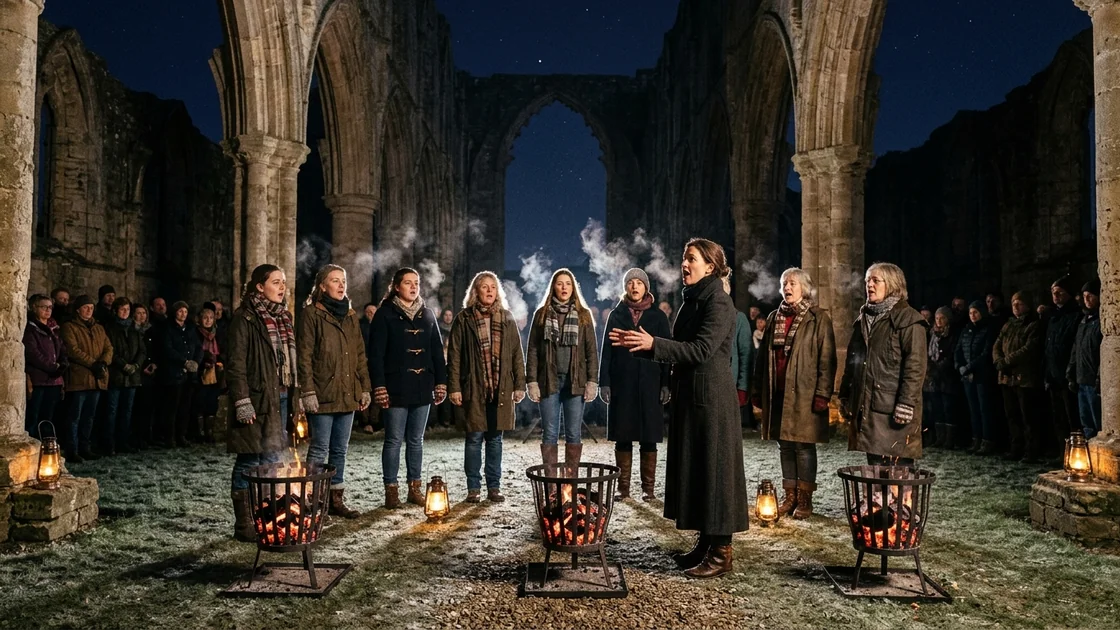
They had set out twenty storm lanterns along the perimeter of the crossing, their wicks trimmed low to produce a warm, amber perimeter that defined the choir’s territory. In the center, between the four great piers, they had placed three cast-iron fire baskets, filled with split ash and lump charcoal from the estate woods.
By six o'clock, the charcoal was glowing cherry-red, sending up columns of heat that created a small, microclimatic lens in the freezing air. The smell was ancient: woodsmoke, hot iron, cold stone, and the faint, sweet perfume of pine needles they had scattered over the gravel to give their boots traction.
At half-past six, the people began to arrive.
They came on foot from the village, their flashlights bobbing like fireflies along the lane. They came in cars that parked three-deep along the grass verges of the lane, their engines ticking as they cooled in the frost. There were old men in sheepskin coats who had sailed with Martha’s husband; there were young women pushing strollers with sleeping children wrapped in blankets; there were farmers smelling of sheep dip and diesel; there were the schoolteachers Grace worked with; there was the parish priest from the new church, wearing his black cassock under an oversized parka.
They did not speak much. The ruined abbey, immense and black under the stars, imposed a churchly quiet upon them. They filed into the nave, their boots crunching on the frozen turf, standing in rows four and five deep behind the perimeter lanterns.
There were nearly a hundred and fifty people. In a village of six hundred, it seemed that every house that held an empty chair had sent someone to the stones.
At five minutes to seven, Eleanor led the nine women into the crossing.
They wore no robes. They were dressed as they were: in heavy tweed coats, wool scarves, hand-knitted mittens with the finger-ends cut off, their boots black with snow-grease. Sal walked between Martha and Naomi; the two sisters, Constance and Beatrice, held each other by the elbow to steady their steps on the frozen ground; Wren held her manuscript against her chest like an offering; Grace and Megan walked with their heads up, their breath already rising in small, twin clouds before them; Iryna carried her small wooden icon in the pocket of her coat, her thumb tracing its worn silver edge.
They formed a curve between the western piers, facing the dark expanse of the nave where the audience stood in the shadow.
Eleanor stood before them.
She was dressed in a long, black wool coat that had belonged to her grandmother, its collar turned up against the draft that slid between the piers. She held no score, no baton, no pitch pipe.
She looked at the faces of her singers.
In the glow of the charcoal braziers, they looked like the faces of saints carved into the porch of an old cathedral: weathered, asymmetrical, marked by the chisel strokes of their particular sorrows. Sal’s cheeks were flushed with the dry cold; Martha’s mouth was set with the grim determination of a helmsman watching a rising sea; Naomi’s eyes were bright, reflecting the charcoal embers.
The village clock in the distance struck seven, the strokes carrying across the frozen fens like iron hammers striking lead.
Eleanor waited until the seventh stroke had died completely into the sea wash.
She raised her hands.
Her long fingers opened in the freezing air. She did not ask for a pitch. She looked into Martha’s eyes and drew a long, slow breath through her nose.
The nine women took the breath with her.
It was not the ragged, terrified gasp of their first October meeting. It was the deep, coordinated expansion of a single lung. Their chests rose together; their shoulders remained down; their pelvises filled with the cold well-water of the earth.
Martha released it first.
A low, deep D. It was not loud, but it had the weight of fifty years of sea-fog behind it. Constance and Beatrice leaned their voices into it, their slightly sharpened timbre adding an acidic bite to the lower octave that made the stones of the crossing pier vibrate.
Then came the chant: O viriditas digiti Dei.
The Latin words rolled through the unroofed church, rising into the freezing sky. Without a ceiling to contain it, the sound behaved differently than it had in the chapter house. It did not loop back upon itself; it traveled upward, straight and clean, toward the winter stars. The acoustics were lean, dry, and pure. Every consonant was audible: the hard t of digiti, the sibilant s of viriditas.
The audience in the dark nave did not cough. No one shifted their feet. The silence between the phrases was as heavy as the stone piers.
Then they moved to the Coventry Carol.
Sal sang the solo verse:
Lully, lulla, thou little tiny child, By by, lully lullay.
Her voice was not the voice of a trained soloist. It had no Italian vibrato; it had no polite English modesty. It was the sound of a nineteen-year-old girl standing over an empty crib in a council terrace, singing to something that was not there. It was so raw, so pier-glass clear, that a man in the third row of the audience—a retired fisherman whose son had been lost in the channel four years before—took off his flat cap and pressed it against his mouth to stop himself from crying aloud.
Sal did not falter. She held the high G at the end of the phrase, her chin up, her throat open, letting the stone carry the overtones until Naomi joined her on the suspension, the two voices grinding against each other in that exquisite, ancient pain that Eleanor had taught them to endure.
And then, Eleanor lowered her hands to her waist.
The braziers crackled. A piece of ash fell through the iron grate and hissed into the frost.
She raised her right hand alone.
The altos began the drone of The Solstice Litany.
The sound was dark, guttural, ancient. It was the sound of the earth turning its face away from the sun, the longest shadow of the year lengthening across the fields until it touched the edge of the sea.
Naomi spoke the first name, her voice clear and carrying:
Margaret. In her tenth month. The frost.
Martha spoke the second:
William. Sixty-one years. The water in his breast.
Grace:
Edward. Eighteen years. Broken on the road.
The litany gathered speed. The sopranos began to weave a polyphonic web of sound around the spoken names, a three-part lament based on the intervals of the fourth and the fifth, rising in pitch with every repetition.
Sarah. Thomas. Alice. Clara.
Eleanor’s hand jerked.
It was Sal who had sung the name. She had found it in Eleanor’s notebook, written in the small, penciled margin where Eleanor had not intended anyone to look. Sal had taken the name and set it to the highest note of the phrase—an A that hung fifty feet above the crossing, shivering against the broken arch.
Clara.
The name hung in the air.
The altos’ drone began to waver. Martha was running out of breath. Her chest was sinking; her shoulders were beginning to rise; the foundation of the sound was cracking at the base.
If the drone fell, the piece would collapse into an awkward, amateur silence. The eighty people in the nave would look at their boots; the cold would rush in; the women would become nine silly creatures in thick coats standing in a ruin with red noses and empty hands.
Eleanor looked at Martha.
The older woman’s eyes were bulging slightly; her lips were turning blue with the effort to hold the pitch.
Eleanor stepped forward into the space between the braziers.
She did not use her hands. She dropped them to her sides.
She unlocked her knees. She felt the cold of the flagstones through the soles of her thin leather boots, the geologic chill of the chalk ridge rising through her ankles, through her calves, through her femur into the bowl of her hips. She opened her mouth.
She did not think of Clara’s hospital bed. She did not think of the monitors or the silence that had followed. She thought of the Purbeck marble pillar in the chapter house, cold and hard and indifferent, waiting for someone to give it something to work with.
Eleanor Vance sang.
The sound that left her mouth was not the polite, cultivated soprano that had won her the silver medal at the Royal Academy when she was twenty-two. It was not the light, agile voice that had sung Handel in the Free Trade Hall.
It was a dark, broad, contralto fundamental that struck the base of the crossing piers with the force of an iron crowbar.
It was pitched on the low D, an octave below Martha’s failing note. It had the roughness of an oak log being dragged across slate; it had the salt of the sea; it had two years of wordless, unspent breath behind it, compressed under the weight of her grief until it had turned into something dense as coal.
Martha caught her breath in a sharp sob, and then fell back into the sound, her own voice locking onto Eleanor’s note like a ship coming alongside a granite quay.
The sound rose.
Eleanor opened her throat wider. The muscles of her neck, which had felt like dried hemp for seven hundred days, relaxed into the column of air. She felt the vibration in her teeth; she felt it in the bridge of her nose; she felt it in the frontal sinuses between her eyebrows. Her skull became an instrument—not hers, but an instrument belonging to the abbey, to the valley, to the ninety people standing in the dark with their scarves pulled over their chins.
She did not sing Clara’s name.
She sang a single, long, unornamented Ah.
It climbed through the harmonic series with a clarity that made the air in the crossing feel thick as oil. The first overtone—the fifth; the second overtone—the octave; the third overtone—the major third; until she was singing an entire chord by herself, the acoustics of the broken limestone arches catching the frequencies and tossing them back into the circle.
Sal’s high A met Eleanor’s low D, and between them, the other seven women found their intervals without looking at the page. They did not need the notes. They were locked into the architecture of the space.
They sang for five minutes, or perhaps for twenty. No one looked at a watch. The charcoal fires crackled, sending up red sparks that drifted into the dark nave and died before they reached the ground.
The sound did not end with a cadence.
It ended because the breath was finished.
Eleanor slowly brought her hands up to her chest, her fingers curling inward, gathering the sound toward her own body, and then closed her palms.
The nine voices stopped at the same instant.
The silence that followed was not the dead, clinical silence of the hospital room.
It was the silence of a great bell that has just ceased ringing: an active, vibrating emptiness that held the memory of the frequency in every grain of stone, in every blade of frosted grass, in the wool of every coat.
No one applauded.
To applaud would have been to reduce what had happened to an entertainment, a performance that could be evaluated and dismissed.
The people stood in the dark nave for a long time, their breath rising together in the starlight.
Then, one by one, they began to leave.
They did not speak to the women. A farmer stepped forward and dropped an armful of dry ash logs into the charcoal basket, nodding once to Martha before turning away. A woman laid a small bunch of winter berries—rowan and holly—on the base of the crossing pier and walked down the path toward the road.
Within half an hour, the gravel was empty. The cars started their engines and drove away, their red taillights disappearing into the mist that was beginning to rise from the fens.
Part VII: The First Morning
They stayed until the fires burned down to gray ash.
Beatrice and Constance shared the last of the peppermint tea from their thermos, sitting side by side on a stone corbel with their knees touching. Sal had fallen asleep against Martha’s shoulder, her mouth slightly open, her woolen cap pulled down over her eyebrows; Martha sat with her arm around the girl’s waist, her yellow oilskin creaking whenever she took a breath.
"My voice felt different tonight," Naomi said. She was standing beside Eleanor, watching the last red coals wink out in the central brazier.
"How?" Eleanor asked. Her voice was low, raspy, but it was no longer a whisper. It had the tone of an old cello that had been left in an attic and then brought down into the firelight: slightly scarred, but resonant down to its ribs.
"It felt like Judith was singing the third above me," Naomi said. "Not in a spooky way. Just... like she had left the door open on her side, and the air was coming through."
"The air comes through," Eleanor said.
She looked up at the crossing arches.
The sky was changing. The deep, winter indigo was softening toward the east, turning to the color of wet lead, then to a pale, milky green along the horizon where the sea met the sky.
The winter solstice had passed.
The earth had completed its long, agonizing pause at the bottom of the swing. The light would not return with a rush; it would return by fractions of a second, three seconds more light tomorrow, four seconds more the day after, an imperceptible widening of the day’s margin that would take five months to bring the daisies out on the cliff-tops.
"Go home, Naomi," Eleanor said gently. "Take Martha and Sal in your car. Sal shouldn't walk back to the village in these boots."
"Are you coming?"
"In a little while," Eleanor said. "I want to put the lamps out."
She walked the perimeter alone.
She blew out the lanterns one by one. As each flame died, the smell of burnt paraffin rose into the dawn air, mixing with the scent of the sea-frost.
When she reached the last lamp—the one standing at the base of the north crossing pier, where the woman had laid the rowan berries—she stopped.
The sun had not yet cleared the horizon, but the light was strong enough now to show the carving on the capital above her head. It was a leaf of water-parsley, carved by a Cistercian mason in the year 1200, its edges curled inward against the stone like an ear listening to the ground.
Eleanor set the lantern down.
She took off her wool gloves and stuffed them into her pockets. She pressed her bare palms against the cold limestone.
She did not sing a carol. She did not sing a chant.
She drew a single, clean breath of the salt air, opened her mouth, and sang the note that belonged to the stone:
A low, steady, unwavering E.
It did not ask for Clara back. It did not explain the two years of silence. It did not make the abbey whole again, and it did not stop the sea from eating the cliff.
It simply sounded.
It ran through the lime-mortar, through the chalk ridge, down into the dark water of the fens where the reeds were waiting for the spring. It hung in the air long after her breath had left her, meeting the first thin, yellow line of the sun as it broke over the rim of the sea.