The Slow Water Kitchen
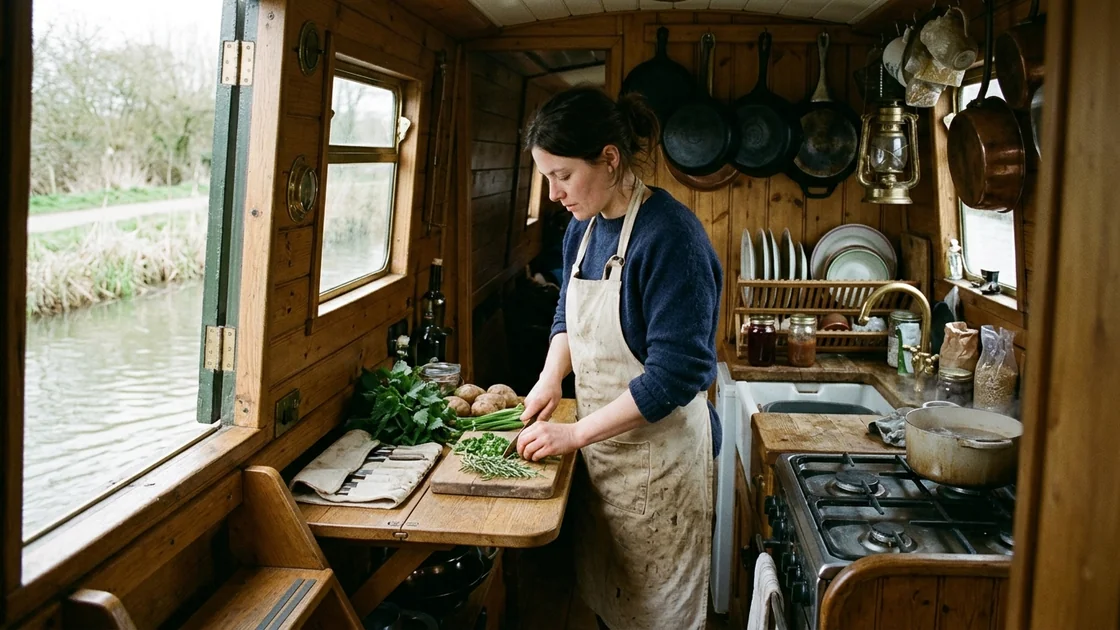
Clara Vane was defined by the relentless heat, stopwatch precision, and Michelin ambition of her London restaurant until a catastrophic electrical fire reduced her life's work to cinder and ash. Desperate to escape the suffocating pity of the culinary world and her own paralyzing grief, she accepts a temporary position as sole cook aboard The Celandine, a twelve-berth hotel narrowboat chugging along the pastoral waterways of the English canals. Confined to a galley no wider than an armspan and governed by a three-mile-per-hour speed limit, Clara must unlearn the aggressive perfectionism of haute cuisine and rediscover the restorative power of food, finding along the reedy banks and gentle lock flights a quiet purpose she had long forgotten.
Chapter One: The Smell of Cold Ash
The smell never truly left the back of Clara’s throat. It was not the wholesome, cedar-sweet smoke of applewood chips smoldering beneath a cloche of smoked duck breast, nor the sharp, caramelized carbon of a dry-aged ribeye kissing a cast-iron skillet at six hundred degrees. It was the rancid, chemical stench of incinerated polymer, scorched copper wiring, melted silicone spatulas, and thirty years of accumulated grease trapped behind sub-floor ductwork, suddenly ignited into an uncontrollable inferno.
Orpiment had stood on a quiet, cobble-flanked corner in Bermondsey for four years. In its fourth year, it had earned its first star. Clara had slept on a fold-out camp cot in the dry store three nights a week to achieve that star. She had weighed shallots to the tenth of a gram. She had fired a commis for failing to keep his chiffonade uniform. She had sacrificed two relationships, a functioning meniscus in her right knee, and the entirety of her twenties and early thirties to the altar of the pass.
And then, on a Tuesday in November at three in the morning, a faulty compressor coil in the walk-in refrigeration unit had sparked.
By dawn, the dining room—with its bespoke lime-washed oak tables and hand-thrown ceramic side plates—was a cavern of blackened ribs. The kitchen, her gleaming temple of brushed stainless steel and induction plates, was a warped, toxic puddle. The insurance settlement had been swallowed instantly by commercial debts, equipment leases, and severance payouts. When the ledger was finally closed, Clara had twenty-two hundred pounds in her current account, a bruised blister on her heel from pacing her empty flat, and hands that shook whenever she tried to hold a knife.
For five months, she lived on instant noodles eaten directly from the pot and toast with salted butter, consumed while staring out the window of her fourth-floor flat in New Cross. Her knives remained zipped inside their heavy canvas roll, tucked beneath her wardrobe like an unexploded ordnance.
The call had come from Arthur Pendelton. Arthur was an old friend of her late father, an eccentric man who had spent forty years running an antique bookshop on Charing Cross Road before vanishing into the British waterways upon his retirement.
"I need hands, Clara," Arthur had said without preamble. His voice sounded like gravel being turned over with a rusty spade. "Mick took a tumble down the cellar steps at the pub in Devizes. Broken collarbone. He’s out for a month, maybe six weeks. The season starts on Saturday. The bookings are paid for. If I don’t have a cook, I have to cancel the charter, and if I cancel the charter, the boat goes under."
"Arthur, I don’t... I haven’t cooked since November," Clara had whispered. "I don’t cook anymore."
"Nonsense. Cooking isn't something you stop doing, like smoking or playing squash. It’s like having bad knees or blue eyes. Pack two sweaters and some non-slip shoes. Meet me at the Bradford-on-Avon wharf on Friday morning. If you hate it, you can get on a train back to Paddington after the first lock flight."
He had hung up before she could formulate an excuse.
Now, standing on the towpath of the Kennet and Avon Canal, Clara felt absurdly, violently out of place. She wore a tailored wool coat that felt too stiff, carrying a duffel bag and her canvas knife roll. The morning mist was thick, smelling of rotting weed, cold silt, and diesel exhaust. Moored against the stone quay was The Celandine.
She was seventy feet long, painted in traditional deep bottle-green and cream, with scrolled signwriting picked out in gold leaf along her sides: The Celandine – Hotel Narrowboat. Two brass mushroom vents gleamed atop her curved cabin roof, alongside two neatly stacked bundles of ash-wood kindling and an upside-down aluminum boarding plank. She was six feet and ten inches wide.
Clara looked at the vessel, then looked down the towpath, half-hoping for an excuse to turn around. A swan broke the mirror-flat surface of the water with a heavy, wet flap of its wings.
A hatch slid back with a metallic rattle. A young woman with a shock of untamed auburn curls, wearing bright yellow waterproof salopettes over a thick Guernsey jumper, popped her head out of the stern hatch.
"You must be Clara!" the girl yelled across the canal. "I’m Tamsin! Mate, deckhand, bilge-pumper, and chief mooring-rope hurler! Come aboard before the kettle boils dry; Arthur’s been pacing since six."
Clara stepped gingerly onto the wooden gunwale, feeling the boat list half an inch under her weight. That tiny, fluid shift underfoot sent an unexpected jolt through her spine—an immediate reminder that here, nothing was anchored to concrete foundations.
Chapter Two: The Galley
The interior was timber-clad, cozy to the point of claustrophobia, smelling of beeswax, paraffin, and stewed tea.
Arthur was sitting at the tiny dinette table, an oversized ceramic mug cradled in his liver-spotted hands. He looked precisely as he had at her father’s funeral: tall, stooped, with eyebrows resembling overgrown hedgerows and a thick woolen scarf wrapped thrice around his neck despite the mild spring air.
"You look awful, Clara," he said cheerfully, standing up and bumping his head lightly against the tongue-and-groove pine ceiling. "Like a turnip left in the bottom of a larder."
"Good to see you too, Arthur," she said, setting her duffel bag down. It blocked the narrow corridor entirely.
"Come on, no time for sentimental drivel," Arthur said, waving her forward. "Tamsin will show you the galley. Guests arrive at four. Eight of them. A retired headmistress, two couples from Gloucestershire who do birdwatching, an American fellow writing a book on canal engineering, and two sisters from Leeds. They expect three meals a day, afternoon tea with cake, and they’ve all paid handsomely for the privilege of moving at three miles per hour."
Clara squeezed past him into the galley. When she saw it, her breath hitched.
At Orpiment, her line had featured eight induction rings, a combi-steam oven that connected to an iPad, an under-counter blast chiller, a commercial sous-vide bath with digital circulation, and six meters of pristine stainless-steel prep tables under daylight-spectrum halogen lamps.
The galley of The Celandine was approximately seven feet long by four feet wide.
On the port side sat a domestic four-burner gas hob fed by LPG bottles, with an oven below it that appeared barely large enough to roast a moderate chicken. There was a sink the size of a washbasin, fitted with a brass hand-pump mixer tap. Above the counter hung an array of hooks holding cast-iron pans that looked as though they had survived the Blitz. The refrigerator was a 12-volt under-counter box that hummed like an angry wasp and had a capacity roughly equivalent to an oversized shoebox.
"Where is the prep station?" Clara asked, her voice dangerously flat.
Tamsin tapped a hinged slab of oak that folded down over the steps leading to the saloon. "Here! You pull this down, and you’ve got a board. Just make sure nobody wants to leave the boat while you’re chopping onions, or you have to fold it back up again."
"Where is the walk-in?"
Tamsin laughed, a bright, barking sound. "The walk-in? Clara, darling, look outside. The whole country is the walk-in. We buy bread from the bakeries at the locks, eggs from the farm gates, and whatever dry goods fit in the bilge storage under the guest berths."
Clara knelt and tugged at a hatch in the floorboards. Beneath lay a dark, steel-ribbed void containing crates of tinned tomatoes, sacks of flour, jars of preserves, and dozens of bottles of ale, all nestled against the cold steel of the hull, just inches above the canal water.
"Power?" Clara asked weakly.
"Engine charges the battery bank while we’re cruising," Arthur called from the table. "When we’re tied up, it’s batteries and inverter. No blenders, no electric whisks, no immersion circulators, and for God’s sake, don’t plug in a hairdryer or you’ll trip the master breaker and kill the bilge pumps."
Clara stood up slowly. Her temple was throbbing. "Arthur, this is insane. I cook with precision. I balance acidity against heat using controlled variables. I don’t cook out of a bilge cupboard on a camping stove."
"Good," Arthur said, his eyes glittering behind his smudged spectacles. "Precision didn't do you much good when the wiring melted, did it? Here, you cook with what’s in front of you. You cook with the water. Now unpack your knives. We cast off in three hours."
Chapter Three: The First Crossing
The guests arrived with an alarming mountain of luggage that Tamsin somehow Tetris-stacked into their compact wood-paneled cabins.
There was Mrs. Henderson, an imposing woman with silver hair cropped like a hedge; Harold and Marjorie, the birdwatchers, who wore matching fleece vests with eighteen pockets each; Peter, the American engineer who immediately produced a notebook and began measuring the thickness of the gunwales; and the sisters from Leeds, Joan and Brenda, who arrived clutching boxes of ginger biscuits and laughing at everything.
"We’re so excited!" Joan proclaimed, peering into Clara’s galley. "Are you the chef? Oh, aren't you tiny! What’s for dinner tonight? We love a good casserole. Nothing with funny squid ink, mind."
Clara forced a professional smile that felt like dry paper on her lips. "Tonight will be braised shin of beef, potato puree, and glazed heritage carrots, Mrs... Joan."
"Oh, lovely! Homemade gravy?"
"Yes," Clara said through her teeth. "Homemade."
At precisely four-thirty, Arthur fired up the engine.
The engine was a vintage Lister two-cylinder diesel, and when it roared to life, The Celandine did not merely start; she awoke with an earth-shaking, rhythmic thumping that reverberated through the iron hull, into the floorboards, through the soles of Clara’s clogs, and up into her molars. Thump-chug, thump-chug, thump-chug.
Clara grabbed the edge of the counter as the boat surged forward. On the hob, a pot of salted water shifted an inch to the left.
"Center your pans on the trivets!" Tamsin yelled down from the rear hatch, where she stood by the tiller. "And always keep the kettle half-full! If it’s full to the brim, it’ll splash out when Arthur hits a bridge hole!"
"When he what?" Clara yelled back.
Before Tamsin could answer, there was a dull, echoing clonk from the front of the boat, accompanied by a scraping sound of iron meeting limestone. The Celandine shuddered. A bottle of olive oil slid across the fold-down board, and Clara lunged forward, catching it by the neck just before it smashed against the floor.
"Bridge hole number seven!" Arthur hollered cheerfully through the hatch. "Bit tight! Narrowed by silt! Don't mind the paint, Tamsin, it'll buff out!"
Clara stood in the cramped galley, clutching the olive oil bottle, her heart hammering against her ribs.
This was not cooking. This was combat inside an elongated biscuit tin.
She turned her attention back to the stove. The beef shin was browning in her heavy enameled pot. Without an industrial extractor fan, the galley instantly filled with sweet, caramelized steam. She flipped the meat with tongs, irritated to find that the gas burner had an uneven flame—the left side hissed with vigorous blue heat while the right guttered in an orange lazy tongue.
"Adjust the collar," she muttered to herself, then remembered she didn't have an engineer on staff. She simply slid the pot two inches off-center to balance the heat.
She peeled potatoes. In Bermondsey, she would have riced them, passed them twice through a fine tamis sieve, and emulsified them with an obscene ratio of chilled cultured butter—fifty percent butter to potato by weight—until the puree had the consistency of poured silk. Here, she had a hand masher with a bent wire handle and half a block of unsalted supermarket butter.
Outside the tiny galley porthole, the world was gliding past with agonizing slowness.
A weeping willow dipped its lime-green fronds into the water, scraping softly against the brass rim of the glass. A moorhen darted out from the reeds, trailing two fluffy black chicks behind her. The canal was flat, green, and quiet, save for the steady heartbeat of the Lister engine. The sun was dipping below the crest of the Wiltshire downs, turning the muddy water into a band of beaten copper.
Clara chopped rosemary. Without the high-pitched shriek of commercial dishwashers and the bark of kitchen tickets, the rhythmic tick-tick-tick of her French carbon steel knife against the wooden board sounded remarkably loud.
The scent of the herb—resinous, sharp, clean—rose into the warm air of the cabin. For a fraction of a second, the phantom smell of ash in her throat subsided.
Chapter Four: The Rhythm of Three Miles an Hour
Dinner was served at seven on the saloon’s communal mahogany table.
Clara plated the dishes onto vintage mismatched ceramic plates that Arthur had salvaged from jumble sales. The shin of beef had braised for three hours in local ale, onions, and beef stock until the meat yielded at the slightest nudge of a fork. The mashed potatoes were rustic, flecked with chopped chives and black pepper.
She carried the plates out one by one, balancing against the gentle roll of the boat as Arthur brought them to a stop for the night, mooring against the bank near Avoncliff.
She set the plates down before the guests, her stomach clenched in an old, familiar knot of dread. At Orpiment, a customer once sent back an entire tasting menu because the temperature of the langoustine carpaccio was two degrees too high.
Joan took a mouthful of the beef. She stopped, chewed slowly, and closed her eyes.
"Oh," Joan said. "Oh, goodness."
Clara braced herself. "Is the seasoning incorrect?"
"It tastes like my mother’s Sunday dinner," Joan said softly, opening her eyes, which were distinctly moist. "If my mother had been a genius. It tastes... like someone took a great deal of trouble to make us feel safe."
Brenda nodded vigorously, her mouth already full. "It’s marvelous, love. Simply marvelous. Sit down and have a glass of cider with us!"
"I... thank you, but I have to scrub the pans," Clara said, feeling a strange, prickling warmth rise up her neck.
"Scrubbing can wait five minutes, Clara," Arthur said from the head of the table. He had already poured her a glass of cloudy farmhouse perry. "The canal isn't going anywhere. It’s been here since 1810, and it doesn't give a damn about your schedule."
Clara hesitated. Her instincts screamed at her to clear, sanitize, reset the line for morning mise-en-place, check the temperatures on the log, and review invoices. But there were no logs. There were no invoices.
She sat down on the edge of the cushioned bench. The cider was tart, crisp, smelling of bruised autumn apples and cellar earth. She took a sip, then another.
Through the window, across the dark towing path, the woods rose steep and black against a lavender sky. An owl called, two short, mournful notes that hung in the still air.
That night, Clara slept in the tiny rear berth adjacent to the engine compartment. The bed was a narrow bunk built into the curve of the hull, barely wider than her shoulders. When she lay down, her cheek was only six inches from the cold steel plating. She could hear the canal water lapping against the metal—slap, gurgle, sigh—a liquid lullaby that seemed to vibrate directly through her temples.
For the first time in six months, she did not dream of fire.
Chapter Five: The Locks of Caen Hill
By the third day, the canal ceased to be a picturesque postcard and became an unrelenting physical reality.
They reached Devizes, where the flight of twenty-nine locks at Caen Hill rose before them like a liquid staircase climbing into the heavens.
"Two miles," Tamsin declared over breakfast, which Clara had served at seven: sourdough toast with poached duck eggs, smoked back bacon, and a pot of coarse marmalade she had sweetened with dark brown sugar. "Twenty-nine locks. Sixteen of them in a straight, terrifying line. We need every hand on the windlasses."
"I have to bake the scones for afternoon tea," Clara protested, wiping down the tiny laminate counter.
"The scones will wait, Chef," Arthur said, pulling on a leather pair of work gloves. "If we don’t have a body at the ground paddles, we’ll be stuck in the pound until Michaelmas. Put your boots on."
A lock, Clara quickly discovered, was an ingenious, brutal machine of cast iron, heavy oak, and thousands of tons of crushing water.
Tamsin thrust a heavy iron handle—a windlass—into Clara’s hands. "You put it on the spindle, like this. Turn clockwise to raise the rack and open the paddle. But keep your fingers clear of the ratchet! If it slips and spins back, it’ll break your wrist clean in two."
Clara stood on the moss-slick limestone coping of the first lock chamber. Below her, The Celandine floated, looking like a toy boat in a deep stone bathtub.
Clara leaned her weight against the windlass. The iron gears groaned, stiff with grease and rust. Her muscles screamed; her palms, softened by years of holding knives and tasting spoons, burned against the cold iron. Slowly, the wooden sluice gate lifted.
A foaming, roaring torrent of brown water erupted into the chamber, boiling white around the boat’s bow. Clara watched, mesmerized and terrified, as the water level dropped, taking the seventy-foot steel craft down into the gloom.
"Now walk it down!" Tamsin shouted from across the lock. "Throw your hips against the balance beam!"
Clara set her backside against the heavy timber beam of the lock gate and pushed. For three seconds, nothing happened. The sheer weight of the water held the gate fast. Then, with a sucking, hollow thud, the seal broke. Clara heaved, her feet slipping on the wet grass, until the massive wooden door swung open into the recess of the stone wall.
She looked down at her hands. They were caked in black gear grease, lichen, and grit. Her nails were chipped. Her fleece smelled of river water and sweat.
She looked down at the boat. Through the saloon window, she could see her tidy little galley waiting for her. And suddenly, she felt a wild, bubbling burst of laughter in her throat.
In London, she had considered herself a master of elements. She had manipulated heat, ice, air, and nitrogen. But she had never moved ten thousand gallons of water with her own shoulders just to boil an egg two miles further up the valley.
When they finally moored in the long pound above lock forty-four, the sun was at its zenith. Clara retreated to the galley. Her arms were trembling with exhaustion, but her mind was clearer than it had been in years.
She had no rolling pin. She wiped down an empty glass bottle of cider with a damp cloth, dusted the fold-down board with flour, and mixed a batch of scones by hand, cutting cold butter into the flour with her fingertips until it felt like coarse sand. She folded in a handful of dried cherries and a splash of buttermilk she had bought from a farmer’s wife who had been leaning over a swing-bridge three miles back.
When the scones came out of the unpredictable gas oven, they were unevenly browned—one side pale gold, the other deeply caramelized where the burner flared.
She carried them out onto the towpath on a wooden board, accompanied by a bowl of clotted cream and strawberry jam.
The guests were sitting on folding chairs beneath an ancient ash tree, their faces flushed from walking the flight. Peter, the American engineer, took a warm scone, broke it apart with his fingers, and smeared it with cream.
"Clara," he said reverently, looking up at her through his wire-rimmed glasses. "This is better than anything I’ve eaten in Paris."
"It’s unevenly baked," she said reflexively. "The heat distribution in the lower deck is completely inconsistent."
Peter smiled. "That's not an inconsistency, Clara. That’s character. You can taste the woodsmoke and the canal air on the crust."
Clara looked at the scone. For the first time, she didn't see an error. She saw something made with flour, fire, and her own bruised hands, offered to people who were genuinely hungry.
Chapter Six: The Towpath Larder
As the days blurred together, marked only by the succession of swing bridges, aqueducts, and stone villages, Clara’s cooking began to mutate.
She stopped looking at the galley as a compromised, broken version of Orpiment. She began to look at it as an extension of the canal itself.
One morning, while Arthur was waiting for a maintenance crew to clear a sunken willow branch from the navigation channel near Hungerford, Clara took a walk along the towing path.
The hedgerows were exploding with spring growth. Beneath a dense tangle of hawthorn, she caught a sharp, unmistakable scent—pungent, garlicky, and green.
She knelt down. Wild garlic. Thousands of tender, spear-shaped leaves carpeted the damp earth beneath the trees.
Beside them grew young stinging nettles, their upper leaves vibrant and tender, and mounds of wood sorrel with its clover-like leaves that tasted of sharp, clean green apple.
Clara pulled an apron from her pocket and began to forage. She picked the nettle tips with her bare fingers, ignoring the mild prickle of their stings; after the Caen Hill lock paddles, her fingertips were numb to minor discomforts. She gathered wild garlic until her canvas apron was bulging.
Back in the galley, she blanched the nettle tops in boiling salted water for thirty seconds, quenching their sting instantly and turning them an electric, emerald green. She pureed them with garlic leaves, a wedge of mature farmhouse Cheddar she had acquired at a lock-side dairy, and toasted walnuts, working the mixture by hand in a heavy stone mortar Arthur used as a doorstop.
That evening, she served hand-rolled potato gnocchi tossed with the wild nettle pesto, topped with shaved cheese and a drizzle of cold-pressed rapeseed oil.
Harold, the birdwatcher, took a mouthful and looked out the window at the canal bank where Clara had been foraging three hours earlier.
"Good lord," Harold murmured. "We’re eating the scenery."
"It’s wild garlic from the bank by bridge seventy-two," Clara said, leaning against the doorframe, a tea towel tucked into the waistband of her apron. "And the nettles grew right behind the lock cottage."
Marjorie, his wife, beamed at her. "Do you know, Clara, we’ve taken canal holidays for twelve years. Usually, it’s tinned ham and baked beans out of a saucepan. We never imagined you could live like this on the water."
"Neither did I," Clara confessed softly.
Later that night, after the dishes were washed and stacked in their grooved racks, Clara sat on the stern deck with Arthur. The engine was silent. The only sound was the rustle of the wind through the tall phragmites reeds and the occasional hollow plop of a water vole diving from the bank.
Arthur lit an old briar pipe, the tobacco smelling of rum and dried fruit.
"You’re cooking differently," he observed, watching the smoke drift up toward the cold stars.
"I’m cooking with no space," Clara replied. "And no tools."
"Space and tools are distractions for people who have nothing to say," Arthur grunted. "My grandfather was a ship’s cook on a coal collier. He fed forty men off two cast-iron griddles in the middle of the North Sea. He used to say that a chef cooks for his own glory, but a ship’s cook cooks so the crew doesn't jump overboard."
Clara looked down at her hands. The calluses were hardening now. The blisters had healed into tough, pale pads.
"I thought I died when the restaurant burned, Arthur," she said, her voice barely louder than the lapping water. "I thought the person who knew how to make things taste good had burned with it."
Arthur took the pipe from his mouth. "The restaurant was just a room with some expensive tiles, Clara. You weren't in the walls. You were in the hands. The hands are still here."
Chapter Seven: The Storm at Savernake
The weather broke as they approached the Savernake Forest.
The sky, which had been a soft, pearlescent gray all morning, curdled into the color of a bruised plum. The wind picked up from the southwest, whistling through the television aerial and whipping the surface of the canal into brown, frothy chop.
"Gale warning!" Tamsin yelled down the companionway. "We need to clear the summit level before the squall hits! If the wind catches the bow in the cutting, we’ll be pinned against the bank until tomorrow!"
Arthur was at the tiller, his yellow oilskins gleaming in the gathering gloom. The Lister engine was working hard, its deep, chugging pulse quickening to an urgent rhythm.
Inside the galley, Clara was preparing dinner for the final night of the charter.
The menu was ambitious: a slow-roasted shoulder of pork, braised red cabbage with spiced vinegar, and individual steamed ginger puddings with custard.
Then the boat hit the open waters of the high cutting, and the full force of the wind slammed into her side.
The Celandine listed violently to starboard.
In the galley, chaos erupted.
A ceramic mixing bowl slid off the counter, smashing into three pieces against the floorboards. The pot of braised cabbage leapt from the hob, spraying dark purple, vinegar-scented liquid across the white laminate wall. Clara lunged across the narrow space, slamming her hip against the sink to wedge herself into position.
"Arthur!" she yelled, but her voice was swallowed by the roar of the wind through the beech trees above the cutting.
The boat heaved again as Arthur fought the tiller against the gale. A drawer flew open, spewing wooden spoons and spatulas onto the deck.
Clara stood braced in the center of the tilted galley, her feet planted wide, her back pressed against the opposite cupboard.
For a heartbeat, the old panic flared in her chest. She saw flames. She saw destruction. She saw everything she had built collapsing into ruin around her.
No, she thought. Not this time.
She reached down, picked up the enameled roasting tin containing the pork, and wedged it firmly into the lower rack of the oven, latching the heavy door shut. She grabbed a rag, dropped to her knees, and wiped up the spilled cabbage before someone could slip on it. She retrieved the surviving spoons, jammed the drawer shut, and secured it with a length of jute twine she pulled from her pocket.
The boat shuddered. The bow struck the muddy bank with a soft, sucking impact, then ground to a halt.
Silence fell, broken only by the drumming of torrential rain against the steel roof.
Tamsin tumbled down the hatch, dripping wet, her face pale. "Is everyone alright? The engine choked on some polythene someone threw in the water! Arthur had to run her into the mud to keep us from broaching across the cut!"
Clara stood up from the floor, wiping sweat and braising liquid from her forehead.
"The red cabbage is half on the wall," she said, her voice remarkably calm. "And I lost a bowl."
"Can you still serve?" Tamsin asked anxiously. "The guests are terrified. Marjorie is clutching her binoculars like a life preserver."
Clara looked at her oven. The rich, garlicky aroma of roasting pork was already beginning to seep from the vents, mingling with the scent of ginger and dark treacle from the steamer pot.
"Tell them dinner will be fifteen minutes late," Clara said. "And open two bottles of the heavy Rioja from the bilge."
Chapter Eight: The Feast of the Mud-Bound
They ate by the light of three brass paraffin lamps, while the rain lashed the windows and the ancient beeches of the Savernake Forest creaked in the dark outside.
The table was crowded. Because the boat was resting at a five-degree list in the mud, Clara had improvised: she set damp dish towels beneath the plates to keep them from sliding, creating a rustic, patchwork table runner.
The pork was spectacular. The skin had blistered into shards of amber crackling that shattered under the knife, while the meat beneath had collapsed into tender, juicy ribbons infused with fennel seed, garlic, and cider. To replace the ruined cabbage, Clara had raided the bilge for a jar of pickled walnuts, slicing them thin and tossing them with shaved raw apples and bitter watercress she had gathered near the last lock.
The guests ate with an intensity born of shared survival.
"I thought we were going over," Julian, the American, confessed, his cheeks flushed with wine. "I swear, when the boat tilted, I saw my whole life pass before my eyes. Mostly unpaid library fines."
"Arthur knows what he’s doing," Brenda said firmly, buttering a thick crust of bread to mop up the pan juices. "A little mud never hurt anyone. And frankly, if I have to drown, I’d prefer to do it with Clara’s pork crackling in my mouth."
Laughter rippled through the small cabin, warm and genuine.
Clara watched them from the galley opening. She was wearing an oversized wool cardigan over her apron, her sleeves pushed up to her elbows. She felt no compulsion to retreat to the shadows. She felt no terror that a critic might find the sauce insufficiently clarified or the plating too unrefined.
Here, in this iron belly resting in the Wiltshire mud, food was doing what food was originally invented to do: it was keeping the cold away. It was binding eight strangers together against the howling dark outside.
Later, when the puddings had been scraped clean to the last drop of vanilla custard, Arthur climbed down into the saloon, his hair plastered to his forehead, his face gray with fatigue.
"Shaft is clear," he announced gruffly. "Tamsin went down with the weed-hatch knife. Cut away two fertilizer bags and an old bicycle inner tube. We’re floating free on the morning tide."
He looked at the empty plates, then at Clara.
Clara stepped into the galley and emerged with a plate she had kept warm over a pot of steaming water: three thick slices of pork, crackling, roasted potatoes, and a generous lake of pan gravy.
Arthur sat down at the corner of the table. He didn't speak. He simply picked up his fork and began to eat. As he took his third bite, his shoulders dropped two inches, the tension draining out of his old frame.
He looked up at Clara, his rheumy eyes soft behind his spectacles.
"Good girl," he whispered.
Chapter Nine: The Crossroads at Pewsey
The charter ended two days later at the Pewsey wharf.
The sun had returned, washing the canal in brilliant, clean spring light that turned the young reeds emerald green and set the water sparkling like scattered diamonds.
The guests departed with long hugs, handshakes, and promises to return next season. Joan pressed an envelope into Clara’s hand, which Clara later discovered contained sixty pounds and a handwritten recipe for Yorkshire curd tart, signed With endless gratitude, Joan & Brenda.
When the last taxi had rattled away down the lane, the boat fell into an astonishing, heavy quiet.
Clara sat on the gunwale, her feet dangling over the water, watching the ripples spread from a family of mallards cruising past.
Arthur approached, carrying two mugs of coffee and an envelope with an embossed London postmark.
"Post was waiting at the wharf office," Arthur said, handing her the mug and the letter.
Clara recognized the heavy cream parchment immediately. It was from Marcus Vance, her primary investor at Orpiment.
She slit the envelope with her thumbnail.
The letter was concise, professional, and dripping with corporate optimism. The final insurance settlement had cleared. Vance had secured a lease on a new site—not in Bermondsey, but in Mayfair, on Albemarle Street. Twice the square footage. A budget for a twelve-seat chef’s counter, a bespoke charcoal hearth imported from the Basque Country, and an executive salary that was nearly triple what she had paid herself at Orpiment.
We can be open by September, Marcus wrote. The narrative is perfect. The phoenix rising from the ashes. London is waiting for you, Clara. Call me the moment you receive this.
Clara held the paper in her hands. The breeze coming off the downs rustled the heavy parchment, making it flutter against her knuckles.
Five months ago, this letter would have been a reprieve from a death sentence. It would have meant redemption. It would have meant that her life had not been permanently derailed by a spark in a refrigerator coil.
She closed her eyes.
She pictured the Albemarle Street kitchen. She saw the white tiles, the hum of the high-velocity extraction system, the clipboards, the food cost spreadsheets, the PR consultants discussing brand identity, the silent, terrifying judgment of the Michelin inspectors sitting at table four, dissecting each micro-herb with their silver forks.
She remembered the camp cot in the dry store. She remembered the taste of cold bile in her throat before every Saturday night service. She remembered the feeling of being entirely alone in a room full of twenty people who worked for her.
She opened her eyes.
Before her lay The Celandine.
The green paint on the cabin side was scratched where Arthur had nudged bridge thirty-two. The brass mushroom vents were tarnished with water spots. In the galley, the gas bottle was nearly empty, and the hand-pump tap had developed a squeak that sounded like a distressed mouse.
Tamsin was on the roof, barefoot, sweeping away beech leaves with a broom made of birch twigs, singing a bawdy canal ballad at the top of her lungs.
"Well?" Arthur asked, leaning against the timber balance beam of the nearby swing bridge, puffing on his pipe. "Does London want its star back?"
Clara looked at the letter again. Then, with slow, deliberate care, she folded the cream parchment in half, then in half again, and tucked it into the pocket of her oilskin jacket.
"Arthur," she said.
"Aye?"
"How much does Mick make a week?"
Arthur’s eyebrows twitched. "Two hundred pounds and all the diesel he can burn. Plus board."
"I want two-fifty," Clara said. "And I want five hundred pounds to buy a proper copper sauté pan and replace that ridiculous hand masher."
Arthur stared at her for three long seconds. The pipe smoke curled lazily around his ears.
"Mick’s collarbone is healed," Arthur said softly. "He called yesterday. He wants to go back to his sister’s farm in Shropshire. Said his boating days are done."
Clara looked out across the canal. A pair of kingfishers darted low over the water, a streak of electric turquoise and copper that vanished into the shadows of the willows.
"The season runs until November, doesn't it?" she asked.
"November," Arthur agreed. "Then we lay up at the basin in Oxford for the winter. We paint the hulls, overhaul the Lister, and sit by the coal stove until the frost breaks."
Clara stood up. She reached down, took her knife roll from where it sat on the deck, and carried it back down into the cabin.
She unzipped the canvas. She took out her favorite chef’s knife—the eight-inch carbon steel blade that had sliced truffles in Mayfair and dived into wild garlic by the Kennet.
She set it on the little oak folding board.
"Tamsin!" Clara called through the roof hatch.
"Yeah, Chef?"
"Where’s the next charter boarding?"
"Hungerford!" Tamsin yelled back, her grin audible through the timber. "Tomorrow at three! Ten people this time! One of them’s a vegetarian!"
Clara smiled, a slow, deep smile that reached all the way to her eyes.
"Tell Arthur to cast off," she said, picking up her sharpening stone. "I need to go find some nettles."