The Sister in the Silver Frame
When veteran wedding photographer Clara Vance sits down in her coastal studio to cull thousands of frames from the opulent Aldridge-Montague nuptials, she expects only the usual blur of silk, white lilies, and performative high-society elegance. Instead, buried in the soft-focus bokeh of an incidental candid, she spots an unmistakable silver crescent scar and the haunted hazel eyes of her older sister, Maya, who vanished without a trace from a seaside boardwalk twenty years ago. Armed only with her lenses, raw image files, and decades of unresolved grief, Clara enters the insular world of the East Coast elite, unraveling a labyrinth of assumed identities, generational secrets, and a devastating family truth that forces her to reconsider everything she thought she knew about the sister she mourned.
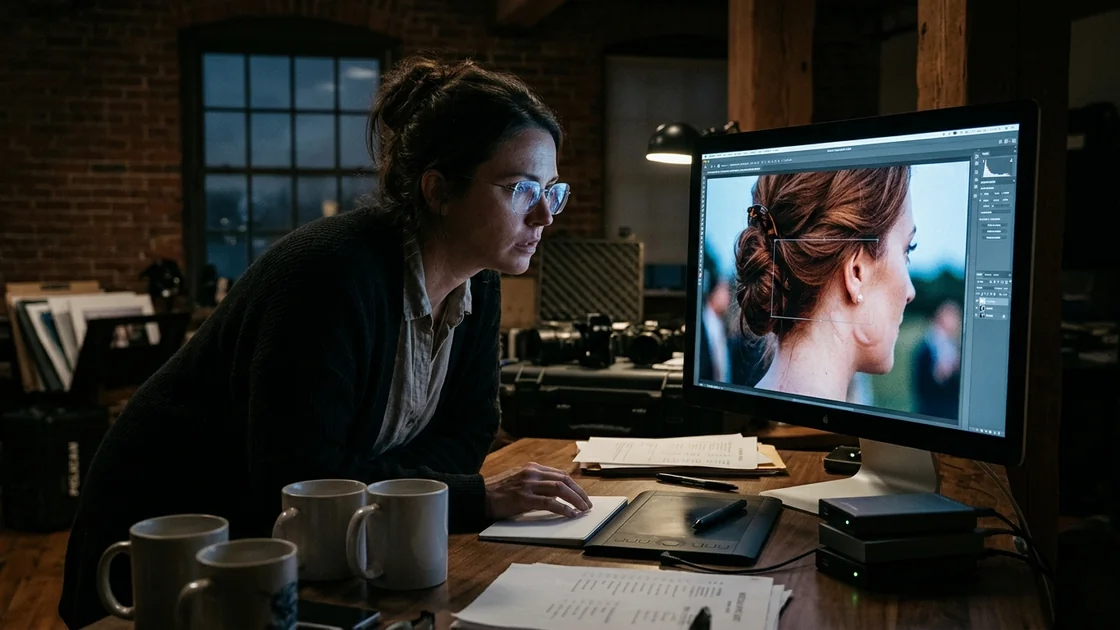
The monitor glow was the only source of light in the third-floor loft of the converted brick tannery. It cast a cool, surgical blue across Clara Vance’s cheekbones, reflecting off the rimless glasses she wore only when the fatigue set in past 2:00 a.m. On the desk sat three empty mugs with dried rings of dark roast, a hard drive humming a steady low-frequency vibration against the walnut wood, and an oversized graphics tablet worn smooth in the center where her stylus had traced millions of micro-adjustments across ten years of professional photography.
Her eyes burned. Wedding photography at this level was not art in the bohemian sense; it was forensic diplomacy. The event was the marriage of Genevieve "Evie" Aldridge to Julian Montague III, an alliance of Manhattan commercial real estate and Rhode Island old money that had occupied three hundred acres of seaside lawn outside Newport over the weekend. They paid twenty-five thousand dollars for Clara’s discretion, her calibrated color science, and her supernatural ability to make three-hundred-year-old bloodlines look timeless rather than inbred.
She was working through Batch D: the cocktail terrace before the reception dinner, right as the maritime twilight turned the Atlantic into hammered pewter.
Clara clicked the right arrow on her keyboard. Frame 4,810. A cluster of groomsmen laughing around crystal tumblers of scotch; she flagged it for deletion because Julian’s eyes were half-shut in a blink.
Frame 4,811. Julian’s father gesturing with an unlit cigar, his linen jacket crisp, laughing at some private joke with an appellate judge. Keep. The light was flattering, catching the sea spray over the stone balustrade.
Frame 4,812.
It was a wide shot taken with an 85mm prime lens at f/1.4—a shallow depth of field designed to isolate the bride, who had stepped aside near a marble fountain to adjust the clasp of her diamond bracelet. Evie was radiant, her ivory lace gown rendered in luminous, velvet clarity. The focus fell sharply on the intricate seed pearls sewn into her bodice, the tender curve of her neck, and the slight, nervous tremble visible in her parted lips.
Everything beyond Evie was supposed to be irrelevant. The background was an impressionistic wash of manicured boxwoods, twilight sky, and out-of-focus guests lingering near the marquee stairs.
Clara’s hand hovered over the keyboard to press the right arrow.
Then her wrist locked.
In the far right quadrant of the frame, twenty feet behind the bride and partially obscured by the shadow of an Italian cypress, a woman was standing alone. She was turned three-quarters away from the revelry, her head tilted slightly toward the open ocean as if listening to the tide crash against the granite cliffs below. The light from a bronze path lantern caught the left side of her throat and jawline.
Because the lens was wide open, the woman was soft—a collection of diffuse pixels, cream silk, and dark auburn hair swept up in a loose French twist held by an antique tortoiseshell pin.
Clara leaned in until her breath fogged the anti-glare coating of the display. She wiped the glass with the sleeve of her cardigan.
With two fingers on the trackpad, she punched in. One hundred percent crop. Two hundred percent. Four hundred percent.
At that magnification, the image broke down into its elemental grains—the Bayer pattern of the 45-megapixel sensor struggling to interpolate low-light shadows. Yet the lens was a masterpiece of German engineering; even in the falloff, the contours remained intact.
Beneath the woman’s left ear, right where the jaw met the mastoid process and angled down toward the clavicle, was a tiny, pale mark. It was not a wrinkle, nor a trick of compression. It was a half-inch crescent of fibrous, pigmentless tissue—a scar left by the jagged lid of an opened peach tin on a rusted fire escape in 1999.
Clara’s thumb pressed hard against her own left index finger, digging the nail into the skin to ground herself. The room felt suddenly devoid of air, the hum of the external drives swelling until it sounded like roaring water.
"No," Clara whispered to the empty room. "You’re tired. You’re seeing patterns in the static."
She backed out to the full image. Then she zoomed in again.
The posture was what undid her. It was the specific, asymmetrical drop of the left shoulder—the result of a childhood collarbone fracture that had set slightly crooked after a spill from an old tire swing behind their grandmother’s house in Maine. The woman’s right hand was resting against the stem of a champagne glass, her pinky finger curled inward, the knuckle slightly prominent.
Maya.
Maya Vance had walked out of a carnival midway on the boardwalk of Old Orchard Beach on July 14, 2004, to buy two bags of fried dough while twelve-year-old Clara waited by the Ferris wheel. She had seventeen dollars in her pocket, a pink plastic watch, and a denim jacket with an embroidered sunflower on the collar. She had never come back.
For two decades, Clara had looked for that jawline in subway cars, in airport terminals, in the back rows of crowded lecture halls, and among the nameless faces of missing persons databases that her mother used to print out until the printer ribbons ran dry and the house smelled like chemical toner and despair. They had held a memorial service eight years in, an empty casket buried under a granite marker that read Beloved Daughter and Sister, Kept in the Palm of His Hand. Their father had died of a sudden, merciful stroke three years after that; their mother lived now in a memory-care facility outside Boston, her mind having retreated behind an impenetrable white fog where it was always July of 2004 and the fried dough was just getting cold.
Clara reached for the shot list provided by the wedding planner, an imperious woman named Sloane who ran events with the logistical precision of a naval invasion. Her hands shook so violently that the glossy, laminated pages rattled against the desk.
The Aldridge family was small. The groom’s side was vast. Clara found the breakdown for the family portraits taken earlier that afternoon on the grand lawn.
Family of the Bride: Arthur Aldridge (Father) Victoria Aldridge (Deceased) Eleanor Vance-Aldridge? No. Clara scanned the names under the bride's immediate party.
There: Arthur Aldridge and his wife, Mrs. Arthur Aldridge (Cynthia).
Clara blinked at the name. Cynthia.
She opened the folder containing the formal family groupings from 3:30 p.m. She had shot two hundred variations of Arthur Aldridge—a hawk-nosed patriarch of sixty-eight with silver hair, a tailored morning coat, and the dead, transactional eyes of a corporate raider—standing beside his young, brilliant daughter Evie.
And beside Arthur stood his wife.
Clara had photographed her for forty-five minutes straight that afternoon. Why hadn't she seen it then?
She opened the formal portraits and pulled up Frame 1,104.
In the midday sun, under the harsh, direct illumination of a beauty dish held by her assistant, the woman named Cynthia Aldridge was impeccably, ruthlessly disguised. Her hair was not the unruly, curly russet of the girl Clara had idolized; it was dyed a deep, glossy chestnut, smoothed into an architectural blowout that looked as though it could withstand an offshore gale. Her nose was narrower at the bridge than Maya’s had been—rhinoplasty, subtle but undeniable. Her teeth were veneers, straight and porcelain-white, erasing the slight overlap of the lower incisors that had given Maya her lopsided grin. She wore a bespoke champagne silk sheath by an Italian designer, diamonds at her throat, and an expression of chilled, patrician composure that Clara had seen on a hundred different society matriarchs from Palm Beach to Bar Harbor.
During the portraits, Cynthia had worn dark sunglasses until the moment the shutter was ready, claiming a migraine from the glare off the water. When she removed them, she had looked past Clara, her gaze fixed strictly on the center of the lens, never once meeting the eyes of the woman kneeling three feet away with a Canon R5 pressed to her face.
Clara remembered saying, "Chin up slightly, Mrs. Aldridge, please. Perfect. Hold that."
The woman had obeyed without a word, her lips set in a polite, practiced curve that never reached the hazel of her eyes. She had treated Clara like furniture, like a tradesperson hired to render a service, no more remarkable than the florist who pinned the boutonnieres or the caterer who circulated the canapés.
Clara dragged the high-noon portrait next to the candid taken at twilight.
She bypassed the altered nose. She bypassed the veneers, the smoothed forehead, the makeup that cost more than a month of Clara’s rent. She zoomed straight into the left earlobe.
Maya had pierced her own ears in their bathroom with an ice cube, a needle, and an apple half when she was fourteen. The left hole had torn slightly when she snagged it on a wool sweater three weeks later, leaving a microscopic notch in the bottom curve of the lobe.
There it was. A tiny, faint V-shaped dip in the flesh, weighted down by a five-carat South Sea pearl.
"It’s you," Clara said into the silence of the loft. The sound of her voice frightened her; it was cracked, thin, stripped of the professional calm she had cultivated for fifteen years. "It’s you, you miserable bitch. You were there."
The sun broke over the harbor in gray, watery bands, but Clara had not slept.
Her studio was strewn with archival prints. In the center of the floor, between the light stands and the backdrop rolls, lay three plastic storage tubs she hadn't opened since her father’s house had been cleared out.
Albums bound in cracked vinyl. Kodak 400 snapshots with the orange dates stamped in the bottom right corner: 08 12 ’98, 06 21 ’01.
Here was Maya at fifteen, sitting on the hood of their father’s rusted Volvo station wagon, scowling with that magnificent, teenage fury that Clara used to mistake for majesty. Here was Maya holding Clara by the ankles over the shallow creek behind the schoolyard, both of them hysterical with laughter. Here was Maya’s eighth-grade school portrait—the hazel eyes wide and bright, flecked with gold around the pupils, the right eyebrow possessing a sharp, natural arch that even the best aesthetician in Manhattan couldn't completely eradicate.
Clara had laid the old prints alongside twelve-by-eighteen proofs she had just run off her professional pigment printer.
The comparison was terrifying.
The girl in the faded drugstore print was messy, vibrant, smelling of cheap strawberry lip balm and clove cigarettes she hid under the loose floorboard in the hall closet. The woman on the semi-gloss paper was an artifact of immense wealth, a creature manufactured to exist within limestone mansions and private yachts.
How does a seventeen-year-old girl with seventeen dollars become Cynthia Aldridge, the wife of an equity titan with a foundation in her name and a seat on the board of the Metropolitan Opera?
Clara sat back on her heels, her knees popping in the quiet. She picked up her phone.
Her first instinct was to call the police. She imagined the conversation: Hello, Newport Police Department? I’d like to report that Cynthia Aldridge, who lives in an eight-million-dollar cottage on Bellevue Avenue, is actually Maya Vance, who went missing from a carnival twenty years ago.
They would laugh. Or worse, they would take a report, file it, call Arthur Aldridge’s lawyers out of courtesy, and within twenty-four hours Clara would find herself served with an injunction, sued for defamation, and blacklisted from every wedding coordinator from Boston to Philadelphia. High society did not tolerate hysterics, especially from the vendors they hired by the day.
She looked at her contact list. Her finger hovered over the number for the Saint Jude Memory Care Pavilion.
Mom, she thought. I found her.
The cruelty of that thought stopped her cold. What would she tell her mother? That Maya had been alive all along? That while their mother had spent five years wandering the beaches of Maine handing out fliers to tourists, while she had starved herself into a clinical depression that eventually dissolved her mind into dementia, Maya had been living ninety miles south, attending charity galas in silk gowns?
If it was true, it wasn't a miracle. It was an atrocity.
Clara stood up, went to the small stainless steel sink in the corner of the loft, and threw cold water over her face. She dried herself with a rough linen towel, staring into the mirror above the basin.
She and Maya had never looked identical. Maya had taken their mother’s auburn hair and sharp, avian features; Clara was built like their father—square-jawed, dark-haired, broad-shouldered, quiet. When Maya had vanished, Clara had retreated into the background of the house, terrified that any sound she made might interrupt the vigil her parents were keeping by the telephone. She had learned to be invisible. Photography had been a natural extension of that: to be present in the room, to witness everything, but to never be seen.
At the wedding, Clara had been wearing black slacks, an oversized black linen shirt, her hair scraped back into an austere bun, wearing heavy glasses instead of her usual contacts. She had looked like an anonymous technician. Maya hadn't recognized her because Maya hadn't looked at her.
"She didn't see me," Clara whispered.
She looked back at the table where the contract for the Aldridge-Montague wedding lay.
Section 8: Deliverables and Consultations. The client is entitled to one (1) in-person proofing session within seven business days of the event at a location of the client’s choosing, prior to the final master retouching and album layout.
Clara walked over to her desk, unlocked her phone, and opened her email.
She drafted a message to Sloane, the wedding planner, copying the
primary contact listed on the billing statement:
c.aldridge@aldridgecapital.com.
Dear Sloane and Mrs. Aldridge, she wrote, her fingers steady now, cold and purposeful. The initial culls for Evie and Julian’s gallery are completed ahead of schedule. Given the scale of the package and the historical significance of the Aldridge estate, I would like to offer the in-person preview tomorrow afternoon. I have several high-resolution proofs of the formal family groupings that require Mrs. Aldridge’s direct approval regarding skin tones and background retouching before we proceed to print. I can drive down to Newport tomorrow at two.
She read it twice. It was formal, deferential, entirely within the parameters of high-end client management.
She hit Send.
Fourteen minutes later, the reply came through. It wasn't from the planner. It was from the direct address.
Clara, the email read. Tomorrow at two is acceptable. Arthur is in Geneva until Thursday, so the Bellevue house will be quiet. Please use the garden entrance off the south terrace. My assistant will let you in. Best, Cynthia Aldridge.
The drive from Boston down through Fall River and over the Sakonnet River Bridge felt like traveling through a vacuum. Clara’s camera kit sat in the passenger seat: two Pelican cases containing her MacBook, a calibrated reference monitor, and a black leather portfolio containing five twelve-by-eighteen prints she had produced at dawn.
The sky was the color of zinc, heavy with the promise of rain that didn't fall, just hung in the air as salt-heavy mist.
Bellevue Avenue was lined with the stone walls of the Gilded Age: the Vanderbilts, the Astors, the Berwinds—monuments built by men who had bought their way into eternity with coal and steel. The Aldridge estate was slightly further down, closer to the ocean, hidden behind a wrought-iron gate set between twin pillars of rough-cut schist.
Clara buzzed the intercom at the gate.
"Yes?" a voice crackled through the speaker.
"Clara Vance. For Mrs. Aldridge. Photography proofs."
There was a five-second pause. A mechanical click followed, and the massive gates swung inward with a faint hydraulic hiss.
The driveway was crushed bluestone, curving through a grove of ancient European beeches whose silver trunks looked like elephants' legs. At the end of the turn, the house revealed itself: a chateau-style manor of limestone and slate, with high copper-clad dormers turned turquoise with age. It looked less like a home than a museum designed to withstand a siege.
Clara parked near the carriage house, out of view of the main entrance. She didn't touch her lenses. She took only the slim leather portfolio case and her laptop bag.
She walked around the flagstone path toward the south terrace. The smell of the ocean was immense here, mixed with the damp, earthy aroma of boxwood and English ivy. Through the French doors of the terrace, she could see a broad sunroom furnished in white wicker, low glass tables, and floor-to-ceiling windows looking out over a sloping lawn that ended at the cliff walk.
A young woman in a gray wool skirt and white silk blouse opened the door before Clara could knock.
"Miss Vance? I’m Blair, Mrs. Aldridge’s personal secretary. She’s just finishing a call with the preservation society. You can set up in the garden room."
"Thank you, Blair," Clara said. Her voice was remarkably steady.
The room smelled of tuberose and lemon oil. On the walls were original pastels—Mary Cassatt, Childe Hassam—framed in heavy, unreflective gold. There were no family photographs anywhere. In the houses of the truly established, photographs of loved ones were kept in silver frames on small tables in private dressing rooms, never displayed in public reception areas like vulgar souvenirs.
Clara set her portfolio on the glass-topped table. She did not open her laptop.
Behind her, the click of low heels on parquetry signaled an arrival.
"Miss Vance. Thank you for making the trip down on such short notice."
Clara turned around slowly.
Cynthia Aldridge stood in the archway. She was dressed for a quiet afternoon at home: cream cashmere trousers, an oatmeal-colored boatneck sweater, flat suede loafers. Her hair was pulled back with a simple tortoise clip. Without the heavy foundations of the wedding day, her skin looked translucent, older, showing the tiny lines around her eyes and mouth that thirty-seven years on earth inevitably carve out.
She was carrying a bone china mug. Her eyes—those bright, amber-flecked hazel eyes—looked directly at Clara for the first time.
Clara didn't blink. She waited for the recognition to strike, for the coffee cup to drop, for the mask to shatter.
One second. Two seconds. Three.
Nothing happened.
Cynthia simply gestured toward the wicker armchairs. "Shall we? Evie is still in Bermuda with Julian, but she told me she was thrilled with the sneak peeks you texted her on Sunday. She said you managed to make Julian’s great-aunt look human, which is an achievement worthy of a medal."
She smiled. It was the same polite, well-bred smile she had given the groomsmen.
Clara felt a sickening drop in her stomach. Maya didn't recognize her.
Of course she didn't. When Maya vanished, Clara was a chubby, clumsy twelve-year-old with frizzy brown hair, braces, and oversized round spectacles. Twenty years of independent life, of gym sessions, of short haircuts, of jaw-tightening discipline had changed Clara entirely. But more than that: people do not expect to see the dead, and they certainly do not expect to see the people they abandoned serving them coffee or showing them proofs.
"I’m glad Evie was pleased," Clara said. Her voice sounded lower than Cynthia’s, thicker with the cadence of their working-class New England youth that Cynthia had so completely excised from her speech.
Cynthia sat down, crossing one leg over the other. "Sloane mentioned you had some concerns about the large family groups? The lighting on the lawn was quite difficult, wasn't it? That glare."
"The lighting was manageable," Clara said, remaining standing. She placed her palms flat on the leather portfolio. "I brought a few specialized enlargements. I wanted to check the rendering on the archival paper before we commit to the five-volume leather sets."
"Lovely," Cynthia said, taking a sip from her mug. "Show me."
Clara unzipped the portfolio. Her fingers were ice, but they didn't shake now. The rage had arrived, cold and stabilizing, settling behind her ribs like a sheet of lead.
She pulled out the first print. It was a formal shot of Cynthia and Arthur.
Cynthia looked at it, tilting her head. "The color is magnificent. You really can’t see the shine on Arthur’s forehead at all. What is this stock?"
"Hahnemühle Photo Rag," Clara said. She laid down the second print: Evie by the fountain. "And this is the bride. Unretouched."
"Gorgeous," Cynthia murmured, her eyes softening with something that looked genuine. "She really was a lovely bride. You have a very sensitive eye, Miss Vance."
"Thank you," Clara said. "And then I have this one."
She pulled out the third print.
It was not a portrait of the wedding.
It was an eight-by-ten scan, printed on the same high-grade archival paper, of an old, faded Polaroid from August of 1997. It showed two girls sitting on the rusted back steps of a duplex in Biddeford, Maine. The older girl was fourteen, wearing cutoff denim shorts and a tank top, holding a popsicle between her lips while she braided the younger girl’s hair. The younger girl had a smear of chocolate on her chin and was holding up a gray kitten with both hands, squinting into the flash.
Clara laid it down on top of the wedding proofs. Right in front of Cynthia Aldridge’s face.
The room went entirely, impossibly silent.
Outside, a gull screamed over the cliffs, the sound muffled by the double-paned hurricane glass.
Cynthia’s mug did not drop. Her hand remained resting on the glass table, but her fingers froze against the porcelain.
The color didn't leave her face all at once; it retreated gradually, like seawater pulling back from sand before a swell. Her gaze stayed fixed on the Polaroid for ten seconds. Twenty seconds. Thirty seconds.
The silence grew so dense that Clara could hear the mechanical ticking of Cynthia’s wristwatch—an expensive, platinum Patek Philippe.
Finally, without looking up, Cynthia spoke.
Her voice had lost its patrician lift. The flat, rounded vowels of the southern Maine coast—the vowels she had spent twenty years burying—pushed through the veneer like weeds cracking concrete.
"Where did you get this?" she asked. It was barely a whisper.
"It was in Dad’s tackle box," Clara said. "In the basement."
Cynthia’s eyes slowly traveled up from the print. They moved past Clara’s black sweater, past her throat, and finally locked onto her eyes.
For a long time, neither woman moved. Cynthia’s eyes dilated, scanning Clara’s brow, the bridge of her nose, the small mole just below her left tear duct.
"Clary?" Cynthia breathed.
Hearing the nickname—the name no one had called her since she was twelve years old—felt like being struck in the chest with a wooden mallet. Clara’s breath hitched, but she refused to cry. She stood rigid, her knuckles white where she gripped the edge of the glass table.
"You have twenty minutes before your secretary comes back," Clara said, her voice trembling despite her fury. "Tell me why I shouldn't walk down to the police station on America's Cup Avenue right now."
Cynthia didn't scream. She didn't faint. She didn't lunge forward to embrace the sister she hadn't seen in twenty years.
Instead, her eyes darted toward the hallway. With a quick, terrifyingly instinctive motion, she reached out, grabbed the Polaroid, and slid it beneath the stack of wedding proofs. Then she stood up, walked to the French doors, and pulled the heavy silk drapes shut, cutting off the view of the terrace and the gardens.
She stood with her back to Clara for several seconds, her shoulders rising and falling with shallow, frantic breaths.
"Is Dad..." she started, then stopped. She cleared her throat. "Is he..."
"He died eleven years ago," Clara spat. "A massive stroke. He was fifty-four. He died in his chair in the living room with the police file on your disappearance open on his lap. He spent every weekend of his life driving up and down Route 1, stopping at every truck stop, every diner, showing your picture to people who didn't care."
Cynthia’s back bowed slightly, as if an invisible weight had settled across her neck. "And Mom?"
"Saint Jude’s," Clara said, each word a bullet. "Dementia. She doesn't know who I am half the time. But she knows who you are. Every day at three o'clock, she asks the nurses if the bus from Old Orchard has arrived yet. She thinks you’re seventeen. She thinks you’re coming home with the fried dough."
Cynthia turned around. Her face was gray, the expensive skin cream and subtle makeup doing nothing to hide the sudden, hollow look of an animal cornered in an open field.
"Clara," she whispered. "You don't understand."
"Then make me understand!" Clara’s voice cracked, rising in volume.
"Keep your voice down," Cynthia hissed, stepping forward, her eyes wide with terror. "Blair is in the office down the hall. If she hears—"
"If she hears what? That Mrs. Arthur Aldridge is Maya Vance? A runaway from a mill town who let her family rot while she played lady of the manor?"
"I was not a runaway!" Cynthia snapped.
The sharpness of her tone caught Clara off guard.
Cynthia pressed her fingertips to her temples, closing her eyes. When she opened them, the patrician mask was completely gone, replaced by the raw, defensive anger Clara remembered from the girl who used to slam bedroom doors until the hinges rattled.
"I didn't run away from the boardwalk," Cynthia said, her voice dropping into a fierce, low rasp. "I was taken."
Clara stared at her. "Taken? By who? You’re here! You’ve been here for years! If you were taken, why didn't you go to the police? Why didn't you call?"
Cynthia let out a dry, bitter laugh that sounded like dry leaves scraping over pavement. "Go to the police? With what? Do you know who Arthur Aldridge is, Clara? Do you have any conception of what that family was twenty years ago?"
"He’s your husband," Clara said, disgust dripping from every syllable. "He’s thirty years older than you."
"He bought me," Cynthia said simply.
The air went out of the room. Clara felt the floor tilt beneath her feet. "What?"
Cynthia walked back to the table, but she didn't sit down. She looked down at the proof of Evie by the fountain.
"I walked behind the arcade to the public bathrooms," Cynthia said, her voice monotone, reciting facts that sounded like they had been rehearsed in the dark for thousands of nights. "A man was waiting there. He had a knife. He shoved me into the back of a panel van before I could even drop the tickets I was holding. They took me south. To a farm outside of Exeter. There were three other girls there."
She stopped. Her hand went to her throat, her fingers tracing the diamond pendant that rested in the hollow of her collarbones.
"I was there for six months," she continued, her gaze fixed on the floor. "I tried to get out once. That’s where the scar on my neck came from—not the peach tin, Clara. That was the story I told you when I cut myself later to cover the stitch marks. The man who owned the house caught me on the wire fence."
Clara’s heart pounded against her ribs like a trapped bird. "Maya..."
"Don't call me that," Cynthia said sharply, her eyes flashing. "That girl died in that cellar in Exeter. By the time Arthur Aldridge came to that house, I was sixty pounds lighter and I would have killed anyone they told me to kill just to see the sun again."
"Arthur?" Clara’s mind struggled to connect the distinguished, silver-haired man in the morning coat with the words coming out of her sister’s mouth. "Arthur was involved in... in that?"
"Arthur was a client," Cynthia said, her voice sickeningly steady. "He was forty-eight then. His first wife, Victoria, was dying of ovarian cancer. He wanted something young. Something he could own completely, something that couldn't ever talk because it didn't officially exist anymore."
She pulled her chair out and sank into it, looking up at Clara with a face stripped of all pride.
"He didn't rescue me, Clara. He purchased the silence of the people who held me. He took me to a private estate in the Bahamas for two years. He had doctors fix my teeth. He had a surgeon change my nose. He hired vocal coaches to strip the mill-town gravel out of my throat. He gave me books on art, on wine, on etiquette, on the history of the families that run this country. He told me that if I ever tried to contact my family, if I ever spoke my real name, he would ensure that Dad was arrested for the disappearance."
"Dad?" Clara said, horrified. "Why Dad?"
"Because the police already suspected him," Cynthia said, tears finally welling in her eyes, pooling along the lower lids without spilling over. "You were twelve, you didn't see the files. Dad had life insurance on me. He had debts with bookies in Portland. Arthur had copies of all of it. He told me, 'You stay Cynthia, and your family stays poor, but they stay free. You try to go home, and I will ruin every single person you ever touched.'"
Clara felt a profound, freezing vertigo. She gripped the back of the wicker chair to keep her balance.
"He... he threatened you with that?"
"For ten years," Cynthia said. "Until Victoria finally died. Then he married me. Publicly. Legally. By then, Arthur had made me a fixture. I was Cynthia St. Clair—an orphan from an impoverished branch of a Virginia family, educated abroad. He fabricated an entire provenance for me. Passports, baptismal certificates, boarding school transcripts in Lausanne. He spent millions creating Cynthia."
"And Evie?" Clara whispered, looking down at the radiant, ivory-clad bride on the table.
Cynthia’s face changed. The hardness melted into something devastatingly pure and broken.
"Evie is Victoria’s daughter," Cynthia said softly. "She was five years old when Arthur brought me back from the islands. Her mother was bedridden, screaming with pain in the west wing. Evie would hide under the piano in the music room, covering her ears. I found her there one night. She looked at me with those huge, terrified eyes, and she asked me if I was the angel who was going to take her mother away."
Cynthia swallowed, her throat working hard.
"I raised her, Clara. Arthur didn't care about her—she was a girl, useless to his corporate lineage until he could marry her off to an investment bank family like the Montagues. I protected that child. I sat with her through her night terrors. I taught her to read. I held her when Victoria died. I made sure Arthur never, ever looked at her the way he looked at the girls in Exeter."
She reached out and touched the edge of the print showing Evie’s face.
"She doesn't know. Evie thinks I’m her stepmother who stepped in and saved her life. She loves me. And I love her more than I ever loved my own breath. If you destroy me, Clara, you don't just punish Arthur. You kill that girl. You tear her entire reality down to the studs."
The grandfather clock in the corner of the sunroom chimed twice. The sound was low, sonorous, reverberating through the floorboards.
Clara stood motionless. The photographs between them seemed to vibrate with the sheer weight of the lie they preserved.
"He’s sixty-eight now," Clara said, her voice hollow. "He’s an old man."
"He’s a monster who owns three senators and half the federal judiciary in this circuit," Cynthia said, looking up. "You think because he has arthritis he’s harmless? He retired from the hedge fund, but his money is in trusts that have legal teams on twenty-four-hour retainers. If I stepped out of line tomorrow, I would be committed to a private sanitarium in Switzerland before the week was out. He has medical power of attorney. He has every angle covered. He’s had them covered for twenty years."
"Then why did you look at the ocean?" Clara asked suddenly.
Cynthia blinked, taken aback. "What?"
"Frame 4,812," Clara said, her voice dropping into the technical cadence that was her only armor. "At the wedding. You were standing by the cypress tree. The bride was fixing her bracelet. You were turned away from the party, looking down at the water. I saw your face at four hundred percent zoom, Maya. You didn't look like Mrs. Arthur Aldridge. You looked like the girl who used to sit on the rocks at Two Lights and stare out at the ships until it was too dark to see."
A single tear escaped Cynthia’s control, tracking down through the faint crease beside her nose. She didn't wipe it away.
"Because I knew you were there," Cynthia whispered.
Clara felt the breath leave her lungs as if she had been hit.
"What did you say?"
"I knew it was you," Cynthia said. Her hands were flat on the glass now, trembling slightly. "Six months ago, when Evie brought home the vendor list. She said, 'Look at this photographer from Boston, Mom. Her work is so honest. She doesn't use those awful pastel presets everyone uses.' And I looked at the contract. Clara Vance Photography."
Cynthia closed her eyes, her lips parting in a silent gasp of pain.
"I spent three nights sitting in the library while Arthur was asleep, looking at your website. I saw your portraits. I saw the way you frame hands. You frame hands the exact same way Dad used to draw them when he was sketching at the kitchen table. And your face—I found an interview you did for a photography magazine. You look so much like him, Clara. So much like Dad."
"You knew," Clara said, the rage rising again, hotter this time, suffocating. "You knew it was me, and you let me take your picture? You stood three feet from me and you didn't say a word? You treated me like a servant!"
"What was I supposed to do?" Cynthia cried, her voice cracking before she caught herself and lowered it to a desperate hiss. "Run to you? Throw my arms around you in front of the Aldridges? In front of Julian Montague’s mother? In front of Arthur? Arthur was standing ten feet away, Clara! He was watching us! If he had seen me look at you—if he had seen even a flicker of recognition—he would have had his investigators pulling your tax records by midnight! He would have destroyed your business! He would have looked into who was paying for Mom’s nursing home!"
She stood up, closing the distance between them until she was inches away. The scent of her—tuberose, expensive tobacco, and beneath it, that familiar, metallic scent of cold skin that Clara remembered from their shared childhood bedroom in the Maine winters—flooded Clara’s senses.
"I hired you," Cynthia whispered, her eyes boring into Clara’s. "Evie had three other photographers on her shortlist. Top-tier people from Paris and New York. I told her you were the only one with real vision. I convinced Arthur to sign the twenty-five-thousand-dollar contract. I wanted you to have that money. I wanted to see you. Just once. I wanted to see that you had survived."
"Survived?" Clara laughed, a harsh, jagged sound. "You think I survived? We died, Maya! The day you didn't come back from that boardwalk, the entire house died! We just kept walking around because nobody had the decency to bury us!"
"I know," Cynthia whispered. "I know."
"You don't know! You were here! In this... this palace!"
"This is a cage!" Cynthia’s voice was venomous now, filled with twenty years of concentrated, distilled hatred. "Look around you! Look at these walls! Every piece of furniture, every dress I wear, every breath I take is monitored! I have to ask permission to draw cash from the bank! I have a driver who reports every stop I make to Arthur’s office! I gave up my soul, my name, my entire youth so that Evie could grow up without being broken, and so that Arthur wouldn't wipe our family off the map! Don't you dare stand there with your freedom and your business and your clean hands and tell me I had it easy!"
They stood chest to chest, breathing each other’s air, two sisters separated by twenty years, millions of dollars, and a mountain of corpses—real and metaphorical.
The door to the hallway clicked.
Both women froze.
"Mrs. Aldridge?"
Blair’s voice came from the threshold, polite and inquiring. The secretary stepped into the room, holding a leather-bound folder. She stopped, her eyes flicking from Cynthia’s flushed, tear-streaked face to Clara’s rigid posture, and then down to the closed drapes.
"Is everything all right?" Blair asked, her tone shifting instantly into that watchful, protective neutrality common to assistants of the extremely wealthy. "I heard voices."
Cynthia didn't flinch.
In the span of half a second, Clara watched the miracle—the monstrous miracle—of Cynthia’s transformation.
The tension drained from Cynthia’s shoulders. Her spine straightened into an effortless, graceful line. She raised one hand to smooth a stray lock of hair behind her ear, her face settling into an expression of mild, slightly amused exhaustion.
"We’re quite fine, Blair, thank you," Cynthia said. Her voice was once again the diamond-polished instrument of Mrs. Arthur Aldridge. "Miss Vance was simply demonstrating the difference in resolution between the raw files and the printed proofs. The level of detail modern lenses capture can be... rather overwhelming. It brought back some very poignant memories of Victoria."
Blair’s eyes softened with immediate sympathy. "Oh. Of course, Mrs. Aldridge. Mr. Montague’s office called from New York. They need your confirmation on the guest list for the Newport Historical Society gala next month."
"I’ll be in my study in ten minutes," Cynthia said, giving the girl a warm, dismissing smile. "Please have some fresh tea sent in."
"Right away," Blair said. She lingered for a fraction of a second, glanced once more at Clara, and then pulled the door shut behind her.
The latch clicked.
The room fell back into silence, but the air had changed. The emergency had passed, leaving behind only the flat, grey reality of what was possible.
Cynthia turned back to Clara. The patrician composure remained on the surface, but her eyes were pleading.
"What are you going to do?" Cynthia asked.
Clara looked down at the table.
She looked at the Polaroid of the two girls on the steps in Biddeford. She looked at the high-noon portrait of Arthur Aldridge, with his cold, dead eyes and his immaculate morning suit. And she looked at Evie, smiling on the sunlit lawn, completely unaware that her life was built upon the wreckage of a kidnapped teenager from Maine.
"Arthur has to pay," Clara said, her voice shaking. "He can’t just... he can’t die in his bed with everyone thinking he was a great philanthropist. He stole you."
"If Arthur goes down, Evie goes down with him," Cynthia said softly. "The Montague family will annul the marriage within forty-eight hours. They are obsessed with pedigree, Clara. If it comes out that Evie’s stepmother—the woman who introduced her to society, the woman who signed the trust documents—is an unregistered identity, a girl bought out of a cellar... they will tear her apart. The press will hunt her down. And Arthur’s lawyers will tie this up in court until after Mom is dead, until after I am dead, and until your studio is bankrupt."
"So you just want me to walk away?" Clara said, tears finally burning her own eyes, hot and humiliating. "You want me to take my twenty-five thousand dollars, edit your daughter’s wedding album, and pretend that my sister is still a piece of granite in a cemetery in Portland?"
Cynthia walked slowly over to the secretary desk against the wall. She reached into the pocket of her cashmere trousers, pulled out a small, heavy brass key, and unlocked a small drawer hidden behind a sliding mahogany panel.
She took out a slim, dark blue notebook with an embossed leather cover.
She walked back to Clara and held it out.
"What is that?" Clara asked, not taking it.
"Arthur is sixty-eight," Cynthia said, her voice dropped to a register so low it was almost subliminal. "His heart is failing. He’s had two stents put in over the last three years. The doctors give him eighteen months, maybe two years if he stops drinking the scotch he keeps in his library."
She pushed the notebook into Clara’s hands. Clara’s fingers closed instinctively around the cool leather.
"Every account," Cynthia whispered. "Every offshore shell company. The real estate holdings in the Bahamas where he kept me. The names of the two men who ran the house in Exeter—both of whom are still alive, living in Florida under pensions Arthur provides to keep them quiet. I spent fifteen years assembling it, one piece of paper at a time, whenever he left his safe unlocked."
Clara stared at the notebook. "Why do you have this?"
"Because I am not his pet," Cynthia said, and for a moment, the fierce, indomitable spirit of the seventeen-year-old girl who used to jump off the high rocks into the Atlantic flashed through her eyes. "I never was. I was a hostage who learned how to manage her captor. When he dies, this book goes to the United States Attorney for the Southern District of New York. Not before. Because when he dies, his power dies with him, but the evidence remains. And Evie will already have her inheritance secured in an irrevocable blind trust that Arthur cannot touch from the grave."
She reached out and took Clara’s hand. Her fingers were warm now, strong, gripping Clara’s wrist with a fierce, desperate pressure.
"Wait," Cynthia begged. "Wait eighteen months. Let him die thinking he won. Let Evie have her life. And then... when the time comes... we bury him. Not with a plaque in Newport, but in the deepest, darkest hole the federal government can dig."
"And you?" Clara’s voice broke entirely. "What happens to you when the truth comes out?"
Cynthia smiled. It was the first real smile Clara had seen on her face in twenty years. It was tired, infinitely sad, but completely free of fear.
"Cynthia Aldridge will disappear," she said. "Just like Maya Vance did. Only this time, nobody will have to look for her."
She reached out, her thumb gently wiping away the single tear that had fallen onto Clara’s cheek.
"Go back to Boston, Clary," she whispered. "Finish the wedding album. Make Evie look like an angel. And let me finish this."
The drive back to Boston was silent.
Clara did not turn on the radio. She did not stop for coffee. She drove through the gathering dusk, watching the wipers sweep away the light, misty drizzle that began to fall north of Providence.
When she reached the tannery loft, the building was dark. She hauled her equipment cases up the three flights of stairs, her muscles aching with an exhaustion that went deeper than bone, down into the marrow where the memories of her childhood lived.
She set the blue leather notebook on her desk, right beside the hard drives.
Then she sat down in her chair.
The monitor flickered to life, bathing the brick walls in that same cool, clinical blue.
On the screen was Frame 4,812.
Evie by the fountain, adjusting her diamond bracelet. And in the background, half-hidden by the shadow of the Italian cypress, the woman in the cream silk gown, looking out at the cold, gray Atlantic.
Clara zoomed in.
Two hundred percent. Four hundred percent. Eight hundred percent.
She looked at the pale crescent scar on the neck. She looked at the tiny notch in the earlobe. She looked at the set of the jaw—not the jaw of Cynthia Aldridge, the society wife, but the jaw of Maya Vance, who had survived twenty years in the belly of the beast, waiting for the right moment to strike.
Clara reached for her stylus.
In digital editing, the healing brush is a tool used to remove imperfections: a stray hair, a blemish on the skin, a cigarette butt on the grass, a ghost in the background. With a single click, the software samples the surrounding pixels and paints over the anomaly, blending it into the background until it appears as though it never existed at all.
Clara hovered the cursor over the figure by the cypress tree.
If she clicked, the woman would vanish. The background would become a smooth, unbroken wash of dark foliage and twilight ocean. Evie would remain centered, perfect, untethered from the horror that had purchased her happiness.
Clara’s hand stayed on the tablet. The stylus hovered a millimeter above the surface.
Then, slowly, deliberately, she moved the cursor away.
She did not delete the figure.
She opened the adjustment layers. She selected the shadow beneath the cypress. With delicate, microscopic strokes of the brush, she brought the exposure up half a stop. Just enough. Just enough so that the light caught the edge of the cheekbone. Just enough so that if someone looked closely—if someone who knew what to look for leaned into the frame—they would see that the woman in the shadow was not looking away in shame.
She was watching.
Clara saved the file.
She closed the laptop, pushed back her chair, and walked over to the window that looked out over the industrial roofs toward the harbor. The tide was coming in, black water swelling against the pilings of the wharf, relentless and deep, carrying the cold salt of the north down along the coast, washing over the rocks, waiting for the dawn.