The Silver Apricot of Ravello
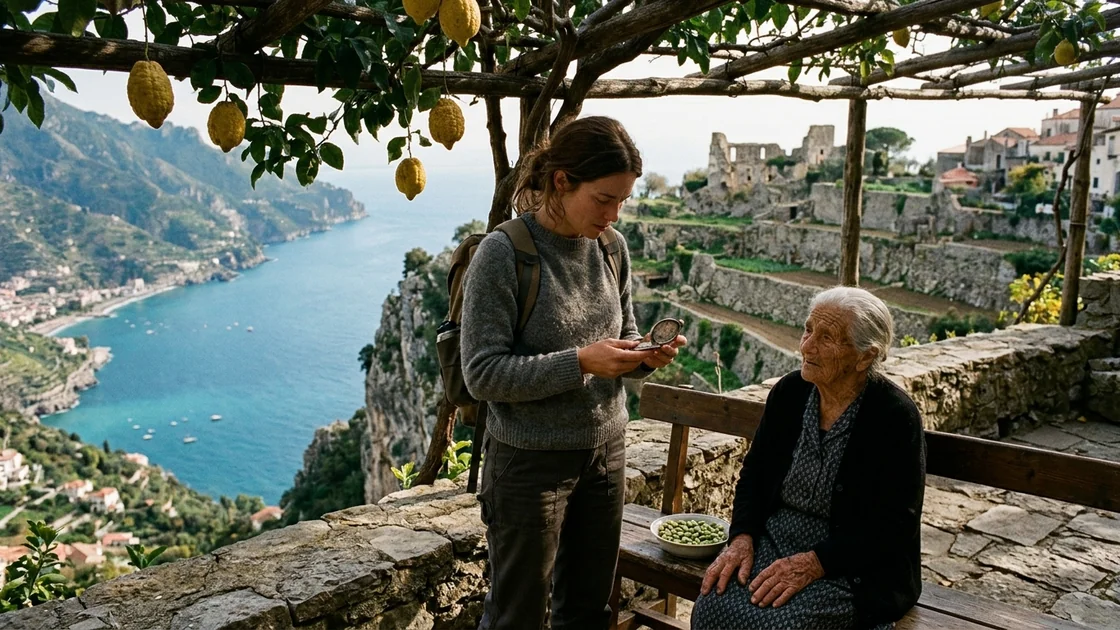
After the death of her grandfather, a quiet archivist from coastal Maine discovers an engraved silver locket among his wartime possessions and buys a one-way ticket to southern Italy. Journeying along the high cliffs and lemon groves of the Amalfi Coast, she searches for the descendants of the mysterious woman depicted within the metal case, determined to return a long-kept promise made during the Allied advance of 1943 and in doing so rebuild her own fractured life.
Chapter I: The Weight of Cedar
The cold along the coast of Maine in early November did not arrive with the dramatic flurry of an arctic gale; it came as a slow, grey seep that got into the floorboards and turned the brass pulls of the dressers icy to the touch. Clara Bailey stood in the upstairs hallway of her grandfather Arthur’s house in South Bristol, her breath visible in the unheated air. The house smelled precisely as it had throughout her childhood: dried bay leaves, tobacco cured fifty years ago, salted wool blankets, and the resinous tang of yellow pine shavings from the basement workshop where Arthur had spent half a century shaping half-hull ship models.
Arthur had died in late September, quietly, in his sleep, his ninety-eight-year-old hands resting over the frayed hem of a quilt Clara’s grandmother had stitched during the Johnson administration. The funeral had been small—a handful of surviving lobstermen, two distant cousins from Bangor, and the young minister from the Congregational church who had awkwardly tried to summarize a life that had spanned two global conflicts, the industrial collapse of the Kennebec shipyards, and sixty years of maritime solitude.
For six weeks, Clara had been living out of a canvas duffel bag on Arthur’s horsehair sofa, moving methodically from room to room with cardboard boxes and packing tape. She was thirty-two, an architectural conservator who had spent the last seven years in Boston documenting the gradual rot of brownstone foundations and seventeenth-century wood-frame houses. Her job was to identify what was salvageable from the past, what was doomed to crumble, and what might survive if given enough shoring up. Lately, however, she had felt as hollowed out as the waterlogged timber she surveyed. Her engagement to a mild-mannered urban planner named Julian had dissolved quietly in August, neither with screams nor tears, but with the mutual, deadening recognition that they had simply ceased to cast shadows in each other’s lives. She had taken an indefinite leave from her firm, claiming the need to settle her grandfather’s estate. In truth, she had nowhere else she wished to go.
On this particular Tuesday morning, she reached the cedar chest that sat beneath the eaves in the attic bedroom. It was a heavy thing, bound with blackened iron straps, built from thick Atlantic white cedar Arthur had felled himself before departing for training in Alabama in the spring of 1942. Clara pulled the brass key from the string around her neck—Arthur had carried it on his key ring for as long as she could remember—and turned it in the tumbler. The lock gave way with a dry, mechanical snap.
Inside lay the sediment of a man’s youth. A stiff wool uniform tunic with the patch of the Fifth Army, the brass buttons darkened by oxidation. Three campaign medals in cardboard boxes with faded ribbon bars. A field manual on pneumatic bridge erection. A stack of letters Arthur had written to his parents from North Africa, their margins scarred by the black ink of military censors. And, at the very bottom, wrapped in an oiled piece of chamois leather, an object Clara had never seen.
She lifted the parcel. The leather was supple, greasy with neatsfoot oil that had kept the moisture of Maine winters at bay. When she folded back the flaps, her fingers brushed against cool metal.
It was an oval locket, roughly two inches in length, forged from sterling silver that had tarnished to the dark, liquid grey of river slate. The front was engraved with astonishing delicacy: not with the standard military shields or stylized eagles of the era, but with a branch of fruiting lemons, their leaves veined and curled as if lifted by a breeze, surrounded by an intricate border of acanthus scrolls. In the center of the design, nestled among the engraved fruit, was a tiny aperture set with a cloudy seed pearl.
Clara turned the piece over. The back was scratched with use, but beneath the scratches lay an inscription cut deep into the silver in an elegant, sloping cursive:
Per Donatella, il mio respiro — 1942.
Her thumb found the small notch at the locket’s side. She pressed gently with her fingernail. The hinge groaned, then parted.
Inside the right half, preserved behind an intact disc of curved celluloid, was a photograph. The woman could not have been older than twenty. Her hair was dark, gathered in loose, thick waves pinned back from her brow, exposing high cheekbones and wide, grave eyes that stared directly out from the paper. She was standing on a stone parapet, a low whitewashed wall behind her. Beyond the wall was an extraordinary drop—a dizzying, sun-drenched precipice that fell away toward a flat, metallic sea dotted with tiny, lateen-rigged fishing boats. A lemon tree hung over her left shoulder, its blossoms pale and star-like. She was not smiling, but her expression possessed a fierce, defiant stillness, as if daring the photographer to look away.
In the left recess of the locket was a folded square of paper, no larger than a postage stamp, yellowed and fragile as onion skin. Clara teased it out with the tip of her penknife and opened it on her palm. It bore five lines written in faded purple fountain-pen ink:
If you carry this across the water, Arthur, you must bring it back to the high terrace. Do not leave it in the soil of strangers. Remember the road behind the convent of San Nicola.
Clara sat back on her heels, the cedar dust swirling in the pale rectangle of morning sun that angled through the dormer window. Arthur had never spoken of Italy with any specificity. He had spoken of mud, of the endless rain that turned the valleys around the Garigliano into grey trenches of despair, of the sound of artillery shells passing through mountain fog like tearing canvas. When asked about the country itself, he would only say, "The stones were very old, Clara. Too old for the war we brought them."
Yet here, tucked beneath his woolen tunic, was a name: Donatella. A woman with dark eyes standing on a cliff above an infinite sea. A direct command: You must bring it back to the high terrace.
Clara looked around the cold attic room. Downstairs, the oil furnace kicked on with a low, vibrating rumble that shook the pine rafters. The rest of her life in Boston was waiting for her: unanswered emails from her firm about a historic warehouse project in the Seaport, Julian’s polite texts inquiring about the split of their joint bank accounts, the endless, damp, pragmatic grey of a New England winter.
She stood up, holding the locket against the palm of her hand. Her fingers closed around the cold silver until the sharp edges of the engraved lemon branch bit into her skin.
Two hours later, sitting at the small kitchen table with her laptop beside a half-empty mug of black coffee, Clara opened a flight aggregator. She typed in BOS to NAP. One way. Depart: Saturday. She did not look at return dates. She entered her credit card information without pausing to reconsider, listening to the grandfather clock in the hall tick through the stillness of an empty house.
Chapter II: The Road of a Thousand Turns
The descent into Naples was a tumble through cloudbanks that broke apart over a bay the color of gunmetal. Clara had not slept for twenty-four hours; her eyes felt as though someone had rubbed fine sea sand beneath her lids. She picked up a rental car—a diminutive, dented Fiat Panda with a gearbox that ground when shifted into third—and left the airport behind, her knuckles white against the steering wheel as she merged into the frantic, horn-blaring current of the Autostrada A3.
The landscape surprised her with its muscularity. Vesuvius rose to the east, not as a gentle scenic backdrop, but as a brooding, hulking mass of basalt and cinder, its peak clipped off by low, scudding cloud. As she drove south, the sprawl of concrete apartment blocks and industrial rail yards gradually surrendered to limestone ridges that thrust upward from the volcanic plain. At Castellammare di Stabia, she left the highway and entered the mountain tunnel that pierced the spine of the Monti Lattari.
When she emerged on the southern side of the peninsula, the world broke wide open.
Clara gasped, her foot instinctively hovering over the brake. The road—the Strada Statale 163—was a ledge carved into the sheer limestone face of cliffs that plummeted hundreds of feet into the Tyrrhenian Sea. The water below was not the flat, cold grey of the bay she had seen from the airplane; it was an impossible, electric sapphire, mottled with turquoise where submerged reefs caught the sunlight. Above the road, the mountains reared straight into the sky, their sheer grey crags terraces of impossible labor: dry-stone retaining walls stacked like centuries of vertebrae, holding up tiny ribbons of soil upon which thousands of lemon trees clung, sheltered beneath dark green shading nets and woven chestnut poles.
The air that poured through the car’s cracked window was warm, rich with the sharp mineral scent of crushed limestone, wild rosemary, maritime pine, and the unmistakable, oily perfume of ripe citrus. It was nothing like Maine. Maine smelled of decay and salt; this place smelled of rock baked by four thousand years of sun and life cultivated on the brink of an abyss.
She followed the road through its tortuous convolutions. Every corner was a blind dare. Local bus drivers sounded pneumatic horns that echoed off the cliffs like trumpet blasts before swinging their massive blue coaches around hairpin curves with inches to spare. Clara tucked her small car against the inner rock wall, her heart hammering against her ribs, her eyes darting between the narrow tarmac and the endless drop to the left.
By late afternoon, the sun had dropped behind the western shoulder of the cliffs, casting the ravines into purple shadow while the sea turned to molten bronze. She reached the turnoff for Minori, a village nestled in the mouth of a steep limestone canyon that spilled down to a pebbled beach. Arthur’s note had mentioned "the road behind the convent of San Nicola." Her preliminary research in the Boston Public Library had revealed that there were several convents and hermitages dedicated to Saint Nicholas in the region, but the most prominent ruins of San Nicola de Carbonario stood on the high ridge above Minori and Ravello, accessible only by footpaths carved into the mountain.
She had booked a room at the Pensione Miramare, an unpretentious establishment situated halfway up the terraced slope on the road toward Ravello. The building was three stories of washed ochre plaster, with green wooden shutters bleached by salt air and a terrace shaded by a sprawling arbor of bougainvillea that had dropped violet petals across the terra-cotta tiles.
The proprietor was a woman named Francesca, whose hair was an unruly crown of steel-grey curls and whose apron smelled comfortingly of garlic, toasted fennel seeds, and damp laundry. She inspected Clara’s passport with sharp, dark eyes that took in the dark hollows beneath Clara’s cheeks and the single duffel bag she carried.
"You come alone?" Francesca asked in English, her voice gravelly and melodic all at once.
"Yes," Clara said. "Just me."
"American." It was a statement, not a question. Francesca handed her a heavy brass key attached to a block of wood. "Room four. You have the balcony. In November, it is quiet. The Germans have gone home. The sea is cold, but the lemons are coming ripe. Dinner is at eight. If you are late, you eat cold lentils."
"Thank you," Clara said. "Francesca... can I ask you something?"
The woman paused, a hand on the counter. "Ask."
Clara drew the silver locket from her coat pocket. The chamois wrap had worn thin, and the silver caught the low lamplight of the reception desk. She held it out on her flat palm. "Do you recognize this? The engraving, or the name? Donatella?"
Francesca looked at the locket, then leaned forward, adjusting a pair of reading glasses that hung from a cord around her neck. She did not touch the silver, but her gaze lingered on the lemon branch and the seed pearl. A subtle shift occurred in her expression—a tightening of the corners of her mouth, a sudden stillness that replaced her bustling demeanor.
"Donatella is a name from our mothers' time," Francesca said quietly. "Every village from Positano to Vietri had twenty Donatellas in 1940. But the work... the silver..." She leaned closer, her breath smelling of espresso. "That is not from the shops in Amalfi. Those shops sell tourist charms—little cornicelli, little silver fish. This is older. This is mountain work."
"Mountain work?"
"From Scala, or the high valleys of Tramonti. Where they worked the metal for the old churches before the roads were built." Francesca looked up, her gaze searching Clara’s face. "Where did you get this?"
"My grandfather," Clara said. "He was a soldier. He was here in the autumn of 1943."
Francesca’s expression softened, but the wariness remained. "The landing at Salerno. The Avalanche. They came through the passes to cut the road to Naples. It was a bad time. The Germans were on the cliffs, your people were down in the smoke, and the people of the coast were caught between the hammer and the stone." She pointed a blunt, flour-dusted finger toward the ceiling. "Go wash your face, signorina. Eat some bread. The mountains do not go anywhere at night. They will still be here when the sun comes over the ridge."
Chapter III: Dust and Parishes
Clara spent her first night listening to the sea. From her high balcony, the water sounded different than it did against the granite ledges of Maine. There, the Atlantic struck with a dull, concussive thud, an ancient fist battering against cold rock. Here, the Tyrrhenian hissed across the shingles of the beach three hundred feet below, a long, rhythmic intake and exhale that seemed to whisper against the foundations of the town.
She woke before dawn. The sky above the eastern rim of the Gulf of Salerno was a luminous wash of apricot and violet. She dressed in heavy canvas trousers, walking boots, and a grey wool sweater, sliding the locket into an inner pocket of her coat where it rested against her collarbone like an extra heartbeat.
Her first stop was the municipal archive in Minori, housed in a modest building near the Basilica of Santa Trofimena. The archivist was a man named Signor De Luca, whose suit looked as though it had been pressed during the reign of the last Italian king and who spoke English with a slow, ornate formality.
"Nineteen forty-three," he murmured, his spectacles perched on the tip of his long, aquiline nose as he turned the pages of a massive leather-bound register of civil records. "A difficult year for paper, signorina. When the British Commandos landed at Maiori on the ninth of September, and the American Rangers took the Chiunzi Pass, the local administration ceased to function. Many registers were moved to caves to protect them from the naval bombardments. Some were used to light fires during the winter of forty-four."
"What about baptismal records?" Clara asked. "Or marriage certificates?"
"For that, you must look to the church," De Luca said, glancing up from the ledger. "The State may forget its citizens when the shells begin to fall, but the Church never forgets an immortal soul. It is their business model." He tapped a slender finger on the desk. "You say the name was Donatella. No surname?"
"None," Clara admitted. "Only the date, 1942, and the reference to the path behind the convent of San Nicola."
De Luca took off his glasses and cleaned them with a silk handkerchief. "The ruins of San Nicola de Carbonario sit on the ridge between Minori and Sambuco. In the nineteen forties, the only people living on that ridge were the contadini—the lemon farmers who worked the church lands. They did not come down to the sea except to sell fruit or bury their dead. If your grandfather found a girl there, she belonged to one of the terrace families: the Gambardellas, the Apicellas, or the Bottis."
He wrote three names on a scrap of paper, his handwriting an immaculate copperplate.
"Start with Father Tommaso at the church of Santa Maria Assunta in Ravello," De Luca advised. "He is ninety-one years old. His memory for who lived in which terrace during the war is better than his memory for what he ate for breakfast this morning."
Clara thanked him and began the climb.
To understand the Amalfi Coast, one must understand the steps. They are not merely stairs; they are a vertical road network that has existed since the maritime republic of the Middle Ages. They are cut from dark, hard limestone or built from mortar and rubble, rising through clefts in the rock at angles that test the knees and lungs.
Clara climbed. The morning sun was climbing too, warming the rock until the wild thyme growing in the crevices released its resinous scent. To her left, the terraces rose like an immense staircase built for giants. Each terrace was fronted by a dry-stone wall—the macerina—painstakingly constructed without mortar from irregular limestone boulders. Some of these walls were twelve feet high, holding back thousands of tons of earth that had been carried up the mountain in woven baskets on the backs of women and donkeys centuries ago.
Beneath the shade nets, the sfusato amalfitano lemons hung heavy and pale gold among dark, glossy foliage. They were unlike any lemon Clara had ever seen in an American grocery store: large, knobby, twice the size of a fist, with thick, rough skins that glistened with essential oils. An old man with a flat wool cap was working on a terrace above her, pruning dead wood with a small curved billhook. He paused as she passed below, raising a hand in silent, weathered greeting. She nodded back, her lungs burning, her calves aching with a clean, sharp fatigue that felt like the beginning of an awakening.
She reached Ravello by noon. The town sat like a crown upon the ridge, perched twelve hundred feet above the sea, looking down into the blue amphitheater of the gulf. Unlike the fishing villages below, Ravello had the hushed, aristocratic air of an ancient sanctuary. Its alleys were paved with smooth cobbles, its piazzas shaded by stone pines and umbrella cypresses.
She found the church of Santa Maria Assunta—the Duomo—anchoring the northern side of the main piazza. Its bronze doors, cast in the twelfth century, depicted fifty-four scenes of the Passion, their reliefs rubbed golden by centuries of passing fingers. Inside, the church was cool and cavernous, smelling of beeswax, old incense, and cold mountain stone.
Near the pulpit—a marvelous creation supported by six marble lions that crouched on the backs of stone dragons—an old priest was kneeling in prayer. He wore a simple black cassock that had turned green at the seams from age. His spine was curved like an olive branch, but when he finished his devotions and turned to look at Clara, his eyes were bright, watery blue, astonishingly clear behind wire-rimmed spectacles.
"Father Tommaso?" Clara asked, stepping forward quietly.
The priest stood with the aid of a walking stick carved from chestnut wood. He looked at her with gentle curiosity. "Yes, my child. You are not with the German tour group from the gardens."
"No," she said. "I’m looking for someone. Signor De Luca in Minori told me you might be able to help."
She took the locket from her pocket and held it out. Father Tommaso looked down at it, then took it into his own dry, liver-spotted hands. His touch was reverent, almost clerical, as though he were handling a liturgical vessel. He squinted at the engraving of the lemon branch, then touched the seed pearl with the tip of his thumb.
"Where did you find this?" he asked. His English was slow, accented with the round vowels of the Neapolitan dialect.
"It belonged to my grandfather, Arthur Bailey. He was an American soldier here in late 1943."
Father Tommaso nodded slowly. He did not look surprised. "Arthur. Yes. The Fifth Army. The young men who looked like boys and smelled of canned meat and clean wool. They brought their trucks into the valleys where only mules had walked since the time of the Romans."
He turned the locket over, his thumb tracing the cursive inscription. Per Donatella, il mio respiro — 1942.
"You know this name?" Clara pressed, leaning closer. "Donatella?"
The priest closed the locket with a soft click that resonated in the quiet nave. "I knew two Donatellas who lived near the high convent during the war. One was Donatella Botti, who died of typhus in the winter of forty-four. She was twelve years old." He paused, looking toward the high altar where the red sanctuary lamp flickered in the gloom. "The other was Donatella Gambardella. Her father had the highest terraces below the Monte Cerreto, where the lemons grow right against the bare rock."
"Did she survive the war?" Clara’s heart was beating in her throat.
Father Tommaso looked at her, his blue eyes clouded with an old, unresolved sorrow. "Survive? Yes. The Gambardellas are made of limestone and wild pear wood; they do not break easily. But the locket... the locket was not made for your grandfather, signorina."
"I know," Clara said. "The date is 1942. The Americans weren't here then."
"It was made by Lorenzo," Father Tommaso said softly. "Lorenzo Di Lieto. He was a silversmith's apprentice from Scala. A boy who could look at a piece of rough metal and see the veins in a leaf. He was betrothed to Donatella. In May of nineteen forty-two, he was conscripted into the Italian Eighth Army and sent to the front in the East. To the Don River. To the snow."
The priest handed the locket back to Clara. The metal felt heavier now, weighted with another layer of grief she had not anticipated.
"He never came home?" Clara asked.
"No one came home from the Don," Father Tommaso said simply. "A hundred thousand Italian boys disappeared into the Russian winter like smoke into the sky. Before he left, Lorenzo spent two months making this locket. He gave it to Donatella on the steps of San Nicola on the morning he marched down to the train at Salerno. He told her that as long as she wore it, his breath was in her chest."
"Then how did my grandfather get it?" Clara whispered. "Why did he have it in Maine for eighty years?"
Father Tommaso looked down at his chestnut walking stick, turning it slowly against the marble floor. "To understand that, signorina, you must go to the high terrace. Donatella is gone—she passed into God’s peace twenty years ago. But her sister Rosa still lives in the house beneath the cliff. Rosa was ten years old when the sky rained fire on Salerno. She remembers everything. She remembers the things we have spent our lives trying to forget."
Chapter IV: The Valley of the Mills
Father Tommaso had told her how to find the house, but he had warned her that the path was not meant for casual travelers. It lay beyond the ruins of the convent, where the cultivated terraces ended and the wild mountain took over.
Before she made the ascent, Clara walked down into the Valle dei Mulini—the Valley of the Mills—behind Amalfi. She felt an urgent need to understand the material world her grandfather had inhabited in those months. Arthur had been an engineer; he understood the world through how things were made, how stones were fitted together, how weight was transferred to the earth.
The valley was a deep, narrow canyon cut into the limestone by the Canneto torrent. For centuries, it had been the industrial heart of the Amalfi Coast, home to the water-powered mills that produced charta bambagina—the thick, handmade cotton paper prized by popes, kings, and merchants across the Mediterranean.
Now, most of the mills were roofless ruins, their towering stone walls draped in maidenhair fern and wild fig trees whose roots split the masonry like wedges. The roar of the mountain stream was constant, trapped between the sheer canyon walls that rose hundreds of feet into the damp mountain air.
Clara walked along the paved mule track, passing the skeletal remains of drying towers where great sheets of white paper had once hung like sails in the draft that swept through the gorge. The air was five degrees cooler here, smelling of moss, wet lime, and rotting walnut leaves.
She came upon a workshop that was still functioning—the Cartiera Amatruda, where paper was still made according to medieval methods. An open doorway revealed a cavernous interior where ancient wooden vats churned with a slurry of white cotton pulp.
An elderly man with forearms like cured oak stood by a copper vat, dipping a wooden frame covered in fine brass mesh into the liquid. With a practiced, fluid motion that looked like a dance, he drew the frame up, shook it twice to distribute the fibers evenly, and turned the glistening, wet sheet of paper out onto a layer of damp wool felt.
Clara stood by the threshold, watching him. She recognized the rhythm: it was the same unhurried, absolute precision Arthur had used when fairing the cedar planks of his boat models.
The papermaker glanced at her, wiping his hands on a coarse linen apron. "Signorina," he said, nodding. "You are looking for the paper museum?"
"No," she said. "Just looking. It’s extraordinary."
"It is work," the man replied, though his eyes showed pride. "My family has made paper in this ditch since 1480. When the water stops, we stop. Not before."
Clara stepped inside, the damp heat of the workshop enveloping her. She reached into her pocket, not to show the locket, but to pull out the folded scrap of purple-inked paper she had found inside it.
"This paper," she said, holding it out carefully. "Is it from here?"
The papermaker wiped his fingers thoroughly on his apron, took the scrap between two dry fingertips, and held it up against the bare bulb hanging above the vat. He peered through the semi-translucent fibers.
"Ah," he murmured, his face breaking into a wide, toothy grin. "Look here. See the watermark?"
Clara looked closely. Faintly visible within the grain of the paper was the silhouette of an anchor intertwined with a maltese cross.
"Amatruda, nineteen thirty-eight," the man said with certainty. "My uncle Luigi made this batch. We used Egyptian cotton rag from the shirt factories in Salerno. Strong paper. You could drop it in the sea, pull it out, dry it in the sun, and write a love letter on it fifty years later."
"My grandfather kept it for eighty years," Clara said.
The papermaker handed the scrap back to her, his expression turning thoughtful. "A piece of paper does not live that long by accident, signorina. Someone must love it, or someone must fear it."
"Why fear it?"
The man shrugged, a heavy, Mediterranean gesture of the shoulders. "Because paper remembers what men prefer to forget. A soldier goes to war, he does what he must to stay alive, then he goes home and becomes a baker, an engineer, a grandfather. He tells his children about the rations and the rain. But the paper remembers the names he spoke when he thought the morning would never come."
He turned back to his vat, dipping the frame into the white slurry with a soft, sucking splash that echoed through the stone vaults. Clara thanked him and stepped back into the canyon.
The words echoed in her mind as she walked back down toward the coast: The names he spoke when he thought the morning would never come.
What had Arthur seen on these ridges? He had been twenty-two years old, an enlisted man in the 36th Infantry Division, a Maine boy who had never seen an olive tree, plunged into the vertical savagery of the Italian campaign. Clara remembered the way he used to sit on the porch in Maine during summer thunderstorms, his hands gripped tight on the arms of his rocking chair, his eyes fixed on the horizon where the lightning flickered over the Atlantic, utterly silent until the squall had passed.
She had thought it was the artillery he was hearing. Perhaps it had been the sound of stone walls collapsing beneath the bombs. Or perhaps it had been something far quieter—a voice calling from a terrace in the rain.
Chapter V: The High Terrace
The ascent to the Gambardella house began behind the cemetery of Minori. This was the true mule track, the Sentiero dei Limoni, ancient before the Roman emperors built their pleasure villas on the shore below.
Clara climbed for two hours. The afternoon sun was fierce, beating against the white limestone steps until the glare made her eyes water. The weight of her small rucksack felt double what it had at sea level, but her stride was steady. The architectural conservator in her couldn't help but notice the craftsmanship of the path: every stone had been selected to fit against its neighbor, tilted slightly backward toward the mountain so that the torrential winter rains would run into rock drainage channels rather than washing away the path itself.
At nine hundred feet, the village below became an abstract pattern of terracotta roofs and white walls hugging the curving shore. She passed the ruins of the convent of San Nicola. The medieval church had lost its roof; its stone apse was open to the sky, framing a breathtaking view of the sea that stretched sixty miles south to the jagged headland of Punta Licosa. Wild capers hung from the gaps in the altar wall, their purple-and-white blossoms trembling in the coastal breeze.
Behind the convent, the trail narrowed to a ledge barely three feet wide, cut into a cliff that rose vertically toward the peak of Monte Cerreto. Here, the shade nets of the lemon groves were darker, heavier, lashed to thick chestnut posts that had been blackened with fire to prevent rot.
She smelled the house before she saw it: woodsmoke from burning olive trimmings, the sharp, acidic tang of fermented lemon rinds, and the musky scent of a donkey.
The path turned a sharp corner around an outcropping of grey dolomite, and there it was: a low, rectangular house built from the same limestone as the mountain, its walls coated in faded pink whitewash that had peeled in patches to reveal the masonry beneath. A wide terrace fronted the house, paved with irregular slabs of dark slate. Above the terrace, a massive pergola of twisted chestnut poles supported a canopy of lemon trees so dense that the light beneath was filtered into a cool, sub-aquatic green.
Sitting on a low wooden bench beneath the pergola was an elderly woman. She wore a heavy black cardigan over a floral print dress, thick black stockings, and worn leather slippers. Her lap was filled with broad fava bean pods, which her gnarled, arthritic fingers split and shelled with mechanical speed, dropping the pale green beans into a dented aluminum basin that rested between her feet.
A yellow dog—a hound mix with scarred ears—rose from the shadows beneath a water cistern and let out a single, deep bark.
The woman did not look up immediately. She finished shelling a pod, tossed the empty hull into a wicker basket, and then raised her head.
Her face was an astonishing map of the coast. The skin was deep bronze, cured by eighty years of mountain sun and salt wind, lined with thousands of deep crevices around her mouth and eyes. But her eyes were extraordinary: large, dark, and clear, beneath eyebrows that were still thick and black. She looked remarkably like the photograph in the locket, aged six decades.
"Buon pomeriggio," Clara said, her voice catching slightly in her throat. She stood at the edge of the terrace, not wishing to intrude upon the stone platform.
The woman studied her with slow deliberation. She looked at Clara’s walking boots, her canvas trousers, her face—sweaty and dust-streaked from the climb—and finally at the silver chain that Clara had looped around her wrist for safekeeping.
"Non vendiamo limoni ai turisti," the woman said in a voice as dry and cracked as summer mortar. "Go down to the road. The shops have limoncello."
"I am not a tourist," Clara said in her halting Italian, which she had been practicing from a phrasebook throughout the night. "Mi chiamo Clara Bailey. Sono la nipote di Arthur Bailey."
The woman’s hands stopped over the fava beans. A pod remained half-opened in her fingers, two pale green beans visible inside its spongy white lining. For several seconds, the only sound on the high terrace was the distant hum of a fishing boat far out on the water and the dry rustle of the lemon leaves in the wind.
The woman set the basin down on the bench beside her. She stood up slowly, her spine stiff, leaning slightly to the left. She was barely five feet tall, but she possessed a formidable, rooted presence, like an olive tree that had grown out of a cleft in the rock and refused to be dislodged by any storm.
"Arthur," she said. The name sounded strange on her tongue, the th softened into a hard t. Artur.
She took two steps forward, peering intently into Clara’s face. She reached up with a rough, calloused hand that smelled of earth and green vegetation, her fingers lightly brushing Clara’s temple, pushing back a stray strand of brown hair. Her touch was surprisingly gentle.
"You have his forehead," the old woman whispered in dialect, then shifted into heavily accented English. "The straight line between the eyes. He had that line when he was thinking about how to fix the road."
"You are Rosa?" Clara asked.
"I am Rosa," she said. "The sister who was too young to die, and now is too old to live." She gestured toward the bench with a flick of her wrist. "Sit down, Clara Bailey. Sit down before your knees turn to water. You climbed the San Nicola path? A stupid path for an American girl."
Clara sat on the slate bench, her rucksack dropping to the stones with a heavy thud. Rosa disappeared into the cool interior of the house and returned a moment later carrying a heavy glass jug of cold spring water and two thick tumblers. She poured with a steady hand, handing one to Clara.
The water was shockingly cold, sweet, with a distinct mineral sharpness that Clara felt all the way down into her stomach.
"Drink," Rosa ordered. "The mountain takes your water before you know you are dry."
Clara drank the entire glass, wiped her mouth with the back of her sleeve, and then reached into her pocket. She drew out the oiled chamois packet, unfolded the leather, and held the silver locket out to Rosa.
The old woman did not take it immediately. She stared at it as it lay on the chamois in Clara’s palm. The afternoon light, filtering down through the lemon leaves, cast dappled shadows of green and gold across the tarnished silver.
Very slowly, Rosa reached out. Her hand trembled—not with the palsy of age, but with an acute, electric hesitation. Her fingertips closed around the locket. She brought it to her chest, pressing it against the coarse wool of her black cardigan, exactly where her heart lay.
She closed her eyes. Her mouth twitched, once, twice, and then her face crumpled into a mask of grief so raw, so entirely unguarded, that Clara felt an instinct to look away, as if she were intruding upon an act of secret prayer.
Rosa did not weep aloud. Two tears squeezed through the wrinkled corners of her eyes, tracking down the deep channels of her cheeks and disappearing into the lines around her mouth. She took a long, ragged breath that sounded like dry gravel shifting beneath a wave.
"Donatella," she whispered.
She opened her eyes, looked down at the locket, and flicked the latch with her thumb. The case opened. She looked at the photograph of her sister, then touched the tiny seed pearl.
"Eighty years," Rosa said, her voice dropping to a low, melodic cadence. "Eighty years in a box across the ocean."
"I brought it back," Clara said, her voice barely louder than the breeze. "He wanted it brought back. He left a note: Do not leave it in the soil of strangers."
Rosa gave a short, bitter laugh that ended in a sigh. "The soil of strangers. That boy from Maine... he was a stranger, too. But he was not an enemy."
She looked at Clara with fierce intensity. "You know what happened here? Your grandfather... did he tell you?"
"He never spoke about it," Clara said. "He kept his medals in a cedar chest. He kept this locket. He built ship models. That was all."
Rosa shook her head slowly. "Men," she said with quiet disgust. "They carry mountains inside their chests, and they think if they do not speak, the rocks will not crush them."
She turned the locket over, looking at Lorenzo’s inscription. Then she pointed toward the steep ravine that plummeted down the eastern flank of the terrace, toward the distant white ribbon of the Chiunzi road.
"Come," Rosa said, standing up. "I will show you where the war met the lemons."
Chapter VI: The Road Behind the Convent
Clara followed Rosa along a narrow goat track that wound around the mountain behind the house. Despite her age and limp, the old woman moved with the deceptive, rhythmic economy of those who have spent their lives on vertical ground.
They stopped at a natural terrace of flat limestone that jutted out over the valley like the prow of a ship. Below them lay the road that connected Maiori to the mountain pass—the road that Allied forces had needed to secure in September 1943 to prevent German armor from counterattacking the Salerno beachhead.
"My sister Donatella was twenty-one," Rosa said, leaning against her walking stick and looking down into the ravine. "I was ten. Our brother Giovanni was in Libya, already taken prisoner by the British. Our father was old, crippled by the stone work. It was only Donatella, me, and our mother."
She pointed to a crumbling stone shed fifty yards below them, half-swallowed by brambles.
"In September, the British Commandos landed on the beach down there in the dark. They ran up the valley like wolves. Then came the Americans with the trucks, the bulldozers, the great guns. The Germans were up on the Chiunzi ridge, with artillery that fired down into the valley every twenty minutes. The earth shook so hard that the lemons dropped from the trees before they were ripe. Millions of lemons, Clara. Crushed into the mud by the tank treads. The whole valley smelled of crushed lemon and diesel oil and burning rubber. A smell like the end of the world."
Rosa looked down at the silver locket she still held tightly in her palm.
"Lorenzo had gone to Russia the year before. We had one letter in December of forty-two, from a place with no trees, only mud and snow. Then... silence. The priest told Donatella that Lorenzo was probably dead. But she would not believe it. She wore this locket every day. She wore it outside her dress, so that everyone could see it. She said Lorenzo’s breath was keeping her alive."
"And Arthur?" Clara asked.
"Arthur was an engineer," Rosa continued, her gaze drifting toward the sea. "His unit was trying to clear the road. The Germans had blown the bridges across the ravines and mined the curves. Arthur was billeted in the cellar of the convent with six other soldiers. They had no water—the German shells had broken the aqueduct that fed the terraces."
She turned back to Clara, her eyes narrowing in memory.
"Donatella and I carried water to them. In copper cauldrons on our heads, climbing up from the spring at the bottom of the gorge. We were terrified. The American soldiers were huge, they spoke like dogs barking—hey, hey, c’mon, goddammit—they chewed sweet gum that smelled like chemicals. But Arthur was different. Arthur didn't bark. He was quiet, like the boys from our mountains. When he saw Donatella carrying that heavy copper pot, he didn't whistle at her like the others. He walked over, took the pot from her head with his own hands, and carried it into the convent himself."
A faint smile touched Rosa’s cracked lips.
"He had never seen a lemon grove. In Maine, he said, they only had pine trees and ice. He would come up to our terrace in the evening, when the shelling stopped for an hour, and sit where you were sitting. He didn't speak Italian, Donatella didn't speak English. But he had a little notebook. He would draw pictures: a boat, a bridge, a pine tree, a lemon. He drew a picture of Donatella."
"Did they love each other?" Clara asked, the question slipping out before she could check herself.
Rosa looked at her sharply. "Love? What is love when the sky is falling on your house? They were two children who wanted not to die. Donatella was mourning a ghost in Russia. Arthur was waiting for a bullet on the road to Naples. For three weeks, they held each other’s hands in the dark when the artillery started. That was all. That was everything."
She paused, her breath hitching slightly in her throat.
"Then came the twentieth of September. A German patrol came down from the ridge through the mist. They set up a machine gun in the ruins of the convent to ambush the American supply trucks coming up the path. Arthur was down on the road with his tools. He heard them."
Rosa’s hand tightened around the locket until her knuckles turned white.
"Donatella was at the spring when the shooting started. She ran up the path to warn the Americans. Arthur ran up from the road to stop her. They met right there—" Rosa pointed with her stick to a flat slab of limestone twenty paces away, where a small iron cross had been hammered into the rock. "Right by the convent wall."
Clara felt a cold dread settling in the pit of her stomach. "She was killed?"
"No," Rosa said, her voice dropping to a harsh whisper. "The Germans fired a mortar into the terrace. The shell hit the retaining wall. The macerina. Ten tons of limestone collapsed down the slope."
She turned to Clara, her eyes burning with the memory.
"Arthur threw Donatella into the ditch behind the wall. He covered her with his body. The rocks came down on them. When our neighbors dug them out two hours later, Arthur’s shoulder was crushed, his ribs were broken, his head was bleeding into the dirt. And Donatella... Donatella was alive, but she was trapped beneath a boulder that had pinned her legs."
Rosa looked down at the iron cross.
"They took Arthur down to the hospital ship at Maiori. He was delirious, screaming in his strange language. As the medics were carrying him down the steps on a canvas stretcher, Donatella pulled this locket from her neck. She couldn't walk—both her legs were broken. She crawled through the dust to the stretcher. She put the locket into his bloody hand."
"Why?" Clara whispered. "If it was Lorenzo’s... why did she give it to Arthur?"
"Because she thought Arthur was dying," Rosa said, a tear finally spilling down her cheek. "And because she believed the locket was a shield. She told him, in our dialect which he could not understand: You took the stones for me. You take Lorenzo’s breath. Bring it back when you are whole."
Rosa wiped her face with the corner of her black apron.
"He lived. They took him to North Africa, then to England, then across the sea to his pine trees. And Donatella stayed here. Her legs healed, but she walked with a limp for the rest of her life. She never married. When the war ended, Lorenzo’s mother received the official letter from the ministry: Lorenzo Di Lieto, missing in action at the battle of Rossosh, January 1943. Presumed dead in the snow."
"And Arthur never came back," Clara said, feeling the immense weight of the decades that had passed.
"He couldn't," Rosa said quietly. "After the war, there was no money. People were eating grass in Naples. And what would he come back to? He was a Protestant from America; she was a crippled Catholic girl on a mountain with no road. And then time starts to run, Clara. You wait one year, you are ashamed you didn't write. You wait five years, you think she has married someone else. You wait thirty years, you think she is dead. And all the while, the silver stays in the cedar chest, getting darker and darker."
Rosa walked over to the edge of the limestone ledge. She looked down at the tiny white church towers of Minori, at the blue water that had seen the Greeks, the Romans, the Normans, and the Americans come and go.
"He didn't forget," Rosa said, turning back to Clara. "That is what matters. In the end, he didn't throw it in the Atlantic Ocean. He gave it to you."
Chapter VI: The Salt and the Lemon
That evening, the terrace beneath the pergola became a banquet of ghosts and stone.
Matteo, Rosa’s grandnephew—a lean, sunburned man of thirty-five with the same sharp, humorous eyes as his aunt—arrived from the lower groves carrying two plastic crates of lemons and a basket of freshly caught sea bass from the marina at Maiori. He was accompanied by his wife, Elena, a woman with round, rosy cheeks who immediately set about lighting the wood-fired outdoor oven behind the house.
When Rosa showed Matteo the silver locket and introduced Clara as Arthur’s granddaughter, the younger man stood motionless for a long moment, the basket of fish hanging from his hand. Then he set the basket down, walked over to Clara, and took her hand in both of his, bowing his head slightly in a gesture of profound, archaic respect.
"My great-aunt Donatella told us about the American who carried the stones," Matteo said in clear, accented English. "We thought it was a fable. You know how old people tell stories—the Americans were ten feet tall, they could lift trucks with their bare hands, they survived under mountains of rock." He smiled, his teeth flashing white against his dark beard. "Now I see his blood. You have his jaw, signorina. Very stubborn."
They ate beneath the lemon trees by the light of three kerosene lanterns that hissed softly in the mountain draft. The dinner was simple, immense, and devastatingly good: scialatielli—thick, handmade ribbons of pasta tossed with garlic, olive oil, and the sweet, briny meat of tiny clams; the sea bass baked in a thick crust of sea salt that Matteo cracked open with a clean hammer blow; and a salad of sliced sfusato lemons dressed with olive oil, mint leaves, and coarse salt, eaten rind and all.
"Eat the skin," Rosa commanded Clara, pointing with her fork. "The skin is where the sun lives. If you eat only the sour juice, you are like the tourists who see only the cliffs and forget the people who built the walls."
Clara ate. The lemon rind was thick, tender, surprisingly sweet, with only a faint, aromatic bitterness that was instantly cut by the fruity oil and the wild mint. She drank the white wine Matteo poured from an unlabeled glass flagon—a wine made from the ancient Falanghina grape grown on the terraces above them, smelling of wet slate, sulfur, and white peaches.
As they ate, Clara pulled Arthur’s wartime sketches from her rucksack. She had brought three of the drawings he had made in the fall of 1943, preserved between sheets of acid-free cardboard: a charcoal study of the ruins of San Nicola, a pencil sketch of the terraced hillsides looking toward Ravello, and a small, delicate portrait in purple ink of a young woman with dark waves in her hair, leaning against a water cauldron.
Rosa held the portrait close to the kerosene lantern. Her eyes traced the lines Arthur’s pencil had made eighty years ago.
"Look at her," Rosa murmured to Elena, who leaned over her shoulder, her eyes wide. "Look how proud she was. She had two dresses, her shoes had cardboard in the soles, but she looked at that American boy as if she owned the whole sky."
"She did own the sky," Matteo said softly. "The mountain was hers."
Rosa looked across the table at Clara. "What will you do with your life now, Clara Bailey? You bring the locket back. The debt is paid. Now what?"
The question hung in the warm air, suspended between the scent of woodsmoke and lemon zest.
Clara looked out from beneath the pergola. Below them, the coast had transformed into a constellation of lights. The towns of Minori, Maiori, and Amalfi glittered along the shore like scattered diamonds, their reflections shimmering in the dark, breathing water of the gulf. Above them, the stars were cold and sharp, untroubled by the centuries of human grief that had soaked into the limestone beneath their feet.
In Boston, she knew, the rain would be turning to sleet on Commonwealth Avenue. The red brick facades would be darkening with wet soot. Julian would be sitting in their old apartment, perhaps eating takeout, wondering why things had ended without an argument. Her colleagues would be cataloging the dry rot in some historic church basement, measuring the deflection of beams, planning how to preserve the shell while the interior was gutted for luxury condominiums.
"I don't know," Clara said honestly. "I bought a one-way ticket."
Matteo laughed, pouring another splash of wine into her glass. "One-way tickets are dangerous in the Costiera, signorina. If you stay three days, you think it is paradise. If you stay three weeks, you realize it is hard labor. If you stay three months, your blood turns to lemon juice and you cannot walk on flat ground anymore."
"The walls are falling down," Rosa said suddenly, her voice cutting through the laughter.
Matteo looked at his aunt, his smile fading.
"The macerine," Rosa said, gesturing toward the dark slopes above them. "The old dry-stone walls. Every winter, the rains get heavier. The mountain slides. There are only five men left in Sambuco who know how to fit the stones without mortar so the water passes through without bursting the wall. Matteo works fourteen hours a day, but he cannot rebuild three miles of wall with his own two hands."
She looked directly at Clara, her dark eyes glittering in the lantern light.
"Father Tommaso told me what you do. You are an architect for old things. For things that are broken."
"I conserve them," Clara said. "I figure out how to stop the decay."
"Then don't go back to your pine trees yet," Rosa said. It was not a plea; it was a directive, issued with the ancient authority of the mountain. "Stay until the harvest is done in January. Help Matteo map the old walls above the convent. Show him which ones are moving. We have no money to pay an American engineer, but you will have a bed, you will have lentils, and you will learn what it feels like to lift a limestone boulder with your own arms until your back remembers you are alive."
Clara looked at the locket, which lay on the table between them, its silver gleaming softly in the lamplight. Lorenzo’s engraving, Arthur’s eighty-year journey, Donatella’s defiant gaze.
A sudden, immense lightness washed through her—not the relief of an escape, but the profound, solid anchor of an arrival. The emptiness that had followed her through the damp streets of Boston and across the Atlantic seemed to dissolve into the cool night air, replaced by the rough, mineral reality of the stone terrace beneath her feet.
"I can do that," Clara said.
Chapter VII: The Stone in the Wall
Three days later, before the sun had cleared the ridge of the Monti Lattari, Clara climbed the steps to the ruined convent of San Nicola with Matteo and Father Tommaso.
The morning was brilliant, washed clean by an offshore breeze that had chased the remaining clouds toward Capri. The air was crisp, carrying the scent of woodsmoke and the sea.
In her coat pocket, Clara carried the silver locket. They had discussed what should be done with it. Rosa had refused to keep it in a drawer. "A locket in a drawer is a dead thing," the old woman had declared. "It belongs to the mountain now."
Father Tommaso led them through the roofless nave of the convent to the small cemetery that lay behind the apse. It was not a modern cemetery of marble headstones and plastic flowers; it was a terrace of earth, walled with limestone, where generations of contadini lay buried beneath mounds of wild rosemary, white irises, and creeping thyme.
At the edge of the terrace, overlooking the immense, sapphire void of the sea, stood a modest stone marker:
Donatella Gambardella 1922 — 2003 Custode della Terra
Beside her marker was a second, smaller plaque of dark slate, newly carved by a stonemason in Minori at Matteo’s request:
Lorenzo Di Lieto — Disperso in Russia, 1943 Arthur Bailey — Maine, 1925 — 2023 Qui si incontrano i respiri. (Here the breaths meet.)
Matteo knelt by the wall behind the markers. With a small cold chisel and a hammer, he carefully loosened an irregular block of grey limestone from the macerina—a stone that had sat in the retaining wall for two hundred years.
Behind the stone lay a small, dry cavity, sheltered from the rain by the massive lintel above.
Father Tommaso stepped forward. He did not say a Latin prayer; he did not make the formal sign of the cross. He simply laid his old, trembling hand upon the stone marker.
"God does not look at flags, my children," the priest murmured in his low, gravelly voice. "He does not look at the lines men draw on maps with rulers and bayonets. He looks at what we do with the love we are given in the middle of the fire."
Clara took the silver locket from her pocket. She had cleaned it the night before with a paste of wood ash and olive oil, just as Rosa had instructed. The tarnished river-slate grey had yielded to a luminous, deep silver that caught the morning sun like a mirror. The engraved lemon leaves seemed to leap from the metal; the tiny seed pearl glowed with a soft, milky luster.
She placed the locket into the dry cavity behind the stone. Inside it, preserved behind the celluloid, Donatella stared out toward the sea she had watched for eighty years. Folded behind her was the scrap of purple-inked paper that Arthur had carried across three oceans.
Matteo lifted the limestone block. He applied no mortar; he simply fitted the stone back into its ancient seat, tapping it gently with the wooden handle of his hammer until the face was flush with the rest of the wall, held fast by the sheer, interlocking weight of the terrace above.
The locket was gone from sight, sealed within the living spine of the mountain.
They stood in silence for a long time. The sea below was beginning to wake, sparkling with millions of points of sunlight as the morning breeze ruffled its surface. Far out on the horizon, a white passenger ship was making its slow way south toward the Straits of Messina, leaving a long, dissolving trail of foam across the sapphire water.
Father Tommaso turned and began his slow descent toward Ravello, his chestnut stick clicking rhythmically against the limestone steps.
Matteo looked at Clara. He pulled a pair of heavy leather work gloves from his back pocket and tossed them to her. They were stiff with dried mud and lime dust.
"The third terrace above the house," he said, nodding toward the high ridge where the net-covered lemon groves met the vertical grey crags of the peak. "The wall has bulged three inches since the rain on Tuesday. We have to take down twelve yards of stone before noon, or the whole thing will come down when the next squall hits."
Clara caught the gloves. The leather was rough against her palms, smelling of damp limestone, sweat, and earth. She pulled them on, flexing her fingers. They were too large for her, but when she made a fist, the leather gripped tight.
"Let’s go," she said.
She turned and began the climb up the path, her boots finding the familiar notches in the ancient stone, her breath steady, her eyes fixed on the high terraces where the pale lemons hung waiting in the sun.