The Shoreline Frequency
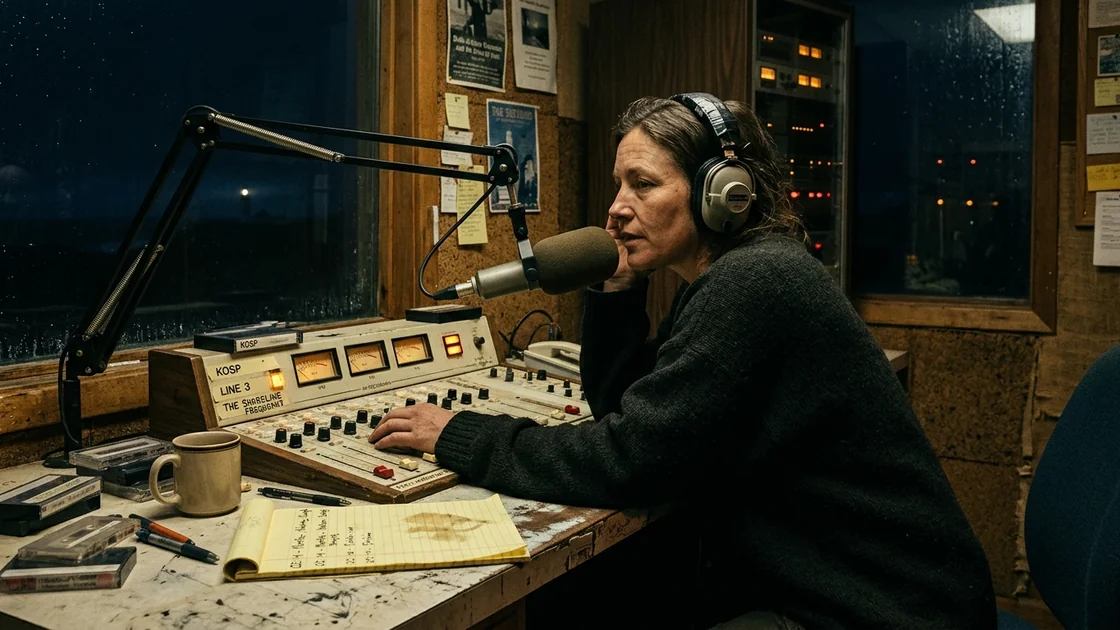
This is the story of Norah Kelly, a woman who returns to a rainy coastal Oregon town after years away and creates a late-night call-in radio program to give voice to the quiet, isolated women living along the fogbound Pacific edge. Over the course of a damp winter, as she fields calls from insomniacs and grieving souls, she finds herself captivated by a regular caller who speaks only in riddles and intimate memories. Slowly, through the crackle of the switchboard and the cadence of shared grief, Norah comes to realize that the anonymous voice on the other end of the line belongs to the mother who abandoned her seventeen years before, forcing both women to confront the silence that drowned their family.
I. The Salt on the Glass
The studio of KOSP 91.3 FM smelled of rain-soaked wool, ozone, and forty years of spilled hazelnut roast. It sat on the third floor of an old cedar-shingled fish cannery at the mouth of Nehalem Bay, balanced on creosote pilings that groaned whenever the Pacific hurled a November swell against the bar.
When the tide rose past nine feet, water slapped the lower floorboards, sending a muffled thud through the floor joists that registered on the visual needles of the broadcast board as a phantom flutter at sixty hertz.
Norah Kelly kept her boots on while she worked. She had bought them second-hand in Portland before retreating south to the coast: oiled leather, shearling-lined, heavy-treaded against the perpetual grease of damp hemlock needles and decomposing sea kelp. She sat with her elbows propped on the scarred laminate counter, the broadcast boom hovering three inches from her mouth, wearing a pair of vintage broadcast monitor headphones whose plastic headbands had been mended with black electrical tape.
Across the glass partition, the automation tower blinked its tiny amber eyes. Beyond the station’s salt-filmed northern window, there was only the vast, black swallowing belly of the ocean, broken occasionally by the pale, stuttering sweep of the Cape Meares lighthouse three miles across the spit.
"It is twelve minutes past two in the morning," Norah said into the foam windscreen. Her voice was lower than it had been during her twenties, sanded down by coastal damp, late hours, and long stretches where she did not speak to a living soul between Sunday afternoon and Tuesday night. "The barometer is dropping at twenty-nine point four. The weather service out of Astoria warns of gale-force gusts north of Tillamook Head by dawn. If you’re driving the coastal curves on 101, watch the shoulders for washed-out shale. And if you are awake in a dark room listening to the rain hit the cedar shakes, the line is open."
She reached out with two fingers and slid the pot down on the music bed—an instrumental acoustic track she had ripped from an obscure cassette found in a thrift bin in Manzanita, a nylon-string guitar picking out a melody that sounded like water dripping into an empty iron kettle.
She reached for the switchboard toggle.
"This is The Shoreline Frequency on KOSP. Line three, you’re on the air."
A soft, mechanical click pulsed through her headphones, followed by the hiss of copper wire routed through twenty miles of waterlogged junction boxes strung between telephone poles along Highway 53.
"Hello?" The voice was frail, slightly breathless, accompanied by the distinct ticking of an oven timer in the background. "Norah?"
"I’m here," Norah said gently. "What’s keeping you up tonight?"
"It’s Martha. Down by the slough." The caller paused, clearing her throat with a wet, papery cough. "The bull elks are down in the orchard again. They knock their racks against the plum trees. Sounds like someone taking a baseball bat to the siding. My Arthur used to go out with an iron skillet and bang it with a wooden spoon to chase them back into the timber, but... well, since March, nobody bangs the skillet. I just leave the porch bulb on, but they don't care about the light. They eat the windfall apples until their bellies swell, and they just stare right into the kitchen window."
"Do they scare you, Martha?" Norah asked, keeping her tone measured, rhythmic, the audio equivalent of a hand laid flat against a shivering shoulder.
"No," the old woman sighed, her breath rattling the telephone diaphragm. "Not scared. It’s just... the noise fills the kitchen up. And then when they leave, around four, the quiet is bigger than it was before they showed up. That’s all. I just wanted someone to know the plums were gone."
"I know," Norah said. "I’m picturing them now. Big shadows in the wet grass, breath like steam. Thank you for calling in from the slough, Martha. Try to get some sleep before the wind hits."
Norah eased the fader down, cutting the line with a practiced flick of her thumbnail. She logged the call on the grease-stained legal pad beside her left elbow: 02:14 - Martha - Nehalem Slough - Elks/Arthur.
For eighteen months, Norah had been keeping the log. She had moved back to the coast after the slow, quiet disintegration of her life in Seattle—a failed relationship with a sound engineer who hated the sound of chewing, a dead-end archival job at a civic museum that lost its county funding, and, finally, the death of her father, Thomas Kelly.
Thomas had died the way he had lived for forty years: alone in a clapboard bungalow that smelled of linseed oil and canned mackerel, sitting in an armchair facing the surf, his heart simply stopping between two cresting breakers on a grey Tuesday afternoon. When Norah had come down to sort through his effects, she had found thirty-two years of unread maritime magazines, eight identical yellow slickers, and not a single photograph or scrap of handwriting belonging to her mother, Beverly.
Beverly had walked out of that same house on a November evening in 2006, when Norah was seventeen years old. She had left an enamel pot of vegetable soup simmering on the gas range, her car keys hanging from the brass hook behind the mudroom door, and her winter coat hanging in the hall closet. She had taken only her canvas shoulder bag, her social security card, and thirty-four dollars from the ceramic piggy bank shaped like a hollowed-out buoy. No body was ever recovered from the rocks. No car was found abandoned at the bus depot in Seaside. She had simply diffused into the damp Pacific air like sea smoke burning off a sandspit.
Norah had taken the job at KOSP because the dead-air hours of the night had become unbearable in her father’s damp house on the headland. The house sat too high, too exposed; on winter nights the wind came off the Pacific with such sustained, predatory violence that the framing timbers shrieked like gulls, and Norah found herself pacing the narrow hallway between her childhood bedroom and the kitchen, checking the latch on the back door ten times an hour.
The radio station was better. At KOSP, the dark was corralled into four walls, partitioned by soundproofing panels of cork and burlap, illuminated by the comforting, amber needles of the volume units. Here, she could invite the darkness in, meter it through a potentiated fader, and send it back out across Clatsop and Tillamook counties at fifty thousand watts, filtered and controlled.
The show had started as a filler program. Artie Gunderson, the station manager—a retired maritime dispatcher whose lungs sounded like two dry paper sacks rubbing together—had told her she could have the midnight-to-four slot on weeknights if she agreed to engineer the high school football tapes on Friday afternoons.
"Nobody listens between two and five except the night-shift peelers at the shrimp cannery, the state troopers on 26, and the crazies who think the Coast Guard is broadcasting mind control through the navigational buoys," Artie had told her, coughing into a blue handkerchief. "Play whatever you want. Old folk, ambient drone, whale songs. Just hit the legal station ID at the top of the hour or the FCC will skin my hide."
Norah had started by playing records: vintage Joan Baez, Sibelius tone poems, obscure field recordings of Appalachian dulcimer players. But by her third week, an insomniac woman named Delores had called from a trailer in Rockaway Beach, sobbing because she had dropped her late mother’s blue glass mixing bowl on the linoleum floor and couldn't afford to replace it. Norah had kept her on the air for twenty-five minutes, not offering advice, simply listening as Delores cataloged every batch of soda biscuits her mother had ever mixed in that shattered bowl.
The next night, three more women called. Within two months, The Shoreline Frequency had transformed from an obscure music program into an underground confessional for the isolated, weathered women of the coastal strip.
They were cannery workers whose fingers were permanently stiffened by ice and brine; timber wives whose husbands were sleeping off twelve-hour shifts in logging camps thirty miles up the gravel forestry roads; elderly widows living on canned peaches and social security checks in salt-rotted pre-fabs behind the dunes; teenage runaways living in rusted camper shells parked along the beach turnouts, listening on cheap transistor radios run on dying nine-volt batteries.
They did not want advice. They did not want inspirational platitudes. They wanted someone to confirm that the rain was falling on them, too; that the ocean was loud and indifferent; that being awake while the world slept was not an illness, but a distinct and terrible country that had its own citizens, its own geography, and its own quiet language.
Norah glanced at the switchboard.
Lines one and two were dark. Line four was blinking with the rapid, frantic cadence that usually indicated a drunk tourist stranded with a flat tire outside Wheeler.
Line three was glowing with a slow, steady, continuous amber light.
It had been glowing like that, at precisely 2:40 AM, three nights a week, for the past four weeks.
Norah touched her fingertips to the plastic toggle. She took a breath, letting her shoulders settle away from her ears.
"KOSP," she said, her voice dropping into its low, resonant groove. "You’re on The Shoreline Frequency."
II. The Caller on Line Three
There was no preliminary background noise. Most callers brought the clutter of their lives onto the airwaves: the drone of a refrigerator motor, the rattle of cheap spoons, the heavy, phlegmy respiration of an ailing hound lying by a woodstove.
Line three was different. Line three was absolute, high-grade silence, save for a thin, metallic hiss that Norah recognized as the copper-line resistance of an outdoor phone—a coin-operated booth or an exposed emergency call box mounted along the highway.
"Norah," the voice said.
It was not a question. It was a statement of arrival.
The voice was low, dry, and slightly raspy, like dry dune grass scraping across the ribbed surface of an aluminum dory. It possessed an odd, rhythmic cadence, pausing in places where standard grammar dictated momentum, and surging forward on unexpected vowels.
"I’m here," Norah said. "Where are you calling from tonight?"
"The south side of the jetty," the woman said. She never gave a name. Over the last four weeks, Norah had begun labeling her simply as The Osprey on her legal pad, because her voice had the sharp, watchful stillness of the raptors that nested in the dead hemlock snags above the salt marsh. "The wind is backing around to the south-southwest. That means the driftwood will be coming in on the morning tide. The big root wads from the river. You have to be careful walking the tideline when the big logs are rolling. A sneaker wave will push an eight-ton spruce trunk right over your shins before you even see the froth."
Norah leaned in toward the microphone. She found herself sitting up straighter whenever this caller was on the line, her fingers hovering near the equalization knobs. There was something strangely hypnotic about the woman’s audio profile; through the broadcast monitor, her voice had almost no room reverb, sounding as though she were standing directly behind Norah’s left shoulder, speaking down into her collarbone.
"You’ve spent a lot of time on the drift line," Norah remarked.
"Thirty years," the woman said. A sharp, mechanical click came through the wire—the sound of an old metal lighter snapping open, followed by a long, slow draw of air, and then a faint, wet exhalation. She was smoking. "Maybe forty. After a while, you don't look at the sand anymore. You look at the color of the foam. If the foam is white like lard, the sea is shallow. If it’s brown and greasy, there’s been a tear in the kelp beds three miles out. It smells like iron and rot."
"What keeps you out by the jetty at two in the morning?" Norah asked softly. "It’s forty-one degrees out there, and the rain is turning into sleet."
A quiet, dry chuckle rattled through the earpieces. It was a cold sound, completely devoid of self-pity.
"I don't like the sound of ceilings," the caller said. "Ceilings hold everything down. They hold down the smell of fried grease, and the things people said twenty years ago that they shouldn't have said, and the things they kept behind their teeth until their gums turned grey. Outside, the sky doesn't have an edge. The things you did just blow off toward Japan. Nobody has to look at them."
"Do you have things you don't want to look at?" Norah asked.
A pause settled over the line. It stretched for three seconds, four, five. In commercial radio, five seconds of dead air was an emergency; program directors had strokes over three seconds of silence. But on The Shoreline Frequency, Norah treated silence like punctuation. She let it hang, heavy and wet, between the transmitter towers.
"Everyone has a cellar," the caller said finally. Her voice had dropped half an octave, losing its brittle edge, turning reflective. "Even the houses built on pilings have a crawlspace where the crabs go to die when the tide drops. You think you’ve swept it clean, but all you did was kick the sand over the bones."
"What kind of bones?" Norah whispered.
"The small ones," the woman said. "The ones that don't make an outline when you lay them on a sheet. You had a piano once, didn't you, Norah?"
Norah’s hand froze on the edge of the mixer.
Her heart gave a single, violent kick against her ribs, like a salmon slapping against the bottom of a cedar hold. She stared at the green needle on channel three. The level was steady, resting at minus four decibels.
"What did you say?" Norah asked, her voice losing some of its cultivated radio neutrality.
"I said, people who stay up late usually had an upright in the front room," the woman said smoothly, though the slight shift in her cadence betrayed a sudden, deliberate calculation. "An old Baldwin or an Everett with damp hammers. The keys stick when the fog comes in off the bay. You can’t play anything fast, so you just play the bass notes. Heavy and slow. Like church bells under twenty feet of water."
Norah swallowed. Her throat felt dry, lined with salt.
She had indeed had an upright piano. An old dark-walnut Everett, bought by her father from the Methodist church basement when she was eight years old. It had lived in the corner of their front room, right beneath the window that looked out toward the three sea stacks called The Needles. The B-flat key had always stuck in November because the wood swelled with the coastal dampness. Her mother had used an emery board to file down the side of the wooden key, leaving a small, pale groove in the varnish where her fingernail had scraped the wood.
"Many people along the coast have old pianos," Norah said cautiously, her eyes tracking the second hand of the studio wall clock as it swept past the half-hour mark.
"They do," the caller murmured. "And they all sound like drowning."
Another long exhalation of smoke hissed through the phone.
"You should check the roof over the transmitter shack tomorrow, Norah," the woman added, her voice regaining its dry, matter-of-fact tone. "The flashing on the south eave is peeling back. If the rain comes in sideways from the south like it’s fixing to do, it’ll run down the guy-wires right into the transformer box. You’ll be off the air by Thursday."
"How do you know about our flashing?" Norah asked, rising slightly from her chair, looking past the glass into the empty, darkened production booth.
"A body can see a lot of things from the road," the woman said. "Sleep when the sun comes up, girl. It’s the only time the water lets go."
There was a dull thunk—the sound of an old Bakelite receiver hitting the cradle of a public telephone—and then the switchboard dropped the connection. Line three was dead.
Norah sat alone in the studio, the headphones pressing hard against her ears, listening to the sixty-hertz hum of the bay rising through the floorboards.
III. The Drift Line
The morning broke the color of an oyster shell.
Norah did not go home to the bungalow on the headland. Instead, she slept for three hours on the lumpy corduroy sofa in Artie Gunderson’s office, wrapped in an old military surplus wool blanket that smelled of mothballs and stale pipe tobacco. When she woke at eight, the rain had temporarily ceased, replaced by a low, clinging drizzle that made the spruce trees outside the window look like smudged charcoal drawings on wet newsprint.
She found Artie in the transmitter room behind the studio, his bald head illuminated by the work light clamped to a steel chassis. He was seventy-two, with ears like dried apricots and skin that had the yellowish, translucent cast of old greaseproof paper.
"Flashing's loose," Norah said, leaning against the doorframe with a mug of instant coffee that tasted primarily of rust.
Artie didn't turn around. He held a soldering iron in his right hand, the tip smoking with rosin-core solder.
"Who told you that? That drunk kid from the coast guard station?"
"A caller," Norah said. "Line three."
Artie snorted, a wet, rattling sound that ended in a cough. "Line three is always the weird ones. Line three is where the copper is split out at the old cannery junction in Wheeler. Every time a logging truck hits the bridge at fifty, the signal shorts. You get ghosts on that wire. Crosstalk from the marine operator in Astoria."
"It wasn't crosstalk," Norah said. "She was at a payphone. She heard the flashing rattling from the road."
Artie touched the iron to a resistor, and a tiny curl of lavender smoke rose toward the ceiling tiles. "Well, she was right. Went up on the ladder at first light. South seam was ripped wide open like a sardine can. Nailed it down with two-inch galvanized tacks. If she hadn't said something, the three-phase board would've blown the first time the squall hit forty knots."
He put the soldering iron into its wire cradle and turned around, wiping his palms on a grease-blackened rag. He looked at Norah through cataract-clouded blue eyes, his bushy grey brows drawn down into a knot.
"You look like hell, Norah. You’re getting that grey look your dad had the last three years he was running the fuel dock. You need some grease in you. Go down to Wanda’s and eat some bacon. Don't sit in that booth all day staring at the meters."
"Artie," she asked, ignoring the advice, "do we have caller logs? From the old switchboard? Before we went to the digital rotary?"
"Why would we keep logs?" Artie spat into a plastic trash can. "Nobody pays us to keep track of who calls. This isn't the 911 dispatch. We’re five thousand watts of community air that barely reaches the dairy pastures in Tillamook. Why do you care who she is, anyway? Some old beach comber. Half the county is women living alone in shanties with sixteen cats and a woodstove made out of an old oil barrel. They got nothing to do at three in the morning except listen to you talk about the weather and pick up the phone."
Norah looked down into her black coffee. A thin sheen of oil floated on the surface, catching the harsh fluorescent light from the ceiling fixture.
"She knew about the piano," she said under her breath.
"What's that?"
"Nothing," Norah said. "I'm going to the beach."
She drove her father’s rusted 1994 Subaru wagon down the spit road toward the south jetty.
The Nehalem spit was a three-mile finger of sand dunes, beach grass, and shore pine that separated the calm, slate-grey waters of the bay from the boiling surf of the open Pacific. The road was barely two lanes of pitted asphalt, constantly encroached upon by windblown dunes that drifted across the yellow centerline like miniature snowbanks.
At the end of the spit, near the public boat launch that was closed for the winter, stood a single, weathered telephone booth.
It was an anachronism—a relic of the Pacific Northwest Bell era, its aluminum frame pitted by thirty years of salt air, its safety glass etched with names, obscenities, and the initials of couples who had broken up two decades ago. The folding door was missing its lower hinge, hanging slightly askew so that it never completely closed, leaving a four-inch gap that let the sand and the sea mist blow straight into the coin box.
Norah pulled the wagon onto the gravel shoulder, shut off the engine, and sat for a moment listening to the tick of the cooling manifold.
The wind was coming directly out of the southwest, just as the caller had predicted. It smelled of sulfur, rotting bull kelp, and the cold, mineral sharpness of deep water being churned up from the continental shelf. Through the salt-filmed windshield, she watched the Pacific break against the jetty—great, mountainous hills of green water that shattered against the black basalt boulders, sending plumes of spray sixty feet into the grey sky.
She got out of the car, pulled her yellow wool watch cap down over her ears, and walked to the booth.
The gravel crunched under her heavy soles. Inside the booth, the floor was covered in two inches of fine, grey sand mixed with dried spruce needles. The heavy black receiver hung from its armored cable, swaying slightly in the draft that came through the broken door.
Norah stepped inside. The enclosure smelled of damp wool, cold iron, and tobacco.
Not ordinary tobacco. Not the sweet, pipe-cut cherry tobacco Artie smoked, nor the chemical, toasted reek of the cheap filter cigarettes favored by the tourists who fished for chinook off the jetty in August.
It was the smell of clove.
Norah’s fingers tightened on the edge of the aluminum shelf.
Her mother had smoked Indonesian Djarum clove cigarettes. She had bought them by the carton from an import store in Portland, keeping them hidden in the vegetable crisper beneath the rutabagas because Thomas Kelly couldn't stand the smell. He said they smelled like an embalming room, all sweet spices and dead flowers. But Beverly had smoked them anyway, sitting on the edge of the concrete cistern behind the woodpile at midnight, the glowing orange ember illuminating her sharp cheekbones and her thin, dry lips as she blew smoke rings up into the dripping branches of the Sitka spruce.
Norah looked down at the metal shelf beneath the rotary dial.
Tucked into the corner where the stainless steel joined the glass panel was a small pile of debris.
Three cigarette butts, their paper wrappers stained a dark, tea-colored brown, the filters crimped flat by small, even teeth. Beside them, arranged with deliberate, geometric precision, were five small beach stones.
They were not ordinary basalt gravel. They were five smooth, flat disks of green jadeite—river stones that had been washed down the Nehalem river from the high coastal range, tumbled by twenty miles of gravel bars until they were as smooth and thin as poker chips.
When Norah was eleven years old, she had spent an entire summer collecting flat green jadeite stones along the gravel bars of the river. Her mother had taught her how to skip them across the deep, green pools where the tidewater stalled behind the railroad bridge. Five skips, Beverly had told her, her voice sharp with a strange, fierce pride, means you get to ask the water for something you aren't supposed to have.
Norah reached out with a trembling hand and picked up the five stones. They were ice-cold against her palm, slick with the airborne salt that coated everything within five hundred yards of the surf.
She held them to her nose.
Behind the smell of brine and stone, there was the unmistakable, oily sweetness of clove.
IV. The Archive of the Disappeared
The Clatsop County Historical Society sat on a hill overlooking the working docks of Astoria, housed in an austere, grey-painted Victorian that had once belonged to a timber baron who had made his fortune clear-cutting the hemlock forests of the Columbia River basin.
Norah went there on Wednesday afternoon, driving forty miles north through the sheets of rain that lashed Highway 101. The wipers on the Subaru worked with a slow, arthritic groan, clearing half-moons of grey visibility through which she could see the swollen estuaries, the drowned pastures where dairy cattle stood knee-deep in mud, and the battered neon signs of closed seafood shacks.
The archivist was a woman named Evelyn Vance, who had been a classmate of Norah’s father at Astoria High School in the late 1960s. She had hair the color of steel wool, cut in a severe bob, and she wore three different pairs of spectacles on cords around her neck like administrative medals.
"Your father was a stubborn man, Norah," Evelyn said, leading her into the basement reading room, where hundreds of acid-free cardboard boxes were stacked on industrial steel shelving. The basement smelled of vinegar, dry paper, and floor wax. "When Beverly vanished, he wouldn't let the sheriff search the house. Did you know that? Sheriff Campbell went out there with two deputies and a tracker dog from Seaside, and Tom met them at the cattle guard with a double-barrel ten-gauge resting on the gate post."
Norah sat down at the heavy oak library table. "He told me the police had been through everything."
"Tom told you what he needed to tell you so you’d finish your high school diploma and get out of that county," Evelyn said, adjusting her middle pair of glasses and sliding a thin grey Hollinger box across the table. "He thought the police were clumsy. He thought they’d find things that would make people talk. You know how this coast is. If a woman dies, she’s a saint. If she runs off, she’s a whore. If she just disappears, she’s a witch or a lunatic. Tom didn't want any of those words pinned to the Kelly name."
Norah opened the box.
Inside were four manila folders labeled with black marker: KELLY, BEVERLY ANN (MISSING PERSONS REPORT - 2006).
There was surprisingly little paper. A three-page missing persons report filed forty-eight hours after Beverly had walked out; two blurry black-and-white copies of her driver's license photograph; three witness statements from local merchants who had seen her on the day of her disappearance.
Norah read the statements carefully.
Statement of Donald Rhymer (Proprietor, Nehalem General Store): "Mrs. Kelly came in around 11:30 AM on the Tuesday. Bought two tins of sardines in oil, a box of matches, and four packages of Djarum clove cigarettes. She didn't look sick or upset. She was wearing that blue oilcloth jacket she always wore, the one with the torn pocket on the left side that she’d mended with green nylon fishnet line. She asked if the mail boat had come down from the upper river yet. I told her the mail boat don't run on Tuesdays on account of the low water. She said, 'The water isn't as low as you think, Donald,' and walked out. She didn't have her car. She was on foot."
Statement of Clara Hembree (Clerk, Tillamook County PUD): "Beverly came to the counter at 1:15 PM. Paid the electric bill for the headland house in cash. Exactly eighty-four dollars and twelve cents. She paid in small bills and dimes. Her hands were very cold. I remember because when she slid the change across the laminate, her fingers brushed mine and it was like touching an icicle from the eave. I asked her if Tom was still planning to sell the dory. She looked right through me. She had those pale, pale blue eyes, like skim milk. She said, 'Tom will keep the dory until it rots out from the bottom. Some men don't know the difference between an anchor and a gravestone.' Then she left."
The third statement was from a woman Norah didn't know: Mrs. Iona Teague, resident of the Necanicum River Road.
"Saw a woman matching the description of Beverly Kelly walking north along the old logging grade behind the quarry at 4:30 PM. It was nearly dark and raining hard. She was not carrying an umbrella or a flashlight. She was carrying a canvas army-surplus rucksack. I blew the horn of the truck to offer her a lift, but she didn't turn around. She climbed the berm into the second-growth timber toward the ridge. Nobody goes up that ridge unless they’re looking for lost cattle or they don't want to be found. It’s all dead-falls, devil’s club, and old open prospect holes from the coal surveys in the twenties."
Norah laid the paper flat on the table, smoothing the curled edges with her thumb.
"Did they ever look up on the ridge?" she asked Evelyn.
The archivist took off her spectacles and cleaned them with the hem of her cardigan.
"For two days," Evelyn said softly. "The sheriff took six men from the volunteer fire department up there. But that ridge is four thousand acres of vertical scrub. The hemlock grew back so thick after the 1933 fire that you can’t see ten feet in front of your face. A horse can’t walk it. A man has to crawl on his belly through the salal in half the gullies. After thirty-six hours, the weather broke bad. A storm came in from the Gulf of Alaska—sixty-mile-an-hour winds, three inches of rain in twelve hours. The creek came up twenty feet. The mud started sliding off the ridge into the canyon. The sheriff called it off. He told your father that if Beverly had gone up that mountain in a light coat, she was in the river by morning, and if she was in the river, she was out over the bar and into the deep trench by the weekend."
"And my father accepted that?"
"Your father," Evelyn said, looking Norah straight in the eyes, "went home, boarded up the north-facing windows of the house, and stopped answering the telephone."
Norah closed the folder. She reached into her coat pocket and felt the five flat green stones she had taken from the phone booth on the jetty. They had warmed against her leg, absorbing her body heat, feeling less like stone now and more like smooth, heavy coins.
"Did she have friends, Evelyn? Anyone she talked to who wasn't in town?"
Evelyn hesitated. She looked toward the small, barred basement window through which the grey afternoon light was rapidly dying, replaced by the yellow glow of the streetlamps along the docks.
"Beverly wasn't from here, Norah. You know that. Tom met her in Coos Bay when he was working the offshore trawlers. She was nineteen. She didn't have family. She used to say she was born out of the bilge of an old lumber schooner. People around here... they didn't take to her. She was too quiet, and then when she did talk, she said things that made women uncomfortable. She’d look at a brand-new house someone built on the headland and say, 'That’ll be down on the beach in thirty years; the sandstone has sand-veins running right through the foundation.' And people hated her for it, because twenty years later, the house would slide off the bluff just like she said."
Evelyn reached out and touched Norah’s sleeve. Her fingers were dry and light, like paper parchment.
"Your mother was a woman who lived with her ear pressed to the floor, Norah. She heard the water coming before anyone else did. Sometimes people like that... they just can't stand the noise of the house anymore."
V. The Frequency of Confession
Thursday night at 1:00 AM, the wind was howling through the cross-bracing of the KOSP broadcast tower like a pack of starving dogs.
Norah sat at the board, her eyes red-rimmed, the skin around her nostrils sore from blowing her nose. The dampness had settled into her sinuses, bringing a dull, throbbing ache behind her temples. On the production desk, an electric space heater hummed, its single quartz element glowing a faint, angry orange, doing almost nothing to cut the chill that seeped through the uninsulated shingle walls of the cannery.
She opened the lines.
The first hour was filled with the usual chorus of coastal insomnia.
A woman named Sarah called from a dairy farm outside Tillamook, crying softly because her husband had broken his leg in the milking parlor and the cows were bawling to be milked, and her teenage son had taken the truck into town and hadn't come back. Norah stayed with her for twenty minutes, talking her through the steps of starting the vacuum pumps, her voice low and even, until the son’s headlights finally swept across Sarah’s barnyard gravel and the line went dead.
At 2:15, a woman who called herself "The Clam Digger" called from a payphone at the boat basin in Garibaldi. She was drunk, her voice slurred with cheap blackberry brandy, singing fragments of old country songs before breaking off into a long, rambling story about her daughter who had moved to San Diego twelve years ago and never sent a postcard.
"She thinks I smell like shrimp," the woman wept into the receiver. "That’s what she told her husband at the wedding. 'Don't hug my mother too hard, Wayne, she smells like the shrimp dock.' I bought her wedding shoes with the money from the shrimp dock. My hands were so swollen from the pickling brine I couldn't even zip up my own dress, but I bought her those satin pumps with the little pearl buckles."
"I hear you, Clam Digger," Norah said, her heart aching with a familiar, hollow soreness. "We hear you all the way down the coast. You bought the shoes. That's what matters. Let the rest of it go out with the ebb."
She faded the woman out and slipped a record onto the turntable—an old vinyl pressing of Scottish border ballads, the pipes wailing thin and sharp through the studio monitors like the cry of a curlew across a frozen mudflat.
At 2:38 AM, line three lit up.
Norah did not answer it immediately. She let it blink.
One. Two. Three. Four.
She looked at the grease-pencil log. She looked at the five green stones sitting in a neat row beneath the VU meter on the control board.
She reached out and flipped the toggle.
"You're on KOSP," she said.
The silence that followed was different tonight. It was not the clean, wind-washed silence of the jetty. There was a low, hollow resonance behind the hiss—the distinctive, drumming acoustics of a small, wooden room with an iron stove going. Norah could hear the distinct, rhythmic clack-whir, clack-whir of a foot-treadle sewing machine.
"You went to Astoria," the voice said.
Norah’s breath caught in her throat. She gripped the edge of the mixer until her knuckles went the color of lard.
"Who are you?" she asked, dropping all radio pretense. Her voice went out across the airwaves raw, cracked, stripped of its broadcast smoothness. "Who are you and why are you watching my house?"
A sharp pause. The treadle of the sewing machine slowed, then stopped. A heavy iron weight seemed to settle on the wire.
"I don't watch your house, Norah," the woman said, her voice dropping into that deep, rhythmic cadence that sounded so terribly, agonizingly familiar. "I don't need to watch it. I know which way the shingles lean when the wind is out of the southwest. I know that the cold comes up through the floorboards around the water heater because your father never insulated the crawlspace after the raccoons tore down the fiberglass batting in ninety-eight."
Norah closed her eyes. The studio seemed to tilt, the smell of damp carpet and hazelnut coffee suddenly overwhelmed by the scent of wild blackberry brambles, woodsmoke, and clove.
"Mother?"
The word was small. It was a seventeen-year-old girl’s word, dropped like a lead sinker into the deep, black water of the Pacific night. It sounded ridiculous on the air, broadcast at fifty thousand watts across three counties, bouncing off the cloud ceiling, traveling into the bedrooms of strangers, into the patrol cars of state troopers, into the headphones of night-shift peelers at the cannery below.
For twenty seconds, there was no sound on the radio except the sixty-hertz hum of the transformer and the distant, muffled thud of the ocean hitting the pilings.
Then, a long, ragged breath through the telephone receiver.
"You shouldn't have come back here, Norah," Beverly Kelly said.
VI. The Geography of Silence
Norah did not cut the broadcast. She did not go to a music track. She did not hit the emergency dump button that would have cleared the line and replaced it with dead air or an automated station ID.
She sat in her chair, her headphones clamped to her skull, her fingernails digging crescent-shaped grooves into the palm of her left hand.
"Where are you?" Norah whispered into the boom.
"Ten miles up the old logging road behind the quarry," Beverly said. Her voice was not shaking. It had that same flat, terrifying calm that Norah remembered from the mornings when the bills were past due and the refrigerator was empty, the calm of a woman who had already stripped herself of every non-essential emotion in order to keep from screaming. "In the old fire guard’s cabin by the second switchback. The one the state abandoned when they put the automated lookout on Onion Peak."
"You were ten miles away?" Norah’s voice rose, cracking at the edges. "Ten miles? For seventeen years?"
"Twelve miles by the ridge trail," Beverly corrected her quietly. "Ten if you take the gravel grade through the clear-cut, but you can’t get a car through there since the culvert washed out in the November blow of 2007."
"He died, Mother." Norah was shaking now, her whole torso trembling with a rage so cold and ancient it felt like ice water in her veins. "Dad died. He died in that chair. He sat there for three days before the mail carrier noticed the milk bottles on the porch. Three days. And you were twelve miles away in a shack?"
"I know when he died," Beverly said. The sewing machine did not start up again. There was the faint, wet scrape of a match against sandpaper, followed by the familiar, aromatic hiss of clove and paper. "I smelled the spruce wood smoke stop coming out of his chimney. Every winter morning for thirty-two years, Tom lit that stove at five-fifteen. You could see the smoke from the ridge line—a blue line going straight up between the two hemlocks until the sea breeze caught it and flattened it against the hill. On the sixteenth of January, three years ago, the smoke didn't come up. I walked down to the tree line above the garden. I saw the sheriff’s car go in with the siren off. I knew."
"And you didn't come down?"
"What would I have come down for, Norah?" Beverly asked, her voice dropping into a register of utter, desolate practicality. "To let the women in the church guild look at my shoes? To let Clara Hembree give me that thin, Christian smile she saves for dogs that got caught in the trash? Tom was done with me in ninety-four. He just didn't have the stomach to pack a bag, so he let me do it instead."
"He looked for you," Norah cried, tears finally breaking through her lashes, hot and stinging against her cold cheeks. "He kept your slicker in the hall. He kept your soup pot on the stove until the grease went green, Mother! He never touched it! He thought you were in the bay!"
"Tom knew where I was," Beverly said flatly.
Norah stopped. Her breath caught in her chest like a barbed hook.
"What did you say?"
"He knew," Beverly repeated. "Every November, on the first Tuesday after the elk season closed, he drove his truck up to the old log landing at mile marker six. He left two bags of fifty-pound flour, a sack of dry beans, four cartons of Indonesian cigarettes, and two boxes of twelve-gauge birdshot behind the rusted grader blade. And he took the cedar shakes I split during the summer to patch the shed roof. We didn't talk. We didn't look at each other. He left the tailgate down, and I waited in the timber until he drove away. He didn't want a wife, Norah. He wanted an anchor that didn't drag. And I was dragging him right down into the mud."
"That's a lie," Norah choked out. "That’s a lie you tell yourself so you don't have to be a monster."
"Maybe," Beverly said. Her voice didn't rise; it had the terrible, unyielding density of an old growth log that had spent fifty years at the bottom of a river. "You can call me what you want on your little radio show, Norah. You’ve got fifty thousand watts and three counties full of lonely women listening to you play at being the mother of the coast. But you don't know anything about the dark down here. You went to Seattle. You lived in rooms with electric heat and people who said 'please' and 'thank you' when they wanted you to bleed for them. You don't know what it’s like to wake up every morning for twenty years and look at that water and realize it’s never going to let you go."
"I came back," Norah whispered.
"I know you did," Beverly said, and for the first time, her voice softened, just a fraction, like the grey moss on the north side of a hemlock trunk yielding to the pressure of a thumb. "I saw your car at the cemetery. I saw the flowers you put on Tom’s grave. Store-bought carnations. Red ones. They looked like grease spots against the wet grass. He hated red, Norah. You forgot that. He told you twice when you were twelve: red was the color of a distress flare. It meant someone was drowning and you couldn't get the dory over the bar in time to save them."
Norah put her forehead down on the edge of the control board.
The cold laminate was smooth against her hot skin. Outside the window, the rain hit the glass with a sudden, violent rattle, a gust of fifty knots striking the cannery building so hard the studio floor swayed beneath her feet. The VU needle on line three dipped into the red and stayed there, humming with the sheer volume of the gale howling through the telephone wires between the bay and the mountains.
"Why did you call?" Norah asked into the microphone, her voice muffled by her sleeve. "If you wanted to stay dead up on that ridge, why did you call the station?"
A long silence followed.
In the background of the wire, through the crackle of the storm, Norah could hear the wind tearing through the cedar shakes of the old fire cabin twelve miles up the river road. It was the same wind that was hitting the station; the same wind that was churning the Pacific into a wall of white froth from Cape Disappointment to Cape Blanco.
"Because the winter is coming on hard," Beverly said softly. "The arthritis is in my hip now, Norah. Some mornings I can’t get the firewood in from the lean-to before the frost takes the kindling. And... I listen to you. Every night. I sit here by the stove with the transistor radio Tom bought me in ninety-nine, the one with the cracked plastic casing held together with duct tape. And I hear you talking to those women. Martha down by the slough. Delores with her blue bowl. You’re good to them, Norah. You’re better to them than I ever was to anyone."
Beverly took a slow, rattling breath.
"I just wanted to know," the old woman whispered, "if the girl who played the cello under the trees was still inside you, or if the salt had got to you, too."
"I don't play the cello anymore," Norah said into the desk. "I sold it in Portland to pay the deposit on the house."
"I know," Beverly said. "I found the receipt in your father's bureau when I came down to look through his things after the funeral."
Norah’s head jerked up. "You were in the house?"
"Of course I was in the house," Beverly said, her tone almost indignant. "It was my house. I built the pantry shelves with my own hands. I took my sewing shears and the brass kettle my aunt gave me from the kitchen. The rest of it was junk. But I took the five stones you left on the dresser when you were eleven. The green ones from the river bar."
Norah looked at the five green stones sitting on the broadcast board.
"You left them in the phone booth," Norah said.
"I left them for you," Beverly said. "To see if you still knew how to count the skips."
The line gave a sharp, violent pop—the distinct sound of a branch hitting a high-voltage line somewhere in the hills above the bay. The amber light on line three flickered, turned green for a fraction of a second, then went dark.
The studio plunged into that terrifying, absolute silence that comes when the telephone network fails.
Norah sat alone in the dim room, the headphones dead against her ears, the orange glow of the space heater the only light left in the cannery.
VII. The Road to the Ridge
Norah did not finish the broadcast.
She walked into the back room, grabbed the grease-pencil, and wrote on the whiteboard above the automation rack: OFF AIR - LINE FAILURE - NORAH. She engaged the automated emergency tape loop—a two-hour cassette of NOAA weather radio mixed with soft acoustic guitar tracks that Artie kept for power outages—and threw the master broadcast toggle to AUTO.
She pulled her heavy yellow oilcloth slicker off the hook behind the door, shoved her hands into her wool-lined gloves, and picked up the five green jadeite stones from the control board, dropping them into her deep pocket where they clinked against her car keys.
She went down the wooden stairs of the cannery two at a time.
Outside, the storm had achieved its peak. The wind was coming off the mouth of the bay with a steady, deafening roar, carrying sheets of salt spray that tasted like brine and dead seaweed. Highway 101 was empty, its black surface shining like obsidian under the periodic flashes of the distant lighthouse.
She climbed into the Subaru, pumped the accelerator twice, and turned the key. The engine coughed, sputtered, and then caught with a high, rattling whine. She threw the transmission into reverse, backed out of the cannery gravel, and pointed the car east, away from the ocean, toward the black, jagged silhouette of the Coast Range.
The road up the Nehalem River was two lanes of narrow, winding tarmac that followed the contours of the water. On her right, the river was running bank-full, its slate-grey surface swollen with runoff from the timberlands, carrying branches, root wads, and sheets of brown foam that spun in the eddies beneath the concrete bridge abutments.
Four miles inland, she passed the old quarry.
The entrance to the logging grade was half-hidden by a wall of Himalayan blackberry brambles that had grown over the rusted steel gate. The gate had been unlocked decades ago; its chain hung loose, green with moss, dangling into the ditch.
Norah swung the Subaru off the pavement. The tires churned through eight inches of wet gravel and decomposed hemlock bark, the front end dipping violently as she crossed the washed-out culvert that Beverly had mentioned on the air. The undercarriage scraped with a sickening, metallic screech, but the all-wheel drive caught, pulling the car up onto the abandoned grade.
Here, the wind lost some of its open-ocean ferocity, broken by the dense, towering stands of second-growth Douglas fir and Sitka spruce. But the forest brought its own dangers. The air was full of flying debris—needles, twigs, dead lichen—and every few hundred yards, a branch the size of a baseball bat lay across the gravel, torn from the canopy by the sixty-mile-an-hour gusts.
The car climbed.
The road narrowed to a single lane, bounded on the left by a sheer rock wall of dark basalt that wept water in continuous, shimmering sheets, and on the right by a steep, hemlock-choked drop-off that plunged four hundred feet down into the roaring gorge of the North Fork.
Norah drove with both hands clamped to the steering wheel, her high beams reflecting off the dense, swirling curtains of sleet that had begun to replace the rain as the elevation rose. Her headlights illuminated the pale, ghostly trunks of the alders that leaned out over the road like skeletal ribs.
At the second switchback, seven miles up, the road ended at an old log landing.
It was a wide, circular clearing surrounded by towering stumps from the original old-growth harvest of the 1920s—monumental cedar buttresses ten feet in diameter, their centers hollowed out by fire, looking like ancient, ruined turrets in the snow-flecked darkness.
In the center of the landing stood the cabin.
It was barely larger than a two-car garage, built of heavy, square-hewn cedar timbers that had weathered to the color of wet lead. Its roof was low-pitched, covered in thick moss, with an eight-inch stovepipe protruding through the south eave, anchored by three rusty wire guys.
A single, small window faced the road.
Behind the glass, half-obscured by a curtain made of red-and-white checked flannel, a faint, amber light flickered—the steady, yellow pulse of a kerosene lamp.
Norah shut off the engine.
The sudden absence of the car’s heater and mechanical rattle was shocking. The silence was not quiet; it was filled with the immense, rushing roar of the wind through the high spruce canopy two hundred feet above the roof, a sound like an endless freight train crossing an iron trestle.
She stepped out of the car. The cold was immediate, needle-sharp, smelling of snow, pitch, and the bitter, oily tang of spruce tea. Her boots sank three inches into the frozen mud and slush.
She walked toward the cabin.
On the porch—three rough hemlock planks laid across two cedar rounds—sat an eight-pound splitting maul, a neat stack of kindling wrapped in a piece of blue plastic tarp, and three pairs of rubber boots of different sizes, all worn down at the heels, lined up against the wall like discarded skins.
Norah stopped at the bottom of the two steps. Her heart was beating in her ears, louder than the river in the canyon below.
She reached into her coat pocket, her fingers closing around the five green stones.
"Mother?" she called out.
Her voice was swallowed instantly by the wind. It went nowhere; it was crushed against the heavy cedar timbers of the house.
She stepped onto the porch. The hemlock planks creaked under her weight.
She didn't knock. In this county, on this mountain, knocking was something done by deputies, power company assessors, and people who brought bad news from the mills.
She pushed the door open.
VIII. The Room Above the Tide
The cabin smelled of kerosene, dry cedar, mutton tallow, and clove.
It was a single room, barely twelve feet by sixteen, its walls lined with rough-sawn boards that had never been sanded or painted. Along the north wall, an iron cast-iron woodstove glowed cherry-red around the draft damper, radiating a thick, dry heat that made Norah’s cold face throb with sudden, painful warmth.
On the table in the center of the room—a massive plank of fir resting on two sawbucks—sat a kerosene lamp with a clean, unsmoked glass chimney, an open tin of sardines, a half-empty mug of black tea, and a battered grey transistor radio.
The radio was on.
Through its tiny, two-inch speaker, the voice of the NOAA automated weather service was reading the offshore buoy reports in a flat, synthesized monotone: ...Buoy four-six-zero-two-nine, Columbia River Bar. Wind southwest forty-five knots, gusts to sixty. Significant wave height twenty-four feet at fourteen seconds. Barometer twenty-nine point three-two and falling...
Beverly Kelly sat in an old wooden rocker beside the stove.
She did not look up when Norah entered. She was wearing an oversized grey wool cardigan with horn buttons, brown corduroy trousers tucked into thick grey work socks, and a pair of sheepskin slippers that had lost all their wool around the toes. Her hair, which Norah remembered as a dense, glossy black that smelled of rain water, was completely white—not the soft, silver white of the old women in town, but the harsh, bleached white of driftwood that had spent three seasons baking on the sand above the high-tide line.
She was holding an iron darning egg inside the heel of a grey sock, working a needle threaded with black wool back and forth across a hole the size of a quarter.
Her hands were deformed by hard work and salt-damp: the knuckles swollen, the skin across the backs of her fingers dry and brown-spotted like a plover’s egg, her thumb nails ridged with deep, longitudinal grooves.
Norah stood by the door, the cold air from the mountain rushing into the room behind her, fluttering the edge of the checked curtain.
"Shut the door, Norah," Beverly said. Her voice was exactly the same as it had been on the radio five miles below: dry, flat, rhythmic, carrying the weight of thirty years of wind. "You’re letting the heat out, and the hemlock I’ve got in that stove took three days to dry."
Norah closed the door. She pushed the iron latch down until it clicked into its keeper.
She stood there with her back against the rough cedar planks, her yellow slicker dripping water onto the scrubbed fir floorboards.
"You look like your grandmother," Beverly said, pulling the wool thread tight with a small, sharp jerk of her wrist. "She had those same thick wrists. Good for carrying water. Bad for wearing anything with buttons at the cuff."
Norah looked at the woman who had left her seventeen years ago.
She had rehearsed this scene a thousand times in her mind: in the narrow bed in her father’s house; in the sound archives in Seattle; in the dark hours behind the KOSP broadcast board. She had imagined screaming until her vocal cords tore; she had imagined striking the woman with her fists; she had imagined turning on her heel and walking back out into the rain without saying a single word, leaving her mother to rot on the mountain as she had left them to rot on the beach.
Instead, she felt an immense, crushing fatigue—the weight of seventy miles of driving through a gale, twenty-four hours without real sleep, and eighteen months of listening to other people’s broken lives through a pair of tape-mended headphones.
She took off her wool cap. Her hair, damp and flattened, fell around her neck.
"Why didn't you leave a note?" Norah asked. Her voice was not angry. It was just hollow, the sound of an empty vessel being dragged across a gravel bar.
Beverly stopped her needle. She looked at the iron stove, her milk-pale eyes reflecting the thin red line of fire visible through the draft vents.
"A note says you're coming back," she said. "Or it says you're sorry. I wasn't coming back, Norah. And I wasn't sorry."
"Not even for me?"
Beverly turned her head and looked directly at her daughter for the first time.
Her face was lined with deep, vertical furrows that ran from the corners of her mouth down to the base of her jaw—the lines that come from thirty years of squinting into the teeth of a Pacific gale. Her eyes were small, deep-set, and dry. There were no tears in them; there was only that terrifying, ancient lucidity that Norah had recognized in the callers who had lost their men to the bar, the look of people who had looked past the edge of the world and found nothing there to be afraid of anymore.
"Especially not for you," Beverly said.
Norah felt a sudden, sharp coldness in the pit of her stomach. "What does that mean?"
Beverly set the darning egg and the needle down on the small pine crate she used as an end table. She reached into the pocket of her cardigan, pulled out a flat tin of clove cigarettes, and took one out with her swollen fingers. She lit it with an ordinary wooden match struck against the side of the stove, the sweet, heavy scent of spice immediately cutting through the dry smell of the hemlock fire.
"If I had stayed," Beverly said, blowing a thin plume of grey smoke toward the low ceiling beams, "you would have stayed, too. You would have married that boy from the fuel dock—the one with the lazy eye and the Plymouth that didn't have third gear. You would have lived in that green pre-fab behind the cannery, and you would have had three babies before you were twenty-four, and by the time you were thirty, your hands would look just like mine."
She held up her right hand, spreading the thick, knotted fingers against the yellow light of the lamp.
"I was poison in that house, Norah. I knew it the day you were born. I looked at you in that little basket Tom made out of cedar lath, and I knew that if I touched you too much, you’d turn into salt just like the rest of us. Your father... Tom was a good man. But he was made of stone. You can’t live with a stone for twenty years without turning into a rock yourself. You had to go to the city. You had to learn how to speak with that voice you’ve got now. That voice doesn't come from Nehalem. That voice comes from books, and from being lonely in rooms that don't smell of dead fish."
"I was lonely because you left," Norah said, her voice rising, shaking with the memory of the seventeen years of silence that had followed that November afternoon.
"You were lonely because you were born here," Beverly snapped, her voice suddenly sharp as a cleaver. "Everyone who is born between the bar and the mountains is lonely, Norah! It’s the rain. It washes everything out of you until there’s nothing left except what you can hold behind your teeth. I gave you the only thing I had to give you: I took the anchor off your neck. If you came back, that's your own fault. I didn't tell you to come back."
Norah walked to the table.
She reached into her coat pocket and pulled out the five flat green stones. She laid them down on the scrubbed fir planks, one by one, in a neat row beside the tin of sardines and the transistor radio.
One. Two. Three. Four. Five.
"You left them for me," Norah said.
Beverly looked down at the stones. The ash on her cigarette grew long, grey, and curved, before dropping onto the knee of her corduroys. She didn't brush it off.
"I found them in the dresser drawer," Beverly said quietly, her voice losing its aggressive edge, sinking back into that low, rhythmic murmur that had come through the studio monitor at two in the morning. "Tom kept them in a tobacco tin behind his shaving mug. He had labeled the tin with a piece of adhesive tape: Norah’s river stones - 1998. He didn't throw them away. Even when he threw out your school papers and your track ribbons, he kept the stones."
She reached out with a trembling index finger and touched the smallest stone—the one that was shaped like an almond, its green surface veined with a thin, pale thread of quartz.
"I took them because I thought... if I had them up here, on the mountain, it was like having a piece of the river that hadn't reached the salt yet. The water down there is too heavy, Norah. It’s got too many dead things in it. But the river up here, behind the ridge... it’s still cold. You can drink it right out of the gravel."
She looked up at Norah, her eyes watering slightly from the smoke of the clove cigarette.
"Do you still have the show tomorrow night?" Beverly asked.
Norah stared at her mother. The question was so mundane, so absurdly domestic in the midst of this cedar ruin on the mountain, that she almost laughed.
"Tomorrow is Friday," Norah said. "We broadcast the high school football game from Seaside. Then the automated loop runs until Monday."
Beverly nodded slowly. She picked up the almond-shaped stone and closed her fist around it, holding it tight against her palm.
"I don't like the football," she said. "The boys shout too much. And the man who does the announcing... he sounds like he’s trying to sell a used combine to a widow."
"That's Artie," Norah said.
"He’s an idiot," Beverly said. "His father was an idiot, too. Stalled his log truck on the railroad crossing in forty-nine and blamed the engineer for not blowing the whistle loud enough."
She stubbed out her cigarette in a rusted sardine tin that served as an ashtray.
"There's tea in the kettle," Beverly said, nodding toward the stove. "The mugs are on the shelf by the window. If you're going to stand there with the door shut, you might as well sit down. The sleet is turning into snow. You won't get that Subaru back over the culvert until the grader comes through on Saturday afternoon anyway."
IX. The Morning on the Mountain
They did not talk about the seventeen years.
They did not talk about Thomas Kelly’s funeral, or the way the skin had pulled tight over his cheekbones in the hospice bed in Astoria. They did not talk about the cello, or the man in Seattle who couldn't stand the sound of chewing, or the reasons why a woman might walk away from a boiling pot of vegetable soup and never look back.
They sat on either side of the cast-iron stove as the storm spent itself against the mountain.
Outside, the wind gradually shifted from the southwest around to the northwest, bringing the dry, freezing air down from the interior of British Columbia. The sound of the trees changed: the wet, heavy thrashing of the hemlocks gave way to a sharp, brittle creaking as the temperature plunged through the twenties, freezing the rain on the branches into clear, glassy sleeves that clicked like beads whenever the gusts touched them.
Beverly mended four pairs of socks.
Norah sat on an upturned wooden crate, her hands wrapped around a heavy ceramic mug of tea made from wild blackberry leaves and dried rose hips that Beverly had gathered from the margins of the clear-cut. It tasted of woodsmoke, iron, and the bitter tannin of dead leaves, but it was hot, and it settled the trembling in her stomach.
Around four in the morning, the transistor radio on the table gave a faint, static-laden hiss, and the automated weather broadcast faded out, replaced by the crackling, distant signal of KOSP.
Norah’s own voice came through the tiny speaker.
It was the pre-recorded station identifier she had cut eight months ago: You’re listening to KOSP 91.3 FM, community radio for the northern Oregon coast. The Shoreline Frequency will return Monday night at midnight. Until then, keep the lights on and the lines clear.
Then came the acoustic guitar track—the one from the thrift bin in Manzanita, picking out that lonely, circular melody that sounded like water dripping into an empty iron kettle.
Beverly stopped her needle. She tilted her head toward the radio, her pale eyes wide, listening to the small, compressed sound with the intense, predatory focus of an owl watching a vole in the dune grass.
"You should turn the bass down on that track," Beverly said softly. "The speaker can’t take it. It makes the paper cone rattle."
"It’s not the speaker," Norah said, her eyes fixed on the red glow of the stove vents. "It’s the tape head. Artie hasn't cleaned it with alcohol since ninety-six."
"He always was lazy," Beverly muttered, but she reached out with two fingers and adjusted the rotary volume knob, turning the sound down until it was barely a whisper, a tiny, metallic murmur that mingled with the dry hiss of the hemlock log burning down to grey ash.
At dawn, the clouds broke.
It happened quickly, the way it always does along the northern coast when the arctic front arrives from the north. The grey ceiling torn open like wet paper, revealing a sky of violent, blinding turquoise, completely clear, polished by ninety miles of gale-force wind.
Norah walked out onto the porch.
The world had been redrawn in white and black. Three inches of dry, powdery snow covered the gravel landing, the rusted grader blade, and the towering stumps of the old cedar forest. Down below, eight miles to the west, the Pacific lay stretched out like a sheet of hammered steel, its surface dark blue, flecked with millions of tiny, glittering whitecaps that marched in orderly rows toward the land.
From this height, the mouth of Nehalem Bay was entirely visible: the long, yellow finger of the sandspit, the tiny, dark blocks of the cannery buildings, and the pale, vertical toothpick of the Cape Meares lighthouse standing against the distant southern headland.
Behind her, the cabin door creaked open.
Beverly came out, wearing her heavy grey cardigan and a pair of men’s wool mittens with the fingertips cut off. She stood on the edge of the porch, looking down toward the water, her breath rising in a straight, white plume through the freezing mountain air.
"The bar is breaking at twelve feet," Beverly said, shielding her eyes with a gloved hand. "No dory will go out today. Even the crabbers will stay tied up at the basin until Sunday."
"The wind will drop by noon," Norah said.
"It will," her mother agreed. "And then the frost will get into the cabbage in the bottom land. Martha will lose what’s left of her greens if she doesn't throw some burlap over the beds."
Norah looked at her mother. The white morning light was cruel; it showed every line, every brown liver spot, every broken capillary in the old woman’s cheeks. She looked small, brittle, and remarkably temporary, like a dried sea urchin shell left on a log above the reach of the high tide.
"I have to go back down," Norah said.
Beverly didn't look at her. She kept her eyes fixed on the distant line where the dark blue water met the turquoise sky.
"The grader won't be through until tomorrow, Norah. The snow is too deep on the grade."
"I can walk to the highway," Norah said. "It’s six miles to the pavement. I can catch a ride with the milk truck from the junction."
Beverly reached into her cardigan pocket. She pulled out the five green jadeite stones, her hand closed around them for a moment, then she opened her fingers and held them out toward Norah.
"Take them," Beverly said.
Norah looked at the stones. They were dark against her mother’s dry, pale palm, smooth and cold, carrying no history, no memory, no forgiveness, and no blame. They were simply pieces of the mountain that had fallen into the river and been smoothed by thirty miles of cold water.
"Keep them," Norah said.
Beverly’s hand didn't move. Her fingers stayed flat, open to the cold air.
"What am I going to do with five green stones up here, Norah?"
"Skip them," Norah said. "There’s a beaver pond on the creek at mile marker four. The ice won't be thick enough to hold an eight-pound maul, but it’ll hold a flat stone. If you hit it at the right angle, it’ll ring all the way down the canyon."
Beverly looked down at the stones. A small, dry smile touched the corners of her mouth—not a smile of happiness, but the thin, stubborn smile of a woman who has found a split cedar shake that fits the gap in the roof.
"Five skips," Beverly murmured.
"Five skips," Norah repeated. "And you get to ask the water for something you aren't supposed to have."
Norah turned and stepped off the porch into the snow.
Her heavy boots made a crisp, crunching sound in the dry powder: clack-whir, clack-whir, like the treadle of an old sewing machine running through the silence of an empty house.
She walked across the log landing, past the rusted grader blade, and down the abandoned grade where the alders bowed low under the weight of the snow, their icy branches forming an archway over the road that led back down toward the bay, toward the cannery, toward the small, salt-filmed room where the lines were waiting to be opened.
She did not look back.
She did not need to. She knew that behind her, on the porch of the cedar cabin, the old woman was standing with five green stones in her pocket and a cigarette between her dry lips, listening to the sixty-hertz hum of the ocean coming up through the floorboards of the world, waiting for the dark to come back down from the mountains so that both of them could turn on their radios and listen to the long, slow rhythm of the shoreline frequency.