The Shape of Quiet Earth
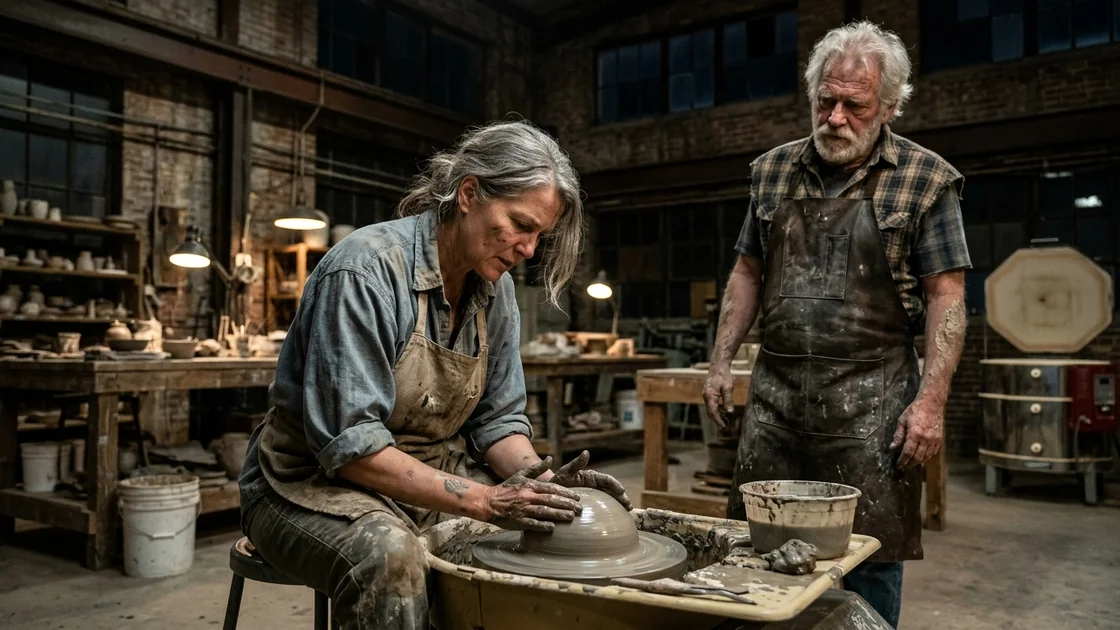
At fifty-four years old and thirty years into a respectable marriage, Eleanor Vance signs up for an unconventional midnight pottery course in an industrial corner of town, seeking refuge from insomnia. As her fingers learn the patient geometry of wet clay under the guidance of an eccentric studio master, she begins to dismantle the pristine domestic existence she built, discovering layer by layer that her taste, her marriage to an ambitious surgeon, and her very posture were never her own desires, but the exact blueprints drawn by her late, overbearing mother.
Part I: The White Carpet
The house on Sycamore Crest was silent in the way only large, expensive houses can be silent. It did not creak with settlement; its timbers had been cured under the supervision of a master contractor three decades prior, anchored to the bedrock of the valley with rebar and high-grade aggregate. The plumbing never groaned. When the forced-air furnace breathed its warm, dry exhalations into the rooms, it did so through brass vents lined with acoustic dampening foam.
Eleanor lay on her back on the eastern side of the California king mattress, her hands folded over her diaphragm. It was the posture her mother, Beatrice, had insisted upon since Eleanor was seven years old. Sleep like a statue, darling, and the skin beneath your chin will never sag. Tossing about is for animals and nervous women.
Beside her, Richard breathed with the slow, metronomic cadence of a man who had performed three total hip replacements that afternoon and had total confidence in the morrow. Richard Vance did not toss either, but his stillness was born of exhaustion and clear conscience, whereas Eleanor’s was an act of vigilant, lifelong preservation.
It was 11:14 PM.
On the nightstand rested a crystal glass of filtered water, precisely three-quarters full, set upon a coaster of hand-stitched Belgian linen. To its left lay Eleanor’s reading glasses, folded with the earstems crossed left over right—never right over left, which Beatrice had maintained stretched the tiny hinge screw over time.
Eleanor opened her eyes. The ceiling was painted in Benjamin Moore’s Chantilly Lace, flat finish, two coats over primer. Her mother had chosen the color for Eleanor’s first apartment after college, had supervised its application in Eleanor and Richard’s first colonial on Mercer Island, and had driven two hours to approve the swatch when this house was erected in the hills above the river twenty-two years ago.
"White," Beatrice had declared, holding the cardboard strip against the bare plaster while two carpenters waited in respectful, terrified silence, "is not the absence of color, Eleanor. It is the presence of standards. Any fool can hide behind wallpaper. A woman of discipline lives in light."
Beatrice had been dead for forty-six months. Her ashes were interred in the Holloway family plot beneath a slab of polished Barre granite that was swept every Tuesday morning by a landscape service Eleanor paid three hundred dollars a month to maintain. Yet as Eleanor looked at the ceiling, she could still smell the dry, mint-and-talc scent of Beatrice’s scarves, could still feel the phantom tap of Beatrice’s index fingernail—manicured into a neat, unthreatening almond—against the small of her back. Up, Eleanor. Shoulder blades in the back pocket.
Eleanor slid her legs out from beneath the four-hundred-thread-count Egyptian cotton sheets. The hem did not whisper against the carpet. The carpet was wool, dyed the shade of oatmeal, thick enough that barefoot steps left momentary depressions that erased themselves within seconds, like footprints in cold butter.
She wore a nightgown of heavy ivory silk, cut modestly across the collarbone. In the master bath, she did not turn on the vanity lights; she knew the geography of the brushed-nickel fixtures by heart. She splashed cold water on her wrists—a trick Beatrice had taught her to calm a racing pulse—and looked into the darkened mirror.
The woman who looked back was handsome, preserved, and neatly outlined. Her gray hair was not allowed to silver at will; it was softened into a buttery ash every four weeks by a stylist Beatrice had chosen in 1998. Her collarbones were prominent, elegant hangers for the single strand of cultured pearls Richard gave her on their twentieth anniversary. She was a woman who served on the library board, who organized the spring gala’s silent auction, who kept three varieties of mustard in the door of the Sub-Zero refrigerator because guests ought to have choices that reflected their palates.
She was also a woman who had not slept more than three consecutive hours since the Tuesday after Thanksgiving.
She went downstairs without turning on a lamp. Her feet found the center of each oak tread, avoiding the edges where the wood occasionally gave a minute, microscopic sigh. In the kitchen, the blue digital clock on the built-in espresso machine glowed: 11:32.
On the island of honed Carrara marble sat a small card, printed on coarse, unbleached kraft paper. It had come slipped inside the community arts council newsletter three days earlier. Eleanor had thrown it in the recycling bin twice, and twice she had retrieved it when Richard was in the garage checking the tire pressure on the Audi.
NIGHT WORKS CERAMICS
Open Studio & Wheel Instruction
Midnight to 4:00 AM
"For those who cannot sleep, and those who need to begin."
Foundry Lane, Unit 7
Instructor: J. Miller
Foundry Lane was down by the water, past the defunct train depot, in a district where diesel trucks idled during the day and the city forgot to replace streetlamp bulbs. It was not a place Beatrice would have allowed Eleanor to say aloud, let alone visit. Beatrice had regarded arts and crafts as the domain of women who had failed at either marriage or interior decoration. If you wish to have art, Eleanor, you buy it from an established gallery on Sutter Street. You do not make it. Making it is messy, and women who smell of turpentine or kiln smoke invariably have dirty fingernails and tragic marriages.
Eleanor picked up the card. Her thumb rubbed against the rough, wood-pulp edge. It felt dry, sharp, and alive against her thumbprint.
Upstairs, Richard slept the sleep of the blameless. His golf shirts were folded into six neat stacks in the mahogany dresser. His passport was current. His cholesterol was 172. Tomorrow at noon, they were scheduled to attend a luncheon for the hospital foundation, where Eleanor would wear a dove-gray sheath dress, laugh at the Chief of Surgery’s jokes, and tell three different trustees’ wives that Richard was really the most devoted man, truly, even after thirty years.
Eleanor walked into the mudroom, slipped her feet into an old pair of leather loafers she usually reserved for gardening, pulled a navy wool trench coat over her silk nightgown, and picked up her car keys from the porcelain tray by the door.
The heavy garage door rolled upward with a muted hum. Eleanor backed the sedan into the night, feeling the cold air slip through the vents before the engine could warm it, smelling for the first time in months the sharp, wet odor of rotting river leaves and early winter frost.
Part II: Unit Seven
The riverfront smelled of creosote and river muck.
Eleanor locked the car with the key fob, the chirp of the alarm sounding absurdly bright and defensive in the alley behind the old locomotive works. She pulled the trench coat tighter around her throat, realizing only now that she had not put on a bra beneath her nightgown. The silk rustled against the lining of the coat with a secret, illicit friction. Her skin prickled. If Beatrice could see her—crossing an unpaved gravel lot at a quarter to midnight, braless, driving into an industrial park without telling her husband—the elder woman’s jaw would have tightened until the tendons in her neck looked like violin strings. You are courting degradation, Eleanor. Discretion is the only thing that separates us from the women who buy their clothes from rotating racks.
Unit 7 had no sign, only a heavy steel fire door painted industrial yellow, peeling at the bottom where decades of salty winter slush had splashed against the metal. A single low-wattage bulb hung in an iron cage above the entrance, humming with a vibration that settled behind Eleanor’s teeth.
She hesitated, her gloved hand hovering over the cold iron handle. From within, there was no sound of music, no laughter, no clatter of tools. Only a deep, rhythmic thrumming, like the slow heartbeat of a sleeping beast, accompanied by the distinct, sulfurous tang of wet slate and turned soil.
She pulled the door open.
The air inside was twenty degrees warmer than the street, humid and dense with the smell of riverbeds after a spring flood. The studio was vast—a converted machine shop with exposed brick walls rising thirty feet to a ceiling crisscrossed by iron girders and copper pipes wrapped in deteriorating insulation.
Along the far wall, three electric kilns stood like small, octagonal silos, their control panels glowing with tiny amber LEDs. In the center of the concrete floor sat eight potter’s wheels, arranged in a rough circle around a scarred wooden workbench piled high with wire tools, wooden ribs, buckets of pale, milky water, and blocks of raw clay wrapped in thick plastic sheeting.
Only two wheels were spinning.
At one sat a young man with dreadlocks tucked into a woolen cap, his eyes half-closed, his hands hovering over a tall cylinder that wobbled with every revolution. At the other sat an older man—he looked sixty, though his beard was completely white—wearing a leather apron over a flannel shirt with the sleeves sheared off at the elbows. His forearms were corded with muscle, grayed by dried slip, his knuckles broad and flat.
He didn't look up when the door clicked shut.
"Water’s in the galvanized pail by the door," the man said. His voice was like stones scraping together in a canvas sack. "Aprons on the hooks behind the shelving. Don't touch the grey shelves; those are bone-dry and waiting for bisque. If you break one, you glaze the pieces and buy the potter a drink."
Eleanor remained frozen on the rubber mat inside the threshold. "I... I saw the flyer."
The man stopped the wheel with the pressure of his foot on the pedal. The silence in the room deepened immediately, filled only by the whisper of water settling in a bucket. He looked up, wiping his thumbs on his apron. His eyes were small, clear, and pale green, surrounded by deep trenches of skin that looked as though they had been etched by weather rather than age.
"You’re Vance," he said.
Eleanor blinked. "I beg your pardon?"
"On the phone. Or via email. You didn't leave a first name. Just 'E. Vance' on the registration form." He pointed a wet finger toward an empty wheel near the back wall, where a metal stool sat upon an uneven sheet of plywood. "Take the one by the radiator. It clanks, but the head doesn't have any wobble. You’re ten minutes late."
"I wasn't certain I was coming," Eleanor said. Her voice sounded thin, decorative, like the bone china she reserved for Easter. It was her social voice, the voice she used to introduce guest speakers at the garden club.
The man stood up. He was shorter than Richard, stocky, with the roll-shouldered posture of someone who spent his days hauling sacks of feldspar and silica. He looked at her trench coat, at the hem of ivory silk that showed beneath it, at her spotless leather loafers.
"You can leave if you want," he said neutrally. "Nobody checks attendance here. But if you’re staying, take off the coat. You’ll ruin the wool, and I don't want dry-cleaning fluid near the pug mill."
Eleanor felt a sudden, sharp heat climb the back of her neck. It was not anger; it was the rare, terrifying sensation of being completely invisible and completely exposed at the same instant. Richard never looked at her clothes unless they were late for dinner, and then only to ensure she was wearing the earrings that matched his cufflinks. Beatrice had examined her clothes like an customs officer inspecting luggage for contraband.
This man looked at her the way he might look at an unworked lump of stoneware: curious about its density, indifferent to its pedigree.
She reached for the buttons of her trench coat. She unfastened them with fingers that shook slightly. She had nowhere to hang it except a rusty nail driven into the doorframe. She took off the coat and hung it there.
Beneath it, the ivory silk nightgown fell to her mid-calf. It was an expensive garment, purchased from a boutique on Madison Avenue during Richard’s surgical conference three winters ago. In this room, against the cold concrete and the gray spatters of dried clay, it looked ridiculous—like a shroud, or a theatrical costume left behind by an actress who had fled the stage.
The instructor didn't flinch. He walked over to the wooden bench, picked up a coarse canvas apron with grease stains on the bib, and tossed it to her. It hit her chest with a dull, heavy flump.
"Tie it tight," Jonas Miller said. "Red clay doesn't wash out of silk."
Part III: Centering
"The wheel does not care who your father was," Jonas said three nights later.
It was 1:45 AM. The young man with the dreadlocks was gone, replaced by a woman in her forties with purple hair who sat in the far corner, silently cutting slabs of dark, groggy clay with a cheese wire. Outside, a sleet storm had begun, ticking against the high clerestory windows like handfuls of uncooked rice.
Eleanor sat on the metal stool, her knees spread wide around the revolving wheel head.
Her posture was wrong. Jonas had told her so six times.
"Stop perching," he said, standing over her with his arms crossed. "You’re sitting like you’re waiting for a bus in the rain. Drop your weight into your hips. Use your skeleton, not your shoulders. If you use your shoulders, you’ll be in physical therapy by Tuesday."
"I am sitting straight," Eleanor said, her teeth gritted.
"That’s the problem. You’re performing straightness. Centering isn't about being upright. It’s about being grounded. There’s a difference."
Beatrice’s voice, cool and clipped, drifted into Eleanor’s inner ear: A lady carries her spine as if it were a string of diamonds being pulled toward heaven by an invisible hand. Slouching is an admission of defeat.
"Lean in," Jonas commanded. "Brace your left elbow on your inner thigh. Lock it there. Don't let your arm move. If your arm moves, the clay wins."
Eleanor obeyed. The position felt obscene. Her legs were parted, her nightgown—she had switched to an old pair of denim trousers and an oversized chambray shirt she found in the attic, garments Richard had bought for a long-abandoned trout fishing trip—was bunched between her thighs, and her face was eight inches from a wet, brown mound of stoneware spinning at two hundred revolutions per minute.
Her hands were wet. Jonas had dumped a cup of icy water over the spinning lump.
"Now," he said. "Palm of your left hand at eight o’clock. Blade of your right hand at twelve o’clock. Squeeze them together. Don't fight it. Absorb the wobble."
Eleanor pressed her palms into the clay.
The sensation was violently physical. The clay was cold—colder than the air—and filled with tiny specks of grog, fired clay that had been ground into sand to give the body tooth. It rasped against her skin. As the mass spun, it fought her palms, lurching to the left, then to the right, jerking her wrists with an erratic, living momentum.
"It won't center," she panted, her knuckles aching. "It’s off-balance."
"The clay isn't off-balance," Jonas said, his face inches from hers as he bent down to inspect the line of her wrists. "You are. You’re giving it your uncertainty. It’s just reflecting what you’re feeding it. Push down. Don't be polite."
Don't be polite.
The phrase struck her like a slap.
All her life, Eleanor had been polite. She had been polite when her mother informed her that she would not be attending the Rhode Island School of Design—where she had secretly been accepted—because "women from our family do not become commercial illustrators, Eleanor, they become board members for the symphony." She had been polite when Beatrice introduced Richard Vance at a country club mixer, remarking afterward in the car that Richard’s father had three car dealerships and Richard himself was already marked for Chief Resident at Northwestern. A man with hands like that, Beatrice had murmured, smoothing her kidskin gloves, will always provide a solid home. Art is a hobby for girls with trust funds who don't mind living alone with cats.
Eleanor had been polite when Richard announced they were moving to this valley because the orthopedic practice here offered a guaranteed partnership within twenty-four months, even though Eleanor had just planted her perennial beds in their Seattle garden.
She leaned her whole weight forward. Her chest pressed against her forearms. She forgot the diamond string pulling her to heaven. She forgot her collarbones. She shoved the heel of her hand into the mud with a fierce, ugly grunt.
The clay squeaked. The uneven wobble smoothed out under the heel of her hand. The violent lurching ceased, collapsing into a perfect, glassy dome that spun beneath her fingers without a hairsbreadth of vibration. It looked stationary, though it was flying beneath her skin.
"There," Jonas said, stepping back. His tone was almost bored, but his pale eyes stayed on her face for a second longer than necessary. "You found the bottom. Now don't lose it."
Eleanor sat back. Her hands were caked in thick, gray slip that had begun to dry into a tight, second skin around her cuticles. Her fingernails—always kept short and painted with Essie’s Ballet Slippers—were rimmed with grit. A drop of sweat had run down her temple, dragging a smear of mud across her cheekbone.
She looked down at her hands.
They were not her mother’s hands. Beatrice had moisturized four times a day with an almond cream imported from London, rubbing it into her palms with small, circular motions while watching television with the sound off. Beatrice’s hands had never touched anything that wasn't finished, polished, or served on a tray.
Eleanor felt a strange, cold draft against her ribs. She took a breath—a deep, jagged breath that went all the way to the base of her lungs—and realized she was trembling.
"What do I do now?" she asked.
"Open it," Jonas said, turning back to his own bench. "Hole in the middle. Go down until you feel the bat, then back off a half-inch. Leave enough clay for a foot. If you don't leave a foot, the thing has no foundation. It’s just a tube."
Part IV: The Inventory of Taste
By the fourth week, Eleanor was leaving Sycamore Crest every Monday, Wednesday, and Friday at 11:30 PM.
Richard had noticed, but only in the peripheral, frictionless way he noticed changes in the weather or the price of premium unleaded fuel.
"You’re reading late downstairs," he remarked one morning, buttering a slice of seven-grain toast with surgical precision. He had already run four miles and showered. His hair was parted with the wet comb-marks still visible.
"Yes," Eleanor said, pouring his coffee from the silver-plated thermal carafe Beatrice had given them as an engagement gift. "The insomnia is worse."
"You should let David prescribe something. Ambien is too aggressive, but a low-dose trazodone would regulate your sleep architecture without the morning fog."
"I don't want pills, Richard."
He looked up from his tablet, where he was reviewing surgical schedules. He gave her that warm, professional smile—the one he used with patients’ families in the waiting room to assure them that the femoral head had seated perfectly in the acetabular cup.
"You’re always so stoic, El. Just like your mother. Beatrice never took an aspirin in her life, did she? Remarkable woman. She knew how to manage her constitution."
"My mother had migraines that kept her in a darkened room with ice packs for three days every July," Eleanor said quietly, her back to him as she wiped the counter with a microfiber cloth.
Richard laughed, a pleasant, baritone bark. "Well, yes, but she did it with dignity. She didn't let it become a performance. Are we still on for the regional hospital dinner on the twelfth? The board wants to introduce the new development director."
"Of course."
"Wear that blue dress. The one with the French cuffs Beatrice liked. It makes you look like a governor’s wife."
"The blue dress has a stain on the hem," Eleanor lied.
Richard frowned, though his eyes were already drifting back to the screen. "Really? Take it to the cleaners on Fourth. The man there worked wonders on my tuxedo trousers."
He rose, kissed her temple—his breath smelled of peppermint toothpaste and the black roast coffee he favored—and took his briefcase from the side table. "Don't work too hard on the garden committee today, El. You look a little peaked."
After the garage door hummed shut, Eleanor stood in the center of the kitchen.
She looked around the room.
The cabinets were cherry, stained to a deep, conservative mahogany that Beatrice had insisted would never look dated. Oak is for Midwestern farmhouses, Eleanor. White laminate is for dentists’ offices. Cherry is permanent.
The draperies in the breakfast nook were damask, patterned with stylized acanthus leaves in sage and gold. Eleanor had spent three weeks looking at simple linen panels in an unbleached ecru, but Beatrice had accompanied her to the design showroom. Ecru? her mother had said, lifting the corner of the fabric with two fingers as though it were a soiled dishcloth. It looks like you couldn't afford the dye, Eleanor. Acanthus is classical. It was used in the Parthenon. Don't be timid. You are Mrs. Richard Vance.
Eleanor walked into the dining room.
The dining table was ten feet long, surrounded by eight shield-back chairs upholstered in striped silk. Over the sideboard hung a large, framed oil painting: a landscape of the Scottish Highlands, depicting sheep standing stoically in a cold mist beneath a violet sky.
It had belonged to Beatrice. It was not a particularly good painting—the sheep’s proportions were slightly distorted, their legs too thin for their bodies—but it had been purchased at an estate sale in Portland by Eleanor’s grandfather.
"Our family has always had land in Inverness," Beatrice had claimed repeatedly, though Eleanor’s genealogy research during college had revealed their Holloway ancestors had been shopkeepers from Leeds who emigrated in steerage. When Eleanor had gently pointed this out, Beatrice had set her teacup down with a sharp clink against the saucer. We do not discuss passenger manifests, Eleanor. We discuss who we are now.
Eleanor walked up to the painting.
She stared at the sheep. For thirty years, she had eaten Christmas dinners, Thanksgiving turkeys, and anniversary cakes beneath those sheep. She had polished the gold-leaf frame every spring with a special horsehair brush.
She hated them.
She had always hated them. The sky was the color of a fresh bruise, and the sheep looked wet, stupid, and miserable.
She looked at her hands.
Beneath her fingernails, despite two scrubbings with a stiff nailbrush, there was still a pale shadow of white stoneware clay—a high-fire porcelain mix Jonas had let her try the night before. Porcelain was cruel; it had memory. If you pushed it too fast, it didn't collapse immediately; it waited until it was in the kiln, and then it cracked along the exact axis where your hand had hesitated.
Porcelain remembers, Jonas had told her, standing over the bat as she struggled to pull the wall of a small bowl. You can lie to yourself while the wheel is spinning. The fire doesn't care about your intentions. It only reveals your technique.
Eleanor went to the sideboard. She reached up, took the heavy, gold-framed painting off its brass hook, and carried it into the hall closet. She set it behind the winter coats, its sheep facing the vacuum cleaner hose, and shut the door.
The wall where it had hung was a bright, clean rectangle of Chantilly Lace, pristine and empty.
Part V: The Midnight Guild
The studio had six regulars who came between midnight and dawn.
There was Sarah, thirty-one, a pediatric intensive care nurse who arrived smelling of hospital soap and lavender hand sanitizer, her eyes rimmed with red fatigue. She threw massive, thick-walled platters that she carved with deep, aggressive zigzags using an old dental tool. She never spoke about the children she looked after; she only talked about the temperature of the glaze room and whether Jonas had ordered more cobalt carbonate.
There was Leo, twenty-four, an art school dropout who lived in a van parked behind the lumber yard. He spent hours wedging clay—a violent, rhythmic process of slamming fifty-pound blocks of earth onto a plaster slab to drive out air bubbles—with a pair of headphones clamped to his skull, his teeth bared in an expression that was either ecstatic or furious.
And there was Jonas.
Jonas Miller had once been an associate professor of fine arts at an upstate university, or so Sarah whispered to Eleanor while they were cleaning the sink traps at 3:00 AM. He had tenure, a house with a mortgage, and a monograph published by a university press about early American salt-glazed stoneware. Then his wife had died of an aneurysm while weeding their garden, and Jonas had resigned thirty days later, sold the house, and moved his equipment into this derelict foundry.
"He doesn't talk to anyone from that life," Sarah said, dumping a gray slurry of clay water into the settling bucket. "My sister had him for introductory ceramics twelve years ago. Said he used to wear tweed jackets with elbow patches and talk about phenomenology. Now look at him. He looks like a harbor seal."
Eleanor glanced across the room.
Jonas was sitting at his workbench, repairing a broken heating element in Kiln Three. He had an iron wrench in one hand and a lead pencil tucked behind his ear. His hair was wild, stuck to his forehead with sweat.
He looked over, catching Eleanor’s eye. He didn't look away, nor did he smile. He simply nodded toward her wheel.
"Vance," he called out. "Your rim is too thick. Trimming won't fix poor throwing. Cut it off with the needle tool and pull it again."
"Yes, Mr. Miller," Eleanor said automatically.
"Jonas," he snapped. "I’m not your school principal."
Eleanor sat down at Wheel Four. It had become her wheel. The metal frame had a spot on the left side where the gray paint had chipped away to reveal red rust shaped like a bird’s wing.
She took her needle tool—a six-inch piece of brass wire with a needle set into the tip—and braced her forearms on her knees.
The bowl before her was eight inches wide. It was her seventh attempt that night. The previous six sat on a wooden board beneath the workbench, crumpled into gray, wet lumps destined for the slop bucket.
Her wrists hurt. Her back throbbed with an ache that was entirely different from the tight, nervous knot she carried between her shoulder blades when she sat through church or hospital luncheons. This was an honest ache, the ache of muscle fibers being asked to support bone rather than posture.
She pressed the point of the needle into the revolving clay, three-eighths of an inch below the wobbly rim.
The steel bit through the wet mud. The scrap of clay—a ring no thicker than a worm—lifted from the wall and curled around the needle. Eleanor pulled it free and flicked it into the splash pan.
"Better," Jonas’s voice came from directly behind her.
She hadn't heard him approach; his work boots had rubber soles that moved silently over the concrete.
"Now," he said, crouching beside her stool. He smelled of tobacco, dry clay, and cedar shavings. "Look at the profile. Don't look at the top. Look at the silhouette."
Eleanor leaned down. The bowl was low, wide, its curve clean and unforced. It didn't look like the decorative porcelain bowls Beatrice had collected—the ones with scalloped rims and gold leaf that were only allowed to hold potpourri made from dried rose petals from the Holloway garden.
It looked like something that wanted to hold soup. Heavy, hot soup made of leeks and potatoes, eaten with a wooden spoon by a person whose boots were still muddy from the fields.
"It’s not symmetric," Eleanor said, her voice dropping.
"Nature isn't symmetric," Jonas said. "You want symmetry, buy a machine-pressed bowl from Target. It’ll be round to the hundredth of an inch, and it won't have a soul in it."
"My mother had a set of Meissen plates," Eleanor said, the words slipping out before she could stop them. "Eighteenth century. She kept them in a locked cabinet with museum glass. If one was rotated three degrees out of alignment, she would notice from across the room."
Jonas looked at the spinning bowl, then at Eleanor’s hands.
"Your mother sounds like she was terrified of dying," he said.
Eleanor caught her breath. The clay wobbled under her thumb, a tiny ripple passing through the wall.
"She was not terrified," Eleanor whispered, defensive by reflex. "She was... she had an appreciation for order."
"Order is what you do when you’re scared of what happens when things move," Jonas said. He stood up, his knees cracking like dry twigs. "Clay moves. It shrinks when it dries. It warps in the fire. It melts if you give it too much heat. You can't control it, Vance. You can only negotiate with it. If you try to dominate it, it cracks just to spite you."
He walked away toward the glaze buckets, leaving her alone with the humming motor.
Eleanor stared at the bowl.
She was terrified of dying.
She remembered Beatrice during her final weeks at the hospice. Even then, when the cancer had reduced her to ninety pounds of skin and brittle bone, Beatrice had refused to allow the nurses to remove her lipstick. Every morning at seven, she had sat up in the hospital bed, her hands trembling so violently she could barely hold the gold cylinder of Revlon Cherries in the Snow, and smeared the red pigment across her cracked, dry lips.
A woman who lets herself go in front of the help, Beatrice had whispered through cracked teeth, has already surrendered her estate, Eleanor. Call the girl to comb my hair.
Eleanor had combed her mother’s hair. She had combed it until her own hands were stiff, parting it precisely down the center, smoothing down the wisps with rosewater spray, while Beatrice watched her in the small plastic mirror, her eyes bright and predatory even in their sunken sockets.
You have Richard, Beatrice had whispered on the third night before she died, clutching Eleanor’s wrist with fingers like bird claws. You have a good life, Eleanor. A correct life. Don't you ever make a fool of me by changing it.
Eleanor stopped the wheel.
The bowl sat on the wooden bat, quiet, brown, and wet.
She took her wire tool—two wooden toggles connected by a twelve-inch piece of braided aircraft cable—held it taut between her thumbs, and pulled it smoothly under the base of the bowl, slicing it free from the wood.
Her fingers were smeared with mud. She lifted the bowl with her bare hands, feeling its wet, yielding weight against her palms, and set it on the drying board.
It was flawed. The wall was thicker on the eastern side than the western. The rim had a tiny dip where her thumb had slipped.
It was the most beautiful thing she had ever made.
Part VI: The Crack in the Glaze
The foundation luncheon was held in the ballroom of the Riverfront Hotel.
The chandelier was imitation Waterford, three hundred crystal drops suspended from a brass hoop that shook whenever a tractor-trailer crossed the bridge three blocks north. Eleanor sat at Table 4, between Dr. Harrison—a cardiologist with a comb-over and three ex-wives—and Mrs. Abernathy, whose family had owned the local timber mill since 1912.
Richard was at the head table, sitting between the hospital CEO and a state representative. He looked magnificent in his charcoal Brooks Brothers suit. His posture was impeccable; he had never needed Beatrice to tell him to keep his shoulder blades in his back pocket. He was born with an innate, structural sense of his own value.
"Eleanor, darling," Mrs. Abernathy leaned in, her breath smelling of gin and dry vermouth. "We missed you at the botanical society on Tuesday. We were finalizing the centerpieces for the June gala. Dried hydrangeas or the white peonies? Beatrice always favored the peonies, of course, but the pricing from the nursery has become simply extortionate."
Eleanor looked down at her plate.
Before her lay a circle of poached chicken breast resting on a bed of wild rice that had been pressed into an immaculate, circular puck with a stainless steel mold. A single sprig of Italian parsley was centered on the meat like a flag planted on a conquered territory.
Her fingernails were clean. She had spent twenty minutes in the bathroom that morning with hydrogen peroxide and a toothbrush, scouring away the remnants of the Albany slip glaze she had been mixing the night before. But the skin around her thumb was raw, and there was a small, dry scratch on her wrist where she had scraped against the kiln’s brick chimney.
"The peonies," Eleanor said.
"Pardon?"
"The peonies are false," Eleanor said. Her voice was louder than she intended. Dr. Harrison paused with his butter knife midway to a roll.
"False?" Mrs. Abernathy laughed, a fluttering, decorative sound. "Darling, they’re grown in Watsonville. They’re perfectly real."
"They’re bred to be so heavy they can't support their own weight," Eleanor said, looking directly into Mrs. Abernathy’s rheumy, blue eyes. "If it rains, they fall into the dirt and rot. They only survive if you stake them to wire frames and cut them before they open. They’re bred to be hostages."
The table went quiet. Dr. Harrison set his knife down with a soft click against the rim of his bread plate.
Mrs. Abernathy blinked, her smile freezing like sugar glaze on an old pastry. "Well. Beatrice always said they had such presence on a damask cloth."
"My mother," Eleanor said, "hated anything that had a mind of its own."
Across the room, Richard’s laugh rang out—confident, clear, perfectly modulated for the acoustic parameters of the room. He was raising a water glass to toast the outgoing chief of medicine.
Eleanor stood up.
"Eleanor?" Dr. Harrison looked up, his brow furrowed. "Are you all right?"
"The chicken is cold," she said.
She did not wait for Richard. She did not leave a note with the coat check attendant. She walked out of the ballroom, down the carpeted corridor with its brass wall sconces, past the reception desk where the clerk was sorting credit card slips, and out into the gray afternoon drizzle.
She walked three miles down the river road.
Her gray heels were ruined within six blocks, the soft kidskin soaked through with muddy river water. She took them off at the railroad crossing and carried them by the straps, her bare feet blackening on the wet asphalt, the hem of her dove-gray sheath dress spattered with grit from passing delivery vans.
When she reached Foundry Lane, the industrial park was quiet, the diesel trucks parked in rows like sleeping rhinos.
Unit 7 was unlocked. Jonas never locked the door during the day; he slept in a loft above the glaze room, his boots hanging from the rafters by their laces.
The studio was cold. The kilns were off. The air smelled of damp earth and stale tea.
Eleanor dropped her heels on the rubber mat. She went to the shelf where her greenware was drying.
Her bowl—the one she had thrown three nights ago—was leather-hard. It had shrunk by eight percent, the clay turning from dark brown to a pale, bone gray. It had set. It was no longer soft enough to reshape, but not yet brittle enough to shatter at a touch.
She picked it up. She took a metal loop tool from Jonas’s bench, pulled out the three-legged stool at Wheel Four, and sat down without turning on the wheel.
She began to trim the foot.
She shaved away the excess clay from the base, long, paper-thin ribbons curling over her knuckles and dropping into her lap. With every stroke of the steel loop, the bowl grew lighter, its profile rising from the heavy, clumsy base into something lifted, floating, almost graceful.
She didn't hear the stairs creak behind her.
"You’re early," Jonas said.
He was wearing gray sweatpants and a thermal undershirt with holes in the cuffs. His white hair was flattened on one side where he had been sleeping on it. He was holding a chipped enamel mug of black coffee.
Eleanor didn't look up. Her hands kept moving, the steel tool biting into the dry clay with a rhythmic, whispering sound: shhh, shhh, shhh.
"I left the luncheon," she said.
"I can see that. That dress didn't come from the Goodwill."
"It cost eight hundred dollars," she said. A ribbon of clay fell onto her silk lap. "My mother chose it from a catalog from Bergdorf Goodman two weeks before she went into the hospital. She told me Richard would look at me and remember why he married me."
Jonas took a sip of his coffee. He leaned against the heavy timber post that supported the loft.
"Why did he marry you?" he asked.
The loop tool stopped. Eleanor stared at the bottom of the bowl.
"Because I was Beatrice Holloway’s daughter," she said. Her voice was flat, stripped of the decorative lilt she had practiced since childhood. "Because I knew how to set a table for twelve without looking at a diagram. Because I had small ears and good teeth and my grandfather had been a regent at the university. Because I was... manageable."
"And you?" Jonas asked. "Why did you marry him?"
Eleanor looked at her feet, bare and gray with road silt against the concrete floor.
"I was twenty-four," she said. "I had spent four years trying to convince my mother that I wanted to live in New Mexico and work at a dig site. Beatrice had three private investigators look into the professor who ran the program. She found out he had been divorced twice and owed back taxes. She called him at his department office and told him that if he accepted me into the field school, she would pull the Holloway foundation’s grant from the anthropology library."
She looked up at Jonas. Her eyes were dry, wide, and clear.
"The professor called me into his office. He was a small man with bad teeth and ink on his fingers. He had my application on his desk. He looked at me like I was a bomb that might go off. He said, 'Miss Holloway, you’re very talented, but your family is too loud. We don't have the stomach for it.'"
Jonas took another sip from his mug. "So you married the surgeon."
"My mother had already bought the invitations," Eleanor said. "They were engraved in London. Crane’s crest on heavy vellum. If you held them to the light, you could see the watermark of three lilies."
She set the loop tool down on the wheel head.
"I spent thirty years thinking I was Richard’s wife," she whispered. "I thought I was the woman who liked the acanthus curtains. I thought I was the woman who enjoyed the botanical society. I thought I was the woman who preferred flat white paint to wallpaper."
She reached out and touched the rim of the bowl.
"I am not Richard’s wife," she said. "I am Beatrice Holloway’s third house."
Jonas didn't offer a platitude. He didn't tell her it was never too late, or that she had her whole life ahead of her, or any of the cheap, comfortable lies people tell when an existence begins to splinter along its fault lines.
He walked over to the shelf, took down a small jar of liquid wax resist, and set it on the bench beside her.
"Wax the foot before you dip it in the celadon," he said. "If you don't wax it, the glaze will run down to the bat and fuse the pot to the kiln shelf. Then you have to take a hammer to it, and that’s a waste of a good bowl."
Part VII: The Kiln
The confrontation did not happen in the kitchen. It happened in the dressing room.
Richard arrived home at seven o'clock that evening. His car door shut with its usual German precision. His steps came up the stairs—firm, measured, unhurried.
He found Eleanor in her closet.
The closet was twenty feet long, lined with cedar-faced shelves and mirrored drawers. Beatrice had designed it. A woman’s wardrobe, her mother had said, should look like an apothecary shop. Everything in its place, labeled, and protected from moths. Chaos in the closet is a sign of an untended mind.
Eleanor was sitting on the floor in the center of the room, surrounded by cardboard boxes from the grocery store.
The eight-hundred-dollar sheath dress lay in a heap by the laundry chute, stained with river water and red clay. Eleanor was wearing an old gray sweatshirt with the sleeves cut off and a pair of faded canvas trousers that smelled of the foundry.
Around her, the shelves were emptying.
The cashmere cardigans—Beatrice had insisted that a lady wears pastel cashmere in the spring and camel in the autumn—were folded into one box. The silk scarves, thirty-two of them, rolled into neat cylinders like colored cigars in their mahogany box, were dumped into another.
Richard stood in the doorway. He had already taken off his jacket and loosened his tie, but his shirt was still tucked into his trousers without a single wrinkle along the waistline.
"Eleanor," he said. His voice was calm, the voice he used when an intern dropped a retractor during an open reduction. "David said you left the luncheon on foot."
"Yes."
"He said you looked unwell."
"I was never better in my life, Richard."
He looked at the cardboard boxes. His forehead creased with a small, neat vertical line between his eyebrows.
"What are you doing with the knitwear?"
"I’m giving it to the women’s shelter on Sixth Street," she said, without looking up. She folded a cream-colored twinset with quick, mechanical movements.
"Those were your mother’s," he said.
"No," Eleanor said, looking at him now. "They were mine. But they were chosen by my mother for the daughter she wanted. I am not that person anymore."
Richard leaned against the doorframe. He crossed his arms. His gold watch—the Patek Philippe Eleanor had given him for his fiftieth birthday, selected from a jeweler Beatrice had known since childhood—glinted in the recessed LED lighting.
"Eleanor," he said, and his voice dropped into that low, reasonable, patronizing register that had sustained their marriage for three decades. "You’ve had a difficult few years. Beatrice’s illness was long, and you bore the brunt of it. I know that. I should have been more present. The clinic expansion was demanding, but that’s no excuse. If you need to take a trip—go to Canyon Ranch for a month, take that painting workshop in Provence you mentioned years ago—we can afford it. You don't need to... to dismantle the house."
Eleanor stopped. She held a pale green cardigan in her hands. The wool was extraordinarily soft, shaved from the underbellies of goats raised in the foothills of the Himalayas.
"I don't want to go to Provence, Richard."
"Then where do you want to go?"
"Down to the river," she said.
He stared at her. "The river? Foundry Lane? What is down there, Eleanor? I checked the Visa statement. You’ve been paying two hundred dollars a month to something called 'Night Works.' A business registered to Jonas Miller. He’s an eccentric, El. A man who lives in an unlicensed commercial unit. People talk about these things."
"What people, Richard? Mrs. Abernathy? The Chief of Surgery?"
"Yes! People who matter to our lives! People who support the hospital, who sit on the boards with us! You cannot simply... disappear in the middle of a foundation dinner and walk down the highway like a vagrant! It reflects on me, Eleanor. It reflects on our home."
Eleanor looked down at the sweater in her lap.
"Do you know what my mother told me on our wedding night?" she asked softly.
Richard sighed, shifting his weight. "Eleanor, please. Not tonight. I have a revision surgery at seven tomorrow morning."
"She came into the dressing room at the country club," Eleanor continued, as if he hadn't spoken. "You were downstairs having whiskey with your father. She unbuttoned my gown. She looked at my shoulders. She said, 'Eleanor, Richard is an ambitious boy. Ambitious men are simple machines. They need a clean shirt, a silent room, and a wife whose name never appears in the newspaper except under the society listings. If you give him those three things, he will never ask you who you are. And that is the greatest gift a husband can give a woman: permission to remain undisturbed.'"
The dressing room was very quiet.
The acoustic foam in the vents muffled the hum of the world outside. The wool carpet swallowed the sound of their breath.
Richard didn't move. For the first time in thirty years, Eleanor saw something flick across his eyes that was not certainty. It was not anger, either. It was a profound, cold bewilderment—the look of an architect who taps on a load-bearing column and hears a hollow ring.
"I didn't ask you who you were," he said slowly, "because I thought I knew."
"You knew Beatrice," Eleanor said. "She was very easy to know. She was a set of architectural drawings. You liked the house she built, so you moved in."
"We have been happy, Eleanor."
She looked up at him, her gray eyes clear, steady, and terrifyingly free of apology.
"No, Richard," she said. "We have been well-maintained."
Part VIII: The Celadon Bowl
The kiln was unloaded at four o'clock in the morning on the second Sunday of November.
The outside temperature was twenty-eight degrees. A thin skin of black ice covered the potholes on Foundry Lane. Inside Unit 7, the air was warm and smelled of burned wax and calcined bone.
Jonas stood before Kiln Two, wearing heavy welder’s gloves made of split cowhide.
"It’s at one hundred and eighty," he said, checking the digital pyrometer. "A little early to open, but I have a flat of garden urns that need to go in before noon. If you take them out now, don't set them on the cold concrete. They’ll shiver."
Eleanor stood beside him. She wore her denim trousers, her work boots, and an old wool sweater she had bought for four dollars at the thrift store down the street. It was dyed an ugly, mustard yellow, and the neck was stretched out so far it showed her collarbone, but it was warm, it was thick, and no one in her family had ever touched it.
Jonas unlatched the heavy iron clasps of the kiln lid.
He lifted it slowly. A wave of heat rolled into the room, dry and sweet, carrying the metallic tang of molten silica that had cooled back into stone.
Eleanor leaned forward, squinting through the shimmer of heat.
On the top shelf sat nine pieces. Sarah’s carved platters had turned a rich, deep tenmoku brown, the edges breaking into rust where the clay showed through the glaze. Leo’s tall, aggressive vases were matte black, scarred with gray salt flashes.
And in the center sat Eleanor’s bowl.
She put on the gloves Jonas handed her. She reached into the kiln, her hands trembling slightly inside the thick leather, and lifted the bowl from the shelf.
The bottom did not stick. The wax resist had done its work; the foot was raw, unglazed stoneware, pale and sandy, while the body was covered in a pale, translucent celadon—the color of river water when the sun hits the stones beneath a rapid.
She carried it to the wooden workbench.
She took off the gloves and set the bowl down on the scarred pine.
She waited three minutes for the clay to cool enough to touch with her bare skin. When she pressed her fingers against the rim, it was still hot—like a person’s forehead in the grip of a fever—and completely smooth.
The glaze was not uniform. In two places, where the dip had been slightly heavier, it had pooled into small, pale teardrops that looked like frozen water. On the western wall, where the clay had been slightly thinner, the iron in the body had bled through the glaze, creating a faint, reddish-brown blush that looked like a bruise, or a thumbprint.
"It shrank ten percent," Jonas said, standing beside her with his hands in his pockets. He looked at the bowl for four seconds, his eyes moving over the rim, the foot, the pooled glaze.
"The foot is clean," he said.
"It has a blush," Eleanor said.
"Reduction did that," he said. "Starved the kiln of oxygen at cone ten. The fire went looking for air and pulled it out of the iron in the dirt. It’s what happens when you let the fire do the work instead of trying to steer it."
He looked at her. "You going back to the surgeon?"
Eleanor didn't answer immediately.
She looked at her reflection in the pale green glaze of the bowl. Her face was distorted by the curve, stretched wide, her jaw broader, her eyes larger and darker than they appeared in the vanity mirror at Sycamore Crest.
She looked like a stranger.
She looked like a woman who could live in New Mexico. She looked like a woman who could sleep in an unheated room and wake up to the smell of rain on sagebrush. She looked like a woman who might fail, who might make things that broke in the kiln, who might die without an obituary in the metropolitan section of the Sunday paper.
"I signed the lease yesterday," she said.
Jonas’s eyebrows moved slightly. "Where?"
"Unit Nine," she said, nodding toward the wall that separated them from the old warehouse next door. "The old pattern shop. The roof leaks over the loading dock, but the three-phase power is still connected."
Jonas looked at her for a long moment. Then, for the first time in the six weeks she had known him, the corners of his mouth twitched upward into a small, dry smile that didn't reach his eyes, but softened the stone-hard trenches around his jaw.
"The roof leaks in the corner," he said. "Put a bucket under it and don't store your dry plaster there. Plaster hates water until you’re ready for it."
He turned back to Kiln Two. "Get your greenware out of my drying rack, Vance. I need the space for the urns."
Eleanor picked up her bowl.
It was still warm. She carried it against her ribs, her forearm cradling the smooth, cool curve of the celadon.
She walked out the steel door of Unit 7 into the predawn dark.
The sleet had stopped. The sky to the east was not yet blue, but the thick, gray belly of the clouds had begun to lift, revealing a sliver of horizon the color of cold zinc. The river ran beneath the railroad bridge, black and heavy with winter runoff, making a sound like canvas tearing in the wind.
Eleanor did not look toward Sycamore Crest. The house on the hill was there, of course, with its Chantilly Lace walls, its empty space above the sideboard where the stupid Scottish sheep had hung, and Richard’s six neat stacks of golf shirts resting in their mahogany drawers. Richard would wake at six, drink his black coffee, and find the envelope she had left on the Carrara marble island beside the engagement carafe.
The envelope contained her wedding ring, her house keys, and a short, hand-written note that did not begin with Dear Richard and did not end with Love.
It contained only seven words, written with a pencil she had taken from Jonas’s bench:
The foundation was too small for me.
Eleanor walked down the gravel alley toward Unit 9. Her boots crunched against the frost. Her hands were red from the cold air, but her palms were warm against the fired earth in her arms.
Behind her, the kiln hummed in the dark, turning dirt into stone, while the rest of the world slept its neat, obedient, terrified sleep.