The Secret Ledger of Nora Vance
When thirty-two-year-old archivist Clara Vance returned to the windswept coastal cottage of her childhood to pack away the belongings of her quiet, devout mother, she expected to find little more than embroidered linens, church bulletins, and tins of dried chamomile. Instead, behind a false wall in the kitchen pantry, Clara uncovered an oilskin journal titled Provisions for Passage, filled with intricately detailed baking recipes whose margins concealed a cryptographic record of international espionage, forged art, and high-stakes survival. As Clara decodes each culinary confession, she uncovers the astonishing, dangerous life her mother lived under an alias before vanishing into domestic obscurity, ultimately forcing Clara to reconsider the quiet sacrifices that built her own safe, ordinary life.
I. The Flour in the Floorboards
The silence in the kitchen of Gull Cottage was not peaceful; it was dense, smelling faintly of lye soap, stale cardamoms, and sea-damp cedar.
For seventy-four years, Eleanor Vance had moved through this kitchen with the light, rhythmic efficiency of a clockwork pendulum. She was a woman who never burned a crust, never spilled oil on an apron, and never spoke above the low hum of the kettle. When she died on the third Tuesday of October, sitting upright in the wingback chair with her knitting needles resting neatly across her lap, the local obituary in the Cape Ann Gazette occupied exactly four lines. It noted her decades of service to the altar guild of St. Jude’s, her prize-winning elderberry jams at the Topsfield Fair, and her status as the widow of Arthur Vance, a quiet postal surveyor who had preceded her into the churchyard fourteen years prior.
Clara Vance had taken three weeks of leave from her post at the Peabody Essex Museum, where she worked in paper conservation and textile preservation, to clear the house. Her hands were accustomed to handling things that had outlived their owners: centuries-old ship manifests eaten by brine, seventeenth-century codices with foxed margins, love letters written in iron gall ink that had slowly burned through vellum. She had believed she knew how to read the dead.
She had spent three days sorting through the upstairs bedrooms. There was nothing remarkable to be found among her mother’s belongings: cotton nightgowns washed so often the blue florals had drifted into grey; boxes of paperclips; bundles of receipt slips from the dry cleaners held together with perished rubber bands; three identical silver thimbles; a Bible with a cracked calfskin spine where the family register was filled out in Eleanor’s upright, schoolmistress hand, recording Clara’s birth, Arthur’s death, and nothing earlier than their marriage in June of 1976.
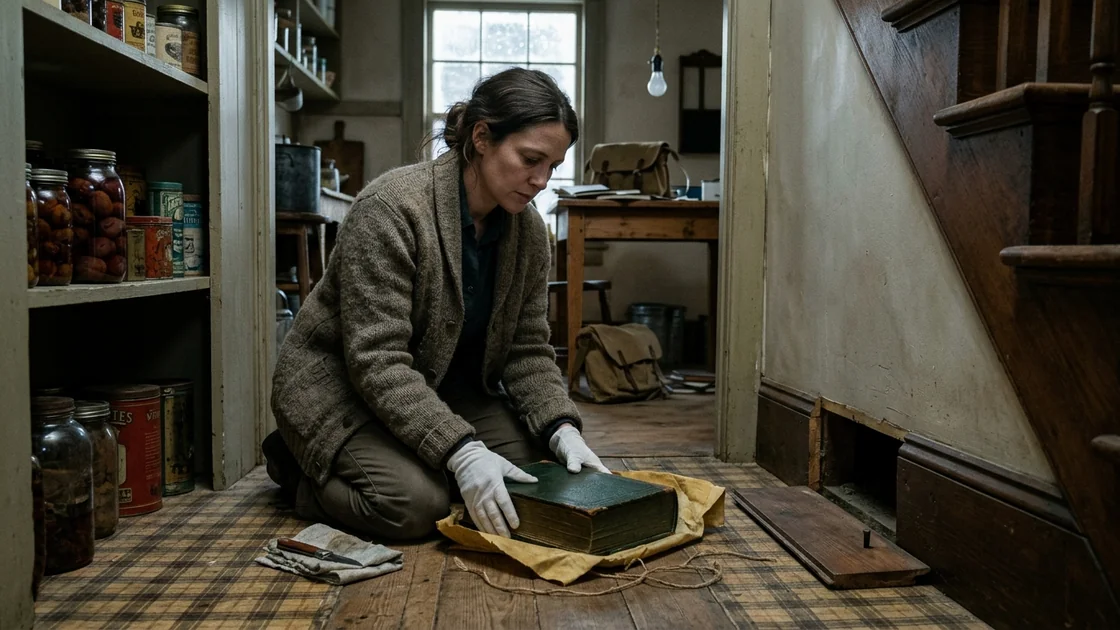
It was on the fourth afternoon, while kneeling in the pantry to remove jars of preserved greengage plums from the bottom shelf, that Clara noticed the baseboard.
The pantry was narrow, tucked beneath the turn of the oak stairs. The air there was always ten degrees colder than the rest of the house, smelling of dry potato skins and vinegar. Clara was wiping down the tongue-and-groove pine with a damp rag when her knuckle clipped a square-headed iron nail near the corner floor-joint. It did not sink flush into the wood; it turned.
Clara paused, sitting back on her heels. The floor was covered in an old pattern of checked oilcloth, ambered with age and wax. Underneath the oilcloth, where the floor met the skirting, the grain of the white pine ran perpendicular to the rest of the planks. She pressed the nail again. A dull spring mechanism popped behind the lath and plaster with the wet snap of old grease.
A five-inch section of the baseboard slid forward an eighth of an inch.
Clara sat entirely still for several breaths. The wind outside was coming off the Atlantic, flinging handfuls of sleet against the high, salt-rimed windowpane above the sink. The grandfather clock in the hall struck three.
She inserted the blade of her pocketknife into the seam, easing the panel free. Behind it lay an oblong cavity cut directly into the dry sill-plate of the house. Wrapped in a square of waxed butcher’s linen and tied with tarred marline twine was a thick, ledger-style volume bound in dark green morocco leather.
Clara lifted it. It was heavy—far heavier than paper alone ought to be—and gave off a faint, contradictory scent that was part almond oil, part gum arabic, and part volatile petroleum ether.
She brought it to the scrubbed pine worktable in the center of the kitchen, beneath the single naked bulb hanging from its frayed green cord. Her archivist’s training kicked in before her grief or curiosity could: she fetched her cotton handling gloves from her satchel, laid down a clean sheet of blotting paper, and carefully clipped the tarred twine.
The cover of the book bore no stamped title, only three small cross-hatches impressed into the bottom corner of the leather with a blunt leather-working stylus. When she opened the front flyleaf, the hand was unmistakably her mother’s, though looser, bolder, and slant-angled, as if written while moving at speed:
Provisions for Passage: Measured for the Palate and the
Road.
E.V. – 1968 to 1975.
If found by anyone other than my blood: consume the salt, burn the
paper, forget the gate.
Clara turned the page.
The first entry was dated Tangier, November 4, 1968. Above the title—Salted Bitter Almond Tart with Orange Blossom Water—was a neat grid of numbers and fractions that bore no resemblance to ordinary baking ratios.
Beside the listing for twelve ounces of blanched bitter almonds, a notation in brown ink read:
Ensure the hulls are not steeped in cold well-water. Cold extracts only the sweetness; use the iron basin heated over charcoal to drive off the lethal balance. Julian says the consul expects three crates by the Friday ferry. The oil does not lie, but the paperwork must.
Clara touched the edge of the leaf. A chill climbed from her wrists to her collarbones. Her mother, according to every story Arthur Vance had ever told over Sunday roast, had been an orphan schoolmistress from Portland, Maine, who had spent the late sixties working in a convalescent home in Bangor before meeting her future husband at a coastal church retreat.
She had never been to Morocco. She had never spoken a word of French or Arabic. She had never owned an iron basin, and she had never, in Clara’s thirty-two years of memory, used bitter almonds for anything at all.
II. The Almonds of the Medina
The handwriting was Eleanor’s, yet reading it was like hearing a stranger speak through her mother’s jaw.
Clara fetched her notebook and a magnifying loupe from her conservation kit. She pulled the kitchen chair closer to the bulb. The kitchen was growing dark, the November twilight turning the windows into black mirrors that threw back the reflection of Clara’s pale, narrow face—the high cheekbones and grey eyes she had always believed she inherited from a mythical grandfather who died in the merchant marine.
She turned her attention to the page headed Tangier, 1968.
The recipe itself was set down with pedantic, almost scientific precision:
SALTED BITTER ALMOND TART (Six small shells)
  Flour: 240 grains (soft winter wheat, triple-sifted)
  Lard: 80 grains (pork, clean-rendered with rosemary twig)
  Bitter Almond Kernels: 140 grains (crushed dry, not macerated)
  Orange Flower Distillate: 2 drams (distilled twice, second run)
  Sea Salt: 1 pinch per case, rubbed onto the rim before baking.
Beneath the ingredients, however, the method split into two distinct columns. The left-hand column described the technique for blind-baking the pastry cases without shrinking. The right-hand column was entirely different.
The ink for the maritime manifest cannot take gum arabic, the entry ran, written in Eleanor’s tiny, upright hand. The humidity of the port at dusk will soften it, and the customs officers at the Bab el-Marsa will know within thirty seconds that the stamps are fresh. Instead, mix the lampblack with three drops of the orange flower distillate and two drops of boiled shellac. It smells of the market, not of the printer’s table. Julian took the seals from the Italian consulate while the third clerk was sick with the jaundice. If the papers for the vessel "Albatross" pass inspection tonight, the boy from the Rue des Teinturiers will carry the crates of parchment to the warehouse behind the Grand Socco. I had to scrub the smell of the charcoal out of my hair three times before Julian would let me go down to the harbor. My apron smelled of scorched marzipan. When the patrol stopped me near the fountain, I offered them two tarts from the basket. The corporal took both. He laughed and said my hands were too small to be a baker’s. He did not look at the parcel beneath the cloth. If he had, I would have had to use the small bottle in my hem.
Clara read the paragraph three times. The words seemed to float on the page, refusing to settle into the domestic reality of Gull Cottage.
Her mother had been five feet, three inches tall. She had had a faint limp in her left hip which she always attributed to an adolescent tumble down the stairs of the Bangor orphanage. Her hands had been dry and slightly rough from gardening, the nails kept trimmed to the quick. Clara remembered those hands holding a wooden spoon, measuring shortening with a metal knife, checking Clara’s forehead for fevers during the long winter colds.
She had never imagined those hands forging maritime stamps with boiled shellac and lampblack.
Clara flipped the page. Glued between the sheets of parchment was a strip of printed newsprint, yellowed and crisp as a dead leaf. It was a clipping from La Dépêche Marocaine, dated November 9, 1968.
Clara’s French was adequate—the museum required reading proficiency in two Romance languages—and she smoothed the clipping under her magnifying glass.
THEFT AT THE ITALIAN CHANCELLERY The maritime police are investigating the disappearance of six blank registries of carriage and three diplomatic seals from the consular annex in the marshan quarter. Authorities suspect the work of an organized ring operating between Tangier and Gibraltar, specializing in the illicit passage of refugees from the Maghreb. An unidentified young woman, speaking fluent castilian with an accent attributed either to the Levant or the Americas, was seen in the vicinity carrying a street-vendor's hamper shortly before the loss was discovered.
In the margin beside the clipping, Eleanor had written in
pencil:
Not Levant. Massachusetts. But my Spanish was better than he
thought. Julian told me I must stop smiling when I hand over the goods;
he says an American girl smiles when she is nervous, and an officer in
Africa always knows that a smile means a hidden pocket. I am twenty-two
years old today. I spent my birthday scraping copper shavings into an
emulsion to turn the seal from Prussian blue to violet-indigo. I ate an
almond tart on the roof looking at the lights of Tarifa across the
water. I do not think I will ever see Boston again.
Clara dropped the magnifying glass. It made a dry clatter against the pine tabletop.
"Twenty-two," Clara whispered into the empty kitchen.
In 1968, Eleanor Vance—if that was even her name—had been twenty-two. According to the marriage certificate preserved in the family Bible, Eleanor had been born in Portland in 1946, the daughter of Thomas and Sarah Vance, both deceased before Clara’s birth. Clara had never seen a birth certificate. Whenever she had asked about her grandparents, Eleanor had replied with that calm, smooth finality that brooked no further trespass: They died of the influenza when I was very small, darling. There were no pictures left after the house fire. It isn't good to dwell on people who aren't here to dwell on you.
Now, the silence of the cottage seemed not empty, but crowded with a thousand unspoken sentences.
Clara got up and went to the larder. Her breath was coming too quickly. She opened the small spice cabinet above the dry-sink—the one Arthur had built out of salvage barn pine in the late seventies. The jars were still there, arranged in alphabetical order with labels made from Eleanor’s hand-cranked embossing label-maker: Allspice, Anise, Basil, Bay, Caraway, Cardamom.
Clara pulled out the jar labeled Almond Essence.
She unscrewed the bakelite cap and held it to her nose. It was not the sweet, cherry-like syrup of modern grocery stores. It was bitter, sharp, biting the back of her palate with a cold chemical prickle that tasted like crushed peach stones and metal.
She looked down at the open book on the table.
The oil does not lie, but the paperwork must.
III. The Marseille Bouillabaisse
That night, Clara did not sleep in the guest room. She dragged her childhood wool blanket down to the kitchen, built up the fire in the small cast-iron woodstove that sat in the chimney nook, and sat with the morocco-bound volume across her knees.
Outside, the Atlantic rose with the midnight tide, throwing long, hollow rollers against the granite ledges at the foot of the garden. The cottage groaned in its timbers.
She turned to page fourteen. The script changed here; it was darker, written with a fountain pen that had a split nib, producing strange double lines on every downward stroke.
Marseille, Quai du Port. October 1970.
Bouillabaisse for Four Men Who Do Not Know Each Other.
FISH:
  Rockfish (rascasse): 2 lbs, heads cracked with the heavy cleaver.
  Gurnard: 1 lb, fins removed and saved.
  Eel: 8 inches, skinned with salt on the fingers.
  No shellfish today; the shells make too much noise in the scullery.

LIQUOR:
  Olive Oil: 4 large spoons (pressed from green fruit; yellow oil is too greasy for the stomach when running).
  Fennel Fronds: 1 dry bundle.
  Saffron: 3 pinches (the real thread from Valencia, not the dyed horsehair sold near the fish market).
  Dry White Wine: 1 tumbler.
  Water: Enough to cover the skulls.
The left-hand method described the fierce, high-heat boil necessary to force the oil and water to emulsify—the rolling boil that was the absolute secret to bouillabaisse, without which it was merely fish boiled in water.
The right-hand column, however, was written in an agony of small, compressed letters:
Julian has been taken.
They did not take him at the apartment in the Panier; they waited until he reached the dry docks behind the bassin de Radoub. The man from the shipping agency—the one who called himself Henri but whose hands had the white calluses of a typesetter—sold the schedule of the cargo boat "Saint-Florent". I had the soup on the kerosene ring when the Basque boy came up the back stairs without his shoes.
He did not knock. He threw Julian’s pocket watch onto the table. The crystal was smashed, and there was grease from the slipway on the silver rim.
He said: "Lina, the flics have the ledger. You have forty minutes before the inspector remembers that Julian did not rent the flat on the third floor alone."
I had four thousand Swiss francs sewn into the quilted lining of my winter coat, but the winter coat was at the cleaner’s on the Rue de la République. I had only my jersey dress, my oilskin apron, and the soup pot. Julian always said: "A woman who is cooking dinner is invisible. No gendarme looks into the eyes of a girl carrying a pot of fish broth."
I put the watch into the bottom of the broth. I took the small brass plate from Julian’s workbench—the one with the etched signatures of the port authority of Genoa—and slid it between the double bottom of the soup kettle. It weighed three pounds. My wrists were trembling so hard the saffron spilled over the oilcloth. Three pinches wasted. Saffron smells like iron and old gold when it hits hot water. Even now, my fingers are yellowed from the pistils.
I carried the pot through the streets at half past seven in the evening. The mistral was blowing down the Canebière, freezing the grease in the corners of my mouth. A squad of three officers stopped me at the corner of the Rue Saint-Ferréol. They were searching every basket for pamphlets.
The sergeant was an older man with the Médaille Militaire in his buttonhole. He looked at my bare arms, red with the cold, and at the steam rising under the lid of the kettle.
"What have you got there, little one?"
"Rascasse and gurnard, Monsieur. My uncle has just come off the trawler."
"It smells of real saffron," he said. He dipped his thumb into the broth and licked it. His thumb was hairy and grey with tobacco smoke. "Your uncle eats better than the Prefect. Move along, but stay away from the harbor. Some communist scum blew a fuel line on a freighter an hour ago."
I walked two miles with that kettle. The brass plate burned against the bottom through the tinning. By the time I reached the garage near the railway depot, the palms of my hands were blistered raw where the wire bail bit through the rag.
Julian will not come out of the Baumettes prison. We both knew the rule: if the wire snaps, you do not reach for the fish; you cut the net. I spent the night in the cab of a lorry carrying fertilizer to Avignon. The driver thought I was a student from Aix who had run out of money for the train. I let him think I was stupid. I let him hold my hand while he shifted the gears. Being thought stupid is the best armor an archivist ever had.
Clara paused, her heart thumping against her ribs.
Lina.
Her mother’s name had not been Eleanor. Or had Eleanor been her middle name? Clara got up and went to the desk in the small parlor where her father’s old papers were kept. She opened the bottom drawer, where Arthur’s tax returns and insurance policies from the 1980s were filed in brown folders.
She found the yellowed deed to Gull Cottage, dated October 14, 1976.
Purchased by Arthur Vance and Eleanor Lina Vance (née Vance).
Arthur had told her once, with that dry, quiet chuckle of his: "Your mother and I were distant cousins, Clara. Fourth cousins twice removed. That’s why she didn't have to change the monogram on her silverware."
A lie. A deliberate, carefully mortared stone in a wall of lies that had stood around Clara’s childhood like the granite breakwater in the harbor.
Clara returned to the table. She looked at the handwriting. Under the loupe, she could see tiny, almost imperceptible dots beneath certain letters in the bouillabaisse recipe.
Under the S in Saffron. Under the G in Gurnard. Under the E in Eel.
She took a clean sheet of paper and began to transcribe the dotted letters in order of their appearance across the recipe’s two columns:
S-T-E-L-L-A-M-A-R-I-S-C-E-L-L-A-R-B-O-X-4
Stella Maris, cellar, Box 4.
Clara caught her breath. The Stella Maris was the Catholic mission down at the harbor in Gloucester, three miles down the coastal road. Eleanor had volunteered there every second Thursday, sorting winter overcoats and mending woolen blankets for the Portuguese and Italian fishermen who docked at the state pier. She had had a key to the parish basement for twenty-five years.
IV. The Blood Orange Preserves
The morning came with a pale, cold sun that turned the frost on the kitchen window into jagged fronds of silver ferns.
Clara did not drive to Gloucester immediately. An archivist knows that plunging into the middle of a collection before reading the register is the surest way to miss the provenance. She made herself black coffee in Eleanor’s enamel percolator, her eyes burning with sleeplessness, and turned the heavy morocco pages one by one.
Between 1970 and 1972, the journal documented a journey that traced the underbelly of Mediterranean Europe:
A recipe for Panisse with Rosemary written in Genoa, where the margins detailed the cleaning of silk screens used to counterfeit Italian travel permits; a recipe for Roast Kid with Myrtle Leaves in the hills behind Nuoro, Sardinia, where the marginal notes recorded two months of hiding in a shepherd’s hut while a man named "Marco with the One Eye" recovered from a gunshot wound in his shoulder; and then, in the winter of 1972, an entry that made Clara’s throat tighten until she had to set her coffee cup down.
Palermo, December 1972.
Blood Orange Preserves with Ash and White Peppercorns.
FRUIT:
  Blood Oranges (Moro variety): 12, skins scrubbed with sea salt to clear the wax.
  Sugar: Equal weight to the boiled pulp.
  Clean Wood Ash: 1 teaspoon (from olive wood only).
  Crushed White Peppercorns: 24 berries.
The tone here was no longer nervous or hurried. It had turned into something cold, level, and lethal:
Don Calogero’s man came three times to the pension on the Via Roma. He believes because I am a foreign girl with no family that I will do the restoration of the altarpiece for twenty thousand lire and his pleasure in the afternoon.
He does not know that I worked four months in the conservation lab at the Fogg before Julian ever found me. He thinks an American girl knows only how to drink Coca-Cola and wear short skirts.
The altarpiece is not an Antonello da Messina. It is a sixteenth-century copy on walnut panel, but the signature has been scraped and retouched with raw umber and zinc white. Don Calogero wants to sell it to an industrialist from Milan as a genuine masterwork to finance his brother’s campaign for the regional council.
He told me: "If the paint peels before the check clears in Lugano, signorina, the sea outside Castellammare is very deep, and you will not need a passport to swim there."
I told him the gesso needed three days to cure in the dark. I did not cure the gesso. I took four ounces of copper carbonate and two drachms of potassium cyanide from the case of restoration reagents he provided.
The ash is essential in the marmalade. It neutralizes the excess acidity of the Moro oranges so the sugar does not crystallize too fast, but it also disguises the grey precipitate of the reagent. I made four small jars. I labeled three with white ribbon for the pantry shelf. The fourth I tied with a piece of blue packing string.
When his driver, Tonio, came to inspect the panel on Thursday, he brought bread and cold sausage. He was arrogant; he sat on Julian’s old folding stool and picked his teeth with a horn-handled stiletto. He reached for the blue-ribbon jar on the dresser, thinking it was strawberry jam.
"Is this for the patron?" he asked.
"It is for whoever has the stomach for it," I said.
He laughed and spread two large spoonfuls across his bread. He said: "You cook like a nun, American. Everything sweet, nothing with blood."
He ate it in three bites.
I stood by the window and watched the carabinieri patrol passing the corner of the Quattro Canti. It took seven minutes. It was not like the books say; there was no dramatic clutching of the breast. He simply stopped chewing, his eyes rolled back until only the whites were visible like two peeled hard-boiled eggs, and he fell face forward into the bowl of plaster dust.
I did not touch his stiletto. I took his wallet, which contained sixteen hundred American dollars in twenties, his identity papers, and the keys to the Fiat 124 parked near the fountain. I did not leave the panel. I took a bottle of mineral turpentine and washed Antonello da Messina away down to the bare, worm-eaten walnut. If they find it, let them sell the worms.
I burned the blue string. The three remaining jars I left on the table for the landlady, but I took the salt shaker with me. You can never trust another person’s salt.
Clara pushed her chair back from the table.
She walked to the kitchen window and rested her forehead against the icy pane. Her mother. Her mother, who had once scolded Clara for using a flyswatter on a bumblebee trapped between the storm sashes, insisting instead on catching it gently in a juice glass and carrying it out to the hydrangea bushes.
You cook like a nun, American. Everything sweet, nothing with blood.
Clara looked at her own hands. They were archivist’s hands: slender, square-palmed, with pale lunulae at the bases of the fingernails. Her mother’s hands. Eleanor had taught her how to hold an ivory paper-knife, how to lift fragile Japanese tissue without tearing the fibres, how to mix rabbit-skin glue to the exact consistency of warm cream.
I worked four months in the conservation lab at the Fogg before Julian ever found me.
Clara’s mind reeled back to her senior year at Radcliffe. When she had told her parents she had decided to study paper conservation instead of medicine or law, her father had looked worried, but Eleanor had merely set her teacup down with an unusual, razor-sharp stillness.
"Paper is a dangerous business, Clara," Eleanor had said then, her voice even and low. "It remembers everything you do to it, and it never forgives a mistake."
Clara had thought it was a poetic metaphor about the sanctity of old books.
It had not been a metaphor. It had been an operational assessment.
V. The Winter Bread of the Danube
By noon, the sleet had turned into a steady, grey downpour that drowned the garden in mud and dead sea-grass. Clara could not sit still. She dressed in her heavy oilskin coat and drove the rattling station wagon into Gloucester.
The Stella Maris Catholic Seamen’s Center was a squat, granite-faced building near the commercial fish slips, wedged between a marine supply chandlery and an engine-repair shop. The air in the entryway was thick with the scent of wet wool, diesel exhaust, and boiled coffee.
Father Thomas, who had given the brief homily at Eleanor’s graveside service two weeks before, was sitting in the small glassed-in office near the stairs, typing a bulletin on an electric Smith-Corona.
"Clara," he said, pushing his spectacles up onto his forehead. "My dear girl. You shouldn't be out in this muck. You ought to be resting."
"I’m clearing things, Father," Clara said, her voice sounding steadier than she felt. "Mother had some storage bins in the basement—for the blanket drives. She kept a small crate here with her name on it. I wanted to make sure it was out of your way before the winter run."
The priest smiled, the wrinkles around his eyes folding with easy, pastoral sympathy. "Eleanor was a saint, Clara. Thirty years she kept that basement organized. Nobody else could ever find the spare cot-frames or the wool socks. She kept her padlock on Box 4 by the boiler. Said it had mothballs and old altar linens that didn't belong to the parish. Here—take the ring. You know the way."
The basement was cold, illuminated by bare fluorescent tubes that hummed with a sick, green vibration. The floor was rough, unpainted cement that sloped toward a central drain.
Along the back wall, behind rows of steel shelving stacked with canned soup and rolled army-surplus cots, stood five green wooden lockers, salvaged from some decommissioned naval vessel.
Locker Number 4 was fastened with an old brass Corbin padlock.
Clara did not have the key. She looked at the padlock, then reached into her pocket for the small set of tension tools she kept in her conservation roll for freeing jammed archive drawers. But before she could insert the pick, she paused and looked at the top of the locker.
Lying in the dust near the hinges was a small, flat piece of lead wire, bent into the shape of a fishhook.
Eleanor had not locked it with the key. The keyway was plugged with candle wax. The shackle was simply balanced inside the body of the lock, held in place by the tension of a tiny wooden wedge inserted from behind. Clara pressed the wedge with the tip of her fingernail.
The padlock clicked open in her palm.
Inside Locker Number 4 there were no altar linens.
There was a grey canvas rucksack, military-issue, Swiss or Austrian; a heavy wool coat with horn buttons; and a flat, hinged artist’s mahogany paint box.
Clara knelt on the cold concrete. She opened the paint box first.
It contained no oil colors. Resting in custom-cut recesses of green baize were six stainless steel dental tools, three fine-tipped camel-hair brushes, a bottle of Chinese vermilion ink that had dried into a shiny purple crust, four small brass stencils for Cyrillic and Roman typography, and seven passports.
Clara lifted the passports.
The top one was Swiss, issued in 1969 to Helena Cruz, née Weber, of Basel. The photograph showed Eleanor at twenty-three, her dark hair cut into an austere, jaw-length bob, her eyes looking directly into the camera with an unblinking, cool defiance that Clara had never once seen in Gull Cottage.
The second was British, issued to Dr. Jane Mercer, Fellow of the Courtauld Institute.
The third was Canadian, issued to Eleanor Vance, of Saint John, New Brunswick.
Clara opened the Swiss passport. Every stamp was crisp, sharp, and slightly off-center—the mark of a master forger who understood that real border guards never stamp a page with mechanical perfection. Real guards are bored; they stamp at an angle, their inkpads are either too wet or too dry, and their thumbs leave faint grease marks on the edges of the watermarked paper.
Underneath the passports lay an envelope of thick, deckle-edged rag paper, addressed simply:
For Clara, when the bread is cold.
Clara’s hands were shaking so violently she could barely tear the flap.
Inside was a single folded sheet of cream paper, written in the same hand as the ledger:
My darling Clara,
If you are reading this in the basement of the Stella Maris, it means you found the pantry seam. I always knew you would. You were the only child in Essex County who looked at a seventeenth-century deed and asked what kind of oak was used to make the gall for the ink.
You are an archivist because I made you one. I taught you to look for the joinery in everything, because the world is full of clumsy seams, and a woman who cannot see the joinery will always be trapped inside another person’s construction.
I did not start as Eleanor Vance. My name was Nora Kelly. I was born in South Boston in 1946. My father was a linotype operator who drank himself to death on kerosene whiskey, and my mother scrubbed offices in the State House at five in the morning. When I won the scholarship to Radcliffe, I thought I was going to be an art historian. I thought knowledge was a clean, white room where people spoke with quiet voices and nobody smelled of turpentine or unwashed shirts.
Then I met Julian.
Julian was brilliant, beautiful, and completely rotten. He worked for people who did not care about art except as currency that could be moved across borders without being taxed by governments or seized by tribunals. He taught me how to age paper with potassium permanganate; he taught me how to lift a watermark with an egg-white emulsion; he taught me that every government in Europe was held together by six inches of stamped paper and three signatures that could be copied by any girl with a magnifying glass and a 00-sable brush.
I thought it was an adventure. That was my first crime: I thought danger was an aesthetic choice.
Turn to page forty-eight of the book. Read the recipe for the Vienna bread. That was the night the adventure died, and the work began.
Clara pressed the letter against her mouth, smelling the cold attic-dust and cedar that still clung to the paper.
She closed the locker, put the passports and the paint box into her canvas tote, balanced the padlock back into its trick housing, and climbed the basement stairs into the rain.
VI. The Caraway and the Iron Gate
Back at the kitchen table, the rain lashed the windows with renewed fury. Clara opened the green morocco book to page forty-eight.
Vienna, December 1974.
Black Rye Bread with Caraway and Bone-Dry Yeast.
GRAIN:
  Dark Rye Flour: 400 grains (stone-ground, damp with cellar air).
  Wheat Flour: 100 grains (to give the crumb its sinew).
  Caraway Seed: 2 spoons, bruised in the mortar with coarse salt.
  Yeast: 1 cake, kept dry in an oiled tin beneath the hearthstone.
  Water: 1 measure from the boiled well, cooled until it does not scald the skin of the wrist.
The right-hand column was long, filling two entire pages in an ink that had faded to the color of dried peat:
The crossing was at Nickelsdorf.
The snow had been falling since four in the morning, thick, wet flakes that stuck to the pine needles and the barbed wire of the border zone. We were three in the back of the coal wagon: myself, the Czech engineer from the turbine plant in Brno, and his daughter, who was seven years old and had a fever that made her breath smell of sour milk.
The papers were mine. I had spent seventy-two hours in the cellar on the Singerstrasse with the magnifying glass and three different jars of iron gall ink, matching the serial numbers on the Hungarian exit visas. My eyes were so bloodshot that when I looked at the candle, there was a red ring around the flame.
The engineer was terrified. He sat with his hands between his knees, shaking until his teeth clicked like knitting needles. He said: "If they search the coal, they will put the iron rods through the sacks. They always use the rods."
I had made three loaves of the black rye that morning before the coal wagon arrived at the depot. I did not make them to eat.
A loaf of hot rye bread, straight from the oven, has a crust that is nearly three-quarters of an inch thick. If you hollow out the bottom with a narrow-bladed boning knife while the loaf is still too hot to hold with bare fingers, the crumb comes out in one steaming lump, leaving a vault that is five inches long and three inches deep.
Inside the first loaf were the child’s baptismal certificate, her mother’s identity card, and the small gold cross she had received at her confirmation.
Inside the second loaf were the microfilms of the turbine plans that the men in London had demanded as the price of the crossing.
Inside the third loaf was nothing except salt, caraway, and four ounces of dry antimony oxide.
Julian was not with us. Julian had stayed in Vienna, at the Hotel Sacher, drinking champagne with a man from the French ministry who bought stolen icons. Julian had told me: "Lina, you take them across. You are small; you look like an Austrian farm-girl going home to her grandmother for Advent. If they catch you, claim the Czech forced you into the wagon at gunpoint. They will send you back across the canal within twenty-four hours."
He did not mention that the Austrians had changed their border guards the day before, following an alert from the ministry in Budapest. He had not mentioned that the man from the ministry had paid him twenty thousand German marks for my location.
I knew about the payment because I had cleaned his jacket before we left the flat. Julian never could resist keeping the deposit receipts from the Creditanstalt in his watch pocket. He liked to touch them through the wool, as if the paper were a woman’s waist.
When the wagon reached the barrier at Nickelsdorf, the Hungarian guard did not use the iron rod. He had a dog—a German shepherd with ribs like a barrel and an ear torn in a fight.
The dog came straight to the tailgate, sniffing the wet coal. It whined once, its tail stiffening.
The guard shouted in German: "Come out, or I turn the dog into the box!"
I climbed down first. I was wearing an apron over my woolen skirt, and my arms were covered in grey rye flour up to the elbows. I held the basket with the three loaves of bread.
"Good evening, Corporal," I said in the broadest Lower Austrian dialect I could muster—the dialect I had spent three weeks learning from the charwoman at the Singerstrasse.
"What is in the sacks?" he asked. He was twenty years old, with acne on his throat and hands that were purple from the east wind.
"Coal for my sister in Zurndorf," I said. "And the bread is for the sergeant at the customs post. He told my uncle yesterday that if we brought him three fresh loaves with real caraway from the market, he wouldn't weigh the coal on the rail-bridge."
The young guard looked at the bread. He was hungry. In 1974, the conscripts on the border ate cabbage soup and grey lard that tasted of kerosene.
"The sergeant isn't here," he said. "He’s down at the barracks playing cards."
"Then you must take the first loaf yourself," I said. I pulled out the third loaf—the one with the antimony—and broke it in half with my hands. The caraway smell burst out into the freezing air, sharp, herbal, and warm.
I offered him the larger half.
He reached out his wool-mittened hand. He took it. He looked into my face, his eyes watering from the sleet.
"You shouldn't be out on the road tonight, Fräulein," he said. "There are patrols from the frontier regiment moving through the woods."
"I have only two miles to go," I said. "God go with you, Corporal."
He ate a mouthful of the crust while he waved the wagon through the gate. He didn't even look under the canvas where the Czech child was shivering under the anthracite.
We cleared the Austrian post forty minutes later.
I did not go to Zurndorf. I did not go back to Vienna. When the wagon stopped at the railway crossing in Parndorf, I took my rucksack and left the engineer and his child by the water tower. The engineer wept; he tried to kiss my hands. He said: "You are an angel of God, Fräulein."
I told him: "No, I am a baker’s daughter. Do not eat the bread in the second basket; it will break your teeth."
I walked eight miles along the railway embankment to the station at Neusiedl. I caught the dawn milk-train to Graz. From Graz, I took the bus across the border into Yugoslavia.
I knew what the antimony would do to the boy at the gate. It would not kill him, but by midnight his intestines would be turning inside out, and he would be unable to stand watch for a week. He would think it was the rye flour; he would think the caraway had gone sour in the cellar. He would never think that an Austrian girl with flour on her nose had given him poison with her own hands while she smiled at him.
I never saw Julian again.
I heard in Paris, two years later, that he had died in a private clinic near Lausanne. His liver gave out. He had drunk all the Creditanstalt money in six months, looking over his shoulder every time a girl with dark hair walked into the bar.
He was right to look.
If I had found him in Vienna that winter, I would not have used the antimony. I would have used the blue string.
VII. The Quince and the Rue
The clock in the hall struck six. The kitchen had gone dark again, except for the circle of yellow light from the bulb above the worktable.
Clara sat with her chin in her hands, her heart feeling like an anchor dragged through gravel.
She had spent thirty-two years believing her mother was the quietest woman in Essex County. Eleanor Vance had been the woman who organized the church bazaars; who kept an emergency tin of sugar cookies in the glove compartment of her Dodge Dart in case Clara became car-sick; who stood at the sink every evening at five o’clock, peeling potatoes with long, ribbon-like strokes of her paring knife, never looking up from the brown peelings as she asked Clara about her homework, her friends, her small, suburban triumphs.
How many times had those grey eyes looked out the kitchen window at the sea and seen not the lobster boats of Cape Ann, but the grey patrol craft in the harbor of Tangier? How many times had those hands, patting down the dough for Sunday dinner rolls, remembered the weight of forged copper plates or the greasy coal-dust of the Hungarian border?
Clara turned the page.
The final recipe was dated Bordeaux, June 1975.
Honeyed Quince and Rue Pastry.
FRUIT:
  Quince: 4, peeled with the horn knife (steel leaves a black mark on the flesh).
  Rue: 1 small sprig (no more than five leaves; more will make the mouth numb).
  Wild Thyme Honey: 3 large spoons.
  Pastry: Thin-rolled, folded seven times with salted butter from the Charente.
The note was written in an entirely different tone—tired, quiet, with long spaces between the sentences, as if the writer had stopped to look at the garden after every line:
Arthur was sitting on the stone bench outside the Protestant cemetery.
He was wearing a light grey seersucker suit that had been cleaned so many times the cuffs were frayed like old rope. He had a map of the Gironde spread across his knees, and he was eating an apple with a bone-handled clasp knife.
He did not look like an agent. He did not look like Julian. His shoes were dusty, and he had an ink-smudge on his thumb from an ordinary American ballpoint pen.
I had been sleeping for three weeks in a room above a cooperage on the Quai des Chartrons, living on dry bread and the last of the Swiss francs. The French police had my photograph from the Marseille dock business; the Americans had a file on Nora Kelly from my Radcliffe days that was thick enough to wedge a heavy door open.
I sat on the other end of the bench.
He did not look up from his map. He said, in that slow, northern Massachusetts drawl that smells of salt marsh and dry leaves: "You have a speck of yellow pigment on your cheek, miss. Near the ear. It’s Naples yellow. Dangerous stuff; it has antimony in it."
I did not move. I had the razor blade between my two index fingers, tucked into the hem of my gloves.
"Who sent you?" I asked.
He sliced a piece of the apple and held it out to me on the flat of his knife blade.
"Nobody sends a postal surveyor," he said. "The federal government doesn't have that kind of imagination. I’m on my vacation. I come over every three years to look at the church towers. My great-grandfather came from Libourne."
I did not take the apple.
"You’ve been following me from Bayonne," I said.
"No," he said, turning the map over to look at the contours of the Dordogne valley. "I’ve been following you from the bookshop on the Rue de la Paix. You were reading a seventeenth-century treatise on paper-sizing and you were crying because you couldn't buy it. A woman who cries over paper-sizing isn't a criminal, Miss Kelly. She’s just somebody who has run out of clean margins."
I looked at him then. His hair was already thinning at the temples, and his eyes were the color of pond ice after a hard freeze—light, clear, and utterly without malice.
"There are no clean margins left," I told him.
"There’s Gull Cottage," he said, as if he were discussing the weather in Gloucester. "The kitchen needs new sills, and the pantry floor has an eight-inch void under the baseboard where an old smuggler kept his tobacco in 1812. My cousin left it to me. It has half an acre of wild plums and a view of the lightship."
I stayed on the bench until the sun went down behind the lime trees.
I asked him: "What would I have to be?"
He folded his map, put his pocketknife into his trouser pocket, and stood up. He offered me his hand—not like Julian, who took your hand to pull you toward him, but like a man helping someone over an awkward stile.
"You’d have to be Eleanor," he said. "Eleanor Vance. She was my third cousin. She died in Bangor when she was twelve years old, but the town hall burned down the year after, and nobody ever filed the return with the state. She was very quiet. She liked to bake."
I took his hand.
My palm was scarred from the wire bail of the fish kettle in Marseille. His palm was callused from the wooden handle of his surveyor’s level.
We were married at the registry office in Southampton three weeks later. I wore a blue linen dress that cost twenty-four shillings at a charity stall. I burned Nora Kelly’s last passport in a coal brazier on the boat deck of the "Queen Elizabeth" halfway across the Grand Banks.
When the ashes flew over the wake, Arthur did not look back. He took my arm and said: "The plums will be ripe by the time we get to Cape Ann. We’ll need two bushels of sugar."
I haven't written a lie since.
Every recipe in this book is true. Every measurement is exact. The pastry is light because the butter must be folded seven times; the rue must be used with five leaves only, because six leaves will make the tongue forget how to say the names of the people you have buried.
If you ever make this pastry, Clara, make it for someone who does not ask where you bought the flour.
VIII. The Salt Beneath the Hearth
Clara sat in the dark kitchen for an hour after she finished reading.
The house had settled into that deep, midnight stillness where every joist and timber seems to hold its breath. The rain had stopped. Outside, the fog was drifting in from the bay, blanketing the ledges in cold, white cotton, until the horn on the lightship sounded far away, muffled and mournful as an owl in the pines.
She looked down at her mother’s handwriting.
Provisions for Passage.
It was not a confession; it was a bill of lading. It was the inventory of an eight-year war fought across four countries with no weapons other than iron gall ink, a camel-hair brush, a basket of almonds, and an iron will that had refused to break under the heels of men like Julian or Don Calogero.
And Arthur.
Clara remembered her father—tall, slightly stooped, his grey cardigan smelling of Prince Albert pipe tobacco and cedar chips—sitting at the same table where she now sat, watching Eleanor slice the bread for Sunday breakfast. He had never spoken of Europe. He had never spoken of his vacation in the Gironde.
Whenever Eleanor had set a dish before him—an apple tart with an unusually crimped crust, or a pot of fish chowder seasoned with an unexpected pinch of wild fennel—Arthur had taken his fork, looked up at his wife with those pale, clear eyes, and said: "You have a light hand with the margins, my dear."
Clara had thought it was a joke about her mother’s housekeeping.
Now, she understood. It had been their secret greeting. It had been the pass-phrase of two conspirators who had built a thirty-year sanctuary out of flour, sugar, and silence.
Clara stood up.
Her legs were stiff, her knees clicking in the quiet room. She looked at the pantry where the small door still hung open, revealing the dark cavity in the sill.
Then she looked at the woodstove.
The green leather journal lay on the table beside her museum loupe, her cotton gloves, and the mahogany paint box containing the dental tools and the seven dead passports.
She remembered the front flyleaf:
If found by anyone other than my blood: consume the salt, burn the
paper, forget the gate.
Other than my blood.
Clara walked to the pantry. She reached into the spice rack and pulled down the jar of Valencia saffron—the real thread, which Eleanor had kept in a small, screw-topped amber glass vial behind the baking powder.
She took out four threads.
She brought them to the mortar, added a pinch of the coarse sea salt Eleanor had kept in the stoneware pig beside the stove, and ground them together until the salt turned the color of sunset on granite—a pale, fierce, luminous orange-gold.
She took a small pinch of the saffron salt and placed it on her tongue.
It was bitter, cold, and metallic. It tasted of the slipways of Marseille; it tasted of the rain on the road to Nickelsdorf; it tasted of the iron ink that had created a woman named Eleanor Vance out of the ashes of a girl who had known how to read the seams of the world.
Clara did not burn the book.
She wrapped it back in its waxed butcher’s linen, bound it with the tarred marline twine, and carried it down to the basement of Gull Cottage.
There, behind the stone foundation wall where Arthur had built the coal bin in 1977, was an iron hook driven into the mortared granite. She hung the ledger there, among the hanging strings of dried onions, the bunches of sage, and the tools Arthur had used to measure the boundaries of the town.
Then she went back up to the kitchen.
She took flour from the bin—soft winter wheat, triple-sifted. She took cold butter from the larder, cutting it into the flour with two knives until it resembled coarse meal.
The house was cold, but the stove was beginning to draw, the dry pine kindling crackling behind the iron door.
Clara rolled the dough out across the scrubbed pine tabletop. She folded it once. She folded it twice. She folded it seven times, her wrists firm, her fingers light, making sure the edges were true, the corners square, and the joinery clean enough to hold against the sea.