The Secret Language of Winter Blooms
In a quiet coastal town nestled between salt marshes and gray cliffs, a reclusive florist named Clara Sterling conducts her life through the forgotten Victorian art of floriography, translating her customers deepest longings and griefs into delicate arrangements of stems and petals. For seven years she has lived under a forged identity, hiding from a catastrophic night at the Briarcliff estate where an illicit botanical discovery and a devastating fire destroyed her former life. When an anonymous bouquet begins arriving at her doorstep every Monday morning, composed of flowers carrying chillingly precise accusations, Clara is forced to decode a trail of floral messages that unearths the truth about what burned in the conservatory, who survived the flames, and the debt she left unpaid.
Chapter I: The Asphodel on the Threshold
The morning fog in Oakhaven always tasted of cold salt and damp shale, drifting off the Atlantic to settle like a wet shroud across Church Street. It seeped under the heavy oak lintel of The Bramble & Bell, chilling the flagstones long before Clara Sterling struck her first match to light the paraffin lamp behind the work counter.
Clara loved that hour before dawn. It was the only time the world expected nothing from her hands except silence. Her hands were broad-palmed, calloused at the pads of the thumbs from decades of pruning shears, the skin permanently ingrained with the dark, iron-rich earth of potting soil and the faint, bitter scent of crushed geranium leaves.
On the third Monday of October, the church bells of St. Jude had not yet rung five when Clara turned the brass deadbolt. She pulled the door inward to take in the wire crate of whole milk and the bundle of newspaper, as she had done every morning for seven years.
Instead, she nearly crushed a bundle lying upon the limestone step.
She stopped, the cold air biting through the sleeves of her wool cardigan. The package was not wrapped in the waxy brown butcher paper favored by the local nurserymen, nor was it tied with the coarse jute twine the delivery boys from the quay used. It was wrapped in heavy, deckle-edged vellum, bound by three passes of black silk ribbon tied in a double reef knot—a knot used by gardeners who handled heavy espaliers against brick walls.
Clara stood motionless. Her breath formed pale, fleeting ghosts in the twilight.
Slowly, she knelt. The stone was freezing beneath her knees. She did not reach out immediately; she looked, reading the arrangement from top to base as one might read a paragraph of copperplate script.
Three stems of Asphodelus ramosus—asphodel, pale and ghostly, its star-shaped blossoms half-withered, whispering the ancient Greek proverb: My regrets follow you beyond the grave. Tucked beneath the pale stars lay a dense sprig of Cupressus sempervirens—cypress, the unmistakable dark plume of mourning and despair. And nestled at the heart, wound tightly around the stems like a strangling vine, was a cutting of Ruta graveolens—common rue, bitter and pungent even in the frosty air, the herb of grace, of repentance, of remorse that eats the soul from within.
Regret beyond the grave. Mourning. Bitter repentance.
A sharp, familiar ache tightened behind Clara’s ribs, right where her breath always hitched when the weather turned damp. It was the place where smoke had scorched her lungs ten years ago, in another life, under another name.
She lifted the bouquet. It was heavy with moisture, the cut ends wrapped not in wet moss, but in a scrap of coarse linen damp with well-water. As she brought it inside and set it upon the zinc-topped table, a single yellowed leaf fell away. It was not from the rue or the cypress.
It was an oak leaf, mottled with powdery mildew and scorched around its serrated margins as though it had been pulled from an ash heap.
Clara drew the curtains of the shopfront shut, leaving only the small amber circle of the paraffin lamp to illuminate the glass cases, the iron urns, and the rows of earthenware jugs filled with seasonal cuttings. Her heart beat with a frantic, disorderly rhythm against her ribs.
For seven years, she had been Clara Sterling. She had arrived in Oakhaven with a single carpetbag, blistered heels, and seventy pounds sewn into the lining of a winter cloak. She had purchased the defunct apothecary on Church Street, scrubbed the smell of carbolic acid and dried valerian from the floorboards, and filled the room with living things. She had never spoken of Briarcliff. She had never spoken of Claire Vane, the girl who had been an apprentice to the brilliant, tyrannical horticulturist Alistair Vance.
And she had never, not once, spoken of Julianne.
Clara walked to the high shelf behind the counter where her library rested between two heavy bookends made of petrified wood. Her fingers passed over modern botanical treatises, manuals on soil chemistry, and Dutch folios on bulb culture, coming to rest upon a small, octavo volume bound in faded green calfskin: The Floral Oracle: A Guide to the Emblems, Allusions, and Conceits of the Plant Kingdom, published in London in 1848 by one Charlotte de La Tour.
The book fell open naturally to pages stained with tea and pressed petals from her youth. She did not need to consult the text; she knew every page by heart. Her grandmother had taught her to read using floral almanacs, turning every garden border into an unvarnished ledger of human emotion. Where ordinary men and women saw mere ornament, Clara saw an exposed diary of lust, ambition, betrayal, and grief.
A widow buying purple lilac was not simply purchasing color for a mantle; she was announcing that her heart was still capable of its first emotions of love. A young clerk purchasing yellow roses for a magistrate’s daughter was unknowingly professing infidelity and jealousy. Floriography was not a charming drawing-room diversion; in its purest form, it was an exact and merciless dialect.
And whoever had left the arrangement on her step spoke that dialect with fluently vicious precision.
The door chimes jingled, shattering the silence.
Clara jumped, her hand instinctively closing over the scorched oak leaf, crumpling it into her palm. She thrust it into the pocket of her apron just as the door swung open to admit Barnaby, the town postman, his cap pulled low against the fog, his woolen scarf dusted with fine sea spray.
"Bit brisk for October, Miss Sterling," Barnaby wheezed, stomping his boots on the coir mat. He smelled of pipe tobacco and wet wool. "Thought I saw you had the latch off. Got two invoices from the seed merchant in Bristol and a letter from the parish council about the harvest festival garlands."
"Thank you, Barnaby," Clara said, her voice smooth, level, perfectly measured. She had spent seven years perfecting that tone—the voice of a modest, respectable tradeswoman who had no history prior to her arrival on the morning coach from Taunton.
Barnaby set the envelopes on the counter. His eyes drifted to the zinc table, where the strange, somber bundle lay in the lamplight. His nose twitched at the sharp, medicinal tang of the rue.
"Curious looking bunch, that," he remarked, tilting his head. "Looks a bit like what old Mrs. Crabtree takes up to the cemetery on the anniversary of her boy's drowning. Not your usual style, Miss Sterling. Where's the Michaelmas daisies?"
"A custom commission," Clara said smoothly, her fingers casually shifting a cluster of dried lavender over the black ribbon. "For a private commemoration. Some people prefer the solemnity of evergreens."
"Aye," Barnaby sighed, pulling his gloves back on. "Grief's an odd customer. Never buys what’s in fashion. Good day to you, Miss Sterling."
"Good day, Barnaby."
When the door clicked shut, Clara picked up the bouquet. Her hands were shaking. She carried it back into her private quarters behind the shop—a narrow room with an iron stove, a narrow cot, and walls lined with drying racks where thousands of petals hung upside down in the dark like sleeping bats.
She placed the stems into a heavy stoneware crock filled with cold water.
"Who are you?" she whispered into the dim room.
The rue and the cypress offered no answer, only their sharp, unforgiving perfume, filling the cold air with the smell of an unburied past.
Chapter II: The Dialect of Petals
To the people of Oakhaven, Clara Sterling was a quiet marvel. In a town where fishermen spoke in blunt monosyllables and shopkeepers gossiped with predatory zeal, the mistress of The Bramble & Bell was an enigma who traded in gentle mercies.
People came to Clara when their own vocabularies failed them.
At ten that morning, Evelyn Ward, the daughter of the local harbormaster, entered the shop. The girl was nineteen, her cheeks flushed with wind and nervous agitation, her gloved fingers twisting the handle of her reticule until the leather groaned.
"Miss Sterling," Evelyn began, glancing back toward the street as if pursued by the town elders. "I need... I must send something to Arthur. He leaves on the afternoon tide for the Newfoundland banks. He asked my father for my hand yesterday, and Father... Father turned him out of the house. Said a third mate on a cod schooner has no business looking at a Ward."
Clara stepped from behind the counter, her eyes gentle. "And what does your heart say, Evelyn?"
"It says Father is a fool," the girl whispered fiercely, blinking back hot tears. "It says I will wait five years if I must. But I cannot write it down. If my brothers find a letter in his sea chest, they will beat him on the quay. Father reads my post. I need Arthur to know, but I cannot give him ink."
"Then we shall give him wood and stem," Clara said quietly.
She moved through the glasshouse at the rear of the shop, where the temperature was kept steady by a charcoal stove. Her hands moved with instinctive certainty, selecting stems not for their outward beauty, but for the weight of their grammar.
First, she clipped three blossoms of Heliotropium arborescens—heliotrope, purple and intoxicatingly sweet, carrying the scent of vanilla and cherry pie. Devotion. I turn to you as the flower turns to the sun. Next, she took a sprig of Veronica spicata—speedwell. Fidelity through adversity. And finally, she bound them together with a slender runner of Hedera helix—common ivy, evergreen, indestructible, its tendrils clinging to brick through gale and frost. Friendship and affection; nothing shall part us.
She tied the posy not with silk, but with a strip of rough sailcloth she kept in a drawer for maritime orders.
"Take this to the slipway," Clara instructed softly, placing the tight, fragrant cluster into Evelyn's trembling hands. "Tell him to drop the stems into his fresh-water cask when he boards. They will last three weeks at sea. He knows his La Tour, does he not?"
Evelyn gave a breathless, watery laugh. "His mother was a Frenchwoman from Guernsey. She taught him the flowers before he knew his navigation tables."
"Then he will understand every syllable," Clara said. "Go now, through the back alley behind the cooperage. The wind is picking up."
The girl pressed Clara’s hand, left a silver half-crown on the counter, and vanished into the gray morning like a startled bird.
Clara watched her go, a hollow ache settling in her stomach. She had once known that reckless, desperate belief that love could outlast distance and fire. She had believed it when she was eighteen, walking the vast glass galleries of Briarcliff under the watchful, terrifying eye of Alistair Vance.
Alistair had been a pioneer in hybridization, a man obsessed with forcing nature to yield forms it had never intended to create. He had constructed an empire of glass upon the moors of Yorkshire—acres of iron ribbing and leaded panes that trapped the heat of giant coal boilers, housing thousands of orchids, carnivorous pitchers, and exotic ferns stolen from the jungles of the Congo and the cloud forests of the Andes.
Clara—then Claire Vane—had been an orphan plucked from a workhouse because of her nimble fingers and her instinctive eye for pollination. In the damp heat of the Briarcliff conservatories, she had met Julianne, Alistair’s niece.
Julianne had been everything Claire was not: fierce, unmanageable, her black hair always tangled with moss, her skin smelling of wet peat and sulfur. While Claire kept the journals, meticulously recording cross-pollination dates and germination ratios, Julianne broke the rules. Julianne stole seeds from Alistair’s private vault. Julianne dreamed of breeding an orchid that could bloom in the snow, a creature of pure defiance that would make them both rich enough to buy a cottage in Cornwall and never see Briarcliff again.
The Blackthorn Lily.
That was what Julianne had called it. A cross between a rare Himalayan fritillary and a native nightshade, bred with an unholy combination of Alistair’s secret growth stimulants and Julianne’s intuitive genius. It possessed petals the color of bruised plums, veined with silver, and a scent that induced hallucinations and fever in anyone who inhaled its pollen in an enclosed space.
And it had been the lily that killed them. Or rather, killed the world they had made.
Clara closed her eyes, leaning against the counter. In her mind’s ear, she could still hear the sound of the glass shattering. Not one pane, but hundreds, collapsing inward like an avalanche of ice as the fire tore through the central boiler room.
She remembered the roar of the flames, the acrid, choking fog of burning pitch, the screams of the rare birds Alistair kept in the canopy. And she remembered Julianne, her face streaked with soot, standing before the iron safe where the seeds of the Blackthorn Lily were locked.
“Take the ledger, Claire!” Julianne had screamed over the noise of the inferno. “Take the ledger and run! I will get the box!”
Claire had held the ledger—the complete record of their hybridization experiments, worth thousands of pounds to any botanical firm in Europe. But she had seen the iron roof timbers buckling. She had seen the sea of flame cutting off the northern door.
She had hesitated. For three seconds—three coward's seconds—she had stared at the wall of fire between herself and Julianne. And then, as the glass canopy above them began to rain molten lead, Claire had turned and run.
She had not looked back until she reached the perimeter wall of the moor, miles away, her hands burned, her clothes in tatters, the leather-bound ledger clutched against her chest like an infant.
When the morning newspapers arrived three days later in Newcastle, where Claire had hidden in an attic room, the headlines were unequivocal:
TRAGEDY AT BRIARCLIFF MANOR: RENOWNED BOTANIST AND NIECE PERISH IN GREENHOUSE CONFLAGRATION. RARE SPECIMENS DESTROYED. FOUL PLAY SUSPECTED IN DISAPPEARANCE OF PROPRIETARY RESEARCH.
Julianne had burned. Alistair had burned. And Claire Vane had died with them, swallowed by the smoke, leaving only Clara Sterling to walk the earth with blood money in her pockets—money she had obtained by selling three non-lethal hybrid formulas to a nursery firm in Edinburgh to fund her escape.
Now, seven years later, the asphodel stood on her table.
My regrets follow you beyond the grave.
Who was alive to regret? Who was alive to remember?
Chapter III: The Second Monday: A Bitter Draft
A week passed in an agonizing crawl. Clara barely slept. She spent the nights sitting by the small coal stove in her back room, a mug of cold chamomile between her palms, listening to the creak of the floorboards and the rattle of the sash windows against the autumn wind.
Every shadow on Church Street looked like a messenger. When the fishwives passed with their wooden barrows, her heart lurched; when the curate stopped to examine the pansies in the window box, she found herself holding an iron dibber like a weapon beneath the apron cloth.
Sunday night was stormy. Rain lashed the glass of the shopfront, turning the streetlamps into blurry smudges of yellow grease. Clara did not go to bed. She sat in the darkened front room, wrapped in a blanket, staring through the narrow gap between the curtains.
She waited.
Between three and four in the morning, the rain eased into a fine, drenching mist. The town was dead. Not even the stray dock cats were prowling.
At twenty minutes past five, Clara blinked against the heavy, burning fatigue in her eyes. She looked down at her hands for a single second—no more than a breath—to rub her aching temples.
When she looked back up, a dark shape was moving away from the door.
Clara gasped, dropping the blanket. She lunged for the latch, her fingers fumbling with the brass deadbolt. The bolt threw back with a loud, metallic clatter that sounded like a gunshot in the silent street.
She wrenched the door open and stumbled out onto the wet flagstones.
The fog was thick, smelling of coal smoke and low tide. Thirty yards down Church Street, where the lane narrowed into the alley known as Dead Man’s Slip, a figure was vanishing into the murk. It was tall, enveloped in a long, dark oilskin coat, its head obscured by a wide-brimmed sou'wester hat pulled low. The figure did not run; it walked with a deliberate, uneven gait, leaning slightly to the left, as if one leg had been broken and poorly set.
"Wait!" Clara cried out, her voice cracked and small against the vast expanse of the morning. "Stop!"
The figure did not turn. It slipped around the corner of the slipway and was swallowed by the dark.
Clara took two steps to follow, but her bare feet struck the freezing stone, and the icy wind cut through her nightdress. She stopped, shivering violently. She knew Dead Man’s Slip; it led to a maze of rotting timber wharves, abandoned fish sheds, and tidal mudflats where a stranger could vanish in seconds.
She looked down at her doorstep.
There, precisely where the first bundle had lain, was a second arrangement.
This one was smaller, but far more violent in its composition. Clara did not need to bring it into the lamplight to recognize the stems.
Aconitum napellus—monkshood, or wolfsbane. Its hooded, deep blue blossoms were swollen with moisture, their appearance majestic and terrible. It was one of the most virulent poisons in the British flora; even handling the bruised stems with bare skin could cause numbness and cardiac distress. Beware a deadly foe. Treachery is near.
Bound to the monkshood with a thick, coarse strand of black horsehair was a spray of Tanacetum vulgare—tansy, its yellow, button-like flower heads bitter and acrid. I declare war against you.
And between the poison and the hostility lay a single, perfect Rosa alba—a white garden rose, but someone had systematically severed every single petal with a pair of sharp snips, leaving only the yellow center, the bruised green sepals, and a crown of vicious thorns.
My innocence was murdered by your hand.
Clara carried the lethal posy inside using a pair of thick leather pruning gauntlets. Her hands were cold, but her face was burning with a terrible, icy fever.
She set the arrangement upon the zinc table and brought the paraffin lamp close.
"Treachery," she whispered, her voice trembling. "A deadly foe. War."
She looked closely at the horsehair binding. It was not ordinary hair; it was coarse, stiff, and carried a faint smell of wood-smoke and pine resin. And tied into the knot, hidden beneath the severed head of the white rose, was a scrap of paper no larger than a postage stamp.
Clara used a pair of fine brass tweezers to extract the paper.
It was not modern machine-made paper. It was heavy, fibrous rag vellum, torn from the margin of a large book. Upon it, written in faded iron-gall ink that had turned the color of dried blood, was a single line of Latin script:
“Hortus inclusus, soror mea, sponsa; hortus conclusus, fons signatus.”
A garden enclosed is my sister, my spouse; a garden enclosed, a fountain sealed.
It was a quotation from the Song of Solomon. But it was not the biblical reference that made Clara drop the tweezers, sending the scrap of vellum fluttering to the floor.
It was the handwriting.
The tall, sloping s, the peculiar crossbar on the t that looped backward like a scorpion’s tail. It was the handwriting of Julianne Vance.
"No," Clara choked, staggering backward against the shelves. A row of terracotta pots rattled. "No, you died. I saw the roof fall. I saw the flames take the north gallery. You were inside."
The empty shop had no answers. The severed rose sat amidst the monkshood, its exposed pistils weeping tiny droplets of yellow sap onto the galvanized zinc, like tears shed upon a surgical tray.
Chapter IV: The Ledger of the Damned
By noon, the rain had returned, drumming against the leaded panes of The Bramble & Bell with relentless fury. Clara had flipped the hanging sign on the front door to CLOSED, a rare occurrence that caused several regular customers to knock puzzledly upon the glass before hurrying along beneath their umbrellas.
Clara did not care. She sat at her kitchen table, the iron stove roaring with sea-coal, the air thick with the smell of drying herbs and her own dread.
In the center of the table lay a heavy mahogany box bound in brass. She had kept this box hidden for seven years beneath the floorboards under her bed, covered by two layers of tarred felt to protect it from the damp salt air. She had sworn she would never open it again. She had sworn that the girl who held the key had burned along with Briarcliff.
Her hand shook as she produced a small, flat key from a locket around her neck. She inserted it into the lock, turned it, and lifted the heavy lid.
Inside lay the relics of her crime.
There was no gold. There were no jewels. There was only a thick, quarto-sized journal bound in cracked pigskin, stained with watermarks and scorched at the edges. Upon the cover, stamped in faded gold leaf, were the words: HORTUS BRIARCLIFF: HYBRIDIZATION AND MUTATION, 1878–1884.
Clara pulled the book toward her. The smell that rose from its pages was instant and overwhelming: the scent of dried moss, stale alcohol, dried pollen, and the faint, sulfurous ghost of fire.
She opened the ledger. Page after page of meticulous entries in two distinct hands.
The neat, precise copperplate was her own—Claire Vane. She had recorded the soil temperatures, the dates of pollination, the proportions of bone meal and potash, the exact hours of sun exposure.
And winding through her neat columns, like wild bindweed strangling a tidy trellis, was the handwriting of Julianne.
Julianne wrote with fury, her pen digging into the paper until it nearly tore. She wrote observations that were half-botany, half-madness: “The seedling rejected the fritillary stock again. It is too proud. It needs more nightshade blood. It wants darkness, Claire. It will only drink when the moon is waning.”
Clara turned the pages with trembling fingers, her heart hammering against her breastbone, until she reached the final entries—the entries for the summer of 1884.
There, on page two hundred and fourteen, was the Latin verse:
Hortus inclusus, soror mea...
Julianne had written it across the top of the page on the night they had successfully forced the first bloom of the Blackthorn Lily. Clara remembered that night with terrifying clarity. The air in the private laboratory had been suffocatingly warm, smelling of crushed almond and rotting vegetation. The lily had opened before their eyes—a hideous, magnificent thing, its petals glistening like wet leather, silver veins pulsing with sap.
Julianne had laughed, her eyes wild with triumph, her face illuminated by the green glow of the greenhouse lamps.
“We are free, Claire,” Julianne had whispered, grabbing Clara’s hands, her palms hot and slick with plant juice. “Uncle Alistair thinks this belongs to him. He thinks he can sell the bulbs to the Duke of Devonshire and lock us in this glass cage forever. But I have copied the formulas. We will take the seeds to London. We will sell them to the French. We will have ten thousand pounds. No more master. No more Briarcliff.”
“And what of Alistair?” Claire had asked, terrified.
“Alistair is an old monster,” Julianne had hissed. “He would see us rot before he gave us our wages. Let him keep his dead glass.”
But Alistair had discovered them.
Two nights later, the old man had cornered them in the potting sheds. He had discovered the missing ledgers, the stolen seed packets. Clara would never forget his eyes—sunken, yellowed with jaundice, burning with the lunatic rage of a collector who would rather burn his collection than see a single specimen taken from his control.
“Thieves!” he had screamed, brandishing a heavy iron coal iron. “Workhouse vermin! You leave this house in a pine box, nothing less!”
He had lunged at Julianne. There had been a struggle—a lantern overturned into a heap of dry peat and oil-soaked rags. The fire had taken with the speed of an explosion.
Clara remembered the heat. She remembered Alistair falling, his skull striking the corner of an iron heating pipe as Julianne fought him off. She remembered the blood pooling on the brick floor, sizzling as the flames reached it.
And she remembered the look Julianne had given her.
“The safe, Claire! The seeds are in the safe!”
Julianne had run toward the flames, toward the iron wall safe where the Blackthorn bulbs were kept. And Clara... Clara had looked at the door. The open door leading out to the cool, rainy moor. The door to freedom.
She had run.
She had told herself that Julianne would be right behind her. She had told herself that Julianne was strong, that Julianne knew the passages better than anyone. But when she had turned on the moor, half a mile away, the entire glasshouse was an inferno, a glowing cage of iron and flame against the black sky, collapsing into the darkness with a sound like dying thunder.
Clara closed the ledger with a heavy thud.
She sat in the quiet kitchen, her hands pressed over her eyes, weeping silently.
If Julianne was alive, she was not a ghost seeking peace. She was a woman who had spent ten years in the shadows, scarred, ruined, watching the girl who had left her to burn build a quiet, respectable life among the sweet peas and the lavender.
The monkshood was not an idle threat. It was an indictment.
Chapter V: The Third Monday: The Shroud of Columbine
The following Monday did not bring rain, but an unearthly, iron-gray cold that turned the puddles of Oakhaven to brittle plates of ice. The salt marsh smelled of rotting kelp and frozen mud, and the gulls wheeled low over the chimney pots, their cries harsh and desolate.
Clara did not wait by the window this time. She knew now that the sender was a creature of the dark, someone who moved with the tide, someone who knew her every habit. Instead, she sat on the wooden bench beside the locked door, fully dressed in her heavy wool coat, her hands tucked inside a beaver muff, waiting for the clock to strike five.
When the bell of St. Jude tolled the fifth hour, a soft, dry rustle sounded against the lower panel of the door, like the claws of a rat scratching at the oak.
Clara stood immediately. She did not hesitate. She wrenched the door open with a single, violent motion.
The street was empty.
The cold air rushed into the warm shop, carrying the smell of brine and horse dung. But on the doorstep lay the third message.
Clara knelt, her heart pounding with a dull, heavy rhythm that felt less like fear now and more like an executioner’s drum.
The arrangement was larger this time, sprawling and wild, unbound by ribbon or cord. It was tied with a length of charred sash cord—the exact type of braided hemp cord used to raise and lower the heavy glass transom windows in the Briarcliff conservatories.
Clara carried it to the counter, her breath misting in the cold room.
The composition was a masterpiece of cruel eloquence.
Dominating the bundle were several tall stems of Aquilegia vulgaris—purple columbine, the petals dark as bruised flesh, their spurred nectaries curled like jester's caps. Desertion. Folly. Resolved to win at all costs.
Intertwined with the columbine was Filipendula ulmaria—meadowsweet, its frothy white clusters dry and crumbling, releasing a faint scent of wintergreen and old dust. Uselessness. Your sacrifices were in vain.
Beneath them, nestled in a bed of dead fern fronds, lay three swollen bulbs of Colchicum autumnale—autumn crocus, or meadow saffron. Its leafless, pale lilac flowers were already wilting, their fleshy white tubes limp and dying. My best days are past. My life is ended by your hand.
And winding around the base of the bulbs, biting into the flesh of the roots, was a length of Bryonia dioica—wild bryony, its red berries shriveled and wrinkled like dried drops of venous blood. Scandal. Disgrace. You shall be uncovered.
Desertion. Folly. My best days are past. Disgrace.
Clara picked up the charred cord. It was stiff, blackened by soot, and when she brought it to her nose, she did not smell the clean sea salt of Oakhaven. She smelled coal gas. She smelled the bitter, alkaline reek of burned greenhouse glass.
The cord had been retrieved from the ruins. Someone had gone back to Briarcliff. Someone had stood among the twisted iron girders and the ash heaps, had reached down into the blackened cellar, and had pulled this very cord from the detritus of their youth.
Tucked into the center of the autumn crocus bulbs was a small object wrapped in a piece of oiled silk.
Clara unwrapped it with cold, numb fingers.
It was a brass greenhouse tag. It was stamped with a number: 74.
Clara knew that number. In the ledger, specimen seventy-four was the mother plant of the Blackthorn Lily.
Beside the tag lay a second scrap of vellum. Upon it was written, in that same jagged, unmistakable hand:
“You grew fat on the seed I bled for. Did you think a new name could wash the peat from your skin, Claire? The dead are thirsty. They drink from the wells of the living.”
Clara let the tag fall. It clattered against the zinc table with a bright, brassy ring.
"Julianne," she whispered, her voice cracking. "Julianne, you are alive."
The relief that surged through her was so violent it nearly brought her to her knees—a sudden, dizzying wave of light that broke through ten years of suffocating guilt. Julianne had not burned to bone in that furnace. She had survived. She had pulled herself out of the cellar.
But the relief was followed instantly by a cold, sickening terror.
Julianne had survived, but she had not lived. She had spent ten years nursing a hatred so deep, so monstrous, that it had consumed whatever light had once lived in her wild, brilliant mind. She had not come to Oakhaven to seek reconciliation. She had come to strip Clara Sterling of her life, petal by petal, thorn by thorn, until nothing was left but the dry, useless husk of a coward.
Clara stood tall in the empty shop. The trembling in her hands stopped.
For seven years, she had run. She had changed her hair, her speech, her dress, her name. She had lived like a field mouse under the shadow of a hawk, jumping at every dry leaf that scraped against the stone.
She would not run again.
She turned to her work table. She took up her sharpest pruning knife, its horn handle smooth and comforting in her palm.
If Julianne wished to converse in the language of thorns, then Clara would answer her. She would not hide behind silence. She would construct an answer that Julianne could not mistake.
Chapter VI: The Garden in the Marsh
That afternoon, Clara did not open the shop. She took her wicker gathering basket, her oilskin cape, and her walking boots, and set out from the town toward the Great Salt Marsh that lay two miles to the west.
The marsh was a desolate, dangerous expanse of tidal channels, mudflats, and wind-scoured islands of sea-lavender and glasswort. In the summer, it was alive with the piping of plovers and the hum of insects; in late October, it was a gray wilderness where a misplaced step could plunge a traveler into waist-deep silt that held like wet cement until the incoming tide drowned them.
Clara knew the marsh better than any soul in Oakhaven, save the duck-hunters. It was where she gathered her wild material—the rushes for basket-making, the samphire for pickling, the salt-tolerant lichens she used to dye raffia for her floral arrangements.
She walked along the narrow embankment of the old sea-wall, the wind howling off the water, whipping her hair loose from beneath her bonnet.
She was not searching for customers' flowers today. She was searching for words.
In a sheltered hollow behind an abandoned lime kiln where the sea-wall had collapsed into the mud, Clara found what she was looking for.
Growing in the brackish ditch were several dense clumps of Eupatorium cannabinum—hemp agrimony, its tall, dull purple flower-heads stiff with frost. Delay. Relief is coming.
Beside it, clinging to the salt-crusted stones of the kiln, grew a wild tangle of Clematis vitalba—traveler’s joy, its seed-heads transformed into pale, silky plumes that blew like old man's beards in the wind. Restitution. I will restore what was taken.
She cut the stems with steady, clean strokes of her knife, laying them gently in her basket.
Then she walked another mile toward the high ground where the limestone cliffs met the sheep pasture. Here, in the hedgerows scoured by the salt wind, grew the wild blackthorn—Prunus spinosa.
The sloes were ripe, hanging like tiny, frosted plums of midnight-blue among the vicious, three-inch thorns that gave the shrub its name. The blackthorn was the ancient symbol of difficulty, of bitter struggle, of fate that cannot be evaded. But it was also the mother of the Blackthorn Lily—the plant that had bound them together in youth and torn them apart in fire.
Clara reached into the heart of the thorny thicket. A long, needle-sharp spine pierced the skin of her forearm, tearing through her woolen sleeve. She did not pull back. She let the blood well up, dark and round, smearing against the gray bark of the branch as she severed a thick, spiny bough laden with fruit.
I do not deny the blood, the branch said. I do not deny the thorns.
Finally, she walked to the churchyard of St. Jude on her return to town.
The sexton was an old man named Matthew, nearly deaf and perpetually covered in cemetery clay. He was raking leaves among the weathered slate headstones when Clara approached.
"Miss Sterling," he grunted, touching the brim of his greasy cap. "Bit raw for gathering, ain't it?"
"I need something from the old ground, Matthew," she said gently. "Near the north wall where the suicides used to lie."
The old man frowned, leaning on his rake. "Ain't nothing there but weeds and nettles, Miss. Nobody tends that strip. Hasn't been a fresh grave there since seventy-two."
"That is where it grows," she said.
She walked to the northern perimeter of the churchyard, where the shadow of the tall flint tower kept the ground perpetually frozen and wet. There, thriving in the sour, mossy soil beneath the yews, was a sprawling colony of Helleborus niger—the Christmas rose, or black hellebore.
It was not yet winter, but the first white buds were already pushing their way through the rotting leaves, pale and waxy as dead flesh, their roots black, fibrous, and deadly.
Anxiety. My heart is troubled. Cleanse me of my madness.
Clara cut five stems of the hellebore. Their pale faces stared up at her from the basket, pure and cold as winter starlight.
She returned to the shop as the dusk settled over the town, the streetlamps flickering to life in the gathering fog. She did not light the lamps in the shopfront. Working entirely by the red glow of the kitchen stove, she began to assemble her response.
She took the blackthorn branch, with its cruel spikes and bitter fruit, and bent it into a circle—a crown of thorns.
Inside the circle, she wove the traveler’s joy and the agrimony. Restitution. Delay. Relief is coming.
And in the center, held firmly by the spines of the blackthorn, she placed the five white blossoms of the hellebore. My heart is troubled. I am ready to answer for the past.
She did not tie it with ribbon. She used a strand of her own hair, pulled from the crown of her head, wound three times around the stems and secured with a weaver's hitch.
She placed the arrangement in a shallow wooden tray and set it upon the work counter.
Now, she had only to wait for Monday.
Chapter VII: The Shadow on the Quay
The fourth Monday arrived not with fog, but with a howling gale that drove sheets of salt spray over the seawall, flooding the lower cellars of the merchants on Wharf Street. The wind screamed through the chimney pots of Oakhaven like a chorus of grieving women, rattling the leaded panes of The Bramble & Bell until Clara feared the old glass would shatter inward upon her ferns.
She sat behind the counter, wrapped in her heavy cloak, the paraffin lamp burning low at her elbow.
At four in the morning, the latch clicked.
It was not a knock. It was the deliberate, quiet lift of the brass handle.
Clara rose to her feet, her hands resting flat upon the zinc counter.
The door swung inward, driven by the gale. A blast of icy air swept through the shop, extinguishing the lamp and sending a cascade of dried lavender heads rustling across the flagstones like dead locusts.
In the open doorway stood a figure.
The streetlamp outside cast a sickly yellow light behind the visitor, throwing their face into deep, impenetrable shadow. The figure wore a long, patched seaman’s reefer coat, stiff with salt and oil, the hem ragged and frayed. Beneath the low brim of a wool cap, Clara could see only the outline of a jaw—thin, sharp, the skin tight against the bone.
The figure stepped over the threshold, closing the door behind them against the wind. The latch clicked back into place with a sound of terrible finality.
Neither of them spoke. For several seconds, the only sound was the howling of the storm outside and the heavy, rasping breath of the intruder—a wet, whistling breath that spoke of lungs scarred by fire and cold sea-fog.
The figure reached into the deep pocket of the coat.
Clara did not flinch. She stood motionless, her eyes fixed upon the intruder's hands.
The hands that emerged were not the nimble, delicate hands of the girl who had pollinated orchids at Briarcliff. The left hand was whole, though calloused and blackened with tar; but the right hand... the right hand was a ruin. The fingers were twisted, drawn together into a stiff, claw-like contracture by thick, pale keloid scars that ran up the wrist and disappeared into the wool sleeve. It was the hand of someone who had pulled herself through a sea of burning timbers, who had gripped red-hot iron and refused to let go.
The scarred hand set a bundle upon the counter.
It was a single stem.
Nerium oleander—oleander. The waxy, dark-green leaves were bruised, their milky sap weeping onto the zinc. Its single pink blossom was crumpled, smelling faintly of bitter almonds and death. Beware. You are condemned.
And beside the oleander lay a small, round object.
A seed pod. Dried, black, the size of a walnut, its surface covered in short, hooked prickles that looked like the claws of a dormant beetle.
The seed pod of the Blackthorn Lily.
Clara looked from the seed to the face beneath the wool cap.
"Julianne," she whispered.
The figure slowly lifted a hand and pulled the wool cap from her head.
Clara’s breath seized in her throat.
The black hair was still there, but it was streaked with broad ribbons of stark, chalky white. The left side of the face was smooth, beautiful, possessing the same fierce, high cheekbone and dark, burning eye that Clara had dreamed of for ten years.
But the right side...
The right side was a map of Briarcliff’s destruction. The skin from the temple to the jaw was a landscape of ridged, purplish scar tissue. The right eyebrow was gone, replaced by a smooth line of white flesh; the corner of the mouth was drawn slightly downward in a permanent, bitter sneer that seemed etched into the bone itself.
Julianne Vance was twenty-eight years old, but she looked like an ancient, vengeful saint pulled from a burned cathedral.
"You have a fine shop, Claire," Julianne said.
Her voice was not the clear, musical bell Clara remembered. It was low, cracked, ruined by smoke, scraping against the ears like shale sliding down a cliff.
"A very fine shop," Julianne continued, her one good eye sweeping across the shelves, the glass cases, the drying racks. "Clean. Respectable. Smells of lavender and honest work. The good ladies of Oakhaven must think very highly of Miss Sterling. Such gentle hands. Such understanding."
"Julianne," Clara said again, her voice breaking into a sob. She took a step toward her, her hands reaching out instinctively. "Julianne, you are alive. Dear God, you are alive."
"Alive?" Julianne let out a short, barking laugh that ended in a wet, rattling cough. "Is that what you call this? Is this what you think life is, Claire?"
She lifted her ruined right hand, thrusting the twisted, clawed fingers into the light of the dying embers.
"I spent two years in the infirmary at Leeds," Julianne hissed, her body trembling with a fury that seemed to radiate from her like heat from a kiln. "Two years on a straw mattress, listening to the madwomen scream, while the surgeons scraped the melted glass from the meat of my arm. Do you know what melted glass smells like when it cools in your flesh, Claire? It smells of lead and burned hair. It smells of you."
"I thought you were dead," Clara wept, tears tracking through the dust on her cheeks. "The roof fell, Julianne! The north gallery collapsed! I looked back from the moor and the entire house was a furnace! There was no one alive in that house!"
"You didn't look back from the moor," Julianne whispered, leaning across the counter, her face inches from Clara’s. The smell of her was salt, wet wool, and the bitter, metallic tang of the marsh. "You ran to the turnpike. You had the ledger clutched in your hands. I saw you through the cellar grating, Claire. I was lying in the coal dust with three broken ribs and my hand burning to the marrow, and I looked up through the iron grate, and I saw your skirts flying past the perimeter wall. You never stopped. You never even shouted my name."
Clara dropped her head. She could not speak. The words were stones in her throat.
Every excuse she had built over seven years—every justification she had whispered to herself in the dark hours before dawn—crumbled to dust beneath the cold, unyielding gaze of that single, dark eye.
She had run. She had chosen her own skin. She had chosen the road and the ledger over the burning cellar.
"I was a coward," Clara whispered, the words small and hollow in the dark shop. "I was terrified. Alistair was dead on the floor... the fire was everywhere... I wanted to live."
"And so did I!" Julianne’s voice rose to a scream that seemed to shake the very foundations of the building. She slammed her scarred fist onto the zinc table, rattling the brass pots. "I wanted to live! But you took the ledger! You took the only proof that I was anything more than Alistair’s kitchen drudge! You took my name, you took my work, and you sold it to the Edinburgh merchants to buy yourself this... this doll’s house!"
She lunged forward, her good hand sweeping a row of glass bottles from the counter. They crashed onto the flagstones, shattering into a thousand glittering shards, releasing the scent of distilled rosewater and tincture of myrrh into the air.
"I have spent seven years looking for you," Julianne panted, her chest heaving, her eye wild. "Seven years working the coal ketches from Hull to Bristol, sleeping in dockside kennels, eating rotten salt pork, just to find the girl who stole my life. And when I found you... when I saw you standing here in your lace collar, selling posies to the parson’s daughter... I knew that death was too easy for you."
Julianne reached down and picked up the oleander.
"Do you know what oleander does, Claire? It slows the heart. One leaf in a cup of tea. It makes the pulse drag like an anchor in the silt. It takes three days to die. Three days of cold limbs, three days of watching the light fade, knowing that every breath is shorter than the last."
She dropped the poisonous stem before Clara.
"You have until dawn," Julianne said, her voice dropping to a terrifying, flat whisper. "You will pack the ledger. You will pack every penny you have stolen from my work. And you will leave this town. If the sun finds you in Oakhaven, Claire Vane, I will not send another bouquet. I will go to the magistrate. I will tell him about Alistair’s skull. I will tell him about the fire. And if they hang me for the arson, they will hang you beside me for the murder."
Julianne turned toward the door.
"Wait," Clara said.
The word was not loud, but it had the weight of iron.
Julianne stopped, her hand on the brass latch, her back rigid.
Clara did not pick up the oleander. She did not look at the shattered glass upon the floor. She reached beneath the counter and brought out the wooden tray she had prepared in the red glow of the kitchen stove.
She set it upon the zinc table, right beside the dried seed pod of the Blackthorn Lily.
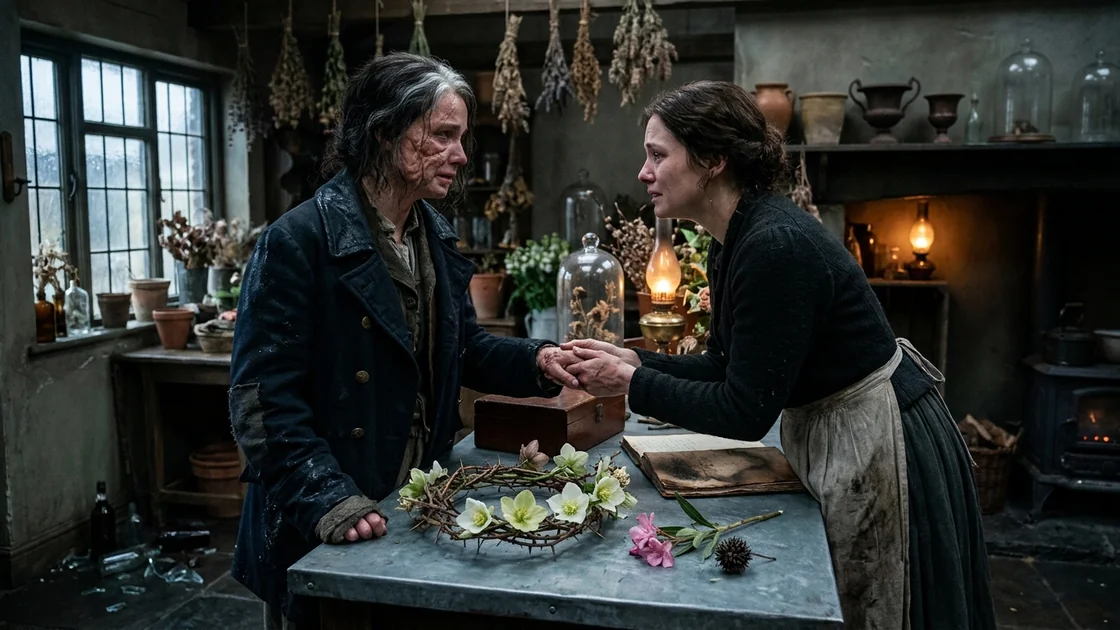
The crown of blackthorn thorns. The traveler’s joy. The agrimony. And the five pale, waxy faces of the Christmas rose.
Julianne turned slowly. Her eye fell upon the tray.
For a long, terrible minute, the shop was completely silent, save for the ticking of the clock on the mantel and the distant, muffled roar of the sea against the cliffs.
Julianne did not move. Her gaze stayed fixed on the flowers, reading the dialect she had learned before her hands were burned, the language she had spoken when they were girls together under the glass roofs of Yorkshire.
Blackthorn: Fate cannot be evaded. Bitter struggle.
Traveler’s Joy: Restitution. I will restore what was taken.
Hemp Agrimony: Delay. Relief is coming.
Hellebore: My heart is troubled. Cleanse me of my madness.
A strange, shuddering breath escaped Julianne’s ruined lips. Her eye widened, the fury in it suddenly replaced by something fractured, something dangerously close to grief.
"You think a handful of weeds can settle this account?" Julianne whispered, but the venom had leaked out of her voice, leaving it thin and cracked like dry parchment. "You think you can give me hellebore and make the fire stop burning?"
"No," Clara said. She walked out from behind the counter. She did not stop until she was standing directly in front of Julianne, so close she could feel the heat radiating from the woman's scarred skin, so close she could see the tiny flecks of gold in her dark eye.
Clara reached out. Slowly, deliberately, giving Julianne every chance to strike her down, she took Julianne’s ruined, claw-like right hand into her own.
Julianne stiffened, a sharp gasp tearing from her throat. Her fingers twitched, as if to pull away, but Clara held them firmly, gently, pressing the twisted, scarred knuckles against her own cheek.
"I will not run from you again, Julianne," Clara said, her voice steady, clear, stripped of all disguise. "I will not pack my bags. I will not hide in another town under another name. If you wish to take me to the gallows, I will walk there beside you. If you wish to put the oleander in my cup, I will drink it from your hand."
She lowered Julianne’s hand and held it between both of her own, feeling the thick, rough ridges of the scars.
"The ledger is in the kitchen," Clara said softly. "The money from the Edinburgh firm is in a bank in Bristol—six hundred pounds. Every penny is yours. It was always yours. I kept it because... because I thought that if I spent it, it would mean you were really dead. It would mean I had killed you for three hundred pounds and a garden shop."
Julianne stared at her, her chest rising and falling in rapid, shallow jerks. The single eye was wet now, glistening in the faint light from the streetlamp outside.
"You left me," Julianne whispered, and for the first time, she did not sound like an avenging demon. She sounded like the eighteen-year-old girl who had stood among the orchids, terrified of the old man’s iron bar. "You let go of my hand, Claire."
"I let go," Clara wept, leaning her forehead against Julianne’s shoulder, smelling the salt and the old smoke that clung to her wool coat. "I let go, and I have lived in the ashes every day since. Forgive me. Or kill me. But do not ask me to pretend that I did not love you."
Julianne stood frozen for a long, agonizing moment, her body trembling with a conflict so violent it seemed it might tear her frail frame apart.
Then, slowly, with an awkward, creaking effort that made the scar tissue pull tight across her wrist, the ruined right hand closed.
It did not close into a fist.
The twisted fingers hooked into Clara’s hair, holding her tight, pressing her head against the rough, wet wool of the coat. A sound broke from Julianne’s throat—a low, animal wail of grief that had been locked behind ten years of stone and iron, spilling out into the dark shop like water from a broken dam.
They stood together on the flagstones, amidst the shattered glass and the smell of rosewater, two ghosts holding one another in the ruins of the world they had made.
Chapter VIII: The Winter Bloom
The gale died before sunrise, leaving Oakhaven scoured and clean, the sky a vast, pale blue that looked like polished steel. The tide went out, exposing miles of glistening brown mudflats where the gulls fed in silence.
At seven in the morning, Barnaby the postman turned the corner of Church Street, his bag over his shoulder, his boots crunching on the gravel that the storm had washed up from the slipway.
He stopped outside The Bramble & Bell.
The sign on the door was turned to OPEN. Through the leaded panes, he could see that the shop was immaculate, the floor swept clean of broken glass, the shelves straightened, the brass urns filled with fresh branches of pine and dried hydrangea.
Clara Sterling was behind the counter, wearing her clean linen apron, her hair neatly pinned beneath her lace cap.
Beside her, sitting on a high stool near the charcoal stove, was a woman Barnaby had never seen before.
She was a striking, severe-looking person, dressed in a respectable gown of dark gray wool, with a thick black woolen shawl wrapped carefully around her right arm and shoulder. Her hair was black, shot through with dramatic streaks of white, gathered into a heavy knot at the nape of her neck. Though the right side of her face was marked by the unmistakable, puckered scars of an old burn, she held her head with a fierce, quiet dignity that made Barnaby instinctively touch the brim of his cap as he pushed the door open.
"Morning, Miss Sterling," Barnaby said, stepping onto the coir mat. "Fierce blow we had last night. Half the shingles off the Methodist chapel are down on the cobbles."
"Good morning, Barnaby," Clara said. Her face was pale, her eyes shadowed with dark circles of exhaustion, but there was a stillness in her expression—a deep, luminous calm that Barnaby had never seen there before. "The sea was very loud."
"Aye," Barnaby agreed, his eyes flicking with polite curiosity toward the stranger by the stove.
"Barnaby, this is my cousin, Miss Vance," Clara said smoothly, her voice clear and untroubled. "She has come from the north to join me in the business. Her health has been delicate since... since a family tragedy some years ago, but she is the finest propagator of rare bulbs in the kingdom. We are going to expand the glasshouse in the spring."
The scarred woman looked at Barnaby. The single dark eye was piercing, intelligent, and completely devoid of fear.
"Good day, sir," Julianne said. Her voice was low and gravelly, like stones tumbling in a stream, but she nodded with cool, aristocratic courtesy.
"An honor, Miss Vance," Barnaby said, blinking, slightly overwhelmed by the woman's intensity. "Welcome to Oakhaven. We’re... well, we’re a quiet sort of place, but we appreciate fine flowers. The harvest festival is coming up, you know."
"We know," Julianne said. "Miss Sterling and I were just discussing the altar garlands."
Barnaby delivered his letters, lingering for a moment to warm his fingers by the charcoal stove before taking his leave.
When the door clicked shut behind him, the two women looked at each other.
On the counter between them sat a large, shallow stoneware bowl filled with damp river sand. In the center of the sand lay the dried, black seed pod of the Blackthorn Lily.
Julianne reached out with her good left hand, picking up a small, pointed bone dibber.
"The seed is old, Claire," Julianne murmured, her eye fixed on the black pod. "Ten years in an iron box. The embryo may be desiccated. It may not have the strength to split the hull."
"It has the strength," Clara said softly, stepping closer, her shoulder touching Julianne’s. "It was born in fire, Julianne. It knows how to wait in the dark."
Julianne looked at her for a long second, the bitter lines of her scarred mouth softening into something that looked, for the first time, like the girl who had run through the Yorkshire heather with her apron full of stolen seeds.
"It will need heat," Julianne said, her fingers deftly working the bone tool into the sand, creating a small, deep hollow. "Bottom heat from the stove, and a cover of bell-glass to keep the moisture from escaping."
"I have three bell-glasses in the back," Clara said. "And the soot from the chimney makes the best soil dressing for nightshades. You taught me that."
"I taught you many things," Julianne said quietly. She placed the black seed into the hollow and pushed the cool, damp sand over it with the pad of her thumb. "And you have taught me how to read."
Clara smiled. She reached to the shelf behind her and brought down a small, fresh posy she had tied while the town was still asleep, before Barnaby had knocked, before the sun had cleared the horizon.
She set it upon the counter beside the planted seed.
It was composed of three stems:
Olea europaea—an olive branch, silvery-green and slender. Peace. The storm is ended.
Trifolium repens—white clover, sweet-scented and humble. Think of me with kindness.
And a single, perfect stem of Viola odorata—the blue violet, tucked into the center like a jewel. Faithfulness. I will never leave you again.
Julianne looked down at the posy. Her scarred hand reached out—not hiding beneath the shawl now, but exposed to the clean, bright morning light that flooded through the shop window.
Her twisted, stiffened fingers curled around the stems. She did not speak. She did not need to.
The language of flowers was an exacting dialect, but between two women who had survived the fire, its grammar was as clear as the salt air blowing off the sea, carrying with it the promise of winter, the certainty of frost, and the secret, stubborn life waiting beneath the sand to bloom once more.