The Sea House Confessions
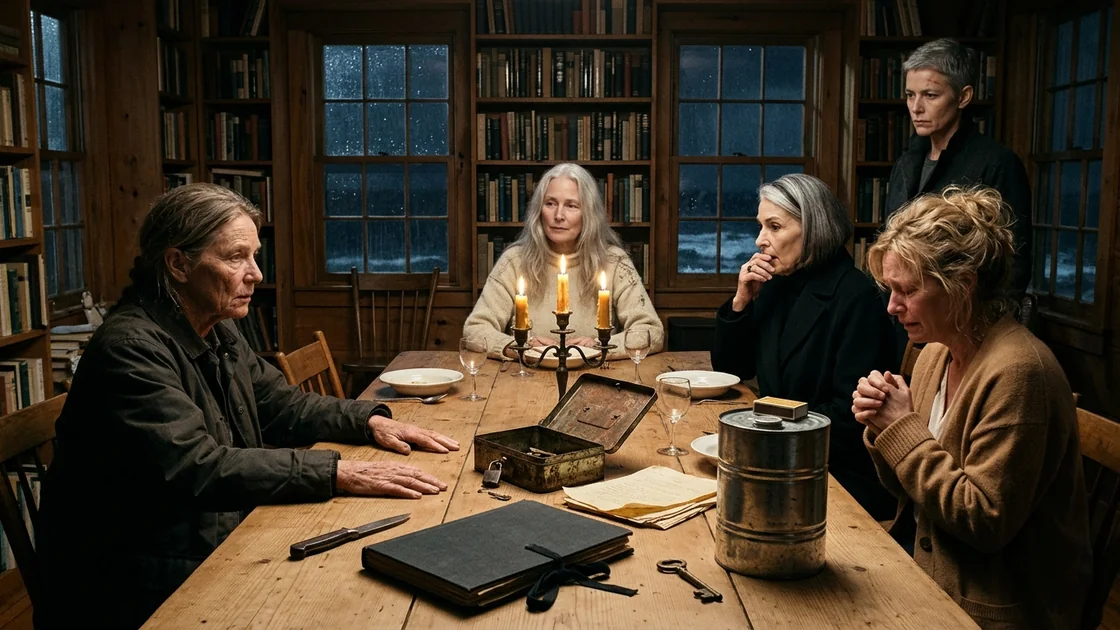
On the eve of her sixtieth birthday, a retired coastal archivist named Eleanor Vance gathers four women who defined the distinct chapters of her life at a windswept cottage in Maine, determined to dismantle forty years of carefully preserved deceptions before the tide turns on Sunday morning.
I. The Salted Register
The road out to Gull’s End did not officially exist on modern municipal surveys. It was merely a packed ridge of crushed clamshells and grey river gravel that ran three miles past the last telephone pole in Cape Neddick, dipping so low beside the tidal marsh that a new moon could turn it into an inlet of black saltwater in less than twenty minutes.
Eleanor Vance stood on the wraparound porch with a flat wicker basket tucked under her elbow, watching the sea foam bloom against the lower spine of the breakwater. Her hair, which had been the color of polished brass throughout her thirties and forties, was now entirely silver, worn long and loose over a heavy cream wool Guernsey sweater she had bought in Lerwick thirty-two years ago. In the drafty kitchen behind her, six stewing pots sat in cold alignment on the cast-iron range: chowder base simmering with bay laurel, yellow onions sweating in salted butter, parsnips scrubbed down to their pale skins, and four loaves of brown soda bread cooling under damp linen towels.
She was fifty-nine years, three hundred and sixty-four days old. When the sun sank behind the loblolly pines at five o’clock on Saturday afternoon, she would cross into the seventh decade of an existence built entirely out of small, load-bearing lies.
She took a breath of the November air. It tasted of kelp and rotted spruce, clean and razor-edged.
Below the rise of the lawn, where the wild rose hips had shriveled into rusty beads against the stone wall, the tires of the first car crunched against the shell driveway. A faded green Volvo station wagon, its tailgate spattered with dried clay from the backroads of Vermont, pulled up beside the wooden water cistern. The engine sputtered, died with an asthmatic cough, and the driver’s side door swung open into the wind.
Clara Bennett got out.
She had not changed her gait in fifty years: a low, slightly pigeon-toed stride that came from a childhood spent balancing on slippery lobster floats and hopping the wet gaps between granite piers. She was sixty-one, wearing a canvas barn coat with frayed cuffs, a yellow wool scarf wrapped three times around her neck, and heavy leather boots scarred by garden work. She stood by the open door of the wagon for a long moment, looking up at the porch where Eleanor stood. Her weathered face, lined by four decades of organic farming and northern winters, was completely expressionless until her mouth twitched into a tight, skeptical line.
"You look like a retired lighthouse keeper, Vance," Clara called out. Her voice was like gravel turned over with an iron shovel.
"You look like you drove six hours without stopping for tea," Eleanor replied, her voice steady, carry-down on the breeze.
"Seven," Clara said, hauling a faded canvas duffel bag from the back seat. "The bridge at Portsmouth was down to one lane. A fuel tanker dropped an axle." She kicked the car door shut with the heel of her boot, adjusted the strap of her bag, and climbed the wooden steps with deliberate, unhurried weight. When she reached the top, she dropped the duffel on the painted floorboards and looked Eleanor directly in the eyes.
For forty-eight years, Clara had carried the story that everyone in Blackwood had agreed upon: that Clara had been the wild one, the girl who had burned down the old cannery office behind the fish piers in the summer of 1974, destroying the town ledgers, the wage receipts, and the promissory notes that held half the fishermen in debt to old man Albright. Clara had served eight months in the county detention home in Auburn, her scholarship to Mount Holyoke vanished like woodsmoke, while Eleanor—quiet, pale, blameless Eleanor—had boarded the morning bus for Boston with a clean record, a tuition grant, and three leather-bound notebooks tucked inside her coat.
"You still have the same clock in the hall," Clara said, stepping past Eleanor into the vestibule. She didn't offer a hug; they had not touched each other since the afternoon they stood on the dock behind the icehouse in August of their seventeenth year. "The one with the bronze ship on the pendulum. It ticks too loud."
"It keeps time," Eleanor said, closing the door against the Atlantic draft. "That’s all it’s required to do."
"And the others?" Clara asked, unknotting her yellow scarf. "They’re actually coming?"
"Vivian called from the airport in Portland an hour ago. She hired a town car because she refused to take a local taxi with fabric seats. Marianne took the train from New Haven; she should be arriving with Saskia by four. Saskia offered to pick her up at the depot in Brunswick."
Clara laughed once, a short bark of genuine amusement. "A literary monster, a high-society ghost, and a German surgeon. Quite a menagerie for an old archivist’s wake."
"It isn't a wake," Eleanor said mildly, taking Clara’s coat and hanging it from an iron peg on the whitewashed wall.
"Isn't it?" Clara glanced around the long, low-ceilinged room. The walls were lined with thousands of books, all arranged not by subject or author, but by the year of their publication, stretching from the seventeenth century near the kitchen hearth to the late twentieth century by the south-facing bay window. "You only summon people to the end of the earth when you’re either going to ask them for their bone marrow or tell them where the bodies are buried."
"The stew needs more salt," Eleanor remarked, gesturing toward the kitchen. "Come stir it while I bring up the cider."
II. The City of Paper
Vivian Cruz did not arrive in an ordinary town car; she arrived in a black Lincoln that looked like a diplomatic vehicle, driven by a young man who looked terrified of her. She stepped onto the crushed shells at three o'clock, wrapped in a black cashmere coat that reached her ankles, her silver-streaked dark hair cut into the same severe geometric bob she had worn when she was the fiction editor of The Atlantic Review in 1988.
She carried no luggage herself. The driver carried two burgundy leather suitcases up the steps, set them down inside the entry hall, accepted a folded twenty-dollar bill from Vivian’s kidskin-gloved hand without looking her in the face, and retreated to the car as if escaping an artillery barrage.
Vivian took off her dark sunglasses, surveyed the cottage's exposed hemlock beams, the worn rag rugs, and Clara Bennett sitting at the kitchen table shelling dried cranberry beans into an enamel bowl.
"It smells of dead crabs and high principles," Vivian announced, unbuttoning her coat with theatrical precision. "Eleanor, my darling, you haven't bought a new sofa since the Carter administration. It’s magnificent. It’s like entering a museum dedicated to northern guilt."
"Sit down, Vivian," Clara said without looking up from her beans. "You’re tracking road salt onto the floor."
Vivian gave Clara a look of aristocratic pity. "Clara. Still tending the turnips, I see. How noble. How utterly devastating to the complexion."
Eleanor emerged from the pantry carrying a bottle of dry white wine and three glasses. "Vivian. You found the turnoff without incident?"
"Your instructions were ridiculous," Vivian said, dropping her coat onto the back of an armchair. "’Turn left at the stone sheep pen.’ The sheep pen collapsed three years ago, Eleanor. It is now merely a heap of moss. But my driver had GPS, thank God, even if the road shook the fillings out of my molars. Why are we here? And please don't tell me it’s the sea air. You despise the sea air; it makes your paper curl."
"I have two more guests arriving," Eleanor said, setting the glasses on the table. "And it’s my sixtieth birthday. Isn't that reason enough to gather the court?"
Vivian’s eyes narrowed. They were the color of stagnant river water, sharp and endlessly perceptive. In the nineteen-eighties, those eyes had scrutinized manuscripts that went on to win every major prize in the hemisphere; they had also reduced junior editors to weeping wrecks in the corridors of Midtown publishing houses.
"You don't care about birthdays," Vivian said, taking the wine glass Eleanor offered her. "You didn't care about your fortieth; you spent it in the basement of the Boston Athenæum restoring water-damaged parish registers from the Merrimack Valley. You didn't care about your fiftieth; you sent a postcard from Reykjavik that simply said The wind is horizontal. Something is rotten in the state of Maine, Eleanor."
"Eat some cheese," Eleanor said.
The dynamic between them had been forged in a third-floor brownstone on Marlborough Street in Boston during the autumn of 1985. Vivian had been thirty-five then, a rising fury in the literary world, possessed of a ferocious intellect and a crippling, secret terror: she was incapable of finishing her second novel. Her first, The Glass Orchard, had made her the darling of Manhattan and London. Her second had remained a seven-hundred-page heap of brilliant, incoherent fragments, stalled by three years of gin, cocaine, and the suffocating expectations of the literati.
Eleanor had been her assistant, a quiet thirty-year-old woman with an uncanny gift for structural engineering and an invisible presence.
For fourteen months, from November of 1985 to January of 1987, Eleanor had sat at the walnut desk in Vivian’s library, taking those chaotic, morphine-tinged paragraphs and cutting them, reordering them, rewriting entire chapters, fabricating narrative bridges out of thin air, and inventing the character of Julian—the very character who would cause The Evening Hour to be called a masterpiece of modern domestic realism.
When the book came out to ecstatic reviews, Vivian had dedicated it: To Eleanor, who kept the lamps lit.
Vivian had believed, for thirty-five years, that Eleanor was merely a midwife to Vivian's genius. She believed that the brilliance had been entirely hers, extracted through the sieve of Eleanor’s pedestrian tidiness.
"You haven't published anything in ten years, Vivian," Clara observed, snapping a bean pod between her blunt fingers.
"I have retired from the arena," Vivian said smoothly, taking a seat at the end of the scrubbed pine table. "The contemporary novel has become an exercise in narcissistic laundry-folding. Why should I add my voice to a chorus of children complaining about their interior design?"
"Or perhaps the ink dried up," Clara muttered.
"Clara," Eleanor said, her voice dropping an octave. It was not a plea; it was an archivist’s correction.
The room fell quiet save for the ticking of the bronze-ship clock and the rhythmic crackle of the woodstove. Outside, the light was turning the color of wet slate. A squall was moving in from the outer islands; the whitecaps were disappearing under a veil of cold, descending mist.
III. The Architecture of Mercy
At four o'clock, the blue Subaru arrived. It was practical, sensible, and covered in the thin layer of salt dust that coated every vehicle in coastal Cumberland County.
Saskia Lind was at the wheel. At fifty-two, she was the youngest of the five, though her cropped iron-colored hair and the faint surgical scar running through her left eyebrow gave her the austere demeanor of a medieval abbess. She was a vascular surgeon who had spent twelve years working with international trauma teams in the Balkans and West Africa before settling into a quiet, rigorous practice in Portland.
From the passenger seat stepped Marianne Fox.
Marianne was fifty-eight, dressed in an oversized camelhair cardigan over a pleated wool skirt, her blond hair pinned up in a soft, hurried twist that seemed on the verge of coming undone. She looked fragile, like an expensive piece of porcelain that had been cracked and glued back together with great skill, but which could never again be filled with hot water. She held a wicker basket filled with small jars of lemon curd and quince preserves, her fingers trembling slightly as she set her feet upon the gravel.
"We saw three deer by the marsh," Marianne said, her voice breathy, melodic, and chronically uncertain, as Eleanor opened the front door to meet them. "They were eating the wild cabbage. Saskia said they were desperate, but they looked so peaceful."
"They have parasites, Marianne," Saskia said, lifting two neatly packed weekend bags from the hatch. Her German accent was faint, sanded down by decades in American teaching hospitals, but the rhythm of her speech remained clipped and precise. "Their winter coat is patchy. They won't survive until March."
She walked up the steps, her gray eyes scanning Eleanor’s face with clinical immediacy. She didn't look at the house, or the ocean, or the grey clouds piling up on the horizon. She looked at Eleanor’s pupillary response, the faint yellow tint at the margin of her sclera, the hollows beneath her clavicles where the thick wool sweater hung slightly slack.
"You’ve lost four kilos since August," Saskia said quietly, setting the bags on the porch.
"I’ve been clearing the south lot," Eleanor answered. "Stacking cordwood."
"Cordwood does not cause temporal wasting, Eleanor."
"Come inside, Saskia. The wind is coming around to the northeast."
When the five of them were gathered in the great room, the air grew thick with decades of unspoken geography. Clara remained at the table with her beans, an immovable rock of grievance; Vivian sat in the armchair with her wine glass, radiating brittle irony; Marianne wandered along the bookshelves, touching the spines of volumes published in 1962, the year of her birth; and Saskia stood with her back to the fire, watching the four of them with the detached vigilance of an officer monitoring an unstable triage ward.
"We need tea," Marianne said suddenly, turning around with a small, flustered smile. "Eleanor, where do you keep the silver pot? The one with the bone handle?"
"I don't have it anymore, Marianne," Eleanor said gently. "It was sold when the house in Cambridge was cleared."
Marianne blinked, a shadow passing over her face like the shadow of a cloud over a salt marsh. "Oh. Of course. I forgot. Sometimes I think we are still on Brattle Street, and David is just down at the law library, and Lily is sleeping upstairs."
Vivian rolled her eyes behind her wine glass. Clara gave a small, disgusted grunt.
"David has been dead for twenty-four years, Marianne," Clara said. "And he wasn't at the library. He was in a motel in Bangor with a paralegal and three bottles of bourbon."
Marianne flinched as if struck.
"That’s enough, Clara," Saskia said, her voice dropping like an iron grate. "There is no diagnostic value in cruelty."
"Diagnostic?" Clara sneered. "Listen to the doctor. Everything’s a chart with you, Lind. Some people just like to wallow in old junk. Some people like to pretend their lives weren't ruined by a coward."
"None of you know what ruined what," Eleanor said.
The sentence was not loud, but it had the weight of an anchor dropping through twenty fathoms of cold water.
The four women looked at her.
Eleanor walked to the heavy oak sideboard that stood beneath the window. On top of it sat five ceramic bowls, an iron soup tureen, and an old, cloth-bound folio tied shut with two lengths of black twill tape.
"The tide is over the road now," Eleanor said, glancing through the glass at the dark water creeping into the salt marsh, cutting the spit off from the mainland. "Nobody leaves until Sunday at dawn. Not by car, not on foot, unless you want to swim through five hundred yards of rip-current in forty-degree water."
She turned back to face them. Her face was illuminated from below by the yellow lamps on the sideboard, the shadows pooling in her eye sockets, giving her the appearance of a stone carving in a crypt.
"Before we eat," Eleanor said, "we are going to settle the ledger."
IV. The First Decennium: Blackwood, 1974
The dining room had no electricity. Eleanor had set three iron candelabra down the center of the long table, the beeswax tapers guttering in the draft that slipped through the sash windows. Outside, the nor’easter had arrived in earnest, throwing sheets of cold, sleet-heavy rain against the western cedar shingles. The cottage groaned like a timber hull caught in an ice pack.
They had finished the stew in near silence. Even Vivian had eaten with a mechanical, subdued appetite, watching Eleanor’s hands as she cleared the bowls and set down a single object on the bare pine: a small, blackened tin box with a rusted padlock that had been pried open long ago.
Eleanor looked at Clara.
"You were seventeen," Eleanor began. Her voice was flat, matter-of-fact, the tone she used when cataloging nineteenth-century probate records. "It was the third of July. The Albright Cannery had laid off fifty men that morning, including your father and your brother Thomas. The town was ready to kill someone."
Clara’s hands tightened on the edge of the table until her knuckles turned ivory. "I don't need you to tell me the history of Blackwood, Vance. I have the scars on my shins from the reform school floor to remind me."
"You didn't burn the cannery, Clara."
Vivian paused with her fork halfway to her mouth. Marianne looked up, confused, while Saskia leaned forward, her analytical gaze shifting from Eleanor to Clara.
"Everyone knows I burned it," Clara snapped. "I admitted it. I signed the confession in the sheriff’s office with my father standing behind me smelling of stale beer and grease. He told me if Thomas went to prison, the family would starve, because Thomas was the only one who could still get a berth on the offshore trawlers. I was just a girl with a scholarship nobody wanted me to have."
"You confessed," Eleanor said, "because you believed Thomas did it. You thought you were taking the fall for your brother."
Clara went very still. The wind slammed into the cottage, rattling the loose panes in the bay window. "Thomas had the kerosene cans in the shed," Clara whispered. "I saw them. The caps were off. His rags were smelling of distillate."
"Thomas didn't touch the cannery," Eleanor said. She reached into the blackened tin box and pulled out a small, scorched object. It was an iron pocket knife with a brass bolster, the initials E.V. scratched roughly into the soft metal near the hinge.
Clara stared at it. Her breath caught in her throat, a ragged, choking sound.
"My father bought me that knife for my twelfth birthday," Eleanor said. "I took the rags from your shed, Clara. I walked along the tide pool path at two o'clock in the morning. I climbed in through the delivery chute behind the office."
"Why?" Vivian interrupted, her voice sharp with sudden professional curiosity. "What could an archivist’s daughter want with a provincial fish factory?"
Eleanor didn't look at Vivian. She kept her eyes fixed on Clara’s face, which had gone the grey of old driftwood.
"The cannery office didn't just hold the debt ledgers," Eleanor said. "It held the medical reports from the county health inspector. In 1972, my mother died of what they called galloping consumption. But it wasn't consumption. She worked in the packing room where they were using industrial solvents to clean the canning vats—solvents Albright bought surplus from the naval yard. The inspector had documented forty-eight cases of liver necrosis among the women on the night shift. Albright paid him five hundred dollars a month to keep the reports in his safe."
Eleanor set the knife on the wood between them.
"My mother died vomiting blood on our kitchen floor," Eleanor said, her voice dropping into a register so cold it seemed to freeze the candle flames. "The doctor wouldn't sign the death certificate with industrial poisoning because he lived in a house Albright owned. I didn't care about the fishermen’s debt. I didn't care about the cannery. I wanted the safe opened, and when I couldn't open it with the chisel, I soaked the filing cabinets in kerosene and lit them."
"You..." Clara’s voice was barely audible above the storm. "You were there?"
"I ran out through the marsh," Eleanor said. "I dropped the knife in the mud by the culvert. And then I went home, washed the soot off my arms, and went to bed. When the sheriff came to your house the next morning, Clara, I was standing on the corner by the post office. I saw them lead you out in handcuffs. I had the Mount Holyoke scholarship application in my satchel, signed by the school principal. If I spoke, my father would have lost his clerkship, I would have gone to the women’s reformatory in Skowhegan, and the Albright family would have owned Blackwood for another forty years."
"You let them take me," Clara whispered. A tear tracked through the deep creases beside her nose, glittering in the candlelight. "You stood on the post office steps and watched them put me in the back of the Plymouth."
"I did," Eleanor said. "And when the Albright family sued the town for the damages, the records were gone. The canning company went bankrupt six months later. Thomas got his berth. Your father kept the house because the debt ledger was ash. But you spent eight months in a concrete room with barred windows, scrubbing laundry with lye until your fingers bled."
"You stole my life," Clara said. It was not a scream; it was a simple, flat declaration of a truth that had been buried for forty-eight years. "I was going to study botany. I had the letter from South Hadley. I had the room assignment in Porter Hall."
"I know," Eleanor said. "I have the letter. I stole it from your mailbox the day after they took you away."
She reached back into the tin box and pulled out a yellowed envelope, its postmark dated July 5, 1974. The seal was broken, the paper brittle and smelling of old iron. She pushed it across the table until it touched Clara’s calloused fingers.
Clara did not pick it up. She looked at it as if it were a venomous snake that had been sleeping under her porch for half a century.
"Why tell me now?" Clara asked, her voice cracking. "I’m sixty-one years old, Eleanor. My joints are swollen with arthritis. My farm is failing. What am I supposed to do with this? Forgive you? Shoot you?"
"I don't want your forgiveness," Eleanor said. "Forgiveness is an administrative convenience. It’s what people ask for when they want to sleep at night. I haven't slept through the night since July of 1974."
V. The Second Decennium: Boston, 1986
Vivian took another long sip of her wine, her fingers tapping a nervous, syncopated rhythm against the crystal stem. The atmosphere in the room had shifted; the theatrical grandiosity she had worn like armor upon her arrival was beginning to fray at the seams.
"Well," Vivian said, attempting a dry smile that didn't reach her eyes. "A provincial tragedy. Very Thomas Hardy. But that was childhood, Clara. We were all monstrous in our teens. The things I did at Sarah Lawrence would turn your hair white."
"You didn't do anything at Sarah Lawrence except fail your French exams and steal a cashmere twinset from your roommate," Eleanor said without looking at her.
Vivian’s smile vanished. "Eleanor. Don't be vulgar."
"Let’s talk about The Evening Hour," Eleanor said.
The silence that followed was different from the previous one. It was colder, sharper, smelling of ink and old paper.
Marianne looked back and forth between them, sensing the change in temperature. "Vivian’s book? But that was such a beautiful book, Eleanor. You always said it was the greatest thing Vivian ever wrote."
"Vivian didn't write it," Eleanor said.
Vivian let out a short, high-pitched laugh that sounded like porcelain breaking on a hearth. "Oh, please. Here it comes. The bitter assistant claims she was the real author. Every secretary in London and New York has the same fantasy, Eleanor. You organized my notes. You typed the manuscripts. You smoothed out the punctuation because you had that dreary, pedantic training from the archives."
"I didn't write it either," Eleanor said.
Vivian froze. Her glass remained suspended two inches above the pine table.
"What do you mean?" Vivian asked, her voice dropping into a dangerous, ragged register. "Of course you didn't write it. I wrote it. I spent eighteen months in that room on Marlborough Street killing myself—"
"You spent eighteen months drinking Gordon’s gin and sleeping until two in the afternoon," Eleanor said calmly. "By November of 1985, you hadn't produced forty coherent pages. Houghton Mifflin was preparing to demand the return of your sixty-thousand-dollar advance. Your agent had stopped taking your calls. You were hiding the bills from the liquor store in the coal scuttle."
Vivian’s throat worked, but no sound came out.
"Where did the manuscript come from, Eleanor?" Saskia asked quietly from her post by the fire. She had not touched her food; she stood with her arms crossed, watching the unraveling with the cold precision of a pathologist watching a dissection.
"In October of that year," Eleanor said, turning her attention to Vivian, "a man named Julian Ward died in the municipal hospice in South Boston. He was thirty-two years old. He had been an orderly at Massachusetts General Hospital, and he was dying of complications from a disease that the newspapers were still referring to as a gay plague."
Vivian’s skin lost whatever color the wine had given it. She looked suddenly very old, the sharpness of her cheekbones collapsing into hollows of gray shadow.
"Julian Ward had no family," Eleanor continued. "His father was a Baptist minister in Lynchburg who had disowned him seven years prior. When he died, the city took his clothes and his mattress. But the social worker at the hospice—a girl named Sarah Higgins who had been my classmate at Mount Holyoke—called me. She said Julian had left four cardboard boxes of papers under his bed. She knew I worked for an archivist. She asked if I could look through them before the city incinerated them, to see if there was anything worth saving for the historical society."
Eleanor reached down to the floor beside her chair and lifted the cloth-bound folio she had prepared.
"There were nine handwritten journals," Eleanor said. "Julian had spent five years documenting the rooms of the men he had cared for, the things they whispered when the dementia set in, the letters they begged him to burn before their mothers arrived from Ohio or Georgia. It was the most exquisite, devastating record of love and extinction I had ever read in my life."
Vivian stood up so violently that her chair tipped backward, its ladder-back frame crashing against the spruce floorboards with the crack of a pistol shot.
"Stop it," Vivian hissed. "Shut your mouth, Eleanor."
"You were desperate," Eleanor said, her voice rising slightly, cutting through Vivian’s panic. "You were going to be publicly ruined. You came into the library one night in December, weeping, your face swollen, holding a handful of Seconal tablets, threatening to swallow them if you couldn't find an ending for the third chapter."
"I was ill!" Vivian cried. "I was out of my mind!"
"I took Julian Ward’s journals out of my satchel," Eleanor said. "I laid them on your walnut desk. I told you they were the diaries of a great-uncle from Maine who had served on a hospital ship in the Great War. I gave them to you, Vivian. And I watched you spend four months transcribing his prose, changing the names, changing the dates from 1984 to 1918, turning Julian’s dead young men into shell-shocked doughboys in the fields of northern France."
"No," Vivian whispered, shaking her head. "No, no, no. I transformed it. It was raw material. Every writer uses raw material! Shakespeare used Holinshed! Joyce used Homer!"
"You didn't transform it," Eleanor said. "You stole the voice of a boy who died with no one to hold his hand in a ward that smelled of carbolic acid, and you put your name on the title page in three-inch gold foil. You won the National Book Critics Circle Award with his dying breath."
"And you let me!" Vivian shouted, her voice breaking into a shrill, hysterical sob that bounced off the low hemlock beams. "You were there! You typed every word! If I am a thief, Eleanor Vance, what does that make you? You were the fence! You were the one who pawned the watch!"
"I was," Eleanor admitted. "I was thirty years old, and I wanted to be near someone who mattered. I wanted to live in a house where people talked about ideas instead of the price of salt cod. I traded Julian Ward’s soul for a room with bay windows and an invitation to dinners where people argued about Derrida."
Eleanor took a yellowed sheet of paper from the folio.
"This is Julian’s death certificate," she said. "And these are photocopies of the original notebook entries, dated August 14, 1984. Page ninety-two of The Evening Hour, the paragraph where the young soldier describes the light dying on the hospital canvas: it is identical to Julian’s entry, word for word, comma for comma, down to the spelling of the word chrysanthemum with two m’s."
Vivian sank onto the bench beside Marianne, her face buried in her hands. Her shoulders shook with silent, convulsive tremors.
"Why?" Vivian whispered through her fingers. "I have built thirty-five years of my life on that book. I have lectured at Oxford. I have taught three generations of students. Why pull the thread now?"
"Because you are seventy years old, Vivian," Eleanor said. "And Julian Ward has been dead in an unmarked plot in Mount Hope Cemetery for thirty-seven years. It is time he had his name back."
VI. The Third Decennium: Cambridge, 1996
Marianne had not moved. Throughout the confrontation between Eleanor and Vivian, she had sat with her hands folded neatly in her lap, her face fixed in the mild, vacant expression of a woman waiting for an omnibus that was twenty minutes late.
Now, as the room fell quiet again except for Vivian’s stifled weeping and the roar of the surf against the outer ledge, Marianne looked down at her wicker basket of jams.
"My David was always so fond of your soda bread, Eleanor," Marianne said, her voice drifting into the room like a dry leaf. "He used to say that nobody could bake bread with a crust like yours. Not even his mother, and his mother was a Cabot."
Eleanor looked at Marianne. There was no coldness in Eleanor’s eyes now; there was only a profound, bottomless weariness, the look of an executioner who has reached the third scaffold of the morning.
"David didn't like my bread, Marianne," Eleanor said softly. "He hated it. He told me it tasted of bicarbonate and sod."
Marianne blinked, her small, polite smile freezing in place. "Oh. No, darling. You’re misremembering. David was always so complimentary. He was such a gentleman. Even when he was... even when he had those headaches, he was always so gentle."
"Marianne," Eleanor said. "David didn't run away to Bangor with a paralegal."
Clara looked up sharply from her corner, her own grief momentarily suspended by the shock in Eleanor’s voice. "What are you talking about, Vance? The whole town of Cambridge knew it. The state police found his Mercedes parked behind the bus terminal. His bank accounts were cleared out."
"The accounts were cleared out because I cleared them," Eleanor said.
Marianne stopped smiling. Her hands, resting on the wool skirt, began to twist the fabric into tight, spiral knots. "Eleanor. Don't. Please don't. We had an agreement. We agreed we wouldn't discuss the bad months."
"It wasn't a bad month, Marianne. It was twenty-four years of your life spent waiting for a ghost who was never going to come through the door."
Eleanor reached into the tin box and pulled out a heavy brass key attached to a numbered tag: Locker 412, North Station, Boston.
"In the spring of 1996," Eleanor said, addressing the room, but keeping her eyes locked onto Marianne’s shrinking form, "David came to my office at the Historical Society. He didn't come to talk about Marianne. He came to borrow forty thousand dollars. He had been speculating on municipal bonds through an offshore account in the Caymans, using the trust fund that Marianne’s father had set up for their daughter, Lily."
Marianne made a small, animal whimper, pressing the heels of her hands against her ears. "I don't want to hear this. Saskia, tell her to stop. She’s making things up. Eleanor has always been jealous of my family. She never had a husband. She never had a child."
Saskia did not tell Eleanor to stop. She reached out and placed a firm, steady hand on Marianne’s shoulder, holding the trembling woman in place. "Listen, Marianne," Saskia said in her low, surgical voice. "Whatever it is, it is already over. The event has already occurred. You are surviving the memory, not the fact."
"He had lost every penny of Lily’s trust," Eleanor said. "Three hundred and eighty thousand dollars. Gone. And the federal bank regulators had issued a subpoena for his partnership records at the firm that was due to be served on Monday morning."
"David was an honorable man," Marianne sobbed, her voice rising to a thin wail. "He was a vestryman at Trinity Church! He was Lily’s father!"
"He had a plane ticket to San José, Costa Rica, in his breast pocket," Eleanor said. "He had already shipped three crates of his personal books to an address in Puntarenas. But he didn't just want Lily’s trust, Marianne. He had discovered that you had inherited your grandmother’s property in Manchester-by-the-Sea. He wanted me to forge your signature on the deed conveyance so he could mortgage it before he boarded the flight."
Marianne took her hands from her ears, her mouth open in a soundless O of horror.
"He told me," Eleanor continued, "that if I didn't help him, he would tell you that he and I had been lovers for three years. He had fabricated letters—dozens of them, written in my hand, imitating the style of the letters I wrote to Vivian in the eighties. He was going to leave them on your vanity table on Sunday morning, so that when the marshals arrived on Monday, you would believe your best friend had destroyed your home."
"Did you?" Clara demanded from the foot of the table, her voice thick with disgust. "Were you sleeping with him?"
"I would rather have slept with a cottonmouth," Eleanor said. "He was a weak, greedy, vicious little man who used his manners to disguise his rot. But I knew Marianne. I knew she was already fragile. Lily was twelve then, struggling with the asthma that nearly killed her twice that winter. If David had left those letters, Marianne would have walked into the Charles River with stones in her pockets."
"So what did you do?" Vivian asked, her voice dry, her tears forgotten in the presence of a drama that rivaled her own ruin.
Eleanor picked up the brass key.
"I told him to meet me at the boat basin behind the Museum of Science on Friday night," Eleanor said. "I told him I had the forty thousand in cash and the forged deed from the Manchester registry. He came in the Mercedes. It was raining—one of those filthy, cold April rains that smells of diesel and old harbor mud."
She paused. Outside, the nor’easter tore a shingle from the cottage roof; they heard it slide down the cedar slope and vanish into the black rocks below.
"He got into my car," Eleanor said. "He reached for the envelope. I had a bottle of medicinal chloral hydrate that I had taken from the Historical Society’s nineteenth-century apothecary collection—we had seized it from an old doctor’s estate in Newburyport three weeks before. I had mixed three ounces of it into a thermos of black coffee with five spoons of sugar. He drank it while he checked the signatures on the deed."
Marianne began to rock back and forth, her eyes wide, staring at the candle flames as if she were seeing through them into the rainy dark of 1996.
"He didn't suffer," Eleanor said. "He was asleep in six minutes. His head fell against the passenger window. I drove the car out to the old gravel pits behind Tewksbury—the ones that had been abandoned by the highway department in the fifties and filled with sixty feet of ground water."
The room became so still that the only sound was the hiss of the beeswax tapers and the erratic gasping of Marianne’s breath.
"I took his watch," Eleanor said. "I took his wallet and his shoes. I put the car in neutral, released the handbrake, and pushed it down the embankment into the quarry pool. It took four minutes to sink. The water was eighty feet deep, Clara. The bottom is thirty feet of glacial silt. It’s like quicksand; once a two-ton car enters that mud, it never comes back up."
"You killed him," Marianne whispered. The words were not loud, but they carried the force of an excommunication. "You murdered my husband."
"I did," Eleanor said. "And then I took the train to Bangor. I checked into that filthy motel under his name using his credit card. I bought three bottles of bourbon at the state liquor store. I hired a girl from a lounge on Union Street to sit in the room for an hour and leave her lipstick on the water glasses, and then I took the five-fifteen morning bus back to North Station. I put his wallet and his watch into Locker 412, and I threw the key into the bottom of my desk drawer."
Eleanor pushed the key across the table until it rested in front of Marianne.
"The Mercedes is still there," Eleanor said. "Forty feet down, under thirty feet of clay, behind the concrete batching plant on Route 38. His bones are sitting in the driver’s seat with his seatbelt fastened. You didn't lose him to another woman, Marianne. You didn't lose him because you weren't pretty enough, or clever enough, or young enough. He didn't abandon you. I took him out of this world because he was going to consume you and your daughter like dry grass in a brushfire."
Marianne did not touch the key. She looked at Eleanor with a horror that was completely pure, completely unmixed with the gratitude Eleanor had imagined for twenty-four years might someday exist.
"You had no right," Marianne cried, the tears finally bursting from her eyes in a torrent of wild, uncontrolled fury. "He was mine! His sins were mine to bear! You took my life and you turned it into a mystery so you could play the savior! You paid for Lily’s college! You bought our groceries! You sat on my porch every Sunday and held my hand while I cried for a man who was rotting in a gravel pit!"
"Yes," Eleanor said, her voice barely a whisper. "I did."
"I hated you," Marianne sobbed, her voice breaking into pieces. "All these years, Eleanor, every time you brought a basket of bread, every time you paid a tuition bill, I felt like a beggar at your gate. I thought God was punishing me for being weak. And it wasn't God at all. It was you."
VII. The Fourth Decennium: Portland, 2008
Saskia Lind did not wait to be addressed.
She walked from the hearth to the table, her steps rhythmic, measured, her heavy leather-soled shoes striking the pine boards with military regularity. She stopped behind the empty chair across from Eleanor, rested her long, sinewy surgeon’s fingers on the backrest, and looked down at the older woman.
"Now me," Saskia said. Her voice was steady, but there was an edge to it now—the sharp, cold glitter of a scalpel being drawn from an autoclave.
"Now you," Eleanor said.
"What did you do to my brother, Eleanor?"
The question took Vivian and Clara by surprise. They looked up, their own grief-stricken faces momentarily arrested by the name.
"Your brother was an artist, Saskia," Eleanor said. "He had a gallery on Fore Street in Portland. He was thirty-eight years old, and he was dying of hepatitis C that he had contracted from a tattoo needle in Berlin in 1989."
"I know what he was dying of," Saskia said, her German accent hardening, the consonants clicking like bone against steel. "I was his physician. I managed his interferon therapy. I watched his liver enzymes climb every month like a thermometer in hell."
"In October of 2008," Eleanor said, "the Maine Medical Board received an anonymous complaint against you. It contained copies of three prescription forms from your private pad, written for eighty milligrams of OxyContin each, filled at a twenty-four-hour pharmacy in Biddeford. The signature was yours. The DEA opened an investigation on Monday morning. By Wednesday, the hospital had suspended your operating privileges."
Saskia’s eyes did not waver. "The signatures were not mine. I told the board that. I told the federal agents that. But the handwriting analysis was inconclusive. The ink was from a Montblanc pen—the pen my father gave me when I passed my board exams in Heidelberg. Only three people had access to that pen: myself, my brother Lukas, and you, Eleanor. You were cataloging his collection of German prints for the estate sale."
"It wasn't Lukas," Eleanor said.
"I know it wasn't Lukas," Saskia said, her voice dropping into a register that made the candle flames tremble. "Lukas was a degenerate and a drunk, but he was not a thief. He would not have destroyed my career to buy four days of peace. That left you."
"Yes," Eleanor said.
"Why?" Saskia demanded. She did not raise her voice; she leaned across the table until her face was six inches from Eleanor’s, her gray eyes burning with fourteen years of suppressed rage. "I was forty years old. I had spent fifteen years working in refugee camps in Goma and Mostar. I was finally building a life. I was saving people whose aortas had been torn apart by steering columns and deer rifles. Why would you try to put me in a federal prison?"
"I didn't try to put you in prison," Eleanor said. "I called the DEA myself."
Saskia blinked. The clinical detachment that had served as her mask for five decades slipped, revealing the bewildered, bleeding child beneath. "You called them?"
"I called the regional director in Boston," Eleanor said. "A man named Marcus Vance. He was my second cousin. I told him that an anonymous tip was coming from Portland regarding Dr. Lind. I told him the tip was a diversion created by an art theft ring that was operating out of the old customs wharf."
"That was a lie," Saskia said.
"Of course it was a lie," Eleanor replied. "It was an absurd, operatic lie. But it was enough to create jurisdictional confusion between the DEA and the FBI for three weeks. And during those three weeks, Saskia, what happened?"
Saskia stared at her. Slowly, the memory of that autumn began to assemble itself in her mind, the pieces clicking together like the tumblers of a safe.
"Lukas died," Saskia whispered.
"Lukas died on the twelfth of November," Eleanor said. "In his own bed, in the loft on Fore Street, with you sitting beside him holding his hand, administering the morphine he needed to pass without convulsing."
"If I had been under active indictment," Saskia said, her voice trailing off as the realization hit her, "my license would have been revoked immediately. The state would have assigned a court-appointed conservator. They would have moved Lukas to the county hospice in Scarborough. He would have died in a sterile ward surrounded by strangers."
"He would have died in restraints," Eleanor said. "Because the delirium had set in, and the county had no staff to sit with him. But that wasn't why I did it, Saskia."
Saskia’s eyes widened. "Then why?"
"You had received an offer," Eleanor said, reaching into the folio and pulling out a folded document on blue stationery. "On the second of October, 2008, you were offered the position of Chief of Trauma Surgery at the Charité in Berlin. It was the job you had dreamed of since you were twenty years old. You were preparing to accept it. You had already signed the preliminary intent form."
Saskia looked at the blue paper. "I had forgotten about that. When the investigation started, the Charité withdrew the offer. They couldn't have an incoming department head with an open federal narcotics inquiry."
"I knew they would withdraw it," Eleanor said.
The room fell into an icy, horrifying silence.
"You..." Saskia’s voice was barely a whisper. "You fabricated the prescriptions... you called your cousin... to keep me from going to Berlin?"
"Lukas was dying," Eleanor said. Her voice was no longer that of an archivist; it was the voice of a starving creature defending a scrap of meat in the snow. "He had four weeks to live. If you had gone to Berlin, you would have left him with a home health aide and five thousand dollars in an escrow account. You would have convinced yourself that the work in Germany was more important than an art-school drunk who had wasted his life."
"It was more important!" Saskia roared, slamming her palms onto the pine table so hard the tin box jumped. "I was forty years old! I was going to lead one of the greatest surgical units in Europe! I would have trained three hundred surgeons! I would have saved ten thousand lives!"
"And Lukas would have died alone in the dark," Eleanor said. "And you would have spent the rest of your life pretending that your ambition was the same thing as duty."
"You don't get to decide that!" Saskia screamed. "You are an old woman in a cold house with four thousand dead books! Who made you the judge of my soul? Who gave you the right to weigh my career against my brother’s dying breath?"
"Nobody," Eleanor said. "Nobody gave it to me. I took it."
She looked around the table at the four of them: Clara, her face ruined by half a century of hard labor; Vivian, hollowed out by the knowledge that her fame was a dead man’s voice; Marianne, shattered by the realization that her husband’s desertion was an execution; and Saskia, trembling with the fury of a destiny that had been hijacked by a librarian with a stolen Montblanc pen.
"I took it," Eleanor repeated, her voice dropping into the quiet center of the storm. "Because without me, not one of you would be here tonight. You would be dead, or in prison, or disgraced, or running an operating room in Berlin with an empty heart."
"You didn't do it for us," Clara said, her voice rising from the corner like an ancient curse. She stood up, her barn coat open, her knuckles white. "Look at yourself, Vance. Look in the glass behind you. You didn't do it to save us. You did it because you were terrified of being alone."
The word hung in the air, heavy and sharp as a butchering hook.
"You were the quiet girl on the dock," Clara spat. "The one nobody looked at. The one who sat on the stringer with her knees pulled up to her chest while the rest of us swam out to the islands. You wanted to be the hand that turned the wheel. You wanted to be the author of four lives because you didn't have the courage to live your own."
Eleanor did not deny it. She sat with her hands folded in her lap, her silver hair catching the flickering yellow light of the tapers, her eyes reflecting the storm that was now beating against the windows with the full fury of the Atlantic.
"Perhaps," Eleanor said. "Perhaps that is true."
"And what happens now?" Vivian asked, her voice shaking with a terrible, bitter exhaustion. "You’ve told us. The ledger is clear. Are you going to call the papers, Eleanor? Are you going to send Julian’s journals to The New York Times? Are you going to lead the state police to the Tewksbury gravel pit?"
Eleanor reached down to the floor one last time. She lifted a five-gallon galvanized steel can that smelled strongly of kerosene.
She set it on the pine table beside the tin box and the folio.
"The tide will be down by six tomorrow morning," Eleanor said. Her voice was steady, calm, and utterly devoid of fear. "Between now and then, you have eight hours. In this folio are the original journals of Julian Ward. The death certificate. The deed to the Manchester property. The key to Locker 412 with David Fox’s watch. The Mount Holyoke letter from 1974. And the original prescription sheets from 2008 with my fingerprints on the backing paper."
She took a box of wooden strike-anywhere matches from her apron pocket and laid them on top of the fuel can.
"I am sixty years old at midnight," Eleanor said. "And thirty days ago, Dr. Lind’s colleagues at the Dana-Farber Cancer Institute informed me that the adenocarcinoma in my pancreas has migrated to the mesenteric lymph nodes. I have approximately twelve weeks before the jaundice becomes irreversible."
Saskia gasped, her hand flying to her mouth, her clinical instincts piercing through her rage to confirm what her eyes had noticed three hours before.
"The house is insured for seven hundred thousand dollars," Eleanor said. "The land is deeded to the Blackwood Conservation Trust. What is inside this room belongs to the four of you. If you want the truth to go into the world—if you want your names back, or your revenge, or your justice—the folio is yours to take when the road clears at dawn."
She stood up from her chair, her knees clicking faintly in the cold room.
"And if you don't," Eleanor added, "the kerosene is right there. You can burn the whole sixty years before the sun comes up over the ledge. I am going upstairs to sleep. The guest rooms are made up with fresh linen. The well water is sweet, but you have to let the tap run for a minute to clear the rust."
She turned her back on them, walked through the archway into the dark vestibule, and climbed the steep, narrow wooden stairs to the second floor, her footsteps fading into the creaking of the cedar timbers and the ceaseless roar of the rising tide.
VIII. The Night of the Salt
The cottage at Gull’s End did not settle easily into silence. For hours after Eleanor’s footsteps had ceased on the floorboards above, the wind drove the sea against the base of the bluff with a rhythm that sounded like heavy artillery firing five miles out in the fog.
In the kitchen, the four women remained at the table. None of them had touched the kerosene can. None of them had touched the matches.
The three beeswax tapers had burned down to yellow puddles of grease in the iron holders, their wicks sputtering and smoking against the pine wood. Vivian had retrieved her cashmere coat from the armchair and wrapped it around her shoulders like a shroud, sitting with her elbows on the table and her face turned toward the black window where the rain ran in crooked, greasy channels.
"She’s lying about the cancer," Vivian said. Her voice was flat, dried out, like paper that had been left too long in the sun. "It’s another performance. It’s Eleanor Vance’s third act. She wants us to pity her."
"She’s not lying," Saskia said.
The surgeon had moved to the kitchen sink. She was washing the soup tureen with cold water and an old horsehair brush, her movements mechanical, rhythmic, the same scrubbing motion she had used ten thousand times before stepping into an operating theater.
"The sclera are yellow," Saskia said without turning around. "The temporal hollows are sunk three centimeters. The skin on the back of her hands has that parchment look that comes when the liver stops synthesizing albumin. She has three months. Maybe four if the mesenteric artery doesn't occlude."
Clara Bennett sat with the yellowed envelope from Mount Holyoke held between her thumb and forefinger. She hadn't opened it. The paper was so thin she could see the purple mimeograph ink of the college crest through the back of the envelope.
"My brother Thomas died four years ago," Clara said to the empty room. "He had emphysema from forty years in the engine rooms. At the funeral, his son came up to me and said, Aunt Clara, my dad always said you were the one who saved the family. He said Thomas never forgot that I took the fall so he could have the trawler berth."
She gave a small, bitter laugh that ended in a cough.
"Forty years," Clara whispered. "I built my whole life on being the martyr. I was the Bennett girl who went to prison for her brother. I didn't marry Frank Higgins because I thought I was tainted. I stayed on that rocky acre in Vermont growing beans and squash because I believed the world had marked me down as a criminal, and the only honest thing to do was live like an exile."
She looked at Vivian.
"And you," Clara said. "You’ve got four honorary doctorates and a townhouse on the Upper West Side."
"Don't," Vivian whispered, her voice cracking. "Please, Clara."
"No, let’s look at it," Clara said, leaning forward, the yellow envelope trembling in her hand. "If you take those journals to the papers tomorrow, Vivian, what happens? You’re seventy years old. They won't put you in prison; they’ll just take your name off the library at Sarah Lawrence. They’ll write three dozen think-pieces in the Sunday magazines about the nature of appropriation and the hubris of the eighties. The students will burn your books in the courtyard."
"They weren't my books," Vivian said, the admission tearing through her throat like a rusty nail. "None of them were. After The Evening Hour, every sentence I wrote was terror. I sat in that study for thirty years trying to invent another Julian Ward. I tried to hear that voice again—that beautiful, doomed, tender voice from the hospice ward. And all I had was my own cleverness. My dreary, selfish, fashionable cleverness."
She turned her head and looked at the cloth-bound folio that sat beside the kerosene can.
"If I destroy it," Vivian said, "I stay Vivian Cruz for the rest of my life. I die in an expensive hospital with an obituary on the front page of the Book Review. And Julian Ward stays in a trench in Mount Hope Cemetery, forgotten by God and man."
"And David stays in the gravel pit," Marianne said.
She was sitting on the floor by the woodstove now, her knees pulled up to her chest, her camelhair cardigan wrapped tightly around her small body. She looked twelve years old, her hair falling around her face in damp, silver-blond strands.
"I hated him," Marianne said softly.
The other three women looked at her.
"I hated him every day of my life," Marianne repeated, her voice perfectly clear, perfectly calm. "From the second year of our marriage, when he came home smelling of that girl from the tennis club. He was cruel, Vivian. He used to tell me that my mind was like a saucer of milk that had been left out for the cat—shallow, cold, and souring."
She reached out and touched the iron foot of the stove.
"When Eleanor told me he was gone," Marianne said, "when she came to the house in Cambridge that Saturday morning and said the police had found his car in Bangor... do you know what the first thing I felt was?"
Nobody answered.
"Relief," Marianne said. "It was like an iron band had been snapped off my ribs. I could breathe. I went into the garden and I smelled the lilac bushes by the fence, and I was happy. And then the guilt came—that terrible, black Cabot guilt that tells you if you are relieved by your husband’s ruin, you must be a monster."
She looked up at the ceiling, where a single faint rectangle of yellow light showed through the floorboards from Eleanor’s oil lamp above.
"She took the sin from me," Marianne whispered. "She murdered him so I wouldn't have to wish him dead. For twenty-four years, I thought I was a poor, abandoned saint who had survived a tragedy with Christian fortitude. And all the while, Eleanor was carrying the dead weight of him at the bottom of a quarry so I could sleep in clean sheets."
"She didn't do it for you, Marianne," Saskia said, her voice rough with irritation. "She did it because she had an obsession with control. Can’t you see the pathology? Eleanor cannot tolerate chaos. She cannot tolerate an uncurated life. If a story doesn't have a satisfactory ending, she rewrites it with kerosene, or chloral hydrate, or forged prescription pads."
"And what did she curate for you, Saskia?" Clara asked.
Saskia stopped scrubbing. The brush dripped grey water into the porcelain sink with a hollow plink-plink-plink.
"She kept me in Maine," Saskia said. Her shoulders, usually so straight, so military in their bearing, slumped downward. "Lukas died six days after the investigation was closed. The night he died, there was a snowstorm. A nor’easter, just like this one. The roads were blocked. The hospice nurse couldn't get through."
She turned around, leaning her back against the wet sink.
"He was terrified," Saskia whispered. "He thought the shadows on the wall were the secret police from East Berlin—the ones who had arrested our uncle in 1961. He was screaming, Clara. He was trying to climb out of the window into the snow in his bare feet. And I was there. I was the only one there. I held him on the floor for four hours until his heart stopped."
She closed her eyes. Two tears squeezed through her gray lashes and ran down the faint surgical scar through her eyebrow.
"If I had been in Berlin," Saskia said, "he would have died with that terror in his mouth. He would have died thinking the Stasi had finally found him. I hated Eleanor for fourteen years because I thought she had stolen my greatness. But every time I walk into an operating room in Portland—every time I take a shattered boy from a logging accident and sew his femoral artery back together—I know I am there because I stayed with Lukas until the light went out."
She opened her eyes and looked at the folio.
"She gave us our lives," Saskia said. "And she made them out of poison."
IX. The Morning on the Bluff
The wind died at five o'clock on Sunday morning.
It did not fade gradually; it simply ceased, as if a great iron valve had been turned shut somewhere out beyond the Grand Banks. The clouds broke apart into long, pale ribs of violet and gold, revealing a sky so clear and cold that the stars seemed to crackle like salt in a fire before the dawn extinguished them.
Down on the shore, the Atlantic was rolling in long, oily groundswells, the grey water breaking against the breakwater with a deep, muffled boom that shook the cottage foundations once every eleven seconds.
The road was clear. The salt marsh had drained with the falling tide, leaving behind a brown expanse of Spartina grass spattered with sea foam and stranded kelp.
Eleanor Vance came down the stairs at six.
She had dressed in her traveling clothes: a dark wool skirt, her heavy Guernsey sweater, and her sheepskin-lined boots. Her silver hair was brushed back and tied with a black velvet ribbon at the nape of her neck. Her face was very pale, the skin around her nostrils pinched and transparent, but her eyes were clear, steady, and entirely dry.
The kitchen was empty.
The six pots on the range had been washed, dried, and set in neat alignment on the wooden shelves. The hearth had been swept down to the red brick, the ashes gathered into an iron bucket that sat beside the woodbox.
On the pine table, the tin box was gone.
The brass key to Locker 412 was gone.
The Mount Holyoke envelope from July of 1974 was gone.
The prescription sheets and the death certificates were gone.
In the center of the table sat five objects:
First, an old iron pocket knife with the initials E.V., its blade cleaned of soot and oiled with linseed.
Second, a first edition of The Evening Hour, its dust jacket missing, its blue cloth boards stained with coffee, with a slip of paper tucked inside the title page upon which Vivian Cruz had written three words in her small, viciously elegant script: For Julian Ward.
Third, a signed conveyance deed for the Manchester property, witnessed and notarized in blank by Marianne Fox, leaving the entire parcel to the Blackwood Children’s Home.
Fourth, an application for the reinstatement of an international medical license, signed by Dr. Saskia Lind, with the assignment section marked: Field Service, International Committee of the Red Cross, Damascus.
And fifth, an iron ash shovel from the woodstove, its flat scoop filled with two inches of grey, powdery cinder—the remains of ninety pages of nineteenth-century parish records, four decades of forged letters, and thirty-five years of an archivist’s private ledger.
Beside the shovel sat Clara Bennett’s yellow wool scarf, folded neatly into a square.
Eleanor stood by the table for a long time. She did not touch the knife, or the book, or the deed, or the ashes. She stood with her hands resting on the back of the pine chair she had sat in the night before, feeling the cold morning air slip through the floorboards from the cellar below.
From the road by the cistern came the sound of an engine starting: the asthmatic, sputtering cough of an old green Volvo wagon, followed by the crunch of gravel and crushed clamshells as the tires rolled down the driveway toward the mainland.
Eleanor did not go to the window to watch it go.
She walked out onto the wraparound porch. The sun was clearing the horizon now, a flat, cold disc of orange fire that turned the wet slate of the roof into copper and lit the white crests of the offshore breakers into ribbons of amber.
The tide was out. The mudflats stretched away toward Blackwood, green with sea lettuce, dotted with the white shapes of gulls picking through the wrack line for stranded mussels.
Eleanor leaned against the porch railing, her Guernsey sweater pulled tight against the thirty-degree breeze that was beginning to lift off the water. She was sixty years and seven hours old. The pain in her right upper quadrant was there, a dull, heavy ache like a warm stone resting against her liver, waiting for its season.
She reached into her pocket, pulled out a small, flat box of matches, and struck one against the sulfur strip.
The flame flared up, small and blue against the vast, salt-scented horizon, burning bright for three seconds before the Atlantic wind caught it and carried the smoke out toward the open sea.