The Sanctuary on Halcyon Hill
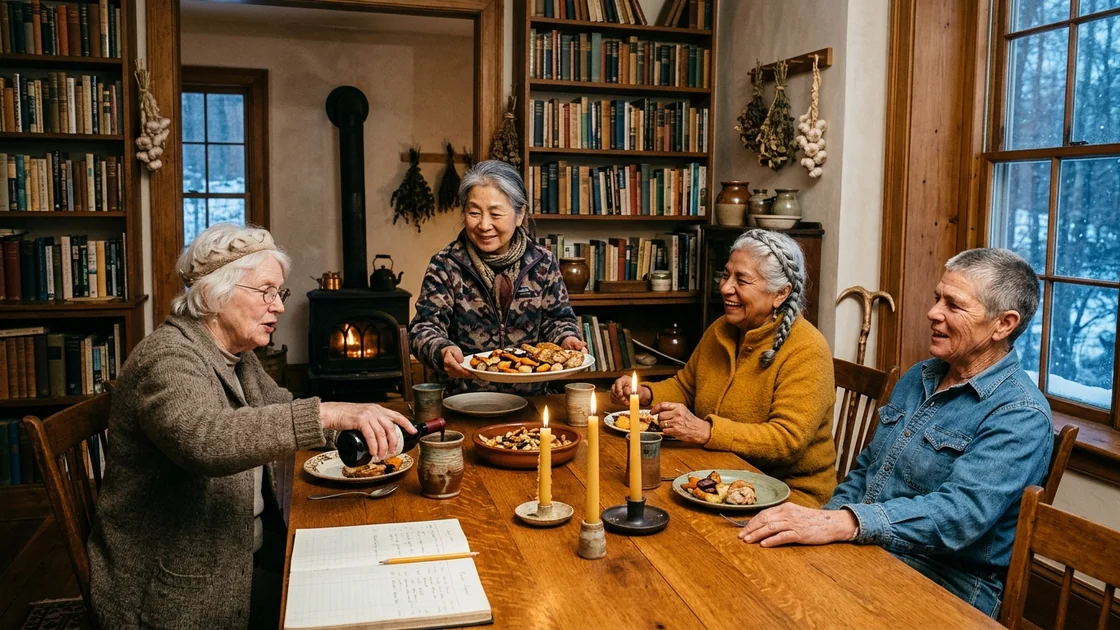
Four women in their sixties decide to rebel against the quiet indignities of modern aging by pooling their pensions and life savings to buy a ruined Victorian estate in the Hudson Valley. Refusing the isolation of sterile one-bedroom rentals and the paternalistic reach of assisted-living facilities, they establish an intentional co-living community bound by legal pacts, chore wheels, and stubborn ambition. Over several grueling and triumphant years, they rebuild dry-rotted sills, fight off municipal zoning boards, confront their own physical limitations and family resentments, and transform a forgotten relic of brick and slate into a self-sustaining collective home that redefines autonomy, friendship, and domestic life in their final third of life.
Chapter One: The Arithmetic of Disappearance
The diner smelled of scorched decaf and bleachy laminate. Outside, an uncharitable November drizzle turned the strip malls of Poughkeepsie into gray smears against an asphalt sky.
Eleanor Vance set her ledger beside a chipped ceramic mug. Her fingers, long and knobby at the knuckles from forty years of chalk dust and grading AP Literature essays, smoothed down the curling corner of the legal pad. The page was split down the middle with a neat blue ballpoint line. On the left was what the state of New York believed an unmarried, retired educator deserved after a career of public service: twenty-eight hundred dollars a month, before taxes and health insurance supplements. On the right was the market rent for a ground-floor, one-bedroom apartment within walking distance of a grocery store: twenty-two hundred dollars.
"They want first, last, and a double security deposit," Eleanor said, not looking up. "Plus an application fee of seventy-five dollars. And the leasing agent asked me if I had an adult co-signer."
Across the vinyl booth, Dr. Beatrice Morales did not curse, though she exhaled with enough force to ruffle her napkin. Beatrice had spent thirty-eight years as an emergency room nurse practitioner before arthritis in her knees had made the twelve-hour floor shifts an exercise in quiet torture. She wore a boiled-wool sweater the color of turmeric, her thick silver braids coiled at the nape of her neck like defensive armor.
"A co-signer," Beatrice muttered. "You’re sixty-four years old. You taught half the town council how to read."
"My niece offered," Eleanor said, the corner of her mouth twitching with dry irony. "She lives in Portland. She said she could sign the lease if I promised to let her manage my utility accounts through an app on her phone. She talked to me in the voice people use when they’re trying to coax a frightened border collie into a bath."
"Don't do it," Clara Lin said softly. Clara was sitting next to Eleanor, her compact frame bundled into a quilted coat she hadn't taken off since they sat down. Clara was sixty-two, with round, gentle eyes that hid a mind like a razor. For thirty years, she had run the billing department of an orthopedic clinic, calculating co-pays, arguing with insurance adjusters, and surviving a divorce from a man who had vanished to Florida with half of his 401(k) and all of their mutual equity. "The moment you give them a toehold, they start picking your curtains. My son sent me brochures for an 'active senior enclave' in New Jersey. Three thousand a month for forty square yards of vinyl flooring, bingo on Tuesdays, and a curfew on the shared laundry room."
"They treat sixty like eighty, and eighty like twelve," Jude Alvarez said, sliding into the booth next to Beatrice.
Jude brought the smell of cold pine needles and damp denim with her. At sixty-five, Jude still possessed the shoulders of someone who had spent her twenties framing houses with a feminist carpentry collective in Oregon before settling into municipal parks maintenance. Her gray hair was cropped close, her cheeks raw from the wind, her knuckles scarred from old encounters with table saws. She threw a waterlogged manila folder onto the center of the table.
"Drink your coffee," Eleanor said. "You’re late."
"The bridge was backed up," Jude said, reaching over to steal a packet of raw sugar from the caddy. "And I took a detour through the back road off Route 9W. The probate court finished the appraisal yesterday. It’s on the market as of nine this morning."
The three other women froze. Even the clatter of the diner’s dish pit seemed to recede into a dull hum.
"How much?" Clara asked, her pen instantly poised above a fresh sheet of paper.
"Three hundred and eighty-five thousand," Jude said. "Cash or conventional rehabilitation loan only. The listing agent didn't even put photos of the inside on the public MLS. She just wrote: Historic opportunity. Bring your architect and your hazard insurance."
"Three eighty-five," Clara whispered, her fingers flying over the keypad of her phone. "Between the four of us, if we liquidate my remaining index funds, Eleanor’s buyout lump sum, Bea’s savings, and the sale of Jude’s quarter-acre lot in Kingston... we have four hundred and twenty thousand liquid."
"Which leaves thirty-five thousand for emergency repairs," Beatrice said, raising an eyebrow. "On a house that’s been abandoned since the Carter administration."
"The roof was patched in ninety-two," Jude countered defensively. "I climbed the carriage-house trellis twenty minutes ago while the rain was light. The main ridge board is straight. The rafters look sound from what I could see through the attic gable. It’s stone and heart-pine, Bea. It isn't one of these dry-walled spitboxes they throw up along the highway. It’s got bone."
Eleanor took off her wire-rimmed glasses and rubbed the bridge of her nose. Her vision without them was soft, indistinct, like water running down a pane of glass. For six months, they had met every Tuesday at this same booth, talking around the edges of their mutual terror.
They were not destitute, not yet. But they were entering the long, downhill slide that modern life reserved for women without husbands, high-powered corporate pensions, or family fortunes: the slow attrition of their savings against rising rent, the gentle social shunning, the humiliating transition from autonomous adults to burdensome elders waiting for someone else to make decisions about their dietary sodium and their thermostats.
"If we do this," Eleanor said, looking around the table, meeting each pair of eyes, "there is no fallback. We aren't just roommates splitting utilities. We’re pooling our principal. We’re legally tethering our old age together. If the septic system fails, we pay for it together. If one of us gets sick, we don't call an administrator; we handle it. If one of us dies, her share has to be protected from predatory heirs."
"My daughter already thinks I’m clinically insane," Beatrice said flatly. "She told me yesterday that women our age don't start 'communes.' She said it sounded like an episode of a true-crime podcast."
"It isn't a commune," Jude spat. "It’s a land-tenure collective. It’s an intentional co-living corporation. Men do it all the time when they buy hunting lodges or private equity partnerships. Four old broads do it to keep out of the poorhouse, and suddenly it's a psychiatric symptom."
Clara leaned forward, her voice quiet but entirely steady. "I’ve spent sixty-two years living under someone else’s name. First my father’s, then Richard’s. When the divorce went through, the bank sent the new deed with Clara Lin, an unmarried woman typed in bold under my signature, like it was a medical diagnosis. I don't care if the roof leaks. I want a house where my name is on the deed alongside people I respect."
Eleanor looked down at her ledger. She picked up her pen, drew a heavy, decisive circle around the figure Clara had scrawled, and then closed the book.
"Call the agent, Jude," Eleanor said. "Tell her we’ll take it as-is, twenty-one-day close, no contingencies for interior paint."
Chapter Two: The Skeleton of Bramble Hill
Highfield Grange had not earned its name through pastoral charm; it had earned it through altitude and stubbornness. Perched on a limestone bluff three miles west of the river, it sat behind two iron gates that had rusted permanently into the loam. A half-mile driveway, choked with black walnut saplings and sumac, wound upward through four acres of tangled overgrowth until the house appeared like an unburied fossil.
It was an 1888 High Victorian Gothic, clad in dark red brick that had weathered to the color of dried liver. It had three full stories, a truncated mansard tower with fish-scale slate, two sprawling wrap-around porches with gingerbread trim hanging like broken lace, and fourteen distinct rooms, each cold enough to freeze water in a bucket.
The real estate agent, a sharp-featured woman in a pristine puffer coat and sensible designer boots, refused to step past the front vestibule. She stood on the threshold, waving a flashlight into the cavernous central hall while the floorboards groaned under Jude’s heavy work boots.
"The seller was a hoarder’s estate," the agent said, checking her watch. "The clean-out crew hauled out seven dumpsters of newspapers and canned goods last month. What you see is what remains. Water has been off for three years. Power is disconnected at the pole. I have the disclosure forms, which essentially say the seller discloses nothing because the heirs never set foot inside."
"Good," Jude said. She was already tapping a claw hammer against the wainscoting, listening for the hollow echo of termite damage. "Less sentimental garbage to negotiate around."
Eleanor stood in the center of the double parlor. The ceiling was twelve feet high, edged in soot-blackened plaster moldings of acanthus leaves and pomegranates. In the corner sat an enormous hearth of polished Verde Antique marble, its mantelpiece thick with decades of lime dust. The air carried the sharp, familiar scent of old paper, cold stone, and decades of woodsmoke trapped in masonry.
"It’s cavernous," Clara whispered, stepping around a pile of dead carpenter ants near the French doors. "How do we heat three thousand square feet with oil at five dollars a gallon?"
"We don't," Beatrice said. She had walked directly to the rear of the main floor, through a swinging green baize door that led into the old scullery. "We zone it. We don't live in fourteen rooms like Victorian gentry with eight servants. We live in the ground floor and the south-facing second-story bedrooms. We close the third floor entirely until spring. We install high-efficiency wood inserts in the major hearths and split the cords ourselves."
"Split them ourselves?" Clara blinked.
Beatrice turned back, her face deadpan. "I have a hydraulic log splitter coming from my cousin's farm on Friday. You're operating the lever, Clara. It doesn't require upper body strength, just attention to fingers."
They signed the closing paperwork three weeks later in a windowless title office in Kingston. The title attorney, a young man who couldn't have been more than thirty, looked between the four women with open bewilderment. They had arrived with their own draft of an operating agreement, prepared by Eleanor after three weeks of studying New York cooperative housing law, with addendums scribbled in Clara’s meticulous bookkeeping hand.
"You’re creating an LLC to hold the title," the attorney said, leafing through the thirty-page document. "With each of you holding a twenty-five percent membership interest, transferrable only to the surviving members upon death or through a mandatory buyout clause at pre-appraised book value."
"That's right," Eleanor said. "No children inherit equity. No outside investors can buy a fraction. If I die, my estate receives the depreciated balance of my initial cash input over a ten-year payment plan, but the deed remains whole with the survivors."
"It’s unusual," the attorney said.
"It’s rational," Eleanor corrected him. "Sign the paper, Mr. Miller."
They moved on the first of December, under a sky the color of zinc.
Their possessions filled one twenty-foot rental truck, driven by Jude with Beatrice riding shotgun, while Eleanor and Clara followed in Clara’s ten-year-old station wagon. They had sold or given away two-thirds of their furniture. They had shed forty years of accumulated domestic baggage: the dining sets meant for twelve-person holiday dinners that no longer occurred; the spare bedroom sets kept for children who visited once every three years; the yard tools, the duplicate blenders, the sets of encyclopedias.
What remained was essential: Eleanor’s three thousand books; Beatrice’s commercial stainless-steel stockpots and four crates of medical texts; Clara’s kiln and her boxes of white restaurant-grade stoneware; Jude’s wall of DeWalt power tools, saws, and hardware organizers.
The first night was a siege.
The electricity had been reconnected that morning, but the ancient oil-fired boiler in the basement had coughed once, spewed a cloud of oily black particulate through the floor registers, and died with a metallic shriek that shook the joists. The temperature outside had dropped to twenty-two degrees.
They did not panic. Jude dragged four folding cots into the small morning room off the kitchen, the only space with intact plaster and an operational flue. Beatrice built a fire in the small hearth using scrap oak lath and seasoned kindling Jude had brought from her old shop. Clara set up a camp stove on the hearthstone, heating four cans of split pea soup and a loaf of day-old sourdough.
They sat on their cots, dressed in thermal underwear, heavy parkas, and knit watch caps, their breath pluming white in the room between bites of steaming soup.
"Well," Clara said, her teeth chattering against her spoon. "The real estate market is missing a prime marketing demographic. 'Four women freeze to death in historic monument to their own vanity.'"
"Nobody is freezing," Beatrice said, reaching down to tuck a heavy wool Hudson’s Bay blanket around Clara’s feet. "The ambient temperature in here is forty-eight. The human body can tolerate forty-eight without cellular damage indefinitely, provided there’s no wind."
"Thank you, Doctor," Clara said dryly. "My toes feel much better knowing their suffering lacks cellular significance."
From the head of the cot, Eleanor watched the firelight dance across the plaster ceiling. A thin crack ran from the chimney breast all the way to the doorframe, zigzagging like a bolt of lightning. It was the largest home she had ever lived in, yet sitting there on a narrow cot surrounded by the breathing of three other women, she felt an unfamiliar, terrifying sense of expansion.
For the three years following her husband Arthur’s death, her world had contracted to the four rooms of their modest Cape Cod. She had moved from the kitchen to the bedroom to the small desk in the study, her life measured out in grocery receipts, pension stubs, and the sound of the neighbor’s lawnmower through double-paned glass. She had begun to feel like an outline of herself, a sketch drawn in fading ink.
Here, in the freezing dark of Bramble Hill, the silence was not the silence of an empty apartment. It was the heavy, pregnant silence of an old ship out on deep water, with Jude snoring softly two feet away, the house settling against its foundations, and forty tons of red brick holding off the night.
Chapter Three: The Choreography of Lime and Wire
By February, Highfield Grange had split their hands and hardened their calluses.
The house was not a home; it was a series of emergency systems masquerading as architecture. Jude lived in a permanent uniform of carhartt overalls, her pockets bristling with wire nuts, Teflon tape, and pencil stubs. She took Clara as her apprentice, recognizing that the former billing clerk had a compulsive need for precision that translated perfectly to electrical circuits and copper pipe sweat-joints.
"Electricity isn't magic, Clara," Jude said, standing at the top of an aluminum stepladder in the front hall, her flashlight beam pinned on a junction box that looked like a bird’s nest of brittle cloth-wrapped wiring. "It’s just water that bites. You turn off the main breaker, you test the lead with the multimeter twice, and you don't touch the neutral until you know where the ground goes."
Clara, standing below with a pair of needle-nosed pliers and a roll of 12-gauge Romex, nodded grimly. Her small hands were covered in minor scratches, her gray hair pinned up with a yellow wooden pencil. "If I electrocute myself, Eleanor gets my share of the parlor, and Bea gets my tea set."
"If you electrocute yourself, I’m using the defibrillator in my truck and dragging you back," Beatrice called from the parlor, where she was kneeling on the floor with a heat gun and an antique putty knife, stripping eighty years of lead-encrusted paint from the baseboards. She wore an industrial half-mask respirator, looking like an elderly, determined insect. "You haven't finished the inventory on the downstairs window sashes yet."
They had established a rhythm, rigid and unforgiving, born of necessity.
Breakfast was at seven sharp. Eleanor, who rose before the others, kept the kitchen range stoked with split ash. The kitchen was an eighty-year-old disaster of chipped enamel and grease-stained pine, but they had installed a commercial two-basin stainless sink salvaged from a closed diner in Newburgh and a massive cast-iron cookstove that Jude had rebuilt with fresh firebricks.
Over oatmeal and black tea, the ledger was opened.
"We have eighteen hundred dollars left in the contingency account for the month," Clara announced, tapping her pencil on the column. "The plumber wants twelve hundred to hook up the main waste line to the septic tank, or we can rent the ditch witch for two hundred and dig the trench ourselves."
"We dig the trench," Jude said immediately. "The ground isn't frozen deeper than six inches this week. The weather report says we get a thaw through Thursday."
"I have a clinic shift in Kingston on Wednesday," Beatrice said, pulling off her work gloves. She had taken a part-time position at a low-cost community health center two days a week, trading sixteen hours of clinical consultations for four hundred dollars that went directly into the house's general operating fund. "If we’re running a trencher, we do it Friday when I’m here. Jude isn't operating heavy machinery without a certified trauma nurse within yelling distance."
"I was running ditch witches before you learned how to take a blood pressure, Morales," Jude grunted.
"And you have three compressed vertebrae in your lumbar spine, Alvarez," Beatrice shot back without looking up. "Don't play the hero. It’s bad for the budget."
Eleanor took notes in the community logbook. It had become the domestic bible of Highfield Grange: a heavy, cloth-bound record book where every decision, dispute, and repair was inscribed.
February 14:
— Trench dug: 42 feet to tank. Jude/Clara/Eleanor. Bea on
standby.
— Replaced six sash cords in South Bedroom.
— Clara reports savings on bulk dry beans: $42 saved by ordering
from cooperative mill.
— Dispute over thermostat setting in library resolved: 58 degrees
during day, 54 at night. Personal electric throws permitted.
The physical labor was relentless, but the hardest work was the dismantling of habits formed over half a century of private living.
Clara was terrified of noise; she had spent twenty-five years tiptoeing around an unpredictable, sullen husband whose temper was set off by the scrape of a chair or a dropped spoon. For the first two months, she apologized every time she closed a cabinet door.
Jude, conversely, was a woman who had lived alone in small cabins for thirty years. She had no volume control. She dropped tools, sang labor anthems off-key at five in the morning, and left her boots wherever she stepped out of them.
The explosion happened in late February over a jar of pickled ginger.
It was four in the afternoon. The temperature had plunged to twelve degrees, and the wind off the river was rattling the storm windows with a steady, hollow roar. Clara had spent three hours crawling through the knee-walls of the attic, blowing cellulose insulation between the ceiling joists, and had emerged gray from head to foot, her eyes watering, coughing dryly.
She came into the kitchen to find Jude’s wet work boots sitting precisely in the center of the tea towel she had laid out to dry on the wood box. Beside them, Jude had left an open jar of ginger, an open loaf of bread, and a grease-stained socket wrench.
Clara did not yell. She simply stood in the kitchen doorway, her small fists clenched at her sides, and began to shake.
"Move them," Clara whispered.
Jude, who was at the kitchen table cleaning the carb on a chainsaw, looked up. "What?"
"Move your filthy, stinking boots off my towel, Judith," Clara said, her voice rising an octave, shrill and tight. "Move them right now, or I swear to God I will throw them into the woodstove."
Jude’s face darkened. "It’s a rag, Clara. Don't be dramatic. I just walked through three inches of slush to clear the chimney intake so we didn't all suffocate from back-draft."
"I don't care about the intake!" Clara screamed, the sound tearing out of her with such sudden, violent force that Beatrice came running from the larder with an open jar of tomatoes in her hand. "I care that you live like an animal! You leave your junk everywhere! You treat this entire house like it’s your private barn, and the rest of us are just your unpaid clean-up crew! I spent twenty-five years picking up boots after a man who hated me, and I will not do it for you! I will not!"
She grabbed the heavy leather boot and hurled it across the kitchen. It struck the cast-iron stove with a dull clang and dropped onto the floorboards.
Silence descended on the room, thick and suffocating. Clara was gasping, her chest heaving under her dust-coated fleece, her face mottled with rage and sudden, crushing shame.
Jude stared at the boot, then at Clara. Her jaw worked, her ears turning bright red. For a moment, Eleanor, who had appeared in the doorway behind Clara, thought Jude might pick up the wrench.
Instead, Jude stood up slowly, walked across the room, picked up the boot, and set it neatly in the small wooden tray by the back door that had been designated for muddy footwear. Then she picked up the socket wrench, wiped the table with a rag, and screwed the lid back onto the jar of ginger.
"I’m sorry, Clara," Jude said, her voice rough, low, and completely level. "You’re right. I was sloppy."
Clara stood still for three seconds, then turned and fled up the back staircase. The sound of her bedroom door shutting was not a slam, but a soft, desperate click.
Eleanor walked into the kitchen, took two mugs from the shelf, and poured hot water over dried mint from the garden tins. She handed one to Jude.
"She isn't mad about the boots," Eleanor said quietly.
"I know what she’s mad about," Jude said, leaning against the counter and rubbing her forehead with a grease-smudged hand. "She’s mad because she’s sixty-two years old and she’s spending her retirement blowing ground-up newspaper into an attic with a crazy old butch and two schoolteachers because the country thinks she ought to be invisible."
"We aren't invisible," Beatrice said from the table, setting her tomatoes down. "If we were invisible, the town code enforcement officer wouldn't have left three notices on the gate this morning."
Eleanor looked up, her cup halfway to her mouth. "What notices?"
Chapter Four: The Law and the Porch
The town of Red Hook did not care about four older women restoring a dilapidated Victorian until the red dumpster disappeared from the driveway and the smoke from the chimneys became permanent.
The official summons arrived on a Friday in mid-March, inside a crisp manila envelope addressed to Halcyon Hill Properties LLC. It alleged four distinct violations of the Red Hook municipal zoning code: unauthorized multi-family occupancy in an R-1 single-family residential zone; maintenance of an unpermitted commercial wood-processing facility (which was how the zoning administrator described Jude’s log splitter); failure to submit an engineered site plan for septic modernization; and non-compliance with the New York State Uniform Fire Prevention and Building Code regarding commercial boarding facilities.
"A boarding facility," Eleanor read aloud, sitting at the mahogany dining table they had finally cleared of paint cans and sandpaper. "They think we’re running an illegal boarding house."
"Old Henderson," Jude spat. "He lives down at the turn of the hill. He’s had his eye on this parcel for ten years. His son-in-law is a developer who builds those vinyl-clad faux-colonials out on the bypass. They wanted this hill for eight half-acre lots with four-car garages."
"They can’t have it," Clara said. She was sitting with a massive binder on her lap, containing every receipt, permit application, and code specification they had filed since November. "We are not a multi-family dwelling under New York State case law. We are a single housekeeping unit."
Eleanor smiled thinly. "You’ve been reading Group Home v. Zoning Board of Oyster Bay."
"I have," Clara said, her eyes flashing with a cold, administrative light that Eleanor recognized from the most formidable senior teachers of her youth. "A group of unrelated individuals living together as a permanent, non-transient domestic unit with a single shared kitchen, shared common funds, and joint tenancy constitutes a single family for zoning purposes under the New York State Constitution. The Court of Appeals settled that forty years ago."
"Henderson doesn't care about the Court of Appeals," Beatrice said. "Henderson cares that we don't have men living here, we don't have children going to the school district to justify their property taxes, and we aren't thirty-year-olds with three hundred thousand dollars of private income who will hire his son-in-law to build a four-car garage."
The zoning board meeting was scheduled for the following Tuesday at the town hall.
For three days, the house became a legal research laboratory. Eleanor drafted the brief; Clara compiled the financial affidavits proving that all food, utility, and maintenance expenditures came from a single pooled bank account; Jude drew architectural schematics of the floor plan demonstrating that the house had only one kitchen, no exterior lockouts, and no subdivided rental apartments; and Beatrice pulled the New York State Department of Health regulations on home care, establishing that the women were neither patients nor operators of an unlicensed adult residential facility.
On Tuesday evening, the four of them walked into the Red Hook Town Hall together.
They had dressed with deliberate care. Eleanor wore her best tweed blazer and pearls—the armor she had used for thirty years to stare down hostile school boards. Beatrice wore a tailored charcoal pantsuit and her silver nurse practitioner pin on her lapel. Clara wore a neat silk scarf and her wire-rimmed glasses, carrying two black accordion files. Jude had scrubbed her hands until her nails were pink, wearing clean pressed khakis and an ironed chambray shirt.
The zoning board consisted of five men and one woman, seated behind a raised dais of fake woodgrain laminate beneath the town seal. The room was crowded with forty or fifty neighbors, mostly retirees in fleece jackets, a few local contractors, and Mr. Henderson, who sat in the front row with his arms crossed over a broad belly.
"Item Four," the board chair read, tapping his microphone. "Halcyon Hill Properties LLC. Violation numbers 23-088 through 092. Unauthorized conversion to multi-family dwelling, operation of an unpermitted boarding establishment."
Eleanor rose from the second row. She did not walk to the podium like a supplicant; she walked like a department head entering a faculty meeting that had gone five minutes over schedule.
"Good evening, Mr. Chairman, members of the board," Eleanor said, her voice clear, low, and carrying without the microphone. "I am Eleanor Vance, managing member of Halcyon Hill Properties. With me are Dr. Beatrice Morales, Clara Lin, and Judith Alvarez. We are the co-owners and sole residents of Highfield Grange."
The board chair, an insurance salesman named Varner, adjusted his glasses. "Ms. Vance, the town has received complaints regarding the intensity of use at the property. Multiple vehicles, constant industrial noise from the rear yard, and reports that the premises are being utilized as an unregulated co-living facility for seniors."
"The 'industrial noise,' Mr. Varner," Eleanor said coolly, "was the sound of an eight-horsepower wood splitter preparing our winter heating supply over a forty-eight-hour period in accordance with town decibel ordinances between the hours of ten a.m. and four p.m. As for the 'unregulated facility'—she paused, turning slightly to motion toward Clara, who stepped forward and placed four identical three-ring binders before each board member—"we have submitted for your record our LLC operating agreement, our joint deed, and a legal memorandum demonstrating that our living arrangement conforms strictly to the definition of a single-family housekeeping unit under the New York State Court of Appeals precedent City of White Plains v. Ferraioli."
A board member on the left, a local real estate broker, leaned forward. "Ms. Vance, let’s be practical. There are four unrelated women living in a fourteen-room house. You aren't a family."
A dead silence fell over the room.
Beatrice stepped forward to the podium. She did not raise her voice, but when she spoke, her tone had the razor-edged authority that had silenced screaming surgeons and belligerent drunks in the Kingston trauma bay for four decades.
"Mr. Peters," Beatrice said, her dark eyes locking onto his. "I have lived in this county for forty-one years. I have delivered the babies of some of the people sitting in this room. I have certified the deaths of others. My partners and I have over two centuries of combined life experience, three clean professional licenses, and not a single criminal conviction among us. We have invested our life savings into a house that this town allowed to rot into a public nuisance for twenty-five years because none of your local developers had the stomach to spend the money to save it."
She rested her calloused hands on the wooden railing of the podium.
"We share our meals from one table. We clean our gutters with our own hands. We pay our school taxes, though none of us will ever send a child through your high school again. We have saved the county the burden of four older women entering your subsidized senior housing rolls, which I believe currently has an eighteen-month waiting list. If you intend to declare us legally incapable of forming a household simply because we chose each other instead of an institution or an empty room, I suggest you consult your town attorney before you vote. Because Dr. Morales, Ms. Lin, Ms. Vance, and Ms. Alvarez will see you in federal district court on a civil rights complaint before we surrender our front door key."
The board chair stared at Beatrice. He looked down at the three-ring binder, then over at the town attorney, who was sitting at the end of the dais with his head in his hands, slowly shaking it from side to side.
"We... ah," the attorney whispered to the chair, loud enough for the first two rows to hear. "She’s right, Bob. The Court of Appeals will hand our heads to us. They have an unbroken line of precedent on functional family equivalents. Let it go."
The chair cleared his throat twice. He shuffled his papers with nervous, uncoordinated fingers.
"The board... finds that the violations are largely administrative in nature," the chair said, his voice dropping into bureaucratic monotony. "Provided that the LLC submits the engineering sign-off on the septic tank within thirty days, and the exterior wood storage is kept twenty feet from the property line, the board moves to dismiss the citation without prejudice."
"Seconded," the woman on the board said instantly.
"All in favor?"
The vote was five to one, with only Mr. Peters staring sullenly out the window.
When they walked down the stone steps of the town hall into the cold night air, the street was deserted. A light frost was forming on the roof of Clara’s station wagon.
Jude stopped on the bottom step, put two fingers into her mouth, and let out a piercing, earsplitting whistle that echoed off the brick facade of the municipal building.
"Don't do that," Eleanor said, straightening her pearls, though her eyes were shining behind her glasses. "The neighbors will think we’re disorderly."
"We are disorderly," Beatrice laughed, pulling her collar up against the wind. "We’re four old women who just made the town council eat their own paperwork. If that isn't disorderly, I don't know what is."
Clara stood by the car door, looking up at the sky. A constellation—the clean, cold bowl of the Big Dipper—hung directly above the hills to the west, pointing toward Bramble Hill.
"I need a glass of port," Clara said. "And tomorrow, Jude, you’re teaching me how to operate the chainsaw. I am not letting you have all the fun with the firewood."
Chapter Four: The Summer of Plaster and Peaches
By July, the house had shed its skin of abandonment.
The first floor was completely functional. The dining room floor, three hundred square feet of quartersawn red oak, had been sanded down through three grits of paper by Eleanor and Clara, then rubbed with four coats of tung oil until it held the deep, amber sheen of aged whiskey. In the parlor, the cracked ceiling had been secured with plaster washers and skim-coated by Jude, who possessed an uncanny, intuitive touch with a hawk and trowel.
The garden had broken out of the limestone soil behind the carriage house like an emerald wave.
Beatrice had turned half an acre of dead briars into forty raised beds, framed with hemlock planks Jude had traded for two cords of split firewood with a local sawyer. There were heirloom tomatoes—Brandywines and Cherokee Purples—tied up with strips of old cotton bedsheets; rows of lacinato kale, sweet corn, runner beans, and four distinct varieties of garlic.
On Saturday mornings, the house had a smell that belonged to no modern apartment: the sharp tang of cider vinegar from pickling brine, the rich, buttery crust of Eleanor’s sourdough loaves cooling on wire racks, the damp, vegetal hum of the gardens, and the faint, permanent ghost of turpentine from the studio Clara had established in the old butler’s pantry.
Clara had bought an old electric Shimpo pottery wheel off Craigslist for seventy-five dollars. She had spent two weeks rewiring the foot pedal and replacing the drive belt, her face smudged with grease, until it spun true. Now, rows of unglazed stoneware crocks, bowls, and mugs lined the shelves where Victorian soup tureens had once sat.
"They're lumpy," Clara had said, holding up a small gray bowl with an uneven rim during their Sunday dinner.
"They hold soup," Jude had replied, taking it from her hands and filling it with vegetable chowder. "Symmetry is a bourgeois neurosis, Lin. A bowl needs to do two things: sit on a flat table without falling over, and hold liquid. This does both."
The town had not warmed to them, but it had grown accustomed.
Local contractors who had initially laughed at their project began stopping by Jude’s driveway to buy lengths of reclaimed heart-pine flooring or salvage hardware that the women had pulled from the third floor during cleanup. The woman at the Agway started setting aside cracked bags of alfalfa meal and bone meal for Beatrice without being asked.
The real test came not from the town, however, but from the south.
It was a Saturday in late August, the humidity hanging heavy as a wool wet sheet over the valley, when a silver Mercedes SUV turned slowly up the gravel drive, its suspension groaning over the water bars Jude had cut into the grade.
Beatrice was on the wrap-around porch, her sleeves rolled up to her elbows, hulling three bushels of early freestone peaches for canning. She stopped her knife, her thumb resting against the fuzzy skin of a peach, as the car doors opened.
Her daughter, Maya, stepped out.
Maya was thirty-six, an interior architect with a firm in Brooklyn, wearing an expensive linen jumpsuit that had never seen a garden tool, her sunglasses pushed into a thick mass of dark curls that were identical to Beatrice's before the silver took over. Behind her came her husband, David, looking uncomfortably at the limestone retaining wall and the mountain of dried firewood stacked neatly under the carriage-house overhang.
"Mom," Maya said, walking across the yard with her hands out, her eyes darting over the scaffolding that Jude had erected to scrape the second-story window trim. "You didn't answer your cell phone."
"The cell reception doesn't penetrate eight inches of exterior brick, Maya," Beatrice said, not standing up, but gesturing with her paring knife toward the wicker chairs. "And I was canning peaches. If I stop now, the syrup turns to sugar. Sit down. Clara’s inside; she’ll bring you some cold tea."
Maya climbed the porch steps, her heels clicking on the newly painted fir decking. She stood with her arms crossed, looking at the stone balustrades, the hanging baskets of nasturtiums, and her mother’s hands, stained yellow from fruit acid.
"You look tired, Mom," Maya said, her voice dropping into that familiar, professional cadence of modern filial concern. "You’ve lost weight."
"I’ve lost twelve pounds of water weight because I don't sit in an office chair twelve hours a day," Beatrice said calmly. "My blood pressure is one-ten over seventy. Last year it was one-forty over ninety. Sit down, David. You look like you’re waiting for a train that’s forty minutes late."
David sat gingerly on the wicker settee. He cleared his throat. "It’s... quite a property, Beatrice. Big project."
"It’s not a project," Beatrice said, dropping a clean peach half into a lemon-water bath. "It’s my house."
Maya leaned against the porch rail. "We came because we’re worried about you. We had that conversation in November, and you went off and did this without... without any family review. You liquidated your whole IRA, Mom. Everything Dad left you. If something happens—if you fall, if you need long-term care—what are we supposed to do? David and I have a two-bedroom in Park Slope. We don't have the space to move you down there if you break a hip."
Eleanor stepped through the screen door, carrying a tin tray with four tall glasses of sun tea with mint and a plate of warm biscuits. Her linen shirt was dusted with flour, her posture as straight as a ruler.
"Good afternoon, Maya," Eleanor said smoothly. "I don't believe we’ve met. I’m Eleanor Vance."
Maya blinked, taken aback by the older woman’s tone. "Hello. I’m Maya, Bea’s daughter."
"I know," Eleanor said, setting the tray on the low wicker table. "Your mother speaks of you often. She’s very proud of that library project you completed in Queens. Please, have a biscuit. The butter is local."
Maya didn't touch the tray. "Ms. Vance, I’m sure this is all very charming, but let’s be realistic. My mother is sixty-six. Her knees are bad. What happens when she can’t climb these stairs? What happens when one of you has a stroke? Who is going to nurse you? You’re four people who met at a book club and a gardening seminar. You aren't family."
From the yard below, the sound of a saw suddenly ceased. Jude emerged from behind the woodpile, carrying a five-foot spirit level and a bucket of mortar. She looked at Maya, then at Beatrice, took off her work gloves, and leaned against the porch railing.
"I’ll tell you what happens, Maya," Beatrice said. She set her knife down on the cutting board with a quiet, final click.
She wiped her hands on her apron and looked her daughter directly in the eye.
"When my knees give out completely, Jude and Clara are converting the small study on the ground floor into my bedroom. We already have the door framed for wheelchair clearance; we measured it three weeks ago when we replaced the jamb. The half-bath off the pantry is being enlarged in October to include a roll-in shower. Clara has already sourced the grab bars from an institutional supplier in Albany. They’re brushed nickel. They don't look like an asylum; they look like a hotel."
Beatrice stood up. Though she was three inches shorter than her daughter, she held herself with the iron carriage of a woman who had never once asked permission to exist.
"If I have a stroke," Beatrice continued, "Eleanor has my medical power of attorney. Not you. Eleanor knows that I do not want artificial nutrition, I do not want a vent, and I do not want to spend three years staring at a drop ceiling in a nursing home while a private equity firm drains my pension down to Medicaid poverty limits. If I need nursing, Eleanor and Clara and Jude will nurse me, because we have an agreement signed in blood and ink that we do not abandon each other to strangers."
Maya’s eyes welled with sudden, angry tears. "That’s unfair, Mom! I’m your daughter!"
"You are my daughter," Beatrice said, her voice softening, but losing none of its density. "And I love you more than my own breath. But you have a career, and you have David, and you have your own life to build in the city. You don't have room for an old woman who needs two hours to get out of bed in the morning. And more importantly, Maya—I don't want to live in your guest room like an overgrown child waiting for you to come home from an eight-hour meeting to ask me if I took my statins."
She reached out and took Maya’s hands. Beatrice’s palms were rough, cracked at the thumb from garden dirt and lime, warm as river stones.
"I didn't spend sixty-six years becoming Beatrice Morales just to spend my last twenty being somebody’s dependent mother," Beatrice whispered. "I built this. I have a stake in this hill. If I die here, I die in my own bed, looking at my own garden, surrounded by women who know what a life costs because they’ve lived one."
Maya looked down at their joined hands. David looked away, out toward the blue ridge of the Catskills rising above the summer haze.
Nobody spoke for a long time. The only sound was the drone of the cicadas in the black walnut trees and the rhythmic, hollow drip of the peach syrup into Beatrice’s porcelain bowl.
Finally, Maya pulled a tissue from her pocket and dabbed her eyes. She looked around the porch—at the neat stack of freshly sanded pine boards, at Clara’s gray pottery mugs, at Eleanor’s calm, unblinking face, at Jude’s scarred arms.
"Can I... have a biscuit?" David asked quietly from the corner.
Eleanor smiled, her eyes crinkling. "Of course, David. Take two. Beatrice made the peach jam yesterday, and it’s entirely safe for human consumption."
Chapter Five: The Ice Storm and the Hearth
Winter did not arrive gently in their second year. It came in late December with an ice storm that coated three counties in two inches of clear, heavy glaze.
It began on a Thursday night as freezing rain, drumming against the slate mansard with the sound of a million thrown marbles. By Friday morning, the power lines were down all along Route 9W. The silence that fell over the Hudson Valley was eerie, interrupted only by the sudden, gun-like cracks of eighty-foot oak limbs snapping under the weight of the ice.
Highfield Grange had prepared.
They had sixteen cords of split oak, ash, and locust stacked high against the carriage house wall. In the basement, Clara had stored sixty gallons of potable water in food-grade carboys, alongside three hundred jars of canned vegetables, fruit, stocks, and cured meats.
When the grid collapsed at three in the morning, the house didn't even shiver.
Jude was down in the basement within five minutes, switching the primary water supply over to the gravity-fed cistern they had rebuilt in the attic tower during the autumn. The cast-iron range in the kitchen was stoked with seasoned locust—a wood that burned with a hot, blue flame like coal—and the two soapstone stoves in the library and parlor were banked for the night.
At dawn, Eleanor stood at the second-story landing window.
The world outside was a kingdom of glass. Every twig on the lilacs was encased in an inch of crystal; the lawn was a sheet of diamond that reflected the pink, frozen glow of a sun that offered no warmth. In the distance, a massive white pine at the property line groaned, shuddered, and collapsed into the underbrush with a muffled roar.
"Nobody goes outside," Beatrice commanded from the kitchen stairs, carrying a steaming pot of coffee. "Falling timber will kill you before you hear the branch drop."
They gathered in the library, which had become the winter living room.
It was the most beautiful room in the house now. Eleanor had spent six months stripping the walnut bookshelves, repairing the rolling ladder track, and organizing her thousands of volumes by discipline: history and poetry along the north wall; natural science, gardening, and mechanics along the east; philosophy and literature flanking the hearth.
A massive braided wool rug, found at an estate auction for forty dollars and cleaned with baking soda and lavender, covered the floor.
They pulled their desks and worktables close to the soapstone stove.
For five days, they were completely cut off from the world. No cars could climb the half-mile hill; the telephone poles on the lower road were snapped like toothpicks; the cellular towers had exhausted their backup batteries by Saturday night.
They lived in a pocket of seventeenth-century warmth within the twenty-first century.
Clara spent the mornings at the large oak table, working on the household accounts by the yellow light of an Aladdin mantle lamp. Her face, which had been pale and pinched when she had first sat in that Poughkeepsie diner thirteen months before, had settled into an easy, confident repose.
"We came in four hundred dollars under budget on food for the quarter," Clara said, not looking up from her ledger. "The cold storage room in the root cellar kept the potatoes from sprouting. We haven't bought a single head of commercial greens since October."
"And Jude’s new flue baffle in the parlor saved us half a cord of wood," Beatrice added, looking up from her mending. She was patching the knee of Jude’s heavy duck trousers with a strip of leather from an old boot tongue. "My joints usually howl during an ice storm. This house is warmer than my old condo in Kingston."
"That’s because your old condo was built out of two-by-fours and compressed sawdust," Jude said from the floor, where she was meticulously cleaning and oiling a collection of hand planes she had salvaged from an abandoned barn down the road. "This place has three courses of brick between us and the weather, and eighteen inches of lime mortar. It’s got thermal mass. Once you get these stones warm, they stay warm for three days after the fire goes out."
Eleanor was sitting in a deep leather armchair by the window, a wool lap robe over her legs, reading aloud to them.
It had become their evening tradition during the dark months. In the first winter, it had been a way to save lamp oil and keep their minds off the freezing cold; now, it was a ceremony they protected fiercely. Eleanor had read them The Odyssey, then Montaigne’s essays, and then, at Jude’s request, the journals of Lewis and Clark.
Tonight, she was reading from Willa Cather’s My Ántonia.
Her voice, trained by decades of reading Shakespeare to indifferent teenagers, filled the high-ceilinged room with a rich, musical resonance:
"‘Optima dies... prima fugit,’" Eleanor read, translating softly as she went. "‘The best days are the first to flee.’ ... We were both very much downcast without knowing why; and it was that which made us dear to each other, perhaps; the first time that each had looked into the other’s heart."
She lowered the book to her knee and looked at the three women around her.
The room was warm, smelling of woodsmoke, coffee, neat’s-foot oil, and dried lavender. Jude’s gray head was bent over her iron plane; Beatrice’s silver needle flashed through the heavy denim; Clara’s pencil made a soft, steady scratch-scratch-scratch against the clean white paper of her book.
Eleanor thought of her mother, who had spent the last seven years of her life in an "extended care facility" in Syracuse. She remembered the linoleum hallways that smelled of boiled carrots and floor wax; the sound of the televisions blaring from every room, each set to a different game show; the aides who were always kind, always hurried, always eighteen years old and exhausted from double shifts; the way her mother had shrunk into the white sheets until she seemed to take up no more space than a bundle of laundry.
Her mother had died with a call button pinned to her gown, waiting for someone to bring her half a cup of lukewarm water.
Eleanor reached out and laid her hand against the cool, dark wood of the library table.
"What is it, El?" Jude asked, looking up from her plane.
"Nothing," Eleanor said, her voice catching slightly before she smoothed it out. "Just... the house. It’s quiet."
"It’s not quiet," Clara said, smiling without lifting her pencil. "Jude is breathing like a steam engine, and the chimney damper has a whistle in it that’s precisely a B-flat. It’s been driving me crazy since four o'clock."
"I don't breathe like a steam engine," Jude grunted.
"You do," Beatrice said without looking up from her seam. "You have a deviated septum from when that two-by-four swung into your nose in nineteen-eighty-four. If you let me cauterize it with the silver nitrate stick like I offered, you wouldn't whistle."
"You aren't putting any silver sticks up my nose, Morales," Jude said, throwing a scrap of leather at her.
Beatrice caught it out of the air with the reflex of an old softball catcher, tossed it into the hearth, and smiled down at her work.
Chapter Six: The Radical Kitchen
By their third spring, Highfield Grange had become something more than a private home; it had developed a gravitational pull.
It began with the repair cafe.
Jude had grown disgusted with the number of perfectly good electric mixers, lamps, chainsaws, and lawnmowers she saw stacked by the curb on trash days in Red Hook. In April, she dragged two sawhorses out to the carriage house apron, set up a sign made from a scrap of plywood that read BRING YOUR BROKEN STUFF — NO CHARGE, and waited.
The first Saturday, three people came: an old dairy farmer with a milk-stirrer that had a broken switch; a young mother with an antique floor lamp that sputtered blue sparks; and the high school shop teacher, who wanted to know if Jude had a set of metric taps he could borrow.
Jude fixed the switch with a six-dollar toggle from her parts bin; Eleanor showed the young mother how to rewire a three-way socket while Clara served her mint tea; and Jude traded the use of the taps for two truckloads of aged horse manure for Beatrice’s asparagus trench.
By June, the repair cafe had become an institution. Every second Saturday, the gravel driveway was lined with pickup trucks and station wagons.
Local people who had looked at the "old maids’ commune" with suspicion for two years now sat on the porch steps drinking Eleanor’s iced mint tea while Jude showed their sons how to sharpen an axe on a sandstone wheel, and Beatrice dispensed advice on everything from tick bites to high blood pressure to young mothers who couldn't afford a clinic visit.
"You’re practicing medicine without an institutional license, Bea," Eleanor had warned her gently one afternoon, watching Beatrice inspect an eight-year-old’s infected finger on the back bench.
"I’m washing a cut with iodine and telling her mother to keep it clean with honey and a sterile dressing," Beatrice said, not looking up. "That isn't medicine; that’s seventeenth-century housewifery. If the state medical board wants to prosecute an old woman for giving away free honey to a child whose father got laid off from the lumberyard, let them bring their marshals up the hill."
The garden had expanded to two acres.
They had brought in four hives of Italian honeybees, which Jude had built from cypress scrap. Clara had taken over the bee yard, moving among the thousands of stinging insects with a calm, deliberate slowness that bordered on the mystic. She wore no gloves—only a simple veil over her gray hair—her hands steady as she lifted the heavy brood frames out of the supers to check for the queen.
"They aren't angry," Clara said one afternoon, her face glowing through the mesh as Eleanor watched from twenty feet away. "They’re just busy. They only sting when you move like you’re trying to own them. If you move like you’re just part of the weather, they let you take the honey."
They had developed an economy that defied every modern financial model.
They spent less than six hundred dollars a month on groceries between the four of them. Their electricity was partially offset by a twelve-panel solar array that Jude and Clara had mounted on the flat roof of the carriage house, bought used from an abandoned solar farm in New Jersey and wired into an old bank of lead-acid batteries Jude had reconditioned with distilled water and Epsom salts.
They were not rich, but they had eliminated the need for money.
Their pensions, which had looked so pathetic when divided into four separate, isolated rents, became an insurmountable fortress when pooled against a paid-for freehold. They had an emergency medical fund with sixty thousand dollars in it; their property taxes were paid six months in advance; their wood sheds were full for two years out.
The local newspaper, the Northern Dutchess News, sent a reporter out in late July. She was twenty-four, wore bright yellow sneakers, and carried a digital voice recorder that she looked at with profound anxiety.
She sat at the large dining table while Clara served her cold cucumber soup and Eleanor’s crusty rye bread.
"So," the reporter said, her pencil poised above a fresh notebook. "The community is... an experiment in feminist socialism?"
Jude, who was sitting at the corner of the table cleaning a spark plug with an old toothbrush, choked on her soup.
"Feminist socialism?" Jude repeated. "Honey, we’re four old women who didn't want to die in a warehouse. If that’s socialism, then every barn-raising in Pennsylvania since seventeen-twenty was a communist conspiracy."
"We aren't an experiment," Eleanor said firmly. "Experiments have hypotheses and control groups. We are simply an adaptation."
"An adaptation to what?" the reporter asked.
"To the fact that modern American society has forgotten what a household is," Eleanor said. She leaned forward, her spectacles glinting in the light from the French doors. "For five thousand years, human beings did not live in isolated, two-person nuclear units where two people had to work sixty hours a week just to pay the interest on a mortgage for four bedrooms they only use on Thanksgiving. They lived in clans. They lived in collectives of aunts, grandmothers, apprentices, and neighbors who pooled their physical labor so that when one person was sick, the fire didn't go out."
Eleanor gestured around the room—at the oil paintings they had rescued from damp basements, at the shelves of books, at the stoneware bowls, at Beatrice’s bunches of dried sage hanging from the acanthus molding.
"We have been told that independence means living alone in an apartment with your own television, buying your own food in plastic containers, and paying a private company to wipe your brow when you’re dying," Eleanor said. "That isn't independence. That is extreme, profitable isolation. We chose interdependence. It’s cheaper, it’s safer, and it makes the bread taste better."
Chapter Seven: The Fracture
No collective lives without blood on the floorboards.
The crisis came in the autumn of their fourth year, not from a zoning board or a broken pipe, but from the simple, unavoidable reality that had chased them up the hill from the beginning: they were mortal, and their bodies were aging.
It was mid-October. The sugar maples along the drive were flares of crimson and cadmium yellow, and the air smelled of frost and fallen leaves.
Jude had been working on the carriage house roof, replacing three rows of broken slate that had begun to weep water into her workshop below. She had done it forty times before. She wore her roof harness; she had her chicken ladder hooked over the ridge.
Nobody saw the slip.
Beatrice was in the greenhouse digging up the rosemary plants to bring inside for the winter when she heard the sound—not a scream, but a heavy, wet thud, followed by the metallic clatter of the slate ripper bouncing down the copper gutter.
Beatrice did not walk; she ran, her sixty-eight-year-old knees screaming, her breath tearing through her throat in ragged gasps.
Jude lay on the limestone flagging of the carriage house terrace.
She had fallen twelve feet from the lower eave. Her harness line had snapped an old cast-iron eyelet that had looked sound from the outside. She lay on her left side, her face chalk-white, her breath coming in shallow, bubbling rasps, her left leg twisted under her at an angle that made Beatrice’s stomach drop into her boots.
"Clara!" Beatrice bellowed, her voice carrying across the four acres with the force of a foghorn. "CLARA! ELEANOR! 911! NOW!"
The next forty-eight hours were a blur of fluorescent lights, cold linoleum, and the sickening, antiseptic smell of the regional trauma center in Albany.
Jude had three broken ribs, a punctured left lung, a shattered acetabulum—the socket of the hip joint—and a severe concussion. She was in surgery for five hours while the orthopedic team pieced the bone together with titanium plates and eight screws.
Eleanor, Beatrice, and Clara sat in the surgical waiting room.
They did not go home. They did not leave to shower. When the nurse told them that only "immediate family" could stay after visiting hours, Beatrice stood up, pulled her retired hospital credential from her wallet, and leaned over the desk.
"Listen to me, young woman," Beatrice said in a voice that was barely above a whisper, but had the weight of a lead weight. "I was running an ER when you were still in diapers. The woman in that operating room has lived with me for four years. We hold property together. We have health-care proxies on file with your legal department. If you attempt to remove us from this room, I will find your Chief Medical Officer, whom I trained at St. Peter’s thirty years ago, and I will have him explain the legal definition of 'domestic partnership' to your human resources director before sunrise. Do you understand me?"
The nurse looked at Beatrice, then at Clara, who was sitting with her hands clasped around her legal binder, and Eleanor, who was staring down the hall like an avenging angel in a tweed skirt.
"There’s an extra pot of coffee in the staff lounge," the nurse said quietly. "Take what you need."
Jude came home three weeks later.
She was forty pounds lighter, her skin the color of parsnips, her left leg locked into a massive steel-and-velcro brace. She could not walk; she could barely transfer herself from the wheelchair to a bed with the help of two people.
The house, which had been a playground of self-reliance, suddenly became an obstacle course.
The stone steps at the front porch were impassable. The doorway to the study was wide enough, but the limestone terrace was rough and uneven.
For two days, Jude lay in the ground-floor bed that Clara had set up with the linen sheets and the down comforter. She did not speak. She stared at the wall, her jaw clenched, her hands—which had built the kitchen tables, the bee hives, the woodsheds—lying useless and trembling on the coverlet.
On the third morning, when Clara came in with a bowl of oatmeal, Jude turned her head away.
"Take it out," Jude rasped.
"You need to eat, Jude," Clara said gently.
"I said take it out!" Jude snarled, her voice cracking with fury and humiliation. "Look at me! Look at this! I’m a cripple! I’m sixty-eight years old and I can't even get to the toilet without two women holding my elbows like I’m a toddler! I’m done, Clara! Sell my share! Use the buyout clause and put me in a state home! I’m not going to be a stone around your necks!"
Eleanor, who was standing in the doorway with the morning mail, walked into the room.
She did not set the mail down. She walked over to the bed, pulled up the wooden straight-backed chair, and sat down.
"Judith," Eleanor said.
"Get out, Eleanor," Jude spat, tears of rage finally leaking from the corners of her eyes. "Don't give me any of your literature quotes. Don't tell me about Montaigne or the Greeks. I’m a carpenter who can't walk. I’m finished."
Eleanor reached out, took Jude’s rough, scarred right hand, and gripped it with surprising strength.
"You are an idiot, Judith Alvarez," Eleanor said, her voice steady, cool, and entirely merciless. "You are an arrogant, self-pitying idiot."
Jude stared at her, stunned.
"When Beatrice had pneumonia last winter," Eleanor said, "did she offer to sell her share? When Clara’s back went out and she couldn't lift a clay crock for two months, did we drop her off at an institution? Did we have an agreement that this house was only for women who could climb twenty-foot ladders and carry seventy-pound logs?"
Eleanor leaned closer, her eyes boring into Jude’s.
"You didn't build this house with your legs, Jude. You built it with your will. And right now, Clara and Bea and I need your will more than we need your carpentry. Who is going to order the lumber for the spring greenhouse? Who is going to calibrate the solar inverters when the charge controllers fail? Who is going to teach the Miller boy how to rebuild the carburetor on the rototiller?"
She dropped Jude’s hand back onto the bed.
"If you want to quit, you sign the quitclaim deed with your own hand. Clara has the forms. But don't you dare lie to us and say you’re doing it for our sake. You’re doing it because you’re terrified of being weak. And in this house, Judith, we allow each other to be weak. That was the whole point."
Jude looked from Eleanor to Clara, who stood by the window with the steaming bowl of oats in her hands, her face calm, waiting.
Outside, the sound of a vehicle came up the gravel driveway. It was the lumber truck from Red Hook.
"What is that?" Jude muttered, wiping her cheeks with the back of her forearm.
"That," Beatrice said, walking into the room with a set of architectural plans under her arm, "is eighty feet of four-by-four pressure-treated cedar and twenty-four decking planks. The shop class from the high school is arriving at one o'clock with their instructor. They’re building a ramp from the south terrace through the French doors."
Beatrice tossed the plans onto Jude’s lap.
"They have the lumber, but the shop teacher says the boys don't know how to calculate the stringer rise for a one-to-twelve ADA slope over uneven limestone. He wants to know if you can review the cut sheet from the bed before they turn on the miter saws."
Jude looked down at the plans. Her fingers, still trembling slightly, touched the blue lines on the white paper.
She picked up the yellow wooden pencil Clara had left on the bedside table.
"He’s using three-inch lags," Jude said, her voice still rough, but the tremor vanishing from her hand as the pencil touched the paper. "Tell him he’s an idiot. You don't use three-inch lags into wet cedar; they’ll pull out in two seasons. He needs four-inch structural screws with star heads. And tell them if they don't crown the stringers before they screw the decking down, I’ll throw a bedpan at their heads."
Clara smiled, stepped forward, and placed the bowl of oatmeal on Jude’s lap.
"Eat your breakfast, Alvarez," Clara said. "You have six teenagers coming in two hours who think they know how to use a framing square. You're going to need the calories."
Chapter Eight: The Architecture of Winter
Two years later, the ramp had weathered to the same soft, silvery gray as the porch deck.
It didn't look like a medical addition; Jude had designed it with graceful, curving switchbacks that wound through Beatrice’s herb garden, flanked by low stone walls Clara had built out of fieldstones cleared from the orchard. In the summer, the ramp was scented with creeping thyme, lavender, and sweet woodruff, so that climbing it in a wheelchair felt less like a descent into infirmity and more like a walk through an Italian cloister.
Jude did not use the wheelchair anymore, except on days when the damp settled deep into the titanium plates in her hip. She walked with a stout ash cane she had carved herself, with an elk-horn handle Clara had found in the woods.
She was slower, yes. She did not climb roofs. But she had rebuilt the workshop so that every tool was within reach from a rolling swivel stool she had salvaged from an old draft-house.
It was December again. The fifth December.
The house was sixty-eight degrees, warmed by the soapstone stoves and the steady, quiet pulse of the solar radiant heat they had installed in the floor joists during Jude’s recovery.
Eleanor sat at the head of the long oak table in the dining room.
She was seventy now. Her hair was entirely white, worn in a soft crown pinned to the top of her head. Her eyesight had narrowed, requiring thicker lenses, but her hands were steady as she poured wine into four of Clara’s gray stoneware goblets.
Beside her, Clara was plating a roast chicken with root vegetables from the cellar and a salad of winter greens grown under the glass frames in the carriage-house bay. Beatrice was lighting the candles—four thick tapers made from their own beeswax, smelling faintly of clover and warm summer afternoons.
"The probate court sent the final clearance on the LLC amendment today," Clara said, setting the platter down on the trivet Jude had welded from old iron straps. "The local banks have officially listed the property as a non-conforming multi-generational asset. We have three inquiries from groups of women in Vermont and Pennsylvania who want to read our operating agreement."
"Tell them to send fifty dollars for a copy," Jude said from the other side of the table, leaning her cane against the wainscoting. "That legal brief Eleanor wrote is worth five hundred at least. We can use the cash for the new greenhouse glazing."
"I am not charging women for the blueprints to their own freedom, Judith," Eleanor said mildly, raising her glass.
"Everything has a cost, El," Jude smiled, her eyes crinkling at the corners. "Even freedom."
"We paid it," Beatrice said. She sat down, her hands resting flat on the clean linen of the table.
They looked at each other across the candle flames.
Outside, the first snow of the season was falling, drifting down through the dark limbs of the black walnut trees, settling softly on the slate roofs, the woodpiles, the greenhouse glass, and the four acres of stone and soil they had rescued from the weeds.
They were old women. Their joints ached; their hearts had skipped beats; their names were no longer on the rosters of the professions that had consumed their youths. The world beyond Bramble Hill was still moving at its frantic, disposable speed—churning through technology, demolishing old neighborhoods, boxing up its elders in suburban holding pens, and measuring human value by the balance of an investment portfolio.
None of that could touch them here.
They had built a fortress out of broken lath, lime mortar, shared pensions, and stubborn friendship. They had proved that home was not a product you purchased from a developer, nor a cage you were consigned to when your utility was spent; it was an act of daily, radical creation.
"To the house," Clara said, raising her glass.
"To the house," Beatrice repeated.
"To the foundation," Jude said, tapping her glass against Eleanor’s with a clean, bell-like ring.
Eleanor looked around the table—at Jude’s scarred hands, at Beatrice’s silver hair, at Clara’s calm, untroubled eyes, and then at the dark windows where the white flakes were drifting against the glass, quiet and steady and cold.
"To the survivors," Eleanor said softly.
They drank. The wine was dry, dark, and red as summer berries, and outside, the house held against the winter night, immense and warm and whole.