The Sanctuary on Elm and Ash
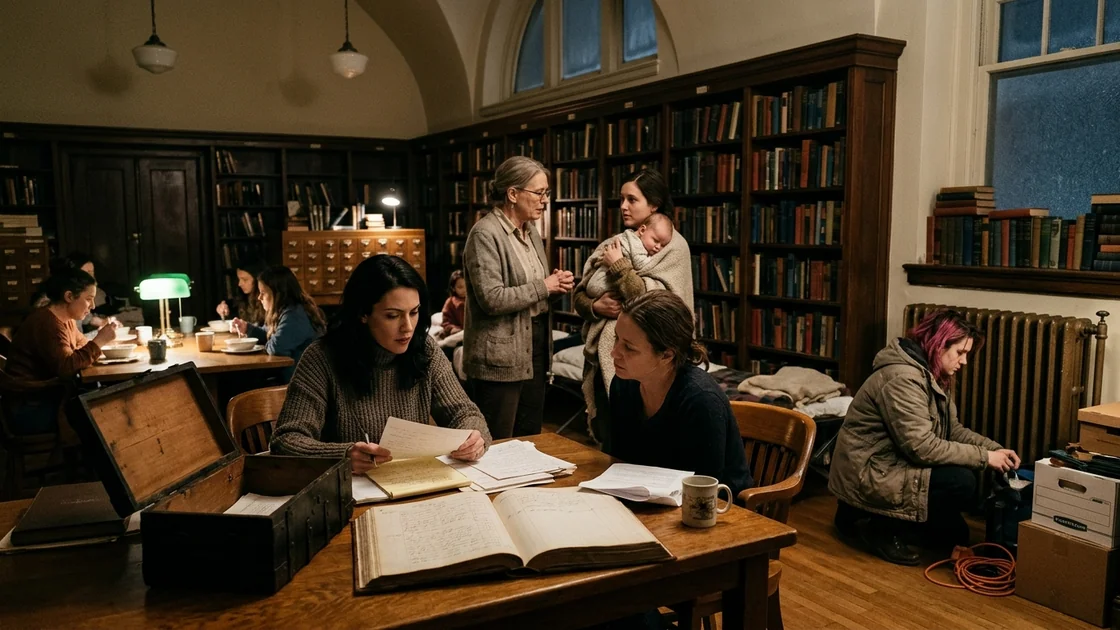
When the historic Elmira Free Library is scheduled for demolition by commercial developers, three female library workers decide to resist the city wrecking ball by transforming the aging limestone building into a covert after-hours sanctuary and skills incubator for women in life transitions. Working against a six-week eviction deadline, the trio balances dwindling municipal resources, intrusive private security contractors, and personal reckonings, ultimately uncovering a forgotten civic deed that redefines community ownership and turns the forgotten reading rooms into an enduring sanctuary.
Act I: The Inventory of Scraps
The radiator in the reference wing of the Elmira Free Library did not hiss so much as it rattled like an iron cage containing a dying animal.
Nora Campbell rested both palms against its flaking silver enamel, feeling for the faint, stubborn pulse of hot water rising from the basement boiler. There was barely enough heat to warm a pair of gloves, let alone the vaulted, forty-foot ceiling of the main hall, where plaster rosettes were slowly crumbling into powder. Outside, the November frost had turned the asphalt of Division Street into a gray sheet, reflecting the dull amber glow of the municipal streetlights.
"It’s not going to make it through January," Sable Vance called from behind the oak circulation desk. Her voice had the dry, clipped cadence of someone who had spent seven years summarizing deposition transcripts before ever touching a library science degree. "The boiler inspector didn't even look at the pump. He just shook his head, signed the red tag, and asked me if I knew when the auction company was cataloging the card files."
Nora pulled her hands away from the radiator and wiped a streak of dried rust onto her wool cardigan. "The card files aren't municipal surplus. They belong to the building."
"The building belongs to the city," Sable said without looking up from the monitor. She was rapidly typing with two fingers, hunting down delinquent interlibrary loan requests from schools that had closed two years ago. "And the city belongs to Marcus Drake and the Northbridge Development Consortium. According to this morning's council agenda, the rezoning variance for the parcel passed three to nothing on the first reading. They don't even have to wait for the spring budget session. Drake’s crew can park the backhoes on the sidewalk the first Monday after New Year's."
From the shadows between the 700s—the art and architecture stacks where the light bulbs had burned out three months prior—came the sharp scrape of a utility knife cutting through corrugated cardboard.
Miriam "Miri" O'Connell backed out into the aisle, dragging a wooden crate packed with broken spine-strips, half-empty jugs of archival paste, and three rolls of bubble wrap. She was twenty-three, wore two pairs of mismatched wool socks under combat boots, and moved through the library’s decrepitude with the nervous, electric energy of an electrician rewiring a house during a thunderstorm.
"They aren't bringing backhoes on Monday," Miri said, blowing a strand of bright magenta hair out of her eyes. "Drake's site manager was out front half an hour ago with a laser surveyor. He was measuring the portico steps. I asked him if he had an encroachment permit for the sidewalk, and he laughed at me and asked if my supervisor knew I was playing with city chalk."
Nora winced. "Did you draw on the limestone again, Miri?"
"I marked the structural boundary," Miri said defensively, wiping her thumb on her jeans. "People need to know where the public right-of-way ends and the private buyout begins. If they take the portico, they take the only dry porch between here and the railway crossing. You know how many people sleep under those arches when the rain turns sideways?"
Nora didn't answer. She knew the number precisely. For the past six years, as Elmira’s textile plants were converted into vacant lofts and the family clinics along the canal were shuttered one by one, the portico had become a gauge of the valley’s misery. In the spring, there were two or three; by mid-autumn, a dozen people gathered under the carved sandstone lintel each night, sitting on flattened cardboard boxes until Nora arrived at seven in the morning to unlock the heavy brass doors.
She walked past the card catalogs, her footsteps muffled by the gray, threadbare runner that stretched the length of the aisle. The Elmira Free Library had been built in 1904, funded not by Carnegie, but by a collective of mill girls who had pooled their pennies to match a bequest from an unmarried textile heiress named Clara Pendelton. The sandstone was soft and local, quarried from the river bluffs, and the windows were high, arched clerestories designed to let in the northern daylight without exposing the readers below to the soot of the coal-fired looms across the canal.
Now, the looms were gone, replaced by three miles of chain-link fence and weeds, and the girls who worked them had been dead for seventy years. What remained was this drafty, water-stained cathedral of paper, staffed by three women who were each, in their own way, running out of track.
"Nora," Sable said, leaning forward on the counter. The blue cast of the cathode-ray terminal accentuated the deep hollows beneath her cheekbones. "We have twenty-seven days. The formal notification came by courier while you were downstairs checking the sump. Drake offered a buyout severance for any staff member who signs an expedited non-grievance waiver by Friday. Two weeks’ pay for every year of service, capped at six."
"I have twenty-two years here," Nora whispered.
"Then you get twelve weeks," Sable said flatly. "And I get four. And Miri gets twenty-five dollars and a thank-you letter signed with a rubber stamp from the mayor’s junior administrative assistant."
Miri kicked the crate of paste. "I’m not signing it. If I sign it, I lose my housing voucher eligibility because they count expedited severance as unearned lump-sum income. My caseworker told me yesterday that if my weekly hours drop below thirty before my re-evaluation in February, I’m out of the studio on 4th Street."
"You won't drop below thirty," Nora said, her voice dropping into the quiet, absolute tone she used when patrons became belligerent over lost deposit slips. "We have three weeks of scheduled hours on the books, and council hasn’t taken the second vote."
"The second vote is a formality, Nora," Sable sighed, closing the terminal screen with a hollow click of the plastic casing. "You know who sits on the zoning board. Bradley's brother-in-law is the lead contractor on Drake's mixed-use high-rise. They've already printed the brochures: 'The Pendelton Lofts.' Forty units, granite countertops, ground-floor retail for an artisan pickle shop or a boutique yoga franchise. They aren't even keeping the facade. They're keeping the name and three keystones for the courtyard fountain."
Nora turned toward the window overlooking Elm Street. Across the intersection, the parking lot of the old freight depot sat empty, save for three white vans bearing the logo of Northbridge Site Solutions.
A woman was sitting on the low stone retaining wall at the perimeter of the library grounds, her coat collar pulled up against the sleet. She had a canvas grocery cart beside her, stuffed with plastic bags that were weighted down with canned goods. Every few minutes, she looked up at the library’s second-floor windows, where the yellow light was still burning.
"Who is that?" Nora asked.
Sable stepped around the counter and joined her by the glass. Her expression shifted, the cynical edge softening into something taut and defensive. "That's Elena. She was here yesterday from opening until five. Sits in the back of the local history room with her infant in a bassinet hidden behind the state census volumes. Her husband works the second shift down at the transfer station."
"Why doesn't she go to the center on Maple?" Nora asked.
"Because the Maple Street Center closed its women’s auxiliary in September," Sable replied, her voice dropping an octave. "You have to be thirty days sober, present two forms of municipal identification with a current street address, and leave your infant in the communal nursery from seven in the morning until six at night while you look for work. She doesn't have an address. Her name isn't on her husband's lease because the landlord doesn't allow secondary occupants without a credit check, which she can't pass because her former partner left her with fifteen thousand dollars of medical debt in Ohio."
Sable spoke with an uncomfortable familiarity. Nora knew that two years prior, Sable had left an immaculate colonial home in the suburbs of Rochester with nothing more than her laptop, three boxes of legal briefs, and a black eye that took six weeks to fade from purple to sickly yellow. The library had been the only place in Elmira that didn't ask why an attorney with seven years of private-firm experience was applying for an eighteen-thousand-dollar-a-year clerkship.
"She’s been sitting there since four," Miri said from behind them. She had picked up a clean dish towel and was methodically wiping down the brass handles of the newspaper racks. "The police cruiser drove by twice. They told her she couldn't park the cart on the curb because it creates a pedestrian obstruction. She moved it five inches onto our grass. She knows they can't touch her on the library lawn unless Nora calls it in."
Nora looked down at her hands again. The dry skin along her thumbs was split from the dry air and the thousands of pages she had shelved that week.
"I'm not calling it in," Nora said.
"They're locking the doors at six," Sable pointed out. "The cleaning crew doesn't come anymore—the city terminated the custodial contract last Tuesday to save the heating oil. Which means when we turn the key at six-fifteen, those steps are thirty-two degrees, and the snow is going to turn into ice by midnight."
Miri stopped wiping the brass. "The annex boiler is still on a separate circuit."
Nora and Sable both turned to look at her.
"The annex," Miri repeated, stepping closer. "The old children’s wing that got shut down during the mold remediation four years ago. The city never uncoupled the steam pipes from the basement loop. They just padlocked the fire door from the hall and turned the thermostat down to forty so the pipes wouldn't burst. I was down in the plenum last week running line for the DSL splitter. The cast-iron radiators down there are fine. It’s warm. It’s dry. And the windows are all high clerestories with opaque wire-glass—you can’t see inside from the street unless someone stands on a table with a flashlight."
"That room is condemned by the city engineer," Nora said, though the protest felt thin even in her own throat.
"The ceiling didn't fall down, Nora," Miri said, her eyes wide. "A ten-inch square of horsehair plaster came loose in the cloakroom because the roof drain was backed up. I cleared the drain with a coat hanger three months ago. It's completely dry. There's fifty feet of shelving, twenty-four electrical outlets, two functioning sinks, and a private entrance through the coal chute that opens onto the alley behind the boiler house."
"It's trespassing," Sable said, but she wasn't looking at Nora; she was looking at the woman on the corner, who was now leaning over her cart, tucking an extra blanket around a child that wasn't visible from the window. "It’s unauthorized occupation of municipal property under section 14 of the administrative code. It’s an immediate forfeiture of pension rights for anyone with administrative oversight."
"My pension is four hundred and twelve dollars a month," Nora said softly. "It won't pay for the propane at my cottage past next winter."
The three women stood in the gathering dusk. Above them, the heavy brass clock over the vestibule gave its rhythmic, mechanical thud as the minute hand dropped to the twelve. Five o’clock.
"Miri," Nora said, without turning around. "Go downstairs and see if the secondary loop on the annex boiler is actually drawing oil."
Miri didn't wait for a second instruction. She dropped the dish towel and disappeared down the iron spiral staircase that led to the engine room, her combat boots ringing against the treads like shell casings falling on stone.
"Sable," Nora continued, her voice steadying, regaining the administrative calm that had run this branch through twenty years of austerity budgets. "Go out to the corner. Tell that woman that our public hours end at six, but our historical research group meets in the south annex from seven until six in the morning. Tell her the meeting includes hot soup, clean water, and an unmonitored Wi-Fi connection."
Sable stood still for a long moment, her dark eyes searching Nora’s face for any sign of hesitation. Finding none, she reached behind the desk, pulled her heavy wool trench coat from the hook, and wrapped a thick knit scarf twice around her neck.
"If Marcus Drake catches us," Sable said, "he won't just evict us. He'll have the district attorney file criminal mischief charges to void the building's historical designation before the council vote."
"He has to catch us first," Nora said. "And to do that, he’d have to actually walk inside a library."
Act II: The Blueprint of the Annex
By eight o’clock, the library was officially dead to the city. The front street lamps cast the long shadows of the portico columns against the locked double doors, upon which Nora had taped the official city notice: CLOSED UNTIL FURTHER NOTICE DUE TO MECHANICAL FAILURE.
Behind the drawn green vinyl shades of the south annex, however, the air was warm, smelling of peppermint tea, linoleum soap, and forty years of damp children’s fiction.
The room had been cleared with ruthless efficiency. Miri had spent two hours hauling broken folding chairs and stacks of water-damaged National Geographics into the coal bunker, revealing a sixty-foot space floored with tongue-and-groove maple that was scarred but solid. Along the south wall, six low radiators hummed, their valves wide open, radiating a clean, dry heat that had already driven the chill from the floorboards.
Elena sat on an overturned milk crate near the center of the room, her four-month-old daughter, Maya, sleeping soundly in a nest of clean wool blankets that Nora had brought in from her station wagon. Elena was twenty-six, with thin, translucent skin and fingers that bore the faint blue stains of industrial ink from her former job at a label-printing facility down the valley.
"He checked the car mileage every night," Elena was saying, her voice barely louder than the hum of the radiator. She was holding a cracked ceramic mug filled with tea. "If there were three miles he couldn't account for between the grocery store and the trailer park, he'd take the alternator out of the engine and put it on top of the refrigerator where I couldn't reach it. He said he was managing the household logistics. That was the word he used. Logistics."
Sable sat across from her on an overturned wooden crate, an open yellow legal pad across her knees. A single twenty-watt task light sat between them, illuminating the ruled lines on the page.
"Did he file joint tax returns for the years 2021 through 2023?" Sable asked.
"I signed something," Elena said, looking down at her mug. "He said it was an authorization for the child tax credit. But I never saw the return."
"He took the refund," Sable said without looking up, her pen moving with methodical speed. "Which means there’s an unreported address. If we file an IRS Form 8857 for innocent spouse relief, we can split the liability and pull your social security number out of his tax account. Once that’s uncoupled, you can apply for the state child support offset without him getting an automated notification of your current county."
Elena looked up, her eyes wide and confused. "You can do that from here?"
"We have three terminals connected to the state legal database that haven't been wiped yet," Sable said, tapping the pad with the end of her ballpoint. "The city thinks we only use them to look up gardening books and obituaries. They haven't updated the proxy servers since 2018. As far as the state court server knows, this room is an active annex of the county law library."
Across the room, Nora was working with Miri near the old circulation desk. Miri had dragged two desktop towers from the staff workroom, cannibalizing parts from three broken receipt printers to create a single functioning workstation on a low plastic table.
"I found seventeen more," Miri muttered, her fingers gray with dust as she stripped the rubber coating from an ethernet cable with her teeth.
"Seventeen what?" Nora asked, holding a flashlight steady over Miri’s hands.
"Women. In the central library’s digital request log. They aren't requesting books, Nora. Look at the search strings from the last forty-eight hours." She spun the monitor around.
Nora adjusted her glasses and read the silent, desperate history of the terminal:
- emergency custody temporary forms no fee
- shelters in chenango county that take dogs
- how to clear search history on android without pin
- overnight parking public lots without patrol
- how many hours between bus layovers at depot
"These were all sent from the public terminals between two and five this afternoon," Miri said. "Before we locked the doors. People are using the reference terminals because their home phones are monitored with spyware. One of them left an email draft open to a sister in Portland: 'He took the lock off the bathroom door today. If I'm not on the ten o'clock bus, check the hospital on 8th.'"
Nora felt a cold weight settle in the pit of her stomach. For twenty-two years, she had viewed her work through the serene, orderly prism of the Dewey Decimal system: 100 for philosophy, 300 for social sciences, 600 for technology, 800 for the great, soaring monuments of human imagination. She had believed that the library’s neutrality was its greatest virtue—that by standing impartial, offering equal silence and equal shelves to every citizen, it preserved a democratic balance.
Now, looking at the glowing phosphor screen in this damp basement room, she saw that neutrality was a luxury of peace, and Elmira had been at war with its own people for a generation.
"Who was on terminal four?" Nora asked.
"A woman named Chloe," Miri said. "She works at the diner by the canal. The one with the broken sign. She’s eighteen. She aged out of the residential center on South Main in June. They gave her a duffel bag, two hundred dollars, and a voucher for an apartment that had lead paint violations and was condemned two weeks after she moved in."
"Where is she now?"
"In the vestibule," Miri said, pointing a wire stripper toward the coal chute stairs. "I told her to wait until the sweep car passed. She’s sitting behind the oil drum with her coat on."
"Bring her down," Nora said immediately.
"Nora," Sable warned from the other side of the room, looking up from her legal pad. "If we have more than three people down here, the thermal signature is going to show up on the industrial sensor Drake’s crew mounted on the telegraph pole across the street. Those private security trucks have FLIR cameras. If they see a heat signature in a condemned wing that’s supposed to be fifty degrees, they’ll call the fire marshal for an emergency entry."
"Then we insulate the clerestories," Nora said. She turned to the stacks of unsorted periodicals in the corner. "Miri, take the town reports from 1970 to 1995. They’re heavy, rag-content paper, two inches thick. Pack them into the window embrasures. Every single one. Two layers deep. Nothing gets through four inches of municipal bureaucracy, not even infrared."
Miri grinned, a sharp, fierce expression that transformed her tired face. "On it."
For the next two hours, the south annex functioned like an underground engine room.
Chloe arrived—a slip of a girl with hollow cheeks, bruised wrists, and an oversized army surplus jacket that dragged on the floor. Within twenty minutes, Elena had shown her how to set up a cot using four library book-trucks and a piece of foam insulation; Sable was cross-referencing her youth-services file against the state ombudsman’s regulations on transitional support; and Nora had heated three cans of vegetable soup over an electric hot plate hidden behind a display rack of The Riverside Shakespeare.
The room became an impromptu network of survival. It was not a charity; there were no forms to sign, no case managers looking at watches, no patronizing lectures about budgeting or self-care. It was simply an infrastructure of necessity, run by three women who understood how information, paper, and physical space could be leveraged as shields.
By two in the morning, four more women had arrived through the alley door, brought in through a network of whispered messages passed along the diner counters and the night-shift break rooms of the valley.
There was Mrs. Henderson, a seventy-one-year-old former school cook whose landlord had doubled her rent after her husband died of black lung, and who had been living out of her 2004 Buick in the commuter lot; and Tara, an apprentice machinist whose boyfriend had locked her out of their fourth-floor walkup without her tools, her driver's license, or her insulin.
In the center of the room, Sable had set up a "re-documentation station."
"You don't exist without your paper," Sable told Tara, who was shivering despite the radiator’s blast. "The city counts on you losing your paper. If you don't have your birth certificate, you can't get an ID. If you don't have an ID, you can't cash a paycheck. If you can't cash a paycheck, you can't get on a lease. And if you aren't on a lease, you're an vagrant subject to summary removal under the downtown revitalization act."
Sable pulled a heavy steel embosser from her canvas bag. It was the old official seal of the Elmira Free Library, which had been retired in 1988 when the city automated its library cards.
"What is that?" Tara asked, her voice cracking.
"This," Sable said, pressing the seal down onto a piece of heavy rag cardstock with a crisp crunch, "is an official repository mark from an institution established under state charter before the municipal corporation of Elmira even existed. In this county, a certified library card issued under seal with a verified patron index number is valid secondary identification for a state administrative hearing. Nora, what’s Tara’s index number?"
Nora went to the tall wooden filing cabinet that held the handwritten master cards from the 1950s. She pulled a blank card, dipped a steel nib pen into an inkpot that smelled of cedar and iron gall, and wrote: PATRON NO. 44,109: TARA LYNN COVINGTON. RESIDENCE: 104 ELM STREET, SUITE B.
"That's this building," Tara whispered.
"No," Nora said, blowing on the wet black ink. "It's the south annex. Suite B is the research study room. Clara Pendelton’s will specifically designated the research study rooms as the primary address for any resident engaged in independent study of the civic arts. As long as you are reading one book a week from these shelves, Tara, you are an independent student in residence."
Tara looked around the room—at the damp plaster, the rows of forgotten encyclopedias, the books blocking the windows, the infant sleeping in the crate—and her shoulders dropped two inches. She began to cry, silent, ugly tears that left streaks in the industrial grime on her face.
Nobody told her it was going to be all right. That was the first rule Nora had established without speaking it: no false assurances. Things were terrible; the city was cold; the developers were coming with heavy machinery in twenty-six days. But until that morning arrived, there was tea, there was eighty pounds of steam pressure in the radiators, and there was an index number that proved they were human beings standing on earth they had a right to inhabit.
Act III: The Shadow on the Limestone
At seven-fifteen the following morning, Nora was standing on the front portico with a push broom, sweeping the sleet off the sandstone steps, when a black Lincoln Navigator pulled up to the curb.
The driver remained inside, the diesel engine idling with a heavy, rhythmic throb that vibrated through Nora’s boot soles. The passenger door opened, and Marcus Drake stepped out.
He was a man of fifty-five who looked as if he had been designed by an architectural firm: steel-gray hair cut with absolute precision, an ash-gray cashmere coat that had never seen a workshop, and expensive leather boots that stepped gingerly onto the salt-stained concrete of Elm Street. Behind him walked Bradley, the city councilman for the third ward, carrying a thin leather portfolio.
"Nora," Drake said, smiling with teeth that were too white for the Elmira gray. He extended a gloved hand. "Good to see you out here. Dedicated to the last. Most branch managers would have called in their sick time two weeks ago."
Nora did not take the hand. She kept both hands wrapped around the smooth hickory handle of the broom. "Councilman Bradley. Mr. Drake. The building doesn't open until ten, though as you can see by the notice, our boiler is currently uncertified."
Bradley, a soft-faced man whose family had owned the local lumber yard before Drake bought it out, shifted uncomfortably on his feet. "Nora, we aren't here for book loans. Marcus wanted to do a preliminary walk-through of the basement perimeter with the structural engineers. The demolition permit was filed yesterday afternoon."
"The second reading on the rezoning isn't until the twenty-first," Nora said. "The public comment period is open until Friday at midnight."
"Public comment is a procedural window, Nora," Drake said gently, as if explaining an overdue fine to an eight-year-old. "We’ve already held three town halls. The turnout was unanimous in favor of the housing revitalization. Elmira needs tax ratables, not six thousand square feet of damp ceiling tiles and unread volumes of the Congressional Record."
"The turnout was twelve people," Nora said. "Eight of them were your subcontractors, and four were members of the downtown business alliance who don't live in the city limits."
Drake’s smile didn't vanish, but it thinned, the skin around his eyes tightening. "The council has made its determination, Nora. We have a five-million-dollar remediation grant from the state that expires if we don't break ground before the frost sets in deep. Every day this structure sits here is costing the taxpayers four thousand dollars in lost bond credits. Now, if you’ll unlock the side entrance, we have an environmental tech who needs to pull air samples from the annex."
Nora’s fingers tightened on the hickory broom until her knuckles turned white. Inside the annex, directly beneath the side entrance Drake was pointing toward, Elena was nursing Maya, Chloe was asleep on three book-trucks, and Sable was preparing four petitions for state injunctive relief.
"I can't do that, Mr. Drake," Nora said.
Drake stopped, his gloved hand resting on the bronze handrail. "Excuse me?"
"The south annex was condemned for suspected mold spores by your own inspector in September," Nora said, her voice dropping into the smooth, flat tone of an archivist reading a catalog entry. "Under state occupational health code 18-A, no person may enter a tagged municipal structure without an independent certified industrial hygienist present, or a warrant signed by a superior court judge. Unless Councilman Bradley has that warrant in his portfolio, the entrance remains sealed until the environmental clearance is complete."
Bradley looked startled. He turned to Drake. "Is that the state code? I thought the local waiver covered that."
"The local waiver covers municipal staff, not developers or third-party contractors," Nora lied with absolute precision. She had spent the previous evening from midnight to two studying the state administrative codes with Sable in the back room. "If you cross that threshold without the state safety monitor, Mr. Drake, the historical preservation board has grounds for an immediate administrative stop-work order. It carries an automatic thirty-day injunction. Would you like to risk your five-million-dollar grant on whether the regional judge in Ithaca signs it?"
Drake stared at Nora. The mask of urbanity slipped away entirely, revealing the sharp, predatory arithmetic beneath. He knew she was bluffing about the preservation board’s speed, but he also knew that state grants were fragile, bureaucratic creatures that hated legal noise.
"You're very protective of a pile of moldy bricks, Campbell," Drake said, stepping closer. He was six inches taller than her, smelling of expensive cologne and roasted coffee beans. "You know what’s going to happen here. In three weeks, the council passes the ordinance. In four weeks, the police clear the building. In five weeks, the excavators tear this hall into gravel. If you cooperate now, there’s an ombudsman position on the community oversight board for the new lofts. Twelve hundred a month for sitting in a conference room once a quarter. If you don't, I will personally see that your administrative record is flagged for gross insubordination, and you won't even be able to volunteer at the middle school book sale."
Nora looked past him, down the long, dying curve of Elm Street, where the chimneys of the old mills stood against the white winter sky like broken teeth.
"Mr. Drake," she said, "I have worked in this building since the year the river flooded and we carried eighty thousand volumes up three flights of stairs on our backs to keep them out of the mud. I have pulled three generations of children out of the snow and sat them by those radiators until their mothers got off the swing shift at the ball-bearing plant. If you think a threat to my municipal record frightens me after thirty years of watching this town eat its own young, you have profoundly misunderstood the kind of woman who works in a library."
Drake looked at Bradley, his jaw set. "Get the city attorney on the phone. Tell him I want an emergency abatement writ signed by five o'clock. We aren't waiting for the second reading."
He turned on his heel and walked back to the Navigator, his boots crunching loudly in the frozen gravel. Bradley lingered for half a second, looking at Nora with an expression that was almost apologetic, before Drake’s horn sounded once, sharp and impatient, and the councilman scuttled down the steps like an errand boy.
Nora stood on the portico until the taillights of the SUV disappeared around the corner of Division Street.
Then she turned, walked back inside, locked the heavy brass deadbolts from the inside, and went straight to the reference desk.
"Sable," she called out.
Sable emerged from the annex door, holding a stack of freshly printed legal forms. "I heard him through the mail slot. He’s going to Judge Miller."
"Miller is his cousin’s golf partner," Nora said. "How long does it take to draft an emergency writ?"
"Six hours if the clerk is sober," Sable said. "Four if Drake pays the expediting fee. We have until three this afternoon before the sheriff's deputies arrive with the padlock order."
"Miri!" Nora shouted.
The girl popped her head out from behind the biography shelves, holding a soldering iron and an old copper pipe. "Yeah?"
"Drop the electronics," Nora said. "We're going into the Pendelton vault."
Act IV: The Iron Deed
The Pendelton vault was not a room; it was an iron-lined cavity beneath the floor of the local history alcove, hidden beneath three layers of tongue-and-groove white oak and a carpet that had been tacked down in 1954.
It took Miri twenty minutes with a crowbar and an old claw hammer to pull up the floorboards, coughing as fifty years of petrified dust and wool fibers rose into the air. Beneath the wood lay a circular iron door, two feet across, with a central spoke-wheel handle that was rusted into its seating.
"The key is in the accession drawer," Nora said, her breath coming in ragged gasps from helping Miri heave the oak planks aside. "A three-inch bronze key with a triangular bit. My predecessor, Miss Gidley, told me in 1994 that it had never been turned since the bank holiday in thirty-three."
Sable returned with the key, which was coated in green verdigris. She dropped three drops of three-in-one oil into the keyway, waited two minutes while Miri tapped the rim with the heel of a heavy shoe, and then inserted the bit.
The metal groaned. For three agonizing seconds, nothing moved, and Nora feared the sixty-year-old brass would shear off in the cylinder. Then, with an explosive clack that sounded like a rifle shot in the quiet room, the internal tumblers dropped.
Miri seized the spoke-wheel with both hands, planting her boots against the base of the nearest shelving unit, and heaved. The iron plate rose with a heavy, sucking sound, exposing a square stone chamber three feet deep.
The air that rose from the hole did not smell of rot; it smelled of dried beeswax, sheepskin parchment, and cold granite.
Nora dropped to her knees, heedless of the splinters in the unfinished floorboards. She reached her arms into the darkness and lifted out the single object resting on the granite floor: a heavy, black-lacquered deed box bound with straps of hand-forged Swedish iron, bearing the initials C. P. – 1899.
"Bring it to the reading table," Nora commanded.
They set the box on the wide oak table under the center skylight. The lock had no keyhole; it was a simple lead wire seal with the stamp of the Chemung County Surrogate Court, dated October 14, 1904.
Sable took her utility knife and sliced through the lead wire with one clean, clinical stroke.
Inside, resting on a bed of faded crimson velvet, was a single ledger-sized document bound in heavy vellum, accompanied by seven smaller packets tied with blue silk ribbon.
Sable pulled her reading glasses down over her nose, lifted the vellum document by its edges, and laid it flat on the green blotter.
"It’s not a municipal conveyance," Sable whispered after two minutes of intense reading, her eyes darting across the elaborate iron-gall calligraphy. Her finger traced the second paragraph, trembling slightly.
"What is it?" Nora asked, leaning over her shoulder.
"It’s a charitable indenture in trust," Sable said, looking up, her face pale. "The city doesn't own this land, Nora. They never owned it."
Miri leaned in, her purple hair brushing the edge of the vellum. "Explain it to me like I’m five, Sable. Can they bulldoze it or not?"
"Listen to this," Sable read, her voice ringing out in the empty, silent hall:
"...to have and to hold, not unto the municipal corporation of Elmira as sovereign property, but unto the Board of Women Trustees herein named, and to their lawful successors in perpetuo, in trust absolute for the following single and unalterable purpose: That these halls shall stand as an open refuge, a free library, and an asylum of learning, industry, and bodily shelter for the working women, unwed mothers, and destitute daughters of the Chemung Valley, whenever their regular homes or places of employment shall fail them through distress, economic panic, or private cruelty."
Sable turned the page. The vellum crackled like autumn leaves.
"And should the municipal corporation, or any private adventurer under color of municipal authority, attempt to divert this ground to commercial profit, residential tenancy for gain, or general municipal office, then the title herein granted shall instantly determine, and the fee simple shall revert, not to the heirs of Pendelton, but to the incorporated body of said resident women, who may hold the same against all writs of entry by common assembly and self-election."
Silence fell over the high room. Outside, a heavy gust of wind hurled sleet against the north clerestories with the sound of thrown gravel.
"A self-electing trust," Nora said, her voice shaking. "Miss Gidley knew. She told me when I was twenty-five: 'Don't let them modernize the charter, Nora. If you modernize the charter, the city clerk gets the keys.'"
"It’s better than that," Sable said, her legal training taking over, her eyes burning with an incandescent, cold fury. "Look at the signature page. Clara Pendelton didn't just sign this alone. It was signed by thirty-two mill workers who each contributed one month’s wage to buy the physical sandstone. The indenture specifies that a 'lawful successor' is any woman who has been employed within these walls for more than twelve consecutive months, or any woman who has received bodily shelter within its boundaries for three consecutive nights during a time of municipal emergency."
Miri let out a low whistle. "Elena. Chloe. Tara. Mrs. Henderson. They aren't squatters."
"They're the trustees," Sable said. "They are the legal successors to Clara Pendelton. Under the terms of this indenture, Marcus Drake’s purchase agreement with the city council isn't just defective—it’s an illegal conspiracy to convey land that belongs to an active, unincorporated charitable trust."
"Judge Miller won't care," Nora said, the practical realities of thirty years in Elmira reasserting themselves. "Drake has the police. He has the building inspector. He has the sheriff. Even if this document is airtight, Miller will grant an emergency writ of possession to the city pending litigation. By the time Sable gets an appellate hearing in Albany next summer, the walls will be in a landfill and the foundation will be filled with concrete."
"Not if the trust is actively sitting," Sable said.
"What does that mean?"
"The deed has an active assembly clause," Sable said, pointing to the smaller packets tied with blue ribbon. "Clara was a suffragist. She knew how county judges operated in 1904. She wrote that to enforce the title against a hostile city sheriff, the trustees must hold an open, public convocation of not fewer than twenty-five women in transition within the walls, under the presidency of the senior librarian, before the writ of entry is executed. If that convocation is in session when the sheriff arrives, the deed requires that the dispute be referred directly to the state supreme court equity term, bypassing the local municipal court entirely."
Nora looked at the brass clock. It was nine-fifteen.
"Drake said he’d have the writ by three," Nora whispered.
"Then we have five hours and forty-five minutes," Miri said, already reaching for her phone. "We need twenty-five women. We have six."
"Where are you going to get nineteen more women who are willing to face down the county sheriff on a four-hour notice?" Nora asked.
Miri looked at the two older women, a broad, wild smile spreading across her ink-stained face. "Nora, you've been working inside this library for thirty years. I’ve been living in the rooming houses and the Laundromats of this town since I was twelve. Give me ninety minutes and twenty dollars for the bus."
Act V: The Underground Assembly
By one o'clock in the afternoon, the south annex did not look like a library; it looked like an armed camp of domestic industry.
Miri had returned, not on the bus, but in the back of a battered Ford pickup driven by a woman named Sarah who owned a small engine repair shop on the north side. Sitting in the truck bed, wrapped in moving blankets and work coats, were seven women: four former line workers from the packaging plant that had shuttered in October, two women who lived in the transitional units behind the Catholic charity, and a young woman named Brooke who was still wearing her white apron from the bakery on 2nd Street.
They came down the coal chute two by two, their boots thumping on the cellar floor.
Within the hour, twelve more arrived. They were women who had been reached by a rapid, invisible cascade of landline calls, handwritten notes shoved under trailer doors, and text messages sent through encrypted chat groups that Miri had set up during her lunch breaks over the past two years.
There was Mrs. Alvarez, whose apartment building had been purchased by Drake’s holding company three weeks ago and who had received a three-day notice to quit because she kept her disabled daughter’s wheelchair in the communal hallway; there was Janelle, a twenty-year-old nursing assistant who had been sleeping in her hospital’s basement locker room since her partner had changed the deadbolts on their shared flat; and there were five older women who had worked the sewing lines with Clara Pendelton’s grand-nieces, who brought with them iron trivets, five-gallon pots of potato soup, and three dozen hand-knitted mittens to sell for legal fees.
By two-fifteen, the south annex held thirty-four women.
Sable had turned the main reference table into a clerk’s bench. Elena sat beside her, bouncing Maya on her knee while she checked names against the handwritten accession register from 1904.
"Brooke Daniels," Sable called out.
The young baker stepped forward, flour still dusting the cuffs of her sweater. "Here."
"Are you currently facing housing instability, economic dispossession, or private cruelty within the bounds of the Chemung Valley?" Sable asked, her voice carrying the ritual gravity of a courtroom.
"My landlord told me yesterday that if I didn't let his son park his snowmobile in my living room, he was cutting the water off," Brooke said, her jaw tight. "And I don't have first and last month's rent for a new place until January."
"Take the pen," Sable instructed. "Sign the indenture roll below the line for the year 2024. By that signature, you are seated as a Trustee of the Clara Pendelton Sanctuary."
Brooke signed, her handwriting round and firm, pressing so hard the steel nib almost pierced the heavy vellum.
"Next," Sable called.
While the roll was being signed, Nora and Miri were upstairs in the main reading room, preparing the defenses.
They did not use barricades; barricades were an invitation to violence, and the sheriff would use them as an excuse to bring fire axes and tear gas. Instead, Nora used books.
Under her direction, the women who had arrived early had systematically moved the entire 300 section—the social sciences, the legal codes, the labor histories, the volumes of constitutional law—out of the stacks and into the vestibule.
They stacked them neatly, professionally, three feet deep and four feet high, directly behind the heavy brass-and-oak doors. It was a literate, silent wall: five hundred volumes of The New York Revised Statutes, eight hundred volumes of The Labor Gazette, and forty years of municipal records, each stamped with the red ink of the Elmira Free Library.
"If they want to break through those doors," Nora said, her voice completely calm as she aligned the spine of an 1892 treaty volume, "they will have to physically chop through eighty years of the laws of this state to do it. Let the television cameras film Marcus Drake’s private contractors putting an axe through the state constitution."
At two-forty-five, Miri, who was standing on an oak ladder looking through the small leaded window above the portico, called down: "They’re here."
Nora wiped her hands on her cardigan, took a deep breath, and walked down the runner toward the annex.
"Sable," Nora said. "Are the rolls complete?"
"Thirty-four signatures," Sable said, lifting the vellum. "Every woman has an assigned index card, an active registration, and an assigned study stall in the annex. Under the terms of the 1904 indenture, the convocation is legally assembled and seated."
"Bring them into the main hall," Nora said.
The thirty-four women moved from the annex into the vaulted space of the main library. They did not hide. They did not cower among the stacks.
Nora had them sit at the heavy oak tables beneath the high arched windows, each with an open book before her. Elena had an atlas of the world; Mrs. Henderson had a volume of Emily Dickinson; Brooke had a manual on commercial electrical wiring; and Chloe was slowly, carefully reading a collection of essays by James Baldwin.
The room was warm, filled with the clean, sharp smell of the potato soup that was simmering on the two hot plates near the reference desk.
At precisely three o'clock, the sound of heavy boots hit the portico steps.
Act VI: The Writ of Entry
The brass mail slot in the outer door rattled open with a sharp, metallic clang.
"This is Deputy Sheriff Miller," a voice barked through the opening. "I have an emergency order of summary possession issued by the Chemung County Supreme Court, pursuant to municipal code chapter 22. Campbell, open these doors immediately or we will force entry."
Nora walked down the center aisle, her heels clicking rhythmically on the floor. She stopped six feet from the brass-studded doors, her hands folded over her apron.
"Deputy Miller," she said, her voice carrying through the oak panels with the crisp acoustic clarity of an auditorium designed for public lectures. "You are addressing the Secretary of the Board of Trustees of the Clara Pendelton Indenture. This building is not municipal property. It is private charitable ground held in trust under a deed recorded in Book 42 of Deeds, Chemung County Clerk’s Office, page 812, on November 4, 1904."
A pause followed. Outside, low voices conferred—the muttering of men who had expected a hysterical spinster librarian and three broken locks, and had instead run into an administrative wall.
Then came Marcus Drake’s voice, filtered through the oak: "Campbell, stop this nonsense. The city attorney verified the municipal title yesterday morning. You're holding an illegal demonstration. If those doors aren't open in two minutes, Miller is bringing the ram."
"Mr. Drake," Sable spoke, stepping up beside Nora. She held a carbon copy of the deed and an emergency petition for an equity transfer. "I am Sable Vance, member of the bar of the State of New York, registration number 441-892. If your deputies touch that door with an iron tool, you are committing a class D felony under the state heritage preservation act, as well as criminal trespass against an assembled charitable trust in session."
"You're disbarred, Vance!" Drake shouted.
"I voluntarily transferred to inactive status, Mr. Drake," Sable said with icy satisfaction. "My license is clean, my fees are paid through December, and I have already electronically filed an emergency application for an immediate stay of execution with the Appellate Division, Third Department, in Albany. The clerk signed the intake notice at two-thirty. Judge Miller’s local order is superseded by operation of law under Section 5519 of the Civil Practice Law and Rules."
Outside, there was a sharp oath, followed by the sound of boots pacing the portico stones.
Through the high leaded glass, Nora could see the flashing lights of three county sheriff cruisers, their red and blue strobes painting the sandstone columns in violent pulses. Behind them, two white pickup trucks bearing the Northbridge logo were parked half on the sidewalk, their engines running.
A small crowd had begun to form along the opposite side of Elm Street.
Miri had not just called the women in transition; she had spent twenty minutes on the phone with the local television news station in Binghamton, two independent reporters from the digital valley newsletter, and the president of the retired textile workers’ union.
A news van with a telescoping satellite mast had just pulled up behind Drake’s Navigator, its floodlights snapping on, illuminating the entire portico in a cold, unforgiving white glare.
"Look at that," Miri whispered from her perch on the ladder. "Channel 12 is here. Drake’s site manager is trying to stand between the lens and the surveyor marks on the steps."
The mail slot opened again. This time it was not Drake, but Deputy Miller, his tone noticeably less certain.
"Miss Campbell," the deputy said. "I can't evaluate an appellate stay through an oak door. I have an order in my hand signed by the county judge. You have people inside that building who aren't staff members. The building inspector says there’s a public safety risk from the boiler."
"Deputy Miller," Nora said, "if you are concerned about public safety, you may send one officer—unarmed—through the side entrance to inspect the mechanical plant in the company of our building engineer, Miss O’Connell. But the main doors remain locked until the appellate clerk in Albany transmits the confirmation to your dispatch office."
A long silence followed.
Through the narrow side windows, Nora watched Councilman Bradley approach the cruiser, his coat unbuttoned, waving his arms as he argued with Marcus Drake. Drake was red-faced, gesturing aggressively toward the television crew, who were now filming the locked portico doors and the handwritten sign Miri had hung from the transom: CLARA PENDELTON REFUGE: TRUSTEES IN SESSION. PUBLIC ENTRY BY HISTORICAL CHARTER.
"He can't do it," Sable murmured, checking her smartphone. "The Third Department just assigned the emergency motion to Justice Eleanor Rivera. She’s the former director of the Albany Legal Aid Society. She hates municipal land-grabs with a passion that borders on religious."
At three-twenty-two, the radio in Deputy Miller’s cruiser gave a series of loud, squawking chirps that cut through the winter air.
Nora saw the deputy walk back to the driver’s side door, lean inside, and pick up the microphone. He listened for thirty seconds, nodding twice, his face impassive.
When he stepped back out, he did not walk back to Drake. He walked straight up the center steps, took a business card from his pocket, wrote something on the back with a ballpoint pen, and slid it through the brass mail slot.
It fell onto the gray runner with a faint snick.
Nora walked forward, picked it up, and turned it over.
In the deputy’s rough, hurried scrawl were five words: STAY GRANTED. UNTIL FRIDAY. BACK OFF.
Outside, the engines of the sheriff’s cruisers revved, their lights shifting to amber as they backed out of the library drive and turned toward Division Street, leaving Marcus Drake standing alone on the icy pavement under the pitiless glare of the television lights.
Act VI: The Long Night of the Commons
The stay was not a victory; it was a stay. It was seventy-two hours of borrowed breath.
By five o’clock that evening, the news segment had aired across three counties. What Marcus Drake had intended as a silent, bureaucratic clearing of an unwanted city asset had become a state spectacle: thirty-four women, from eighteen-year-old runaways to seventy-year-old widows, occupying an unheated limestone library under the banner of a hundred-and-twenty-year-old feminist indenture.
The front doors remained locked, but the coal chute and the alley entrance became an open artery.
At six, the delivery van from the Italian bakery on 4th Street pulled up to the alley. Two young men carried four cardboard boxes into the basement, filled with day-old sourdough loaves, tubs of butter, and five gallons of minestrone.
"My mother told me to bring this," one of them said to Miri, wiping his hands on his apron. "She said Miss Campbell gave her the books for her citizenship exam in ninety-six. She said if Drake’s people touch the roof, tell her brothers down at the sheet metal local."
At seven, an electrician named Frank—whose wife had spent two weeks in the annex three years ago when their house caught fire—arrived with four commercial space heaters, two heavy-duty industrial extension cords, and a diesel generator which he chained to the iron railings in the coal yard.
"You can't run that boiler on city oil," Frank told Nora, spitting a toothpick into the gravel. "The city superintendent put a lock-out tag on the fuel intake at noon. But I tapped the secondary breaker into the old streetcar junction box in the alley. As long as the municipal power is on, you’ve got forty amps on the south wall. It’ll keep the babies warm."
Inside the main reading room, the tables were cleared of legal briefs and turned into an impromptu night school.
Mrs. Henderson, who had taught twenty-five years of home economics before the school district cut the program, was standing at the end of the long oak table, showing Elena and Brooke how to mend winter coats using heavy carpet thread and a tailor’s bone.
In the local history room, Sable had set up four laptop computers borrowed from the union hall, each running off Miri’s bootleg Wi-Fi connection. A line of six women sat on wooden folding chairs, waiting to speak with her.
"Next," Sable called out.
It was Chloe. She had washed her face, combed her tangled brown hair, and was holding a crumpled sheet of paper.
"I don't have an index card yet," Chloe said.
Sable pulled a clean card from the box. "We’re going to give you more than an index card, Chloe. What do you want to do?"
The girl looked startled. "What do you mean?"
"I mean," Sable said, leaning back in her chair, the blue light of the laptop reflecting in her dark eyes, "you’re eighteen years old. You’ve aged out of the county system. They gave you nothing. Do you want to be a welder? A medical assistant? Do you want to learn database entry? Do you want to take your high school equivalency?"
"I wanted to be a bookbinder," Chloe said, her voice so small that Sable had to lean forward to hear it over the rattle of the space heater. "When I was in the group home, they had a print shop. I liked the glue. I liked the sewing. I liked making something that stayed together when you picked it up."
Sable turned to Nora, who was standing by the card files.
Nora didn't say a word. She walked to the back of the reference stacks, reached onto the highest shelf of the archival supply cabinet, and brought down a heavy iron book-press, three bone folders, and a bolt of unbleached linen book-cloth that had been purchased in 1968 and never unwrapped.
She set them on the table before Chloe.
"The Elmira Free Library has twelve hundred volumes of local records that need spine re-backing," Nora said. "The city canceled our binding allocation in 1991. If you take this station, Chloe, you are the Apprentice Conservator of the Pendelton Collection. Your room and board are covered under the trust indenture, and the apprentice allowance is sixty dollars a week from our petty cash fund."
Chloe looked down at the bone folder, her fingers tracing the smooth, yellowed cow-bone. "Is that legal?"
"It’s in the will," Nora said with absolute authority. "Clara Pendelton hated cheap binding. She considered it a sign of municipal decay."
Across the room, Miri was sitting on the floor with three children who had arrived with their mothers from the Catholic charity home. She had pulled out a crate of old map drawers, laid out sheets of blueprint paper, and was teaching them how to make rubbings from the carved copper drawer pulls and the iron rosettes on the radiator screens.
"Look at this," an eight-year-old boy named Leo said, holding up a blue sheet of paper covered in white, textured diamonds. "It looks like armor."
"It is armor," Miri told him, her purple hair falling across her nose as she helped him press the crayon down. "It’s sixty-pound sandstone armor. It’s kept the rain off this town for a hundred and twenty years, and it’s going to keep it off you tonight."
By midnight, the library was quiet.
The diesel generator in the alley hummed with a low, reassuring drone that vibrated through the floorboards like a ship’s engine at sea. Thirty-four women and seven children were asleep on mattresses made of book-truck foam, wool blankets, and heavy catalog canvas.
Nora Campbell sat at the circulation desk, the single green-shaded banker’s lamp burning above her head.
Her bones ached with a deep, liquid fatigue that went back thirty years. She knew that Friday was coming; she knew that Justice Rivera’s stay was only a pause; she knew that Marcus Drake had money, lawyers who slept four hours a night, and an entire municipal machine that regarded this night as an intolerable insolence.
Sable walked up the steps from the basement, carrying two mugs of instant coffee. She set one on the blotter in front of Nora and sat on the stool opposite her.
"Drake’s lawyers filed their response in Albany an hour ago," Sable said. "They’re arguing that the 1904 trust is defunct because the library accepted municipal appropriations in 1954, 1972, and 1998."
"Did it?" Nora asked.
"Yes," Sable said, sipping her coffee. "The city gave Miss Gidley twelve thousand dollars to fix the roof after Hurricane Agnes. Drake says that municipal appropriation converted the charitable trust into a public department by implied waiver."
"And what do you say?"
Sable set her mug down. A strange, fierce smile pulled at the corner of her mouth. "I say that Miss Gidley was smarter than Marcus Drake’s entire legal team. I went through the 1972 municipal correspondence in the deed box. When the city gave her that twelve thousand dollars, she didn't deposit it in the general account. She set up a separate revolving credit line labeled 'Municipal Repair Advance,' and she made the city clerk sign a receipt acknowledging that the payment was a non-possessory grant-in-aid under the 1904 deed."
Nora stared at her. "Miss Gidley did that?"
"Miss Gidley was seventy-four years old and had spent forty years watching the county board try to turn the children’s room into the tax assessor’s basement," Sable said. "She knew exactly who she was dealing with. She preserved the trust line with every single check she ever cashed."
Nora reached out and touched the edge of the master index drawer. "Sable... why did you come here? To Elmira. With your credentials, you could have gone to Rochester. To Buffalo. To any corporate firm that needed twenty hours of billable research a day."
Sable looked away, toward the high clerestories where the stars were finally breaking through the clearing clouds.
"My husband was the managing partner of the firm where I worked," Sable said, her voice dropping all its legal iron, leaving only the raw, scarred wood beneath. "He had the house. He had the cars. He had the bank accounts in his name and his brother's name. When I walked into the police station in Penfield with three broken ribs, the desk sergeant asked me if I wanted to call my husband’s partner to handle the mediation. Because my husband played squash with the town judge every Thursday morning."
She took a slow, deliberate breath.
"I drove south until the gas tank was on empty," Sable continued. "I had eight dollars in change and my laptop. I walked in here on a Tuesday because the sign on the door said: FREE TO ALL. Not 'Free to residents with a verified credit history.' Not 'Free to women whose husbands aren't on the country club board.' Just Free to All. You gave me a library card, Nora. You didn't ask for my marriage license. You didn't ask why I had an Ohio plate on a car that was leaking transmission fluid. You just pointed to the reference room and said the legal digests were in the 340s."
Nora reached across the desk and laid her hand over Sable’s cold fingers. "They belong in the 340s. That’s where they’ve always been."
"This isn't a building, Nora," Sable said, her voice breaking slightly before she forced it back into line. "It’s an armory. And they aren't taking it."
Act VII: The People’s Equity
On Friday morning at nine o’clock, the municipal council chamber on the third floor of the Elmira City Hall was packed to the doors.
The room smelled of damp overcoats, cheap radiator steam, and fear.
Marcus Drake sat at the front table on the left, flanked by three attorneys in charcoal-gray suits from a regional firm in Syracuse. Councilman Bradley and the other two members of the municipal board sat behind the curved mahogany dais, looking like men who wished they had stayed in the hardware business.
On the right table sat Nora Campbell, Sable Vance, and Miri O’Connell.
Behind them sat fifty-two women.
They wore what they had: parkas with grease stains, clean church dresses with worn cardigans, high-visibility work vests, and aprons from the diners and the laundries. Elena was there, holding Maya; Chloe was there, carrying under her arm a newly rebound copy of the 1904 Charter of the Chemung Valley, its fresh red-linen spine glowing like an ember in the gray fluorescent light of the room.
At the back of the chamber stood forty men from the sheet metal and carpenter locals, their heavy arms folded across their jackets, silent and watchful.
At the center of the dais sat Justice Eleanor Rivera.
She had arrived from Albany by car at dawn—a woman of sixty-five with short, iron-gray hair, dark eyes that missed nothing, and a reputation for treating municipal bureaucracy with the warmth of an arctic wind.
"This is an extraordinary session," Justice Rivera began, her voice cutting through the muttering of the chamber without the aid of the microphone. "We are here to consider the motion of Northbridge Development Consortium to vacate the administrative stay entered by this court on November 15, and to consider the cross-petition of the Trustees of the Clara Pendelton Indenture for a permanent injunction against the municipal transfer of the property known as 104 Elm Street."
Drake’s lead attorney, a man named Hendershot with a three-hundred-dollar haircut, stood up immediately.
"Your Honor, this is a very simple matter of municipal sovereignty. The property at 104 Elm Street has been carried on the tax rolls of this city as exempt public property for seventy years. The city has funded its maintenance, paid its staff, and managed its utilities. The 1904 document produced by the respondents is an archaic historical curio. It was superseded when the city incorporated the library system under the state education act of 1954. These respondents are former employees whose positions have been eliminated due to budgetary necessity, along with unauthorized occupants who have seized a condemned public asset."
"Is that your position, Mr. Hendershot?" Justice Rivera asked, looking over her half-glasses.
"It is the settled law of this state, Your Honor," Hendershot said, smiling with total confidence.
"Miss Vance," Justice Rivera said, turning to the right table. "Does the trust wish to be heard?"
Sable stood up. She did not look at Hendershot; she did not look at Drake. She looked directly at Justice Rivera.
"May it please the court," Sable said, her voice clean, resonant, and completely devoid of tremor. "The city cannot supersede what it never possessed. Under the deed of October 14, 1904, Clara Pendelton and thirty-two women workers conveyed the fee simple of 104 Elm Street not to the municipal corporation, but to a self-electing board of women trustees. That deed contains a reverter clause that is absolute on its face."
She lifted the original vellum document, holding it high so that the seal was visible to the entire chamber.
"The deed specifies," Sable continued, "that if the city attempts to divert this property to private gain or commercial tenancy, the fee instantly reverts to the resident women who hold the ground by common assembly. The city argues that municipal appropriations in 1954 and 1972 waived this trust. We submit to the court Exhibit C: the original municipal treasury receipts from June 12, 1972, signed by then-City Clerk Arthur Miller, expressly acknowledging that every dollar of municipal assistance was a non-possessory grant-in-aid to an active, independent charitable trust."
Hendershot scoffed. "A clerk’s receipt from fifty years ago cannot bind the modern municipal corporation!"
"A clerk’s receipt acknowledging a trust covenant binds the land forever, Mr. Hendershot," Justice Rivera said sharply. "That was settled in Trustees of the Union College v. City of New York in 1903. Have you read that case, counsel?"
Hendershot blinked, his mouth opening and closing without sound. "Your Honor... the current city administration was unaware—"
"Ignorance of the county deed registry is not an argument for an emergency writ of demolition," the judge said coldly.
She turned her gaze to Marcus Drake.
"Mr. Drake," Justice Rivera said. "Your firm entered into a purchase contract with the city for five hundred thousand dollars, with a planned development of forty luxury residential units. Did your title insurance company issue an affirmative endorsement over the 1904 deed?"
Drake stood up, smoothing his tie. "Your Honor, our title searchers indicated that the Pendelton trust was abandoned. There has been no formal board meeting of the trustees recorded in the county clerk’s office since 1938."
"That is incorrect," a clear, quiet voice rang out.
Nora Campbell stood up beside Sable.
She opened the green cloth-bound library ledger that she had kept on her desk for twenty-two years.
"Every year," Nora said, her voice carrying through the packed hall without effort, "on the second Tuesday of October, the senior librarian has recorded the minutes of the Pendelton Assembly. We did not record them in the county clerk’s office because the indenture specifically forbade municipal registration to preserve the sanctuary from political interference. But here they are."
She turned the pages, showing the dense, beautiful, handwritten history of forty years.
"October 1984: Twelve women sheltered during the foundry layoff. Twelve library cards issued under seal. October 1994: Eighteen women provided with literacy instruction and vocational training in the annex. October 2004: Twenty-four women sheltered during the flood. October 2024: Thirty-four women seated as trustees in lawful convocation."
Nora looked across the aisle directly into the eyes of Councilman Bradley, who dropped his gaze to the mahogany desk.
"This library was not abandoned, Your Honor," Nora said. "The city abandoned this valley. The developers abandoned these people. But the women of this library have kept the trust of Clara Pendelton every single day for one hundred and twenty years without missing a single hour."
A rustle went through the back of the chamber. Elena stood up, holding Maya against her chest. Brooke stood up. Chloe stood up, holding the rebound charter. Mrs. Henderson stood up.
Then, one by one, the forty trade unionists in the back stood up, their heavy work jackets creaking in the silence.
Justice Rivera looked down from the dais at the assembly. For a long moment, the only sound in the third-floor chamber was the ticking of the municipal wall clock and the low, muffled thrum of a delivery truck idling on the street below.
She closed the file before her.
"The court finds," Justice Rivera said, her voice dropping into the final, absolute cadence of a judicial decree, "that the property at 104 Elm Street is an active, unextinguished charitable trust in perpetuo. The contract of sale between the City of Elmira and the Northbridge Development Consortium is ultra vires, null, and void for total lack of title in the grantor."
Hendershot looked as if he had been struck with a two-by-four. "Your Honor—the state grant—"
"The state grant may be returned to the treasury, Mr. Hendershot," Justice Rivera said. "Or Mr. Drake may use it to build affordable housing on one of the eighteen vacant parcels his company owns along the canal."
She looked at Nora, Sable, and Miri.
"The court further orders," she continued, "that the Board of Trustees of the Clara Pendelton Sanctuary shall immediately file their confirmed charter with the clerk of the Appellate Division as an independent educational and residential corporation under the laws of the State of New York. The Sheriff of Chemung County is enjoined from entering the parcel at 104 Elm Street except upon written invitation of the Senior Librarian."
Justice Rivera brought her gavel down with a single, massive crack that seemed to shake the plaster from the ceiling.
"This court is adjourned."
Act VIII: The House on Elm Street
By mid-December, the frost was six inches deep in the lawn of 104 Elm Street, but the radiators in the south annex were singing.
They were not running on municipal steam anymore.
A coalition of the sheet metal local, the electrical union, and three local plumbing contractors had spent two weekends installing a modern, high-efficiency biomass boiler in the old coal cellar, funded by twenty thousand dollars in micro-donations that had poured in from library workers, retired teachers, and domestic violence survivors across five states after the television segment went national.
The front doors of the Elmira Free Library were open.
In the daylight hours, it remained what it had always been: a quiet, dignified cathedral of books where old men read the morning papers, children checked out dog-eared copies of fantasy novels, and high schoolers did their algebra homework under the high clerestory windows.
Nora Campbell sat at the circulation desk, methodically stamping late slips with the heavy brass date stamp: DEC 18 2024.
Beside her, Chloe was working on a 1912 atlas of the canal system, using wheat-starch paste and Japanese tissue to repair a torn foldout map, her movements deliberate, confident, and calm.
At five o’clock, the public hours ended.
Nora stood up, walked to the vestibule, and turned the heavy brass key in the outer lock.
Then she turned the sign around.
It did not say CLOSED.
It said: THE PENDELTON HAVEN: EVENING SESSION. MEALS, LEGAL AID, REPAIR CLINICS, AND SLEEPING BERTHS FOR WOMEN IN TRANSITION. WALK IN THROUGH THE ANNEX.
Down in the south annex, the long oak tables were already set for dinner.
Mrs. Alvarez was stirring a massive pot of chicken stew on the new commercial range that had been donated by the diner on the canal. In the corner, three children were sitting on a circular wool rug, listening to Miri read from an oversized picture book about an owl who was afraid of the dark, their laughter ringing against the clean, whitewashed brick walls.
In the old local history room, Sable sat at a long walnut desk beneath a brass plaque that had been polished until it caught the light like a mirror: CLARA PENDELTON LEGAL INTAKE & CIVIC ARCHIVE.
Across from her sat a young woman from the trailer park on the north bypass, her coat still wet from the snow, holding a four-day-old eviction notice.
"Don't worry," Sable was saying, her voice calm, even, and absolute as she pulled a clean yellow legal pad from the drawer. "They forgot to serve the thirty-day notice of default before the summary petition. It’s an invalid filing under Section 711. We have two weeks to get your vouchers in line, and until then, your bed is in Suite B, right between the gardening books and the state history."
The woman looked up, her eyes wet, her shoulders trembling. "Who pays for this?"
Sable smiled—a warm, deep, unhurried expression that reached all the way to her eyes.
"Clara Pendelton paid for it," Sable said. "In 1904. She just needed us to come here and open the box."
Upstairs in the main hall, Nora Campbell walked the perimeter of the room, turning off the reading lamps one by one until only the center chandelier was burning, casting its amber glow over the sandstone arches and the forty thousand volumes that lined the walls like an army of quiet friends.
She paused by the north window. Across the street, the Northbridge vans were gone. The vacant lot was still empty, but the snow had covered the tire tracks, turning the gravel into a clean, white field.
Nora touched the sandstone lintel beside the glass. It was cold, but it was solid. It had stood for a hundred and twenty years, held together by the lime of the valley and the wages of the girls who had spun the thread.
She walked back to the center desk, pulled her cardigan around her shoulders, and sat down to balance the daily register.
From the floor below, she could hear the clatter of spoons against bowls, the sound of a woman singing a lullaby in Spanish, and the deep, steady, rhythmic thrum of the new boiler, driving the warmth up through the iron pipes, into the floorboards, and through the bones of the old house.