The Salt-Light Archive
Clara Ellis, exhausted after seven years in a Boston pediatric intensive care unit, trades her high-rise apartment for a winter on an isolated Maine peninsula in a restored lighthouse keeper's cottage, seeking absolute solitude from grief, phantom monitor alarms, and the weight of small lives she could not save. What she finds instead is a landscape stripped down to bone, ice, and tide, and Maeve Vance, an aloof landscape painter living in a converted fish-salting barn whose raw, storm-scoured canvases and fierce privacy mirror Clara's own defenses. Across months of blizzards, frozen pipes, and shared woodsmoke, the two women forge an uneasy, transformative alliance that slowly dismantles their shared need to hide from the living world.
I. The Architecture of Absence
The radiator in apartment 4B on Worcester Square had a hiss that sounded like an oscillating ventilator on high-frequency peep. For seven years, Clara had fallen asleep to it, or tried to, her brain translating the clank of hot iron pipes into the rhythmic percussion of the fifth-floor pediatric intensive care unit: the soft trill of an infusion pump running dry, the flat ping of a pulse oximeter dropping below eighty-eight, the squeak of crepe-soled clogs turning hard on wet linoleum.
When she packed her life into four canvas duffels in late October, she realized how little of her apartment belonged to her. The furniture had come with the lease. The books on the shelves were mostly clinical pharmacology guides, pediatric dosing manuals, and water-damaged thrillers bought in airport newsstands on the two vacations she had taken since her residency ended. The only things that felt entirely hers were her stethoscope—its tubing turned brittle and discolored from years of hospital-grade antiseptic wipes—and a collection of smooth beach stones she had gathered on the Cape when she was twelve, kept in an old ceramic ramekin beside her bed.
The exchange had been arranged through a sabbatical board maintained by New England universities. An associate dean of maritime history wanted three months near the Boston Athenaeum to finish a monograph on early-nineteenth-century cod cartels; Clara wanted somewhere with no sirens, no children, and no fluorescent light.
The keys arrived in an unpadded manila envelope with a hand-drawn map of Monhegan spit and a note written in fountain pen: The draft comes from the northeast parlor sill. Keep the flue closed until the kindling catches, or you’ll smoke yourself out of the kitchen. Mr. Arbuthnot will leave two cords of split birch by the shed. If the generator dies, call Donald on the marine band, channel nine, though he is ninety and mostly deaf.
Clara drove north in a nine-year-old Subaru with a rusted subframe, following Route 1 until the billboards for lobster rolls and antique barns grew sparse, replaced by salt-stunted tamaracks, gravel quarries, and low granite ledges dripping with rusty runoff. Past Ellsworth, the coast unspooled into deep, ragged fingers of rock that reached into the cold gray trough of the Gulf of Maine.
Cross Ledge was not an island, not quite. It was an elbow of schist and spruce tethered to the mainland by a two-mile spit of crushed shale and cobble that vanished under four feet of brine twice every twenty-four hours.
She arrived at low water. The sun was an oval of greasepaper hanging behind clouds the color of a wet slate shingle. The air smelled of rotten bladderwrack, frozen mud, and diesel exhaust. Across the causeway, the lighthouse rose like an amputated bone against the darkening Atlantic: sixty feet of white-washed fieldstone capped by an octagonal lantern room whose black iron railings were crusted with rime. Clustered at its base was the keeper’s house—a one-and-a-half-story saltbox sided with silvered cedar shakes that looked as if they had been dipped in vinegar.
Clara killed the engine. The silence hit her ears like a drop in cabin pressure.
For twenty seconds, she did not move. She sat with her hands gripping the cracked urethane of the steering wheel, waiting for the ambient roar of Boston to drain from her skull. It didn't. Her inner ear remained tuned to the hiss of wall oxygen and the distant rumble of the orange line train under Massachusetts Avenue.
She stepped out into the wind. It was thirty-four degrees, but the wind was coming directly off the open water, raw and smelling of clean salt and dead crabs, shearing through her thrifted wool coat like wire gauze. Her ankles wobbled on the loose shale as she dragged her duffels up the path to the porch.
The key turned hard in the brass padlock. Inside, the house was colder than the beach, holding the damp, mineral chill of stone that had stood in the shade since the equinox. The parlor was furnished with a horsehair settee, two spindle-back rockers, a long trestle table of hand-planed pine, and an iron woodstove shaped like an upside-down boot.
On the table sat a half-burned paraffin candle, a tin of matches, and a yellow legal pad.
Water is on. Pump switch is behind the larder door. Don't run the washing machine and the kettle at the same time. The painter lives half a mile out on the seaward point. Leave her be. She doesn't like company, especially from Massachusetts.
Clara dropped her bags onto the spruce-plank floor. The hollow thud echoed through the empty rooms above her. She went to the window that looked out past the light tower toward the open sea. Two miles out, a navigation buoy dipped and rose in the chop, flashing a red lantern every eight seconds like a slow, failing sinus node.
"Perfect," she whispered, her voice sounding strange, flat, and thin in the empty room. "Nobody wants anything from me."
II. Phantom Alarms
In the first two weeks, her nervous system betrayed her constantly.
She would wake at 3:14 AM—the exact hour when, for five years on the night rotation, the pediatric code team was most likely to be called—with her heart battering against her ribs like a trapped gull. Her hands would reach into the dark, fingers curling into the claw-like grip used to bag-mask an infant, her thumbs searching for the non-existent ridge of a silicone seal.
Then the darkness would resolve into the angular slope of the keeper’s bedroom ceiling, the rhythmic click-clack of the hall sash rattling in the northeast gale, and the sweep of the automated lantern overhead. Every forty seconds, the beacon threw a white blade of light across her whitewashed wall: present, gone, present, gone.
Her body did not know what to do with twelve hours of uninterrupted night. In the hospital, rest was an anomaly, an eight-minute wedge of unconsciousness taken face-down on a pile of blue vinyl-covered charts in the dictation cubby, interrupted by the flat-toned intercom calling for respiratory to room seven. Here, the dark was endless, heavy as wet felt.
By noon, the daylight would already begin its retreat, the sun sliding along the southern rim of the ocean like an amber marble rolled across a cellar floor.
Clara spent her days learning the small, manual rituals required to stay warm. The woodstove was capricious. If she stacked the split birch too tightly, it suffocated in its own smoke, belching plumes of acrid gray resin through the iron seams into the parlor. If she left the draft open too wide, the dry birch roared through its fuel in twenty minutes, turning the iron cherry-red and threatening to set the soot in the chimney on fire with a deep, rumbling freight-train growl that terrified her.
She learned to chop kindling on a spruce stump behind the outbuilding. At first, her swings were tentative, glancing off the cedar blocks and digging ugly furrows into the frozen earth. Her palms blistered, then tore, the red raw meat under the calluses stinging sharply when she washed her dishes with water pumped cold from the cistern.
"Thumb flat, swing from the latissimus," she muttered to herself on the sixth day, adjusting her stance. She had spent a decade studying neuromuscular pathways; she knew the mechanics of leverage. When she brought the four-pound maul down with her whole weight, the cedar split with a wet, satisfying crack that sounded like clean bone parting under an osteotome.
She dropped the maul and stood there, breathing white vapor into the noon silence, her chest heaving.
Down on the rocks, three hundred yards away, something moved.
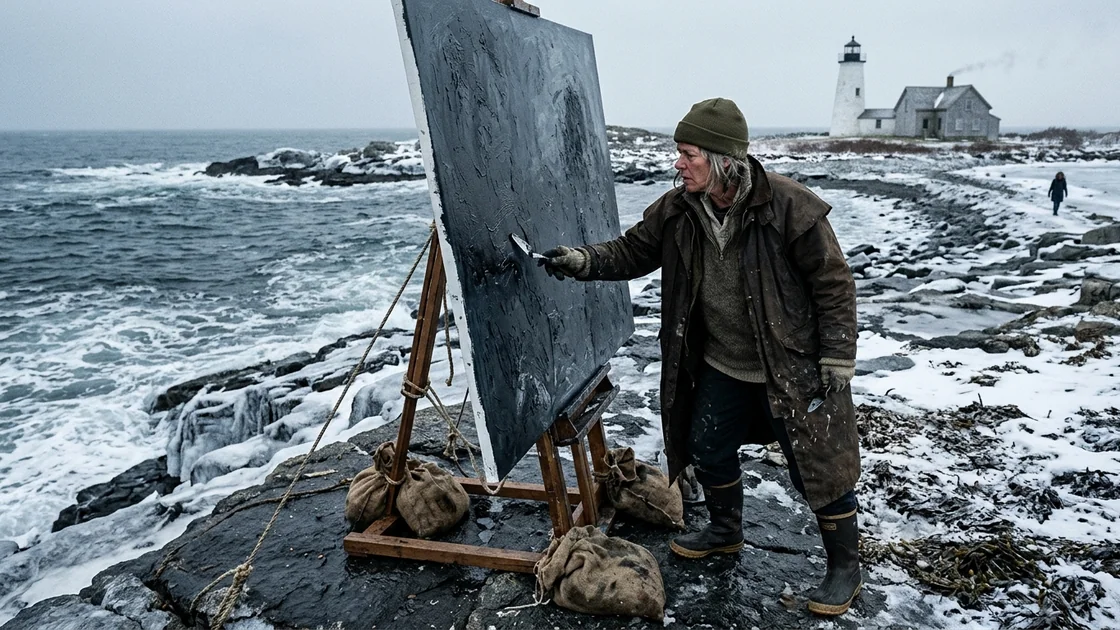
Clara shaded her eyes against the glare off the surf. A figure was perched on the very edge of the granite spine where the Atlantic broke into gray foam. It was wrapped in a brown oiled-cloth duster that trailed down to the rubber tops of its boots, its head muffled in an olive-drab watch cap.
Beside the figure stood a heavy wooden easel, anchored to the stone with two burlap sacks—likely filled with cobbles—tied to its crossbars with yellow polypropylene lobster twine.
Clara watched through the kitchen binoculars. The woman—it was clearly Maeve Vance, the painter the note had warned her against—was not painting with delicate brushstrokes. She was holding a triangular mason’s trowel in one gloved hand, scooping thick, sludge-gray paste from a piece of marine plywood and smearing it across a massive sheet of linen with violent, downward thrusts of her shoulder.
The wind was blowing at twenty knots out of the north, cold enough to freeze sea-spray onto the lichen within seconds, yet Maeve worked with her coat unbuttoned at the throat, her movements feverish and mechanical. Every few minutes she would drop her arm, step back three paces onto a slick patch of bladderwrack without looking down, spit into the foam, and stare at the canvas with a squint so severe it made Clara’s own eyes ache.
Clara lowered the glasses.
She had seen that look before. It was the face the senior surgical fellows wore around hour eleven of a complex liver resection, when the field was full of blood that wouldn't clot and the anesthesia monitors were starting to chime in three-part disharmony. It was not the face of someone making art; it was the face of someone trying to hold back an engine failure with their bare hands.
"Leave her be," Clara said aloud, repeating the note.
She took her armful of cedar kindling inside, kicked the heavy spruce door shut, and slid the iron bolt into its hasp.
III. The Salt-Shop on the Spit
The weather held clear and bitterly cold until the middle of December, when the barometer dropped two inches in eighteen hours.
The general store was five miles back across the causeway, situated in a sheltered gut between two hills covered in second-growth birch. It was called simply The Point Supply, run by an old woman named Etta who sat behind a glass counter filled with packs of rolling tobacco, dry flies, rusted spark plugs, and wool mittens knit from unwashed sheep's fleece that still smelled of lanolin and dung.
Clara had driven across at low tide to buy kerosene, three tins of salt pork, rolled oats, and a five-pound bag of yellow onions.
While Etta was tallying the figures with a flat carpenter’s pencil on the back of a paper sack, the bell over the door gave a dry, brassy jangle.
The cold entered first—a draft that smelled of raw ocean brine and linseed oil—followed by Maeve Vance.
Up close, the painter was older than Clara had guessed from a distance, perhaps fifty-five, though her body had the hard, spare economy of an adolescent boy who worked on a dragger. Her hair was cut with blunt shears into an uneven slate-colored mop that fell into her eyes; her cheekbones were high and raw, wind-burned to the color of raw beef. Her fingernails were stained permanently with lampblack, cobalt violet, and Prussian blue, the pigment driven deep into the periungual folds like coal dust in a miner’s knuckles.
"Salt," Maeve said. Her voice was surprisingly low, textured like dry sand scraping across a hemlock floor.
"Rock or table?" Etta asked without looking up from her sums.
"Coarse. Two bags of the cattle lick if you have it. The fifty-pounders."
"Out back by the grain shed. Take the hand-truck. You got three packages from New York. Came on the Tuesday freight."
Maeve stiffened. "I didn't order anything from New York."
"Well, they’re here," Etta said, pointing a gnarled, liver-spotted finger toward three flat, cardboard crates leaning against the molasses barrel. They were stamped with the logo of an art supply house on Eleventh Avenue: Utrecht Linens & Raw Pigments.
Maeve looked at the crates not with anticipation, but with an expression Clara recognized instantly: it was the cold, nauseated dread of a patient looking at an envelope bearing the return address of a pathology laboratory.
"Send them back," Maeve said.
"Cost three dollars apiece to return 'em on the packet," Etta replied flatly. "I ain't paying it. Donald ain't hauling 'em twice. Take 'em or throw 'em off the spit into the ditch."
Maeve stood motionless for three breaths. Her jaw worked, a small muscle twitching over the angle of her mandible like an insect caught behind gauze. Clara, leaning against the counter waiting for her change, felt her professional instincts prickle. The painter’s breathing was shallow, clavicular; she was holding her left arm tight against her rib cage, her shoulder slightly hitched—a classic guarding posture for pleurisy, or a broken rib, or an acute rotator cuff tear.
Maeve reached for the first crate. As she lifted it, her face blanched—the sudden, chalky pallor that precedes a vagal drop. She didn't cry out, but a sharp, whistling hiss escaped through her teeth.
Clara moved before she thought.
Seven years of triage do not leave a woman's hands because she has crossed a state line. Her arm went out, catching the edge of the heavy carton before it hit the floorboards, her hip sliding automatically beneath the weight to brace it, her other hand coming up to support the painter’s left elbow.
"Don't hoist from the shoulder," Clara said, her tone level, flat, and authoritative—the tone she used when an intern was about to blow a central line into a subclavian vein. "You've got an impingement or an effusion. Let go of it."
Maeve jerked back as if Clara’s wool-mittened hand were a hot poker.
"Don't touch me," she snarled.
Her eyes were the color of stagnant harbor ice, the pupils small and hard. She was shaking, whether from rage or the sharp, sickening spike of tendon pain, Clara couldn't tell.
"I’m not trying to touch you," Clara said calmly, lowering the heavy crate of linen to the floor with her legs bent, keeping her spine straight. "I'm trying to keep sixty dollars worth of Belgian flax from crushing your toes. And you're favoring that arm. You have been since you walked in."
"I don't need a nurse," Maeve snapped.
Clara raised an eyebrow. "I didn't say I was a nurse."
"You smell like one," Maeve said, her lip curling slightly with genuine disgust. "Chlorhexidine and that sour, boiled-milk tea they drink from paper cups in waiting rooms. You’re the one in the keeper’s cottage."
"Clara Ellis," Clara said, not offering her hand.
"I know who you are. The historian told me he was renting to some hospital refugee from Boston. He thought it would be 'quiet' for you." Maeve spat the word as if it were an insult. "This spit isn't quiet. It's just loud with things that don't care about you. Donald!" she bellowed toward the back room. "Help me with the damn cattle salt."
She turned her back on Clara, her boots squeaking on the salted pine planks as she hauled open the heavy latch of the back door, leaving a cloud of cold fog swirling around Clara’s shins.
Etta pushed Clara’s three dollars and forty cents in change across the counter.
"She’s been here seven years," the old woman remarked casually, returning her pencil to behind her ear. "Used to be in the magazines. Had a show in Paris. Then she came up here on the mail boat one November with two trunks and four crates of linseed oil. Hasn't left the point since."
"Has she had that arm looked at?" Clara asked, pocketing the coins.
"Looked at by who? Doc Miller died in '98. Nearest clinic is Machias, thirty miles of black ice away. Maeve Vance don't go to doctors anyway. She says doctors are just butchers who went to church."
Clara picked up her sacks of rolled oats and salt pork. "She’s going to tear the supraspinatus clean off the bone if she keeps swinging that trowel."
"Then she’ll paint with her teeth," Etta said, picking up a rag and wiping a ring of lard off the counter. "Or she won't paint at all, and then maybe we’ll finally get some peace from that generator of hers."
IV. The Blue Hour
By the winter solstice, the light died at 3:45 in the afternoon.
The world contracted to the perimeter of the cottage’s woodstove and the thirty-foot circle illuminated by the yellow incandescent bulb hanging above the kitchen sink. Outside, the Atlantic was no longer blue or green; it was a vast, sliding plain of ink that hissed against the shingle with the sound of a million dry leaves being swept across concrete.
Clara developed a routine that she clung to with religious severity.
She woke at six, when the beacon was still tracing its slow circles through the frost on her bedroom glass. She stoked the fire with four splits of hard birch and one of hemlock for crackle. She drank two mugs of black chicory coffee standing up by the cast-iron stove, her hands wrapped around the tin mug for warmth. Then she put on three layers of wool, her heavy sheepskin coat, her crampons, and walked the perimeter of the spit.
The spit was a natural breakwater, two miles long and twenty yards wide at its spine, composed of glacial till—granite boulders the size of sheep, slabs of slate that split like pastry underfoot, and vast ridges of blue-black mussels whose shells cracked under her irons with a sound like breaking eggshells.
At the far tip, where the reef met the full surge of the open sea, stood Maeve’s place.
It was an old herring-salting shed, built in the 1880s on high hemlock pilings that had turned black and hairy with seaweed. The salt had pickled the wood from the inside out, preserving it against rot, but the building leaned five degrees to the south, like an old horse bracing against a storm. A massive chimney of unmortared beach stones rose up its northern flank, chuffing out thin, bluish smoke that smelled not of clean birch, but of driftwood—the salty, slightly chemical stink of burning sea-oak and pitch-pine.
Clara never approached the house. She would reach the high-water marker—a weathered spar buoy driven into the rocks like a spear—turn on her heels, and walk back.
She didn't want Maeve’s company. The woman's prickly, defensive fury was too familiar; it was the same sour armor Clara had worn during her final six months in Boston, when every shift felt like an ambush and every parent’s tearful question felt like an accusation she couldn't answer.
Yet she watched.
From her second-story bedroom, with the brass binoculars resting on the sash, she watched Maeve work.
The painter did not stop for the weather. In twenty-degree temperatures, she stood on the salt-bleached platform of the old wharf, her canvas lashed to the pilings with chain. She was painting the sea, but not the sea of the postcard racks in Kennebunkport. There were no white sails, no lighthouses, no gulls perched romantically on cedar posts.
Her canvases were enormous—eight feet wide, sometimes ten—and they were dark. They were studies of water under pressure: the violent, olive-drab weight of a wave just before it breaks against stone; the dirty, yellowish foam that gathers in the corners of sea caves; the slick, purple-gray sheen of wet kelp exposed to a killing freeze at low water.
One afternoon, three days before Christmas, the wind swung around to the south-southeast, bringing with it a thick, warm-nosed fog that rolled over the spit like sheep’s fleece. The temperature rose to thirty-eight degrees, turning the hard snow to slippery, gray slush.
Clara was sitting at the pine table, trying to read a monograph on eighteenth-century navigational charts she had found in the study, when she heard the horn.
It wasn't the lighthouse foghorn—that was automated, an ear-splitting, compressed-air bellow from the tower that sounded every twenty seconds with mechanical indifference.
This was an engine horn. Short, frantic, wet.
Clara went to the porch. Down at the spit’s narrow neck, where the tide crossed the road, a blue pickup truck was angled half into the ditch, its rear wheels spinning helplessly in the brine, tossing up rooster tails of gray mud and salt ice.
She grabbed her coat and her rubber boots.
When she reached the truck, the tide was already six inches deep across the cobble causeway. In another twenty minutes, it would be four feet. The Atlantic did not take prisoners on the spit; the water rose with terrifying speed, pushed by the south wind like a drawer sliding into a desk.
Maeve was behind the wheel of the old Ford, her face purple with exertion, her good arm hauling on the steering wheel while her left arm hung limp as a dead eel by her side. The engine screamed, the transmission whining in reverse, but the rear differential was hung up on a granite boulder.
Clara waded into the freezing slurry, which rose instantly over her ankles, chilling her through her wool socks. She banged her fist on the driver’s side glass.
Maeve rolled it down three inches. The interior of the cab smelled of turpentine, stale pipe tobacco, and sweat.
"Get out," Clara shouted over the engine. "You're high-centered."
"I have six tubs of lead white in the bed," Maeve yelled back. "If they get wet, they're ruined."
"If you stay here twenty minutes, you'll drown in your own cab. Get out!"
"Mind your own business, nurse!"
Clara reached through the gap, found the inside handle, and yanked the door open. The force of the wind ripped it out of her grip, slamming it against the front fender with a loud twang of distorted sheet metal.
"Listen to me, you stubborn old fool," Clara said, her voice dropping into the low, deadly register she used when parents tried to give water to a child who was NPO for surgery. "You've dislocated your shoulder or torn the tendon completely. You have no traction. The tide is coming in at three knots. You are going to step out of this truck right now, or I will drag you out by your good collar and let your damn paint go to Portugal."
Maeve stared at her. For three seconds, their eyes met through the thickening fog. The painter’s face was wet with rain and sea-spray, her jaw clamped so tight Clara could hear the grinding of her molars.
Slowly, without a word, Maeve swung her legs out of the cab.
The moment her boots hit the flooded road, her left knee buckled—not from injury, but from the bone-deep shock of the cold water soaking through her trousers. Clara caught her under the right armpit, taking her weight.
Maeve was surprisingly light—all sinew, gristle, and light bird bones beneath the heavy canvas duster. She gasped as Clara hauled her up onto the higher spine of the spit.
"The linen," Maeve croaked, looking back over her shoulder. The crates from New York were in the open bed, the salt water already splashing against the cardboard.
"Let it go," Clara said, not stopping.
They stumbled up the gravel path toward the light keeper’s cottage, the wind at their backs, the sea rising behind them like a gray wall erasing the road. By the time they reached the granite steps of the porch, the truck’s tires were submerged, its yellow parking lights glowing beneath six inches of foam like the eyes of some dying deep-sea monster.
V. Triage by Lamplight
Clara kicked the door shut and dropped the bolt.
The parlor was warm, the woodstove humming its low, steady song. Clara didn't speak. She moved with the silent, economical efficiency of someone who had spent seven years in rooms where words were a waste of oxygen.
She stripped Maeve’s sodden duster from her shoulders, ignoring the painter’s low, wet hiss of pain when she had to pull the left sleeve free. Beneath the coat, Maeve wore three wool sweaters, each one more paint-stiffened than the last. Clara took a pair of heavy shears from her sewing kit on the mantel.
"Don't cut them," Maeve rasped, shivering violently, her lips a faint, lavender blue. "That’s Harris tweed."
"It’s full of salt water," Clara said, her fingers already working the horn buttons. "Salt holds the moisture against the skin. You’ll be hypothermic in forty minutes. Unbutton the right side yourself."
She peeled the layers back until Maeve was sitting on the horsehair settee in a thin, grease-stained cotton undershirt.
Clara knelt on the floor beside her. Her bare hands were warm from the stove; Maeve’s shoulder was as cold as a butchered hog hanging in an outhouse.
The anatomy was obvious. The humeral head was sitting forward and down, bulging unnaturally beneath the thin deltoid muscle like a walnut stuffed under a handkerchief. The hollow where the bone should have been—the glenoid fossa—was an empty, purple dimple.
"Anterior dislocation," Clara said, looking up into Maeve’s gray eyes. "Subcoracoid. How long has it been out?"
"Two days," Maeve whispered. Her teeth were chattering so hard she could barely articulate the syllables.
Clara paused, her fingers freezing on the cold skin. "Two days? You've been hauling crates with an unreduced shoulder for forty-eight hours?"
"It slipped on Tuesday. When I was moving the big stretcher bar. It’s done it before."
"It shouldn't do it before. It’s unstable." Clara stood up, went to the kitchen, and fetched a clean dish towel and a bottle of rye whiskey the maritime historian had left in the cupboard. She poured four fingers into a jelly glass and handed it to the painter. "Drink this."
Maeve looked at the amber liquid. "I don't drink."
"Tonight you do. You need twenty milligrams of morphine and ten of diazepam, but all we have is Jim Beam and three cords of birch. Drink it, or I'm going to have to drive you to Machias across a flooded causeway with your arm swinging loose."
Maeve took the glass in her right hand, her fingers trembling, and swallowed it in two long, ugly gulps. She didn't cough, but a thin line of red rose in her throat, the alcohol hitting her empty stomach like paraffin on embers.
"Now," Clara said, sitting on the bench across from her. "Lie down on the floor."
"What?"
"Lie down on your stomach. On the rug. Put your face toward the stove."
Maeve hesitated, then lowered herself to the hooked rug, moving with the stiff, awkward caution of a wounded dog. Clara grabbed a ten-pound iron weight from the sash-window repair box in the hall, wrapped it in the dish towel, and tied it to Maeve’s left wrist with two half-hitches of lobster twine.
"Hang your arm down over the edge of the settee," Clara instructed, adjusting Maeve’s position until the injured arm swung free toward the floorboards, three inches above the pine. "Gravity does the work. We call it the Stimson technique. If I try to muscle it back in, your pectorals will spasm and tear the capsule. We let the weight tire out the muscle. It takes twenty minutes."
Maeve lay with her cheek pressed against the rough wool of the rug. Her breath smelled of raw whiskey and pine smoke.
The only sound in the room was the wind rattling the double-hung windows and the slow, rhythmic tick-tick-tick of the brass mantle clock.
"You have very cold hands," Maeve muttered into the wool.
"They're warmer than your shoulder," Clara replied. She sat on the low stool beside the painter’s head, her fingers resting lightly on the radial artery at Maeve’s wrist, monitoring the pulse. It was seventy-two, regular, slightly thready.
"Why did you leave?" Maeve asked suddenly. Her voice was muffled by the rug. "The historian said you were the head nurse at Children’s."
"I wasn't the head nurse. I was just a nurse."
"He said you walked out in the middle of a shift."
Clara’s thumb pressed a fraction deeper into the tendon groove. Her voice remained flat, neutral—the clinical voice that reveals nothing. "He talks too much."
"Small towns," Maeve said, her words slurring slightly as the rye took hold. "Everyone knows everyone's business because there’s nothing else to look at. Just water and trees. Water and trees get boring if you don't paint them."
"I didn't walk out in the middle of a shift," Clara said after a long silence. The wind hit the eastern corner of the house with a high, whistling shriek that made the lamp flame dance inside its glass chimney. "I finished the shift. It was seven in the morning. I did the handoff report for bed twelve. A three-year-old with acute lymphoblastic leukemia who had developed an intussusception. I handed the chart to Sarah Chen. Then I went down to the locker room, took off my badge, put it in the biohazard bin, and walked out the ambulance bay."
"Why?"
"Because if I heard the alarm on an Alaris pump one more time, I was going to throw an oxygen cylinder through the sixth-floor glass." Clara adjusted the towel around Maeve’s wrist. The muscle in the painter’s shoulder was beginning to tremble—the fasciculation that comes before total muscular fatigue. "You’re loosening up. Another two minutes."
"That’s not why you left," Maeve murmured. Her eyes were closed now, her gray lashes long and tangled against her sallow cheek. "You didn't leave because of an alarm. You left because you couldn't stand being seen."
Clara didn't answer.
She watched the iron weight swing slightly—a pendulum an inch above the floor.
A soft, dull clunk vibrated through the boards.
Maeve let out a long, shuddering gasp—half sob, half groan—as the humeral head slipped back over the lip of the glenoid rim into its socket. Her whole body went limp, her forehead dropping hard against her forearm.
Clara immediately untied the twine, knelt down, and supported the joint with both hands, gently bringing the arm up across Maeve’s chest into an adducted position.
"It’s in," Clara whispered.
Maeve didn't move. For four minutes she lay there on the floorboards, weeping silently, without tears, her shoulders heaving with the dry, terrible exhaustion of an animal that has finally slipped the snare. Clara stayed on her knees beside her, her hand resting firmly on the painter’s uninjured shoulder, not stroking it, not offering soft words, simply holding her against the earth until the shaking stopped.
VI. Turpentine and Bone
Maeve did not go back to her salting barn that night. The causeway remained under four feet of water until the dawn tide, and the southeaster turned into a stinging sleet that plastered the northern side of the lighthouse with a skin of gray ice.
Clara put her in the narrow spare bed upstairs, tucking an old wool army blanket around her chin. Maeve fell asleep instantly, her face slack, snoring with the heavy, rattling breath of an exhausted soldier.
In the morning, the light was clean and terrifyingly bright. The storm had blown the sky clean of haze; the blue was so pale and cold it looked like frozen nitrogen.
Clara found Maeve in the kitchen, dressed in an oversized flannel shirt belonging to the maritime historian. Her left arm was bound securely to her torso with Clara’s ace bandage, but she was using her right hand to lift the iron kettle with absolute, stubborn ease.
"The truck is gone," Maeve said, not looking around as Clara came down the narrow stairs.
"The coast guard will find it in the cove when the ice clears," Clara said, pulling on her boots.
"The truck doesn't matter. It was a twenty-year-old rust bucket. The linen was ruined anyway." Maeve set the kettle down on the stove trivet with a sharp clink. "Come over to the barn at noon. I have salt cod. If you eat salt cod."
"I don't know if I eat salt cod," Clara said. "I've never had it."
"It tastes like old salt and wet wood. But it’s food." Maeve picked up her duster—still damp, but stiff enough to stand on its own—and walked out the door without saying thank you.
At noon, Clara walked out to the spit’s end.
The salting barn was even larger inside than it looked from the shore. The original ceiling had been knocked out, revealing the heavy hemlock rafters forty feet above, hung with dried clusters of bladderwrack, old cod hooks on rusty gaffs, and stretches of dried sheep intestines once used for sausage casings.
The northern wall had been replaced entirely with salvaged window sashes—dozens of six-over-six frames screwed together in an irregular grid that let in an enormous, cold, shadowless flood of northern daylight.
The smell was overwhelming. It was not the sterile, alcohol-and-bleach scent of Clara’s old life, but a thick, oily broth of damar varnish, cold-pressed linseed oil, pure spirits of turpentine, and the rank, fishy glue Maeve used to size her raw linen.
Canvases were everywhere. They were stacked ten deep against the hemlock walls, face-in, like slate headstones in an overcrowded churchyard.
In the center of the space stood a cast-iron pot-bellied stove, red-hot around its belly, venting into a stovepipe that ran horizontally for thirty feet to heat the drafty room before exiting through the wall.
Maeve was sitting by the stove on an upturned nail keg, peeling boiled potatoes with a pocketknife.
"Sit," she said, nodding toward a low chair made of barrel staves padded with an old sheepskin.
On the table between them was an iron skillet filled with a pale, bubbling hash of flaked salt cod, boiled potatoes, yellow onions, and thick cubes of salt pork that had been rendered down until they were translucent as amber.
They ate in silence for ten minutes. The food was salty enough to make Clara’s tongue shrivel, but it was hot, rich with animal fat, and tasted better than anything she had eaten since leaving Boston.
"You have a good touch," Maeve said, setting her fork down on the edge of the tin plate. "For a butcher."
"I’m not a butcher. I was an ECMO specialist."
Maeve squinted. "What's that? Greek?"
"Extracorporeal membrane oxygenation," Clara said, wiping her fingers on a rough linen rag. "When a child’s lungs are so damaged by pneumonia or congenital diaphragmatic hernia that the ventilator can't push oxygen through the tissue without blowing holes in it, we cannulate the carotid artery and the jugular vein. We pull all the blood out of their body, run it through an artificial silicone lung, warm it, and pump it back in. We do it for weeks at a time."
Maeve stared at her. Her small gray eyes were wide, unblinking, like the eyes of an owl sitting in the eaves.
"You keep them outside themselves," Maeve said.
"Yes."
"The whole blood?"
"About five hundred milliliters at a time. A pint. In an infant, that’s almost their entire blood volume outside their skin, circulating through plastic tubes."
Maeve looked down at her hands—her right hand, stained blue and black, and her left, still strapped to her ribs by Clara’s bandage.
"Why did the boy die?" she asked.
Clara felt a sharp, icy prick behind her ears. The barn suddenly seemed very cold, the heat from the pot-bellied stove failing to reach the space between their chairs.
"Which boy?"
"The one in bed twelve. The three-year-old with the Greek name."
"He didn't have a Greek name. His name was Toby. And he didn't die on my shift."
"He died, though," Maeve said. It wasn't a question.
Clara set her plate on the hemlock floor. She looked at the wall of sashes, where the Atlantic was breaking against the black rocks two hundred feet below. A seal was bobbing in the kelp bed, its gray snout pointing into the wind, perfectly balanced against the rip tide.
"His mother was twenty-two," Clara said. Her voice didn't shake; it had that thin, terrifying clarity that comes when a memory has been stripped of its fat by repetition. "She worked at a dry cleaner's in Revere. She had three other children. She would come in at eleven at night, after her shift, smelling of perchloroethylene and cheap vanilla body spray. She would sit by the crib and hold his heel. Not his hand—his hand had three arterial lines and an IV in it—just his heel. She would sing the same song. Some Portuguese hymn about a boat on the river."
Clara took a breath. Her chest felt tight, as if the ace bandage were around her own ribs.
"On his last night, his bowel infarcted. It was dead tissue. Necrotic. The surgeon opened him at three in the morning and looked inside and just... shook his head. He closed him back up. He told me to turn off the epinephrine drip slowly so her mother could get there before his pressure hit zero."
Maeve didn't speak. She didn't look away.
"I didn't turn it off slowly," Clara whispered. "I kept the pump running at five micrograms until seven o'clock because she was stuck on the Tobin Bridge in an ice storm. Her car had broken down. I knew he was brain-dead. His pupils were fixed and dilated at five-thirty. But I kept the heart beating with the pump until she walked through the doors at ten past seven. She got to touch his heel while it was still warm."
Clara looked at Maeve.
"Then I washed the bed. I helped the orderly put him in the white vinyl bag with the zipper. I signed the register. And then I went to my car."
The barn was dead quiet except for the roar of the surf beneath the pilings—a deep, pneumatic lung-sound that vibrated through the spruce planks into the soles of their boots.
Maeve stood up. She walked over to the stack of canvases leaning against the northern wall. With her good right arm, using her hip and knee to balance the weight, she dragged one out into the center of the room and turned it toward the light.
"Look at this," Maeve said.
Clara looked.
It was not a landscape. It was a painting of a dead minke whale that had washed ashore on the spit three years before, its belly swollen with gas, its dark skin torn open by dogfish and gulls to reveal the thick, glistening layers of blubber beneath—white, yellow, tinged with grease-pink.
It should have been repulsive. But it wasn't.
Maeve had painted the carcass not with disgust, but with a fierce, almost devotional precision. The blubber looked like alabaster; the torn black skin had the texture of wet slate; and above the dead animal, the sky was not gray, but a clear, terrifying lilac, the light of early morning breaking over the carcass with absolute indifference and absolute mercy.
"You think you’re special because you couldn't save him," Maeve said, her voice rough as sandstone.
"I don't think I'm special."
"You do. You think your grief is larger than the spit. You think you’re the only person who ever held a dying thing and discovered that the world doesn't stop turning when the breath goes." Maeve picked up a palette knife from her work bench, scraping a crust of dried lead white from its steel edge with her thumb. "The whale lay there for four months. The ice froze it. The gulls took the eyes. The foxes took the tongue. In June, the high tide took the bones out into the deep channel. Now the lobsters are living in its skull."
She looked at Clara, her gray eyes burning with an old, dry fire.
"You aren't a monster for keeping the pump running, Clara. You're just a fool who thinks she’s stronger than the tide. Nobody is stronger than the tide. Not even with an electric pump."
VII. The Iron Month
January came in with a series of blue northers that froze the harbor out to the five-fathom line.
The spit was no longer land; it was an ice shelf. The spray from the breakers blew across the rocks and froze instantly upon contact, encasing the keeper’s house, the light tower, and the old salting barn in a four-inch armor of clear, salt glaze.
If Clara stepped outside without her irons strapped to her boots, she was down immediately, the wind skittering her across the blue ice toward the ledge like a dry leaf.
The two women developed a silent, necessary symbiosis.
Maeve’s shoulder was healing, but the capsule remained weak. She could not lift firewood, and she could not haul water from the cistern. Clara could do both, her young back and legs strong from years of lifting forty-pound children and twelve-lead EKG machines.
Every morning at nine, Clara hauled three birch logs and two five-gallon buckets of water across the frozen spit to the barn.
In return, Maeve fed her.
They did not talk about Boston, and they did not talk about the galleries in New York that Maeve had fled fifteen years before. But they talked about everything else.
They talked about the chemistry of pigments—how the French ultramarine was made of sulfur-rich silicate that smelled like rotten eggs when ground with cold oil, while the Prussian blue was made with iron ferrocyanide and was so lightfast it would survive three hundred years of direct sun on a south wall.
They talked about the mechanics of the heart—the four valves that Clara described not as biological wonders, but as simple, self-sealing check valves that failed when the pressure in the pulmonary circuit exceeded thirty millimeters of mercury.
"It’s all plumbing," Maeve said one evening, poking the fire with a length of copper pipe. "Painting is just fluid mechanics. You’re managing viscosity and dry times. You’re trying to catch something before it sets up and becomes stone."
"Medicine isn't plumbing," Clara said, leaning back against the barrel staves.
"No? What is it then?"
"It’s an argument."
Maeve looked up, her eyebrow cocked. "With who?"
"With the dark," Clara said. "You know you’re going to lose. The patient always dies eventually. If not today, then forty years from today. But you make the argument anyway. You say: not this one. Not on this shift. Not while I have four units of O-negative and an eight-gauge catheter. You just make the dark wait."
Maeve was silent for a long time. She reached into her pocket, pulled out a chunk of dry charcoal, and began sketching on the pine arm of her chair—rapid, jagged lines that captured the curve of Clara’s wrist where it rested on her knee.
"The dark doesn't care about your argument," Maeve said softly.
"I know," Clara replied. "That’s what makes the argument worth having."
Late in the month, Clara began to draw.
She hadn't drawn since she was eleven years old, when her father had given her a set of graphite pencils and a sketchpad with a green cardboard cover. Maeve didn't offer lessons, but one Tuesday she left a scrap of three-hundred-pound watercolor paper and three sticks of vine charcoal on the corner of the trestle table.
Clara started with the window frame.
She drew the twelve small panes of glass, each one warped slightly by age so that the horizon line outside stepped down an eighth of an inch from left to right. She drew the zinc glazing points that held the glass in place. She drew the salt crust that formed in the corners of the lower panes—intricate, dendritic patterns like ferns growing out of dried brine.
Maeve would walk past her chair, glance down at the paper without stopping, and make a dry, clicking sound with her tongue.
"Too tight," she would say. "You’re drawing what you know is there, not what your eye is seeing. Look at the value, not the thing. The thing doesn't exist. Only the light hitting it exists."
"The thing does exist," Clara countered, her pencil digging into the heavy cotton paper until the lead snapped. "The wood is three inches thick. It was cut from old-growth pine in 1840. It has mass. If I don't draw the mass, it’s just grease on paper."
Maeve stopped. She looked at Clara’s drawing—the heavy, dark, almost surgical precision of the pencil marks, every joint and nail head rendered with obsessive, anatomical clarity.
"You draw like an undertaker," Maeve said.
"Thank you."
"It wasn't a compliment."
"To me it is," Clara said, picking up an emery board to sharpen her graphite point. "An undertaker is the only one who doesn't lie to the family."
VIII. The White Lantern
In February, the island experienced what the old-timers called the Hard Freeze.
The wind died completely. The Atlantic stopped roaring. For four days, the temperature stayed at twelve below zero during the day and dropped to twenty-six below at night.
The sea did something Clara had never seen: it began to congeal.
The surface of the bay turned into grease ice—a thick, gray, oily slush that dampened the swell until the water looked like undulating lead. Then the grease ice froze into pancake ice—circular floes three feet across, their edges turned up where they bumped against one another in the slow, suffocating tide. Within seventy-two hours, the bay was a solid sheet of white, scarred by pressure ridges where the current had forced the floes together into mini-mountain ranges of blue-green ice.
The world was entirely white. The sky was a pale, milky sheet; the sea was frozen bone; the spit had vanished into the drifts.
On the third night of the freeze, the generator at the lighthouse died.
Clara woke to the silence. Not the silence of the island, which was always present, but the sudden absence of the low, sub-audible hum that came from the cellar—the machine that kept the water pipes from bursting and the small electric heater in the bathroom from freezing solid.
Her breath was coming in thick, white clouds. Inside the bedroom, the temperature was already down to fifteen degrees. The moisture from her lungs had frozen onto the edge of the down quilt, forming a ridge of frost along her chin.
She put on all her clothes—two pairs of long underwear, two sweaters, her canvas work pants, her down coat, her boots—and took the heavy iron flashlight down to the cellar.
The generator was cold. The diesel had gelled in the lines, thick as clover honey.
She tried the marine band radio. Channel nine was dead, filled only with the soft, bacon-fat crackle of atmospheric static.
"Donald," she spoke into the mic, though she knew it was useless. "Donald, the fuel is gelled. The spit is frozen."
Nothing.
She went to the door and looked toward the point.
The salting barn was dark. No smoke was coming from Maeve’s chimney.
Clara didn't hesitate. She took her small pack, stuffed it with two boxes of matches, a bottle of 90-percent isopropyl alcohol from her first-aid kit, a loaf of frozen soda bread, and her wood-chopping maul.
The half-mile walk across the spit took forty-five minutes.
The air was so cold that each breath felt like swallowing crushed glass; her trachea burned with a dry, metallic heat that made her cough, and each cough sent a sharp spike of pain through her ribs. The crust on the snow was hard enough to hold her weight for two steps, then would shatter under the third, plunging her knee-deep into the sugar snow beneath, where the granite boulders waited to bark her shins.
When she reached the barn, the heavy hemlock sliding door was frozen three inches deep in an ice-drift.
She took the maul and swung it with all her strength against the ice, the shock traveling up the ash handle into her shoulders like an electric jolt. Crack. Crack. Crack.
She cleared the sill, hauled the door open four inches, and squeezed her body through the gap.
Inside, the barn was colder than the beach. Because of the vast volume of the space and the high, uninsulated roof, the interior had become a cold-trap, holding the twenty-below-zero air like a stone cistern.
"Maeve?" Clara’s voice was instantly swallowed by the rafters.
No answer.
The pot-bellied stove was cold, a gray cone of ash sitting in its grate.
Clara found her in the corner behind the large canvases.
The painter had dragged four old wool rugs into a mound between two crates of linen. She was curled inside them like a larva, her knees pulled up to her chin, wearing her canvas duster, three hats, and two pairs of boots.
Clara knelt beside the mound and pulled back the top rug.
Maeve’s face was the color of a skimmed milk puddle. Her eyes were half-open, glazed, the pupils large and sluggish. She did not look at Clara; her gaze was fixed on a point three inches above Clara’s shoulder.
"Maeve. Look at me."
Maeve’s lips moved, but the sound that came out was only a dry, clicking wheeze.
Clara touched her cheek. The flesh was stiff, doughy—the stage of hypothermia where the peripheral capillaries have surrendered entirely, the body shunting its remaining warmth into the core, shutting down the brain’s higher functions one by one to keep the sinoatrial node firing.
"Severe," Clara muttered to herself, her hands already moving to the zipper of Maeve’s coat.
She didn't try to move her. Moving a severely hypothermic patient can trigger ventricular fibrillation; the cold, acidotic blood pooled in the limbs rushes back to the heart, irritating the myocardium until it twitches like a dying fish.
"Stay still," Clara said, though Maeve had no choice.
Clara ran to the stove. She dumped the ash with three violent shakes of the grate. She tore the cardboard covers off two of Maeve’s unused sketchbooks, crumpled them into tight balls, and shoved them into the firebox. She poured half the bottle of pure isopropyl alcohol over the dry birch splits she had hauled the day before, struck a match, and dropped it in.
The alcohol caught with a soft, blue whoosh. The paper flared; the dry birch snapped, its yellow resin bubbling out of the bark and catching the flame.
Within five minutes, the iron pipe was ticking as it expanded.
Clara didn't bring Maeve to the fire. She brought the fire to Maeve.
She found two empty five-gallon steel kerosene tins. She filled them with water from the cistern bucket, set them directly on top of the stove, and waited until they were steaming—not boiling, but hot enough to hurt through a thin rag.
She wrapped the tins in her own wool sweaters, hauled them back to the nest of rugs, and placed them against Maeve’s groin and beneath her armpits—the great vascular junctions where the femoral and axillary arteries could carry the heat directly to the core without warming the skin too fast.
Then she stripped off her own sheepskin coat, crawled into the rugs beside the older woman, and pulled the frozen mass of wool over both of their heads.
"You're an idiot," Clara whispered into Maeve’s ear, her arm thrown over the painter’s torso, pressing her own chest against Maeve’s shivering back. "You have two cords of birch in the shed. You let the fire go out."
Maeve’s body was shaking now—the violent, teeth-snapping tremors that mark the return of metabolic function. She groaned, a long, low, animal sound of pure agony.
As the blood warmed and returned to the ischemic nerve endings in her fingers and toes, the pain would be unspeakable—the pain of the thaw, which mountain climbers describe as having their limbs dipped in boiling acid.
"Breathe," Clara commanded, her hand flat against Maeve’s sternum, feeling the slow, heavy thump... thump... thump of the painter’s heart. "Don't fight it. Breathe with me. In for four. Out for four."
They lay there in the dark under the heavy rugs for three hours while the iron stove roared twenty feet away, filling the freezing air of the barn with the scent of burning birch and hot linseed oil.
Clara did not move. She became the monitor; she became the ECMO circuit. She matched her breath to Maeve’s ragged respirations, her own body heat leaking through the wool to warm the older woman’s hollow bones.
Around noon, Maeve spoke.
The voice was tiny, cracked, like a dry leaf scraping across stone.
"Clara."
"I'm here."
"The painting on the easel."
Clara looked through a gap in the rugs. Across the barn, illuminated by the cold, horizontal light of the frozen bay, stood the canvas Maeve had been working on for three weeks.
It was not the sea. It was not the dead whale.
It was the interior of the lightkeeper’s kitchen at midnight.
There was the pine table, rendered in heavy, rough slashes of raw umber; there was the tin mug; and there was Clara, seen from behind, sitting under the yellow incandescent bulb with her hands spread flat on the oilcloth, her shoulders hunched like an old hawk's, her neck bowed beneath a weight that had no color, no shape, but filled the entire upper third of the canvas with a dense, suffocating cloud of lead white and indigo.
It was the most terrifying thing Clara had ever seen.
It was her own exhaustion, rendered so accurately, with such merciless, diagnostic precision, that it felt as if Maeve had peeled back the skin of her back and painted the marrow of her vertebrae.
"Do you see it?" Maeve whispered.
"I see it," Clara said. Her face was wet. She hadn't realized she was crying until a tear dropped off her chin onto Maeve’s wool collar.
"I didn't finish it," Maeve said.
"You will," Clara said, tightening her grip around the painter’s ribs. "The stove is hot. The wind is dying. You're going to finish it, you old bitch."
Maeve let out a short, wet wheeze that might have been a laugh.
"You have... terrible bedside manner," she muttered.
"I know," Clara said. "That’s why they put me in the intensive care unit. Nobody there could talk back."
IX. The Thaw
The sea ice broke on the tenth of March.
It did not go quietly. The wind swung around to the south-southwest, bringing with it a thick, warm rain that smelled of the open ocean and melting sod. The bay began to groan—a sound like hundreds of iron girders being twisted by giant hydraulic jacks.
Then came the cracks. They ran through the ice with the sound of rifle shots, long blue fissures zig-zagging from the spit toward the open channel.
By noon, the floes were moving. Millions of tons of salt ice ground against the granite ledges, heaving themselves up onto the rocks like dying walruses, then sliding back into the gray water with a roar that drowned out the automated horn on the lighthouse tower.
The road reopened three days later.
Donald came across first in his five-ton International dump truck, its bed loaded with road gravel to fill the washouts where the ice had torn the culverts away. He stopped by the keeper's cottage, left four five-gallon jugs of kerosene on the porch, yelled something unintelligible through his tobacco-stained beard, and rumbled on toward the mainland.
Clara’s sabbatical was up on the first of April.
She spent the last two weeks of March scrubbing the cottage. She washed the soot from the parlor ceiling with vinegar and ammonia; she polished the brass fittings on the woodstove with rottenstone and lard; she folded the linen sheets the associate dean had left in the cedar chest and stacked them with lavender sprigs from the garden border.
Her hands were different now.
The skin was thick, brown from the winter sun that reflected off the snow, criss-crossed with small, healed white scars from cedar splinters and oyster shells. The nails were short, clean, but no longer scrubbed to that raw, bleeding pink she had maintained for seven years in the hospital.
When she held her fingers out before her in the morning light, they did not shake.
The phantom alarms had stopped. She no longer heard the high-frequency ventilator in the hiss of the radiator; she heard only the radiator—an old iron tank holding hot water under low pressure.
She walked out to the salting barn on her last afternoon.
The snow was gone from the spit, replaced by a brown, wet tundra of moss, goose-grass, and shattered mussel shells. The air was fifty degrees, smelling of mud and the cold, green life that was beginning to stir in the kelp beds.
The barn doors were wide open.
Maeve was working on a twelve-foot canvas of the break-up. She was using a house-painter’s brush four inches wide, slapping a mixture of zinc white and cold wax across a dark ground with broad, sweeping arcs of her left arm.
The shoulder was healed. It was not as good as new—it hitched slightly at the top of the stroke, a hitch that would likely turn into arthritis before she was sixty—but she had full range, her body moving with a loose, rhythmic grace that looked almost easy.
She didn't stop painting when Clara walked in.
"The ferry runs at seven tomorrow," Maeve said, her brush making a dry, whispering sound as it dragged across the linen.
"I know. Donald’s coming for the bags at six."
Maeve stepped back, her boots squelching on the damp hemlock floor. She dipped the brush into a five-pound tin of turpentine and swirled it until the liquid turned the color of ditch-water.
"You going back to the children?" she asked.
Clara stood by the long workbench, her fingers tracing the edge of an old iron drawing compass.
"Not to the PICU," she said.
"Where then?"
"There’s a clinic in Belfast. Public health. Visiting nurse association. They need someone with pediatric experience to do home visits for the fishing families down on the peninsulas. Northport, Lincolnville, Isleboro."
Maeve looked at her sideways through her slate-colored fringe.
"Pay is shit," Maeve said.
"Probably."
"Roads are worse than this one."
"Probably."
Maeve wiped her hands on the thighs of her trousers, leaving two wide, greasy smears of Prussian blue across the brown duck cloth. She went to the corner of the barn, picked up a flat package wrapped in brown butcher paper and tied with tarred twine, and set it on the bench beside Clara.
"Take this," Maeve said.
"I can't afford one of your canvases, Maeve. The dean said your work sells for twenty thousand dollars in New York."
"New York is full of bankers who buy paintings because they're afraid of their own wives," Maeve spat. "This isn't for a banker. It’s for you. And it’s not a canvas. It’s on paper."
Clara untied the twine.
It was the drawing Maeve had made that night in January, after Clara had brought her back from the cold—not the large painting of the kitchen, but a charcoal study of Clara’s hands, drawn on a scrap of heavy, water-stained rag paper.
The hands were resting on the edge of the pine table. They were not young hands, and they were not gentle. They were blunt-fingered, scarred, their tendons standing out like the stays of a small boat, holding a chipped white bowl between them as if it were the most fragile thing on earth.
In the lower right corner, Maeve had written in pencil, in her jagged, impatient script:
Clara Ellis, R.N. Cross Ledge. February.
Clara looked at the drawing for a long time.
The line of the thumb was slightly off—the value on the thenar eminence was too dark by half a tone—but the mass was there. The weight was there. It was three pounds of bone and muscle that knew how to hold a baby’s lung, and knew how to hold an axe, and knew how to let go when the tide came up.
"It’s good," Clara said. Her voice was steady.
"It’s accurate," Maeve corrected her, turning back to her massive, unfinished sea. "Don't confuse the two."
X. The Crossing
The morning was clear, with a light wind out of the west that flattened the chop in the gut until it looked like green glass.
Clara packed her four duffels into the bed of Donald’s pickup. The Subaru was already parked at the ferry dock in Rockland, having been towed off the spit and repaired with a used tie-rod three weeks before.
She stood on the gravel turnaround by the lighthouse keeper’s cottage for one last minute.
The beacon was off. The great Fresnel lens—six tiers of ground glass prisms assembled in France during the administration of Chester A. Arthur—sat motionless inside its lantern room, catching the low morning sun and scattering it across the ledges in thousands of tiny, prismatic rainbows that danced over the lichen and the blue-black mussels.
The house behind her looked clean, empty, and indifferent. In three days, the maritime historian would return with his leather-bound notebooks and his tweed jackets, and he would write about the salt-tax riots of 1812 while the radiator clanked in the parlor.
He would never know that twenty milligrams of lead white had been scrubbed from the floorboards by the pantry, or that a woman had wept herself to sleep on the horsehair settee while holding a dislocated shoulder against the hearth.
Donald honked the horn—two short, dry blasts of the pneumatic horn that startled three gulls off the fish-pier.
"Coming," Clara called out.
She climbed into the cab. The interior smelled of wet dog, stale menthol cigarettes, and road salt.
As the truck lurched forward, its tires crunching on the loose shale of the causeway, Clara looked out the side window toward the point.
The salting barn was small now, a gray speck of driftwood perched on the ledge between the spruce trees and the wide, indifferent Atlantic.
On the high platform of the wharf, a white sheet of linen was flapping in the west wind like a signal flag. In front of it stood a figure in a dark duster, one arm raised not in a wave, but held straight out, the hand flat against the sky, measuring the angle of the light between the sea and the sun.
Clara did not raise her hand to wave back.
She reached down, took the framed drawing from her lap, and set it carefully between her boots on the floorboards of the cab, where the heater was blowing a steady, dry, imperfect warmth against her ankles.
The truck crossed the high spine of the spit just as the tide began to lick at the lowest cobbles, the water clear as bottle-glass, cold enough to kill, and full of life.