The Salt Garden
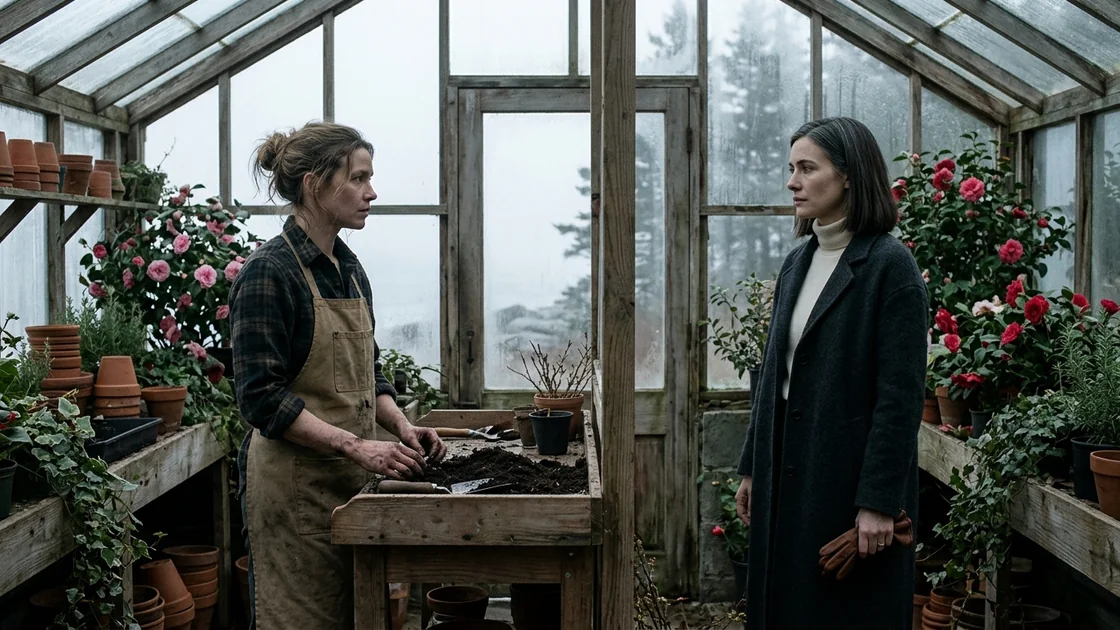
Nora Hayes has spent twelve years rebuilding her life in a quiet coastal town after the catastrophic end of her friendship with Beatrice Delacroix, but when Beatrice reappears with an unimaginable request to serve as the gestational surrogate for the child Beatrice cannot carry, the two women are forced to confront the wreckage of the summer at High Ledge, dredging up long-buried secrets, lingering resentments, and the fragile possibility of redemption.
I. The Salt Greenhouse
The winter Nora turned thirty-four was the winter the sea smoke refused to leave the harbor. It rose every morning off Penobscot Bay in white, ghostly plumes, creeping over the granite ledges and settling into the spruce groves until the world smelled exclusively of brine, frozen spruce needles, and wet shale.
Nora worked in the third greenhouse, the one she called the glass bell. It was kept at a strict sixty-eight degrees to protect the winter-blooming camellias and the propagation beds of coastal rosemary. Her hands were perpetually stained with damp peat and green juice; her thumbnails had developed hard, horn-like edges from scraping scale off the undersides of bayberry leaves. It was solitary, quiet work, punctuated only by the hum of the oil furnace and the click of the copper misting nozzles. She liked the boundary of the glass. Inside, there was order, temperature control, and the predictable obedience of root systems. Outside, the North Atlantic was chewing away at the coast, cold and indifferent.
She was potting bare-root winter hazel when the bell above the nursery entrance chattered.
It was a Tuesday afternoon in late January. Nobody came to an ornamental nursery in coastal Maine on a Tuesday in January unless they were lost, looking for road salt, or looking for her.
Nora wiped her knuckles on her canvas apron and walked through the breezeway connecting the greenhouse to the shop. The floorboards, warped by years of spilled mist and muddy boots, creaked familiarly beneath her clogs. Behind the counter, standing beneath a string of dead bay leaves left over from Christmas, stood a woman who did not belong to the county.
She wore a charcoal coat of boiled wool that fell to her mid-calf, unbuttoned to reveal a cream cashmere turtleneck. Her leather gloves were butter-soft, the color of wet chestnuts, held loosely in one hand. She was looking at a rack of seed packets—heirloom squash, purple carrots—with an expression of intense, almost academic bewilderment. Her dark hair was cut blunt at the collarbone, silver-threaded at the temples, but the posture was unmistakable: the slight, defensive cant of the left shoulder, the elegant, narrow wrist exposed between coat and glove.
"Bee," Nora said.
Beatrice Delacroix did not startle. She turned slowly, her face catching the milky, diffused light from the north skylight.
Twelve years had etched faint parentheses around Bee’s mouth and deepened the hollows under her cheekbones, but she remained what she had always been: terrifyingly symmetrical. She had the Delacroix jawline, sharp enough to open mail, and eyes the pale, washed-out blue of skimmed milk.
"You smell like dirt," Bee said. Her voice was lower than Nora remembered, gravelly at the bottom edges, as if she had spent the last decade shouting over traffic or smoke.
"I’m a nurseryman. It comes with the trade." Nora did not move past the end of the counter. She kept a three-foot gulf of worn pine between them. "What are you doing here, Bee?"
"You didn't answer my email."
"I deleted it."
"I know," Bee said softly. "The server gave me a read receipt, and then twelve hours passed. You always were an immediate responder when you wanted to be, Nora. When you went quiet, it was always a verdict."
"It wasn't a verdict. It was an archival decision." Nora untied her apron, folding it methodically on the counter. "There’s nothing here for you. If you need perennials for the house in Camden, the catalog goes out in March."
"High Ledge was sold six years ago," Bee said. "After my father died. We don't have the house anymore."
Nora’s hands stilled against the canvas. High Ledge was the center of the world they had once inhabited—a three-story cedar-shingled beast perched on the spine of the granite bluff three miles down the point, with twelve bedrooms, a saltwater pool that filled with the tide, and a screened porch that smelled of gin, citronella, and old money.
"I didn't know," Nora said.
"Nobody tells you things if you don't pick up the phone." Bee stepped closer. The scent of her rolled over the counter: something expensive, dry, and mineral, like vetiver and iris, cutting through the greenhouse smell of wet loam. "I didn't drive up from Boston to talk about real estate, Nora. I need you to have dinner with me. One dinner. At the inn in town. If you still want me to walk into the sea after dessert, I’ll get in my car and I won't come back."
"I don't want you to walk into the sea," Nora said, her voice flat. "I want you to leave me alone. We finished this."
"We didn't finish anything," Bee replied, her eyes steady, unflinching. "We just stopped talking. There’s a distinct difference."
II. The Ask
The tavern at the harbor inn was overheated and smelled of fried haddock and kerosene. They sat at a corner table near the woodstove, where the heat made Nora’s cheeks burn and Bee’s cashmere seem absurdly out of place.
Julian was not with her. Nora remembered Julian from their senior year at Colby—a boy with soft, heavy eyelids, expensive teeth, and an inherited ease that Nora had spent half her youth resenting. Julian had been the kind of young man who left his sailboat unlocked because he assumed the world was fundamentally populated by people who respected his property.
"He stayed in Cambridge," Bee said, answering the question Nora hadn't asked. "He thought it would be better if it was just us."
"Julian always was diplomatic."
"Julian is tired," Bee said. She took a sip of seltzer with lime. Her fingers, stripped of all rings save for a very thin platinum band, were chapped at the cuticles. It was the only unkempt thing about her. "We're both tired. We've been tired for four years."
Nora looked at her. Beneath the tavern’s low-wattage yellow bulbs, the makeup couldn't hide the bruising under Bee’s eyes—not the purple of sleeplessness, but the dull, yellowish-brown of chronic, systemic grief. It was an interior stain Nora recognized from her own mother’s final months in the hospice wing at Belfast.
"What's wrong with you?" Nora asked, the old instinct of friendship piercing her armor before she could check it. "Are you sick?"
"My uterus is dead," Bee said plainly.
The waitress set down a basket of warm rolls and two bowls of chowder. Neither woman moved. The steam curled between them, smelling of salt pork and thyme.
"I have Asherman's syndrome," Bee continued, her voice level, clinical, drained of drama. "Scar tissue. The result of three D&Cs after three consecutive missed miscarriages. Then two rounds of surgery to clear the scarring, which caused more scarring. Then an infection. The lining is gone, Nora. It doesn't grow. It’s a desert. We did four rounds of IVF. We have six euploid embryos frozen in a tank in Waltham. They are genetically sound. They are Julian and me. But there is nowhere to put them."
Nora felt the air leave her chest in a slow, icy hiss. She looked down at her hands, at the calluses across the pads of her fingers. "I’m sorry, Bee. Truly. That sounds like hell."
"It is hell. It’s an expensive, fluorescent, refrigerated hell where people in scrubs give you pitying smiles and charge your credit card twelve thousand dollars every time they shatter your life." Bee leaned forward. Her knuckles were white against the edge of the dark oak table. "We interviewed three agencies. We looked at independent surrogates. Two matched with us and backed out. One had a medical disqualification at the thirteenth hour. The commercial system is... it’s an industry of strangers, Nora. Julian wants to keep trying the agency route. But I can't. I can't sign another contract with a woman in Idaho who wants to buy a kitchen remodel with my child in her stomach and who might decide at twenty weeks that she doesn't believe in vaccines or ultrasounds."
"Bee," Nora said, a cold premonition crawling up her spine. "Stop."
"I need someone who knows me," Bee whispered. Her composure cracked, just for an instant, a hairline fracture running through the porcelain facade. "I need someone who isn't doing it for a new minivan. I need someone who possesses... who has iron in her. You carried your mother through three years of cancer without dropping a single plate. You ran that nursery out of the red when your uncle died. You are the only person on earth I trust not to break."
"No." Nora pushed her chair back. The legs screeched against the wide pine boards.
"Nora, please."
"No. Absolutely not." Nora stood up, her heart knocking against her ribs like a trapped crow. "You haven't spoken to me in twelve years. Twelve years, Bee! You didn't come to my mother’s funeral. You didn't send a card. You had your father’s lawyer threaten me with a trespass order if I set foot on High Ledge after that August. And now you drive up here in your six-thousand-dollar coat and ask me to grow your baby?"
"I was twenty-one!" Bee’s voice cut through the murmur of the tavern. Two men at the bar turned their heads. Bee didn't care. She looked up at Nora, her eyes wide, glassy with unshed tears. "I was twenty-one, and I was terrified, and I was cruel. I know what I did. I have lived inside what I did every day since."
"You haven't lived inside it," Nora spat, leaning down, her voice trembling with a decade of kept silence. "You lived in Cambridge. You lived in London. You lived in a house with radiant floor heating while I dug drainage ditches in the rain to keep my mother from losing the house. You don't get to come back and use my body because yours failed you."
Bee went completely pale. The insult landed like an open-handed slap, but she didn't flinch. She sat there, small against the heavy booth, her hands resting flat on the table.
"You're right," Bee said quietly. "You don't owe me a thing. Not a glass of water. But I am asking anyway. Because if I don't ask you, those six vials stay in the liquid nitrogen until Julian and I get too old to care, and then they destroy them. That’s my whole family, Nora. That’s everything."
Nora turned on her heel and walked out of the tavern into the freezing fog.
III. The Salt on the Skin
The memory of the summer they stopped speaking did not come back to Nora in a neat, chronological reel. It came back in sensory spikes: the smell of coconut oil mixed with stale beer; the scratch of dried sea salt on the backs of her thighs; the hollow, metallic clunk of the aluminum ladder against the side of the High Ledge dock.
That summer, they were twenty-one. They had just graduated from Colby—Nora with an art history degree she couldn't afford to use, Bee with an English degree she didn't need. Nora had spent four years navigating the strange, razor-wire fence between her world and Bee’s. Nora’s mother, Clara, had been the head librarian at the Belfast Free Library, a woman whose hands smelled of book paste and lavender, whose clothes came from the church thrift shop, and who had taken out a second mortgage to pay for Nora’s room and board. Bee’s father was Charles Delacroix, a man whose ancestors had logged the Kennebec valley, dammed the rivers, and sold the timber to build half of Boston.
At Colby, Nora was Bee’s shield. Bee was dazzling, erratic, prone to sudden, terrifying depressions where she would stay in bed for four days drinking cold black tea and staring at the radiator, followed by weeks of incandescent energy during which she would buy vintage furs for strangers and organize midnight excursions to abandoned quarries. Nora was the anchor. Nora brought the saltines; Nora wrote the drafts of the papers Bee turned in at the deadline; Nora pulled Bee’s hair back over the toilet when the gin soured.
"We are a two-woman republic," Bee had declared one night during their sophomore year, sitting on the fire escape in the freezing rain, sharing an apple. "Nobody else has voting rights. Just us."
And Nora, who had never had a sister, who had grown up in the quiet, dusty house with her tired mother, had believed her. It was intoxicating to be necessary to someone so bright.
The summer after graduation, Bee insisted Nora stay at High Ledge. "You can't go back to the library basement," Bee had argued, lounging on Nora’s twin bed in Waterville while Nora packed her milk crates. "My mother is at the clinic in Zurich again. My father is in New York until August. It’s just me and Leo. You can paint in the boathouse. I’ll pay you to catalog the library. My father has four thousand first editions that are rotting in the damp. Consider it a residency."
Nora should have said no. She knew the Delacroix house had a way of flattening people who weren't born with the family’s casual cruelty. But Clara had been tired that June—already displaying the gray pallor that the doctors would misdiagnose as anemia for another six months—and Nora wanted, desperately, to live for one summer inside the golden world where money acted as a buffer against gravity.
Then there was Leo.
Leo was nineteen, Bee’s younger brother, born with the same pale blue eyes and the same hollow under the cheekbones, but none of Bee’s social armor. Leo was soft. He had been kicked out of two boarding schools for what the headmasters called "morbid non-participation." He spent his days in the cove behind High Ledge, taking apart the carburetors of broken outboard motors and leaving them in neat, grease-stained rows on the rocks.
"Don't look at him too hard," Bee had warned Nora on the first day, as they carried their bags up the sweeping, uncarpeted oak stairs. "Leo is made of wet paper. If you breathe on him, he dissolves."
But Nora hadn't breathed on him. She had just sat on the rocks with her sketchbook while he worked. He didn't speak to her for three weeks. Then, on a Tuesday in mid-July, he had wiped his hands on an oily rag, walked over to where she sat in the shade of a hemlock, and handed her a flat, polished stone of green serpentine he’d dived for in the mouth of the gut.
"Your hands are always clean," he’d said. "It makes me nervous."
That was the beginning of the quiet rot between Nora and Bee.
Bee did not like things she could not control, and she could not control Leo’s sudden, dog-like devotion to Nora. Nor could she control the fact that Nora, for the first time in four years, was not waiting by the phone for Bee to decide whether the day was going to be a tragedy or an adventure.
By August, the heat had settled over the coast like a wet wool blanket. The salt air felt thick enough to chew. Charles Delacroix had returned from New York, bringing with him a retinue of loud, sunburnt men who drank scotch at ten in the morning and talked about tax shelters while their wives played tennis on the clay court below the bluff.
Julian had arrived, too. He was courting Bee with the steady, predictable persistence of a tidesman. He was safe. He had a family trust, a spot waiting at Harvard Law, and a mother who approved of Bee’s lineage if not her temper.
The tension in the house was a low, electric hum, like a transformer box before a blowout.
The explosion came on the night of the Perseid meteor shower.
IV. The Protocol
Two weeks after the dinner at the tavern, Nora drove to Portland.
She didn't tell herself she was going to say yes. She told herself she was going to look at the paperwork. She was a professional; she ran a business that dealt in contracts, liens, and zoning permits. One did not make life-altering decisions based on old guilt and tavern dramatics. One looked at the terms.
The clinic was located in a converted brick brickyard on the Fore River. It was whisper-quiet inside, all pale beechwood, gray felt acoustic panels, and the faint, citrusy smell of hospital-grade disinfectant.
Julian was there.
He stood when Nora walked into the consultation room. He was thicker through the middle now, his hair receding at the temples, but he still had that scrubbed, Andover look. He took Nora’s hand in both of his. His palms were warm and dry.
"Nora," he said. His voice was cracked with genuine emotion. "Thank you for coming. You have no idea what this means. Even just the conversation."
"I haven't agreed to anything, Julian," Nora said, sitting down in the ergonomic leather chair opposite the desk.
"I know. We know." Julian sat beside Bee. He immediately reached for Bee’s hand, but Bee kept her fingers curled in her lap, out of reach.
A woman in a navy blazer entered—Dr. Elizabeth Chen. She had the brisk, reassuring efficiency of someone who spent eight hours a day translating miraculous biology into cold logistical steps.
"Nora," Dr. Chen said, opening a heavy folder. "I’ve reviewed the preliminary health records your OB-GYN sent down. Thirty-four. Non-smoker. No history of cardiovascular issues, no chronic illnesses. Blood type O-positive. You’ve had one pregnancy, twelve years ago, terminated at six weeks with no complications?"
Nora felt the room contract. The air grew thin.
Beside her, Bee did not move. Bee’s profile remained rigid, carved from tallow.
"Yes," Nora said. Her voice was steady, though her heart was slamming against her breastbone. "Twelve years ago. Vacuum aspiration. No infection, no retained tissue."
"Good," Dr. Chen said, not looking up from her screen. "Gestational surrogacy is chemically and physically demanding, Nora. You would not be the biological mother; the child would have no genetic link to you. We would use Julian’s sperm and Beatrice’s eggs, which have already been fertilized and biopsied. But your body would be the incubator. You would undergo six weeks of high-dose estrogen to thicken the endometrial lining, followed by daily intramuscular injections of progesterone in sesame oil."
"Injections?" Nora asked.
"In the gluteal muscle," Dr. Chen said, demonstrating with her thumb against her hip. "A one-and-a-half-inch, twenty-two-gauge needle. Every evening at the same time, until the tenth or twelfth week of pregnancy, when the placenta takes over hormone production. It is not comfortable. The oil is thick; it causes nodules, bruising, and deep muscle soreness. There is morning sickness, gestational diabetes risk, preeclampsia risk, and the standard hazards of labor and delivery."
Dr. Chen paused, folding her hands over the file.
"And then there is the psychological component. We require four sessions with our reproductive therapist before transfer. You must understand, and Beatrice must understand, that you are not co-parenting. You are carrying a child for another family. When the baby is born, it is placed on Beatrice’s chest, not yours. You do not lactate for it. You sign the pre-birth parentage order at twenty-four weeks, which waives every legal claim you have under Maine law."
Dr. Chen looked between them.
"I’ve read your background. You two have a long history. In my experience, known surrogacy—working with a friend or a sister—is either the most beautiful experience of a person’s life, or it is a catastrophic engine of mutual destruction. There is no middle ground. If there are old ghosts in the room, Nora, the progesterone will find them. The postpartum crash will find them. You have to be entirely certain that the foundation between you is solid rock."
Nora let out a dry, short bark of laughter.
Dr. Chen blinked. "Is something funny?"
"No," Nora said, looking directly at Bee. Bee finally turned her head, meeting Nora’s gaze. "Nothing at all. The foundation is rock, Dr. Chen. Granite, actually. Cold, sharp, and buried under forty feet of salt water."
V. The Night of the Falling Stars
The Perseid shower in August of their twenty-first year had coincided with the Delacroixs’ annual midsummer gala.
There were two hundred people on the lawn at High Ledge. White canvas marquees had been raised over the rhododendrons; an eight-piece jazz band from Boston was playing Cole Porter on the terrace; waiters in black waistcoats carried silver trays of oysters and champagne through the crowd.
Nora had worn a dress Bee had bought for her—sea-green silk, cut low in the back. Nora had felt like an imposter all night, her skin prickly under the expensive fabric.
Bee was manic that night. Her mother had refused to come down from her suite on the third floor; she was upstairs with a bottle of dry sherry and three milligrams of Ativan, weeping because the band was playing too loud. Charles Delacroix was drunk by nine, cornering a state senator by the sundial.
Bee had dragged Julian toward the boathouse, her laugh too shrill, too brittle. "Come on, Julian, don't be a corpse! It’s a party!"
Nora had slipped away from the noise, walking down the stone stairs that wound through the pitch pines to the rocky point where the lighthouse horn sounded during fog.
Leo was there, sitting on an overturned dinghy, wearing a tuxedo with the bow tie undone and his bare feet tucked into the cold weed.
"You look like a mermaid who got lost in a department store," he told her.
"Thank you," Nora said, sitting beside him on the salt-bleached cedar. "Your sister bought it."
"Beatrice buys things when she wants to own the space they take up," Leo said softly. He handed her a metal flask. It smelled of cheap rye. "Don't drink the champagne. It’s the stuff my father buys for people he wants to impress but doesn't actually like."
They had sat together for an hour, watching the sky. The meteors were fast, thin scratches of green and white light that died before you could point them out.
"I’m leaving," Leo had said suddenly.
Nora looked at him. "Leaving Colby?"
"Leaving all of it. I’m going to Alaska. A guy I met in Rockland runs a gillnetter out of Petersburg. He needs a deckhand. I leave Thursday."
"Does Bee know?"
"If I tell Bee, she’ll call my father, and my father will call the trust officer, and the trust officer will freeze my account, and then Bee will make a speech about family solidarity until I agree to go back to school." Leo looked at Nora, his pale eyes wild in the starlight. "Bee thinks everyone is an extension of her nervous system. If she twitches, you’re supposed to jump. If she hurts, you’re supposed to bleed."
"She loves you, Leo."
"No," Leo said. "She needs me. There’s a difference."
Then he had leaned over and kissed Nora.
It was not a passionate kiss; it was desperate, clumsy, smelling of rye and salt water. It was the kiss of an eighteen-year-old boy who was drowning and thought that touching someone solid might keep him afloat. Nora had not kissed him back, but she had not pushed him away immediately, either. She had put her hand on his cheek, feeling the thin, soft fuzz of his jaw, feeling the terrifying, fragile truth of him.
When she opened her eyes, Bee was standing at the top of the stone path.
The sea-breeze was whipping Bee’s black hair across her mouth. Julian was five paces behind her, holding two champagne flutes, looking bewildered and vaguely disgusted.
Bee hadn't screamed. She hadn't thrown anything. She had just looked down at Nora with an expression Nora had never seen before—a total, absolute withdrawal of light. It was the face Charles Delacroix made when an employee asked for an advance on their wages.
"Get up," Bee had said.
"Bee—" Leo started.
"Shut up, Leo. Go to the house. Father is looking for you. He wants you to meet the governor’s nephew."
Leo had looked at Nora, his eyes wide with cowardice, then scrambled up the path, his bare feet slapping on the wet granite. He didn't look back.
Nora stood alone by the dinghy, her silk dress rustling against the stones. "Bee, it wasn't anything. He was upset. He’s leaving for Alaska—"
"You're a parasite," Bee said.
The band on the lawn was playing "Night and Day." The brass notes floated down the bluff, thin and ridiculous.
"Excuse me?" Nora said, the blood draining from her ears.
"My mother said it three weeks ago. She said, 'That girl looks at this house like she’s taking an inventory.' I defended you. I told her you were my friend. I told her you were different." Bee stepped down the first three stairs. Her silk gown was the color of blood in the darkness. "You aren't different. You’re just cheap. You took my room, you took the dress off my rack, and now you’re taking my brother in the dirt behind the boathouse."
"Beatrice," Julian said, his hand on her shoulder. "Come on. Drop it. Everyone’s up there."
"Let go of me, Julian!" Bee shook him off. She looked down at Nora, her mouth curled into a sneer that didn't hide the feral terror underneath. "Pack your bags, Nora. My father has an account with the taxi service in Camden. You can take the five a.m. bus from the pharmacy. If you are on this property when the sun comes up, I will tell the Belfast police that the sapphire pendant my grandmother left me is missing from my vanity, and I will tell them you were the only one who had the key."
"You wouldn't," Nora whispered.
"Try me," Bee said. "Who do you think the sheriff believes? The Delacroixs, or Clara Hayes’s daughter from the trailer on Northport Avenue?"
Nora had packed her bags in the dark.
She hadn't taken the taxi. She had walked the four miles into town with her two canvas duffels, the straps cutting into her shoulders, her dress ruined by the dew on the roadside grass.
Two weeks later, the nausea had started.
It wasn't Leo’s. It had been the boy from the Colby grounds crew—a quiet, brown-eyed boy named Sam who had spent three nights in Nora’s dorm room in May because they were both lonely and neither of them wanted to go home.
Nora had gone to the clinic in Bangor alone. She had paid for it with the three hundred dollars she had saved from her work-study check. She had sat in the recovery room drinking apple juice from a plastic cup with a tin-foil lid, watching the rain hit the gravel parking lot, waiting for the bleeding to slow down so she could catch the bus back to Belfast to cook her mother’s dinner.
She had never told Bee. She had never told anyone.
VI. The Hormones
The contract was sixty-two pages long.
Nora signed it in April, at a mahogany conference table in Boston, with an attorney Julian had hired to represent her interests—a sharp, kind woman named Sarah who made sure Nora had an ironclad stipend, life insurance, disability coverage, and a clause that stated Beatrice could not contact Nora more than twice a week unless there was an emergency.
"Are you sure about this, Nora?" Sarah had asked in the private conference room before the signing. "The money is fair—sixty-five thousand is standard for an experienced surrogate, and since you’re a novice, it’s generous. But money doesn't cure psychological damage. If this woman broke you once, she has the blueprints."
"She didn't break me," Nora had said, her fountain pen poised above the signature line. "She just showed me the perimeter. Now I know where the fence is."
The injections began in May.
Nora stood in her bathroom every night at eight o'clock, looking at her reflection in the medicine cabinet mirror. The light was cruel, highlighting the small crow’s-feet at the corners of her eyes and the pale, winter-white skin of her hips.
She held the glass vial of progesterone upside down, drawing the thick, honey-colored oil into the syringe. The needle looked like an instrument of torture—thick enough to feel like a nail.
The first three nights, she tried to do it herself, twisting her torso awkwardly, her thumb trembling on the plunger. By the fourth night, her left buttock was a constellation of yellow and purple hematomas, the muscle beneath feeling like a knot of wet gristle.
She didn't call Bee. She called Martha, the seventy-year-old woman who ran the nursery’s retail desk.
"Drop your pants," Martha had said without ceremony, sitting on Nora’s kitchen stool with her reading glasses on. "My sister had to take these for her hips back in the eighties. Don't flinch, or I’ll hit the bone."
The transfer happened on a bright, breezy morning in June.
It was entirely unromantic. Nora lay on an examination table with her feet in plastic stirrups, her bladder painfully full to provide an acoustic window for the abdominal ultrasound.
Julian sat in the chair in the corner, holding his breath, looking violently uncomfortable. Bee stood at Nora’s left side, wearing paper scrubs and a hairnet that made her look like a prisoner.
"There it is," Dr. Chen said, pointing a gloved finger at the grainy gray monitor.
A tiny, white speck—a grain of sea-salt on a dark field—glowed within the dark contour of Nora’s uterus.
"Catheter is clear," the embryologist called from the small sliding window in the wall.
"Transfer complete," Dr. Chen said. "Now, Nora, you lie still for fifteen minutes. Then you can go pee."
Bee looked down at Nora.
For the first time since she had walked into the greenhouse six months ago, Bee’s eyes were completely unguarded. There was no Delacroix haughtiness, no Boston polish, no defense. There was only a terrifying, naked awe.
Bee reached out. Her hand hovered over Nora’s bare forearm, trembling.
"Don't," Nora whispered.
Bee’s hand froze.
"Don't touch me, Bee," Nora said, her voice small and cold in the sterile air. "We signed the papers. We did the transfer. Let that be enough."
Bee pulled her hand back as if the skin of Nora’s arm were an induction stove. She swallowed hard, nodded twice, and walked out into the corridor.
VII. The Quickening
The baby took.
At six weeks, there was a yolk sac and a flicker of cardiac activity that Dr. Chen measured at one hundred and twelve beats per minute. At ten weeks, Nora stopped the progesterone injections, her hips mottled with hard, painful lumps that would take months to dissolve.
At fourteen weeks, the nausea subsided, replaced by an insatiable, hollow hunger that drove Nora to eat cold roast beef out of the butcher’s paper standing by the open refrigerator at midnight.
Her belly swelled—not with her own bloodline, but with Julian’s long bones and Bee’s narrow ribcage.
In July, Bee moved to Camden.
She rented a cottage on the bay, two miles from Nora’s nursery. She had obeyed the contract; she texted twice a week.
How is your blood pressure? Did the iron supplements help with the dizziness?
Nora responded with facts: 118/74. Yes.
Then, on a Sunday in late August—the anniversary of the meteor shower—the fog rolled in so thick that the bell buoy at the harbor mouth clanged every forty seconds with a low, mournful tonk-tonk.
Nora was in the potting shed, trying to lift a fifty-pound bag of perlite, when a sharp, tearing cramp caught her in the groin. She dropped the bag. It split on the concrete, white dust billowing up around her boots like flour.
She sat down hard on an upturned wooden crate, her breath coming in ragged gasps, her hands clutched over the low mound of her stomach.
Not this, she thought, a cold sweat breaking out across her forehead. Not their baby. Not here.
She reached for her phone. She didn't call Julian. She didn't call Dr. Chen.
She called Bee.
Bee arrived in eight minutes.
She didn't knock. She burst through the greenhouse breezeway, her hair soaked with fog, wearing a pair of old jeans and a paint-stained sweater that Nora recognized from their college dorm.
"Where are you?" Bee yelled, her voice frantic, echoing off the glass panes.
"Back here," Nora said, her voice weak.
Bee dropped to her knees in the white perlite dust. She didn't care about her clothes; she didn't care about the dirt. She grabbed Nora’s hands. "What is it? Are you bleeding? Tell me if you’re bleeding."
"I don't think so," Nora panted. "It’s... it was a sharp pull. Low down. On the right side."
Bee reached into her pocket, pulled out her phone, and put it on speaker. Within forty seconds, Dr. Chen was on the line.
"Round ligament pain," Dr. Chen said after three questions. "Nora, you lifted something, didn't you?"
"A bag of perlite," Nora admitted, her face hot with shame.
"Don't do that," Dr. Chen said, her tone sharp with relief. "Your body is producing relaxin. Your joints are loose. The round ligaments supporting the uterus are stretching. If there’s no fluid and no red blood, drink a quart of water, take two Tylenol, and lie on your left side for two hours. Bee, make sure she stays down."
"I will," Bee said.
The line went dead.
The two women sat in the quiet potting shed. The only sound was the drip of condensation from the roof rafters and the distant, rhythmic groaning of the harbor bell.
"You're an idiot," Bee whispered. Her face was gray. "You could have hired someone to move that."
"I run this place alone, Bee," Nora said, leaning her head back against the rough cedar boards of the wall. "I don't have a staff of gardeners like your father had."
"My father is dead," Bee said, her voice dropping into the quiet between them. "And Leo is dead, too."
Nora’s eyes snapped open.
Bee was looking down at her own knees, brushing the white perlite dust back and forth across the denim with a repetitive, mechanical motion.
"What did you say?" Nora asked.
"Two years ago," Bee said. "In Kenai. He was working a crab boat. He was drunk, or he was high, or he just slipped. The Bering Sea doesn't give people back, Nora. They found his skiff three days later. That was it."
Nora felt the world tilt on its axis. The air in the potting shed turned thick and dark, smelling of winter rot. Leo. Leo with his soft jaw, his grease-stained thumbs, his green serpentine stone that was still sitting in the bottom of Nora’s jewelry box under three broken silver chains.
"You didn't tell me," Nora said.
"How could I tell you?" Bee looked up, and for the first time, Nora saw the true depth of the ruin behind those pale eyes. "You hated me. You had every right to hate me. I drove you away, and then I drove Leo away. I spent my whole life trying to keep High Ledge from falling apart, and in the end, the house was sold to a private equity guy from Greenwich who tore down the boathouse to build an infinity pool. My mother died in a home in Danvers. Leo drowned. And I was left in that big brick box in Cambridge with Julian, looking at six glass vials in a freezer."
Bee’s chest heaved. She didn't cry; she was too far past tears for that.
"I asked you to carry this child because you're the only person who remembers that we were once good," Bee said. "Before my family poisoned everything we touched. You were the only clean thing in my life, Nora. And I destroyed you because you saw how weak Leo was, and I couldn't bear for you to know that the Delacroixs were just garbage with better silver."
Nora sat on the crate, the baby shifting beneath her ribs—a flutter, like a trout turning in an eddy.
"You didn't destroy me," Nora said softly.
"I tried to."
"You did," Nora agreed. "You were cruel, and you were small, and you used your father’s name like a club. But you didn't destroy me. I built this place. I buried my mother. I paid off the bank."
Nora took Bee’s wrist—not gently, but firmly, her rough, callused fingers wrapping around Bee’s delicate bones. She pulled Bee’s hand forward and pressed it against the swell of her belly, right over the hard knot of the uterus.
Bee froze. Her breath caught in her throat.
Beneath the linen of Nora’s shirt, beneath the wall of muscle and skin, the child kicked. It was not a flutter this time; it was a firm, distinct rap, an announcement from the dark.
Bee let out a sound that wasn't words—a ragged, animal sob that tore out of the center of her chest. She dropped her forehead against Nora’s knees, her shoulders shaking violently, her hand pinned between Nora’s belly and her own grief.
Nora did not stroke her hair. She did not say it was okay.
She just held Bee’s hand against the baby, keeping them both tethered to the earth while the fog pressed against the glass.
VIII. The Harvest
The labor came in early November, three weeks ahead of schedule.
It was not dramatic. Nora woke at three in the morning to a wet warmth between her thighs and the unmistakable, dull grinding ache in the small of her back that felt like someone was tightening a turnbuckle around her pelvis.
She called the service. She called Julian.
By five, she was in the labor room at the hospital in Rockport. The window looked out toward the bay, where the first winter gale was whipping the gray water into froth.
Julian sat in the armchair in the corner, his face gray with terror, holding a notebook he had filled with breathing techniques from the hospital class. Bee sat on a stool beside the bed, her face scrubbed clean, her sleeves rolled to the elbows.
"I’m here," Bee said.
"I know," Nora breathed, her eyes closed against a contraction that felt like a steel band contracting around her spine. "Get the ice chips."
For fourteen hours, they worked.
There was no talk of the past. There was no mention of Colby, or High Ledge, or the boathouse, or the twelve years of salt that had accumulated between them. There was only the biological machinery of birth: the slow, inexorable dilation; the monitor’s rhythmic gallop-gallop of the fetal heart; the smell of rubbing alcohol and warm skin.
Bee was steady. When Nora vomited into a plastic basin at seven centimeters, Bee held her hair back without a word. When Nora screamed during the transition, her fingers digging so deep into Bee’s wrist that the skin broke, Bee did not pull away.
"Push," Dr. Chen said, her voice cutting through the fog of pain. "Come on, Nora. Give me everything you’ve got. The head is right there."
Nora grabbed the handles on the bed. She looked at Bee.
Bee’s eyes were wild, dilated, reflecting the bright white surgical lights.
"Bring her," Bee whispered to Nora. "Bring her home."
Nora roared—a sound that came from the bottom of her boots, from the granite shelves of the bay, from twelve years of silence and labor—and pushed.
The baby came out in a rush of fluid and blood at four in the afternoon.
A girl.
She did not cry immediately. Dr. Chen held her upside down, suctioning the tiny nose and mouth with a blue bulb. Then, a thin, furious wail cut through the room—high and bright, like a gull in the wind.
"Eight pounds, two ounces," the nurse called out.
Dr. Chen looked at Nora. "Do you want to cut the cord, or Julian?"
"Julian," Nora gasped, sinking back into the damp pillows, her chest heaving, her body feeling hollowed out, as if an interior sea had receded, leaving only wet stones.
Julian stepped forward with trembling scissors. The cord was clamped and cut.
The nurse wiped the baby with a warm towel and carried her directly to Bee.
Nora watched.
She had wondered for eight months what this moment would feel like. She had prepared herself for a savage, tearing grief—the biological mother’s instinct screaming for the cub. She had prepared for resentment, for jealousy, for the final, bitter realization that she had been used once more by the Delacroix family.
But as she watched Bee pull down the front of her shirt, pressing the wet, red, screaming infant against her bare chest, Nora felt only an immense, cavernous quiet.
Bee was weeping, her face buried in the baby’s dark hair—hair that was thick, black, and straight, like Leo’s had been. Julian was on his knees beside the bed, his arm around Bee’s shoulders, his forehead pressed against her arm, sobbing quietly into the cotton sheet.
They were a family. It was closed. The republic had three citizens now, and Nora was not one of them.
Dr. Chen worked between Nora’s knees, delivering the placenta, checking the tear. "A small second-degree, Nora. Three stitches. You did beautifully. Just incredible."
"Thank you," Nora whispered.
She looked toward the window. The sun was going down behind the Camden Hills, casting a long, cold, purple shadow across the harbor. The sea smoke was already starting to rise, curling around the pilings of the town dock like grease.
Bee looked up from the baby.
Her face was transformed. The hardness, the sharp, defensive symmetry of the Delacroix line was gone, melted away by a profound, terrifying tenderness.
"Her name is Clara," Bee said across the room, her voice shaking. "Clara Leona."
Nora closed her eyes.
A tear slipped from the corner of her left eye, running into her hairline, tasting of salt.
"It’s a good name," Nora said. "She looks like she has iron in her."
IX. The Perennial Border
Spring came late to the coast that year.
In May, the ice finally cleared from the drainage ditches, and the nursery opened for the season. Nora hired two girls from the high school to work the register and help with the flats of pansies and sweet pea.
Her body had returned to itself, mostly. Her hips were wider; the skin on her lower belly had a soft, crepe-like texture that had not tightened, marked with faint silver lines like the tracks of snails across wet shale. The injections had left two small, numb patches on the outer curves of her thighs that tingled when the weather turned cold.
On a Thursday afternoon, while Nora was dividing hostas behind the second greenhouse, a black station wagon pulled into the gravel drive.
Julian got out of the driver’s seat. He looked older, his hair thinner, but there was an ease in his shoulders that hadn't been there in the consultation room in Portland. He walked over to the potting bench, carrying a wooden crate lined with moss.
"Bee stayed in the car," Julian said, nodding toward the wagon, where Nora could see the outline of a woman in the front seat, looking down at a bundle in her lap. "She didn't want to intrude. We're on our way to the house on North Haven. We took a rental for the summer."
"You don't have to stay in the car," Nora said, wiping her hands on her apron.
"She thought... she thought you might need the fence to stay up for a while," Julian said gently.
He set the wooden crate on the bench.
Inside, nestled in the damp sphagnum, were six small, dormant root balls, each tagged with a hand-written copper label.
"We were cleaning out the carriage house at High Ledge before the new owner bulldozed it," Julian said. "Bee found these in the cold cellar. They were your mother’s. The white peonies she planted behind the library in ninety-eight. Bee took divisions before the property transferred. She’s kept them alive in pots in Cambridge for six years."
Nora looked down at the gnarly, brown roots. They looked dead—dry, hairy, like mummified fingers. But at the crown of each root, tiny pink eyes were pushing through the bark, sharp and stubborn, hungry for light.
"She kept them?" Nora whispered.
"Bee doesn't forget anything, Nora," Julian said. "That’s her tragedy. She remembers every single leaf."
He reached into his pocket and handed her an envelope. It was thick, heavy linen paper.
"The final disbursement from the trust," he said. "And the legal decree. The adoption was finalized in Bangor on Tuesday. You're free, Nora. Legally, medically, entirely."
Nora took the envelope. She didn't open it. She laid it on the bench next to the peonies.
She walked past Julian, down the gravel path, and stopped at the driver’s side window of the station wagon.
Bee rolled the glass down.
The baby was five months old now. She was strapped into a rear-facing car seat, wearing a yellow knit bonnet, her cheeks round and mottled from sleep. She had Julian’s chin and Bee’s long, inquisitive nose.
Bee looked up at Nora. She looked tired, the normal, ordinary, beautiful tiredness of a mother whose child wakes three times a night to nurse.
"The roots need to be planted shallow," Nora said. "Not more than two inches of soil over the eyes. If you bury them too deep, they won't bloom."
Bee nodded. "I know. Clara told me that when I was twelve."
They looked at each other through the open window.
There was no apology that could bridge the twelve years, and there was no gratitude large enough to pay for what had been grown in the dark between them. The summer at High Ledge was still there, sitting between them like an old, sunken hull in the channel—corroded, dangerous, covered in barnacles. It would never go away. You couldn't drag it to the surface and turn it into something sweet.
You could only navigate around it. You could only mark it on the chart with a small red buoy that said: Hazard. Keep clear.
"Will you come out to the island?" Bee asked. Her voice was quiet, lacking any demand. "In August? The porch is screened. We could sit. Just for an hour."
Nora looked at the baby. Little Clara had opened her eyes—pale, milky blue, blinking at the bright sky through the tinted glass.
"Maybe," Nora said.
She stepped back from the car.
"Plant the peonies on the south side of the cottage," Nora told her. "They like the morning sun. But keep them out of the wind. They're heavy flowers, Bee. If the gale catches them when they're open, they shatter."
Bee smiled—a small, tired, real smile that reached all the way to the silver at her temples.
"I’ll stake them," Bee said.
She rolled the window up. Julian got back behind the wheel, the gravel crunched beneath the tires, and the car turned down the point road toward the ferry terminal.
Nora stood in the driveway until the red taillights vanished into the spruce trees.
Then she picked up the crate of her mother’s roots, carried them into the glass bell, and began to dig.