The Salt and the Steam
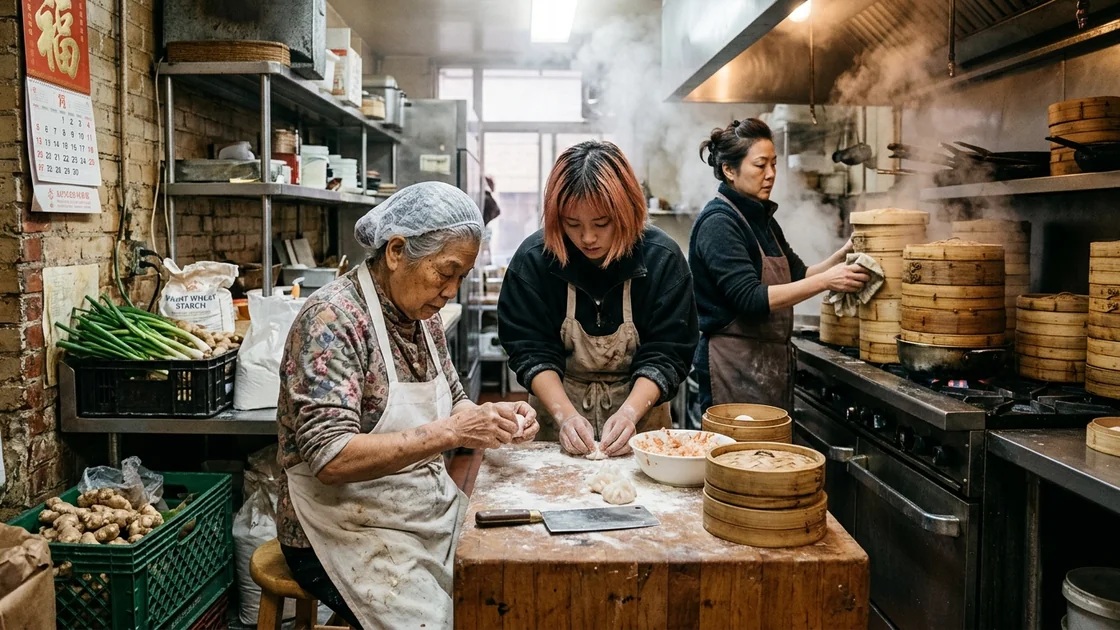
Three generations of Chinese American women fight to preserve their family dim sum restaurant, the Golden Dragon Tea House, during a blistering summer in San Francisco Chinatown. Lin Baobao, the family matriarch who crossed the Pacific in 1968, clings fiercely to the grueling culinary traditions of Guangzhou. Her daughter, May Chen, bears the silent agony of balancing the restaurant ledgers against skyrocketing commercial rents and the predatory advances of a venture-capital development group. Meanwhile, granddaughter Ruby Chen returns from college adrift and uncertain, only to discover that the vanishing neighborhood holds the key to her identity. Together, the three women navigate old domestic wounds, changing cultural tides, financial ruin, and the shifting identity of an immigrant sanctuary, transforming a fight for real estate into a passionate defense of labor, heritage, and the enduring power of food.
Act I: The Hour of the Tiger
The Stockton Street corridor did not awaken so much as it shook off the damp, salt-laced fog that crept up from the bay at four in the morning. Before the municipal buses began their grinding ascents up the grades, before the produce trucks idled against the curbs to discharge crates of bitter melon, Chinese broccoli, and bok choy still slick with dew, there was the hiss of Lin Baobao’s steam valves.
The Golden Dragon Tea House occupied the ground floor and basement of a three-story brick building constructed just two years after the 1906 earthquake. Its jade-green tile facade had weathered a century of diesel exhaust, oceanic brine, and winter storms. Inside, the air smelled permanent: a thick, atmospheric lacquer composed of toasted sesame oil, scorched peanut fat, fermented black beans, five-spice powder, and seventy years of pork fat rendered into the floorboards.
Lin Baobao stood at the heavy butcher block in the rear kitchen. At seventy-seven, her spine was curved like the handle of a ceramic spoon, but her forearms possessed the dry, corded density of cured hardwood. She wore her uniform: a faded floral smock over black trousers, rubber boots with corrugated treads, and a white cotton hairnet pulled taut over steel-gray hair.
In front of her sat thirty pounds of wheat starch and tapioca flour.
Lin did not use scales. She measured with her palms. She scooped the starch into a mountain on the zinc table, made a crater at its summit with two fingers, and poured boiling water from a battered copper kettle. The water had to be at a violent rolling boil; if the temperature dropped even five degrees, the starches would fail to gelatinize properly, resulting in a skin that broke when pinched or turned gummy in the steamer baskets.
She took a flat wooden paddle and beat the slurry into a translucent paste. Her movements were rhythmic, relentless, and unsparing. Steam billowed into her face, beading on her eyelashes and softening the deep creases framing her mouth.
"A-Ma," a voice called softly from the basement staircase. "You didn't turn on the hood exhaust again. The alarm in the hallway will start screaming."
Lin did not turn. "The exhaust sucks the heat out of the air. Cold air kills the dough. You know this, May. Forty years I tell you this."
May Chen descended the final three steps, carrying a stack of plastic milk crates laden with green onions. At forty-nine, May had the same sharp, appraising eyes as her mother, though hers were ringed with violet exhaustion. She wore a fleece vest over an apron and held a clipboard beneath one arm. Her knuckles were swollen with the early onset of the same arthritis that bowed Lin’s fingers.
"The health inspector doesn't care about the dough, A-Ma," May said in Cantonese, setting the crates beside the washing sink. "Mr. Gidley from the Department of Building Inspection said last November that our ventilation was borderline. If we trip the sensor, it logs it."
"Gidley has never eaten a decent har gow in his miserable life," Lin muttered, digging both hands into the hot mass of dough. She began to knead, transferring her entire body weight through the heels of her palms. "A man who drinks cold milk out of a carton has no business telling me how to handle steam."
May sighed, a small exhalation that barely stirred her bangs. She walked to the small corner desk that had served as the restaurant’s nerve center since her father, Raymond Chen, had purchased the lease in 1974. The desk was buried beneath an avalanche of vendor receipts, produce manifests, linen services invoices, and utility notices. On top of everything lay a certified envelope from Vanguard Urban Partners, postmarked sixteen days earlier.
May’s hand drifted toward the envelope, hovered for a second, and then retreated. She picked up the kitchen schedule instead.
"Ruby's train was supposed to get into Emeryville at midnight," Lin said, her rhythm never faltering as she divided the dough into long, pale cylinders. "Did you pick her up?"
"She took the bus across the bridge," May replied, her tone deliberately even. "She said she didn't want me driving late after the dinner shift."
"A girl of twenty shouldn't be wandering the streets at one in the morning with a suitcase," Lin said. "Chinatown isn't what it was. Too many strange ghosts hanging around the alleys now. Empty storefronts. People with no homes, sleeping on the steps of the herb shops. In my day, the family met you at the dock. Even if it was three in the morning, even if it was raining stones."
"She’s twenty-one, Ma. And she’s grown up here. She knows every cobblestone between the bridge terminal and Jackson Street."
The swinging aluminum doors leading to the dining room squeaked on their brass hinges. Ruby stepped through, carrying a large canvas tote bag and a cardboard cup of black coffee from the corner bakery.
Ruby had inherited Lin’s square jaw and May’s wide, guarded eyes. Her hair was cut into a jagged, chin-length bob, the ends tinted an oxidized copper that Lin had already spent two phone calls lamenting. She wore an oversized chore jacket, loose denim trousers frayed at the hems, and canvas sneakers stained with printer's ink from her university’s lithography studio.
"I can hear you both from the cashier stand," Ruby said, speaking English with the rapid, percussive cadence of someone who had spent the last three years in dormitories and seminar rooms. "Good morning, Popo. Morning, Mom."
Lin stopped kneading. She wiped her hands on her apron, leaving two white, ghostly handprints on the calico print. She stepped forward, her eyes narrowing as she scrutinized her granddaughter.
"Look at you," Lin said in Toishan-inflected Cantonese, reaching up with a floured hand to gently pinch Ruby’s cheek. "Thinner than a bamboo rake. What do they feed you at that school in Portland? Grass? Everything is cold up there. You look like you haven't seen a bowl of hot rice since Christmas."
"I eat fine, Popo," Ruby said, leaning down to let her grandmother press a dry, warm forehead against her neck. "I cook."
"Boiling noodles in an electric pot is not cooking," Lin declared, turning back to the dough with an air of absolute authority. "Go wash your hands. The pork filling for the siu mai needs more white pepper, and the turnip cake is already in the steamer. If you're going to stand there looking like a ghost, you might as well peel garlic."
Ruby caught her mother’s eye over Lin’s curved shoulder. May gave a slight, almost imperceptible shake of her head—a warning: Don't start. Not today.
"I brought my portfolio," Ruby said quietly, setting her canvas bag on an empty prep table. "The woodblocks from the Chinatown history project."
"Put it in the office," May said, not looking up from her clipboard. "Don't let the soy sauce splatter on it. Today is Friday. The lunch rush starts at eleven, and Uncle Keung called in with his gout again. We have three hundred reservations between noon and two, and half of them are tour groups from the wharf."
Ruby looked around the kitchen. Nothing had changed in three years, or ten, or twenty. The blue-flame roar of the high-BTU wok burners; the rhythmic, metallic thunk-clack of the vegetable cleavers hitting ironwood boards; the sweet, pungent breath of five-spice and caramelized drippings trickling down the wall of the roast-meat pit; the yellowed calendar from the Bank of Canton, frozen on an auspicious lunar date from five months ago.
Yet beneath the familiar sounds, Ruby felt an unfamiliar vibration—a strange, hollow frequency that hummed in the floorboards. Across the street, the three-story building that had once housed the Wah Sing Herbal Dispensary was completely shrouded in black scaffolding. For three weeks, heavy drills had been tearing out the century-old redwood beams to make way for a forty-unit "boutique lifestyle" condominium project with ground-floor artisanal retail. Every time the hydraulic breakers struck the earth, the delicate porcelain teacups on the Golden Dragon's back shelves clinked together like small, anxious teeth.
Act II: The Anatomy of a Dumpling
By ten in the morning, the kitchen had entered its state of organized frenzy.
Dim sum was not merely food; it was an architecture of timing and physical pressure. The Golden Dragon offered over fifty varieties, each requiring a distinct hand motion, an exact cooking time, and a specific balance of fat to lean, moisture to starch.
Lin Baobao sat on a low wooden stool beside the primary dumpling station. To her left was a broad porcelain tub filled with har gow filling: wild-caught gulf shrimp cut into bite-sized segments, bamboo shoots shredded into fine needles, rendered pork lard cut into cubes the size of peppercorns, seasoned with toasted sesame oil, ginger juice, sugar, and white pepper. The lard was the secret—it had to remain frozen until the moment the dumpling entered the steam, where it would melt into a rich, boiling broth that bathed the shrimp from within.
Lin held a round-bladed cleaver—a pi mian dao—its surface rubbed with peanut oil. She took a walnut-sized ball of translucent starch dough, placed it on the board, and with a single, sweeping circular motion of the flat blade, flattened it into an immaculate, paper-thin disc.
"Watch the edges," she commanded, not looking at Ruby, who sat on a matching stool across from her. "The center must be thick as a coin; the edge must be thin as a cicada's wing. If the center is too thin, the shrimp tails punch through when they swell. If the edge is too thick, the pleats will taste like raw paste."
Ruby attempted the stroke. She held the heavy blade, pressed down, and dragged it across the board. The dough tore, leaving a jagged, sticky smear on the steel.
"Too heavy," Lin muttered. "You use your shoulder. Why do you use your shoulder? The cleaver is your hand. Does your hand weigh twenty pounds? Use your wrist. Light. Like a bird landing on water."
Ruby balled up the ruined dough, tossed it into the scrap bin, and reached for another portion. Her thumb ached. At the university, she spent twelve hours a day carving intricate relief lines into cherry-wood blocks, capturing the faces of Chinatown laundry workers and garment seamstresses from the 1920s. Her hands were precise, calloused from gouges and chisels, yet here, under Lin’s ancient, unblinking glare, her fingers felt thick and useless, like wet clay.
"You have no patience," Lin said, her own knife moving in a hypnotic blur: press, sweep, lift. A perfect disc appeared. Without looking, she dropped a spoonful of filling onto the circle. Her left thumb and forefinger began to fold, gathering the translucent skin into pleats. One, two, three, four, five...
By the tenth pleat, the dumpling had closed into a perfect, crescent-shaped purse, resembling a pleated bonnet. Lin placed it on a square of parchment paper inside a round cedar steamer basket. It joined eleven identical twins, all sitting in precise formation, their pink fillings blushing softly through the sheer dough.
"Twelve pleats," Ruby murmured. "Nobody does twelve pleats anymore, Popo. Even the big banquet halls on Geary use machines now. Eight pleats, maximum."
"Machines," Lin spat the word out like a bitter melon seed. "Machines make paste bags. A machine doesn't know if the shrimp is wet today or dry today. A machine doesn't know if the fog outside has made the starch damp. A machine has no heart to tell it when the dough wants to break. You eat a machine dumpling, you are eating dead things."
"The machines don't get arthritis," May’s voice cut in. She was carrying three heavy aluminum trays of braised chicken feet—deep-fried, marinated in star anise, cinnamon, and red fermented bean curd, then steamed until the skin puffed into tender, wrinkled folds.
May set the trays down with a sharp clang. She looked down at Ruby’s clumsy efforts, then at her mother’s effortless production.
"Don't push her, Ma," May said. "Ruby didn't come home to become a dim sum chef. She has a degree to finish. She’s going to be a designer. An artist."
"An artist," Lin echoed, her voice dropping into a register of dry amusement. "What is this?" She held up her cleaver, its mirror-polished face catching the bare fluorescent light overhead. "This is not art? Forty years I make this skin. People come from Vancouver, from New York, from Hong Kong to eat this. The governor came here. That man with the big hair—the governor—he sat at table six and ate two baskets by himself. He said, 'Mrs. Chen, you are an artist.' Now my granddaughter goes to Oregon to learn how to make drawings of dead people, and her mother calls that art."
"Popo, they aren't dead people," Ruby said, struggling to keep her voice level. "They’re our people. The people who built the tunnels through the Sierra. The people who ran the illegal basement boarding houses during the Exclusion Act. If we don't document them, their stories get erased."
"Their stories are in the food," Lin said firmly, setting down her cleaver with a final, decisive tap. "The food is still here. The people are still here."
"Are they?" Ruby asked, pointing a flour-dusted finger toward the front window where the dining room was beginning to show the first signs of life. "Look outside, Popo."
Through the frosted glass of the double doors, the silhouettes of the neighborhood were visible. Across the street, the construction crew was already unloading steel girders. Down the block, the old bakery that had sold egg tarts and lard biscuits for fifty-five years was shuttered, its windows covered in brown paper bearing a glossy architectural rendering of an "open-concept co-working lounge."
Lin did not look. She picked up another ball of starch dough.
"People get hungry," she said. "They will always come for the tea."
May didn't answer. She turned away quickly, her face pale, and vanished back into the small office. Through the half-open door, Ruby watched her mother pick up the white certified envelope from Vanguard Urban Partners, turn it over in her hands, and drop her head onto her arms amidst the scattered receipts.
Act III: The Red Ledger
By two in the afternoon, the lunchtime storm had subsided, leaving the dining room strewn with dirty teacups, bamboo steamers slick with chili oil, crumpled paper napkins, and the faint, sweet scent of almond cookies.
The Golden Dragon was a split-level palace of another era. The walls were paneled in imitation walnut veneer, adorned with large, circular mirrors framed by gilded plaster dragons chasing mother-of-pearl flaming pearls. The ceiling was a grid of pressed-tin tiles painted a faded vermilion, from which hung two enormous chandeliers of cut glass that jingled whenever the cable cars rumbled along California Street two blocks away.
Ruby sat at table twelve, clearing empty tea caddies. In the corner, near the defunct aquarium where plastic water plants swayed in stagnant water, May sat with an adding machine.
The machine was an ancient, electric Monroe with a narrow roll of paper tape that curled onto the floor like a dried ribbon. Every punch of a key produced a sharp, concussive clack, followed by the metallic wheeze of the carriage return.
Clack-clack-clack-whirrr.
Ruby set down her tray and walked over. "Mom."
May did not look up. Her finger kept moving over the number pad. "Did you finish wiping down the cart runners? Uncle Keung says the cart wheels are sticking. If they don't roll smooth, the soup spills."
"Mom, stop for a second. Look at me."
May’s finger paused over the zero key. The machine gave a low, unsatisfied hum. She slowly leaned back, removing her reading glasses with a small, exhausted gesture. Her eyes were sunken, dark smudges beneath the lower lids telling of months of broken sleep.
"What is that letter?" Ruby asked, pointing to the desk where the Vanguard envelope now lay open.
May looked at the paper tape pooling around her ankles. "It’s nothing you need to worry about. Go help your grandmother with the afternoon prep. The banquet tonight has eighty covers."
"I'm twenty-one," Ruby said, pulling out a chair and sitting down opposite her mother. "I'm not twelve. I know we haven't paid the linen bill since March. I saw the red stamps on the flour invoices in the storeroom. And I know who Vanguard Urban Partners is. They just bought out four residential hotels on Powell Street."
May let out a short, brittle laugh. She picked up the letter and laid it flat on the formica table.
"They bought the building," May said, her voice dropping to a whisper so it wouldn't carry into the kitchen where Lin was clattering the stockpots. "Mr. Ho sold it. His sons live in San Jose; they don't want to manage a seventy-year-old brick box with cracked pipes and a leaky roof. Vanguard bought the master parcel for eleven million dollars."
Ruby stared at the corporate letterhead. The logo was a minimalist geometric tree, sleek and clinical. "And our lease?"
"Our lease expired three months ago," May said. "We were on month-to-month. Ho told me last year not to worry, that he would give us a ten-year renewal when he got back from Hong Kong. He never went to Hong Kong. He went to a lawyer's office in Palo Alto."
"How much are they raising it?"
"They aren't raising it," May said.
Ruby blinked. "They’re not?"
"They’re terminating it," May whispered, her fingers curling tightly around the edges of the table. "They want the building empty by August thirty-first. They’re converting the upper two floors into luxury lofts—'creative live-work spaces'—and they want the ground floor for a food hall. An ‘artisan marketplace.’ They offered us forty thousand dollars as a relocation incentive if we vacate quietly and surrender the fixtures."
"Forty thousand dollars?" Ruby’s voice rose, sharp and incredulous. "You couldn't move the walk-in refrigerator across the street for forty thousand dollars! The commercial kitchen hoods alone cost sixty grand to install!"
"Hush!" May hissed, glancing toward the kitchen doors. "Do you want her to hear you?"
"Does she know?"
"No," May said, her voice trembling for the first time. "And she can't know. Not yet. Do you know what this place is to her, Ruby? In 1968, when she came over, she worked in the basement of the garment factory on Commercial Street for six years. Twelve hours a day, five cents a dress. She saved every nickel in an iron biscuit tin under her mattress. When your grandfather bought this place, they slept on cots in the dry-goods room for the first three years so they wouldn't miss the four-o'clock vegetable deliveries. This floor is her life. If I tell her we're being thrown out by a group of tech investors who think dim sum is something you order through an app on a phone, she won't survive it."
"You can't hide it from her, Mom. It's July. We have six weeks."
"Then we have six weeks," May said grimly, picking up her glasses and putting them back on. "I have an appointment with a loan officer at East West Bank tomorrow. I'm going to see if we can secure a secondary commercial line to make a counter-offer. If we can match their projected revenue for the first two years—"
"Match their revenue?" Ruby stood up, her chair scraping sharply against the linoleum. "Mom, you just said they paid eleven million! The rent will be thirty thousand a month! How many baskets of siu mai do you have to sell to make thirty thousand dollars? At six dollars a basket? That’s five thousand baskets just for rent! Not including pork, not including shrimp, not including payroll, not including gas!"
May flinched. The numbers were there on the paper tape, long columns of black ink marching toward a final, bloody subtraction.
"Then what do you want me to do, Ruby?" May’s voice broke, the reserve she had maintained for years cracking open like an eggshell. "You want me to walk in there and tell your grandmother that her fifty years of work was for nothing? That the white people with the money can just walk in, sign a paper, and wash us away like grease down a drain? Is that what they teach you in Oregon? How to quit?"
Ruby stepped back, her chest heaving. Through the double doors, Lin Baobao emerged. She was carrying a huge round wicker tray laden with hundreds of dried lotus leaves, soaked in hot water to make them pliable for wrapping sticky rice.
Lin stopped. She looked at May, hunched over the adding machine, her face wet with silent tears. She looked at Ruby, standing rigid, her hands clenched in her pockets.
The old woman set the heavy tray down on table eight. The dry leaves gave off a deep, marshy fragrance, reminiscent of stagnant river water and summer rain.
"The tea is cold," Lin said simply.
She walked to the large copper urn near the counter, poured three porcelain cups of dark, fragrant Pu-erh tea, and brought them to table twelve. She set one before May, one before Ruby, and kept one for herself.
"Sit," Lin commanded.
Ruby hesitated, then sat. May took a shuddering breath, pulled a paper napkin from the dispenser, and wiped her eyes beneath her glasses.
Lin took a slow sip of the tea, her eyelids dropping slightly as she tasted the dark, earthy brew. "The envelope is from the landlord."
May froze. "Ma..."
"You think because I don't read the English newspaper, I am blind?" Lin’s voice was remarkably calm, carrying none of the sharp irritability she used when correcting Ruby’s knife work. "The building was sold in May. Old man Ho’s cousin told me at the herb shop two weeks ago."
May stared at her mother, her mouth slightly open. "You knew?"
"I know Ho. His father was an honorable man. He had sand in his hands. But the sons? The sons wear shoes made of thin leather and don't know how to hold a bowl. When Ho's wife died, I knew he would sell. A man who loses his woman loses his anchor. He wants to go sit in the sun in Monterey and forget he ever smelled chicken broth."
"A-Ma," May whispered, "they want us to leave by August."
"They want," Lin said, setting her teacup down with a hollow click. "A dog wants a beef bone. Does the ox give it to him? No. The ox keeps pulling the plow."
"This isn't an ox, Popo," Ruby said, leaning forward. "This is a venture fund. They have lawyers, they have millions of dollars, they have the city planning commission in their pockets. You can't just ignore them."
Lin looked at Ruby, her ancient, cloudy eyes suddenly clear and sharp as chipped obsidian.
"In 1971," Lin said, "the city wanted to tear down the International Hotel on Kearny Street. They wanted to put a parking garage there. The police came with horses. They came with clubs as thick as my arm. Your grandfather and I, we stood on that sidewalk with the old Manongs, the Filipino brothers who lived in the small rooms. We held hands. A horse stepped on my foot. Look here."
Lin pulled back her trouser leg, showing an ankle where the bone was slightly misshapen, the skin marbled with white scar tissue.
"Did we leave?" Lin asked. "They tore the hotel down, yes. Many years later. But they did not tear us down. We stayed. We moved three doors down, we opened this shop. The white men with the briefcases, Ruby—they are like the summer grasshoppers. They come when the sun is hot, they make a great noise, they eat everything green, and then the cold wind comes, and they die. But the earth? The stone? The stone is still here."
"A-Ma, this isn't the 1970s," May said wearily. "They don't use clubs anymore. They use lease covenants and zoning variances. If we don't have the rent, the sheriff comes and changes the locks. It’s that simple."
"Then we find the money," Lin said.
"Where?" May cried, gesturing around the vast, empty room. "Where are we going to find two hundred thousand dollars for a lease deposit and back rent? Look at these tables! We're half-empty on Tuesday nights! The young people, the ones who work in the big towers downtown—they don't want to come here. They say it’s too greasy. They say the carts are loud. They want their food brought to them in brown paper sacks by men on bicycles! They want poke bowls and boba tea! They don't want us!"
Lin stood up. She smoothed her smock down over her flat hips.
"They don't want us because you have forgotten who we are," Lin said, her voice dropping into a register of icy, terrible certainty. "You cut the menu. You buy the frozen bamboo shoots because they are cheap. You stop serving the winter melon soup because it takes eight hours to carve the rind. You buy the commercial dumpling wrappers for the pan-fried dumplings because you say nobody knows the difference."
Lin turned to Ruby. "Do they know the difference?"
Ruby looked from her grandmother’s fierce, weathered face to her mother’s hollowed, wounded eyes.
"Yes," Ruby said quietly. "They know."
Act IV: The Architecture of Memory
That night, after the grease traps had been emptied and the heavy steel security gates pulled down over the front windows with a hollow, rattling groan, Ruby did not go to bed.
She stayed in the dining room, sitting by the faint yellow glow of a single brass floor lamp. Spread across table seven were her woodblock prints, her sketchbooks, and three thick binders she had pulled from the back shelves of the Chinese Historical Society of America on Clay Street, where she had interned the previous summer.
Chinatown was not merely a neighborhood; it was an organism built on layers of collective defense. After the 1906 quake, when the city oligarchy attempted to relocate the entire Chinese population to the marshlands of Hunters Point to claim the prime real estate overlooking the financial core, the community had fought back not with weapons, but with architecture. They had hired Western architects to design buildings with fanciful, exaggerated pagodas, flared eaves, and bright red temple balconies—creating a deliberate, theatrical "Chinoiserie" that transformed the neighborhood into an undeniable tourist attraction that the city could not afford to raze.
Survival through performance, Ruby wrote in her notebook. Authenticity as a weapon.
She flipped through the yellowed clippings in the historical binder. In 1938, the garment workers went on strike for fifteen weeks against the National Dollar Stores factory, winning the right to collective bargaining through sheer, disciplined endurance. In 1977, the tenants of the I-Hotel had mobilized thousands of students, activists, and elders to form a human barricade against the wrecking balls.
She heard soft footsteps on the linoleum. May emerged from the kitchen, wearing an old terry-cloth bathrobe, holding two mugs of hot water steeped with dried chrysanthemum petals and goji berries.
She set a mug before Ruby and pulled out the adjacent chair.
"You should sleep," May said. "The morning prep starts at four."
"I'm looking at the lease history," Ruby said, tapping a copy of the 1974 commercial agreement Raymond Chen had signed. "Mom, did you know this building was originally designated as an anchor property for the Chinese Consolidated Benevolent Association?"
May blew softly across the surface of her tea. "I know. Your grandfather had to go before the Six Companies council three times before they approved the transfer. He had to prove he had enough family support to guarantee the business wouldn't fail. In those days, there were no bank loans for people like him. You borrowed from your village association, from the cousins with the same surname. Everyone put fifty dollars into an envelope, and you paid it back twenty years later, without interest, but with your reputation as collateral."
"What happened to that?" Ruby asked. "The associations?"
"The world changed," May said, her gaze drifting toward the darkened street. "The old uncles died. The kids grew up, went to Berkeley and Davis, moved to Walnut Creek, Fremont, San Jose. They didn't want to work fourteen hours a day over a boiling oil wok. Can you blame them? Your grandfather died of a stroke behind that counter when he was fifty-eight. His heart just stopped while he was slicing roast duck. I was twenty-two, Ruby. Exactly your age."
Ruby looked at her mother. She had heard the story before, but always as a bare fact, an entry in the family chronology.
"You took over right away?"
"I was enrolled at San Francisco State," May said quietly. "I was studying accounting. I wanted to work for one of the big firms in the high-rises on Montgomery Street. I had the interview suits. I had the little heels that clicked when you walked on marble floors. Then Raymond died. The next morning, the flour truck arrived at four. A-Ma couldn't sign the invoice; she couldn't read the English. The vegetable man was threatening to take the bok choy to another shop if he didn't get cash. So I put on Raymond's apron. It smelled like five-spice and grease. It hung down to my ankles."
May reached out, her finger tracing the carved grain of one of Ruby’s woodblocks—a detailed, high-contrast portrait of an elderly woman carrying an iron steamer basket through an alley hung with laundry.
"I thought it would be for a year," May murmured. "Just until we paid back the uncle associations. Then a year became five. Then I met your father. He worked the roasting pit. He had big ideas about opening a second location in Oakland. Then he left, and the restaurant was still here. It was always here. It ate my twenties, it ate my thirties, it ate my marriage. And now..."
She stopped, her throat working silently.
"And now you think you're going to lose it," Ruby said.
"I think," May said, her voice dropping into a register of profound, exhausted defeat, "that I have failed both of you. I didn't get out like the cousins did, and I couldn't protect what Raymond left behind."
Ruby reached across the table and took her mother’s hand. The skin of May’s palm was thick and rough, calloused from decades of carrying heavy ceramic platters and hot stainless steel lids. It felt exactly like Lin’s hand.
"You didn't fail," Ruby said fiercely. "Popo is right about one thing, Mom. We've been playing defense for thirty years. We've been trying to survive by getting smaller, by cutting things, by apologizing for being old. Vanguard doesn't think this place is worthless. If they thought it was worthless, they wouldn't want the ground floor."
Ruby pulled a glossy brochure from her portfolio bag. It was the marketing packet Vanguard Urban Partners had released for the building redevelopment, which she had downloaded from their corporate website that afternoon.
On the front was a three-dimensional digital rendering of the Golden Dragon space. The iconic dragons had been stripped from the mirrors. The red tile had been replaced with white subway tile and polished concrete. The high, clattering pushcarts were gone; in their place were communal blond-wood tables, exposed iron ductwork, and sleek neon signs that read: CHINATOWN BAZAAR: AUTHENTIC HERITAGE EATS.
"Look at this," Ruby said, shoving the brochure toward May. "Look at what they’re calling it. 'The Historic Silk and Spice Hall.' They're selling our memory, Mom! They’re kicking us out so they can hire an outside hospitality group to sell twenty-dollar bowls of pork belly ramen and eight-dollar steamed buns to the people who move into the lofts upstairs!"
May looked at the rendering. Her eyes narrowed, the defeat in her posture suddenly replaced by a sharp, cold clarity.
"They kept the chandeliers," May noted, her voice dropping an octave. "They took down the dragons, but they kept the chandeliers Raymond brought over from Hong Kong."
"Because they look 'vintage,'" Ruby sneered. "They want the skin of this place, but they want to hollow out the meat."
"So what do we do?" May asked, looking up from the glossy paper to meet her daughter’s eyes. "We can't outbid them, Ruby. Vanguard has private equity behind them."
Ruby leaned in, her eyes shining with the manic, furious energy that comes from sleeplessness and revelation.
"We don't outbid them," Ruby said. "We make it impossible for them to build it."
Act V: The Battle of the Banners
The strategy began not with a spreadsheet, but with ink.
By dawn on Saturday, Ruby had cleared the tables in the Golden Dragon’s rear banquet room, transforming it into a makeshift printmaking workshop. Using heavy brayers, she rolled water-soluble relief ink across large linoleum blocks she had spent thirty hours carving.
The images were bold, graphical, reminiscent of the agitprop posters produced by the San Francisco Poster Workshop during the student strikes of 1969. One showed Lin Baobao’s hands, magnified and monumental, holding a bamboo steamer from which rose clouds of steam that formed the characters for SOLIDARITY and CONTINUITY. Another depicted the facade of the Golden Dragon surrounded by an unbroken chain of human silhouettes, beneath the bold English and Chinese text: WE BUILT THIS CITY. WE ARE NOT FOR SALE.
"What is this mess?" Lin demanded, entering the room at five in the morning, her arms full of dried scallops for the congee.
"This is our lease defense, Popo," Ruby said, not stopping as she lowered a sheet of heavy mulberry paper onto the inked block and ran a wooden baren across the back in steady circles.
Lin peered at the print. She reached down, her ink-averse fingers hesitating an inch above the wet surface.
"The nose is too big," Lin said, pointing at her own likeness. "I don't have a nose like an eggplant."
"It’s stylized, Popo," Ruby said, peeling the paper back to reveal the crisp, striking image.
"It looks like an eggplant," Lin repeated, but her hand lingered near the image, and a tiny, almost invisible softening appeared at the corner of her mouth. "Why are you writing in English? The city inspectors don't care about your pictures."
"The city inspectors don't," Ruby said, "but the Historic Preservation Commission does. Mom and I were up until three. We filed an emergency petition this morning for the Golden Dragon to be reviewed as an Individual Historic Landmark under Article 10 of the Planning Code."
Lin turned to May, who had just entered carrying a crate of winter melons. "What is an Article 10?"
"It means," May said, setting the crate down with a grunt, "that if the city designates the restaurant as a historic resource—not just the building, but the culinary practice inside it—Vanguard can't alter the interior fixtures, they can't demolish the kitchen, and they can't terminate our occupancy without a two-year environmental review and neighborhood impact study."
Lin looked suspicious. "The city does this? The same city that gave us a parking ticket every morning for twenty years when the vegetable truck was five minutes late?"
"The city won't do it because they want to, A-Ma," May said, her voice firmer than it had been in months. "They'll do it because we're going to make it too politically expensive for them not to."
For three weeks, the Golden Dragon became the epicenter of an insurgency.
Ruby mobilized her network from the university, bringing down young organizers from the Chinatown Community Development Center, artists from the Kearny Street Workshop, and student activists from across the Bay. They hung the relief prints in the windows of every herbal dispensary, grocer, and laundromat between Broadway and Bush Street.
They set up a table outside the front entrance, collecting thousands of signatures on petitions demanding that the Board of Supervisors halt the commercial eviction of long-standing cultural institutions. They produced short, percussive videos for social media showing Lin Baobao hand-crafting har gow pleat by pleat, contrasting her labor with the corporate portfolio of Vanguard Urban Partners, whose lead managing partner had recently been quoted in a tech journal calling Chinatown "an under-monetized transit-adjacent real estate opportunity."
The video went viral. Over two million people watched Lin’s flour-dusted hands work the cleaver blade.
Suddenly, the lunchtime crowds shifted. The tourists from the double-decker buses were still there, but they were joined by young Asian Americans from across the state—software engineers from San Mateo, law students from Berkeley, nurses from Oakland—who waited in lines that stretched three blocks down Stockton Street, under the watchful, nervous eyes of the construction workers across the street.
They didn't just want food; they wanted communion. They wanted to sit in the high-backed booths beneath the gilded dragons, to hear the clatter of the pushcarts, to taste the pork fat and the bitter tea, to feel that by spending twelve dollars on a plate of steamed rice noodle rolls, they were throwing a stone against the overwhelming machinery of displacement.
Inside the kitchen, the work became merciless.
Lin refused to compromise. If the orders tripled, the standards tripled. She stood at the wok stations for fourteen hours a day, her face glistening with oil, barking corrections at the prep line.
"More ginger in the tripe!" she screamed over the roar of the burners. "The water is not hot enough for the sponge cake! Who folded this dumpling? It looks like a squashed toad! Throw it out! Throw it out!"
May handled the floor with military efficiency. She had abandoned the Monroe adding machine; she now worked from an iPad Ruby had configured, tracking seat turnovers, managing the waitlist, and coordinating with the local merchant association.
Yet beneath the surge of cash and the intoxicating energy of resistance, the clock was running out.
On the third of August, an official envelope arrived, bearing the seal of the San Francisco Superior Court. Vanguard had filed an unlawful detainer action, accompanied by a request for summary judgment. The hearing before the Historic Preservation Commission was scheduled for August twenty-fifth, but the eviction notice required the premises to be surrendered by August twenty-second.
The law was moving faster than the culture.
Act VI: The Night of the Great Kettle
The heatwave that struck the Bay Area in the second week of August was the worst in forty years. The marine layer failed completely, leaving the city baking under a dry, stagnant dome of inland air that smelled of baking asphalt and eucalyptus dust.
In the kitchen of the Golden Dragon, the temperature hovered at one hundred and four degrees.
The walk-in compressor was screaming. Its fan belt, worn thin by decades of continuous rotation, had begun to shred, filling the basement with the faint, toxic stench of burning neoprene.
"It won't hold through the weekend," May said, emerging from the basement with a mechanic’s wrench in her hand. Her face was smudged with black grease. "The repairman from Mission Refrigeration says he can't get the replacement motor until Tuesday. If the temperature in the box goes above forty-one degrees, the health department will shut us down on the spot."
Lin was sitting on her low stool, peeling water chestnuts. Her breath came in short, dry gasps. She had refused to sit near the electric fan Ruby had brought, claiming the draft gave her rheumatism in her shoulders.
"Get the ice," Lin croaked.
"A-Ma, we need three tons of ice to keep that walk-in cool," May said.
"Then call the fish market," Lin said, her voice shaking slightly with fatigue. "The Lee family on Jackson. They have the crushed ice for the rockfish. Tell him Lin Baobao needs it. He remembers who lent his father the money for his first diesel boat."
Ruby looked at her grandmother. Lin’s lips were pale, tinted with a faint bluish cast that terrified her.
"Popo, you have to go home," Ruby said, kneeling beside the stool and gently taking the small paring knife from her fingers. "You've been here since four. You're dehydrated."
"I am not going home," Lin said, trying to pull her hand back, but her grip was weak, lacking its usual iron authority. "Tomorrow is the Midsummer Banquet. The Six Companies are coming. The Supervisor is coming. That girl from the television station is coming. If the turnip cake is sour, we are finished."
"Popo, please," Ruby begged.
Lin looked at her. For the first time in Ruby’s life, she saw hesitation in her grandmother’s eyes—a vast, terrible vulnerability.
"If I leave this room," Lin whispered in Toishan, "the doors will close. I know it. When Raymond died, I went to the cemetery for three hours. When I came back, the landlord had already put a chain across the back gate. If I walk out that door, Ruby, I will never walk back in."
May stepped forward. She knelt beside Ruby, so that both women were at eye level with the matriarch.
"Ma," May said softly, using the intimate, childlike term she hadn't spoken in thirty years. "The restaurant isn't the brick. It isn't the green tiles. It isn't the dragons on the wall."
"Don't tell me fairy tales," Lin said harshly, though tears were welling in the corners of her milky eyes. "You sound like the white people on television. The food needs a stove. The stove needs a floor. The floor needs a roof. Without this room, what are we? Two old women and a girl with an ink roller, sitting on the sidewalk like beggars."
"We are not beggars," Ruby said.
The swinging doors opened with a dull rattle. Standing in the doorway was a man in an expensive charcoal suit, accompanied by two younger men carrying digital tablets and laser measuring devices.
Julian Mercer, Senior Vice President of Acquisitions for Vanguard Urban Partners.
Mercer was thirty-six, athletic, with close-cropped silvering hair and the relaxed, predatory posture of someone who had never lost a negotiation in his life. He looked around the kitchen with an expression of faint amusement, his eyes lingering on the grease-lacquered exhaust hood and the stacks of bamboo steamers.
"Mrs. Chen?" Mercer said, speaking to May. "I'm Julian Mercer. We had an appointment with your counsel, but he wasn't at his office."
May stood up slowly, wiping her greasy hands on her apron. Ruby rose beside her, her spine rigid, her chin lifted.
"Our lawyer is filing an emergency injunction at the Superior Court," May said. "You have no right to be in this kitchen, Mr. Mercer. This is an active commercial leasehold until the sheriff says otherwise."
Mercer offered a polite, practiced smile. He pulled a gold-clipped pen from his breast pocket and tapped it lightly against his palm.
"Actually, Mrs. Chen, that’s why I'm here. To save everyone the indignity of the sheriff. The Superior Court denied your ex-parte application forty minutes ago. The writ of possession was signed by Judge Martinez at three o'clock."
The kitchen fell dead silent. The only sound was the failing hum of the walk-in refrigerator and the steady, rhythmic drip-drip-drip of condensation falling from the copper pipes onto the zinc table.
May’s breath caught in her throat. Her face drained of all color.
"The landmark hearing is on the twenty-fifth," Ruby said, stepping between Mercer and her mother. "You can't execute a writ of possession while an Article 10 designation is pending."
Mercer looked at Ruby with the mild, patronizing indulgence one might show an articulate child.
"Miss Chen, I presume? The artist? We've seen your posters. Very impressive campaign. Truly. But Article 10 applies to structures, not businesses. We have no intention of altering the historic exterior. In fact, our architects have incorporated the original masonry and the ceiling trusses into the design for the new food hall. The Historic Preservation Commission reviewed our preliminary drawings this morning and issued a letter of non-opposition."
Mercer turned back to May, his tone lowering into what he clearly believed was a sympathetic register.
"Mrs. Chen, we don't want to drag your mother out onto Stockton Street in front of the local news cameras. It’s bad for our brand, and it’s deeply painful for your family. The forty-thousand-dollar relocation offer is off the table, but I am authorized to offer you seventy-five thousand dollars—in cash, today—if you sign the voluntary surrender agreement and deliver the keys by midnight tomorrow."
He reached into his breast pocket and produced a neat, blue-bound legal document, laying it on the edge of the prep table, inches from the bowl of peeled water chestnuts.
Lin Baobao did not move. She sat on her stool, her hands resting in her lap, looking at the blue document.
"Seventy-five thousand," May murmured. It was enough to clear their vendor debts. It was enough to pay off Uncle Keung’s back wages. It was enough to ensure that Lin wouldn't spend her final years living in a single-room-occupancy hotel on Pacific Avenue.
May reached out her hand toward the pen Mercer held.
"Mom, don't," Ruby whispered.
"Ruby, it's over," May said, her voice cracking into a dry sob. "The judge signed it. There's no more appeals. We don't have the money for a bond."
Mercer extended the pen, his smile widening slightly—the smooth, frictionless conclusion to an annoying administrative delay.
Before May’s fingers could touch the gold barrel, Lin Baobao stood up.
Her movement was not slow or arthritic. It had the sudden, explosive economy of a cleaver striking bone.
She picked up the porcelain bowl of peeled water chestnuts—heavy, cold, and dripping with cloudy water—and inverted it directly over Mercer’s polished calfskin shoes.
The wet chestnuts bounced across the floor like ivory dice, splashing starch-clouded water and dark scrapings of peel over the developer’s immaculate trousers and leather loafers.
Mercer leaped back with a sharp, undignified curse, his face flushing crimson. "What the hell is wrong with you?"
Lin looked at him. She did not raise her voice. She did not shout. She spoke in her heavy, ancient Toishan dialect, each word dropping like an iron ingot onto the stone floor.
"You smell like paper," she said.
Mercer glared at May. "Translate that."
May looked from the wet mess on the floor up to her mother’s face. She saw the absolute, unflinching fury in Lin’s eyes—the same fury that had survived the garment sweatshops, the race riots of the 1970s, the death of her husband, and forty years of eighteen-hour days.
May took a slow, deep breath. The exhaustion seemed to drain from her shoulders, replaced by something ancient, cold, and hard as jade.
She looked at Mercer.
"She says," May translated, her voice ringing clear and steady through the quiet kitchen, "that you smell like paper. She says a man who eats paper and sleeps on paper knows nothing about what feeds a human being. And she says you should get the hell out of her kitchen before she takes the cleaver to your other pair of shoes."
Mercer’s eyes went wide. He looked at the two young men with the tablets, then back at May.
"You have until midnight tomorrow," Mercer spat, his professional veneer completely vanished, revealing the small, vindictive bureaucrat beneath. "After that, the tactical unit from the sheriff's department will clear this floor. And you won't get a single dime."
He spun on his heel and strode toward the swinging doors, his wet shoes squeaking loudly on the linoleum: squick-squick-squick.
The kitchen doors settled. The silence returned.
May turned to Lin. Lin turned to May.
For five seconds, neither woman spoke. Then, Lin reached out, picked up a fresh water chestnut, and handed the paring knife back to Ruby.
"We have two hundred portions of sticky rice to wrap," the old woman said. "Why are you two standing around with your mouths open?"
Act VII: The Midsummer Banquet
They did not sleep.
Word spread through Chinatown not through the internet, but through the subterranean networks that had existed since the Qing Dynasty: the kitchen back doors, the alleyway loading docks, the laundry chutes, the card games in the basements of the family association halls.
At nine that evening, Uncle Keung arrived, his swollen, gout-stricken foot wrapped in an old wool scarf and stuffed into a felt slipper. He limped to the roast-meat station without a word, tied a canvas apron around his thick waist, and lit the gas burners on the three-hundred-pound cylindrical roasting drum.
At ten, the back door opened, and Mrs. Lee from the fish market entered, followed by two burly fish cutters carrying four fifty-pound wooden tubs of crushed ice, their aprons smelling of brine and ocean kelp. They dumped the ice into the walk-in’s drainage pans, packed it around the compressor coils, and set three industrial fans to circulate the chilled air.
"No charge," Mrs. Lee said to May, wiping her hands on her trousers. "My husband said if the Golden Dragon closes, Stockton Street is dead anyway. Just save me a basket of the pan-fried turnip cake tomorrow."
By two in the morning, the kitchen was full of ghosts and neighbors. Old cooks who had retired to the Sunset District ten years ago arrived carrying their personal cleavers wrapped in oiled rags. Aunts and cousins from three generations arrived with bags of scallions, ginger root, and five-star soy sauce.
They were not preparing for an eviction; they were preparing for a banquet.
Dim sum was traditionally a morning affair—yum cha, literally "to drink tea." But tonight, the Golden Dragon was reviving the ancient tradition of the Manchu-Han Banquet style—the multi-course evening feast that celebrated survival, defiance, and community continuity.
Lin Baobao presided over the stoves like a general commanding a besieged fortress. She didn't shout; she pointed. A single flick of her chin sent three young men running to check the bamboo steamers. A lift of her eyebrow told Uncle Keung that the pork belly was blistering too fast on the left side of the pit.
Ruby worked the dumpling line. Beside her sat three girls from the university who had never held a pi mian dao in their lives. Under Ruby’s steady, patient direction, their movements grew smoother, more rhythmic.
Press, sweep, lift.
Center thick, edge thin.
Twelve pleats.
Ruby’s fingers flew across the board. The dough no longer tore. Her wrists had learned the lesson of the river: light, like a bird landing on water. The har gow emerged from her hands with the exact, exquisite symmetry of sea shells, their pleats standing crisp and proud, ready to face the steam.
At six in the morning, the front doors were unlocked.
They did not wait for the lunchtime crowd. They opened the doors to the sunrise.
The street was already packed. Hundreds of people were gathered on Stockton Street, stretching from Jackson down to Sacramento. There were elderly grandmothers in quilted vests carrying collapsible stools; young tech workers in fleece jackets holding coffees; civil rights attorneys; local merchants in white aprons; and dozens of families who had held wedding banquets, baby-month celebrations, and funeral lunches in the Golden Dragon’s red-lacquered room for three generations.
May stood at the door. She had washed her face, combed her hair into an elegant, severe chignon, and put on a high-collared black silk jacket that had belonged to her father.
"Welcome," May said, her voice carrying across the quiet morning street. "The tea is hot."
The crowd surged forward, not in a rush, but like a tide returning to its familiar bay.
Every seat was filled within four minutes. Tables that seated eight took twelve. Strangers sat knee-to-knee at the formica tops, passing heavy ceramic pots of Jasmine and Pu-erh tea, sharing plates of blistered siu mai, translucent har gow, golden-crusted turnip cakes, and deep-fried sesame balls that crackled like dry autumn leaves between their teeth.
The pushcarts rolled. Uncle Keung had greased the brass wheels with lard; they glided over the linoleum like silk, their aluminum tiers rattling with a joyous, percussive music that drowned out the construction drills across the street.
At ten in the morning, a television news crew arrived, followed by Supervisor Aaron Peskin and two members of the San Francisco Board of Supervisors.
May led them to table one, beneath the central crystal chandelier. She did not hand them menus. She served them herself: three steaming baskets of Lin’s twelve-pleat har gow, a porcelain bowl of century-egg congee drizzled with fragrant sesame oil and scattered with crispy wonton skins, and a plate of steamed rice rolls so sheer that the green scallions within showed through like river reeds under clear ice.
"Eat," May said.
The supervisor ate. The cameras rolled. He closed his eyes, his expression shifting from municipal caution to pure, involuntary reverence.
"Mrs. Chen," the supervisor said, dabbing his mouth with a paper napkin. "This isn't food. This is cultural heritage."
"That’s what we told the planning department," Ruby’s voice cut in from behind the camera. She stepped forward, holding her woodblock print of Lin’s hands. "The question, Supervisor, is whether this city protects its heritage, or whether it sells it for seventy-five thousand dollars to a Delaware LLC."
At eleven o'clock, the crowd outside began to murmur.
A white Ford Crown Victoria belonging to the San Francisco County Sheriff's Department pulled up to the red curb, its amber lights flashing slowly.
The dining room went completely silent. The clatter of chopsticks ceased. The only sound was the bubbling of the tea urns and the distant, rhythmic chop of Lin’s cleaver in the rear kitchen: thunk, thunk, thunk.
Deputy Sheriff Miller entered the restaurant. He was a veteran officer with thirty years on the force, wearing a crisp tan uniform and a heavy duty belt. He held a manila folder containing the signed writ of possession.
Julian Mercer stepped out from behind the sheriff’s cruiser, followed by three private security guards in black tactical vests.
Mercer looked at the packed dining room, the television cameras, the city supervisors sitting at table one, and the hundreds of people watching silently from the street. His jaw was clenched so tightly that the muscles twitched beneath his ear.
"Deputy," Mercer said, pointing a finger through the double doors. "The court order is clear. Vacate the premises. Change the locks."
Deputy Miller walked into the restaurant. He took off his campaign hat, holding it against his chest. He looked at May Chen, standing behind the cashier counter with the open ledger before her. He looked at table six, where he had eaten dim sum with his partner every Friday for twelve years when he walked the Chinatown beat.
"May," the deputy said quietly.
"Deputy Miller," May replied, her voice steady, respectful, and completely immovable.
"I have an order here from Judge Martinez," Miller said, looking down at the manila folder in his hands.
"I know," May said. "We have an order too."
She laid a paper on the glass counter. It was not a court injunction. It was a certified resolution, signed twenty minutes earlier in the banquet room by the President of the Chinatown Merchants Association, the Executive Director of the Chinese Consolidated Benevolent Association, and the head of the Northern California Land Trust.
"The Community Land Trust has executed a purchase agreement for the master parcel," May said. "The Six Companies put up the acquisition deposit this morning at nine o'clock. We matched Vanguard’s eleven-million-dollar offer, backed by a municipal preservation bond under the Small Sites Program."
Mercer lunged forward, his face purple. "That's bullshit! The purchase contract with the Ho estate was exclusive!"
"The exclusive period expired at midnight, Mr. Mercer," Ruby said, stepping out from the crowd, holding a faxed confirmation from the title company. "When your legal team failed to file the closing escrow deposit yesterday because you were too busy threatening my mother in our kitchen, the Ho trust exercised their right of default. Old man Ho’s cousin in San Jose still remembers how to read a calendar. And he prefers cash from Chinatown to paper from Delaware."
The room erupted.
It was not a cheer; it was a roar. The sound shook the crystal chandeliers until their cut-glass pendants jingled like brass bells. Old men banged their teacups against the formica tables. Young organizers jumped onto the vinyl booths, waving Ruby’s relief prints in the air. The television cameras swept across the scene, capturing the faces of three generations of neighborhood residents who had drawn a line in the steam and held it.
Deputy Sheriff Miller looked at Mercer. He slowly closed his manila folder, slipped it back under his arm, and put his campaign hat back on his head.
"Looks like a civil boundary dispute to me, Mr. Mercer," Miller said with an unmistakable hint of satisfaction. "Not an unlawful detainer. You'll have to take it up with the probate master on Monday. Now, if you'll excuse me, I’m off shift. May, do you have any of the shrimp dumplings left?"
Act VIII: The Persistence of Steam
The summer fog returned to San Francisco in the third week of September, rolling down from the Twin Peaks and settling into the alleys of Chinatown like a cool, damp blanket.
The construction across the street had resumed, but the black scaffolding now bore a large municipal sign announcing that forty percent of the units would be reserved for low-income senior housing, managed by the Chinatown Community Development Center. The ground floor would not be an "artisan marketplace"; it would remain the home of the Wah Sing Herbal Dispensary, whose third-generation master was already cataloging his drawers of dried ginseng and licorice root.
Inside the Golden Dragon Tea House, the morning shift began as it had for fifty-two years.
At four in the morning, the heavy copper kettle reached a violent rolling boil.
Lin Baobao stood at the zinc table, her smock dusted with white flour, her curved spine swaying slightly with the rhythm of her wooden paddle as she beat the wheat starch into translucent dough.
Beside her stood Ruby.
Ruby had not returned to Oregon. She had transferred her credits to the San Francisco Art Institute, taking night classes in lithography and urban cultural geography. Her days were spent here, at the dumpling station, her hands moving with increasing precision across the oiled ironwood board.
Press, sweep, lift.
Center thick, edge thin.
She made the pleats: one, two, three, four, five...
Lin watched from the corner of her eye. She did not speak. She reached out with her paring knife, gently corrected the tilt of Ruby’s wrist by three degrees, and then picked up her own cleaver.
"Eleven pleats," Lin said.
"Twelve," Ruby countered, her fingers executing the final, delicate pinch that sealed the shrimp within its translucent skin. She set the dumpling down in the cedar basket. It was identical to the eleven beside it—a perfect, pale crescent, full of pork fat, wild shrimp, and seventy years of defiance.
Lin looked at the dumpling. She picked it up with two fingers, held it to the bare lightbulb overhead, inspecting the seam, the thickness of the belly, the transparency of the pleated hem.
The old woman grunted. It was a small, dry, percussive sound that could have meant anything.
She placed the dumpling back in the basket and laid the cedar lid over the top.
From the front office, the sound of the adding machine began: clack-clack-clack-whirrr.
May was there, her reading glasses perched on her nose, going through the vegetable invoices. But beside the ledger lay no legal envelopes, no certified letters from Delaware, no termination notices. There was only a bank draft made out to the Community Land Trust, signed by May Chen, Raymond Chen’s daughter, Lin Baobao’s child, Ruby Chen’s mother.
The swinging doors squeaked open.
"A-Ma," May called out from the doorway, her voice quiet in the early morning stillness. "The delivery truck is here. The fresh bamboo shoots from the delta. Three crates."
Lin Baobao turned to her daughter. For a moment, the three women looked at one another across the kitchen—through the clouds of flour, through the blue glare of the wok burners, through the white, rising breath of the steam that filled the room from floor to ceiling.
"Good," Lin Baobao said, turning back to the stove. "Tell him to bring them down. The water is already boiling."