The Salt and the Hearth
Eleanor Vance is a quiet mother of three living in the conservative Southern town of Corinth, North Carolina, where traditional expectations dictate every aspect of womanhood, family, and faith. For five years, under the cover of pre-dawn stillness, Eleanor has written a ferocious feminist novel titled The Salt Catcher under the pseudonym V. E. Sterling. When the book becomes an unexpected runaway national bestseller and touches off a fierce cultural firestorm in her community, Eleanor finds herself trapped between the protective camouflage of her domestic life and the moral necessity of claiming her work. As local church leaders, neighbors, and her own husband become embroiled in a crusade to ban the book and purge it from the public library, Eleanor must choose between the safe preservation of her quiet domestic world and the radical vulnerability of speaking her truth aloud.
Act I: The Blue Hour
The kitchen floor always spoke before anyone else did. It was the third pine plank from the pantry threshold, warped by sixty summers of Piedmont humidity, giving off a dry, brittle snap like a green twig underfoot. Eleanor had learned precisely where to set her wool-slippered heel to avoid it. At four-fifteen in the morning, silence was not merely an absence of noise; it was an architecture, a fragile scaffolding of cool air and ticking clocks that she had spent twelve years learning how to inhabit without disturbing a single timber.
She did not turn on the overhead fluorescent fixture, whose ballast hummed with an intolerable domestic drone. Instead, she thumbed the switch on the under-cabinet light above the sink. A pale strip of amber fell across the drying rack, illuminating last night’s cast-iron skillet, still lightly filmed with bacon grease, and three mismatched plastic sippy cups that six-year-old Ben had long outgrown but refused to surrender.
Eleanor filled the ceramic kettle, struck a wooden match, and touched it to the front burner of the gas range. While the water heated, she retrieved her notebook—not a leather-bound journal of the sort sold in the tourist shops up in Asheville, but a wide-ruled, blue-spiral notebook meant for middle-school social studies, bought in a bulk pack of ten at the Walmart off Highway 29. She opened it to page seventy-two.
Tucked inside was an envelope from New York, postmarked three weeks ago, flattened so many times against her thigh that the paper had gone limp as cloth.
Dear Ms. Sterling, the letter began, signed in the spidery purple ink of Clara Dupont. The third print run has cleared. The Sunday Times will list us at number two this weekend. Knopf has put in a preemptive floor for the paperback rights. The producer from the morning show called again yesterday. I know what you told me about Corinth. I know what you said about your family. But Eleanor, you have built a cathedral here. You cannot expect people to worship in the dark forever.
Eleanor folded the paper along its soft, frayed creases and laid it flat beside the burner.
In Corinth, North Carolina, worship was never conducted in the dark. It was conducted in broad, merciless daylight under the clean white steeple of First Baptist, where the stained glass depicted only lilies, sheep, and the unblemished hands of the Savior. In Corinth, a woman was known by the state of her hydrangeas, the crumb of her pound cake, and the professional trajectory of her husband. Thomas Vance was the senior partner at Vance & Holbrook Civil Engineering, a firm that designed the culverts, drainage basins, and road grades for every subdivision expanding into the county’s dying tobacco acreage. He was a decent man, broad-shouldered and calm-eyed, who smelled of cedar shaving soap and printouts of topographic surveys. He loved Eleanor with a gentle, incurious devotion that had, over fourteen years, smoothed her down like river glass.
Upstairs, a floorboard groaned. Leo, fifteen and growing three inches every semester, was shifting against his headboard. In forty minutes, the house would detonate into its daily choreography: the scent of toasted frozen waffles, the hunt for soccer shin guards, the frantic signing of permission slips, the lunchboxes packed with sliced apples dipped in lemon juice so they wouldn't brown before noon.
Eleanor opened her laptop—a six-year-old machine with a missing down-arrow key—and clicked open the encrypted file named Subdivision_Grade_Reports_2021.
The screen filled with the final pages of what had become, to the outside world, The Salt Catcher by V. E. Sterling.
The book was not polite. It did not possess the soft edges of the Southern memoirs sold on the spinning racks at the pharmacy by the town square. It was the story of three generations of women living along a poisoned tidal river in the coastal low country, women whose bodies were treated as communal property by church boards, county judges, and exhausted husbands until one of them walked into the brackish marsh and returned with her hands full of salt, refusing to speak, refusing to bleed where she was told to bleed, systematically dismantling the myth of maternal martyrdom with the cold precision of an autopsy.
The New York Times had called it "a magnificent, terrifying excision of the domestic pact." The Atlantic had described it as "an insurrectionary psalm for every woman who has ever felt herself swallowed whole by the linoleum."
Eleanor read the last sentence she had revised two nights ago: She realized then that peace was not the absence of war; it was merely the silence that followed total surrender.
The kettle began to hiss, a rising, metallic breath. She pulled it off the burner just before the whistle could sound, her heart hammering against her ribs with the familiar, sickening thrill of trespass.
Act II: The Parlor Guild
By eleven that morning, the blue hour had vanished beneath a sky the color of zinc. The rain that had been hanging over the Blue Ridge foothills had finally descended, turning the red clay yards along Dogwood Lane into thick, slick porridge.
Eleanor stood in the foyer of Evelyn Miller’s two-story colonial, holding a glass dish containing a pear tart still warm through its foil wrapping. Evelyn Miller was the wife of Frank Miller, Corinth’s chief magistrate and the chairman of the county board of commissioners. Evelyn’s home smelled permanently of lemon wax, dried lavender, and the mild, sour musk of an antique carpet that had survived three generations of high-born Presbyterians.
"Nora, darling, take your coat off right there in the hall," Evelyn called from the double parlor. "Don't you mind the brass hooks; Frank tightened them up just Saturday. Come in, come in! Carolyn brought the spiced tea, though heaven knows we don't need any more sugar."
The women of the Corinth Literary and Historical Circle were six in number, though their literary selections over the past decade had leaned heavily toward biographies of Confederate generals' wives, Christian allegories about pioneer hardship, and the occasional British drawing-room mystery in which nobody died untidily.
Eleanor took her place on the rose-colored settee between Carolyn Foster, whose husband ran the largest farm-implement dealership in the district, and young Sarah Beth Pritchett, who had married into the town’s premier dry-cleaning family two summers ago and still looked terrified of spilling anything on Evelyn’s upholstery.
"We aren't discussing the Churchill book today," Evelyn announced, settling into the wingback armchair with an audible rasp of raw silk. She held a pale blue mug between both palms. Her expression was not her usual placid hostess face; it was drawn tight at the corners of her mouth, sharpened by that unmistakable Southern appetite for civic disaster.
"Is someone ill?" Eleanor asked, keeping her voice pitched to the mild, neutral frequency she had used in this room for eight years.
"Not ill in the flesh," Carolyn said, crossing her ankles with a sharp snap of nylon. "Though it’s an illness all the same. Sarah Beth, show Nora what you found down at the county branch yesterday."
Sarah Beth reached into her straw tote bag and withdrew a paperback with a stark, black-and-ochre cover. A white bird hung upside down over a gray expanse of marsh grass, its wings tangled in barbed wire. Across the top, embossed in rough, bone-white letters, ran the title: The Salt Catcher. Below it: A Novel by V. E. Sterling.
Eleanor’s fingers closed involuntarily against the edge of her saucer. The porcelain clattered against the glass rim of the coffee table.
"Careful, sweetie," Carolyn murmured, reaching over to steady Eleanor’s cup. "It’s enough to shake anybody. Go on, Sarah Beth. Read what you showed us."
Sarah Beth looked as though she had been asked to handle a live copperhead. She adjusted her tortoise-shell spectacles, cleared her throat, and turned to a dog-eared page near the center of the book.
"'A mother’s kitchen is not an altar,'” Sarah Beth read, her voice thin and wavering against the tick of the grandfather clock in the corner. "'It is an execution chamber where the self is sliced thin as ham, laid out on silver trays, and passed around to men who wipe their grease-slick chins and ask what’s for dessert. We call this love because if we called it cannibalism, we would have to burn the house down to survive the shame.'"
A silence settled over Evelyn Miller’s parlor, heavy and stagnant as swamp water before a squall.
"She wrote that," Evelyn said, her voice dropping into a harsh register that carried all the authority of her husband’s bench. "A woman who calls herself V. E. Sterling. And do you know where Sarah Beth found that filth? On the New Releases shelf at the Corinth Memorial Library. Right between the new Jan Karon and the historical society’s monograph on the Battle of Guilford Courthouse."
"It has four stars from the Library Journal," Eleanor said before she could stop herself. The words felt foreign in her mouth, like pebbles.
Evelyn turned her pale, watery eyes upon Eleanor. "Nora, honey, the Library Journal is run by people who think marriage is an anachronism and children are an environmental burden. Have you read this?"
"I... I’ve read about it," Eleanor whispered. "In the papers."
"Well, you haven't read the filth," Carolyn Foster said, taking the book from Sarah Beth’s trembling lap and slapping the cover with the back of her manicured hand. "There is a scene in the fifth chapter—I couldn't even finish it, my stomach went so sour—where the daughter performs what can only be called an act of pagan desecration in a church creek. She takes off her communion shift. She uses language about the Holy Spirit that would have gotten a person whipped in our grandfathers' day. It’s an attack. It isn't just a dirty book, Nora. It is an intentional, coordinated assault on the Christian family."
"Frank says it’s funded by those dark-money PACs out of Chicago," Evelyn added, nodding with grim satisfaction. "The ones trying to break the school boards in the rural counties. He spoke to Reverend Douglas about it this morning after breakfast. The county commissioners are meeting on Tuesday. Frank is introducing a resolution to suspend the library’s municipal materials grant until the head librarian—that poor, misguided Miss Gable—removes every single copy from circulation."
Eleanor felt the room tilt slightly. Miss Gable was sixty-eight years old, suffered from degenerative disc disease, and had spent forty years helping children find books on horse breeding, astronomy, and the American Revolution. She lived alone on Sycamore Street with three rescue terriers.
"Can they do that?" Eleanor asked. "The county commission? The library has an independent board of trustees."
"The trustees don't pay the electric bill, Nora," Evelyn said softly, a thin, triumphant smile touching the corners of her lips. "Frank pays it. With the taxpayers' money. And the taxpayers of Corinth do not pay taxes to have their daughters instructed on how to spit upon their mothers' lives."
Eleanor looked down at her hands. The cuticle on her right thumb was picked raw, a tiny bead of dried blood dark against the pale nail bed. She had sat in this room for nearly a decade, nodding over discussions about church flower arrangements and the scandalous hemlines of the high school dance team. She had swallowed her tongue until it felt like a dead muscle in her mouth.
"Perhaps," Eleanor murmured, each syllable costing her an ounce of breath, "the author wasn't attacking mothers. Perhaps she was writing about how lonely they are."
Carolyn let out a sharp, incredulous snort. "Lonely? With a roof over their heads and good Christian men to provide for them? If a woman is lonely with a family around her, Nora Vance, it isn't because she needs a book like this. It’s because she hasn't spent enough time on her knees."
Act III: The Living Room at Dusk
The rain let up around five o'clock, leaving the hemlocks in the front yard dripping into the sodden mulch.
Thomas came through the back door with his canvas coat smelling of wet spruce and diesel. He set his muddy work boots on the rubber mat by the door, walked straight to Eleanor, who was peeling potatoes at the counter, and kissed the crown of her head. It was the same kiss he had given her every evening since Maya was born: warm, predictable, and brief.
"Smells good, hon," he said, peering into the pot of simmering beef stew. "Where are the boys?"
"Leo’s over at Miller’s pond with the Miller boy. Ben’s upstairs building something with those magnetic blocks." Eleanor kept her eyes on the potato in her palm, her paring knife drawing off a long, unbroken ribbon of brown skin. "Maya’s in her room."
Thomas sighed, pulling out a wooden kitchen chair and sitting down with a groan that belonged to a man twenty years older. "Frank Miller called the office today."
Eleanor’s hand slipped. The knife nicked the fleshy part of her index finger. A bright drop of crimson welled up, bright and clean against the starch of the potato.
"You cut yourself," Thomas said, rising instantly, reaching for the paper towels.
"It’s nothing. Just slipped." She pressed the rough paper against the wound. "What did Frank want?"
"He wants the firm to sign on to a public letter," Thomas said, standing beside her now, his broad hand resting between her shoulder blades. "You know Frank. He never just makes a move on the commission without lining up the business association first. He’s got the bank, the feed store, and Foster’s Equipment. He wants Vance & Holbrook at the top of the local business coalition supporting the decency standard for county institutions."
Eleanor kept the paper towel pressed to her thumb. "The decency standard?"
"It’s about that book down at the library," Thomas said, walking over to the refrigerator to pull out a bottle of amber ale. He popped the cap against the counter edge. "Some northern trash that got put on the high school recommended list by mistake, and now the library’s got six copies on hold with a waiting list forty people long. Frank says it’s full of anti-marriage garbage. Some woman named Sterling."
"Do you know what it says?" Eleanor asked, turning around to face him. Her voice was too quiet, but Thomas didn't notice. He was looking out the kitchen window at the darkening garden.
"Don't have to," he said simply. "Frank showed me an excerpt from the county brief. It’s radical nonsense, El. You know how these things go. Some academic out of New York writes three hundred pages telling women they’re oppressed if they pack lunches and go to church, and then the media turns it into the gospel truth. We don't need that kind of division here. We’ve got enough trouble with the textile mill layoffs without people turning mothers against their husbands."
"Do you think I'm oppressed, Thomas?"
Thomas paused, the beer bottle half-raised to his mouth. He laughed, a short, affectionate sound, and stepped toward her, his gray eyes crinkling at the corners. He reached out and tucked a strand of her light brown hair behind her ear.
"You? Nora, you’re the rock this whole house sits on. If you were oppressed, I’d be sleeping on the porch and the kids would be running barefoot in the street. You’re the happiest woman in Corinth, hon. You’ve got everything you ever asked for."
He took another drink, tipped his head toward the stairs, and said, "I'm going to wash up before dinner. Don't let that stew burn."
Eleanor stood alone in the kitchen as his heavy steps climbed the stair runner. She looked down at the potato peeling in the sink. It lay there curled like a dead skin.
Everything you ever asked for.
She had asked to study comparative literature at Chapel Hill twenty years ago. She had asked to take the editorial internship in Philadelphia when she was twenty-two. But her mother had developed the trembling palsy that summer, and Thomas had bought the five acres off Old Mill Road, and her father had looked at her across the dining table with eyes like damp slate and said, A daughter who wanders off when her family needs her isn't much of a daughter, Eleanor.
She had stayed. She had folded the laundry until her knuckles grew thick; she had ironed Thomas’s blue button-downs until she could anticipate the exact slope of his left shoulder with the steam tip; she had nursed three children through ear infections, croup, broken wrists, and teenage cruelty. And in the dark, between four and five in the morning, she had built a pyre of language so hot it had burned its way onto the front page of every major newspaper in the country.
She threw the potato into the cold water. The red drop from her thumb bloomed through the pot like a feather of ink.
Act IV: The Sanctuary of Dog-Eared Pages
Maya’s bedroom was at the far end of the hallway, past the linen press and the trapdoor to the attic. Maya was eleven, an age where girlhood began to rot at the edges, turning suspicious and guarded. Her room smelled of strawberry lip gloss, damp horse blankets, and the sharp, vinegar tang of acne astringent.
Eleanor did not knock; mothers in Corinth did not knock on their eleven-year-old daughters’ doors unless they wanted to invite accusations of deceit. She turned the white ceramic knob and stepped inside.
Maya was sitting on her braided rug, her back pressed against the footboard of her twin bed. Her knees were pulled up to her chest, her oversized middle-school band sweatshirt swathing her like a monk’s cowl. As the latch clicked, her hands moved with frantic, guilty speed, shoving something beneath the quilted edge of her dust ruffle.
"Homework?" Eleanor asked gently.
"Just reading," Maya muttered, not looking up. Her brown hair, thick and wavy like Eleanor’s, fell forward, hiding her profile.
Eleanor walked across the room and sat on the edge of the mattress. Her hip touched the lump under the dust ruffle. She did not reach for it immediately. Instead, she looked at the walls: posters of horses she would never own, a map of the British Isles torn from an old National Geographic, a ribbon for third place in the county middle-school spelling bee.
"Your father’s home," Eleanor said. "Dinner’s in ten minutes."
"I'm not that hungry."
"Maya." Eleanor’s hand slipped down between the mattress and the pine rail. Her fingers found the stiff paper edge of a book cover. She pulled it out slowly, deliberately, her heart hammering a wild, hollow tattoo against her ribs.
It was not the glossy library edition Sarah Beth Pritchett had carried. It was a trade paperback, the spine cracked into white zigzags, its corners softened and furred by heavy use. Pasted inside the front cover was a bright yellow sticker: Property of Corinth High School Library — Discard/Review.
Maya looked up then, her eyes wide, terrified, and defiant all at once. "Don't tell Dad."
Eleanor looked down at the cover. Her own words stared back at her: The Salt Catcher.
"Where did you get this, Maya?"
"Jenny Miller brought it from her sister’s room," Maya whispered, her lower lip beginning to tremble, though she fought it with a vicious, adolescent clench of her jaw. "Her sister’s a senior. Jenny had it in her locker. She said everyone was talking about it because the preachers are going to make Miss Gable burn them."
"Nobody is burning anything," Eleanor said, though the words tasted like chalk. "What were you doing with it?"
"I was reading it." Maya’s eyes flared, suddenly wet and fiercely bright. "Jenny said it was dirty. She said it was about girls doing things they weren't supposed to. But it’s not dirty, Mom. It’s not."
Eleanor felt the breath leave her lungs in a long, cold draft. She looked at her daughter—her fierce, awkward, brilliant little girl who still cried when her brother broke her pencil lead but who looked at the horizon through the school bus window with a hunger that Corinth could never feed.
"What is it about, then?" Eleanor asked, keeping her voice so low it was almost lost beneath the wind outside the glass.
Maya looked at her hands, then reached out and touched the cover, her small finger tracing the barbed wire around the bird’s wing.
"'It’s about how nobody ever asks you what you want to say,'" Maya quoted, her voice small and steady now. "'They only ask you if you've said your prayers and set the spoons straight.' That's on page forty. I memorized it."
Eleanor closed her eyes. A shudder went through her that reached down into the soles of her feet. She remembered writing that line. It had been three years ago, on a February morning so cold that the frost had patterned the inside of the kitchen storm windows with silver fern fronds. She had written it while Ben was coughing with bronchitis in the crib down the hall, while Thomas’s work boots sat drying by the vent, while her own mind had felt like an empty, gray field after the corn had been cut down to the mud.
"Mom?" Maya’s voice was frightened now. "Are you going to take it away? Are you going to tell Dad?"
Eleanor opened her eyes. She looked at the book, then at her daughter’s face. She saw herself at eleven, standing on the porch of the old parsonage on Ridge Road, holding a volume of Emily Dickinson behind her back while her father spoke about the duties of Christian daughters to the church choir director.
"No," Eleanor said softly. She reached out and placed the book back in Maya’s lap. "I'm not going to take it away. But you don't read it downstairs, Maya. You don't leave it where Leo or your father can see it. Do you understand me?"
Maya nodded, her eyes wide with a mixture of shock and conspiratorial awe. "Why? Do you think it’s bad, too?"
"No," Eleanor said, rising from the bed with legs that felt like lead pipes. "I think it is the truest thing that has ever been brought into this county. And that is why they are going to try to kill it."
Act V: The Call from New York
At ten-thirty that night, the house was finally silent. Thomas was asleep on his right side, his breathing heavy and rhythmic, one large arm draped over the empty space Eleanor had vacated twenty minutes prior.
She sat on the floor of the walk-in pantry, behind three tiers of home-canned green beans and pickled okra, with her knees pulled up and her phone pressed to her ear. The glow from the screen was the only light in the tiny, enclosed room, illuminating the dusty labels on Mason jars she had sealed five summers ago.
"Eleanor, you're whispering," Clara Dupont said. Her voice came through the receiver with the crisp, metallic velocity of Manhattan, where people did not have to hide in closets to speak their minds. "Where are you?"
"I'm in the pantry," Eleanor said, her hand cupping the microphone. "Thomas is asleep."
A long sigh drifted down the line from eight hundred miles away. "Eleanor. This has gone beyond a publicity campaign. Have you seen the wire services today?"
"No. I don't look at the news during the day."
"The North Carolina Coalition for Traditional Values has issued a press release naming the Corinth Library as the primary battleground. They’ve picked your county, Eleanor. Because of the Miller man—the county commissioner? He’s running for the state senate next term, and he’s using The Salt Catcher as his platform horse. They’re holding an open hearing next Thursday. They have television crews coming down from Charlotte and Raleigh."
Eleanor leaned her head back against a pine shelf. A jar of preserved peaches dug cold into her shoulder blade. "They want Miss Gable fired. They want the book pulled from every branch in the region."
"The PEN American center wants to intervene," Clara said. "The Authors Guild is preparing a statement. But Eleanor... nobody knows who V. E. Sterling is. The press thinks Sterling is an academic from Duke. Some people think it’s a pseudonym for an older novelist living in Maine. If this book is defended by a committee of northern lawyers who don't know the first thing about Piedmont North Carolina, Frank Miller wins. He tells the cameras that New York is trying to shove pornography down the throats of decent Southern folks, and the school board folds like a wet paper towel."
"And if V. E. Sterling speaks?" Eleanor’s voice was barely a thread of sound.
"Then it isn't an outside invasion anymore," Clara said quietly. "It’s a woman from Corinth. It’s a mother who sits in their pews, whose husband builds their bridges, whose children go to their schools. It changes the entire moral weight of the fight. But Eleanor... they will tear your life apart. You have to know that. Thomas will be furious. Your neighbors will look at you like you’ve been poisoning the well water. You have to decide if the book is worth the house."
Is the book worth the house?
Eleanor looked at the jars around her. Row upon row of salt, vinegar, sugar, and glass. Preservation. That was what women did here. They took things that were fresh and alive and wild, things that would rot if left to the sun, and they boiled them down, packed them into sterile jars, sealed them with rubber rings, and locked them in dark closets until they were needed for winter survival.
She had preserved herself for forty years. She had kept her rage sealed in a pressure cooker until the metal had grown thin as paper.
"Eleanor?" Clara’s voice was cautious now, stripped of its usual professional sheen. "Are you there?"
"I'm here," Eleanor said.
"What do you want to do?"
"I don't know yet," Eleanor said. "The hearing is Thursday?"
"Thursday night. Seven o'clock. Corinth High School auditorium."
"I have to go, Clara," Eleanor whispered. "The floorboard just creaked."
She cut the connection before the agent could reply, slipped the phone into her apron pocket, and sat in the dark between the green beans and the okra, listening to the silence of her own home until her ears rang with it.
Act VI: The Gathering Storm
By Sunday morning, the controversy had ceased to be an undercurrent and had become the very air the town breathed.
The marquee outside First Baptist Church, set on the corner of Maple and Jefferson, had been updated in black plastic lettering: THE TONGUE IS A FIRE: PROTECTING OUR CHILDREN FROM THE LIES OF THE FLESH.
Eleanor sat in the third pew from the front, flanked by Thomas on her right and Maya on her left. Leo sat next to his father, his long legs jiggling nervously, his eyes fixed on the ceiling fans that rotated slowly beneath the white plaster vaults.
Reverend Douglas, a man whose silver hair looked as though it had been sprayed with lacquer, took the pulpit with a Bible in one hand and a manila folder in the other. He did not read from the Psalms. He read from the book of Jude, his voice booming through the sound system, rattling the stained-glass panes behind the choir.
"There are those among us," he proclaimed, leaning over the polished oak lectern until the wood groaned under his forearms, "who have crept in unnoticed. Crept into our schools, into our libraries, into the minds of our young daughters! They write under false names because their deeds cannot bear the light of Christ!"
A low murmur of assent rippled through the congregation. Thomas nodded once, firmly, his jaw set in that hard, civic line that meant he was thinking of the firm’s standing in the county.
"They tell our women that the home is a prison!" Reverend Douglas shouted, his face darkening with righteous blood. "They tell them that the holy bond of matrimony is an instrument of degradation! They take the beautiful, sacred calling of motherhood—the highest calling under Heaven—and they spit upon it, call it slavery, and offer our children the poisoned water of self-worship!"
He raised the manila folder. "This Thursday, our elected leaders will decide whether this county belongs to the Lord or to the degenerates who write filth for profit in New York City! Frank Miller has stood up! Thomas Vance has stood up!"
Eleanor’s head whipped toward her husband.
Thomas did not look at her. He was staring straight ahead at the pulpit, his face expressionless, his large hand resting flat on his Sunday trousers.
"We will not be intimidated by northern lawsuits!" Douglas roared. "We will clear the chaff from the threshing floor! And let whoever wrote this book know this: you may hide behind your initials, you may hide behind your publishers, but your sin will find you out!"
The congregation broke into open, scattered applause—an extraordinary breach of Baptist decorum that signaled the depth of the fever that had taken the room.
Beside Eleanor, Maya had gone stiff as an iron rail. Her small fingers dug through the fabric of her skirt, pinching the skin of her knee. Eleanor reached down and covered her daughter’s hand with her own. Maya’s skin was ice cold.
When the service ended, the congregation spilled out onto the front steps into a pale, watery midday light. The air smelled of exhaust and damp magnolias.
Frank Miller was holding court near the bronze historical marker commemorating the town’s founding. He was surrounded by four men from the county commission, their gray suits flapping in the autumn wind.
"Nora! Thomas!" Evelyn Miller called, bustling through the crowd with her leather-bound Bible tucked under her elbow. Her cheeks were flushed with a feverish, pink delight. "Wasn't that a sermon? That was the old-time fire. Thomas, Frank wants to see you for a second about the press release before the Charlotte channel gets here."
"I'll be right back, hon," Thomas said to Eleanor. He didn't ask if she wanted to come. He stepped toward the circle of men, his shoulders broad and obedient, slipping naturally into the space reserved for the town’s reliable sons.
Eleanor stood on the bottom step, holding Maya by the shoulder. Leo had drifted toward his friends from the varsity track team, who were leaning against the tailgate of a Ford pickup, laughing too loudly about something they had seen on their phones.
"Nora Vance."
Eleanor turned. It was Miss Gable.
The librarian was dressed in her Sunday best—a wool coat that was ten years out of date, its cuffs showing the gray thread of old repairs, and a small felt hat pinned to her thin white hair with a silver dragonfly. Her hands, twisted by arthritis, gripped a black vinyl handbag.
"Miss Gable," Eleanor said, stepping forward. "How are you?"
The old woman looked exhausted. The skin beneath her eyes was bruised with lack of sleep, and her chin had a tiny, uncontrollable tremor.
"I’ve had three letters in the mail this week, Nora," the librarian whispered, her eyes darting toward the circle of men around Frank Miller. "One of them said they were going to come by my house and make sure I didn't have any more 'contraband' hidden in my cellar. They broke the library's book-drop door last night. Poured motor oil through the slot."
Eleanor felt a cold stone settle into her belly. "Did you call the sheriff?"
"The sheriff is Frank Miller’s second cousin, dear," Miss Gable said with a faint, bitter smile. "He told me that if I didn't want trouble, I shouldn't have put that book on the front table. He said I brought it on myself."
She looked at Maya, then reached out with a trembling, liver-spotted hand and touched the girl’s hair. "Don't you stop reading, Maya. Don't you ever let them tell you that the world is only as big as Corinth. That's what they want. They want the fences so high you can't see the river."
"Miss Gable," Eleanor said, her voice shaking. "You don't have to stay for the hearing on Thursday. You can let them have the copies. It isn't worth your safety."
Miss Gable straightened her back. It was a visible, painful effort that brought a wince to her eyes, but she did it anyway.
"Nora, I have spent forty-two years in that building. I checked out To Kill a Mockingbird to Frank Miller when he was nine years old and had dirty knees. I checked out The Color Purple to girls who had nowhere else to learn that their pain wasn't unique to them. If I walk out of that auditorium on Thursday without saying that a book has a right to breathe, then I might as well have spent my whole life cleaning up dirty dishes."
She turned and began the slow, halting walk down the concrete sidewalk toward Sycamore Street, her coat flapping behind her like the wings of a small, determined sparrow.
Act VII: The Fracture
The kitchen that evening was not a sanctuary; it was a courtroom without a judge.
Thomas had brought the draft of the business coalition letter home. It lay on the dining room table, weighted down by his brass paperweight shaped like a surveyor’s transit. Across the top, in crisp twelve-point font, ran the heading: STATEMENT OF PRINCIPLES: THE CORINTH COMMERCIAL LEAGUE FOR FAMILY INTEGRITY.
"You didn't tell me you were signing it," Eleanor said. She was standing by the china cabinet, her arms crossed over her apron, her back straight.
Thomas looked up from his dinner plate. He had loosened his tie, but his collar was still buttoned, red and tight against his throat. "I told you on Friday Frank asked me. It’s expected, Nora. Half our contracts are municipal drainage projects. You think the county’s going to renew Vance & Holbrook’s retainer if we’re the only firm in town that won't sign on to a community standards statement?"
"It isn't a community standards statement, Thomas. It’s an order to censor a public library. It’s an attack on an old woman who has served this town since you were a boy."
"Miss Gable should have known better!" Thomas snapped, his fork clattering against his plate with a sharp, violent ring. "She’s not stupid, Nora. She knew that book was dynamite. She knew what was in it. Why does she have to force it on people? Why does everything have to be an issue?"
"Because it’s true," Eleanor said.
Thomas stared at her. A silence fell between them, thick and sour with the smell of leftover meatloaf and cold gravy.
"What did you say?" he asked softly.
"I said it’s true." Eleanor walked to the table. She laid her finger on the letter, right above Thomas’s bold, legible signature. "Have you read one paragraph of it, Thomas? Just one?"
"I don't need to read it," he said, his face hardening. "I know what it represents. It represents people who look down on us. People who think because we live in the country, because we go to church, because we love our families, that we’re ignorant. That we’re beasts. It represents women who think men are the enemy."
"It does not say men are the enemy," Eleanor whispered, her voice trembling with an intensity that made Thomas lean back slightly in his chair. "It says that silence is the enemy. It says that when a woman has to bury everything she thinks, everything she wants, everything she fears, just so her husband can feel like a king in his parlor, that isn't a family. It’s a tomb."
Thomas stood up. He was six feet two inches tall, and when he was angry, he filled the room like an oncoming weather front.
"Where are you getting this?" he demanded, his voice dropping into a harsh, vibrating register that Eleanor had only heard him use with contractors who had botched an excavation. "Who have you been talking to? Evelyn said you were acting strange at the guild on Friday. You’ve been reading that garbage, haven't you?"
"I know the book, Thomas."
"Well, you throw it out," he commanded, stepping toward her, his finger jabbing into the air between them. "I won't have it in this house. I won't have Maya reading it. I won't have my wife standing up in public and making excuses for people who want to burn down everything we’ve worked for. Do you understand me? Vance & Holbrook is my life. This house is my life. And I will not have it ruined by some miserable, bitter lunatic who doesn't even have the courage to put her real name on the cover!"
He grabbed his jacket from the back of the chair and walked out the back door, slamming it so hard that the blue willow plates on the rail of the china cabinet shuddered against the wall.
Eleanor stood alone in the dining room.
She looked down at the paperweight. She picked it up. It was heavy, cold, brass-cast, solid. It was the weight of Corinth. It was the weight of three generations of men who had surveyed the land, divided it into neat, square lots, laid down the pipes, covered the ditches with sod, and told everyone who lived there that they were safe, provided they never looked down to see what was buried beneath the grass.
She set the paperweight back down on top of Thomas’s name.
Then she walked up the stairs, entered the small laundry room off the hall, reached behind the spare bottles of bleach and wool wash, and pulled out her blue notebook.
Act VIII: The Eve of the Threshing
Monday and Tuesday passed in a blur of gray rain and rising civic madness.
Television vans from Raleigh and Charlotte were parked along the perimeter of the town square, their hydraulic microwave masts rising above the oaks like silver reeds. Reporters with microphones and plastic raincoats stood before the First Baptist Church, interviewing Frank Miller, who wore a new tweed jacket and spoke with grave, sorrowful resolve about "protecting the innocence of the Piedmont’s children."
In the grocery store, women avoided Eleanor’s eyes. Evelyn Miller had clearly done her work. When Eleanor reached for a carton of eggs in aisle four, Carolyn Foster turned her cart around with such sharp, deliberate speed that the wheels squeaked against the linoleum.
"Nora," a voice whispered from behind the bread display.
It was Sarah Beth Pritchett. The young woman looked pale, her makeup applied with a haste that left her cheeks unevenly pink.
"Sarah Beth," Eleanor said.
"I didn't... I didn't tell Evelyn about what you said on Friday," the girl whispered, glancing over her shoulder toward the butcher counter. "About loneliness. I didn't tell her."
Eleanor looked at her. "Why not, Sarah Beth?"
The girl’s chin trembled. Her knuckles were white on the handle of her cart. "Because my mother had those blue notebooks, too," she said, her voice so thin it was almost lost beneath the Muzak version of a hymn playing from the ceiling speakers. "She kept them in the bottom of her sewing chest. When she died, my daddy burned them in the barrel out back before we even had the funeral. He said they were just foolishness. But I saw them once. They were full of poems about the ocean. She had never seen the ocean, Nora. Not once in her whole life."
Sarah Beth pushed her cart away quickly, her head down, disappearing down the canned goods aisle before Eleanor could speak a single word.
Eleanor stood between the white bread and the rye, her hand resting on the cardboard egg carton.
She had never seen the ocean.
That night, Eleanor did not go to bed.
She sat at the small kitchen table with the missing-down-arrow laptop open before her. She was not writing The Salt Catcher; that was finished, out in the world, living its own life like an unruly child who had run away from home. She was writing an email to Clara Dupont.
Dear Clara, she typed.
Send the high-resolution files of the author portrait we took in Atlanta two years ago. The ones we decided not to use because my hair looked too familiar. Send them to the Charlotte Observer, the News & Observer in Raleigh, and the Associated Press bureau in Greensboro.
Tell them that V. E. Sterling will be attending the public hearing at the Corinth High School auditorium on Thursday night.
And Clara? Don't call me tomorrow. I need to be here for the children until they get on the bus.
She hit Send.
The computer gave a faint, cheerful chirp—a small, domestic sound that seemed absurdly inadequate for the detonator it was.
Eleanor closed the lid. She sat in the dark kitchen. Outside, the wind had shifted to the north, stripping the last of the yellow leaves from the sweetgum trees, tossing them across the black asphalt of Dogwood Lane like handfuls of gold coins thrown into the mud.
Act IX: The Assembly
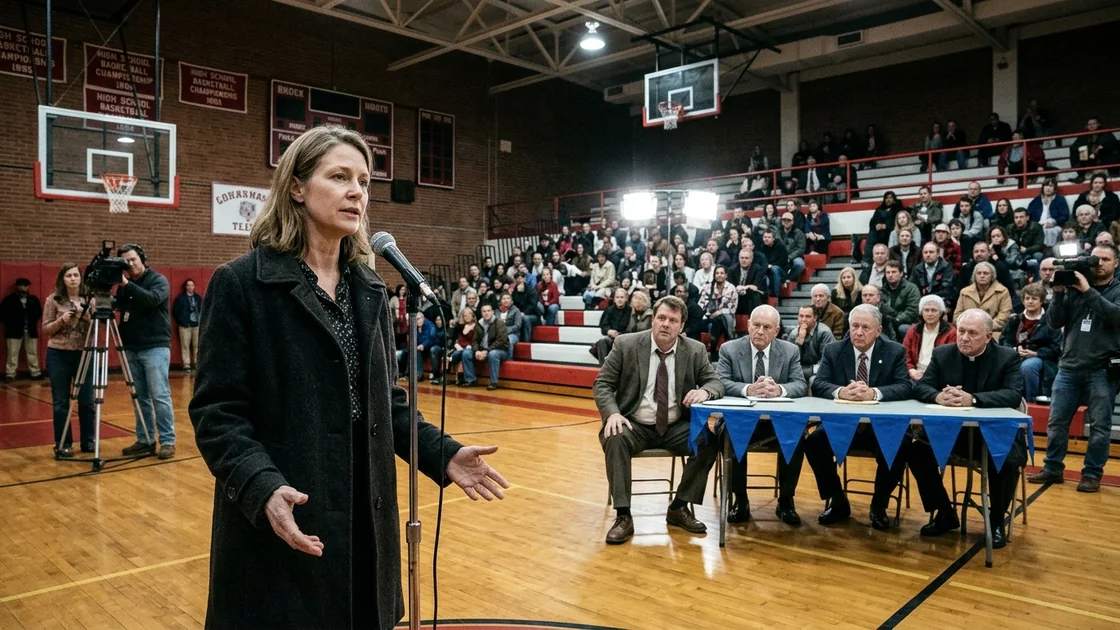
The Corinth High School gymnasium had been converted for the evening into an arena.
The bleachers had been pulled out from the varnished walls, their red and white fiberglass slats groaning under the weight of seven hundred people. The air was thick with the smell of wet wool, damp raincoats, popcorn from the athletic boosters' concession stand in the lobby, and the sharp, hot ozone of the television lights mounted on tripods along the baseline.
At the center of the basketball court stood a long folding table draped in blue bunting. Behind it sat the five members of the County Board of Commissioners, with Frank Miller in the center. To his right sat Thomas Vance, representing the town’s commercial development board; to his left, Reverend Douglas, acting as the county’s "special advisor on educational standards."
A single microphone on a chrome stand had been set up twenty feet in front of the table, facing the board. Behind it, two rows of folding chairs were reserved for members of the public who had registered to speak: four minutes per citizen, timed by an assistant high school principal holding a yellow digital stopwatch.
Eleanor sat in the fifth row of the bleachers, between Maya and an old farmer named Henderson who had farmed soy along the river since the Korean War. Maya was wearing her Sunday coat, her hands clasped tightly in her lap, her eyes wide as she took in the television cameras, the police officers standing by the double doors, and the sea of familiar faces made strange by the hard, theatrical glare of the lights.
Thomas sat at the high table with his notes spread before him. He had not spoken to Eleanor that morning beyond asking if she had remembered to leave the garage door opener on the hall table. He looked important, heavy, and respectable. His gray hair was neatly trimmed; his tie was pinned with a silver clip given to him by the Rotary Club. He was the picture of the town’s sturdy, immovable foundation.
Frank Miller leaned into his microphone. A sharp squeal of feedback tore through the gymnasium, causing three babies in the upper bleachers to wail in unison.
"The meeting of the Corinth County Commission regarding Materials Policy 402 will come to order," Miller said. His voice was practiced, slow, Southern-honey over gravel. "We are here tonight not in anger, but in sorrow. We are here to determine whether the resources provided by the hard-working taxpayers of this county are being used to build up our young people, or to tear down the moral fabric that has sustained this valley for two hundred years."
A round of applause broke out, led by Carolyn Foster and the members of the First Baptist choir, who were seated in a solid block behind the home bench.
"We have twelve registered speakers," Miller continued, consulting a legal pad. "The board will hear testimony, and then we will vote on the resolution introduced by Commissioner Vance and myself to withdraw county support for any facility maintaining material that violates our common decency code. First speaker is Reverend Marcus Douglas."
Douglas stepped to the floor microphone. He spoke for four minutes about the decline of Rome, the duty of Christian magistrates, and the specific obscenities contained in The Salt Catcher. He read passages aloud—the same passages Sarah Beth had read in Evelyn’s parlor—his voice vibrating with theatrical disgust that caused several elderly women to dab at their eyes with folded tissues.
"This is not literature!" Douglas shouted, his face purple beneath the halogen lights. "This is an ideological plague! It was written by an agent of destruction who hates the family, hates the church, and hates God! We must burn it out like a rot in the timber!"
The crowd rose to its feet, cheering. Thomas Vance clapped, his hands coming together with slow, heavy thuds.
Next came Carolyn Foster, who presented a petition signed by six hundred residents demanding the immediate termination of Miss Gable’s contract.
Then came Miss Gable herself.
The old woman walked to the microphone with the help of a four-pronged aluminum cane. The room did not cheer for her; a cold, hostile silence fell over the gym, broken only by the scrape of her rubber cane tips against the basketball court’s polyurethane finish.
"Mr. Miller," she said, her voice thin, reedy, but astonishingly clear. "I have known you since you were eight. I remember when you hid behind the encyclopedias because your father was angry about your report card."
Miller’s face tightened. "Miss Gable, please address the policy."
"I am addressing the policy, Frank," she said softly. "The policy says that Corinth is afraid. That Corinth cannot bear to let its children know that there are people who think differently, who hurt differently, who survive differently. A library is not a church, Frank. It is an open door. If you lock that door because you don't like what’s on the other side of it, you aren't protecting this town. You’re turning it into a prison. And I will not resign. If you want my keys, you will have to come down to the desk on Monday morning and take them from my hand."
She turned and began the long walk back to her seat. A few people clapped—younger people, two teachers from the middle school, a high school junior with blue hair—but their applause was swallowed instantly by a chorus of low, rumbling boos from the upper bleachers.
"Next speaker," Frank Miller said, his voice clipped, "is registration number eight. V. E. Sterling."
A collective gasp went through the gymnasium.
Reporters at the side of the court scrambled, their cameras swinging around to cover the floor. Frank Miller looked up from his legal pad, his brow furrowed with annoyance.
"Is there an attorney representing the author?" Miller asked, looking around the room. "If this is a stunt by the ACLU, I’ll remind you that non-residents must have a local sponsor to address the commission."
Nobody stood.
Thomas Vance leaned toward Miller, whispering something behind his hand. Miller nodded, looking disgusted.
"Moving on," Miller said, reaching for his gavel. "Registration number nine—"
"I am here," a voice said.
It did not come from the floor. It came from the fifth row of the bleachers.
Eleanor Vance stood up.
Act X: The Unmasking
The gymnasium did not go quiet immediately. There was a confusion of rustling coats, people leaning forward to see who was blocking the aisle, the sound of a television camera tripod clattering against the bleacher railing as the operator scrambled to refocus.
Thomas Vance looked up from the table. His eyes found Eleanor. His face did not register surprise at first; it registered only the mild, impatient confusion of a husband wondering why his wife was making a scene in public.
"Nora?" he said, his voice carrying through the table microphone, small and tinny. "Sit down, hon. Frank’s on number nine."
Eleanor did not sit down. She stepped out into the wooden aisle between the bleacher sections. She was wearing her dark wool coat, her hair pinned neatly behind her ears, her sensible flat leather shoes making no sound at all as she descended the steps toward the basketball court.
Maya reached out, her small hand catching the hem of Eleanor’s coat.
Eleanor paused. She looked down at her daughter. Maya’s eyes were huge, dark with terror, but beneath the terror was something else—something wild and fierce that Eleanor recognized with an ache that went down to her marrow.
"Go, Mom," Maya whispered.
Eleanor stepped onto the floor.
The television lights hit her with the physical force of a summer noon, hot and white, blinding her for a fraction of a second until her pupils adjusted. The floor microphone stood before her, a thin black rod with a round mesh head.
"Mrs. Vance," Frank Miller said, his voice dropping into that condescending, neighborly tone he used with widows at estate sales. "I know this has been an emotional evening for everybody. Thomas, maybe you want to step down here and help your wife back to her seat?"
Thomas stood up from the table. His face had gone the color of skim milk. He looked at Eleanor not with anger, but with a dawning, monstrous comprehension that seemed to paralyze him where he stood.
"Nora," he croaked, the sound barely reaching the edge of the bunting.
Eleanor took the microphone between her thumb and forefinger. She did not look at the cameras. She looked straight at Frank Miller, then at Reverend Douglas, and finally at her husband.
"My name is Eleanor Vance," she said. Her voice did not shake. It was the voice she used when the children were feverish in the night, the voice she used when she had to tell the truth about an invoice to a subcontractor who was trying to cut corners. It was calm, level, and entirely devoid of apology. "I have lived on Dogwood Lane for fourteen years. I have taught third-grade Sunday school at First Baptist Church. I have made forty-two pear tarts for the Corinth Literary Circle."
She paused. The gymnasium had become so still that the hum of the transformer behind the scoreboard sounded like a horn.
"And for five years," Eleanor said, "I have written under the name V. E. Sterling. I am the author of The Salt Catcher."
A sound went through the room that was not human—a collective, sucked-in breath that sounded like dry leaves being pulled into a furnace.
Carolyn Foster stood straight up in the bleachers, her mouth open in a perfect, horrified circle. Evelyn Miller dropped her program onto the floorboards.
"Nora," Thomas whispered. He took two steps toward the front of the table, his hands hanging limp at his sides like lead weights. "Nora, what are you doing? What are you saying?"
Eleanor turned her gaze to him. Her heart was beating with a slow, heavy rhythm that felt almost peaceful. The blue hour was over. The light had finally come into the room, and it was cold, bright, and clean.
"I wrote it, Thomas," she said. "I wrote it on the kitchen table while you were asleep. I wrote it while you were at the office designing the drainage basins for Miller’s Creek. I wrote it because I was dying in your kitchen, and you didn't even notice the smell of the smoke."
A reporter from Charlotte was on his feet now, his microphone held high, his cameraman edging around the commission table to catch Eleanor’s profile against Thomas’s face.
Frank Miller grabbed his gavel and slammed it down three times. The wood cracked against the sound block with the report of a pistol. "This meeting is out of order! This is a public hearing on county policy, not a domestic dispute!"
"This is your policy, Frank!" Eleanor said, turning on the commissioner with a ferocity that made the large man flinch back into his high-backed chair. "You sat in that church on Sunday and told seven hundred people that V. E. Sterling was a monster from New York who wanted to destroy their families! You told them that someone had crept into their town to corrupt their daughters! Well, look at me, Frank! Look at my hands!"
She held them out, palms up, beneath the hot glare of the television lamps.
"These hands have ironed your shirts when you stayed at our house during the flood of '18! These hands have cooked the meals your commission ate when you were lobbying for the bypass! I am not an outsider. I am your daughter, your wife, your neighbor, your mother. And every word in that book was paid for with forty years of my silence!"
The silence in the gymnasium was total. Even the babies had stopped crying.
Reverend Douglas leaned into his microphone, his hand shaking with rage. "You are an apostate, Mrs. Vance! You have brought shame upon your husband’s house! You have broken your vows before God and this community!"
Eleanor looked up at the preacher. She felt no fear—only a vast, cool pity that seemed to stretch from this gymnasium all the way to the blue ridge of the mountains.
"I did not break my vows, Reverend," she said quietly, her words carrying into every corner of the vast, high-ceilinged room. "I kept them until they nearly killed me. But a vow that requires a woman to pretend she has no soul, no mind, and no grief is not a vow to God. It is a contract with a graveyard. And I am walking out of the graveyard tonight."
She let go of the microphone.
It swayed on its chrome stand, a silver pendulum marking the end of a time that would never return.
Eleanor turned her back on the commission. She turned her back on the cameras, on the staring eyes of the women she had shared tea with for ten years, on the men who had employed her husband and patted her children on the head.
She walked toward the bleachers.
At the bottom of the steps, Leo was standing. His face was red, his fists clenched in the pockets of his track jacket, tears tracking through the dust on his cheeks. He looked at her as if she were a stranger who had fallen from the moon.
Beside him stood Maya.
The little girl did not look at the crowd. She did not look at her father, who was still standing behind the bunting with his arms hanging limp, looking down at his desk as if the floor had given way beneath him.
Maya took two steps down, reached out, and took Eleanor’s hand. Her fingers were small, warm, and dry.
"Come on, Mom," Maya said. Her voice was loud enough for the first three rows to hear. "Let’s go home."
Act XI: The Clearing
The road home was black, straight, and quiet.
Thomas did not come home in the car with them; he had stayed behind with Frank Miller and the lawyers, surrounded by the flashing red lights of the news vans and the shouting reporters who had blocked the doors of the high school lobby.
Eleanor drove her ten-year-old station wagon through the dark lanes of Corinth with Maya in the passenger seat and Leo in the back. Nobody spoke. The wipers dragged across the glass with a steady, rhythmic thwack-slap, clearing the light mist that had begun to fall again over the orchards.
When they pulled into the driveway off Dogwood Lane, the house was dark.
Eleanor cut the engine. The silence of the Piedmont settled over the car like an old, heavy coat.
"Are you going to leave Dad?" Leo asked from the dark of the back seat. His voice was cracked, raw, the voice of a boy whose world had been dismantled in twenty minutes by the woman who had packed his lunch that morning.
Eleanor turned in her seat. She looked at her son—at his long, awkward limbs, his wide forehead that belonged to his father’s people, his eyes that were so full of hurt they looked almost black.
"I love your father, Leo," she said, her voice steady and quiet. "And I love this house. But I will not lie anymore. Not to him. Not to you. And not to myself."
"They're going to hate us," Leo whispered, putting his head in his hands. "Everyone at school. Everyone on the team. They’re going to say you're crazy."
"Some of them will," Eleanor said. "And some of them will go home tonight and look for that book because they want to know why a woman would risk everything she has just to say what’s inside it."
She opened the car door. The cold night air hit her face, smelling of wet red clay, decaying leaves, and the faint, sweet woodsmoke of a neighbor’s stove. It was the same air she had breathed for forty years, but tonight it tasted different. It tasted vast. It tasted dangerous.
They went inside.
Eleanor did not turn on the kitchen lights. She helped Ben, who had been left with a teenage sitter who had fled the house the moment Eleanor walked through the door, get into his pajamas. She tucked him into his bed, kissed his forehead, and sat with him until his breathing went soft and regular.
Then she went down to the kitchen.
She put the kettle on the stove. She struck a match. The blue flame leaped up, bright and clean against the black iron grate.
While the water heated, she heard the crunch of tires on the gravel outside.
A car door slammed. Heavy, slow steps came up the back porch. The third pine plank in the kitchen did not creak when Thomas stepped on it; he was too heavy, his weight landing squarely on the timber, pressing it down into the joist with a dull, solid thud.
He stood in the doorway between the mudroom and the kitchen. He had taken off his tie. His white shirt was unbuttoned at the neck, his hair rumpled where he had run his hands through it a hundred times.
He looked at her across the width of the room.
"Frank says the firm has lost the county contract," he said. His voice was completely empty of anger; it was the voice of a man who had survived a train derailment and was looking at the twisted steel without understanding how it had happened. "Foster’s Equipment pulled their retainer thirty minutes ago. He said he couldn't have his books audited by a man whose wife is a... whose wife is V. E. Sterling."
Eleanor did not look away. "I know."
"Why didn't you tell me, Nora?" Thomas took a step into the kitchen, his boots heavy on the linoleum. He reached out and touched the edge of the laminate counter, as if he needed something anchored to the earth to keep from falling. "Fourteen years. We’ve slept in the same bed for fourteen years. I built this house for you. I put every nail in those rafters with my own hands. Was it all a lie? Everything we did?"
"No," Eleanor said, her voice thick with a grief that was entirely dry of tears. "It wasn't a lie, Thomas. I loved you. I love you now. But you built this house for a woman who didn't exist. You built it for a woman who had no voice, no memory, and no hunger. You built it for a shadow."
"You weren't a shadow," he whispered, his eyes reddening at the margins, his large hands trembling against the counter. "You were my wife."
"I was your wife," she said. "And I was V. E. Sterling. I was both, Thomas. The whole time. You just only wanted the half that kept the kitchen clean."
The kettle began to whistle—not the rising shriek of a sudden alarm, but a steady, high, clear note that filled the kitchen, pushing out the silence, pushing out the dark, filling the space between them until there was no room left for anything that was not true.
Eleanor did not reach to turn it off.
She let it whistle. She let the sound rise into the rafters he had nailed, through the floorboards where her children were sleeping, through the walls of the house that had been her sanctuary and her cage.
Thomas stood there, looking at her. For the first time in fourteen years, he was not looking at his dinner, or his prints, or his prospects. He was looking at her face—at the lines around her eyes, at the gray hair silvering at her temples, at the straight, unbroken line of her mouth.
"What do we do now?" he asked. His voice was small, like a boy lost in the woods after dark.
Eleanor walked to the stove. She took the kettle from the flame and set it on the cold iron burner. The whistle died away into a long, soft sigh that joined the wind against the glass.
"Now," Eleanor Vance said, looking out the black window toward the road that led out of Corinth, "we see who we are."