The Salt and the Grace
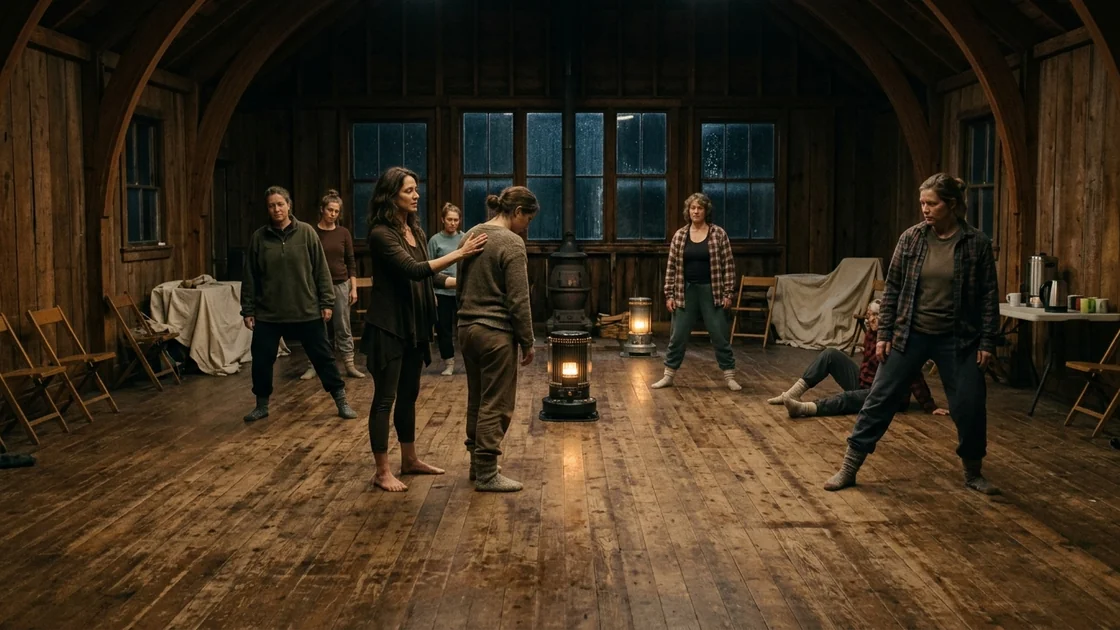
When forty-two-year-old prima ballerina Elena Vance leaves behind the glittering stages of Europe and New York to care for her ailing father in the damp timber country of her youth, she believes her relationship with movement has ended. Instead, among the moss-draped pines of Blackwood Creek, she finds herself drawn to the exhausted women of the town who spend their lives lifting children, hauling groceries, and quietly carrying the burdens of working-class survival. By opening the warped doors of the shuttered Grange hall and stripping away the rigid dogmas of classical dance, Elena creates a sanctuary where overworked mothers learn to reclaim their bodies from fatigue, discovering that grace is not the denial of gravity, but the courage to bear it together.
The radiator in the hallway of her father’s cedar-shingle bungalow did not hiss so much as it rattled, a loose metallic shudder that mimicked the pulse in Elena Vance’s left ankle.
Every morning began with that joint. Before her eyes opened to the grey Oregon light filtering through the Douglas firs outside her childhood bedroom, she cataloged the damage. First came the subtalar joint, which felt as though someone had packed it with fine beach sand while she slept. Then the metatarsal heads, flattened and calcified after thirty years of satin ribbons, rosin, and the relentless mathematics of pointe work. Finally, the lower lumbar vertebrae, L4 and L5, which hummed a quiet, thrumming grievance against forty-two years of life, thirty-two of which had been spent defying the gravitational pull of the earth.
Elena rolled onto her back, staring at the tongue-and-groove cedar ceiling. In Paris, at the Palais Garnier, the ceiling had been Marc Chagall—a swirling carnival of red angels, blue horses, and floating musicians. In New York, it had been the crisp, shadowed plasterwork of the David H. Koch Theater. Here, it was knotty pine, water-stained in the corner where the heavy rains of November had crept past the flashing around the woodstove flue.
Downstairs, a pot dropped.
The sound was sharp and aluminum, followed not by an oath, but by a prolonged, terrible silence.
Elena was out of bed before her brain could consult her feet. She skipped the slippers, hit the cold fir floorboards on her forefeet—old habits died hard, even when the arches were screaming—and took the narrow staircase two steps at a time. Her right hip gave its customary dry click at the landing.
In the kitchen, the air smelled of burnt toast and yesterday’s wet wool. Arthur Vance stood in the middle of the linoleum, staring down at a dented stewpot that had rolled against the baseboard. He wore his heavy red plaid flannel shirt, the one he had worn to the sawmills for forty years, but he had buttoned it crookedly. The top flap hung lower than the bottom, revealing the pale, corded hollow of his collarbone.
"Dad," she said, keeping her voice in the lower register that never startled him. "It’s all right. Leave it."
Arthur did not look up immediately. His hands, broad and scarred across the knuckles from decades of managing chain decks and timber carriages, twitched at his sides. The veins were thick as garden hoses beneath paper-thin skin.
"I had the oats in the tin," he muttered, his voice gravelly with sleep and the slight slurring that had begun three months ago after the transient ischemic attack. "The tin was right on the second shelf, El. Beside the molasses. But somebody moved the molasses."
"Nobody moved it, Dad. We finished it Tuesday, remember? We made the bran bread."
Arthur blinked at the empty pot. His jaw worked, a muscle leaping beneath his grey stubble. For a second, the old Arthur—the man who could eyeball a western red cedar and tell you to the board-foot what it would yield at the planer—surfaced behind his cloudy blue eyes. Then the fog rolled back in, soft and merciless.
"Tuesday," he whispered. "Right. Well. It’s early."
"It’s seven," Elena said gently. She knelt, retrieving the pot. Her knees popped in stereo, a sound like dry kindling snapping underfoot.
Arthur looked at her knees, then down at her face. "You sound like an old carriage house door, girl."
"I am an old carriage house door," she said, smiling as she set the pot on the laminate counter. "Go sit in the rocker by the stove. I’ll make the oatmeal. Steel-cut, the kind you like with the salted butter."
Arthur shuffled toward the hearth. His gait was the opposite of hers: heavy, dragged, heels striking the floor first, the posture of a man who had spent sixty years resisting falling trees and wet slopes. Elena watched him sink into the rocking chair her mother had bought at an estate sale in 1984. He pulled the wool blanket over his knees without being asked, his gaze drifting out the bay window toward the driveway, where the mist hung like damp cheesecloth between the alder trees.
Elena turned to the stove. As she measured the oats, she caught her reflection in the dark glass of the microwave.
She looked forty-two. Her dark hair, which had been scraped back into severe, lacquered chignons for decades, was loose around her shoulders, cut blunt at the collarbones. Without stage makeup, the hollows under her cheekbones were shadowed with genuine exhaustion rather than theatrical contour. There was a faint line between her brows that had settled in during her last season with the San Francisco Ballet, the season her meniscus had shredded during a rehearsal of Giselle, Act II. The Wilis were supposed to be spirits, weightless and vengeful, floating across the marshes. Elena had landed from a grand jeté, felt something inside her knee tear like wet linen, and realized, with terrifying clarity, that she was made of meat, bone, and water.
She had stayed in the city through the surgery, through the bleak months of physical therapy where eighteen-year-old apprentices in paper-thin tights looked at her with polite pity. Then the call had come from the sheriff in Blackwood Creek. Arthur had been found walking along Highway 101 in his undershirt at four in the morning, looking for the mill whistle.
She had sold her condominium on Russian Hill, packed three duffel bags, her old portable barre, eight pairs of dead pointe shoes she couldn't bring herself to burn, and her mother’s silver tea set, and driven north until the asphalt gave way to cracked secondary roads bordered by blackberries and clear-cuts.
That was six months ago. The winter had been a long, dark corridor of doctor’s appointments in Coos Bay, pill organizers with little plastic doors marked M-T-W-Th-F-S-Su, and the relentless drip of water from the cedar boughs onto the corrugated metal roof of the woodshed.
"El?" Arthur called from the rocker.
"Yes, Dad?"
"Did you dance yesterday?"
Elena paused, the wooden spoon hovering over the bubbling oats. "No, Dad. Not yesterday."
"You ought to," he said, not turning around. "You paid enough for them legs. Your mother and I paid enough for them, too. All them Saturdays driving you to Eugene in the station wagon. The clutch went out twice in Drain."
"I remember," Elena said softly.
"A machine that sits in the rain rusts," Arthur said, reciting one of his mill-floor proverbs. "You leave an edger out in the wet, the arbor seizes up. Then you got to take an oxyacetylene torch to it. You don't want the torch."
"No," Elena said, stirring the porridge. "You don't want the torch."
The Blackwood Creek Co-op smelled of chicken scratch, diesel exhaust, and damp alfalfa.
Elena leaned her hip against the counter, waiting for Ray to find the five-eighths-inch galvanized bolts Arthur had insisted he needed to fix the latch on the woodshed—a latch that was not broken, but which Arthur visited three times a day to test with his thumb.
Behind her, the door jangled open, letting in a gust of cold, sea-salted wind and the sound of a toddler screaming with the pure, resonant fury of an air raid siren.
"Hush, Toby. Stop it now. Look, look at the big bags of dog food. See the puppy on the bag?"
The voice was frayed, thin at the edges, pulled taut over sheer desperation. Elena turned her head.
The woman was perhaps thirty-five, though she wore the grey, powdery skin of someone who hadn't slept through the night since the previous administration. She was balancing a heavy plastic infant seat in the crook of her left elbow while her right hand gripped the wrist of a squirming four-year-old boy in muddy rubber boots. A stained canvas diaper bag was slung across her chest like bandoliers, the strap digging deeply into the meat of her neck, pulling her left shoulder down and forward in a grotesque imitation of a hunchback.
Elena watched her with the involuntary clinical eye of a ballet mistress. Look at that right scapula, Elena thought. Winged out, completely unsupported by the rhomboids. Her pelvis is tilted so far forward to counterbalance that car seat that her lower spine must be screaming. If she sneezes, three discs are going to pop.
The toddler threw himself onto the concrete floor, his boots drumming a frantic rhythm against a pallet of salt licks.
"Toby, please," the woman whispered. Her voice broke. She didn't sound angry; she sounded defeated, the kind of quiet ruin that happens when the body simply has no more chemical reserves to manufacture adrenaline. She stood there, frozen, the thirty-pound car seat dragging her spine into an agonizing C-curve, her hair falling into her eyes in greasy, unwashed strands.
Elena knew her. It took a moment for the adult face to align with the freckled child from thirty years ago.
"Sarah?" Elena said.
The woman blinked, turning her head with an effort that clearly engaged the wrong muscles in her neck—she turned her entire torso rather than rotating her cervical spine. She looked at Elena’s clean, tailored wool coat, her straight back, the way Elena stood with her weight distributed perfectly between both heels.
"Elena?" Sarah’s mouth opened slightly. A dull flush of pink rose beneath her tired skin. "Oh, God. Look at me. Don't look at me."
"Don't be ridiculous," Elena said. She stepped forward, her movement silent and smooth, and reached down. "Let me take the bucket."
"The—the seat? It’s heavy, the handle sticks—"
"I’ve got it." Elena slipped her forearm under the plastic bar. It wasn't just heavy; it was an awkward, deadweight mass designed by engineers who had clearly never carried a human child thirty feet from a minivan to a front door. As the weight transferred to Elena’s arm, she automatically adjusted her core, dropping her tailbone, drawing her navel toward her spine, engaging her lats to take the strain off her shoulder. Even so, the torque on her hip was immediate and violent.
"Jesus," Elena muttered under her breath.
Sarah let out a breath that was half-laugh, half-sob. She bent to haul Toby off the floor, hoisting the four-year-old onto her hip. Instantly, her ribcage collapsed inward, her shoulder jackknifed toward her ear, and her lumbar spine took the brunt of forty pounds of thrashing boy.
"He won't walk," Sarah apologized, wiping her nose with the back of her sleeve. "He’s been screaming since six. Mark’s out on the rig—he’s been on the night shift at the cedar yard for three weeks straight—and the baby has colic, and I dropped a gallon of milk in the driveway this morning. It just exploded. Whole milk everywhere on the gravel. I sat on the porch and cried like an idiot over four dollars of milk."
"It wasn't over the milk," Elena said.
Sarah looked at her, startled. Her eyes were green, the same color as the moss on the river stones, but they were bloodshot, the whites yellowed with fatigue. "No. I guess it wasn't."
Ray came back to the counter, dropping a paper sack of bolts with a clatter. "There you go, Elena. Tell your old man these are the coarse thread. If he strips these, he’s doing it on purpose."
Elena paid for the bolts, then walked Sarah out to her battered Subaru. The tailgate was held shut with a yellow bungee cord. The rear cargo area was a catastrophe of discarded paper cups, crushed Goldfish crackers, a spare tire, and three plastic totes full of hand-me-down clothes.
Elena watched Sarah maneuver the baby into the car seat base. The angle was terrible; Sarah had to lean into the vehicle at a forty-five-degree tilt, her legs straight, her hamstrings locked, while extending a twenty-pound weight at arm’s length.
"Do you hurt?" Elena asked abruptly.
Sarah stopped, her head still inside the car. Slowly, she backed out, hitting her elbow on the door frame. She rubbed the joint with an expression of faint surprise.
"Where?" Sarah asked.
"Everywhere. Your neck. That spot right between your shoulder blades where it feels like a hot nail is being driven in. Your lower back when you stand at the sink to wash dishes."
Sarah gave a short, jagged bark of laughter. "Elena, I’m thirty-four years old. I’ve had three kids in five years. I carry thirty pounds of toddler on my left hip and twelve pounds of baby on my right arm, and when I sit down at night, my legs feel like lead pipes filled with hot water. I don't 'hurt.' Hurting is for people who have time to notice it. I’m just... broken down. Like Mark’s truck."
"It’s not broken down," Elena said, her eyes narrowing as she studied the line of Sarah’s collarbone. "It’s braced. You’re bracing against everything. You walk like you’re waiting to be hit."
"Well," Sarah said, pulling the bungee cord tight over the trunk with a sharp snap that shook the car. "Most days, I am."
The Grange hall sat on the corner of River Road and North Fork, half-hidden behind an overgrown hedge of wild blackberry and elderberry. It was an unpainted, rectangular barn of a building, erected in 1922 by the local dairy farmers. The white paint had long since peeled down to the silver-grey cedar beneath, and the sign above the double doors—BLACKWOOD GRANGE NO. 418—had lost its N and its G.
Elena obtained the key from Mrs. Henderson, who ran the water district out of her sunroom. The district owned the building now, using it mostly to store extra lengths of PVC pipe and folding tables for the annual 4-H chili feed.
The brass key turned in the padlock with a dry, screeching groan.
Inside, the room smelled of eighty years of floor wax, mouse droppings, and damp air. But it was huge: forty feet by sixty feet, with high, arched rafters of old-growth Douglas fir that had never seen a drywall screw. And the floor—Elena walked out onto the center of the room, her boots echoing against the walls—the floor was clear-grain, tongue-and-groove white fir. It was scuffed, water-marked near the north windows, and buckled slightly near the old potbelly stove, but it was sprung. Real, suspended timber over joists, built for square dances and wedding reels before anyone had invented poured concrete slabs.
Elena set her duffel bag on a folding chair.
She took off her coat, then her boots, and then her wool socks.
The floor was cold as slate against the calloused soles of her bare feet. She stood in the center of the empty hall, in the pool of grey light falling through the clerestory windows, and closed her eyes.
Her body knew what to do, but her mind hesitated. For two years, she had avoided this. In the physical therapy rooms, movement had been reduced to degrees of flexion, resistance bands, and isometric holds. It was clinical, devoid of spirit, an apology for aging.
She took a breath. She drew the air in through her nose, feeling her ribs expand laterally—not up into her throat like Sarah had breathed at the co-op, but wide, pushing out against the sides of her ribcage, filling the lower lobes of her lungs.
She dropped down. Not into a grand plié, not with the turnout that had been carved into her femoral heads by Russian pedagogues when she was eight years old. She simply bent her knees, parallel, feet flat, letting her pelvis drop toward the floor like a plumb bob.
Her knees groaned. The meniscus in the left knee pinched, a dull, familiar bite.
Elena stayed there, hovering in the squat, feeling the floorboards receive her weight. In ballet, the goal was always transcendence. You spent twenty years training your body to pretend that mass did not exist. You pulled up, up, out of the floor, defying the dirt, pretending that you were an ethereal creature made of spun glass and light, hovering an inch above the boards. You masked the impact of every jump; a six-foot leap had to conclude with the silent whisper of satin rolling through the metatarsals, absorbing three times your body weight without a breath of effort.
It was an exquisite lie. And it destroyed the women who told it.
Elena let her heels sink deeper. She allowed her shoulders to drop—really drop, down away from her ears, letting the trapezius muscles release their frantic clutch on the base of her skull. She let her belly go soft. For thirty years, she had kept her transverse abdominis locked like an iron corset, flattening her stomach until her organs had nowhere to go.
She let it out. Her stomach pushed against the waist of her leggings.
She exhaled, long and slow, through her mouth. A sound came with it—a low, involuntary hum that rattled in her chest.
The floor seemed to rise to meet her. Not as an enemy, not as a hard surface that shattered bones, but as a shelf. Something that was entirely capable of holding one hundred and twenty pounds of exhausted woman without asking for anything in return.
She reached out with her right hand, trailing her fingers along the scarred wood, and began to crawl.
The flyer was three lines, printed on plain white paper from Arthur’s ancient dot-matrix printer, which shrieked like an enraged crow as it dragged the perforated paper past the ribbon:
MOVEMENT FOR TIRED BONES The Old Grange Hall. Thursday, 7:00 PM. No leotards. No mirrors. Wear your thickest socks.
She tacked one to the corkboard at the co-op, right between a notice for a three-ton flatbed trailer and a flyer for a missing blue-tick coonhound. She put another on the bulletin board at the post office, next to the postal rates and the photo of the county commissioner who was running on a platform of ditch maintenance. She gave the third directly to Sarah Miller.
Sarah had looked down at the slip of paper, her thumb smudging the fresh ribbon ink.
"Elena, I don't dance," she said, her voice completely flat. "I danced once at my junior prom. I had a silver dress that pinched my armpits, and I drank three wine coolers behind the vocational building and threw up in the woodshop sawdust bin. That’s my dance history."
"It’s not a dance class," Elena said.
"Then what is it?"
"I don't know yet," Elena said honestly. "Just come. Leave the kids with Mark."
"Mark works until six. He gets home, he smells like hydraulic fluid and wet bark. He falls asleep in his recliner with the TV on the fishing channel before the six o'clock news is over."
"Then wake him up," Elena said. "Tell him your back is out. If your back goes, the whole house stops running. He knows that."
Sarah had looked away, out toward the log trucks rumbling down River Road, their Jake brakes roaring as they slowed for the bridge. Her fingers had curled tightly around the paper, crushing the corners.
Thursday night was black and wet. A typical North Coast November storm was rolling off the Pacific, driving sheets of rain horizontally against the Grange’s tall north windows. The wind found every gap in the old siding, making the canvas drop-cloths Elena had hung over the back storage area billow like the sails of a derelict ship.
Elena had brought three kerosene heaters from her father’s workshop. They smelled strongly of lamp oil, but they threw an orange, circular glow across the wide floorboards, cutting the damp chill of the room. She had set out eight wooden folding chairs in an open circle. On a small utility table near the door, she had placed an electric kettle, a box of Red Zinger tea, and a stack of thrift-store mugs.
At 6:58 PM, she was entirely certain no one would come.
It was a preposterous idea. She was an outsider now, a woman who had lived in apartments on the Île Saint-Louis and eaten dinner at eleven at night in bistros where the wine cost more than Arthur’s monthly property taxes. She was the miller’s daughter who had run away to wear ribbons in her hair, returning only when her joints had failed her and her father couldn't remember where he had hidden his checkbook.
Then, the outside latch clicked.
The door swung inward against the wind, admitting a blast of cold rain and Corinne Peters.
Corinne was fifty-eight, though she looked seventy. Her husband had died of lung cancer six years ago, leaving her forty acres of scrub timber, a mortgaged double-wide, and custody of their daughter’s seven-year-old twins. Corinne cleaned rooms at the Driftwood Motel on the highway three days a week and worked the register at the hardware store on the other two. Her hands were broad, the skin dry and cross-hatched with fine white lines from bleach and cold water.
She stood on the doormat, shaking an umbrella that had three broken ribs.
"Is this where the back thing is?" Corinne asked, squinting into the gloom.
"It is," Elena said, stepping forward. "Come in, Corinne. Take your boots off. Leave your socks on."
"Floor’s cold," Corinne grunted, but she kicked off her rubber mud-boots. She wore two pairs of socks: a white tube sock underneath and a hand-knit grey wool sock over top. She walked into the circle of chairs with the stiff, deliberate waddle of someone whose hips had forgotten how to rotate thirty years ago.
Before Corinne could sit down, the door opened again.
It was Sarah. She looked wild-eyed, her rain jacket half-zipped, her dark hair plastered to her forehead. Behind her was Brenda Klein, the county records clerk, a woman of forty-five who weighed two hundred and fifty pounds and spent eight hours a day sitting on a broken pneumatic chair in the basement of the courthouse, entering land deeds into a green-screen terminal while nursing an autistic son whose tantrums routinely tore the curtains off their living room rods.
And behind Brenda slipped Jolene—twenty-two years old, waiting tables at the Blackwood Diner, six months postpartum with twin girls, her face swollen with the grey, puffy exhaustion of the utterly unsupported.
Nobody spoke for a long moment. The kerosene heaters hummed, their blue-and-orange flames wavering as the wind rattled the window sashes.
"There aren't any mirrors," Jolene said, her voice small, almost defensive. She was looking around the vast, shadowy cavern of the hall. She wore a pair of oversized fleece sweatpants with a bleach stain on the thigh and an old high school track sweatshirt.
"No mirrors," Elena said.
"Good," Brenda said, lowering herself onto one of the folding chairs with an audible groan from both her knees and the metal rivets of the chair. "Because if I had to look at myself in spandex right now, I’d walk straight down to the boat ramp and keep going."
"No spandex," Elena said. "Everybody take your chairs. Pull them out into the middle. Leave five feet between each other."
The women moved, their heavy socks sliding and scuffing along the fir floor. There was an intense, palpable awkwardness. They knew each other—in a town of twelve hundred people, everyone knew whose husband was drinking, whose son was failing algebra, and whose truck had been repossessed—but they had never been in a room together without a counter, a desk, or an altar between them.
Elena took a chair in the center of the ring. She didn't sit on it like a dancer; she sat like Arthur sat when he was tired, her feet wide, her elbows resting on her knees, her hands dangling between her shins.
"Why are you here, Corinne?" Elena asked quietly.
The older woman looked startled. She smoothed her wool slacks over her knees, her thick fingers trembling slightly. "Because my sciatica is like a blowtorch from six in the morning till noon. Because the doctor in Coos Bay told me to swim laps, and the nearest pool is forty miles away, and I don't have twenty dollars for the gas, let alone a swimsuit that covers what sixty years of life did to my backside."
"Brenda?"
"My neck," Brenda said simply. "I hold the phone between my ear and my shoulder while I’m typing deeds because the county won't buy us headsets. By three o'clock, I can't turn my head to the left to check my blind spot when I drive home. One of these days I’m going to get t-boned by a chip truck on the bypass, and honestly, some days I think that wouldn't be the worst thing that could happen."
Sarah didn't wait to be asked. "I can't feel my fingers," she said, looking down at her hands. "When I wake up in the morning, my middle fingers are locked shut. I have to pry them open with the other hand. Trigger finger, the clinic said. From gripping. Gripping the stroller, gripping the steering wheel, gripping the sides of the crib so I don't lose my mind."
Jolene didn't say anything. She just sat with her knees pulled up to her chest, her chin resting on her fleece-covered knees, watching Elena with dark, guarded eyes.
Elena nodded slowly. She stood up.
"In the world I used to live in," Elena said, her voice carrying easily into the rafters, "we were taught that the body was an instrument to be conquered. You starved it, you beat it, you packed it in ice, and you forced it into shapes that God never intended a human frame to make. We spent eight hours a day trying to pretend we didn't weigh anything at all."
She walked over to the potbelly stove, then turned back to them.
"That was a lie," she said. "And it broke every single woman I ever danced with. The ones who survived are forty-five with two hip replacements, living on gin and muscle relaxers in tiny apartments in Queens."
Brenda let out a short snort.
"You have been told," Elena continued, stepping back into the center of the circle, "to hold it together. Pull your stomach in. Keep your chin up. Don't let them see you shake. Hold the baby, hold the groceries, hold your temper, hold the marriage. You’ve been holding for twenty years."
She stopped. She looked at Sarah, whose eyes had filled with sudden, bright tears.
"Drop it," Elena said.
"What?" Sarah whispered.
"Drop it. Stand up."
The four women hesitated, then stood. They were an uneven, lumpy assembly in the orange kerosene light: broad hips, rounded shoulders, thick socks, frayed hemlines.
"Stand with your feet as wide as your shoulders," Elena commanded, her voice dropping an octave, becoming resonant, authoritative, the voice of the ballet mistress who had commanded sixty-person corps de ballet at Covent Garden. "Not together. Wide. Like you’re standing on the deck of a tugboat in a six-foot swell."
They widened their stances.
"Now," Elena said. "Soft knees. Unlock them. If I came behind you and tapped the back of your knees, you should drop two inches, not shatter like glass. Soft."
She walked around them. She reached out and touched Brenda’s shoulder—not a light tap, but a firm, heavy palm pressing down on the trapezius.
"Let your shoulders fall," Elena said. "No, Brenda, don't push them down. That’s just more muscle. Let them drop. Let the earth have them. The earth has gravity. It wants your weight. Give it to the floor."
Brenda took a ragged breath. Her huge shoulders sank half an inch.
"More," Elena said. "Let your belly fall out."
"Elena," Brenda protested, a flush rising on her throat. "I’ve got three rolls here."
"I don't care if you have ten rolls. Release your abdominal wall. Stop holding your breath. If you don't breathe into your guts, your pelvis can't move. Let it out."
Brenda exhaled. Her middle expanded, spilling softly over the waistband of her stretch pants. As it did, her lower back visibly softened, the deep, defensive arch in her lumbar spine flattening out.
"Now," Elena said, returning to the center. "We aren't going to dance. We are going to find where the floor begins."
She raised her arms. But she didn't raise them with the curved, classical delicacy of a swan. She raised them heavy, elbows slightly bent, palms down, as though she were resting her hands on the surface of a deep, warm river.
"Inhale through the nose," Elena said. "Fill the sides of your body. Push your ribs against your shirts."
The sound of four women breathing in unison filled the Grange hall, soft and rough, like the sound of the wind through the hemlocks outside.
"Now exhale through the mouth," Elena said. "And as you exhale, bend your knees and let your hands sink. Don't push them down. Sink."
They sank. It was small—an inch, two inches.
"Again. Inhale, rise on the joints, but don't lock them. Exhale, drop. Let the weight fall through your heels. Don't balance on your toes. Your toes are for running away from bears. You aren't running away. You live here. Sink into the heels."
They did it ten times. Twenty times. In the silence of the old hall, the rhythm began to take hold. Up two inches, down two inches. The kerosene heaters chattered. The rain hammered the cedar shingles.
By the thirtieth repetition, Jolene had let her feet widen another three inches. Her chin had lifted off her chest, not in defiance, but because her neck was no longer carrying the full weight of her collapsed shoulders.
"Now," Elena said, her voice dropping to a whisper. "The shift."
She shifted her weight to her right foot. But she didn't step; she simply poured her mass from one leg to the other, like water being tilted in a broad basin. Her left heel remained light, floating, while the right leg took the sixty kilograms of her body, her hip sliding into alignment over the ankle without popping outward.
"Shift," Elena said. "Don't step. Pour."
Sarah tried it. She swayed, her hip jerking sideways with an awkward hitch.
"No," Elena said, moving behind her. "Don't throw your hip out. That’s how you carry Toby. You use the bone as a shelf because your glutes are asleep. Wake up the back of your leg. Press the floor away with your left heel. Feel that muscle under your pocket?" Elena pressed her thumb firmly into the meat of Sarah’s right gluteus medius. "There. Turn that on. That’s your engine. That’s what keeps your spine from twisting like a pretzel."
Sarah gasped. "That hurts."
"That’s not hurt," Elena said. "That’s work. There’s a difference. Hurt is what happens when you make your ligaments do the job of your muscles because you’re too tired to stand up straight. Pour into the right. Now press. Pour into the left."
They began to sway.
It was not a waltz. It had no three-quarter time. It was a slow, primordial oscillation, four women and their teacher, sliding weight from one pillar of bone to the other across the wide, scarred floorboards of the Grange. They moved without music, accompanied only by the rhythmic scrape of their wool socks against the white fir and the wet, lashing fury of the November storm against the glass.
Arthur’s decline was not a straight slope; it was a staircase. He would remain on a landing for three weeks, relatively stable, capable of buttering his toast and finding his way to the bathroom, and then, overnight, he would drop down three steps into a deeper, stranger cellar.
The morning after the second Grange class, Elena found him standing in the garden behind the house.
It was eight o'clock, thirty-eight degrees, and raining a cold, sleety drizzle that turned the garden beds into black soup. Arthur was wearing his work boots, his undershirt, and a pair of suit trousers he hadn't worn since Elena’s mother’s funeral twelve years ago. He was holding a rusted pruning saw, his breath coming in short, white puffs.
"Dad," Elena said, stepping off the porch in her sheepskin slippers, ignoring the wet mud that immediately soaked through the wool. "What are you doing?"
Arthur pointed the saw at an ancient, gnarled Gravenstein apple tree that had stood in the corner of the lot since the 1940s. The tree was half-dead, its bark thick with yellow lichen, but it still produced three bushels of tart, green-striped apples every September.
"The leaders are choking it out," Arthur said. His voice was thin, vibrating like a loose guy-wire. "You don't take the water-sprouts off, the core rots. Then the whole crown comes down in the first gale. Your mother wanted the apples for the butter. She said the Gravensteins make the only butter worth putting in a jar."
"Mother died, Dad," Elena said gently, coming up beside him. She didn't try to take the saw; she knew better than to treat him like a child when he had steel in his hand. Instead, she slipped her hand into the crook of his elbow, feeling the cold, damp flesh of his bare arm. "She died twelve years ago."
Arthur didn't blink. He kept his eyes fixed on the crotch of the apple tree. "I know she died," he said, and for a moment his voice was so clear, so terribly lucid, that Elena felt her breath catch. "I know she’s up in the cemetery behind the Presbyterian church. I’m not crazy, El. I just forgot for an hour. Can a man forget for an hour without everybody jumping down his throat?"
Elena leaned her cheek against his shoulder. His flannel smelled of old cedar sawdust, machine oil, and the sharp, vinegar tang of age.
"You can forget for an hour," she whispered. "Come inside and put a shirt on. The tea is hot."
Arthur looked down at the pruning saw. Slowly, his fingers unclenched. The saw dropped into the wet chickweed with a soft, dull squelch.
"I’m losing the edges," he said.
"I know."
"It’s like when the tide comes up through the slough," he said, looking down at his socks, which were soaked black from the wet grass. "You think you’re standing on dry ground, and then you look down and the water is up over the tongue of your boots. And there isn't nowhere to walk that isn't wet."
Elena took his hand. His fingers were stiff as driftwood, curled inward like dry roots.
She didn't lead him like an invalid; she stepped beside him, matching her stride to his, feeling the heavy, uneven clump of his boots. As they walked toward the porch stairs, she subtly shifted her center of gravity, placing herself half an inch lower than him, so that her shoulder acted as a fulcrum beneath his triceps. She didn't carry him; she gave him a line of resistance to push against.
"Lean down into my hip," she said as they hit the bottom step. "Don't try to lift yourself with your knee, Dad. Push through your left heel and use my hip."
Arthur hesitated, then leaned his weight into her. His ribcage pressed against hers. For three seconds, they were a single, four-legged creature climbing the wet stairs of the porch—clumsy, heavy, but perfectly balanced against the grey morning.
By the fourth week, there were eleven women in the Grange hall.
They had brought no one by advertising; it had spread by the strange, invisible telegraph that operated between women who stood in line at the school pick-up lane or met each other in the aisles of the discount grocery in Coos Bay.
There was Mary, whose husband was sixty miles out on a crab boat in twelve-foot seas, leaving her alone with four-year-old twins and an eighty-year-old mother-in-law who hid raw hamburger in the linen closet. There was Diane, who drove a school bus thirty miles every morning through mountain passes with thirty-five screaming children behind her, her right shoulder locked in a permanent, agonizing cramp from working the manual door lever.
The room smelled of kerosene, wet rain jackets, and lavender essential oil that Jolene had brought in a glass dropper because she read on the internet that it helped with inflammation.
Elena had brought a boombox—an old, silver Sony cassette deck that Arthur had kept in his shop to listen to Paul Harvey broadcasts. But she had no classical tapes. She had gone through the cardboard boxes under her father’s workbench and found three cassettes: The Best of the Kingston Trio, a recording of local fiddle tunes from the 1978 Douglas County Fair, and an unlabelled tape that turned out to be an ambient recording of coastal rain falling on a cedar shake roof, made by an eccentric neighbor who had died in the nineties.
She put the rain tape in the deck and hit play.
The hiss of the tape head filled the room, followed by the soft, hollow patter of water against cedar.
"Tonight," Elena said, standing in the middle of the floor, "we are going to work on the floor."
A collective groan rose from the folding chairs.
"I can't get down there, Elena," Corinne said, shaking her head. "If I get down on that wood, you’re going to need the volunteer fire department’s winch to get me back on my pins."
"You can get down," Elena said. "And more importantly, you can get up. But you’re not going to get up by hauling on your collarbones like you’re trying to climb out of a ditch."
She walked to the center of the hall and dropped.
It was a masterclass in kinetic conservation. Elena didn't collapse; she melted. First the ankles yielded, then the knees tracked forward over the second toes, the pelvis dropped straight down, one hand swept behind her to find the floor with a soft, flat palm, and she rolled smoothly onto her left hip, her spine unwinding like a strip of black silk until her shoulders were flat against the white fir boards.
The women watched in absolute silence. It hadn't looked like exercise. It had looked like water finding a drain.
"Your body is thirty percent bone and sixty percent water," Elena said, her voice echoing off the ceiling beams. "The rest is connective tissue. But you treat yourselves like you’re made of cast iron. You move in straight lines. You hinge. You lock. You brace."
She rolled onto her side, propping her head with one hand.
"Down," she said. "All of you. Slowly. Find a patch of floor near a heater. Take your time."
The next three minutes were a cacophony of groans, popping joints, fabric rustling, and heavy, exasperated sighs. Brenda went down like a feller-buncher dropping a four-foot hemlock, landing on her hands and knees with a thump that rattled the kerosene heater. Corinne lowered herself with a string of muttered Presbyterian curses, clinging to the rung of a folding chair until her hip was safely nestled against the wood.
Finally, all eleven women were on the floor.
"Now," Elena said, standing back up so she could see them all. "Lie on your backs. Knees bent. Feet flat on the floor. Put your hands on your lower ribs."
They shifted. The room grew still, save for the rain from the boombox and the real rain hammering the glass above them.
"Ballet," Elena said, walking slowly between the sprawled bodies, her bare feet silent on the wood, "is an obsession with the vertical. The king stands; the peasants kneel. The dancer leaps; the audience watches from below. It is about conquering the horizontal. It is about telling the world that you are too good for the dirt."
She stopped beside Jolene. The young woman was staring at the rafters, her chest heaving in short, shallow gasps. Elena gently tapped the girl’s lower belly with the toe of her sock.
"Let it go, Jolene. The babies aren't in there anymore. The floor has them. The floor has you."
Jolene’s stomach relaxed with a wet, gurgling sound. The girl covered her face with both hands, her shoulders shaking once, twice, before she went still.
"The horizontal is where we heal," Elena said. "The dirt is not the enemy. The floor is the only thing in your life that doesn't need you to feed it, clean it, wipe its nose, or tell it that it’s doing a good job. The floor is completely indifferent to you. And because it’s indifferent, it is completely reliable."
She knelt beside Brenda.
"Brenda, where is your head?"
"On the floor," Brenda said through gritted teeth.
"No, it isn't. Your chin is jutting toward the ceiling like a gun barrel. You’re holding your neck two inches off the wood. Let the back of your skull sink. Imagine your skull is a twelve-pound bowling ball sitting in wet sand. Let it make a dent."
Brenda let out a ragged breath. Her head shifted back. The tendons on the sides of her neck, which had been standing out like steel cables, flattened into her throat.
"Now," Elena said. "The Pelvic Clock."
For forty-five minutes, she guided them through movements so small an observer standing at the back of the hall would have seen nothing at all. They tilted their pelvises toward twelve o'clock—flattening their lumbar spines into the fir—and then toward six o'clock, creating a small arch beneath their backs. They rolled toward three o'clock, dropping the left hip, and nine o'clock, dropping the right.
There were no counts. There was no one-and-two-and-three-and-four. There was only the breath and the internal topography of bodies that had been ignored for decades until they had started screaming.
"Feel that knot on the left side of your sacrum, Sarah?" Elena murmured, crouching over her.
"Yes," Sarah gasped. "It feels like a hickory nut."
"Don't fight it. Don't try to stretch it. Just roll your pelvis right over the top of it. Use your own weight to iron it out. Let the bone press the muscle against the wood. You don't need a hundred-dollar massage. You have twenty-four square feet of white fir and thirty pounds of bone. Work it."
Sarah let out a long, shuddering groan that sounded half-agony, half-ecstasy. Her eyes fluttered shut.
Elena walked to the perimeter of the room. She leaned against the cedar wall, her own back finding the cold, flat studs.
She had spent her life performing for audiences that demanded an impossible, bloodless perfection. If a ballerina’s foot slipped three inches, if her fouetté drifted off its spot, if the line of her arabesque dipped below ninety degrees, she was judged, critiqued, dismissed. The beauty was real, but it was purchased with the currency of absolute self-loathing.
Here, in the dim orange light of the kerosene heaters, watching eleven exhausted women in sweatpants and thick socks roll their bruised pelvises across an eighty-year-old floor, Elena saw something that made the hair on her forearms stand up.
It was not pretty. It was not decorative.
It was vast.
It was the terrifying, magnificent grace of animals that had survived the winter. It was the movement of trees under snow—the slow, creaking, unyielding physics of life that refused to snap under the weight of the ice.
In late December, the frost came down from the Siskiyous and locked the river valley in a blue, motionless freeze.
The puddles in the ruts of River Road froze into white, opaque plates of ice that shattered like dinnerware under the tires of Arthur’s old Ford pickup. The hemlocks stood stiff, their needles edged with white rime, and the smoke from the chimneys of Blackwood Creek rose straight up into a leaden, colorless sky, unbent by any wind.
Arthur had stopped going out to the workshop.
The cold was too sharp for his lungs; it made him cough a deep, rattling cough that shook his thin frame until Elena had to hold him by the shoulders to keep him from tipping over. He spent his days in the rocking chair, three feet from the woodstove, watching the flames through the glass door.
Sometimes he knew Elena. Sometimes he called her Martha, his sister who had died of the measles in 1952.
"Martha," he said one afternoon as Elena was chopping kindling on the back porch. The wood was dry cedar, splitting easily along the grain with a crisp, bell-like tock. "Did you feed the calf?"
Elena lowered the hatchet. Her hands were bare, the skin red and cracked from the dry cold. She didn't correct him.
"I fed him, Arthur," she said, leaning against the door frame. "He had his warm mash."
Arthur nodded, staring into the orange heart of the stove. "Good. Good. Don't let the frost get into his hocks. A calf with frozen hocks won't ever make an ox. He’ll just limp along behind the wagon."
"I took care of him," she said.
She came inside, stamped the snow off her boots, and knelt beside the chair. She took his feet—swollen, grey-white, the toes rigid as stones—and pulled off his thick wool socks.
"What are you doing to my feet, girl?" he asked, not looking down.
"They’re cold, Dad. I’m going to warm them up."
She took a dollop of bag balm—the thick, green, petroleum-and-lanolin ointment he had used on dairy cow udders forty years ago—and rubbed it between her palms until it was slick and warm.
She took his right foot in her hands.
Ballet had taught her the anatomy of the foot the way an armorer knows the joints of a gauntlet. She knew every one of the twenty-six bones. She knew where the abductor hallucis met the medial calcaneal tuberosity; she knew how the plantar fascia fanned out across the metatarsal heads like an archer’s bowstring.
She worked her thumbs into his arches.
Arthur’s feet were not dancer’s feet, but they were ruined feet nonetheless. Decades of standing on concrete vibrating under the weight of band saws, decades of wet boots that never quite dried out by the woodstove, had curled his toes into hammer-toes and laid down thick, yellow shields of callus over the balls of his feet.
"You’re pushing too hard," he grumbled.
"No, I’m not," she said softly. "You’ve been curling your toes to keep from falling down, Dad. You haven't let your heels touch the ground right since October. You’re walking on your knuckles."
She worked the heel bone, her strong, calloused dancer’s fingers gripping the calcaneus and gently, firmly rocking it side to side, freeing the locked subtalar joint.
Arthur’s breath hitched. He stiffened, his fingers digging into the arms of the rocking chair.
"Hold on," Elena said. "Breathe out, Dad. Just like you told me when I was little and got thrown off the pony. Blow the air out."
Arthur let out a long, whistling hiss through his teeth.
His right foot gave a small, wet pop beneath her thumbs. The rigid, clawed toes visibly relaxed, lengthening against her palm.
Arthur looked down at his own foot with an expression of childlike bewilderment. He moved his toes—not much, half an inch—but they moved independently for the first time in years.
"Felt like somebody took a boot off," he whispered.
"You’ve been wearing two pairs of boots for eighty years, Dad," Elena said, reaching for his other foot. "One made of leather, and one made of yourself."
The storm hit on a Tuesday in January, two days before the Grange class.
It was not a rain storm. It was an atmospheric river from the Gulf of Alaska that met a cold front from the Columbia Gorge, dumping eighteen inches of heavy, wet, cement-like snow across the coast range within twelve hours.
The power went out at 3:00 AM.
Elena woke to the silence—that heavy, muffling, absolute silence that only comes with deep snow. The rattle of the hall radiator was gone. The only sound was the dry crackle of the woodstove downstairs, which she had banked with alder before going to sleep.
She threw on her down coat, her boots, and grabbed her headlamp.
Downstairs, the house was sixty degrees and dropping. Arthur was asleep on the sofa, buried beneath four quilts, his grey cap pulled down over his ears, his breathing rhythmic and deep.
Elena went out to the back porch.
The world had been redrawn. The blackberry bushes were white mounds like sleeping sheep; the Gravenstein apple tree was bent double under the weight of the snow, its lower limbs touching the ground. On River Road, there were no tire tracks. No plows had been through; Blackwood Creek was the last priority for the county road department, which had its hands full keeping Highway 101 clear for the timber trucks and fuel tankers.
Elena checked the woodbox. There were six sticks of dry cedar left. The woodshed was forty feet away, across a drift that came up to her thighs.
She got the shovel.
It took her forty-five minutes to dig a trench to the shed. The snow was back-breakingly heavy—the kind the loggers called "Sierra cement." Every shovelful weighed twenty pounds.
By the time she reached the woodshed door, her breath was burning in her trachea, her hair was soaked with sweat beneath her beanie, and the old tear in her left meniscus was throbbing like a rotten tooth.
She leaned against the split-rail cedar siding of the shed, gasping for air, her head hanging between her knees.
I am forty-two, she thought. I am alone in a house with a dying man and six sticks of wood, forty miles from a hospital, in eighteen inches of snow. I have spent my entire life learning how to pretend to die on stage while an orchestra plays Tchaikovsky, and I don't know how to keep a woodstove lit for three days without freezing my fingers off.
She looked down at her hands. They were trembling.
Not with fatigue, but with panic. The thin, sharp panic of the civilized person who realizes that the walls are paper-thin and the cold is very, very large.
Then, she heard the sound.
It was the low, grinding growl of a four-cylinder diesel engine running in low-low gear.
Elena walked to the corner of the house, squinting through the falling flakes.
Coming down River Road, pushing a broad, V-shaped bow-wave of snow with its steel blade, was an ancient, yellow John Deere tractor with chains on all four tires. The chains clinked and clattered against the hidden asphalt with a rhythmic, metallic roar.
Behind the tractor walked two figures in high-visibility orange road-crew jackets, their faces obscured by scarves and hoods.
The tractor turned into Elena’s driveway, the blade dropping with a hydraulic screech that set her teeth on edge. In three passes, it carved a clean, wide lane right to the porch stairs.
The tractor idled, its exhaust stack chuffing black smoke into the white air.
The driver’s door opened, and Brenda Klein dropped down onto the cleared gravel. She was wearing men’s Carhartt bib overalls that made her look eight feet wide, a fluorescent hunting hat with earflaps, and steel-toed boots that looked like two cinder blocks.
Behind her, the other figure pulled down their scarf. It was Sarah.
"Your old man up?" Brenda shouted over the rumble of the diesel engine.
"He’s asleep!" Elena shouted back, walking down the steps, her boots crunching on the packed snow. "Brenda, what are you doing?"
"Road’s shut from here to the bridge," Brenda said, spitting into the snow. "County won't have a grader out here till Friday. Sarah said you only had that little hatchet and whatever dry wood was on the porch."
Brenda turned to the back of the tractor. Fastened to the three-point hitch was a heavy hydraulic log splitter.
Sarah walked past them toward the woodshed without a word. She was carrying a six-pound splitting maul in one hand and a steel wedge in the other. She walked with her feet wide, her knees soft, her hips sliding through that low, grounded gait they had practiced on the Grange floor. There was no hesitation in her stride. She didn't look like the woman who had cried over four dollars of spilled milk at the co-op; she looked like someone who had moved forty tons of wet wood in her life and fully intended to move forty more.
"You take the split stuff," Brenda said to Elena, pointing a leather-gloved finger at her chest. "Stack it on the porch. Sarah and I will bust up those dry fir rounds your dad left by the fence."
Elena opened her mouth to speak, but nothing came out.
"Don't stand there catching flies, Vance," Brenda said, hauling a three-foot-thick round of Douglas fir off the ground with an explosive, grunt-assisted hip-drive that would have earned a nod from an Olympic weightlifting coach. She rolled it onto the splitter bed with a single, continuous motion. "Diesel’s four dollars a gallon, and I’m not idling this machine for my health."
For three hours, they worked.
They didn't talk. The diesel engine pounded its steady, rhythmic pulse into the freezing air. The splitter’s hydraulic ram groaned as it drove its wedge through the stubborn fir knots, popping the wood open with sounds like rifle shots.
Elena hauled the split wood to the porch.
At first, she lifted with her arms, her biceps and shoulders taking the strain. By the twentieth trip, her traps were locking up, her breath coming in shallow gasps.
She stopped at the bottom of the porch steps, two heavy chunks of red fir in her arms, and closed her eyes.
Pour, she told herself. Don't carry. Pour.
She dropped her pelvis. She let the two logs rest not against her chest, but down against her hips, supported by the shelf of her pelvic girdle. She drew her belly in just enough to lock her core, engaged her glutes, and pressed the world away with her feet.
The weight disappeared. It didn't become lighter; it simply became part of her. She was not a woman carrying wood; she was an arrangement of bone through which thirty pounds of wet fir reached the earth.
She carried the wood up the stairs. And the next load. And the next.
When they finished, the back porch was stacked four feet high with clean, fragrant, split red fir, enough to keep Arthur’s stove roaring for three weeks.
Brenda shut off the tractor.
The sudden silence was immense, filled only by the ticking of the cooling manifold and the heavy breathing of the three women.
Sarah leaned against the tractor tire, her face flushed red beneath her freckles, sweat plastering her hair to her temples despite the freezing cold. She looked at Elena, then at the mountain of wood on the porch.
"Your turn tomorrow night," Sarah said.
"Tomorrow?" Elena looked at the snow, which was still falling in large, lazy feathers. "The Grange will be ten degrees."
"I brought two gallons of kerosene in the back of the John Deere," Brenda said, wiping her nose with her sleeve. "And Jolene’s bringing three electric space heaters if the power comes back on by noon. If it doesn't, we’ll wear our coats."
"Why?" Elena asked. The question came out before she could stop it. "Brenda, you’ve been out in this since six in the morning. Sarah has three kids in a cold house."
Brenda looked at her. Her small, dark eyes were steady beneath the brim of her hunting hat.
"Because if I don't go to that hall tomorrow night," Brenda said, "I’m going to go into the basement and scream until my lungs bleed. And then I’m going to come upstairs and yell at my boy, who doesn't understand why the lights don't work, and then I’m going to sit in the dark and feel like the worst piece of trash in Douglas County."
She pulled her gloves off and blew into her hands.
"I need that floor, Elena," Brenda said. "I need one hour where I’m not the clerk, I’m not the mother, and I’m not the fat lady who can't walk up the courthouse stairs without breathing through her teeth. I just need to be on the boards."
The spring thaw did not come gently; it came with three days of warm rain from Hawaii that melted the mountain snowpack in forty-eight hours, turning Blackwood Creek into a churning, coffee-colored torrent that took out two culverts and drowned the low pastures along the river.
Arthur stayed in bed now.
The drop had come two weeks after the snowstorm. He was not in pain, the hospice nurse assured Elena as she checked his blood pressure in the dim bedroom, but the machinery was simply running down. The edger arbor was seizing. The fuel was low.
"He has maybe three weeks," the nurse said, her voice soft and professional. "A month if his heart holds. Don't try to force the broth, Elena. If he doesn't want it, let him be. The body knows how to shut down its own boilers."
Elena sat by his bed for three days straight, listening to the wet rasp of his breathing.
On the fourth day, Arthur opened his eyes. The fog had lifted, leaving his gaze clear, cold, and bright as a mountain lake.
"You got a class tonight?" he asked.
His voice was a whisper, dry as corn husks.
Elena looked at her watch. It was 6:15 PM. Thursday.
"I’m not going, Dad. Corinne can lead them. They know what to do now."
Arthur turned his head on the pillow. It took him thirty seconds to make the motion, his neck muscles corded with the effort.
"Go," he said.
"Dad—"
"I listened to you," he whispered. "All them years. Every time you came home from Portland or San Francisco, you’d talk about the ballets. You’d talk about the girls who broke their feet, the ones who didn't eat, the ones who went crazy because they weren't pretty enough."
He reached out. His hand found hers. His fingers were cold, but his grip—the old millwright’s grip—was surprisingly firm.
"I thought it was foolishness," he said. "All that jumping around in your underwear. I thought it was just vanity."
He closed his eyes, his breath rattling in his chest like loose stones in a box.
"It wasn't vanity," he said. "It was just work. You took the hardest work in the world, and you didn't even get to keep the timber. You just gave it away to people in fancy suits."
He opened his eyes again and looked directly at her.
"Give it to them," he said. "They need it worse than the folks in New York."
Elena sat there for a long time, holding his hand, until his breathing smoothed out into the rhythmic, heavy sleep of the deeply exhausted.
She stood up. She kissed him on his forehead, which smelled of cold skin and menthol rub.
"I’ll be back at eight-thirty," she whispered.
The Grange hall was different now.
Over the four months of the winter, the women had brought things. There were three rag rugs covering the worst of the cold spots near the north wall. There was a shelf with twenty-two mugs, each labeled with masking tape: BRENDA, SARAH, JOLENE, CORINNE, MARY, DIANE. There was a battery-powered CD player that Jolene had donated, and a stack of discs: Otis Redding, an album of Irish whistle music, and a recording of Aaron Copland’s Appalachian Spring that Elena had found in the library sale bin.
There were sixteen women in the room.
They were not sitting on the folding chairs. When Elena walked through the door, five minutes late, she stopped on the threshold.
The room was in motion.
No one had called the class to order. There was no teacher in the center.
In the far corner, Corinne and Brenda were working together. Corinne was standing with her back against the cedar wall, her hands on Brenda’s shoulders, while Brenda slowly, smoothly executed a parallel squat, her hips dropping between her heels, her breath coming in long, deep exhalations that matched the rhythm of Corinne’s hands pressing down on her collarbones.
Near the stove, Jolene was on the floor, her feet wide, rolling her spine through the pelvic clock with her eyes shut, her arms thrown wide across the fir boards, her face completely still.
Sarah was standing in the center of the hall. She was holding a heavy cast-iron kettle—empty, but weighing eight pounds—transferring it from her right hand to her left, shifting her weight across her feet with that slow, liquid pour that Elena had taught her in November. Her spine did not twist; her neck did not wrench. She moved like a crane operator swinging a load across a flatbed—grounded, efficient, entirely in possession of her own mass.
They didn't stop when Elena came in. They simply adjusted the circle to make a space for her.
Elena took off her boots. She took off her coat.
She didn't put on the music.
She walked into the center of the floor, feeling the white fir beneath her bare feet. The wood was no longer freezing; the spring sun had warmed the roof during the day, and the old boards held the heat like bread fresh from the oven.
"Arthur’s dying," Elena said.
Her voice was not loud, but it cut through the rustle of socks and the deep breathing of the women.
Corinne stopped. Brenda straightened up from her squat. Sarah lowered the kettle to the floor, her movement silent, and stood up straight.
None of them said, I’m so sorry. None of them offered the frantic, helpless condolences that people offer when they are afraid of death. They were women who had seen calves pulled out of cows dead in the mud; they were women who had washed their mothers’ bodies for the undertaker and changed the dressings on their husbands’ amputated fingers.
They looked at her with the terrible, quiet comprehension of the soil.
"He told me to come," Elena said. Her throat was tight, a band of iron cinching her trachea. "He said you needed it."
Brenda stepped forward. She didn't look like a county clerk. In the soft light of the spring evening, her broad, heavy face was carved with a dignity that had nothing to do with beauty and everything to do with endurance.
"We don't need you to teach us tonight, Elena," Brenda said.
Elena blinked. "What?"
"Lie down," Corinne said, pointing her thick, scarred finger at the center of the room.
"Corinne, I’m the teacher—"
"Lie down, girl," Corinne repeated, her voice dropping into the tone she used on the twins when they were about to touch a hot stove. "You’ve been holding that old man up for six months. You’ve been holding this whole room up since November. You look like a split cedar rail that’s about to go in two. Lie down on the boards."
Elena stood there. For thirty years, she had been the one who moved while others watched. She had been the object, the instrument, the projection of other people’s fantasies of lightness, purity, and control.
Her knees shook.
Not with the arthritis, not with the meniscus tear, but with the sudden, overwhelming, terrifying realization that she had nowhere left to run. Her career was gone; her youth was gone; her father was slipping away into the black water of the river; and she was standing in an unpainted Grange hall in Blackwood Creek, Oregon, surrounded by women who smelled of dish soap and woodsmoke.
She dropped.
She didn't drop like a dancer. She didn't drop with the liquid grace she had spent forty years perfecting.
She fell onto her knees with a sharp, ugly clatter that echoed off the cedar rafters. Her hands hit the floor, her head dropped between her shoulders, and a sound came out of her chest that was not a dance term, not a count, not a hum.
It was a howl.
It was the raw, unvarnished sound of a forty-two-year-old child whose father was leaving her in the dark.
She curled onto her side, her knees pulled up to her chest, her forehead pressed against the scarred, scuffed white fir boards that had been laid down by dairy farmers in 1922. Her hands clawed at the wood, her fingers finding the small grooves left by sixty years of square-dance boots and children’s shoes.
She waited for them to touch her. She waited for the awkward pats on the shoulder, the handkerchiefs, the embarrassed murmurings of people who wanted her to stop making that terrible noise.
They didn't touch her.
Instead, she heard the rustle of wool against wood.
One by one, the sixteen women lay down.
They didn't crowd her. They didn't make a circle of pity. They simply found their patches of floor.
Brenda went down on her back, her huge frame settling into the boards with a heavy, deliberate sigh. Corinne lay down on her side, facing Elena, her eyes open, her breathing steady and slow. Sarah lay five feet away, her arms outspread, her heels sinking into the wood. Jolene, Mary, Diane, all of them.
Within two minutes, the entire hall was horizontal.
No one spoke. No one wept with her. They simply provided mass.
Elena lay in the center of that wide, silent field of bodies, her face wet against the floorboards.
With every sob that shook her ribcage, she felt the floor receive it. The fir boards did not buckle; they did not bend. They took the shock of her grief and distributed it across sixty feet of old-growth joists, through the cedar foundation blocks, down into the black, river-bottom silt of the valley.
And beneath the silt, the rock.
The women breathed. Sixteen chests rising, sixteen chests falling. The sound was like the tide coming into the mouth of the Coquille River—vast, regular, entirely unconcerned with the individual drop of water, yet made entirely of drops of water.
Elena’s sobbing slowed. Her fingers uncurled from the cracks in the wood. Her breath, which had been jagged and thin, began to hitch itself to the rhythm of Brenda’s breathing, to Sarah’s breathing, to the slow, ancient respiration of the room.
She let her weight go.
Not the weight of her body—that had already been surrendered. She let the other weight go: the weight of being Elena Vance, the prima ballerina; the weight of the girl who had to be better, lighter, higher, cleaner; the weight of the daughter who had to keep Arthur from forgetting the name of the Gravenstein apple tree.
The floor held all of it.
It held the dancer, it held the timber surveyor’s daughter, it held the grief, it held the sixteen overworked mothers who had spent their lives carrying the world on their collarbones.
Elena rolled onto her back.
The clerestory windows were dark now, the blue of the spring evening deepening into the vast, starry black of the coast range. The rafters above were huge and silent, the old Douglas fir trunks holding the roof without a complaint, just as they had for a hundred years, just as they would after Arthur was gone, after Elena was gone, after the hall itself was nothing more than moss and cedar dust returning to the loam.
She looked to her left.
Corinne was looking back at her. The older woman didn't smile. She just gave a single, slow nod—the nod of a partner at the end of a long, difficult piece, acknowledging that the curtain was down, the stage was clear, and the work had been done well.
Elena closed her eyes.
She did not reach for the air. She did not pull up toward the ceiling.
She sank three inches deeper into the earth, felt the solid, unyielding floor against the back of her head, and for the first time in forty-two years, she rested.