The Route We Burned Behind Us
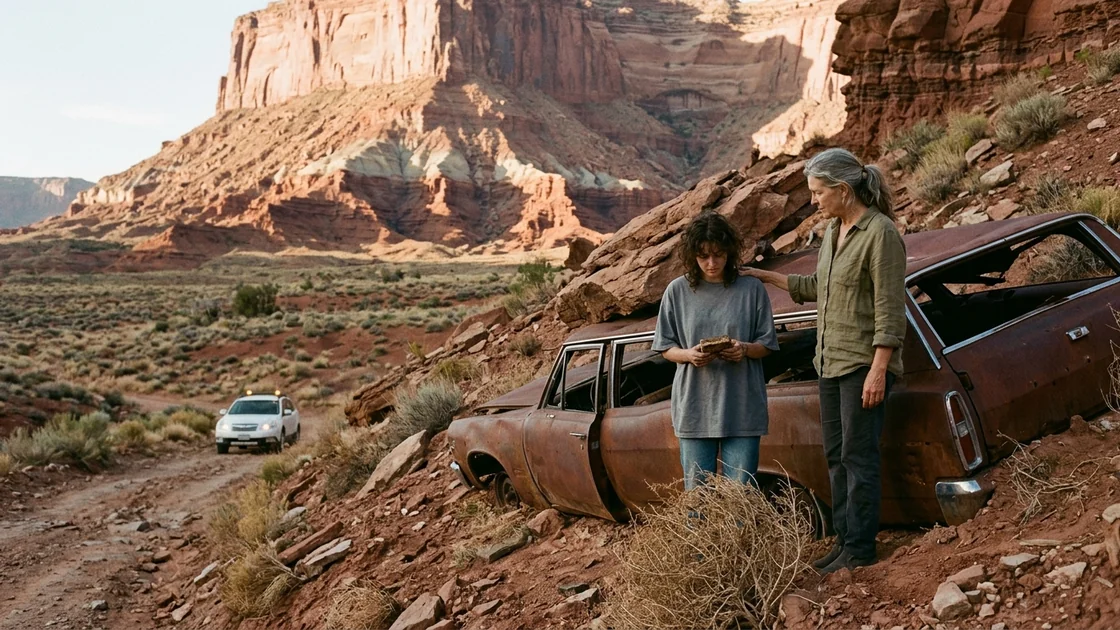
In the summer of nineteen eighty-five Nora crossed the American Southwest with her reckless companion Cleo in a battered station wagon, an adventure that defined the rest of her youth. Nearly four decades later, grieving Cleo and struggling to bridge an aching distance with her twenty-four-year-old daughter Maren, Nora convinces the skeptical young woman to retrace the original route from the California border to the red cliffs of New Mexico. Traveling through forgotten highway towns, bleached desert basins, and crumbling roadside relics, both women confront the ghosts of who they used to be and the uncertain terrain of who they might become to one another.
I. The Odometer at Zero
The air-conditioning in the 2009 Subaru Outback smelled faintly of dried mouse grass and burnt copper, a sharp, metallic reminder that machines, like people, possess an internal decay that accelerates the moment you demand too much of them.
Nora adjusted the plastic vent with a thumb calloused from thirty years of sorting municipal library returns. She angled the lukewarm current toward her collarbone. On the passenger side, her daughter Maren had already drawn her knees up against the glove box, creating an angular barricade of denim and oversized headphones. Maren’s phone rested face-down on her thigh, its screen pulsing every six or seven seconds with a pale green notification light that she pointedly ignored.
"We aren't even past San Bernardino," Maren said. Her voice was flat, pitched beneath the hum of the radial tires on grooved concrete, but it carried the clean, surgical edge that had defined her speech since she turned twenty. "If you’re going to sigh like that every time an eighteen-wheeler changes lanes, we’re going to be out of water by Barstow."
"I wasn’t sighing at the truck," Nora said, keeping both hands at ten and two on the cracked polyurethane wheel. "I was looking at the ridge. In eighty-five, there wasn't a single roofline past the wash. It was just chaparral and those electrical towers that looked like giant praying mantises."
"Now it’s distribution centers," Maren said, not looking out the window. "Praise be to two-day shipping."
Between them, wedged into the cup holder usually reserved for loose change and dry cleaning receipts, sat an object that had spent thirty-nine years in an airtight cedar chest at the bottom of Nora’s linen closet. It was a spiral-bound Mead composition notebook, its blue cover faded to the color of skim milk, swollen around the edges where rain or spilled Dr Pepper had puckered the pulp. Tucked between the lined sheets were four-by-six color prints from a long-vanished pharmacy in Glendale, their borders yellowed, their emulsions faded to a warm, sickly magenta. On the front, written in black grease pencil with the bold, theatrical slant that had belonged exclusively to Cleo Vance, were five words: The Great Escape or Bust.
Maren hadn't touched the book. When Nora brought it out to the car that morning in Pasadena, laying it across the console like an offering or an atlas, Maren had merely set her reusable water bottle next to it with a sharp, plastic clink.
"You really think it’s still out there?" Maren asked now, her eyes tracking an exit sign for a town that had become an unbroken strip of tile outlets and drive-thru coffee kiosks. "Whatever it was."
"It isn't a what," Nora replied mildly, though her knuckles tightened against the wheel. "It’s a place. A road doesn't just evaporate because people built warehouses along the shoulder."
"Civilizations do," Maren murmured, sliding the headphones over her ears again.
Nora didn't argue. She knew the silence that followed. It was the same silence that had occupied the hallway between their bedrooms for the past eighteen months, ever since Maren moved back into the bungalow with three mismatched duffel bags, a master’s degree in comparative literature that no one seemed willing to pay her for, and an unspoken, leaden sorrow over a girl named Julian whose name was never mentioned before noon.
Nora had watched her daughter turn into a ghost who raided the pantry at two in the morning and left circles of condensation on the coffee table. When the letter from Cleo’s sister had arrived three weeks ago—a stiff, cream-colored card announcing that Cleo had died in an assisted-living facility outside of Tucson of something respiratory and nameless—Nora hadn't wept in front of Maren. She had simply walked out into the garage, pulled the cedar trunk into the dusty square of light beneath the single bulb, and lifted the Mead notebook by its worn wire spine.
We are going, Nora had said that night, dropping the atlas onto the dining table where Maren sat picking the crust off a slice of toast.
Going where?
East. We’re taking the old four-lane. We’re going to Needles, then Oatman, then across the plateau to Grants and the turquoise cut.
I have interviews, Maren had lied. Her eyes were rimmed in red, her resume open on her laptop screen, untouched for four days.
You have an empty calendar and a mother with two weeks of accrued vacation, Nora had said. Pack four shirts and the boots your uncle gave you. We leave at six.
Now, the smog of the Inland Empire began to tear open against the sharp teeth of the Cajon Pass. The sky, which had been a bruised gray-white all morning, suddenly arched upward into an aggressive, terrifying blue. The scrub oak gave way to Joshua trees—stiff, twisted arms frozen in postures of ancient bewilderment.
Nora reached down and tapped the Mead notebook. "Page twelve," she said aloud, even though Maren’s ears were buried under foam and synthetic leather. "Page twelve is where Cleo stole the hubcap in Victorville."
Maren didn't move, but Nora saw the small muscle at the hinge of her daughter’s jaw jump once, twice, before settling into the stony endurance of the young.
II. The Caliche Line
By two in the afternoon, the temperature outside the Outback had climbed to one hundred and four degrees. The highway had shed its lanes one by one until it was nothing more than an asphalt ribbon bisecting a cracked white expanse of caliche and creosote: old Route 66, running parallel to the singing iron of the Santa Fe tracks.
In 1985, Cleo had driven the Nova with her bare feet propped on the lower rim of the steering wheel, her toenails painted with a chipped metallic blue lacquer she’d bought at a Thrifty drugstore. She had worn an army surplus vest over nothing at all, her collarbones sharp as flint, her hair cropped close with kitchen scissors.
"Listen to that," Cleo had shouted over the roar of the floorboards, which had rusted through beneath the pedals until you could see the gray blur of the desert floor rushing beneath your heels like dirty river water. "That’s the sound of nobody knowing where the hell we are. You feel that, Nor? That’s zero gravity."
Nora had felt only terror and an intoxicating, liquid gratitude that she had been chosen to sit in the passenger seat. She had been twenty-one, dough-faced, her luggage packed with neatly ironed cotton blouses and an extra pair of sensible walking shoes her mother had forced upon her. Within forty-eight hours, Cleo had tossed the walking shoes out of the window somewhere outside of Ludlow because she claimed they smelled like suburban defeat.
Now, Nora pulled the Subaru into the gravel lot of Roy’s in Amboy.
The giant neon sign still stood against the dead volcanic cone behind it—a boomerang of yellow and aqua that looked like an artifact dropped by an illiterate alien culture. The gas pumps were modern now, digital and sleek, but the bungalows behind the main office stood boarded up, their screen doors hanging by single rusted springs, shivering in the blast furnace of the Mojave wind.
"Ten minutes," Nora said, turning off the engine. The silence that rushed into the cabin was immediate, heavy, and hot enough to dry the moisture from their nostrils in three breaths.
Maren pulled off her headphones. Her dark hair was stuck to the side of her neck with sweat. She squinted through the windshield at the blinding white gravel.
"Is this a joke?" Maren asked. "People live here?"
"They used to," Nora said. "There was a girl named Shirley who worked the counter. She had a tattoo of a swallow on her wrist and she gave us two packages of lemon drops because Cleo told her we were backup singers for Joan Jett."
"Were you?"
Nora looked at her daughter, surprised. "Did I ever look like a backup singer for anyone?"
"No," Maren said, opening her door. The desert air hit her, and she flinched, her shoulders hitching. "You look like someone who pays her taxes early to get the direct deposit."
They walked across the heat-softened asphalt together, their sneakers crunching on the cinder dust. Inside the small lobby, a glass cooler hummed frantically against the ambient heat, stocked with overpriced craft sodas and bottles of spring water with labels designed to look rustic. A bearded man in his late twenties sat behind the counter, scrolling through an iPad with the languor of an inmate counting ceiling cracks.
Nora walked over to the corner where the postcards were displayed in a wire rack that squeaked as she turned it. Most of the cards were modern reproductions—glossy prints of vintage cars with their contrast cranked up until the sky looked like turquoise plastic. But near the bottom, wedged behind a card showing a sidewinder rattlesnake, she found an older one: a matte print of the cabins as they had looked in the late seventies, a row of bright pastel boxes with Pontiacs parked out front under the tamarisk trees.
She picked it up. Her finger left a pale, damp smudge on the cardboard.
"We stayed in number four," Nora said softly. "The air conditioner sounded like a lawnmower, and we had to put a wet towel along the base of the door to keep the sand beetles out. Cleo drank half a bottle of peppermint schnapps and threw up in the sink, and then we stayed up until four in the morning talking about whether God was an architect or an electrician."
Maren was leaning against the cooler, holding an aluminum can of iced tea against her cheek. She watched her mother with an expression that Nora couldn't quite decipher—part pity, part clinical interest, like a biologist observing an animal that hadn't realized its habitat had been paved over.
"Did you love her?" Maren asked.
The question was so quiet, so flat, that for a moment Nora thought the swamp cooler had made the sound.
"She was my best friend," Nora said, her fingers tightening on the postcard.
"That wasn't what I asked."
"It’s what I’m answering." Nora turned the postcard over. The back was blank, the address lines printed in faded gray ink: Place Stamp Here. Domestic One Cent, Foreign Two Cents. "Things didn't have names then, Maren. Not the names you have now. We didn't walk around with clipboards checking off boxes about who we were. We just... were."
"That sounds convenient," Maren said. She set the iced tea on the counter and pulled a crumpled ten-dollar bill from her pocket. "And cowardly."
Nora felt the blood rise in her cheeks, hot and sudden, competing with the furnace blast from the open doorway. "You think everything is simple because you have five hundred words for every twitch in your brain. You think if you can label a thing, you own it."
"No," Maren said, taking her change from the bearded clerk, who didn't even lift his eyes from his screen. "I think if you don't name a thing, it lets you pretend it didn't happen when you get old and scared."
She walked out into the sun before Nora could answer. Through the plate glass, Nora watched her daughter cross the gravel lot—a thin, slightly stooped silhouette in an oversized gray T-shirt, walking with her arms crossed over her chest as if she were trying to hold herself together against the immense, indifferent bowl of the sky.
III. The Hill to Oatman
The road out of Needles didn't cross the river so much as it surrendered to it. They crossed into Arizona on the old steel bridge, the brown water of the Colorado sliding below them like melted chocolate, broad and treacherous between the reeds.
Nora had the notebook open on her lap now. She drove with one hand, her glasses perched on the tip of her nose, her eyes darting between the yellowed lines of Cleo’s handwriting and the modern green road signs that had replaced the hand-painted wooden markers of forty years ago.
Mile 142, Cleo had written in purple felt-tip pen. Nora is terrified of the burros. She thinks they have rabies. I told her if one bites her, she’ll just turn into a donkey at midnight like in Pinocchio. She didn't laugh. She never laughs when she’s hungry.
"Take the switchback," Nora instructed, nodding toward an abrupt right turn that peeled away from the highway toward the Black Mountains. "Route 66 doesn't take the interstate through Kingman. It goes up through Sitgreaves Pass."
"The road that looks like a pencil scribble on the mountain?" Maren asked, glancing up from her phone, which had finally lost its last bar of cellular service three miles past the river. "The one with no guardrails?"
"It’s the original road," Nora said.
"It looks like an insurance claim."
"Cleo drove it at seventy miles an hour with three cylinders misfiring."
"Cleo is dead," Maren said.
The words fell between them with the weight of wet clay. Nora didn't flinch, but her hands on the steering wheel settled into a low, rigid grip.
"Yes," Nora said. "She is. And you’re here."
"Not by choice."
"You could have stayed in the house. You could have spent another month staring at the ceiling in your childhood bedroom, waiting for the world to apologize to you for being difficult."
Maren turned her head sharply toward the side window. Her reflection in the glass was pale against the brown ramparts of the volcanic rock rising outside. "You don't know anything about it."
"I know what a girl looks like when she thinks she’s the first person in human history to have her heart broken," Nora said, her voice dropping into a register that was harder than she intended. "I’ve seen it in the mirror, Maren. It isn't a career."
The Subaru began to climb. The road was narrow, notched directly into the face of the yellow rock, with nothing between the passenger-side tires and a four-hundred-foot drop into the canyon except six inches of crumbly asphalt and an occasional white-painted stone. The radiator began to click, a steady, rhythmic ticking that Nora recognized from every high-mileage engine she’d ever owned.
Around the fourth switchback, they found the wild burros.
They were standing in the middle of the road—three of them, their coats dusty gray, their long ears swiveled backward against the wind. One of them had its nose buried in a paper bag someone had discarded by the rocks; the other two stood motionless, like statues carved from the same caliche as the cliffside, staring at the front bumper of the car with ancient, unblinking eyes.
Nora braked. The car came to a halt four feet from the largest donkey, whose left ear was notched with a ragged V-shaped tear.
"Don't honk," Nora said.
"I wasn't going to," Maren said. She had rolled her window down an inch. The scent came in immediately—wild sage, dry dung, and the hot, resinous breath of the creosote bushes clinging to the rocks.
The notched burro stepped forward, its hooves clicking neatly on the stones, and laid its gray muzzle directly against Maren’s window. It exhaled, a long, whistling snort that fogged the glass.
Maren didn't pull back. Slowly, with a hesitation that looked almost like reverence, she slid her fingers through the gap in the glass and touched the bridge of the animal’s nose. The hair was coarse, stiff as pine needles, bleached by a sun that never relented.
"Cleo was wrong," Maren whispered.
"About what?"
"They don't look like donkeys in Pinocchio. They look like old men who forgot what they were looking for."
Nora watched her daughter’s hand. The fingers were long and slender, Cleo’s fingers—not by blood, for Maren was the child of a sensible marriage Nora had made six years later with an accountant who played squash on Thursdays and died of an aneurysm when Maren was nine—but by some strange, atmospheric inheritance that Nora had never been able to explain to anyone. Maren had the same habit of tucking her thumb inside her fist when she was uncertain; she had the same sharp, sideways tilt of the head when she was listening to music she hadn't decided whether to hate yet.
"In eighty-five," Nora said, her voice dropping into the quiet of the car, "we had seven dollars between us when we hit this ridge. The Nova’s clutch was slipping so badly we had to take the steepest parts in reverse because reverse was the only gear that had any teeth left."
Maren kept her hand on the burro’s forehead. The animal’s eyes half-closed in the heat. "Why didn't you just go home?"
"Because there was nothing to go home to," Nora said. "My father had already told me that if I didn't register for the secretarial course at Glendale Community by September, he wasn't paying my board. And Cleo... Cleo’s father had found the letters."
The burro shifted its weight, its tail flicking at a fly.
"What letters?" Maren asked.
"The letters from the girl in Flagstaff," Nora said. "The one who worked at the observatory. Cleo had them tied up in a silk scarf under the floor mats. He found them when he was changing the oil, and he threw her out on the lawn with her duffel bag while the neighbors were mowing their yards."
Maren turned her head slowly. Her eyes, which had been defensive and hooded all morning, were wide and strangely clear in the mountain light. "You never told me that."
"You never asked," Nora said. "You assumed I was born at forty-five with a cardigan and a library stamp."
The notched burro gave a low, rumbling groan from deep in its belly, lost interest in the window, and wandered off toward the scrub at the edge of the drop-off. Nora shifted the Subaru into drive, but she didn't hit the gas.
"She wasn't afraid of anything," Nora said, looking down at the notebook. "Except being ordinary. That was the only thing that made her hands shake."
"That isn't a small thing," Maren said. She pulled her hand back inside and rolled the window up, but she didn't put the headphones back on.
IV. Seligman and the Preservation of Dust
They spent the night in Seligman, at a motor court that had painted its exterior in broad, aggressive stripes of lemon yellow and turquoise to attract the tour buses that ran between Las Vegas and the Grand Canyon.
The town was a museum that had refused to bury its corpses. Everywhere there were fiberglass statues of mid-century icons: James Dean leaning against a wooden post with his collar turned up; Marilyn Monroe with her skirt eternally billowing over a ventilation grate that blew only hot, dry dirt; Elvis Presley smiling with bleached, resin teeth from behind the wheel of a convertible that had no engine.
Nora sat on the edge of the bed in Room 114. The bedspread was polyester, printed with a pattern of stylized route markers and old-fashioned road signs that had already begun to pill beneath her heels.
Across the room, Maren had unpacked her laptop. She sat at the small laminate desk, illuminated by the pale, cold glare of the screen, her fingers clacking against the keys in short, frustrated bursts.
"Are you working?" Nora asked.
"I’m looking at listings," Maren said without looking up. "There’s a two-bedroom in Long Beach. With three roommates. One of them works at a collective bakery and the other two are in an experimental theater troupe."
"Can you afford that?"
"No," Maren said. "I can’t afford an experimental sandwich right now, Nora. That’s not the point."
"You could stay at the house another year. You don't have to pay rent."
"I can’t breathe in that house," Maren said, her voice dropping into that familiar, venomous quiet. "Every room smells like Meyer lemon furniture polish and dead relatives. You have twenty years of National Geographic stacked in the garage that you won't throw away because you think someone might need to look up a map of Madagascar from nineteen seventy-four."
Nora stood up and walked to the window. Outside, neon light buzzed—a high-frequency cicada song that vibrated through the thin plate glass. A group of German tourists in matching khaki shorts was taking pictures in front of the barber shop across the street, their laughter thin and bright in the empty desert night.
"I keep them because they’re beautiful," Nora said to the glass.
"They’re paper," Maren said. "They’re just paper that somebody else didn't want to throw in the recycling."
Nora turned. "Do you know what Cleo did with her diploma?"
Maren stopped typing. Her hands hovered over the keyboard like two white crabs. "What?"
"She burned it in a coffee can behind the gym," Nora said. "She said if she had a piece of paper that said she was qualified to teach ninth-grade English, someone would eventually make her do it. She didn't want a safety net because she knew she’d fall into it."
"And look where that got her," Maren snapped. "A state-run home in Pima County with a social worker signing her death certificate."
The air in the room seemed to contract. The neon light outside pulsed red, then yellow, then green, painting the lines of Maren’s face with garish, theatrical greasepaint.
Nora walked over to the desk. For a moment, Maren pulled back, as if she expected a blow, but Nora merely reached down and closed the laptop screen until the blue light vanished, leaving only the buzzing neon from the street.
"She lived forty years between that coffee can and that room," Nora said, her voice shaking with an anger that had taken decades to find its throat. "She lived forty years that you don't know anything about. She played the bass in a band that opened for the Minutemen in San Pedro. She ran an illegal printing press in Albuquerque that printed leaflets for the farmworkers. She lived in a converted water tower in Taos with three women and seven goats and she made silver bracelets that she sold out of the back of a truck until her hands got too twisted to hold the pliers."
"And where were you?" Maren asked.
"I was in the library," Nora said. "I was checking out books to people who forgot to bring them back. I was marrying your father because he had health insurance and he never raised his voice when he was tired."
"You hated him," Maren whispered.
"I loved him," Nora said, and the truth of it surprised her even as it left her mouth. "I loved him because he was safe. Because when I was with him, I didn't feel like I was about to slide down the side of a mountain with no brakes. But I loved Cleo because she made me feel like the mountain was the only thing that mattered."
Maren looked down at the closed laptop. The neon light outside turned green, washing the small room in a pale, aquatic gloom that made both of them look like they were standing at the bottom of a dry reservoir.
"Julian wasn't like that," Maren said. Her fingers traced the beveled edge of the plastic casing. "Julian didn't want to burn anything. She wanted a mortgage. She wanted an air fryer and a hybrid with lane-assist. She left me because I couldn't figure out how to want those things without feeling like I was being buried alive."
Nora stood behind her daughter. She did not touch her—they were not a family that leaned into easy physical comforts—but she stayed close enough that Maren could have leaned back against her ribs if she had let her weight go.
"The fear doesn't change," Nora said softly. "Just the things you use to hide it."
V. The Wigwam and the Petrified Trees
They bypassed Flagstaff the next morning, cutting southeast along the edge of the Mogollon Rim.
The country here changed its skin. The gray creosote of the low desert gave way to red dirt, then to high, yellow grassland where the wind ran through the grama grass like a hand over velvet. Off to the north, the San Francisco Peaks hung against the horizon—pale blue triangles capped with late-spring snow that looked like sugar frosting on slate.
Nora had the mixtapes.
She had found them in the cedar chest with the notebook: five Maxell XL-II cassettes, their plastic shells labeled with Cleo’s tiny, frantic block printing in faded red ink. She had bought a portable cassette player with a headphone jack at a thrift store in Barstow, running a patch cord into the Subaru’s auxiliary input.
When Nora pushed the plastic button down with a heavy clack, the speakers didn't produce the clean, compressed digital audio Maren was used to. There was a long second of hiss—a sound like meat frying in another room—followed by the dry, percussive crack of an electric guitar that had been recorded through a cheap amplifier in a garage that probably smelled of oil pans and stale beer.
It was The Gun Club. Jeffrey Lee Pierce’s voice came howling through the dashboard like an animal that had caught its foot in a gate:
“Well, my gun is my guide, my gun is my guide...”
Maren reached out instinctively to turn the knob down, but Nora caught her wrist.
"Leave it," Nora said.
"It sounds like a lawnmower falling down the stairs."
"It’s nineteen eighty-five," Nora said. Her eyes were bright, almost feverish, reflecting the red glare of the sandstone cuttings that rose on either side of the road. "We bought this tape from a guy who was selling them out of a milk crate behind the Mabuhay Gardens. Cleo played this track four times in a row while we were crossing the Mojave because she said it was the only music that didn't sound like it was trying to sell you a pair of sneakers."
Maren let her hand drop. She listened.
The rhythm was ragged, frantic, driven by a bass line that stumbled forward with the blind momentum of a drunk running down a hill. Through the hiss and the tinny treble, there was something else: a sudden, high laughter caught on the magnetic tape—a woman’s laugh, wild and sharp-toothed, followed by Cleo’s voice cutting across the intro:
“Nora, stop looking at the temperature gauge! If it blows, it blows!”
Nora’s breath caught in her throat. She hadn't listened to the tape in thirty years. She had forgotten that the machine had been running while they were talking, that the microphone on the dashboard had sucked in their voices along with the guitar strings and the roar of the dry air through the quarter-vent.
Maren turned her head toward the console. Her expression had lost its defensive irony; she looked startled, as if a hand had reached up out of the carpet and touched her ankle.
"That was her?" Maren asked.
"That was her," Nora whispered.
“If it blows, it blows,” the recorded Cleo repeated, her voice thin and bright against the thumping drums. “We’ll walk to Holbrook. I know a guy in Holbrook who has an orchard. We’ll eat peaches until we throw up.”
Then the guitar slammed back in, drowning out the voices with a wall of fuzzed-out distortion, and Nora let her head rest back against the headrest for three miles, her lips moving silently along with words she hadn't known she remembered.
They pulled into Holbrook at two in the afternoon, stopping at the Wigwam Motel.
The fifteen concrete teepees stood in a semicircle around an oval of gravel, each with its own vintage sedan parked out front like a museum diorama. The sign out front still promised SLEEP IN A WIGWAM, its neon tubes unlit in the white afternoon glare.
Nora turned off the engine. The silence that returned was different now; it wasn't the dead weight of the low desert, but the high, thin hush of the Colorado Plateau, where the wind smells of stone dust and juniper.
"There weren't any peaches," Nora said, looking at the concrete cones.
Maren unbuckled her belt. She held the composition book in both hands now, her thumbs resting on the worn corners. "What was there?"
"A radiator shop," Nora said. "And an old man named Virgil who had three fingers on his left hand and charged us forty dollars to solder the brass tank. We sat on the curb outside his shop for seven hours, sharing a can of sardines and a sleeve of saltines that had turned soft from the humidity."
"Did you fight?"
Nora looked at her daughter. Maren’s face was framed by the dark curls that had always refused to stay in any clip or band—the same curls Nora’s mother had tried to iron out with wet towels and a hairbrush when Nora was twelve.
"We fought about everything," Nora said. "We fought about whose turn it was to push the car when the starter solenoid clicked. We fought about the girl in Flagstaff. Cleo wanted to go back for her. She wanted us to drive up to the mountain and wait in the pine trees outside the girl’s dormitory until she came out, and then she wanted us to take her with us to New Orleans."
"Why didn't you?"
"Because the girl had a fiancé," Nora said. "A boy who was studying forestry. He had a beige pickup truck and a setter that rode in the back on a sheepskin pad. She had already chosen the pattern for her silverware. Cleo couldn't understand that. She thought if you loved someone, you just... kicked the door off the hinges and dragged them into the street."
"And you?" Maren asked. "What did you think?"
Nora looked out at the concrete teepees. A lizard, gray as slate, sat on the doorframe of Number Eight, its throat pulsing with a steady, mechanical beat.
"I thought she was going to get us killed," Nora said. "And I thought that if she did, it would be better than going back to the library."
They walked into the Petrified Forest an hour later.
The park was empty, save for a lone camper van with Ontario plates parked near the rim of the Painted Desert. The badlands tumbled away from the overlook in ripples of lavender, rose, and ash-gray, looking less like earth than like a sea that had been frozen and shattered during an earthquake that happened before the stars were named.
They walked along the paved trail through the Giant Logs. The fallen trees lay across the gravel like marble pillars from a smashed cathedral—agate, jasper, and chalcedony, their rings preserved in shades of blood-red, honey, and bruised violet.
Maren knelt beside a massive log that had broken into three neat segments, each as thick as a tractor tire. She laid her palm against the polished face of the stone.
"It doesn't feel like wood," Maren said.
"It isn't wood anymore," Nora said, standing over her with her hands in the pockets of her linen trousers. "The wood rotted out two hundred million years ago. The silica came in and filled every cell, molecule by molecule. It’s an exact copy of a tree, made out of rock."
Maren looked up, squinting against the late sun that was turning the red cliffs to copper. "So it’s a lie."
"No," Nora said. "It’s a memory that figured out how to survive the weather."
Maren didn't answer. She stood up, her knees cracking in the dry silence, and for the first time since they had left the garage in Pasadena, she didn't look at her phone. She looked out across the basin toward the red mesas of the Navajo Nation, where the shadows of clouds were moving across the sand like great blue whales sliding through shallow water.
VI. The Continental Divide
They crossed into New Mexico at Lupton, where the sandstone cliffs rose into massive, red-and-buff battlements that looked like the ruins of a city built by giants who had abandoned it before the plaster dried.
The highway here was wider, but the towns were poorer. In Gallup, the pawnshops lined the old route like teeth: NAVAJO RUGS. OLD PAWN. LIQUIDATION. The air smelled of woodsmoke from the stoves in the camps up on the north side, a sweet, oily cedar smoke that caught in the back of the throat and spoke of winter even in June.
Nora stopped at a diner that had changed its name three times since 1985 but still had the same horseshoe counter of chipped yellow Formica and the same high, stamped-tin ceiling painted the color of dried milk.
The waitress was an older woman with silver hair pulled back into a tight bun with a turquoise-topped silver pin. She set two heavy mugs of coffee on the counter without being asked, their surfaces trembling with the passage of an eastbound freight train two hundred yards away.
"You ladies traveling far?" the waitress asked.
"Santa Fe," Nora said.
"High road or low road?"
"The old road," Nora said. "Through Grants and Laguna."
The woman nodded, wiping a rag across the Formica with slow, circular strokes. "A lot of water in the wash past Bluewater. The culverts are silted up from the storm Tuesday. Take it slow through the reservation."
When the woman walked back toward the kitchen, Maren picked up her mug. She didn't add sugar, though Nora knew she had taken her coffee with three packets of raw sugar and oat milk since she was fifteen. She drank it black, her lips pursed against the heat.
"Why Santa Fe?" Maren asked.
"That was where it ended," Nora said.
"The trip?"
"Everything," Nora said.
The diner counter was cool beneath Nora’s wrists. She looked down at the pale scar between her left thumb and forefinger—a small white line she had gotten from an opened can of peaches in a motel room in Tucumcari that they had never reached.
"We had forty dollars left when we hit Santa Fe," Nora said. "We stayed in an adobe place behind the rail yard that was owned by a friend of Cleo’s brother—a painter who made huge, ugly canvases out of mud and sheep fat. Cleo went out to buy tortillas and came back with a dog."
Maren set her mug down. "A dog?"
"A three-legged heeler mix with one blue eye," Nora said, a small, cracked smile pulling at the corner of her mouth. "She found it behind a bakery near the plaza. She named it Trotsky. She said we couldn't go back to California because the dog was an artist and needed the light in northern New Mexico."
"And what did you say?"
"I said I had to be at the library on Monday," Nora whispered.
The freight train outside hit the crossing, its horn howling three long blasts that shook the glass in the pie case on the back counter.
"I had twelve credits left to finish my degree," Nora said. "My mother had bought me an interview suit—a terrible navy blue thing made of polyester that smelled like chemicals when you ironed it. I had an apartment lined up with two girls from my church choir. I had a life that was laid out like a sidewalk with the cement already dry."
"And you left her?"
"We stood on the platform at the Lamy depot," Nora said. "The train back to Los Angeles was twenty-two dollars. I had twenty-four. Cleo stood there with that blue-eyed dog on a piece of clothesline, wearing a man’s flannel shirt with the sleeves ripped off, and she wouldn't look at me. She just kept throwing pebbles at the rails."
“You’re an old woman, Nor,” Cleo had said. She hadn't yelled. That was the worst part. She had spoken with that terrible, quiet pity that Nora had never forgotten. “You’re twenty-one years old and you’re already an old woman who looks both ways before she crosses a one-way street.”
“I have to live, Cleo,” Nora had told her.
“This isn't living,” Cleo had said, gesturing at the depot, the train, the conductor with his gold watch chain. “This is just waiting to be buried so you don't make a mess on the carpet.”
Nora picked up her spoon and turned it over in her fingers. The silver plating had worn through on the handle, showing the dull gray zinc beneath.
"The train pulled out," Nora said. "And she was still standing there. She didn't wave. She just sat down on an overturned milk crate and gave the dog a piece of dried meat from her pocket."
Maren watched her mother. The diner was quiet now that the train had cleared the crossing, leaving only the low, electrical hum of the pie case and the sound of someone chopping onions in the back.
"Did you ever see her again?" Maren asked.
"Twice," Nora said. "Once in ninety-two, at a wedding in Long Beach. She had cut her hair even shorter, and she was wearing a tuxedo jacket with jeans. She kissed me on the forehead and told me I smelled like a good credit score."
"And the second time?"
"Three years ago," Nora said. Her voice had dropped so low Maren had to lean across the Formica to hear it. "In Tucson. I drove out alone while you were at that residency in Vermont. I didn't tell you because I didn't want you to ask why."
"What was she like?"
"She didn't know who I was," Nora said. "She thought I was her cousin from Boise. She kept asking me if I’d brought the green quilt from the cedar chest. But when I got up to leave, she took my wrist—she still had that grip, Maren, like an eagle catching a trout—and she looked right into my eyes and said, ‘The clutch was slipping, Nor. We should have taken it in reverse.’”
Maren looked down at her hands. The nails were bitten short, the cuticles rough. Slowly, without looking up, she slid her hand across the counter until her fingers touched the side of her mother’s wrist, just above the pale scar.
"We have two days left," Maren said.
"I know."
"Let’s take the dirt road through the wash," Maren said. "The one the waitress told us not to take."
VII. The Red Mesa
The road through the Laguna wash wasn't on the Subaru’s navigation system. It was marked on Nora’s 1984 Rand McNally map as a broken gray line labeled Primitive Road – Inquire Locally.
The pavement ended five miles past the railroad siding, dissolving into a corrugated track of red clay and caliche that ran between two towering sandstone mesas. The rocks were the color of raw beef, banded with layers of white gypsum that looked like fat running through meat.
The storm the waitress had mentioned had left pools of brown, milky water in the hollows of the road. Nora drove slowly, the Outback’s all-wheel-drive system clicking as it searched for traction in the slick, greasy clay.
"If we get stuck here," Maren said, leaning her forehead against the passenger window, "we’re going to have to walk twelve miles to find a person who owns a tractor."
"Then we’ll walk," Nora said.
She wasn't looking at the road. She was looking at the way the light fell from the rim of the southern mesa. It was late afternoon, the hour when the desert stops being an oven and becomes a furnace of color—reds so deep they look like fresh blood, yellows that burn with the intensity of sulphur, and the long, cold shadows that pool in the canyons like ink.
"Stop," Maren said suddenly.
Nora hit the brakes. The car slid three feet through the clay before coming to rest with its front wheels cocked toward a clump of rabbitbrush.
"What is it?"
"Look," Maren said, pointing up toward the talus slope at the base of the cliff.
Halfway up the red scree, half-buried in forty years of wind-blown dust and tumbleweeds, sat the carcass of an automobile.
It was an old station wagon—a Plymouth or a Dodge from the late sixties—its roof crushed by a slab of sandstone that had fallen from the rim above. The paint had been scoured away by decades of sandstorms until it was nothing but the soft, velvet gray of bare steel, rusted to a rich, dark cinnamon along the rocker panels. One of its doors stood open, tilted toward the sky like the broken wing of a beetle.
Maren opened her door and stepped out into the clay. Her sneakers sank an inch into the red mud, but she didn't seem to notice. She began to climb the talus slope, her boots slipping on the loose stones, her hands reaching out to catch the stiff, spiny branches of the saltbush.
"Maren!" Nora called, getting out of the car. The wind hit her—hot, dry, smelling of ozone and wet sandstone. "Be careful! There are rattlers in those rocks!"
Maren didn't stop until she was standing beside the crushed hood of the wagon.
Nora climbed after her, her breath coming short and hot in her chest. By the time she reached the car, her shins were smeared with red mud and her linen trousers were torn at the hem, but when she looked at Maren’s face, the words of caution died in her mouth.
Maren was looking into the interior of the wreck.
The seats had long since been stripped by pack rats, leaving only the rusted springs and the gray burlap backing. But on the floorboards, half-covered in red silt, sat an object that the desert had refused to digest: an eight-track tape cartridge, its plastic casing cracked, its label faded to a ghost of white paper.
Maren reached down and lifted it from the mud. She blew the dust from the edge.
"What is it?" Nora asked, leaning against the fender. The steel was warm, like an animal’s flank in the sun.
"Bob Dylan," Maren said, reading the faint, stamped letters on the plastic. "Desire."
Nora laughed—a short, barking laugh that turned into something else, something that caught in her throat and tasted of the dust that was blowing off the rim.
"Cleo had that," Nora said. "She played One More Cup of Coffee until the tape wore thin and the vocals sounded like they were underwater."
Maren held the cartridge in both hands. She turned toward her mother, her silhouette dark against the blazing orange rampart of the mesa behind them.
"I’m sorry," Maren said.
The wind took the words and whipped them away across the wash, but Nora heard them.
"For what?"
"For thinking you were just... an old person who didn't want anything," Maren said. Her voice was cracked, the defensive irony stripped away until she sounded twelve years old again, standing on the edge of a swimming pool she was afraid to dive into. "I thought you stayed in that house because you liked the carpets. I thought you wanted me to be like that."
"I wanted you to be safe," Nora said.
"It’s the same thing," Maren said, her eyes filling with tears that didn't fall, dried by the desert wind before they could clear her lashes. "You made safety look like a prison, Nora. And then I went out and I found someone who wanted to build another one with me, and I was so terrified of being you that I burned it down."
Nora stepped across the rusted tailpipe of the wagon. She reached out and took the Dylan cartridge from Maren’s fingers, setting it gently back on the rusted springs of the front seat, where it had waited forty years for someone to notice it was there.
Then she took her daughter by the shoulders.
Maren was taller than she was—she had her father’s long shins and broad collarbones—but she felt fragile under Nora’s hands, like a dry stick that might snap if the wind turned three degrees to the north.
"I didn't stay because I was safe," Nora said, looking directly into the dark, familiar eyes. "I stayed because I had you. And having you was the only thing I ever did that was more dangerous than getting in the car with Cleo."
Maren let her forehead drop against Nora’s shoulder. It was an awkward, unpracticed embrace—two women who had spent two decades learning how not to touch each other—but Nora held her ground against the slope, her boots dug deep into the red clay, her hands flat against the back of her daughter’s gray shirt.
Below them, the Subaru sat in the middle of the wash, small and white and ridiculous against the ancient red bones of the earth, its hazard lights blinking once, twice, three times—a small, artificial pulse in a landscape that had forgotten how to measure time.
VIII. The Turquoise Cut
They reached Santa Fe at dusk, but they didn't go to the plaza.
They didn't go to the galleries with their polished bronze coyotes and five-thousand-dollar squash-blossom necklaces, nor did they look for the adobe house behind the rail yard where the muddy canvases had been stored.
Instead, Nora drove south, out toward the Turquoise Trail that wound through the ghost towns of Madrid and Cerrillos.
The road was empty. The Sandia Mountains rose to the west, a long, dark wall of granite turned black against a sky that was the color of a bruised plum. The air was cool now, smelling of cedar smoke and the first, faint moisture of the summer rains that were gathering over the mountains.
Near the old mining cuts outside of Cerrillos, where the hills were pitted with holes the Pueblo people had dug with stone hammers eight centuries before the first Spaniard lost an iron stirrup in the gravel, Nora pulled the car off onto a level bench of crushed caliche.
She reached down, picked up the Mead composition book, and got out of the car.
Maren followed her without a word.
The wind on the ridge was cold, carrying the sharp, pine-pitch smell of the high desert. Below them, forty miles to the south, the lights of Albuquerque were just beginning to wake up—a scattered handful of yellow embers dropped across the floor of the Rio Grande Valley.
Nora walked to the edge of the caliche bench. She held the notebook against her chest for a long moment, feeling the wire spiral press through her linen shirt against her ribs.
"Page seventy-two," Nora said into the wind.
Maren stood three feet behind her, her hands tucked into the pockets of her oversized jacket. "What’s on page seventy-two?"
"Her address in Santa Fe," Nora said. "And the list of things she wanted us to buy if we ever made it to the coast."
"What were they?"
"A pair of binoculars," Nora said. "A silver ring with a green stone. And a portable record player that could run off a car battery."
Nora looked down at the book. In the gathering dusk, the grease pencil on the cover was almost invisible, the faded blue cardstock looking like a piece of slate.
She didn't open it. She didn't turn to page twelve, where the stolen hubcap was recorded, or to page forty, where Cleo had drawn a map of the stars over the Grand Canyon using grease pencil and a white crayon she’d stolen from a waitress in Williams.
Slowly, deliberately, Nora laid the book down on a flat slab of limestone that rose three inches above the dirt.
She reached into her pocket and pulled out the small, gray river stone she had picked up at the edge of the Colorado three days ago in Needles. She set the stone on the middle of the blue cover, right over the words The Great Escape or Bust.
"Aren't you going to keep it?" Maren asked.
Nora looked at the lights of the valley below. They looked cleaner from here, stripped of the billboards and the strip malls and the long, sad rows of chain hotels that had tried to pave over the road she remembered.
"I’ve kept it forty years," Nora said. "That’s long enough for anything."
Maren walked over to the limestone slab. She looked down at the notebook, then reached into her own pocket.
She pulled out her phone.
For a second, Nora thought her daughter was going to take a picture—to turn the notebook into another flat, digital rectangle that could be saved to a cloud and forgotten with ten thousand other images of things that used to matter.
Instead, Maren pressed the power button, held it down until the screen asked her if she was certain, and slid the red icon across the glass.
The screen went black.
Maren set the phone down on the limestone next to the notebook, then looked up at her mother with that sharp, sideways tilt of the head that Nora had seen forty years ago in the passenger seat of a rusted-out Nova.
"The wind is picking up," Maren said.
"It always does," Nora replied.
"Where are we sleeping tonight?"
Nora looked back toward the highway, where the single headlights of a long-distance truck were cutting through the dark like a white needle through black cloth.
"I don't know," Nora said, and for the first time in forty years, the words didn't feel like a confession of failure. "Let’s drive until we find something with a vacancy sign that isn't completely broken."
They walked back to the car together. When Nora turned the key, the old engine caught with a rough, confident growl that shook the mirrors, and when she shifted the transmission into reverse to back out of the turnout, Maren didn't look at her phone, and Nora didn't look at the map. They just watched the red dust rise behind the red taillights, hanging in the cold night air like a cloud of sparks before the dark took it back.