The Roots of Monte Ceniza
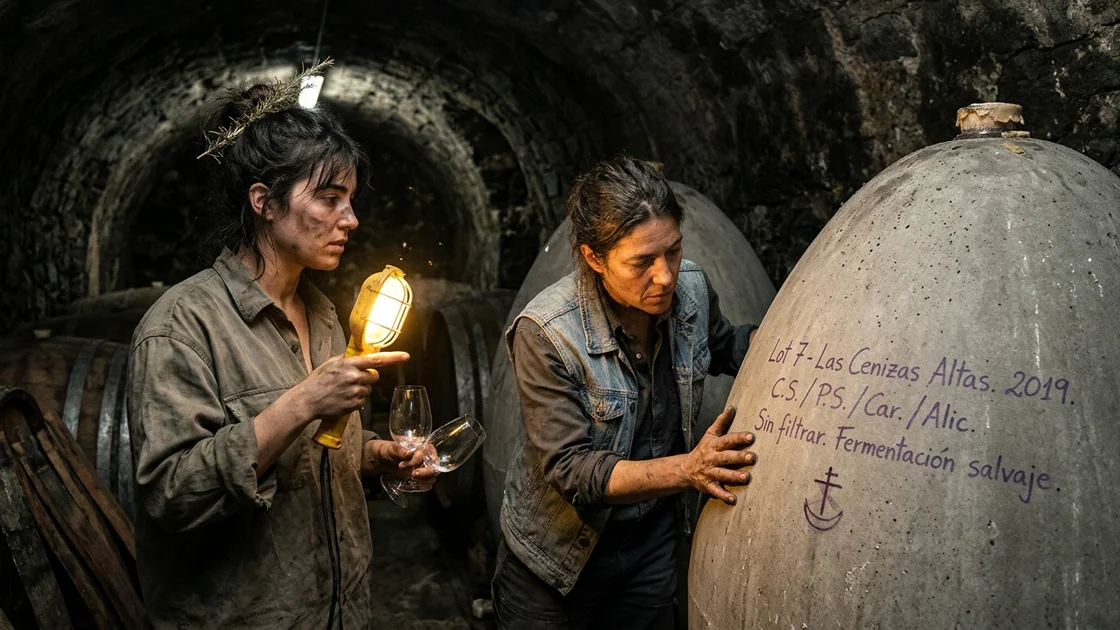
In the sun-baked hills of Sonoma Valley, two estranged sisters must confront the mounting debts of their family vineyard when a ruthless beverage conglomerate offers an easy exit, forcing them to stake their entire future on a forgotten, experimental vintage left behind in the cellars by their visionary late mother.
Chapter I: The Dry Year
The morning frost on the Mayacamas ridge had burned away before seven, leaving behind a sharp, metallic heat that smelled of parched bay laurel and sun-cured switchgrass. Elena Ramos knelt in Block Four, her calloused thumb testing the tension of a drip-emitter line that had long ceased to hiss. The black plastic pipe was brittle, cracked by four consecutive seasons of historic heat and the inquisitive beaks of scrub jays searching for moisture. Beneath her knees, the red volcanic earth was pulverized into a floury dust that settled into the cross-hatching of her work boots and the dry pores of her wrists.
She picked up a hand trowel, digging six inches down near the base of an eighty-year-old Zinfandel vine. The gnarled trunk, thick as an ox’s thigh and twisted like a braid of hemp rope, plunged into the mountain bench with stubborn, indifferent dignity. At six inches, the soil was warm. At ten inches, it yielded only dry shale and pebbles of basalt. Not a bead of cool dampness remained.
Elena stood up, wincing as her lower back caught. She was thirty-four, but harvest seasons were counted like dog years; after twelve vintages managing the viticulture for Monte Ceniza, her spine carried the tally of every dropped cluster, every jammed sorting conveyor, and every sleepless frost watch spent walking the rows with a propane torch and a thermos of bitter chicory coffee.
From the top of the bench, she could look down the length of Sonoma Valley. Below, where the valley floor flattened into alluvial loam toward the Russian River and the bay marshes, the corporate vineyards lay spread like green circuit boards: laser-leveled, perfectly trellised with uniform VSP systems, and lushly fed by deep-well aquifers that smaller family properties along the ridge could never afford to drill. Over there, the irrigation was timed by computer algorithms, and the grapes were picked by two-million-dollar Pellenc harvesters that shook the fruit clean in the dark while the owners slept in air-conditioned villas in St. Helena or San Francisco.
Monte Ceniza had none of that. It had eighty acres of steep, rock-strewn hillside, thirty-two of which were planted to head-trained, dry-farmed heritage vines that had survived the Spanish flu, Prohibition, and phylloxera, only to face an enemy far more mundane: a final notice from the agricultural credit bank folded inside the front pocket of Elena’s denim vest.
A low, guttural whine echoed up the canyon. It was the distinct sound of their 1978 Massey Ferguson tractor dropping a gear because the second-cylinder valve was sticking again.
Elena walked down through the vineyard terracing, her boots scuffing clouds of rust-red earth into the morning air. The winery compound sat tucked against the amphitheater of black volcanic rock from which the property drew its name—the Ash Mount. The main barn was built of hand-hewn redwood timbers, grayed by century-long exposure to coastal fog and inland sun. Its roof of corrugated tin was spotted with rust like the skin of a brown trout. Beside it, the stone cellar, tunneled directly into the basalt hillside by Italian stonemasons in the 1890s, offered the only true refuge from the July glare.
At the loading pad, the tractor shuddered to a halt, coughing a plume of blue diesel exhaust into the blue sky before dieseling to a stop.
Her younger sister, Clara, jumped down from the metal seat. She wore cutoff canvas shorts, oil-streaked work gloves, and an oversized cotton shirt that had belonged to their father, who had been dead ten years, or perhaps to their mother, who had been dead for fourteen months. Clara’s dark hair was tied back in an untidy knot held together by a dry sprig of rosemary, and her cheek was smudged with grease.
"The hydraulic lift is gone," Clara said without greeting. She pulled off her leather gloves and shook her hands, her fingers trembling slightly from the engine vibration. "I got the second bin of sulfur up to the upper terraces, but the ram won't hold pressure. It dropped six inches every time I hit a rut. If we have to spray the back cabernet block next week, we’re doing it with backpack rigs."
"We can't do twenty acres with backpack sprayers, Clara. Our shoulders will be hamburger by row four."
"Then we hire a crew."
"With what?" Elena touched the corner of the envelope in her pocket. "The bank froze the operating line on Tuesday. First Western won't honor checks for contract labor until we clear the principal on the restructuring loan."
Clara stopped unlatching the tractor’s three-point hitch. She turned, her hazel eyes—so much like their mother’s that it caused an involuntary hitch in Elena’s throat—narrowing against the light. "You said we had until the end of August."
"The assessor moved the date up. The commercial appraisal came in twenty percent lower than the baseline because of the vine-decline study in the valley. They don't see an historic hillside vineyard with sixty-year-old Zinfandel and field-blended Carignan. They see twenty-four tons of low-yield fruit that costs three times as much to pick as flat ground, serviced by a well producing four gallons a minute."
Clara kicked the front tire of the tractor. A puff of dry dry-rot rubber powder rose from the tread. "It’s Julian Vance, isn’t it?"
Elena didn't answer immediately. She walked to the galvanized metal trough beside the cellar doors, turned the brass spigot, and splashed the tepid mountain water over her face and the back of her neck. She drew a long breath through her nose, smelling the iron, the dry stone, and the distant, ever-present vanilla note of toasted oak barrels lingering in the air vents of the cave.
"Vance’s car was in the lower driveway at seven-thirty," Elena said, wiping her eyes with the hem of her shirt. "He left a portfolio on the office steps. He didn't even have the decency to wait until business hours. He knows the bank’s decision before we do because Aurelius Beverage Group sits on the regional advisory board."
"What’s the number?"
"Two point four million."
Clara let out a short, hollow laugh that was almost a bark. "Two point four? For eighty acres on Moon Mountain? That doesn't even clear the debt and the back taxes, El. We’d walk away with maybe ninety thousand dollars each. Ten years of sixteen-hour days, and we leave with enough to rent a two-bedroom apartment in Santa Rosa for three years while we pour tasting flights for tourists at a corporate bar."
"It clears the debt," Elena said quietly. "It clears Rosa’s medical bills. It pays off the line of credit on the bottling line. And it stops the bleeding. If we go to auction in October, the foreclosure goes public. Aurelius buys it on the courthouse steps in Sonoma for one point six, the bank takes everything, and we walk away with our clothes and the pickup."
Clara walked past her, yanked open the heavy oak door of the cave, and disappeared into the cool, damp dark within. Elena stood in the blinding light for a moment longer, watching a red-tailed hawk circle on a thermal above the obsidian ridge, before following her sister into the earth.
Chapter II: The Shadow in the Stone
The cave at Monte Ceniza was not one of the polished, chandelier-lit tourist grottos found on the Silverado Trail. There were no polished aggregate floors, no bronze statues of Bacchus, and no velvet seating areas for VIP club members. It was a working burrow: six hundred feet of vaulted tunnels blasted out of solid rhyolite and basalt in 1894, their walls rough-hewn and covered in a thick, velvety fleece of black cellar mold—Cladosporium cellare—that fed on the quiet vapors of evaporating alcohol and oak lactones.
The temperature dropped twenty degrees within ten paces. The air smelled of wet gravel, tartaric acid, damp stave wood, and the deep, rich ghost of a century of fermented grapes.
Clara was standing at the end of the central barrel gallery, her hands planted on her hips, staring at three high stacks of neutral French oak barrels. These were the 2021 and 2022 vintages: estate Syrah and a meager lot of Cabernet Sauvignon that tasted good, even honest, but lacked the density and miraculous aromatics that their mother had coaxed from these vines year after year. Without Rosa, the wines had become correct, tidy, and utterly forgettable—the kind of wine that received an 88 from regional magazines and sat on the shelves of local grocery stores until discounted to twelve dollars a bottle.
"We aren't selling to Vance," Clara said into the shadows. Her voice was flat, muffled by the porous walls.
"Look at the cooperage, Clara," Elena said, leaning against a barrel rack. "Half these staves are over seven years old. They’re exhausted. We don't have the money for new wood. We don't have the cash for the enzymes, the sulfur, the glass orders. Have you looked at the price of glass pallets from Mexico? Double what it was eighteen months ago. We have seventy tons of fruit hanging out there that will be ripe in six weeks, and we don't have enough empty glass to bottle what's already in these casks to make room for it."
"I don't care about the glass."
"You have to care about the glass! Wine doesn't live in the air, Clara. It lives in containers that cost money we do not have."
"Come here," Clara said.
"Clara, please. I have to go through Vance’s term sheet before the bank calls at four."
"I said come here."
There was something in Clara’s tone that cut through Elena’s administrative fatigue—a sharp, nervous vibration that reminded her of their mother when a fermentation was turning volatile and she was listening for the precise moment the yeast began to struggle.
Elena stepped over the floor drain, navigating the puddles of rinse water and the black snakes of thick rubber cellar hose. Clara had moved past the active barrel bays into the far northern drift of the cave—a low-ceilinged spur that had been used for decades as a graveyard for decommissioned equipment: broken basket presses, rusted barrel stirrers, bundles of dried cane stakes, and stacks of old redwood lug boxes from the 1960s.
Clara was holding an ancient yellow halogen work light, its cord trailing back down the tunnel. She was pointing the beam into the deep recess behind a wall of stacked, warped redwood staves that had been salvaged from an old fermenter tank.
"Help me move these," Clara commanded.
"What is this?"
"Just pull. Don't drop them on your feet; they’re full of dry wood borers."
Together, they wrestled the heavy four-inch-thick timbers aside. The wood was dry and brittle, smelling of ancient tannin and attic dust. Behind the barricade, where the tunnel narrowed into an alcove cut into a seam of dense, blue-gray basalt, sat something Elena had forgotten existed.
It was a battery of three 500-liter puncheons—twice the size of standard Bordeaux barriques—made of thick, white oak with broad iron hoops that had oxidized to a dark, chalky gray. Beside them, tucked into the coolest pocket of the rock where groundwater naturally sweated from the stone face, sat two egg-shaped concrete vessels, their chalky gray flanks unmarked except for a series of notations made in broad, grease-pencil strokes.
Elena lifted the work light.
The handwriting on the concrete eggs was unmistakable. It was Rosa’s: an angular, impatient script that slanted hard to the right, written with the violet chinamarker she always kept behind her ear.
Lot 7 – Las Cenizas Altas. 2019. C.S. / P.S. / Car. / Alic. Sin filtrar. Fermentación salvaje.
Beneath the date, their mother had drawn a small, crude sign: an obsidian cross over a crescent moon.
Elena walked forward, her boots crunching on small fragments of stone. Her hand reached out hesitantly, her fingers touching the cool, slightly grainy surface of the concrete egg. Concrete breathes differently than wood; it doesn't impart vanilla or spice, but it allows a slow, minuscule exchange of oxygen while preserving the electric, mineral nerve of fruit grown in high-stress soils.
"This is from the fire year," Elena whispered.
"The year before she got sick," Clara said. Her face, half-lit by the yellow bulb, was fierce with an emotion Elena couldn't quite decipher—part triumph, part grief. "Everyone else on the mountain picked early because of the smoke warnings in October, or they dumped their lots when the winds shifted. Remember? The big houses on the valley floor refused fruit from Moon Mountain because they said it was tainted by the fires up in Lake County."
"It was tainted," Elena said, the memory coming back with sudden clarity. "The whole ridge smelled like charred pine for two months. Vance canceled three hundred tons of grower contracts across the sub-appellation. Everyone sold off their lots for industrial distillation at forty cents a gallon."
"Rosa didn't," Clara said. She reached into her back pocket and pulled out a stainless steel wine thief and two tasting glasses she had sneaked from the laboratory sink. "Look at the bung on the puncheons. Sealed with food-grade paraffin. She didn't distill it, El. She didn't even put it in the production ledger."
"Why wouldn't she put it in the ledger?"
"Because if it was in the ledger, the bank would have claimed it as collateral when we refinanced the crush pad in 2020," Clara said simply. "She hid it. She knew the loan officers only count the barrels in rows one through four. Nobody comes back here with a flashlight."
Elena looked from the concrete eggs to the three massive oak puncheons. Five hundred liters each. That was fifteen hundred liters in the wood, another twelve hundred in the two concrete eggs. Nearly twenty-seven hundred liters of wine.
Three hundred cases. Thirty-six hundred bottles.
"It’s five years old, Clara," Elena said, her voice dropping to a whisper, as though the bank appraisers were listening from the entrance. "If she left it on the gross lees without racking, it’s probably full of hydrogen sulfide. It could be vinegar. It could be pure smoke-taint—like licking an ashcan. You know what happens to high-tannin mountain fruit left untended in concrete for five years? It turns to leather and acetone."
Clara took a small pocket knife from her belt and worked the blade around the wax rim of the bung on the first concrete egg. The yellow paraffin flaked off in brittle curls, falling into the red dust at their feet. With a wet, sucking sound, she loosened the glass stopper.
A breath of air escaped the tank—cool, dense, and scented.
Elena stepped back involuntarily. She had prepared herself for the sharp, prickling sting of acetic acid or the cabbage stench of mercaptans.
Instead, the alcove was suddenly filled with an odor that was shockingly alive: wild blackberries crushed on hot iron, the resinous perfume of mountain sage, dried violet petals, pipe tobacco, and an underlying, smoldering note of scorched volcanic rock that was not smoke taint, but the pure, unmistakable smell of the mountain itself after a first rain.
Clara inserted the glass thief through the neck. The long tube filled with a liquid so dark it was almost impenetrable to the halogen light—a dense, black-garnet core with a narrow rim of brilliant magenta, showing almost no signs of oxidation despite its five years in the stone.
She lifted the thief and let four ounces run into each glass. The liquid fell with a thick, glycerin-rich weight, sheeting against the sides of the glasses in slow, heavy tears.
Clara handed one glass to Elena. Her hand was no longer trembling.
"Don't do this," Elena said, looking down into the dark well of the glass. "Don't make me hope for something that can't fix this."
"Taste it," Clara said. "Or I'll drink the whole damn tank myself."
Chapter III: The Tongue of the Mountain
Elena held the glass by the stem. She didn't swirl it immediately; she brought it to her nose while the liquid was still quiet, letting the first volatile compounds hit her olfactory senses.
There was no smoke taint.
Smoke taint was greasy, medicinal, reminiscent of wet campfire ash and cheap smoked meat. This was different. This was char: the ancient, mineral charcoal of decomposed volcanic tuff, intermingled with high-toned red currants, pomegranate molasses, and the spicy, brambly grit of ancient Carignan.
She took a small sip, letting the wine roll across the front of her tongue, then drew in a tiny draft of air through her teeth—the cellarman’s whistle.
The impact was immediate and physical. A shock of acidity hit the salivary glands, sharp and crystalline as mountain water, followed instantly by a massive, structural wave of tannin that was fine-grained, like the silt of crushed river stone. It wasn't green, and it wasn't dried out by excessive oak. The wine had an astonishing tension—a tightrope walk between brute power and a delicate, savory herbal freshness that tasted of the chaparral that rimmed their property: wild laurel, fennel root, and dried bay leaf.
It wasn't a modern California wine. It didn't taste like the sweet, jammy, bourbon-barrel-finished confections that dominated the retail racks, nor did it taste like the anemic, under-ripe, low-alcohol curiosities favored by natural wine boutiques in the city.
It tasted like Monte Ceniza had tasted in the 1970s, when their grandfather had dry-farmed with mules—unapologetic, ferocious, and distinctly of its earth.
Clara swallowed, her eyes wide. "The Carignan," she said. "She used the block behind the water tank. Those vines were planted in 1912. They have roots that go down thirty feet into the fissures. They didn't take up the surface smoke from the 2019 fires; they were drinking from the deep shale."
Elena took a second, larger sip. As the wine warmed in her mouth, the mid-palate expanded, unfolding into layers of black fig, ironstone, graphite, and cocoa nibs, ending with a long, saline finish that lingered on the palate for more than sixty seconds.
"She blended it with the Petite Sirah from the west terrace," Elena whispered, her viticulturist’s memory piecing the map together. "And the Alicante Bouschet. That’s where the color comes from. Alicante has red flesh—it doesn't need skin contact to give that blood-ink tone. And she left it on the fine lees in concrete to smooth out the edge of the Petite."
"It’s not just good, El," Clara said, her voice dropping into a register that made the hairs on Elena's forearms rise. "It’s the best thing that has ever come out of this canyon. It’s better than the '97 Reserve that won the Gold Medal at the State Fair. It’s better than anything Rosa ever made while she was alive."
"It was her last," Elena said.
A heavy silence fell over the small stone room. The halogen lamp hummed softly, casting long, angular shadows of the two sisters across the rough-cut basalt walls.
Elena knew what this wine was. In the wine trade, it was what they called an "outlier"—a bottle that defied the current commercial vocabulary, something that could either be completely dismissed by mainstream buyers as backward and rustic, or hailed by the small, influential circle of serious critics as a masterwork of terroir.
"Vance is coming back at five," Elena said, her voice steadying as the business reality pushed back against the sensory rush of the wine. "He wants an answer on the letter of intent."
"Tell him to go to hell."
"Clara, look at me." Elena set the glass down on the top of the concrete egg with a sharp click. "Even if this wine is what we think it is, it’s currently sitting in five-hundred-liter casks and concrete eggs without a label, without a capsule, without a TTB certificate of label approval, and without a market. We have twelve thousand dollars in the checking account. The bottling truck charges four thousand just to roll onto the property. Glass will cost us six thousand. Corks, capsules, labels, cartons—another three. We don't have the money to get it into the bottle, let alone launch a brand."
"We sell the tractor."
"The tractor has a broken hydraulic pump! It’s worth seven hundred dollars in scrap!"
"Then we sell the truck. We sell Dad’s '68 Mustang that’s sitting in the back shed."
"That car hasn't run since we were in high school, Clara. Its block is cracked." Elena rubbed her temples, where a tension headache was beginning to bore a hole behind her eyes. "You don't understand how the industry works now. You can't just put great wine in a bottle and wait for the world to beat a path to your door. The distribution channels are locked up. Aurelius owns four of the six major distributors in the state. If you don't have a placement rep, you don't get into the restaurants, you don't get into the specialty shops, and you don't get reviewed by the three critics whose scores actually move cases."
Clara leaned over the open bung of the concrete egg, her face reflected faintly in the dark surface of the wine within.
"The Sonoma Harvest Reserve Tasting," Clara said.
Elena stopped. "No. Absolutely not."
"It’s in three weeks. The entry deadline for the library and barrel lots is Friday."
"The Harvest Reserve Tasting is run by the Vintners Alliance. The table fee alone is eight hundred dollars, and it’s judged by the old guard. Devereaux is the lead judge this year."
"Exactly," Clara said, turning around, her eyes ablaze with an almost terrifying intensity. "Paul Devereaux. He hates the fruit bombs. He hates what Aurelius has done to the valley. He spent twenty years praising Rosa’s early vintages before she started chasing the commercial scores to pay for the new destemmer. If Devereaux tastes this—if he tastes what Rosa did when she stopped caring about what the market wanted—he’ll write it up. One note from him in the Quarterly, and we don't need a distributor. We can sell the entire three hundred cases direct-to-consumer at a hundred and fifty dollars a bottle."
Elena did the arithmetic instantly, the numbers flashing behind her eyelids: Three hundred cases. Thirty-six hundred bottles. At a hundred and fifty dollars, that’s five hundred and forty thousand dollars gross.
It was enough. It wouldn't make them rich, but it would wipe out the bank’s immediate principal demand, buy out the delinquent water district assessment, and give them two more years of runway to nurse the heritage blocks back into health.
"And if Devereaux doesn't like it?" Elena asked, her voice cracking slightly. "If he thinks it’s rustic? If he finds the smoke, or if the Brettanomyces spikes once we move it into glass? We’ll have spent our last dime on bottling supplies. We won't even have enough cash left to hire the U-Haul when the sheriff serves the eviction notice."
Clara walked over to her sister. She smelled of diesel fuel, cellar mold, and the wild, dark perfume of the wine they had just tasted. She reached out and took Elena’s hand, pressing Elena’s palm against the cool, damp stone of the cave wall.
"Feel that," Clara said. "That’s three generations of our blood in this rock. Mom died with her skin stained with grape juice, Elena. She killed herself trying to keep this place together for us by making wine she hated for people who didn't care about anything except the alcohol percentage. This—" she pointed toward the dark alcove, "—this was the only thing she made for herself in the last ten years of her life. If we sell this place to Julian Vance, he’s going to rip these vines out with a bulldozer. He’ll plant high-density clone 337 Cabernet, put up an Italianate tasting palace with a fake bell tower, and sell twenty-dollar plonk with our family name on the label."
Clara squeezed Elena’s hand until the knuckles went white.
"I’d rather go broke in the dirt," Clara whispered, "than let him have her last wine."
Chapter IV: The Wolf at the Kitchen Table
At four-fifteen that afternoon, the dust cloud appeared at the bottom of the olive-lined driveway.
Elena watched it from the porch of the wood-frame ranch house their grandfather had built in 1938. The paint had peeled from the window casings, revealing the weathered gray cedar beneath, and the second step from the bottom creaked with a high, warning groan whenever anyone mounted it.
A gunmetal-gray Mercedes-Benz SUV climbed the grade with that effortless, silent torque that only eighty thousand dollars could buy. It pulled up to the gravel turnaround, its engine barely whispering before it was switched off.
Julian Vance stepped out. He was forty-two, with the lean, wind-tunnel posture of a man who rode six-thousand-dollar carbon fiber road bikes through the Napa hills every Saturday morning. He wore an immaculate linen shirt, untucked over tailored Italian trousers, and soft leather driving loafers without socks. His hair was cropped close, salted with just enough gray at the temples to give his corporate aggression the veneer of statesmanlike experience.
Ten years ago, Julian had been a junior broker who bought bulk juice from Rosa during lean years. Now, he was the Senior Vice President of Acquisitions for Aurelius Beverage Group—a conglomerate that owned forty-seven wine brands across four continents, five thousand acres of California real estate, and a significant percentage of the valley’s industrial water rights.
"Elena," he called out, his voice smooth, warm, and pitched with that easy familiarity that set her teeth on edge. "You’re looking lean. Harvest work suits you."
"Julian," she said, remaining on the top step of the porch. She did not offer her hand. "You’re early. You said five."
"Traffic on the 101 was light," he said, walking toward the porch with a soft, supple leather folder under his arm. He stopped at the base of the stairs, looking around the yard with an expression of faint, patronizing pity. He noted the dry patch where the lawn had been allowed to die, the rusted harrow leaning against the barn, and the tractor sitting dead on the concrete pad.
"It’s quiet," he said. "Too quiet for late July. Usually, Rosa had three tons of dry ice delivered by now, and the fruit flies were already gathering at the crusher."
"We’re dry-farming the bench this year," Elena said. "Brix are coming along slower. Acidity is holding. We don't need to rush."
"Dry-farming," Julian chuckled softly, shaking his head. "A romantic term for having your well pump fail. Elena, I saw the hydro-survey from the district. The water table under the Mayacamas ridge dropped another fourteen feet since January. You aren't dry-farming by choice; you’re out of water."
Clara came around the side of the house. She had washed her face, but she hadn't changed her shirt. In her right hand, she carried a three-pound iron pipe wrench, swinging it gently against her thigh with every step.
Julian’s eyes flicked to the wrench, then back to Clara’s face, his smile widening slightly, entirely unruffled.
"Clara," he said. "Still the firebrand. I see you’re keeping up the equipment."
"What do you want, Julian?" Clara asked, stopping six feet away from him, her boots planted wide in the gravel.
Julian sighed, an executive sigh that signaled he was about to do them a favor they didn't deserve. He climbed two steps of the porch, sat down on the bench beside the door without being asked, and opened the leather folder.
"I spoke with First Western this morning," Julian said, looking up at Elena. "They were prepared to issue the foreclosure notice on Monday. Not late August. Monday. I had to personally call their credit committee chair to hold the filing until five o'clock today."
"How generous of you," Elena said, her arms crossed over her chest. "I’m sure it had nothing to do with Aurelius wanting to pick up the title without going through an open public auction."
"Of course it has something to do with that," Julian said, his voice dropping its decorative warmth and acquiring the hard, clear edge of a diamond point. "At auction, the estate gets chopped up. The parcel on the north side goes to the conservation trust. The state takes the water easements along the creek bed. The vineyard blocks get abandoned, and the phylloxera that’s currently creeping up from the canyon floor will finish off those old vines within two seasons. Nobody buys Monte Ceniza as an operating winery except us."
He tapped the white paper inside the folder.
"We increased the cash component," he said. "Two point six five. We absorb the six hundred and forty thousand in outstanding bank debt. We settle the hospital liens for forty cents on the dollar—we have attorneys who do that in their sleep. And we give you and Clara a five-year residential lease on the house. You can live right here. You don't have to leave the mountain."
Clara took a step forward, the wrench shifting in her grip. "And the vines?"
Julian looked at her steadily. "We’re going to be realistic, Clara. The sixty-year-old Zinfandel is yielding less than a ton and a half an acre. It’s economically non-viable. We’ll pull the mixed blocks on the terraces, install a modern drip system tied to the lower aquifer line we’re bringing up from the valley, and replant to high-clone Cabernet Sauvignon. We’ll keep the Monte Ceniza name. We’ll make it the flagship mountain tier for our Oak & Vine brand."
"Oak & Vine," Elena whispered. It was a twenty-two-dollar supermarket brand that Aurelius pumped into regional grocery chains by the hundred-thousand case.
"It’s a brand that does twelve million cases a year, Elena," Julian said, his voice rising with genuine pride. "It’s stability. It’s security. Your mother spent her life breaking her back on this mountain, and what did it get her? She died without a retirement account, leaving her daughters with a mountain of scrap iron and a defaulted bank note. Sign the paper. Let me take the burden off your back."
Elena looked down at the contract. The signature lines were flagged with neat, yellow plastic tabs that read: SIGN HERE.
For a single, terrifying second, the weight of the proposal pulled at her like gravity. She imagined waking up on Monday morning without the knot in her stomach. She imagined not having to listen to the tractor’s failing valves, not having to check the water meters with a dry mouth, not having to open envelopes with red print on the outside. She imagined five years of quiet in this house, watching someone else pay for the diesel, someone else fight the bank, someone else worry about the drought.
Then she smelled the trace of wild sage that still lingered on the skin of her thumb from Block Four, and she remembered the taste of the wine in the deep dark of Cave Three: that fierce, defiant, volcanic electricity that tasted like her mother’s voice.
"No," Elena said.
Julian’s hand remained on the paper. His smile didn't vanish, but it froze, turning into something brittle and thin.
"Elena," he said, his voice dropping an octave. "Don't be reckless. There is no other buyer. There is no white knight coming up the valley in a silver truck. The bank will file on Monday at nine a.m. By the end of next month, this house will be padlocked by the Sonoma County Sheriff."
"We have an asset you haven't appraised," Clara said from the gravel.
Julian turned to look at her, an eyebrow arched in faint amusement. "An asset? Clara, I’ve been through every room on this property. I’ve seen your barrel room. You have forty-four casks of oxidizing Syrah and some thin Cabernet that wouldn't make the cut for our third-tier blending program."
"Not in the main room," Elena said, taking a step down the porch toward him.
Julian looked between the two sisters. For the first time, a flicker of uncertainty crossed his eyes—not fear, but the sharp irritation of an accountant who has discovered a missing row in a balanced spreadsheet.
"What are you talking about?"
"Come back in three weeks, Julian," Elena said, her voice firmer than it had been in two years. "Come to the Harvest Reserve Showcase at the Mission Pavilion. Taste what we’re pouring."
Julian let out a short, incredulous breath. He closed the leather folder with a soft thwack.
"The Showcase?" He laughed. "You’re going to enter the Showcase? Elena, Aurelius is the primary underwriter of the event this year. I’m on the tasting committee. You think you’re going to roll up with some boutique field blend and save an eighty-acre mountain estate on the retail trade?"
"We aren't entering the retail trade," Elena said. "We’re entering the Heritage Reserve category."
Julian’s face darkened. He stood up from the bench, the casual, easy-going posture vanishing entirely. He straightened his linen collar, his eyes cold and flat.
"The bank won't wait three weeks because of a tasting competition, Elena."
"They will if we make the interest payment on Friday," Elena said, though her heart was hammering against her ribs like a trapped bird. "The contract allows a thirty-day extension upon payment of the accrued penalty interest. That’s eight thousand four hundred dollars. I’ll wire it to the Santa Rosa branch by three o'clock tomorrow."
Julian stared at her for five long seconds. He knew their financial situation down to the nickel; he knew eight thousand four hundred dollars was virtually everything they had left in the world.
"You’re throwing your life savings into a ditch," he said quietly. "And when you lose, you won't even get the two point six. My next offer will be at liquidation value. One point four. And you won't get the residential lease on the house."
"Get off our mountain, Julian," Clara said, taking two steps forward, the pipe wrench hanging low and heavy at her side.
Julian looked at Clara, then back at Elena. He didn't say another word. He walked down the porch steps, his leather loafers silent on the wood, got into the Mercedes, and closed the door with a dull, airtight thud.
The car turned on the gravel, its red taillights glowing like angry coals through the dust as it accelerated down the grade, disappearing past the dry olive trees toward the valley floor.
Chapter V: The Alchemy of Midnight
The mobile bottling unit arrived at three in the morning on the following Tuesday.
It was an enormous, twenty-four-wheel semi-truck that looked like a space laboratory on wheels, owned by a veteran Swiss mechanic named Beat Marti who smelled of stale cigarillos and machine oil. He had worked with Rosa for twenty-five years, and he had agreed to come to Monte Ceniza on the condition that Elena pay him half in cash and half in twelve cases of the 2018 Estate Zinfandel that remained in the private family reserve.
The truck sat on the flat concrete apron between the barn and the cave entrance, its diesel generator roaring with a rhythmic, deafening cadence that rattled the windows of the ranch house. Floodlights mounted on the truck’s sides illuminated the night in harsh, blue-white glare, turning the swirling dust into silver confetti.
Inside the trailer, the machinery was a miracle of stainless steel, pneumatic lines, and precision timing: an automated carousel that picked up empty bottles, blasted them with nitrogen to purge the oxygen, filled them with four spouts to within two millimeters of the cork level, compressed the natural corks with four-piece brass jaws, slipped the tin capsules over the necks, and rolled them smooth with spinning rollers.
Elena stood inside Cave Three beside the concrete eggs.
They had rigged a diaphragm pump—run by compressed air so it wouldn't shear the delicate molecules of the wine—to transfer the liquid from the concrete eggs and the three puncheons through two-inch food-grade sanitary hoses out to the truck’s intake manifold.
Every gallon moved was a terror.
Wine at this age, having rested undisturbed in the dark for five years, was like an invalid being led into the midday sun. Excessive agitation, a loose gasket that allowed air to be sucked into the line, or a spike in temperature could trigger rapid oxidation, turning the magnificent fruit into flat, brown cardboard before it ever reached the glass.
Clara was stationed at the manifold outside, her hands purple to the wrists. She wore rubber cellar boots and an apron that was black with lees. Every fifteen minutes, she took a sample from the petcock on the bottling line, checking the dissolved oxygen levels with a portable sensor they had borrowed from Don Mateo, the retired winemaker who lived three miles up the ridge.
"How is it?" Elena shouted over the generator’s scream as she came down the ramp of the truck.
Clara held up the sensor. "Point-four parts per million. It’s clean, El. The nitrogen purge is holding. Beat’s machine is dialed in."
Elena climbed into the back of the trailer where the finished bottles were coming off the conveyor.
They had no printed labels. There hadn't been time to submit the paperwork to the Tax and Trade Bureau for a formal label certification, nor had there been the five thousand dollars required for a high-end graphic designer and a commercial printing run of embossed, gold-foiled paper.
Instead, they were using Rosa’s old reserve stock: heavy, punted, dead-leaf-green Burgundy-style bottles that had been stored in cardboard boxes in the rafters of the barn since 2015. On the face of each bottle, Clara had applied a hand-cut square of heavy, cream-colored cotton print paper using a mixture of milk and gum arabic—an old cellarman's trick that held the paper fast to the glass until soaked off in warm water.
On each label, Clara had used a hand-carved linoleum block stamp to press a single image in black printer's ink: the obsidian cross over the crescent moon, and beneath it, hand-lettered with an architect's pen:
MONTE CENIZA Las Cenizas Altas – 2019 Rosa Ramos, Vintner Non Filtré – 3,540 Bouteilles Sonoma Valley
Elena picked up a bottle fresh from the labeling wheel. The glass was cool, heavy, and balanced in the hand. The tin capsule was a deep, matte black, pressed down smooth over the neck with no wrinkles.
She carried the bottle over to the floodlight. Inside the green glass, the wine was an impenetrable dark well.
"We just spent the last of the cash," Clara said, appearing at Elena’s elbow. Her face was gray with exhaustion, the skin beneath her eyes dark and hollow. "The wire to the bank cleared this morning at ten. Our account has sixty-two dollars and forty cents in it."
"Then we’d better make sure every one of these bottles sells," Elena said.
Beat Marti stuck his head out from the cab of the truck, wiping his forehead with an oily rag. "That’s the end of the second tank, girls! You got about fifteen gallons of bottoms left in the egg—mostly thick lees and tartrate crystals. You want me to run the pump dry or shut her down?"
"Shut her down, Beat!" Elena called back. "Don't pull the lees! Leave them in the tank!"
The roar of the bottling carousel slowed, the rhythmic clack-clack-clack of the corker subsided, and the air was suddenly filled only with the steady, idling hum of the diesel truck.
Elena and Clara stood together in the cold night air, surrounded by wooden pallets stacked high with cardboard cases. Three hundred cases. Twenty-seven hundred liters of their mother’s final work, sealed in glass and pine, standing between them and the complete erasure of their name from the valley.
Beat Marti climbed down from the trailer, pulled a cold beer from a cooler in his cab, and popped the cap with his pocket knife. He looked at the stacks of cases, then at the two sisters.
"Your mother," Beat said in his thick Swiss-German accent, "she was a crazy woman, you know? In 2019, when the sky was yellow and everyone was crying about their contracts, she came to my shop in Sebastopol. She had three lugs of these black grapes in the back of her truck. She made me taste them right there on the workbench, with grease on my fingers."
He took a long swig of the beer, looking up at the black silhouette of the Mayacamas ridge against the stars.
"She told me, 'Beat, the world has forgotten that vines are weeds. They think wine is made in a chemistry lab with powdered tannin and oak chips. They forgot that the best juice comes from an old plant that has to fight through twenty feet of rock to find water while the sky is burning.' She was right, you know?"
He pointed his beer bottle at the pallets.
"I don't know what you girls got in those bottles," Beat said. "But if it’s half as stubborn as Rosa was, nobody in that valley is going to know what hit them."
Chapter VI: The Judgement at the Mission
The Sonoma Harvest Reserve Showcase was held in the historic barracks and courtyard of the Mission San Francisco Solano, at the northern edge of the Sonoma Plaza.
It was an event designed for the elite of the Northern California wine trade: master sommeliers from San Francisco and New York, high-end retail brokers, Michelin-starred wine directors, and the core of the international wine press. The courtyard was shaded by ancient fig trees and broad-leafed palms, their trunks wrapped in tiny white fairy lights that would glow once the sun dropped behind the Sonoma Mountains.
By four in the afternoon, the temperature was ninety-two degrees, but inside the covered adobe portico, the thick clay walls held the coolness of the morning.
Elena stood behind Table 48.
Her table was covered in a simple white linen cloth that Clara had ironed that morning on the kitchen table. On it sat three bottles of the Las Cenizas Altas 2019, two clean Gabriel-Glas crystal stems, and a small, hand-lettered card describing the blend: 42% Carignan, 28% Petite Sirah, 18% Cabernet Sauvignon, 12% Alicante Bouschet. Unfined, unfiltered, native yeast.
Directly across the courtyard sat the Aurelius Beverage Group pavilion.
It was four times the size of any other table—a polished walnut bar manned by three professional pourers in matching black silk vests, backed by a large, backlit acrylic display showing the modern, minimalist branding of their new Moon Mountain reserve series. Julian Vance stood at the center of it, wearing an unstructured stone-colored suit and an open linen shirt, holding court with a group of four young sommeliers from an international hotel group.
Julian caught Elena’s eye across the garden. He lifted his glass of pale, glistening Chardonnay in a mock toast, his expression one of calm, professional amusement. He had not filed the foreclosure notice on Monday; he had granted the thirty-day extension because he was a businessman who preferred to win without a messy court battle, but his presence here was a statement: Enjoy your afternoon. The result is already written.
"Look who just walked in," Clara whispered, nudging Elena’s hip.
Through the heavy timber gates of the mission courtyard came Paul Devereaux.
He was seventy-one years old, a towering, broad-shouldered man with a wild shock of white hair that made him look like a retired sea captain. He wore a rumpled corduroy jacket despite the heat, a faded chambray shirt, and carried a leather-bound notebook with a fountain pen clipped to the pocket.
Devereaux was the last of the independent wine critics—a man who had never accepted advertising in his publication, who bought all his own bottles at retail, and whose single-sentence dismissals could render a million-dollar marketing campaign entirely useless. He was known to have a vicious palate: he despised oak-flavored syrup, had an almost pathological hatred for residual sugar in dry reds, and was notorious for spitting wine into the gravel with an audible snort if he detected the use of commercial coloring agents.
He was flanked by the president of the Vintners Alliance and two winery owners from Rutherford who were desperately trying to steer him toward Table 12, where an eighty-point-scoring Howell Mountain Cabernet was waiting on ice.
Devereaux ignored them. He walked slowly, his heavy spectacles hanging from a cord around his neck, looking at the catalog in his left hand.
He stopped at the Aurelius pavilion.
Julian stepped forward instantly, his professional warmth turning on like an infrared lamp.
"Paul," Julian said, offering a hand that Devereaux looked at for a fraction of a second before touching with two fingers. "Delighted you made it down from Mendocino. I have the new 2021 Apex Reserve from the ridge block. Yields were down twenty percent, but the concentration is astonishing. Hundred percent new French oak—Taransaud and François Frères."
Devereaux didn't answer. He accepted a glass poured by one of the black-vested servers, brought it to his nose, turned it once, and took a small sip.
His face remained an unreadable mask of weathered granite. He held the wine in his mouth for five seconds, then stepped back and spat it cleanly into the brass spittoon set on the corner of the bar.
"Wood," Devereaux said, his voice a low, gravelly rasp that carried across the courtyard. "You're selling liquid floorboards, Julian. If I wanted to drink a forest, I’d chew on a pine cone. Too much extraction, too much alcohol, and the fruit was picked two weeks after it died on the vine."
He handed the glass back to the server without looking at him.
Julian’s smile tightened, the color rising slightly in the hollows of his cheeks, but he maintained his smooth composure. "The market prefers that density now, Paul. We scored ninety-five on the barrel sample in Chicago."
"The market," Devereaux snorted, "is currently being taught how to taste by people who drink soda pop for breakfast."
He turned away from the pavilion, his eyes scanning the courtyard, looking for something that wouldn't insult his intelligence. His gaze drifted past the industrial displays, past the copper-bucket chillers, until it snagged on the small, solitary table tucked into the corner of the adobe wall where the two Ramos sisters stood in their clean linen shirts with their stained hands resting on the white cloth.
He stopped. His eyes dropped to the hand-stamped label on the bottle.
He walked over.
Elena felt her heart knock against her ribs with such violence that she was certain Clara could see the fabric of her shirt moving. Clara, beside her, went absolutely motionless, like an animal detecting a predator in the brush.
Devereaux stopped in front of Table 48. He looked at the bottle, then tilted his head back and peered down through his thick spectacles at Elena, then at Clara.
"You’re Rosa’s girls," he said. It wasn't a question; it was an inventory.
"I’m Elena," Elena said, her voice steady. "This is my sister, Clara."
"I heard she died," Devereaux said bluntly. "Last year, wasn't it?"
"Fourteen months ago," Elena said.
"A shame," the old man said, his eyes returning to the bottle. "She was the only person in this godforsaken valley who knew what to do with Carignan. Everyone else ripped it out to plant that cabbage-water Pinot or commercial Cab. What’s this?"
He tapped the cotton paper label with the nail of his forefinger.
"It’s her last vintage," Clara said. "2019. She picked it before the October winds. Native fermentation in concrete and five-hundred-liter neutral puncheons. Left on the gross lees for five years."
Devereaux’s white eyebrows drew together until they almost touched. "Five years on the gross lees? Without racking? It should be dead. It should taste like a sewer."
"It doesn't," Clara said.
Devereaux looked at Clara for three seconds. A tiny, ghost-like twitch pulled at the corner of his mustache.
"Pour," he said, holding out his glass.
Elena picked up the bottle. Her hand did not shake. She tipped the dead-leaf-green glass, letting the dark, purple-black liquid fall into the crystal bowl. The wine caught the late afternoon sun that slanted under the portico, glowing with a deep, ruby-violet luminescence that looked like pomegranate syrup poured over iron.
Devereaux took the glass.
He didn't speak. He stepped two feet away from the table, turning his back to the crowd. He brought the glass to his nose and stayed there for thirty seconds, his eyes half-closed.
Elena watched his throat. She saw his nostrils flare slightly as the volatile aromatics—the graphite, the crushed bay leaf, the smoked rock, the dried violet, and the wild mountain bramble—hit his senses.
He swirled the glass once, a sharp, violent snap of his wrist that coated the crystal. Then he took a large sip.
The courtyard around them seemed to drop into absolute silence, though Elena knew the chatter of three hundred people was still bouncing off the mission walls. Across the garden, Julian Vance had stopped talking to his buyers; he was watching Devereaux with his hands deep in his trouser pockets, his eyes fixed on the critic’s face.
Devereaux held the wine. He did not spit immediately.
He closed his eyes completely. His jaw moved slowly, working the wine across his palate, aerating it against his gums, letting the massive, structural tannin interact with the natural acidity of the sixty-year-old vines.
Ten seconds passed. Fifteen.
He did not use the spittoon.
He swallowed.
A deep, shuddering breath escaped the old man’s nose. He looked down into the glass, where a small rim of magenta foam still clung to the crystal. Then he looked up at Elena, his pale blue eyes suddenly wide, clear, and wet.
"She knew," Devereaux said, his voice so quiet that Elena had to lean forward over the white linen to hear him.
"What did she know?" Elena asked.
"She knew the fire was coming," Devereaux said. "Not the wild fire—the money fire. The fire that’s burning every real thing out of this county."
He pointed a thick, trembling finger at the bottle.
"This is not California wine," Devereaux said, his voice rising in volume, cutting through the warm air of the courtyard. "This is the ghost of the valley before the bankers got their hands on it. This is wild fruit grown on a volcano by people who didn't give a damn about a balance sheet."
He reached into his corduroy jacket, pulled out his fountain pen, and uncapped it with his teeth. He opened the leather notebook, laid it flat on Table 48, and began to write with furious, slashing strokes.
"Mr. Devereaux?"
It was a young woman—a wine buyer for a Michelin three-star restaurant in Manhattan who had been trailing Devereaux like a shadow for two hours. She was holding an empty glass, looking from the old critic to the strange, unlabelled bottle with the hand-stamped obsidian cross.
"What is that?" she asked.
Devereaux did not look up from his writing. "Get a glass, young lady," he barked without stopping his pen. "Get a glass and taste what this valley used to be before it turned into a golf course."
Chapter VII: The Turn of the Press
The line at Table 48 began with three people.
Within twenty minutes, it stretched across the flagstones of the mission courtyard, past the fountain, cutting directly through the crowd that had been gathered around the Aurelius pavilion.
Word in the wine trade moves with the speed of an electrical current through salt water. A sommelier from The French Laundry tasted the wine, said nothing, stepped aside, and immediately pulled out his phone to call his head sommelier in Yountville. A regional buyer for an import-export house in London tasted it, closed her eyes, and asked Elena if there were five hundred cases available for immediate shipment to the United Kingdom.
"Three hundred," Elena said, her voice hoarse from pouring. "Three hundred cases total. That’s all there is. That’s all there will ever be."
"I want fifty," the London buyer said, reaching for her card. "Name your price."
"A hundred and eighty a bottle," Clara said from behind the table before Elena could speak.
Elena’s eyes widened, but she didn't flinch. A hundred and eighty dollars. It was an astronomical price for an unclassified wine from an unknown mountain label without a distributor.
The buyer didn't even blink. "I’ll take sixty cases. I’ll wire the forty percent deposit on Monday morning. Do you have refrigerated transport to the Oakland port?"
"We can arrange it," Elena said.
By six o'clock, the first bottle was empty. Clara uncorked the second.
The courtyard had begun to cool as the mountain shadows stretched across the red tiles of the barracks roof. The white fairy lights came on, casting an amber glow over the faces of the crowd that pressed against Table 48: sommeliers with tastevins around their necks, retail shop owners from San Francisco, and collectors who had slipped past the gate guards to find whatever it was that had made Paul Devereaux write a full-page review in the middle of a trade tasting.
Julian Vance walked through the crowd.
The people parted for him slightly, but the deference was gone; they were focused on the glasses being passed from Clara’s purple-stained fingers.
Julian stopped three feet from the table. He was holding an empty crystal stem. His face was no longer smooth; the linen shirt was damp at the collar, and his jaw was set so hard that the muscles at the corner of his mouth were twitching.
"Elena," he said.
Elena set the bottle down on the white cloth. She was exhausted; her legs felt like two pillars of lead, and her right hand was cramped from uncorking and pouring, but she met his gaze without blinking.
"Julian," she said.
"Give me a taste," he said.
Clara moved to pick up the bottle, but Elena put a hand on her sister’s arm, stopping her.
Elena picked up the second bottle of Las Cenizas Altas. She poured two ounces into Julian’s glass. The liquid fell with that familiar, dark, mineral weight, catching the tiny white lights from the fig branches above.
Julian brought the glass to his nose.
Elena watched him. She knew Julian Vance was a corporate executive, but she also knew he hadn't started that way. Twenty years ago, he had been an enology student at Davis; he had worked a harvest in the Rhône; he knew how to taste. He had simply buried that knowledge beneath twenty years of spreadsheets, acquisitions, and brand-equity models.
She saw the precise moment the wine reached him.
It was a barely perceptible widening of his pupils, followed by a sudden, total stillness in his shoulders. He didn't swirl the glass. He didn't whistle through his teeth. He took the sip, held it, and swallowed.
He looked down at the dark circle in his glass for a long time. The chatter of the courtyard seemed to wash around him like water around an anchor stone.
When he looked up, the professional veneer was completely gone. In its place was something hollow, cold, and profoundly sad.
"She made this from the back block," Julian said, his voice barely above a whisper. "The one I told her to pull out in 2018."
"She didn't pull it," Elena said.
Julian looked at Elena, then at Clara, whose hand was resting on the neck of the third and final bottle.
"This won't save you long-term, Elena," Julian said, though the conviction had leaked out of his voice like water through dry staves. "Even if you sell out this lot at two hundred a bottle, you still have the water problem. You still have forty acres of failing vines. You still have to farm next year."
"We’ll farm it," Clara said. "With backpack sprayers and hand hoes if we have to."
Julian looked at the white card on the table: Rosa Ramos, Vintner.
"The bank note," Julian said quietly. "Aurelius can still buy it from First Western. We have the right of first refusal on any secondary debt assignment."
"Not anymore," Elena said. She reached into her vest pocket and pulled out a yellow carbon copy of a bank deposit slip. "Don Mateo and three other growers on Moon Mountain formed a cooperative trust this afternoon. They guaranteed our line with the credit union in Santa Rosa. The principal on the First Western loan was satisfied at three-fifteen today."
Julian looked at the slip. He didn't reach for it. He didn't need to; he knew the game was over. The valley had its own immune system—slow, old-fashioned, and often indifferent, but when it mobilized to protect its own, even Aurelius couldn't move it.
"You're making a mistake," Julian said, though it was merely the formal exit line of a defeated man. "You’re going to work yourself to death on that hill."
"Probably," Elena said. "Our mother did. But at least we’ll be working for ourselves."
Julian Vance set the glass down on the table. The two ounces of wine were gone; he had swallowed every drop. He turned on his heel, his soft leather loafers soundless on the mission flagstones, and walked away through the crowd toward the gate, leaving his linen-draped pavilion and his corporate pourers behind him.
Chapter VIII: The Ash Mount
The following evening, the silence had returned to Monte Ceniza.
The mobile bottling truck was gone, leaving only the dark, wet square on the concrete apron where the rinse water had dried into the stone. The generator’s roar had been replaced by the dry, high-pitched scrape of cicadas in the valley oaks and the occasional cluck of a mountain quail calling to its covey from the manzanita brush.
Elena sat on the top step of the ranch house porch, her boots off, her bare feet resting on the sun-warmed wood. In her lap lay the spiral-bound ledger book where she kept the estate accounts.
The numbers were different now.
The London order: sixty cases. The Manhattan restaurant group: forty cases. The local specialty shops in Sonoma and Healdsburg: seventy cases. The private orders taken from Devereaux’s readers who had called the house phone non-stop since six that morning: eighty-five cases.
There were forty-five cases left.
"We aren't selling the last forty-five," Clara said, coming out through the screen door. She was carrying two thick-bottomed water tumblers and a bottle without a label—the last bottle from the trial bottling run that had spent the night in the kitchen icebox.
"We need the cash for the well drilling," Elena said, though she made no move to pick up her pen.
"The well drilling is paid for through harvest," Clara said, sitting down beside her sister on the step, her bare shoulder leaning against Elena’s. "The deposit from London cleared this afternoon. We keep the forty-five cases. We keep them in Cave Three behind the redwood staves. For us. For Rosa."
Clara poured four fingers of the dark wine into each tumbler.
The sun was dropping behind the ridge across the valley, turning the sky a deep, bruised violet that matched the color of the juice they had spent the last five days fighting for. Down on the valley floor, the lights of the corporate vineyards were beginning to flicker on—cold, white dots of LED efficiency spread across the flat loam.
Up here on the bench, the air was warm and smelled of iron, charred stone, and dry grass.
Elena took her glass and held it against the fading light.
There were still thirty-two acres of vines that needed sulfur. The Massey Ferguson tractor still had a sticking valve that would require three days of work with a socket set and a torque wrench. The lower irrigation line was still dry, and harvest was four weeks away, bringing with it the sixteen-hour days, the cold mornings, the bee stings, and the purple-black stains that would sink into their fingernails until November.
She took a sip from the tumbler.
The wine was cooler now than it had been in the mission courtyard, and without the panic and the noise of the trade show, its true character was even more apparent. It was fierce, yes, and it had the uncompromising weight of the mountain’s dark earth, but underneath the tannin and the volcanic rock, there was an astonishing, singing sweetness of wild blackberry that felt like a hand laid gently against the back of her neck.
"What do we do tomorrow?" Clara asked, looking out over the rows of Block Four, where the gnarled old Zinfandel vines stood like dark sentinels in the dusk.
Elena leaned her head against her sister’s shoulder, feeling the steady, rhythmic warmth of her breath.
"Tomorrow," Elena said, "we take the heads off the Massey’s engine. We replace the valve gaskets. And then we start thinning the fruit on the south terrace."
She lifted her tumbler toward the mountain, where the black rhyolite peak of Monte Ceniza caught the final, blood-red rim of the setting sun.
"We have a vintage to pick," Elena said.
The sisters sat together in the gathering dark, their glasses held level, drinking their mother’s wine while the mountain cooled around them and the deep, silent roots reached down through thirty feet of ancient stone to find the water that was waiting in the dark.