The Preservation of Clara Morrow
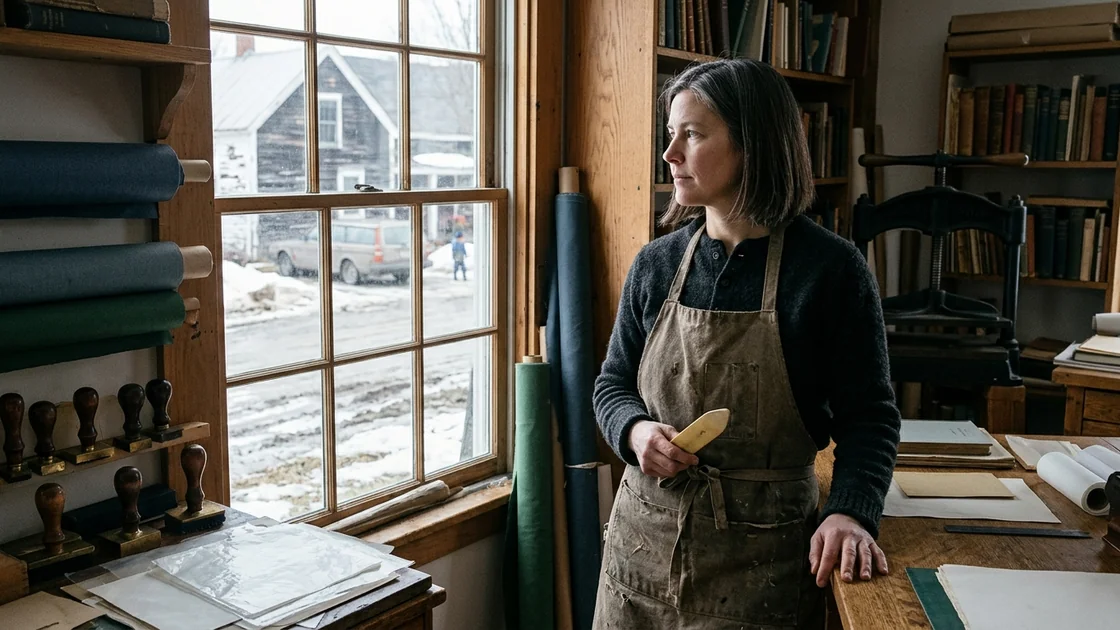
Clara Morrow had spent twenty-three years building a life out of paper, wheat starch, and silence in the mountain town of Corinth, Vermont, having long ago discarded the name and face that once belonged to Maisie Callow, the most famous child actress of the nineteen-nineties. When a young investigative journalist named Nicholas Trent rents the saltbox cottage across the frost-heaved dirt road, her carefully constructed anonymity begins to fracture under his relentless curiosity and the sharp, invasive instincts of an industry she nearly died trying to escape.
I. The Bone Folder
The tool was five inches long, carved from the dense, polished shin of an ox, yellowed at its tapered bevel from three decades of thumbs. In Clara’s right hand, it was an extension of tendon and nerve. She pressed it against a folded leaf of eighty-pound Mohawk Superfine paper, bearing down with an even, rhythmic weight that produced a crisp, definitive crease.
Scritch.
Outside the window of the carriage house, March was doing what March always did along the spine of the Green Mountains: it was pretending to yield. Beneath the eaves, icicles as thick as a man’s forearm were weeping into the gravel, but the mud in the driveway remained frozen in jagged ruts that would snap an axle if taken too fast. The air off the hemlock ridges smelled of damp granite, woodsmoke, and the faint, bitter iron of lingering winter.
Clara liked the cold. Cold kept things from rotting; it slowed down the biological clock of mildew, inhibited the blooming of foxing spots in ancient calfskin, and kept tourists south of Brattleboro until the blackflies arrived in May.
She set down the bone folder, wiped her palms on the coarse canvas apron tied double around her waist, and lifted her mug of black tea. It was tepid, rimmed with a faint circle of tannin. Through the wavy cylinder glass of the six-over-six panes, she saw the blue tail of exhaust before she heard the engine.
A low-slung, front-wheel-drive hatchback—an older Swedish wagon with clear-coat peeling from the roof like sunburned skin—was dragging its belly through the frozen ruts of the access lane. It bounced violently over the culvert and swung with unearned confidence into the driveway of the saltbox house directly opposite hers.
The saltbox belonged to Mrs. Renfrew, who had died in a nursing facility in White River Junction the previous November. All winter, the house had stood dark and blind, its roof sagging under five feet of hard-packed crust, its porch buried in snowdrifts that Clara had occasionally shoveled out of a neighborly reflex toward the dead.
The car stopped. The engine gave three shuddering diesels and died.
A young man stepped out into the slush. He was perhaps twenty-eight or thirty, wearing a waxed canvas coat that was too clean to have ever touched cordwood and leather boots with flat, city soles that immediately slipped on the packed ice of the driveway. He caught himself on the car door, his elbow hitting the window with a hollow thunk, and let out a white cloud of profanity that drifted straight across the fifty feet of frozen air between their houses.
Clara did not move. She remained standing behind the tall oak workbench, three feet back from the glass, where the shadow of the interior beams swallowed her silhouette.
She had learned the physics of being looked at when she was six years old, under five-thousand-watt key lights that baked the sweat into her foundation until it tasted like powdered chalk. She had learned how light bounced off retinas; she had learned the angles of sightlines; she had learned, most importantly, how to become furniture when a director was screaming or when a mother was weeping into a gin tumbler in a trailer with the blinds drawn.
The young man righted himself, hauled a canvas duffel from the back seat, and then—with a reverence that betrayed his priorities—retrieved a padded nylon equipment bag and a heavy Pelican case. He looked up at the saltbox, his eyes running across the peeling white clapboards, the chimney with its missing mortar, and then, inevitably, his gaze swept across the lane.
He looked directly at the carriage house.
Clara did not blink. She did not breathe. She lowered her chin by an eighth of an inch, allowing the line of her cheekbone to blur against the dark background of her drying racks.
His eyes lingered on the glass for three seconds, searching for movement, finding none, and then slid away. He turned back to the saltbox, shoved a brass key into the frozen lock, shoulder-barged the swollen door until it gave with a loud crack, and vanished inside.
Clara waited until the door swung shut behind him. Then she set her tea mug down on the blotter, picked up the bone folder, and resumed her work.
Scritch.
II. The Ledger of Losses
In the village of Corinth, there were three hundred and twelve registered voters, one general store that sold both rotisserie chicken and galvanized roofing nails, a white-steepled Congregational church that held services only during the summer when the heating bills wouldn't bankrupt the parish, and a town clerk named Martha who had held the office since Gerald Ford was in the White House.
Clara had arrived in Corinth twenty-three years ago, when she was twenty.
She had possessed a cashier’s check for ninety-four thousand dollars, a Social Security card bearing the name Clara Morrow that had been issued through an attorney in Wilmington, Delaware who asked no questions and died two years later, and a face that was, at that precise moment, the most recognized face of any nineteen-year-old girl on the North American continent.
In those first two years, she had worn an oversized wool watch cap pulled down to her eyebrows, tinted wire-rim glasses with clear lenses, and had stayed inside until the mail had been delivered and the streets were empty. But she had soon discovered something miraculous about small towns in the north: people did not expect to see a phantom in the produce aisle.
If you had a face that belonged on the cover of Rolling Stone or the side of a promotional soda cup, but you were wearing a stained Carhartt chore coat, smelled of hide glue and liniment, and spent twenty minutes carefully inspecting an acorn squash for soft spots, people did not think: Look, it’s Maisie Callow, the child star of three blockbuster family films and two tragic television dramas who vanished into the Mojave desert after her mother crashed their Mercedes through a guardrail on Mulholland Drive.
They thought: That’s Clara, the quiet woman who fixes books for the college library down in Hanover and doesn’t like to talk about where she’s from.
Over two decades, Clara had built a life out of paper.
Book conservation was an art of patient erasure. To fix an old book, you did not impose yourself upon it; you submitted to its historical injuries. You washed the pages in warm deionized water to pull the sulfuric acid out of the wood pulp. You mended tears with Japanese tissue so thin it looked like dragon-fly wings, adhering it with starch paste made by cooking wheat flour until it turned into a translucent, odorless gel. When you were finished, your work was supposed to be completely invisible. A good repair was one that nobody could see.
That afternoon, she worked on an 1842 edition of The American Orchardist. The calfskin binding had red rot—the leather had deteriorated into a fine, rust-colored powder that stained the fingers like paprika. The front board was detached, hanging by a single shred of linen cord.
She took a sharp scalpel and carefully slit the spine cloth, preparing to lift the dry leather so she could insert a new strip of dyed goat skin beneath it.
Her hands were steady. They had always been steady. Even on the soundstages at Culver City, when she had been eight years old, doing twelve takes of a scene where she had to cry on cue while an off-camera lighting tech ate a pastrami sandwich three feet from her eyeline, her hands had not shaken. She had possessed an unnatural, terrifying control over her autonomic nervous system.
The bell above her workshop door jingled.
Clara’s scalpel did not slip. She laid it down in the groove of the wooden tray, draped a clean sheet of glassine paper over the open book, and stepped through the partition into the front room.
It was Nicholas Trent.
Up close, in the clear north light of the workshop, he was younger than she had thought. His skin had the grayish, blue-tinged pallor of people who spent twelve hours a day illuminated entirely by liquid crystal displays. He had dark, untidy hair that looked as though it had been cut by someone who was angry at him, and an unzipped parka that revealed an old crewneck sweatshirt with the logo of a mid-Atlantic liberal arts college faded across the chest.
"Hi," he said. His voice was higher than she expected, brisk, rhythmic with the fast cadence of the coast. "The door was unlocked. The sign outside says 'Bindings and Restorations,' but I wasn't sure if that meant you were open-open or just... open."
"I’m here," Clara said. Her voice was low, flat, pitched carefully in the lower third of her chest. It was an acquired voice, four notes deeper than the shrill, silver-plated piping that had once earned fifty million dollars for Universal Studios. "Can I help you?"
"My name’s Nicholas. Nicholas Trent. I just moved in across the road. The Renfrew place."
He extended a hand. Clara looked at it. It was pale, with clean nails, the thumb calloused from a smartphone screen. She did not take it immediately; she let two seconds of Vermont silence settle between them—the customary pause that told an outsider he was moving too fast.
Then she took it, gave it a single, dry pump, and let go. "Clara Morrow."
"Clara," he repeated, looking around the room. His eyes were not casual. They were scanning, cataloging, taking inventory. They moved from the cast-iron standing press in the corner—an eight-hundred-pound monster from 1890 with a three-inch central screw—to the shelves of finishing tools, the small brass stamps with their boxwood handles, the rolls of bookcloth in slate blue, buckram, and forest green. "Incredible space. What is that, nineteen-twenties?"
"Eighteen-eighty," she said. "It was a cooperage first. Then a carriage shed."
"You don't see this kind of setup anymore," Nicholas said. He walked three steps toward the display case, his hands tucked into the pockets of his parka. "Most people just buy a new Kindle when the glue cracks on their paperbacks."
"Most people do," she agreed. "Did you need something, Mr. Trent? Wood? The saltbox has oil heat, but if the pump fails, you'll want the stove going."
"No, the oil’s fine. The tank’s half full. The furnace sounds like an angry submarine, but it’s blowing warm air." He smiled, an easy, charming, calculated smile that she recognized with an internal chill. It was the smile of someone who was accustomed to being liked, or who used charm as an ice-axe to break through small-talk. "Actually, I was wondering about the internet out here."
"There isn't any," she said.
His smile flickered. "Well, there’s satellite, right? Or DSL through the phone company?"
"The copper lines on the ridge went down during the ice storm of ninety-eight," she said evenly. "They never ran broadband out this far. Too few houses per mile. If you want a signal, you can drive down to the library in town. They have an access point that stays on until nine o'clock. You can sit in your car by the Dumpster."
Nicholas let out a short, dry laugh, waiting for the punchline. When none came, his face settled into a look of genuine panic. "You're serious. There's no cell service either? My phone’s been saying 'Searching' since I hit Route 11."
"You can get two bars if you stand on the stone wall behind the cemetery at the top of the notch," Clara told him. "When the leaves are down. In the summer, you don't even get that."
He stared at her, his mind visibly recalculating the parameters of his existence. "I took this place for six months. The landlord’s nephew in Boston said it had 'rural connectivity.'"
"The nephew hasn't lived here since he was eight," Clara said. "Rural connectivity means you have a landline that works unless a birch branch falls on the wire."
Nicholas took a deep breath, ran a hand over his mouth, and then his eyes snapped back to hers. "Well. That’s... that’s going to make filing things interesting. I’m a writer. A journalist."
"I see."
"Freelance. Mostly longform stuff. Culture, crime, investigative profiles. The Atlantic, Wired, sometimes the Times Magazine." He dropped the names with the casual nonchalance of someone throwing out breadcrumbs to see if the fish would rise.
Clara did not move a muscle in her face. The names meant nothing to her, or rather, they meant a very specific kind of predator. The kind that didn't hide in bushes with seven-hundred-millimeter telephoto lenses, but the kind that sat across from you in a booth with a digital voice recorder and an expression of warm, therapeutic empathy until you gave them the one sentence that would ruin the rest of your life.
"Well," she said, her voice completely smooth. "You won't have any distractions."
Nicholas looked at her then—really looked at her.
He was standing four feet away. Clara was wearing no makeup; her hair, once a cascade of honey-gold ringlets that had spawned thousands of copycat perms across middle schools from Maine to Oregon, was now dark ash-brown, streaked with silver at the temples, cut bluntly at the jawline with a pair of shears she used for linen. Her nose had been broken in the crash on Mulholland Drive; the surgeon at the county hospital in Van Nuys had set it straight enough, but there was a tiny, hard bump on the bridge, the size of a split pea, that had changed the entire geometry of her profile.
Yet, despite the gray hair, despite the nose, despite the twenty-four years of woodstove soot and northern wind, her eyes were the same. They were a vivid, improbable slate-blue, with dark rings around the irises—eyes that the cinematographers used to say didn't need a filter.
Nicholas tilted his head slightly. A faint, almost imperceptible line appeared between his eyebrows.
"Have we met?" he asked.
"No," Clara said.
"You look... familiar. Do you have family down in New York? The Hudson Valley?"
"I'm from Ohio," she lied without a flicker of hesitation. She had rehearsed the lie ten thousand times. "My father worked for an agricultural implement dealer in Findlay. I came east after school."
"Ah." The line between his brows didn't entirely disappear, but it smoothed out. "Must be one of those faces. A classic look."
"A common look," Clara corrected. "If you need an extra space heater, Mr. Trent, I have a radiator in the barn. It uses a lot of juice, but it doesn't smell like kerosene."
"Nicholas," he said. "Please. And that would be amazing. I think the saltbox was last insulated with newspapers from the Hoover administration."
"I'll leave it on the porch," she said, turning back toward her workshop. "Good luck with your writing."
It was a dismissal as heavy as an iron gate. He took it, lingered for half a beat, and then backed toward the door.
"Thanks, Clara. I appreciate it."
The bell rang as he opened the door, then chimed again as it closed.
Clara stood in the center of the front room until the sound of his city boots crunching across the frozen mud of the road had faded entirely. Then she walked to the window, her hand sliding into the pocket of her apron, her fingers closing tightly around the ox-bone folder until the hard, polished edge bit into her palm.
III. The Architecture of Ash
That night, the wind shifted from the south to the northwest, bringing the real weather.
The temperature plunged twenty degrees in four hours. The wet gravel of the road froze into black glass, and the old carriage house groaned as the gusts came slamming down off the ridge, rattling the storm sashes in their frames.
Clara sat at her kitchen table. The only light came from the open draft of the cast-iron Jotul stove, which cast a dancing, orange ribcage of light across the wide pine floorboards.
On the table sat a metal lockbox.
It was an old fireproof Sentry safe, its olive-green paint chipped at the corners. Clara had not opened it in seven years. The key was kept behind a loose brick in the chimney breast, wrapped in an oily rag to keep the rust off.
She unlocked it. The mechanism turned with a dry, metallic click.
Inside was the paper skeleton of Maisie Callow.
There was her original California birth certificate: Margaret Mary Callow, born June 14, 1980, Cedars-Sinai Medical Center, Los Angeles.
There was the contract for Little Miss Sunshine—not the film that came out years later, but a forgotten, failed 1988 sitcom pilot about a precocious orphan who lived with an eccentric lighthouse keeper. Clara’s mother had signed it with a flourishing, loopy hand that reeked of desperate ambition: Sylvia Callow, Guardian.
There was a stack of glossy eight-by-ten production stills.
Clara lifted the top one.
The girl looking back at her was nine years old. She was wearing a pinafore dress with a Peter Pan collar, sitting on a yellow sofa on Stage 4 at Sunset Gower Studios. She was smiling. It was an astonishing smile—luminous, completely convincing, filled with an electric, infectious joy that had made millions of lonely people sitting in dark living rooms feel as though everything was going to be all right.
Clara looked at the girl’s eyes.
She remembered the day that photo was taken. She had an ear infection. Her eardrum had been swollen to the point of rupture, throbbing with a sickening, liquid pain that made every swallow feel like a razor blade. Sylvia had given her two aspirins crushed in a spoonful of raspberry jam and told her that if she cried, the director would replace her with the little blonde girl from the juice commercial who was sitting in the lobby right now, waiting for her to fail.
So she had sat on the yellow sofa. The photographer had said, Give me that million-dollar sunshine, Maisie, and she had turned on the light behind her eyes like flicking a wall switch.
Below the photographs was the thickest item in the box: the manila envelope containing the police report from September 18, 1999.
Vehicle 1 (1997 Mercedes-Benz E320) traveling westbound on Mulholland Drive at an unsafe speed for conditions... failed to negotiate curve... descended approximately 140 feet down the embankment...
Sylvia had died instantly. The steering column had crushed her chest.
Clara—Maisie—had been in the passenger seat. She had not been wearing her seatbelt; she had unbuckled it two minutes earlier during their screaming match, threatening to jump out of the car if Sylvia didn't turn around, if Sylvia didn't stop the car, if Sylvia didn't cancel the meeting with the producers of the new network procedural who wanted an eighteen-year-old Maisie to do a topless scene to prove she was an "adult actress."
The impact had thrown her clear through the passenger window before the car struck the outcrop of sandstone at the bottom of the ravine. She had landed in a thicket of dry chaparral, her collarbone snapped, her nose smashed, three ribs cracked, her face shredded by the safety glass.
When she woke up in the hospital, the room was surrounded by security guards. Outside the double doors of the intensive care unit, seventy photographers had camped in the corridor. A nurse had tried to sell a photograph of Clara’s swollen, stitched face to a tabloid for twenty thousand dollars.
Two weeks later, Clara had walked out of the back exit of the hospital in sweatpants and a borrowed baseball cap, gotten into a taxi, and disappeared.
The world had assumed she was in rehab. Then they assumed she had joined a cult. Then they assumed she was dead. Every five years or so, some pop-culture website would run an article headlined: What Ever Happened to Maisie Callow? The Dark Mystery of the 90s Golden Girl.
Clara had never read them. She had spent twenty years erasing herself, molecule by molecule, until she was just a woman who smelled of wheat paste and linseed oil.
And now, across the road, sat a boy with an expensive coat and a laptop.
Clara closed the lockbox. She locked it, carried it back to the chimney, and slid it into the dark cavity behind the brick.
She stood there in the cold kitchen, listening to the wind claw at the shingles.
"Ohio," she whispered to herself. Her voice was flat, dry. "Findlay, Ohio. Father sold combines. Mother died of pneumonia when I was twelve."
She repeated the details until her pulse slowed down.
IV. The Intrusions
For two weeks, nothing happened.
Nicholas Trent’s car remained parked in the ruts of the saltbox driveway, occasionally leaving in the morning and returning in the early afternoon with brown paper grocery bags from the co-op in Hanover.
Clara observed his routine from her workshop window.
He woke late—she could tell by the blue glow of his upstairs bedroom window, which did not appear until after eight. He made coffee; she could see him standing at the kitchen counter, his shoulders hunched, staring blankly out at the snow. By nine, he was at the wooden dining table in the front room, his laptop open, typing furiously for twenty minutes, then stopping, pacing around the room with a mug in his hand, staring at the ceiling, then sitting back down.
He was working on something.
Once or twice, she saw him walking up the road toward the notch, his phone held aloft like an offering to a sky god, searching for the elusive signal near the cemetery.
On the third Sunday of March, the weather cracked.
A warm front from the Gulf rolled over the mountains, bringing forty-eight hours of torrential, lukewarm rain. The three feet of snowpack that had insulated the valley all winter melted with catastrophic speed. The culverts choked with slush; the brook behind Clara’s barn roared into an ochre torrent that dragged hemlock logs and ancient beer cans down from the upper logging roads.
By Monday morning, the dirt road was not a road. It was an estuary of brown, porridge-like mud, four feet deep in the center, bordered by ditches that had turned into rivers.
At noon, Clara heard the unmistakable sound of an engine revving to the point of valve-float.
She walked to the carriage house door and pulled it open.
Nicholas had tried to drive his Swedish wagon through the low spot in front of his house. The front wheels were buried to the hubs in gray clay; the front bumper was acting as a plow, pushing a mound of liquefied silt ahead of it. The right rear wheel was spinning wildly three inches off the ground, spraying mud in a glorious forty-foot rooster tail that had completely coated the white clapboards of Mrs. Renfrew’s front porch.
Nicholas was standing in the road, calf-deep in muck, his leather boots ruined, his hands covered in mud, kicking the driver’s side tire with pure, incandescent rage.
"Damn it! Damn it to hell!"
Clara stood in the dry doorway of her shop, her arms crossed over her chest. She watched him kick the tire three more times.
"You're high-centered," she said.
Nicholas whipped around, startled. He wiped his forehead with the back of his sleeve, which only succeeded in smearing a stripe of wet clay across his temple.
"The bottom fell out," he said, breathing hard. "The road was solid yesterday."
"Yesterday it was thirty degrees," she said. "Today it’s fifty-five. It’s mud season. You don't drive on the dirt roads between twelve and six when the sun’s on them."
"I have an interview in Montpelier at three," he said. He looked like he was about to cry—a combination of exhaustion, city frustration, and the terrifying realization that nature did not care about his deadlines. "I have to get out of here."
Clara looked at the car. She looked at the road.
"You're not going to Montpelier," she said. "Not in that."
"I can call a tow truck."
"The tow truck from Bradford is a ten-ton flatbed," she said. "If he comes down this road today, he’ll slide into the ditch and take the telephone pole with him. He won't even try until Thursday."
Nicholas stared at his car. His shoulders slumped. The anger seemed to drain out of him all at once, leaving behind a small, bewildered boy who didn't understand why the world wasn't paved.
"I’m stuck," he said.
"Yes," Clara said. "You are."
She stood there for another five seconds, weighing the risks. The safest thing would be to turn around, walk back into her shop, pull the door shut, and let him sit in his cold, damp house with his dead car and his dead internet. That was what twenty-three years of survival instinct told her to do.
Do not invite them in. Do not let them look at you from an angle. Do not give them a reason to think about you.
"Come inside," she said. "You're getting mud on Mrs. Renfrew’s lilacs."
V. Tea and Printer's Ink
He left his ruined boots on the rubber mat inside the shed door, walking into her kitchen in thick wool socks that had holes at the heels.
Clara pointed to the wooden bench by the stove. "Sit there. Don't touch the paper on the counter."
She went to the sink, pumped water into the copper kettle, and set it on the iron top of the woodstove. She took down two stoneware mugs—heavy, gray, unglazed things made by a potter down in Craftsbury.
Nicholas sat on the bench, holding his mud-stained hands out toward the warmth of the cast iron. He was shivering slightly; the rain had soaked through his waxed coat.
"This is an incredible place," he said again. His eyes were doing the cataloging thing again, moving across the kitchen.
There was nothing personal in the room. No family photographs, no calendars with handwritten notes, no postcards stuck to the refrigerator with magnets. There was only a cast-iron skillet hanging from a forged hook, three copper pots, a row of dried herbs hanging from the rafters—sage, thyme, sweet cicely—and a shelf of reference books: Middleton’s The Restoration of Leather Bindings, Cockerell’s Bookbinding and the Care of Books, and a run of the Journal of the American Institute for Conservation.
"You live alone?" he asked.
"Yes," she said.
"Must get quiet out here in the winter."
"That's the point."
She poured the boiling water into a brown ceramic teapot, dropped in two measures of loose Assam tea, and set a small three-minute sand timer on the table between them.
Nicholas watched the white sand trickle through the glass neck.
"I was wondering," he said, his voice dropping into that smooth, confessional register she had heard two weeks ago. "How long have you lived in Corinth, Clara?"
"Twenty-three years," she said.
"And before that?"
"I told you. Ohio."
"Right. Findlay." He tapped his fingers on his knee. Tap, tap, tap. A nervous, caffeinated rhythm. "It’s funny. I was talking to Martha down at the town clerk’s office last week when I went to register my car."
Clara’s hand, resting on the handle of the teapot, did not move. Her muscles did not tighten. She kept her breathing slow, shallow, invisible.
"Martha likes to talk," Clara said.
"She does. Great lady. Knows where every body is buried since 1790." Nicholas leaned forward, resting his forearms on his knees. "She said you bought this place from an estate sale in nineteen ninety-nine. Paid cash. Said you were just a kid. Twenty or twenty-one."
"I had an inheritance," Clara said. "My father died."
"Right. The combine dealer." Nicholas paused. The sand in the timer had nearly run out. "Martha said you didn't have an Ohio license when you showed up. She said you had a temporary permit from Delaware, and your car had New Jersey plates."
Clara lifted the teapot. The water was dark, fragrant with malt. She poured it into the two mugs, the stream steady, unbroken.
"The car was a rental," she said. "My father’s estate took a long time to settle through the courts in Wilmington. Is there a point to this, Mr. Trent?"
Nicholas looked up at her through his messy dark hair. His eyes were bright, too bright, like a dog that had caught the scent of something dying in the brush.
"I’m curious," he said. "It’s my job. I look at people, and I try to figure out the story. Why would a twenty-year-old girl with ninety thousand dollars in cash buy an abandoned carriage barn at the end of a dead-end road in the coldest corner of Vermont and spend the next two decades gluing old paper back together?"
"Some people like old paper," Clara said. She pushed one of the mugs toward him. "Some people don't like other people. Drink your tea."
He took the mug, his fingers wrapping around the hot stoneware. He blew on the surface.
"I was doing some research last night," he said, watching the steam rise. "On satellite. It took three hours to load a single page, but I managed it."
"Research on what?"
"A profile I’m writing. An anniversary piece." He took a tiny sip of the tea, his eyes never leaving her face. "Twenty-five years ago this fall. A big Hollywood story. Maybe you remember it?"
The room became very quiet. The only sound was the steady, heavy drumming of the rain on the tin roof of the carriage house and the hiss of an alder log in the stove that hadn't been fully seasoned.
"I don't follow Hollywood," Clara said.
"Nobody had to follow it," Nicholas said. "It was everywhere. Maisie Callow. The girl from The Great Outdoors and The Honeycutts. The one who won the Golden Globe when she was twelve and then her mother drove them off a cliff on Mulholland."
Clara took a sip of her tea. It was very hot. It burned the tip of her tongue, a clean, sharp pain that gave her an anchor.
"I remember hearing about it," she said. Her voice was steady, perfectly indifferent. "A tragedy."
"They never found her," Nicholas said.
"I thought you said she was in the car."
"Her mother died. Maisie survived the crash. She was in the hospital in Van Nuys for two weeks. Then one morning she just... walked out the laundry entrance. Left her clothes, left her purse, left eighteen million dollars in trust accounts that have been sitting in the California State Controller’s unclaimed property division for two decades."
Nicholas set his mug down on the table with a soft clink.
"People thought she was dead," he continued. "They searched the desert outside Barstow. They searched Mexico. There were sightings in Berlin, in Maui, in a commune outside Portland. But the weird thing is... if you look at the medical records that leaked during the coroner’s inquest, Maisie Callow had a compound fracture of the right nasal bone. And she had a three-inch laceration across the lateral side of her right clavicle from the safety glass."
He stopped.
His eyes dropped to Clara’s throat.
She was wearing a thick wool henley, buttoned to the collarbone. Beneath the collar, two inches to the right of her sternum, was a pale, silvery line of scar tissue that looked like a dry pine needle pressed into the skin.
Clara did not touch her collar. She did not look down.
"That's a very dramatic story," she said. "I hope your magazine pays you well for it."
Nicholas leaned back against the wooden bench. He smiled. It was no longer the charming, boyish smile. It was the smile of a hunter who has found the blood trail on the leaves.
"You know," he said softly, "the bone structure doesn't really change. Even when someone loses twenty pounds, or gets thirty years older, or cuts their hair with paper shears. The distance between the pupils and the philtrum... it’s an anatomical constant. Like a fingerprint."
Clara looked at him across the pine table.
For twenty-three years, she had anticipated this moment. She had rehearsed it in her bed at night while the winter wind rattled the sashes. She had imagined it happening with a state trooper, or an insurance investigator, or a tourist from Los Angeles who had stopped to ask for directions to the apple orchard.
She had thought she would feel terror. She had thought her heart would hammer against her ribs like a trapped bird, that she would be seized by that old, paralyzing nausea that used to hit her in the dressing room before the live tapings.
Instead, she felt an immense, glacial cold.
It was the same feeling she got when she encountered a seventeenth-century bible with spine rot: the leather was gone, the threads were broken, and there was nothing left to do but take the whole thing apart down to the bare signatures.
"Mr. Trent," she said.
"Nicholas," he corrected.
"You have mud on your socks," she said. "And your tea is getting cold."
He blinked, thrown off by her lack of reaction. "Clara—or Maisie—"
"My name is Clara Morrow," she said, her voice dropping into a register that was neither loud nor soft, but completely, unyieldingly flat. "I have lived in this town for twenty-three years. The people in this town know me. They know I don't like strangers, they know I don't like noise, and they know I do good work on their town registers and their family bibles."
She stood up. She did not tower over him; she was five feet four inches tall, slight, her shoulders rounded from years over a workbench. But she stood with the absolute authority of a woman who had survived things he could not begin to imagine.
"If you write one word about me," she said, "I will deny it. The town clerk will deny it. The selectmen will deny it. You will look like an ambitious young man who came up to the woods, went stir-crazy without his high-speed internet, and started hallucinating dead child stars in the local craftswomen."
Nicholas laughed, but it was thin, defensive. "I have facial recognition software, Clara. I ran a high-res still from The Honeycutts against a photograph I took of you from my porch with a four-hundred-millimeter lens last Thursday. It’s a ninety-six percent match."
Clara felt a tiny, sharp prick behind her eyes.
He took a photograph.
The telephoto lens. The shutter clicking from fifty yards away, through the wet glass of her carriage house. The camera had found her again. Even here, three hundred miles from the nearest studio, forty miles from the interstate, at the end of a road that was currently four feet of mud.
The camera never died. It just waited for you to come out of the woods.
"Get out of my house," she said.
Nicholas’s smile vanished. "Look, Clara—Maisie. I’m not trying to ruin your life. This is the story of the decade. Do you know how many people care about you? Do you know what kind of cultural impact this would have? The girl who survived the Hollywood meat grinder, who said no to the whole toxic machine, who chose art and silence over celebrity. It’s not an exposé. It’s a tribute. I can help you tell it on your own terms."
"On your terms," she said. "For your byline. For your book contract."
"Does it matter? The truth is the truth."
"The truth," Clara said, leaning her palms on the table, "is that Maisie Callow died in that ravine on Mulholland Drive. Her mother killed her. The girl who survived was someone else. And she does not belong to you."
Nicholas stood up. He was taller than her, but he looked small, his wet wool socks slipping slightly on the waxed pine floor.
"I have a deadline," he said, trying to regain the offensive. "The pitch is already approved. I’m filing the draft on Friday."
"Then you’d better find some dry boots," Clara said. "Because the mud isn't going anywhere until May."
VI. The Anatomy of an Invasion
He left.
The front door slammed. Clara stood in the center of the kitchen, her arms hanging at her sides.
The tea on the table was dead, the surface covered in an oily, iridescent skin. Outside, the rain continued to fall, steady, merciless, washing away the dirty crust of winter, exposing the bare, raw earth of the garden, the dead stalks of last year’s sunflowers, the gray bones of the stone walls.
She walked into the carriage house workshop.
Everything was in its place. The lying press, the tub, the sewing frame with its unbleached linen tapes stretched tight between the screws. The smell of hide glue—warm, animal, ancient—hung in the air like an incense.
She had built this room to be a fortress. She had chosen every timber, planed every oak board of the bench, fitted every drawer with hand-cut dovetails. In this room, she was in command of time. She could take an eighteenth-century map that had been torn into thirty pieces by a child or an idiot, and she could lay it on a sheet of wet Hollytex, wash it with calcium hydroxide, line it with Japanese gampi paper, and make it whole again. She could reverse the work of fire, flood, and neglect.
I ran a photograph against a high-res still.
She walked to the tool rack.
Her finishing tools were arranged by size: the gouges, the fillets, the decorative pallets with their patterns of leaves, acanthus, and Greek keys. They were made of brass, set into turned boxwood handles that had darkened from the oils of her palms.
She reached out and touched the three-millimeter gouge. It was cold.
She remembered the summer of nineteen ninety-six. She was sixteen.
She had been filming a movie in Toronto—a prestigious, dreary drama about an abused girl who plays the cello. She had practiced the cello six hours a day until her fingertips were calloused and bleeding, because she wanted to be an actress, a real one, not just a set-piece with big eyes who could cry when Sylvia squeezed her arm under the table.
There had been a reporter from a magazine—a glossy, expensive magazine that fancied itself serious. He had spent three weeks on the set. He had bought her hot chocolate; he had talked to her about Chekhov and Salinger; he had treated her like an adult, an intellect, an equal. She had told him things she had never told anyone: that she hated the sound of applause because it sounded like dry leaves being crushed; that Sylvia locked the pantry at night so she wouldn't eat bread; that sometimes, when she was driving to the studio at five in the morning, she hoped the car would hit a bridge abutment so she could just sleep for two days.
When the article came out, the cover line was: MAISIE CALLOW: HOLLYWOOD’S LOLITA GROWS UP.
The reporter had taken her quotes about the pantry and turned them into a breathless, titillating piece about her "precocious appetites." He had described her teenage body in language that made her throw up into the dressing room toilet while Sylvia screamed at the publicist over the speakerphone because they hadn't used the photograph where Maisie was wearing the diamond choker.
That was the day she had learned the law of the lens: You are not a person. You are material. You are pulp to be pressed into whatever shape sells the paper.
Clara took down her apron. She folded it into a neat square and laid it on the bench.
She walked upstairs to her bedroom.
From the closet, she pulled down an old canvas rucksack. She laid it on the bed.
She had sixty thousand dollars in cash hidden in three mason jars buried beneath the gravel floor of the fruit cellar. She had a clean Vermont driver’s license that didn't expire for two years. She could be in Montreal by midnight if she could get past the mud on the notch road. From Montreal, she could take a train to Halifax. From Halifax, a container ship to Scotland, or Norway, or anywhere where people spoke with vowels that didn't sound like television.
She opened the drawer of her nightstand to get her socks.
Then she stopped.
She looked at her hand. The thumb was scarred near the cuticle from an errant slip of an English scalpel twenty years ago. The palm was wide, strong, the muscle at the base of the thumb thick from pulling the levers of iron presses.
She was forty-three years old.
She was not sixteen. She was not nineteen.
She looked out the bedroom window. Across the road, the blue light of Nicholas Trent’s laptop was already glowing through the lower window of the saltbox. He was sitting at the table. He was typing. He was turning her into material.
Filing the draft on Friday.
He thought she was a ghost. He thought that because she had hidden in the woods for twenty years, she was made of mist, that she would blow away if he turned on the high-beams of his self-righteous, journalistic curiosity.
Clara closed the canvas rucksack.
She did not pack her socks. She walked back down the stairs, through the cold kitchen, and out into the rain.
VII. The Law of the Mud
She did not cross the road to his house.
Instead, she went to the barn behind her workshop. The barn was older than the house—a timber-frame structure built of hand-hewn hemlock bents, smelling of dry hay from sixty years ago and the greasy iron of forgotten machinery.
In the back bay, covered by an oilcloth tarp that had turned gray with dust, sat her tractor.
It was a 1964 International Harvester Farmall 140—a low, squat, red tractor with wide ag-tires on the rear and a heavy cast-iron belly. Her neighbor, old man Clough, had sold it to her before he died in nineteen ninety-eight. It had no electronics. It had no computer chips. It had an iron starter rod, a six-volt battery, and a carburetor that could be cleaned with a piece of wire and a mouthful of gasoline.
Clara pulled the tarp off.
She checked the fuel tank; it was half-full of clear, red-dyed off-road diesel. She checked the oil with the notched flat dipstick; black, thick, but full.
She climbed onto the steel pan seat, pulled the choke out half an inch, set the throttle lever to one-third, and turned the heavy brass ignition switch.
She reached down and pulled the starter rod.
The six-volt starter groaned, turning the big iron flywheel with a slow, heavy chug... chug... chug...
Then the cylinders caught.
A puff of blue-gray smoke shot from the vertical exhaust pipe, hitting the tin roof of the barn with a sharp pock, and the two-cylinder engine settled into a loud, rhythmic, deafening idle that rattled the tools on the walls.
Thump-a-thump, thump-a-thump, thump-a-thump.
Clara did not put on a coat. She sat on the cold steel seat in her wool henley and her canvas work trousers, let out the heavy foot clutch, and swung the tractor out of the barn bay into the gray afternoon rain.
She drove it around the side of the carriage house, down the gravel driveway, and out onto the ruined dirt road.
The Farmall’s tall rear tires, four feet high and fifteen inches wide, with their deep, chevron-patterned rubber cleats, did not care about the mud. They bit through the two feet of liquefied topsoil, found the frozen ledge beneath, and pushed forward with the slow, unstoppable momentum of three tons of low-geared iron.
Nicholas was standing at the saltbox window.
He saw the red machine emerging from the rain like an iron ghost. He saw Clara sitting on the high seat, her jaw set, her hair plastered to her forehead by the water, her hands steady on the big three-spoke steering wheel.
She turned the tractor into his driveway.
She did not slow down. She drove straight toward the Swedish wagon, which was still mired to its axle in front of the porch.
Nicholas ran to the front door, throwing it open, standing on the porch in his stocking feet.
"What are you doing?" he shouted over the roar of the tractor. "Hey! Stop!"
Clara brought the tractor to a halt eighteen inches from his rear bumper. She shoved the transmission into neutral, pulled the handbrake, and let the engine idle. The exhaust pipe was sputtering a steady rain of blue soot into the wet air.
She climbed down from the iron step.
From the tool tray beneath the seat, she retrieved a twenty-foot length of three-quarter-inch logging chain, its links greasy, heavy, forged from American steel that had been made when factories still had chimneys.
She walked through the mud, dragging the chain behind her. It rattled like a dungeon door.
"Get your keys," she said.
Nicholas stared at her. "What?"
"Get your keys," she repeated, her voice cutting through the thrum of the two-cylinder engine. "Get in the car. Put it in neutral. And steer straight."
"I told you, I’m filing the draft—"
"You're not filing anything from this house," she said, stepping toward him. She was covered in diesel soot and cold rain, her boots caked with clay, her slate-blue eyes boring into his face with an intensity that made him step back two inches on the porch boards. "You want to tell a story about me, Nicholas? You want to write a long, beautiful, self-congratulatory piece about the girl who disappeared?"
She threw the hook of the logging chain onto the wet porch at his feet. It struck the pine with a loud, violent clack.
"You're going to hear it first," she said. "All of it. Not the version you found in the newspaper archives. Not the version the producers told the coroner. You're going to hear what it smells like when your mother’s chest hits a steering column at sixty miles an hour while she’s telling you that you're worthless if you don't take your clothes off for thirty-five-year-old men."
Nicholas looked from the heavy chain to her face.
The color had drained from his cheeks. The glib, eager, professional curiosity that had lived in his eyes for the past two weeks was gone, replaced by something dark, cold, and uncertain.
"I have a recorder," he whispered, almost by reflex.
"Bring it," she said. "And put on your boots. You're going to help me hook the drawbar."
VIII. The Signatures of the Dead
They sat in the workshop.
The Farmall was parked outside, ticking as its iron cooled in the rain. Nicholas’s car was dragged twenty feet out of the mud, sitting on the high gravel strip by Clara’s barn, safe from the ditch but useless until the road dried.
In the center of the workshop, Clara had cleared the main oak bench.
She had not offered him tea this time. She had not offered him a chair. She stood behind the bench, her bone folder in her hand, while Nicholas sat on the tall wooden stool usually reserved for sewing signatures.
His digital recorder—a slim, brushed-aluminum rectangle—sat on the clean blotter between them, its tiny red LED pulsing with a slow, mechanical heartbeat.
00:01:14... 00:01:15...
"Ask your questions," Clara said.
Nicholas looked at the recorder. His hands were clasped in his lap. His boots, still dripping brown water onto the floorboards, were tucked behind the rungs of the stool.
"Why didn't you go back?" he asked. His voice was different now. The cleverness had been stripped out of it by the rain and the sight of her dragging his car through the mud with an engine that was built twenty years before he was born. "You had eighteen million dollars. Even after the lawyers and the taxes, you were rich. You could have lived anywhere. You could have made your own movies. You could have bought a studio."
Clara picked up a strip of linen tape. She measured it against a brass rule, took a pair of shears, and cut it with a dry snip.
"Do you know what sixteen million dollars smells like, Nicholas?" she asked.
He didn't answer.
"It smells like burnt hair," she said. "It smells like the air-conditioning unit in the trailer on Stage 12 that had a dead mouse in the vent for three months during the summer of ninety-four, but the line producer wouldn't let them turn it off because it cost four hundred dollars an hour to stop the cameras."
She laid the linen tape on the bench.
"When I was nine," she said, her voice quiet, steady, completely devoid of self-pity, "I worked fourteen hours a day on The Honeycutts. The California labor laws said a child could only be on set for nine hours, including three hours of schooling. So Sylvia had the studio hire a tutor who signed the time-sheets without looking at them. The schoolroom was a windowless closet behind the craft service table. The tutor was twenty-two, and he was writing a screenplay about a detective who played the saxophone. He told me that if I did his laundry, he’d give me an A in social studies."
Nicholas’s fingers twitched on his knee. "Did you tell anyone?"
"Who was I going to tell? Sylvia? Sylvia was getting ten percent as my manager and another five percent as my legal guardian. Every time I cried, she bought another pair of Italian shoes. She had four hundred pairs of shoes in the house in Bel-Air. Most of them still had the plastic tags on the soles."
Clara took a pot of wheat paste and a round hog-bristle brush. She dipped the tip of the brush into the white, cool paste and worked it into the linen with circular strokes.
"By the time I was fourteen," she continued, "I was the only person in that house who was employed. I supported my mother, her boyfriend, two business managers who were stealing fifty thousand dollars a quarter through a shell corporation in Reno, three publicists, a personal trainer who gave me amphetamines so I wouldn't gain weight between the spring and fall seasons, and a therapist who was paid two thousand dollars a week by the network to make sure I didn't have a nervous breakdown before the syndication deal closed."
She looked at Nicholas.
His eyes were fixed on her hands.
"Do you know what happens to a person when she discovers that everyone she has ever known—everyone who has ever hugged her, or kissed her cheek, or told her she was clever—was being paid to do it?"
Nicholas swallowed. "No," he said softly.
"You stop believing that people are real," she said. "You look at an adult, and you don't see a human being. You see an animal that wants something to eat. And you learn that the only way to keep them from eating you is to give them a piece of your skin every single day until there's nothing left but bone."
She laid the glued linen tape onto the spine of the book she was repairing, smoothing it down with the edge of the ox-bone folder.
Scritch.
"The night of the crash," she said, "Sylvia had spent three hours at a restaurant in Malibu with a man named Bernstein. He was seventy years old. He had bad teeth and he smelled of gin and almond oil. He was producing a cable thriller. He told Sylvia that if I did a shower scene in the first ten minutes, he’d give her an executive producer credit and two points of the backend."
She didn't stop working. Her fingers moved with the absolute precision of a watchmaker.
"We got into the car. Sylvia was driving. She had had four martinis. She told me I was being an ungrateful little cunt. She said I had five years left before my face fell apart, and that if I didn't take the Bernstein deal, we’d be living in a condo in the Valley by Christmas."
Clara looked up from the bench, staring directly into the red eye of the digital recorder.
"I reached across the console," she said, "and I grabbed the steering wheel."
Nicholas stopped breathing.
"You did?" he whispered.
"I didn't want to die," Clara said. "I just wanted her to shut up. I wanted the sound to stop. I wanted the headlights to stop showing me the road. She slapped me—she had three diamond rings on her right hand that caught me across the mouth—and she jerked the wheel to the right. The car went through the chain-link fence like it was paper."
The workshop was completely silent except for the rain.
The sand had run out of the timer long ago.
"When I woke up in the bushes," Clara said, "it was very dark. The engine was on fire down in the gully. It was making a hiss like a snake. Sylvia was screaming, but only for about twenty seconds. Then the horn started blowing. It blew for forty minutes because her forehead was pressed against the center of the wheel."
She picked up a sheet of Japanese tissue, holding it up to the light to inspect the grain.
"I sat in the chaparral," she said. "The crickets were singing. It was the first time in my life I had ever heard crickets without a boom mic hanging over my head. I looked at the fire, and I thought: If I go down there, the photographers will be there in twenty minutes. If I go back to the hospital, the managers will be there in thirty."
She looked at Nicholas.
"So I waited until the ambulances arrived. I let them put me on the stretcher. I let them stitch my nose. And the first morning I could stand up without vomiting blood, I put on a pair of blue scrub pants from the laundry cart, walked out the dock where they unload the frozen vegetables, and I got on a bus."
Nicholas was staring at the recorder. The little red counter had reached 00:18:42.
"Where did you go?" he asked.
"Findlay," she said.
His head snapped up. "You really went to Findlay?"
"I had seen it on a map in an atlas when I was ten," she said. "I liked the name. It sounded like something you could find. I worked at a dry cleaner’s behind a bowling alley for three months. I washed shirts. Nobody looked at my face because nobody looks at the girl behind the counter of a dry cleaner’s. They look at their collars to see if the grease came out."
She laid the tissue over the torn page, tapped it with the tip of her finger, and brushed it with the starch paste until it vanished into the grain of the eighteenth-century paper.
"Then I met an old man named Arthur," she said. "He had a bindery in Oberlin. He was eighty. His eyes were failing. He needed someone with good hands who could fold signatures and didn't talk. He taught me the craft. He taught me how to wash paper. He taught me that if you give a damaged thing enough time, and you don't force it, it can be made whole again."
She put down the brush.
"Arthur died in ninety-nine. He left me his tools. These tools." She swept her hand across the bench, indicating the bone folders, the brass stamps, the cast-iron presses. "I took the money I had saved from the dry cleaner’s, and the little bit he left me, and I came here."
She leaned forward, resting her weight on her knuckles.
"That is the story, Nicholas. That is the whole thing. There are no secret accounts. There is no comeback. There is no second act. There is only a forty-three-year-old woman who likes the smell of hide glue and wants to be left the hell alone."
Nicholas sat motionless on the high stool.
The rain outside had begun to taper off, the heavy roar on the roof softening into a gentle, rhythmic patter. In the valley below, a crow called out three times—a harsh, dry scrape against the cold air.
He reached out his hand.
His fingers hovered over the recorder.
"What do you want me to do?" he asked. His voice was cracked, uncertain, stripped of all its journalistic distance.
Clara looked at him.
"I can't tell you what to do," she said. "You're a professional. You have an editor. You have an audience that wants to know what happened to the girl from the lunchboxes."
She turned back to her book, picking up a small weight covered in pigskin to hold the newly pasted leaf flat while it dried.
"You have the recording," she said. "You have the photograph you took through my window. You can drive down to Hanover tomorrow when the ruts freeze, plug your computer into the library network, and send it to New York. You’ll be famous for six weeks. People will invite you on podcasts. You might even get a book advance."
Nicholas looked down at the little aluminum machine. The counter was still running: 00:22:15... 00:22:16...
"And you?" he asked.
"I’ll pack the rucksack," she said simply. "I’ll bury the presses in the floor of the barn. And I’ll find another town where the internet doesn't work."
IX. The Archival Grade
Nicholas Trent did not leave for Hanover the next morning.
The frost returned at midnight, as it always did in Vermont, turning the liquid mud back into jagged, iron-hard stone that would hold a car’s weight, but his Swedish wagon remained parked by Clara’s barn.
Clara woke at dawn.
The sky was the color of a wet slate shingle, clear and cold. The icicles along the eaves had stopped dripping; they hung like teeth, sharp and still.
She did not pack her rucksack.
She put on her apron, tied the cords double around her waist, and walked into the workshop.
On the center of her bench, sitting on top of the clean white blotter, was an object.
It was Nicholas’s digital recorder.
Next to it was a small, rectangular slip of white paper—not notebook paper, but a scrap of eighty-pound Mohawk Superfine, cut with a sharp scalpel from the off-cuts bin beneath her bench.
On it, written in pencil with a neat, unhurried hand, were three lines:
The file has been deleted from the cloud.
The card in this machine is empty.
I’m going back to Boston on Tuesday.
Below the lines, he had written a single postscript:
The grain of the paper runs parallel to the spine. Cockerell was right.
Clara picked up the paper scrap. She ran her thumb over the pencil marks. The graphite had bitten slightly into the cotton fibers, leaving a faint, permanent indentation that would remain even if someone took an eraser to it.
She walked to the window.
Across the road, the saltbox house was quiet. A thin curl of gray woodsmoke was rising from the chimney, straight and true into the cold morning air, untroubled by the wind.
Through the lower sash, she saw him.
He was sitting at the table, wearing his clean city parka, with a ceramic mug between his hands. He was not looking at his laptop; the screen was closed, its silver lid dark. He was looking out the window, across the road, at the carriage house.
Clara did not move back into the shadows.
She stood in the center of the pane, the clear morning light catching her face, illuminating the small, hard bump on the bridge of her nose, the silver threads at her temples, the quiet, unyielding slate-blue of her eyes.
She did not smile. She did not wave.
She simply looked at him across fifty feet of frozen mud and dead grass—one survivor of the world looking at another who had decided, at the last possible second, not to be a butcher.
Nicholas lifted his mug by an inch. A small, solemn toast.
Clara dipped her head—a single, definitive nod that acknowledged the debt, recorded the transaction, and closed the ledger.
Then she turned back to her bench.
She picked up the ox-bone folder. It was cold from the night, but as her thumb pressed into the yellowed bevel, it took the heat of her blood, warming until it felt like a part of her own hand.
She took a leaf of sixteen-pound handmade rag paper, laid it across the sewing frame, aligned the edges with her bone folder, and began to bind.