The Postmark from Yesterday
Miriam Vance was sixty-seven years old when the past arrived in her rural mailbox, slipped between a grocery circular and an electric bill. The postcard, yellowed and carrying the scent of damp paper and long-forgotten postal distribution bins, had been mailed forty years earlier by her sister Clara, just twelve days before Clara died in an automobile accident on a rain-slicked highway. Clara had scrawled a cryptic message across the back, directing Miriam to a forgotten time capsule buried deep within the soil of Briarwood Farm, the ancestral orchard their parents had been forced to sell decades ago. Caught between grief and disbelief, Miriam travels back to her childhood home in upstate New York, only to find the orchard transformed into a sprawling private estate owned by a reclusive stranger. To recover the last piece of her sister, Miriam must navigate the boundaries of private property, the shadows of family tragedy, and the stubborn grace of old memories that refuse to stay buried.
The metal latch of the mailbox made a hollow, metallic snap that echoed down the quiet gravel shoulder of Old Mill Road. It was a Tuesday in early October, the kind of New England morning where the air tasted of woodsmoke and damp slate, and the sugar maples dropped their first brilliant flakes of amber across the ditch.
Miriam Vance stood in her quilted barn coat, clutching a handful of envelopes. Most of it was the usual refuse of modern life: a windowed bill from the rural electric cooperative, a glossy supermarket flier advertising pork loin on sale, and an unsolicited catalog filled with orthopedic shoes and flannel nightgowns she would never order. But lodged between the catalog and a charity appeal was a rectangular piece of heavy stock that felt entirely wrong in her palm.
It was stiff, thick, and slightly curved, with edges softened into velvety fuzz.
Miriam frowned, adjusting her wire-rimmed reading glasses with one gloved finger.
The front of the card showed a faded Kodachrome photograph of the Catskill Mountains, the greens slightly shifted toward cyan, the sky an unnatural turquoise. Printed across the bottom in curved white lettering was the legend: Greetings from the Hudson Valley, New York.
She flipped it over.
In the upper right corner was an uncancelled stamp—an orange-red twenty-cent stamp bearing the image of a United States Supreme Court flag, flanked by a second, faintly smeared ink cancellation mark that read: Albany & NY R.P.O. – AUG 14 1984.
Directly below the original postmark was a modern, fluorescent-orange barcode sticker, peeling slightly at the edges, accompanied by a stamped violet notification: FOUND IN SUPPOSEDLY EMPTY EQUIPMENT / RE-ENTERED INTO STREAM / USPS ATLANTA PEACHTREE FACILITY.
Miriam’s breath hitched. A strange coldness, like water drawn from a very deep well, spread from the base of her neck down through her shoulders.
The handwriting on the left side was unmistakable. It was slanted, frantic, written with a blue ballpoint pen that had skipped occasionally on the uneven paper. Clara’s handwriting. Not the practiced, measured script Miriam had copied in school, but the loose, wild hand of a girl who always drove five miles an hour above the speed limit and never finished peeling an apple before taking the first bite.
Miri-cat, the postcard read.
They’re going to bulldoze the south ditch on Monday for Dad’s new drainage culvert, so I moved the red tin box before the backhoe got to it. It’s not in the chicken coop anymore. If you want your half of the summer, you’ll have to look where the stone wall makes an elbow under the blind owl’s perch. Don’t tell Arthur. He’s still furious about the tractor clutch. Meet me there on Labor Day with a spade and the key we stole from the harness room. I put the silver half inside with the rest of the fortune. Love, Clara.
Miriam stood motionless on the gravel shoulder while a pickup truck rumbled past, its tires kicking up a swirl of dry maple leaves that brushed against the cuffs of her corduroy trousers. The driver tapped his horn—a polite, country neighbor greeting—but she did not look up.
Her fingers trembled against the stiff paper.
Forty years.
Clara had written this on August 14, 1984.
Twelve days later, on August 26, Clara was driving the farm’s beat-up Datsun pickup down Route 9G in a driving thunderstorm. A tire had caught the soft shoulder, the truck had spun twice on the slick macadam, and Clara had been thrown through the passenger door when it sheared against a concrete retaining wall. She had been twenty-two years old. Miriam had been seventeen.
Miriam remembered every detail of that August: the oppressive heat that hung like wet wool over the orchards, the sound of the cicadas whining in the dry grass, the terrible silence that descended upon their dinner table after the two state troopers had walked up the porch steps with their hats held against their chests.
The postcard had never arrived. It had slipped behind a sorting table, or fallen into the bottom of a canvas mail sack that had been tossed into the back corner of a federal depot in Georgia, slumbering for four decades in the dark while empires fell, while Miriam’s hair turned silver, while her parents withered and died of broken hearts and unpaid farm notes, while Briarwood Farm was sold out from under them in the foreclosure wave of 1991.
Now, on an ordinary Tuesday in her sixty-seventh year, Clara had spoken.
Miriam walked back up the drive toward her cottage, her boots crunching on the stone. She did not open the rest of the mail. She walked into her kitchen, laid the postcard flat on the scrubbed pine table, and sat down before it without taking off her coat.
The kitchen clock ticked with heavy, mechanical patience. On the table, the blue ink seemed almost wet, as if Clara had stepped away only moments ago to wipe peach juice from her fingers.
Where the stone wall makes an elbow under the blind owl’s perch.
Miriam closed her eyes. Instantly, the geography of her youth unfolded behind her eyelids: two hundred and ten acres of rolling limestone ridges, Macintosh and Northern Spy orchards, the gray cedar shingles of the drying barn, the perennial ditch where water ran cold off the Taconic hills in springtime.
And the blind owl’s perch.
It was not a bird, but an ancient, lightning-struck sugar maple that stood along the eastern perimeter, where the orchard boundary met the hardwood forest. Half the trunk had been hollowed by fire before their grandfather’s time, and the top branches had broken off into two jagged, calcified horns that looked, from the road below, like the tufted ears of a great horned owl. In the crotch of those horns, a massive burl resembled a sightless, rounded eye.
Below it, the old dry-stack fieldstone wall turned sharply south toward the property line, forming an acute angle—an elbow.
"The red tin box," Miriam whispered into the empty kitchen.
It was an old biscuit tin from England that their grandmother had kept buttons in during the 1950s. After their grandmother died, Clara had claimed it, scraping away the remaining bits of paper label until the red lithographed metal shone through. In the summer of 1984, during the last three months they would ever spend together, the two sisters had gathered what Clara had called their "sovereign estate."
Miriam couldn't remember everything they had put into it. There had been photographs—polaroids from Clara’s camera that Clara refused to show their parents. There had been two halves of a broken silver locket their aunt had given them, some foreign coins their uncle had brought home from the naval shipyards, and a reel of cassette tape containing their favorite radio songs recorded off the Albany rock station late at night.
Most importantly, there had been Clara’s notebooks.
Clara had been an aspiring botanist and an obsessive diarist. She kept small, canvas-bound notebooks in which she pressed leaves, sketched cross-sections of grafted fruit trees, and recorded her private thoughts about their father’s mounting debts, her secret romance with a young surveyor from Millerton, and her plans to run away to Montreal before the autumn harvest began.
Miriam had never read those notebooks. When Clara died, Miriam and her mother had searched her bedroom from corner to corner, looking for something—anything—to help them understand her final weeks. They had found clothes, textbooks, empty jars of cold cream, and half-finished letters to college friends, but the red tin box and the journals had vanished. Their father had assumed someone had stolen them, or that Clara had thrown them away in a fit of temper during one of her frequent rows with him.
She hadn't thrown them away. She had buried them.
Miriam stood up, her joints popping with a stiff, familiar protest. She went to the entryway, took off her barn coat, and walked down the short hallway to her spare bedroom.
In the corner stood a cedar blanket chest. Miriam knelt, lifted the lid, and pushed aside the stacks of hand-stitched quilts until she reached the bottom. There, wrapped in an oiled rag, was a heavy iron key with an oval bow, pitted with tiny specks of ancient rust.
The harness room key.
When Briarwood Farm had been auctioned off on the courthouse steps in Hudson thirty-three years ago, Miriam had snuck into the old barn one final time before the sheriff posted the padlock. She had taken the harness room key from the peg beside the door. It was a petty, childish theft, born of grief and a stubborn refusal to surrender every square inch of her childhood to the bank. She had carried it with her ever since, from apartment to apartment, through a brief, unremarkable marriage and a long, quiet widowhood.
She picked up the key. It felt heavy and cold in her hand.
"Labor Day is thirty-nine years late, Clara," she murmured. "But I suppose I have the key."
The drive south from Miriam’s cottage to Briarwood took forty-five minutes.
The landscape had changed in the decades since she had left. What had once been a patchwork of working dairy farms, apple orchards, and modest woodlots had been carved into weekend retreats for people who worked in Manhattan. Gravel roads had been paved with smooth asphalt; old barns with sagging roofs had been demolished to make way for modernist glass cubes, or meticulously restored into high-end guest houses with copper gutters and landscape lighting.
As Miriam turned onto Briarwood Road, her hands tightened on the steering wheel of her ten-year-old Subaru.
The orchard trees were gone.
Where once hundreds of gnarly, gray-barked Macintosh trees had stood in tidy rows, there was now an expanse of sculpted lawn, dotted with native grasses, ornamental sumac, and young birch clusters arranged with deliberate, expensive carelessness. The weathered post-and-rail fences of her childhood had been replaced by a six-foot-tall deer fence of black tensile wire, nearly invisible against the treeline except for the heavy steel gateposts that anchored it at the entrance.
A polished bronze plaque was mounted to a stone pillar beside the driveway:
SOLITUDE RIDGE PRIVATE RESIDENCE NO TRESPASSING
Miriam pulled her car onto the narrow verge fifty feet past the gate, tucking the wheels as close to the brush as possible. She killed the engine.
The silence of the country morning settled over her. Through the deer fence, she could see the main house where the old farmhouse had once stood. The clapboard structure she remembered—with its wraparound porch, squeaking screen doors, and peeling green paint—had been utterly erased. In its place stood a sprawling, low-slung house of dark cedar siding, fieldstone, and plate glass that seemed to grow directly out of the bedrock.
It was beautiful, Miriam had to admit. But it was alien. It had no memory of her.
She reached into the footwell and picked up the canvas tote bag she had packed that morning. Inside was Clara’s postcard, a pair of leather work gloves, a heavy-duty garden trowel with a serrated edge, a small hand-axe, and the iron harness room key.
She opened the car door and stepped out.
The morning sun had burned off the mist, and the Taconic hills rose sharp and blue against the eastern horizon. Miriam looked toward the ridgeline.
There it was.
Even from half a mile away, the old sugar maple was unmistakable. It stood high on the eastern rise, its gray, calcified upper limbs reaching into the sky like antler horns. The lower canopy was sparse now, yellowed by age and drought, but the great hollow bole remained, flanked by the dark green needles of hemlocks that had grown tall around it over the last forty years.
Miriam walked slowly along the perimeter of the deer fence.
The fence was modern, eight feet tall, designed to keep the white-tailed deer from devouring the new owner's ornamental shrubbery. It ran parallel to the road for three hundred yards, then cut sharply up the hill, following what Miriam realized was the original boundary line of her family’s land.
She followed it up the slope, her breath coming in short, rhythmic huffs as the incline steepened. The grass outside the fence was knee-high, damp with dew that soaked through her canvas sneakers. Blackberry canes tore at her jeans, but she barely felt them. Her gaze was locked on the ridgeline.
When she reached the crest of the hill, two hundred yards above the modern cedar house, she saw the stone wall.
It was ancient, built of Hudson Valley limestone and slate during the late nineteenth century by her great-grandfather and his brothers. The stones were covered in gray-green lichens and patches of thick, velvety moss. Over the decades, frost heaves had knocked several boulders from their perches, and wild grapevines had threaded through the gaps, binding the rocks together in a web of dry wood.
And there, ten feet inside the modern deer fence, the wall made an abrupt, ninety-degree turn toward the south.
The elbow.
Miriam stood outside the fence, her fingers hooked into the high-tensile wire, her heart hammering against her ribs like a trapped sparrow.
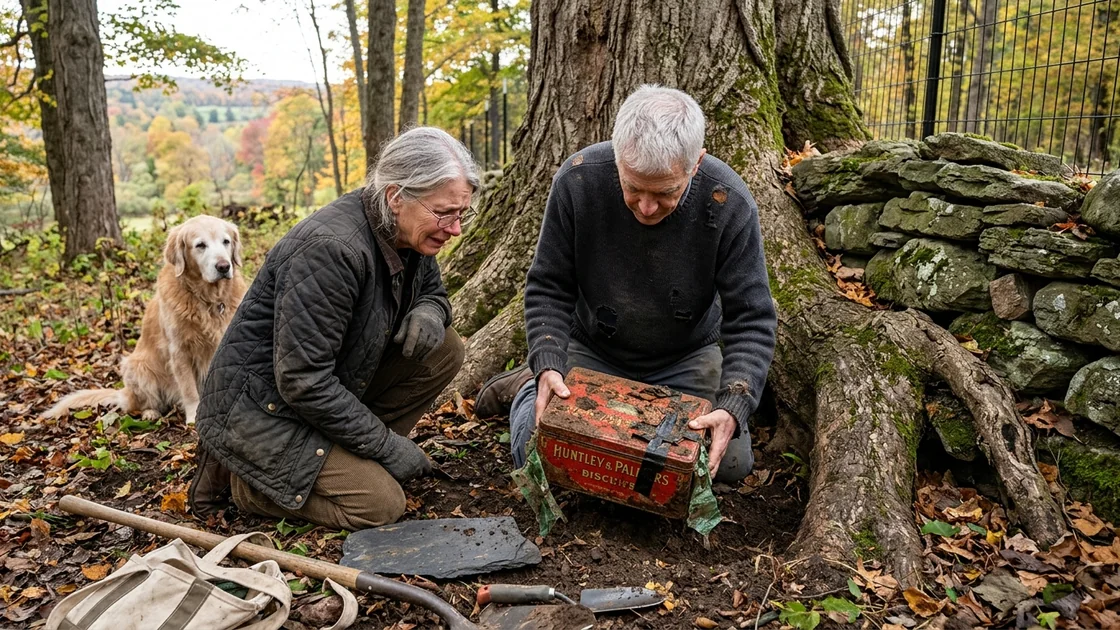
Right beside the elbow of the stone wall stood the hollow maple. At its base, a massive root system spread out like the knobby knuckles of an old hand, gripping the rocky ground. Between two thick roots, half-buried under forty years of decayed leaves, pine needles, and forest detritus, was a hollow filled with rich, black soil.
It was entirely inaccessible. The fence stood between her and the tree, the black wire pulled drum-tight and fastened to steel posts anchored in concrete.
"Damn it," Miriam whispered.
She looked down the slope toward the house.
A gravel driveway wound from the main road up to a three-car garage. Beside the garage stood a dark gray pickup truck and a garden tractor. A thin ribbon of blue woodsmoke curled from a stone chimney at the center of the main house. Someone was home.
Miriam looked back at the tree.
She was an elderly woman, a retired librarian from Columbia County. She had never been arrested. She had never received a speeding ticket in her life. She paid her property taxes six days early every June.
If you want your half of the summer, you’ll have to look where the stone wall makes an elbow.
Miriam adjusted the canvas strap of her bag over her shoulder. She turned and began walking down the hill toward the driveway.
The gravel of the private drive was pristine, consisting of uniformly crushed blue stone that crunched loudly under Miriam’s shoes. As she approached the house, she felt increasingly small, conscious of her mud-splattered sneakers, her frayed barn coat, and the absurd garden trowel clanking against the hand-axe in her bag.
A flagstone walkway led through an expanse of Japanese bloodgrass toward a heavy oak front door with iron hardware. Miriam paused at the bottom of the steps, took a deep breath, and walked up.
There was no doorbell, only a heavy bronze knocker in the shape of an acorn. She lifted it and let it fall three times.
The sound boomed through the house.
For a long moment, there was nothing. Then, from somewhere deep inside, came the click of a dog’s nails on hardwood, followed by a low, inquisitive bark. A voice, muffled and deep, called out: "Quiet, Rufus. Sit."
Footsteps approached. The deadbolt turned with a heavy, precision click, and the heavy door swung inward.
The man standing in the doorway was perhaps seventy, with a thick mane of silver hair cut short, sharp blue eyes beneath bushy eyebrows, and a days-old growth of silver stubble along his jawline. He was tall, dressed in a faded charcoal sweater with leather elbow patches and worn denim trousers. Beside his knee stood an elderly golden retriever whose muzzle was entirely white.
The man looked at Miriam. His gaze drifted from her face down to her muddy sneakers, over to the canvas tote bag, and back to her face. His expression was not angry, but guarded—the look of a man who had paid several million dollars precisely so he would not have to speak to people standing on his porch.
"Can I help you?" he asked. His voice was gravelly, carrying the flat vowels of western Pennsylvania.
"Good morning," Miriam said. She cleared her throat, realizing how thin her voice sounded in the cool air. "My name is Miriam Vance."
She paused, half-expecting the name to register, but the man’s expression remained blank.
"Are you lost, Ms. Vance?"
"No," she said. "I am not lost. I... well, my family used to own this land. It was Briarwood Farm for about eighty years."
The man’s eyebrows rose slightly. The hostility in his posture softened into mild curiosity, though his hand remained firmly on the edge of the door.
"Ah," he said. "The apple people. The tax map still lists the parcel as Briarwood on the older surveys. I’m Julian Ward."
He did not offer his hand, but he nodded once.
"Mr. Ward," Miriam began, feeling the heat rise in her cheeks. "I know this is an extraordinary intrusion. I know that you have private property signs posted, and I know that people don't just appear on doorsteps without an appointment anymore. But something happened this morning that... well, I wouldn't have believed it if I hadn't held it in my own hands."
Julian Ward looked at her carefully. He seemed to be weighing whether she was mentally unstable or merely eccentric. "What happened this morning?"
Miriam reached into her canvas bag, took out the postcard, and held it out to him.
Julian looked down at it. He hesitated, then reached out with long, calloused fingers and took it from her. He looked at the faded photograph of the Catskills first, then turned it over.
He read the address. He read the postmark.
His eyes lingered on the orange modern barcode and the purple stamp from the Atlanta facility.
"Nineteen eighty-four?" he said, his voice dropping an octave.
"August fourteenth," Miriam said. "She died twelve days later on Route 9G. Clara. She was my older sister."
Julian looked up from the card. The wariness had completely disappeared from his eyes, replaced by a deep, quiet stillness. "She was twenty-two?"
"She was twenty-two," Miriam repeated, her voice cracking slightly on the final syllable. "I was seventeen. We sold the farm after my parents died in ninety-one. We lost everything to the bank, Mr. Ward. Every square foot of it. When Clara died, she had taken a red tin box that we shared—a sort of time capsule we made that summer. She buried it. We never knew where. We looked for years, but she kept her secrets well. And then, two hours ago, this arrived in my mailbox."
Julian looked down at the postcard again. He read the message aloud, his voice steady: "If you want your half of the summer, you’ll have to look where the stone wall makes an elbow under the blind owl’s perch."
He looked back toward the high ridge behind his house.
"The old sugar maple," he said.
Miriam blinked. "You know it?"
"Of course I know it," Julian said. "I’m an architect, Ms. Vance. When I bought this property seven years ago, I walked every single foot of the boundary lines before I designed the house. That tree was struck by lightning again in the nineties, by the look of the scarring, but the core is still holding. The arborist told me to take it down because of the dead limbs, but I wouldn't let him. It has... character."
He stood in the doorway for a long moment, looking past Miriam toward the hill. The dog leaned its weight against his leg, sighing softly.
"Mr. Ward," Miriam said softly. "The new deer fence runs right past the roots. The elbow of the wall is inside your perimeter. I have a trowel and the key to the box. I am not asking for your land, and I am not asking for your silver. I just want to dig up the tin box. If it’s still there."
Julian looked down at the postcard once more, tracing the forty-year-old ink with the tip of his thumb. He handed it back to her with great care, as if handling an ancient manuscript.
"You brought a garden trowel?" he asked.
"I did."
He shook his head, a faint, wry smile touching the corners of his mouth. "You'll never get through the root mat with a garden trowel, Ms. Vance. The limestone in that ridge will snap stamped steel like a pretzel. Wait here."
He turned back into the house, leaving the door wide open. Miriam stood on the porch, her hands clutched against her chest, listening to the ticking of the kitchen clock inside and the rustle of the dog's coat as it stretched on the rug.
Five minutes later, Julian reappeared. He had swapped his loafers for heavy leather work boots. Over his shoulder, he carried a long-handled trenching spade with a sharpened forged blade, a mattock, and an eight-pound iron pry bar. In his left hand, he held a set of keys.
"Rufus," he said to the dog. "Stay."
He pulled the oak door shut until the latch clicked, turned to Miriam, and gestured toward the path that led up the ridge.
"Lead the way, Ms. Vance," he said. "Let's go see what your sister left behind."
The climb up the ridge was slower this time. Julian matched her pace without being patronizing, his boots crunching methodically through the dead leaves.
As they walked, Miriam found herself speaking. The landscape, once so forbidden behind the high black fence, seemed to loosen the tight knot of silence she had carried for decades.
"We had eighty cows when I was ten," she told him, pointing toward a swale that was now an undulating lawn of blue fescue. "Holsteins. They used to get out through the south fence every July because the elderberries grew thick along the creek. My father would come down the lane banging an old galvanized milk pail with an iron wrench, and they’d come trotting back like school children."
"Did you work the orchard?" Julian asked.
"Every harvest. By the time I was fourteen, I had calluses on my thumbs from the canvas bucket straps. Clara hated the cows, but she loved the apples. She could tell a Northern Spy from a Baldwin just by the smell of the bark in the dead of winter. She was going to Cornell to study pomology. She had a full scholarship for that September."
Miriam stopped to catch her breath, looking out over the valley.
"She was so bright it almost hurt to look at her," Miriam whispered. "And she was angry all that last summer. My father was borrowing money from the production credit association just to pay the diesel bill. The drought had stunted the fruit, and the packers in Hudson were only offering three dollars a crate for cider drops. Clara saw the end coming long before he did. She wanted him to sell thirty acres to a developer from White Plains who wanted to build vacation houses. Dad called her a traitor."
"Old farmers don't sell pieces," Julian said quietly. "They hold on until the whole thing goes over the cliff."
"Yes," Miriam said. "That’s exactly what he did."
They reached the gate in the deer fence fifty yards below the ridgeline. Julian unlocked the padlock, swung the high wire gate open, and allowed Miriam to pass through.
The atmosphere changed once they stepped under the shadow of the old sugar maple.
The tree was immense. Its trunk was nearly six feet in diameter at the base, covered in deeply ridged, slate-gray bark that felt like stone beneath Miriam's palm. The western side of the trunk was entirely dead—a blackened, hollow chimney where lightning had scorched the heartwood decades ago. But the eastern half was stubbornly alive, sending up two massive limbs that twisted toward the sun, clothed in leaves that were just beginning to turn the color of dried apricots.
The stone wall met the tree precisely where Clara had said it would.
The limestone rocks, lichen-crusted and heavy, formed a right angle. One root, thicker than a man’s torso, had grown directly over the top of the wall, swallowing three of the coping stones in a wooden embrace that had taken a half-century to form.
Miriam knelt in the damp leaf litter between two primary root flares.
The ground was covered in a thick carpet of brown maple leaves, pine needles, and the soft, black humus of forty autumns.
"She said between the elbow and the perch," Miriam said, her voice barely louder than the wind in the hemlocks. "Don't tell Arthur. Arthur was our father."
Julian laid the pry bar and the mattock on the grass. He knelt beside her, his knees sinking into the damp earth. He picked up a dry stick and began scraping away the top layer of leaves.
"If she buried it in August of eighty-four," Julian said, his architect’s eye assessing the terrain, "she would have had to dig into the soil between these two main roots. Here, where the ground dips. She wouldn't have dug under the stone wall itself—the foundation stones go down two feet, and the soil is packed too hard."
He reached for the garden trowel Miriam had brought. "Let’s start gentle."
Miriam took the trowel. She pushed the steel blade into the black earth.
The soil was soft for the first three inches—decades of leaf mold that had accumulated since the Reagan administration. Beneath that, the blade met resistance: a dense network of fine, hair-like rootlets from the surrounding brush.
Miriam worked with steady, rhythmic cuts. She cut a circle twelve inches across, peeling back the turf like a plug of sod. The smell of rich, damp earth filled her nostrils—the exact smell of Briarwood after an August rain.
Thunk.
The steel tip of the trowel struck something hard.
Miriam’s heart leaped. "I hit a rock."
"Let me look," Julian said.
He leaned in, using his bare fingers to scoop out the loose dirt from the hole. He scraped against the obstruction.
"It’s flat," he said softly.
He didn't use the shovel. Working like an archaeologist, he used the hand-trowel to clear the perimeter of the object. Ten inches down, wedged tight between two thick roots of the maple tree, was a flat piece of blue Hudson Valley slate, roughly the size of a dinner plate.
"A capstone," Julian said. "Someone put this here to protect whatever was underneath."
He took the small hand-axe from Miriam's bag and used the flat hammer-end to tap gently around the edges of the slate, loosening forty years of soil compaction. Then he hooked his fingers under the lip and pulled.
The slate came free with a wet, sucking sound.
Miriam leaned forward, her hands flat on the wet ground, her hair falling forward across her eyes.
Beneath the slate, wrapped in what appeared to be the remnants of an old, heavy-duty green plastic trash bag, was a rectangular shape.
The plastic was brittle. It had cracked under the weight of the earth, and pieces of it flaked away like dried onion skins as Julian brushed at it. But beneath the plastic, dull and spattered with patches of bright red rust, was the lithographed metal of a vintage biscuit tin.
Miriam let out a ragged breath she hadn't realized she was holding. A single tear broke free and traced down the deep groove beside her nose, dropping into the dirt.
"Clara," she whispered.
Julian did not try to pull it out immediately. The roots had grown around the tin, pinning the corners in a tight wooden vise.
"We need to be careful," he said quietly. "If we just yank it, the tin will tear open. The metal is probably paper-thin from moisture."
He took the serrated trowel and began shaving the wood of the root away from the edges of the box, millimeter by millimeter. Miriam helped, using an old rag to clear the loose wood shavings and damp dirt from the top of the tin.
On the lid, beneath the dirt and the flaking rust, a few faded letters were still visible in gold script: HUNTLEY & PALMERS.
"My grandmother’s biscuit tin," Miriam said. "She kept her pearl buttons in it."
After twenty minutes of patient excavation, Julian placed both hands beneath the bottom rim of the box. He shifted it gently left, then right.
The metal gave a faint, creaking groan.
"It’s loose," he said.
With infinite care, he lifted the red tin box out of the ground and laid it on the clean grass between them.
The box was roughly twelve inches long, eight inches wide, and four inches deep. It was surprisingly heavy. The seam where the lid met the base had been sealed with thick, black electrical tape—layers upon layers of it, wrapped around and around until it formed a rubbery, waterproof gasket.
In the center of the lid, taped beneath a square of clear packing tape that had yellowed into amber, was an envelope. On it, written in Clara’s bold, impatient hand, were two words:
FOR MIRI.
Miriam reached out with a trembling hand and touched the tape. Her finger left a clean smudge on the dusty surface.
"Do you want to open it here?" Julian asked gently. He had stepped back slightly, giving her space, his hands resting on his knees.
Miriam looked around. The Taconic hills rolled away to the east under a vast, cloudless autumn sky. The dry leaves of the sugar maple clattered in the breeze above them. Down in the valley, the world was moving on—trucks were carrying milk down Route 9G, people were checking their phones, banks were calculating interest rates.
"No," Miriam said. "Not here. Would you... would you mind if we took it to your house? My hands are shaking too much to do this outside."
Julian looked at her, his blue eyes softening. "My kitchen table is clean, Ms. Vance. And I have coffee."
The kitchen of Solitude Ridge was vast, airy, and smelled of cedar and freshly ground French roast. Floor-to-ceiling windows looked out over the southern swale where Miriam’s father’s cows had once grazed.
Julian had cleared the center of a massive farmhouse table made of reclaimed chestnut. He laid down several sheets of clean brown butcher paper, set the muddy tin box in the middle, and placed a pair of kitchen shears, an X-Acto knife, and a clean dry towel beside it.
He set a mug of black coffee in front of Miriam and pulled up a chair opposite her. He didn't hover. He simply sat down, his hands wrapped around his own mug, watching with quiet respect.
Miriam took the harness room key from her pocket and set it beside the box.
"She told me to bring the key," Miriam said, staring at the tin. "She said the key we stole from the harness room. But this box doesn't have a keyhole."
Julian looked at the heavy iron key. "Maybe it’s not for the box."
Miriam picked up the X-Acto knife. Her fingers were steady now, driven by a strange, quiet calm that felt like the eye of a hurricane.
She carefully slit the clear tape holding the envelope to the lid. The paper of the envelope was stiff and slightly curved, but the seal was unbroken. She did not open it yet. She laid it beside her coffee mug.
Next, she attacked the black electrical tape.
The vinyl had degraded over forty years, becoming gummy and brittle in places, but Clara had wrapped it at least a dozen times. Miriam scored the seam with the tip of the knife, then used the shears to peel back the thick, black ribbon. The smell that rose from the tape was intense: old petroleum, damp rubber, and the sharp, metallic tang of sealed air from 1984.
With a final cut, the last layer of tape came away.
Miriam laid down the shears. She looked across the table at Julian.
"Go ahead," he said softly.
Miriam placed her thumbs against the lip of the lid and pushed upward.
The metal groaned. The seal broke with a faint, audible pfft of displaced air. The lid came off.
Inside, the box was packed to the brim, protected by a layer of pale blue cotton—a piece torn from an old summer dress Miriam recognized instantly. It had been Clara’s favorite sundress, the one with the tiny yellow daisies she had worn to the fourth of July parade the summer she turned nineteen.
Miriam lifted the cloth.
Beneath it lay the contents of their lost summer, perfectly dry, entirely untouched by forty years of rain, snow, and frost.
The first thing Miriam saw was a broken piece of silver.
It was half of a heart-shaped silver locket, the kind that opened on a tiny hinge. The surface was engraved with an ivy leaf. Their Aunt Margaret had given it to them when they were girls, and they had deliberately snapped it down the middle with their father’s pliers during a dramatic swearing of mutual loyalty when Clara was fourteen and Miriam was nine.
Miriam reached into her own shirt collar, pulled out a thin silver chain she had worn every day of her adult life, and laid its pendant on the table.
The other half of the heart.
The two jagged edges fit together with a minute, perfect click.
Julian let out a slow whistle through his teeth. "Forty years," he said.
Miriam smiled, a watery, brilliant smile that felt strange on her face. "She kept her half."
Beside the locket were three cassette tapes in clear plastic cases. The handwritten labels were in Clara’s script: Summer '84 - Side 1: The Cars, Cyndi Lauper, Bruce. Side 2: Midnight Radio & Rain on the Barn. The second tape was labeled: Field Notes & Orchard Survey - July 12. The third was simply labeled: For Miri - Do Not Play in Front of Arthur.
Under the tapes was a stack of three dozen Polaroid photographs, held together by a thick rubber band that had long since melted into a brittle amber crust.
Miriam gently pried the photographs apart.
The colors were distinctively square and slightly muted, with the broad white margins of the vintage film.
The first photograph showed Clara.
She was sitting on the hood of the old Datsun pickup, her long, sun-bleached brown hair whipped across her face by the wind, her bare feet propped against the front bumper. She was wearing cut-off denim shorts and a faded green Cornell forestry t-shirt, holding up a massive, misshapen green apple with a look of triumphant, mocking glee.
Miriam’s breath hitched in her throat.
"That was the twenty-sixth of July," Miriam said, her voice shaking violently. "We had found a wild seedling growing in the limestone ravine. It had the sweetest fruit we'd ever tasted, but it was ugly as a toad. Dad told us to chop it down because it was a host for cedar rust. Clara spent three hours threatening him with a pruning hook if he came near it."
Julian leaned forward, looking at the photograph. "She had your eyes," he said.
"She had everyone's eyes," Miriam whispered. "She took all the light in the room."
She flipped through the other photographs: Miriam at seventeen, gangly and sunburned, sitting on a three-legged stool in the milking parlor; their mother standing beside the hydrangeas with a basket of wet laundry; the old drying barn before its roof collapsed; the barn cats sleeping in a tangle on the hood of the International Harvester tractor.
And then, beneath the photographs, were the notebooks.
There were two of them. Small, pocket-sized ledgers with black-and-white marbled covers and red cloth spines.
Miriam lifted the first notebook.
Tucked into the back of the tin, beneath the second notebook, was a heavy object wrapped in oilcloth.
Miriam reached down and pulled it out. As the cloth fell away, metal clinked against the chestnut table.
It was a small, brass-bound wooden box, about the size of a cigar case. On its front was a miniature brass hasp, secured by a small, rusted padlock.
Miriam picked up the heavy iron harness room key she had brought with her.
She looked at the padlock, then at the key. The iron key was far too large for the brass padlock.
"That's not what the key is for," Julian said, studying the lock. He reached into his pocket, pulled out a small multi-tool, and selected a pair of thin needle-nosed pliers. "May I?"
"Please," Miriam said.
Julian took the wooden box. With a quick, practiced twist of the wrist, he applied pressure to the brass hasp. The forty-year-old screws pulled free from the dry cedar with a dry crack, leaving the lock intact on the latch.
He laid the box back in front of Miriam and folded his hands.
Miriam took a deep breath. She lifted the lid of the wooden box.
Inside lay a legal document, folded into thirds, on heavy, blue-tinted rag paper. Across the top, printed in formal gothic lettering, were the words:
DEED OF PARTITION AND AGRICULTURAL CONSERVANCY.
Miriam unfolded the paper.
The date was August 10, 1984.
Beneath the title was the signature of Arthur Vance, witnessed by a notary public in Hudson, New York. And beside it was Clara’s signature.
Miriam’s eyes raced across the dense, typed legal prose.
"...does hereby grant, convey, and partition the parcel known as the Eastern Ridge, consisting of forty-two contiguous acres bounded by the stone boundary wall and the ancient sugar maple, into the irrevocable stewardship of Clara Vance and Miriam Vance, as joint tenants with right of survivorship, designated as an agricultural and forestry reserve..."
Miriam stopped reading. Her mouth went dry.
"What is it?" Julian asked, his voice sharp with sudden interest.
"My father..." Miriam said, her voice faint, almost inaudible. "My father didn't hate her idea. He signed this."
"Signed what?"
"Clara wanted to protect the eastern ridge from the creditors," Miriam said, her fingers tracing the blue paper. "In eighty-four, the banks were circling. They were threatening to foreclose on the whole two hundred acres. Clara went to an attorney in Hudson—she must have taken Dad with her. They partitioned the eastern ridge—this ridge, right here—and put it in our names, as a separate agricultural preserve, so the bank couldn't take it when the main farm fell."
Miriam looked up, her eyes wide with shock. "Julian... the bank took the whole farm in ninety-one. They took the house, the barns, the bottom land, the orchards. And when they sold it at auction... they sold the deed as it was originally recorded in nineteen fifty-two."
Julian went completely still. His architect’s mind, accustomed to deeds, surveys, title searches, and property lines, was visibly working through the implications.
"Did they ever record this partition?" Julian asked quietly, his finger pointing to the blue document.
Miriam turned the page.
On the back was a county clerk's red-ink recording stamp: RECORDED IN COLUMBIA COUNTY DEEDS, BOOK 612, PAGE 844, AUGUST 12, 1984. RECORDING TAX PAID.
"It was recorded," Miriam whispered.
Julian stood up from the table. He walked over to a wide set of flat architectural drawers against the far wall of his kitchen. He pulled open a middle drawer, rifled through several rolled-up blueprints, and extracted a large, laminated tax survey map of the town of Ancram.
He spread the map across the counter, weighted the corners with a sugar bowl and a salt cellar, and leaned over it.
"When I bought this land," Julian said, his voice measured, almost clinical, "the title insurance company flagged a discrepancy on the eastern boundary. The seller—a development trust out of White Plains that bought it from the bank in ninety-four—claimed two hundred and ten acres. But the town tax map only billed them for one hundred and sixty-eight."
He looked back at Miriam over his shoulder.
"The title company couldn't find the underlying documentation for the missing forty-two acres," he said. "The courthouse in Hudson had a fire in the basement archives in nineteen eighty-eight. Half the deed books from that decade were damaged or lost before they digitized the records. The bank sold what they thought they owned, the title company issued an exception on the policy for the disputed boundary, and the developer just fenced the whole thing because nobody contested it."
Julian looked down at the blue paper in Miriam’s hands.
"You don't just have Clara's memories, Ms. Vance," Julian said. "You own the ridge."
The silence in the kitchen lasted a long time.
The only sound was the soft humming of the stainless-steel refrigerator and the distant rustle of the wind against the great plate-glass windows.
Miriam sat frozen, the blue rag paper resting in her lap. Her mind refused to process the scale of what Julian had just said. She had spent thirty-three years believing she was landless, the displaced daughter of a ruined family whose heritage had been liquidated on the courthouse steps. She had lived in a rented two-bedroom cottage down the road, looking at the ridge from afar, believing that every blade of grass belonged to strangers with deep pockets and high fences.
"No," Miriam said finally. Her voice was firm, shaking off the vertigo. "No, Julian. That’s not why I came here."
Julian walked back to the table and sat down. He looked at her, his expression unreadable.
"I didn't come here to take land from you," she said, leaning forward. "You bought this property in good faith. You built this home. You preserved the old tree when the arborists told you to cut it down. I don't want forty-two acres. I don't want a lawsuit. I'm sixty-seven years old, Julian. I live on a librarian’s pension and social security. I don't want a legal war."
Julian looked down at his coffee mug. He reached out and touched the edge of the blue paper.
"Do you know why I bought this place, Miriam?" he asked quietly.
It was the first time he had used her given name.
Miriam shook her head.
"My wife, Sarah, died six years ago," Julian said. "Pancreatic cancer. We were married for forty-one years. We lived in a townhouse in Brooklyn. She was a painter; I was a partner in a firm that designed high-rise developments. When she died, the city became... unbearable. Every street corner had her ghost on it. Every restaurant we ever ate at was still there, but she wasn't."
He looked out the window toward the high ridge, where the antlers of the dead maple reached into the sky.
"I bought this ridge because it was quiet," he said. "I built this house because I wanted to design one thing in my life that wasn't meant for thousands of people to pass through without looking. I wanted a place where things stayed put. I put up that deer fence because I wanted to keep the outside world outside."
He turned back to look at Miriam.
"I’ve lived here for seven years, and I’ve never had a guest sit at this table," he continued. "Not one. The people down in the village think I’m an arrogant bastard from the city who bought up their views. And maybe they’re right. But I know what it means to lose the person who anchored you to the earth."
He pointed to the envelope sitting beside Miriam's mug.
"Read your letter, Miriam," he said softly. "The land isn't going anywhere. Let's find out what Clara had to say first."
Miriam picked up the envelope.
The paper was stiff, but the blue ink was dark and sharp. Clara had sealed it with a drop of red candle wax—a typical Clara touch, theatrical and deliberate.
Miriam slid her thumb under the flap and broke the wax.
Inside was a four-page letter, written on lined yellow legal paper. The pages were covered on both sides in Clara's handwriting.
Miriam unfolded the first sheet. She took a breath, leaned her elbow on the table, and began to read.
August 14, 1984.
Miri,
If you’re reading this, either it’s Labor Day and we’re sitting on the stone wall eating peaches with dirt on our shins, or something went terribly wrong and you’re digging this up without me.
I have to write this down because if I keep it inside my head, I’m going to scream at Dad until the cows stop giving milk. We went to Hudson on Monday. I made him put on his church suit. You should have seen him, Miri—he looked like an old crow with his wings clipped, sitting in that lawyer’s office with all the leather books. He didn't want to sign. He said, 'Clara, a farm can't be cut into scraps. It's like cutting an arm off a man to save his coat.'
I told him: 'Dad, they’re taking the coat, the arm, and the boots unless we hide the ridge.'
He cried. I’ve never seen Dad cry before, not even when Uncle Thomas died. He signed the partition because he knows I’m right, even if he can't admit it. The Eastern Ridge belongs to you and me now. The bank doesn't know about it yet, and Mr. Van Horn says as long as we record it before the next mortgage cycle, it’s a separate legal parcel that can't be attached to Dad’s agricultural debt.
I’m leaving the deed in the box with our things. I’m also leaving the journals.
I need you to know why I’ve been so rotten to you this summer. I know I’ve been snapping at you about the dishes and the haying, and I know you think I can't wait to leave you behind when I go to Ithaca next month. That’s not true, Miri-cat. I’m terrified.
I’m terrified that if I leave, this whole place will dissolve like sugar in the rain. Dad is broken. His hip hurts him every morning, and Mom spends half her day looking out the pantry window at the weeds in the garden. If I go, you’ll be left here alone to hold up the sky.
Don’t let them break you, Miri. You have more spine than both of us put together, even if you never raise your voice. That’s why the deed is in both our names. If they sell the bottom land, keep the ridge. Don't let anyone pave it. Don't let them turn it into golf courses or parking lots. Build yourself a cabin under the blind owl and watch the sun come up over the Taconics.
There’s one more thing.
The harness room key. You're probably wondering why I told you to bring it, since it doesn't fit the biscuit tin.
I didn't steal that key because I wanted a souvenir of the barn. I stole it because of what is hidden behind the fourth floorboard under the oat bin. Do you remember the old leather veterinary satchel Grandfather kept the sheep medicine in? I took all the silver dollars Aunt Margaret left us—all eighty-two of them—and I put them in that satchel. I hid it under the floorboards in the harness room on the day Dad said he was going to take them to the bank to pay the interest on the tractor note. They were our silver dollars, Miri. Yours and mine.
If the barn is still standing when you read this, take the key. Go get the sheep satchel. If the barn is gone, well... at least we made the bank work for every dime they stole.
I’ll see you at the tree on Labor Day. Bring a jar of Mom’s strawberry jam and two forks. We’re going to sit on the elbow and plan our empire.
All my love,
Clara.
Miriam let the letter fall to the table.
She did not cry. The grief had passed through the phase of tears forty years ago, turning into something resembling the gray limestone of the ridge—hard, cool, and permanent. But her chest felt wide open, as if a window that had been shuttered since she was seventeen had suddenly been thrown open to an October wind.
"The barn," Miriam said softly.
Julian was watching her. "The barn was torn down in nineteen ninety-six," he said gently. "The developer cleared it before I ever saw the property. The foundation is still out there, under the gravel turn-around by the garage. They used the old hand-hewn timbers to build a ski lodge in Vermont."
Miriam picked up the heavy iron harness room key from the table. She looked at its pitted surface, the dark gray iron that had once smelled of linseed oil, leather dressing, and sweet clover hay.
"It doesn't matter," she said.
She laid the key down beside Clara's letter.
"She thought she could save the whole world with a biscuit tin and eighty-two silver dollars," Miriam whispered, a dry chuckle escaping her throat. "She was twenty-two years old, and she thought she could outsmart the Chase Manhattan Bank and the United States District Court."
"She outsmarted them on the ridge," Julian said.
He leaned forward, his elbows on the table, looking squarely at Miriam.
"You own forty-two acres, Miriam. Under New York law, a conveyance properly recorded takes precedence over an inaccurate subsequent deed from an estate or foreclosure sale if the buyer had constructive notice. The town tax records had notice. My title insurance policy specifically excluded the disputed eastern perimeter."
Miriam shook her head. "Julian, please. What am I going to do with forty-two acres of rocks and sugar maples? I don't have the money to build a cabin. I don't have the energy to fight a court case to quiet title. I don't want to force you to tear down your fence."
Julian stood up. He walked to the window and looked out toward the ridge.
"My house," he said, "is built on the lower parcel. The two hundred feet surrounding this building is indisputably part of the original farm homestead. The ridge... the ridge begins at the tree line, right where that stone wall turns."
He turned back to face her.
"I didn't build Solitude Ridge because I wanted to own forty-two acres of rocks," Julian said. "I built it because I didn't want anyone else building on them."
He walked back to the table, pulled out his chair, and sat down.
"Here is what we’re going to do," Julian said, his voice taking on the decisive, authoritative tone of a man who had spent forty years running construction sites and managing complex corporate partnerships. "If you agree."
Miriam looked at him, curious. "What?"
"We take that deed to my land-use attorney in Hudson tomorrow morning," Julian said. "He’s the best in the county. We file an action to quiet title, not against me, but against the prior owners and the bank’s successors, establishing that the Eastern Ridge partition was valid in nineteen eighty-four and remains valid today."
"Julian—"
"Listen to me," he interrupted, holding up a hand. "We establish that the forty-two acres belong to the estate of Clara Vance and to Miriam Vance. Then, you and I execute a permanent, perpetual conservation easement on the entire parcel."
Miriam blinked. "A conservation easement?"
"We deed the development rights to the Columbia Land Conservancy," Julian said, his eyes bright. "No one can ever build on it. No one can ever subdivide it. It can never be cleared for vacation homes, it can never be logged, and it can never be turned into an orchard or a subdivision. It remains an agricultural and forestry reserve, exactly as Clara and your father wrote on that blue paper forty years ago."
Miriam stared at him. The breath left her in a quiet rush.
"And the ownership?" she asked.
"You keep the ownership," Julian said simply. "You own the land. You grant me an easement for access to maintain the boundary, and we take down that damned black deer fence along the ridge so the deer can walk the stone wall again. And we put a bench under the sugar maple."
He reached across the table, took Clara’s postcard, and pushed it back toward her.
"Your sister didn't bury that box so you could become a real estate speculator, Miriam," Julian said softly. "She buried it because she wanted you to have your half of the summer. That ridge was your half. It still is."
The sun had climbed high into the midday sky, turning the Taconic hills from deep blue to a brilliant, dazzling tapestry of scarlet, gold, and burnt orange.
Miriam and Julian walked back up the hill together.
Julian had left his tools behind. He carried only a thermos of hot water and two ceramic mugs. In her tote bag, Miriam carried Clara’s cassette tapes, the small battery-powered tape recorder Julian had found in his studio, and the half of the silver locket, now reunited with its mate on a single chain around her neck.
When they reached the high ridge, the wind had picked up, sweeping across the valley with the clean, cold scent of high altitude.
Julian pulled a small, brass-backed folding knife from his pocket. He walked over to the modern deer fence, reached up, and cut the high-tensile wire where it met the corner post. The wire snapped with a musical ping, curling back like a loose guitar string. He cut the next three strands, opened a twelve-foot gap in the barrier, and pulled the wire flat against the ground.
"There," Julian said, dusting off his hands. "The blind owl has his view back."
Miriam walked through the gap.
She walked to the ancient sugar maple and sat down on the dry, mossy stones of the wall, right at the elbow. The limestone was warm beneath her thighs, having absorbed the midday sun.
Behind her, the great hollow trunk of the tree rose like a fortress wall, sheltering her from the north wind. Before her, the land fell away in long, golden swales down to the creek bed, then rose again toward the blue bulk of Mount Washington on the Massachusetts line.
Julian sat down five feet away on the stones, setting the thermos between them. He did not speak.
Miriam took the cassette recorder from her bag. She picked up the third tape—the one labeled For Miri - Do Not Play in Front of Arthur.
She opened the plastic case, inserted the tape into the deck, and closed the door with a plastic click.
Her thumb hovered over the play button.
Forty years.
For forty years, Clara had been a photograph on her nightstand, a name on a polished marble headstone in the cemetery behind the Methodist church, a silent ache that throbbed whenever the smell of bruised Macintosh apples drifted on the autumn air.
Miriam pressed the button.
The machine let out a low, mechanical hiss. The reels turned, orange and black plastic spinning behind the tiny rectangular window.
For three seconds, there was only the sound of tape hiss and the faint, distant rumble of a car engine from forty years ago. Then, someone cleared their throat.
"Is this thing on?" Clara’s voice said.
The sound was so clear, so immediate, so entirely alive, that Miriam gasped.
It was not the voice of an ancestor. It was not the voice of a ghost. It was the voice of a girl—loud, impatient, with a slight gravelly catch on the high notes and that sharp, northern New York clip that Miriam had spent decades trying to smooth out of her own speech.
"Okay," Clara’s voice said on the tape. There was a rustle of paper, followed by the clink of a soda bottle against a metal desk. "Testing. One, two, three. It’s August thirteenth. It’s about two in the morning, and Miri is asleep in the other room. She thinks I’m writing my botany paper for Cornell. I’m not. I’m sitting here looking at this stupid red biscuit tin."
A soft, self-conscious laugh came through the tiny speaker.
"Miri-cat," Clara said, her voice dropping into a conspiratorial whisper. "If you’re listening to this, you’ve found the box. Which means you either have the harness room key, or you smashed the lock with Dad’s sledgehammer, which is what I would have done."
Miriam closed her eyes. The tears came now, silent and hot, tracing down her cheeks and dripping from her chin onto her wool coat, but she did not wipe them away.
"I just wanted to tell you..." Clara said on the tape. She paused. The wind on the recording rose, rattling the screens of their old bedroom window. "I wanted to tell you that I’m sorry I yelled at you yesterday about the cider press. I know you were just trying to help. It’s just that everything feels like it’s slipping through my fingers, Miri. The trees are getting old, and the bills are so big, and Dad looks so small lately. I feel like if I don't hold on with both hands, the whole mountain is going to blow away."
There was a long silence on the tape. The sound of Clara breathing, steady and rhythmic, filled the autumn air on the ridge.
"Don't let it blow away, Miri," Clara whispered. "Even if I go to Ithaca, and even if you go to college in Boston like you want to... don't forget the hill. Remember the way the mist sits in the south hollow in October. Remember that we were here, and that we owned this sunlight, even if we didn't have five nickels to rub together."
A bird called in the background of the forty-year-old recording—a robin singing its late-summer evening song outside their bedroom window.
"I'm going to put the tape in the box now," Clara said. "I'm going to walk up to the elbow before the sun comes up and bury it. The backhoe is coming at seven. Meet me there on Labor Day, okay? Don't be late. I'm bringing the good peaches."
A click. A pop of static. Then only the low, steady hiss of the empty magnetic tape.
Miriam did not move. She sat with her eyes closed, listening to the silence that followed her sister’s voice.
Beside her, Julian poured hot water into the two mugs, the steam rising white against the blue backdrop of the mountains. He set one mug down on the stone wall beside her hand.
"She had a good voice," he said quietly.
Miriam opened her eyes.
She looked at her hand, resting on the gray limestone. The skin was spotted with age, the veins prominent and blue, the knuckles slightly swollen with arthritis. It was the hand of an old woman—an old woman who had outlived her sister by more than four decades, who had survived the loss of her family, the loss of her home, and the long, slow passage of an ordinary, quiet life.
She picked up the postcard from her lap.
Greetings from the Hudson Valley, New York.
The orange modern barcode was still there, a bright, vulgar reminder of the four decades the message had spent wandering through the dark sorting bins of the world, carried by diesel trucks and conveyor belts, overlooked in canvas corners, waiting for the one machine that would finally read its destination.
It was not late.
Miriam looked out over the ridge—her ridge. The high grass bent before the wind, waving like a sea of pale gold toward the dark hemlocks. Forty-two acres of limestone, sugar maple, and silence, held safe behind an unrecorded blue deed and an old biscuit tin.
"Julian," she said.
"Yes, Miriam?"
"Do you have a spade in that truck of yours?"
Julian looked at her, his eyebrows raised. "I do."
Miriam picked up the locket from the stone wall, clutching both halves together in the palm of her hand.
"Tomorrow we go to the lawyer in Hudson," she said. "We make the conservancy. We take down the rest of the fence. But right now... Clara told me to bring two forks and a jar of strawberry jam."
She reached into her canvas bag, pulled out a small glass jar with a handwritten label that she had taken from her pantry that morning, and set it on the wall beside the mugs.
"I didn't bring the forks," Miriam said, her voice rich with a quiet, triumphant humor. "We'll have to use our fingers. But I think she’d forgive us for that."
Julian looked at the jar of jam, then at Miriam, then up at the great, scarred horns of the old maple tree above them.
A slow, wide smile spread across his weathered face. He picked up his mug, raised it toward the dead branches of the blind owl's perch, and then tapped it gently against Miriam's.
"To the empire, Miriam," Julian said.
Miriam raised her mug to the mountain, to the wind, and to the girl who had driven too fast down Route 9G forty years ago, leaving her voice behind in the dirt like a seed that had waited through the longest winter in the world just to bloom in the autumn sun.
"To the empire, Clara," Miriam said.
And there, on the stone elbow where the past had finally caught the present, the two of them sat together under the hollow maple, watching the light change across the valley as the afternoon deepened into gold.