The Porch Light of Oakhaven
When retired high school literature teacher Martha Higgins agrees to write an anonymous advice column for her sleepy New England weekly newspaper under the pen name The Porch Light, she expects petty garden squabbles and church choir rivalries, but she soon finds herself offering fierce, transformative counsel to a despairing young woman trapped in a silent marriage and suffocated by an overbearing family, completely unaware that the desperate correspondent is Penny, her own quiet daughter-in-law.
Chapter I: The Grammar of Solitude
The red pen did not know how to stop.
For thirty-eight years, Martha Higgins had wielded it like a scalpel, paring away redundant adjectives, slicing through the tangled weeds of dangling modifiers, and demanding, in the cramped margins of lined loose-leaf paper, that the youth of Oakhaven speak with precision. In the classroom, clarity was a moral imperative. If you could not name what you felt, you were doomed to be governed by it; if you could not construct a sentence, you could not construct a life.
Now, in the autumn of her sixty-seventh year, the red pen lay on the blotter of her walnut desk, cold and unsummoned.
The house on Schoolhouse Lane was too large by half. Built in 1892 by a timber merchant who had more ambition than progeny, it possessed eleven-foot ceilings, crown moldings that trapped dust like spider silk, and an echoing quiet that Thomas had left behind when his heart stopped among the tomato vines six years ago. Thomas had been an expansive man, loud-booted and fond of laughter that rattled the glass in the china cabinet. Without him, and without the three daily sections of American Literature at Oakhaven High School, Martha had become an archivist of her own stillness.
She kept to a schedule, because without a schedule, one ended up eating saltines over the kitchen sink in a bathrobe at three in the afternoon. She woke at six. She boiled water in the copper kettle, toasted two slices of rye bread, and spread them with orange marmalade. She walked the perimeter of her garden, inspecting the frost-bitten stems of the phlox and the drooping purple heads of the late asters. She washed her teacup by hand, dried it with a linen towel that had belonged to her grandmother, and returned it to the cupboard hook.
Then came the hours between ten in the morning and four in the afternoon. Those were the hours that stretched like wet dough.
On a Tuesday in late October, the telephone rang. Its bell was an antique trill that startled the clock on the mantel.
"Martha? Don't hang up," rasped Arthur Vance. Arthur had edited The Oakhaven Courier since the Nixon administration. His fingers were permanently stained with printer’s ink, and his voice sounded as though it had been dragged through a gravel quarry. "I know you hate the telephone before noon, but I am in a state of absolute, unmitigated crisis."
Martha shifted the receiver to her other ear and picked up her brass letter opener. "Arthur, you consider a misprinted coupon for the butcher shop a state of absolute crisis. What has happened? Has the selectboard approved the neon sign for the bowling alley?"
"Worse. Clara Bowles has decamped."
Martha paused. Clara Bowles had written Clara’s Counsel for the Courier for twenty-four years. Her column was a local institution, providing gentle, pious platitudes to people whose neighbors let their hounds run through the hostas or whose sponge cakes refused to rise.
"Decamped?" Martha asked. "Clara is eighty-two. Where could she possibly decamp to?"
"A retirement village in Sarasota," Arthur said with profound disgust. "She left on the six o’clock bus this morning. Left a note on my keyboard under a paperweight shaped like a lobster. Says her joints can’t take another mud season, and her daughter bought her a condo with a lanai. A lanai, Martha! She gave me three days' notice. The Friday layout has a twelve-inch hole on page four. It is the most-read feature in the entire paper after the police blotter and the obituaries. People need their weekly dose of scolding, and I have nothing to give them."
"Run an extra crossword puzzle," Martha suggested coolly. "Or reprint recipes for squash casserole. It is autumn. People are desperate for ways to disguise butternut squash."
"They don't want squash, Martha. They want to know what to do about their sisters-in-law stealing the family silver. They want someone to tell them they’re right and the world is wrong. Look, I’m not asking you to do it forever. Just six weeks. Until I can find some eager journalism student from the community college to take it on for twelve cents a word."
Martha looked out her window. A single yellow leaf from the sugar maple was plastered against the glass by a cold drizzle. The street was empty.
"I am not Clara Bowles," Martha said. "I do not believe that all marital strife can be resolved by baking a peach cobbler, nor do I believe that God pays particular attention to whether the altar guild uses brass polish or vinegar on the candlesticks."
"Good!" Arthur barked. "I’m sick to death of peach cobbler. Clara was sweet enough to cause diabetes in a stone. Give them something with teeth, Martha. You spent four decades terrifying the sons and daughters of this valley into memorizing The Canterbury Tales. Terrify them into behaving themselves. You can use whatever ridiculous pen name you like. Nobody has to know it’s you. If they knew it was you, half the town wouldn't write in for fear you’d grade their spelling."
"They ought to fear that," Martha muttered.
"Think about it," Arthur said, his tone softening into something that sounded dangerously like genuine appeal. "Come down to the office this afternoon. Look through the mailbag. Clara left two weeks' worth of unread letters in a shoebox. Just... look at them. If you hate it, I’ll run the crossword. But you have too many books in that house, Martha, and not enough people."
He hung up before she could formulate a grammatical objection to the cadence of his final sentence.
She stood by the telephone for a long moment. Not enough people. It was an impertinent thing for Arthur Vance to say, particularly since Arthur had been divorced twice and lived in an apartment above the laundromat that smelled entirely of fried onions and old newsprint.
Still, when she walked past the hall mirror, she caught sight of her own face: the silver hair pulled back into a clip that brooked no rebellion, the gray wool cardigan buttoned to the collarbone, the mouth set in the thin, defensive line of a woman who had spent too many afternoons conversing only with the ghost of her husband and the radio host on the public broadcast station.
She put on her heavy tweed coat, took her umbrella from the porcelain stand, and stepped out into the rain.
The office of The Oakhaven Courier smelled precisely as it had in 1974: solvent, wet wool, stale Maxwell House coffee, and the faint, sweet decay of wood pulp. Arthur sat behind a fortress of yellowing broadsheets, a blue grease pencil tucked behind his ear.
Without a word, he reached beneath his desk and hauled up an old cardboard box that had once contained size-9 Sears work boots. He dropped it onto the counter between them. It landed with a dull, heavy thud.
"There they are," Arthur said. "The unwashed confessions of Oakhaven, Vermont. Go on. Take it home. Read three. If you aren't appalled, amused, or tempted to correct their syntax by dinner, bring it back and I’ll buy you a sandwich at the diner."
Martha looked at the box. The flaps were curled. Peeking out from the cardboard were envelopes of every description: pale pink stationery with deckled edges, sheets torn from legal pads and folded into thirds, cheap self-adhesive envelopes from the pharmacy, and heavy cream vellum.
"What is the pay?" she asked, surprised at her own voice.
"Forty dollars a week," Arthur said without blinking. "And all the stale doughnuts you can steal from the breakroom."
Martha picked up the box. It was surprisingly light, considering how much misery it supposedly contained.
"I will not use the name Clara," she said firmly. "It sounds like a cow that has won a ribbon at the county fair."
"Pick your own poison," Arthur grinned, showing yellow teeth. "The typesetter needs the first copy by Thursday noon."
Chapter II: The Invention of The Porch Light
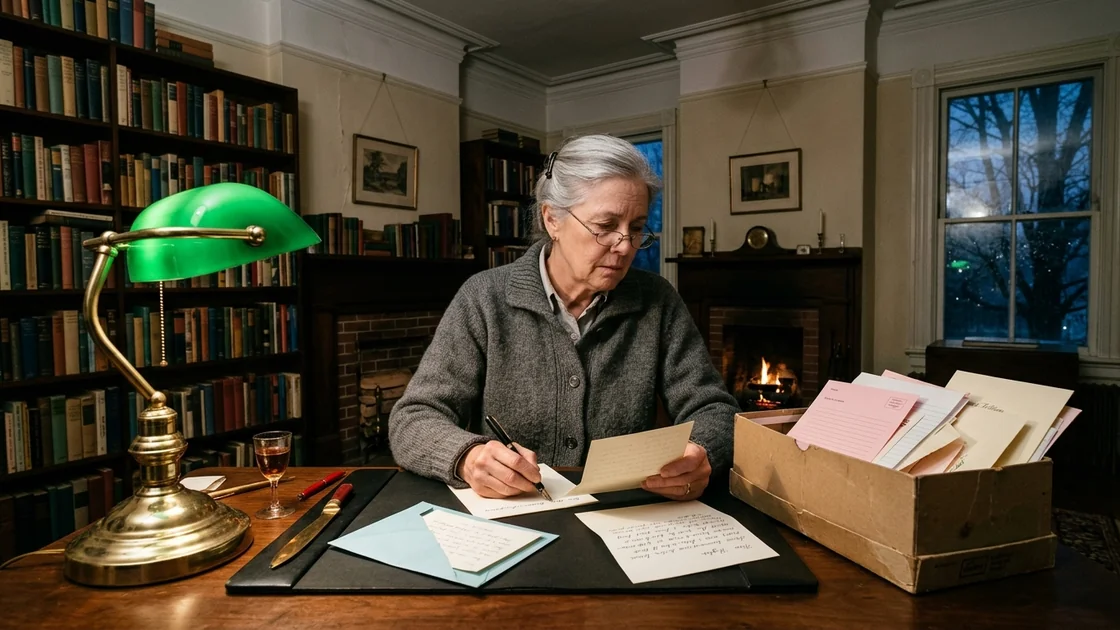
That evening, Martha built a small fire in the hearth. She placed the shoebox on the low table beside her wingback chair, poured three fingers of dry sherry into an etched cordial glass, and unscrewed the cap of her fountain pen.
She opened the first envelope.
Dear Clara, the letter began in a shaky, spider-like scrawl. My neighbor across the lane has hung a plastic skeleton from his porch beam. It is not even Halloween yet. It has red bulbs for eyes that blink all night and shine directly into my guest bedroom. When I spoke to him, he told me to buy thicker curtains. What is the Christian response to such insolence? Signed, Disturbed on High Street.
Martha snorted. She picked up her pen.
Dear Disturbed, she wrote, her cursive sharp and upright. The Christian response is undoubtedly patience and the turning of the other cheek, but since few of us are saints, the practical response is twofold: first, invest in a set of blackout shades, which will serve you well long after November; second, recognize that your neighbor is likely an unimaginative man who finds his own amusement in your irritation. Cease showing him your displeasure, and the skeleton will lose its charm. An audience of one is never sufficient for a boor.
She set it aside. It felt brisk. It felt tidy. It felt like grading a mediocre essay on The Crucible.
She opened a second. It was a dispute over a recipe for rhubarb pie that had supposedly been stolen from a church bazaar committee in 1988. Martha dismissed it in three sentences, pointing out that rhubarb belonged to everyone and that forty years was an undignified amount of time to nurse a pastry-related grudge.
She opened a third, a fourth, a fifth.
They were petty, predictable, and small. They were the minor frictions of human beings living too close together in a valley where winter lasted five months and everyone knew who had bought whose tractor at the bank auction. She began to feel a familiar, pedagogical impatience. Was this all that occupied the minds of her neighbors? Were they so cushioned from real tragedy that a blinking plastic skull constituted an existential crisis?
Then she pulled a square, pale blue envelope from the bottom of the box.
The paper was good—heavy cotton bond, the kind sold in sets at the stationer's down in Brattleboro. It had no return address. The ink was dark sepia, applied with a nib that had hesitated, leaving small, round blots at the beginnings of certain words.
Dear Clara, the letter said.
I do not know why I am writing to a newspaper. I suppose it is because paper cannot look back at me with disappointment, and ink does not sigh when I fail to be what it expected.
Martha’s pen stopped hovering. She adjusted her reading glasses.
I have been married for four years. My husband is not a bad man. He does not drink; he does not raise his hand; he works long hours and provides a home that anyone from the outside would call lovely. Everyone tells me how fortunate I am. His family is prominent here, well-respected, established. His mother is a woman of formidable intellect and dignity, the kind of person who makes the very air in a room feel properly ordered just by walking into it.
The trouble is that I am disappearing.
When I was twenty-two, I had a scholarship to an art institute in Chicago. I dreamed of large canvases, of botanical illustration, of seeing the world through my own eyes. But my mother fell ill, and I stayed. Then I met my husband. He was solid when everything else was falling apart. He offered me a foundation. But now that the foundation is poured, I realize he expects me to be the wallpaper.
He does not look at my drawings. When I set up my easel in the spare room, he asks if I might finish before dinner because the turpentine smells, though I use only odorless mineral spirits. His mother, whom I admire so much that it chokes me, visits every Sunday and gently rearranges my life. She straightens the books on my shelves according to subject. She brings me jars of her own preserves and asks why I buy jam from the store when it is so simple to put up fruit. She does not do this to be cruel; she does it because her standards are absolute, and I am perpetually found wanting.
I have stopped drawing. My hands shake when I hold the pencil. Last night, at dinner, my husband talked for forty-five minutes about the county drainage ditches, and I realized that if I were to vanish into the floorboards, he would not notice until the butter dish ran out. I feel like a moth pinned to a board in a very clean, very quiet museum.
Do I stay because I promised to stay? Or do I break the glass and run, even if running makes me a monster in the eyes of everyone who thinks I have been given heaven on a platter?
Signed, A Bird in the Chimney.
Martha lowered the paper. The fire gave a soft, resinous pop, sending a spray of orange sparks against the mesh screen.
The handwriting was unfamiliar. It was delicate, loopless, modern—the writing of someone young, someone who had likely attended school after Martha had stopped teaching the younger grades. But the voice was not the voice of the church bazaar. It was raw, unarmored, and dangerously honest.
His mother is a woman of formidable intellect and dignity.
Martha felt a small, prickling sensation at the nape of her neck. How many women in Oakhaven fit that description? A dozen, surely. Mrs. Abernathy, whose husband owned the bank; Evelyn Croft, who had served three terms in the state legislature; Beatrice Hall, who ran the historical society with an iron parasol. It could be any of them. Oakhaven was thick with formidable matrons who believed their taste was the only objective reality in the universe.
Martha looked at the letter again. A moth pinned to a board.
She remembered herself at twenty-six, freshly married to Thomas, terrified of his mother, old Maude Higgins, who could tell by smelling a room whether the floor had been scrubbed with lye or merely mopped with water. Martha had spent five years trying to bake bread that didn't resemble cobblestones, trying to speak only when she had something "constructive" to say, swallowing her own sharp wit until her stomach burned with acid. Only after Maude had passed had Martha felt the rafters of this house lift, allowing the light to strike the floor.
Why should this girl wait for someone to die before she began to breathe?
Martha dipped her pen into the ink. She did not write as Clara Bowles would have written. She did not suggest prayer, nor did she suggest having a frank, heart-to-heart talk over a roast chicken. She knew men like the one described: they did not listen to heart-to-heart talks; they endured them until the woman stopped crying, then returned to their dinner.
Dear Bird, Martha wrote, her pen biting deep into the paper.
A promise made to another person is a sacred thing, but a promise that requires the systematic murder of your own soul is an idolatry.
You speak of your husband’s kindness as though it were a debt you must repay with your existence. Kindness is not a mortgage. A man who provides a roof but refuses to look at the woman who lives beneath it is not a partner; he is a landlord of your youth.
As for his mother: you are suffering from the tyranny of the competent. Women of strong will often mistake their own preferences for natural laws. If she straightens your books, it is because she cannot bear a universe she did not organize. That is her tragedy, not your duty. Hand her the duster and let her occupy herself, but do not mistake her neatness for wisdom.
If your hands shake when you hold the pencil, it is because your hands are smarter than your intellect. They know they are being starved. Do not ask for permission to draw. Do not ask for the room to be cleared. You do not need to break the glass and flee into the night like a tragic heroine in a cheap novel; that is the fantasy of the powerless. You must simply begin to inhabit your own life with such weight and purpose that those around you are forced either to see you or to step aside.
Paint your canvases. Leave the turpentine where it sits. If the butter dish is empty, let him fetch his own butter. If he cannot love the woman who creates, he never loved you at all; he loved an unpaid housekeeper who smelled of his mother’s approval.
You are not a bird in a chimney unless you choose to stay where the smoke is. Climb out, or prepare to be soot.
Signed, The Porch Light.
Martha sat back. Her fingers were stained with ink. Her heart was beating with an unseemly, illicit rhythm.
She read the response once, twice. It was far too long. It was far too severe. It violated every tenet of small-town journalism, which was designed to soothe, to placate, and to keep the advertisers happy.
She picked up the page, folded it with the others, and placed them in a manila folder.
"The Porch Light," she whispered to the empty room. "Because someone in this valley needs to leave a wick burning, if only to show people how dark their parlors have become."
Chapter III: Sunday at the Colonial
The rain had cleared by Sunday, replaced by that crystalline New England autumn light that makes every red barn look like a postcard and every dry stone wall look like a monument to human persistence.
At twelve-thirty precisely, Martha heard the sound of David’s truck crunching over the gravel driveway.
David was her only child. Born late in her marriage, after eleven years of negative tests and quiet tears in church pews, he had been the center of Martha’s world—though she had taken great, pedagogical care never to let him know it. She had raised him not with indulgence, but with expectations. He had become what she had groomed him to be: steady, upright, an engineer who worked for the state highway department, measuring the slope of culverts and the load-bearing capacity of bridges. He was thirty-two now, broad-shouldered and quiet, with his father’s square jaw and her own hazel eyes.
Beside him in the cab of the Ford was Penelope.
Penny was twenty-seven, small, with hair the color of unpolished copper that she perpetually twisted into an untidy knot with a wooden knitting needle. David had met her three years ago when she was working at the nursery in town, designing their seasonal catalog with delicate, precise ink drawings of hydrangeas and ferns. Martha had approved of her then; she was polite, she had good posture, and she did not interrupt when David spoke.
"Mother," David said, stepping through the back door and stooping to kiss Martha’s cheek. He smelled of cold air and cedar shavings. "I brought the cider from the mill. The crisp kind, not that sweet syrup they sell at the market."
"Thank you, David. Put it on the sideboard, please," Martha said, offering her cheek with practiced affection. She turned to Penny. "Penelope, my dear. You look pale. Have you been taking your iron?"
Penny offered a thin, small smile that did not reach her gray eyes. She was wearing an oversized beige cardigan that completely erased her waist, and her hands were tucked into the pockets. "I'm fine, Martha. Just... the change of season, I think. The damp gets into everything."
"Only if you don't air the rooms properly," Martha remarked, leading the way into the dining room. "I always open the second-floor sashes for twenty minutes after breakfast, even in November. Stagnant air breeds melancholy. Thomas always said a cold draft is better than a dull mind."
"Yes, Martha," Penny said quietly.
Dinner was roast pork loin with rosemary, braised red cabbage, and boiled potatoes. It was the same meal Martha had cooked on the third Sunday of October for thirty years.
"The county commissioners approved the expansion of the bridge at Blackwater Creek," David said between mouthfuls of pork. He cut his meat into precise, identical squares before eating them one by one. "It’s about time. The abutments on the south side have had scouring issues since the spring runoff in ’19. I told them if we don't drop two new concrete piers by next August, the whole deck will shift an inch and a half to the west."
"An inch and a half is significant in a bridge," Martha observed.
"It’s fatal," David said simply. "Everything depends on the load path. You can’t have the weight transferring where there's no steel to meet it."
Martha nodded approvingly. "And you, Penelope? How is the nursery?"
Penny jumped slightly, her fork clattering against her plate. "Oh. It’s... it’s fine. We’re putting the perennials to bed for the winter. Heeling in the roses. It’s mostly raking and burlap now."
"A pity they don't keep you on for the design work through the winter," Martha said, reaching for the water pitcher. "You had such a nice touch with those garden markers last spring. Though I must say, the lettering on the parsley signs was a bit ornate. Sans-serif is always more legible at a distance."
Penny’s fingers tightened on her napkin in her lap. "I like the older fonts," she murmured. "They have... character. They look like they grew out of the soil."
"Legibility is the primary function of a sign, my dear," Martha said with a gentle, patient smile. "If a person cannot tell whether they are buying parsley or parsnips, the beauty of the flourish is rather beside the point, wouldn't you say?"
Penny looked down at her red cabbage. "I suppose so."
David did not look up from his potatoes. "Pass the mustard, would you, Pen?"
Penny passed the mustard.
Martha watched them. A strange, fleeting discomfort stirred in her chest—a vague echo of something she had read recently, though in the moment she did not connect it to the blue envelope resting under the blotter on her desk upstairs. David and Penny were a good match. They never argued. They had a tidy bungalow on Maple Street with a fenced yard and a lilac bush. David was doing well at the department; he had just been promoted to senior surveyor. Why, then, did the room feel so heavy? Why did the silence between the scrape of knives sound less like peace and more like an armistice?
"Did you see the Courier on Friday?" David asked suddenly, wiping his mouth with his napkin.
Martha froze, her water glass halfway to her lips. "I... glanced at it. The newsprint was terribly smudged this week. Arthur needs to adjust the pressure on his drums."
"Not the news," David chuckled. "Clara Bowles is gone. Some new person took over the advice column. Calling herself The Porch Light."
Penny looked up, her eyes suddenly wide, a faint color rising in her cheeks. "You read it, David?"
"Read it? Half the office was talking about it during the coffee break," David said, shaking his head. "Old man Miller was laughing his head off. Someone wrote in about their neighbor's plastic Halloween skeleton, and this Porch Light person basically told them to stop being a busybody and buy some blinds. It was harsh. Clara would have told them to bake the neighbor a pumpkin bread and pray for his soul."
"I thought it was... refreshing," Penny said, her voice barely above a whisper.
David looked at his wife with mild amusement. "Refreshing? Pen, it was downright rude. The person who wrote in about their marriage—did you see that one? Telling the woman her husband was just a 'landlord of her youth'? That's dangerous talk. People shouldn't be airing their linen in the paper like that anyway, but whoever this writer is, she sounds like she wants to blow up half the homes in the county."
Martha took a slow, measured sip of water. She felt an extraordinary sensation—a hot, electric thrill that traveled from the base of her spine to the roots of her hair.
"Do you think it was dangerous, Penelope?" Martha asked, keeping her tone light, detached, academic.
Penny looked directly at Martha, and for the first time in three years, Martha saw something fierce and unyielding in her daughter-in-law’s gaze.
"I didn't think it was dangerous," Penny said, her voice steadying. "I thought it was the first true thing printed in that paper since I moved to this town."
David laughed, reaching over to pat Penny’s hand with careless indulgence. "Listen to you. You wouldn't know dangerous if it bit you, Pen. You won't even return a sweater to the dry cleaner if they shrink it."
Penny pulled her hand back from his touch, resting it in her lap. She did not smile.
"I'll clear the plates," she said, standing up so abruptly that her chair legs groaned against the floorboards.
Martha watched her walk into the kitchen. The line of the girl’s shoulders was rigid, like an iron bar under the beige wool.
A moth pinned to a board, Martha thought.
And then, with the sudden, nauseating finality of a bridge deck giving way beneath a surveyor's boots, Martha recognized the blue cotton bond.
She had given Penny a box of that very stationery for Christmas two years ago. Crane & Co., pale blue, with a deckled edge, purchased from the high-end stationer in Brattleboro.
Martha sat at the head of her table, the silver fork heavy as lead in her hand, the braised cabbage turning to vinegar in her mouth.
Chapter IV: The Shoebox on the Desk
The house was cold when they left.
David had kissed her cheek again, grumbling about an early inspection at the Blackwater bridge site, and Penny had murmured her usual, polite "Thank you for dinner, Martha," keeping her eyes lowered toward the hallway runner.
Martha had stood on the porch, the wind whipping her gray skirt against her calves, watching the red taillights of David’s truck disappear around the bend where the hemlocks grew thick. She had not gone back inside immediately. She had stood there until her fingers were numb and her breath came in white plumes, trying to convince herself that she was mistaken.
It could be anyone, she told herself as she bolted the door. Half the women in the county buy Crane stationery. It is sold at three shops between here and the Massachusetts line. And 'a woman of formidable intellect and dignity'—that could describe anyone. Evelyn Croft. Mrs. Abernathy.
She climbed the stairs with a heavy, dragging step that made her feel every one of her sixty-seven years.
In her study, she did not turn on the overhead chandelier. She clicked on the brass desk lamp, its green glass shade casting a pool of emerald light across the walnut surface.
She opened the bottom drawer and pulled out the pale blue envelope.
She held it under the light.
There, in the lower left corner, pressed into the thick rag paper with blind embossing, was a tiny, elegant insignia: a single fern frond.
Martha closed her eyes.
She had watched Penny draw that very frond. It was Penny’s maker’s mark, the little device she had used on the nursery catalog, the signature she had spent three months perfecting when she was twenty-one and believed she would have a studio of her own.
"Dear God," Martha whispered.
She sat down in the swivel chair. The leather groaned beneath her.
A man who provides a roof but refuses to look at the woman who lives beneath it is not a partner; he is a landlord of your youth.
His mother... Women of strong will often mistake their own preferences for natural laws... Hand her the duster and let her occupy herself, but do not mistake her neatness for wisdom.
Martha covered her mouth with her hand.
She had written those words. She had sharpened the knife, polished the blade, and handed it to the girl with instructions to use it on David. On David, who had built a treehouse in the backyard when he was nine and had cried for three days when his spaniel died; on David, who worked fifty hours a week in the freezing rain to make sure the county roads didn't collapse; on David, her son.
And on herself.
The tyranny of the competent.
Martha looked around the room. The books on the shelves stood in terrifying, alphabetic discipline: Austen, Brontë, Cather, Dickens, Eliot. Not a spine was tilted; not a dust jacket was torn. On the corner table, the brass letter opener lay parallel to the edge of the leather pad, precisely two inches from the margin. In the pantry downstairs, the jars of stewed tomatoes, pickled beans, and blackberry jam were labeled in her own immaculate, copperplate hand, dated with the month and year, their rings tightened to the exact quarter-turn recommended by the agricultural extension office.
She straightens your books because she cannot bear a universe she did not organize.
"It is not true," Martha said aloud to the dark corners of the room. "I was helping her. She was a disorganized girl. She left her sketching pads on the dining room table where they gathered grease. She bought jam made of high-fructose corn syrup when there were wild blackberries rotting on the stone walls behind her house."
The green lamp hummed softly.
You do not need to break the glass and flee... You must simply begin to inhabit your own life with such weight and purpose that those around you are forced either to see you or to step aside.
Martha pulled the shoebox toward her. Her hands, usually as steady as a surgeon's, were trembling.
There were thirty-two letters left in the box. She did not open them. She could only stare at the blue envelope, lying like an unexploded shell in the circle of green light.
She could stop now. She could call Arthur in the morning, tell him her eyes were failing, tell him the work was too vulgar, tell him to run the squash casserole recipes and the crossword puzzles. She could bury The Porch Light before the next edition went to press.
And what would Penny do then?
Penny would look at the Friday paper, find only Clara Bowles's ghost or an extra column of church announcements, and assume that her cry into the dark had been nothing more than an echo. She would assume that the one voice that had spoken to her with clarity had been extinguished. She would go back to her oversized cardigans, her silent dinners, her husband who talked about drainage ditches, and her mother-in-law who checked the dust on the baseboards.
She would become soot.
Martha picked up the blue envelope, slipped it into the private drawer of her desk, and turned the small brass key in the lock.
Chapter V: The Ripening of the Sins
By Thursday, the second column was due.
Arthur Vance sat in his office with his sleeves rolled up, a mug of cold tea balanced on a stack of proofs, looking at Martha with something approaching reverence.
"I don't know what you put in that water, Martha, but the mailbag this morning was double its usual size," he said, tapping a cardboard carton that was already overflowing. "Old lady Miller called to complain that The Porch Light was cynical, three people from the Methodist choir wrote in to say it was the first time someone told the truth about High Street, and the florist down on Main wants to take a two-inch ad right below the column."
Martha sat straight-backed in the wooden client chair, her gloved hands folded over her leather handbag. "I am not interested in the florist, Arthur. I have brought this week’s copy."
Arthur took the two typewritten pages she handed him. He scanned them, his eyebrows rising steadily toward his receding hairline.
"Good Lord," he muttered. "A woman writes in about her husband spending all their savings on a vintage snowmobile, and you tell her to open her own bank account and let him freeze in the shed?"
"A snowmobile is an indulgence; a marriage is an economic partnership," Martha said clippedly. "If he wished to remain a bachelor with a motorized toy, he should not have taken vows in a church."
Arthur chuckled, a low, rumbling sound. "You're a terror, Martha. A holy terror. The town is going to lynch you if they ever find out it’s you."
"They will not find out," she said. She hesitated, her fingers tightening on the clasp of her purse. "Was there... was there anything else in the mailbag? Anything of a... more serious nature?"
Arthur glanced at the overflowing carton. "Dozens of 'em. Haven't sorted through them yet. Why? You looking for a particular sinner?"
"No," Martha said, standing up. "I merely think that if the column is to have any moral weight, it should address the genuine grievances of the heart, not merely the mechanics of snowmobiles and barking dogs."
"Take the box," Arthur said, waving his hand toward the carton. "Take the whole damn thing. You're the one who has to read them."
Martha carried the carton to her car like a woman carrying a box of contraband.
That night, she sat by the fire and went through them with feverish speed. She set aside letters about property lines, letters about loud music from the apartments behind the mill, letters about whether white shoes could be worn after Labor Day in modern Vermont.
At the bottom of the stack, nestled between a complaint about the school bus driver and a poem about a deceased cocker spaniel, lay the second blue envelope.
Martha’s breath caught in her throat.
She took a bone folder from her desk and slit the paper with surgical care.
Dear Porch Light,
I bought three tubes of oil paint yesterday. Cobalt blue, cadmium yellow, and burnt umber. I have not bought paint since the spring my mother died.
I came home and set them on the dining room table. When my husband came in from the survey crew, he looked at them. He didn't ask what they were for; he simply picked them up, moved them to the sideboard, and asked if I had remembered to call the plumber about the trap under the kitchen sink.
I didn't answer him. I stood there, looking at him, and for the first time in four years, I didn't apologize for leaving things out.
His mother came by this afternoon. She didn't stay long—she had a meeting of the library board—but she brought a basket of pears from her tree. She walked into my kitchen, saw the dishes in the sink from breakfast, and she didn't say a word. She just took off her gloves, rolled up her sleeves, and washed them.
Every clink of a plate against the porcelain felt like a slap. She was being 'helpful.' She always is. But as I watched her back—that straight, impeccable back that never leans against a chair—I realized that she does not see me at all. She sees a vacancy that she is kindly attempting to fill with her own competence.
I took your advice. I didn't hand her the duster, but when she finished the dishes and asked why I hadn't made pear butter yet, I said, 'Because I have other things to do, Martha.'
She stopped. She looked at me as if a chair had suddenly spoken French to her. Then she put on her gloves, picked up her basket, and said, 'Of course, Penelope. I merely thought you wouldn't want them to rot,' and walked out.
My heart was hammering so hard I thought my ribs would crack. I felt wicked. I felt like an ungrateful wretch. She has been good to me in her way—she gave us the down payment on the house, she bought our washer when the old one flooded. But why does her goodness feel like a cage with the door locked from the outside?
I have started a painting. It is large. It takes up the entire south wall of the spare room. It smells of linseed oil, and my husband slept on the sofa last night because he said the fumes gave him a headache.
Am I tearing my house down with my own hands?
Signed, A Bird Learning to Use Its Wings.
Martha dropped the letter onto her lap.
The room was utterly quiet, save for the ticking of the clock on the mantel—the clock that had belonged to Thomas’s grandfather, the clock that had marked every second of David’s childhood, every second of her widowhood.
She looked at me as if a chair had suddenly spoken French to her.
Martha remembered the afternoon clearly. It had been Tuesday. She had brought the Bartlett pears because the tree had yielded more than she could can, and she knew Penny liked fruit. She had seen the breakfast dishes—two oatmeal bowls, crusted and dry, two coffee mugs with dark rings at the bottom—and she had simply felt the automatic, instinctive urge to restore order. She had thought she was being kind. She had thought, The poor girl is tired; I will do this small thing for her so she does not have to face it when she comes in from the garden.
Was that what it was?
Or was it, as the letter said, the refusal to let another person exist on their own terms?
Martha stood up and walked to the tall mirror between the bookshelves.
She looked at her own straight, impeccable back. She looked at the silver hair that never had a strand out of place. She looked at the cool, intelligent, judging eyes that had made three generations of schoolboys drop their gaze in shame.
"You old fool," she said to the glass. "You arrogant, blind old fool."
She had spent three years believing she was a model mother-in-law. She had never dropped in unannounced—except, well, on Tuesdays when the pears were ripe, or on Fridays when she had extra bread. She had never criticized Penny’s housekeeping directly—she had only corrected it with her own hands. She had never told David he had married beneath him—she had only treated Penny like an amiable, slightly dull child who needed constant supervision to prevent her from running into the furniture.
And David.
David had learned it all from her.
He had watched his father treat Martha not with malice, but with the quiet, functional neglect of a man who assumed the household was an automated system that required no maintenance other than a weekly paycheck. Martha had accepted it because she had her school, her books, her authority over two hundred children a day. But Penny had nothing. Penny had only her drawings of leaves, and David was moving them to the sideboard so he could eat his pot roast in peace.
Martha went back to her desk.
The ink was black this time. No sepia. No softness.
Dear Bird, she wrote.
Do not apologize for the smell of linseed oil.
A home that can be brought down by three tubes of paint and an unwashed oatmeal bowl was not a home; it was a stage set. If the walls are shaking now, it is because you have finally stopped holding up the scenery.
You ask if your mother-in-law’s goodness is a cage. It is. The most durable cages are not made of iron bars; they are woven from obligations, from down payments, from washers purchased in times of trouble, and from jars of pear butter left on the counter like little brass padlocks. A person who gives you a gift that makes you feel smaller has not given you a gift; they have purchased a share in your compliance.
She does not see you because she has never had to look. For forty years, the world has likely conformed to her rhythm. She does not know how to dance to music she did not compose.
Do not back down. If your husband sleeps on the sofa, let him buy an extra blanket. If his head aches from the linseed oil, remind him that your soul has been aching from the silence for four years, and that linseed oil, at least, eventually dries.
You are not an ungrateful wretch for wanting to be real. You are simply discovering that reality comes with a price that those who prefer neatness are rarely willing to pay.
Paint your wall.
Signed, The Porch Light.
Chapter VI: The Dinner at Maple Street
The second Friday after the pear incident, David called.
"Mother? Can you come down to the house tonight? For dinner?"
His voice was different. The heavy, confident resonance was gone, replaced by a tight, reedy strain that Martha had not heard since he was twelve and had broken his collarbone falling out of the hemlock tree.
"Is something wrong, David?"
"No. Yes. I don't know," he said, the words tumbling out in an uncharacteristic rush. "Penny’s... Penny has cooked something. She said she wants to have dinner. Just the three of us."
"Is she unwell?"
"She’s... she’s not herself, Mother. That's all. Just... come at six, would you?"
Martha arrived at five minutes to six.
The bungalow on Maple Street had always been a quiet house, shaded by two large Norway maples that kept the living room in a perpetual, submarine gloom. But tonight, as Martha walked up the flagstone path, she noticed that every light in the house was blazing. The curtains were thrown wide open.
David opened the door before she could knock.
He was wearing his work khakis, but his flannel shirt was buttoned crookedly, and his hair was uncombed. He looked bewildered, like a man who had returned to his car in a parking lot to find it had been replaced by an identical vehicle painted fire-engine red.
"Come in," he whispered, as if there were a sick person in the next room. "She’s in the dining room."
Martha stepped into the hallway.
The smell hit her immediately. It was not the scent of pot roast or boiled ham. It was garlic—sharp, pungent, and unapologetic—and rosemary, and the rich, acidic tang of wine reduction. Beneath it, distinct and sharp, was the turpentine-and-flaxseed odor of linseed oil.
She walked into the dining room and stopped.
The mahogany table, which had belonged to David’s grandmother and was usually protected by three layers of pads, table linens, and glass coasters, was bare. In the center sat a rough stoneware platter heaped with roasted chicken, charred lemons, and whole cloves of garlic. Beside it was a loaf of bread that was definitely not from the bakery in town—it was dark, crusty, uneven, and split across the top like a volcanic fissure.
And on the south wall, which had previously held a print of Currier & Ives winter scenes in an oval gilt frame, was a canvas that stretched five feet wide and four feet high.
It was not finished. It was an explosion of botanical anatomy: the cross-section of an oak gall, rendered in microscopic, terrifying detail; the tangled roots of an ash tree tearing through a layer of slate; the pale, ghostly tendrils of winter fungus blooming on a rotting log. It was neither pretty nor decorative. It was magnificent. It was ferocious. It was alive.
Penny stood by the kitchen door, wearing an apron smeared with Prussian blue and burnt umber. Her copper hair was down, hanging over her shoulders in wild, loose waves that caught the light from the unshaded chandelier.
She did not look pale. Her cheeks were flushed, her gray eyes were bright and wide, and she held a bottle of red wine in one hand and a corkscrew in the other.
"Hello, Martha," Penny said. Her voice did not have the meek, rising inflection of a girl asking for permission to breathe. It was flat, calm, and level.
Martha looked from the canvas to the girl. Her breath was short.
"Penelope," Martha said. She did not know what else to say.
"Sit down," Penny said, gesturing toward the table with the corkscrew. "David, get the glasses. The real ones, from the top shelf. Not the jelly tumblers."
David scurried into the kitchen like a private who had just received an order from a general who was not his usual sergeant.
Martha sat. She did not straighten her napkin. She did not check the silverware for spots. She sat with her hands folded in her lap, feeling the heat of the roasted lemons and the heavy, intoxicating fumes of oil paint pressing against her temples.
David returned with three wine glasses, his hands shaking slightly so that the crystal chimed like small bells. Penny poured the wine—a dark, rough Italian red that smelled of leather and cherries—and sat down opposite Martha.
"There are no potatoes," Penny said, looking directly into Martha’s eyes. "I didn't feel like peeling them. There is bread. You can tear it with your hands."
David looked at his mother with an expression of sheer terror, waiting for the lightning to strike, waiting for the red pen to come down across the margins of the room.
Martha reached out. Her fingers were slightly stiff. She took the dark, crusty loaf, broke off a jagged piece with a sharp, dry crack that sounded like a gunshot in the silent room, and placed it on her plate.
"The bread has a good crust," Martha said. "Did you use a Dutch oven?"
Penny’s eyes narrowed slightly, surprised by the flank attack. "I did. High heat. Forty minutes with the lid on, twenty with it off."
"That is the proper method," Martha said, dipping the bread into the olive oil and garlic at the bottom of the chicken platter. "Thomas’s mother always said that bread without a crust was merely cake for people who lacked the courage to eat sugar."
David let out a long, shuddering breath that sounded like a tire going flat. He took a huge gulp of his wine.
"Penny’s... Penny’s entered a competition," he said, his voice cracking slightly before he found his surveyor’s baritone. "Down in Boston. The Society of Botanical Illustrators. She’s... she’s sending three large panels."
"Four," Penny corrected him, without looking away from Martha. "I'm sending four. And if I win the fellowship, I will be in Boston for three months in the spring."
The silence returned, but it was no longer the silence of the dining room on Schoolhouse Lane. It was the heavy, pregnant silence of a storm rolling over the ridge.
David stared at his wife. "You didn't tell me that, Pen. You said three weeks. You didn't say three months."
"I am telling you now," Penny said simply. "The fellowship provides a studio on Newbury Street and a stipend. If I win it, I am going."
"And what about the nursery?" David asked, his face reddening. "What about the house? Who’s going to... I mean, three months, Penny. I have the spring runoff projects on the county bridges. I can't just move to Boston."
"I didn't ask you to move to Boston," Penny said softly. "I asked you to pass the chicken."
Martha watched them. She saw the panic in her son’s eyes—the genuine, uncomprehending bewilderment of a man who had built a very good, very straight fence around his life, only to find that the grass inside had turned into a briar patch that refused to be mowed.
And she saw Penny.
The girl was terrified. Underneath the bold apron, underneath the wild copper hair and the steady voice, Martha could see the small, rhythmic flutter of the pulse at the base of her throat. Penny was not brave because she felt no fear; she was brave because she was desperate.
Do not back down, Martha had written. Reality comes with a price that those who prefer neatness are rarely willing to pay.
"David," Martha said.
David turned to her, his eyes pleading for the old authority, pleading for the mother who had spent thirty years maintaining order, who had taught him that everything had its proper place and its proper season.
"Yes, Mother?"
"The chicken is becoming cold," Martha said, her voice dropping into that deep, resonant classroom register that could silence thirty teenagers with a single syllable. "Eat your dinner. We will discuss the logistics of Boston when the letter of acceptance actually arrives. Legibility, after all, is not the same as reality."
Penny looked at Martha, startled.
For a fraction of a second, their eyes locked. Martha saw a flicker of doubt in Penny’s gaze—a sudden, sharp question that flared like a match in the dark.
Where have I heard those words before?
Martha reached for her wine glass with an utterly steady hand, took a sip of the dark, bitter wine, and turned her attention to the terrifying, magnificent canvas on the wall.
"The roots of the ash," Martha said, pointing a finger toward the lower corner. "They are mathematically correct. The tensile strength of ash is greater than that of oak, you know. If the soil shifts, it is the ash that holds the bank."
Penny swallowed. "I know," she whispered. "That's why I painted it."
Chapter VII: The Confession on Newsprint
The crisis came on the second Tuesday of November.
The weather had turned brutal. A wet, sleety storm had swept down from Canada, coating the hemlocks in gray ice and turning the gutters of Oakhaven into slushy rivers.
Arthur Vance called at eight in the morning.
"Martha. You have to come down here."
Martha had not slept. She had spent the night listening to the sleet striking her bedroom window like handfuls of rice. "Arthur, the roads are glazed. The highway department hasn't even sanded the hill yet."
"I don't care if you have to come on snowshoes," Arthur growled. "We have a problem. A legal problem. Or a moral problem. I don't know which, but I’m not printing this without you seeing it."
Martha hired the Miller boy, who had four-wheel drive and chains on his tires, to drive her to the office.
Arthur was alone in the back room, standing over the light table where the galleys were laid out. The air smelled of kerosene from an auxiliary heater that was chugging away in the corner.
He didn't speak. He simply pointed to a sheet of paper lying under a lead weight on his desk.
It was not Crane stationery. It was a sheet of heavy, rough watercolor paper, torn from a spiral-bound pad. The sepia ink was gone, replaced by dense, black India ink applied with a technical pen.
Dear Porch Light, the letter read.
I know who you are.
Martha felt the blood drain from her face, leaving her skin cold as the sleet outside.
I didn't know at first. I thought you were some wise, angry old woman living on a hill who had seen the world and hated it. But last Friday, at dinner, she used a phrase. 'Legibility is not the same as reality.' She had used the same phrase two weeks ago when she told me my lettering on the garden signs was too ornate.
And then I looked at the paper. I looked at the way the words were put together. The semicolons. Nobody uses semicolons in a small-town newspaper unless they have spent forty years beating them into the heads of high school sophomores.
It is you, isn't it, Martha?
You sat at my table. You ate my chicken. You drank my wine. You told me my ash roots were mathematically correct.
And all the while, you were the one who told me that David was a landlord of my youth. You were the one who told me that your own goodness was a cage.
Why did you do it?
Did you hate me so much that you wanted to destroy my marriage from behind a mask? Or did you hate your son so much that you wanted to see him broken by his own wife?
I am leaving on Friday. The fellowship in Boston accepted my preliminary portfolio—they didn't even wait for the final panels. I have packed my bags. They are in the back of my station wagon right now.
David doesn't know. He is out on the Blackwater bridge, standing in the sleet with his transit and his steel tape, measuring the piers that he thinks will keep the world from falling down.
I don't know whether to curse you for waking me up or to pity you for being the woman who built the cage in the first place.
Signed, Penelope.
Martha did not move. She stood over the desk, her coat still buttoned to her chin, the dampness from the melted sleet soaking through her leather boots.
Arthur was watching her from across the light table, his grease pencil suspended in the air.
"Is it true?" he asked. His voice was unusually quiet, stripped of its usual cynical rasp. "Is that your girl? David’s wife?"
Martha took a slow, deep breath. The air smelled of kerosene and old paper.
"Yes," she said.
Arthur lowered the grease pencil. He rubbed his eyes with the heel of his hand, leaving a smear of blue ink on his temple. "Jesus, Martha. What did you do?"
"I answered her letters," Martha said. Her voice was remarkably steady, though inside, she felt as though her own abutments had scoured away, leaving the entire deck of her life hanging over a void.
"She delivered it by hand at seven this morning," Arthur said. "Pushed it through the mail slot. She told Toby—the intern—that if it wasn't in Friday’s paper, she’d take it to the Brattleboro Reformer."
"She won't take it to Brattleboro," Martha said. "She doesn't want the world to know. She wants me to know."
"Well, what do you want to do?" Arthur asked. "I can spike it. I can tell her the page was already locked. I can run an ad for the snowmobile dealership. Just say the word, Martha. I won't let her tear you to pieces in your own backyard."
Martha looked at the rough watercolor paper. She looked at the black India ink, permanent, waterproof, unalterable.
She remembered Penny standing in the dining room with her hands smeared with Prussian blue, her wild copper hair catching the light, her voice level and unarmored.
Legibility is the primary function of a sign.
"No," Martha said.
"No?" Arthur blinked. "Martha, if I print this, David will read it. The whole valley will read it. They’ll know."
"They will only know if I don't answer," Martha said.
"Answer? How the hell are you going to answer that?"
Martha took off her leather gloves, folded them neatly, and placed them on the corner of Arthur’s desk. She reached into her handbag and pulled out her brass fountain pen.
"Give me two sheets of paper, Arthur. And leave the room."
Chapter VIII: The Grammar of the Hearth
Arthur looked at her for a long moment, then spat into the wastebasket, turned on his heel, and walked out the back door onto the fire escape, letting the cold sleet blow into the hall as he went to smoke his clove cigarette.
Martha sat down in Arthur’s grease-stained chair.
She did not hesitate. For thirty-eight years, she had demanded that her students face the truth of their texts, no matter how cruel the conclusion. You did not rewrite the ending of The Great Gatsby to make it pleasant; you did not allow Hester Prynne to take off the letter because the town found it uncomfortable to look upon.
She placed her pen against the paper.
Dear Penelope, she wrote.
She did not use the pen name. She did not use The Porch Light.
I will not defend the mask. A mask is always an act of cowardice, even when it is worn by someone who believes she is holding up a light.
When I answered your first letter, I did not know it was you. That is the truth, though I know truth from a coward’s mouth sounds very like an excuse. I knew only that a woman in this valley was dying of silence, and I knew the voice of that silence because I had lived in it for forty years.
You ask if I hate my son. I love David with the fierce, terrified love of a woman who knows she has given him everything except the permission to be soft. I taught him to be like his father: to be steel, to be stone, to be a man who measures the world in inches and never looks at the sky for fear he will miss a crack in the foundation. I thought I was protecting him from the chaos of the world. I did not see that I was turning his house into a tomb for any woman who had wings.
And you ask if I hated you. Penelope, I was jealous of you.
I was jealous because you had the courage to bring turpentine into a house that smelled only of furniture polish. I was jealous because you looked at my jars of preserves and saw them for what they were: monuments to my own need to be indispensable. I have spent my life being competent because I was terrified that if I were merely human, no one would find a reason to love me.
You were right: goodness that demands compliance is not goodness; it is an empire. And I have been a very small, very tidy empress in an empty kingdom.
Do not stay for David’s sake. If you stay because you pity him, you will grow to loathe him, and that is a murder far slower and more cruel than leaving.
Do not stay for my sake. I have my books, my alphabetized shelves, and the cold comfort of being right.
But if you go to Boston, Penelope, do not go in secret like a thief in the gray sleet. That is what cowards do. That is what I did behind the name of The Porch Light.
Walk through the front door. Look my son in the eye. Tell him that the bridge he is building has no room for your life, and give him the choice to tear down his plans and build a wider one. He may not do it. He may not know how. He is his father’s son, and he is mine; his hands are clumsy with things that cannot be calculated with a transit.
Give him the chance to fail you honestly, face to face, rather than abandoning him to the silence that I taught him to keep.
And if you win your fellowship, paint the roots of the ash. But remember that an ash tree does not grow by tearing down the cliff; it grows by finding the cracks in the rock and filling them with its own life until the stone itself becomes the soil.
I am resigning this column today. The paper will have to find another voice to settle its small revenges.
Go to Boston, my dear. Or stay. But do it with your own name, and let the chips fall where they must.
Signed, Martha Higgins.
Martha set the pen down.
She did not reread the letter. She did not correct the single ink smudge on the second page where her cuff had dragged across the margin. She took the two pages, walked to the light table, and placed them directly beneath Arthur’s grease pencil.
Beside them, she laid her brass fountain pen.
She put on her gloves, picked up her handbag, and walked out into the sleet.
Chapter IX: The Bridge at Blackwater Creek
She did not take the Miller boy’s truck back to Schoolhouse Lane.
"Drive me out to the Blackwater bridge," she told him.
The boy looked at her through his grease-smudged glasses. "Mrs. Higgins, the creek road is pure ice. The state trucks haven't even dropped gravel on the north approach yet."
"You have four-wheel drive and chains, Toby," she said, using the tone that had once made him spend three afternoons memorizing the third act of Macbeth. "And I am paying you twenty dollars. Drive."
They crawled along the river road. The Blackwater was running high, gray and swollen with the sleet runoff, its banks fringed with ragged shelves of yellow ice. The trees hung low under the weight of the glaze, their branches clicking together like dry bones in the north wind.
They saw the flashing amber lights of the state truck through the mist half a mile before they reached the crossing.
The bridge was a steel-truss structure built in the 1930s, its gray girders arching over the dark water like the ribcage of an ancient whale. A temporary wooden barrier blocked the northbound lane, its red-and-white stripes spattered with road grit.
David was standing on the south abutment, wearing a high-visibility orange parka that was darkened with sleet across the shoulders. A yellow hard hat was pulled low over his forehead. He had a brass plumb-bob in his hand, suspended over a wooden stake driven into the mud, and he was shouting something to an assistant who was holding a leveling rod twenty yards out on the deck.
"Wait here," Martha told the Miller boy.
"Mrs. Higgins, you can't walk down there," the boy protested. "It’s a mud bank. You’ll ruin your boots."
"My boots have lived through seventy winters, Toby. They will survive ten minutes of mud."
She stepped out into the wind. The sleet struck her cheeks like needle points, cold and clean. Her leather boots sank three inches into the saturated gravel of the shoulder, but she did not stop. She held her coat closed with one hand and scrambled down the bank, her feet sliding on the slick clay until she reached the concrete wingwall where David stood.
"David," she said.
Her son turned, his hand automatically reaching out to catch her arm before she could slip. His face was gray with exhaustion and cold, his stubbled jaw tight with tension.
"Mother? What in God's name are you doing here? Did Toby Miller drive you down the creek road in this? It’s not safe!"
"Nothing is safe, David," Martha said, her voice carrying over the roar of the water beneath the deck.
David stared at her, his hazel eyes wide with alarm. "Is it the house? Did the pipes burst? Did the oil burner go out?"
"The house is fine," Martha said. She looked at his orange parka, at the cold grease on his gloves, at the plumb-bob swinging in the wind between his knees. "Penelope is leaving."
David froze. The plumb-bob struck the mud with a soft, wet thwack.
"What?" he said. The wind took the word and tore it away over the river.
"She has packed her bags," Martha said, looking directly into his eyes. "They are in the back of the station wagon. She has a fellowship in Boston. She is leaving today, David. Within the hour."
David looked at her as if she were speaking an ancient language. "Boston? She... she was talking about the spring. She said the fellowship was for the spring."
"She is leaving now," Martha repeated, her voice dropping into a hard, desperate clarity. "Because she cannot spend another night in a house where her life is moved to the sideboard to make room for your dinner."
David’s face drained of what little color the cold had left him. "I... I bought her the paints," he stammered, his voice breaking like a boy’s. "I cleared the spare room for her. I took the sofa so she could have the light from the south window, Mother! I didn't say a word about the smell!"
"You didn't look at them," Martha said. The words were stones, heavy and smooth, dropped one by one into the torrent. "You moved them aside. Just as your father moved my books aside so he could set down his toolbox. You thought that because you didn't strike her, because you didn't drink, because you put a roof over her head, that you were a husband. You were not a husband, David. You were an engineer maintaining an easement."
David recoiled as if she had struck him with the surveyor’s rod. "How can you say that to me? You’re my mother! You taught me how to live! You told me that a man works, that a man keeps his promises, that a man doesn't complain!"
"I taught you the grammar," Martha shouted into the teeth of the sleet, her silver hair breaking free from its pins and whipping across her eyes. "I forgot to teach you the poetry! I forgot to tell you that a woman does not marry a stone to be kept safe; she marries a man to be seen!"
David stood on the edge of the abutment. Below him, the Blackwater Creek surged against the new concrete pier, throwing up a spray of yellow foam that smelled of mud and rotting leaves.
He looked at the bridge. He looked at the transit, level and true on its tripod, its brass screws glistening with ice. He looked at his hands, covered in heavy work gloves, holding the string of the plumb-bob.
"She’s really going?" he asked. The question was tiny, lost in the roar of the river.
"She is sitting at the kitchen table right now," Martha said. "Waiting for the sleet to stop so she can drive out of this valley and never look back. Unless you go to her."
"What am I supposed to say?" David cried, his voice cracking with a raw, ugly agony that Martha had never heard from him, not even when his father was lowered into the frozen ground behind the church. "What do I say to her, Mother? I don't know the words! You have all the words! You and her with your books and your Latin names for weeds! I don't know what she wants from me!"
Martha reached out. She took his heavy, gloved hands in her own small, cold fingers.
"You don't need my words, David," she whispered, her voice fierce and low against his chest. "Tell her you are terrified. Tell her you don't know how to look at her paintings, but that you want to learn. Tell her to go to Boston—and tell her that you will drive down on Friday nights, even if you have to sleep on the floor of a cold studio that smells of oil paint, just to watch her draw."
David looked at his mother. The tears in his eyes did not fall; they froze against his lashes in the bitter wind.
He looked down at the plumb-bob in the mud.
Slowly, deliberately, he let go of the string. The brass weight dropped into the brown water and vanished beneath the foam.
He didn't turn off the transit. He didn't speak to his assistant. He tore off his hard hat, dropped it onto the gravel, and scrambled up the bank toward his truck, his heavy boots throwing clods of frozen clay behind him.
Martha stood by the concrete wingwall, watching the red taillights of the state truck lurch onto the icy road, its tires spinning for a second before the chains bit into the gravel and hurled it forward into the gray mist.
Chapter X: The Empty Desk
By Friday morning, the sleet had turned to a dry, powdery snow that muffled the world in six inches of white velvet.
The town of Oakhaven was silent. The snowplows had been through once, leaving high, clean banks along the edges of Schoolhouse Lane.
Martha sat at her kitchen table.
She was wearing an old flannel dressing gown that had belonged to Thomas. Her silver hair was not in its usual clip; it hung over her shoulders in a long, neat braid that rested against her collarbone. On the table before her sat a pot of tea and the Friday edition of The Oakhaven Courier.
The front page carried a story about the Blackwater bridge: State Highway Department Halts Pier Construction Due to Early Freeze.
Martha turned to page four.
The twelve-inch hole was there. But it was not empty.
At the top of the column, in the bold, black typeface that had once announced Clara’s Counsel, sat a new header:
THE PORCH LIGHT: A FINAL CORRESPONDENCE
Beneath it was Penelope’s letter. Every word. Every semicolon. The watercolor paper, the India ink, the accusation, the cry of a bird that had discovered the bars of its cage were made of family silver.
And beneath that was Martha’s answer.
I will not defend the mask. I was jealous because you had the courage to bring turpentine into a house that smelled only of furniture polish. An ash tree does not grow by tearing down the cliff; it grows by finding the cracks in the rock.
Martha looked at her name at the bottom of the page.
Martha Higgins.
It looked smaller than she had expected. For thirty-eight years, that name had been stamped on grade reports, on recommendations for scholarships, on the roster of the church choir and the historical society. It had been an emblem of unassailable rectitude.
Now it was printed on the cheapest wood pulp, sold for seventy-five cents at the diner, wrapped around greasy bacon, dropped into recycling bins, and read by every woman who had ever wondered why her husband looked past her at the dinner table.
She picked up her teacup. It was cold.
The crunch of footsteps on the front walk was soft, muted by the fresh powder.
Martha did not move. She did not rise to smooth her robe; she did not reach for her hairpins. She sat still, listening to the sound of the front door latch lifting.
David came in first.
He had snow on the shoulders of his coat, but his face was not gray. He looked exhausted, with dark circles beneath his eyes that spoke of three nights without sleep, but his jaw was relaxed. In his hand, he carried a large, flat wooden crate tied with rough hemp twine.
Behind him was Penelope.
She was wearing a wool cap pulled down over her copper curls, and her cheeks were bright from the cold. Her beige cardigan was gone; she wore a bright green jacket that made her gray eyes look like moss under water.
Neither of them spoke.
David set the wooden crate down against the kitchen wall. It landed with a hollow, resonant thud against the baseboards.
Penny walked over to the table. She looked down at the open newspaper, at the black ink of her own letter, at the signature at the bottom.
"Arthur said you wouldn't let him spike it," Penny said. Her voice was quiet, but it had no tremor.
"Arthur is a newspaper editor," Martha said, keeping her eyes on her teacup. "He knows that a story without an ending is merely a rumor."
Penny sat down in the chair opposite Martha—the chair that Thomas had occupied for forty years. She reached out and touched the newspaper with a finger that was stained, around the cuticle, with a faint trace of cadmium yellow.
"We leave on Tuesday," Penny said.
Martha looked up, her heart giving a small, cold lurch. "We?"
David stepped forward, leaning against the doorframe. He had his hands in his pockets, but his shoulders were not rigid. "I took a three-month leave from the department," he said. "The Blackwater project is shut down until the April thaw anyway. They brought in a consulting firm from Burlington to do the design work. I told the commissioner I had... personal business in Massachusetts."
Martha looked from her son to the girl. "Boston?"
"Newbury Street," Penny said. "It’s a third-floor walk-up. The bedroom is tiny, and the kitchen doesn't have an oven—just a hot plate and a toaster. But the light," she said, her eyes suddenly shining with something that looked suspiciously like triumph, "the light from the north windows is four times larger than the room on Maple Street."
"And David?" Martha asked, her voice barely a whisper. "What will you do on Newbury Street, David? There are no culverts to measure on Newbury Street."
David looked down at his boots, then looked up, meeting his mother’s gaze without flinching.
"I bought a set of drafting pens," he said. A faint, self-conscious smile touched the corner of his mouth. "Penny says she needs someone to draw the perspective lines on the larger architectural plates. My line work is good, Mother. You always said my lettering was clean."
Martha sat back in her chair.
The silence that filled the kitchen was not the silence of Schoolhouse Lane. It was not the cold, dead stillness of a house that had been scrubbed with lye and organized into submission. It was the vast, terrifying, beautiful silence of a white field after a storm, before the first tracks are made.
"Your lettering was always legible, David," Martha said softly. "Though perhaps a bit lacking in flourish."
Penny reached across the table. Her hand was warm, slightly rough from the cold and the turpentine, and she laid it over Martha’s cold, spotted fingers.
"I brought you something," Penny said.
She nodded toward the wooden crate against the wall. David went to it, cut the hemp twine with his pocketknife, and lifted out the panel.
It was not five feet wide. It was small—scarcely fourteen inches square—painted on a panel of seasoned birch.
It was a single branch of a pear tree in late autumn. The leaves were gone, save for one withered, russet leaf that clung to the twig with stubborn persistence. On the branch sat two pears, their skins mottled with gold and brown, split near the stem by the frost, exposing the translucent, sweet meat beneath.
In the lower right corner, where the bark was darkest, was Penny’s tiny fern frond.
And beside it, in small, precise, sans-serif letters, was an inscription:
For Martha. Who left the light on.
Martha looked at the painting. She looked at the russet leaf that refused to fall; she looked at the fruit that had split to show its sweetness only after the freeze had struck it.
She felt a tear slip from the corner of her eye. It did not freeze. It ran down the dry channel of her cheek and fell onto the cheap newsprint of The Oakhaven Courier, soaking into the space between her confession and Penny’s name, blurring the black ink into a soft, gray shadow.
"It is mathematically correct," Martha whispered, her voice trembling for the first time in thirty years. "The load path is true."
Penny smiled, and this time, the smile reached every corner of her gray eyes.
"Drink your tea, Martha," Penny said, rising to take the kettle from the stove. "It’s cold. I'll boil some fresh water."
Martha did not object. She did not tell the girl where the matches were kept; she did not reach for the linen towel to wipe the drop of water from the oilcloth.
She sat with her hands open on the table, feeling the cold morning light pour through the kitchen window, watching her son show his wife how the draft from the sash could be stopped with a folded strip of newsprint, listening to the iron kettle begin to hum its slow, ancient song upon the flame.