The Parlor Behind the Wall
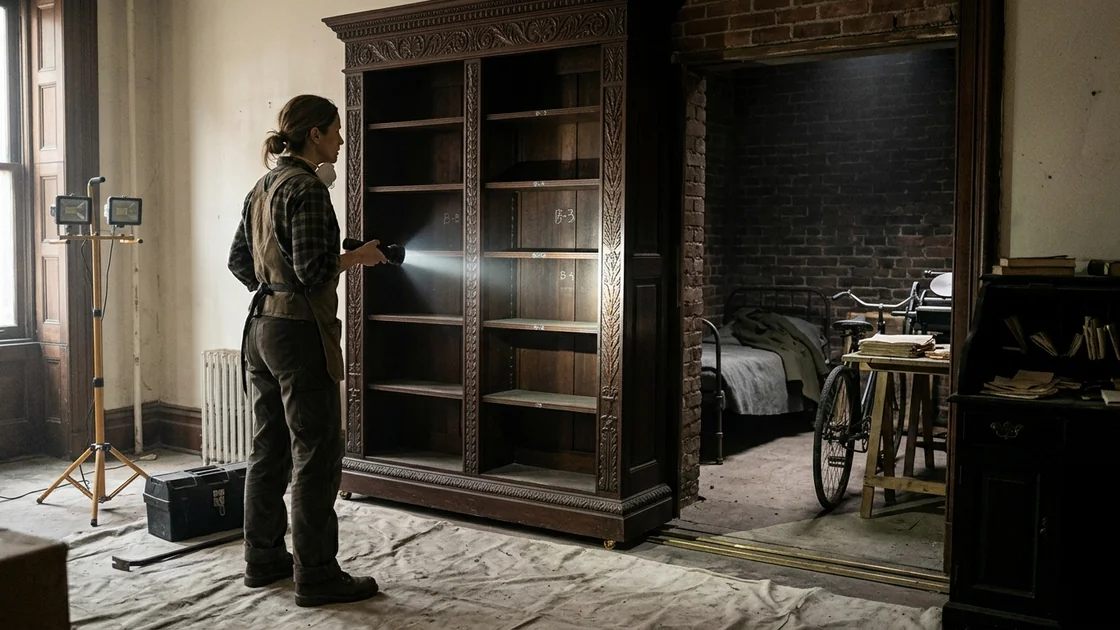
When architectural conservator Clara Bell purchases a neglected nineteenth-century brownstone in Brooklyn, her intention is simply to strip away decades of water damage and restore the home to its historic integrity. While dismantling a set of floor-to-ceiling mahogany bookshelves in the rear parlor, she uncovers a concealed pocket door leading to an unmapped chamber frozen in the autumn of 1913. Inside lie the clothes, printing plates, letters, and personal effects of Margaret Holloway, a radical suffragette who vanished without a trace weeks before the state voting referendum. As Clara untangles the artifacts and delves into municipal archives, she reconstructs Margaret's final, dangerous months, ultimately unearthing the long-buried truth behind her sudden disappearance and confronting the quiet costs of historical memory.
The purchase of 442 Westmoreland Avenue had not been an act of sentimentality, though everyone at the Department of Historic Preservation assumed it was. Clara Bell had spent twelve years working as an architectural conservator for the municipal trust, measuring the decay of limestone pediments, mapping damp penetration in Dutch colonial cellars, and filing reports that wealthy developers routinely paid civil engineers to ignore. She knew what old buildings were: damp traps of horsehair plaster, lead pipes furred with mineral crust, and joists chewed hollow by powderpost beetles. She knew they did not love the people who lived inside them.
Yet when the brownstone came to auction following the death of an eccentric recluse who had inhabited the ground floor while letting the upper three stories rot into a bird sanctuary, Clara had cashed out her late mother’s modest life insurance policy, emptied her municipal pension fund, and signed the deed.
The house was a four-story Italianate row house faced with brown Triassic sandstone from the Portland quarries in Connecticut. The stone was spalling badly across the parlor floor lintels, shedding thin, rust-colored flakes onto the iron railing below like dried brisket. The interior smelled of dead mice, wet lath, and coal soot that had settled into the grain of the floorboards eighty years earlier and refused to leave.
By October, she had cleared sixteen tons of rubbish from the garden and upper suites. She lived on the second floor in a state of continuous, deliberate warfare against lime dust. Her days began at five in the morning with a respirated mask and a pry bar, and ended at midnight over preservation manuals and structural surveys spread across a folding plastic table.
The library, or what the late-Victorian floor plan designated as the rear parlor, was the room that resisted her most. It occupied the northern half of the first floor, its bay window looking out onto a narrow garden shadowed by an overgrown ailanthus tree. The room was lined with floor-to-ceiling shelving made not of soft modern pine or veneer, but dense, close-grained Santo Domingo mahogany. The uprights were four inches thick, carved with stylized ears of wheat and acanthus leaves, anchored into the masonry by hand-forged iron spikes.
On the third Monday of November, Clara set out to remove the western wall of shelving. The chimney breast behind it showed signs of severe saltpeter efflorescence; white, furry minerals were blooming through the wall, pushing the plaster outward until the shelving unit leaned three degrees into the room. If she did not repoint the brick behind the wood, the entire wall would buckle by spring.
She removed the shelves one by one, labeling each with chalk. When she reached the central bay—a towering structure six feet wide that appeared to be pinned flush against the party wall—her pry bar met an unexpected resistance. It did not give with the soft, tearing screech of nails pulling from lath. It clanged against heavy metal.
Clara switched off her shop light and reached for her halogen work lamp. Kneeling on the chalky canvas tarp, she directed the beam into the three-inch gap between the bottom plinth and the subfloor.
There were no iron brackets securing the base. Instead, sitting within a recessed steel channel lubricated with blackened tallow, was a pair of grooved brass casters.
She stood, dusting her knees, and ran her fingers along the upright carved with wheat stalks. Near the middle shelf, four feet from the floor, she noticed an irregularity. A carved knot in the acanthus molding was worn smooth, stripped of the dark varnish that covered the rest of the wood. The grain of the mahogany around the knot had been rubbed dull by the oil of human thumbs.
She pressed the knot.
Within the wall, a sash weight shifted with a hollow, metallic thud that traveled up through the floor joists. A counterweight rose inside a hidden cavity, and the entire six-foot central bay swung outward toward her on silent, oil-soaked hinges, releasing a pocket of air that had not moved in over a century.
It did not smell like the rest of the house. There was no rot in it, no wet animal grease, no sewage. It smelled sharply of dried peppermint, iron gall ink, tallow candles, and wool stored in cedar sawdust. It smelled cold, dry, and immaculately preserved.
Clara stepped back, her boot heels clicking sharply on the exposed subfloor. She caught her breath, reached for her flashlight, and stepped over the threshold into the dark.
The room was narrow—scarcely eight feet wide and twelve feet deep—carved out of what had once been the service passage between the front hall and the pantry, walled off with double courses of damp-cured lime brick. There were no exterior windows. The only ventilation came from a pair of circular brass grilles set into the floor and ceiling, connecting to the dormant chimney flue.
Clara raised the beam of the flashlight.
Against the far wall stood a drop-front secretary desk of ebonized walnut, its lid closed and secured with a small brass padlock. To the left, an iron daybed was made up with a gray wool blanket and two feather pillows, their ticking yellowed but whole. On the bed lay an olive-green wool walking coat with black velvet lapels, its horn buttons still securely sewn. Beside the bed sat a Columbia Model 40 women’s safety bicycle, its pneumatic tires long since collapsed into brittle, flat rings of gray vulcanized rubber, its chain gleaming dully under a thick layer of grease.
On a trestle table in the center of the space sat a small hand-lever tabletop printing press—a Boston platen press, Clara recognized from her work on historical ephemera—its rollers dried and cracked like old leather, its chase still locked with a forme of lead type. A stack of paper rested beneath an iron paperweight shaped like a crouching lion.
Clara approached the table slowly, careful not to let her work coat brush against the furniture. She leaned down until her face was inches from the chase.
The inverted lead type was set in Caslon twelve-point:
VOTES FOR WOMEN IS NOT A PLEA FOR COURTESY; IT IS A DEMAND FOR JUSTICE. MEETING AT COOPER UNION, NOVEMBER 4, 1913. DO NOT BE DECEIVED BY THE COMPROMISE AMENDMENT.
Next to the press was an open cigar box filled with lead sorts: e’s, t’s, and a’s sorted into separate cardboard partitions. Beside that lay a stack of yellow ribbon rosettes, their silk frayed at the edges, pinned with celluloid badges that read: NEW YORK STATE WOMAN SUFFRAGE ASSOCIATION.
Clara’s hands hovered above the ribbons. The room was not an abandoned storage closet; it was a sanctuary that had been vacated in an instant. A tea cup sat on the desk’s leather insert, half-full of dark, dried resin—the evaporated residue of black tea—with an enameled silver spoon leaning against the rim. On the daybed, beside the hem of the green coat, lay a pair of brown kidskin gloves, the fingers curved slightly, preserving the shape of the hands that had peeled them off.
Clara turned her light toward the small secretary desk. The padlock was a tiny Yale brass tumbler, typical of the 1900s. She knew better than to force it. She knelt and examined the seams of the drop front. The wood was dry, and forcing the lock would split the walnut surrounding the escutcheon. Instead, she retrieved a small dental mirror and a tension tool from her restoration kit. It took four minutes of patient, gentle manipulation before the tumbler clicked.
The lid dropped down on its brass stays with a soft hiss.
Inside the pigeonholes were neat bundles of letters tied with black seam binding, a ledger bound in green morocco leather, a small box of brass hairpins, a silver pocket watch that had stopped at seventeen minutes past four, and a fountain pen made of red mottled ebonite.
Clara pulled on a pair of white cotton archival gloves from her pocket. She picked up the green morocco ledger and brought it toward the light.
On the flyleaf, written in a disciplined, forward-leaning script with iron gall ink that had oxidized into a warm sepia, was a single line of ownership:
Margaret Holloway. Her Book. Commenced October 12, 1911. 442 Westmoreland Avenue.
Clara held the book in her hands, listening to the silence of the house around her. The traffic on the avenue two blocks away hummed like a low, persistent motor, but here, between the party wall and the false mahogany shelving, the century had remained hermetically sealed.
She opened the ledger to the first entry.
October 12, 1911. The room is finished. Arthur believes I have simply commissioned a deeper set of cases to house Father’s collection of Atlantic Monthly volumes and the botanical folios. He never measures anything; a man of his class assumes that space expands or contracts according to his comfort. The builder, Mr. Clough, was expensive, but he was a Quaker from Flushing who understood the concept of an interior sanctuary. When I told him that I required a room where a woman might work without being summoned to pour coffee for bank directors, he took twenty dollars off the invoice.
The press arrived in two barrels marked ‘Hardware and Spikes.’ We carried the castings through the coal chute while Arthur was at his club. Maud helped me haul the platen up the service stair. We laughed until our stays nearly cracked, though we had to keep our skirts tied up with twine to keep from leaving oil marks on the hall runner.
If Arthur discovers the press, he will threaten to have me committed to the retreat at Amityville. He has said as much already when I spoke at the armory. He told Sarah that my brain was ‘congested with politics.’ Sarah looked at her tea plate and said nothing. My dear sister has traded her vocal cords for a pair of diamond ear-drops and a town carriage with two bays.
Let them have the front parlor. This room is mine. When the door is shut, I can hear neither Arthur’s boots nor the streetcars. Here we shall set the type that the commercial printers refuse to touch for fear of Tammany Hall.
Clara sat on the floor of the secret room, the cold seeping through her denim trousers, and read until her work lamp began to dim.
The entries in the green ledger were detailed, pragmatic, and increasingly frantic. Margaret Holloway had not been an ordinary society suffragist who poured tea at the Colony Club and carried silk banners down Fifth Avenue in the annual spring parades. She was part of the militant vanguard that split from the mainstream movement after the 1912 defeat.
She had operated an underground press from this room, printing anonymous circulars that exposed the collusion between Tammany Hall politicians, brewery lobbyists, and municipal police chiefs who used anti-loitering laws to arrest working-class women organizing garment strikes.
Clara turned through sixty pages of accounting entries: expenses for paper stock from the Hudson Valley paper mills, pounds of type metal purchased under false names from suppliers on Pearl Street, contributions from women who signed only their initials—‘M.B., five dollars; A.K., fifty cents; A girl from the Triangle, fifteen cents.’
Then the handwriting changed. Beginning in August 1913, the script became tighter, more angular, the ink applied with heavy, hurried downstrokes.
October 28, 1913. The watchmen have been posted at the corner of Fulton Street since Friday. They do not wear uniforms, but they carry the heavy boxwood sticks of off-duty patrolmen. Arthur knows something. He asked me at breakfast why I smelled of turpentine and printer’s wash. I told him I had taken up oil painting. He laughed and said it was a pity I had no talent for landscape.
Maud came at dusk. She was white as flour. She says that Inspector Devery’s men raided the flat in Greenwich Village and took the membership lists for the Harbor League. My name was not on the rolls—I was careful to keep that promise to Father—but they took the draft of the circular regarding the waterfront payoffs. The printer’s proof had my handwriting on the margins.
They will not charge me with politics. They are not so foolish as to make a martyr of a judge’s daughter. They will charge me with conspiracy to incite riot, or Arthur will sign the medical certificate. He had Dr. Van Dorn in the parlor this afternoon. I heard them talking through the floorboards. Van Dorn said: ‘A few months of rest at the sanatorium, Mrs. Holloway, with the hydrotherapy and the cold baths, works wonders for the hysterical temperament.’
November 2, 1913. The circulars must go out before Tuesday’s vote. If the district leaders see that we have the names of the aldermen who accepted money from the liquor syndicates to defeat the amendment, they will not dare tamper with the ballot boxes in the Fourth Ward.
I have packed the strongbox with the documents, the ledger, and the letters from the girls at the laundry union. Maud will come with the carriage at two in the morning. She will tap three times on the scuttle above the laundry cellar.
If they come before she arrives, I have the key to the garden wall.
The next page was blank.
Clara rose to her feet, her joints stiff. She turned her light toward the small space behind the daybed.
There, tucked under the iron frame where the shadows were deepest, sat a small wooden crate. She knelt and dragged it out. It was heavy, reinforced with hoop iron, the stenciled lettering on the side reading: SUNLIGHT SOAP—NEW YORK.
The crate was empty save for a folded piece of gray wrapping paper. On it, written in pencil with an unsteady hand, were six words:
They are at the front door.
Clara stared at the paper. The pencil marks were deep, the lead broken at the end of the final r, leaving a jagged scratch in the fiber.
She checked the desk again, the pigeonholes, the small drawer beneath the tea tray. There were no further notes. No newspaper clippings from after November 1913.
She climbed out of the secret room, pulled the mahogany bookcase shut until the latch engaged with a dull, heavy click, and sat down in the middle of her empty parlor.
The house was cold. The radiators had not yet been bled, and the wind from the garden rattled the bay window like fingers tapping against the glass.
The Municipal Archives on Chambers Street smelled of damp paper, microfilm vinegar, and floor wax. Clara had spent hundreds of hours in the basement research rooms over the years, tracking down historic building permits and property easements, but she had never searched for a person.
She sat at a microfilm reader, her eyes burning from the green phosphorescent glow of the screen as she spun the reel through the New York Tribune for the first week of November 1913.
The election of Tuesday, November 4, had been a disaster for the suffrage movement in New York. The statewide constitutional amendment had not even reached the ballot that year—it was tied up in committee by the state legislature, crushed beneath the heel of Tammany boss Charles Murphy. The newspapers were full of reports on horse-drawn carriages carrying voters to the polls, Tammany thugs intimidating watchers in the Bowery, and society ladies hosting consolatory tea parties at the Plaza.
She turned the crank, advancing the reel day by day.
On page seven of the Brooklyn Daily Eagle, published on Friday, November 7, 1913, tucked between an advertisement for castor oil and an account of a runaway coal wagon on Flatbush Avenue, she found it:
SOCIETY WOMAN DISAPPEARS FROM BEDFORD HOME. MISS MARGARET HOLLOWAY MISSING SINCE SUNDAY NIGHT. FAMILY FEARS NERVOUS COLLAPSE.
Police of the Grand Avenue precinct have been asked to search for Miss Margaret Holloway, 31 years of age, who disappeared from her residence at 442 Westmoreland Avenue late Sunday evening. Miss Holloway is the younger daughter of the late Supreme Court Justice Thaddeus Holloway and resided at the home with her sister and brother-in-law, Mr. Arthur B. Vance, vice president of the Borough Trust Company.
Mr. Vance informed detectives that his sister-in-law had been in failing health for several months, suffering from intense nervous excitability brought on by an excessive interest in radical social theories. On Sunday evening, Miss Holloway retired to her room on the third floor at nine o’clock. On Monday morning, her bed was found undisturbed, and her personal jewelry, including an emerald brooch inherited from her mother, was missing from her dressing table.
It is feared that Miss Holloway may have suffered a loss of memory or met with an accident. She is described as being five feet five inches tall, of slender build, with dark hair and gray eyes. When last seen, she was wearing a dark walking suit. Detective Sergeant Thomas Foley is in charge of the investigation.
Clara printed the article, the machine whining as it dispensed the thermal paper.
She looked at the date again. November 7. Five days after Margaret had written her final entry.
She searched for follow-up articles over the next six months. There was a brief mention three weeks later: SEARCH FOR MISS HOLLOWAY EXTENDED TO BOSTON. Then a small notice in January 1914: NO CLUE IN HOLLOWAY MYSTERY.
By March, the papers had forgotten her. In June, the Archduke Franz Ferdinand was assassinated in Sarajevo, and the world had other disappearances to attend to.
Clara turned to the property records.
The deed for 442 Westmoreland Avenue showed that upon the death of Justice Thaddeus Holloway in 1908, the house had been left jointly to his two daughters, Sarah Holloway Vance and Margaret Holloway.
In January 1915, fourteen months after Margaret’s disappearance, Arthur B. Vance petitioned the Kings County Surrogate’s Court to have Margaret declared legally dead, citing her "known history of mental derangement" and the absence of any communication. The petition was granted in March 1916. The entire title passed to Sarah.
Six weeks later, Sarah Holloway Vance died of pneumonia at thirty-six.
Arthur Vance sold the house three months after that to an investment company and moved to Manhattan.
Clara packed her notes into her leather satchel and left the building. The November sky over Manhattan was a low, uniform gray, the color of wet lime plaster. She walked across the Brooklyn Bridge, the wind coming up off the East River biting through her wool scarf, watching the brownstone-lined ridges of Brooklyn emerge through the river mist.
A woman with a bicycle, a small hand press, and a strongbox full of names does not simply evaporate from a locked brownstone while off-duty patrolmen watch the street.
She did not leave by the front door. She wrote that they were at the front door.
If they were at the front door, she went out through the back.
That evening, Clara took a halogen lamp and a tape measure into the cellar of 442 Westmoreland Avenue.
The cellar was a subterranean labyrinth of rough-cut schist fieldstones held together with lime mortar that had begun to crumble into soft, sandy piles. The floor was packed earth, covered in places by slabs of bluestone. Overhead, the heavy hand-hewn hemlock floor joists were black with eighty years of coal smoke from the furnace.
She started at the front wall beneath the sidewalk, where the old coal chute entered the house. The iron flap was rusted shut, welded together by layers of red corrosion. She moved backward, pacing the length of the building toward the rear garden.
The layout corresponded to the floor above, with one exception: beneath the hidden room on the parlor floor, the cellar ceiling was covered with beaded tongue-and-groove pine boards rather than the exposed lath and plaster found elsewhere.
Clara stood beneath the pine ceiling, looking up.
The boards were painted a dull lead gray. She ran her hands along the edges, feeling for nail heads. The planks were not nailed; they were secured with counter-sunk wood screws, their heads filled with putty that had dried and shrunk over the century.
She brought her ladder over, set it firmly on the dirt floor, and climbed up with a wire brush and a battery-powered driver.
She cleared the putty from six screws near the eastern wall and backed them out. The iron threads were coated in grease—the same preservation technique used on the caster wheels above. She eased the center section of the pine paneling downward.
It did not open into a simple cavity between joists.
A rectangular hatchway, two feet wide by three feet long, was cut cleanly through the double floorboards above. Suspended from the joists was an iron ladder made of round blacksmith-forged rungs, dropping down into the space where Clara stood.
She climbed the ladder, poking her head through the hatch.
She was looking up through the underside of the iron daybed in the hidden room. The woven wire spring of the bed was hinged on one side, held down with a simple spring catch that could be released from either above or below.
Margaret had not fled through the front parlor. When the men pounded on the front door, she had dropped through the daybed into the cellar.
Clara climbed back down the ladder, holding her lamp high.
If she reached the cellar, where had she gone?
The cellar had only three exits: the coal chute at the front, which was visible from the street where the patrolmen waited; the service stair leading up to the kitchen, which would have put her right into the arms of whoever entered the front hall; and the rear door leading to the garden.
Clara walked to the rear foundation wall.
The door to the garden was a massive slab of white pine reinforced with diagonal battens, hung on hand-forged strap hinges that reached across the entire width of the door. A heavy wrought-iron drop bar rested in two iron staples bolted through the masonry.
The bar was down. It was locked from the inside.
Clara felt a chill that had nothing to do with the cellar’s damp draft.
If Margaret had gone into the garden, someone had replaced the iron drop bar behind her. Or she had never left the cellar at all.
Clara set the lamp on a dry stone pier and knelt on the bluestone flags near the rear wall.
She had spent years examining historic masonry and stonework. She knew how stone aged, how it settled, and how lime mortar cracked when an unreinforced foundation shifted.
The bluestone flags at the rear of the cellar were uneven. Most of them were large slabs, three feet by four feet, their surfaces rippled by the natural bedding planes of the quarry. But directly beneath the brick arch that supported the parlor fireplace above, the floor was paved with smaller, square flags.
She pulled a narrow trowel from her back pocket and scraped the dirt from the joints between the smaller flags.
The mortar was not lime. It was natural hydraulic cement—Rosendale cement, which dried dark gray and hard as granite within hours, often used in the late nineteenth century for water-retaining cisterns and bridge piers.
And in the center of one of the flags, scratched into the wet cement before it had set, was a set of initials:
M. V.
Not M. H. Margaret Holloway.
M. V. Maud Vance.
Clara sat on the ladder rung in the cold cellar for a long time, the halogen light casting her shadow long and distorted against the rough fieldstone wall.
Arthur Vance had married Sarah Holloway. His brother was Julian Vance, a lawyer who had handled the legal affairs of the Brooklyn municipal water board. And Julian’s wife was Maud—Maud Vance, Margaret’s sister-in-law, the woman mentioned in the journal.
‘Maud helped me haul the platen up the service stair. We laughed until our stays nearly cracked.’ ‘Maud came at dusk. She was white as flour.’ ‘Maud will come with the carriage at two in the morning.’
Clara climbed the stairs to the second floor, her boots heavy with cellar clay. She washed her hands in the small porcelain basin she had hooked up to the temporary copper water lines, then made a pot of black coffee on her camp stove.
She opened her laptop and connected to the internet via the cellular hotspot on her phone.
She accessed the digitized records of the Brooklyn Historical Society and the genealogical databases of the New York State Surrogate’s Court.
Arthur Vance had died in 1934 in a private sanitarium in Connecticut, penniless following the Wall Street crash. His brother Julian had died much earlier, in 1918, a victim of the second wave of the Spanish influenza at the military embarkation camp in New Jersey.
Maud Vance had survived them all.
According to the 1920 federal census, Maud Vance was thirty-eight years old, living alone in a boarding house on State Street, her occupation listed as "Stenographer, Private Office." In the 1930 census, she had vanished from Brooklyn.
Clara typed the name into the national death index.
A Maud Vance, born September 14, 1882, had died in November 1968 in a small town called Truth or Consequences, New Mexico.
Her estate had been settled by a public administrator. She had left no descendants. Her effects had consisted of two cedar chests, a collection of hand-printed pamphlets, and eighty-four shares of a municipal irrigation bond.
Clara stared at the screen, the steam from her coffee cup drifting across the glowing display.
She pulled the green morocco ledger toward her and reopened it to the last page. She held the blank page up to the work light at an angle.
The page was not entirely blank.
Beneath the last written line on the preceding page, the heavy pressure of the steel dip pen had left an indentation on the virgin rag paper of the following sheet.
Clara took a soft 4B graphite pencil from her restoration kit. Holding the pencil almost parallel to the paper, she shaded the surface with strokes as light as a moth’s wing.
The white hollows resisted the graphite, leaving the ghost of words pressed into the fibers by a desperate hand:
Maud took the plates. The tunnel to the carriage house is blocked. She has the key to the cistern.
The brownstone’s garden was thirty feet wide and fifty feet deep, enclosed by high walls of crumbling red brick topped with jagged shards of green glass set into mortar—a common Victorian deterrent against intruders.
At the rear of the lot stood a low, single-story brick structure that had once served as a carriage house and stables, its front facing the service alleyway that ran through the center of the block. Decades ago, the alleyway had been closed by the city, deeded to the adjoining property owners, and the carriage house had been partitioned into garden sheds.
Clara walked into the garden with a spade and a heavy flashlight.
The ailanthus roots had buckled the brick pathways, lifting the pavers into sharp, moss-covered ridges. Near the rear wall of the main house, where the downspout from the roof emptied into the soil, the ground was soft and marshy.
She knew the architecture of these row houses intimately. In 1913, brownstones were connected to the municipal sewer lines, but many retained their old rainwater cisterns—deep, brick-lined vaulted chambers beneath the garden that collected runoff from the roof to be used for laundry and garden maintenance before water meters were introduced.
She cleared away three feet of dead hosta leaves and pokeweed stalks near the foundation wall.
Her spade struck stone four inches below the turf.
She cleared the soil with a mason’s trowel, revealing a circular ring of North River blue stone three feet in diameter. In the center was an iron cover with two recessed lifting eyes, sealed with a band of pitch.
Clara fetched her crowbar and a propane torch from the house.
She heated the iron ring until the century-old pitch softened, bubbling and sending up thin plumes of black, acrid smoke that smelled of petroleum and pine tar. She wedged the chisel end of the crowbar under the lip of the cover and threw her weight onto the steel.
The seal broke with a dull suck of displaced air.
Clara pulled the heavy iron lid aside.
She held the flashlight over the opening.
The beam plunged into a circular chamber twelve feet deep, lined with curved brick glazed with dark brown salt-glaze. It was dry. The lead pipe that had once directed rainwater from the roof had been redirected into the sewer decades earlier.
At the bottom of the cistern lay an accumulation of debris: decayed leaves that had sifted through the cover, bits of rotten wood, and a large, rectangular object wrapped in a heavy rubberized canvas tarpaulin, tied securely with hemp marline.
Clara did not hesitate.
She went back to the cellar, retrieved her twelve-foot aluminum extension ladder, lowered it through the opening until the feet bit into the silt at the bottom, and climbed down into the dark.
The air inside the cistern was cold, damp, and smelled of mineral dust and oxidized rubber.
Clara knelt beside the tarpaulin. The hemp cord was brittle, snapping like dry straw under her gloved fingers. She peeled back the rubberized cloth, which had grown stiff and crackled like dried bacon rind.
Inside was a leather traveling trunk with brass corners, its leather dry-rotted but the brass hinges bright and clean.
The lock had been pried open with a cold chisel long ago; the hasp hung loose against the leather.
Clara raised the lid.
Lying on top was a woman’s dark wool jacket, neatly folded. Beneath the jacket were three sets of zinc printing plates, each plate wrapped in greasy brown butcher paper.
Clara peeled the paper back from the topmost plate.
It was an etched zinc plate, ten inches by fifteen inches, prepared for a platen press. The text was reversed, but Clara had spent enough time reading historic type to decipher it without a mirror:
THE CONSPIRACY OF SILENCE. HOW THE FOURTH WARD WAS BOUGHT FOR TWENTY THOUSAND DOLLARS. THE AFFIDAVITS OF PATROLMAN JAMES KELLY AND ALDERMAN JOHN SULLIVAN.
Tucked beneath the plates was a flat tin deed box.
Clara opened the tin. Inside was an envelope addressed to Miss Margaret Holloway, c/o The Western Union Telegraph Office, St. Louis, Missouri.
Beside the envelope lay a single train ticket, issued by the Pennsylvania Railroad on November 3, 1913: One First-Class Passage, New York (Penn Station) to Chicago, via Pittsburgh.
The ticket had been punched twice. It had been used.
Beneath the ticket was a letter, written on the stationery of the Woman’s Political Union, 25 East 45th Street, New York. It was dated November 1, 1913, and signed by Harriet Stanton Blatch:
My Dear Margaret, The arrangements are complete. The papers you provided regarding the brewery payoffs have been placed in the hands of Mr. Stimson. He agrees that if they are published from New York under your name, Arthur and his associates will have you committed before the ink is dry. The certificates are already prepared; Dr. Van Dorn has been well compensated for his signature.
You must go West. The work in California and Washington is where the movement has its teeth now. New York will follow, but it will take years of grinding against these Tammany beasts.
Maud has been extraordinary. She has secured the passage and will bring your trunk to the carriage house by the back alley while the watchmen are watching the street door. She will replace the flags in the laundry floor so that Arthur believes you escaped through the coal hole. Let him search the harbor; by the time he realizes you are not in the river, you will be across the Mississippi.
Do not write to us directly. Send your reports to Mrs. Belmont under the name of Mary Hughes.
Be brave. What you did with the press in Westmoreland Avenue has saved three dozen girls from the workhouse and broken the back of the ward committee.
Yours in the Cause, Harriet.
Clara sat on the floor of the dry cistern, holding the fragile sheet of bond paper between her gloved fingers.
Margaret Holloway had not been murdered. She had not been taken to the asylum in Amityville. She had not drowned herself in the East River in a fit of "hysterical temperament."
She had beaten them.
She had set her type in the dead space between the walls of her brother-in-law’s house, run her circulars while he slept above her head, and when the traps closed, she had slipped through the floor, through the cellar, into the alley, and vanished into the vast, anonymous continent to the west.
Clara looked up through the circular opening of the cistern.
Above her, the sky was darkening into the deep indigo of a New York autumn evening. The bare branches of the ailanthus tree moved against the first stars, framing the jagged silhouettes of the brownstone cornices.
It took Clara three weeks to complete the cataloging of the room behind the bookcase.
She worked systematically, applying the conservation protocols she had practiced for the state: each document was humidified, flattened under blotter weights, and placed into acid-free mylar sleeves. The lead type in the Boston press was cleaned with mineral spirits and secured with cotton twill tape. The dried tea leaves in the porcelain cup were transferred to a glass specimen vial, labeled with the date and provenance.
She contacted the Sophia Smith Collection at Smith College, the primary repository for the papers of the American women’s suffrage movement.
A week later, an archivist named Dr. Elizabeth Cole arrived at the brownstone. She was a woman in her sixties with keen, sharp eyes behind wire-rimmed glasses, carrying two leather briefcases filled with preservation foam and conservation ledgers.
Clara led her through the parlor, where the mahogany bookcase now stood open on its brass casters.
Dr. Cole stood in the threshold of the secret room for several minutes without speaking. She looked at the iron daybed, the green wool coat, the Columbia bicycle with its collapsed rubber tires, and the small Boston press sitting on its trestle table.
"In forty years of archival work," Cole whispered, her voice cracking slightly in the dry, enclosed air, "I have never seen anything like this. We have their letters, Clara. We have their banners and their pamphlets. But we never have the rooms. They were always cleared out. The families burned the papers. The husbands whitewashed the basements. The daughters were ashamed of the militant years."
Cole stepped into the room, her eyes darting from the press to the secretary desk.
"And Margaret Holloway," Cole said, looking at Clara. "We knew her name only from three police blotters and a footnote in Carrie Chapman Catt’s diaries. Catt called her 'an unruly element whose publications caused unnecessary friction with the municipal authorities.' No one knew what became of her."
"She became Mary Hughes," Clara said, handing the archivist the train ticket and the letter from Harriet Stanton Blatch. "She went to Chicago, then to New Mexico. She lived in Truth or Consequences until 1968. She lived to be eighty-six years old."
Cole examined the ticket through a magnifying loupe, her fingers trembling against the glass.
"Do you know what this means, Clara?"
"I know it means she won," Clara said.
"It means more than that," Cole replied, looking around the small, immaculate space. "It means the record is whole. A history that was erased by her own family has refused to stay buried."
By April, the restoration of 442 Westmoreland Avenue was nearly complete.
The brownstone facade had been carefully patched with lime mortar matched to the original Portland sandstone, the saltpeter efflorescence had been washed from the brick chimneys, and the rear parlor had been painted a soft, historic ochre that caught the morning light from the garden.
The secret room remained.
Clara had not dismantled the false mahogany bookcase. She had repaired the counterbalance pulleys, cleaned the tallow from the brass casters, and replaced the deteriorated wire cords with high-tensile steel cable.
The artifacts—the letters, the plates, the personal effects—had gone to the Sophia Smith Collection, where they were housed in climate-controlled vaults under the title The Margaret Holloway Papers (1911–1913).
In their place, Clara had left the press, the bicycle, and the small ebonized desk.
On the desk sat a modern reproduction of the Caslon type circular Margaret had left in the chase on the night she fled:
VOTES FOR WOMEN IS NOT A PLEA FOR COURTESY; IT IS A DEMAND FOR JUSTICE.
On the second Tuesday of November, seven years after she had purchased the house and more than a century after Margaret had climbed through the cellar floor, Clara stood in the parlor as the afternoon light faded.
It was election day.
Clara wore her heavy wool coat. Pinned to the lapel was a modern paper sticker, white with red lettering: I VOTED.
She walked to the mahogany bookcase, reached for the carved ear of wheat at the center upright, and pressed the worn knot of wood.
The sash weight thudded softly within the wall. The shelves swung outward on their brass casters, silent and smooth, opening the door into the quiet sanctuary.
Clara did not go inside.
She stood in the threshold, looking at the press and the empty daybed, smelling the faint, permanent ghost of peppermint and cedar that still lived within the brickwork.
She pulled the sticker from her coat, stepped forward, and pressed it onto the iron frame of the printing press, just above the platen where the ink had dried a hundred years before.
Then she swung the bookcase shut, listened for the click of the latch, and walked out into the Brooklyn evening to meet the world.
The street was full of people.
Women with strollers, teenagers with backpacks, old men in heavy wool caps walking home from the corner market, and a steady stream of voters coming up the steps of the public school on the corner of the avenue. The streetlights flickered to life along Westmoreland Avenue, casting long, overlapping shadows of the brownstone stoops onto the damp asphalt.
Clara stood on the top step of her house, her hands in her pockets, the cold river wind coming up over the rooftops, carrying with it the sounds of traffic, the distant rumble of the subway beneath the street, and the endless, indestructible hum of a city that was always moving forward, whether it remembered where it had come from or not.