The Paperweight Society
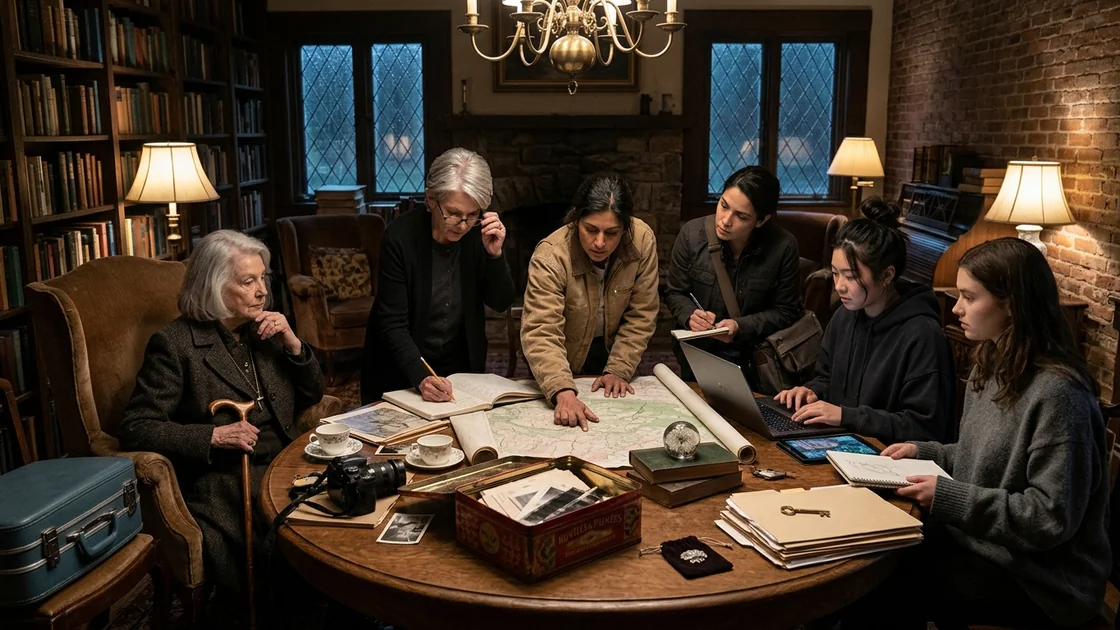
Across five decades of age and vastly different lived experiences, six women in the quiet Hudson Valley town of Oakhaven gathered each month under the pretense of discussing classic literature, until the discovery of a long-concealed ledger hidden within an old carriage house revealed the truth behind a town scandal from fifty years earlier. United by their shared suspicion of the local authorities and an unspoken desire for purpose, the women pooled their disparate skills—ranging from archival research and architectural forensics to modern cyber-investigation and social infiltration—to unravel the cold case of a vanished housemaid without ever revealing their identities. As the amateur sleuths dug deeper into the history of Oakhaven, they untangled not only the forgotten tragedy of Clara Ward and the financial corruption that built their community, but also the deep-seated isolations and silent vulnerabilities within their own lives, discovering that the strongest protection against an indifferent world is the intentional family they formed around a battered oak table.
Chapter One: The Anatomy of a Reading List
The carriage house smelled perpetually of dried lavender, damp sandstone, and the yellowing pulp of three thousand volumes that had survived two world wars, a localized flood in 1983, and Evelyn Vance’s refusal to allow climate control into her ancestral library.
"The thematic failure of Middlemarch," Martha Sterling announced, setting her bone china teacup onto its saucer with a sharp, ceramic click that brooked no dissent, "is that Dorothea settles. A woman of her singular organizational capacity should have overseen the drainage of the county herself, rather than offering moral support to a succession of ineffectual men."
"Dorothea was nineteen, Martha," Bea Alvarez said gently from the sunken end of the velvet sofa, where her laptop bag sat perched against her ankles like a protective animal. "At nineteen, most of us were still confusing emotional turbulence with profound destiny. She did what her century permitted."
"I was nineteen in nineteen-sixty-three," Evelyn said from her wingback chair beside the dormant stone hearth. Her fingers, swollen at the knuckles by rheumatoid arthritis but still tipped with a neat coat of pale pink enamel, turned a page of her worn notebook. "I can assure you, my dear, we were entirely capable of distinguishing between a foolish marriage and civil infrastructure. We simply preferred the foolish marriage because it was the only venture for which the bank did not require our father's signature."
Chloe Kim did not look up from her tablet, though the blue-white glare of the screen illuminated the sharp, skeptical angle of her cheekbones. "George Eliot was nonbinary-coded anyway, and Dorothea should have simply sued her uncle for embezzlement. Which, by the way, is exactly what someone in this zip code is doing right now, judging by the township planning commission's financial disclosures."
"We are not discussing the planning commission," Martha said, though her pencil hovered with instinctive precision over her leather-bound agenda. "We are discussing chapter twenty-two."
"We haven't discussed chapter twenty-two in forty minutes," Nora Patel murmured, leaning back against the exposed brick wall, her arms crossed over a canvas work jacket that bore faint chalkings of drywall dust. Nora, at forty-eight, was the only person present who treated Evelyn’s eighteenth-century furniture with the rough familiarity of an artisan; she had spent the previous afternoon repairing the sash weights in the library’s north-facing dormers. "Besides, Chloe’s right about the drainage. If the town council approves the river-bluff variance on Tuesday, the runoff is going to take out the old culverts along Orchard Lane. The carriage house will have four inches of standing water before the first frost."
Across the circle, tucked into the bay window with her sketchpad balanced on her knees, nineteen-year-old Lily Thorne said nothing. She had spent the evening rendering Evelyn’s sleeping cat in charcoal, using quick, nervous strokes that suggested an animal made entirely of smoke and tension. Only her eyes, shifting toward the window every time a car turned down the gravel lane, betrayed that she was listening to every frequency in the room.
They were six women divided by sixty years: Evelyn at seventy-eight, her memory an unindexed encyclopedia of the town’s ancestral pedigree; Martha at sixty-four, four months retired from twenty-seven years as the principal of Oakhaven High School and suffering from the severe, disorienting vertigo of sudden irrelevance; Nora, forty-eight, divorced, a restoration carpenter whose knees cracked when she stood up and whose teenage sons lived four states away with their father; Bea, thirty-four, who ghostwrote corporate white papers by day and applied for investigative fellowships by night with the frantic persistence of a shipwreck survivor firing flares into an empty sky; Chloe, twenty-four, whose degree in computer engineering had yielded only freelance UX design contracts and an encyclopedic disgust with institutional incompetence; and Lily, who was taking what her parents referred to as a "restorative gap semester" following an incident at her liberal arts college that nobody had the bad manners to name aloud.
They had been assembled two years prior through a flyer pinned to the bulletin board at the local independent grocer—Literary Conversations for Discerning Women: No Contemporary Romances, No Wine-Mom Manifestos—penned by Evelyn in a copperplate hand. For twenty-four months, they had met every third Tuesday, pretending that the literature was the anchor, rather than the solitary hours of their respective weeks that required filling.
The storm that broke over Oakhaven at nine that evening was not predicted by the weather bureau. It arrived from the south across the river, sudden and violent, throwing heavy sheets of rain against the library’s diamond-paned leaded windows with the percussion of gravel.
"The culvert," Nora said, immediately setting her tea down and rising to her feet.
"Nora, please," Evelyn sighed. "The culverts have held since the McKinley administration."
"The McKinley administration didn't pave over eighty acres of marshland for the Hawthorne Ridge corporate center," Nora replied, already pulling her work gloves from her jacket pocket. "If the basement floor drains back up into the carriage arch, the floor joists underneath this room are going to drink three hundred gallons of mud. Evelyn, where is the hatch to the sub-cellar?"
"Behind the winter rug storage," Evelyn admitted, an expression of profound distaste crossing her face. "Beneath the walnut armoire. It hasn't been unsealed since my sister died in ninety-two."
Within ten minutes, the discussion of George Eliot had dissolved into the brutal practicalities of nineteenth-century engineering. Martha, who could not see an unorganized task without imposing a managerial hierarchy upon it, commandeered two heavy-duty flashlights and directed Chloe to hold the trapdoor open with a heavy brass boot-scraper. Bea and Lily brought down buckets from the pantry, while Evelyn sat at the top of the cellar stairs like a displaced monarch, offering warnings about spider webs and damp mortar.
It was Nora, kneeling on the damp gravel floor of the crawlspace beneath the foundation’s dry-stone wall, whose trowel struck something that did not yield with the dull thud of slate or the hollow ring of a lead water pipe.
"What is it?" Bea called down, her phone flashlight cutting through the suspended dust of half a century. "A root?"
"Too square," Nora muttered. She scraped away a layer of black, anaerobic silt that smelled of iron and stagnant well-water. "It’s tin. Or zinc. There’s an iron box tucked into the lintel cavity behind the old bread oven. Evelyn, did your grandfather keep a safe down here?"
From the top of the stairs, Evelyn’s voice came down through the hatchway, stripped suddenly of its dry irony. "My grandfather died in an armchair at the Union League Club in 1941, Nora. He did not keep tins behind the bread oven. He had solicitors for things he wished to conceal."
Nora’s fingers, calloused and patient, worked the silt out of the seams. The box was nine inches long, four inches wide, and bound with three wraps of oiled linen tape that had rotted into a greasy, asphaltic residue. When she pulled it free from the stone pocket, a shower of crumbling mortar fell around her shoulders like dry bone.
Ten minutes later, the box sat on Evelyn’s walnut library table, centered beneath the brass chandelier like an uninvited guest. A ring of six women stood around it, the storm outside forgotten, the water in the driveway rising unnoticed against the grass.
Chapter Two: The Inventory of 1974
The tin was an old Huntley & Palmers biscuit container, its red lithographed heraldry faded to the color of dried liver. The brass latch was corroded green with verdigris, but the metal had not crushed; whoever had placed it behind the bread oven had wrapped the vessel first in heavy waxed butcher paper, though subterranean beetles had chewed the margins into lace.
"We shouldn't open it," Martha said, though her fingers were already twitching toward the corner of the lid. "If it is historical material, it belongs to the municipal archives. There are chain-of-custody protocols for private discoveries."
"The municipal archives are housed in the basement of Town Hall, Martha, where they currently share space with five surplus floor polishers and the high school’s spare marching band uniforms," Chloe said. She reached out and flicked the latch with the tip of an ordinary kitchen butter knife she had brought from the sink. The latch snapped with a small, dry tink. "Besides, Town Hall is run by Bradley Hawthorne’s brother-in-law. If this has anything to do with property lines, it’ll be in a shredder before breakfast."
Lily reached out her sleeve-covered wrist and stopped Chloe’s hand before she could lift the lid. "Wait," she said, her voice barely louder than the drumming rain. She pointed to the edge of the seal. "Look at the seal. It’s not wax. It’s nail lacquer. Blue. That electric blue that came out in the seventies."
Evelyn leaned forward over the back of her chair, her spectacles sliding down the thin bridge of her nose. Her expression had changed from curiosity to an odd, defensive stillness. "Clara," she whispered.
"Who was Clara?" Bea asked, her thumb hovering over the voice memo app on her phone, then deliberately lowering it.
"Clara Ward," Evelyn said, her voice dropping into a register that none of the younger women had heard before—a tone preserved in the amber of an old grief. "She was eighteen. She lived in the rooms above my father’s stable—this building, before we converted it into the library. Her mother had been the cook at Hawthorne Manor across the lane. In October of nineteen-seventy-four, Clara disappeared. The police said she had taken forty thousand dollars in bearer bonds from the Hawthorne estate safe and gone to California with a boy who worked the ferry."
"Did she?" Nora asked, studying the tin.
"She didn't own a coat heavy enough for the ferry in October," Evelyn replied simply. "And she left her mother's rosary on her dressing table. Girls like Clara did not go to California without their mothers' beads."
Martha drew a slow, deliberate breath through her nose. "Open it, Chloe."
Chloe tipped the lid back. The interior of the box smelled sharply of camphor, cedar, and an underlying chemical sharpness that Bea instantly identified as darkroom fixer.
On top lay a spiral-bound stenographer’s pad, its blue-lined paper curled at the corners. Beneath it were three items: a heavy brass key stamped with the number 14; a small velvet jeweler’s pouch containing an Edwardian brooch fashioned from platinum, rose-cut diamonds, and three cabochon emeralds; and an unsealed manila envelope containing sixteen black-and-white photographs, five by seven inches, printed on thick, double-weight fiber paper.
Bea lifted the photographs by their margins, using two fingers like tongs. "These aren't amateur snaps," she observed, tilting them toward the chandelier light. "Look at the focal length. These were taken with an 85-millimeter lens, probably a Nikon F, shot from the tree line looking down toward the river wharf."
The images depicted three men standing on the old wooden quay behind what was then the Oakhaven Tannery, now the site of the Hawthorne Ridge Golf Club. Two of the men wore the wide-collared suits of the mid-1970s; the third wore the coveralls of a county surveyor. Between them sat four fifty-five-gallon steel drums with stencil marks that read PENN-SOLV INDUSTRIAL. In the fourth photograph, one of the men in suits—a man with high, patrician cheekbones and a prominent silver streak through his dark hair—was handing an envelope thick with paper to the county surveyor.
"That's Arthur Hawthorne," Evelyn said quietly, looking at the man with the silver streak. "Bradley Hawthorne's father. He died in ninety-six. A pillar of the historical society. He donated the pipe organ to St. Jude’s."
"And the surveyor?" Nora asked, leaning close. "Look at the seal on his transit case."
"Russell Vance," Evelyn whispered, her hand rising to her collarbone. Her fingers touched her own throat as if seeking an obstruction. "My second cousin. He was the county engineer who certified the foundations for the Oakhaven municipal reservoir in seventy-five."
Martha picked up the stenographer's pad with immense care, turning the first leaf with the edge of her pencil. The handwriting was rapid, slanted, written in purple ballpoint ink that had begun to blossom into the fibrous paper like miniature violet veins.
October 3, 1974, the first entry read. Mr. H told me that if I left the back pantry unlocked on Thursday nights, he would give me two hundred dollars toward my nursing school tuition. He said it was just business papers his brother wasn't supposed to see before the probate settled. But it wasn't business papers. It was the registry books from the county clerk’s office. The old deed books from 1890 through 1920. He had them on the kitchen table with an X-Acto knife and a bottle of parchment glue. He was cutting out the riparian rights along the black creek.
Martha paused, her spectacles reflecting the yellow page. She cleared her throat, her voice dropping into the steady, administrative cadence she had used for thirty years to read disciplinary reports to school boards.
October 9, Martha read. I took the camera from the library cupboard while he was on the phone with the judge. I know what they did to the creek. The dead fish at the bend aren't from the heat. The water in the kitchen tap tastes like paraffin. If I tell Mrs. Vance, she will tell Mr. Hawthorne, because they are cousins, and cousins do not believe the girl who washes their sheets. I am putting the pictures in the tin. If he sees me looking at him the way I am looking at him, I won't get to go to Syracuse. If you are reading this and I am not here, look behind the brickwork in the reservoir pump-house. Key 14 opens the old inspection hatch beneath the spillway.
The final entry was dated October 14, 1974. It was only three lines long:
He knows I have the negative strips. He was outside my room at three in the morning. He didn't knock. He just stood there until the church clock struck four.
The library fell completely silent, save for the rhythmic, metallic thrash of the rain against the glass.
Lily reached out and touched the platinum brooch in the velvet bag. Her hand was shaking slightly. "The emerald brooch," she said. "My grandmother had a photograph of that brooch. She said it was stolen from the Hawthorne estate by their maid in October of nineteen-seventy-four. She said the girl was a thief who broke her mother’s heart."
"That is what the Oakhaven Herald printed," Evelyn said. Her voice was flat, hollowed out by eighty years of understanding precisely how her social class operated. "On page four, beneath the high school football scores. 'Maid Flees With Family Heirloom.' No warrant was ever served. Arthur Hawthorne announced that out of respect for her family’s long service, he would not press criminal charges if she did not return to the county."
"He framed her," Bea said. The journalist in her had taken over; her posture was rigid, her fingers twitching against her notebook. "He planted the rumor of the theft to destroy her credibility in advance if she ever went to the state police. And then he made sure she never left."
"We don't know that," Martha said instinctively, the former civic servant recoiling from the leap. "We have an unverified diary and sixteen photographs of men standing near barrels."
"Those aren't just barrels, Martha," Chloe said, her fingers already flying across her tablet screen, pulling up historical hazardous waste databases. "Penn-Solv was the commercial trade name for polychlorinated biphenyls and trichloroethylene manufactured by Pennsylvania Chemical until they went bankrupt in seventy-eight. If they dumped those along the Black Creek bluffs in seventy-four, they dumped them directly over the aquifer recharge zone for the entire lower county."
She turned the tablet toward the table. An aerial map of Oakhaven glowed in saturated colors: the blue river, the green sprawl of the corporate park, and a red cross-hatched polygon labeled Proposed Hawthorne Ridge Phase IV: Residential Parcels 1–12.
"Phase Four," Nora said, her voice dropping an octave into pure, architectural anger. "They’re breaking ground on Phase Four next month. They’re excavating eighty feet into the bluffs to put in underground parking for the condominiums."
"And if they dig there," Bea finished, "they hit whatever Arthur Hawthorne buried fifty years ago. Unless they already know it's there and they're digging it out to pave over it permanently."
Lily looked up from her sketchpad. The charcoal cat was finished, forgotten on the paper. "My father is the lead real estate partner on Phase Four," she said, her voice steady now, though her face was bleached white in the lamplight. "He has a meeting tomorrow morning at eight with Bradley Hawthorne and the district attorney. They aren't discussing the drainage. They never discuss the drainage."
The six women looked at one another across the circular table. Outside, the rain beat down upon the roof of the old carriage house that had stood through three centuries of men making decisions in wood-paneled rooms while girls like Clara Ward washed their linen and disappeared into the night.
"Well," Evelyn said, adjusting her spectacles with two trembling, diamond-ringed fingers. "It appears that we have finished Middlemarch."
Chapter Three: The Architecture of Discretion
The division of labor was not decided by a vote; it was established with the silent, terrifying efficiency that occurs when women who have spent their lives being managed decide to manage something themselves.
"The primary danger," Martha said, standing before Evelyn’s mahogany blackboard—ordinarily reserved for Evelyn’s Latin botanical taxonomy notes—with a piece of dusty chalk, "is discovery. If Bradley Hawthorne or Lily's father realizes that anyone is looking into the seventy-four surveyor records, the relevant archives will simply vanish. Municipal basements have a remarkable habit of suffering localized electrical fires when state audits are threatened."
"We don't exist," Chloe said. She was slumped in an armchair, her feet hooked over the armrest, her fingers tapping rhythmically on her phone. "That's the rule. No emails with our names. No shared Google drives. No searches from home IP addresses. I’ve already set up an air-gapped cellular router running through a commercial VPN routed through Iceland. We are an anonymous clearinghouse. If we send anything to anyone, it comes from an encrypted ProtonMail address with an automated PGP signature: The Paperweight Society."
"Why paperweight?" Nora asked, squinting over a county topographical map she had unrolled across the library table, weighting the corners with an unabridged dictionary, two iron doorstops, and an antique glass paperweight containing a preserved dandelion seed-head.
"Because," Evelyn said softly, touching the glass dandelion with the tip of her forefinger, "our purpose is to keep things from blowing away in the wind."
They met every forty-eight hours under the cover of their standard schedule. To the outside world—to the neighbors who observed them through the dripping laurels of Orchard Lane—it was merely an intensified literary seminar. Martha arrived with her wicker basket of blueberry scones; Nora arrived in her mud-spattered Dodge Ram; Bea arrived on her bicycle with her messenger bag; Chloe walked from her apartment above the bakery; Lily was dropped off by her mother’s driver in a silver Mercedes, carrying her portfolio case like an obedient daughter attending an art critique.
Their generational roles crystallized into an invisible engine.
Evelyn was their living library. At seventy-eight, she possessed what neither Google nor the county records office could provide: the social genealogy of Oakhaven. She knew that the judge who signed the 1975 drainage easements had been Arthur Hawthorne’s roommate at Dartmouth; she remembered that Clara Ward’s older sister, Mary, had moved to an assisted living facility in Poughkeepsie thirty years ago after her husband died of leukemia; she knew which back doors in town were left unlocked on garbage nights because the deadbolts had been sticking since the bicentennial.
Martha was the administrative battering ram. Having drafted three decades of school district budgets, she knew how municipal records were buried. She knew that if an administrator wished to hide an environmental testing report, they did not shred it—which left an audit trail—they misclassified it under Capital Equipment Maintenance: Miscellaneous Plumbing or filed it in the dead archives under the name of the subcontractor's corporate entity rather than the township project.
Bea was the forensic reader. She spent hours in the microfiche room of the Poughkeepsie Public Library, forty miles away, where nobody recognized her, scrolling through three decades of regional industrial reports. She tracked the shipments of Penn-Solv from the chemical depot in Newark to the Oakhaven river terminal, cross-referencing shipping manifests with the dates of Arthur Hawthorne’s personal checking accounts, which Nora had retrieved from an old estate inventory filed during a 1982 tax assessment.
Nora provided the physical literacy. She understood soil densities, concrete curing times, and the mechanical logic of nineteenth-century infrastructure. "A steel drum buried in clay fifty years ago doesn't stay intact," she explained, her thumb tracing the contour lines on the topographical survey. "The iron rusts through in twenty-five years. The chemical migrates down the hydraulic gradient toward the lowest water table. That's the old reservoir basin behind the carriage house. If Arthur Hawthorne dumped twenty drums of solvent into the bluffs in October of seventy-four, that poison didn't stay on the ridge. It followed the shale shelf directly toward Clara's house."
Chloe was their shadow. Working from burner laptops purchased for cash at a strip mall in Newburgh, she bypassed the amateur firewalls of the county assessment office, downloading forty years of high-resolution aerial orthophotography. She ran differential pixel analysis on the land elevations around the bluffs, comparing the tree cover of 1973 with that of 1976.
"Look right here," Chloe said on the third evening, projecting an image from her laptop onto Evelyn's whitewashed chimney breast.
The women gathered behind her chair.
The black-and-white aerial photo from September 1974 showed a dense canopy of oak and hemlock running all the way to the limestone cliffs above the river. The photo from May 1975 showed a raw, pale scar—an area roughly forty yards square, scraped clear of timber, with two deep tire tracks leading from the old logging road to the edge of the limestone sinkhole.
"That's where they dumped it," Bea whispered.
"No," Lily said, her voice cutting through the hum of the laptop fan.
The women turned to her.
Lily had pulled a large sheet of watercolor paper from her portfolio. On it, she had not drawn an architectural sketch, but a detailed, hand-drawn map of her father's current development plans for Hawthorne Ridge Phase Four, reconstructed entirely from memory.
"They aren't digging out the sinkhole," Lily said, her pencil pointing to the site of the pale scar on Chloe’s screen. "My father's blueprint has that exact spot marked as Preserved Green Space: Non-Disturbance Zone. They're paving over everything around it—the parking garages, the swimming pool, the tennis courts. But that specific four-thousand-square-foot patch? It's designated as an ornamental wetland buffer. They're pouring four feet of bentonite clay over it and planting decorative cattails."
Nora leaned down, her face inches from the paper. "A bentonite cap," she murmured, a cold appreciation in her eyes. "That's how modern engineers entomb hazardous industrial waste without triggering an EPA remediation mandate. They aren't cleaning it up. They're capping it under the guise of an eco-friendly pond so nobody can ever drill a foundation core there."
"And Arthur Hawthorne didn't just dump chemicals there," Bea said, her hand reaching into the tin box to touch Key 14. "Clara said to look in the reservoir pump-house. Key 14 opens the inspection hatch beneath the spillway."
"The spillway was decommissioned in seventy-nine," Evelyn said softly. "When they built the regional water authority lines from the reservoir. It sits in the ravine behind my property, on the boundary line between my garden and the Hawthorne estate. The town locked the gates forty years ago. They said the masonry was structurally unsound."
"Masonry doesn't become unsound in forty years unless somebody wants it to," Nora said, her jaw setting into a hard, stubborn line. "I have a two-ton hydraulic jack and a set of master lock picks in my truck. We don't need a search warrant if the gate sits on town land that hasn't been deed-restricted since seventy-six."
"Nora," Martha said, her voice trembling on the edge of panic. "That is trespassing. That is breaking and entering. If you are arrested, Bradley Hawthorne will have your general contractor's license revoked by noon."
"He can try," Nora said, looking Martha directly in the eye. "My business is already fifty thousand dollars in debt because the town council held up my renovation permits on the old mill for eight months while waiting for an envelope I refused to hand them under the table. I'm fifty years old, Martha. I've spent twenty years being careful with men who don't even bother to hide their signatures when they steal from us. I am going into that spillway."
Martha looked at the map, then at the photograph of Clara Ward—a girl with a neat, round collar and dark, frightened eyes, whose life had ended at eighteen so that an emerald brooch could sit in a tin box while a developer’s son built tennis courts over her grave.
Martha took a slow, agonizingly deliberate sip of her cold tea. "If you are going into that spillway," she said, her voice regaining its ironmaster tone, "you will need someone to monitor the county sheriff’s dispatch frequency on the scanner. I was the emergency coordination liaison for the school district for twenty-two years. I know every dead spot in the valley."
Chapter Four: Whispers in the Microfiche
The division between investigation and personal history blurred as the autumn nights deepened.
Bea Alvarez sat in the third-floor carrel of the Poughkeepsie library, her eyes burning from the greenish luminescence of the microfiche reader. She had been searching through three months of regional obituaries from the winter of 1974.
The official narrative had always been that Clara Ward left alone. But Bea knew that in small towns, secrets rarely leave without leaving footprints in the minor notices—the property transfers, the livestock auctions, the brief mentions of hospital admissions on the county line.
On reel forty-two, between an announcement for an estate sale of milking shorthorns and an advertisement for winter tire recapping, she found it.
November 4, 1974. The body of an unidentified female, estimated age 18–25, was recovered from the downstream intake grates of the Central Hudson Hydroelectric Plant at Roseton. No identification was found. The deceased was wearing a blue wool cardigan, a white cotton blouse, and a small gold chain without a pendant. The coroner’s preliminary report attributed cause of death to drowning, with blunt-force trauma to the left temporal region consistent with river debris impact. Burial was conducted in the county potter’s field at New Paltz.
Bea’s hand froze on the manual advance knob.
She leaned in until her forehead nearly touched the scratched plastic screen. The date of recovery was twenty-one days after Clara’s last diary entry. The distance from the Oakhaven spillway to the Roseton hydro intake was eleven miles downstream—a straight line along the river’s deepest current.
She reached for her phone, remembered Chloe’s rule, and instead pulled a three-by-five index card from her pocket, writing down the volume number, the page, and the name of the deputy coroner who had signed the certificate: Dr. J. M. Vance, M.D.
Evelyn’s brother.
Bea sat back in the creaking wooden chair, the library around her smelling of wet wool coats and radiator steam. Her mind reeled through the implications. The cover-up had not been merely the work of one powerful developer; it had been an agreement of class solidarity. The Hawthornes, the Vances, the county engineers—the families whose portraits hung in the town hall vestibule—had closed ranks around their own, trading the life and memory of a housekeeper’s daughter for the protection of their property values and their clean, ancestral names.
She drove back to Oakhaven through a low, clinging river fog that turned the bare branches of the maples into reaching fingers.
When she arrived at the carriage house, she found Lily alone in the library, sitting on the floor by the cold hearth, her knees pulled up to her chest.
"Where are the others?" Bea asked, shedding her damp trench coat.
"Evelyn is resting," Lily said, her voice flat, empty of its usual quiet reserve. "Martha went home to make dinner for her husband—or rather, to sit in the kitchen while he eats in his den with the television on. Nora is out behind the barn checking the battery on her winch."
Bea sat down on the floor across from the girl. "What happened, Lily?"
Lily reached into her pocket and pulled out a folded slip of heavy cream cardstock—an invitation.
"My parents are hosting the Hawthorne Ridge Groundbreaking Gala on Saturday night," Lily said. "At the country club. Three hundred people. Bradley Hawthorne is giving the keynote address. They’re unveiling the bronze scale model of the development. My father told me this morning that I am expected to wear a dress and stand in the receiving line because Bradley’s son, Arthur the third, is back from London."
She looked at Bea, her eyes wide, dry, and dark with an ancient, exhausting fury.
"He wants me to marry him, Bea. Not right now. But that's the shape of it. That's what my whole life has been—this quiet, polite glide path from one lawn to another, where everyone knows who belongs and everyone agrees never to look at what's under the turf."
"You don't have to go," Bea said.
"If I don't go, my father stops paying my tuition," Lily said simply. "He stops paying for my studio. He reminds me that without the family trust, I am an unqualified nineteen-year-old girl with an incomplete transcript and a psychiatric hospitalization on my record."
Bea leaned forward, her shoulder touching Lily’s. "Let me tell you about what I found in Poughkeepsie," she said quietly.
As Bea spoke, describing the cold water at Roseton and the signature of Dr. J. M. Vance on the county burial certificate, Lily’s posture changed. The defeated, inward curl of her shoulders straightened; the trembling in her fingers stopped.
"They think they're clean," Lily whispered, looking toward the dark windows that looked out toward the Hawthorne ridge. "They think because fifty years have passed, the mud has turned into rock."
"It doesn't turn into rock," Nora’s voice said from the doorway. She stood there, wiping black grease from her hands with a red shop rag, her face smeared with soot from the spillway gate. "It just turns into pressure. And when you relieve the pressure, things blow."
Nora held up a heavy, corroded ring of iron from which dangled a broken padlock the size of a saucer.
"The gate's open," Nora said. "The masonry is dry enough to crawl through. We go tonight at midnight, or we don't go at all."
Chapter Five: Beneath the Spillway
The mist was so thick along the valley floor that the six women moved through it like figures in a negative print.
They wore no matching uniforms, no tactical gear; they wore what they owned—Nora in her canvas duck jacket and steel-toed work boots; Martha in an old dark navy stadium coat that had seen twenty seasons of high school track meets; Bea in her dark olive oilskin; Chloe in an oversized black hoodie with the hood pulled low over a baseball cap; Lily in her heavy gray woolen sweater; and Evelyn, who had refused to stay behind, supported between Nora and Bea, wearing a tweed driving coat that her husband had bought in Edinburgh in 1968.
"I will not sit by my fire like an invalid while you girls rummage through my family's shame," Evelyn had told them at eleven o'clock, leaning on her horn-handled walking stick with an authority that left no room for debate. "If Russell and Julian helped bury that child, I am the only person left alive with the legal right to stand upon their dirt."
The spillway was a massive, battered concrete sluice built into the natural limestone ravine fifty yards below the old carriage house. Over fifty years, wild blackberries and invasive sumac had woven a thorny, impassable mattress over the concrete channel, hiding it from the sight of the golf course maintenance crews.
Nora dropped down first into the stone-lined cut, her flashlight beam muffled with two layers of red cellophane to prevent any sweeping white light from being spotted from the road.
"Watch the footing," she whispered back. "The silt is slick as lard."
One by one, they descended the iron rungs set into the wing wall. Martha handled Evelyn with the terrifying, practiced efficiency of a former gym teacher, bracing her hip against the stone while Nora guided the older woman's feet to the dry flagstones below.
At the bottom of the cut, fifty feet beneath the level of Orchard Lane, the air was ten degrees colder and smelled of sulfur, damp slate, and something faintly synthetic—a sweet, cloying chemical tang that coated the back of the tongue like varnish.
"That's the trichloroethylene," Chloe whispered, her phone screen showing a small, portable VOC sensor she had purchased on an industrial supply site. The readout was blinking yellow: 42 PPM. "Don't take deep breaths. We have about forty minutes before this starts causing dizziness."
Before them lay a rectangular masonry tunnel, five feet high, capped with an arched ceiling of red Vitrified sewer brick. A heavy iron hatch, stamped with the letters O.W.D. 1928, hung half-open on its lower pivot, held in place by Nora's mechanical spreader.
"Key fourteen," Bea whispered.
Lily reached into her pocket, pulled out the brass key from Clara's biscuit tin, and handed it to Nora.
The key did not fit the iron hatch; the hatch was already broken. But twenty paces inside the brick tunnel, where the old water main branched toward the reservoir, there was an auxiliary valve cabinet built directly into the bedrock—a cast-iron door set flush with the limestone, sealed with a brass padlock that had been greased with tallow before being locked fifty years ago.
The brass of the padlock was dull, but when Nora inserted Key 14, the cylinder turned with a smooth, heavy clunk that echoed down the brick culvert like a pistol shot.
"Jesus," Martha whispered, her hand clutching the collar of her stadium coat.
Nora pulled the iron door outward.
Inside the rock cavity, protected from fifty years of river floods by an oiled canvas tarpaulin, sat three items:
A four-drawer olive-drab steel filing cabinet, bolted directly to an iron rail; two five-gallon carboys of clear chemical reagent, their labels long since rotted away; and a woman’s blue leather overnight suitcase with two nickel-plated latches.
The suitcase was not empty.
When Bea lifted the lid, the red beam of the flashlight illuminated a pair of sensible white nurse's shoes, size six; three folded cotton uniforms with the embroidery St. Luke's Hospital School of Nursing; a birth certificate for Clara Marie Ward, born August 12, 1956; and, tucked into the silk side-pocket, sixteen yellowed envelopes containing negative strips—the medium-format Tri-X films that Arthur Hawthorne had spent fifty years believing were at the bottom of the Hudson River.
Beside the suitcase, resting on the top of the filing cabinet, lay a small, black-bound ledger—not a personal diary, but the official job-site logbook for the Oakhaven Municipal Reservoir Project, Volume IV, covering the months of August through December 1974.
Martha stepped forward. Her fingers did not shake as she opened the cover.
The handwriting was not Clara's slanted purple script. It was the precise, block lettering of an engineer.
October 16, 1974, the entry began. Special foundation stabilization, sector nine, bluffs drainage interface. Arthur Hawthorne present on site with two private transports from Newark. 22 drums solvent disposed into core trench. Backfill executed immediately with three feet crushed dolomite and four feet native clay. No county inspection requested per commissioner's order #44. Russell Vance, P.E.
Below the entry, in the same neat engineering hand, was a single addendum written in different ink:
C.W. approached the trench at 22:30 hours. Accidental fall from north retaining wall during active backfill operation. Recovery deemed impossible due to depth and chemical volatility of fill matrix. Site sealed per A.H. direct instruction. Report filed as unauthorized absence.
The tunnel became completely silent, save for the slow, rhythmic dripping of groundwater somewhere in the darkness behind the brick.
"Accidental fall," Nora read, her voice shaking with an anger that was no longer architectural, but human, ancient, and absolute. "They didn't drown her at the hydro plant. That girl in Roseton was someone else. Clara is in the trench. She’s been under the fourth hole of the golf course for fifty years."
Evelyn leaned her forehead against her walking stick. Her knuckles were white, her eyes closed. "My cousin Russell bought a six-bedroom house in Southampton the following spring," she said, her voice dry as dead grass. "He always told us he had been fortunate in the municipal bond market."
"They knew," Chloe said, looking at the filing cabinet, which was packed to the brim with forty years of township easements, private buyout agreements, and water testing results that showed carcinogenic levels of solvent in the wells along Orchard Lane dating back to 1988. "Every single administration knew. They didn't fix it because fixing it would mean acknowledging that the most valuable real estate in the county was a toxic waste dump built over a homicide."
"What do we do?" Lily asked. She was looking at the small white nurse's shoes in the blue suitcase. Her face had lost all trace of the timid girl who had sketched cats in the window. "We can't just take this to the sheriff. The sheriff's son is the site manager for the excavation."
"No," Martha said. She closed the engineer's logbook with a clean, sharp movement that sounded like a desk drawer shutting in an empty office. "We do not take it to the sheriff. We do not take it to the township council. We are going to Arthur Hawthorne’s party."
Chapter Six: The Dossier of the Six
For the next seventy-two hours, the carriage house did not sleep.
The six women operated like a clandestine intelligence cell operating behind hostile lines, but with the specific domestic thoroughness that comes from decades of planning school fundraisers, church suppers, and historic preservation battles.
Martha drew up an operational schedule timed to the second, divided into three phases: Duplication, Distribution, and Detonation.
"A single leak is a nuisance that can be managed by a public relations firm," Martha instructed, pacing before the mahogany board with her chalk. "A synchronized delivery to nine separate regulatory and journalistic nodes across three states is an institutional crisis that cannot be contained by a local judge."
Chloe worked through two nights with Bea at her side. They did not scan the documents with a commercial flatbed scanner, which left identifiable digital metadata; they photographed every page of the engineer’s log, every negative strip, and every township easement using an old analog copy stand and three separate digital cameras with randomized serial numbers, saving the images onto forty-eight unbranded USB flash drives purchased for cash by Nora in three different counties.
Bea wrote the accompanying brief—a forty-page investigative dossier titled simply: The Orchard Lane Deposition: A Record of Environmental Concealment and Corporate Manslaughter in Oakhaven, New York, 1974–2024.
Her prose was stripped of emotion, devoid of adjectives, and armored with cross-references: every entry in Russell Vance's engineering log was linked to a specific parcel tax ID, a specific water testing result from the state archives, and a high-resolution print of Clara Ward's negatives showing Arthur Hawthorne handing envelopes of cash to county officials beside the chemical drums.
At the end of the brief, Bea placed a single photograph: Clara Ward’s high school graduation picture, enlarged from the microfiche of the 1974 Oakhaven High School Oracle, beneath which was printed the final entry from her purple stenographer’s pad: He didn't knock. He just stood there until the church clock struck four.
Meanwhile, Nora and Evelyn handled the physical evidence.
The original biscuit tin, the blue overnight suitcase with the nurse’s uniforms, and the cast-iron valve key were packed into a custom-built, cedar-lined presentation case that Nora constructed from eighty-year-old barn siding taken from Evelyn’s loft. It looked like an artifact from a museum, heavy, dignified, and impossible to mistake for trash.
"And who delivers the packages?" Chloe asked on Friday afternoon, her eyes rimmed with red exhaustion, her fingers hovering over the encryption keys for the digital drives.
"The United States Postal Service," Evelyn said firmly. "Never trust a private courier with an insurrection. A registered letter signed for by a federal clerk at the State Attorney General’s Environmental Protection Bureau carries the weight of federal statute. If Bradley Hawthorne tries to intercept a mail truck, he is committing a felony that his brother-in-law cannot fix over eighteen holes of golf."
Thirty-six packages were mailed on Friday morning from six different post offices along the Taconic Parkway: to the New York Times metro desk, the Albany Times Union, the EPA Region 2 Criminal Investigation Division, the New York State Department of Environmental Conservation, the State Attorney General’s Public Integrity Bureau, and the families of every resident currently living on the lower slopes of Orchard Lane whose wells had shown elevated sulfur levels since 1990.
The remaining twelve drives, and the cedar box containing Clara’s original possessions, were reserved for Saturday night.
"Lily," Martha said, turning to the youngest among them. "Are you prepared for what happens after this? Once your father's name is on that brief, your family’s standing in this county is finished. There will be no trust fund. There will be no polite season in London."
Lily stood before the window, looking out at the rain that had finally ceased, leaving the lawn covered in a bright, sharp carpet of gold and scarlet leaves.
"My family's standing," Lily said, her voice steady and clear as glass, "was built on a girl buried under four feet of clay while my grandfather drank bourbon on her porch. I would rather be an orphan with clean hands than spend another year pretending to love people who measure their safety by how many secrets they can afford to keep."
She turned back to them, her dark hair pulled back into an elegant, severe knot that made her look ten years older than nineteen.
"Give me the cedar box," Lily said. "I know exactly where to put it."
Chapter Seven: The Gala on the Ridge
The Hudson Valley Country Club was designed to resemble an eighteenth-century manor house, all white porticos, black shutters, and massive crystal chandeliers that reflected the polished silver of three hundred champagne flutes.
At eight o’clock on Saturday evening, the grand ballroom was filled with the collective wealth and administrative power of the lower county. State senators mingled with real estate developers; the county executive shared oysters with the senior partners of three regional law firms; and Bradley Hawthorne, seventy-one, with the same silver streak in his hair that his father had worn in the 1974 photographs, stood on the low dais beside a six-foot-long mahogany architectural model of Hawthorne Ridge Phase Four, draped in blue velvet.
Lily Thorne stood in the receiving line beside her parents, wearing a sleeveless midnight-blue silk gown that her mother had selected from an atelier in Manhattan. She smiled when she was introduced to bank presidents; she extended a cool, steady hand to the district attorney; she nodded when Arthur Hawthorne III, twenty-six and already bearing the soft, unearned confidence of his lineage, leaned in to murmur that she looked "remarkably classical tonight."
"Thank you, Arthur," Lily said, her voice dropping into the quiet cadence she had practiced with Martha. "My friends and I were just discussing classicism. Specifically, the Greek principle that what is buried in the earth always finds its way to the surface."
Arthur blinked, his smile faltering for a microsecond before reasserting itself. "Right. Quite. Very philosophical."
At eight-thirty, the heavy brass double doors at the back of the ballroom opened, and five women entered.
They did not break in; they did not shout.
Evelyn Vance entered first, leaning on her horn-handled stick, wearing an ankle-length gown of black silk velvet with an Edwardian collar of Brussels lace—the uniform of a woman whose family had settled the valley before the state of New York was incorporated.
Beside her walked Martha Sterling, wearing her finest gray wool dress suit, her retired principal's clipboard replaced by a heavy leather portfolio tucked beneath her arm like an unexploded shell.
Behind them came Nora Patel, her graying hair pinned up with silver combs, wearing an embroidered silk jacket over dark trousers; Bea Alvarez, carrying her professional camera with the casual, indisputable authority of an accredited member of the press; and Chloe Kim, wearing a sharp, tailored black suit that made her look like an associate from an international corporate risk agency.
A murmur moved through the room—not of alarm, but of social disorientation. Evelyn Vance had not attended a country club function since 1994; Martha Sterling had educated half the junior partners in the room; Nora Patel had repaired the roofs of five of the board members' homes. They were not protesters; they were the furniture of the town, suddenly standing up and walking into the light.
Lily’s father, Robert Thorne, stepped out of the receiving line, his face tightening with a sudden, instinctive irritability.
"Evelyn," he said, moving toward them with an outstretched hand that was more defensive than welcoming. "What a surprise. I didn't know you were getting out these days. Martha, Nora... is there something we can help you with? The private dining room is reserved tonight."
"We don't need a table, Robert," Evelyn said, her voice carrying through the room with the crystalline projection of an archivist who had addressed three hundred students in lecture halls without a microphone. "We have come to present the historical provenance for the new development. We felt it would be improper for Bradley to unveil the bronze model without the accompanying documentation."
Bradley Hawthorne stepped to the edge of the dais, his champagne glass resting between two fingers, his expression one of patronizing amusement. "Evelyn, my dear, the historical society already provided the plaque for the carriage house. We have the whole family history in the program."
"Not the whole history, Bradley," Martha said. She stepped forward to the media table where the local cable access crew had set up their cameras to record the speech.
With three quick, practiced motions, Chloe reached behind the audiovisual technician’s console. Before the twenty-year-old technician could object, she had pulled the HDMI input from the regional promotional video loop and inserted an unbranded black cable running directly from her tablet.
The two twelve-foot projection screens on either side of the dais flickered, went black, and then resolved into a single, high-resolution image:
The 1974 photograph of Arthur Hawthorne standing on the river quay, handing an envelope of cash to Russell Vance beside the drums of Penn-Solv.
A collective gasp, small and dry, ran through the three hundred people in the ballroom.
"What is that?" Robert Thorne barked, turning to the tech booth. "Turn that off. Peter, pull the main breaker."
"The main breaker is locked with an OSHA safety hasp," Nora said from the edge of the dais, her voice calm and level. "It takes a four-ton bolt cutter to clear it. I know, Robert. I installed the box in ninety-eight."
On the screens, the images began to advance at twelve-second intervals:
The engineer's logbook entry detailing the disposal of twenty-two drums into sector nine; the aerial photograph showing the scraped earth of the sinkhole; the high-resolution scan of Clara Ward's final diary entry; and finally, the water quality report dated three weeks ago, commissioned anonymously through an EPA-certified laboratory in New Jersey, showing 840 parts per billion of trichloroethylene in the drainage ditch directly behind the country club's tenth green.
"This is an outrage," Bradley Hawthorne said, his face turning the color of an overripe plum as he stepped toward Martha. "This is defamatory fiction. Who authorized this?"
"The State Attorney General's Environmental Protection Bureau," Bea Alvarez said, stepping forward with her camera, the heavy flash unit discharging with a brilliant, blinding white flare that froze Bradley’s furious face in three successive exposures. "They received the complete evidentiary dossier, along with the physical logbooks, at three o'clock yesterday afternoon. Two agents from the Public Integrity Unit are currently waiting at the state police barracks in Montgomery with warrants for the township planning files."
A dead, suffocating silence descended upon the ballroom. The champagne flutes ceased to clink; the string quartet in the corner stopped playing mid-measure, the cellist’s bow hovering two inches above the strings.
It was then that Lily stepped forward from the receiving line.
She did not look at her father, who was staring at her with an expression of paralyzed horror; she did not look at Arthur Hawthorne III, whose mouth had fallen slightly open.
She walked to the center of the dais, carrying the cedar box that Nora had built.
With slow, ceremonial precision, Lily lifted the lid and set three items onto the blue velvet skirt beside the bronze model of Hawthorne Ridge Phase Four:
The Edwardian platinum brooch with its three emerald cabochons; the small white nurse’s shoes from St. Luke’s Hospital; and the faded Huntley & Palmers biscuit tin.
"Her name was Clara Ward," Lily said, her voice clear, unhurried, and quiet, reaching every corner of the frozen room. "She was eighteen years old. She lived in the carriage house on Orchard Lane. She was not a thief. She did not go to California. She is lying beneath forty feet of shale and chemical waste under what you have labeled as the fourth fairway."
Lily turned to Bradley Hawthorne.
"You have twenty minutes before the press release hits the national wires, Mr. Hawthorne," she said. "I suggest you don't waste them on the speech."
Chapter Eight: The Tuesday Evening Guild
The legal and political collapse of Hawthorne Ridge Phase Four did not happen in an hour, but when it came, it moved with the grinding, irreversible momentum of an alpine glacier.
By November, the New York State Department of Environmental Conservation had designated the entire eighty-acre bluffs parcel a Class 2 Inactive Hazardous Waste Disposal Site, freezing all building permits indefinitely. By December, a special grand jury had been impaneled in Goshen to investigate thirty years of municipal drainage easements and campaign contributions from the Hawthorne Development Corporation to three successive county executives.
Robert Thorne resigned from his firm on a gray Tuesday morning, issuing a two-sentence statement regarding his desire to "pursue private family interests." The grand house on the river was listed for sale three weeks later, its price dropping twice before the first sign was hammered into the frost-hardened lawn.
On the third Tuesday of January, the weather was fourteen degrees, with six inches of dry, powdery snow drifting against the stone foundations of the carriage house.
Inside Evelyn Vance’s library, the walnut table had been cleared of maps, flashlights, and hydraulic jacks. The air smelled once more of dried lavender, sandstone, and old paper, mixed with the rich, buttery scent of Martha’s lemon scones and the dark, bitter steam of Evelyn’s lapsang souchong tea.
"The structural issue with The House of Mirth," Martha was saying, her pencil poised with administrative precision over her fresh agenda, "is that Lily Bart was entirely too passive regarding her social debts. A woman of her intelligence should have opened an accountancy firm in Newburgh rather than wandering about hotel lobbies waiting for Lawrence Selden to find his spine."
"She couldn't open an accountancy firm, Martha," Bea said, looking up from her laptop, where a draft of her long-form article for The Atlantic—titled The Ground We Walk Upon: Fifty Years of Murder and Memory in an American Suburb—sat minimized beside a folder of graduate school fellowship applications. "In nineteen-oh-five, a woman who opened an accountancy firm was treated as an eccentric lunatic or a social pariah."
"I opened a general contracting business in nineteen-ninety-four," Nora said from the sofa, where she was carefully carving a replacement peg for an eighteenth-century corner cupboard. "And people still ask me if my husband is available to look at their load-bearing walls. Some centuries take a very long time to finish."
Chloe Kim did not look up from her tablet, though her boots were propped comfortably on Evelyn's velvet footstool. "Wharton was right about the money, though. If you don't have your own capital, you're just inventory with a pulse. Which reminds me: the municipal court clerk’s database just posted the revised deed for the bluffs. The state took the entire parcel under eminent domain this morning."
Evelyn Vance turned her head toward the window. Her hands, swollen and stiff in her lap, were quiet now; the small platinum brooch with the rose-cut diamonds and the three emeralds was gone, having been formally transferred two weeks earlier to the Clara Ward Memorial Scholarship Endowment at the Dutchess Community College School of Nursing, established through an anonymous gift from six local patrons.
"And what will they name the park?" Evelyn asked softly.
"They aren't naming it a park," Lily said from the window seat.
She had cut her hair short—a sharp, clean bob that framed her face with the decisive lines of an architectural drawing. Her sketchpad was open, but she was not drawing smoke or animals; she was rendering the elevation of the new carriage house greenhouse, which Nora had agreed to help her build in the spring.
"The state conservation deed has it listed as a perpetual wildlife refuge," Lily said, her pencil moving across the paper with steady, unhurried strokes. "No buildings. No roads. No sports fields. Just the oaks, the sumac, and the river."
"A non-disturbance zone," Martha murmured, writing the phrase neatly into her notes.
"Precisely," Evelyn said. She reached for the glass paperweight containing the dandelion seed-head, turning it between her fingers until the crystal caught the late afternoon sun coming through the leaded panes, throwing six small, bright points of refracted light across the worn walnut table. "A non-disturbance zone. It seems we have finally managed to keep something from blowing away."
They sat together in the quiet room as the winter dusk fell blue and cold across the Hudson Valley. Outside, the snow continued to settle upon the old carriage house, upon the bluffs where the earth was finally resting, and upon the quiet, stubborn lives of six women who had decided that a story does not end simply because the men who wrote the first chapter believed they had turned the final page.