The Paper Daughter of Belgravia
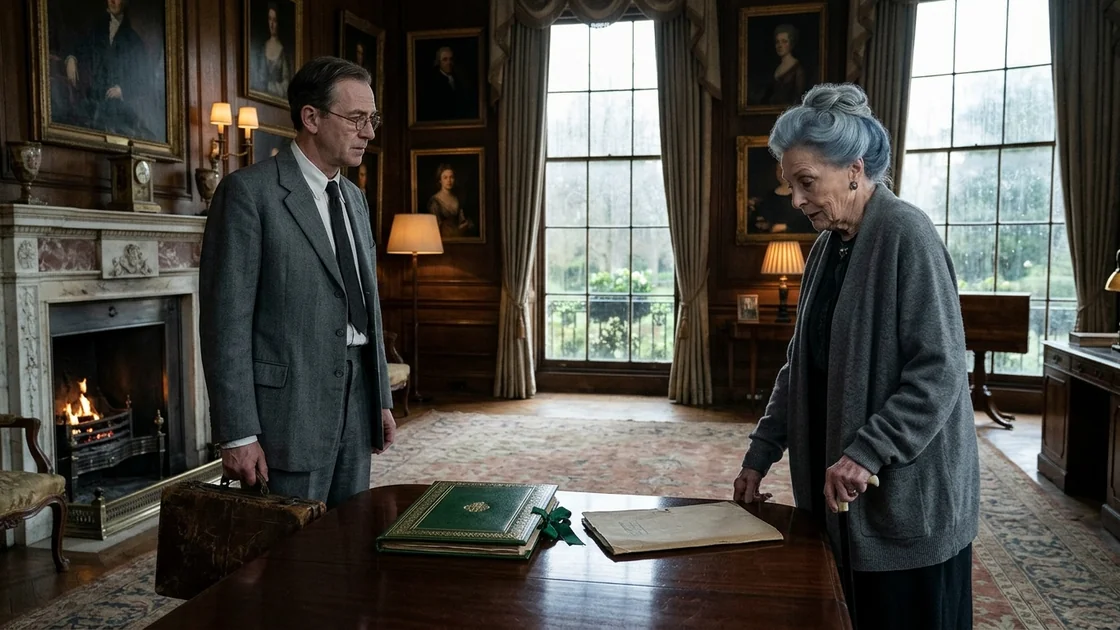
A veteran London genealogist is commissioned by an imperious Belgravia matriarch to construct a definitive ancestral record of her aristocratic bloodline, only to uncover that the foundation of her noble birth was fabricated amidst the fires of the 1940 Blitz.
Chapter I: The Room in Eaton Square
Arthur Finch had spent thirty-four years measuring the passage of human lives in quarter-bound calfskin and vinegar-tinted microfilm. To the solicitors of Lincoln's Inn and the probate courts of Holborn, he was not an artist or a historian, but a plumber of bloodlines, called in when the pipes of inheritance had rusted shut or burst with rival claimants. He was a man of dry habits, gray worsted suits, and fingers perpetually stained with the pale, powdery bloom that clings to archival box-board.
When the letter arrived from Sterling House, Eaton Square, it did not arrive via royal mail or digital transmittal, but in a thick, wove envelope delivered by a chauffeur whose uniform bore no livery save for the immaculate silence of old money.
The drawing room into which Arthur was shown three days later did not smell of parchment, but of tuberose and beeswax. It was a vast, high-ceilinged chamber overlooking private gardens where late-October plane trees shed their mottled bark.
Lady Clarissa Sterling sat near a fireplace framed in statuary marble that had been carved before the French Revolution. At eighty-four, she was an architectural presence in her own right. Her spine was an unbroken rod of bone; her hair, tinted the precise blue-silver of dusk over slate roofs, was swept upward into an architectural twist that defied the tremors of her left hand. Across her lap lay a rug of green Shetland wool, and upon the mahogany lowboy beside her rested a silver tray containing a single porcelain cup and an unopened file bound with black ribbon.
"Mr. Finch," she said, without turning her head until he had crossed the Aubusson carpet to the exact center of the room. Her voice was like cut glass dropped upon velvet—resonant, dry, and wholly indifferent to the possibility of contradiction. "Sit down. Not on the gilt chair. That is Louis Quinze and will not survive a man who carries his trade in his waistline. Take the wingback."
Arthur sat. He placed his briefcase—scuffed pigskin, purchased in 1988—against the side of his ankle. "Good afternoon, Lady Clarissa."
"You were recommended by Sir Peregrine Croft," she said, her eyes fixing upon him. They were an extraordinary shade of hazel, pale as cider, ringed with the milky blue arc of advanced age. "He told me you are thorough, that you do not write books for tourist shops, and that you have no discernible political opinions. Is that accurate?"
"I deal in certificates, Lady Clarissa," Arthur replied evenly. "Certificates are largely indifferent to politics."
A dry twitch of her mouth answered him. "Certificates, Mr. Finch, are the only things that prevent this country from degenerating into a penal colony. You know my family, of course."
"The Vanes of High Wycombe and Kensington," Arthur said. "Baronets of the United Kingdom since 1814. The third baronet married into the Douglas-Pennant line; the fifth, your grandfather, was Under-Secretary for War under Asquith. Your father was Captain Arthur Vane, Scots Guards, killed at Anzio in February 1944."
The old woman inclined her chin an eighth of an inch. "A précis worthy of Debrett’s. But my sons are restless, Mr. Finch. Julian wishes to restructure the family trust, and the American trustees are demanding an audited pedigree going back to the first baronet’s patent. They have lawyers in Philadelphia who seem under the impression that English landed families keep their records in shoe boxes. I require a certified, ironclad cartulary. Every baptism, every marriage settlement, every probate grant from 1814 to the present day. Tied with ribbon. Bound in morocco. Presented so thoroughly that even an American accountant might understand it."
"That is my usual line of business," Arthur said. "Though standard pedigree work does not usually require personal interviews."
"Standard work is done by clerks who use search engines," Lady Clarissa said coldly. "I do not pay for search engines. I have here the domestic register—the family Bible, rebound in 1902—and the primary transcripts of our muniments from the Kensington house before it was sold in forty-six. The rest you will find in Somerset House, or wherever it is they have moved the dead these days."
"They are in Myddelton Place, in Clerkenwell, and Kew," Arthur said. "And the parish registers are largely deposited with the London Metropolitan Archives."
"Quite so. You will start with my father's line, proceed through my mother—she was Lady Margaret Douglas, daughter of the Earl of Dunbarton—and end with myself. I will have the work completed before Christmas. Julian leaves for New York on the tenth of January."
She reached out and tapped the black-ribboned dossier on the lowboy. Her knuckles were swollen, the signet ring on her fourth finger—bearing the Vane crest of a falcon perched on a broken spear—biting deep into the flesh.
"My fee is three hundred pounds per diem, plus disbursements," Arthur noted.
"Sir Peregrine told me you were expensive," she countered, her gaze never wavering. "Send the invoices to Coutts. But remember this, Mr. Finch: I am paying for certainty. The Vanes have been in this country since the Conquest, but our title rests on paper. Make sure the paper is clean."
Arthur took the folder. The ribbon was modern grosgrain, but the paper within was old—vellum-finish foolscap, penned in the iron-gall hand of late Victorian solicitors, detailing the settlements of the late Captain Vane and the birth of a single heiress: Clarissa Margaret Vane, born October 14th, 1940, at 14 Kensington Park Gardens, London.
"It shall be as clean as the records allow, Lady Clarissa," Arthur said, rising.
"Good day, Mr. Finch," she said, already looking back toward the garden, where a gardener was sweeping plane leaves into a burning brazier. "Do not telephone me until you have something to show."
Chapter II: The Vaults of Clerkenwell
Arthur Finch worked best in rooms with no natural light.
His office in Lincoln’s Inn was little more than a converted scullery in the basement of an eighteenth-century set of chambers, smelling of damp lime and cold tea. For thirty years he had lived in an unmarried state of quiet orderliness in a flat near Tufnell Park, where his domestic life consisted of a clockwork radio, two cats named Camden and Stow, and a cellar filled with auction catalogues from defunct provincial estate agents.
On Thursday morning, he took the Circle Line to Farringdon and walked up through the damp, diesel-stained chill of Clerkenwell to the London Metropolitan Archives. The reading room was quiet, populated only by two American Mormons tracing nineteenth-century weavers from Bethnal Green and an elderly German scholar transcribing livery company accounts with a silver propelling pencil.
Arthur set his spectacles upon his nose—half-moon lenses with light horn frames—and unrolled the preliminary tree he had drafted on butcher’s paper.
The Vane lineage was, on its surface, an archivist’s delight. Families of the baronetcy were bureaucratic creatures; they did not vanish into the coal pits or emigrate without leaving a trail of wills, indentures, settlements, and commissions.
By midday, Arthur had verified the lineage from Sir Hugo Vane, 1st Baronet (1778–1842), through his son Charles, down to Captain Arthur Vane. The Scottish connection through the Earl of Dunbarton was equally pristine; the Scotch Office registers and the parish rolls of East Lothian dovetailed with the London marriage register of St. Paul's, Knightsbridge, where Captain Vane had wed Lady Margaret Douglas on a bright, apprehensive Saturday in June 1939, six weeks before the declaration of war.
The photographs in the society papers from that week—which Arthur had examined on microfilm at the Colindale depository years before—showed a tall, narrow-chinned young officer in the uniform of the Scots Guards and a bride whose face was an oval of terrifying, aristocratic fragility. She looked like an ivory carving that might shatter if one shut a carriage door too firmly.
"The Douglas constitution," Arthur murmured to himself, scribbling in his notebook. Lady Margaret had died in 1948, barely thirty years old, at a sanatorium in Davos.
He took his lunch—a hard-boiled egg and a bottle of mineral water—on the bench outside the archives, watching the pigeons peck at gravel in the courtyard. Then he returned inside, checked his slip, and called up the microfiche for the civil registration indices for the fourth quarter of 1940.
The Civil Registration system of England and Wales, established on July 1, 1837, is an empire of names. Every birth, marriage, and death is recorded first in a local register office by a district registrar, then transcribed quarterly onto parchment sheets, bound, indexed, and preserved. To a genealogist, the system is a clockwork cosmos. A person may be wicked, foolish, noble, or utterly obscure, but if they were born in London in the autumn of 1940, they are in the books.
Arthur placed the plastic carrier under the glass plate of the viewer, wound the spool to the letter V, and ran his thumb down the column.
Vane, Arthur C. – Kensington – 1a 142 Vane, Charles E. – Marylebone – 1a 88 Vane, Clarissa M. – Kensington – 1a 204
He noted the volume and page number in his ledger: Kensington, Volume 1a, Page 204. Quarter ending December 1940.
It was perfectly standard. He filled out the priority search slip for an official certified copy of the entry from the General Register Office, handed it to the clerk at the desk with his research fee, and requested the historical district log for the Kensington registration sub-district for that same period.
"District log?" the young woman behind the desk asked. Her name tag read Tracey. She had two silver rings in her eyebrow that flickered under the fluorescent tubes. "Is that the local register?"
"The registrar's daybook," Arthur said mildly. "The ledger in which the sub-district registrar entered the applications chronologically before they were transcribed to the quarterly sheets for St. Catherine's House. Kensington District, Sub-district 1A, October to December 1940."
"Most people just want the green certificate, Mr. Finch," Tracey said.
"Most people are content with what they are told," Arthur said. "I am old, Tracey. I have a morbid attachment to ink."
Twenty minutes later, the box was brought up from the basement. It was not bound in calfskin, but in drab gray buckram with red linen tape ties, labeled Kensington Sub-District: General Log-Book, 1939–1941.
Arthur sat at table six, beneath a sign strictly forbidding the use of fountain pens. He untied the tape. The smell that rose from the pages was distinct—not the dry, vanillin scent of seventeenth-century rag paper, but the bitter, slightly chemical odor of cheap wartime paper, made from wood pulp and esparto grass under the strictures of the Paper Control Board.
He turned to October 1940.
London that month had been an abattoir of brick and slate. The Luftwaffe had come every night, almost without exception, from the seventh of September through the middle of November. The Kensington register bore witness to it not in rhetoric, but in the frantic, cramped handwriting of the local registrar—a man named Horace Cluer, whose penmanship grew steadily more jagged as the days advanced.
Entries for births were few; entries for deaths by enemy action were vast. Whole pages were given over to descriptions of bodies retrieved from the wreckage of Queen’s Gate and the High Street: Female, unknown, approximately 40 years, wearing wedding band inscribed ‘T.H. to M.L.’; Child, male, aged about two, recovered from basement of 18 Argyll Road.
Arthur turned past the dead to the birth section at the back of the daybook.
On page 82, under the date 21 October 1940, Horace Cluer had entered the births reported during the previous week. Entry 412: October 12, to the wife of Thomas Briggs, plumber, a daughter, Mary. Entry 413: October 13, to the wife of George Alverstone, bus driver, a son, Peter. Entry 414: October 14, to Lady Margaret Vane, wife of Captain Arthur Vane, Scots Guards, of 14 Kensington Park Gardens, a daughter, Clarissa Margaret.
The ink was black Higgins India, slightly faded to violet at the margins. The signature was Lady Margaret’s own, or at least a proxy's: Margaret Vane, mother. Beside it was the signature of Horace Cluer, Registrar.
Everything was in order. It was so completely in order that Arthur Finch should have closed the book, tied the red linen tapes, collected his coat, and billed Lady Clarissa Sterling three days' work at three hundred pounds per diem.
Except for one detail.
Arthur Finch took a small, brass-rimmed pocket magnifier from his waistcoat. He did not look at the name, or the date, or the signature. He looked at the horizontal lines that ruled the ledger paper.
The ledgers of the Registrar General were produced by His Majesty’s Stationery Office according to rigid specifications. In 1940, the lines were printed in faint water-based azure ink using a ruled ruling-comb that produced forty lines per page. Each line had an imperceptible wobble on the fourth column, three-quarters of an inch from the left margin, caused by a slight dent in the ruling-drum of the printing press at HMSO’s works in Harrow—a press that had been installed in 1934 and remained in operation until it was destroyed by a parachute mine in November 1941. Arthur had charted that specific plate defect during a disputed peerage case in 1996.
On page 82, under Entry 414, the blue ruling-line did not have the wobble.
More than that: the line did not continue beneath the writing. When Arthur focused the magnifier until the crystalline structure of the paper fibers became visible under the lens, he saw that the paper beneath the words Entry 414 was marginally thinner than the paper beneath Entry 413. The paper was not wood pulp with esparto. It had the smooth, hard-sized texture of post-war Whatman paper, laid down with an adhesive so fine, so perfectly pressed, that to the naked eye it seemed entirely of a piece with the leaf.
It was an insertion. An eradication.
A whole slip of paper—three-eighths of an inch wide and seven inches long—had been shaved into the sheet with a razor, sized with bone glue, and burnished flat with an agate burnisher. The ink was old, but it had not bitten into the sizing in the same manner as the entries above and below it; it had feathered slightly at the edges, the microscopic capillary drift that occurs when iron-gall ink is applied to paper that has already been calendered.
Arthur Finch sat back. He took off his spectacles and polished them with the silk square from his breast pocket.
The room around him remained completely silent. The young Mormons whispered over a census return from 1871. The German scholar turned a leaf of parchment with a dry rustle like dead grass.
"My dear," Arthur whispered to the empty air, "what in the name of God did you do?"
Chapter III: The Phantom in the Churchyard
Genealogy is not the study of life; it is the study of documentation. When documentation breaks down, life does not become invisible; it merely becomes suspect.
Arthur Finch did not return to Eaton Square. Instead, he went to the National Archives at Kew.
It was a cold, salt-gray morning along the Thames. The path from the station was thick with sodden sycamore leaves, and the river ran high and muddy against the concrete revetments. Arthur secured a terminal in the research hall and pulled the records of the Ministry of Health, specifically the wartime correspondence between the Registrar General and the Kensington Borough Council’s civilian casualty committees.
The night of October 14, 1940, had been one of the most violent of the autumn.
According to the Air Raid Precautions (ARP) log for Borough of Kensington (File HO 198/42):
20.15 hrs: High explosive bomb dropped on Kensington Park Gardens. Nos. 12, 14, and 16 sustained direct hits. Gas mains ignited. Extensive cratering. Water pressure failed at 20.40. Static water tanks brought into use. Rescue squads Nos. 4 and 7 deployed. Unexploded ordnance reported at rear of No. 10.
Arthur leaned closer to the monitor.
Casualties reported: No. 12—Three persons rescued alive, two deceased. No. 14—Residence of Lady Margaret Vane. Structural collapse of rear mews and lower levels. Search continued until 04.30 hrs. Lady Margaret Vane extracted from nursery shelter in cellar, suffering from shock, inhalation of smoke, contusions. Infant child—unnamed female—recovered by Warden T. Briggs. Declared dead at scene by Dr. C. Lowther, ARP Medical Post 3. Transferred to mortuary at St. Mary Abbots Hospital.
Arthur stared at the green-tinted screen until his eyes watered.
Declared dead at scene.
He read it again. The child had not been born on October 14. Lady Clarissa’s birth certificate claimed she was born on October 14 at 14 Kensington Park Gardens. But the ARP log stated that on the evening of October 14, the house was a smoking crater, and an unnamed female infant had been taken from the ruins to the mortuary of St. Mary Abbots.
Arthur stood up from the terminal. His knees gave a sharp, dry pop. He walked out of the reading room and down to the cafeteria, where he ordered a cup of black coffee that tasted of scalded urns. He did not drink it. He sat with his hands wrapped around the paper cup, feeling the heat leach through the cardboard into his palms.
If the Vane child had died on October 14, 1940, in the basement of Kensington Park Gardens, who was the woman with the cider-colored eyes who sat in the high-backed wing chair in Eaton Square, holding court over three million pounds in land and securities?
And whose name had Horace Cluer erased from the register with a razor and a slip of Whatman paper?
He caught the district line back into town, his briefcase tucked under his arm like a shield. By three in the afternoon, he was in the Surrey countryside, standing on the gravel path of St. Peter's churchyard in Chobham.
The Vane family had possessed a country seat outside Chobham until the debts of the fourth baronet forced its sale in 1921, but they had retained their right of burial in the family vault beneath the north aisle of the church. The air in Surrey was different from the air in Clerkenwell; it was resinous and wet, smelling of pine needles, wet clay, and autumn rot.
The rector was a young man with damp red hair and anorak over his dog-collar who seemed bewildered that anyone should wish to inspect the parish registers of 1940 rather than the Elizabethan tithe maps.
"We have them in the safe in the vestry," the young man said, shaking his keys. "Though usually people want the nineteenth-century ones. The Americans, you know. They’re all terribly keen on finding they’re descended from blacksmiths."
"I am looking for a burial," Arthur said. "October or November 1940."
The vestry was small, smelling of candle wax and damp choir surplices. The register of burials for the parish of Chobham was an oblong folio covered in pigskin, its corners protected by brass caps.
The rector opened it on the vestry table, beside an empty box of communion wafers. "What name was it?"
"Vane," Arthur said. "A child."
The rector ran his index finger down the column for November 1940. The entries were written in a sprawling, watery black ink by a former incumbent whose hand had clearly been ruined by age.
"Ah," said the rector. "Here we are. November 4th."
He pointed. Arthur looked over his shoulder.
Entry 892: November 4, 1940. Clarissa Margaret Vane, of Kensington, aged 2 days. Service conducted in private. Interred in the north vault.
"She’s there," the rector said, glancing at Arthur. "Poor little thing. Blitz casualty, I suppose? A lot of them were brought down here out of the city. Families thought the churchyards out here were safer than London cemeteries, though what difference it makes to a corpse, God only knows."
"Yes," Arthur whispered. "What difference indeed."
He produced his notebook. "Is the vault accessible?"
The rector looked doubtful. "We don't open the flags except for interments, Mr. Finch. The last one was the Dowager Lady Sterling—no, wait, that was her husband, Sir Julian Sterling, in ninety-two. The Vane vault was sealed after the Captain was killed in Italy. The floor is covered with oak parquet now, in the north aisle. You’d have to take up the pews."
"There is no need," Arthur said softly. "The register is sufficient."
He closed his notebook with a sharp snap. The infant Clarissa Margaret Vane had been laid in the earth seventy-eight years ago, beneath the stones of Chobham church, with two lines of Latin and an entry in a parish register.
And yet, thirty miles away in Belgravia, Lady Clarissa was waiting for her morocco-bound folder to prove to the trustees in Philadelphia that her blood was pure, her descent unbroken, and her inheritance unassailable.
Chapter IV: The Ghost of Samuel Oakes
A forgery is never an isolated act. It is an interruption of momentum. A single lie in an archive demands fifty auxiliary lies to sustain it; it requires altered receipts, silenced witnesses, falsified certificates, and compliant clerks.
Arthur returned to his scullery office in Lincoln’s Inn. He turned on the single desk lamp—a green glass shade over a sixty-watt bulb—and laid out the three documents he now possessed:
- The photostat of the civil registration log from Kensington (showing the Whatman paper insertion at Entry 414).
- The printout from the National Archives ARP log (recording the death of an unnamed female infant at 14 Kensington Park Gardens on October 14, 1940).
- The extract from the Chobham burial register (recording the interment of Clarissa Margaret Vane, aged two days, on November 4, 1940).
The mathematics was brutal. The child who died on October 14 was buried on November 4 under the name Clarissa Margaret Vane.
Therefore, who was the woman born on October 14 who had been registered under Entry 414?
Arthur reached for his telephone—an old rotary instrument that had belonged to his predecessor—and dialed a number in Lewisham.
The voice that answered was cracked and dry, like dry corn husks rubbing together in a November wind.
"Ronald?" Arthur said.
"Arthur? You’re calling late. University Challenge is on in ten minutes."
"I need your memory, Ronnie. I need Samuel Oakes."
A long silence followed on the line. Ronald Keats had been the senior superintendent of the search rooms at Somerset House from 1952 until his retirement in 1989. He was a man who remembered not only the names of clerks who had died before the coronation, but the specific shorthand quirks they had used in the marginal corrections of marriage certificates.
"Oakes," Ronnie said at last. "He wasn't Somerset House. He was Kensington. Second clerk under Horace Cluer. Died in sixty-one, sixty-two? He was dismissed, wasn't he?"
"That is what I want to know," Arthur said. "Why was he dismissed?"
"It wasn't Somerset House that dismissed him," Ronnie replied, his voice dropping into the lower register of old archival gossip. "It was the Metropolitan Police. There was an inquiry in forty-seven. Something about ration books and identity documents. After the war, you see, the deserted wives and the deserters wanted to be someone else. There were thousands of them. Men who had walked away from their regiments in forty-two and were living under assumed names in Tottenham; women whose husbands were missing in Malaya and who wanted to marry Canadian sergeants without waiting for the seven-year presumption of death. Oakes had access to the blank certificates. He had the old stamps."
"Did he do birth certificates?"
"He did whatever had a five-pound note tucked inside it, Arthur. But he was clever. He didn't invent names. If you invent a name, the central index catches you out when the quarterly transcript goes up to the General Register Office. You have to match an actual event. You have to find a dead child, or a child that was never entered because the parents died before registration, and you put them in the space left by an erasure."
"Or an insertion," Arthur said.
"Ah," Ronnie breathed. "You've seen one. Whose work was it?"
"The handwriting is Horace Cluer’s," Arthur said. "Or an excellent imitation."
"Cluer was honest as an anvil," Ronnie said immediately. "He died at his desk in forty-five. Heart attack during the victory celebrations. But Oakes lived in Cluer's pocket for ten years. He could sign Cluer's name better than Cluer could. In forty-seven, when the inspectors went into the Kensington basement, they found thirty pages where entries had been scraped out with a bone scalpel. But Oakes was never tried. He had friends in the West End. High-up people. The file was marked Nolle Prosequi by the Director of Public Prosecutions and shoved into the cellar at Scotland Yard."
"Where is the file now?"
"The police files from forty-seven? Kew, if they haven't pulped them. MEPO 3. Look under 'Irregularities in Civil Registration, West London District.' And Arthur?"
"Yes, Ronnie?"
"Be careful whose mother you kill. People don't like finding out they are made of ink."
Chapter V: The MEPO Dossier
On Friday, Arthur Finch was back at Kew.
The box from the Metropolitan Police collection (MEPO 3/2841) was tied with black ribbon that had frayed to a greasy fringe. Inside were three manila folders, warped by humidity and smelling of the tobacco smoke of detectives long turned to dust.
Arthur turned the sheets slowly. The police reports, typed on flimsy pink carbon paper, were dated March 1947.
Subject: Samuel James Oakes, former Deputy Registrar, Kensington Sub-District. Investigating Officer: Detective Inspector G. Vance, Criminal Investigation Department, New Scotland Yard.
The report laid bare the dark economy of post-war London. In the chaotic autumn of 1940, with the bombs falling nightly and thousands of families scattered across the country or living in shelters, the registration system had been strained to breaking point. Children were born in tube stations; mothers died in hospitals before they could give their names; infants were found in ruined houses by rescue squads and handed over to volunteer nurseries without so much as a scrap of paper.
Samuel Oakes had seen the commercial possibilities.
He had maintained a private notebook—recovered from his lodgings in Earl's Court—which the police had cataloged as Exhibit C. Arthur found the photostat of Exhibit C at the back of the second folder.
It was an ordinary exercise book with a red marbled cover. In it, Oakes had kept two columns. On the left: Children deceased, unregistered, or unidentified. On the right: Applications.
Arthur ran his eye down the column for October 1940.
And there it was.
Item 112. Date: 16 October 1940. Source: South London Emergency Nursery, Lambeth. Subject: Female infant, approximately 5 days old. Recovered from the ruins of a tenement in Bermondsey (Tooley Street) after the raid of 10 October. Parents unknown, presumed dead under rubble. No identity disk. Nursery designation: Child No. 44.
Beside it, in the right-hand column, written in Oakes’s cramped, clerkish script:
Settlement arranged through Dr. C. Lowther (ARP Medical Officer, Kensington). Transferred to: Lady M. V. Fee: £500 (inclusive of entry insertion in Kensington Daybook, folio 82, vice Entry 414 deceased). Action taken: Original certificate of birth for infant Vane (stillborn/died 14 Oct) destroyed. Child No. 44 substituted. Register entry 414 amended to show live birth on 14 Oct. Certified extract provided.
Arthur Finch leaned his forehead against his hand. His skin felt cold, greasy with the dry sweat of shock.
Dr. Charles Lowther had been the ARP doctor who attended the ruins of 14 Kensington Park Gardens. He had signed the death slip for the true Clarissa Vane. And then, within forty-eight hours, he had walked across the river to the emergency nursery in Lambeth, picked up an unnamed dockworker's baby whose family had been obliterated on the south side of the river, and brought her to the shattered, grieving widow in Kensington.
Why?
The answer lay in the legal settlements Arthur had examined three days before in Eaton Square.
Under the terms of the Vane settlement of 1928, executed by the fifth baronet:
...in the event of Captain Arthur Vane dying without issue surviving him, the entire Kensington estate, together with the trust securities derived from the Douglas-Pennant alliance, shall pass absolutely to the collateral branch represented by Giles Vane, Esq., of Montreal, Canada, or his heirs, to the absolute exclusion of any widow surviving...
Captain Arthur Vane was at that moment in training with his battalion at Aldershot, preparing for embarkation. Lady Margaret Vane was twenty-three years old, her home destroyed, her firstborn child dead in a basement shelter. If she had no living child, she was an impoverished widow in the eyes of the family trust; if she had a daughter, she retained the life interest in the townhouse, the country rents, and two-thirds of the trust income.
A dead baby was destitution. A live baby was survival, status, and three million pounds in twentieth-century values.
And so Samuel Oakes took his five hundred pounds—a fortune in 1940, enough to buy three suburban houses—took out his razor, split the paper of the Kensington Daybook, pasted in the Whatman slip, and created Lady Clarissa Margaret Sterling out of the ash of Tooley Street.
Chapter VI: The Daughter of Tooley Street
The rain was falling in earnest when Arthur Finch came out of Kew Gardens station. It was that gray, persistent London rain that seems to come not from the sky, but from the pavements themselves, rising like vapor from the gutter stones.
He went home to Tufnell Park. He fed Camden and Stow their tins of pilchards. He made a pot of tea and let it sit on the trivet until it was black and bitter.
He sat at his kitchen table with his spectacles lying beside his cup, staring at the rain against the windowpane.
He had the whole narrative now. He could write the report. He had the police documents from MEPO; he had the Kensington Daybook; he had the Chobham register; he had the ARP log. It was a masterpiece of forensic genealogy. It would destroy a family, shatter a will that had been settled thirty years ago, cast the ownership of four estates into the chancery courts, and strip an eighty-four-year-old woman of every name, title, and ancestor she had claimed since she was a toddler in a smocked silk dress.
Lady Clarissa Sterling was not a Vane. She was not a Douglas. She had no right to the crest of the falcon on the broken spear; she had no right to the portraits by Laszlo and Reynolds that hung in the gallery at Eaton Square; she was not the grand-niece of the Under-Secretary for War or the cousin of five dukes.
She was Child No. 44 from the South London Emergency Nursery. Her father had likely been a lighterman on the Thames or a carter at the Surrey Commercial Docks; her mother had probably scrubbed floors or worked the bottling plant at Bermondsey before the high-explosive bomb took them both into the gray mud of the riverbank.
Arthur put his hand into his coat pocket and touched the signet ring he always carried—his own father’s ring, a plain band of silver with no crest at all, worn smooth by fifty years of carpentry.
We are what the ink says we are, he thought. Until the ink is scratched away.
He did not sleep that night. He sat in his study with the green shade tilted low, typing on his ancient Olympia manual typewriter. The keys hit the ribbon with a steady, dry clack-clack-clack that sounded like the ticking of a clock in an empty church.
He typed two documents.
The first was a certified pedigree of Lady Clarissa Margaret Sterling, showing her descent from Sir Hugo Vane, 1st Baronet, complete with dates of baptism, marriage, and probate, perfectly aligned, exquisitely researched, citing every ledger from Somerset House to Chobham. It was three pages long, typed on his heaviest hand-made cream laid paper, tied with green silk ribbon, and sealed with red parcel wax.
The second was a single sheet of paper. It contained sixty-four words, two dates, and four file references from the Metropolitan Police archive and the Ministry of Health.
At ten o’clock on Saturday morning, Arthur Finch took the Piccadilly Line to Hyde Park Corner and walked down through the rain to Eaton Square.
Chapter VII: The Razor and the Agate
Lady Clarissa was in the drawing room, but the fire was not lit. The room felt immense, cold, and hollow, like the nave of a cathedral before a memorial service.
She was wearing a cardigan of gray cashmere that seemed too large for her shoulders; her frame, stripped of the tailored wool she had worn on Arthur’s first visit, appeared shockingly diminished. The cider-colored eyes, however, were as hard and clear as agates.
"You are early, Mr. Finch," she said, without turning from the window. "Julian does not leave until the tenth. I did not expect you until December."
Arthur did not take the wingback chair. He remained standing by the mahogany table, his briefcase flat against his thighs.
"I have completed the preliminary verification, Lady Clarissa," he said.
"And?"
"The lineage of the Vanes is unbroken from 1814 to 1944. Sir Hugo’s grant is valid; the Douglas-Pennant marriage settlements are sound; the Dunbarton descent is registered with the Lord Lyon in Edinburgh."
She turned slowly. Her hand was resting on an ebony cane with an ivory pommel. "You speak as though there were an 'and,' Mr. Finch. I do not like 'ands.' They sound like invoices."
Arthur placed his briefcase upon the table. He did not open the locks. He laid two folders side by side on the polished mahogany.
One was bound in green calfskin, tooled with gold line-work—the morocco portfolio she had requested, containing the clean descent. The other was an ordinary manila folder, unmarked, thin as a leaf.
"I found three things in the archives, Lady Clarissa," Arthur said. His voice was low, flat, entirely devoid of the theatrical cadence of a man delivering a revelation. "The first was the air-raid report for the night of October 14, 1940. The second was the burial register for the parish of Chobham for November 4 of that same year. And the third was the police file on Samuel James Oakes, deputy registrar for Kensington."
The old woman did not move. Not a muscle in her face shifted. But the ivory pommel of her cane gave a tiny, dry squeak against the palm of her hand.
"Go on," she said.
"The girl who was born to Lady Margaret Vane on October 14 died six hours after her birth, in the cellar of 14 Kensington Park Gardens. She died of blast lung, unattended by a surgeon. She was buried three weeks later in the family vault in Surrey under a special wartime license."
The clock on the chimney-piece—a bronze mantel clock depicting the flight of Chronos—measured out five beats before she spoke.
"My mother was an invalid, Mr. Finch. She spent three years in Switzerland after the war. Her memory of that winter was... imperfect."
"Her memory may have been imperfect, Lady Clarissa," Arthur said. "Her need was not. If she had no living child, the Kensington house and the Douglas trust passed to Giles Vane in Canada. She had five hundred pounds left in her personal account. She gave it to Samuel Oakes through Dr. Lowther."
Arthur tapped the manila folder.
"On October 16, 1940, a child was brought to Kensington from the South London Emergency Nursery in Lambeth. Her parents had been killed in a tenement in Tooley Street four days earlier. She was five days old. She was not a Douglas. She was not a Vane. Samuel Oakes erased the registration of a stillborn child in his daybook with an ink-knife, pasted a slip of Whatman paper across the erasure, and wrote the name Clarissa Margaret Vane in the ledger."
The room was so still that Arthur could hear the hiss of the gas ring in the butler’s pantry down the corridor.
Lady Clarissa did not look at the manila folder. Her gaze was fixed entirely on Arthur Finch's face—on the worn gray collar of his shirt, on the ink-stains on his fingers, on the dull horn frames of his spectacles.
"Tooley Street," she said. The word was strange in her mouth; she pronounced it not as a Londoner would, but with the fastidious, elongated vowels of the Edwardian nursery. "Where is Tooley Street?"
"It is by the river," Arthur said. "Beside London Bridge. Near the butter wharves."
She looked down at her own hands—long-fingered, pale, the veins standing up beneath the skin like blue cords, crowned with the signet ring of the falcon and the broken spear.
"A dockworker," she said.
"Or a drayman," Arthur said. "Or a clerk in the hop exchanges. The records do not say. The bomb destroyed the whole side of the street. There was no one left to give a name."
She took two steps toward the table. Her movement was stiff, the cane striking the Aubusson carpet with a muffled thud. She stopped six inches from the two files.
"Does Julian know?" she asked.
"No one knows," Arthur said. "Except myself, Ronald Keats—who does not know which name I was seeking—and the dead."
"And the American trustees?"
"The American trustees have never seen the Kensington Daybook. They have seen the quarterly index certificate from St. Catherine's House. That certificate was issued in 1941 from the forged transcript. As far as the law of the United States is concerned, Lady Clarissa, you are the daughter of Arthur and Margaret Vane."
She raised her eyes. For the first time, Arthur saw something human behind the cider-colored irises: not fear, and not shame, but a vast, bottomless fatigue—the weariness of an actor who has worn a leaden crown for seventy years on a stage that has long since grown cold.
"My mother," she whispered, "used to sit by the window in the house at Sunningdale. In the fifties. She would look at me for hours without speaking. Sometimes she would take my hands and turn them over, looking at the palms. She would say: 'You have your father’s wrists, Clarissa. Strong wrists. Not like the Douglases. The Douglases are all glass.'"
She gave a short, jagged laugh that sounded like dry leaves catching in an iron grate.
"Strong wrists," she repeated. "To carry flour sacks, I imagine."
Arthur said nothing.
"Why have you brought both folders, Mr. Finch?" she asked. Her voice had regained its edge, though it was thinner now, like paper that has been scraped with an eraser. "If you are an honest man, you should have gone to the High Court. Or to the Canadian cousins. They have descendants in Toronto, you know. Two boys who run an automobile dealership. Very energetic young men, Sir Peregrine told me. They would be delighted to own Eaton Square."
"I am an honest man, Lady Clarissa," Arthur said. "Which means I know the limits of the register."
He touched the green calfskin folder.
"In this book is the story the world has agreed upon. It is the story upon which your sons have married, your daughters have inherited, and your taxes have been paid. It is signed by registrars, certified by bishops, and recorded in the rolls of the Crown. It is false, but it has existed for eighty years. It has become solid through the passage of days."
He touched the manila folder.
"In this book is the truth. The truth is that you are an orphan of the Blitz, whose life was purchased for five hundred pounds to preserve an estate from a Canadian cousin who had never seen the Thames. It has no legal standing until someone takes it to a judge. If you take it to a judge, your father’s name will be expunged from your children's birth certificates. The trusts will be liquidated. Your house will be sold to pay sixty years of back-taxes and misallocated revenues. The Canadian car salesmen will have the portraits, and you will have a name that does not exist."
"And what will you have, Mr. Finch?" she asked softly.
"I will have three hundred pounds per diem," Arthur said, "for eight days' work. And the knowledge that I found what was there."
Lady Clarissa reached out her hand. It hovered for a moment above the table—the signet ring trembling against the light—and then her fingers came down upon the manila folder.
She did not open it. She held it by its corner, her thumb pressing into the cardboard.
"My father," she said, her voice dropping into a register so low that Arthur had to lean forward to hear her, "was buried in the military cemetery at Cassino. There is an inscription on his headstone: To his daughter, Clarissa, who preserves his line. He wrote that in a letter from the troopship. He had never seen me. He had only been told that the child was safe, that she was a girl, that she was healthy."
She closed her eyes.
"Was she pretty, Mr. Finch? The baby in the vault at Chobham?"
"The register does not record beauty, Lady Clarissa," Arthur said. "Only age. Two days."
"Two days," she murmured. "And I have had eighty-four years."
She opened her eyes. The cider-colored irises were clear again. The old imperiousness, that armor constructed of seventy years of being bowed to by footmen and solicitors, slid back into place like an iron portcullis.
"The fire is laid in the library, Mr. Finch," she said. "Julian had the wood brought up from the country yesterday. Good ash. It burns clean."
Arthur picked up his briefcase. He did not touch the manila folder. He left it lying beneath her hand.
"The green folder is yours, Lady Clarissa," he said. "The research is complete. Every signature has been verified against the transcripts at Kew. The American trustees will find no defect in it."
"No defect," she echoed.
"None that can be seen without a glass," Arthur said.
He bowed—a slight, awkward inclination of his head, the bow of a man who spent his life in reading rooms—and turned toward the door.
"Mr. Finch," she called out.
He stopped with his hand on the gilt brass door-handle.
"What was her name?" Lady Clarissa asked. Her voice was barely more than a breath against the cold expanse of the room. "The child from Tooley Street. Before Samuel Oakes took her."
Arthur looked back. The old woman was standing by the table, solitary between the vast mirrors and the portraits of men with lace collars and narrow, aristocratic noses who were not her kin.
"She had no name, Lady Clarissa," Arthur said gently. "She was Child Forty-Four."
Lady Clarissa stood silent for a long moment. Then, with a movement that was steady and deliberate, she picked up the manila folder, tucked it under her arm beside her cane, and walked toward the library door.
"Then she shall remain Clarissa Vane," she said. "The docks have enough dead without me."
Chapter VIII: The Ledger of the Living
Arthur Finch sat at his desk in Lincoln’s Inn on Monday morning.
The post had arrived. There was a check from Coutts & Co. for two thousand four hundred pounds, drawn on the account of the Sterling Estate, accompanied by a compliment slip from Sir Peregrine Croft thanking him for his customary discretion.
Beside the check was his working notebook, open to the page where he had sketched the Vane descent.
He took his pen—his ordinary steel dip-pen with the Gillott 404 nib—and dipped it into the bottle of black Pelikan ink.
At the bottom of the tree, beneath the name of Captain Arthur Vane (1914–1944), he had drawn a single vertical line leading to:
Clarissa Margaret Vane (b. 14 Oct 1940).
Arthur held the pen above the paper. A single drop of ink gathered at the point of the split nib, black and swollen with weight, trembling between the metal and the surface of the paper.
He thought of the churchyard at Chobham, where the damp yellow clay of Surrey held the dust of a two-day-old infant beneath an oak floor that no one would ever take up.
He thought of the mud of Tooley Street, where the barges had brought coal from Newcastle and timber from the Baltic, where women had washed cabbage leaves in tubs and children whose names were never entered in any book had played among the salt-crusted ropes.
He lowered the nib.
He did not cross out the name. He did not write Child 44. He did not make an erasure with a bone scalpel or paste a strip of Whatman paper across the line.
Instead, he added a single footnote at the bottom of the margin, in his neat, microscopic archivist’s hand:
Entry confirmed by the Register of the General Register Office, London. Valid in law.
He set the pen down upon the glass stand. He blew upon the ink until the wet shine vanished, replaced by the dull, impenetrable blackness of the permanent record.
Then Arthur Finch closed the book, pulled down the green glass shade of his desk lamp, and went out into the London rain to look for someone else’s grandfather.