The Painted Horizon
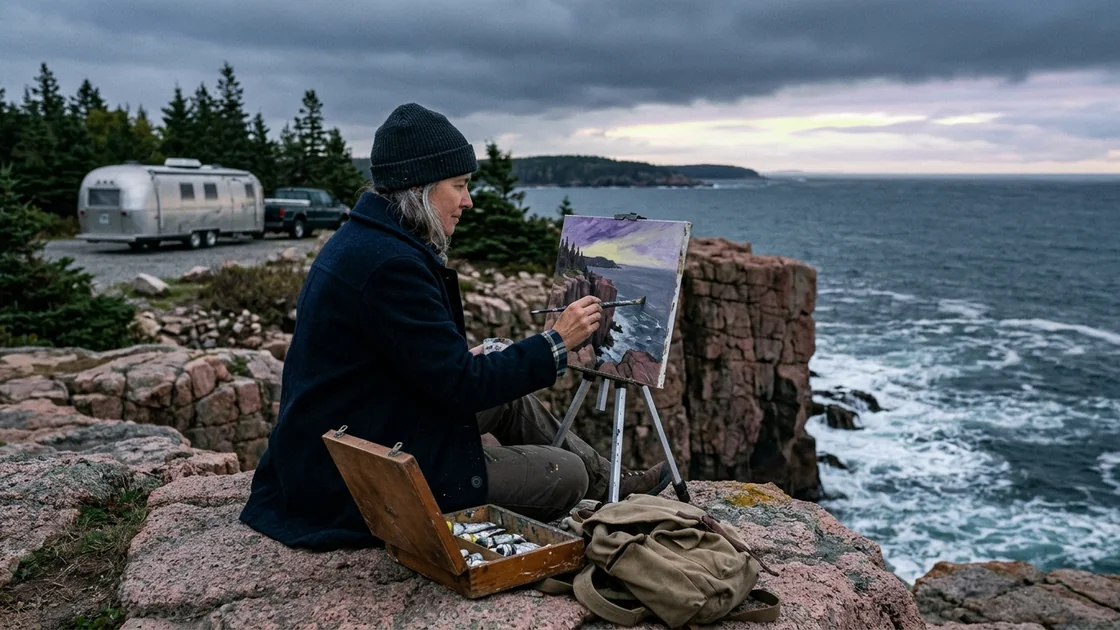
When her youngest son drove away toward college, Eleanor Vance sold her four-bedroom colonial in Ohio, purchased a polished 1974 Airstream Sovereign, and set out to find the exact coordinates of sixteen oil paintings left behind by her late mother. What began as a structured pilgrimage through America's national parks became an unmooring from thirty years of domestic routine, leading Eleanor through desert monsoons, high-mountain passes, coastal fog, and forgotten family secrets etched into linen canvas. Along the way, she learned that landscape was never merely a backdrop for memory, but an enduring conversation between the women who survived it.
Part I: The Geometry of Leaving
The house on Sycamore Lane did not empty all at once; it exhaled by degrees.
First went the twin mattresses, hauled down the curved staircase by two teenage boys who smelled of cedar deodorant and cheap cologne. Then went the rows of cracked paperbacks on European history, the lacrosse sticks with their frayed nylon pockets, and the heavy ceramic mixing bowls that Eleanor had used every Sunday morning since 1996 to make sour-cream pancakes.
When Caleb, her youngest, finally shut the passenger door of his rusted Honda Civic, the sound was surprisingly light. It was a dry, hollow snap, like a dry twig breaking beneath a boot in late November. He had leaned out the window, his jaw shaded by the patchy beginnings of a beard he was growing for his freshman year in Burlington, Vermont, and grinned with the terrifying carelessness of an eighteen-year-old on the brink of reinvention.
"Don't do anything crazy, Mom," he had shouted over the rattling muffler. "Don't turn my room into a pottery studio."
"I wouldn't dream of it," Eleanor had replied, her hands tucked deep into the pockets of her boiled-wool cardigan.
She had lied. She had no intention of making pottery. She had already signed the closing papers on the house three days prior.
The closing attorney, a man named Henderson whose father had handled Eleanor’s father’s estate, had peered at her over wire-rimmed bifocals in a conference room that smelled of toner and stale peppermint. "A cash buyer from Chicago, Eleanor. No contingencies. They want possession on the fifteenth of October. But where are you sending the net proceeds wire? You haven't listed a forwarding address."
"To the credit union," she had said evenly. "For now."
"And your residence?"
"Mobile."
Henderson had chuckled, assuming she meant she was renting an apartment while she shopped for a townhome near the country club, or perhaps looking at those low-maintenance patio villas out by the reservoir where widows played bridge on Tuesday afternoons. Eleanor let him chuckle. Let everyone think what they liked. For thirty-two years, Eleanor Vance had been predictable. She had been the treasurer of the library board, the woman who remembered which children were allergic to gluten at the soccer banquets, the daughter who visited the nursing home every Thursday with fresh gladiolus, and the wife who, during a clean and bloodless divorce seven years earlier, had asked only for the house, the station wagon, and custody of the boys.
Her older son, Marcus, was already an associate at a corporate firm in Charlotte, living in a loft with exposed ductwork and an espresso machine that cost more than Eleanor’s first three cars combined. Caleb was headed toward a degree in forestry or civil engineering—he wasn't sure which, only that he wanted to be outside. They were launched. They were projectiles fired into the future, their trajectories clean and irreversible.
The house, stripped of them, was simply eighty-four thousand cubic feet of heated air and mortgage payments.
In the center of the hardwood living room sat three things: an olive-drab canvas rucksack, a stack of road atlases with yellowing edges, and a narrow cedar trunk that had belonged to Margaret Vance.
Margaret had died eight years before Caleb graduated, leaving behind no life insurance, three silver-plated tea spoons from an excursion to Montreal, a pair of worn German field glasses, and sixteen unstretched oil paintings wrapped in heavy brown wax paper. Margaret had been an elusive, weather-beaten woman who spoke in declarative sentences and kept turpentine in recycled milk bottles. When other mothers in the 1970s were joining garden clubs and needlepoint circles, Margaret had disappeared for four or five months every other year in a Dodge Tradesman van with a rusted bumper, chasing light.
She had never exhibited her work in galleries. She had never tried to sell them. When Eleanor was a child, she had resented those disappearances with a sharp, tight fury that curdled behind her ribs. She had wanted a mother who packed crustless egg-salad sandwiches and stood behind the chain-link fence at softball games; instead, she had a mother who returned smelling of woodsmoke, piñon resin, and cheap linseed oil, her fingernails rimmed with permanent crescents of burnt umber and viridian green.
Eleanor opened the cedar trunk. The scent of aromatic wood and dried flax rose into the empty room.
She lifted the canvases out one by one. They were modest in size—none larger than sixteen by twenty-four inches—painted on linen mounted to heavy bookbinder’s board so they wouldn't warp in damp weather. On the reverse of each board, written in Margaret’s spidery, impatient hand in graphite pencil, was an identification:
1. Shenandoah – Old Rag Mountain from the Saddle Trail. October 4, 1968. 2. Great Smoky Mountains – Little River gorge, third bend above Elkmont. June 12, 1969. 3. Big Bend – South Rim over the Chisos Basin, late light. March 22, 1971. 4. Zion – The Temple of Sinawava after flash rain. July 18, 1972. 5. Grand Canyon – Below Moran Point, red shale bench. September 9, 1972. 6. Yosemite – Tenaya Creek below Pywiack Dome. May 30, 1974. 7. Lassen Volcanic – Chaos Jumbles, sulfur wash. August 14, 1974. 8. Crater Lake – Cloudcap Overlook, north by northwest. September 2, 1974. 9. Olympic – Hoh River Valley, nurse log maple cluster. October 11, 1975. 10. Mount Rainier – Reflection Lake with late melt. July 29, 1976. 11. Glacier – Grinnell Glacier tarn, ice melt green. August 19, 1976. 12. Yellowstone – Hayden Valley bison wallow, morning mist. September 14, 1977. 13. Grand Teton – Cascade Canyon, second footbridge. September 28, 1977. 14. Rocky Mountain – Dream Lake outlet, winter approach. November 3, 1978. 15. Badlands – Cedar Pass notch, pale mudstone shadow. June 5, 1979. 16. Acadia – Otter Cliff, low tide before sunrise. October 16, 1980.
After 1980, Margaret had stopped painting. Or she had stopped traveling. That was the year Eleanor turned fifteen, the year Eleanor’s father had finally walked out for good, and Margaret had put down her brushes to work forty hours a week as a receptionist at a plumbing supply warehouse in Akron. She had never talked about the parks. When Eleanor had once asked her why she didn't paint the backyard lilacs or the brick churches downtown, Margaret had wiped her spectacles on the hem of her apron and said, "Because they don't fight back, Eleanor. A house is just wood that gave up trying to be a tree."
Eleanor took a roll of blue painter’s tape and secured the wax paper around each board. She packed them into a custom-padded aluminum case she had bought from an audio-equipment liquidator in Cleveland.
Outside, in the driveway where the boys’ skateboards had once clattered over the expansion joints, sat the machine that was to be her new skin.
It was a 1974 Airstream Sovereign, thirty-one feet of curved aircraft-grade aluminum, bought from an elderly mechanic in Canton who had spent eight years gutting and rebuilding its chassis with stainless-steel hardware and modern wiring. Its exterior was not the blinding, mirror-polished silver of modern boutique trailers; it possessed the soft, frosted gleam of an old nickel, weathered by decades of interstate salt and western hail into a pale, dignified satin.
Inside, the mechanic had replaced the rotten vinyl and water-stained veneer with pale birch plywood, oiled to a dull gold. There was a two-burner cast-iron propane stove, a deep porcelain sink salvaged from an old schoolhouse, an eight-foot bench covered in heavy navy wool, and at the rear, nestled under the rounded end-cap windows, a double mattress tucked into a frame of dovetailed ash.
"You're sure about this, Mrs. Vance?" the mechanic, a thick-fingered veteran named Silas, had asked her while hitching it to her dark-green Ford F-250. "Thirty-one feet is a lot of tail to wag behind an eight-foot bed. She’ll pull straight, but when you back her into a tight timber stall in the dark with the rain coming down, you’ll think every tree has got an arm out to catch your bumper."
"I've backed horse trailers into three-sided barns in the dark, Silas," Eleanor had told him, adjusting her driving gloves. "And horses move around while you do it."
"Fair enough," he had grunted, handing her the brass keys on an unadorned iron ring. "Don't let the black tank freeze. And grease the sway bars every thousand miles, whether you think they need it or not."
Now, she carried the aluminum case of paintings out to the truck, locked it into the heavy steel tool vault bolted behind the cab, and returned to the front door of 442 Sycamore Lane. She left the keys on the granite kitchen island beside the garage remote and the paperwork for the lawn irrigation system.
She did not take a walk through the rooms to say goodbye. She did not weep on the threshold. She simply pulled the front door until the deadbolt clicked into the strike plate, walked down the flagstone path, climbed into the cab of the Ford, and turned the key.
The diesel engine rumbled to life, a low, thrumming bass that vibrated through the steering column into the small bones of her wrists. She checked her mirrors. The Sovereign sat behind her, sleek and seamless, reflecting the gray October sky and the red leaves of the neighboring maples like a curved mirror drawn across the landscape.
She pulled out of the driveway, her blinker ticking in the quiet cab, and turned South.
Part II: The Terracotta Epoch
The transition from suburban domesticity to the rhythm of the highway was not a poetic unfolding; it was an abrasive education in physics, weight distribution, and mechanical vigilance.
In the mountains of Virginia, along the spine of the Blue Ridge where she sought out Margaret’s first vista at Shenandoah, the rain fell in heavy, iron-gray sheets that turned the leaves on the asphalt into greasy parchment. The Ford climbed steadily, its turbocharger whistling softly beneath the hood, but behind her, the trailer was a live thing—a great, buoyant silver beast that surged on the downhill grades and pushed Eleanor against her seatbelt with thirty-one feet of momentum.
When she reached the crest of Old Rag Mountain, the mist was so thick that the summit existed only as a rumor behind a curtain of pearlescent white. She sat on an overturned granite milestone, Margaret’s 1968 board resting on her knees.
The painting was rougher than she remembered. In the foreground, Margaret had used a palette knife to lay down violent, jagged strokes of burnt sienna and indigo, capturing the fractured ribs of the metamorphic rock. There was no sentimentality in the work—no golden-hour glow, no delicate deer grazing in the gap. It was harsh, lonely, and muscular. On the back, her mother had written: Old Rag from the Saddle Trail. October 4, 1968. Wind out of the north. R. was late with the coffee.
R.
Eleanor tapped her finger against the wood. She had searched through her mother’s sparse correspondence before leaving, but there were no letters from an R. Her father’s name was Thomas. In 1968, her mother had been twenty-six years old, married to Thomas for three years, and Eleanor herself had not yet been born. Thomas Vance had hated camping. He was a man of flannel trousers, linoleum-floored insurance offices, and dry martinis at the Elks Lodge. He had famously declared that the only thing nature ever gave a man was poison ivy and an early grave.
"Who was R.?" Eleanor murmured into the damp fleece of her collar.
A raven croaked from the crown of a dead hemlock, shook the rainwater from its wings, and launched itself into the fog.
By November, Eleanor had crossed the Mississippi, left the hardwood forests behind, and entered the vast, flat reaches of western Texas. The landscape flattened, stripped itself of ornament, and expanded until the sky accounted for three-quarters of everything visible through the windshield.
She drove five hundred miles a day, her fingers developing rough calluses from the leather-wrapped wheel. She learned the rituals of the trailer: the distinct thunk of the leveling jacks hitting wooden blocks; the hiss of the propane pilot lights catching; the metallic clink of the heavy brass padlock on the hitch coupler; the specific, vinegar-sharp smell of the tank deodorizer. She learned to cook one-skillet meals of black beans, chorizo, and cornmeal mush over a flame no larger than her palm, washing her single cast-iron pan with coarse salt and an oily rag so as not to waste her thirty gallons of fresh water.
Big Bend rose out of the Chihuahuan Desert like an impossible dream of stone.
She parked the Airstream at the Rio Grande Village campground, where the cottonwood leaves were turning a brittle, papery yellow against the turquoise sky. The air was dry and smelled of dust, creosote, and the faint, sweet decay of river silt.
Canvas Number Three: Big Bend – South Rim over the Chisos Basin, late light. March 22, 1971.
To reach the South Rim, Eleanor had to hike. She was fifty-three years old, and though she had walked three miles every morning on the paved community trail back in Shaker Heights, carrying a daypack with three liters of water, an aluminum easel, and Margaret’s painting up the Laguna Meadow trail was an entirely different enterprise.
Her quadriceps burned with a steady, white-hot ache. The air thinned as she climbed above five thousand feet, wind gusting through the piñon pines and drooping junipers with a sound like a distant sea. Her heart hammered against her ribs, loud and rhythmic, reminding her of things she had forgotten: that she had blood; that she had breath; that she was a mammal moving across the surface of a turning planet.
When she crested the rim at three in the afternoon, the world dropped away.
Below her, the Chisos Basin plunged two thousand feet into a fractured wilderness of dry washes, purple ridges, and the distant, silver ribbon of the Rio Grande cutting through the limestone canyons toward Mexico. The horizon was not a line, but a vast, shimmering haze of rose and ochre where the earth curved into the afternoon sky.
She set her aluminum folding stool on the lip of the rock, weighted the legs with chunks of basalt, and unwrapped the 1971 painting.
She held the board up against the view.
Margaret had stood precisely here. The alignment was unmistakable: a peculiar, notched fin of volcanic rhyolite on the left margin intersected the high saddle of Emory Peak at exactly the same sixty-degree angle. But what stopped Eleanor’s breath was the color.
In Margaret’s painting, the basin was not the dry, sun-bleached khaki that Eleanor saw before her. It was rendered in deep, bruised violets, streaks of cadmium orange, and a strange, luminous emerald that seemed chemically impossible for a desert floor.
Eleanor sat for an hour, watching the sun decline toward the Mexican mountains.
And then, as the clock passed five, the light changed.
The sun slipped below a shelf of cloud over the Sierra del Carmen. Suddenly, the direct glare vanished, replaced by an enormous back-scattered glow from the western sky. The red dust suspended in the Chihuahuan air caught the raking beams. The shadows in the canyons deepened into pure violet; the sun-scorched scrub along the arroyos reflected the copper ceiling of the sky, turning into streaks of incandescent orange; and down in the basin floor, the low stands of mountain mahogany and sotol, hit by the blue light of the upper atmosphere and the yellow light of the horizon, ignited into that exact, impossible emerald Margaret had mixed on her palette fifty-three years before.
Margaret had not invented the colors. She had simply waited for them.
"You sat here until the dark," Eleanor said aloud, her voice small against the gulf of space.
On the reverse of the board, below the date, there was another pencil inscription that Eleanor hadn't noticed under the dim light of her Ohio attic. It was written in a firmer, rounder hand than Margaret’s—not graphite, but faded blue fountain-pen ink:
M.—If you lean any further over the ledge to catch that shadow, I'm tying your belt to the cedar stump. The stew is getting cold. —Ruth.
Eleanor let her thumb trace the ink. Ruth. Not a lover named Richard or Robert. Ruth.
Eleanor thought back through the fragments of her childhood. Aunt Ruth? There had been no Aunt Ruth. There had been an older woman who came to the house twice when Eleanor was seven or eight—a woman with short, iron-gray hair, an ivory linen shirt, and small turquoise rings on her knuckles who had brought Eleanor a carved wooden roadrunner from Arizona. Eleanor remembered her father’s cold, stony silence during those visits; remembered how he had sat in the den with the door closed, listening to the baseball game while Margaret and the woman sat at the kitchen table until two in the morning, their voices low and urgent over coffee cups that smelled of bourbon.
The woman had not visited again after 1973.
Eleanor packed the painting into her rucksack. She stood on the rim until the last light died out of the stone, then switched on her headlamp and began the long descent in the dark, her boots crunching steadily through the gravel under an ocean of stars so dense and brilliant they cast faint shadows on the path before her.
Part III: The Red and the Pale
In Zion, the world turned vertical.
Eleanor towed the Airstream up through the Virgin River gorge, the truck’s transmission temperature gauge creeping into the warm amber zone as she hauled the five-ton rig up the long, punishing grades of southern Utah. The red Navajo sandstone cliffs rose above the highway like petrified cathedrals, stained with vertical streaks of desert varnish—black iron and manganese oxides that ran down the cliffs like dried blood.
She camped at Watchman, under the shadow of a monolithic buttress of rock that glowed like an ember long after the sun had slipped behind the canyon walls.
Canvas Number Four: Zion – The Temple of Sinawava after flash rain. July 18, 1972.
She took the shuttle bus to the end of the canyon trail, where the Virgin River emerged from the Narrows. The day was overcast, heavy with the threat of an unseasonal winter storm coming out of the north. The air smelled of cold stone and wet sand.
The Temple of Sinawava was a natural amphitheater, its walls towering a thousand feet overhead, weeping water from hidden aquifers through beds of hanging maidenhair fern. When Eleanor reached the site, a light drizzle had begun to dimple the muddy water of the river.
She found the vantage point on a gravel bar guarded by three massive Fremont cottonwoods whose leaves had already fallen, leaving their pale, skeletal limbs stark against the wet, dark-red stone.
The 1972 painting was different from the earlier ones. The brushstrokes were looser, wetter, applied with a hurried, almost frantic tempo. The red of the sandstone cliffs was cut through with thick, impasto slashes of zinc white and pale cerulean, depicting waterfalls that did not normally exist—ephemeral torrents that poured over the canyon rims only during torrential downpours.
On the back: July 18, 1972. Sinawava. Water came in forty minutes. Ruth’s sketchbook washed halfway to the footbridge. We slept in the Dodge with the heater rattling. She says my work is getting too dark. I say the world isn't made of pastels.
Eleanor set up her small camping stool, pulled her waterproof poncho over her shoulders, and sat with the painting on her lap.
Visitors drifted past her in the drizzle—families wrapped in bright nylon rain ponchos, young German tourists with heavy trekking poles, a solitary elderly man who walked with a limp and nodded to her with the quiet camaraderie of people who did not mind getting soaked. None of them looked at the cliffs the way she was looking at them. They looked up with open mouths, snapped three digital photographs with their smartphones, and moved on toward the safety of the paved loop.
Eleanor didn't take a photo. She watched the water seep into the sandstone.
She was beginning to understand her mother’s trajectory. It was not a grand, romantic tour of the sublime, like the nineteenth-century expeditions of Thomas Moran or Albert Bierstadt, who traveled with pack trains and military escorts to produce six-foot canvases designed to convince Congress to preserve the wilderness. Margaret’s journey had been smaller, more desperate, and far more intimate. She was chasing something that could not be held: the five minutes after a deluge when the cliffs wept; the sixty seconds when the Chisos Basin turned violet; the frost that formed on the shale before the sun crested Moran Point.
And she had not been alone.
Ruth Harrison. Eleanor had found the name that morning after paying for a three-day pass to an ancestry database using the trailer’s cell booster.
Ruth Harrison had been an assistant professor of botanical sciences at Oberlin College from 1964 until her sudden resignation in 1974. She had specialized in desert cryptobiotic soils and the bryophytes of the Colorado Plateau. She had lived four miles from the house Eleanor grew up in. She had died in 1999, in a hospice care facility in Flagstaff, Arizona, with no surviving immediate family.
Eleanor touched the dried white paint of the ephemeral waterfall on the canvas.
In 1972, Eleanor had been seven years old. She remembered that summer. It was the summer she had stayed with her grandmother in Sandusky, eating strawberry gelatin with canned peaches and waiting for postcards that arrived three weeks after they were mailed. The postcards had always shown pictures of deer or mountains, with short, brisk notes: Saw a badger today. He was very busy digging for mice. Be good for your grandmother. Wash your neck. Love, Mother.
There had never been any mention of the rain that swept sketchbooks into rivers. There had never been any mention of Ruth.
Eleanor felt a sudden, sharp pang of anger, cold and sharp as the river water pooling around her boots.
Why hadn't Margaret told her? Why had she kept those summers locked away like contraband goods in the cedar trunk? Eleanor had spent forty years believing her mother was simply an eccentric, emotionally distant ghost who drifted through the periphery of their lives, indifferent to the rituals of family, only to find that her mother had lived with this ferocious, blazing intensity in the company of a woman whose name was never spoken at the dinner table.
"You could have said something," Eleanor whispered toward the dripping walls of Sinawava. "You could have told me who you were."
The canyon did not answer. The Virgin River continued its low, grinding friction against the boulders, tumbling tons of red silt toward the sea, careless of every woman who had ever wept or painted on its banks.
Part IV: The Great Mirror
Winter caught her in the high country of northern California.
She had bypassed the desert parks of Arizona for the moment, drawn northward by a strange, magnetic pull toward the Pacific Northwest. She towed the Sovereign across the Great Basin along Highway 50—"The Loneliest Road in America"—where the snow lay in clean, wind-sculpted drifts against the sagebrush, and the truck’s tires hummed an eerie, single-note drone on the salt flats.
She arrived at Lassen Volcanic National Park in late November, just before the high road was closed for the season. The park was deserted. The air was twenty degrees, crystalline and still, smelling of sulfur and frozen pine needles.
Canvas Number Seven: Lassen – Chaos Jumbles, sulfur wash. August 14, 1974.
The Chaos Jumbles was a vast, desolate rock avalanche that had fallen three hundred years before from the face of Chaos Crags, burying the forest beneath millions of tons of dacite boulders. Margaret’s painting was almost monochromatic: stark white snow, gray stone, and a strange, sickly yellow crust of sulfur along the margin of a thermal spring.
Eleanor walked among the boulders. Her breath hung in the frozen air like clouds of spun glass.
Her mobile phone rang—a thin, tinny vibration from inside the pocket of her down parka. She looked at the screen. It was Marcus.
She stepped behind a shoulder of rock to shield herself from the mountain wind and swiped the screen. "Hello, Marcus."
"Mom? Where are you? The connection sounds like you're inside a tunnel."
"I'm at Lassen. In California."
A long silence on the line. She could hear the faint clacking of a keyboard in the background—Marcus at his desk in Charlotte, surrounded by mahogany paneling and the low hum of the climate control.
"California?" he echoed, his voice rising half an octave. "What are you doing in California? Caleb said you bought a camper, but I assumed you were staying at that resort in Hilton Head for the winter."
"It's not a camper, Marcus. It's an Airstream. And I'm not in Hilton Head."
"Mom, you sold the house. You sold the house we grew up in without even telling us until the movers were already there."
"I told you I was downsizing," she said, her voice remaining calm, steady, anchored like the leveling jacks beneath her trailer. "You live in North Carolina, Marcus. Caleb is in Vermont. The house had six bedrooms if you count the finished attic. I spent thirty years sweeping rooms that nobody was standing in."
"That's not the point. The point is... it's erratic. You don't just sell your real estate and go wandering around the mountains like some kind of... of transient."
"I'm not a transient," she said, looking at the gray dacite boulders covered in lichens that had taken three centuries to grow two inches across the stone. "I am visiting some places your grandmother painted."
Marcus sighed—a sharp, exasperated release of breath that Eleanor had heard a thousand times from her ex-husband. "Grandma Maggie? Mom, Grandma Maggie was completely out of her mind. She spent forty years working in a warehouse and living in a duplex that smelled like turpentine and cat food. Why would you model your retirement after her?"
"Because she knew what things looked like," Eleanor said.
"What does that even mean?"
"It means I have to go, Marcus. The light is changing, and I have to hike back to the truck before the park service locks the gate at Manzanita Lake."
"Mom, wait—"
"I love you," she said. "I'll send you some dried apricots from the valley."
She hung up, turned off the phone, and slipped it back into her pocket. Her heart was beating fast, not with guilt, but with a strange, giddy exhilaration. She had never hung up on Marcus in her life. She had never hung up on anyone. She had been the great absorber of other people’s anxieties, the sponge that soaked up the spills of everyone else's domestic mess without ever leaving a mark on the counter.
She looked at Margaret’s canvas.
In the corner, where the sulfur wash met the snow, Margaret had scratched something into the wet pigment with the handle of her brush. Eleanor had never noticed it before. Under the sharp, unforgiving winter light of the real Lassen, the scratched letters were clear:
M.V. + R.H. — The world broke open here.
Part V: The Pacific Edge
She reached the Pacific coast at Olympic National Park in early January.
The rain was different here. It was not the theatrical deluge of Zion or the gray sleet of Virginia; it was an atmospheric condition, a permanent state of suspension where the boundary between the sea, the air, and the forest dissolved entirely.
She found a campsite at Kalaloch, perched on a bluff thirty feet above the wild, gray surf of the ocean. Below her, giant Sitka spruce logs, stripped of their bark and polished to the color of bone by the waves, lay tumbled across the beach like the ribs of stranded whales.
Inside the Airstream, the woodstove Silas had installed—a tiny, cast-iron marine stove meant for a sailboat—glowed a steady, comforting dull cherry red. Eleanor fed it small chunks of dried alder she bought from a native family down the road in Queets. The smell of the smoke was clean and sweet, mixing with the brine of the ocean and the damp cedar of the trailer’s frame.
Canvas Number Nine: Olympic – Hoh River Valley, nurse log maple cluster. October 11, 1975.
The Hoh Rain Forest was quiet with a silence that felt ancient, prehistoric, almost hostile to human self-importance.
Eleanor walked the Hall of Mosses trail. The Bigleaf maples leaned out over the path like giant, green-bearded sentinels, their limbs draped in long curtains of club moss that swayed in the imperceptible drafts of the understory. Every fallen log—some of them eight feet in diameter and two hundred feet long—was covered in a thick carpet of seedlings, ferns, and saplings that drew their life from the decaying wood of their ancestors.
Nurse logs.
She found the cluster from Margaret’s canvas three miles up the main river trail, beyond the tourist loops, where the path skirted an old meander of the Hoh.
The painting from 1975 was different from all the others. It was larger, painted with an extraordinary, microscopic precision that seemed at odds with Margaret’s usual bold, slash-and-run style. She had rendered every frond of licorice fern, every droplet of moisture hanging from the hanging moss, every red-orange spore capsule on the liverworts.
And in the center of the canvas, half-hidden among the sprawling roots of a western hemlock that had straddled its fallen mother-log, was a human figure.
It was the only human figure in all sixteen paintings.
It was small, viewed from the back: a woman in a gray wool jacket and brown twill trousers, her head tilted upward toward the canopy, a field notebook held loosely in her left hand.
Ruth.
Eleanor leaned her forehead against the rough, mossy flank of the hemlock.
The date was October 11, 1975.
That was the month Ruth Harrison had resigned from Oberlin. That was the autumn Margaret had come home to Ohio with her knuckles swollen and her eyes hollow, had packed her easel into the cedar trunk, and had told eight-year-old Eleanor that they were moving to the small brick house on Maple Street because her father had decided he wanted to live in Sarasota with his dental hygienist.
Eleanor had always assumed the divorce was about the hygienist.
Now, standing in the cathedral green of the rain forest, watching the water drip from the hemlock needles onto the exact moss that Margaret had painted forty-nine years ago, Eleanor saw the geometry of the tragedy.
The hygienist was simply the excuse. The world of Ohio in 1975 could not hold what had happened between Margaret and Ruth in this forest. It could not accommodate two women who lived in the back of a Dodge van, who mapped the mosses and painted the rain, who loved the world with a ferocity that made suburban tea sets and rotary telephones look like children's toys.
Ruth had left. She had gone to Arizona, to the dry, clean desert where things did not rot and decay under the weight of rain.
And Margaret had stayed behind to raise Eleanor.
She had worked at the plumbing supply warehouse. She had typed invoices for cast-iron elbows and copper pipe. She had worn polyester slacks and beige cardigans. She had baked the casseroles. She had attended the parent-teacher conferences. She had done everything that Eleanor had demanded of her—everything the world had demanded of her—and she had died with the smell of turpentine still clinging to her cedar trunk like a dried tear.
"You gave it up for me," Eleanor whispered.
The rain fell through the canopy, whispering against the leaves of the salal bushes.
"I didn't ask you to," she said, her voice catching on a dry, ragged edge in her throat. "I didn't know."
She sat on the wet bench beside the trail, her head in her hands, and cried for the first time since she had hitched the Airstream in Canton. She cried not for her own lost youth, not for the empty bedrooms on Sycamore Lane, not for the boys who had flown out into the world like arrows, but for the woman who had laid down her brushes so that a little girl could have a mother who looked like all the other mothers on the street.
Part VI: The High Passes
By June, the snows were melting from the northern spine of the continent.
Eleanor had turned the Sovereign east, towing her through the orchard valleys of Washington, across the dry coulees of the Columbia Plateau, and up into the ragged, glacial teeth of Montana.
Glacier National Park was just opening its high alpine transit when she arrived at West Glacier. Going-to-the-Sun Road was cleared of its winter avalanches, the fifty-foot snowdrifts along the Big Drift carved into vertical white walls by giant diesel snowblowers.
She could not tow the thirty-one-foot trailer over the pass—regulations prohibited any vehicle combination over twenty-one feet from attempting the narrow, cliff-hugging shelf road—so she pitched her basecamp at Apgar, beneath the lodgepole pines on the shore of Lake McDonald.
Canvas Number Eleven: Glacier – Grinnell Glacier tarn, ice melt green. August 19, 1976.
She took only the truck, leaving the Airstream behind like an anchor in the valley, and drove up to the Many Glacier valley on the east side of the Continental Divide.
The hike to Grinnell Glacier was six miles each way, climbing high above the turquoise chain of lakes that filled the valley floor. The trail was cut directly into the sheer face of the shale cliffs, the rock under her boots a dark, wine-red argillite shot through with bands of pale limestone. Small mountain goats, their winter coats shedding in ragged tufts of white wool, grazed on the ledges above her, indifferent to the three-thousand-foot drop below.
When she reached the upper basin, the glacier was there, resting in its stone amphitheater beneath the sharp arête of the Garden Wall.
It was dying.
Eleanor stopped at the edge of the terminal moraine, her lungs burning from the altitude.
She pulled Canvas Number Eleven from her pack.
The difference was terrifying.
In Margaret’s 1976 painting, the glacier had filled the entire upper basin—a massive, rumpled tongue of blue-white ice sixty feet thick, spilling directly into the tarn where small icebergs bobbed like floating islands. The color of the water was what Margaret had called ice melt green—a milk-thick, opaque turquoise caused by glacial flour, the finely ground rock dust suspended in the meltwater.
Before Eleanor, the glacier was a shadow of its former self. It had retreated up the rock shelf by hundreds of yards, divided into two smaller, shrunken patches of gray, crevassed ice that clung to the foot of the cliff like dying snowbanks. The tarn was twice the size it had been in the painting, its water a deeper, colder, more transparent blue.
Margaret had painted a body that was already disappearing.
Eleanor sat on a flat slab of red rock and looked at the canvas.
On the back: August 19, 1976. Grinnell. It is shrinking. You can hear it groaning in the heat. Ruth says everything that is beautiful is in the process of leaving. I told her that was an excuse for running away. She didn't argue.
The ink was Margaret’s. Ruth had not written on this board.
Eleanor looked up from the wood to the ice.
A chunk of the upper glacier, no larger than a small car, detached itself from the face with a sound like a rifle shot that echoed back and forth between the walls of the amphitheater. It slid down the polished rock, struck the water of the tarn, and sent a small, perfect series of concentric waves rippling across the surface, breaking against the shore where Eleanor sat.
Everything that is beautiful is in the process of leaving.
She thought of Caleb’s car disappearing down Sycamore Lane. She thought of Marcus’s hurried, impatient voice from his high-rise in Charlotte. She thought of her ex-husband’s gentle, apologetic shrug across the kitchen table when he had told her he didn't want to be married anymore.
They hadn't left because they were cruel. They had left because that was what things did. Rivers ran down to the sea; glaciers melted into tarns; sons grew until their limbs were too long for the beds their mothers had bought them; and light shifted across the face of a cliff until the violet became ochre, and the ochre became stone, and the stone was simply dark.
She took out a small sketchbook she had bought in Kalaloch—her own sketchbook, its pages blank and toothy.
She had not drawn anything since high school art class. Her hands were stiff, clumsy, used to the functional tasks of peeling potatoes, folding towels, and checking tire pressures.
She picked up an 4B graphite pencil.
She did not try to paint the magnificent, retreating glacier or the soaring crest of the Garden Wall. She drew the small, dead stump of a subalpine fir that clung to the rock beside her feet—its grain twisted by eighty years of alpine wind into a corkscrew of weathered fiber, its roots gripping a crack in the red shale with the stubborn, desperate tenacity of something that refused to be blown into the abyss.
Her lines were thick, uncertain, lacking her mother’s slashing confidence or Ruth’s botanical precision.
But they were hers.
They were Eleanor Vance, standing at six thousand feet above the level of the sea, making a mark upon the white pulp of the paper.
Part VII: The Unfinished Work
By September, she had reached the high plains of the Dakotas.
The Badlands were an alien landscape—a labyrinth of deeply eroded clay buttresses, sod tables, and knife-edge ridges of ash-gray and ochre mudstone that rose abruptly from the yellow sea of the buffalo grass prairie.
It was here, at Cedar Pass, that Canvas Number Fifteen had been painted: Badlands – Cedar Pass notch, pale mudstone shadow. June 5, 1979.
The Airstream sat in the loop at Cedar Pass Campground, the wind whistling through its roof vents with a dry, hollow piping sound. The weather was turning; the prairie autumn was short, violent, and cold, with afternoon temperatures dropping forty degrees in an hour as the Canadian fronts surged down across the plains.
Eleanor took Canvas Number Fifteen and Canvas Number Sixteen out of the aluminum case.
Number Fifteen was standard: the strange, pale, skeletal fluting of the Badlands formations under an overcast sky that looked like bruised lead.
Number Sixteen was the anomaly.
Acadia – Otter Cliff, low tide before sunrise. October 16, 1980.
It was unfinished.
The lower half of the linen board was covered in a rich, dark underpainting of raw umber and Prussian blue—the sea, churning against the base of the granite cliffs. The cliff itself was blocked out in heavy, rectangular slabs of burnt orange and violet. But the sky—the sky that should have contained the dawn, the first light of the United States hitting the easternmost edge of the continent—was blank.
It was bare, white gesso, marked only with three faint, diagonal charcoal lines indicating the tilt of the cloud deck.
And on the back of Number Sixteen, there was no inscription.
No date in graphite. No sarcastic comment about coffee. No scientific observation from Ruth.
Only a clean, white label that had yellowed around the gummed edges, bearing the stamp of the art supply store on High Street in Columbus where Margaret had bought her boards.
Eleanor turned the unfinished painting over in her hands.
In October of 1980, Margaret had not gone to Maine.
Eleanor remembered October of 1980 with terrifying, crystalline clarity. It was the month Eleanor had come down with spinal meningitis. She had been fifteen years old, lying in a darkened room at Children’s Hospital in Columbus, her neck so stiff she could not touch her chin to her chest, her brain burning with a fever that produced hallucinations of giant, silver insects crawling across the acoustic tile ceiling.
Margaret had been there.
For three weeks, Margaret had not left that room. She had slept in the brown vinyl recliner beside the bed, her face gray, her hands smelling of hospital soap instead of turpentine. When Eleanor had finally woken up, the fever broke and her vision clear, the first thing she had seen was Margaret’s face—not the fierce, wild face of the woman who climbed Old Rag or chased the shadows in the Chisos Basin, but the ruined, hollow-eyed face of a mother who had bargained with whatever gods there were to trade her own soul for the life of her daughter.
Margaret had bought the board for Acadia in September of 1980. She had planned the trip. She had prepared the ground with umber and blue.
And then Eleanor had fallen ill.
Margaret had never gone to Maine. She had never finished the sky. She had closed the box, put the cedar trunk in the attic, and gone back to the warehouse.
Eleanor sat on the edge of the ash-framed bed in the rear of the Airstream, the Badlands wind rocking the trailer on its dual axles with a gentle, oceanic rhythm.
"You didn't finish it," Eleanor said to the empty room.
She held the board against her chest, the dry linen rough against her wool sweater.
She had spent months looking for Margaret’s footsteps, looking for Margaret’s light, looking for the secret life Margaret had shared with Ruth Harrison. She had thought she was solving a puzzle—uncovering the hidden, radical woman who had been suppressed by the crushing weight of midwestern motherhood.
But the final painting was not about Ruth. It was not about the wilderness.
It was about Eleanor.
The silence on the back of Canvas Sixteen was the sound of a woman laying down her life so that someone else could have theirs.
Part VIII: The First Light
She drove through October without stopping for more than a night at a time.
She bypassed Ohio entirely. She took Interstate 90 east through the rolling hills of New York, across the Massachusetts Turnpike, and up the spine of Maine as the northern maples shed their final, fire-bright crowns of orange and crimson.
She reached Mount Desert Island on the fifteenth of October—forty-four years to the day after Margaret had purchased the board in Columbus.
The Airstream was parked at Blackwoods, nestled deep in a forest of coastal red spruce and balsam fir that smelled of salt, moss, and decaying needles. The campground was nearly empty; the season had ended, the water systems had been drained to prevent freezing, and the park was settling into its long, granite slumber.
Eleanor set her alarm for four-thirty in the morning.
When the bell rang, the trailer was freezing. The water in the kettle had a skin of ice over the spout. She did not light the stove. She pulled on three layers of wool, her heavy windproof parka, her gloves, and her knit cap.
She took Canvas Number Sixteen, her wooden sketching box, three tubes of oil paint she had bought in a small marine-supply shop in Bar Harbor, and a wide, flat badger-hair brush.
She drove to Otter Cliff in the absolute dark.
The road was empty. The stars were gone, hidden behind a high, thick ceiling of maritime clouds that moved out of the southeast on a cold, rising wind.
She parked in the gravel turnaround and followed the path through the stunted spruce trees to the edge of the cliff.
The Atlantic Ocean was invisible below her, but its presence was absolute—a massive, rhythmic roar of water rising and falling against sixty feet of sheer, vertical pink granite, sending plumes of spray into the freezing air that tasted of salt and kelp.
She found the vantage point. It was not difficult. Margaret had chosen her compositions with an engineer’s eye for structural geometry: the diagonal line of Otter Cliff plunging down from the left, meeting the horizontal horizon at precisely one-third of the canvas’s height.
Eleanor set her small easel on the granite ledge, weighting the tripod with her canvas rucksack.
She placed Margaret’s unfinished board on the shelf.
In the faint, pre-dawn grayness that was beginning to seep into the eastern horizon, the unfinished sky looked like a wound—a patch of pale, raw linen waiting for something that had been delayed for forty-four years.
Eleanor opened the sketching box.
She squeezed out three dollops of paint onto the wooden lid: titanium white, cadmium yellow light, and a deep, cold cobalt violet.
Her hands were shaking, not from the cold, but from a profound, terrifying vertigo.
She was not a painter. She was a woman who had spent thirty years organizing carpools, balancing checkbooks, and planting begonias in neat, rectangular beds along a concrete walkway. Who was she to touch this board? Who was she to finish what Margaret Vance had left silent?
The eastern horizon began to tear.
It did not break into golden sunlight. A storm was coming off the Grand Banks, and the under-belly of the cloud deck was a dark, bruised slate that caught the rising light before the ocean did.
A thin, razor-sharp sliver of pale, incandescent lemon yellow opened along the boundary where the sky met the sea. It was not warm; it was cold, electrical, brilliant—the light of a furnace seen through a crack in an iron door.
Above the yellow, the slate clouds turned a deep, luminous violet, shot through with gray streaks of salt rain already falling ten miles out to sea.
It was the exact, impossible sky Margaret had left empty.
Eleanor picked up the badger-hair brush.
She did not mix the paint on the palette until it was uniform. She loaded the bristles with the cobalt violet, tipped the corner into the cadmium yellow, and dragged the brush across the bare gesso of the board.
The oil paint caught the tooth of the linen.
The stroke was rough, uneven, trembling with the pulse of her wrist.
She loaded the brush again. Titanium white, cut with the yellow light, slashed across the horizon where the sea met the air.
She worked with a frantic, desperate concentration she had never felt in her life. The wind whipped her hair across her eyes, the spray from Otter Cliff settled in cold droplets upon her cheeks, but she didn't stop. She laid down the violet, swept the yellow beneath the dark belly of the clouds, and used the edge of her thumb—just as she had seen Margaret do forty years before—to smudge the transition where the storm rain dissolved into the gray ocean.
She did not paint Ruth. She did not paint herself.
She painted the dawn.
When the sun finally cleared the water, invisible behind the wall of the coming gale, the light on the canvas was complete.
The transition between Margaret’s forty-four-year-old brushstrokes and Eleanor’s wet, shining paint was visible—you could see the seam where the past met the present, where the mother’s silence ended and the daughter’s voice began. It was not seamless. It was a scar.
But it was whole.
Eleanor laid the brush down on the granite ledge.
She took the pencil from her pocket, turned the board over in the wind, and leaned it against her knee.
Below the yellowed label from the store on High Street, she wrote in her own neat, cursive hand:
Acadia – Otter Cliff. October 16. The sky was cold. Eleanor finished it.
Part IX: The Open Meridian
The storm held off until midday.
Eleanor sat inside the Airstream, the woodstove crackling with dry birch logs that filled the aluminum shell with the scent of winter. The sixteen canvases were laid out across the long navy-wool bench, side by side, forming a single, continuous horizon that stretched from the blue mists of the Appalachians, through the red canyons of the desert, into the green depths of the rain forest, and ending at the granite cliffs of Maine.
They were no longer her mother’s secrets.
They were her own territory.
Her phone buzzed on the birch table.
She picked it up. A text message from Caleb, followed by a photograph.
The photograph showed a small, wooden table in his dorm room in Vermont. On the table was a battered two-burner camp stove, a frying pan with two eggs, and a small, framed photo of Eleanor standing beside the Sovereign on the day she bought it in Canton.
The message read: Made pancakes. They weren't as good as yours. Where are you, Mom?
Eleanor looked out the curved rear window of the Airstream.
Through the spruce trees, the gray swells of the Atlantic were rolling into the cove, their white crests breaking against the pink granite with the steady, measured pulse of a clock that had been ticking since the world was formed from fire and mud.
She tapped the screen.
I'm at the edge of the water, Caleb, she typed. Heading west tomorrow.
She put the phone down, took her coat from the brass peg beside the door, and stepped out into the clean, cold air to grease the sway bars before the snow began to fall.