The Painted Herd of Peregrine Bay
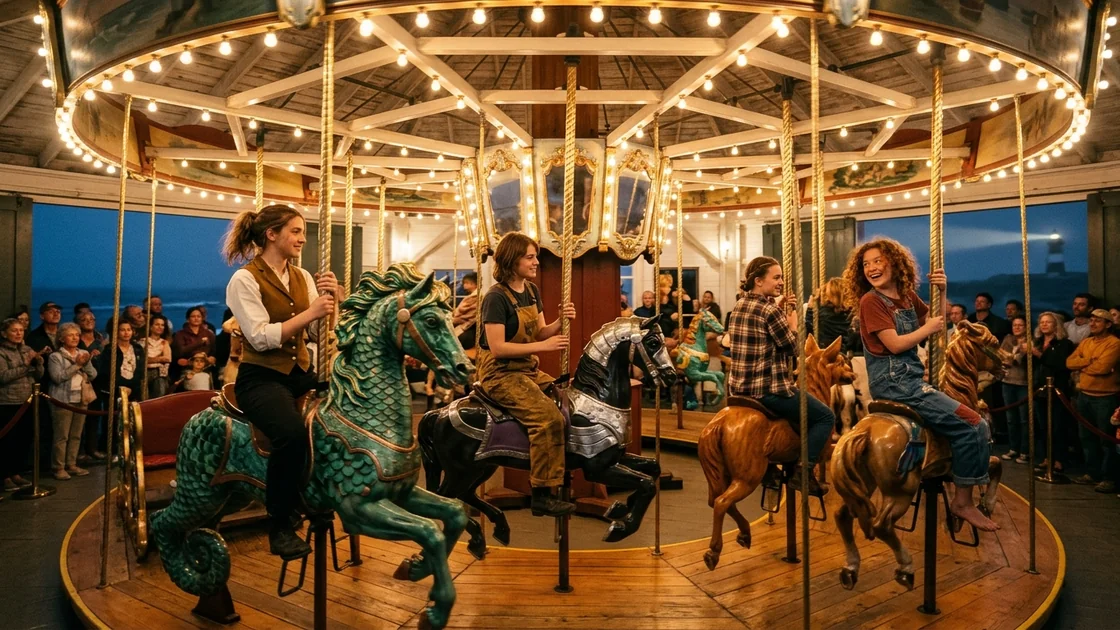
When their eccentric grandmother Beatrix Laurent dies and leaves behind a crumbling seaside carousel on the verge of municipal condemnation, four estranged cousins must put aside years of bitter silence to spend one humid summer restoring the handcrafted landmark. Gathered in the fog-drenched coastal town of Peregrine Bay, Maeve, Clara, Sloane, and Willa face rotted decking, seized bevel gears, and a hostile town council determined to replace the historic pier with luxury condominiums. As the women scrape away decades of salt-crust, repaint mythical wooden beasts, and rebuild the antique band organ, they uncover the buried family secrets that tore their mothers apart, discovering that repairing the carousel is their only chance to rebuild their own fractured lives.
Chapter I: The Reading on the Salt-Rot Pier
The envelope had arrived in four different mailboxes on the same rainy Tuesday in late May, smelling faintly of machine grease, dried lavender, and the sour brine of low tide.
Maeve Laurent had smelled it before she even sliced the heavy cream vellum open in her cramped Cambridge apartment. For ten years, Maeve had worked as an architectural conservator, spending her days with dental picks and scalpel blades, painstakingly removing coal soot from the pediments of Gilded Age brownstones. She knew the odor of decay intimately. It was a chemical signature—cellulose giving up its ghost, iron weeping rust into soft coastal pine.
When she stepped off the regional bus at Peregrine Bay three weeks later, the air carried that exact same smell, only magnified a thousandfold by the vast, indifferent Atlantic.
The boardwalk was largely abandoned. June had brought not sunshine, but a stubborn, freezing sea mist that clung to the pilings like wet wool. At the far end of the pier, looming out over the gray swells like a stranded, barnacle-encrusted ship, stood the Laurent Pavilion.
"You look like you're attending an execution," a voice called out from the shadow of the ticket booth.
Maeve stopped, adjusting the strap of her heavy canvas duffel. Emerging from the gloom was Clara, their cousin who had never left the county. Clara was dressed in oilskin overalls, her dark hair sheared practical and short at the jawline, her fingers permanently darkened around the cuticles by engine grease and marine varnish. Clara ran a small wooden-boat repair shed two coves over in Spaniard’s Harbor. Unlike Maeve, Clara had actually visited their grandmother Beatrix during the long decade of decline. She had also, Maeve remembered with a twinge of guilt, stopped answering Maeve’s occasional polite holiday postcards around year four.
"It might be an execution," Maeve said, her voice tight. "Have you seen the notices posted on the pilings?"
"Every day for six months," Clara replied, not offering a hug, not even extending a hand. She spat into the seafoam churn below the floorboards. "Arthur Vance and the town council have been drooling over this parcel since Beatrix’s first stroke. Ocean frontage, unobstructed view of the outer light, municipal water lines already hooked up at the street. If Vance gets his way, there'll be forty luxury duplexes with private moorings sitting on this pier before the frost hits."
Before Maeve could respond, the sound of hard heels clicking sharply against uneven decking echoed down the boardwalk.
Sloane appeared through the mist like an apparition from another tax bracket. She wore an immaculate camel-hair coat over tailored black trousers, carrying a leather briefcase that cost more than Clara’s truck. Sloane had been the child prodigy—the violinist who practiced six hours a day in Beatrix’s parlor until her fingers bled, who won the state conservatory scholarship at fifteen, and who had abruptly walked away from the stage at twenty-two to become a cutthroat intellectual-property strategist in Manhattan. She looked at the peeling turquoise paint of the pavilion with an expression of clinical disdain.
"Tell me the roof isn't leaking directly onto the machinery," Sloane said without greeting either of them.
"The roof isn't leaking directly onto the machinery," Clara said flatly. "It’s leaking directly onto the rounding boards, the center bearing, and the Wurlitzer. The machinery is just soaking in salt fog."
"Charming," Sloane muttered, checking her watch. "Where is Willa? If she doesn't show, the probate lawyer said the whole conveyance lapses automatically to the municipality."
"She’s here," a voice drifted down from above.
All three women craned their necks. Perched precariously on the copper-clad cornice of the pavilion’s cupola, twenty-five feet above the roaring surf, was Willa. She was barefoot, clad in faded denim overalls patched with scraps of floral feed-sacks, her long auburn curls pinned up haphazardly with a brass framing square. She was leaning out over the edge, squinting into the fog through an antique brass transit.
"Willa, get down from there before you break your neck," Maeve snapped, the reflex of being the oldest cousin returning instantly, sharp and unwanted.
"The cupola has settled three inches to the northeast," Willa shouted down, completely ignoring the admonition. She swung herself over the gutter with the careless grace of an alley cat, found the rusted rungs of the maintenance ladder, and slid down the final ten feet to drop onto the boardwalk with a dull thud. She smelled of turpentine and sweet clove cigarettes. "The king post has a twist in it. If we get a tropical depression out of the south, the whole crown is going into the drink."
The four of them stood in a lopsided circle. It had been seven years since they had occupied the same room—the funeral of Beatrix’s younger sister, an icy afternoon in March that had ended with broken china and screaming accusations in the parking lot of a lobster shack. They were four branches of a family tree that had splintered under the weight of pride, artistic jealousy, and their mothers' inherited grudges.
"Well," an older, reedy voice interrupted them. "At least you are all punctual. Beatrix always claimed none of you would show up until the wood was already being loaded into the incinerator."
Mr. Abernathy, Beatrix’s lifelong attorney, emerged from the shelter of the pavilion’s arched entryway. He carried a battered leather portfolio tied with frayed cotton tape. His face was weathered like driftwood, his rheumy eyes assessing each woman with dry amusement.
"Inside, ladies," he said, turning the massive iron key in the padlock of the pavilion doors. "Let us see if the old girl still has teeth."
Chapter II: The Sovereign Herd
The doors groaned open on rusted iron rollers, letting in the dim light of the sea-gray afternoon.
The pavilion smelled of eighty years of trapped summer: popcorn grease, damp horsehair, sulfur matches, ozone, motor oil, and the dry, sweet scent of seasoned basswood and sugar pine. Above them, the vast, vaulted ceiling arched like the ribcage of a leviathan, its radial rafters converging on a massive central king post thick as an old-growth redwood.
And there, suspended in the perpetual twilight of the circular hall, stood the carousel.
It was not a modern carnival contraption of molded fiberglass and blaring pop music. It was a masterpiece of the golden age of American woodcarving—Madame Laurent’s Celestial Carousel, commissioned by Beatrix’s father in 1912 and expanded by Beatrix herself over sixty years of solitary, obsessive work.
Thirty-six beasts stood frozen in three concentric rings on the massive, canted platform.
The outer row featured the Sovereign Herd—massive, stationary figures carved with an almost terrifying lifelikeness. There was a salt-stained Hippocampus with scales like hammered copper and eyes of blown green glass; an armored Warwick Warhorse whose nostrils flared with painted crimson rage; a towering Barnacle Fox gripping an ivory crab in its jaws; a Great Northern Lynx with tufted ears and silver leafing flaking from its flanks like winter dandruff; and at the lead, the Grand Stork, its six-foot wings folded back against its spine, carrying a carved basket containing three sleeping cherubs whose features bore an unsettling resemblance to the cousins when they were toddlers.
The inner rows were jumpers, suspended from fluted brass poles that ran into the overhead cranks: leaping dolphins, spotted fallow deer, sea dragons, snarling timber wolves, and long-necked ostriches.
Now, however, the sovereign herd was dying.
Green mold clung to the bellies of the jumpers. Salt air had oxidized the gold leaf to a sickly greenish-gray. The belly of the Great Lynx had split along a lamination seam, revealing the dark, hollow core where mice had built a labyrinth of shredded ticket stubs and insulation. The overhead platform was bowed like the deck of a foundering schooner. The mirrors on the rounding boards were clouded by dampness, their beveled edges peeling silver like dead skin.
At the center of it all, housed in a walnut cabinet carved with frolicking bacchantes, sat the Wurlitzer 105 band organ. Its facade was silent, its brass trumpets tarnished black, its tracker bar clogged with mud-dauber nests.
Mr. Abernathy cleared his throat, the sound echoing hollowly in the vast cavern. He drew a document from his portfolio.
"I will spare you the legal throat-clearing," Abernathy said, his voice flat and practical. "Your grandmother Beatrix Laurent was of sound mind, if entirely insufferable temperament, when she executed this codicil three months ago. She leaves the pavilion, the pier, the parcel of submerged tidelands, and Madame Laurent’s Celestial Carousel to the four of you in equal, undivided shares."
Willa let out a soft whistle. "The town offered four million for this footprint last winter."
"Don't start pricing sports cars yet, Willa," Abernathy countered, leveling a gaze over his half-moon spectacles. "The conveyance is subject to a condition precedent. You hold the title as joint tenants with right of survivorship for precisely ninety days. During those ninety days, you must perform a complete structural and mechanical restoration of the carousel and pavilion, bring it into compliance with the Commonwealth’s amusement safety standards, pass an inspection by the State Department of Public Safety, and operate the carousel for twenty-four continuous hours on Labor Day weekend."
"That's impossible," Maeve said immediately. Her professional training took over, cataloging the structural nightmares in rapid succession. "Look at that cant! The timber framing on the south quarter has dry rot. The overhead drive bevels are cast iron—they haven't been turned in a decade, which means the babbitt bearings have probably seized solid. And the carvings—you can’t just slap house paint on historic basswood! They need to be stripped to the bare wood, stabilized with reversible consolidants, gessoed, gilded, and sealed with marine spar varnish. Ninety days? It would take a crew of twelve conservators two full seasons!"
"And who pays for it?" Sloane demanded, crossing her arms, her knuckles white. "A restoration like that costs hundreds of thousands of dollars. Did Beatrix leave a trust? An operating account?"
"Beatrix died with two hundred and fourteen dollars in her checking account," Abernathy said smoothly. "She spent her last dime fighting Arthur Vance’s zoning variances. What she left behind is this: a workshop in the basement containing roughly four tons of cured white pine, five gallons of hide glue, thirty books of twenty-three-karat leaf, an unholy quantity of spare parts she stole from defunct boardwalks in New Jersey fifty years ago, and her tools."
Abernathy paused, folding the paper carefully.
"If the carousel does not spin under its own power, certified safe and inspected, by midnight on the Sunday of Labor Day weekend, the entirety of the property—pier, pavilion, and beasts—reverts to the Town of Peregrine Bay. Arthur Vance has already signed a memorandum of understanding with a development group out of Providence. The bulldozers are scheduled for September eighth."
"And if we refuse the bequest?" Clara asked, her voice dangerously quiet.
"Then it defaults to the town immediately," Abernathy said. "Vance’s demolition crew will begin tearing down the framing on Monday morning. The beasts, I understand, are slated to be sold at municipal surplus auction. Vance told the town paper he thought the hippocampus would look lovely mounted over the salad bar in the new clubhouse."
Silence fell over the pavilion. High above, through the cracked glass of the cupola, the wind wailed through the brass stay wires.
"That monster," Willa whispered. Her eyes, usually wild and laughing, had gone completely flat. "He always hated that she wouldn't sell to his father."
"You have twenty-four hours to accept or decline the terms," Abernathy said, offering a single fountain pen to Maeve. "All four signatures are required. If one says no, the pier falls."
Maeve looked at the pen, then at the Great Stork standing frozen before her. She remembered sitting in that carved basket when she was five years old, her grandmother standing on the stationary platform with an oil can in one hand, shouting over the bellowing pipes of the band organ: Keep your chin up, Maeve! A Laurent never lets go of the brass ring, even when the horse is bucking under them!
She looked at Clara, whose jaw was clenched so hard the muscles jumped beneath the skin. She looked at Sloane, whose polished veneer was cracking to reveal the terrified, fierce girl who had once played Bach partitas while the painted lions spun around her. She looked at Willa, who had spent her entire adult life running from home, but who now looked like she was ready to set fire to Arthur Vance’s office.
Maeve reached out and took the pen.
"Where do we sign?" she said.
Chapter III: The Anatomy of a Beast
The work did not begin with poetry; it began with forty tons of pigeon droppings, salt rot, and swollen oak.
The basement beneath the pavilion was a tidal cavern, supported by sixty-four stone and timber pilings that vanished into the black, sucking mud of the bay. Clara took command of the underworld. Armed with an antique hydraulic jack, a chainsaw, and a headlamp, she spent the first two weeks waist-deep in frigid sea water at low tide, inspecting the footings.
"The three central pilings are split," Clara announced on the fifteenth evening, clambering up the access hatch into the center of the carousel deck. She was covered from cheekbone to hip in black creosote mud and grease. "The original white oak has held, but someone in the seventies tried to sister them with cheap hemlock. It’s turned into sponge. If we put forty people on the deck and try to rotate the platform, the center bearing will drop four inches and shear the bull gear clean off the shaft."
Maeve, kneeling beside the Barnacle Fox with a heat gun and an assortment of dental curettes, didn't look up immediately. She was carefully testing the flaking layers of paint on the fox’s left ear.
"Can we jack the king post?" Maeve asked, blowing away a curl of scorched paint. "If we offload the weight with three screw jacks on the bedrock ledge, can we slide fresh greenheart pilings under the hub?"
Clara looked at her cousin with a flicker of begrudging respect. "Greenheart? Where the hell are we going to find marine-grade greenheart in Peregrine Bay on twenty-four hours' notice?"
"Old man Hendrickson's boatyard," Willa chimed in from the other side of the carousel. She was perched on an aluminum stepladder, applying chemical stripper to the gilded mane of the Warwick Warhorse with a horsehair brush. "He has three twelve-by-twelve baulks of Guyana greenheart sitting behind his saw-shed. They’ve been seasoning there since nineteen-eighty-four. He wanted five hundred bucks apiece for them."
"We don't have fifteen hundred dollars," Sloane said, walking in through the side door. She was carrying three grease-stained paper bags from the local diner and a legal pad covered in precise, tiny columns of figures. She had traded her tailored suit for an old flannel shirt of Beatrix’s, though she still wore her hair pinned back with clinical severity.
"We do now," Sloane said, dropping the bags on the ticket counter. "I spent the morning at the town clerk's office. It turns out Beatrix never filed for her state historic preservation exemptions on the property taxes for the last six years. Vance has been tacking on commercial penalties that were completely illegal under the Massachusetts Historical Commission charter. I threatened to file an emergency federal injunction against the town council for civil rights violations regarding municipal lien fraud. Vance’s town attorney went white as a scallop shell. They issued an immediate tax rebate credit of four thousand two hundred dollars."
Willa let out a whoop that bounced off the cupola rafters. "I knew there was a reason we let the lawyer back into the family!"
"I am an intellectual-property strategist, not a lawyer," Sloane said coldly, though the faint pink blooming on her cheeks betrayed her satisfaction. "And that money is strictly allocated: fifteen hundred for Clara’s timber, eight hundred for two drums of marine epoxy, six hundred for gold leaf and pigments, and the rest for the electric utility deposit. If we go over by twenty cents, we won't have enough to pay the inspector's filing fee."
The work shifted into a grueling, rhythmic exhaustion.
The carousel platform was sixty feet in diameter, divided into twenty-four pie-shaped sweeps of seasoned pine. Half of the sweeps had dry rot from rain leaking through the damaged canvas canopy. Maeve and Clara worked in tandem—Clara ripping out the infected sections with a circular saw, Maeve scarfing in new yellow-pine wedges, fastening them with counter-sunk bronze screws and waterproof resorcinol glue.
Every muscle in Maeve’s back screamed. Her hands, once smooth and accustomed to the climate-controlled rooms of fine arts museums, were blistered, calloused, and lined with black lead-paint residue. But as the days bled into late June, an odd transformation occurred within the pavilion.
The silence that had hung between them for years began to erode under the constant percussion of restoration.
"Why didn't you come home when mother was dying?" Clara asked abruptly one afternoon.
They were working on the belly of the Hippocampus. The beast had been unbolted from its brass hanger and laid out on heavy sawbucks like an immense patient on an operating table. The seam along its spine had split, exposing the internal hollow where the original carver had chiseled his initials: G.L. 1912.
Maeve stopped her scraper. The wood was cold under her palm. The bay was quiet outside; the tide was dead low, the smell of mud and bladderwrack thick in the air.
"Because your mother told me not to," Maeve said softly.
Clara dropped her chisel. "What are you talking about? She asked for you every week."
"She called me in Boston three months before the end," Maeve said, her voice shaking slightly despite her best efforts. "She told me that if I came back, it would just kill Beatrix faster. She said my mother had stolen the family trust to put me through conservatory school, and that every time Clara looked at me, she saw the reason her own father had walked out."
Clara stared at her, her eyes wide, the grease smudges on her forehead stark against her pale skin. "Maeve... Aunt Sarah didn't steal that money. Beatrix spent that money herself. She used it to buy the Wurlitzer from an amusement park that went bankrupt in Coney Island. Mother knew that. She just... she was so bitter that Beatrix loved the wood more than she loved her daughters. She couldn't stand that you had escaped."
Maeve looked down at the carved scales of the sea horse. Beneath five layers of oxidized tractor paint, she had uncovered the original ground layer: a brilliant, shimmering malachite green, mixed with ground abalone shell that caught the pale light from the cupola.
"We all thought the others were the favorites," Maeve whispered.
"Beatrix didn't have favorites among us," Willa’s voice came from the scaffolding above. She was hanging upside down by her knees, touching up a damaged fresco of a mermaid on the ceiling rounding boards. "She only loved two things: this damn machine, and watching us bleed for it. Look at this."
Willa tossed down a small, yellowed slip of paper she had pulled from behind a molding strip on the cornice. Maeve caught it.
It was a sketch in purple drafting pencil, dated July 14, 1998. It showed four girls sitting on the back of the Grand Stork, their legs dangling, their faces crude but instantly recognizable caricatures of mischief. Beneath the sketch, Beatrix’s jagged handwriting read: The herd only runs when the harness is shared. Idiots, all of them. But mine.
Clara picked up her chisel again, but her hands were less rigid now. "Get the hide glue hot, Maeve," she muttered, turning back to the seam. "This fish isn't going to fix itself."
Chapter IV: The Breath of the Wurlitzer
By the second week of July, the Sovereign Herd had been stripped of its dead skins.
The pavilion looked like an animal sanctuary after an air raid. The beasts were scattered across the floor in various stages of surgical reconstruction. The Barnacle Fox stood in raw, pale basswood, its hollow torso filled with fresh cedar blocking to shore up dry rot. The Warwick Warhorse was covered in white chalk gesso, smooth as bone, waiting for its base coats.
And then there was the band organ.
Sloane had claimed the Wurlitzer 105 as her personal battleground. She had approached it with the cold detachment of a surgeon, but within three days, the machine had reduced the sharp-edged Manhattan executive to a state of hollow-eyed obsession.
"It’s not just a mechanical music box," Sloane announced over coffee at 5:00 AM, her fingers tapping an erratic rhythm on the laminate diner table. Her fingernails, once impeccably manicured, were chipped and stained with orange shellac. "It’s a pneumatic computer. It has seventy-four wooden pipes, sixteen brass horns, a snare drum, a bass drum, and a glockenspiel, all operated by negative pressure through a tracker bar with perforated paper rolls. And the bellows are rotted to lint."
"Can you bypass it?" Clara asked, rubbing her eyes. "Can we just hook up a car battery and an iPod with some brass-band MP3s hidden in the cabinet? The inspector is only checking the mechanical rotation and safety brakes, isn't he?"
"No," Sloane said fiercely, her voice dropping into a register that made all three cousins look up. "If we put an iPod in Madame Laurent's cabinet, I will personally burn this pavilion to the water line. Beatrix didn't carve these animals to ride in silence. The music is the counterweight. The entire cadence of the rotation was designed around the tempo of the waltzes! When the machine reaches four-and-a-half revolutions per minute, the organ hits the downbeat of The Skaters' Waltz. The visual parallax matches the acoustic tempo. Without the organ, it’s just a meat grinder with wooden horses."
Maeve smiled faintly into her mug. The prodigy hadn't died; she had just been trapped in a corporate boardroom for ten years.
For the next three weeks, Sloane disappeared inside the walnut cabinet. She replaced ninety-six feet of rotting rubber tubing with lead and surgical gum. She cut new leather valves from kidskin scraps using Beatrix’s old razor strops. She rebuilt the primary and secondary bellows using heavy bellows cloth and hot animal glue, working inside a tent of plastic sheeting with a space heater to keep the glue from chilling before it seized.
One afternoon, a sharp rap echoed against the pavilion entrance.
Standing in the doorway was Arthur Vance, flanked by two men in high-visibility vests carrying clipboards. Vance was a man whose expensive linen suits couldn't conceal the aggressive posture of a former high school linebacker who had spent forty years getting his way in zoning meetings.
"Ladies," Vance said, not taking off his sunglasses as he surveyed the chaos. "I see you've made a magnificent mess. The Fire Marshal received an anonymous tip about unpermitted volatile organic solvents being stored on site. Marine epoxy? Turpentine? Lacquer thinner?"
Clara stepped forward, holding a two-foot-long framing mallet loosely at her side. "Everything is stored in OSHA-compliant steel flammables cabinets, Arthur. Inspected and tagged by the harbor master on Tuesday. Try again."
Vance’s smile didn't reach his eyes. He stepped onto the raw pine decking, his leather loafers squeaking on the fresh wood. He stopped before the Barnacle Fox, reaching out a finger to touch the unsealed basswood.
"Don't touch the carvings," Maeve said, her voice dropping into the icy, authoritative cadence she used with clumsy construction contractors on historic landmarks. "The oils on your skin will contaminate the gesso ground. Step behind the yellow line, Mr. Vance."
Vance slowly dropped his hand, turning to look at Maeve. "You always had your grandmother’s mouth, Maeve. But you don't have her money, and you don't have her time. In forty-two days, this lease expires. The building inspector has already drafted his preliminary structural review. The main ring gear has six cracked teeth. You can’t cast replacement gray-iron gears in forty-two days. Not for four thousand dollars. Not for forty thousand."
Clara’s jaw tightened, but she remained silent.
"We have a meeting of the Town Council on August twentieth," Vance continued, smoothing the lapels of his suit. "I’m willing to offer each of you twenty-five thousand dollars as an emergency relocation stipend if you execute an immediate deed of surrender. A hundred thousand total. That’s real money. You can walk away from this carcass with something in your pockets instead of salt spray and tetanus."
Sloane emerged from the depths of the Wurlitzer cabinet. Her face was smeared with graphite powder, her hair standing on end. She looked Vance up and down with the practiced eye of a woman who ate hedge-fund lawyers for breakfast.
"Section 106 of the National Historic Preservation Act," Sloane said clearly.
Vance blinked. "What?"
"This pavilion was listed on the National Register of Historic Places in nineteen-seventy-six," Sloane said, stepping forward, wiping her hands on an oily rag. "Any municipal acquisition utilizing state or federal development block grants—which your luxury marina project relies on for forty percent of its harbor dredging budget—is subject to mandatory review by the Advisory Council on Historic Preservation. If you demolish this pavilion without demonstrating an exhaustive structural impossibility of repair, I will file an Article 78 proceeding in federal court that will tie up your dredging permits until you are eighty-five years old. You won't break ground on a single duplex until your grandchildren are in college, Arthur."
Vance’s face darkened, the fake pleasantness dropping like a wet drape.
"August thirty-first," Vance hissed. "Midnight. The state safety inspector will be here at eight in the morning on Labor Day. If this platform doesn't make fifty consecutive cycles without a mechanical fault, the condemnation order will be signed on site. No extensions. No administrative appeals."
He turned on his heel and strode down the boardwalk, his two inspectors trailing behind him like gulls behind a trawler.
When his car doors slammed in the parking lot, Willa let out a long breath. "Is that true? The Section 106 thing?"
"Partially," Sloane said, turning back to the Wurlitzer. "Enough to buy us four days in front of an administrative judge if we need it. But the state safety test is real. If the ring gear fails under load, we’re finished. Clara—are the gear teeth really cracked?"
Clara looked at the center floorplate, her eyes grim. "Three of them are fractured clean through the root. If we put the motor to them, they’ll spit iron shrapnel through the floor."
"Then we don't use the motor," Clara added after a beat. "We do what grandfather did before they brought electricity to the spit."
Maeve looked at her, stunned. "The auxiliary drive? Clara, that was designed for a team of draft horses!"
"We don't have horses," Clara said, reaching for her grease gun. "We have an eighty-horsepower diesel marine winch out of an old lobster boat sitting in my shop. We’re going to run a flat-belt drive through the floor."
Chapter V: The Gold of the Kelpie
August brought the humidity that Peregrine Bay dreaded. The air became thick, salty, and hot as broth, turning the pavilion into an oven. Hide glue dried too fast; paint skins formed before the brush could leave the surface; tempers, already frayed by sixteen-hour shifts, began to spark like static on wool.
The focal point of the final push was the Hippocampus—or, as Beatrix had always called it, the Kelpie.
It was the largest beast on the carousel, anchoring the outer ring directly opposite the ticket booth. Beatrix had spent three years in the early nineteen-fifties carving the head alone. The mouth was agape, showing rows of ivory sea-beast teeth; the mane was composed of crashing tidal waves, each crest tipped with stylized sea spray; the hindquarters melted into the muscular coils of a serpent covered in thousands of individually carved fish scales.
Willa had taken ownership of the Kelpie’s paint.
She sat cross-legged on the floor, surrounded by small porcelain cups containing hand-ground pigments: genuine lapis lazuli for the deep ocean shadows, verdigris copper for the middle scales, and a brilliant, glowing cadmium lemon for the highlights. Beside her lay a gilded cushion of calfskin and a flat gilder’s tip made of badger hair.
"You're using the wrong size," Maeve said, leaning over Willa’s shoulder. She held a technical bulletin from the Smithsonian Conservators Guild. "The traditional size for exterior gold leaf is a twelve-hour lead-based varnish. You’re using water-based acrylic size. It won't withstand the marine dampness; it’ll bloom white in six months!"
Willa didn't stop her hand. She picked up a sheet of twenty-three-karat gold leaf—so thin it would disintegrate into dust if touched by human fingers—and transferred it to the Kelpie’s crest using static electricity from her own hair.
"Grandmother didn't use lead size on this horse, Maeve," Willa said, her voice strained with exhaustion. "I found her recipe in the margins of her sketchbook. She used boiled linseed oil, venice turpentine, and copal varnish. It flexes with the wood when the humidity shifts. If you use your museum-grade modern size, the first time the wood swells with the August fog, the gold will craze into spiderwebs."
"Willa, conservation science has progressed since nineteen-fifty!"
"And this carousel has survived eighty years in the salt without your conservation science!" Willa exploded, slamming the gilder’s tip down onto the bench. Her eyes flashed with tears of pure frustration. "You think everything can be fixed with a manual and a spreadsheet! You left! You went to Harvard, you went to Boston, you went to your clean, air-conditioned laboratories where everything is already dead and preserved in glass cases! Beatrix didn't carve these things to be preserved in glass cases! She carved them to be rode by greasy-fingered children who just ate cotton candy!"
The shout echoed through the pavilion, silencing the rhythmic sound of Clara’s pneumatic wrench and the whistling hiss of Sloane’s air lines.
Maeve stood frozen, her face pale. "I had to leave, Willa," she said, her voice dropping to a whisper. "I couldn't breathe here. Look at what this place did to our mothers. They spent their whole lives waiting for Beatrix to say they were good enough, and she never did. She just pointed at the carousel and asked why they hadn't finished the gilding on the rounding boards."
"She said it to me," Willa said, her voice cracking. She pulled her knees to her chest, her fingers stained with Prussian blue. "The night before she died. I was the only one here, Maeve. Clara was hauling a trawler off the rocks in Spaniard’s Harbor. Sloane was in Chicago. You were in Europe at some preservation symposium. It was just me and her in that cold house on the hill."
Clara and Sloane stepped quietly onto the platform, drawn by the raw pain in Willa’s voice.
"She couldn't speak clearly after the third stroke," Willa continued, her chin trembling against her denim knees. "She took my wrist. Her grip was like an iron clamp—her carving hand never lost its strength. She looked at me, and she didn't say she loved me. She didn't say she was sorry for driving my mother away to California. She just looked out the window at the pier and said: Don't let them burn the horses, Willa. The horses are the only part of us that doesn't rot."
Willa buried her face in her hands. The tears tracked through the blue pigment on her cheeks, leaving bright indigo smears across her skin.
Maeve stood motionless for three long seconds. Then, slowly, with an awkwardness that spoke of years of emotional isolation, she dropped to her knees on the sawdust-covered deck. She put her arms around her youngest cousin, pulling Willa’s head against her shoulder.
"We aren't going to let them burn the horses," Maeve whispered into Willa’s curls. "We aren't."
Clara sat down on the other side of Willa, her calloused, oil-stained hand resting firmly on the back of Willa’s neck. Sloane, after a moment of hesitation, sat on the edge of the Kelpie’s sawbuck, reaching out to clasp Maeve’s hand.
For the first time since they were children playing hide-and-seek among the uncarved basswood blocks in the basement, the four Laurent girls were silent together, not out of resentment, but out of a shared, terrible grief that was finally allowed to breathe.
Outside, the Atlantic broke against the pilings with a slow, relentless pulse. Inside, the gold leaf on the Kelpie’s crest caught the dying light of the afternoon sun, shining like a beacon in the cavernous room.
Chapter VI: The Night of the Nor’easter
Nature does not care about probate deadlines.
On August twenty-fourth, seven days before the state inspection, the barometer began to plummet. The local harbor radio started broadcasting gale warnings at noon: a late-season tropical storm had hooked north off Cape Hatteras and was racing up the eastern seaboard, gathering strength over the warm Gulf Stream waters.
By 6:00 PM, the sky over Peregrine Bay had turned the color of a bruised plum. The wind was shrieking through the pier pilings, throwing gray sheets of spray against the pavilion’s south windows.
"The south doors won't hold!" Clara shouted over the roar of the surf. She had spent the last two hours driving three-inch lag screws through the emergency storm shutters, but the sheer force of the wind was bowing the heavy pine doors inward like sails. "The surge is going to crest at ten feet! That puts the water level six inches above the platform deck!"
"The roof!" Willa cried, pointing upward.
A section of the copper flashing on the cupola had peeled back with a sound like tearing sheet metal. Rain was driving diagonally through the open clerestory windows, drenching the newly painted rounding boards and pouring directly toward the Wurlitzer’s open back.
"Sloane, get the tarps!" Maeve yelled. Her conservator’s panic was gone, replaced by an electric, clear-headed adrenaline. "Clara, we need to lash the jumpers! If the platform rocks under the surge, the brass hangers will bend!"
What followed was six hours of pure, unadulterated war against the Atlantic.
They worked by the erratic yellow light of battery-powered emergency lanterns, the municipal power having failed when an oak tree dropped across the wires on Ocean Avenue at 8:00 PM. The pavilion was a screaming madhouse of wind, rain, and groaning timber.
Maeve and Willa climbed into the roof trusses, hauled upward on hemp halyards by Clara. Swaying twenty feet above the spinning shadows, soaked to the skin by freezing horizontal rain, Maeve and Willa wrestled a sixty-foot vinyl trucker’s tarp over the cupola. Maeve’s fingers were numb with cold; twice the wind nearly plucked her from the purlins, but Willa’s iron grip on the back of her safety harness held her fast. Together, they drove roofing nails with wild, desperate swings, anchoring the vinyl against the shrieking gale.
Below them, Sloane was fighting for her life’s work.
Water was pouring across the floorboards. She had dragged heavy canvas sails over the walnut cabinet of the band organ, but the run-off from the north sweeps was pooling around the base of the machine. Sloane was down on her stomach with a hand-bilge pump, sucking water from the floor and discharging it out an auxiliary vent, her lungs burning, her muscles convulsing with exhaustion.
At 2:00 AM, the true crisis hit.
A massive rogue swell, driven by the spring tide and the storm’s eye, slammed into the seaward pilings of the pier. The entire pavilion lifted two inches, shrieked in mechanical agony, and dropped back onto its footings with a violent, shuddering crash.
A sound like a gunshot echoed from the central crawlspace.
"The king post!" Clara screamed from the hatch. "The secondary screw jack buckled! The center hub is shifting south!"
Maeve slid down the truss rope, scraping the skin off her palms, and plunged through the center hatch behind Clara.
The basement was a nightmare of black, surging water and creosoting stench. The tide was swirling around their waists, carrying pieces of driftwood and ancient floorboards like battering rams. The massive greenheart baulk they had installed three weeks earlier was holding, but the temporary hydraulic jack holding the north cant had tilted forty-five degrees, its steel piston binding in its sleeve.
The king post—the central axis of the entire carousel, holding forty tons of suspended timber and brass—was leaning. Above them, they could hear the horrific, dry groaning of the radial sweeps bending toward their breaking points.
"If the main shaft snaps, the whole roof comes down with it!" Clara roared through the spray. "We have to reset the mechanical screw! Now!"
The mechanical screw was a three-hundred-pound cast-iron house jack Beatrix had salvaged from an old rail depot. It lay half-submerged in the mud ten feet away.
Maeve didn't think. She plunged into the freezing black water, her boots sinking deep into the sucking tidal silt. Clara was beside her. Together, their chests burning, their teeth chattering violently, they grabbed the iron handles.
"On three!" Clara screamed. "One! Two! Lift!"
They heaved. The iron tore into Maeve’s palms, salt water burning her fresh scrapes like lye. For a second, the weight was absolute—an impossible, immovable deadness. Then, with a sucking gasp from the mud, the jack lifted.
They stumbled forward through the swirling surf, slamming the heavy iron base onto the granite footing beneath the king post.
"Willa! Sloane!" Maeve screamed up through the hatch. "The crank bar! Drop the five-foot pipe!"
An iron pipe clattered down through the opening, splashing into the water. Clara caught it, jamming it into the screw collar of the jack.
Together, their shoulders pressed against each other, their bodies shivering so violently their teeth clicked, Maeve and Clara threw their weight against the lever.
Click.
The screw turned one notch. Above them, the timber groaned.
Click.
Another notch. The greenheart baulk settled against the iron cap with a wet, solid thunk.
Click.
The agonizing groan of the overhead sweeps ceased. The king post straightened. The weight of Madame Laurent's Celestial Carousel settled back onto the earth, solid, immovable, and true.
Maeve collapsed backward into the waist-deep water, her head resting against Clara’s oilskin-clad shoulder. Clara was laughing—a wild, ragged, half-hysterical laugh that echoed through the dripping substructure.
"You're a maniac, Laurent!" Clara shouted over the storm.
"Takes one to know one, Laurent!" Maeve shouted back.
Above them, through the open hatch, came the reedy, sputtering, triumphant sound of Sloane’s band organ. Sloane had engaged the hand-crank on the organ's bellows, and through the howling dark of the Atlantic gale, thirty-six wooden pipes were coughing out the opening bars of The Liberty Bell March.
Chapter VII: The Dressing of the Herd
The storm died by morning, leaving the Atlantic flat, silver, and docile as a pond.
The final five days were an blur of mineral spirits, gold leaf, and high-tensile machine oil. The town of Peregrine Bay woke to find the pavilion still standing, its vinyl roof patch gleaming like an obscene black bandage in the August sunshine, but its structure intact.
Word had spread through the village.
It started with old man Hendrickson, who walked down the pier on Tuesday morning carrying a gallon of raw tung oil and a box of freshly baked blueberry scones from his wife. He didn't say much; he just set the scones on the ticket booth, unrolled his tool roll, and began planing the edges of the damaged south doors so they would shut flush against the jamb.
By Wednesday, three retired machinists from the nearby boatyards had appeared, lured by the rumor of Clara’s auxiliary diesel drive. They climbed into the basement with Clara, their ancient, gnarled hands caressing the flat-belt pulleys and babbit bearings, arguing in raspy down-east accents over the proper tensioning of the leather belts and the shimming of the gear-teeth.
By Thursday, the women of the local historical society were standing on stepladders along the perimeter, carefully cleaning the leaded-glass windows with vinegar and crumpled newspaper, their sharp tongues dissecting Arthur Vance’s family history back to the nineteenth century.
The carousel was being dressed.
Willa had finished the Kelpie. The beast was terrifying in its beauty. Its body gleamed with seven shades of blue and green, each scale individually outlined in pure ivory enamel. The waves of its mane were tipped with genuine gold that seemed to burn with an inner light whenever the sun hit the clerestory windows.
Beside it, the Barnacle Fox was finished in soft, burnt-umber oil glazes, its glass eyes catching the light with the cunning, wild intelligence of a living predator. The Warwick Warhorse stood regal and terrible in black lacquer and polished silver leaf, its armor plate etched with delicate scrollwork that Willa had copied from Beatrix’s sketchbook.
And at the lead, the Grand Stork shone with forty coats of hand-rubbed white dammar varnish, its huge wings protective and still over the three cherubs, who now had the unmistakable, bright-eyed smiles of three little girls who once believed their grandmother owned the sun.
Maeve stood on the edge of the platform on Friday night, holding a drop-light.
Every inch of the sixty-foot diameter was smooth, oiled, and flush. The bronze hangers had been polished until they looked like solid sunlight. The overhead rounding boards, restored by Maeve and Willa, told the complete allegorical history of Peregrine Bay: the arrival of the fishing sloops, the great storm of eighteen-ninety-eight, the building of the lighthouse, and Madame Laurent herself, depicted as a formidable woman in a high lace collar, holding a mallet in one hand and a chisel in the other, carving the world out of raw wood.
Sloane was sitting on the organ bench, carefully feeding a ninety-foot roll of perforated thick manila paper into the brass spools of the tracker bar. The roll was labeled: Laurent Master Roll No. 1 – The Grand Promenade.
"Will it play?" Maeve asked softly.
Sloane didn't look up, but her fingers lingering on the brass tracker bar were remarkably gentle. "It will play. Every valve is sealing at minus four inches of mercury. The trumpets are in tune. The glockenspiel has new felt dampers." She paused, then looked at Maeve. "I found a piece of paper taped inside the bass drum resonator."
Sloane pulled a small, yellowed index card from her pocket and handed it to Maeve.
It was in Beatrix’s handwriting, dated September 1, 1985—the day Sloane had given her first solo violin recital in the Peregrine Bay Town Hall.
Sloane plays like an angel who wants to pick a fight with God, the note read. Good. Music shouldn't be polite. It should leave a bruise.
Sloane looked away, staring toward the dark water beyond the windows. "I haven't touched my violin in four years, Maeve. After the firm made partner, I told myself I didn't have time for toys."
"This isn't a toy," Maeve said, gesturing to the silent, magnificent circle of beasts.
"No," Sloane said, a faint, rare smile touching the corners of her mouth. "It definitely isn't."
Clara emerged from the basement hatch, wiping her hands on her ubiquitous grease rag. Her face was gray with fatigue, but her eyes were clear.
"The winch is coupled," Clara said. "The governor is set for four-point-two RPM. If Vance wants to see fifty cycles tomorrow morning, he’d better bring a comfortable chair."
Chapter VIII: The Judgment of Arthur Vance
Saturday morning, August thirty-first, broke over Peregrine Bay with an azure sky so clear it hurt to look at. The sea had calmed to a deep, rolling blue, the gentle swell slapping rhythmically against the scrubbed pilings.
At 7:45 AM, the boardwalk was already lined with people.
Nearly three hundred townspeople had gathered—fishermen in rubber boots, summer residents in tennis sweaters, shopkeepers, kids on bicycles with rusted handlebars, and elderly women carrying folding aluminum lawn chairs. They stood behind the velvet rope the cousins had strung across the pavilion entrance.
At precisely 8:00 AM, a black Lincoln Town Car pulled up to the foot of the pier.
Arthur Vance stepped out, accompanied by three men. One was the town attorney; the second was the municipal building inspector; the third was a tall, stern-faced man carrying a heavy leather field kit—Chief Inspector Thaddeus Rourke of the Commonwealth of Massachusetts Department of Public Safety, Amusement Device Inspection Division.
Rourke was legendary in New England. He was the man who had shut down the historic coaster at Paragon Park; he was the man who had condemned three ferris wheels in Maine without blinking an eye. He cared nothing for history, nothing for sentiment, and everything for shear-pin tolerances and hydraulic deceleration valves.
"Ladies," Vance said, his voice loud enough to carry to the assembled crowd. He looked confident, immaculate in a light-gray summer suit. "The time is eight o'clock. Under the terms of the Laurent codicil, failure to demonstrate operational safety under the state amusement code by noon results in immediate administrative condemnation."
"The inspection was scheduled for eight, Arthur," Maeve said calmly, stepping forward. She wore clean khaki work pants and an ironed white linen shirt, her hair tied neatly at the nape of her neck. She carried a three-ring binder containing forty-two pages of engineering certifications, wood-density tests, and non-destructive weld inspections. "Inspector Rourke, we are ready for you."
Rourke gave a curt nod. "Clear the deck. No one on the platform except the testing engineer and myself."
Clara stepped up to the control station, her hand resting on the heavy bronze clutch lever that projected through the floorboards.
For the next two hours, the pavilion was a silent, agonizing torture chamber.
Rourke did not simply look; he dissected. He crawled beneath the sweeps with an ultrasonic flaw detector, testing the babbitt bearing housings. He measured the run-out on the main shaft with a dial indicator. He checked the lamination seams of every single beast on the outer ring with an infrared moisture meter. He inspected the emergency stop cable, the dead-man switch, the auxiliary hand-cranks, and the fire extinguishers.
Arthur Vance stood by the ticket booth, his arms crossed, his watch held ostentatiously in his left hand.
"Ten-thirty, Rourke," Vance murmured. "We have the Council meeting at one."
"Quiet, Arthur," Rourke said without looking up from the center hub. "I’m measuring the backlash on the pinion."
He stood up, wiped his hands on a clean lint-free cloth, and walked over to Clara.
"The auxiliary drive is unusual," Rourke said, his gravelly voice echoing in the hush. "A marine diesel winch connected via a tensioned flat belt?"
"It’s an authorized historical modification under Commonwealth Code 520, Section 5.04," Sloane spoke up, stepping forward with an open volume of the Massachusetts General Laws. "The original nineteen-twelve steam donkey engine was removed in nineteen-twenty-six and replaced with an identical belt-driven auxiliary arrangement. We have restored it to its nineteen-twenty-six operating specification. The mechanical speed governor is redundant, with an automatic centrifugal trip that drops the main clutch if the shaft exceeds four-point-eight revolutions per minute."
Rourke looked at Sloane over his wire-rimmed glasses, a faint twitch at the corner of his mustache. "I wrote that section of the code, counselor."
"I know," Sloane said without blinking. "I cited your nineteen-ninety-four monograph on kinetic amusement inertia in the compliance brief."
Rourke let out a dry, short grunt that might have been a laugh. He turned back to Clara.
"Start the engine, Miss Laurent."
Clara looked at Maeve, then at Willa and Sloane. She took a deep breath, reached down, and hit the starter switch for the marine diesel in the crawlspace.
A deep, throaty rumble vibrated through the floorboards—the smooth, confident purr of an eighty-horsepower Detroit Diesel, muffled by marine water-jackets. The floor hummed, alive with kinetic potential.
"Engage the herd," Rourke ordered.
Clara took the heavy bronze clutch lever in both hands. Slowly, smoothly, with the exquisite touch of a woman who knew the exact friction point of every fiber of seasoned leather, she pushed the lever forward.
The flat belt caught. The heavy cast-iron bull gear engaged with a low, metallic clunk.
Above them, forty tons of wood, brass, and gold began to move.
It did not shudder. It did not groan. It glided.
The Sovereign Herd woke up.
The Hippocampus leaned into the turn, its green and gold scales catching the bright morning sun through the windows. The Warwick Warhorse leaped forward, its silver armor gleaming like a brandished blade. The Barnacle Fox, the lynx, the storks, the dolphins, the spotted deer—all of them began their slow, majestic, circular promenade around the great central king post.
"Now, Miss Laurent," Rourke said, looking at Sloane. "Let’s hear the music."
Sloane stepped to the walnut cabinet. She engaged the vacuum bellows lever and flipped the toggle on the paper feed.
The Wurlitzer inhaled.
A soft, pneumatic hiss escaped from the tracker bar, followed by the deep, resonant thump of the bass drum. Then, with a bright, crystalline blast of thirty-two brass trumpets and forty-two wooden flutes, Madame Laurent’s Celestial Carousel burst into song.
It was The Blue Danube Waltz.
The sound was immense. It was not the tinny, digitized noise of a modern theme park, but the rich, acoustic roar of a thirty-piece mechanical orchestra. The wooden pipes spoke with warmth and breath; the glockenspiel rang like silver bells in a cathedral; the snare drum rattled with military precision.
Outside, the crowd on the boardwalk gasped, then erupted into wild, frantic cheering.
"Fifty cycles," Rourke shouted over the music, checking his mechanical stopwatch. "Continuous rotation. Commencing now."
The beasts spun. One cycle. Two. Five. Ten.
The motion was intoxicating. The canted platform created a perfect optical illusion—the outer ring seemed to float three inches above the stationary floor, while the jumpers rose and fell on their gleaming brass poles with the smooth, languid grace of diving porpoises.
Arthur Vance stood by the door, his face mottled red, his mouth a thin, furious slit. "This is absurd! The pavilion itself is structurally compromised! The roof—"
"The roof passed structural deflection review at eight-fifteen, Arthur," Rourke said without taking his eyes off the tachometer. "Twenty cycles. Shaft speed four-point-one RPM. Harmonic balance within zero-point-zero-three millimeters."
Twenty-five cycles. Thirty.
Willa suddenly grabbed Maeve’s hand. "Come on!"
"Willa, we can't—Rourke said no one on the deck!"
"To hell with Rourke!" Willa laughed. She leaped onto the moving platform with the effortless grace of a child, grabbing the brass pole of the Grand Stork.
Maeve looked at Rourke. The inspector didn't even look up from his clipboard; he simply made a tiny, almost imperceptible flick of his pencil toward the platform.
Maeve ran. She caught the mounting step of the Kelpie, swinging herself up onto the wide, carved leather saddle. The basswood was warm beneath her hands; the gold leaf of the mane flashed before her eyes.
Clara, leaving the clutch locked in its safety detent, leaped onto the platform next, mounting the Warwick Warhorse. And Sloane, stepping away from the organ cabinet with a wild, triumphant laugh that none of them had heard since she was twelve years old, swung herself onto the Barnacle Fox.
The four cousins rode.
They spun through the patches of sea-sunlight and shadow, their hair flying wild in the breeze created by the sixty-foot wheel. The music roared around them—the brass pipes singing of lost summers, old grudges, and the stubborn, immortal beauty of things made by hand.
Through the glass windows, Maeve saw the crowd surging forward. Children were pointing; old men were wiping their eyes with work-worn handkerchiefs; the entire town of Peregrine Bay seemed to be leaning toward the pavilion like flowers turning toward the sun.
"Fifty cycles!" Rourke’s voice cut through the crescendo of the waltz.
Clara reached out, caught the auxiliary trip lever, and smoothly disengaged the clutch. The marine diesel dropped to an idle. The heavy platform coasted, sixty feet of seasoned timber moving through the air with silent, majestic inertia, until it came to a rest precisely where it had begun eighty years before.
Silence fell inside the pavilion, broken only by the panting breaths of the four women and the ticking of the cooling machine.
Inspector Rourke systematically capped his fountain pen. He pulled a heavy brass seal from his kit, along with an adhesive inspection certificate printed on bright, indestructible orange vinyl.
He walked over to the main entrance column, peeled the backing from the certificate, and pressed it firmly against the raw, sanded pine.
COMMONWEALTH OF MASSACHUSETTS, it read. AMUSEMENT DEVICE PERMIT NO. 00412. STATUS: CERTIFIED FULL OPERATIONAL COMPLIANCE.
Rourke turned to Arthur Vance.
"Your condemnation notice is void, Mr. Vance," Rourke said flatly. "This device meets or exceeds every structural requirement under the state code. If you attempt to interfere with its operation, I will have the State Police cite you for municipal obstruction of a certified historic public conveyance."
He turned back to the four cousins, touched the brim of his fedora, and picked up his leather kit.
"Fine work, ladies," Rourke said quietly. "Your grandmother would have told you the jumpers were rising half an inch too slow on the south quarter. But she was never satisfied with anything."
He walked out through the doors, parting the cheering crowd like the bow of an icebreaker.
Chapter IX: The Labor Day Run
The line began at the pavilion doors and stretched six hundred yards down the boardwalk, past the salt-water taffy shop, past the bait dock, all the way to the municipal parking lot on Ocean Avenue.
It was 11:30 PM on Sunday night. The twenty-four-hour continuous run had begun at noon, and Madame Laurent’s Celestial Carousel had not stopped spinning for eleven and a half hours.
The admission was fifty cents—the exact price Beatrix had charged in nineteen-sixty-eight.
Willa was in the ticket booth, her cheeks flushed, her hair adorned with a spray of wild sea-lavender. She was cranking out serialized paper tickets from the brass dispenser with one hand and handing out Beatrix’s hand-printed postcards with the other.
"Next! Six jumpers, two stationary chariots open on the harbor side! Watch your step on the mounting deck!"
Clara was in the pit, monitoring the diesel with the proud, watchful eye of a mother wolf. The engine was purring at a steady eighteen hundred RPM, the flat-belt singing its smooth, leathery song, the grease cups on the babbitt bearings staying cool to the touch.
Sloane was at the organ, switching out paper rolls every forty minutes with the precision of a concert master. She had found Beatrix’s entire collection in the basement storage lockers: Sousa marches, Strauss waltzes, ragtime two-steps by Scott Joplin, and old sea shanties arranged specifically for the seventy-four pipes of the 105.
And Maeve stood on the platform, acting as ride master.
She wore a conductor’s brass-buttoned vest she had found in Beatrix’s closet. Her blistered hands were steady as she helped four-year-olds onto the back of the spotted deer, checked the safety belts on the Kelpie, and signaled Clara with two sharp tugs on the brass bell-pull.
The platform would engage. The organ would roar. The faces of the riders would blur into a spinning kaleidoscope of laughing mouths, wide eyes, and wind-blown hair.
At 11:58 PM, the final cycle of the mandatory twenty-four-hour period began.
The four cousins gathered on the moving platform, standing together in the open space beside the Grand Stork. Outside, the boardwalk was still packed with people, watching the illuminated cupola spin against the starry summer sky like a crown of amber fire.
"We did it," Willa whispered, leaning her head against Sloane’s shoulder.
"We have thirty-seven hundred dollars in the brass fare-box," Sloane said, though for once her mind wasn't on the balance sheet. "After we pay for the fuel and the insurance binder, we have enough to replace the cupola glass before winter."
"And Arthur Vance?" Clara asked, looking out the window toward the town hall, where the lights were dark.
"Arthur Vance resigned from the development committee this afternoon," Maeve said, pulling a folded copy of the town paper’s evening extra from her pocket. "The historic preservation easement was approved by the state secretary at four o'clock. The pier is designated as permanent public trust land. No one can ever build a condo on these pilings, Clara. Not now. Not in fifty years."
The clock on the Peregrine Bay church tower began to strike midnight.
One. Two. Three.
The Wurlitzer reached the grand, crashing finale of The Stars and Stripes Forever. The brass trumpets screamed their high, joyful counterpoint; the cymbals crashed; the bass drum drove the rhythm deep into the ancient white-oak pilings below.
Ten. Eleven. Twelve.
The ninety days were over. The title had vested.
The carousel was theirs.
Clara reached out and cut the drive. Slowly, with that long, majestic, velvet glide, the Sovereign Herd slowed. The music drifted down into a soft, dying sigh of air from the wooden pipes.
The platform stopped.
Outside, the crowd did not roar this time. Instead, a soft, spontaneous applause began—warm, sustained, and deep—rippling down the wooden planks of the pier and out into the salt-scented night air.
The cousins didn't get off the platform.
They sat down together on the fresh, honey-colored pine of the canted deck, their backs resting against the flank of the Grand Stork, their legs stretched out before them. Above them, the carved wooden faces of the herd looked down—the Barnacle Fox, the Warwick Warhorse, the Kelpie, and the Lynx—their glass eyes reflecting the warm amber lanterns of the pavilion.
Maeve reached out and touched the carved wing of the stork. For the first time all summer, she didn't feel the wood as an architectural artifact, a historical specimen to be preserved against decay. She felt it as an anchor—something heavy, deep, and beautifully stubborn that held all four of them fast against the tide.
"Same time next summer?" Willa asked, closing her eyes with a sleepy, contented smile.
Clara pulled her grease rag from her pocket, looked at it, and for the first time all season, tossed it carelessly into the waste bin by the gate.
"Same time next summer," Clara said.
Sloane leaned back against the stork's carved basket, her eyes tracing the circle of the ceiling frescoes. "I'll bring the music rolls."
Maeve looked out through the open doors toward the sea. The beacon of the outer light swept across the dark water, flashing white and steady against the horizon, once, twice, and always returning, regular as the turning of a wheel.
"I'll bring the gold," Maeve said.