The Overlapping Harvest
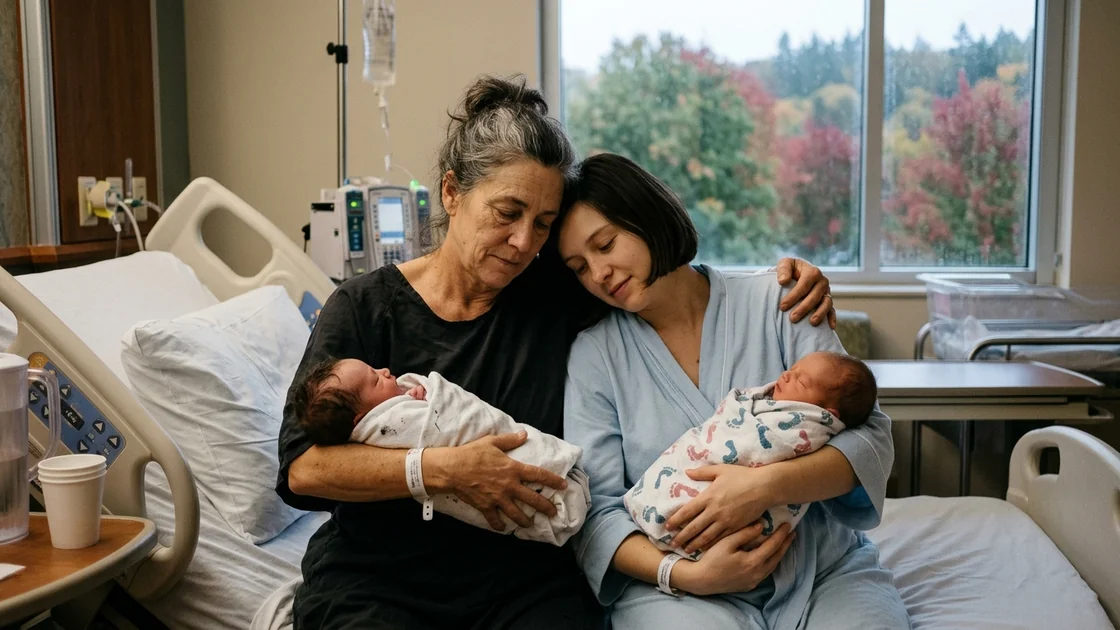
At fifty years old, Nora Miller believed her season of child-rearing was long behind her, leaving her to cultivate a peaceful midlife routine alongside her husband and run her botanical preservation studio. Everything fractures into disbelief during an intimate family dinner when her twenty-five-year-old daughter Chloe triumphantly reveals her first pregnancy, moments before Nora can process the terrifying medical confirmation that she herself is expecting an unplanned child at the exact same juncture of life. Caught between Chloe need for unshared maternal devotion and the biological shock blooming within her own aging body, Nora navigates months of unspoken resentment, generational friction, medical anxieties, and eventual reconciliation as both women confront what it means to yield and expand together.
Part I: The Salt and the Petal
The calendar on the wall of Nora’s workroom was an artisanal letterpress affair, thick linen paper imprinted with woodcut illustrations of medicinal roots: burdock for January, comfrey for February, valerian for March. Beneath the grid of April, where the squares were filled with tidy pencil notations regarding wholesale resin orders, silica gel drying cycles, and bridal bouquet deliveries, there were no red circles.
There had not been a red circle since the previous November.
At fifty, Nora had welcomed the absence. She had discussed it with her gynecologist, Dr. Jean Aris, the previous autumn over a paper-sheeted examination table. You are right on schedule, Nora, Jean had said, patting her knee with latex-gloved familiarity. Irregularity, hot flashes, fatigue. The ovaries are simply turning off the parlor lights and locking the front door. It is a completely natural transition.
Nora had celebrated by buying three silk shirts that could not easily be washed if stained, and an expensive, non-refundable weekend trip to Santa Fe with her husband, Julian, scheduled for late May. They had raised Chloe; they had survived Chloe’s turbulent adolescence, her undergraduate years at an expensive liberal arts college, her panicked twenties, and her lovely, pale-yellow wedding to Marcus two summers ago. The house in the foothills outside Portland was finally their own. Its pine floors, once dented by soccer cleats and littered with discarded sheet music, were polished to a dark, monastic gleam.
Then came the salt cravings.
It began in the third week of March. Nora found herself standing in the kitchen at midnight, eating pickled green beans directly from the jar with a silver dessert fork, her bare feet cold against the slate tiles. She blamed the salt on her low blood pressure. Then came the nausea, which she blamed on a bad batch of clams Julian had grilled on an unseasonably warm Sunday. But by the second week of April, when the scent of the mounting adhesive she used for her archival herbarium frames caused her to drop a pane of museum glass onto the floor, where it shattered into a hundred harmless diamonds, she stopped making excuses.
She did not buy a home test. At fifty, buying a plastic stick in a box adorned with stylized drawings of pink blossoms felt like an act of profound self-delusion, an absurd comedy she refused to perform before the twenty-year-old cashier at the neighborhood pharmacy. Instead, she called Jean’s office and asked for blood work, claiming she wanted her hormone levels checked to see if hormone replacement therapy might temper the sudden, violent waves of morning exhaustion that left her trembling over her worktable.
The call had come at two o’clock on a Tuesday.
"Nora," Jean had said. Her voice lacked its usual breezy, professional cadence. It sounded stripped, careful, and unnervingly quiet. "Are you sitting down?"
"I’m at my workbench," Nora replied, holding the receiver between her ear and her shoulder while using tweezers to arrange the dried petals of a wild dogwood. "I’m pinning specimens. Jean, if my estrogen is down to zero, just tell me. I can handle a patch."
"Your estrogen isn't down, Nora. Neither is your human chorionic gonadotropin." A long, agonizing pause hummed through the line. "Your hCG levels are nearly forty thousand. Nora, you aren't in menopause. You’re approximately eight weeks pregnant."
The dogwood petal slipped from the stainless-steel prongs. It drifted onto the blotting paper, frail as skin.
"That's biologically impossible," Nora said. Her voice was flat, an objective observation made about an improbable weather pattern. "I haven't had a period in six months. Julian and I... we haven't even been careless. We haven't had to think about that in seven years."
"The perimenopausal ovary can release an egg spontaneously after months of dormancy," Jean said gently. "It is rare. Exceptionally rare at fifty without reproductive intervention. But it happens. Nature is not an accountant, Nora. I need you to come in for an ultrasound tomorrow morning. We have to confirm viability and make sure it’s intrauterine."
Nora had hung up the phone without another word. She had not screamed; she had not wept. She had walked out of the studio, through the breezeway, and into the garden. The air was crisp, smelling of damp bark, cedar needles, and the rich, decaying mulch of winter. She stood beside her compost bin for twenty minutes, staring at the bright green shoots of early daffodils thrusting their heads through the sodden earth like stubborn, ignorant fingers.
She was fifty. In ten years, she would be sixty. When this hypothetical child finished high school, she would be nearly seventy years old. Her knees already clicked when she climbed the stairs carrying a basket of wet laundry. Her lower back ached if she stood too long at her worktable. Julian’s hair was completely silver at the temples, and he had recently taken up reading glasses with +2.00 magnification to examine his architectural joinery plans.
It was an absurdity. It was a clerical error of the flesh.
She had resolved to tell Julian that evening after dinner, when the light had drained from the hemlocks and they were sitting by the wood stove with their tea. She had mentally rehearsed the words three dozen times: Julian, something extraordinary and terrifying has occurred, and we have to decide what to do.
But she had forgotten that Tuesday was Chloe’s night.
Part II: The Announcement
Chloe arrived at six-thirty, accompanied by Marcus. Chloe did not simply enter a room; she colonized it with her vitality. At twenty-five, she was an event coordinator for an upscale boutique hotel in downtown Portland, a job that suited her manicured energy, her quick laughter, and her deep, unyielding terror of disorder. She wore a cream cashmere sweater that smelled faintly of sandalwood and expensive dry-cleaning, her dark hair cut into a sharp, chin-grazing bob that made her look older than her years, though her wide, hazel eyes—so like Nora’s—still held the urgent transparency of childhood.
"Mom!" Chloe called out, kicking off her boots by the entryway bench. "We brought the good bread from the bakery on 23rd. Marcus, don't put the wine on the radiator, it'll cook the Pinot."
Marcus, a gentle, broad-shouldered software engineer whose temperament was an enduring cushion against Chloe’s sharp edges, gave Nora a warm, apologetic smile as he set two brown paper sacks on the butcher-block island. "Hey, Nora. Julian out back?"
"He's stacking the seasoned oak before the rain starts," Nora said. She stayed on her side of the island, her hands gripping the edge of the wood counter until the knuckles showed white through her skin. A strange, sour taste had settled under her tongue since two o'clock—a metallic, copper tang that no amount of peppermint water could wash away. "You didn't need to bring wine, Marcus. We have plenty open."
"Oh, you'll want this one," Marcus said, grinning. There was an unusual flush in his cheeks, a vibrating excitement he couldn't entirely mask.
Chloe shot him a warning glare that was entirely devoid of malice. "Marcus, stop it. Don't ruin it."
Julian entered through the back mudroom, smelling of damp flannel and split wood, sweeping his boots across the coir mat. "Look at this," he said, smiling as he saw his daughter. "The working professionals grace us with their presence. Marcus, did you see the timber framing on that new library downtown? Disgraceful joinery. Exposed brackets everywhere."
"Dad, sit down," Chloe commanded, though her voice wavered slightly. She remained standing, her hands buried deep in the pockets of her high-waisted trousers. She waited until Julian had washed his hands at the sink and pulled out a chair beside Nora.
Nora looked down at her own lap. Her stomach felt hollow, yet swollen, as though an invisible balloon had been inflated beneath her ribcage. The secret burned in her throat like lye. She looked across the kitchen island at her daughter—her finished child. Nora had carried Chloe through thirty-six hours of back labor when she was twenty-five; she had nursed her through cracked nipples and mastitis; she had stayed up through chickenpox, middle school betrayals, the driving test failed twice, the broken heart over the boy with the motorcycle. They had arrived, finally, at the plateau of friendship. They exchanged podcast recommendations; they went to museum openings together; they were equal women in the world.
"Mom," Chloe said softly.
Nora looked up, forcing a neutral, maternal smile. "Yes, sweetheart?"
Chloe took a small, folded bundle from her pocket. She did not place it on the counter; she stepped around the island, knelt beside Nora’s chair, and laid it in her mother’s lap.
It was a pair of hand-knitted woolen booties, no larger than walnut shells, colored the pale green of lichen. Tucked into the cuff of the left bootie was a strip of thermal paper, curled tightly like a dried leaf.
"You're going to have to cancel that Santa Fe trip in May," Chloe whispered, her eyes filling instantly with bright, shimmering tears. "Or at least, you'll have to come back early. Because by November, you are going to be a grandmother."
Julian let out a sharp, ragged sound—half laugh, half sob—and instantly shoved his chair back, dropping to his knees beside Chloe to wrap his long arms around her. "Oh, honey. Oh, my girl. Marcus! You son of a gun!"
Marcus stood by the counter, rubbing the back of his neck, his face split into a wide, goofy grin of absolute triumph. "Ten weeks," he said proudly. "Everything’s measuring perfectly. Strong heartbeat. One hundred and sixty beats per minute."
Nora did not move.
Her fingers rested upon the microscopic woolen shoes. Beneath them, her own womb felt heavy, dark, and unimaginably ancient, like an abandoned cellar into which someone had recklessly tossed a burning match.
Eight weeks, Jean had said. Approximately eight weeks.
Her child was ten weeks. She was eight.
"Mom?" Chloe pulled back from Julian’s embrace, her forehead creased with the sudden, sharp prick of doubt. "Mom, are you okay? You look like you've seen a ghost."
Julian turned, his eyes wet, his smile faltering as he saw Nora’s face. "Nora? Sweetheart, what is it?"
Nora swallowed the copper in her mouth. She felt the sudden, terrifying vertigo of a woman standing on the edge of a balcony whose railing had just dissolved into mist. If she spoke now—if she opened her lips and uttered the truth that was rattling against her teeth—she would detonate the room. She would tear the banner of Chloe’s triumph from the ceiling and stomp it into the floorboards. Chloe had spent her entire youth measuring herself against Nora: Nora’s career, Nora’s marriage, Nora’s competence. This was the one thing that belonged purely to Chloe, the sacred threshold she was crossing first among her peers, coming home to lay her victory at her mother’s feet.
If Nora said, I am pregnant too, it would not sound like a miracle. It would sound like an obscenity. It would sound like an act of grotesque, narcissistic theft.
Nora inhaled, drawing the cold air deep into her lungs, and let the mask fall into place. It was the same mask she had worn when Chloe fell off her bicycle at seven and snapped her collarbone; the mask of absolute, unshakeable maternal calm.
"Oh, Chloe," Nora said, opening her arms and pulling her daughter against her breast. She squeezed her tightly, hiding her face in the soft cashmere of Chloe’s shoulder, feeling the rapid, youthful flutter of Chloe’s heart against her own ribs. "Oh, my darling girl. A baby. A baby."
Chloe melted against her, sobbing happily. "I was so scared to tell you. I thought you'd say Marcus and I were too young, that we haven't bought a house yet..."
"You are ready," Nora whispered into her daughter’s hair, though her eyes remained wide open over Chloe’s shoulder, staring directly at Julian, whose expression had softened into pure, sentimental joy. "You are completely ready."
And beneath the woolen booties in her lap, Nora’s own hands began to shake.
Part III: The Cloak of Silence
The bedroom was silent save for the rhythmic, metallic ticking of the antique mantel clock that had belonged to Julian’s grandfather. It was past midnight. Chloe and Marcus had left hours ago, their laughter lingering in the driveway like exhaust fumes before their taillights disappeared down the winding gravel road.
Julian was sitting on the edge of the mattress, unbuttoning his work shirt, a lingering, dreamy smile playing on his lips. "A grandfather," he murmured, shaking his head. "God, Nora. How did that happen? It feels like last week we were bringing Chloe home from Good Samaritan in that terrible foam car seat that kept tipping over."
Nora stood by the dresser. She had not undressed. She had removed her earrings and laid them on the porcelain tray, their faint click the only sound she had made in twenty minutes.
"Julian," she said.
He looked up, catching her reflection in the dark glass of the window. The smile faded from his eyes, replaced by a furrow of concern. "Nora? What's going on? You've been three thousand miles away all night."
Nora turned around. She reached into her pocket and pulled out the small piece of paper Jean’s nurse had faxed to her studio phone an hour before the dinner. She walked across the room and held it out to him.
Julian took it, squinting against the low light of the bedside lamp. "What is this? Lab results? Is this for your thyroid?"
"Look at the line item, Julian. Look at the reference ranges."
Julian read. His eyes moved left to right, then stopped. He shifted his glasses down the bridge of his nose. He read it again. He looked up at her, his brow bunched into deep, bewildered trenches. "Human chorionic... this is forty-one thousand. That's..." He laughed, a brief, nervous puff of air. "Is this a misprint from the lab? Did they mix your blood up with Chloe’s? Did Chloe have her blood drawn at the same clinic?"
"Chloe goes to a practice in the Pearl District," Nora said, her voice entirely flat. "I went to Jean. In Lake Oswego. Julian, I’m pregnant."
The room seemed to contract. The ticking of the clock grew brutally loud, each swing of the brass pendulum striking like a tiny mallet against bone.
Julian stared at her. His hands dropped to his knees, the paper fluttering between his fingers. "Nora. You're fifty."
"I am aware of my age, Julian."
"You went through menopause. You told me you stopped having periods."
"Perimenopause," she said, the syllables sharp as broken slate. "Apparently, the ovaries have an encore. Jean called it an unpredictable ovulatory surge. I am eight weeks along. The baby—the pregnancy—is due in late November. Exactly two weeks after Chloe’s."
Julian stood up so quickly his knees knocked against the mahogany bed frame. He began to pace the narrow strip of wool rug between the bed and the cedar chest, his hands running violently through his thick silver hair.
"No," he said. "No, no, no. This is... it's a joke. It's a tumor. Isn't there an ovarian cyst that secretes hormones? A teratoma? I read about that somewhere."
"I have an ultrasound tomorrow at eight in the morning," Nora said. "You can come and look at the screen if you think it's a cyst."
He stopped pacing. He looked at her as if she were a stranger who had climbed through the window, someone wearing his wife’s skin but possessing none of her familiar logic. "Nora. We are fifty years old. We were looking at houses in Provence for our fiftieth birthdays. We just finished paying off Chloe’s student loans. We were done."
"Do you think I planned this?" Her voice broke then, the icy composure shattering to reveal the howling terror beneath. "Do you think I want this? I am exhausted, Julian! I went to the grocery store yesterday and almost wept because the fluorescent lights made my head ache! I am fifty years old! I am supposed to be buying gardening gloves and thinking about retirement funds, not wondering if my uterine lining can support a placenta without detaching!"
Julian crossed the distance between them in two strides, pulling her against his chest. He was trembling. His heart was hammering against her collarbone with the frantic rhythm of a trapped bird.
"I'm sorry," he whispered into her hair. "I'm sorry. God, Nora. Your health. What does this mean for your body? Fifty... women don't have babies at fifty without teams of endocrinologists and donor eggs. It’s dangerous."
"It's high risk," she said, her voice muffled against his wool undershirt. "Advanced maternal age is an understatement. They call it 'very advanced maternal age.' Dr. Aris wants to do early genetic screening. The risk of chromosomal abnormalities is one in ten, Julian. One in ten."
Julian pulled back slightly, his gray eyes searching hers. "And if... if the screening is bad? What are we doing, Nora? What are we actually talking about here?"
Nora looked down at the floorboards. "I don't know," she whispered. "I don't know what I'm capable of. I don't know if I can end a life that somehow, impossibly, fought its way through fifty years of my body's decline. But I also don't know how I can look Chloe in the eye and tell her that her mother is having a baby at the same time she is."
"We don't tell her," Julian said instantly.
"What?"
"We don't tell her yet," he urged, his voice tightening with protective instinct. "Not until we know if it's viable. Not until the genetic panel comes back. Why break her heart or confuse her now? Let her have this week. Let her have this month. She’s been floating on air all evening. If this... if this doesn't continue, if your body miscarries, which Jean said is likely anyway, right? Then Chloe never has to know. No one ever has to know."
Nora felt a chill pass through her, cold as well water. "You want me to keep it a secret from our daughter."
"I want to protect you," Julian said, his eyes pleading. "And I want to protect her. Can you imagine what Chloe would do with this information? She would think it was about her. You know how she is, Nora. Everything is a referendum on her value. She would think you were competing with her."
"That's absurd," Nora snapped. "I am her mother."
"And she is Chloe," Julian countered softly. "She has spent twenty-five years trying to emerge from your shadow. If you walk into her nursery with a belly of your own, it will break something between you that we might not be able to fix."
Nora turned back to the window. Outside, the rain had finally begun, a soft, relentless drizzle that smeared the yellow porch light into a dull, watery halo. Deep in the pit of her stomach, below the salt cravings, below the fear, she felt a microscopic pulse—a stubborn, insolent flick of life that had no business being there, claiming space in a house that had already declared itself closed.
Part IV: The Gray Screen
The ultrasound room at the maternal-fetal medicine clinic smelled of isopropyl alcohol and hot electronics. It was dimly lit, the blinds drawn against the brilliant morning sun that washed the suburban medical park in cheerful, indifferent light.
Nora lay on the table, her skirt pushed down to her hips, her blouse pulled up to her sternum. The conductive gel was warm, a synthetic grease that felt slick and unnatural against her loose, pale skin.
Dr. Aris was not doing the scan herself; she had brought in Dr. Robert Chen, a perinatologist whose face possessed the grim, unreadable calm of an air traffic controller handling an emergency landing. Julian sat in a hard vinyl chair in the corner, his coat still zipped to his throat, his knuckles white against his knees.
The wand moved across Nora’s lower abdomen. The machine emitted a low, electronic hum, followed by the rhythmic, oceanic whoosh of blood rushing through the uterine arteries.
On the high-resolution monitor mounted to the wall, a gray, grainy landscape resolved. To Nora, who spent her life classifying the delicate structures of angiosperms and gymnosperms, it looked like a cross-section of ancient limestone: dark caverns, porous borders, shadowy depths.
"There's the gestational sac," Dr. Chen said, his voice level. He clicked a trackball, the sound loud in the quiet room. Two yellow crosses appeared on the screen, measuring a dark, oval void. "Implanted high on the posterior wall. Good position."
Nora held her breath. Julian leaned forward, his mouth slightly open.
"And here," Dr. Chen adjusted the probe, angling it downward with firm pressure that made Nora wince, "is the fetal pole."
Suddenly, the screen zoomed. In the center of the dark fluid hung a tiny, translucent shape, no larger than a kidney bean, curved like a cashew nut. And in the center of that shape, flickering with violent, electric precision, was a rapid white flutter.
Thump-thump-thump-thump-thump.
The sound burst through the machine’s speakers, filling the small room with the furious, galloping rhythm of an engine running at top speed. It did not sound old; it did not sound tired. It sounded like an unbroken wild horse running across a prairie.
"Heart rate is one hundred and fifty-four," Dr. Chen said, tapping the keys. "Crown-rump length measures eight weeks, three days. Nora, that puts your estimated due date at November twenty-fourth."
Nora stared at the flickering pixel. Tears, hot and silent, spilled over the outer corners of her eyes and soaked into her hairline. She felt Julian’s hand suddenly reach out and cover hers on the table. His fingers were icy, but his grip was crushing.
"It's... it's really there," Julian whispered, his voice cracking. "It’s not an error."
"It is very much there," Dr. Chen said, wiping the excess gel from Nora’s abdomen with a coarse paper towel. He swung the monitor away and turned his stool to face them, his expression settling into serious, clinical gravity.
"Nora, Julian. We need to talk about the road ahead. You are fifty years old. The statistics for a spontaneous pregnancy at this age are vanishingly small, but the risks are not. Preeclampsia, gestational diabetes, placental abruption, intrauterine growth restriction—these are real, statistically significant threats to you. And then there are the chromosomal risks. At fifty, the chance of Trisomy 21 is approximately one in ten. The chance of other aneuploidies is higher."
"We want the cell-free DNA test," Nora said immediately, sitting up and pulling her blouse down over her belly. Her voice was steady now, fortified by the mechanical reality of the heartbeat. "The NIPT. Take the blood today."
"We will," Dr. Chen nodded. "We can draw it right now. We'll have results in ten days. That will give us an accurate read on chromosomes thirteen, eighteen, and twenty-one, as well as the sex chromosomes. If those are clear, we will follow with an early anatomy scan at fourteen weeks, and if you choose, an amniocentesis at sixteen weeks to be certain."
"And if they aren't clear?" Julian asked, his voice raw.
Dr. Chen looked at them both with gentle, unblinking eyes. "Then we will discuss your options. You do not have to make any decisions today. But Nora, you need to begin high-dose folic acid immediately, and I’m starting you on low-dose aspirin to help prevent early-onset preeclampsia. No heavy lifting. No prolonged standing in your studio."
"I press flowers for a living, Dr. Chen," Nora said, a bitter edge entering her tone. "I don't haul gravel."
"You stand for eight hours over worktables," Dr. Chen replied smoothly. "And you carry flat-files and boxes of glass. That stops. Julian, make sure she sits down."
In the elevator down to the parking garage, they did not speak. The fluorescent lights overhead buzzed with a low, sickening hum. Nora clutched her handbag against her ribs, feeling the glossy printout of the ultrasound tucked into the inner zipper pocket like an unexploded grenade.
As they stepped into the gray daylight of the parking structure, Nora’s phone chimed in her coat pocket.
She pulled it out. It was a text from Chloe.
Mom! I made an appointment for us at the nursery boutique in the Pearl on Saturday! They have the organic linen bassinets I showed you. Marcus is playing golf with his dad so it's just us girls. Lunch at the French place after? My treat! Baby needs croissants!
Attached was an image of Chloe, smiling broadly in the mirror of an elevator, holding her flat stomach with both hands, wearing a pastel yellow trench coat.
Julian leaned over Nora’s shoulder, reading the screen. He let out a long, ragged sigh that smelled of stale coffee.
"What are you going to do?" he asked.
Nora looked from the bright screen of her phone down to the concrete floor of the parking garage.
"I'm going to look at bassinets," she said.
Part V: The Boutique on 10th
The boutique was named Légère, an airy expanse of bleached birch, muted sage linen, and white-painted brick that seemed designed specifically to convince affluent young parents that infancy was an orderly, fragrance-free aesthetic experience.
Chloe was already there when Nora arrived, standing by a display of Scandinavian cribs crafted from sustainably harvested beechwood. She looked incandescent. The morning sickness that had plagued her earlier in the week had temporarily relented, leaving her cheeks flushed with a delicate, petal-pink glow.
"Look at this, Mom," Chloe said without preamble, grabbing Nora’s wrist and pulling her toward a hanging rattan cradle suspended from a heavy brass ceiling hook. "It rocks with the baby’s own movement. Marcus thinks it’s impractical because we’re renting, but I told him we could reinforce the joist. Don't you love it?"
Nora looked at the cradle. A sudden, sharp wave of exhaustion pressed against the back of her eyes. Her lower abdomen felt heavy, tight with the low-dose aspirin and the silent, rapid cellular division taking place beneath her trench coat. She had dressed with surgical precision that morning: an oversized charcoal wool tunic that hid the slight, thick softness of her waistline, dark leggings, and flat leather boots.
"It's very beautiful, Chloe," Nora said, keeping her hands firmly tucked into the pockets of her coat. "Though Marcus might have a point about the ceiling joist. In an older rental, plaster can crack if the weight isn't distributed evenly across two studs."
Chloe’s face tightened by a fraction of a millimeter—the familiar, reflexive irritation that always surfaced when Nora offered structural reality in exchange for Chloe’s aesthetic vision.
"We'll have a contractor look at it," Chloe said briskly, moving toward a rack of organic cotton onesies arranged in gradients of oat, clay, and washed eucalyptus. "Everything doesn't have to be a disaster waiting to happen, Mom. You always look for the structural failure first."
"I look for safety, sweetheart. There's a difference."
"Well, Marcus says I'm nesting early," Chloe laughed, her irritation dissolving as she picked up a miniature ribbed bonnet. "I know it's crazy. Ten weeks is early. But I just feel like... my whole life was leading up to this, you know? Like everything I did before—college, the PR firm, the wedding—was just killing time until I became someone’s mother."
She turned, holding the bonnet against her own chest, her eyes wide with a luminous, terrifying vulnerability.
"Did you feel that way? When you had me?"
The question hung between them, suspended over the table of $40 organic baby rattles.
Nora swallowed. She remembered being twenty-five. She remembered the sheer, suffocating terror of holding Chloe in the hospital room, looking down at that angry, mottled face, and realizing that her own private existence had just been permanently revoked. She had loved Chloe with a ferocity that bordered on illness, but she had never felt that her life before was just killing time. She had loved her painting; she had loved her solitude; she had loved the person she was before the milk came in.
"I was terrified, Chloe," Nora said honestly. "I loved you immediately, but I didn't feel complete. I felt dismantled."
Chloe’s expression chilled. She set the bonnet back on the wooden shelf with deliberate slowness. "Right. Well. You were always very focused on your work."
"That isn't what I meant—"
"I want to feel complete," Chloe said, her voice dropping into a register that was quiet and fiercely defensive. "I want to give this baby everything. I don't want to be the kind of mother who is always checking the clock to see when she can go back to her studio."
The slap could not have been louder if Chloe had struck her across the face.
Nora stood frozen beside the display of oat-colored swaddles. The metallic taste flooded her mouth again, hot and sickening. She wanted to unbutton her coat. She wanted to pull out the ultrasound photo from her purse, slam it onto the bleached birch table, and scream: I gave you twenty-five years! I built my entire life around your fragile, selfish demands! And right now, inside this fifty-year-old body you think is so cold, there is another heart beating!
Instead, her stomach gave a violent, rebellious heave.
The scent of the boutique—a mixture of expensive soy wax, lavender laundry detergent, and fresh paint—suddenly concentrated into a toxic fog. Nora’s vision went dark at the edges, the white brick walls dissolving into gray static.
"Excuse me," Nora whispered.
She turned and rushed blindly toward the back of the store, pushing past an astonished sales associate holding a wooden balance bike. She found the single-occupancy restroom, locked the brass bolt behind her, and fell to her knees before the white porcelain basin, retching violently until her ribs screamed with fire.
She knelt there on the cold hexagon tiles for a long time, her forehead pressed against the edge of the sink, listening to the muffled sound of boutique lullaby music drifting through the louvered door. Her breath came in short, ragged gasps.
A soft knock rattled the wood.
"Mom?" Chloe’s voice was hesitant, stripped of its defensive armor. "Mom, are you okay? Did you eat something bad?"
Nora dragged herself up using the chrome plumbing beneath the sink. She rinsed her mouth with cold water, washed her face, and patted her skin dry with a brown paper towel. Her face in the mirror was pale, the skin around her eyes drawn and lined with deep, dark crescents of purple. She looked every single one of her fifty years, and then some.
She opened the door.
Chloe was standing in the narrow hallway, her brow furrowed with genuine worry. "Mom, you look terrible. What is wrong? Is it the flu? Should we go to urgent care?"
Nora leaned against the doorframe, her legs trembling. She looked at her daughter’s smooth, youthful face, unmarred by time, unmarred by the terror of a body that was breaking its own treaties.
"It's not the flu, Chloe," Nora said. Her voice was barely a whisper, but the narrow hallway amplified it, turning it flat and heavy as lead.
"Then what is it? You've been acting weird since Tuesday. You didn't even look at the nursery prints I sent you."
Nora reached into the pocket of her trench coat. Her fingers closed around the folded, thermal paper printout from Dr. Chen’s office. She did not throw it. She did not slam it. She simply held it out between two fingers, her hand trembling so violently that the paper fluttered like an aspen leaf in high wind.
"I had an appointment yesterday morning," Nora said.
Chloe took the paper. She frowned, turning it toward the hallway sconce. "What is this? Is this... did you have an MRI? Mom, do you have a growth? Is it cancer?"
"Look at the letters in the corner, Chloe," Nora whispered. "Look at the gestational age."
Chloe’s eyes tracked down to the bottom of the black-and-white image. She read the letters aloud, her voice small, detached, like a child reciting a Latin lesson: "GA: 8w3d. EDD: 11/24. Miller, Nora."
Silence fell over the corridor, so profound that the hum of the store's air conditioning sounded like a jet engine idling on a tarmac.
Chloe’s gaze moved from the thermal paper to Nora’s face, then slowly down to Nora’s charcoal wool tunic, and then back up to her mother’s eyes. Her hazel irises were completely dilated, swallowed by black pupils.
"This isn't yours," Chloe said.
"It is mine, Chloe."
"No," Chloe laughed, a high, thin, hysterical sound that caused a shopper in the next aisle to turn and look toward the corridor. "No, it isn't. You're fifty years old. You're menopausal. You're... you're done."
"Chloe, please—"
"Did you do IVF?" Chloe stepped back, her voice rising in pitch, her eyes wild with sudden, blistering outrage. "Did you and Dad do this on purpose? Were you secretly doing treatments behind my back? Did you know Marcus and I were trying? Did you decide you couldn't stand me having something of my own?!"
"IVF?" Nora gasped, staggered by the accusation. "Are you insane? Why on earth would I do IVF at fifty? Julian and I didn't want this! We didn't plan this! It is an accident of nature, Chloe! A medical freak occurrence!"
"An accident?" Chloe’s voice cracked into a sob that she instantly choked back, her face turning crimson with a mixture of humiliation and fury. "An accident? You always lectured me about birth control! You spent my entire teenage years telling me how careful I had to be, how one mistake could ruin my life! And now you're telling me you were sleeping with Dad without protection like a couple of teenagers?!"
"Chloe, lower your voice," Nora said, her own temper flaring through the nausea. "I did not ask for this. I have spent the last three days terrified out of my mind that I am going to have a stroke, or a miscarriage, or that the genetic tests will come back with a fatal abnormality. I am fighting for my life here, and all you can think about is—"
"All I can think about?" Chloe shouted, no longer caring who heard her. Tears were streaming down her face now, ruining the careful mascara, turning her into the frantic, furious sixteen-year-old who used to slam the bedroom doors until the frames rattled. "This was my time! This was supposed to be about me! I am twenty-five years old, I am married, I did everything the way you wanted me to do it! And you couldn't even give me nine months! You had to go and get pregnant at the exact same time, with your ancient, dried-up body, just to make sure everybody was looking at you!"
"Chloe!"
"Don't touch me!" Chloe knocked Nora’s reaching hand away with a vicious swipe of her forearm. She dropped the ultrasound paper onto the floor, where it fluttered under the wheels of an organic baby stroller. "It's disgusting. You're fifty years old, Mom. It's grotesque."
She turned and ran down the hallway, bursting through the linen-draped aisles of the boutique, the brass bell above the front door clattering violently as she slammed it behind her.
Nora stood alone in the corridor.
She looked down at the floor. The thermal paper lay facedown on the pine boards, a smudge of gray dirt across the back. Slowly, painfully, Nora dropped to her knees, picked up the paper, and pressed it flat against her thigh.
Part VI: The Fault Lines
The house was cold.
Julian had built a fire in the living room, but the heat seemed trapped within the brick hearth, refusing to travel into the room where Nora sat wrapped in an alpaca blanket. It was Sunday evening. Thirty-six hours had passed since the scene at the boutique.
Chloe had not answered her phone. She had not responded to Nora’s six text messages, nor to Julian’s four voicemails. Marcus had finally sent Julian a brief, agonizing text on Sunday afternoon:
She's really upset, Julian. She won't stop crying. She feels like the rug was pulled out from under her. I think it's better if we give her some space right now.
"Give her space," Julian muttered, pacing the floorboards with a glass of rye whiskey in his hand. He had barely touched the drink; the ice had melted, leaving a pale, amber liquid that he swirled aimlessly. "She spoke to you like a dog in a public store, and we have to give her space?"
"She was in shock, Julian," Nora said. Her voice was flat, depleted of all adrenaline. "And she was right about one thing."
Julian stopped, turning to her with a look of fierce incredulity. "Right about what? Right about calling her mother grotesque? Right about accusing us of doing this out of spite? Nora, she’s twenty-five years old, not twelve. She has no right to speak to you that way."
"She said this was her time," Nora whispered, staring into the flickering embers. "And it was. It was supposed to be her initiation. For twenty-five years, she has lived under the weight of my expectations. I was the capable mother who knew how to cook, how to fix the plumbing, how to run a business, how to arrange the flowers. She wanted to enter motherhood as an authority, Julian. She wanted to show me that she could do it, that she didn't need my instruction anymore. And now, she feels like I’ve turned her sacred ceremony into a freak show."
"It is not a freak show," Julian said, though his voice lacked conviction. He sat down on the ottoman before her, setting his glass on the hearth, and took her hands in his. "Nora, have you thought about... what we're going to do if the test results are clear?"
Nora looked at him. His eyes were shadowed with an exhaustion that mirrored her own. "What do you mean, Julian?"
"I mean," he began, hesitating, choosing each syllable with agonizing care, "we don't have to carry this pregnancy to term. Even if the genetic tests are normal. If you feel... if you feel this will permanently destroy your relationship with Chloe, or if the physical toll is too high... there are options. We could go to Seattle. We could take care of it quietly. No one else has to know."
Nora pulled her hands from his grasp. The alpaca blanket slipped from her shoulders.
"Take care of it quietly?" she asked, her voice dangerously calm. "Is that what you want?"
"I want you to be alive!" Julian exploded, the whisper cracking into a ragged shout. "I want my wife! I don't want to bury you because your kidneys fail from preeclampsia at thirty weeks! I don't want to spend our retirement raising a child who will be sixteen when I am sixty-eight! What if I have a stroke? What if you develop dementia? Who raises this child, Nora? Chloe? Do you think Chloe is going to raise our child while she raises her own?!"
The words hit the room like buckshot.
Nora did not answer. She could not. Every fear Julian had just articulated was an exact duplicate of the nightmares that had kept her awake since Tuesday, staring at the ceiling while the hemlocks scraped against the gutters.
She stood up, her knees cracking in the silence, and walked into the dark kitchen. She did not turn on the lights. She stood by the counter, looking out the window at the garden. The rain had ceased, leaving the lawn gleaming under the cold, indifferent glare of an April moon.
She pressed her palm against her lower belly. It was still flat, yet under the wool of her trousers, she could feel the firm, stubborn mound of the expanded uterus, rising above the pubic bone like an island emerging from the tide.
I am fifty, she thought. My bones are losing density. My skin is thinning. But I am not dead.
Part VII: The Call and the Needle
Ten days later, the call came from the maternal-fetal medicine clinic.
Nora took it in her studio. She had tried to work that morning, attempting to sort pressed maidenhair ferns into archival folders, but her hands had been so unsteady she had torn two fragile fronds.
"Nora," Dr. Aris said. "The NIPT results are back."
Nora closed her eyes. She gripped the edge of the workbench, bracing herself against the wooden frame. "Tell me."
"The risk for Trisomies twenty-one, eighteen, and thirteen is low. Less than one in ten thousand."
Nora let out a breath she felt she had been holding for two weeks. Her ribs expanded, aching with the sudden release of pressure. "Low risk?"
"Extremely low," Jean confirmed. "The fetal fraction was nine percent, which is well above the threshold for accuracy. And... if you want to know the sex, it's included in the report."
Nora hesitated. Knowing the sex made it a person. It stripped away the clinical abstraction of the "fetal pole" and the "gestational sac" and replaced it with a human being who would have a name, a room, a voice.
"Tell me," Nora said.
"It's a girl, Nora. You're having a daughter."
A daughter.
Another daughter. Twenty-five years after the first.
Nora hung up the phone and sat down on her stool. She did not cry. She looked at the wall where Chloe’s childhood drawings—now yellowed and brittle—were still pinned above the desk: a crayon drawing of a horse with five legs, a watercolor of an enormous sunflower that tilted under the weight of its own yellow petals.
That evening, Julian came home with groceries. He set the bags on the counter, looking at Nora with a question in his eyes that he was too terrified to ask aloud.
"The genetics are normal," Nora said, slicing carrots at the island. "It's a girl."
Julian stood frozen in the middle of the kitchen. A head of romaine lettuce rolled out of the paper bag and stopped against the toaster. He did not smile; he did not weep. He simply closed his eyes, his shoulders slumping as though an invisible surveyor had just added another five stories to a building he was already too tired to build.
"A girl," he whispered.
"Yes."
"Have you heard from Chloe?"
"No," Nora said, the knife striking the wooden cutting board with rhythmic precision. "Marcus texted me yesterday. She went to her twelve-week scan. Everything is fine. She's having a boy."
Julian walked to the sink, turned on the tap, and let the water run over his wrists. "A boy for her. A girl for us. An uncle who is younger than his nephew. No, wait—an aunt. An aunt who is two weeks younger than her nephew." He shook his head, a hollow, bitter laugh escaping his throat. "The family tree looks like an Escher drawing."
"We will adjust," Nora said firmly, though her stomach churned.
"Will we?" Julian turned, his gray eyes piercing hers. "Nora, she hasn't spoken to you in two weeks. Mother's Day is next Sunday. What are we going to do? Sit in a restaurant and pretend you aren't both carrying children?"
"I don't expect her to take me to brunch, Julian."
"That's not the point, Nora! The point is she's cutting you out! And you're letting her, because you feel guilty for being pregnant!"
"I do feel guilty!" Nora shouted, slamming the knife onto the board. A carrot wheel bounced onto the slate floor. "I feel like a monster! Every time I feel sick, every time I look in the mirror and see my waist disappearing, I feel like I have stolen something from her! She waited her whole life to be the center of this family, Julian, and my body—my stupid, miraculous, impossible body—stole it from her without my permission!"
The front door clicked open.
Julian and Nora froze.
The kitchen fell dead silent. In the entryway, the sound of keys rattling on the brass hook was followed by the soft, distinct scuff of leather sneakers on the coir mat.
Chloe walked into the kitchen.
She was thinner than she had been two weeks ago. The radiant glow from the boutique was gone, replaced by a gray, waxy pallor around her nose and mouth. She was clutching a large canvas tote bag against her stomach, her hair pulled back into an uncharacteristically messy bun. Marcus was not with her.
She looked at Julian, then at Nora. Her eyes were red-rimmed, bruised by lack of sleep.
"I need help," Chloe said. Her voice was flat, devoid of pride, stripped down to raw, desperate need.
Nora stepped forward instantly, the knife forgotten. "Chloe? What is it? What's wrong? Is the baby okay?"
"The baby is fine," Chloe said, though her lower lip began to tremble uncontrollably. She dropped the canvas tote onto the floor; it hit the tiles with a heavy, plastic clatter. "I’m not. I can't stop vomiting, Mom. I haven't kept water down in three days. Marcus wanted to take me to the ER, but I... I didn't want to go to the hospital. I couldn't stand the smell of the ER."
She took one more step into the room and then her knees simply gave out.
Julian caught her before she hit the slate, his long arms scooping her up as if she were seven years old again, carrying her toward the sofa in the living room. "Nora, get a basin. Get some ginger ale."
"Not ginger ale," Nora commanded, her maternal instincts overriding every shred of tension, fear, and estrangement that had accumulated over the past month. "She can't handle the sugar. Get ice chips. And call Dr. Aris's after-hours line. Tell them Chloe has hyperemesis."
For the next four hours, the living room became a field hospital.
Nora knelt on the rug beside the couch, holding Chloe’s hair back while her daughter retched dry, painful heaves into a stainless-steel bowl. When the heaving stopped, Nora sat on the edge of the cushions, pressing a damp, cold washcloth to Chloe’s forehead, feeding her crushed ice from a teaspoon, one chip at a time.
Chloe did not speak of the boutique. She did not mention the ultrasound photo. She lay there, limp, frail, her eyes closed, clinging to Nora’s free hand with a grip so fierce that Nora’s wedding band cut into her finger.
"I'm so sick, Mom," Chloe whimpered around midnight, her voice muffled against the throw pillow. "I thought it was supposed to be beautiful. The books said... the books said it was a gentle nausea in the morning."
"The books were written by men who never grew a placenta, sweetheart," Nora whispered, smoothing the damp strands of hair from Chloe’s temple. Her own nausea was humming in the background—a persistent, sour ache in her throat—but she ignored it, shoving it down into the dark corners of her consciousness. "It's awful. It's violent and it's lonely. But you are going to survive it."
Chloe opened her eyes. In the dim light of the dying fire, her hazel gaze fixed onto Nora’s face. She looked down, slowly, to where Nora’s free hand was resting against her own abdomen.
"Are you sick, too?" Chloe asked. Her voice was barely audible above the crackle of the ash.
Nora hesitated. "A little. Not like you. Your body is doing this for the first time, Chloe. It's fighting the invasion. My body... my body remembers the road, even if it's an old road."
Chloe turned her head away, staring into the dark corner of the room. "I was horrible to you."
"You were shocked," Nora said softly.
"I said you were grotesque."
"You did."
"Are you?" Chloe’s voice cracked, a small, childlike sob breaking through the dry crust of her throat. "Are you really having a baby, Mom?"
"Yes, Chloe," Nora said, her voice steady, refusing to apologize any longer for the reality of her own flesh. "I am. A girl. She’s healthy, and she’s coming in November."
Chloe squeezed her eyes shut. Tears leaked from beneath the lids, cutting clean tracks through the gray exhaustion on her cheeks. "I don't know how to do this," she whispered. "I was supposed to have you. You were supposed to be the grandmother. You were supposed to bring casseroles and hold the baby while I slept. Now who's going to hold my baby while you're holding yours?"
The raw, simple truth of it hung in the room, stripped of all vanity, all rivalry, all pride.
Nora leaned down, pressing her forehead against Chloe’s temple, smelling the familiar, childhood scent of her daughter’s scalp beneath the salt of her sweat.
"I will hold your baby, Chloe," Nora said, her own tears finally falling, warm and heavy onto Chloe’s cheek. "I have two arms. I have carried you your entire life. Do you really think I can't carry one more?"
Part VIII: The Swelling of the Ground
Summer arrived in the Pacific Northwest not with a sudden burst of heat, but with a slow, golden expansion that turned the Douglas firs dark green and baked the soil of Nora’s garden into dry, fragrant crusts.
By July, both women were undeniably, visibly pregnant.
The dynamic between them had settled into a strange, cautious truce—a borderland where neither woman fully acknowledged the surreal nature of their reality, yet neither could completely ignore it. They attended prenatal yoga together on Thursday evenings at a studio in northwest Portland, an experience that Nora found both humiliating and oddly transcendent.
The class was populated primarily by thirty-year-old tech professionals and attorneys wearing matching pastel activewear, their bellies neat, taut spheres protruding from lithe, toned torsos.
And then there was Nora and Chloe.
Chloe, at twenty-two weeks, carried her baby boy low and out front, like a basketball tucked beneath her linen shirt. She was radiant now, having survived the hyperemesis with the help of medication and Nora’s bone broths, her hair thick and glossy from prenatal vitamins.
Nora, at twenty weeks, carried her daughter like a fortress. Her midlife body had not expanded neatly; it had thickened everywhere. Her hips, already wide, had settled outward; her bust had swelled to proportions she hadn't seen since her twenties, straining the seams of her linen tunics; her ankles, usually slim, puffed into soft dough by four o'clock every afternoon. When she stood at the back of the yoga studio, her silver-threaded hair tied in a loose knot, she looked like an earth goddess who had wandered into an athletic club by mistake.
The whispers were inevitable.
Nora felt them like tiny needle pricks against her neck whenever they walked through the lobby.
Is that her mother? Are they both...? She must be at least fifty. Is it a surrogate thing?
One evening, as they were rolling up their mats, a woman with a sleek blonde ponytail and a diamond ring the size of an acorn approached them, smiling with that bright, aggressive suburban friendliness that masked a bottomless well of curiosity.
"I just have to say," the woman chirped, looking between them, "it is so wonderful that you two are doing this together! Are you sisters?"
Chloe froze, her hand gripping the foam roller.
Nora did not blink. She slipped her sandals on, adjusting the strap over her swollen foot with slow dignity. "I am her mother," Nora said smoothly. "And we are both expecting."
The woman’s smile faltered, her eyes dropping involuntarily to Nora’s heavy midsection before darting back to her face with a mixture of horror and fascinated revulsion. "Oh! Oh, wow. That's... what a blessing! A late-in-life surprise!"
"A surprise, certainly," Nora said. "Excuse us, my daughter needs some water."
In the parking lot, the heat radiating from the asphalt smelled of dry pine needles and exhaust. Chloe walked beside Nora, her steps slow, matching her mother’s waddle.
Suddenly, Chloe let out a snort.
Nora looked over. "What?"
Chloe pressed her hand to her mouth, her shoulders shaking. "Did you see her face? She looked like she had just seen an owl fly out of your sweater."
Nora stared at her daughter for a second, and then, without warning, a laugh escaped her own throat—a deep, chest-shaking laugh that she hadn't felt in months. "She looked like she was trying to calculate the Medicare eligibility of my fetus."
"She was terrified of you!" Chloe laughed, leaning against the side of Nora’s station wagon, her face flushed with genuine amusement. "You looked like an ancient druid who had just cursed her fertility."
They stood there in the dusky July heat, laughing until Chloe had to cross her legs and lean against the car door. "Stop, stop, I’m going to pee, Mom, seriously."
The laughter tapered off, leaving behind a warm, quiet stillness that smelled of summer evening. Chloe looked across the hood of the car at Nora. The amusement faded from her eyes, replaced by a quiet, contemplative softness that Nora had never seen before.
"Marcus felt the baby kick last night," Chloe said softly.
"Did he?"
"Yeah. Right under my ribs. It felt like... like a little fish turning over in an aquarium." Chloe paused, her fingers tracing the edge of the car window. "Does yours kick?"
"She rolls," Nora said, her voice dropping into an instinctive tenderness. "She doesn't kick much. She just... turns. Like a heavy stone shifting in a riverbed."
Chloe looked down at Nora’s belly, where the charcoal linen of her dress was stretched tight over the low, wide swell. For the first time since April, Chloe reached out. Her hand was hesitant, hovering an inch above the fabric, waiting for permission.
Nora did not move. She held her breath.
Chloe laid her palm against her mother’s stomach.
Beneath the linen, beneath the stretched skin, beneath the fifty years of life, the child moved. It was a slow, deliberate roll, an elbow or a heel sliding across the inner wall of the womb, pressing firmly against the palm of her sister’s hand.
Chloe gasped, her eyes flying to Nora’s face.
"She's right there," Chloe whispered.
"She's right there," Nora agreed, her throat tight with tears.
Chloe didn't pull her hand away. She left it there for a long moment, feeling the heat of her mother’s body, the strange, impossible pulse of a generation that had refused to wait its turn.
Part IX: The Compression of Time
By October, the truce had become a partnership of necessity.
The romantic notions of pregnancy had been stripped away from both of them, replaced by the mechanical, exhausting labor of simply existing. Portland had descended into its autumn routine: endless gray skies, the steady drumming of rain against the cedar shingles, and the smell of rotting leaves along the curbs.
Nora had been placed on modified bed rest at thirty-two weeks. Her blood pressure, which had remained stubbornly compliant through the summer, had begun to creep upward in late September—138 over 88, then 142 over 92. Dr. Chen was watching her like a hawk.
"No studio," he had ordered during her thirty-fourth-week appointment, tapping his pen on the desk. "No driving into town. You lie on your left side for four hours every afternoon. We are getting you to thirty-seven weeks, Nora. That is our goal. Thirty-seven weeks is term. If your protein creeps up, we take her out."
The studio was shuttered. The resin dried in its bottles; the silica gel sat untouched in its airtight tubs; the orders for bridal frames were politely declined or refunded. Julian had taken over the cooking entirely, his carpentry business running on half-shifts while he hovered over Nora with iron skillet frittatas, beet salads, and compression socks.
Chloe was thirty-six weeks. Her belly was immense, an astonishing, perfect dome that seemed to pull her whole frame forward. She had taken her maternity leave early, unable to spend eight hours on her feet coordinating corporate retreats.
Instead, she spent her afternoons at Nora’s house.
The living room had become a shared sanctuary. Nora lay on the sofa, propped up with four down pillows, her feet elevated on a folded quilt. Chloe sat in the wide armchair opposite her, a nursing pillow on her lap, folding miniature cotton garments into separate stacks: sleep sacks, swaddles, tiny kimono tops.
"Marcus is driving me crazy," Chloe announced one Tuesday afternoon, snapping the buttons of a gray onesie with ruthless efficiency. "He reads these forums for new dads. Yesterday he told me we need to buy a white noise machine that mimics the sound of blood flowing through the uterine artery. I told him the baby has spent nine months listening to my uterine artery and probably wants a break."
Nora smiled from the sofa, her hands resting on her enormous belly. "Tell him to buy a box fan from the hardware store. It worked for you."
"A box fan is an aesthetic disaster, Mom."
"It costs twenty dollars and it doesn't require an app on your phone, Chloe."
Chloe sighed, setting the onesie on the stack. She leaned back in the chair, closing her eyes, her breath coming in heavy, shallow puffs. Her face looked tired, the skin beneath her cheekbones drawn and pale.
"I’m scared, Mom," she said quietly to the ceiling.
Nora looked at her daughter. The rain was lashing against the windowpanes, blurring the garden into streaks of gray and slate. "Of the labor?"
"Of all of it," Chloe whispered. "What if I don't love him immediately? What if he comes out and I just feel... empty? Like I’m just an empty shell that he broke out of?"
Nora shifted carefully onto her left hip, wincing as her pelvic bones clicked with a dull, sickening ache. "You will love him, Chloe. But it might not be a choir of angels. Sometimes it just feels like survival. You look at this tiny, red, screaming stranger and you think: Well, we have to keep each other alive today. The poetry comes later. The poetry comes when they smile at you over the rim of a cereal bowl at two years old."
Chloe turned her head, looking at Nora across the expanse of the rug. "Did you feel that way with me?"
"The first night we brought you home," Nora said, her voice soft with memory, "your father and I sat on the floor of the nursery for four hours just watching your chest go up and down. We didn't talk. We were terrified that if we looked away, you would simply stop. It is not an easy love, Chloe. It is an ambush."
Chloe reached down, rubbing the bottom of her belly where the baby was dropping into her pelvis. "And now you have to do it again."
Nora looked down at her own body—the swollen, heavy vessel that felt as fragile as ancient porcelain, yet as stubborn as granite.
"Yes," Nora said. "I have to do it again."
"Are you scared?"
"I am terrified," Nora said without hesitation. "I am terrified of the delivery. I am terrified of being sixty when she starts middle school. I am terrified that my joints will be too stiff to chase her through the park." She paused, her hazel eyes meeting Chloe’s with absolute, unadorned honesty. "And I was terrified of losing you."
Chloe did not look away. The silence stretched between them, filled only by the rhythmic clicking of the mantel clock and the steady drumming of the Oregon rain.
"You didn't lose me," Chloe said. Her voice was thick, but it was clear. "You just... you crowded me, Mom. You've always taken up a lot of room."
"I know," Nora whispered. "I'm sorry."
"Don't be sorry," Chloe said, a faint, wry smile touching the corners of her dry lips. "Just make sure she has her own room. I'm not sharing my old nursery furniture with an infant aunt."
Part X: The Crossing
The water broke at three in the morning on October twenty-ninth.
It was not Nora’s.
Julian’s phone rang on the nightstand, its shrill vibration rattling against the oak wood. He fumbled for it in the dark, his voice thick with sleep. "Hello? Marcus?"
Nora rolled onto her back, her breath hitching, her hand instinctively flying to her belly.
Julian sat bolt upright. "How far apart? Three minutes? Okay. We’re on our way. Meet you at St. Vincent’s."
Nora threw back the quilt. "Her water broke?"
"Two hours ago," Julian said, his legs already tangled in his trousers. "She didn't want to call us until the contractions were regular. Marcus says she’s already in transition."
"Get my coat," Nora commanded, dragging herself out of the bed. Her body screamed in protest—her lower back was a sheet of hot iron, her ankles stiff as wood—but the maternal engine, once engaged, allowed for no delay. "Get my shoes, Julian. Hurry."
The drive down Highway 26 was a blur of yellow streetlights and rain-slicked asphalt. Nora sat in the passenger seat, gripping the dashboard with both hands, breathing through her own braxton-hicks contractions that had fired up in sympathetic, frantic resonance with her daughter’s labor.
Not yet, Nora silently commanded the child within her. Stay where you are. This is Chloe’s night. You stay where you are.
They arrived at the labor and delivery ward at four-fifteen.
The maternity floor smelled of iodine, warm blankets, and the unmistakable, primal scent of amniotic fluid. Through the heavy double doors of Room 412, Nora could hear the sounds: the guttural, low-pitched moans that only came from the very end of labor—the sound of an animal pulling a heavy plow through frozen dirt.
Julian hung back by the nurses’ station, his face pale, giving his daughter the privacy she had earned.
Nora pushed the door open.
The room was dim. Marcus was leaning over the head of the bed, his shirt soaked with sweat, murmuring frantically into Chloe’s ear. Chloe was on her hands and knees in the center of the bed, her face buried in a mound of hospital pillows, her knuckles white where she gripped the plastic headboard.
A contraction peaked. Chloe let out a long, ragged scream that tore the air into ribbons, her spine curving like a drawn bow.
"Chloe," Nora said.
Chloe’s head whipped around. Her face was unrecognizable—sweat-plastered hair, lips swollen and dry, eyes bloodshot and wild with the pure, unadulterated terror of the final stage.
"Mom!" Chloe shrieked, reaching out a trembling, IV-bruised arm. "Mom, make them stop! I can't do it! Tell them to cut him out! I can't do it!"
Nora crossed the room in three strides. She did not look at the monitors; she did not look at the nurse adjusting the oxytocin drip. She climbed onto the edge of the mattress, despite the immense weight of her own belly, despite the groaning protest of her sixty-year-old knees, and positioned herself directly in front of her daughter.
She took Chloe’s face in both of her hands. Her skin was cool against Chloe’s burning cheeks.
"Look at me, Chloe," Nora commanded. Her voice was low, deep, and steady as an anchor dropped in forty fathoms of water. "Look at my eyes."
Chloe’s wild gaze snapped to Nora’s. She was hyperventilating, her chest heaving against her hospital gown.
"You are not dying," Nora said, her thumbs sweeping the wet hair from Chloe’s eyes. "The pain is not an injury. It is just the work. Your body knows how to open. It is older than you are, Chloe. Trust it. Drop your shoulders."
"I can't—"
"Drop your shoulders," Nora repeated, her voice brooking no argument. "Breathe into my mouth. Breathe with me."
Nora inhaled deeply through her nose. Chloe followed, an involuntary mimicry born of twenty-five years of muscle memory. They exhaled together—a long, low, whistling breath that emptied the room of panic.
"Again," Nora whispered.
The next contraction rolled in like a tidal wave. Chloe’s face twisted, but this time she did not scream. She buried her forehead against Nora’s shoulder, her fingernails digging deep into Nora’s collarbone, while Nora held her, rocking back and forth on the edge of the hospital bed, two immense bellies pressed against each other like tectonic plates grinding against the earth.
At five-forty-seven in the morning, as the first gray light of dawn broke over Mount Hood, a boy was born.
He arrived with a furious, indignant wail, covered in white vernix and dark hair, his tiny fists punching the sterile air of the delivery room.
The doctor laid him on Chloe’s bare chest.
Chloe collapsed back against the pillows, her breath coming in ragged sobs, her hands trembling as they hovered over the slippery, steaming life that had just torn its way out of her. She looked down at him, her hazel eyes wide with a terror that had suddenly, miraculously, converted into worship.
"Arthur," Marcus sobbed, kissing Chloe’s forehead, kissing the baby’s shoulder, kissing Nora’s sleeve. "Arthur Julian."
Nora stepped back from the bed.
She stood by the window, her hand pressed against the glass, watching the sun ignite the clouds into ribbons of salmon and gold. Behind her, her daughter was weeping with joy, surrounded by nurses, blankets, and monitors.
And then, deep within her own pelvis, Nora felt a sharp, distinct pop.
It was not a kick. It was not a muscle spasm.
It was the sudden, warm release of water.
Nora looked down. A dark, wet stain was spreading across the cuff of her gray trousers, dripping onto the clean linoleum floor.
She did not scream. She did not interrupt the family gathered around the bed. She simply looked at the nurse who was weighing baby Arthur on the digital scale, caught her eye, and pointed downward with a wry, exhausted smile.
"I think," Nora whispered, "you’re going to need another room."
Part XI: The Parallel Nursery
The induction was swift.
Because of Nora’s age and the sudden rupture of membranes at thirty-six weeks and five days, Dr. Chen was not interested in waiting for nature to take its leisurely course. By seven in the morning, Nora was installed in Room 418—just three doors down the corridor from her daughter.
Julian looked like a man who had been run through a timber mill. He sat beside Nora’s bed, his hair sticking out in wild tufts, holding an iced paper cup of hospital coffee that had grown cold two hours ago.
"Two in one day," he muttered, staring at the floorboards. "Nora, our grandchildren and our children are going to have the same kindergarten graduation."
"Drink your coffee, Julian," Nora said.
Her labor was different from Chloe’s. It was not the wild, thrashing storm of a first-time mother; it was the heavy, rhythmic grinding of an old engine that had been restarted after decades of storage. It was painful—a brutal, dull ache that settled into her sacrum like an anvil—but Nora knew the landscape. She did not fight the contractions. She leaned into them, closing her eyes, visualizing the botanical specimens she had spent her life pressing: the way a dry seed pod swells in autumn rain until the seam splits and the seed falls, obedient to nothing but gravity.
At one o'clock in the afternoon, the door to Room 418 swung open.
Marcus wheeled Chloe into the room.
Chloe was sitting in a wheelchair, wearing a pale blue robe, looking pale and fragile as tissue paper, but her eyes were clear. In her arms, swaddled in a flannel blanket stamped with tiny blue footprints, was Arthur.
Marcus wheeled her right up to the side of Nora’s bed.
Nora was between contractions, her face slick with sweat, her hair damp against the pillows. She looked down at her daughter, and then at the tiny bundle in Chloe’s lap.
"Look at him," Nora whispered.
Chloe reached out, taking Nora’s limp hand. "He's three doors down, Mom. He's waiting for his aunt."
Nora let out a wet, breathless laugh. "His aunt is being very stubborn."
"She’s a Miller woman," Chloe said, squeezing Nora’s fingers. "What did you expect?"
A contraction seized Nora’s abdomen—hard, sudden, and demanding. The monitor beside the bed let out a frantic series of beeps as the uterine pressure spiked. Nora’s eyes fluttered shut, her breath hissing through her teeth as she gripped the aluminum bed rail.
Chloe didn't let go of her hand. She leaned forward from the wheelchair, her voice steady and clear, cutting through the electronic hum of the room.
"Breathe with me, Mom," Chloe commanded softly. "Breathe into my mouth."
Nora opened her eyes. Through the haze of pain, she saw her daughter’s face—not the frightened child from the boutique, not the defensive girl from the summer, but a mother. A woman who had crossed the river and was standing on the opposite bank, holding out her hand to pull Nora across.
Nora inhaled. Chloe breathed with her.
Together, they rode the contraction down until the line on the monitor flattened into a gentle hill.
"Dr. Chen is coming," the nurse said, checking beneath the sheet. "Nora, you're fully dilated. It's time."
Marcus gently wheeled Chloe back toward the door, giving the medical team room. Chloe stood up from the chair, ignoring Marcus’s frantic attempts to keep her seated, and walked to the foot of the bed, holding baby Arthur against her shoulder.
"Go on, Mom," Chloe said, her voice ringing out across the sterile room like a brass bell. "Bring her home."
Part XII: The Overlapping Harvest
Beatrix Miller was born at two-fourteen in the afternoon.
She was smaller than her nephew—six pounds, two ounces—with a shock of dark hair like her sister’s and wide, slate-blue eyes that looked around the delivery room with ancient, unfazed curiosity.
There were no complications.
Dr. Chen had delivered the placenta with practiced, gentle efficiency, examining the tissue with mild astonishment. "Nora," he said, shaking his head as he stripped off his gloves, "your uterus should be studied by the Smithsonian. It looks like the anatomy of a thirty-year-old."
"Don't tell Julian," Nora croaked from the pillows. "He'll think we can have another one."
Julian was weeping openly, his forehead pressed against Nora’s hip, his long fingers trembling as he held the tiny hand of his second daughter. "Beatrix," he whispered. "Beatrix. You ridiculous, beautiful little thing."
Two hours later, the room was quiet.
The hospital staff had receded, leaving behind the soft, golden light of late afternoon. Outside, the rain had stopped, and through the fourth-floor window, the foothills were visible, ablaze with the red and amber leaves of late October—the last, brilliant display before the sleep of winter.
The bed had been adjusted so Nora was sitting upright.
Beatrix lay in the crook of Nora’s left arm, wrapped in a white blanket, nursing with a fierce, instinctive rhythm that made Nora’s womb contract with sharp, familiar pangs.
On the edge of the mattress sat Chloe.
She had brought Arthur over from her room. He was sleeping soundly, his face buried in the crook of Chloe’s elbow, his breath emitting tiny, rhythmic snuffles that sounded like a kitten.
The two babies lay less than twelve inches apart.
Arthur’s face was round, pink, and heavy-featured; Beatrix was long, delicate, with high cheekbones and fine, dark down along her ears.
"They don't look like cousins," Chloe murmured, her finger tracing the curve of Beatrix’s tiny ear.
"They aren't cousins," Nora said softly, her voice still rough from the labor. "They're an aunt and a nephew."
Chloe let out a soft, amused sigh, leaning her head against Nora’s shoulder. The weight of her head was familiar—the exact same angle, the exact same bone structure that had rested there when Chloe was five, when she was twelve, when she was twenty.
"It's going to be so weird, Mom," Chloe whispered. "People are going to ask questions. Every single day at the playground, at school, at the grocery store. They're going to think we’re crazy."
Nora looked down at the two dark heads resting against her body—the child of her youth, and the child of her winter. She thought of her letterpress calendar, of the empty red circles, of the seed pods that had split in the cold autumn rain when everyone thought the ground was finished producing.
She raised her right arm and wrapped it around Chloe’s shoulders, pulling her daughter tight against her side, until the four of them—two mothers, two children—were a single, breathing island in the quiet room.
"Let them ask," Nora said, her voice dropping into the quiet, unshakeable calm of the earth after the harvest. "Let them ask, Chloe. We have nothing to explain."