The Mothers of High Crag
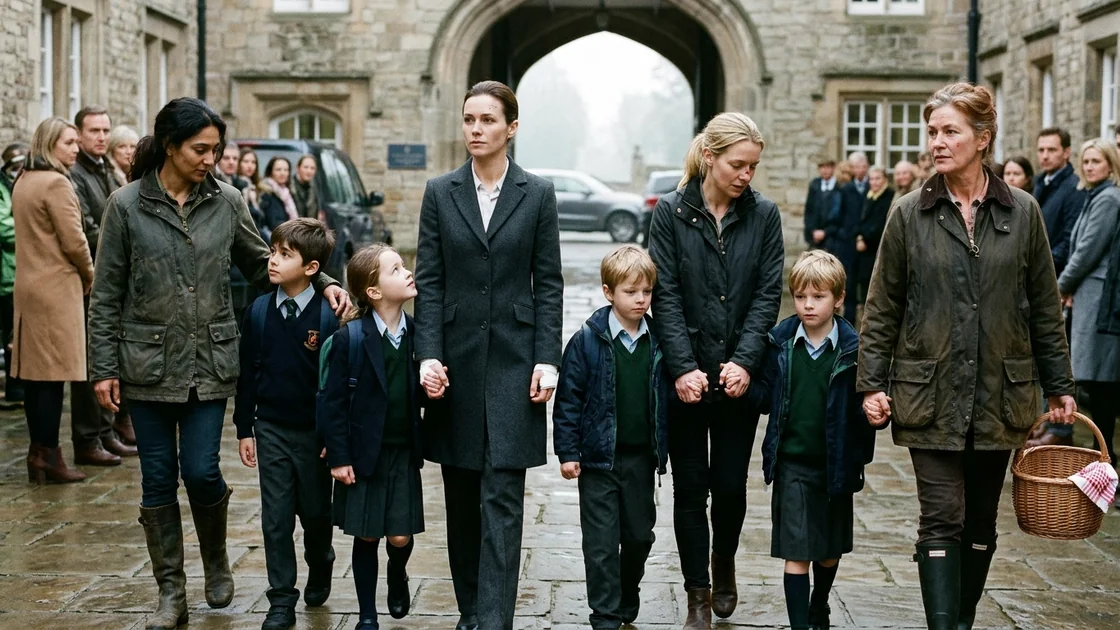
Four women who share nothing beyond an uncomfortable morning nod at the gates of St Jude Preparatory School find their polite pretenses shattered when an ill-fated charity hike across the Pennine moors places them directly in the path of a ruthless cartel execution. Stranded miles from civilization in a blinding squall, an image-obsessed influencer, a ruthlessly disciplined corporate litigator, an isolated former search-and-rescue volunteer, and a quiet church baker must abandon their superficial identities and pool their hidden, hard-won instincts to outwit professional killers on treacherous terrain. As the night deepens and their pursuers close the distance, survival demands absolute trust, transforming four passing strangers into an indomitable force forged by the single instinct they all share, the fierce and unyielding necessity of making it home alive to their children.
The courtyard outside St. Jude’s Preparatory School was paved in reclaimed York stone that glistened like wet river slate beneath the October drizzle. At precisely eight-thirty every weekday morning, a fleet of high-end German estate cars and luxury four-wheel drives pulled into the turning circle with the rhythmic precision of a military parade.
The social hierarchy was as rigid as the wrought-iron railings. There were the generational families who arrived on foot from their Georgian townhouses, their dogs trotting obediently alongside cashmere-clad knees. There were the tech-wealth arrivals, perpetually speaking into discreet earbuds while handing over violin cases and lacrosse sticks. And then there were the outliers, orbiting one another like mismatched celestial bodies bound together only by the gravity of tuition fees and the school uniform code.
Eleanor Vance stood beside her pristine Range Rover, one hand resting on the carbon-fiber roof while the other checked an urgent legal brief on her tablet. Her dark hair was pulled back into a severe chignon that had not yielded a single loose strand since 2014. At thirty-nine, she was a senior partner at one of Manchester’s most rapacious commercial litigation firms. To Eleanor, life was a series of clauses to be parsed, risks to be hedged, and competitors to be out-leveraged. Her eight-year-old daughter, Chloe, was already tucked safely inside the Lower School entryway, having received a crisp peck on the crown of her head and a reminder that mediocrity was an active choice.
Three yards away, Gemma Brooks was orchestrating an impromptu lifestyle photoshoot against the ivy-covered brickwork of the science block.
"Hold the juice pouch higher, Leo," Gemma whispered through a gleaming, camera-ready smile. "Max, sweetheart, look at Mummy, not at the pigeon. That's it. Natural joy. Unfiltered."
Gemma had three hundred thousand followers on Instagram, where she chronicled the curated chaos of raising seven-year-old twin boys. Her blonde waves tumbled in practiced disarray over a shearling jacket that had been gifted by a Scandinavian fashion house. She appeared to the world as an ethereal creature who subsisted entirely on organic matcha and radiant optimism. No one outside her private banking representative knew that her husband’s commercial packaging firm was three missed supplier payments away from administration, or that her immaculate outerwear hid a shoulder blade bruised from dragging heavy sample boxes up three flights of stairs in their mortgaged-to-the-hilt Victorian semi.
Leaning against the sandstone boundary wall, deliberately out of frame, was Samira Patel. Samira wore mud-splattered walking boots, a faded fleece with a frayed collar, and an expression that suggested she was constantly measuring the structural integrity of the surrounding architecture. Her son, Rohan, was on a full academic bursary, a fact Samira never spoke of but felt burning like an iron brand against her ribs. Before marriage, motherhood, and a crippling period of postnatal depression that had hollowed out her late twenties, Samira had spent six years with the Peak District mountain rescue team. Now, she made bespoke stoneware pottery in a converted shed and rarely spoke unless spoken to. Her silence was routinely mistaken by the other mothers for cold intellectual arrogance.
Then came Ruth Gallagher, bustling through the wrought-iron archway with the unhurried authority of an ocean liner entering a modest harbor. Ruth was fifty-one, with silver-streaked russet hair pinned up in large tortoiseshell combs, wearing sensible orthopedic shoes and an oversized waxed jacket that smelled faintly of cinnamon and damp golden retriever. She was a mother of five; four were grown and gone, and eight-year-old Bethany was the late-in-life miracle who kept Ruth tethered to the playground politics of women twenty years her junior. Ruth ran a community bakery in the valley, served on the parish council, and was universally recognized as someone who could not be hurried, intimidated, or impressed by capital gains.
"Morning, Eleanor," Ruth said as she passed, her voice warm and deep as stout. "You look like you're about to cross-examine that phone."
Eleanor didn't look up, though her thumb paused on the glass screen. "Quarterly performance reports, Ruth. Some of us don't have the luxury of letting our attention drift."
"Shame," Ruth murmured pleasantly. "The morning light is lovely on the chestnut trees. You'll be ready for Saturday, won't you? Twenty-four miles across the High Crag. The library fund needs your legs, dear, not your balance sheet."
Eleanor finally raised her gaze, her eyes cold and gray. "I have already paid for the top-tier sponsorship package. My attendance is purely decorative."
Across the flagstones, Gemma lowered her camera, flashing an incandescent smile that failed to mask the tension tightening around her mouth. "Decorative? Oh, don't say that, Eleanor! I’ve tagged our team in three promotional stories already. We’re 'The St. Jude’s Trailblazers.' The outdoor apparel brand I work with is sending moisture-wicking beanies. We are going to look fantastic in the summit reels."
Samira, who was tightening the strap on Rohan’s battered rucksack, let out an involuntary sound that was half-cough, half-snort.
Gemma’s eyes darted toward her. "Did you say something, Samira?"
"Only that beanies won't stop the gale-force gusts on the western ridge," Samira said quietly, not looking up. "The Met Office is forecasting a front pushing in from the Irish Sea by mid-afternoon Saturday. It’s not going to be a reel. It’s going to be a bog."
"We have GPS trackers, high-visibility bibs, and a marshaled route," Eleanor said, checking her gold watch with a snap of her wrist. "We walk from the southern trailhead to the tarn, circle the ridge, and finish at the pub in time for a glass of terrible pinot grigio and an oversized novelty cheque presentation. Let's not romanticize a walk in the hills into an expedition."
Ruth smiled, a small, knowing twitch of her lips that gave nothing away. "Well, whatever it turns out to be, ladies, we’re the four who drew the short straws for the senior parent relay. So we’d better make sure our socks are dry and our tempers are short."
Saturday dawned not with the dramatic fury of a storm, but with a flat, leaden uniformity that made the Pennine fells look like charcoal sketches scrubbed out with spit.
By seven in the morning, sixty parents and teachers were huddled in the gravel car park of the Fox and Hounds in the valley bottom. The air smelled of woodsmoke, diesel exhaust, and the bitter damp of dead bracken. A fold-out plastic table held cardboard urns of lukewarm instant coffee and boxes of dry flapjacks provided by the headmaster’s wife.
Gemma was already shivering inside her powder-pink, down-filled technical jacket, holding her phone aloft to capture the mist clinging to the lower slopes. "Good morning, everyone! We are here at the foot of High Crag, ready to conquer the elements for the new digital learning suite!" She lowered the phone, her teeth chattering slightly. "Jesus, it’s freezing. Is it supposed to be this cold in October?"
Eleanor stood beside the registration table, wearing a brand-new, top-of-the-line Gore-Tex shell in charcoal black, complete with tags that had clearly been clipped off that very morning in her garage. Her boots were pristine Italian leather, stiff and unyielding. She held an laminated map with the posture of an admiral inspecting a battle line.
"The course marshals have already gone ahead to check points one and three," Eleanor announced, her voice cutting through the chatter of the car park. "The school has insisted on four-person pods for accountability. Since we four represent the trustee committee liaison, we are designated Pod C. I intend to complete the circuit in six hours, which allows for an average pace of four miles per hour. If everyone maintains discipline, we will be back before the rain intensifies."
Samira walked up, her hands shoved deep into the pockets of a worn, dark green canvas smock. Her boots were scratched to the welt and darkened with old dubbin. Over her shoulders hung a battered thirty-litre daypack with worn webbing and a rusted carabiner clipped to the haul loop. She looked at Eleanor’s stiff leather boots, then at Gemma’s pristine white trail sneakers.
"You haven't broken those in," Samira said to Eleanor.
"They are custom-molded German orthotics," Eleanor replied without looking up from the map. "They do not require breaking in."
"They'll strip the skin off your heels by mile seven," Samira said evenly. Then she turned to Gemma. "And those runners are mesh. The peat on the plateau will soak through them in thirty seconds. By noon your toes will be numb."
Gemma gave an airy, defensive laugh. "They're trail-specific, Samira! The brand ambassadors swore they have grip."
"On dry gravel in California, maybe," Samira muttered.
Ruth appeared between them, carrying an enormous wicker basket covered with a red-and-white checked tea towel. She was wearing an ancient pair of heavyweight wool trousers tucked into well-oiled gaiters, and a thick fisherman's sweater beneath her faded Barbour jacket.
"Never mind the shoes, girls," Ruth said cheerfully, lifting the cloth to reveal rows of warm, heavy pastry crescents. "Cheddar, bacon, and leek pasties. Still warm from the aga. If the moor doesn't kill us, the cholesterol certainly won't."
"We cannot carry unnecessary weight," Eleanor said coldly. "We have high-protein energy gels provided in the registration pack."
"You can eat petroleum jelly in a silver packet if you like, Eleanor," Ruth said, slipping four wrapped pasties into the side pockets of her pack with calm disregard. "The rest of us will have food that tastes like somebody loved us."
The headmaster blew a brass whistle from the steps of the inn, gave a brief, pompous speech about community spirit and resilience, and waved an umbrella toward the fell gate. The crowd raised an uncertain cheer and began to churn through the mud of the farm lane, an unwieldy procession of bright nylon and nervous optimism.
For the first three miles, the track wound gently upward through enclosed pastureland. Drystone walls bordered the path, their rough limestone blocks silvered with lichen. Black-faced Swaledale sheep lifted their heads from the cropped grass, watching the brightly colored intruders with indifferent yellow eyes.
Eleanor set an aggressive, metronomic pace at the front, her trekking poles clicking rhythmically against the stone. Gemma followed immediately behind, alternating between panting softly and pausing every few hundred yards to record quick video updates for her channel, her face transforming instantly from strained fatigue to radiant enthusiasm the moment the camera lens caught her. Ruth walked at an unhurried, rolling gait, her breath steady, occasionally humming a hymn tune beneath her breath. Samira brought up the rear, her eyes scanning not the path, but the horizon—the darkening bank of cloud rolling over the western shoulder of the ridge, and the subtle shift in the wind that brought the smell of salt and cold iron from the sea.
By eleven o'clock, the pastureland was gone, replaced by the open moor.
The landscape here was stripped bare of comfort: vast, undulating waves of heather, peat hags carved deep by ancient rainfall, and the dark, forbidding cliffs of High Crag rising like broken teeth through the drifting mist. The air had dropped ten degrees. The drizzle had hardened into a sharp, spiteful sleet that stung the skin.
Other walking pods were strung out along the trail ahead and behind, colorful specks of red, blue, and yellow slowly being swallowed by the descending cloud.
"Look at that visibility," Samira said, catching up to Eleanor at the junction of the main bridleway and an older, abandoned drover’s path. "It’s down to fifty yards. We shouldn't take the High Crag loop. We should cut down through the lower valley via the tarn path."
Eleanor didn't stop. She checked her GPS watch with an irritated flick of her wrist. "The official charity route follows the high ridge. There is a marshal station at the old slate quarry two miles ahead. If we bypass it, our team is disqualified from the team prize."
"Who gives a damn about a prize?" Samira said, her voice dropping into the quiet, flinty register of someone who had pulled hypothermic corpses out of peat bogs. "Look at the western sky, Eleanor. That isn't a squall. It’s an occluded front. The temperature is going to plummet another five degrees within the hour, and once the cloud sits on the crag, you won't see your own hand in front of your face."
"I have the Ordnance Survey map pre-loaded on two separate devices," Eleanor retorted, her jaw set into a hard, stubborn line. "And I have no intention of explaining to the headmaster that our group turned back because of a bit of northern weather."
"Gemma's shivering," Ruth observed mildly, coming alongside them. Her own cheeks were flushed like winter apples, but her breath was calm. She glanced back at Gemma, who had fallen twenty yards behind. Gemma was clutching her thin jacket tightly around her ribs, her white running shoes soaked through with black, viscous bog water. Her face was gray under her makeup.
"I’m fine!" Gemma called out, hearing her name. Her voice held a thin, brittle edge of hysteria. "I’m totally fine! It’s just... it’s so pretty up here, isn't it? Very dramatic."
"You're in the early stages of mild hypothermia," Samira said bluntly, walking back to her. She reached into her pack, pulled out an oversized, battered oilskin windbreaker, and held it out. "Put this on. Now. Over your jacket."
"Oh, no, really, Samira, my shell is breathable, it’s supposed to—"
"Put it on," Samira said. There was an absolute authority in her voice that brooked no debate. Gemma swallowed hard, looked at the scuffed, ugly green oilskin, and put it on. It swamped her small frame, but the instant the heavy canvas blocked the cutting wind, she let out an involuntary whimper of relief.
"Thank you," she whispered, looking down at her mud-caked feet.
"Keep moving your fingers," Samira told her. "Wiggle your toes inside your shoes. Don't stop moving."
They pushed forward, leaving the lower track behind and ascending the steep, rocky spine that led toward the quarry. Within twenty minutes, the mist had closed around them entirely, turning the world into a claustrophobic dome of white vapor and dripping rock. The other hiking groups had vanished; the sounds of distant laughter and calling voices were swallowed by the vast, deadening silence of the moor.
The track narrowed, skirting the edge of Dead Man’s Cut—a dramatic gorge where an abandoned Victorian slate quarry bit deep into the mountain’s flank. Below them, invisible in the fog, lay a drop of nearly three hundred feet onto shattered scree and rusted industrial ironwork.
"The quarry hut should be right through this gap," Eleanor said, though for the first time her voice carried a flicker of uncertainty. She was squinting at her tablet screen, which was clouded with condensation. "There's supposed to be a marshal table with tea and soup."
They rounded a massive shoulder of dark slate, following the remnants of an old narrow-gauge railway line that had once carried wagons of rock down to the valley. The ground flattened into a wide, unnatural shelf cut into the mountainside.
Ahead, loom-like through the gray mist, stood the remains of the old quarry engine house: a roofless cathedral of dark stone blocks, surrounded by rusted boilers, tumbled walls, and high piles of slate debris.
There was no marshal table. There were no banners, no urns of hot soup, and no cheerful volunteers in high-visibility vests.
Instead, parked beside the crumbling wall of the engine house, was a dark, unmarked commercial van with heavy mud smeared over its registration plates. Beside it stood an expensive, customized Land Rover Defender, its engine idling with a low, diesel thrum that had been masked by the whistling of the wind.
Eleanor frowned, lowering her trekking poles. "This isn't the checkpoint. Is this search and rescue?"
Samira froze. Her body went entirely rigid, every muscle snapping taut like an over-tuned cello string. Her hand shot out and caught Eleanor by the shoulder, hauling the taller woman back behind the lip of a slate spoil heap with shocking violence.
"Hey!" Eleanor hissed, her temper flaring. "What the hell do you think you’re—"
"Down," Samira whispered. It was not a request. It was an order hissed with such primal, jagged urgency that Eleanor’s voice died in her throat.
Ruth immediately dropped to her knees in the wet heather, reaching out an arm to pull Gemma down beside her. Gemma opened her mouth to ask a question, but Ruth’s hand clamped over her forearm with fingers like iron calipers.
"Quiet," Ruth breathed into Gemma’s ear.
Twenty yards ahead, through the ragged gaps in the engine house wall, three figures emerged.
Two of them were dressed in heavy, dark technical workwear, their faces obscured by neoprene neck-gaiters pulled up to their eyes and dark woolen beanies. They were carrying large, heavy-duty duffel bags, which they swung into the open rear doors of the unmarked van. Their movements were methodical, silent, and hurried.
The third man was different. He wore a tailored cashmere overcoat that seemed wildly out of place on the mountain, unbuttoned to reveal an expensive dark suit. He was bareheaded, his silver-blond hair neatly trimmed and beaded with moisture. He stood on the edge of the quarry clearing, checking an illuminated mobile phone, his profile sharp and aristocratic against the gray stone.
Eleanor gasped—a tiny, sharp intake of air that was nearly lost in the wind.
Beside her, Samira turned her head slowly, her eyes boring into Eleanor. "You know him?" she breathed.
Eleanor’s skin had turned the color of skimmed milk. Her fingers dug into the wet moss covering the slate. "That's Julian Mercer," she whispered, her lips barely moving. "He's... he's the managing director of Mercer Infrastructure Holdings. His firm is handling the commercial development of the old shipyards in Barrow. My firm represents their primary mezzanine lender."
"What’s he doing up here with an unmarked van?" Ruth asked from behind them, her voice low and steady as a heartbeat.
Before Eleanor could answer, the rear doors of the Defender opened.
A fourth man was hauled out of the back seat. His hands were bound behind his back with thick, yellow industrial zip-ties. A burlap sack was pulled over his head, stained dark around the mouth. He was wearing an orange high-visibility site jacket, torn and covered in grease. He fell to his knees in the mud, sobbing, his chest heaving with ragged, desperate gasps that carried clearly across the slate clearing.
The two men in neoprene masks stepped back.
Julian Mercer slipped his phone into his coat pocket. He walked over to the kneeling man with the casual, measured gait of an executive crossing a boardroom carpet. He reached down, took the burlap sack by its crown, and yanked it off.
Underneath was a middle-aged man with broken spectacles hanging from one ear and a bloody, swollen nose.
"Julian, please," the kneeling man wept, his voice cracked with terror. "Julian, I swear to God, I didn't send the files. I have the drive in my locker at the works. I didn't speak to the Environment Agency! I swear it on my children's lives!"
Mercer looked down at him with an expression of mild, clinical boredom. He pulled a pair of dark leather gloves from his pocket and began to work them onto his fingers, smoothing the leather over each knuckle with exquisite care.
"You see, David, the problem with swearing on your children's lives is that it only carries weight if you value them more than your conscience," Mercer said. His voice was cultured, deep, and utterly devoid of rage. "And you’ve always had a very inconvenient conscience. That makes you a liability to the consortium. And liabilities, as any good accountant will tell you, must be written off."
Mercer reached beneath the left lapel of his cashmere coat.
When his hand came out, he was holding a heavy, black semi-automatic pistol fitted with a long, cylindrical sound suppressor.
Behind the spoil heap, Gemma let out a tiny, stifled squeak of pure horror. Ruth’s arm instantly locked around Gemma’s neck, pulling the younger woman’s face hard against her woolen shoulder, muffling the sound against the thick, damp weave of her sweater.
"Don't move," Samira whispered, her voice so low it was almost subliminal. "Do not breathe."
In the quarry clearing, the kneeling man opened his mouth to scream.
Mercer didn't hesitate. He took one step forward and fired twice.
The sound was shockingly small—not the thunderous roar of cinema gunfights, but two sharp, mechanical snaps, like heavy dry timber cracking under a boot heel, followed by the dull, metallic clatter of spent brass casing bouncing off the wet slate.
The man in the orange jacket pitched forward onto his face, his limbs twitching once before going entirely limp in the gravel. A dark, thick pool began to seep into the puddles around his head.
Eleanor pressed her forehead against the freezing stone, her eyes squeezed shut, her entire body trembling violently.
Mercer stood over the body for three seconds. He turned to the two masked men. "Put him in the shaft behind the boiler room. Forty fathoms of flooded slate. He won't be found until the Pennines turn to sand. Then wash the ground and meet me at the service station on the M6."
"Right, boss," one of the men grunted.
Mercer turned back toward the Defender. He raised the pistol, ejected the magazine to check the spring, and slapped it back into the grip with the heel of his palm.
At that exact moment, twenty feet away behind the spoil heap, Eleanor’s high-end satellite-synced sports watch emitted a piercing, crystalline chime.
BEEP-BEEP. BEEP-BEEP.
It was the automated six-mile pace alert.
The sound cut through the misty stillness like a razor through silk.
Every man in the clearing stopped dead.
Mercer’s head snapped toward the spoil heap, his eyes narrowing instantly. The two masked men dropped the dead man’s legs, their hands plunging into their jackets.
"Who’s there?" Mercer called out, his voice sharp and cold.
Samira didn't wait for an answer. She knew terrain, she knew momentum, and she knew that hesitation was the precise moment where people died. She reached down, grabbed Eleanor by the collar of her expensive jacket, and yanked her backward with all her strength.
"Run!" Samira yelled. "Down the gully! Run!"
They did not run like athletes; they ran like prey.
The world dissolved into a nightmare of flying peat, jagged rock, and blinding white mist. Eleanor stumbled, her stiff boots sliding uselessly on the wet grass, but Ruth caught her by the waist and hauled her upright with the terrifying, farm-bred strength that had spent thirty years shifting fifty-pound flour sacks.
"Move your legs, girl!" Ruth roared into her ear. "Move them!"
Behind them, a shout rose through the fog—coarse, angry, and sharp. Then came the whip-crack snap of a suppressed round passing through the mist above their heads, followed by the wet thwack of lead pulverizing a clump of heather three feet to their right.
"They're shooting at us!" Gemma screamed, tears streaming down her face, washing lines through her foundation. "Oh my God, they're shooting at us!"
"Keep your head down!" Samira shouted from the front. She wasn't following the path. The path was open, exposed, and led straight back along the ridge where Mercer could easily run them down or shoot them from the rim. Instead, she threw herself down a steep, treacherous drainage fissure that carved its way into the western flank of the mountain—a labyrinth of fractured shale and gushing black water known as the Raven’s Clough.
They half-ran, half-slid down the forty-degree slope, shale rattling beneath their heels like gunfire.
Gemma lost her footing entirely, crying out as she skidded ten yards on her hip before crashing into a thick clump of gorse. The rough spikes tore through her leggings, scoring red lines across her calves. Ruth arrived beside her a second later, hauling her to her feet by the scruff of Samira’s oversized canvas coat without breaking stride.
"Up, darling, up! You're doing brilliantly, keep your feet!"
"I lost my phone!" Gemma sobbed, looking back up the slope. "My phone fell out—"
"Leave it!" Samira barked, dropping into a crouch behind an enormous limestone boulder that leaned out over the ravine like a frozen wave. "If you go back up there, they will put a bullet through your skull. Understand me? He killed that man like he was swatting a fly. He cannot leave witnesses."
Eleanor collapsed against the cold limestone, clutching her ribs. Her face was gray, her immaculate hair coming undone in wild, wet strands that whipped across her eyes. "Julian Mercer," she whispered, her chest heaving so hard she could barely articulate the syllables. "It was Julian Mercer. He knows my firm. He knows my face. If he saw me—"
"Did he see you?" Ruth demanded, leaning over her, hands on her knees, her breath coming in deep, whistling rasps.
"I... I don't know," Eleanor stammered. "The watch... the watch went off."
"Take that bloody thing off," Samira said, reaching down and ripping the watch from Eleanor’s wrist before the lawyer could protest. Samira looked at the illuminated screen. "It has GPS tracking. If Mercer has technical gear or if he takes your phone, he can trace the Bluetooth signal. We don't carry anything transmitting."
Samira smashed the watch against the limestone face with two brutal blows of a hand-sized cobble, shattering the glass and the circuit board, then hurled the remnants into the foaming torrent at the bottom of the ravine.
"My phone is in my pack," Eleanor said, her voice shaking with a terrifying blend of panic and professional outrage. "I have to call the police. I have to call the Chief Constable. I have his private number—"
"Try it," Samira said grimly, gesturing toward the sheer rock walls rising into the cloud above them. "Look at your screen."
Eleanor fumbled in her pocket, pulled out her phone with trembling fingers, and stared at the display.
NO SERVICE.
"We're in the dead zone behind the Western Escarpment," Samira said, her voice dropping into a flat, clinical rhythm that stood in shocking contrast to the panic around her. "There’s no cellular tower within nine miles that can penetrate this limestone cut. Even if you had a signal, the police helicopter can't fly in this soup. We are on our own. For at least five hours. Probably until morning."
"Until morning?" Gemma gasped, her voice climbing into the rafters of hysteria. She was trembling so violently that her teeth clicked together like castanets. "We can't stay out here until morning! We'll freeze! They have guns! They have actual guns!"
"Shut up, Gemma," Eleanor snapped, though her own voice cracked with terror. "Just... shut up! I need to think!"
"Don't tell me to shut up!" Gemma shrieked, the thin veneer of her polished social persona peeling away entirely, revealing a raw, feral panic beneath. "You were the one who insisted on taking the high path! You and your stupid fucking charity prize! You dragged us up here!"
"I didn't tell a gang of cartel executioners to use the quarry as a dumping ground, you narcissistic idiot!"
"Both of you, hold your tongues," Ruth said.
The tone was not loud, but it fell upon them with the absolute weight of a church bell. Ruth stood between them, her broad shoulders squared, her eyes blazing with an ancient, maternal fury that brooked no resistance.
"We have two men with rifles and a psychopathic developer behind us," Ruth said, her voice cutting through the wind. "We have a three-mile descent through a ravine that could break our necks in daylight, let alone in this muck. If we start screaming at each other like fishwives, we are dead women. Chloe Vance needs her mother. Rohan Patel needs his mother. Bethany Gallagher needs hers. And Leo and Max need theirs. Do you hear me?"
She looked directly into Gemma’s wide, terrified eyes, then into Eleanor’s pale, trembling face.
"Do you hear me?" Ruth repeated, harder this time.
Eleanor swallowed. She pressed her palms against her eyes, took a long, shaking breath, and nodded once. "Yes."
Gemma wiped her nose with the sleeve of the oversized canvas coat, her shoulders hitching. "Yes. I’m sorry. I’m sorry."
"Good," Ruth said. She turned to Samira. "You know these hills, Samira. What’s our play?"
Samira was already kneeling by the stream, dipping two fingers into the current to judge its speed, then squinting down the winding, fog-choked throat of the clough.
"They have vehicles, but the vehicles are useless down here," Samira said, her thoughts clicking into place with tactical clarity. "Mercer has two men who looked like hired muscle—heavy boots, urban tactical gear. They aren't hill-walkers. But they’re fit, they’re armed, and they know the terrain well enough to have chosen that quarry for an execution. They know there are only two ways down off this side of the mountain."
She pointed down the ravine. "One is the main path along the stream bed that leads out to the High Mill road. That’s where they’ll expect us to go. If they have any sense, Mercer will drive the Defender around the valley road to cut off the mouth of the clough, while his two dogs come down the ravine behind us."
"A pincer," Eleanor said, her legal training instantly recognizing the strategic logic. "They flush us down, and Mercer waits at the exit."
"Exactly," Samira said. "Which means we cannot take the main path."
"Then where do we go?" Gemma asked, looking at the towering, slick cliffs of dark shale that enclosed them on both sides. "There’s nowhere else to go!"
"There’s the Old Level," Samira said, looking up toward the southern wall of the gorge. "In the 1870s, before they open-cast the quarry, they drove horizontal prospecting adits into the rock looking for lead and slate. The Raven Mine. My grandfather worked the safety surveys on them forty years ago. Most of the entrances are collapsed, but there’s a drainage tunnel—the Deep Drain—that cuts straight through the limestone ridge and comes out on the eastern side, above the sheep pastures."
"A mine?" Gemma looked horrified. "Like... underground? In the dark?"
"It’s three-quarters of a mile of wet rock, waist-deep iron water, and rotting timber," Samira said without sugarcoating it. "It’s pitch black, it smells like bad eggs, and if a roof slab drops, nobody will ever find our bodies. But there are no men with guns inside it."
Eleanor straightened her jacket. Her face was still terribly pale, but the panic had receded, replaced by the cold, calculating detachment that had made her a terror in the commercial courts.
"Lead the way," Eleanor said.
They climbed out of the stream bed, scrambling up a forty-foot scree bank of loose, sharp-edged slate that clattered terrifyingly with every step.
Ruth went first, planting her heavy boots with deliberate, methodical care, testing each foothold before hauling herself upward using the tough, fibrous stems of the heather. Gemma followed immediately in her wake, clinging to Ruth’s belt, her eyes fixed on the older woman’s sturdy back. Eleanor struggled; her stiff leather soles had no flex, sliding off the wet rock faces until her knuckles were scraped raw and bleeding.
"Give me your hand," Samira said, coming alongside her from below.
Eleanor hesitated for a fraction of a second—the instinctive recoil of a woman who had never permitted anyone to see her falter—then reached out. Samira’s grip was shockingly hard, calloused from clay and rock, locking around Eleanor’s wrist like an iron band. With a single, coordinated heave, Samira hauled Eleanor up onto the narrow sheep terrace that cut across the face of the cliff.
"Movement," Ruth whispered from twenty yards ahead, flattening herself against the rock.
They all froze, pressing their bodies into the wet moss and heather.
A hundred feet below them, through the drifting gray shreds of mist, two figures emerged into the bottom of the ravine.
The men moved with professional caution, their rifles held at the low-ready position across their chests. Even from this distance, the deadly intent in their posture was unmistakable. They weren't calling out; they weren't whistling. They were hunting. One of them paused, knelt by the muddy verge of the stream, and pointed down at a distinct mark in the silt—the deep skid where Gemma had fallen earlier.
The man looked up, spoke into a small radio clipped to his shoulder, and gestured downstream toward the valley mouth. His partner nodded, and the two began to move again, their boots splashing through the water at a rapid, predatory jog.
"They're taking the bait," Eleanor whispered, her breath trembling against her teeth. "They think we're running for the road."
"They'll realize their mistake within twenty minutes," Samira said. "When they hit the lower falls and don't find our bodies, they’ll know we doubled back or went high. We have until they reach the valley to get into the adit."
She turned and led them along the narrow shelf. The path was barely eighteen inches wide, a terrifying traverse with sheer rock rising to their left and a vertiginous drop into the fog on their right. Gemma kept her eyes locked on the wall, her fingers trailing along the cold stone, whispering a frantic, rhythmic prayer beneath her breath: "Leo, Max. Leo, Max. Mummy is coming home. Leo, Max."
Ruth heard her. Without looking back, she reached behind her and squeezed Gemma’s knee. "Keep praying, love. God’s listening, but He expects us to keep our boots moving while He does."
After two hundred yards of heart-stopping exposure, the terrace ended abruptly at a massive cleft in the limestone wall.
It looked less like an entrance and more like a wound in the mountain: a low, jagged opening half-choked with fallen shale and tangled birch roots. Water—orange and foul-smelling from iron runoff—poured out of the black opening in a steady, bubbling torrent that smelled of rusted iron, damp earth, and ancient, stagnant rot.
Samira dropped to her knees and peered into the darkness. She reached into her pack and pulled out a small, heavy aluminum headlamp. She clicked it on; the beam was a sharp, narrow spear of white LED light that cut twenty feet into the gloom before being swallowed by the absolute blackness.
"The timbering looks stable for the first fifty yards," she said, her voice echoing strangely back from the tunnel mouth. "The roof is low. We’ll have to crawl for the first section, then it opens into the main haulage level. Keep your heads down. Watch for iron spikes in the walls."
Gemma looked at the black hole, then down at the boiling mist in the ravine below. Her breath began to hitch again. "I can't. Samira, I can't. I have severe claustrophobia. I can't even take the lift in the department store. If I go in there, I won't be able to breathe."
Eleanor stepped up beside her. For the first time all day, there was no condescension in Eleanor’s eyes, no sharp legal edge. She looked at Gemma not as an annoying influencer who held up the morning drop-off, but as a terrified woman who was seven miles away from her children.
"Gemma," Eleanor said softly. She reached out and took Gemma’s trembling, ice-cold hands in her own scraped, bloody ones. "Look at me."
Gemma looked up, her blue eyes wide and swimming with tears.
"My husband left me three weeks ago," Eleanor said, the words coming out flat, brutal, and unvarnished. "He cleaned out our joint investment portfolio, moved into an apartment in Deansgate with a twenty-four-year-old paralegal from my own firm, and served me with divorce papers via courier on a Tuesday morning while I was pouring Chloe’s cereal."
Gemma blinked, stunned into silence by the sheer, incongruous intimacy of the confession.
"I haven't slept more than two hours a night since September," Eleanor continued, her voice steady now, iron-hard. "Every morning at that school gate, I stand beside that car and I pretend that I am entirely in control of my world, because if I admit for one second that I am breaking into pieces, I don't know how I will ever put myself back together for my daughter."
She squeezed Gemma’s hands until the knuckles whitened.
"You are terrified of the dark. I am terrified of being exposed as a failure. But neither of those things matters today. What matters is that your boys are waiting for you at four o'clock, and Chloe is waiting for me. We are going into that hole, Gemma. You and me. And Ruth and Samira. We are going through the mountain, and we are going home."
Gemma let out a long, ragged sob that seemed to tear something loose in her chest. She wiped her eyes with the sleeve of the oilskin, looked at the black, yawning mouth of the mine, and gave a sharp, jerky nod.
"Okay," Gemma whispered. "Okay."
"Good girl," Ruth murmured, giving her a firm pat on the shoulder. "Now, into the belly of the whale, ladies. Jonas made it out, and so will we."
The entrance of the Deep Drain was a test of sanity.
The roof hung barely three feet above the floor, forcing them onto their hands and knees in the freezing, iron-orange water. The cold was an immediate, physical shock, cutting through their trousers and biting into their kneecaps like dull chisels. The air was thick, damp, and tasted of sulfur and wet copper.
Samira crawled in the lead, her headlamp beam cutting through the gloom, illuminating ancient, rot-blackened oak timbers that bowed under the terrifying weight of the mountain above them. Long, pale tendrils of cave fungus hung from the ceiling like cobwebs, brushing against their faces as they crawled.
"Watch the roof here," Samira called back, her voice muffled by the stone. "The shale has spalled off the bedding plane. Don't touch the uprights."
Behind her came Gemma, her teeth clenched so hard her jaw ached, her eyes fixed entirely on the rubber soles of Samira’s boots. Whenever the panic rose—whenever the crushing weight of hundreds of feet of solid rock pressed against her chest like an iron plate—she repeated Eleanor’s words: Chloe is waiting. Leo is waiting. Max is waiting.
Eleanor crawled behind Gemma, her long limbs awkward in the cramped space, her palms shredded by the sharp, rusted shards of slate lining the stream bed. Her designer jacket was soaked through with foul, orange slurry, the high-performance fabric utterly overwhelmed by the primitive, brutal reality of the mine.
Ruth brought up the rear, moving with slow, relentless determination, carrying a small, hand-cranked dynamo torch she had pulled from her wicker basket. The steady, rhythmic whir-whir-whir of the dynamo mechanism provided an oddly comforting soundtrack to their agonizing progress.
After seventy yards of excruciating crawling, the ceiling suddenly vaulted upward into a cavernous, echoing chamber.
"Stop," Samira whispered.
She stood up, the water sloshing around her shins, and swept the headlamp beam across the space.
They were standing in an underground junction where three separate tramway tunnels converged. Rusted iron rails emerged from the water and disappeared into the darkness. Abandoned wooden wagons—their iron fittings rusted to orange lace—lay overturned against the walls. The air here was colder, but there was a distinct, faint draft moving against their wet faces.
"Air," Ruth said, leaning back against a stone pillar, her chest heaving. "There’s a draft from the eastern shaft."
"It means the tunnel is open through to the valley side," Samira said, checking the compass she held in her palm. "We follow the main haulage line east. It’s about six hundred yards to the portal. The water gets deeper near the sump, but the roof is solid limestone here. No collapse risk."
"Let's get it done," Eleanor said, wringing the filthy water from the hem of her jacket.
They began to walk, their boots splashing through the ankle-deep water along the old rails. In the wider space, their spirits rose slightly; the oppressive, claustrophobic terror of the crawl-way gave way to the grim, focused determination of a forced march.
Then, behind them, from the narrow hole they had just crawled through, came a sound that froze the blood in their veins.
Clack.
The sound of slate slipping under a heavy boot.
Then, a harsh, low voice, echoing through the drainage pipe with terrible clarity:
"Track marks here in the mud. Little ones. They went into the drainage adit."
The mothers stood frozen in the beam of Samira’s headlamp.
"Jesus," Gemma whimpered, clapping her hands over her mouth. "They found us."
"They didn't go down the valley," Eleanor whispered, her mind racing through the variables with terrifying speed. "They saw our footprints in the scree. They followed us up to the terrace."
"How far behind us are they?" Ruth asked, her voice dropping into that calm, terrifyingly flat tone.
"Five minutes," Samira said, clicking off her headlamp to avoid casting a silhouette back toward the entrance. The world plunged into absolute, suffocating darkness, broken only by the faint, greenish glow of Ruth’s dynamo torch. "They have to crawl through the squeeze just like we did. They can't move fast in there, especially with rifles."
"Can we outrun them to the eastern exit?" Eleanor asked.
"No," Samira said in the dark. "The eastern portal is gated. It’s an iron grille to keep kids from wandering into the workings. It’s supposed to be secured with a council padlock. We’ll have to break it or climb the ventilation shaft above it. If they catch us at the gate, we're in a cul-de-sac. They’ll butcher us through the bars."
A terrible silence filled the underground chamber, broken only by the steady, rhythmic drip-drip-drip of water falling from the unseen roof into the pool at their feet.
"Then we don't run," Ruth said.
The three other women turned toward the sound of her voice in the pitch black.
"What did you say?" Eleanor asked.
"I said, we don't run," Ruth repeated.
There was a rustle of heavy canvas as Ruth slipped her pack from her shoulders and set it down on an overturned ore wagon with a wet, heavy thud.
"They're coming through a three-foot hole on their bellies," Ruth said, her voice completely calm, completely devoid of panic, carrying the terrifying, immovable authority of a woman who had raised four boys to adulthood and buried a husband who had tried to drink away his demons. "A man with a rifle is very dangerous when he’s standing fifty yards away in the open. When he’s crawling through a wet drain on his elbows, he’s just a man who can’t use his hands."
Samira’s breath caught. The search-and-rescue volunteer, trained in tactical terrain assessment, instantly recognized the brutal simplicity of the older woman’s logic.
"The bottle-neck," Samira breathed. "The exit of the crawl-way opens four feet above the floor of this chamber. They have to slide out head-first onto the slate floor."
"Exactly," Ruth said. She clicked on her dynamo torch for three seconds, illuminating the chamber just long enough for them to see what lay around them: hundreds of loose, heavy slabs of quarry slate, three-foot lengths of rusted iron tram-rail, and several rotting wooden pit-props banded with iron hoops.
"Eleanor," Ruth commanded. "Take the other side of that iron rail with me. Gemma, Samira, gather every heavy piece of stone you can lift and bring it to the mouth of that hole."
Gemma didn't hesitate. The paralysis that had gripped her on the mountain path was gone, burned away by the sheer, animal necessity of survival. She plunged her hands into the freezing water, hauling out a thirty-pound slab of sharp, dense roofing slate, carrying it against her chest like an infant, and stacking it beside the opening.
Eleanor stepped up beside Ruth. Together, the high-powered corporate lawyer and the church baker gripped the end of a four-foot section of sheared iron railway track—cold, pitted with rust, and weighing at least fifty pounds. They hoisted it between them, their boots slipping on the slick rock floor, their teeth bared in an identical snarl of effort.
"They're coming," Samira whispered from beside the opening.
From inside the low tunnel came the distinct, wet splashing of two grown men crawling through the muck. Grunts of exertion, curses hissed in the dark, and the metallic scraping of steel barrels against the rock roof.
"Bloody hell, it's tight in here," a voice echoed through the stone pipe. "If I ruin these boots, Mercer’s paying for them."
"Shut up and keep moving. The prints were fresh. They can't be more than a few minutes ahead. Shoot anything that moves when we hit the open ground."
Samira stood to the left of the opening, flat against the stone wall, a jagged forty-pound chunk of slate held high above her right shoulder like an executioner’s axe.
On the other side of the opening stood Ruth and Eleanor, their knuckles white around the rusted iron rail, the heavy steel bar held horizontally at waist height, poised like a battering ram.
Gemma stood five feet back, holding Ruth’s heavy wicker basket. Inside it, wrapped in greaseproof paper, were three glass bottles of homemade elderberry cordial that Ruth had packed for the celebration at the pub. Gemma took one out by its neck. It was thick, heavy Victorian glass with a reinforced base. Her hand was steady.
The sounds inside the tunnel grew louder.
A beam of high-powered tactical white light suddenly stabbed through the opening, illuminating the chamber ceiling, reflecting violently off the black water.
"Looks like a big room ahead," the lead tracker grunted. "Hold on, let me slide out."
A black-clad arm appeared through the hole, holding a tactical torch, followed by the barrel of a short-barreled automatic rifle. Then came the man’s head—a neoprene mask, eyes wide and scanning the dark, unaware that the four women were pressed flat against the rock walls directly beside and above him.
He pushed himself forward, his torso clearing the lip of the opening, his weight balanced precariously on his elbows as he prepared to drop to the chamber floor.
"Now!" Ruth roared.
The iron rail swung with the combined, desperate strength of Eleanor Vance and Ruth Gallagher.
The heavy steel hit the man directly across the bridge of his nose and cheekbone with a sickening, wet crunch of shattered bone and cartilage. The impact was ferocious, driving his head violently sideways into the rock frame of the tunnel.
He shrieked—a high, bubbling wail of agony—and his rifle slipped from his gloved fingers, splashing into the two feet of water below.
Before he could pull himself back into the tunnel, Samira brought the forty-pound slate slab down with both hands directly onto his exposed shoulder blade and the back of his neck. The crack of bone was like a dry branch snapping under an elephant’s foot. The man went completely limp, his torso dangling out of the opening like an empty sack of grain, his legs wedged tight inside the narrow crawl-way behind him.
"Terry!" the second man screamed from inside the pipe, his voice muffled by his partner’s body. "Terry! What happened? Get out of the way! Move!"
The second man tried to push his way forward, but the unconscious bulk of his partner was jammed solidly into the three-foot opening, completely blocking the tunnel.
"He's stuck!" Gemma screamed.
From inside the pipe came the deafening, concussive roar of a firearm. The second tracker, panicked and blind, began firing his rifle directly through his unconscious partner’s torso, trying to clear the obstacle.
The muzzle flashes illuminated the tunnel in violent, strobing spasms of yellow light. Bullets ripped through the dead man’s flesh, ricocheting wildly off the stone ceiling of the chamber with screaming, metallic whines that showered the women with rock splinters.
"Down!" Eleanor screamed, tackling Gemma into the water behind an overturned iron wagon.
"We have to finish it!" Samira shouted over the roaring echoes of the gunshots. "When he reloads, he’ll push Terry out and come through with a fresh mag!"
Ruth didn't drop. She stood in the freezing water, her waxed jacket peppered with slate dust, her face streaked with blood from a flying stone chip. She reached down into the water, caught the fallen automatic rifle by its sling, and hauled it out of the muck.
She didn't know how to disengage the safety; she had never held a firearm in her life.
Instead, Ruth reversed the weapon, gripping the hot steel barrel with her bare, flour-calloused hands, swung the heavy composite stock over her shoulder like a split-log maul, and drove the butt-plate violently into the exposed crown of the dead man’s skull, wedging him even deeper, tighter, and more immovably into the mouth of the tunnel.
"Gemma!" Ruth shouted, her voice cutting through the ringing in their ears. "The oil! The lantern oil in my basket!"
Gemma’s eyes went wide. She scrambled across the submerged rails to Ruth’s basket. Beside the elderberry cordial was a small, brass-fitted tin of paraffin oil that Ruth used for lighting the community hall’s vintage storm lanterns.
Gemma grabbed the tin, unscrewed the brass cap with her teeth, and hurled it to Samira.
Samira caught it, dumped the entire pint of combustible fluid over the dead tracker’s heavy canvas jacket and into the narrow gap around his shoulders, then reached into her smock pocket and pulled out her storm-proof emergency matches.
She struck one against the abrasive strip. The sulfur flared into a fierce, wind-resistant blue flame.
"Get back!" Samira yelled.
She dropped the match onto the fuel-soaked jacket.
WHOOSH.
A wall of yellow fire erupted across the mouth of the crawl-way. The heavy, greasy smoke from the paraffin and synthetic technical clothing instantly filled the narrow entrance, sucked hungrily inward toward the tunnel by the draft from the western portal.
From inside the pipe came a terrifying, animal shriek of agony as the second man was suddenly engulfed in a tidal wave of choking black smoke, burning vapors, and superheated air.
"I can't breathe! I’m burning! Back! Back up!"
The sounds of frantic, desperate scrambling echoed back through the stone pipe as the surviving tracker attempted to crawl backward through seventy yards of freezing water and toxic fumes to escape the inferno.
Within thirty seconds, his coughing, sobbing cries faded into the distance.
The fire continued to crackle at the tunnel mouth, casting huge, leaping shadows of the four women across the vast, dripping limestone walls of the underground chamber.
Silence returned to the mountain—thick, heavy, and profound.
Eleanor slowly stood up from behind the ore wagon, her hands shaking so violently she had to press them against her ribs. She looked at the smoldering opening, then at the heavy steel rail lying in the water, and finally at Ruth Gallagher.
Ruth was standing with her boots planted wide in the water, her hands resting calmly on her hips, her chest rising and falling in slow, measured beats. Her sweater was torn, her cheek was bleeding, and her gray-streaked hair had come loose around her face like a warrior queen of the ancient Brigantes.
"Well," Ruth said, blowing a strand of hair from her mouth. "That’s one way to handle a trespasser."
Gemma let out a sound that started as a sob, hitched into a gasp, and transformed into a wild, uncontrollable laugh that echoed off the vaulted ceiling. She collapsed back into the water, laughing until tears carved wide, clean paths through the soot and mud on her cheeks.
"We hit him with a train track," Gemma wheezed, clutching her stomach. "We literally hit an assassin with a piece of the London and North Western Railway."
Samira looked at the three of them—the corporate litigator covered in iron slurry, the Instagram influencer sitting in a bog laughing hysterically, and the church baker holding a smoking firearm by the barrel. A slow, terrifyingly fierce grin split Samira’s face for the first time in ten years.
"He was on our land," Samira said quietly. "Now let's get the hell out of here before Mercer realizes his dogs aren't coming back."
The eastern portal of the Raven Mine was a rusted iron grille set into a stone archway overgrown with wild ivy and brambles, perched halfway up the eastern escarpment of High Crag.
When they reached it, twenty minutes later, Samira didn't even need to pick the council padlock. The hinges had rusted through thirty years ago; Eleanor took a heavy iron bar from the haulage line, wedged it behind the latch, and with one furious, coordinated thrust from all four women, the gate tore free from the rotted masonry with a shriek of tortured iron.
They tumbled out of the darkness and into the open air.
The rain was still falling, but the murderous squall that had trapped them on the western plateau had begun to break. Great ragged tears appeared in the low cloud, revealing the vast, green expanse of the Eden Valley spread out beneath them like an embroidered quilt.
Far below, two miles across the sloping sheep pastures, the slate roofs of the village of High Crag gleamed in the pale, watery light of late afternoon. Smoke rose peacefully from the chimney of the Fox and Hounds.
And there, parked on the gravel shoulder of the single-track lane that led out of the valley, was the dark Land Rover Defender.
Julian Mercer was leaning against the wing of the vehicle, his cashmere coat buttoned tight against the damp, binoculars raised to his eyes as he swept the lower mouth of Raven’s Clough, waiting for his men to flush his victims into his sights.
He was entirely alone.
Eleanor stood on the rock terrace three hundred yards above him, looking down through the blowing rain. Her face was set in lines of cold, absolute diamond.
"He doesn't know we're here," Eleanor said, her voice dropping into the terrifyingly calm register of a barrister about to deliver the fatal blow in a cross-examination. "He’s watching the ravine mouth. He has no idea we came through the mountain."
"What do we do?" Gemma asked, coming alongside her. She had tied the sleeves of Samira’s oversized canvas coat around her waist, her bare arms covered in mud and scrapes, her eyes clear and sharp. "Do we wait for him to leave?"
"No," Eleanor said. "If he leaves, he destroys the evidence. He disposes of the body in the quarry, he sanitizes his phone, and by tomorrow morning his legal team will have created twelve different alibis for his whereabouts today."
She turned to look at the three other women.
"Julian Mercer thinks women like us are invisible. He thinks we are decorative fixtures at school gates. He thinks we are consumers of lifestyle products and organizers of bake sales."
Eleanor reached down and picked up a heavy, fist-sized river cobble from the terrace edge.
"I have spent fifteen years protecting men like him from the consequences of their arrogance. I know how they think. When they are in control, they are monsters. When they lose control of the narrative, they are cowards."
Ruth smiled—a slow, terrifying widening of her lips that made the fine lines around her eyes crinkle like dry paper. "I believe the Fox and Hounds has an auxiliary landline in the barn, half a mile down the lane," Ruth said. "The publican is my second cousin, Jack. If I get to Jack’s phone, I can have the regional armed response unit here in twelve minutes."
"And what about Mercer?" Samira asked, her eyes fixed on the man below.
"He has the keys to that Defender in his pocket," Eleanor said. "And the ignition carries a digital memory chip that logs the vehicle’s exact coordinate history for the past forty-eight hours. The coordinates that will prove he was at Dead Man’s Cut when David was murdered."
She looked at Gemma. "Gemma, your phone is gone. Do you still have your secondary digital vlogging camera?"
Gemma reached into the interior breast pocket of her soaked down jacket. She pulled out a small, ruggedized, waterproof action camera with an ultra-wide optical zoom—the camera she used for high-definition trail footage.
"Battery is at seventy percent," Gemma said, her mouth tightening into a grin that was anything but curated.
"Good," Eleanor said. "Ruth, run for the barn. Samira, you and I are going to ensure Mr. Mercer stays precisely where he is until the police arrive."
"And me?" Gemma asked.
Eleanor looked at her. "You’re our content creator, Gemma. Make sure you get his best side."
Julian Mercer was growing impatient.
He checked his platinum chronograph for the third time in ten minutes. The wind was shifting to the north, bringing a sharper, freezing chill off the Irish Sea. His two men were late. They should have flushed those four hysterical school mothers down the clough forty minutes ago. It was impossible that four middle-aged women in designer activewear could have evaded two trained former military contractors on an enclosed mountain path.
He pulled his phone from his pocket. Still no signal on the valley road. He would give them another ten minutes, then he would drive up to the quarry himself, dump the remaining drums of chemical solvent into the shaft, and leave the contractors to clean up their own mess.
A soft, sharp rustle in the bracken ten yards to his right made his hand drop instantly to the concealed pistol beneath his cashmere coat.
"Terry?" Mercer called out, his voice sharp. "Henderson?"
No answer.
Only the steady, rhythmic drip-drip-drip of rainwater from the hawthorn hedge.
Mercer drew the suppressed semi-automatic pistol, his thumb smoothly sliding the safety catch to fire. He stepped away from the Defender, his leather-soled city shoes slipping slightly in the slick roadside mud, his eyes scanning the dense, tangled bank of gorse and fern that bordered the lane.
"Come out," Mercer commanded, raising the weapon. "I know you're in there. If you walk out with your hands up, we can reach an accommodation. I have substantial resources. More than enough to ensure your silence is extremely profitable."
"An accommodation, Julian?"
The voice came from behind him.
Mercer spun on his heel, his pistol coming up in an instinctive, deadly arc.
Standing on the high drystone wall directly above the lane was Eleanor Vance.
She looked unrecognizable. Her dark hair was plastered to her skull with mud and water, her face was smeared with black peat, and her thousand-pound technical jacket was torn to ribbons at the shoulders. But her posture was as erect, as haughty, and as utterly devoid of fear as it had ever been in the High Court of Justice.
"You won't shoot me, Julian," Eleanor said, her voice carrying the dry, cutting authority of a judge handing down a life sentence. "Because if you shoot me, you won't know where the other three are. And more importantly, you won't know which one of them has already uploaded the footage of you executing David at the engine house."
Mercer’s eyes narrowed to slits. A cold, venomous fury tightened his handsome, aristocratic face.
"You're bluffing, Eleanor. You were behind that spoil heap. You couldn't have had line-of-sight for a recording in that mist."
"Is that a risk your consortium is willing to underwrite?" Eleanor asked, taking one slow, deliberate step down from the wall onto the road. "Because as your mezzanine counsel, I can tell you that the morality clauses in your Barrow development contract are remarkably strict. A single indictment for capital homicide doesn't just cancel the credit facility—it triggers an immediate, cross-collateralized liquidation of your entire commercial portfolio."
Mercer’s finger tightened on the trigger. "It doesn't matter what the contract says if you aren't alive to testify, Eleanor. You and your little committee of school-gate cows are going into the peat."
He raised the pistol, aiming directly at the center of Eleanor’s chest.
He never pulled the trigger.
From the thick gorse bush behind the Defender, Samira Patel exploded like a mountain cat.
She didn't use an iron rail; she used thirty pounds of jagged, flint-hard limestone wrapped in her heavy canvas smock. She slammed the weighted bundle directly into the side of Mercer’s right knee with the full, driving momentum of her body.
The human knee is not designed to bend laterally.
The sound of Mercer’s ligaments tearing was loud as a pistol shot in the quiet lane. He shrieked—a high, agonized, aristocratic scream—and his leg folded beneath him like a cheap card table. The pistol flew from his hand, spinning across the wet tarmac before clattering into the deep, muddy ditch on the far side of the road.
Mercer crashed onto his back, clutching his shattered joint, gasping for breath, his cashmere coat soaked in horse manure and ditch water.
"You bitch!" he wailed, his handsome face contorted into an ugly, weeping mask of shock and pain. "You broken... feral... bitch!"
Samira didn't look at his face. She stepped over him with clinical, cold efficiency, kicked his remaining good leg flat to the road, and planted her heavy, mud-caked mountain boot directly onto the center of his throat, pressing down until his eyes bulged and his curses choked into a wet, wheezing rattle.
"Stay still," Samira said quietly. "Or I will break the other one."
Twenty feet away, standing on the hood of the idling Land Rover Defender, Gemma Brooks was holding her wide-angle action camera with both hands, the red recording light blinking steadily against the gray Pennine sky.
"Smile for the cloud storage, Julian," Gemma said, her voice trembling slightly, but her eyes bright with a fierce, vindictive joy. "The lighting is absolute shit, but the audio is crisp. We’ve got your confession, your gun in the ditch, and your face in the muck."
Down the lane, from the direction of the village, came the sudden, wailing shriek of multiple European sirens.
Two high-performance police estates and an armored tactical response van appeared around the bend, their blue strobe lights flashing violently against the yellow autumn leaves of the hedgerows, tearing through the puddles at eighty miles an hour.
Leading them on foot, running down the center of the tarmac with her waxed jacket flapping open like the wings of a battle-scarred eagle, was Ruth Gallagher.
She was waving a wooden rolling pin she had grabbed from cousin Jack’s kitchen, her voice booming over the sirens like the trumpet of the Last Judgment:
"Over here, lads! We’ve got the bastard tied up like a Sunday roast!"
Monday morning at St. Jude’s Preparatory School arrived beneath a pale, washed-out October sun that made the wet York stone of the courtyard steam like a horse’s flank.
The luxury German estate cars were in their usual positions, idling smoothly in the turning circle. The cashmere-clad mothers stood in their familiar, self-conscious clusters near the wrought-iron gates, discussing half-term ski bookings, lacrosse fixtures, and the shocking, sensational news that had dominated the national broadsheets all Sunday afternoon.
PROPERTY TYCOON ARRESTED IN PENNINE MURDER CONSPIRACY. FOUR LOCAL MOTHERS PRAISED FOR 'EXTRAORDINARY BRAVERY' IN MOORLAND PURSUIT.
The playground was buzzing with a nervous, electric curiosity. No one knew the details; the police had issued only a brief, tightly controlled statement mentioning that four female hikers had assisted in the apprehension of three armed suspects following an incident near High Crag.
At precisely eight-twenty-five, the heavy oak doors of the Lower School opened, and the bell began to toll.
A sleek, black Range Rover pulled into the turning circle.
Eleanor Vance stepped out. She was wearing a tailored charcoal wool coat, her dark hair pinned back with its customary precision. But beneath the neat cuffs of her silk blouse, thick white bandages were visible around both wrists. A small, butterfly suture closed a neat cut just beside her left eyebrow.
She walked around to the passenger side, opened the door, and helped Chloe out. Instead of the usual crisp peck on the crown of the head, Eleanor knelt directly onto the damp York flagstones—not caring that the cold water was soaking through the knees of her four-hundred-pound trousers—and pulled Chloe into a long, fierce, crushing embrace that made the little girl gasp in surprise.
"Mummy?" Chloe whispered, her arms wrapping around Eleanor’s neck. "You're squeezing too hard."
"I know, my darling," Eleanor murmured into Chloe’s hair, her eyes closed, her voice thick. "I know. Have a wonderful day. Be kind today. Just... be kind."
Across the courtyard, a battered, ten-year-old Volvo estate with a missing hubcap rattled to a halt.
Samira Patel got out, wearing her usual faded fleece. Her face was bruised along the jawline, and she walked with a slight, stiff limp. Rohan tumbled out of the passenger side, his rucksack slung over one shoulder. Samira caught him by the chin, kissed both of his cheeks with an unhurried, shameless warmth that made the eight-year-old boy blush with pride, and ruffled his dark hair.
Then came Gemma Brooks, stepping out of a modest, five-year-old family hatchback that had replaced her husband’s leased sports coupe. She was wearing no makeup—not a trace of foundation or mascara—and her hair was pulled back into a simple, functional ponytail. She had a healing scrape across her nose and a dark purple contusion along her collarbone. Leo and Max were clinging to each of her hands like small barnacles. Gemma wasn't holding a phone. She wasn't filming. She was looking at her sons, listening to them bicker about a plastic dinosaur with a look of radiant, untroubled wonder that no filter could ever have replicated.
And finally, Ruth Gallagher arrived on foot through the archway, holding eight-year-old Bethany by the hand, her wicker basket over her arm, smelling gloriously of fresh sourdough and cinnamon buns.
The courtyard chatter dropped into an uncomfortable, hesitant silence.
The other mothers—the ones who had stayed in the valley, the ones who had complained about the rain, the ones who had spent Saturday afternoon in the dry warmth of the Fox and Hounds drinking pinot grigio—parted like the Red Sea as the four women approached the school steps.
A wealthy trustee’s wife, wearing a pristine camel coat and diamond studs, took a hesitant step forward toward Eleanor.
"Eleanor... darling," the woman breathed, her eyes darting from Eleanor’s bandaged wrists to the cut on her brow. "We saw the news. We were simply horrified. It was Julian Mercer, wasn't it? From the foundation board? Was it... was it truly dreadful?"
Eleanor paused on the flagstones. She looked at the woman—a woman she had sat beside at thirty different committee dinners, a woman whose legal business she had courted for five years with calculated, polite subservience.
Then Eleanor looked past her, across the courtyard.
Her eyes met Samira’s.
Samira gave a single, almost imperceptible nod, the corner of her mouth twitching with the ghost of that fierce, subterranean grin.
Eleanor looked at Gemma, who gave an uncurated, utterly genuine wink.
And finally, she looked at Ruth, who was already pulling a warm, greaseproof-wrapped pastry from her basket with a wink that held all the ancient, immovable power of the earth itself.
Eleanor turned back to the trustee’s wife.
"It was just a walk in the hills, Victoria," Eleanor said smoothly, her voice clear and cool as mountain water. "The weather was somewhat challenging, but we found our footing."
Without waiting for a response, Eleanor walked past her, reaching out her hand as she went.
Samira fell into step on her left. Gemma took her place on her right. And Ruth brought up the flank, the four of them walking abreast across the ancient York stone toward the school doors, their shoulders touching, their boots striking the pavement with the heavy, unshakeable rhythm of women who had looked into the dark beneath the mountain, faced the wolves, and walked each other home.