The Morning Orbit
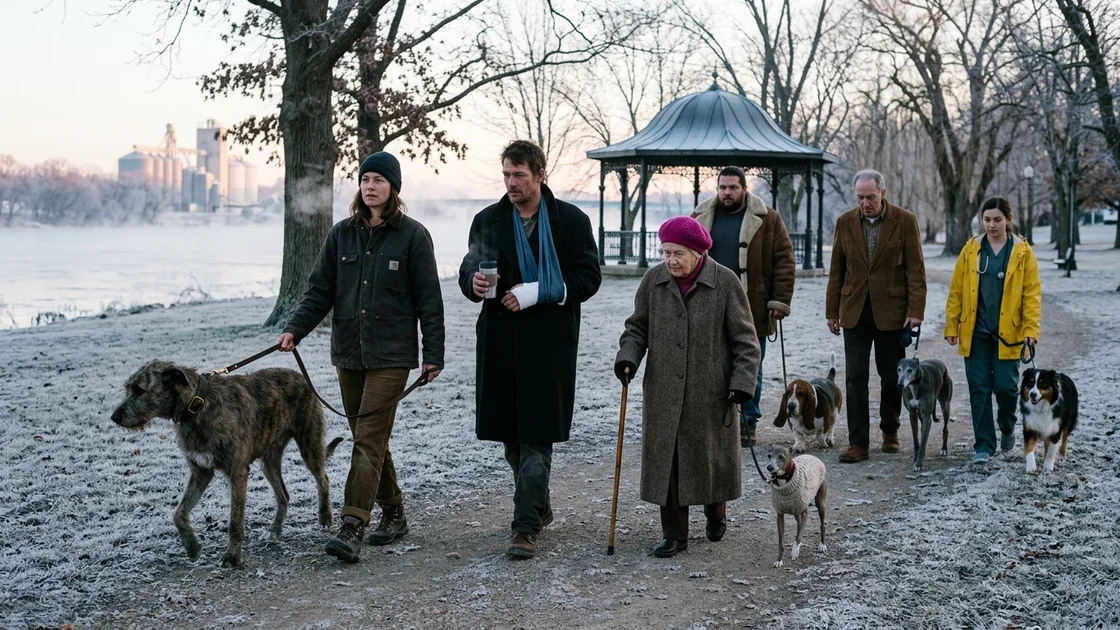
When Clara Bennett reluctantly agrees to shelter her estranged brother Jesse's unmanageable rescue hound for thirty days, her meticulously ordered life in a sleepy riverfront town is upended by chewed baseboards, frantic leash-pulling, and sleepless nights. Desperate to walk the dog without humiliating public scenes, she ventures into the municipal park at dawn, where she discovers an eccentric, tight-knit circle of early-morning regulars whose quiet rituals and communal patience slowly transform both the panicked animal and Clara herself. As the month draws to a close, she finds that healing her fractured family begins not with grand gestures, but with the daily discipline of showing up in the cold blue light.
Chapter One: The Freight on the Porch
The telephone call had not come from a hospital, a county jail, or the coroner’s office, which were the three possibilities Clara’s mind had maintained in steady reserve for seven years. It had come instead from a gas station outside of Duluth, Minnesota, punctuated by the rhythmic thumping of diesel engines and the wet hiss of passing semi-trailers.
"He doesn't bite people," Jesse had said. His voice was rougher than she remembered, scraped raw by wind or tobacco, or simply by thirty-four years of being Jesse. "He bites drywall if you leave him alone in a hallway, and he’ll eat a broom if you corner him with one. But he doesn't bite people. He’s just… he’s big, Clara. And he doesn't know where his feet are."
"I live on the second floor of a four-flat, Jesse," Clara had answered, standing barefoot in her kitchen, where the copper saucepans hung in precise descending diameter above the soapstone counter. "I restore archival paper. I have seventeenth-century town charters laid out under weighted glass on my drafting table. I do not have room for an animal that eats brooms."
"It’s four weeks. Twenty-eight days. I took an emergency salvage gig on an ore boat out of Superior. The pay clears what I owe the drydock, with enough left over to put a roof over my head for the winter. But the boat doesn't allow dogs. They’ll put him in a county pound if I don't drop him somewhere by tomorrow night, and you know what they do with ninety-pound mutts who can't pass a kennel evaluation. They put them down in forty-eight hours."
Clara had pressed her forehead against the cool glass of her back window, looking down into the narrow communal courtyard where Mrs. Gable’s begonias were withering under the first October frosts. She had hated Jesse for five minutes with an incandescent, familiar fury—the kind that lived in the lower ribs like an old stitch from running too fast as a child. He had always dropped his life like an armload of wet firewood at her feet and expected her to build a stove around it.
"Twenty-eight days," she had said. "On the twenty-ninth, I put him on a tether in front of the municipal building with your phone number on his collar."
"He doesn't have a collar," Jesse had muttered. "He breaks them. I use a tow strap with a climbing carabiner. I'll see you by sunrise."
He had arrived not at sunrise, but at three in the afternoon, in a rust-speckled Ford pickup that groaned as it pulled against the curb of her quiet street in Elm Creek. The dog had not waited to be unloaded. When Jesse opened the passenger door, a blur of grizzled brindle and wild yellow limbs had exploded onto the pavement, skidded three feet across damp maple leaves, and immediately hoisted its hind leg against a wrought-iron lamppost with a sigh that sounded like an emptying tire.
"Barnaby," Jesse said, stepping down from the cab. He had lost weight; his collarbones were sharp under a faded flannel shirt, and his knuckles were permanently grayed with engine grease. He looked at Clara with a defensive, squinting neutrality, as if she were a customs officer inspecting an irregular passport. "Barnaby, heel. Or whatever."
The dog had not heeled. It had plunged forward, nostrils flaring like bellows, sweeping the ground with a nose the size of a billiard ball. It was mostly lurcher, perhaps crossbred with an Irish wolfhound and something broad-skulled and bull-necked that gave it an unsettling, muscular dignity. Its fur was coarse as coconut fiber, broken here and there by silver scars, and its amber eyes possessed the wild, unfocused vigilance of a beast that had spent its formative months dodging kicked gravel and backing out of wire snares.
"You look like hell, Jesse," Clara said, keeping her hands tucked into the pockets of her boiled-wool cardigan.
"You look like our mother," Jesse replied, though without malice. He reached into the truck bed and dragged out a torn fifty-pound sack of cheap kibble, a five-gallon plastic bucket, and a length of purple climbing webbing. "His bowl’s in there. He drinks a gallon at a time, then he throws some of it back up if you let him run right after. Keep him off the stairs until he figures out they don't move."
"He doesn't know stairs?"
"He was kept in an orchard shed in Eau Claire until the sheriff shut the guy down. He thinks steps are a trick." Jesse set the bag of food on the bottom step of the porch. He didn't offer to carry it up. He stood with his thumbs hooked into his belt loops, his eyes flicking past Clara toward the warm, silent hallway behind her front door, where a grandfather clock was ticking with calm, rhythmic authority.
"You aren't coming up?" she asked.
"Boat sails at midnight out of Duluth. I got three hours of highway just to hit the canal." He hesitated, his jaw working as if he were trying to chew through a knot of words he hadn't spoken in years. "Thanks, Clara. I know you hate this."
"I don't hate this," Clara lied, her voice rigid. "I hate the way you do it."
"Yeah," Jesse said. He bent down, took the dog’s broad, bristling head between his scarred hands, and gave it two hard, flat-palmed slaps on the ribs—the rough, wordless affection of men who lived alone. "Don't jump out any windows, you bastard. Be good to Clara. She’s delicate."
"I am not delicate," she snapped.
Jesse didn't answer. He climbed back into the cab, slammed the door with a metallic rattle that startled three sparrows off the wire, and pulled away without looking into the side mirror.
Clara stood on the sidewalk with the climbing strap looped three times around her wrist. At the other end, Barnaby was vibrating. Every muscle in his haunches was taut, his ears pinned back against his skull, his tail tucked so deeply between his hocks that the tip brushed his belly. He smelled of woodsmoke, damp hay, and an old, sour dog-fear that made her throat tighten.
"Come along," she said, trying to summon the voice she used when instructing college interns on how to lift vellum from rotten oak boards.
Barnaby sat down. He did not merely sit; he lowered his center of gravity until he seemed to bond with the concrete, his yellow eyes fixed on the empty corner where Jesse’s truck had vanished.
It took Clara forty-five minutes, two slices of smoked turkey from her refrigerator, and an undignified amount of shoving from behind to get the dog up the twelve carpeted treads to her apartment. When the oak door finally clicked shut behind them, Barnaby walked three circuits around her dining room table, his long claws clicking like knitting needles on the parquet, stopped beside a nineteenth-century lithograph of the Apostle Islands, lowered his head, and gave a single, mournful howl that vibrated through the floorboards into Mrs. Gable’s parlor below.
Chapter Two: The Hour of the Ghosts
The first night had been an unmitigated disaster of sound and water.
Barnaby did not sleep. He paced from the kitchen to the bathroom, his claws seeking out every loose board in the flat. Whenever Clara drifted into an uneasy doze, she was jerked awake by the sound of heavy, rhythmic licking, or the sudden, violent shudder of the dog shaking his entire frame, his ears slapping his skull like pistol shots. At three in the morning, he had attempted to dig his way through the baseboard beneath the kitchen radiator, peeling away six inches of pristine cream-colored enamel that Clara had restored by hand three summers ago.
By five o’clock, Clara’s head throbbed behind her temples, a dull, iron wedge of exhaustion. She smelled dog breath in her sheets, though Barnaby had refused to approach the bed, preferring to wedge his long, scabby spine into the narrow gap between the credenza and the wall.
"Up," she said, nudging his shoulder with the toe of her wool slipper. "Out. Before you drop through the floor into the basement."
She dressed in the dark: heavy corduroy trousers, a fleece-lined anorak, a knit watch-cap, and her thickest hiking boots. She tied the purple webbing around her waist for safety, having already discovered that Barnaby’s lunging power was sufficient to yank her shoulder out of its socket if she held the line with her fingers alone.
Outside, the world was entirely blue.
It was 5:45 AM. The streetlights had just cut out, leaving the residential blocks in that deep, hollow gloom that precedes an autumn sunrise. A skin of white frost lay across the roofs of parked sedans and the leaves of Norway maples that choked the gutters. There were no cars. The milk trucks and delivery vans of the mid-century had long since vanished from Elm Creek, leaving the dawn hours empty of anything except the hum of commercial refrigeration units behind the bakery two streets over and the distant, metallic shunting of freight cars along the river.
Clara pulled Barnaby toward St. Jude’s Park.
The park occupied forty acres of glacial drumlin that sloped down toward the black, slow-moving water of the river. It was an old park, landscaped in the 1890s with weeping willows, stand-alone white oaks, gravel carriage paths, and a Victorian cast-iron pavilion whose paint was flaking in long curls like birch bark. During the afternoons, it was the territory of mothers with strollers, teenagers with vape pens, and joggers with neon armbands.
Clara had chosen the dawn specifically because she did not want to see anyone. She did not want to explain the purple climbing harness, the bleeding gouge on her left boot where Barnaby had stepped on her, or the fact that her brother—the family ghost, the perennial delinquent—had once again dumped his wreckage in her hallway.
Barnaby hit the grass and immediately went wild.
The cold scent of damp earth and squirrel track seemed to ignite every neuron in his broad, scarred head. He lunged toward an ornamental birch with such ferocity that Clara was jerked into a stumbling run, her boots sliding over the frost-slick turf.
"Barnaby, stop! Sit! Halt!" she hissed, her breath pluming white around her face.
He did not halt. He hauled her across the bridle path, his claws throwing up clods of frozen loam, heading straight for the dense cedar grove near the public restrooms. Clara dug her heels in, leaning her weight backward until her spine screamed in protest, but the dog weighed forty kilos and possessed four-wheel drive. She was three feet from being pulled face-first into an elderberry bush when a sharp, clear sound cut through the mist.
Clack-clack.
It was the sound of wood hitting wood—a dry, rhythmic strike that echoed off the brick flank of the pavilion.
Barnaby’s head came up. His ears swiveled, his tail froze halfway through its tuck, and his front legs stiffened. Clara regained her footing, gasping, her lungs burning from the frozen air.
Out from behind the cedar hedge emerged a parade so strange that Clara, in her sleep-starved delirium, wondered for an instant if she had walked into an etching from an old Scandinavian picture book.
Leading the group was an eighty-year-old woman no taller than a nine-year-old child, encased in an ankle-length tweed overcoat that had clearly belonged to a very large man thirty years ago. On her head was a knitted beret of alarming magenta. In her right hand she carried a polished ash walking stick, with which she had just struck the side of a wooden trash bin to make the clack-clack sound. In her left hand, on a braided silk lead thin as a shoelace, was an animal that looked like a peeled potato mounted on four toothpicks—a three-legged Italian Greyhound wearing a high-collared cable-knit sweater.
Flanking her was a man of immense girth, clad in an oil-stained Carhartt jacket with the sleeves sheared off at the elbow despite the twenty-eight-degree temperature. Beside him waddled a Basset Hound whose belly was so low it cleared the frost like an old-fashioned push-mower, leaving a dark, wet swath through the grass.
Behind them came two more figures: a woman in surgical scrubs and a yellow slicker, being dragged horizontally by a juvenile Australian Shepherd that seemed to have no bones, and a tall, stooped man in a corduroy jacket with leather elbow patches, who walked beside an enormous, silver-muzzled racing Greyhound with the mournful, aristocratic bearing of an exiled Russian duke.
Barnaby took one look at this congregation, let out a noise that was half-gasp and half-strangled gargle, and dropped flat onto his belly in the dirt, his tail tucked so tightly it curled up over his groin.
"Don't yank him," the tweed-coated woman called out. Her voice was extraordinary—a deep, resonant contralto that had likely terrified high-school assemblies for half a century. "If you yank him now, he’ll think we’re going to eat him, and frankly, my teeth aren't up to that much gristle."
Clara stood frozen, her fingers white where she gripped the purple tow-strap. "I'm sorry," she stammered. "He’s… he isn't mine. He’s out of his mind."
"Nonsense," the woman said, arriving within six feet and stopping with military precision. The three-legged greyhound stopped also, lifting its single front paw into the air and shivering with dramatic, operatic intensity. "He’s not out of his mind. He’s just never seen a civilized lawn before. Look at his pads. Soft as suet. Where’d you get him? The gravel pits?"
"My brother," Clara said, as if that explained the entirety of the dog’s morphology and criminal demeanor.
"Ah," the woman said. "A brother dog. That accounts for the rope. Arturo, look at the hocks on this brute. What did I tell you about the cross-bred ones from the south county?"
The immense man in the sleeveless Carhartt stepped forward. His face was a map of broken capillaries and grease-stained pores, his eyes small, wet, and infinitely kind. He didn't look at Clara; he looked down at Barnaby, who was pressing his snout into a clump of dead plantain leaves as though attempting to drill his way to the earth’s mantle.
"Lurcher," Arturo grunted. His voice sounded like two gravel bags rubbing together in the bed of a truck. "Good chest. Badly started. Look at the ears. Somebody clipped 'em with kitchen shears when he was eight weeks old." He reached into a voluminous pocket, pulled out a small, dried brown rectangle that smelled aggressively of tripe, and tossed it. The treat landed three inches from Barnaby’s nose.
The dog didn't move, but Clara saw his black nostrils flare once, twice.
"I’m Evelyn," the magenta-bereted woman said, ignoring the dog entirely now and turning her pale, hooded blue eyes on Clara. "This is Leopold. He lost his limb to a municipal snowplow four years ago and has never stopped complaining about it. That’s Arturo with Beauregard. That’s Mina over there trying not to be strangled by Sprout, and that’s Keith Vance with Blue."
The woman in the scrubs gave a tired, one-handed wave while her Australian Shepherd bounced four feet into the air on all four paws simultaneously, like an over-caffeinated spring. The tall man with the elbow patches merely touched the brim of an imaginary hat, his expression one of quiet, scholarly detachment.
"I’m Clara," she said, feeling absurdly small beneath her anorak. "Clara Bennett."
"Arthur Bennett’s girl?" Evelyn asked instantly.
"Yes."
"The archivist."
"Yes."
"Your father had no head for municipal drainage," Evelyn declared, leaning on her ash stick. "He voted against the 1984 culvert assessment, and every cellar on Third Street has smelled of river silt ever since. A stubborn man. But he kept his fences painted. Walk with us, Clara. Standing still in this wind is an invitation to rheumatics."
"Oh, no," Clara said, backing up half a step. "Thank you, but he’s really not good with other dogs. He might… I don't know what he might do."
"He’s doing it," Arturo observed calmly.
Clara looked down. Barnaby had consumed the piece of tripe without moving the rest of his body. He was now looking sideways at the Basset Hound, Beauregard, who was standing two feet away, completely indifferent to Barnaby’s terror, his long ears dragging in the frosted grass as he chewed on a piece of dried bark.
"A pack that moves doesn't fight," Evelyn said, already turning her small, tweed back and heading down the asphalt loop toward the river. "Only dogs with too much time and no itinerary fight. Walk, Clara. The sun will be over the silos in ten minutes, and after that, the people with the waist-belts and the water bottles show up, and they are entirely intolerable."
Chapter Two: The Architecture of Dawn
The park, Clara learned over the next six mornings, had its own topography that had nothing to do with the maps published by the Elm Creek Department of Public Works.
There was the Cold Gate, a gap in the limestone retaining wall near the old boat slip where the wind coming off the river dropped five degrees in three paces, freezing the moisture inside your nose before you had cleared the second willow tree. There was the Bread Line, an eighty-yard stretch of gravel where an eighty-five-year-old widower named Mr. Henderson scattered cracked corn for the mallards at 6:15 every morning, creating an explosion of green-headed chaos that required all dogs to be held on short leashes to avoid catastrophic bird-chasing. And there was the Bench of the Epistles, an ornate concrete seat beneath a dying chestnut tree where the group paused every morning at 6:35 AM while Keith Vance unscrewed the chrome top of an enormous Stanley thermos and poured Arturo half a cup of black coffee that smelled like chicory and wood ash.
Barnaby’s initial panic did not vanish, but it underwent an architectural transformation. He became less like an explosive charge and more like a badly loaded cargo barge.
By the fourth morning, he no longer dropped to his belly when Evelyn’s ash stick sounded against the trash cans. Instead, he moved behind Clara’s left knee, using her wool-clad thigh as a mobile parapet. He watched Leopold, the three-legged greyhound, with an expression of bewildered terror. Leopold, who weighed perhaps eight pounds soaking wet, ignored Barnaby with an aristocratic insolence that seemed to baffle the larger dog entirely. Whenever Barnaby leaned his great, whiskered nose down to sniff Leopold’s cable-knit sweater, Leopold would emit a dry, paper-thin click of his teeth without even turning his head, and Barnaby would flinch back as if he had been grazed by lightning.
"He respects boundaries," Keith Vance remarked on Thursday. Keith walked beside Clara, his greyhound Blue stepping with an eerie, silent grace that seemed almost mechanical. Blue’s coat was the color of a wet slate shingle, his eyes cloudy with the cataracts of an animal who had spent twelve years looking at nothing but mechanical rabbits and the insides of wire crates.
"He doesn't respect the baseboards in my kitchen," Clara said. Her eyes were dark-ringed; she had spent the previous evening sanding the chewed moldings with 120-grit garnet paper, her wrists aching from the repetitive work. "He chewed through a telephone wire yesterday afternoon. Luckily it was the landline, which I haven't used since the flood of '08, but he could have killed himself."
"Boredom," Keith said softly. He had the voice of a man who spent forty years explaining the meiosis of onion root tips to fifteen-year-olds who were looking out the window. "A dog like that has three hundred miles of open country in his blood. You put him in a four-flat with horsehair plaster and parquet floors, he thinks he’s in a trap. He thinks the walls are closing in on him an inch an hour."
"My brother lived in an airstream trailer behind a gravel pit," Clara said, the bitterness escaping before she could filter it. "The dog had plenty of country. He just had no discipline."
Keith pulled a leather-gloved hand from his pocket and touched Blue’s silver cheek. The old hound leaned into the leather with an audible sigh. "Discipline is what people use when they don't have time for habit," he said. "Habit takes thirty days. Sometimes forty. You’ve only had him a week, Clara."
"Twenty-one more days," she said, checking off the tally in her head. "Three weeks from Sunday, Jesse’s barge docks in Superior. He gets his truck out of impound, he comes down the 53, he takes the dog, and I go back to being able to leave a loaf of sourdough on my breadboard without finding it in eight pieces under the clawfoot tub."
"And your brother?" Keith asked, his tone so neutral it was impossible to take offense. "Does he go back into the gravel pit?"
Clara looked at her boots, watching the frost dissolve into dark grease on the toes of the leather. "Jesse goes where Jesse wants. He has since he was twelve. Our mother spent twenty years trying to lay carpet under his feet so he wouldn't make noise, and he just went out the window."
Ahead of them, Arturo stopped. Beauregard had discovered the scent of something ancient and foul near the water’s edge—likely an expired carp that had washed into the reed grass during the weekend’s high water. Arturo did not yell. He simply dropped a single, heavy hand onto the dog’s broad, wrinkled wither.
"Leave it, General," Arturo said. His voice was not an order; it was an immovable fact of physics, like gravity or the freezing point of water.
The Basset Hound paused, gave the dead fish one last, lingering sniff of pure, tragic longing, and turned his loose-skinned face back toward the path.
"Look at that," Arturo said, turning to Clara as she caught up. "He wants to roll in that stink so bad he’s droolin' on his dewlaps. But he don't. You know why he don't?"
"Because you have more dried liver in your pocket?" Clara suggested.
"No," Arturo said, chuckling, his broad stomach shaking beneath the Carhartt. "Because he knows I got to live with him after. Dogs know who pays for the soap. Come here, boy."
The last was directed not at the Basset, but at Barnaby.
Barnaby hesitated. He looked at Clara, then at the紫tow-strap, then at Arturo’s grease-blackened boot. Slowly, his hindquarters swaying with uncertain, low-slung momentum, he stepped forward. Arturo didn't reach for him; he turned his side to the dog, looked up at the sky where the clouds were turning the color of an unripe peach, and held out his broad palm flat, fingers down.
Barnaby approached the hand as if it might contain a live hornet. He stretched his neck until his vertebrae clicked, his black nose twitching. He touched the edge of Arturo’s calloused thumb with the tip of his wet leather nose, inhaled once with a wet, whistling intake of breath, and then did something Clara had not yet seen him do: he leaned his entire seventy-pound ribcage against Arturo’s knee with a long, tremulous expiration that sounded like an old carpet being shaken out in the wind.
Arturo didn't stroke him. He just let the dog lean, absorbing the weight against his thick leg as if Barnaby were nothing more than a sack of dry grain.
"Good frame," Arturo murmured, his eyes still on the pink clouds over the grain elevators. "A little bent in the stay-bolts, but good iron. He’ll hold together if nobody hits him with an axe."
Clara watched from three feet away, feeling a sudden, ridiculous prickle of heat behind her eyelids. She had spent seven days feeling only the brute resistance of the dog—the raw mechanical force of his neck against the webbing, the stubborn friction of his body on the stairs, the cold weight of his silence in her apartment. She had forgotten that an animal was a porous thing; that it absorbed the room it was placed in, and that her room had been filled with nothing but cold air, sharp corners, and the smell of seven-year-old grievances.
"He stinks, Arturo," she said, her voice unsteady.
"Everything that works stinks," Arturo replied. "Come on. Evelyn’s gettin' ahead of us, and when she gets to the bridge first, she starts talkin' about the school board election of 1972, and none of us get any breakfast."
Chapter Three: The Thermos Society
By the second week, Clara’s internal clock had been shattered and rebuilt according to a new, primitive order.
The alarm on her bedside table, set for 5:15, was no longer necessary. At 5:02, she would feel the mattress depress under an enormous, stealthy weight. Barnaby, who had spent his first four nights sleeping behind the sideboard, had now graduated to what Clara called the Plow Position: he would crawl from the bedroom doorway on his elbows until his massive, bristling chin rested directly on the edge of her duvet, his yellow eyes glowing in the dark like unpolished amber beads, staring at her with unblinking, terrifying intensity until she opened one eye.
"You are an invasive species," she would tell him into the dark.
Barnaby’s tail would hit the floor once—thump—a single, heavy thud that vibrated through the floorboards.
The mornings were growing colder. The November wind now came off Lake Superior ninety miles to the north, sliding down the river valley like a cold knife slipped into a pocket. The mud on the bridal paths had frozen into sharp, ridged ruts that threatened ankles, and the leaves were gone, leaving the white oaks looking like giant iron candelabras against the gray sky.
Clara’s attire had deteriorated from sensible to defensive. She now wore a pair of Jesse’s old wool work socks over her own, their heels padded with gray mending yarn, and a canvas chore coat she had found in the bottom of her hall closet, its shoulders stiff with ancient grease from some forgotten project of her father’s. She no longer smelled of the dry lavender and isopropyl alcohol she used for paper restoration; she smelled of wet cedar, wool grease, and Arturo’s liver treats, which she now carried in an old tobacco tin in her pocket.
"The secret to the morning," Evelyn said one Tuesday as they huddled under the overhang of the park pavilion while a sharp squall of sleet rattled against the corrugated tin roof, "is that nobody here has to be interesting."
Evelyn was holding a red plaid thermos between her small, liver-spotted hands. Leopold was tucked entirely inside her tweed coat, only his black nose and his large, watery eyes protruding from between two horn buttons, like a kangaroo joey in a very expensive pouch.
"I spent forty-three years being interesting," Evelyn continued, her voice cutting through the drumming of the sleet. "I was interesting to the superintendent, who was an idiot. I was interesting to the parents, who were terrified their children wouldn't learn to read Latin. I was interesting to my late husband, who spent thirty years wondering why I didn't bake bread like his mother. At six in the morning, nobody cares if you have an interior life. You have a dog and you have a coat. That’s the entire inventory."
"Mina has an interior life," Clara said, nodding toward the young woman in the yellow slicker, who was currently leaning against a cast-iron support pillar with her eyes closed, while Sprout, her Australian Shepherd, methodically licked the salt off the rim of her rubber boots.
"Mina is an emergency room nurse who just spent twelve hours watching people take off their own fingers with table saws," Evelyn said briskly. "She doesn't have an interior life; she has trauma and a pension. Drink this, Bennett."
Evelyn thrust a plastic thermos cup toward Clara. It contained tea that was the color of a wet horse and smelled intensely of bergamot and cloves.
"Thank you," Clara said, taking the cup. The heat passed through her thin gloves into her fingers, which had been numb since the Cold Gate.
Barnaby had curled himself into a tight, hairy crescent at her feet, his nose tucked beneath his flank. Beside him, Blue the racing greyhound stood with his head down, his long nose resting gently on Barnaby’s shoulder blade. It was a bizarre tableau—the scarred, rough-hewn farm mongrel and the blooded, needle-nosed aristocrat—but they had established a mutual non-aggression pact based entirely on their shared desire to avoid Leopold’s teeth.
"How’s the hand?" Keith asked Clara.
Clara glanced down at her right hand. Two days prior, Barnaby had bolted after a feral tomcat near the old maintenance sheds, and the purple webbing had burned a three-inch stripe across her palm before she could check him.
"It’s fine," she said. "I used calendula ointment. It’s what we use on sheepskin bindings when they get parched."
"You treat yourself like an eighth-century psalter, Clara," Keith said with a dry, quiet smile. He was leaning against the railing, his long coat hanging straight down from his thin frame. "Everything wrapped in linen and kept at fifty percent humidity."
"It keeps things from falling apart," she retorted.
"Things fall apart anyway," Keith said, looking out at the gray river, where chunks of grease-ice were beginning to form along the banks. "That’s what they do best. The trick isn't stopping them. The trick is having somewhere to stand while the plaster comes down."
Clara looked at him, surprised by the sudden edge in his voice. She knew very little about Keith Vance, except that his wife had died four years ago of something long and expensive that had required him to sell his house near the college and move into an apartment above the hardware store. He never spoke of her, but whenever he looked at the old racing dog, his hand moved with a peculiar, unconscious gentleness, as though he were smoothing out a dress that had already been put away in an attic.
"Jesse called last night," Clara said, the information tumbling out before she could stop it.
The regulars did not turn their heads, but she felt the attention of the circle shift toward her, like needles settling in a compass. Even Mina opened one bloodshot eye from beneath the hood of her slicker.
"Did he?" Evelyn asked.
"From a bar in Grand Marais. He says the ore boat broke a shaft in the harbor. They’re stuck at the dock until a part comes up from Milwaukee. He wants to know if I can keep Barnaby an extra two weeks."
A silence fell over the pavilion, broken only by the sharp, rhythmic tick of sleet on the tin roof and the steady, heavy breathing of the three large dogs.
"What did you tell him?" Arturo asked, his voice low and rumbly as an idling tractor.
"I told him the phone connection was bad," Clara said. "Then I hung up."
Arturo took a slow sip from Keith’s Stanley cup, his gray mustache dripping with coffee foam. "A man who calls from a bar in Grand Marais ain't lookin' for a dog," he said. "He’s lookin' for an excuse to lose one."
"Jesse isn't like that," Clara said, and was immediately horrified to hear herself defending him. "He’s… he’s careless. He’s always been careless. When we were eight, he took the wheels off my bicycle because he wanted to make a cart for a dead racoon he found in the culvert. He didn't hate my bicycle; he just forgot that bicycles were for riding."
"A distinction without a difference," Evelyn snapped. "The bicycle was still in pieces in the gravel. A person who forgets you have a life is no different from a person who sets out to ruin it. More tea?"
"No," Clara said, her voice tight. "I have to get back. I have an eighteenth-century map of the Fox River that needs its backing lifted before noon."
She reached down and took the tow-strap. "Barnaby. Up."
The dog did not scramble up as he had a week ago. He rose with an easy, fluid power, shook himself until his purple harness rattled, and then looked up at Clara. His ears were cocked forward, his yellow eyes clear and inquisitive. He looked at her not as a prisoner looks at a jailer, but as an apprentice looks at a journeyman, waiting for the tool to be handed over.
"Walk on," Clara said.
As they stepped out from under the tin roof into the driving sleet, she felt the dog’s shoulder graze her wool-clad calf—not a stumble, not an accident, but a deliberate point of contact in the gray drift of the morning.
Chapter Four: The Great Collar Incident
The second crisis occurred on the seventeenth day, a morning so cold that the mud had turned to gray iron and the river was steaming like a horse after a race.
A municipal garbage truck, three hours off its normal schedule, came roaring down the service lane behind the pavilion with its hydraulics screaming like a wounded hog. Sprout, the cattle dog, merely barked twice and tried to herd the front left tire. Leopold vanished entirely into Evelyn’s pocket, growling like a mechanical toy.
Barnaby, however, had an ancient, unresolved feud with hydraulic noise.
He did not lunge toward the truck; he went backward with the blinding, elastic speed of a hooked pike. The purple tow-strap, which had held him through seven days of rough trailing, was knotted around an old iron d-ring that Clara had bought at the feed store. Under the sudden, ninety-pound shock of Barnaby’s panic, the pot-metal tongue of the buckle snapped with a clear, crystalline ping.
The strap went slack in Clara’s hand.
Barnaby did not look back. He hit the river trail at a full double-suspension gallop, his long, scarred limbs reaching out over the frozen turf, his tail held low like a rudder. In five seconds, he was fifty yards away, heading straight for the river bridge where the morning commuters were beginning to fill the four-lane highway with eighteen-wheelers and grain haulers coming off the interstate.
"Barnaby!" Clara shrieked. The sound was high, thin, and useless in the wind. She started to run, but her boots were heavy and her coat flapped against her thighs like wet canvas. She was three strides into the pursuit when she felt a hand like an iron vise grip her shoulder.
"Stop," Arturo said.
"He’s going to the road!" she cried, trying to wrench herself free. Her face was gray with sudden, violent terror. "Arturo, let me go! He’ll be killed!"
"You run, he runs faster," Arturo said. He didn't raise his voice, but the weight of his grip was absolute. "A dog like that thinks a runnin' person is either chasin' him to beat him or runnin' from what’s chasin' him. Either way, he don't stop. Keith!"
Keith Vance did not run. He reached down with his left hand, unclipped the thin leather lead from Blue’s collar, and pointed his long arm toward the river path. He didn't shout an order; he made a sharp, clicking whistle through his incisors—two short notes, one falling, one rising.
The transformation in Blue was terrifying.
The old, cloudy-eyed greyhound, who had spent the last two weeks looking like an antique piece of furniture on casters, dropped his chest three inches toward the frozen earth. His spine arched into an enormous, flexible spring. With a single, silent leap that cleared five yards of gravel, he launched himself after Barnaby.
There was no sound—no barking, no frantic panting, only the rhythmic thup-thup-thup of long, clawed feet striking the frozen dirt. Blue did not run like a dog; he ran like a shadow cast by a low cloud, moving with an eerie, horizontal velocity that made the world around him seem stationary.
Barnaby was fast, but he was running with the heavy, uncoordinated desperation of a mongrel that had learned its speed in brush piles and fence corners. Blue was running on three hundred years of deliberate, cruel geometry. Within ten seconds, the gap had halved. Within fifteen, the greyhound was running flank-to-flank with Jesse’s dog, three feet to his right, cutting off the curve that led up the embankment toward the highway.
Blue did not snap or crowd. He simply occupied the space where Barnaby wanted to turn, his long, silver jaw extended forward like the prow of a skiff, herding the larger dog by the mere presence of his mass and momentum, turning him away from the asphalt and back toward the wide, dead-end bowl of the river meadows.
"Now," Arturo said, releasing Clara’s shoulder. "Walk. Don't run. Walk like you left your glasses on the kitchen table."
Clara’s heart was hammering against her ribs like a trapped bird. Her knees shook so violently that she could barely keep her feet on the frozen ruts. Behind her, Evelyn was marching with her ash stick, her magenta beret pulled low over her ears, her expression one of grim, general-staff fury. Mina had Sprout pinned between her calves, her hands over the dog’s muzzle to keep him from barking.
In the middle of the meadow, three hundred yards away, the race had ended.
Barnaby had stopped, his sides heaving like old bellows, his head low, his tongue hanging out of the side of his mouth in a long, frothy ribbon. Blue was standing three paces from him, completely still, his long ribcage expanding and contracting with slow, aristocratic efficiency, not a single hair out of place on his silver coat. He was not looking at Barnaby; he was looking across the river at the grain silos, as if he had merely stepped out to observe the weather.
When Clara reached them, her boots slipping on the frozen clover, Barnaby did not bolt. He looked at her through his crusted, yellow forelock, lowered his tail until it touched the frosty grass, and gave a small, miserable whimper.
Clara did not scold him. She did not have the breath. She fell to her knees in the frost, ignoring the cold that immediately struck through her corduroys, and wrapped both arms around the dog’s thick, bristling neck.
Barnaby’s weight came down on her. He shoved his great, hard head under her chin, nearly knocking her backward, his rough coconut fur scratching the tender skin of her neck, his body shaking with the aftershocks of his panic. He smelled of cold mud, river water, and the old, sour fear that Clara realized had never truly left him—the fear that every door was temporary, every yard had a boundary made of wire, and every person was an appointment that was about to expire.
"You idiot," she whispered into his ear, her fingers tangling in the thick, coarse fur of his scruff. "You absolute, unmitigated idiot."
"He’s not an idiot," Keith Vance said, arriving beside them with Blue’s lead in his pocket. He laid one long, gentle hand on Barnaby’s rump. "He just thought the truck was coming for him. In Eau Claire, the trucks came with nets."
Arturo reached into his pocket and pulled out a heavy strap of oil-tanned harness leather, an inch wide, with a solid brass roller-buckle that looked as if it had been forged by a blacksmith for an artillery horse.
"Here," Arturo said, dropping it into Clara’s lap. "I made it last night on the bench. Double-stitched with waxed nylon. You couldn't break it with a tractor. Put it on him before he catches his wind."
Clara looked at the collar. It was supple and heavy, dark with neatsfoot oil, and along the side, Arturo had used a set of metal alphabet punches to stamp, with slightly uneven spacing: BARNABY — BENNETT.
"Arturo," she said, looking up, her eyes burning. "I can't… he’s not my dog."
Arturo spit into the dry weeds. "He’s somebody’s dog," he said gruffly. "And right now he’s the dog that’s breathin' on your coat. Buckle it, Clara. My tea’s gettin' skim on it."
Chapter Five: The Map of the River
By the third week, the weather had closed down into that gray, lightless iron that defines late November in the upper Mississippi basin. The sun did not rise so much as the dark thinned into grease.
In Clara’s apartment, a subtle, silent armistice had been signed between the dog and the furniture.
Barnaby had learned that the drafting table was holy ground. When Clara stood beneath the green-shaded lamp, using a scalpel to lift the linen tape from an eighteenth-century tax roll, the dog would lie precisely two inches outside the circle of light on an old wool army blanket she had folded for him. He would lie with his chin flat on his paws, his breath moving a loose scrap of rag paper whenever he sighed, an enormous, patient ballast that anchored the room against the rattling of the north windows.
He no longer chewed the baseboards. Instead, he had developed an obsession with an old ash-wood mallet that had belonged to Clara’s grandfather. He did not splinter it; he simply carried it from room to room like a sceptre, holding it by the handle, his tail waving in slow, solemn arcs as he inspected the pantry, the linen closet, and the water pressure in the radiator.
On Thursday evening, the phone rang.
It was seven o'clock. The apartment smelled of beef stew and cedar shavings. Barnaby was lying on his blanket, methodically gnawing on a knuckle-bone Arturo had procured from the local butcher.
Clara picked up the receiver. "Hello?"
"Clara."
Jesse’s voice was different this time. It wasn't the defensive bark from the gas station or the loose, slurred growl from the Grand Marais saloon. It was quiet, thin, and hollowed out around the edges, like an old canoe that had taken on water.
"Where are you?" she asked, leaning against the doorframe, her eyes on the dog’s rhythmic jaw.
"Duluth. Harbor clinic."
Clara’s hand tightened on the receiver until the plastic creaked. "What happened?"
"A cable parted on the winch. Took out two of my ribs and split my forearm. Nothing that won't knit, but they won't let me back on the boat. They’re paying me out for the salvage share tomorrow morning."
Clara closed her eyes. The old pattern was there, waiting for her like an open drawer—the sudden emergency, the medical bill, the brother who needed five hundred dollars and a place to sleep on the sofa while his bones clicked back together.
"Jesse—"
"I’m not askin' for money," he said quickly. "I got the salvage check. It’s six thousand dollars. It’s more money than I’ve had in a fist since the gravel pit went under."
"Then what are you asking for?"
There was a long pause on the other end of the line. Through the receiver, Clara could hear the tinny, electronic chime of an automated blood-pressure cuff and the distant sound of an orderly calling for laundry.
"How is he?" Jesse asked.
Clara looked down at the dog. Barnaby had stopped chewing. He had raised his head, his ears turned toward the telephone receiver, his amber eyes fixed on Clara’s face with an uncanny, electric attention. He knew the name Jesse did not belong to the room, but he knew the sound of the voice that lived inside the plastic.
"He doesn't eat brooms anymore," she said.
"Did he bite anybody?"
"No."
"Did he run?"
"Once," Clara said. "A retired high-school teacher had to run him down with an eighty-pound racing dog. Arturo made him a collar out of harness leather. It has his name on it."
Jesse let out a short, wet breath that might have been a laugh or an intake of pain from his cracked ribs. "Arturo? That old grease-monkey from the auto shop by the tracks? He’s still alive?"
"He has a Basset Hound," Clara said. "They walk at dawn."
"You don't walk at dawn, Clara. You don't even get out of bed until the radio plays the classical hour."
"I walk at six," she said, her voice dropping into a register that surprised her—firm, balanced, and strangely peaceful. "Every morning. Rain or sleet. We do the two-mile loop by the willows, we drink tea from Evelyn’s thermos under the pavilion, and then we come home."
Jesse was silent for so long that she thought the line had dropped.
"I can get a ride down on the afternoon bus," he said finally. "I can be at the terminal in Elm Creek by five tomorrow. I can take him off your hands, Clara. Like I said. Twenty-eight days."
Clara looked at the wall above her drafting table, where she had pinned a photograph of her father and Jesse taken twenty-five years ago at the county fair. Jesse was ten, holding a blue ribbon for a pig he had raised in the back orchard, his hair sticking up like alfalfa, his grin broad and careless. Her father was standing behind him, not smiling, his hand resting on Jesse’s shoulder not with warmth, but with that heavy, anxious vigilance that had defined their entire childhood—the fear that the boy was already slipping through the cracks of the floorboards.
"You can't take him on a bus, Jesse," Clara said softly. "He’s ninety pounds and he smells like a swamp."
"I'll rent a truck."
"With two cracked ribs and a broken arm?"
"I'll figure it out," Jesse said, the old, stubborn defensiveness creeping back into his throat. "I always figure it out."
"No," Clara said. "You don't figure it out. You drop it and you run until somebody else picks it up."
The words were hard, but they were spoken without the acid that had poisoned them for seven years. They were simply facts, like the wood-rot in the south sash or the tears in the vellum charters.
"Clara, please," Jesse muttered. It was the first time she had heard him use the word since their father’s funeral. "I don't have anywhere to put him. The place I’m lookin' at in Superior… they want a two-hundred-dollar pet deposit, and they don't allow dogs over forty pounds. I was gonna… I don't know what I was gonna do. Tie him in the yard until the landlord wasn't lookin'."
Clara felt a strange, cold clarity settle into her chest. It was the feeling she got when she finally removed the last layer of discolored varnish from an old engraving, revealing the clean, black line of the original plate beneath thirty years of soot.
"Take the bus down tomorrow," she said.
"Clara—"
"Take the five o'clock bus. I'll meet you at the station. You can stay in the spare room behind the kitchen until the plaster comes off your arm. You will sleep on the daybed, you will not smoke on the fire escape, and you will wipe your boots on the horsehair mat before you touch my hall runner."
"And Barnaby?" Jesse’s voice was cracked, almost inaudible.
"Barnaby," Clara said, looking down at the dog, who had risen from his blanket and was now pressing his great, bearded cheek against her knee, "has an appointment at six-fifteen on Saturday morning. Arturo is bringing a beef shank, and Evelyn wants to tell him about the flood of '65. He cannot be absent."
She hung up the receiver before Jesse could answer.
Chapter Six: The Morning Orbit
The Elm Creek bus depot was a brick cube with two plastic benches and an electric clock that had been twenty minutes slow since the Eisenhower administration.
When the 5:15 from Duluth hissed to a halt at the curb, only three people stepped down into the blue, freezing twilight. Jesse was the last. His right arm was encased in white plaster from knuckles to bicep, held against his chest by a blue cloth sling that was already grimy around the neck. His face had the yellow, waxy cast of someone who had spent forty-eight hours on codeine and institutional soup, and his duffel bag was slung over his good shoulder by a piece of clothesline.
Barnaby did not wait for an invitation.
Clara had kept him on Arturo’s leather harness, but as Jesse’s boots hit the concrete, the dog let out a sound that Clara had never heard before—a long, high, bell-like bay that rang off the brick walls of the depot like a hunting horn. He surged forward, not with panic, but with an immense, joyous momentum that dragged Clara two steps before she could plant her heels.
Jesse dropped the duffel bag. He went down on his good knee on the salted asphalt of the depot platform, his left arm opening wide.
Barnaby hit him like a sack of wet laundry.
The dog did not lick; he buried his entire head into the hollow of Jesse’s neck, his great tail flailing against the metal siding of the bus shelter with a hollow, rhythmic booming that sounded like a bass drum. Jesse let out a sharp, muffled grunt of agony as the dog’s shoulder bumped his broken ribs, but he did not pull away. He buried his face in the coarse brindle fur of Barnaby’s neck, his good hand gripping the dog’s scruff with a white-knuckled desperation that made Clara look away toward the darkening street.
"You big bastard," Jesse was whispering, his voice breaking into pieces against the dog’s hide. "You ugly, big bastard. Look at you. Somebody combed you. Did she comb you?"
"I used a horse curry," Clara said, stepping forward, her hands deep in the pockets of her chore coat. "He had burrs in his flank the size of walnuts."
Jesse looked up from the pavement. His eyes were red-rimmed, his cheeks wet—not just from the wind. He looked at Clara’s boots, at the heavy harness leather on the dog’s neck, and then up at her face beneath the knit watch-cap.
"You look different, Clara," he said, squinting through the twilight.
"I look like a woman who hasn't slept past five o'clock in four weeks," she said. "Get up, Jesse. The wind’s coming out of the north, and Mrs. Gable made an apple cake that she’s going to leave on the back stairs if we aren't home by six."
The next morning was Saturday, and the frost was the heaviest of the year.
It was not merely a skin on the grass; it was an architecture. It grew in long, crystalline feathers along the iron railings of the St. Jude bridge, furred the edges of every dead oak leaf, and turned the asphalt loop into a gray, glittering ribbon that crunched beneath their boots with the sound of breaking china.
There were three of them walking down the hill from the flat: Clara, Barnaby, and Jesse, who walked with his left hand tucked into the pocket of an old overcoat of their father’s that Clara had dragged out of the cedar trunk in the hall. Jesse walked slowly, his boots catching on the frozen ruts, his face pale in the blue light, but he did not complain. Barnaby walked between them, his head turning every three seconds from Clara’s knee to Jesse’s hip, ensuring that the two halves of his world remained precisely four feet apart.
When they reached the willow turn, the circle was already waiting.
They were gathered beneath the dying chestnut tree near the Bench of the Epistles. Arturo was there, his sleeveless Carhartt replaced by an ancient sheepskin coat that made him look like a brown bear standing behind a hedge. Beauregard was wearing a custom-made neoprene belly-band to keep his undercarriage off the frozen earth. Mina was sitting on the bench with two thermal mugs between her mittens, while Sprout attempted to dig through two inches of permafrost after a phantom vole.
And Evelyn was standing by the trash bin, her magenta beret blazing against the gray sky like a signal fire, her ash stick held at port arms. Leopold was nowhere to be seen, having retreated entirely into the dark interior of her tweed overcoat, where only the wet tip of his black nose caught the morning light.
As Clara and Jesse approached, the regulars did not stare. They did not drop their mugs or make room with dramatic politeness. They simply opened the arc of their circle by three paces, as naturally as water moves around an anchored piling.
"Arturo," Jesse said, stopping four feet from the big man. He sounded unsure of himself, like a boy who had returned to a shop after breaking a window. "You still got that '68 Dodge in the barn?"
Arturo looked up from his thermos. He looked at Jesse’s sling, at the white plaster on his wrist, and then at the leather collar around Barnaby’s neck.
"Transmission dropped out of it in ninety-two," Arturo said evenly. "I sold the block to a fella from Red Wing. You look thin, Jesse. Your father had better shoulders."
"I broke two ribs," Jesse muttered.
"Ribs knit," Arturo said. "Stupidity don't. Keith, give the boy some chicory before he falls into the creek. He looks like a turnip that’s spent the winter in a root cellar."
Keith Vance stepped forward with the chrome Stanley thermos. He did not ask Jesse how long he was staying, where his truck was, or why he hadn't come home when their father died. He simply poured two inches of steaming, black liquid into the red plastic cap and handed it to Jesse’s good hand.
"Blow on it," Keith said gently. "It’s hotter than it looks."
Jesse took the cup. His fingers, rough and gray-knuckled, curled around the plastic. He looked around the circle—at Mina, who gave him a sleepy, silent nod from beneath her hood; at Blue, who stepped forward and laid his long, aristocratic chin against Jesse’s uninjured hip with the effortless grace of an ancient diplomat; and finally at Evelyn, who was inspecting him with the cold, diagnostic eye of an owl on a fence post.
"You’re the one who ran the tractor into the bandstand during the Centennial," Evelyn declared, pointing her ash stick at Jesse’s knee.
"The steering box seized up," Jesse said, his voice rising in automatic, thirty-year-old defense.
"The steering box did not seize up," Evelyn said smoothly, turning her back and beginning her slow, rhythmic march down the gravel loop toward the river. "You were looking at the Miller girl’s ankles and you missed the turn. Leopold remembers it perfectly. Don't lag behind, Jesse. The wind is coming over the levee, and we don't have all morning to listen to your excuses."
Jesse stood still for a second, looking at Clara with an expression of pure, unadulterated shock.
"Does she ever stop?" he whispered.
"Never," Clara said, stepping into stride beside him. "Not for snow, not for high water, and not for the Bennett family."
Barnaby hit the front of the line.
He did not lunge. He trotted with a long, rhythmic, wolf-like gait, his rough brindle coat catching the first yellow rays of the sun as it finally cleared the gray concrete wall of the grain elevators across the river. He moved between Blue and Sprout, his broad head carried high, his tail waving in a slow, content arc, his new leather collar creaking softly in the frost like a harness on an old plow-horse that had finally found the center of the furrow.
Clara walked beside her brother. She could smell the cold wool of their father’s coat, the bitter chicory in Jesse’s cup, and the sharp, clean smell of river ice that had been frozen and thawed ten thousand times before they were born, and would freeze ten thousand times after they were gone.
She didn't know where Jesse would be in March. She didn't know if the six thousand dollars would last past the removal of the plaster, or if Barnaby would spend the next year sleeping on her army blanket while Jesse went north to the lumber camps or west to the oil fields. She didn't know if her kitchen baseboards would ever truly take another coat of paint without showing the scars of the dog’s teeth beneath the enamel.
None of that belonged to the morning.
The morning belonged to the two-mile loop: past the Cold Gate, through the Bread Line where the mallards were already gathering in the gray reeds, around the willow turn where the frost was beginning to drop from the branches in silver showers, and down toward the bridge where the world was beginning to wake, noisy and careless and full of trucks.
"Walk on," Clara said, not to the dog, but to the small, slow procession moving through the blue light ahead of them.
And behind her, Jesse Bennett took a long sip of the bitter tea, adjusted the sling on his broken arm, and followed his dog into the park.