The Miniature in the Rosewood Desk
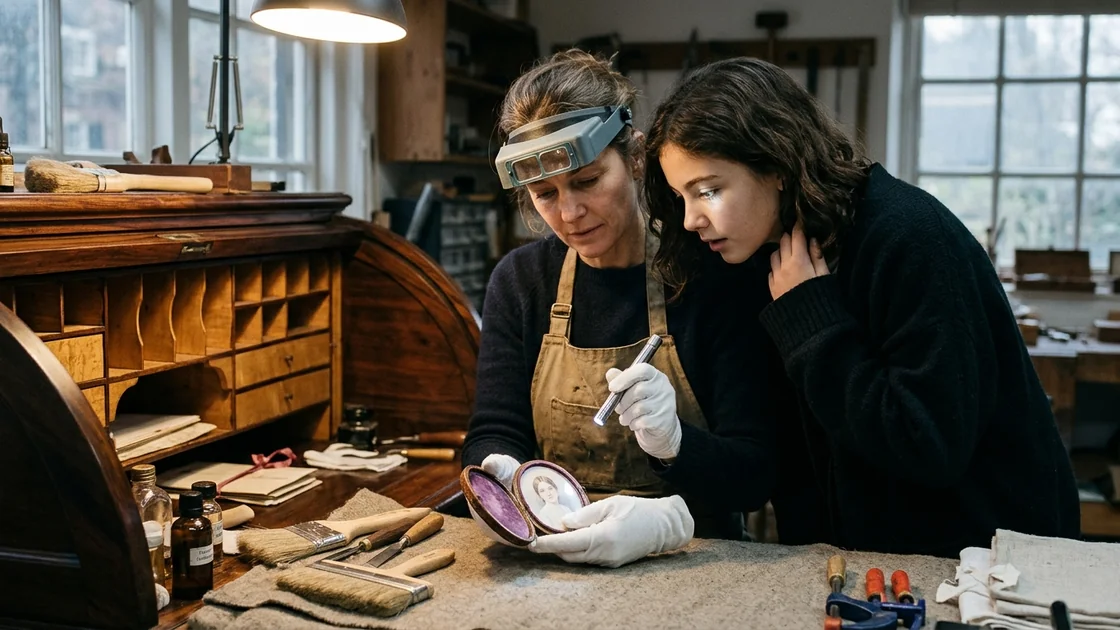
Elena Vance is a meticulous antique conservator living in a coastal New England town whose quiet life with her adopted daughter Clara is upended when a nineteenth-century rosewood cylinder desk arrives in her workshop. While disassembling the piece for extensive restoration, Elena triggers a forgotten spring latch and discovers a hidden miniature watercolor portrait painted on ivory, depicting a young girl who shares Clara's striking features down to a peculiar silver fleck in her left eye. Driven by maternal dread and obsessive curiosity, Elena investigates the provenance of the desk and its creator, unearthing an ancestral lineage of quiet resilience and artistic secrecy that bridges a forgotten past with the girl she has raised as her own.
Chapter I: The Anatomy of Grain
The workshop smelled perpetually of aged spirits, bone glue, and the dust of dry timber. To anyone stepping inside from the salt-rimed chill of High Street, the atmosphere might have seemed stifling, thick with the vapor of denatured alcohol and orange shellac flakes simmering in double boilers. But to Elena Vance, the room was an engine of quietude.
She stood at her central workbench, her fingers dusted with rottenstone, leaning over a Regency-era tilt-top table that had surrendered to humidity fifty years prior. Outside, the November tide of Cape Ann retreated against the granite seawall, dragging loose shingles and brown kelp into the grey swell of the Atlantic. The sky was the color of zinc.
"You're holding your breath again, Mom."
Elena blinked, looking up through the bifocal loupes resting on the bridge of her nose. Clara leaned against the doorframe leading from the small residential kitchen at the back of the shop, an oversized wool cardigan swallowed around her hands. At fourteen, Clara was all long limbs and quiet contemplation, her presence marked not by the slamming doors of typical adolescence, but by a ghost-like stillness that could leave a room feeling unoccupied even when she was sitting dead in the center of it.
"I wasn’t holding it," Elena said, lifting the loupes to her forehead, where they pressed into the faint indentations they had worn over twenty years of trade. "I was leveling a drop of lacquer. Air currents ruin the skin."
"You hold it when you're thinking about bills, too," Clara observed, sliding onto the tall stool near the drying rack. She pulled an apple from her pocket, turning it over in her palm. "Mr. Henderson called while you were out back getting the turpentine. He said the truck from the estate in Newburyport will be here before four."
Elena glanced at the cast-iron wall clock. It was quarter past three. "He didn’t give much warning."
"He never does. He said the family wanted the attic cleared before the first frost broke the slate roof." Clara took a bite of the apple, her gaze drifting toward the tools racked along the pine-board walls—the gouges, the micro-chisels, the horsehair brushes with handles rubbed smooth by three generations of hands. "Is it an important piece?"
"It’s an escriutoire. American cylinder desk, mid-1870s, or so Henderson claims. Probably rosewood veneer over northern pine, likely cracked along the tambours. People never oil the tambours. They force them down when the humidity swells the canvas, and then the whole track splinters." Elena wiped her hands on her linen apron, leaving streaks of grey abrasive across the bib. "If it's in the condition Henderson usually finds, it will keep the lights on until March."
Clara watched her with her head tilted, a habit Elena had noticed the day she first brought her home from the state agency in Augusta twelve years ago. Even as a toddler of two, wrapped in an oversized winter coat that smelled of industrial laundry detergent, Clara had cocked her head at that exact forty-five-degree angle whenever the world presented something that required translation.
There was a singular architecture to the girl’s face that Elena had long memorized: the narrow bridge of the nose ending in an abrupt, sculpted tip; the heavy, slightly drooping outer corners of the eyelids that gave her an expression of perpetual, gentle skepticism; and, most distinct of all, the left iris. While Clara’s right eye was an ordinary, quiet hazel, her left possessed a sharp wedge of pale, reflective grey—almost silver—cutting across the bottom quadrant like a sliver of broken mirror. The agency social worker had called it sectoral heterochromia, a genetic quirk of pigmentation that meant nothing medically, but which rendered Clara’s gaze startlingly memorable.
"I can help with the canvas," Clara said softly. "If the backing is rotted, I can size the linen."
"We’ll see how bad the timber is first," Elena said, offering a small, reassuring smile that Clara met with a brief nod.
They did not speak much of the agency or the early years. The paperwork had been sparse: an infant found surrendered under the safe-haven provisions at a regional medical center in central Maine, no names, no familial traces, only a clean flannel blanket and a handwritten slip of paper that read Her name is Clara. Elena, twenty-nine then and raw from the quiet erosion of her own marriage, had taken that baby into her drafty clapboard house over the shop and built a life out of routine, patience, and the slow preservation of old, abandoned things.
The rumble of a heavy diesel engine broke the ocean wind outside. Through the leaded panes of the shop front, Elena saw Henderson’s battered flatbed pull to the curb, its exhaust blowing white clouds into the falling dusk.
Chapter II: The Rosewood Cylinder
The desk was not in pieces, but it had suffered the cold indignities of neglected storage. When Henderson and his young driver dropped it onto the rubber-matted furniture dollies, the wood groaned—a dry, hollow complaint of desiccated joinery.
"Nineteenth-century estate off the turnpike," Henderson grunted, wiping sweat from his red neck despite the November chill. " Belongs to the last of the Calloways. House is being subdivided into condominiums. Everything was going to the dump if the bank didn't clear the lien by Friday. I told them you were the only one within forty miles who wouldn't just strip it with a dip-tank and ruin the grain."
"Thank you, Donald," Elena said, her eyes already tracing the lines of the carcass.
It was more ambitious than she had anticipated. Standing nearly five feet tall, it was an imposing cylinder-top writing desk made not merely of veneer, but of heavy, figured Brazilian rosewood—dense, oily Dalbergia nigra, its swirling black-and-coffee veins rippling across the arched hood like frozen river water. The base rested on carved bracket feet that terminated in stylized lion claws grasping flattened spheres, a transitional detail nodding to the classical revivals that lingered in high-end New England cabinet shops well after the Civil War.
"Look at the pulls," Clara whispered from behind Elena’s shoulder.
Elena leaned in. The drawer pulls were cast brass, darkened to an oily bronze patina, but their faces were chased with unusual care: not the standard acanthus leaves or rosettes of mass-produced hardware, but intricate, interlaced brambles of wild sea-rose, thorns and petals intertwining around the mounting pins.
"It’s bespoke," Elena muttered, her thumb skimming over the dry, crusted finish on the desk’s top ledge. "A commissioned piece. Not factory work."
"Well, it's yours for four hundred," Henderson said, pulling a clipboard from his coat. "If you can make three thousand off it in Boston, good on you. Just sign the manifest so I can tell the executor the room is empty."
Elena signed. After Henderson’s truck rumbled back toward the highway, the shop returned to its cavernous silence, punctuated only by the rhythmic tick of the wall clock and the hum of the small ceramic heater under the bench.
Clara approached the desk, reaching out a pale hand to touch the curved tambour hood. "It’s stuck?"
"Don't force it," Elena cautioned instinctively. "The tracks will have collected fifty years of dirt, and the hide glue holding the slats to the canvas backing dries into glass. If we jerk it, the slats will snap."
Elena retrieved her diagnostic kit: an adjustable LED penlight, an angled dental mirror, a thin stainless-steel spatula, and a bottle of raw linseed oil cut with mineral spirits. She knelt before the writing desk, shining the narrow beam into the hairline gap between the bottom of the roll-top and the writing deck.
"The lock is engaged," Elena observed, tapping the small, escutcheon-ringed keyhole centered on the roll. "Or the bolt dropped when the springs died. Fetch the lock-picks and the whalebone wedges, Clara."
The girl moved without needing further explanation, returning in seconds with the velvet roll of tension wrenches and the polished pieces of baleen Elena used to ease historic joints without marring the wood.
Elena worked by feel, kneeling on the cold floorboards. The mechanism was an English four-lever mortise lock, simple in theory, but stiff with petrified tallow. With a steady, upward twist of the brass pick, she felt the first tumbler rise, then the second. A faint, dry snick echoed inside the carcass.
"Hold the top rail," Elena commanded gently.
Clara set her palms flat against the crown molding, bracing the heavy timber. Elena hooked her fingers into the recessed finger-grooves beneath the cylinder and eased upward.
With a sound like heavy parchment scraping across stone, the curved wall of rosewood retreated into the upper cavity. The interior was revealed.
It was an exquisite miniature cathedral of mahogany and bird’s-eye maple. A central prospect door, flanked by two turned colonnettes with Corinthian capitals, was bordered by eight pigeonholes, each arched with delicate fretwork. Beneath them sat six small document drawers, their faces veneered in creamy maple that contrasted starkly with the dark exterior rosewood.
"It’s beautiful," Clara whispered. Her breath caught in the cool air of the shop. "It smells like... cloves."
Elena leaned in, her nose close to the pigeonholes. It did not smell of cloves; it smelled of dried myrrh and old bayberry wax, the residue of candles long burned to their sockets. But there was something else beneath it: the sharp, metallic tang of oxidized iron and the dry, sweet scent of seasoned cedar.
"Let’s inventory the drawers," Elena said.
She pulled the drawers one by one, inspecting the joinery. The dovetails were impossibly fine, cut by hand with pins no wider than a toothpick—the work of a master craftsman who had spent weeks on the interior architecture alone. Each drawer was empty, save for a few desiccated husks of carpenter ants and the ghost rings left by inkwells that had been removed decades ago.
Elena set the six small drawers on the workbench, arranging them in the sequence they had been pulled. She reached into the empty cavities with her bare fingers, running her skin along the dustboards and the interior carcase walls.
"What are you looking for?" Clara asked, sitting cross-legged on the floor now, her chin propped in her hands.
"The carcass depth doesn't match," Elena said. Her eyes narrowed as she stared into the dark recesses of the central compartment where the prospect door stood locked. "Look at the overall depth of the desk from the back wall to the front. It’s twenty-eight inches. These interior pigeonholes and drawers only extend fourteen inches."
"The roll-top curve needs space behind it to slide down," Clara noted.
"Yes, but the curve only accounts for eight inches of radius. There’s a void. Four to six inches behind the prospect cabinet. A dead space."
Elena withdrew her arm and fetched a thirty-centimeter brass rule. She measured the interior floor of the cabinet, then laid the rule along the exterior side panel. Her calculation was correct. Between the rear wall of the bird’s-eye maple colonnade and the primary pine backboard of the desk, there was a pocket of air five inches deep, eighteen inches wide, and twelve inches high.
"A secret well," Elena said, her voice dropping into the quiet reverence she always felt when encountering the private thoughts of a dead artisan. "A hidden compartment."
She did not reach for a hammer or a pry bar. To force a nineteenth-century lock or trigger was an act of vandalism. Instead, she began systematically exploring the internal framework with her fingertips, feeling for what cabinetmakers called the "trick"—a false drawer-runner, a spring-loaded bottom board, or a hidden peg disguised as an interior molding.
She pressed the left colonnette. It was rigid. She pressed the right. It shifted downward a millimeter.
"Clara, look here."
Clara leaned forward, her silver-flecked eye reflecting the small circle of the penlight.
"Hold the column down," Elena instructed. "Gently. Don't let it snap."
Clara pressed her slender thumb against the carved maple capital. Elena took a long, thin steel feeler gauge and slid it beneath the central prospect compartment's bottom rail. There was a click—clear, dry, and musical.
The entire central nest of pigeonholes, colonnettes, and miniature drawers shifted forward on hidden oak runners, propelled half an inch out of the carcass by a pair of coiled steel flat springs that had waited in the dark for more than a hundred and thirty years.
Chapter III: The Girl on Ivory
The hidden compartment was lined with green baize that had faded to the color of dried sage. Elena drew the sliding nest completely free of the carcass and laid it carefully on a clean wool blanket on the bench.
Inside the dark recess of the desk’s interior cavity sat three items: a small lead-crystal ink pot with its silver cap corroded shut; a tied packet of folded letters addressed in iron gall ink, brittle and brown along the folds; and a flat, oval case of black morocco leather no larger than the palm of a child's hand.
Neither of them spoke. The wind outside seemed to drop, leaving the shop wrapped in a sudden, breathless pressure.
"The letters first?" Clara asked, her voice hushed.
"No," Elena said, her eyes drawn irresistibly to the leather case. "The leather is dry. We need to handle it before the hinge disintegrates."
Elena put on clean white cotton inspection gloves. She lifted the small oval case. The leather was embossed with a faint border of wild roses, matching the cast brass pulls of the exterior drawers. A tiny brass push-button catch sat at the side, green with verdigris.
Using a wooden micro-spatula, Elena gently depressed the corroded catch. The spring had lost its temper, but the lid released with a soft, reluctant sigh.
The interior lid was lined with faded purple velvet, deeply indented where it had pressed against the glass cover of the portrait below. Beneath the oval crystal, set into a gilded brass bezel chased with tiny forget-me-nots, lay a miniature portrait painted in watercolor upon a wafer of genuine elephant ivory.
Elena looked down at it through her loupes.
The breath left her lungs in a sharp, involuntary gasp. Her hand jerked back from the bench so quickly she nearly tipped the jar of horsehair brushes.
"Mom? What is it?"
Elena did not answer. She could not. A sudden, cold ringing filled her ears, drowning the faint creak of the floorboards, the distant hum of the surf, even the sound of her own heart.
She reached out again, her gloved fingers trembling as she brought the penlight down to illuminate the tiny disc of ivory.
The miniature depicted a young girl, perhaps thirteen or fourteen years of age. She was dressed in a high-collared gown of slate-blue silk with a small lace tucker pinned at her throat by a black jet brooch. Her hair, a rich, dark chestnut that fell in soft, loose waves around a broad, pale forehead, was parted severely in the middle, behind ears that had tiny, distinctly curled upper lobes.
Her face was long, with a delicate, slightly stubborn jaw and eyebrows that swept down toward the temples in an unbroken, melancholy arc. The mouth was closed, but the lower lip was slightly fuller than the upper, indented at the corners by two tiny, natural shadows.
And her eyes.
The right eye was hazel, painted with minute strokes of burnt umber and yellow ochre. But the left eye—the artist had executed it with an almost fanatical precision using a wash of Payne’s grey and pure white gouache—bore a distinct, unmistakable wedge of pale silver cutting across the lower half of the iris.
It was Clara.
It was not merely an impression, not the vague, familial resemblance one might imagine when staring too long at old photographs in antique shops. It was an exact, anatomical duplicate of the girl sitting three feet away from her. The tilt of the brow, the specific curl of the ear’s helix, the slight asymmetry of the chin, and that singular, striking defect of the iris—an occurrence so rare it appeared in less than a fraction of a percent of the population.
"Elena?"
Clara rarely called her by her first name. She did so only when the balance of their small, insular world was threatened. The girl stood up, alarmed by the sudden, bloodless pallor of Elena’s face.
"Don't look," Elena said, the words slipping out before she could evaluate them. It was the primal, irrational instinct of a mother sensing a snare hidden in tall grass.
"What is it? Is it something bad?"
"No," Elena breathed, trying desperately to master her voice. "No, Clara. It's... it isn't bad. Just... give me a moment."
Clara did not stay back. She stepped to the bench, her sneakers silent on the pine boards, and looked down over Elena’s shoulder into the circle of light.
The silence that followed stretched until Elena felt the wood beneath them might split from the weight of it.
Clara leaned down. She did not touch the case—she had been raised around antiquities and knew the sanctity of an unsealed surface—but her face came within inches of the glass. Her right hand rose slowly to her own throat, her fingers pressing into the collarbone precisely where the girl in the painting wore the jet brooch.
"Who is she?" Clara whispered. Her voice was thin, stripped of tone.
"I don't know," Elena said.
"That's... that's my eye, Mom." Clara turned her face toward Elena. In the bright white beam of the LED lamp, the girl’s left eye caught the light, the silver shard within the hazel ring gleaming like an exposed seam of quartz. "That’s my eye. Nobody has that eye."
"I know," Elena said, her own voice cracking.
"Where did this desk come from?"
"Newburyport," Elena said, her mind spinning backward through the bills of sale, through Henderson’s gravelly voice, through the damp air of the auction circuit. "Donald Henderson cleared it from an estate. The Calloway house."
"Am I... am I a Calloway?"
The question hung in the air like a blade suspended from a frayed cord. For twelve years, Clara’s history had been an empty ledger—a peaceful, if occasionally haunting, expanse of white space upon which they had built their quiet life. Elena had never lied to her. She had told her what the state had told her: an infant left at an emergency clinic in Augusta, healthy, cared for, but entirely devoid of provenance.
Now, looking up from the depths of an escriutoire built in the decade after the Civil War, an ancestor was looking back through a window of ivory and glass, wearing Clara’s face like an inheritance that refused to be buried.
Chapter IV: The Conservation of Memory
That night, sleep did not come to the house on High Street.
Clara had retreated to her bedroom under the eaves at nine, but Elena heard the soft, irregular creak of the floorboards above her head until long past midnight. Every so often, the sound would stop directly over the bench where the desk sat downstairs, as if the girl were staring down through the ceiling boards, pulled by some invisible, subterranean current toward the rosewood carcass.
Elena remained in the workshop. She had brewed a pot of bitter chicory coffee and sat under the low green shade of the drafting lamp, surrounded by the three objects from the secret well.
Before she touched the letters, she turned her attention to the physical artifact of the miniature. As a conservator, she knew that materials were less prone to deception than human testimony. Ivory portraits of that size—known as miniatures in the English and American traditions—peaked in popularity between 1790 and 1840, before being largely displaced by the cheaper, faster marvels of the daguerreotype and ambrotype. By the 1870s, painting on ivory was an archaic choice, reserved for the deeply conservative, the wealthy, or those with an eccentric devotion to historic crafts.
She positioned the miniature under her binocular stereomicroscope, adjusting the focus to forty times magnification.
The surface was pristine, protected from ultraviolet radiation by its century of darkness within the rosewood well. The brushwork was breathtakingly fine. The painter had utilized a technique of minute stippling—thousands of microscopic points of pure pigment applied with a brush that must have possessed only three or four sable hairs.
She studied the silver wedge of the left eye.
Under magnification, it was not merely a flat wash of grey. The artist had layered ultramarine ash, zinc white, and a microscopic dusting of mica to capture the uncanny, iridescent quality of the anomaly. The painter had known that eye intimately. It was not a stylized representation; it was a clinical, loving documentation of a specific human body.
Elena shifted the illumination to raking light, angling the beam across the surface to reveal the brush topography. In the lower right curve of the oval, nearly hidden beneath the brass bezel, she found the signature:
A. V. C. — 1876
"A. Calloway," Elena murmured to herself.
She set the miniature aside and brought the packet of letters to the center of the clean blotting paper.
The packet was tied with a faded ribbon of black silk that had shattered into fragments at the touch of her tweezers. There were five envelopes, each made of laid rag paper, yellowed at the perimeter but remarkably supple. The ink was iron gall, now aged to the warm sepia tone of walnut stain.
Elena took a micro-spatula and slipped it under the flap of the top envelope, which was unsealed. She drew out a single sheet of paper covered in a small, disciplined cursive hand that leaned slightly backward, as if the writer were pulling away from the page even as they inscribed it.
She began to read:
September 14, 1876
My Dear Silas,
The wood you selected has settled well in the north parlor. The grain of the cylinder is like dark water, just as you promised when you brought the planks from the timber yards in Salem. I sit before it even now as the carpenter finishes the mortising of the lower plinth. It is strange to think that an object of such bulk and permanence can be built to enclose so light and fragile a secret.
Adelaide sat for me again this morning by the garden window. Her fever has left her weak, but her spirits are clear. She laughs at my persistence with the ivory, saying that Mr. Southworth’s camera could have finished the business in ten seconds and spared her the sitting. But I told her that silver plates have no soul; they see only the exterior shadows, while the brush must record what the heart already knows. When she turns her head toward the sea, that strange, light splash in her eye catches the grey clouds, and I feel as if I am painting a child who belongs half to the earth and half to the salt water.
Her father remains stubborn. The carriage will come for her before the first snowfall, regardless of the physician’s warnings. He believes that by sending her inland to the school in Vermont, the Calloway name will be scrubbed clean of what he calls ‘the taint of maternal madness.’ He does not see that what he calls madness is merely the will to see what is true.
I have asked Silas to construct the well precisely to the measurements of the little oval case. If they will not permit her likeness to hang upon the walls of Highfield House, it will live within the timber of this desk, which he cannot sell without violating his grandfather’s trust. Wherever this desk goes, she will go with it.
Yours in enduring affection, Vivian
Elena lowered the letter. The air in the workshop felt thin, vibrating with a high, silent resonance.
"Adelaide," Elena whispered.
She picked up the second letter. It was dated two months later, November 1876:
Silas,
She is gone. Not to Vermont, as he lied to the town, but to the cottage at Cape Split, beyond the bay. He could not abide the sight of her face after her sister’s passing. He claims she looks too much like the portraits in the old gallery—the ones he had burned when the estate was surveyed.
I gave her the locket before the wagon left. She took the miniature of her mother, and I have kept the portrait of Adelaide here, behind the false colonnade of your marvelous desk. If you ever have cause to look into this well again, know that the child did not submit quietly. She told him that blood does not stop flowing because a father closes the door.
Elena read through the remaining letters. They were a chronicle of a quiet, desperate resistance waged within a prominent New England mercantile family. The writer, Vivian Calloway—evidently an aunt or an elder cousin—documented the systematic erasure of a girl named Adelaide Calloway, born in 1862, who possessed an unconventional spirit and an uncanny, inherited physical resemblance to an estranged maternal line that the patriarch, Arthur Calloway, had spent a fortune trying to forget.
The letters ceased abruptly in January of 1878. The final entry was not a letter at all, but a folded scrap from a regional gazette:
DIED — At Cape Split, Maine, on the 12th inst., Adelaide, daughter of Arthur Calloway, Esq., in the sixteenth year of her age.
Elena stared at the newsprint. "Sixteen," she muttered. "She died at sixteen."
She looked from the clipping back to the miniature. The girl on the ivory looked out at her with that calm, stubborn lower lip and the split-silver eye.
If Adelaide Calloway had died at sixteen in a remote fishing outpost on the Maine coast in 1878, how could Clara be sitting upstairs in 2024 with Adelaide's face, Adelaide's ears, and Adelaide's impossible eye?
Chapter V: The Provenance of Timber
Elena was not a genealogist, but twenty years of antique conservation had taught her how to follow a trail of dead hands. Every historic object had two histories: the physical history recorded in its materials—tree rings, tool marks, chemical compositions—and the social history recorded in registries of deeds, wills, customs manifests, and court disputes.
By eight in the morning, Clara was down in the kitchen, buttering toast with an uncharacteristic, mechanical rigidity. Her school backpack sat beside her chair, untouched.
"You're not going to school today," Elena said, pouring two mugs of tea.
Clara looked up, her expression guarded. "Why? Because of that?" She nodded toward the closed door of the workshop.
"Because we are going to Maine," Elena said simply.
Clara’s fork paused above her plate. "Maine? To where I was found?"
"To Cape Split," Elena replied, setting the tea before her. "And then to the county seat in Machias. Donald Henderson said the Calloway estate was cleared because of a bank foreclosure. The family had been selling off their holdings for forty years. But that desk didn't spend its whole life in Newburyport. There are railway shipping stencils on the back of the pine carcase that say Maine Central R.R. — Machias Station, 1882."
Clara looked into her tea. "What did the letters say, Mom?"
Elena hesitated, feeling the sudden, perilous weight of parenthood. She could shield the girl; she could bundle the letters and the miniature into an archival preservation box, seal it with acid-free tape, and store it on the high shelf behind the eighteenth-century clocks. She could tell Clara that history was full of strange coincidences, that human genetics was an endless roll of dice, that two unrelated people could look identical across the expanse of a century.
She could lie, but the lie would curdle every honest thing they had built between them.
"They say that a girl named Adelaide lived in that desk," Elena said gently. "She had your face, Clara. And she had your eye. The woman who painted her said it was an eye that belonged to a family her father wanted to destroy. The official record says she died at sixteen at Cape Split. But I’ve spent twenty years reading old inventories, and people don't hide lockets in spring-loaded secret drawers unless they are trying to preserve something they know is being hunted."
Clara took a slow breath. Her fingers reached out and tapped the wooden tabletop three times—a small, grounding ritual she had performed since she was a little girl.
"I want to see the house," Clara said. "The one where they sent her."
They left within the hour, leaving a sign on the shop door that read Closed for Sourcing — Back Monday.
The drive north was grey and long. They followed Route 1 through the rocky coastal shelf of New Hampshire, crossing into Maine as the morning light turned the marsh grass along the tidal flats to the color of tarnished copper. Elena drove her battered Volvo wagon, the miniature portrait resting securely in its velvet case inside the glove compartment, wrapped in layers of bubble wrap and acid-free tissue.
Beside her, Clara watched the spruce trees thicken along the highway. As they moved past Portland, then Brunswick, and into the rocky, jagged coast of Downeast Maine, the modern world seemed to thin out, peeled back like layers of old varnish under a solvent wash.
Elena’s mind kept returning to the woodwork of the desk.
She had checked the interior joinery before they left. Beneath the bottom runner of the secret well, she had found another maker’s mark, stamped cleanly into the white pine with an iron die:
S. THORNE — CABINETMAKER — ADDISON, ME — 1876
Silas Thorne had not been a Boston maker or a high-style artisan from New York. He had been a Downeast craftsman, working from a coastal village where boatbuilders and timberwrights shared the same spruce logs and white oak knees. The desk had been built in Maine, transported to the Calloway mansion in Massachusetts, and then, evidently, followed the daughter back to the north.
By three in the afternoon, the highway had narrowed to a two-lane road that wound through coastal spruce barrens and salt marshes. The smell of the ocean was different here than on Cape Ann: colder, sharper, smelling of granite cliffs, crushed mussel shells, and damp peat.
Cape Split was a long, rocky finger of land extending into the grey expanse of Pleasant Bay. The road ended at a gravel turnaround near a cluster of lobster-boat moorings and a small, weathered town hall that doubled as the local historical repository.
Elena pulled the car to a stop near the granite slipway. The wind off the bay was ferocious, carrying a spray that tasted of winter.
"Wait here for a minute, Clara," Elena said, slipping the morocco case into her heavy coat pocket.
"No," Clara said, her voice firmer than Elena had ever heard it. She unbuckled her seatbelt and reached for her coat. "I'm not sitting in the car, Mom. If this is about me, I'm coming in."
Elena looked at her daughter’s determined face, at the line of the jaw that matched stroke-for-stroke the ivory miniature in her pocket. She felt a sudden, fierce pride that chased away the lingering dread.
"All right," Elena said. "Button your collar. It's cold."
Chapter VI: The Record of the Lost
The Addison Historical Society was housed in the ground floor of an 1840 union church with peeling white paint and a leaning belfry. Inside, the space was heated by a cast-iron woodstove that hissed with spruce resin.
An elderly woman with thick silver hair pinned in a neat coil sat at a library table, sorting through cardboard boxes of property tax ledgers. A hand-lettered wooden sign on her desk identified her as Martha Beal — Town Historian.
She looked up as the bell above the door rattled in the draft. Her pale, rheumy eyes drifted over Elena, then settled on Clara.
The woman froze. Her pen remained suspended over the open ledger, a drop of blue ink pooling on the yellowed leaf.
Elena saw the recognition immediately. It was not the recognition of an acquaintance, but the shock of an archivist who has seen an apparition step out of a frame.
"Good afternoon," Elena said carefully, stepping toward the table.
Mrs. Beal did not answer immediately. Her gaze remained pinned to Clara’s face, tracing the curve of her eyebrows down to the silver wedge in her left eye. When she finally spoke, her voice was a dry, sea-bird croak.
"You’re a Thorne," the old woman said, her voice trembling slightly. "Or you’re from the bay people out on the reach."
Clara glanced at Elena, who stepped forward and gently laid the oval morocco case on the desk.
"My name is Elena Vance. This is my daughter, Clara. We came from Massachusetts because of an antique desk made by Silas Thorne in 1876."
Elena pressed the catch and flipped the case open.
Mrs. Beal looked down at the miniature on ivory. She did not gasp; she merely let out a long, shuddering sigh that smelled of mint lozenges and old paper.
"So it wasn't burned," Mrs. Beal whispered. "Silas’s journal said Vivian hid it, but we always believed Arthur Calloway found it when he took the furniture back to Newburyport after the girl passed."
"The desk had a secret compartment," Elena said. "Behind the prospect door. It hadn't been opened since the eighteen-seventies."
"Sit down," Mrs. Beal said, gesturing with a trembling hand toward two oak library chairs. "Sit down, both of you."
The old woman pushed her ledgers aside and went to a metal filing cabinet in the corner of the former sanctuary. She unlocked the middle drawer with a small brass key and retrieved a bound volume of heavy, ledger-sized pages covered in buckram cloth.
"The Calloways were timber merchants," Mrs. Beal said, laying the volume on the table between them. "They owned the spruce mills on the river and thousands of acres of timber rights all the way to the Canadian line. But the money came from the sea. Arthur Calloway married a girl from the islands—Maeve MacNair. The MacNairs were Scots-Irish settlers who came out to the outer islands in the seventeen-hundreds. Queer people, the old folk called them. Strong-willed, red-haired or dark-haired, with eyes that looked like split river pebbles."
Mrs. Beal turned the pages until she reached a hand-drawn genealogical chart from the late nineteenth century.
"Maeve had that eye," Mrs. Beal said, tapping a yellowed square on the linen paper. "The silver iris. In the Gaelic they called it the sùil a’ chait—the cat’s eye—or the mark of the seal-folk. A foolish superstition, but Arthur Calloway was a proud, brittle man who hated anything he couldn't govern with a ledger. Maeve bore him two daughters: Eleanor and Adelaide. Eleanor died of the scarlatina when she was twelve. When Adelaide began to grow up, she looked so much like her mother—and like her mother’s people—that Arthur couldn't bear her."
"The letters said he sent her here to die," Clara said quietly.
"He sent her here to be out of sight," Mrs. Beal corrected gently. "To the cottage on the split. But she didn't die here."
Elena leaned forward, her heart hammering against her ribs. "The newspaper clipping—the gazette notice said she died on January 12th, 1878. Sixteen years old."
Mrs. Beal offered a thin, triumphant smile that revealed her crooked lower teeth.
"Arthur Calloway paid five dollars to the editor of the Machias Union to print that notice," she said. "He wanted her legally dead so he could break the trust his wife had left for her. He wanted the MacNair blood off his books. But the people of Cape Split didn't work for Arthur Calloway; they worked for the sea."
She flipped several pages forward in the parish register, running her index finger down a column of faded Spencerian script.
"Adelaide didn't die in January of seventy-eight," Mrs. Beal said. "She was married that winter in the parlor of the lightkeeper’s house on Nash Island. She married Julian Thorne—Silas the cabinetmaker’s youngest boy. The whole village kept the secret because Arthur Calloway would have seized Silas’s timber leases if he'd known."
Mrs. Beal turned the book toward Clara.
"Adelaide lived to be seventy-one years old," the historian said, her voice soft and reverent. "She raised five children in the salt-water farmhouse two miles down the spit road. She was a weaver. She had a daughter named Vivian, who had a daughter named Maeve, who had a daughter named Adelaide."
Clara’s hand rose to her throat again, her fingers curling around the hollow of her collarbone.
"Then... who was my mother?" Clara asked.
Mrs. Beal looked at Clara with an expression of profound, aching gentleness. "In nineteen-ninety-two, the last Thorne on the split was a young woman named Sarah. She was a brilliant girl, an illustrator. She went down to Portland to study art, but she came back when the sickness took her mother. Sarah had that eye, child. The silver wedge. Everyone on the cape knew the Thorne eye."
The room was silent save for the crackle of the woodstove.
"What happened to Sarah?" Elena asked, reaching across the table to cover Clara’s cold fingers with her own.
"She had a hard time of it," Mrs. Beal said softly. "The family money was long gone. The farm was sold for taxes in the late nineties. Sarah lived in a cabin out by the marsh, painting signs and doing what she could. In the winter of twenty-ten, she took sick with pneumonia. She was young, barely twenty-two, but she was alone. When she realized how sick she was, she got in her old car and drove inland toward the regional hospital in Augusta."
Mrs. Beal closed the ledger with a quiet thud.
"She never came back to the Cape," the historian said. "We heard from the state police that she died in the emergency ward that December. They said she had given birth to a little girl a few weeks before she passed, but there were no records of the father, and the baby had already been taken into protective care by the state."
Mrs. Beal reached out and gently laid her dry, wrinkled palm over Clara’s knuckles.
"We looked for you, child," Mrs. Beal said, her eyes glistening. "The parish collected money to try and trace the state records, but the state closed the files tight under the safe-haven laws. We couldn't prove who you were without names or blood tests we couldn't afford. But Silas Thorne built that rosewood desk for Adelaide. He put her face in the secret well so she would never be forgotten. And now the desk has brought you home."
Chapter VII: The Salt-Water Farm
They left the historical society in the late afternoon, as the low winter sun began to drop behind the black spires of the spruce ridges.
Following Mrs. Beal’s directions, Elena drove the Volvo down a rutted gravel lane that wound toward the southern tip of the peninsula. The trees fell away, replaced by sweeping fields of wild lowbush blueberry, their bare twigs a deep, crimson rust against the grey granite outcroppings.
At the end of the lane stood the remains of the Thorne farmstead.
The main house had collapsed twenty years prior, its roof caved in upon itself like the ribcage of a stranded whale, but the fieldstone chimney still stood tall and straight against the sea wind. Beside it, an old timber-frame workshop had survived, its cedar shingles weathered to the brilliant silver-grey of driftwood.
Clara stepped out of the car. The wind caught her hair, whipping the chestnut strands across her face. She did not pull them back. She walked toward the edge of the granite ledge where the property dropped thirty feet into the boiling surf of Pleasant Bay.
Elena followed her at a distance, giving the girl room to breathe the air that had formed her bones.
Across the water, the white tower of Nash Island Light flashed its steady, rhythmic pulse against the gathering dusk. It was the same light that had shone through the window when Adelaide Calloway stood in the keeper’s parlor in the winter of 1878, refusing to die for her father’s ledgers.
Clara turned to look at the fallen house.
"My mother lived here," she said. It was not a question.
"Yes," Elena said, stopping beside her.
"And her mother before her. All the way back to the girl in the desk." Clara looked down at her own hands. In the cold air, her knuckles were pink, her long, slender fingers resembling the hands of the girl in the ivory portrait. "Why didn't she leave a note, Mom? Why didn't Sarah leave my name?"
Elena thought of the young woman alone in the winter cabin, coughing by the light of a kerosene lamp, knowing that her lungs were filling and her strength was gone.
"Because she was afraid, Clara," Elena said gently. "Think of what this family lived through. For four generations, people tried to take their children, take their land, erase their names. Sarah probably thought that if she gave them a name, the state would put you in an institution or hand you over to someone who would treat you like a case number. By leaving you clean—just your name on a slip of paper—she gave you a chance to be found by someone who would love you for who you were, not for what had been taken from her."
Clara looked up at Elena. In the fading light, her left eye caught the white flash of the Nash Island beacon, the silver wedge gleaming with an internal, unquenchable fire.
"You found me," Clara said.
"I found you," Elena said. "And then the desk found you."
Clara reached into Elena’s coat pocket and drew out the morocco case. She opened the lid, holding the miniature against the backdrop of the bay. The painted girl on the ivory wafer looked out over the water, her slate-blue silk gown matching the darkening Atlantic, her silver eye fixed upon the same horizon she had watched through Silas Thorne’s workshop window a hundred and forty-eight years before.
"She doesn't look dead," Clara whispered.
"She isn't," Elena said. "Not while you're standing here."
Chapter VIII: The Grammar of Preservation
They returned to Cape Ann two days later.
The journey back was quiet, but it was not the suffocating silence of secrets; it was the full, settled quiet of timber that has finally finished seasoning. Clara sat in the passenger seat with Silas Thorne’s letters in her lap, reading them over and over until she had memorized the cadence of Vivian’s cursive and the dry, sturdy notations of the cabinetmaker.
The workshop on High Street was cold when they unlocked the door, but Elena immediately rekindled the ceramic heater and lit the gas burners beneath the glue pots.
The rosewood desk stood in the center of the shop, waiting.
Now that the mystery of its internal space had been solved, the task of conservation remained. To an ordinary dealer, the value of the desk was in its marketability as a high-style Victorian curiosity. But to Elena and Clara, it was a reliquary—an architectural ark that had preserved a bloodline across the silence of a century.
"We don't sell it," Clara said, leaning against the workbench as Elena put on her work apron.
"We couldn't sell it if we wanted to," Elena said, smiling faintly. "Silas Thorne would come down from Maine and splinter my chisels. It stays in the family. We'll put it in the study upstairs."
"Can I help restore it?"
Elena looked at her daughter. Clara had taken off her cardigan and rolled up her flannel sleeves, revealing the slender, capable forearms that had spent years holding planes and leveling varnish.
"Fetch the hide glue and the horsehair clamps," Elena said. "We have to re-back the cylinder."
For three weeks, the workshop became a sanctuary of meticulous restoration.
They did not rush. In conservation, haste was the enemy of truth. Every movement was calculated to preserve the historic fabric while arresting the decay of time.
Elena taught Clara how to prepare animal protein glue, melting the amber pearls in the water-jacketed pot until the mixture reached precisely one hundred and forty degrees Fahrenheit. Together, they laid the rosewood cylinder slats face down on the bench, aligning each thin strip of timber with wooden wedges until the curve of the tambour was mathematically true.
"Now the linen," Elena instructed, demonstrating how to size the unbleached Belgian flax with a thin wash of glue.
Clara worked with an instinctive, natural precision. Her fingers smoothed the wet fabric across the backs of the rosewood slats, chasing out the air bubbles with a polished bone folder until the textile became one with the wood.
"Silas used an open-weave hemp," Clara noted, examining the shredded fragments of the original backing they had removed. "He put three rows of linen tape across the stress points."
"Then we will put three rows of linen tape," Elena said. "We follow his hand."
When the tambour was reassembled and cured, they addressed the finish. Elena refused to use modern polyurethanes or harsh chemical strippers. The original finish was a traditional French polish—hundreds of micro-layers of orange button shellac, applied with a wool fad lubricated with drops of raw walnut oil.
For seven days, they worked in tandem, their hands moving in broad, figure-eight patterns across the swirling rosewood grain. With each pass of the pad, the wood deepened, drinking in the alcohol and resin until the dry, greyish patina vanished, replaced by a deep, three-dimensional warmth that looked like tortoiseshell suspended in liquid amber.
The figure of the Brazilian timber came alive under their palms. The dark veins rippled across the cylinder like storm water, while the bird’s-eye maple of the interior pigeonholes glowed with the soft, creamy luminescence of candlelight.
Finally, they came to the secret well.
The mechanism was cleaned with kerosene and lubricated with microcrystalline wax. Elena repaired the fractured oak runner that supported the prospect cabinet, resetting the original coiled steel flat springs into their mortises.
When Clara pressed down on the carved Corinthian column on the right, the catch released with the same clean, metallic snick that had echoed through the shop a month before. The entire architectural nest glided forward smoothly, revealing the baize-lined cavity behind.
Clara took the morocco leather case.
She had spent the previous evening cleaning the verdigris from the brass bezel with a wooden toothpick and a drop of mineral spirits, restoring the tiny chased forget-me-nots to their original, muted gold luster.
She did not leave the case closed.
Using a tiny square of archival conservation foam, she mounted the miniature portrait upright against the back wall of the secret well, so that whenever the hidden mechanism was triggered, Adelaide’s face would emerge directly into the light, looking out from the rosewood frame.
Beside the miniature, Clara placed a new document: a sheet of heavy rag paper upon which she had inscribed in neat, black ink the lineage of the Thornes of Cape Split, from Adelaide Calloway Thorne down through Sarah Thorne, ending with her own name: Clara Vance — 2024.
"Should we close it?" Clara asked, her fingers resting on the maple colonnette.
Elena stood beside her, her arm resting over Clara’s shoulders. The smell of the shop was clean now—the scent of fresh shellac, beeswax, and cured hide glue mixing with the cold salt air drifting through the shop door.
"Close it," Elena said. "It knows when to open."
Clara pressed the nest back into the carcass. With a firm, satisfying thud, the spring latched, the false backboard settled flush against the partition, and the interior of the desk became once again a serene, seamless landscape of nineteenth-century order.
Clara turned around, leaning her back against the finished rosewood.
"Mom?"
"Yes, sweetheart?"
"Thank you for finding the desk."
Elena smiled, pulling the bifocal loupes from her forehead and setting them down among the chisels on the bench.
"I didn't find it, Clara," Elena said, looking into the girl’s eyes—the hazel right, and the brilliant, silver-veined left that held a century of salt water and survival. "You were already here. The desk just brought your mother’s love home to keep you company."