The Midwife of High Crag
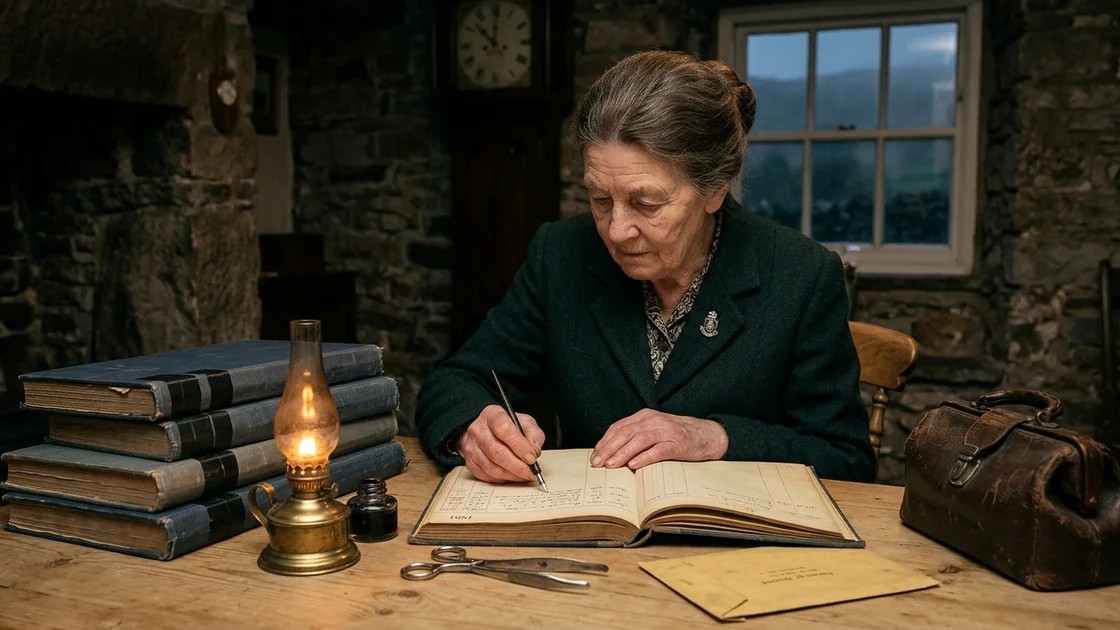
After forty-two years of ushering new life into the remote valley of High Crag, Margaret Thorne has finally surrendered her bicycle, her leather medical bag, and the sleepless nights that defined her existence. When the community gathers to celebrate her retirement with a grand reunion of the thousands of children she delivered, Margaret must confront the solitary ghost of her career. Amid the toasts and laughter, a woman bearing the unmistakable likeness of a girl who supposedly died childless in the bitter winter of 1981 arrives, forcing Margaret to face the desperate, unlawful choice she made on her very first night as a licensed midwife.
I. The Weight of the Bag
The silence of retirement was not peaceful; it was deafening. For forty-two years, Margaret’s ears had been tuned to the register of human distress and human triumph: the low, guttural moans of transition; the sharp, metallic click of arterial forceps laid upon an enamel tray; the hiss of a paraffin heater struggling against a Pennine draft; and that first, furious, indignant intake of air that proclaimed another soul had taken up the burden of mortality.
Now, there was only the hum of the refrigerator in her stone cottage and the rhythmic ticking of the longcase clock her father had left her.
Margaret sat at the scrubbed pine table, her knuckles swollen with the early damp of October. On the table lay her logbooks—forty-two cloth-bound ledgers, their buckram covers faded from navy to slate, their spines reinforced with black electrical tape. Every birth was recorded in the same crisp, sloping script she had learned from the sisters at St. Jude’s Hospital in Leeds: date, hour, mother’s full name, parity, presentation, duration of stage two, weight of the infant, and remarks. Two thousand, one hundred, and fourteen names. A village of her own making, walking the earth, plowing fields, driving lorries, teaching school, dying in their own turns.
Beside the newest, half-empty ledger lay an envelope of thick, cream-colored vellum. It had been hand-delivered three days prior by young Thomas Bradley—whose great-aunt Margaret had turned from a transverse lie in the bitter spring of 1986.
To Sister Margaret Thorne, SCM, the card read in the ornate calligraphy of the Parish Council. You are cordially invited to St. Jude’s Church Hall on Saturday, the twenty-fourth of October, for an Afternoon of Remembrance and Celebration. Four decades of our children welcome you.
Margaret touched the heavy card. She did not want to go. Midwifery was not a trade that tolerated sentimentality; it was too bloody, too visceral, too close to the bone. You did not look back; you washed your hands in Hibiscrub until the skin flaked, you hung your waterproof apron behind the scullery door, and you slept until the telephone rang again.
Yet she knew she would go. In a valley like High Crag, refusal was considered an insult worse than theft. If you brought three generations of a man’s blood into the daylight, you owed him the courtesy of letting him buy you a glass of warm sherry.
Her eyes drifted to the oldest book at the bottom of the stack: 1981.
Its cover was water-stained, the corners nibbled by the field mice that had infested her first lodgings above the blacksmith’s shop in Ghyll Beck. Margaret did not open it. She did not need to. Page one, entry one, was carved into her brain with the permanence of an epitaph on slate.
December 14, 1981. 03:15 hours. High Ghyll Farm. Mother: Finch, Nora. Age: 19. Unmarried. Primigravida. Infant: Female. 4 lbs 2 oz. Stillborn. Cause: Macerated, cord prolapse.
It was a neat, professional lie. A lie written with an ink pen that had trembled so violently Margaret had nearly blotted the page. A lie that had stood for forty-three winters, buried beneath thousands of screams, thousands of placentas burned in iron ranges or buried beneath apple trees, thousands of blessings whispered into the damp crowns of downy heads.
She pushed her chair back, the wood scraping loudly on the flagstones. Her knees cracked as she stood. She walked to the window, looking out over the fellside where the bracken was turning the color of dried blood.
"God forgive me," she whispered to the empty glass of the windowpane, as she had whispered nearly every evening since she was twenty-three years old. "God forgive me for what I couldn't mend."
II. The Great Freeze of 1981
The memory had the frozen clarity of a winter photograph.
Margaret had been twenty-three, fresh from the brick wards of Leeds, armed with pristine starched aprons, a brand-new silver-plated Pinard stethoscope, and an arrogant certainty that textbooks had mapped the entirety of female suffering. High Crag had laughed at her arrogance immediately. The county was in the grip of the Great Freeze; roads were impassable drifts of gray snow, sheep froze standing against drystone walls, and the telephone lines hung like heavy, glazed ropes between sagging poles.
She had been assigned as junior to Sister Beaton, a woman carved out of salt and granite who had delivered half the West Riding by candlelight. But on the night of December thirteenth, Sister Beaton was in Bradford with a fractured hip, and Margaret was alone in her drafty cottage when the knocker sounded at two in the morning.
It had not been a husband. It had been Arthur Sterling, the master of High Ghyll Farm, his coat frosted white, his face gray with fury and fear.
"Get your kit," he had said, not stepping across the threshold. "The Finch girl’s dropped."
Nora Finch was Arthur Sterling’s ward—or his maid, or his victim, depending on which gossip one listened to at the Black Bull. The valley knew Arthur: an elder of the chapel, a man who owned three tenant farms and spoke to God as if he were an equal partner in a small holding. He did not tolerate weakness, and he did not tolerate shame. Nora was an orphan from the valley head, quiet as a mouse in the wainscot, who had stopped coming to chapel five months earlier.
The ride up the gill had nearly killed Margaret’s pony. The wind came off the moors like a skinning knife, driving pellets of sleet through the wool of her scarf. When they reached the farmhouse—a hulking, blackened pile of gritstone sitting beneath the crags—there was no fire in the hearth of the back scullery where Nora had been put.
Only an iron bedstead, two horse blankets, and the girl.
Nora Finch was small, her dark hair plastered to her skull by sweat that had already gone cold. Her lips were blue. She was not crying; she was beyond crying. Her abdomen was enormous, grotesque on so slight a frame.
"She’s been at it since noon," Arthur Sterling had said from the doorway, his hands jammed deep into his sheepskin pockets, refusing to look at the bed. "Get it done with, girl. If it’s alive, the carter from the parish home comes at noon tomorrow. I’ll not have the bastard under my slate."
"Get out," Margaret had said. It was the first time she had ever used that voice—the voice she would later use to cow violent husbands and drunken uncles for the next four decades.
Arthur had blinked, startled, then spat onto the flags and pulled the heavy oak door shut behind him.
When Margaret pulled back the horse blankets, the smell had told her what the textbooks had only hinted at: the sweet, copper stench of old blood and the foul rot of infection. Nora was burning, her skin dry as parchment.
Margaret had fitted the cold bell of the Pinard to the girl’s belly. She listened. There was the heavy, thudding rhythm of the girl’s racing heart, and then, faintly, down in the left iliac fossa, the galloping tick-a-tick-a-tick of fetal life.
"Nora," Margaret had whispered, brushing wet strands from the girl’s forehead. "Nora, can you hear me? I’m Margaret. I’m the midwife."
Nora’s eyes had rolled toward her, milky and unfocused. "He’ll give it away," she had gasped, her fingers clawing at Margaret’s sleeve with terrifying strength. "He swore it on the Book. He said he’d throw it in the beck before he let me keep it. He said... he said it was his disgrace."
"Hush now. Don't waste your wind."
The first baby had come forty minutes later, in a rush of black waters and agony. A boy. Broad-shouldered, pale, his cord wrapped tightly twice around his throat. Margaret had worked with frantic, frozen fingers, untying the knot, clearing the mouth with her bulb syringe, slapping the small soles until he let out a thin, mewling cry.
She had wrapped him in her own flannel petticoat and laid him on the girl’s breast. "A boy, Nora. Look at him. A fine boy."
Nora had looked down, her face twisting into something that was not joy, but terror. "There's... there’s another," she had choked. "Margaret... the pain isn't done."
Margaret’s hands had returned to the girl’s abdomen. To her horror, she felt a second head, high and unengaged. Twins. Undiagnosed, unanticipated, in an unheated room in a snowed-in valley miles from surgical help.
The second stage began again almost instantly, but Nora’s strength was spent. The hemorrhage started before the second infant emerged—a bright, arterial fountain that soaked the mattress and pooled on the stone floor. Margaret had no ergot left in her bag; the single glass ampoule she possessed had shattered when the pony stumbled on the ice. She used her fist, pressing through the abdominal wall onto the aorta, screaming for Arthur Sterling.
No one answered. The wind shrieked through the chimney.
The second baby was born into Margaret’s palms without an active push from the dying mother. A girl. Tiny, scarcely larger than two fists, blue as twilight, limp as a rag. No cry. No movement. The cord had slipped down ahead of the head, cold and pulseless.
"She's dead," Nora had whispered. The girl was slipping away; the bed was an ocean of scarlet. "Thank God... thank God she’s safe from him."
Margaret had laid the silent, limp bundle aside on the washstand, desperate to save the mother. She had packed the vagina with rags, applied bimanual compression, her arms trembling until the muscles tore, her own tears freezing on her cheeks.
"Stay with me, Nora. Look at your son. Look at him."
Nora’s hand had reached out, not toward the boy, but toward the corner where the silent girl lay wrapped in an old flour sack.
"Don't... let him... take..." Nora’s eyes fixed on the ceiling beams. A long, shuddering sigh rattled in her throat. The tension left her body like water draining from a basin. Her hand dropped limp onto the bloody sheets.
She was gone. Nora Finch was nineteen years old, and she was dead.
Margaret had stood alone in the dark room, covered in blood to her elbows, her breath pluming in the freezing air. The boy on the bed whimpered.
And then, from the washstand, came a sound that froze Margaret’s heart in her ribs.
A sneeze.
A tiny, wet, furious sneeze.
Margaret had whirled around. The flour sack was stirring. The girl was not dead. The shock of the freezing air on the washstand had triggered the respiratory center. The blue skin was mottling with pink; the chest was lifting, falling, lifting again. A fragile, flickering spark of life, stubborn as a mountain weed.
Footsteps had thudded in the passageway. The heavy latch clicked.
In that half-second—that infinitesimal fracture of time between the latch lifting and the door swinging open—Margaret had made her choice.
She had looked at the dead girl on the bed. She had looked at the boy, who Arthur Sterling intended to send to the workhouse parish home in Halifax. And she knew what would happen to this tiny, frail girl, an illegitimate reminder of whatever darkness Arthur Sterling had visited upon his ward. If Arthur knew there were two, neither would survive the winter. And Arthur would have his will.
Margaret had seized the bundle from the washstand, dropped to her knees, and thrust it deep into the lower compartment of her wicker bicycle pannier, which she had brought inside to keep her supplies dry. She had thrown her thick woolen traveling cloak over the basket just as the door flew open.
Arthur had stood there, an oil lamp in his hand, casting long, menacing shadows across the carnage. He took in the bed, the blood, the motionless woman.
"She's dead, then," he said. His voice was flat, void of grief, tinged only with an ugly, bitter relief.
"She is," Margaret said, her voice shaking so badly she could barely enunciate. "She bled out. I couldn't stop it."
Arthur’s gaze shifted to the bed, where the boy lay wrapped in the flannel petticoat. "And that?"
"A boy. Alive."
Arthur had cursed under his breath, a venomous string of blasphemies. "I told the carter to bring a box, not a basket. Where's the other? You shouted there was another."
Margaret had looked him straight in the eyes, though her stomach felt as if it were turning to water. "She was born dead, Mr. Sterling. Cord was crushed. She never drew breath. I’ve wrapped her for the churchyard."
Arthur had glanced at the small, blood-soaked flour sack lying by the washstand—which Margaret had swiftly stuffed with a rolled-up towel and a clot of placenta before he entered.
"Fling it in the muck heap," Arthur said coldly. "One's bad enough. I’ll not pay the vicar for two graves."
"No," Margaret had said, her voice suddenly ringing like iron. "She goes in the parish ground with her mother, or I swear to Almighty God I will have the coroner here from Leeds before noon to examine the state of this house."
Arthur had stared at her, the lamp shaking slightly in his grip, before turning away. "Take the brat and go," he growled. "Leave the dead one. The undertaker can fetch Nora and her shame together."
"The baby needs milk now," Margaret had said, scooping up the boy in one arm and seizing her heavy wicker basket with the other. "I’m taking him down to the village."
She had walked out into the blizzard, the boy pressed to her chest, the wicker pannier cutting into her fingers. Inside the basket, beneath her wool cloak and two layers of cotton wadding, the smallest girl in Yorkshire had breathed against the cold.
III. The Road to Low Laithe
Margaret had not gone to the village.
She had turned the pony not down toward Ghyll Beck, but east, across the high drift at Redmire, where the wind screamed across five miles of heather toward the isolated valley of Low Laithe.
There had lived her sister, Clara.
Clara was eight years older than Margaret, married to a gentle, broken-spirited weaver named David Hallowes. Clara had spent ten years burying four infants, one after another, in the acid peat of the chapel yard. Her womb was a graveyard, her arms perpetually empty, her mind slipping slowly into the quiet, gray dementia of the childless moorland woman.
Margaret had hammered on the door of the weaver’s cottage at four in the morning.
When Clara opened it, her hair in braids, an old shawl crossed over her chest, Margaret had set the boy down on the settle by the stove. Then she reached into the basket.
She held out the tiny, miraculous girl, whose skin was now a dusky rose, whose dark eyes were wide and milky, staring up at the soot-blackened rafters.
"Take her," Margaret had said, her teeth chattering so hard she could scarcely form the words.
Clara had gasped, drawing her hands back as if from fire. "Margaret... whose is it? What have you done?"
"Nora Finch died an hour ago," Margaret said, her voice dropping to a harsh, desperate whisper. "Arthur Sterling would have killed her or thrown her into the ditch. The boy is his heir—he’ll send him away, but he won't let him die. This one... this one doesn't exist, Clara. She has no name. She has no record. I have written her down as stillborn."
Clara’s face had drained of color. "Margaret, that’s transportation. That’s prison."
"It's a life," Margaret hissed, thrusting the warm bundle into her sister's arms. "Look at her! She’s breathing. She wants to live. If you don't take her, I’ll have to leave her at the convent in Ripon, and she’ll die of the thrush before the snow melts. Take her, Clara. David will say she came early. You haven't been down to the village since Michaelmas; no one knows you weren't carrying."
Clara had looked down at the tiny face. The child had rooted against her breast, seeking warmth through the rough wool of the shawl. A sound had escaped Clara’s throat—a low, animal sob that Margaret would never forget.
"David," Clara had called softly, her voice breaking. "David, bring more wood. God has sent us a girl."
Margaret had stayed only long enough to see the child take a drop of warm goat’s milk from an eyedropper. Then she had taken the boy, climbed back into the trap, and driven through the dying blizzard down to the village doctor's house in Ghyll Beck.
She had reported Nora Finch's death. She had reported the survival of the male child. And she had opened her brand-new logbook, taken up her pen, and entered the lie that had anchored forty-two years of immaculate service.
Two years later, David and Clara Hallowes had packed their looms and their few sticks of furniture and moved south, to the smoky outskirts of Sheffield, where David found work in the steel mills. The girl had been named Ruth. Margaret had seen her twice: once at three years old, running barefoot through a tiny soot-blackened garden in Attercliffe, and once at seven, when Clara had brought her to Leeds for the day.
Then Clara had died of the influenza in 1991. David had drifted further south to Nottingham, and the correspondence had withered into Christmas cards, then postcards, then silence.
Margaret had told herself the past was dead. Nora Finch was bone in the chapel yard, beneath a stone that Arthur Sterling had never paid for. Arthur himself had died in his bed twenty years ago, unloved and unmourned, leaving High Ghyll Farm to the son he had tried to discard—Julian Sterling, who had returned from an agricultural college in Cirencester to turn the estate into one of the most successful sheep enterprises in the Riding.
Julian was a fixture of the valley: broad, graying, quiet, a bachelor who lived alone with his border collies and his ledgers. Margaret delivered the children of his tenant farmers; she saw him at the agricultural shows; she nodded to him outside the post office. Every time she looked at his square jaw and dark, deep-set eyes, she saw Nora Finch dying in her own blood.
And she wondered, with a sickening pang she never dared voice, where the other half of that night was walking.
IV. The Parish Hall
The twenty-fourth of October broke with that rare, brilliant northern light that turns the gritstone hills into monuments of gold and charcoal.
Margaret dressed with surgical care. She chose her best wool suit—a dark, bottle-green tweed that had belonged to her mother—and pinned her silver Queen’s Institute of District Nursing badge to the lapel. Her hair, which had turned from chestnut to the color of wet slate, was coiled into an uncompromising bun at the nape of her neck.
She walked the quarter-mile from her cottage to the village green.
The church hall was already overflowing. Bunting made of colored paper triangles was strung between the cast-iron gas brackets. Long trestle tables were piled high with sandwich platters, fruitcakes, iced buns, and silver tea urns that vented fragrant steam into the chilly hall.
As Margaret stepped through the porch, the hubbub of seventy voices dropped into an instantaneous, reverent hush.
Then, someone started clapping.
It began with old George Metcalfe, whose twelve children Margaret had pulled into the world between 1983 and 2001. Then the young mothers joined in—girls who had been terrified seventeen-year-olds when Margaret held their hands through thirty hours of back-labor. Then the men, awkward in their Sunday suits, clapping with great, leather-palmed thuds that shook the rafters.
"Here she is!" shouted the Vicar, a youngish man with wire-rimmed glasses whom Margaret still regarded as a newcomer, though he had been there eight years. "The Mother of the Valley! Sister Margaret!"
A wave of bodies surged toward her. Margaret was engulfed in wool, lavender water, tobacco, and the warm, milky scent of infants.
"Look at him, Sister," cried a woman whose name Margaret instantly supplied: Sarah Birkett, née Gledhill, primipara 2012, post-partum retention. "He’s top of his class in Richmond! You said he had the lungs for an auctioneer!"
"Sister Margaret, do you mind this one?" asked another, thrusting a gawky, red-haired teenager forward. "You fished him out of the foot of the bed when the snow was over the sills in ninety-six!"
"Of course I mind him," Margaret said, her voice dry and steady, though her throat felt tight. "He had a knot in his cord and an extra thumb on his left hand. The surgeon in Skipton clipped it."
The boy flushed and grinned, looking down at his ordinary hand.
They moved past her like a living river of her own life's work. She touched cheeks, shook calloused hands, examined the soft fontanelles of third-generation babies thrust into her arms. She knew the map of their bodies better than they did: the scars of old episiotomies she had sewn by candlelight; the pelvic arches that had refused to give; the hearts she had listened to when they were no bigger than a walnut.
"You’ve earned your rest, Margaret," said Julian Sterling.
He had materialized at her elbow, tall, solid, dressed in an expensive tweed jacket that smelled of lanolin and pipe smoke. He was forty-two now, his temples salted with silver, his eyes kind but solitary.
Margaret turned to him. Even after forty years, her pulse gave that tiny, traitorous leap when she met his gaze. He had Nora’s eyes. Exactly Nora’s eyes: that peculiar, pale hazel that turned green in the rain.
"Julian," she said softly. "You shouldn't be here. You’ve sheep to dip before the freeze."
"The sheep can wait," Julian smiled, offering her a glass of ginger wine. "I wouldn't miss this. If it weren't for you, Sister, I’d have ended in the lime pits behind the workhouse. Arthur told me that much before he went."
"Arthur was an ignorant man," Margaret said with a sharpness that surprised them both. "He knew the price of wool and nothing else."
Julian laughed softly. "Aye. But he spoke the truth about that night. He said you fought him like a badger for me. He said you were the only thing that stood between me and the parish carter."
Margaret looked down into her glass, watching the amber wine catch the light of the church hall lamps. "Every child deserves a start, Julian. That’s all a midwife is. A start."
"Well, you gave me mine," he said. He reached into his coat pocket and withdrew a small, heavy box wrapped in silver paper. "From the estate. And from me."
"Julian, you shouldn't—"
"Open it later," he said gently, pressing it into her liver-spotted hand. "When the shouting's done."
He nodded, a courteous, solitary man, and drifted back toward the elders of the parish who were clustered around the cider keg.
Margaret felt a strange, cold vertigo. She leaned against the edge of the trestle table, the silver box heavy in her palm. The weight of Julian’s ignorance was a terrible thing. He did not know that his mother had died in an unheated room while his father cursed her. He did not know that he had shared the dark warmth of Nora’s belly with another heart. He believed he was an only child, born of an unnamed, disgraced girl whom Arthur Sterling had taken pity on.
"Sister Thorne?"
The voice was unfamiliar.
It was not the broad, rolling dialect of the Dales, nor the brisk, clipped tongue of the modern West Riding. It was softer, flavored with the flatter vowels of south Yorkshire, but carry-over from somewhere further east.
Margaret turned.
Standing before her was a woman in her early forties. She was dressed simply in a dark wool coat and a cream-colored silk scarf. She carried a leather shoulder bag that looked worn at the seams.
Margaret looked at her face.
The room seemed to fall away. The clatter of teacups, the screech of children sliding on the polished pine boards, the Vicar’s booming laugh—all of it receded into a dull, underwater roar.
The woman had Nora Finch’s face.
Not as Julian had it—softened by male bone and thirty years of wind and sun—but Nora’s face as it had looked in the lantern light of High Ghyll Farm before the hemorrhage took her. The same straight, delicate nose; the same high, fragile cheekbones; the same line of the jaw that looked as though it might snap under pressure, yet had the stubborn resilience of moorland slate.
And the eyes. Those pale, green-hazel eyes.
Beside the woman stood a girl of sixteen or seventeen, holding an infant bundled in a modern nylon fleece.
"Sister Margaret Thorne?" the woman repeated. She was nervous; her throat twitched as she swallowed. "I’m sorry to intrude. The Vicar said anyone was welcome if... if they had business with you."
Margaret’s knuckles went white against the edge of the table. "Who are you?" she whispered.
The woman took a breath. "My name is Clara. Clara Wilson. My mother was Ruth Hallowes."
V. The Ghost of High Ghyll
Margaret did not faint. Midwives do not faint; they are trained to lower themselves to the floor if their blood pressure drops, but Margaret did not even do that. She simply stood, frozen, feeling the seventy years of her life settle into her joints like lead.
Ruth’s daughter. Nora Finch’s granddaughter.
"You look like her," Margaret murmured, her voice scarcely louder than the hiss of the urn.
"Like my mother?" the woman asked, puzzled. "People always said I had her eyes. She passed away four years ago, Sister. Cancer. It took her very quick."
"Ruth is dead?" Margaret closed her eyes for a brief, agonized second. The child she had pulled from the flour sack, the child she had carried through the blizzard, had completed the entire arc of human existence—birth, growth, motherhood, death—while Margaret had stayed here, in this valley, recording the births of others.
"Yes," Clara said. "She was only thirty-nine. She... she didn't leave much. Just some boxes from when my grandfather David died. But in the bottom of his tin trunk, we found these."
The woman reached into her leather bag.
She did not pull out a legal document. She pulled out a small, rectangular object wrapped in greaseproof paper, and an envelope that had yellowed to the color of dry grass.
"The Vicar said you were the only midwife in the parish back then," Clara continued, her voice trembling slightly. "My mother always believed she was born in Sheffield. Her birth certificate says she was registered in Ecclesall in 1982. But when we went through grandfather’s things, we found this."
She unwrapped the paper.
It was a pair of cord scissors.
Not the modern, stainless steel disposable tools used now, but an old-fashioned pair of nickel-plated Spencer Wells forceps, their jaws cross-hatched, their pivot screw stamped with the mark of the Leeds Surgical Supply Company: 1979.
Engraved on the handle, in tiny, scratched block letters done with an amateur’s burin, were the initials: M.E.T.
Margaret Ellis Thorne.
Her first pair. The pair she had bought with her own savings when she passed her Central Midwives Board examination. The pair she had left on Clara Hallowes’s washstand on the morning of December 14, 1981, because her fingers had been too numb to find the clasp of her medical bag.
"And this," Clara Wilson said, handing her the yellowed envelope.
Margaret’s hand shook as she took it. It was addressed to Sister Margaret Thorne, Ghyll Beck, in her sister Clara’s sloping, uneducated hand. It had never been posted. The stamp was an old four-penny blue, unfranked.
"My mother told me before she died," Clara said, leaning closer, her eyes searching Margaret’s face with a desperate, hungry intensity. "She said she wasn't Clara Hallowes’s blood. She said she knew it from the time she was twelve. She said there was a secret about who she was, and that it belonged to High Crag. When I found the scissors with your name... I had to come. I had to know."
Margaret looked past Clara’s shoulder.
Ten yards away, Julian Sterling was talking to the blacksmith. He had his hands behind his back, his weight balanced on his heels, his head tilted in that familiar, attentive way that Nora had tilted hers when she listened to the winter wind.
The girl beside Clara shifted the baby in her arms. The child gave a small, querulous grunt—a sound that went through Margaret’s ribs like a bodkin.
"Come with me," Margaret said.
"Sister?"
"Don't speak," Margaret commanded, the authority returning to her voice with such sudden force that the younger woman stepped back, startled. "Not here. Follow me."
Margaret led them through the crowd. She did not look at the well-wishers who tried to catch her sleeve; she did not answer the calls for another photograph by the cake. She steered them through the vestry door at the back of the hall, turned the heavy iron key in the lock, and shut out the sound of the reunion.
VI. The Vestry
The vestry was cold, smelling of damp surplices, floor wax, and the dry, sweet dust of old hymnals. A single lancet window looked out over the churchyard, where the headstones leaned like gray teeth against the rising mist of the valley bottom.
Margaret stood by the oak table where the parish registers were signed after weddings. She placed the silver scissors on the wood. The metal clicked against the oak—the exact sound they had made forty-two years ago.
"Sit," Margaret said.
Clara Wilson sat on the rush-bottomed chair. Her daughter remained standing, her eyes wide, clutching the baby protectively against her coat.
"Your mother was Ruth," Margaret said. She was not looking at Clara; she was looking through the lancet window at the corner of the churchyard near the yew tree, where the common graves lay unmarked.
"Yes," Clara said.
"She was born on the fourteenth of December, 1981," Margaret said, her voice dropping into the flat, rhythmic cadence of an official report. "At three-twenty in the morning. At High Ghyll Farm, three miles up this gill. Her mother was Nora Finch. She was nineteen years old. She was not married."
Clara sucked in her breath. "Nora Finch. Was she... did she give my mother away?"
Margaret turned around. Her eyes, usually so bright and sharp, were hooded with a terrible, ancient fatigue.
"Nora Finch died twenty minutes after your mother was born," Margaret said. "She died of a postpartum hemorrhage. She bled until her heart stopped. There was no doctor. There was only me. A girl of twenty-three with a bag of useless tools and no ergot."
Clara’s face went white. "Then... my grandfather David? Clara Hallowes?"
"Clara Hallowes was my sister," Margaret said. "She was a good woman. She had buried four babies of her own in that ground out there. She had milk in her breasts from a child she had lost three weeks before, and her mind was breaking with the grief of it. I brought your mother to her through five miles of snow."
Clara rose from the chair, her hands trembling. "You gave my mother away? Like a stray pup?"
"I saved her life!" Margaret’s voice cracked across the small stone room like a whip.
The baby in the girl’s arms began to whimper. The girl shushed it frantically, rocking from foot to foot.
"You don't know," Margaret said, stepping toward them, her old body shaking with the sudden, violent resurgence of that night. "You sit there with your motor cars and your hospitals and your legal registries, and you know nothing. Arthur Sterling owned High Ghyll. He owned the land, he owned the sheep, and he owned Nora Finch. When Nora was dying, Arthur stood in that room and told me to fling your mother’s body into the muck heap because he wouldn't pay the church to bury a bastard."
Clara stared at her, horrified.
"He was going to take the other one—the boy—and send him to the parish home in Halifax," Margaret continued, the words pouring out now, a dark, unstoppable river that had broken forty years of masonry. "He didn't know your mother was alive. She was born blue. She had the cord round her neck. She didn't breathe for three minutes. When she did... Arthur was outside getting his horse. If I had told him she was alive, he’d have taken her. Or he’d have let her freeze in that scullery. He was a hard, wicked man, Clara. He had church on his tongue and grease on his soul."
Margaret reached out, her old, spotted hand grasping Clara’s wrist with surprising strength.
"I had five seconds to choose. Five seconds between the latch lifting and the door opening. I could enter her in the book as alive, and watch Arthur Sterling destroy her. Or I could write her down as dead, and give her to a woman whose arms were empty and whose heart was breaking. I chose the lie. I have lived with that lie every hour of every day for forty-two years."
Clara Wilson looked down at the hand holding her wrist. She did not pull away. The anger in her face was dissolving into a bewildered, aching sorrow.
"And the boy?" Clara whispered. "You said... you said there was a boy."
Margaret released her wrist. She walked back to the lancet window and pointed a crooked finger through the glass toward the church hall.
"His name is Julian Sterling," Margaret said. "Arthur couldn't send him away in the end. He was too proud. He had no other sons, and he needed an heir for the land. Julian was raised at High Ghyll. He lives there now. He is your mother’s twin brother."
The room was utterly silent, save for the muffled thump of the bass drum from the hall, where the village dance band had just begun to play The Dalesman’s Litany.
Clara Wilson pressed her hands to her mouth. "A twin? My mother had a twin brother?"
"He is out there now," Margaret said. "Drinking ginger wine and talking about tupping season. He thinks he was an only child, born of an unnamed girl who died in shame. He knows nothing about you. He knows nothing about your mother."
"I have an uncle," the teenage girl by the door said, speaking for the first time. Her voice was thin, stunned. "Mum... we have family here."
Clara turned slowly toward Margaret. "Why didn't you ever tell them? When Arthur died? When my mother grew up?"
"Because the law does not understand mercy," Margaret said, her voice dropping into a harsh, dry whisper. "If I told the truth, Julian’s title to the farm would be challenged by Arthur’s cousins. My license would have been revoked. I would have gone to prison for forging the register. And what would it have brought your mother? A brother who didn't know her, raised in a house that killed her mother?"
Margaret looked down at her own shoes—the sensible, thick-soled leather shoes of a district nurse.
"I thought I was God," she said softly. "That’s the sin of every young midwife. You catch two or three babies, you stop a bleed, and you think you have the right to divide the living from the dead. I thought I had saved you all. But all I did was make a ghost."
VII. The Law of the Book
The door handle of the vestry rattled.
"Margaret?" It was Julian Sterling’s voice, muffled by the heavy oak. "Sister Margaret? The Vicar wants to cut the cake. They’re looking for you."
Clara Wilson froze. Her eyes flew to the door, then to Margaret, wide with sudden, animal panic. "Is that him?" she whispered. "Is that Julian?"
Margaret did not answer immediately. She looked at the silver cord scissors on the table. She looked at the letter from her dead sister.
Forty-two years of silence pressed against the panels of the door.
She could tell Julian to go away. She could slip Clara Wilson and her daughter out through the priest’s door that led into the churchyard, drive them to the station at Skipton, and let the secret settle back into the cold limestone of the valley. She was retired. Her books were closed. Her service was done.
Or she could break the seal.
"Julian," Margaret called out, her voice steadying. "Come in. The door isn't bolted."
The heavy brass latch clicked. The door swung inward, and Julian Sterling stepped into the vestry, a smile on his broad, weathered face.
"There you are, Sister, we thought you’d—"
He stopped.
His eyes fell on Clara Wilson.
It was like watching a man walk into an invisible glass wall. Julian did not move. He did not speak. The smile died on his lips, replaced by an expression of profound, terrifying confusion.
He looked at Clara’s forehead. He looked at Clara’s eyes. He looked at the way her hands were clasped in front of her chest—the exact posture he himself adopted when he was troubled.
"Julian," Margaret said, stepping between them, though she did not hide either from the other. "This is Clara. She has traveled from Nottingham today."
Julian looked at Margaret, his jaw working silently for a moment before he found his voice. "Who is she?" he asked. His voice was thick, unnatural. "Sister... who is she?"
"She is your niece," Margaret said.
Julian blinked. "My... my niece? I have no family. Arthur had no sisters."
"Not Arthur’s family," Margaret said. "Nora’s."
The name hung in the cold air of the vestry like frost. Julian’s skin lost its healthy, ruddy color, turning the dull, grayish-yellow of old parchment.
"Nora had no one," Julian whispered. "She was an orphan from the head of the dale."
"Nora had two children on the night she died, Julian," Margaret said. Each word was dropped into the silence like an iron weight into deep water. "She had you. And five minutes later, she had a daughter. Your twin sister. Her name was Ruth."
Julian looked from Margaret to Clara, his chest heaving beneath his tweed waistcoat. "A twin? That’s... that’s impossible. My birth certificate... the church book..."
"The church book is a lie," Margaret said. "I wrote the lie. I wrote that your sister was stillborn because your father stood in that scullery and promised to cast her into the ditch. I hid her in my basket. I carried her through the Great Freeze to my sister Clara in Low Laithe. She was raised in Sheffield. She died four years ago."
Julian took a step back, his shoulders hitting the stone doorframe. He looked as though he had been struck with an axe.
"You lied?" he whispered. He looked at Margaret with an expression that cut deeper than any scalpel—a mixture of childish betrayal and dizzying horror. "You? The whole valley... my whole life... you were the one who told me I was alone. You told me my mother was an unfortunate girl who died before she could speak. You let me grow up in that house with Arthur, thinking I was the only thing left of her."
"I was twenty-three, Julian," Margaret said. Her voice did not plead; it was dry, stripped of defense, presenting the raw facts of her failure. "I was terrified. I thought he would kill her. If you want to call the constable from Skipton, he’s in the hall eating beef sandwiches. You can have me arrested now. I will not deny a single word."
Julian didn't look at the constable’s direction. He couldn't take his eyes off Clara.
He took two slow, hesitant steps forward. He was a large man, but he looked suddenly frail, his big hands hanging loosely at his sides.
"Ruth," he whispered. "Your mother was Ruth?"
"Yes," Clara said, her voice shaking with tears. "She... she had your chin. She had that little cleft in the bone. I never knew where it came from. Grandfather David didn't have it."
Julian stared at her. Slowly, awkwardly, he raised a hand to his own face, touching his chin as if discovering it for the first time.
"And she’s... she’s gone?"
"Four years ago," Clara said. "In the hospice at Rotherham. She had three children. I’m the oldest. This is my daughter, Maisie. And this..." She reached out, gently lifting the corner of the nylon blanket from the baby’s face. "...this is Nora."
Julian stopped two inches from the bundle.
He looked down at the tiny, red, sleeping face of his grand-niece. The child bore the name of the girl who had died in the cold scullery forty-two years ago—the girl whose face he had never seen, whose voice he had never heard, whose only presence in his life had been a mound of grass in the dampest corner of St. Jude’s yard.
A great, shuddering breath tore through Julian’s chest. A sound that was half-gasp, half-sob escaped him. He reached down with one calloused, grease-stained index finger and touched the baby’s cheek.
The infant stirred in its sleep, its tiny fingers unfurling to grasp the man’s thick knuckle.
Julian’s knees buckled. He dropped to his knees on the cold flagstones of the vestry, his head bowing over the child’s hand, his broad shoulders shaking violently as forty-two years of solitude broke within him like an ice dam in the spring.
Clara knelt beside him. She did not hesitate; she laid her arm across the shoulders of the uncle she had met three minutes before, her dark hair mingling with his graying curls, weeping silently with him into the wool of the baby’s shawl.
VIII. The Living and the Dead
Margaret Thorne stood by the lancet window, watching them.
She felt entirely empty, as if some essential fluid that had sustained her for four decades had been drained away, leaving only a brittle shell of bone and tweed. She had spent her life guarding the threshold between darkness and light, managing the pain of others, directing the breathing, cutting the cords, cleaning the messes.
Now, she was outside the circle. The cord was cut.
She reached down and picked up the silver Spencer Wells scissors from the table. She slipped them into her pocket, their cold metal resting against her thigh.
She turned toward the small priest’s door that led out into the churchyard.
Her hand was on the iron ring-latch when Julian’s voice stopped her.
"Sister."
Margaret paused, her back to them. She could not bear to look at his face—to see the accusation that she knew must follow the grief.
"Yes, Julian?"
There was a long silence. The baby gave a soft, contented sigh. The floorboards creaked as Julian rose to his feet.
"You stayed," Julian said.
Margaret turned slowly.
Julian was standing with his niece, his face blotched with red, his eyes swollen, but the terrible, frozen look had left him. In its place was something deeper, something ancient and weathered, like the stones of the valley.
"What do you mean?" Margaret asked.
"You could have gone south," Julian said, his voice husky. "After that night. You could have gone back to Leeds. You could have gone to London. You were twenty-three. You didn't belong to this gill. But you stayed here. You delivered my tenants. You delivered the people who hated Arthur. You delivered the whole valley."
He looked down at the baby in Clara’s arms.
"You carried the lie by yourself so that we didn't have to carry the shame," he said softly. "Arthur would have ruined her, Sister. He’d have put Ruth in the asylum or the parish home, and he’d have beaten me until I was just like him. You gave my sister a mother who loved her. And you gave me... you gave me this."
He touched Clara’s shoulder.
Margaret felt a strange, piercing sensation in her chest—not pain, but the sudden, terrifying release of a pressure she had carried for so long she had mistaken it for her own heart.
"It was a crime, Julian," Margaret whispered. "Under the law of England, it was a crime."
Julian looked at her, his hazel eyes clear and steady. "The law doesn't live in High Ghyll in December, Sister. We do."
He walked to the vestry door that led into the church hall. He laid his hand on the brass latch.
"They’re waiting for you," he said. "The Vicar has the knife ready for the cake. If you don't come out, they’ll think you’ve taken ill, and old George Metcalfe will try to climb in through the window."
Margaret looked at him. Then she looked at Clara Wilson, who gave her a small, tearful nod of encouragement.
"Go on, Sister," Clara said. "We’ll be right behind you. We want to see them cut the cake."
IX. The Final Entry
The party did not end until the sun had sunk behind the high crags, leaving the valley in a pool of purple twilight.
Margaret had cut the cake. She had endured the speeches, the Vicar’s terrible jokes, the presentation of a silver tea service she would never use, and the endless chorus of For She’s a Jolly Good Fellow that rattled the leaded glass of the windows.
She had introduced Clara and Maisie to the room as "distant kin of the Hallowes family from down Sheffield way, who had business with Julian Sterling." The valley had accepted the explanation without question; in the Dales, family connections were like underground watercourses, surfacing three valleys over without explanation, and it was considered bad manners to dig too deeply into another man’s spring.
Julian had left with Clara, Maisie, and the baby in his Land Rover, driving them up the rough track to High Ghyll Farm. For the first time in forty-two years, a woman with Nora Finch’s blood was sleeping under that slate roof without fear.
Now, night had fallen.
Margaret sat once more at her scrubbed pine table. The cottage was cold; she had not bothered to light the stove. The only illumination came from a single brass oil lamp she had brought with her from her first lodgings—the same lamp she had carried to three hundred births before the electricity came to the upper gills.
Before her lay the oldest ledger: 1981.
Beside it lay an ordinary bottle of black Quink ink and a steel-nibbed dip pen.
Margaret turned the brittle, yellowed pages until she reached December. Her finger traced the neat, sloping script she had written when her hair was brown and her heart was whole.
December 14, 1981. 03:15 hours. High Ghyll Farm. Mother: Finch, Nora. Age: 19. Unmarried. Primigravida. Infant: Female. 4 lbs 2 oz. Stillborn. Cause: Macerated, cord prolapse.
Margaret dipped the pen into the ink.
Her hand was not shaking now. The arthritis was there, dull and throbbing in her knuckles, but the fingers were steady. The midwife’s fingers.
She drew a single, neat red line through the word Stillborn.
Above it, in the narrow space between the ruled lines, she wrote:
Alive.
And in the column marked Remarks, where forty-two years of silence had rested, she added:
Infant female. Named Ruth. Removed from the room for preservation of life during extreme blizzard. Delivered to the care of Clara Hallowes, Low Laithe. Present at this date in her granddaughter, Nora. Record corrected by Margaret Thorne, SCM, retired.
She laid the pen down on the glass rest.
She did not close the book immediately. She sat watching the wet black ink catch the yellow lamplight, sinking slowly into the fibers of the paper, becoming part of the valley’s history, permanent as the gritstone, true as the cold wind that had begun to whistle through the keyhole of her door.
From the fellside above the cottage came the long, lonely cry of a curlew, flying south before the snow.
Margaret reached out, turned down the wick of the lamp until the flame sputtered and died, and sat in the dark, listening to the valley breathe.