The Midnight Oven of Pelican Bay
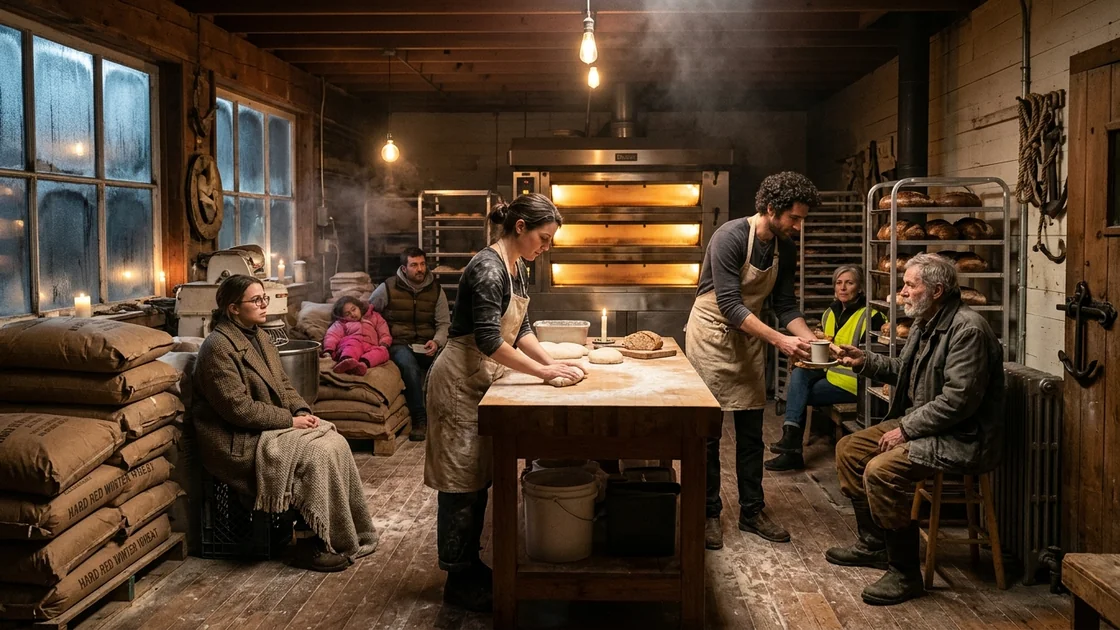
When two lifelong friends leave behind the exhausting noise of the city to open a wholesale bakery in a windswept seaside town, their intention is simply to work through the dark hours undisturbed and ship loaves to mainland grocers by dawn. Instead, the amber glow of their kitchen windows and the scent of warm cardamom, caramelized rye, and bubbling butter act as an irresistible beacon for the coastal town of Pelican Bay. Over the course of a freezing winter, an unbolted timber door transforms their nocturnal workspace into an accidental sanctuary for the insomniacs, the grieving, and the hopelessly heartbroken who wander the foggy streets when the rest of the world is asleep.
I. Salt on the Cedar
The building had spent sixty years smelling of Stockholm tar, dried bladderwrack, and rusted cable before Maeve Lin and Julian Vance took a scrub brush to the floorboards.
It sat on the crook of the spit where the bay ceased being polite and met the open churn of the grey northern Pacific. During high tide in November, the water slapped the barnacled pilings directly beneath the storeroom, making the sacks of hard red winter wheat shudder with a dull, rhythmic resonance that Julian insisted was the heartbeat of the coast. Maeve told him it was simply the tide, and that if he didn't help her hoist the fifty-pound sacks onto cedar pallets, the heartbeat of the coast was going to rot two hundred dollars' worth of grain before their business license arrived from the county seat.
They were thirty-two years old, had known one another since a rainy afternoon in sixth-grade detention when Julian had offered Maeve half a smuggled jam doughnut in exchange for her silence regarding a dissected frog, and both had arrived in Pelican Bay with the pale, hollowed look of people who had run out of road.
Maeve was the baker. Her hands were broad, calloused at the knuckles, and perpetually dusted with a faint haze of stoneground flour that settled into the whorls of her fingerprints like chalk. She possessed a terrifying capacity for routine. She understood hydration levels the way navigators understood coastal currents: eighty-two percent for the country boules, seventy-five for the spelt, ninety for the dark, treacle-heavy rye that took forty-eight hours of low fermentation to abandon its sour fury and settle into rich earthiness.
Julian was the rest of it. He was tall, loose-jointed, with a crown of dark curls that refused all pomade and a smile that made strangers tell him the medical history of their third cousins within ten minutes of meeting him. Julian had spent ten years working the floor of Michelin-starred dining rooms in San Francisco, reciting tasting menus like liturgical rites, until one evening in the middle of a Friday rush he had looked down at a plate of micro-greens arranged with jeweler’s tweezers and realized he could no longer remember the sound of the ocean. Two months after that, his six-year relationship with an interior architect named Marcus had quietly dissolved in an apartment full of expensive, low-slung Danish furniture that neither of them cared enough to keep.
"Wholesale only," Maeve had stated with ferocious clarity as they signed the lease in the back of an insurance agent’s office that smelled of menthol cigarettes and damp carpet. "We bake from nine at night until five in the morning. The ferry comes in at six-fifteen. We load the crates onto the regional distributor's truck. By eight in the morning, we are asleep with the blinds drawn, Julian. We do not do customer service. We do not do cheerful banter over oat milk lattes. We do not smile at people who ask if the gluten-free bread can be made without flour. We produce four hundred pristine loaves of naturally leavened bread every night, sell them to coastal farm stands and city specialty shops, and we live like monks."
"Monastic," Julian had agreed, leaning over the desk to hand the broker a certified cashier's check. "Ascetic. The Trappists of Pelican Bay. I will take up chanting."
"I am serious, Julian. My nervous system is a frayed wire."
"Mine is ash, darling. A monk’s life for me."
They spent September installing the deck oven—a three-tiered Swedish monster with stone hearths that had required a crane, four fishermen from the marina, and a case of bourbon to maneuver through the double doors facing the wharf. They scrubbed the walls down to the bare, pickled spruce, erected open steel shelving, and built a central island of three-inch-thick butcher block that had once been the workbench of a boatwright.
Above the front door hung a small brass bell on a coiled wire, an antique left behind by the ship chandler who had owned the building before them. Maeve taped the clapper with blue painter's tape to keep it silent. They did not need a bell. The latch was heavy, black iron, shaped like an anchor.
The plan was airtight. It possessed the clean, unyielding geometry of one of Maeve’s sourdough schedules.
The plan survived for precisely nine days.
II. The Draft in the Door
The gale of October fourteenth was not a storm that knocked down power poles; it was the kind of wet, sideways squall that peeled the yellow leaves off the alder trees and plastered them like wet stamps to every car windshield in town. The ocean was the color of a bruised mussel shell.
Inside the bakery, the heat was ferocious. The Swedish deck oven was purring at four hundred and sixty degrees, radiating a dry, volcanic warmth that met the cold, salt-laden draft leaking through the floorboards and turned the air into something thick and maternal. The scent in the room was a dense braid of toasted caraway, caramelized sugars from the crusts of forty walnut-fig boules, and the clean, sharp vinegar-tang of the sourdough starter—a wet, bubbling organism Julian had named Barnaby, which lived in a five-gallon food-grade bucket beside the walk-in cooler.
It was two in the morning. Julian was standing at the butcher block, his shirtsleeves rolled to his elbows, scoring baguettes. He made five diagonal slashes across each pale, floury spine with a double-edged razor blade mounted on a wooden stick, his wrist flicking with the nonchalant grace of a fencer.
Maeve was on her knees by the low hearth, using an ash shovel to check the bottom crust of a pan of dark molasses gingerbread she was testing for the holidays.
The door blew open.
It did not rattle politely. A gust caught the latch, which Julian had neglected to slide fully into its iron cradle after hauling out a tub of compost, and the heavy cedar door banged against the interior wall with a sound like a pistol shot.
Rain swept across the threshold in a silver sheet, dampening the sack of stoneground rye sitting near the entryway. With the wind came a man.
He was wearing a yellow oilskin coat that had turned nearly grey with brine and diesel grease. Beneath the sou’wester hat, his face looked like a piece of drift cedar that had spent three years tumbling in the surf—lined, grey-bearded, with eyes so pale they looked bleached by fog. He had one hand clamped around a plastic grocery bag containing two tins of smoked sardines, and his breath came in short, raspy whistles that rattled in his throat.
Maeve froze, holding the ash shovel like a cricket bat.
Julian, whose instincts had been forged in dining rooms where a dropped dessert fork was treated as a spiritual emergency, set down his razor blade, wiped his hands on his apron, and stepped toward the gale.
"Jesus," Julian said, his voice soft and instinctively accommodating. "Come out of the wet, sir, before the tide follows you in."
He reached past the man, grabbed the sodden brass handle, and pulled the door shut against the howling dark, throwing the heavy deadbolt with a solid, echoing thud.
The man did not move. He stood on the floorboards, water pooling around his gumboots in black puddles, staring at the three-tiered deck oven with an expression of unadulterated shock. His nostrils flared, drawing in the heat, the malt, the deep, grounding smell of baked flour.
"You're not Arthur's Marine Supply," the man said. His voice was cracked, like two slates rubbing together in an undertow.
"Not for about six months," Julian said gently. "Though we do have a great deal of salt."
The old man looked down at his grocery bag, then at the rows of cooling loaves on the metal speed-racks: mahogany-dark crusts blistered with tiny, golden bubbles, dusted with white flour that looked like hoarfrost under the warm Edison bulbs.
"The light was on," the man murmured. "I was down at the spit. Walking. I haven't... I don't sleep much since June."
Maeve had slowly lowered the ash shovel. She stood up, wiping her forehead with the back of her forearm, leaving a streak of grey hearth-ash above her eyebrow. She looked at Julian with an expression that said get him out, we have three bakes left before the truck arrives.
Julian did not look at her. Instead, he pulled out a wooden stool that lived near the water filter—a stool meant for whoever was doing inventory—and nudged it toward the radiator.
"Sit down, Captain," Julian said. "You're shivering so hard your teeth are going to chip."
"Arthur," the man said, blinking slowly. "Arthur Pendelton. I’m not a captain. Just had the thirty-foot gillnetter out of the south basin. The Mary G. Sold her two years ago."
"Sit down, Arthur," Julian repeated.
Arthur sat. He did not take off his coat; he simply unbuttoned the top two bone buttons, revealing a frayed wool sweater the color of cold tea. He placed his plastic bag between his boots. His hands, when he laid them flat on his knees, were enormous, crooked at the knuckles with arthritis, and trembling violently.
Maeve watched from the oven. She knew that look. It was the specific, hollow-eyed vertigo of someone whose house was entirely too quiet. When Maeve’s father had died three years earlier, she had spent four weeks walking the aisles of twenty-four-hour supermarkets in south Seattle at three in the morning, not because she needed canned beans, but because the fluorescent hum and the presence of the stock boys meant that for twenty minutes she was not the only living thing in the universe.
She swore under her breath, a tiny, sulfurous syllable that did not carry past the roar of the ventilation hood.
She turned to the workbench, picked up a serrated bread knife, and took the end off a warm loaf of dark honey-porridge bread that had come out of the deck twenty minutes prior. The steam rushed out, carrying the scent of toasted oats and wildflower honey. She hacked off a heel—thick, uneven, roughly two inches of dense, gelatinized crumb and crackling mahogany crust.
She walked across the flour-dusted floor, reached into the small under-counter fridge where they kept their personal provisions, and carved off a slab of pale, cultured butter from a local dairy. She did not spread it; she simply laid the cold yellow slab across the steaming bread so that the edges began to run into liquid gold while the center remained thick and cold.
She held it out to Arthur Pendelton.
"Eat that," she said, her voice clipped, professional, completely devoid of sentiment. "And take off the sou’wester. You’re dripping into my rye."
Arthur looked at the bread. A swallow worked its way down his throat, visible through the loose skin of his neck. He took it with both hands, his fingernails dark with engine oil that had soaked so deep into the keratin it would never come out.
He bit into it. The crust shattered with an audible shhh-crk, a sound so sharp it seemed to startle him. Then he closed his eyes.
He didn't speak for ten minutes. He chewed with a slow, deliberate gravity, his eyes shut tight against the warm air of the room, tears leaking out from the corners of his squinting eyelids and losing themselves in the deep, wind-burnt creases around his cheekbones. He ate the heel down to the last crust, licked the melted butter from the ball of his thumb, and then let his hands drop back to his knees.
"My wife," Arthur whispered to the deck oven, "used to make an oatmeal bread on Tuesdays. She used lard. But the crust was like that. You could hear it across the parlor."
Julian had leaned his hip against the steel bench, quietly pouring three mugs of black drip coffee from the Bunn machine they kept for their own survival. He placed one in Arthur's hands.
"What happened to Mary?" Julian asked.
"Stroke," the old man said simply. "In the garden. She was digging the late carrots. June twenty-second. The sun was out. It wasn't even raining." He looked at the floor between his boots. "The house makes noises. Wood settling. The freezer kicking on. I sit in the chair and wait for her to come down the hall to tell me to turn down the television. She always said I had the volume too high. But she doesn't come down the hall."
Maeve turned her back on them. She went back to the deck oven, slid her long wooden peel under four loaves of pain de campagne, and drew them out with a practiced, sweeping motion. The bread clattered onto the cooling rack, singing its tiny, metallic cooling song as the crusts contracted in the room’s air.
Arthur stayed until four in the morning. He did not say much else. He drank two mugs of black coffee, watched Julian shape sixty-four croissants with a metal scraper, and watched Maeve feed Barnaby with fifty pounds of flour and forty pounds of water, her arms plunged up to the elbows in the grey, bubbly mash, working the dough with powerful, churning strokes.
When the horn of the six o'clock freight truck groaned from the highway above the bluff, Arthur stood up. He reached into his pocket and pulled out a damp, crumpled five-dollar bill.
"No," Maeve said without looking round from the sink where she was scrubbing her arms with cold water. "Keep your money."
"I pay for what I take," Arthur said stubbornly.
"You didn't take it," Maeve snapped. "Julian gave it to you. Julian is an idiot who has no head for business. Come back on Tuesday if you want bread. We don't take cash."
Arthur blinked at her back, then looked at Julian.
Julian winked. "Tuesday night, Arthur. Two o'clock. We do the cardamom buns on Tuesdays. If you don't show up, I'll have to eat them all myself and my cholesterol is already an act of pure faith."
The old man stood in the doorway for a second, the cold sea wind whipping the skirt of his yellow oilskin. "Thank you," he said. He didn't say it to the room; he said it to the bread. Then he vanished into the salt fog.
Maeve dried her forearms with a linen towel, her face like granite.
"Not a word, Julian," she said, pointing a finger at his chest. "Not one single, solitary, smug word."
Julian raised his flour-covered hands in surrender. "I didn't say anything, Mave. I was merely admiring the structural integrity of your honey-porridge loaf."
"He was wet," she muttered, turning off the water. "He was getting grease on the floorboards. I wanted him to leave."
"Naturally," Julian said. "You're a monster of corporate efficiency."
III. The Architecture of the Unwell
By the second week of November, Pelican Bay had entered its true winter state.
The summer people—the ones who bought artisanal raspberry vinegar and driftwood mirrors from the three shops on Front Street—had long since retreated to Portland, Seattle, and San Francisco. The marina was a forest of bare masts clinking against the grey aluminum shrouds in the northeast wind. Half the streetlights on the harbor road flickered with a wet, violet hum, their ballasts corroded by forty years of sea spray.
The bakery should have been an island.
Instead, it developed a leak.
It began with Clara Perez. Clara was thirty-four, possessed a master’s degree in archival science, and was the sole employee of the Pelican Bay Public Library, a damp, shingled bungalow that smelled exclusively of dry rot and paperback mysteries from 1974.
Clara did not have a dead husband. Clara had an ex-fiancé named David who, sixty days prior to their planned wedding at the headlands lighthouse, had informed her via an eleven-page handwritten letter left on their butcher-block dining table that he felt "unanchored by her certainty" and had moved to Boise with a woman who sold commercial insurance.
Clara had not slept more than ninety consecutive minutes since September.
She appeared at the bakery door on a Thursday at one-fifteen in the morning. She did not wear oilskins; she wore a men’s tweed overcoat three sizes too large, pink flannel pajama bottoms tucked into sheepskin boots, and spectacles with round tortoise-shell frames that were so fogged by the bakery’s heat she immediately walked into the edge of the cooling rack, setting off a chime of vibrating sheet pans.
Julian caught her elbow before she took down a tier of cooling baguettes.
"Careful," he said, steering her with the practiced ease of an usher handling a late patron at the opera. "The baguettes are armed and dangerous."
Clara took off her glasses, wiped them on the sleeve of her tweed coat, and squinted up at him. Her eyes were rimmed with pink, dry skin, the lids heavy and dark as bruised plums.
"I can smell you from the bluff," she said. She did not sound apologetic; she sounded faintly accusatory. "The wind carries it right up 4th Street. It smells like... like burnt sugar and yeast. It’s coming down my chimney. I haven't slept in three weeks and my entire house smells like your kitchen."
"Pear galettes," Maeve said from the pastry station. She was rolling out rough-puff pastry, her marble pin moving with the steady, thumping cadence of a printing press. "We burnt the edges on the two o'clock batch. The pectin leaked onto the stones."
Clara looked at the pastry station. She looked at the long, wooden table where twenty-four round, golden galettes sat cooling, their sliced pears shimmering under a glaze of apricot jam and sea salt, their crusts dark, blistered, and flaking like ancient parchment.
"I need something," Clara said. Her voice broke slightly, dropping into a small, jagged register that made Julian’s chest tighten. "I don't know what it is. A bun. A roll. A crust. Anything that isn't frozen waffles. I can’t eat frozen waffles anymore. When you toast them, they smell like an electrical fire."
Julian pulled out the stool.
"Clara," he said, having read her name off the library tote bag swinging from her shoulder. "Sit. Sit down right now."
Within a week, Clara had her own corner.
She did not sit on the stool; she migrated to an overturned milk crate near the flour bins, where the warmth from the deck oven’s exhaust duct created a microclimate that Julian estimated to be roughly eighty degrees. She brought a yellow legal pad and three black rollerball pens.
She didn't write anything. For the first two nights, she simply sat with her knees pulled up to her chin, watching Maeve's hands.
Watching Maeve bake was like watching a mason lay stone. There were no wasted gestures. She did not flour the table with theatrical flourishes; she dropped a cloud with a flick of her wrist that covered exactly the square footage required. She cut dough with a bench knife that moved with mathematical certainty—nine hundred grams, nine hundred and two grams, eight hundred and ninety-nine grams. She shaped the rounds by cupping her palms and pulling the dough against the wood, creating a taut, gleaming skin over the wet interior through friction alone.
Thump. Slide. Turn. Thump.
"How do you do that?" Clara asked at two-thirty in the morning on her third visit, holding a mug of chamomile tea into which Julian had tipped a generous splash of apple brandy from their private cupboard.
"Surface tension," Maeve said without stopping. "If you don't create surface tension on the outer skin, the gas escapes during the oven spring. It doesn't rise. It just spreads out into a pancake. Flat, heavy, and sad."
Clara stared at the dough. "I don't have any surface tension," she said.
Maeve stopped. The bench knife hovered two inches above a mound of country rye.
She looked at Clara Perez—at the ink stains on her fingers, the yellow pajamas, the way her shoulders seemed to curve inward as if trying to protect her ribs from an invisible boot.
"Nobody does at first," Maeve said, her voice dropping into that rare, flat honesty she usually reserved for Julian. "When I left Seattle, I was ninety percent water. I couldn't hold a shape to save my life. I spilled all over the counter."
"What did you do?"
"I let Julian drag me here," Maeve said, slamming the bench knife down onto the wood with an authoritative thunk. "And then I bought forty tons of flour. Flour doesn't give a damn about your fiancé, Clara. Flour requires you to be here at midnight, whether your heart is broken or whether it’s singing Handel’s Messiah. The yeast doesn't wait for your feelings."
Clara watched the dough rise slowly in the proofing baskets, the linen liners cradling each loaf like a newborn.
"Can I dust the baskets?" Clara asked timidly.
Maeve glared at Julian, who was grinning from the espresso machine.
"Rice flour only," Maeve said, shoving a bag and a sifter toward the girl. "If you use the wheat flour, the dough sticks to the linen and the whole loaf tears when you dump it on the peel. And if you tear my loaves, Clara, you’re banned from the heat vent."
By December, the bakery was no longer wholesale.
They hadn't changed their sign—there was no sign, only the salt-silvered cedar facade with the words Arthur’s Marine Rigging & Tackle faintly visible where the painted letters had resisted thirty years of UV light. They hadn't put an ad in the Pelican Bay Light. They had not listed hours on the internet.
Yet at one in the morning, the latch would lift.
It was never a crowd. The town did not have crowds after nine o'clock. It was an erratic, solitary procession of people who had run out of distractions.
There was Toby Marsh, thirty-eight, the high school chemistry teacher whose wife had died of leukemia fourteen months prior, leaving him with an eight-year-old daughter who slept like an angel while Toby paced the perimeter of his three-bedroom split-level until his socks wore through at the heels. Toby came in smelling of chalk and cedar woodsmoke, his hands shoved into the pockets of a down vest. He didn't eat pastries; he ate the dark, bitter rye bread with raw red onion and sharp cheddar that Julian kept in a ceramic crock for him. Toby spent two hours every Tuesday night balancing Maeve’s salt-to-flour ratios on a scrap of butcher paper, using molecular weights to prove why her sourdough had better crust development on nights when the barometric pressure dropped below twenty-nine inches. Maeve pretended to ignore him, but she never corrected his calculations.
There was Siobhan, the harbor dispatcher who worked the four-to-midnight shift in the concrete tower above the coast guard station. She was fifty, with silver-streaked hair cut as short as an otter’s fur, and a voice that had been sanded down by three decades of talking tugboats through pea-soup fog. She brought gossip that smelled of bilges and local council corruption. She would sit on the flour pallet, her legs crossed, eating scalding-hot cardamom buns with butter dripping between her fingers, telling Julian which city council members were taking kickbacks from the oyster farms.
And there was Arthur. Always Arthur.
Arthur arrived at two o'clock on the dot, three nights a week. He never knocked; he simply lifted the iron latch, stepped inside, closed the door with the meticulous care of a seaman securing a water-tight hatch, and took his seat on the wooden stool by the radiator. He had abandoned the plastic grocery bag. Now he carried a thermos, which Julian filled with strong, chicory-heavy coffee, and a small wooden whittling knife with which he was slowly, over sixty nights, carving a tiny, perfect gull out of a piece of yellow cedar for Julian’s espresso machine.
They didn't talk about their hearts. That was the rule that no one had spoken, but everyone obeyed.
They talked about the price of diesel. They talked about the humidity. They talked about whether the town would ever repair the slipway at the north pier, and why the local crows had decided to wage war on the postal van. They talked about the crumb—always the crumb. Was the crumb too tight? Was the bake five minutes too long? Was the honey-porridge loaf singing its cooling song with enough vigor?
Underneath the conversation, like the slow, subterranean hum of the Swedish deck oven, was the shared knowledge that every person in the room had found the daylight world unbearable.
The night bakery was the only place where no one was expected to be fine.
IV. Julian’s Ghost
The secret about Julian Vance was that he had not come to Pelican Bay to help Maeve Lin open a business; he had come because he was terrified that if he stayed in San Francisco, he would die of a quiet, elegant stroke in an expensive restaurant bathroom and no one would notice until the check was due.
On a Tuesday in mid-December, when the wind was throwing salt-spray all the way across the road to freeze into a glaze on the front windows, the bakery was empty save for the two of them. It was midnight. The first mix was in the spiral kneader—a massive, cast-iron machine that groaned with a deep, hydraulic rhythm as its spiral arm folded forty kilos of wet dough over and over, mimicking the motion of a human fist.
Julian was sitting on the edge of the butcher block, peeling local apples for the morning turnovers. His curls were tied back with a piece of butcher’s twine.
"Marcus got married on Saturday," Julian said.
He said it into the hollow of an apple, his peeler removing a long, unbroken green ribbon of skin that dropped into the compost tub between his feet.
Maeve did not stop her work. She was at the stone counter, portioning out butter blocks for the croissant lamination. Her rolling pin rose and fell with rhythmic, concussive cracks that vibrated through the floorboards.
Crack. Turn. Crack.
"In the city?" she asked.
"Big Sur," Julian said. "At that place with the redwood decks where we had that awful anniversary dinner in 2021. You know, the one where they served the broth made of charred pine needles that tasted like floor cleaner."
"I remember," Maeve said. "You wore that linen suit that made you look like a Miami cocaine dealer who had found God."
Julian laughed, but it was a thin, paper-dry sound that blew away into the steam of the dishwasher. "That was the one. Three hundred people. He married a pediatric cardiologist. Can you imagine anything more sickeningly unimpeachable? A cardiologist, Maeve. The man literally repairs the broken hearts of children for a living. What do I do? I score wheat and make small talk with retired gillnetters."
Maeve set the rolling pin down.
The silence in the room was suddenly vast, filled only by the low, wet slosh of the mixer and the hiss of the salt-spray on the glass.
She walked over to the butcher block, took the peeler out of Julian’s hand, set it down on the wood, and picked up his left wrist. She turned it over. His skin was pale, marked with three distinct, pale white lines where he had caught himself on the hot edge of the deck oven during their second week of operation.
"You smell like caraway," Maeve said.
Julian looked down at his wrist. "That’s because Barnaby is twenty percent caraway this week."
"No," Maeve said. "You smell like caraway, butter, and woodsmoke. When you lived in the city, Julian, you smelled like dry cleaning and fear. Every time I came to your apartment, you looked like you were waiting for a subpoena. You had sixteen different kinds of gin and three different kinds of sleeping pills on your nightstand, and you hadn't laughed from your belly since we were twenty-four."
Julian swallowed. His eyes looked very dark in the low light of the pendant lamps.
"I loved him, Mave," he whispered. "I really did. For four years, I thought he was the house I was going to live in."
"He wasn't a house," Maeve said softly. "He was a showroom. There wasn't any room for your mess in that place, Julian. Look at this floor." She gestured with her chin toward the grey fir boards, covered in a persistent, velvety drift of white flour, caraway seeds, and dropped almond flakes. "This is your life now. It’s dirty, it smells like sour mash, and you have to wake up at eight in the evening to make it work. But nobody here is asking you to be an ornament."
Julian looked at her for a long moment. Then, with a sudden, jerky movement, he dropped his forehead against her shoulder, resting his face against the rough bib of her canvas apron.
She didn't hug him—Maeve was not a hugger—but she laid one heavy, flour-white hand against the back of his neck, her fingers pressing into the tense muscles at the base of his skull with the same firm, certain pressure she used to test the proof of a country loaf.
"Get off me," she muttered after thirty seconds. "You’re getting snot on the linen."
"It’s not snot," Julian said, his voice muffled by her collar. "It’s brine. I’m absorbing the local maritime atmosphere."
"You’re an idiot," she said, but her hand stayed on his neck until the timer on the spiral mixer gave its shrill, electronic whistle.
V. The Night of the Red Embers
The true test of the bakery’s place in the town’s clandestine ecosystem came on the night of January eighth.
It had begun with rain that turned to sleet by eight in the evening, and by eleven, the coastal highway was a sheet of black ice that had brought down three miles of transmission lines between Pelican Bay and the substation at Cape Disappointment.
The power went out with an audible whump that killed the streetlights, the harbor beacon, and the low, comforting hum of the bakery’s refrigeration units in a single, breath-holding instant.
Maeve and Julian were caught in pitch darkness. The only sound was the wind, which had abandoned all subtlety and was now throwing itself against the western wall of the building with the force of an avalanche.
"Don't move," Maeve commanded from the darkness. "The peel is on the floor. If you step on the handle, it'll break."
"I am currently holding eight raw sourdough rounds on a cedar board," Julian's voice came from three feet to her left, surprisingly calm. "If I drop them, it will be forty pounds of wet dough on my slippers."
"Stay there."
Maeve felt her way along the cold edge of the stainless steel bench until her fingers found the metal drawer where they kept the emergency supplies. She struck a match. The small, yellow flare illuminated her face—her eyes wide, her dark hair coming loose from its band—and then she touched the flame to three fat beeswax church candles they had bought from an estate sale in Astoria.
The room sprang back into existence, but transformed.
Without the harsh glare of the Edison bulbs and the fluorescents over the wash-sink, the old chandlery became something ancient. The candles cast huge, dancing shadows up the spruce walls, reaching all the way to the exposed cedar joists twenty feet above. The stone deck of the oven, still retaining the immense heat it had gathered over twelve hours of firing, glowed with an internal, subterranean red through its glass inspection ports.
Then the latch clicked.
It did not rattle; it lifted with a slow, desperate persistence.
The door swung inward, and with the howling sleet came not one person, but four.
Arthur Pendelton was first, carrying a hurricane lantern that cast a swinging circle of kerosene light across the threshold. Behind him was Clara Perez, wrapped in a blanket that looked like a horse rug, her teeth chattering so violently they sounded like castanets. Behind Clara was Toby Marsh, holding his eight-year-old daughter, Ruthie, who was bundled into a pink snowsuit so thick her arms stuck straight out like a starfish’s. And bringing up the rear was Siobhan, still wearing her high-visibility yellow vest from the harbor office, carrying a five-gallon bucket of fresh water and two split logs of dry spruce.
"Town’s black," Siobhan said, kicking the door shut with her heel and dropping the iron bar into place. "Line’s down on the bluff. Road’s closed both ways. Trees across the highway at milepost twelve. The heat in the municipal building failed an hour ago."
Nobody asked if they could stay.
Toby set his daughter down on the butcher block. The little girl, blinking sleepily in the candlelight, looked around the cavernous room with its glowing stone oven and its mountain of pale dough, her mouth forming a round O of wonder.
"Is this Santa’s house?" Ruthie asked, her voice small and clear against the booming wind.
"No, darling," Julian said, stepping forward with a candle and setting it on the wood beside her. "Santa has much better business sense and doesn't smell this strongly of vinegar. But we have gingerbread."
The next six hours took on the quality of a fever dream.
Without electricity, Maeve could not use the mixers, the proofer, or the mechanical slicer. But the Swedish deck oven was a hybrid beast—designed to run on electricity for its fans, but with stone hearths so massive they held four hundred degrees of radiant heat for twelve hours after the elements died.
"We don't lose the bake," Maeve said. Her eyes were bright, almost feral, in the candlelight. "The dough is already at eighty degrees. If we don't bake it now, it over-proofs and turns into sour slop by dawn. Julian, grease the sheet pans. Clara, get over here."
"What do I do?" Clara asked, her eyes wide behind her glasses, the horse blanket still draped over her shoulders like a royal mantle.
"You shape," Maeve said. "Wash your hands with the kettle water. Toby, hold that lantern right over the center block. Siobhan, get those logs into the wood stove in the back room—if we lose the ambient heat, the dough will catch a chill and stop rising."
They worked by the yellow light of three candles and two kerosene lamps.
Julian stood beside Clara, his long arms guiding her wrists as they worked through sixty pounds of country sourdough.
"Don't fight it," Julian murmured, his voice rhythmic, hypnotic. "Cradle it. Like you’re tucking a sheet under a mattress. Push with the palm, tuck with the fingers. Feel that? That’s the gluten tightening. That’s the bread deciding it wants to be something."
Clara’s hands, usually so hesitant, so prone to twitching when she was startled, found the rhythm. She shaped one. Then another. Maeve watched from the corner of her eye, her bench knife flashing in the candle flame, and for the first time in four months, she did not correct the girl's work.
In the corner, little Ruthie had fallen back asleep on a bed made of three empty fifty-pound flour sacks covered with Julian’s clean wool coat, her face lit by the soft amber glow of the hurricane lamp. Arthur sat on his stool beside her, his old pocket knife moving with microscopic precision over his cedar gull, the tiny wood shavings curling onto the knees of his trousers like dried orange peel.
At three in the morning, Toby Marsh stood at the edge of the wood stove, watching the flames lick through the spruce logs Siobhan had brought.
"She used to make soup," Toby said quietly. He wasn't looking at anyone; he was looking at the small blue tongues of gas dancing off the cedar bark. "When the power went out in the winter. Sarah would take every vegetable in the crisper, put it in the copper pot with some beef bullion, and we'd eat it on the floor in front of the fireplace with those terrible saltine crackers from the tin."
Maeve, who was scoring forty loaves with a speed that seemed almost supernatural in the dim light, didn't turn around.
"Saltines are a crime against wheat," she said roughly.
"They were," Toby agreed, a small, wet chuckle escaping his throat. "They were completely tasteless. But she would sit there with her wool socks touching mine, and it was... it was the only time the world felt like it had four walls."
Maeve set down her razor. She reached under the counter, brought out a cast-iron Dutch oven that had belonged to her grandmother, and set it on the flat top of the wood stove.
"Julian," she said.
"Already on it," he replied.
From the walk-in—which was still cold as a tomb—he brought out three quarts of rich chicken stock they had simmered two days before from roasted carcasses, a bunch of winter leeks, four potatoes the size of cobblestones, and a heel of Parmesan cheese as hard as granite.
For the next hour, while the loaves baked in the dying, radiant heat of the stone deck, the bakery smelled not just of bread, but of leeks sweating in butter, of garlic, of rich broth reducing over woodsmoke.
When Maeve pulled the loaves from the stone, they were different from any bread they had ever produced. Because the fans weren't circulating the steam, the crusts weren't thin and blistered; they were thick, dark, almost prehistoric—crusts that looked like the bark of ancient trees, deeply furrowed, smelling intensely of caramel and roasted barley.
They ate at four in the morning, sitting in a circle on overturned buckets, flour crates, and the woodbox.
They ate leek and potato soup out of ceramic mugs, dipping thick, ragged chunks of the scalding, dark-crusted bread directly into the broth. Ruthie dipped hers until it was soft enough for her eight-year-old teeth, her cheeks flushed with the heat of the wood stove, her fingers greasy with butter.
Arthur took a sip from his mug, then took a piece of the dark crust and held it up to the candlelight.
"That's the one," he said.
"The one what?" Maeve asked, her face grey with exhaustion, her knuckles red from the heat.
"The bread Mary made the week after the freeze of '78," Arthur said. His voice was steady now, free of that dry, whistling catch that had haunted it in October. "Power was off for six days. The bay froze all the way out to the red nun buoy. She baked in the cast-iron range. Bread tasted just like that. Tasted like... like staying alive anyway."
Nobody spoke. Clara Perez took a bite of her bread, closed her eyes, and let her head rest back against the cedar siding of the wall. Toby Marsh watched his daughter eat, his hand resting gently on the small curve of her back, his thumb tracing the pattern of her pink snowsuit in slow, absent circles.
Outside, the storm shrieked against the spit, wanting everything they had.
Inside, the stones were warm, the candles smelled of honey, and six people who had forgotten how to live in the daylight sat together in the flour dust, chewing their crusts in the dark.
VI. The Summons
The sunlight in Pelican Bay during February was never direct; it was an indirect, pearlescent grey that filtered down through three miles of maritime cloud, illuminating the town with a flat, merciless clarity.
At nine-fifteen on a Tuesday morning—an hour when Julian and Maeve were typically dead to the world in their respective bedrooms in the rented saltbox house three blocks away—the knock on the bakery door had the sharp, bureaucratic rhythm of a government clipboard.
Maeve answered it. She was wearing Julian’s oversized flannel shirt over her waffle-knit pajamas, her hair an unbrushed nest, her eyes small and murderous.
A man was standing on the gravel pad between the bakery and the road. He wore a navy-blue quilted vest over an ironed tattersall shirt, khaki trousers that were entirely too clean for the county, and held a tan manila folder.
"Maeve Lin?" he asked.
"If you're selling solar panels, I will throw this deadbolt through your windshield," Maeve said.
"Howard Henderson," the man said, not blinking. "Pelican Bay Town Council. Planning and Zoning Commission."
Maeve’s spine stiffened. The sleep vanished from her brain, replaced by the cold, metallic dread that usually accompanied a visit from a health inspector with an axe to grind.
"The commercial license is on the wall," she said. "Approved by the county seat in August. Class Four wholesale manufacturing. We don't have customers. We ship out."
Henderson opened the folder. He had three sheets of 20-pound bond paper with red ink annotations in the margins.
"Yes," Henderson said, adjusting his wire-rimmed glasses. "Class Four Wholesale. Non-retail. Non-assembly. The conditions of the permit are quite clear, Ms. Lin: operations restricted to production and delivery prep between the hours of 8:00 PM and 6:00 AM. No public accommodation. No retail transactions on-site. Off-street parking limited to two commercial transport vehicles."
"We don't retail," Maeve said. "We sell to three distributors."
Henderson looked past her, through the large plate-glass window that looked out on the spit.
Inside, the bakery was clean, but it did not look like a factory. There were three wooden stools near the radiator. There was a shelf with eight different ceramic mugs, none of which matched. There was a small, hand-whittled cedar seagull sitting on top of the two-group La Marzocco espresso machine. And on the floor, clearly visible near the flour pallet, was a small, plastic hair-clip shaped like a purple butterfly that Ruthie Marsh had dropped two nights before.
"We have had complaints," Henderson said.
"From whom?"
"Residents on the bluff," Henderson said smoothly. "Light pollution. Noise during non-standard hours. Vehicles idling in the slipway turnaround between one and four in the morning. And reports of foot traffic. Unregulated foot traffic entering and exiting a food preparation facility that is not licensed for retail occupancy or public dining under County Ordinance 42-B."
Maeve felt the blood surge into her temples, hot and dangerous. "There is no foot traffic. There are seagulls and the occasional stray dog."
"Mr. Henderson," Julian’s voice came from the interior of the bakery.
He appeared behind Maeve, looking surprisingly magnificent for a man who had slept three hours. He had thrown on a heavy charcoal-grey cardigan over an immaculate white t-shirt, and he held two ceramic cups of black coffee that smelled richly of roasted chicory and Ethiopian beans.
"Howard," Julian said, his voice dropping into that smooth, buttery register he had once used to calm tech billionaires whose tasting menus were ten minutes late. "It’s Howard, isn't it? From the bank board?"
Henderson hesitated, his bureaucratic armor chinking slightly. "Julian Vance. I didn't realize you were... your family had that place down in Gearhart, didn't they?"
"My great-uncle," Julian lied with effortless elegance, offering Henderson one of the steaming cups. "A dreadful man who hated children and dogs, but he did know how to build a sea wall. Drink that, Howard. It’s too cold to stand on the gravel talking about ordinances that were written when this town was still canning pilchards."
Henderson took the coffee instinctively. He took a sip, and his eyelids flickered. "That’s... that’s not supermarket blend."
"Direct trade from a cooperative in Sidama," Julian said. "Roaster friend in Portland sends it down in five-pound bags. But tell us about these complaints. Surely our little flour shop isn't keeping the good people of the bluff awake? Our mixers make less noise than the foghorn on the south spit."
Henderson regained his footing, though he did not set down the coffee.
"It’s not the noise, Julian," Henderson said, his voice dropping slightly. "It’s the... the irregularity. Pelican Bay has two police cruisers and one code enforcement officer. We have three motels that sit half-empty all winter. We have a problem with people drifting down from the highway. People who shouldn't be wandering around the marina at three in the morning. The council received an informal notice from Councilman Gidley that your establishment is operating an unlicensed night cafe. There are people coming and going at two in the morning. People in... irregular states."
"Irregular states?" Maeve barked. "They're locals, you bureaucrat! They're your neighbors!"
"Maeve," Julian warned softly.
"No," Maeve snapped, stepping past Julian onto the frost-crusted gravel. "Councilman Gidley lives in that three-story cedar monster on the hill with the heated driveway. He doesn't like that our chimney smells like sourdough because it interferes with the cedar scent of his hot tub. Who is in an irregular state, Howard? Arthur Pendelton? He lived on this spit forty years before Gidley bought his lot with money he made selling timeshares in Scottsdale!"
Henderson took a half-step back, his folder clutched against his chest like a breastplate.
"There will be an administrative hearing," Henderson said stiffly, though he was careful not to spill the Ethiopian coffee. "Next Thursday. Six o'clock. The town hall. If you cannot demonstrate that this facility is strictly wholesale, your occupancy permit will be suspended pending a full safety and retail review. Which, given the state of the harbor district's commercial code, will take approximately five months."
He turned on his heel and walked toward his Subaru, his clean khakis rustling in the salt wind.
"Five months," Maeve whispered, watching his taillights clear the rise. "Five months without production will kill us. We have three thousand dollars left in the reserve account, Julian. We won't make the lease on the deck oven."
Julian watched the grey road where Henderson had disappeared. He took a slow sip from his mug, his eyes narrowing slightly—not with despair, but with that specific, dangerous theatricality he usually displayed when a stage manager told him a set couldn't be built in time for opening night.
"Next Thursday," Julian said.
"Don't do that voice," Maeve said. "That’s your 'I'm going to fix this with charm' voice. Charm does not work on planning commissions, Julian. Planning commissions are where charm goes to be strangled by parking requirements."
"Charm won't work," Julian agreed, turning back into the bakery and kicking the door shut against the freezing spray. "Which is why we aren't going to use charm."
VII. The Assembly of the Night
The town hall of Pelican Bay was built in 1934 out of hand-hewn fir logs that had settled so deeply into the coastal mud the whole building seemed to lean slightly to the south, like an old sailor bracing against an offshore gale.
The council chamber smelled of wet wool coats, cedar oil, and eighty years of municipal arguments about culverts and clamming limits.
On Thursday at six o'clock, the fluorescent fixtures overhead were buzzing with that cold, institutional hum that made everyone look faintly yellow. Behind the raised mahogany bench sat the five members of the Planning and Zoning Commission, with Councilman Gidley—a man with skin the color of tinned salmon and hair that looked like it had been sprayed with marine lacquer—sitting dead center.
Maeve and Julian sat in the second row of benches.
Maeve was wearing her only good suit—a dark charcoal wool thing she hadn't worn since her father's funeral—and she felt like an elk forced into an evening gown. Julian was beside her, immaculate in a navy double-breasted blazer and a white linen shirt, his legs crossed, looking like an investor who had accidentally wandered into a village hall in the Scottish Highlands.
"Item four," Gidley said, his voice amplified by a microphone that screeched with feedback whenever he leaned forward. "Conditional use review for Commercial Parcel 104, 18 Harbor Spit Road. The Nocturne Oven LLC. Violations of Class Four light-industrial zoning codes, specifically unauthorized retail assembly and night-time nuisance."
Gidley looked down over his spectacles. He did not look at Julian; he looked at Maeve.
"We have reports," Gidley said, rustling a stack of papers, "from several concerned property owners regarding activities inconsistent with wholesale bread production. Noise, lights, unpermitted gatherings between the hours of midnight and 5:00 AM. The council has received a petition to suspend the business license until an environmental and traffic impact study can be completed."
"May I speak, Mr. Chairman?" Julian stood up.
"The chair recognizes Julian Vance," Gidley said with an audible sigh, as if he had already spent forty minutes preparing himself to resist Julian's smile. "Mr. Vance, this is an administrative matter. The law is quite simple. A Class Four wholesale bakery cannot serve as a public accommodation. Do you sell bread from the premises?"
"We do not," Julian said clearly.
"Do you have customers who enter the facility during production hours?"
"We do not have customers," Julian said.
"Then who," Gidley asked, leaning forward so hard the microphone squealed like an injured gull, "are the people observed entering your building at two in the morning by the night patrol?"
A bench in the third row creaked.
A man stood up.
He did not wear a navy blazer. He wore his Sunday best: a brown tweed sport coat that had been purchased in 1982 from a department store in Aberdeen that no longer existed, a clean white flannel shirt with a clip-on tie the color of dried kelp, and dark trousers that were roughly two inches too short for his long legs.
Arthur Pendelton took two steps into the center aisle.
"Arthur," Gidley said, his voice losing some of its bureaucratic bark. "This isn't public comment time yet. The hearing is—"
"I was in their building on Tuesday," Arthur said. His voice was not loud, but it had spent fifty-two years carrying over the roar of twin Detroit diesels in six-foot seas. It filled the room like a foghorn. "And on Sunday. And on Thursday last."
Maeve closed her eyes. We're dead, she thought. The old idiot is going to sink us.
"Arthur," Gidley said, holding up a hand. "We understand you’ve been... visiting. But that is precisely the issue. That facility is not zoned for—"
"My wife died in June, Ed," Arthur said.
The room went completely silent. Even the radiator in the corner ceased its clanking.
Gidley blinked. "I... I know that, Arthur. We were all very sorry to—"
"No, you weren't," Arthur said evenly. "You sent a card with an orchid on the front that your secretary signed. That was fine. Mary didn't like you anyway. She said you were too slick for a man who didn't own a boat."
A muffled snort came from somewhere in the fourth row, where three gillnetters were sitting with their arms crossed over their oilskin jackets.
"Arthur," Gidley stammered, his salmon-colored skin turning the shade of a ripe plum. "That is hardly relevant to a zoning ordinance—"
"I didn't sleep for five months, Ed," Arthur continued, his eyes locked onto Gidley’s face with a flat, terrifying intensity. "Not one night. I'd sit in the chair until the walls started creeping. I’d walk down to the spit at two in the morning to see if the water was high enough to take the skiff out, because when you're on the water, at least the noise makes sense. And one night the wind was blowing sixty knots out of the southwest and I was so cold I couldn't feel my thumbs, and their door was open."
Arthur stopped. He reached into his coat pocket, pulled out the tiny, hand-whittled cedar gull, and set it on the edge of the mahogany bench in front of him.
"They didn't sell me anything," Arthur said. "That girl with the flour on her face gave me the heel of a honey loaf. And that boy with the curls gave me coffee that didn't taste like chicory dust. And they let me sit by the oven."
Another figure stood up from the back row.
Clara Perez did not look nervous. She was wearing her library cardigan, but she had pinned a silver brooch shaped like an owl to the lapel, and her round spectacles were clear and clean.
"I was there too, Mr. Gidley," Clara said. Her voice, usually so reedy and hesitant behind the circulation desk, had the dry, clear snap of good parchment. "And Toby Marsh was there. And Siobhan from harbor dispatch. If you want to cite The Nocturne Oven for public assembly, Mr. Gidley, you’ll have to cite the library too. Because I’ve checked out forty-two volumes on sourdough microbiology and coastal agriculture to Mr. Vance in the last four months, and under State Library Statute 12, those research materials are protected from administrative interference."
"That’s... that’s absurd," Gidley sputtered. "Research? At three in the morning?"
"Science doesn't care about your sleep schedule, Ed," Toby Marsh said from the far aisle, not even bothering to stand up. He had Ruthie on his lap, her little hands playing with the brass zipper of his down vest. "I’ve been running hydration tests on their stone deck for sixty days. It’s the only place in this county where a person can find a stable four-hundred-and-fifty-degree surface during a winter storm. Or did you forget that when the power died three weeks ago, it was their oven that kept forty people on the spit from freezing to death while the county road crew was still looking for their salt trucks?"
The murmur in the room rose—not a loud roar, but the low, rumbling growl of thirty people who had lived in Pelican Bay long enough to remember when the town had six canneries, four sawmills, and neighbors who knew what an open door meant in the middle of a freeze.
Howard Henderson, sitting at the end of the commission bench, cleared his throat.
He did not look at Gidley. He looked down at the manila folder on his desk, his fingers tapping the 20-pound bond paper with a small, rhythmic cadence.
"Mr. Chairman," Henderson said into his microphone.
Gidley glared at him. "Howard, we are in the middle of a—"
"Under Section 8, Paragraph C of the Pelican Bay Municipal Code," Henderson said, his voice flat, dry, and terrifyingly precise, "light-industrial food production facilities are permitted to engage in 'ancillary quality-control testing and community-based product development' on site, provided that no direct retail cash transactions are executed on the premises."
Henderson looked up over his glasses. He looked directly at Maeve.
"Ms. Lin," Henderson said. "Do you charge Arthur Pendelton for the bread he consumes?"
"No," Maeve said, her voice clear and hard as iron.
"Do you have a cash register?"
"No."
"Have you ever accepted currency from any person entering that facility between the hours of midnight and 6:00 AM?"
"Not one red cent," Maeve said.
Henderson turned back to Gidley. "Then under Section 8, Paragraph C, these individuals are not customers, Mr. Chairman. They are voluntary participants in an ongoing, nocturnal product-development study regarding the psychological and nutritional impact of naturally leavened grain products on coastal populations during periods of seasonal distress."
The council chamber was so quiet that the buzz of the fluorescent tubes sounded like an angry hornet.
Gidley looked at Henderson as if his colleague had just grown a third ear out of his forehead. "A product-development study? Are you out of your mind, Howard?"
"It is fully compliant with the text of the code, Ed," Henderson said calmly. "And unless you wish to fund an independent audit of their sourdough hydration metrics from the planning commission's discretionary budget—which currently contains four hundred and twelve dollars—I suggest we find the applicants in conditional compliance and move to Item Five: the drainage ditch on 7th Street."
Gidley looked around the bench. The other three commissioners—two retired crabbers and an elderly woman who ran the town’s only hardware store—were already nodding with the slow, stubborn finality of people who had decided where their bread was buttered.
Gidley brought his gavel down with a sharp, furious crack that set off the microphone feedback again.
"Conditional compliance granted," Gidley hissed. "Item Five. The drainage ditch."
VIII. The Sourdough Moon
They walked back down the bluff road in the dark.
The rain had stopped, and the clouds had broken just enough to reveal a sliver of cold, silver moon that hung over the mouth of the bay like a discarded lemon peel. The water was flat, black as obsidian, reflecting the single white light of the whistling buoy two miles out.
Maeve had taken off her suit jacket and was carrying it over her arm, the cold night air cutting through her linen shirt, but she didn't seem to notice.
Julian walked beside her, his hands shoved deep into his blazer pockets, his breath rising in white, rhythmic puffs that vanished into the salt air.
Behind them, at a distance of twenty paces, walked Arthur, Clara, Toby, and Siobhan. They didn't walk as a crowd; they walked as a small, quiet flotilla, their boots crunching on the wet gravel with a synchronized, unhurried cadence.
"A product-development study," Maeve said softly.
"Henderson was magnificent," Julian said, his eyes glittering in the moonlight. "Positively Byzantine. I’m going to send him a dozen cardamom buns every Tuesday until the man dies of sheer butter-fat poisoning."
"We almost lost it, Julian."
"We didn't lose anything, Mave," Julian stopped in the middle of the road, right where the spit curved out toward the old chandlery.
The building sat against the black water, low and solid, its cedar siding weathered to the color of wet slate. Through the large front windows, the amber pilot lights of the deck oven were visible—three small, red eyes glowing in the dark, warm and immovable.
"Look at it," Julian said.
Maeve looked.
"When we lived in the city," Julian said, his voice dropping into that quiet, unguarded space he usually kept hidden behind his stage-manager smile, "everything had to have a purpose. You bought a coffee to get the caffeine to go to the job to pay the rent on the apartment you only slept in. You loved someone because they looked right on your arm at the gallery opening. You made things because they were going to be reviewed, or photographed, or sold for eighty dollars a plate."
He turned to look at her, his dark curls blowing across his forehead in the northwest wind.
"None of this has a purpose, Mave," he said. "Arthur isn't going to get his wife back because you gave him oatmeal bread. Clara isn't going to forget that bastard David because she knows how to dust a banneton. Toby is still going to go home to a house that’s too big, and I’m still going to wake up sometimes and remember that Marcus didn't want the life I had to give him."
Maeve felt a strange, tight ache in the back of her throat—the kind of ache she usually only felt when she had worked thirty hours without sleep, when the world became too thin to bear.
"Then what are we doing, Julian?" she asked, her voice cracking slightly in the cold wind. "Why are we waking up at eight in the evening to break our backs for four hundred loaves of bread that are gone by sunrise?"
Arthur Pendelton caught up to them. He didn't stop; he simply slowed his long, seaman’s stride to match theirs, his yellow cedar gull now resting safely in the pocket of his tweed coat.
"Because the dark is too long, girl," Arthur said without looking at her. He kept his eyes fixed on the small red lights of the bakery window across the gravel. "If you don't have something to smell while you wait for the dawn, you forget that the sun is coming back at all."
He walked ahead of them, lifted the heavy iron anchor-latch with a practiced flick of his thumb, and pushed the door open.
The smell came out to meet them on the gravel road.
It was not the smell of an industrial kitchen. It was the smell of two hundred years of salt-cured cedar, of forty pounds of butter slowly melting into warm dough, of crushed caraway and roasted barley, of yeast that had been fed and kept alive through three moves and four heartbreaks, and of a fire that had not gone out since October.
Maeve stood on the road for a long second, her hand resting on the rough sleeve of Julian’s navy blazer.
"Come on," Julian said, his fingers closing gently around her flour-dusted wrist. "The second mix is at eight-thirty. If we don't start the autolyse now, the crumb will be tight, and you know how Arthur gets when the rye doesn't sing."
Maeve looked up at the cold, silver moon hanging over the Pacific, then down at the warm, golden rectangle of the open door where Clara was already lighting the candles and Toby was setting his daughter on the flour pallet.
"The crumb won't be tight," Maeve said, stepping across the gravel into the heat. "Not while I'm holding the peel."
She walked through the door, Julian pulled it shut behind them, and inside the old chandlery on the edge of the sea, the night’s work began again.