The Mending Rooms of Oakhaven
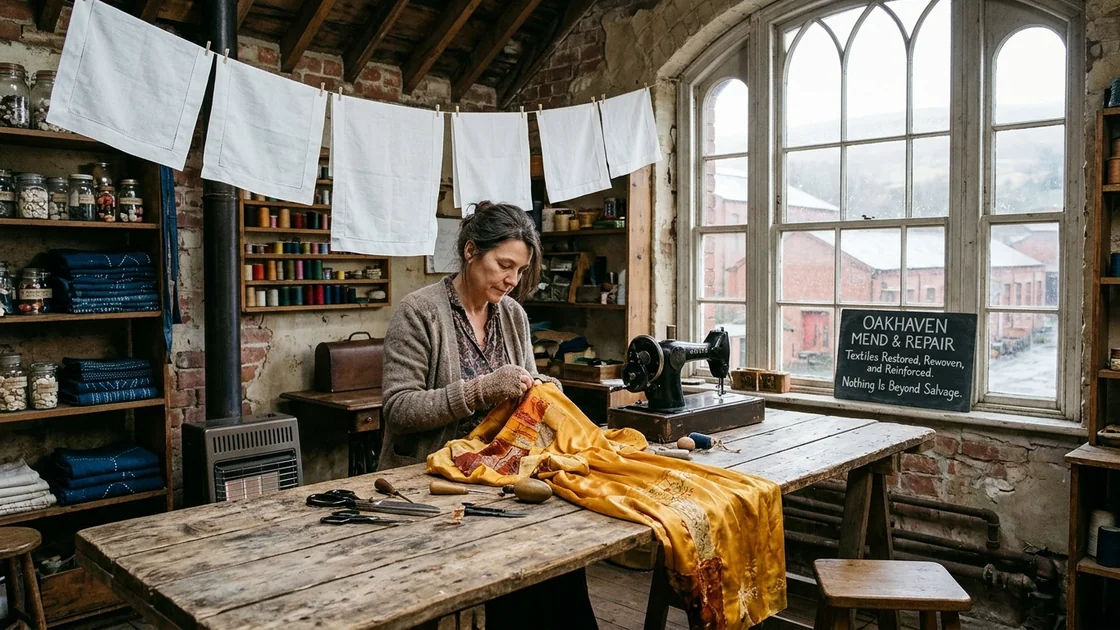
In the fading industrial valley of Oakhaven, a former city tailor named Elena Finch opens a modest textile restoration shop where she resolves to mend the discarded and damaged clothing of a bruised community. As the residents bring in their torn work coats, scorched silk dresses, and frayed blankets, Elena discovers that each threadbare collar and split seam holds an intimate record of grief, endurance, and quiet survival. Through the patient art of visible mending, both the townspeople and Elena herself learn that life is not ruined by its ruptures, but enriched by the stubborn grace of what is lovingly stitched back together.
I. The Red Brick Shell
The key did not turn smoothly. It screeched against pins encrusted with thirty winters of river damp, but Elena Finch leaned her shoulder into the oak door and forced the bolt back. Inside, the air smelled of cold mortar, oxidized copper, and the phantom dry perfume of forgotten flax.
Number 14 Foundry Lane had once been the paymaster’s cottage for the Blackwood Loomworks. When the mills choked on cheaper foreign synthetics in the late 1980s, the valley had exhaled a long sigh of soot and gone quiet. The river Calder still ran past the back foundations—a swollen, brown ribbon flecked with foam from the limestone weirs upstream—but the waterwheels had been uncoupled, the great steam whistles dismantled, and the rows of red-brick sheds sold off to auto-salvage yards, scrap merchants, and cheap carpet outlets.
Elena put down her two valises and her grandmother’s cast-iron Singer 201K sewing machine. The machine weighed forty-two pounds; carrying it six blocks from the railway platform had left deep, purple dents across her forearms. She rubbed her muscles, looked up at the high, arched sash windows that faced north toward the shale hills, and exhaled.
"It will do," she whispered. Her voice sounded thin, lost in the high ceiling. "It has to do."
By dusk, she had cleared the cobwebs with an ash-handled broom bought from the ironmonger around the corner. She scrubbed the broad deal floorboards with boiled water and soda crystals, watching years of grime yield to raw, pale grain. In the center of the front room, she raised an eight-foot trestle cutting table made of reclaimed scaffold planks, sanded until they were smooth as bone. Upon it she arranged her shears: heavy German dressmaking scissors with cold-forged carbon blades, tiny Japanese thread snips with spring handles, horn-handled awls, and a dozen boxwood darning eggs turned on a lathe by her grand-uncle fifty years ago.
Behind the table, she lined the walls with open shelves. Instead of new rolls of pristine fabric, these shelves held jars of vintage bone buttons, drawer-pulls salvaged from demolished dressers, spools of Gutermann silk thread in colors that had not been manufactured since the middle of the last century, hanks of indigo-dyed sashiko cotton, and bundles of washed linen remnants retrieved from rag-mills and auction boxes.
In the window, she placed a simple painted sign on slate:
OAKHAVEN MEND & REPAIR
Textiles Restored, Rewoven, and Reinforced.
Nothing Is Beyond Salvage.
The local butcher, an apron-wrapped man whose knuckles were permanently mapped with purple chill blains, paused on the cobbles that first Tuesday morning to stare at the slate sign. He spat into the gutter, shook his head with bemused pity, and crossed the street. In an era when a synthetic quilted jacket could be ordered from a warehouse three thousand miles away for less than the price of a pub lunch, paying a woman to spend four hours hand-stitching a blown-out elbow seemed like madness.
Elena knew this. She had spent fourteen years in the fluorescent-lit alterations department of a luxury department store in Manchester, pinning garments for women whose hemlines were adjusted once for a single gala before the dress was banished to a cedar closet forever. She had grown sick of the waste—the endless cascades of petroleum-based chiffon, the delicate tissue paper torn and swept into plastic wheelie bins, the utter contempt for human labor stitched into every three-pound polyester blouse.
Her hands had wanted weight. They wanted friction. They wanted things that had rubbed against real skin until the fibers were soft, bruised, and honest.
II. The Canvas Duck Duster
The first customer did not enter until Thursday afternoon. The shop bell, an old bronze ship's bell rigged over the lintel, gave a short, cracked ping.
Elena looked up from her bobbin-winder. Standing in the doorway was an elderly man who smelled of diesel oil, wet wool, and cheap roll-up tobacco. His spine was bent into the parenthesis common among men who had spent forty years shoveling coal or clearing track ballast. He held a bundle tucked under his arm, wrapped in an oily copy of the regional evening gazette.
"Are you the one who says she fixes clothes?" he asked. His voice had the dry rasp of shale sliding down an embankment.
"I am," Elena said, setting her hands flat on the cutting table. "I’m Elena Finch."
He stepped forward cautiously, as if the clean scrubbed floor were thin ice. He placed the newspaper parcel on the scaffold planks and slowly folded back the damp newsprint. Inside lay a canvas chore coat, once dark ochre, now weathered to the mottled shade of dried hornbeam leaves.
It was a ruin. The left sleeve had been ripped from the armscye down to the cuff, leaving a jagged, shredded mouth of broken warp threads. The back panel was gouged as though an animal had raked it, and the brass shank buttons were gone, replaced over the years with twists of copper wire and an incongruous safety pin.
"Thomas Bell," the man said. "They tell me you’re waste of time. My boy said throw it in the drum and set match to it. Said he’d buy me one of them fleece jackets from the hypermarket down near the bypass."
Elena did not touch the coat immediately. She looked at it with the reverence an archaeologist might offer an urn hauled from peat. "Why didn't you let him?"
Thomas Bell’s jaw worked. His mouth was sunken where his molars had been pulled. "Because my father wore this coat on the footplate of the 2-8-0 freight run out of Crewe during the freeze of sixty-three. When he died of the dust in seventy-two, he gave it to me. I wore it the morning the pit collapsed at Low Moor. I wore it when I met my wife on the canal bridge. It’s got her scent in the collar still, if you get your nose close enough, past the diesel."
He stopped, embarrassed, his gray eyes darting toward the street outside where a cold drizzle had begun to speckle the plate glass.
"Can you do it?" he asked, his tone hardening defensively. "Or is it just fancy skirts and lace curtains you do?"
Elena reached out. Her fingers were long, scarred at the left index tip from decades of errant needles. She touched the shredded canvas. The material was twelve-ounce cotton duck, stiff as cardboard near the hem, softened by fifty years of sweat and rain across the shoulders.
"If I mend this invisibly," she said softly, "the repair will fail. The canvas around the old seam is too tired. It won't hold tension from a machine."
"Aye," Thomas muttered, turning his cap in his hands. "Figured as much."
"So we don't hide it," Elena said. She picked up a scrap of heavyweight indigo hemp she had brought from a salvage bin in Leeds. "We back the tear with this. We use an eight-ply unbleached linen thread, waxed with beeswax. We stitch it with a running sashiko grid across the whole shoulder, distributing the pull across four inches instead of one line. The blue will show. The white thread will show. Everyone will know it was torn."
Thomas squinted at the blue cloth. He touched it with his thumb, which was black under the nail from years of engine grease.
"Like a scar," he said.
"Like a scar," Elena agreed. "Scars aren't shameful, Mr. Bell. They’re just skin that refused to give up."
He stood silent for nearly a minute. Outside, the tires of a coal lorry hissed against the wet tarmac.
"How much?" he asked.
"Ten pounds for the hemp and thread. Three pounds an hour. It will take me four hours."
"Twenty-two pounds," he calculated instantly. He reached into his trouser pocket and pulled out a small leather pouch tied with string. He counted out two ten-pound notes and two pound coins, laying them beside the mangled coat. "My pension comes on a Wednesday. Take your time. Just... don't cut off that pocket. She put a silver threepence in the lining behind the flap in seventy-four before we went to Blackpool. It’s still in there. You can feel it if you press."
Elena touched the pocket flap. Beneath three layers of hardened cloth, a small, hard disc shifted. "I won't touch it," she said.
That night, Elena worked by the yellow light of an adjustable anglepoise lamp. The shop was cold; the small gas fire in the grate popped and hissed, struggling against the drafts that seeped through the window frames.
She did not use the Singer for Thomas Bell’s coat. The machine was too fast, its rhythm too mechanical for fabric that had grown brittle with age. She used a stout sailor’s needle, pushing it through the layers of canvas and hemp with a brass palm thimble. With each plunge of the needle, the room filled with the smell of fifty-year-old chimney smoke, old motor grease, and the faint, unmistakable smell of dried lavender—the ghost of Mrs. Bell’s linen cupboard, preserved in the weave like an insect in Baltic amber.
As the needle rose and fell, Elena found herself matching her breath to the resistance of the cloth. One, two, through. Pull. Seat the knot.
She thought of her own scars. The little flat she had sold in Salford; the marriage to a junior accountant that had slowly, quietly evaporated like rain on a radiator until there was nothing left between them but two sets of keys and an argument over who owned the electric toaster. There had been no screaming, no plates broken on the lino—only a mutual realization that they had become synthetic, garments made of cheap acrylic that looked passable from five paces but melted the moment anything hot came near them.
She had wanted to go where things were worn down to the bone.
By midnight, the blue patch was anchored to the ochre canvas by a field of two hundred small, perfect white dashes. The sleeve hung true once more. The shoulder was twice as strong as it had been when the coat was cut in 1958.
When Thomas Bell returned on Saturday morning, he didn't pick up the coat right away. He stood before the trestle, his hands clasped behind his back, looking down at the blue patch and the bright white stitching.
Slowly, he slipped his arms into the sleeves. The coat fell around his frame with the familiar clatter of heavy cloth. He rolled his right shoulder, then his left. The new seam held; the indigo hemp flexed without binding.
He looked into the small, oval mirror Elena had hung beside the chimney breast. His reflection was that of an old man in an old coat, but his shoulders were straighter than they had been on Thursday.
"It looks like an iron bridge," he said, touching the sashiko grid. "Like the girders over the Calder."
"It’s strong enough to carry coal," Elena said.
Thomas did not say thank you. Men of his generation in the valley did not use the phrase easily; it tasted too much of charity. Instead, he reached into his pocket, took out a small brown paper bag containing two warm Eccles cakes from the bakery, set it on the table, nodded once, and stepped back out into the rain.
III. Scorched Silk
Word did not spread quickly in Oakhaven, but it spread deep. It moved along the washhouses behind the terraces, down the allotments by the canal, and through the queues at the post office.
The second garment arrived in the hands of Margaret Vance.
Margaret was seventy-four, with hair dyed the violent violet-red of cheap port wine and eyes that missed nothing behind thick, gold-rimmed bifocals. She had retired after thirty-five years as head clerk at the town’s municipal water authority. She walked with a nickel-plated cane and carried her burden in a clean, lavender-scented pillowcase.
"Thomas Bell showed me his shoulder," she announced without introducing herself, leaning heavily on her cane as Elena opened the door. "He looked like an old crow with a blue wing, but he could swing his coal shovel without the sleeve dropping into the slack. Did you do that?"
"I did," Elena said. "Come in, please. Sit by the fire."
Margaret sat, arranging her floral wool skirt over her knees. She laid the pillowcase across the deal table and looked at Elena with an expression that was half defiance, half terror.
"This isn't workwear," Margaret said sharply. "This isn't something you can whack with a sailmaker's bodkin and heavy string. This is pure mulberry silk satin. Paid three weeks’ wages for it in Manchester in the spring of seventy-three."
She pulled the garment from the pillowcase with slow, trembling reverence.
It was an evening gown, cut on the bias in the style popularized by the early seventies’ revival of thirties glamour. The color was magnificent—a pale, luminous saffron yellow that seemed to trap the gray light coming through Elena’s sash window and turn it into honey.
But the hem was horrific.
The entire right front skirt had been blackened, crisped, and eaten away by fire. Long, ragged tongues of carbonized silk had flaked off, leaving an irregular semicircular void that climbed nearly to the hip. The remaining edges were crusty, hard, and smelling faintly of scorched animal protein.
Elena felt an involuntary tightening in her throat. Silk satin cut on the bias was the most unforgiving medium in existence; it stretched diagonally, slipped under the presser foot like oil, and revealed every uneven stitch like a beacon.
"What happened?" Elena asked gently.
Margaret looked at the yellow fabric, her mouth curling into an ironic, bitter smile that did not reach her eyes.
"The miners’ strike of seventy-four," Margaret said. "The three-day week. We had no electricity on Thursday nights. The town hall had organized a dance by candlelight—everyone was trying to pretend we weren't sliding back into the nineteenth century. I went with Arthur Davies."
She stopped. A tram rolled by in the distance, its wheels clattering over the crossover on Foundry Bridge.
"Arthur wasn't a miner," Margaret continued, her voice dropping into a lower register. "He was a surveyor for the National Coal Board. The local lads thought he was a spy for the management. When we came out of the hall, three of them were waiting behind the war memorial with bottles of paraffin and rags. They didn't throw them at us—they were just boys, really, scared boys whose fathers were eating soup out of tin cans. But one of them swung a brand to keep Arthur back. It caught my hem."
She touched the burnt edge. The carbon crumbled under her gloved fingernail, dropping a dusting of black ash onto the clean wood of Elena’s table.
"Arthur ripped the skirt in his hands to smother the fire," Margaret said. "He burnt his palms down to the meat. We were supposed to be married that September."
"What happened to Arthur?" Elena asked.
"He went south," Margaret said simply. "His hands took three months to heal. He said he couldn't live in a town where his neighbors looked at him like he was vermin. He asked me to go with him to London. To an estate in Croydon."
She took off her glasses, wiped them on her cardigan sleeve, and put them back on. Her eyes looked smaller now.
"I didn't go. My mother had the creeping paralysis. My sisters had already married into the potteries. If I left, she would have gone to the union workhouse infirmary, and I wasn't going to let that happen to the woman who washed other people’s sheets so I could learn shorthand. So Arthur went. And I stayed. And the dress stayed in the bottom drawer under my communion missal."
Elena looked down at the saffron silk. It was sixty years old, yet the bias cut still had that liquid, serpent-like drape that modern synthetic silks could never emulate.
"Why bring it out now, Margaret?"
Margaret looked straight into Elena’s eyes. "Arthur died three weeks ago. In a nursing home in Reigate. His daughter sent me a note. She said he kept a picture of me in this dress in his wallet till the day his mind went soft. I’m going to his memorial service next month. Down in Surrey. His daughter said I’d be welcome."
She swallowed, her throat clicking. "I want to wear it. Not to look young. I’m not an idiot; I look like an old toad now. But I want to wear it so his ghost knows I kept the fire, but I didn't let it kill me."
Elena sat down on her stool. Her fingers hovered over the burnt perimeter.
"We cannot replace the yellow silk," Elena said after a long silence. "Even if I found modern mulberry satin, the dye lot would scream against fifty-year-old fabric. It would look like a bad tooth in a clean smile."
"Then what?" Margaret asked. Her voice cracked, just a little.
"We cut away the carbon," Elena said. "Cleanly, right down to the living threads. And then we rebuild the skirt using an under-layer of black silk organza, and over it, we stitch falling leaves. Individual leaves cut from vintage silk neckties, ribbons, and scraps of forest-green, burnt-orange, and gold. It won't look like an accident that was patched. It will look as if the dress is stepping out of an autumn bonfire."
Margaret stared at her. "Leaves?"
"Embroidered over the seam with couched gold thread," Elena said, her eyes shining with the vision that had suddenly formed in her mind. "It will be heavy at the hem, anchoring the bias, and thin out as it reaches your hip. A drift of sparks and leaves."
Margaret leaned forward. Her gloved fingers gripped the edge of the trestle table until the leather stretched.
"How long?" she whispered.
"Three weeks," Elena said. "I will need you to come in three times for fittings on the stand. Bias won't sit right if you don't fit it on the body."
"The money doesn't matter," Margaret said, rising stiffly. "I’ve got the water board pension and nothing to leave to anyone except a nephew who only visits when his car needs new tires. You take whatever you need."
For the next twenty days, Elena lived inside Margaret Vance’s yellow dress.
She sourced three 1960s Liberty silk scarves from an estate dealer in York—one a moss green with bronze paisleys, another a deep, wine-red foulard, and a third in black with tiny gold stars. She spent forty hours cutting individual willow-shaped leaves from these scraps, sealing their edges with a tiny flame from a spirit lamp so they would not fray, and then pinning them onto the black organza substrate she had inserted into the skirt's charred flank.
She used French silk embroidery floss, splitting the six-ply thread down to single filaments no thicker than a baby’s hair. Every stitch was an act of balance. Pull too tight, and the bias silk puckered into an ugly furrow; leave it too loose, and the leaf sagged like a wet leaf on a windscreen.
As she worked through the long, quiet evenings, listening to the Calder gurgle behind the floorboards, Elena thought about the choices that pinned a person to a map.
She had stayed in Manchester for years after her mother died because she felt she was the only person left who remembered the way her mother had laughed—a high, bubbling sound like water over pebble-dash. She had stayed with Richard because leaving required energy she simply didn't have at the end of a ten-hour shift behind the steam press. We stay, she realized, not because we are cowards, but because our lives become woven into the warp and weft of other people's needs until cutting ourselves out feels like slashing our own throats.
On the third fitting, Margaret stood upon the wooden footstool in the corner of the workshop. The yellow dress fell over her withered frame. The scorched void was gone. In its place was a cascade of autumn foliage: dark greens, golds, and deep coppers, caught in an upward swirl of microscopic gold-thread vines that seemed to leap from the floorboards toward her waist.
Margaret looked at herself in the three-way mirror Elena had retrieved from an old haberdashery in Halifax.
She didn't speak for five minutes. She turned her body slightly. The bias caught the movement; the leaves rustled with a sound like dry beech woods in November.
"He would have loved this," Margaret said, her voice entirely steady, though two tears broke from beneath the gold rims of her glasses and carved clean paths through the powder on her cheeks. "He always told me I was too quiet. He said I was like a mouse that lived under the church floor."
She looked at her reflection, lifting her chin until the loose skin of her neck pulled taut.
"No mouse wears a dress like this," she said.
IV. The Boy with the Fox-Colored Scarf
Winter came early to Oakhaven that year. By late November, the frost did not lift from the north-facing walls of Foundry Lane even at midday. The stone doorsteps were rimmed with white rime that tasted of sulfur from the valley’s remaining domestic coal fires.
Elena had to wear fingerless woolen gloves in the shop. She kept a terracotta pot inverted over a candle on her desk to warm her fingertips between seams; cold fingers were clumsy fingers, and clumsy fingers snapped needles and pricked fine wool.
One Tuesday after four o'clock, when the street outside had already turned the color of cold dishwater, the ship's bell gave a tiny, uncertain jingle.
A boy stood in the doorway. He was perhaps nine years old, wearing an oversized nylon parka with polyester stuffing leaking out of the pocket corners like greasy gray candy floss. His boots were cheap rubber wellingtons, two sizes too large, that flapped against his skinny calves.
In his red, chapped hands, he held something small and orange.
"Are you the mender?" he asked. His breath came out in short, nervous puffs of white vapor.
"I am," Elena said, stepping around the trestle table. "Come in, lad. Close the door; the wind is coming off the weir."
He kicked the door shut with the heel of his wellington. He was trembling, partly from the cold, partly from a terror so intense Elena could see the pulse jumping in the hollow of his small throat.
"I haven't got much money," he said. He reached into his parka pocket and brought out a handful of change: copper two-pence pieces, three five-pence coins, and a metal token for a car wash. He laid them on the corner of the table with agonized precision. "That's seventy-four pence. And the token. The token's worth two quid if you go to the shell station on the bypass."
Elena looked down at the coins, then at the bundle in his hands.
"What have you got there?" she asked.
He held it out. It was a hand-knit scarf, about four feet long, made of thick, homespun wool dyed the rich, bright orange of a dog fox.
Or rather, it had been a scarf.
A puppy, or perhaps a sharp bicycle sprocket, had caught the middle of the scarf and ripped through three ribs of the garter stitch. From that single trauma, the wool had begun to run. Nearly eighteen inches of the scarf had unraveled into a tangled, kinky nest of loops and crinkled yarn, like the curly red hair of an angry child.
"It’s my granddad's," the boy said. His voice was very thin now, wavering on the verge of that dry, breathless sobbing that boys use when they are trying not to cry in front of strangers. "He’s in the hospice. Over at Highfield. He’s cold all the time. He sits in the chair by the window and his chin shakes. My mum said if I lost his scarf, she’d take the hide off me. I didn't lose it. Buster got it. Buster’s our terrier. He got it under the kitchen table while Mum was at the laundry."
Elena took the scarf from him. The wool was rough, oily, and completely real—unadulterated Shetland or Swaledale fleece, hand-spun with an irregular, rustic twist that spoke of a wooden spindle or an old upright wheel. It had not been washed in modern detergents; it smelled of sheep fat, peat smoke, and the faint, sweet smell of menthol rub.
"What is your name?" she asked.
"Leo," he whispered.
"Well, Leo," Elena said, sitting on her low stool so she was at eye level with him. "Buster has done some damage, that's true. But the thread isn't broken. Look."
She gently teased apart the tangled ball of kinky orange yarn.
"When knitting unravels," Elena said, her voice dropping into that calm, rhythmic cadence she used when explaining things to herself during long nights, "it looks like everything is ruined. It looks like a pile of rubbish. But the yarn is just waiting to remember the path it took before. It has what we call 'crimp memory.' See how it curls? It wants to be loops again. It just needs someone to show it the way."
Leo watched her, his large hazel eyes fixed on her hands as she untangled the yarn without snapping a single fiber.
"Can you do it before seven o'clock?" he asked. "Mum gets off the shift at the packing plant at half-six. If she goes to the hospice and the scarf isn't on Granddad's bed, she’ll know."
Elena looked at the clock on the wall. It was twenty past four. Re-knitting eighteen inches of two-ply homespun garter stitch, picking up dropped loops with a crochet hook from a frayed edge, would take at least two hours of intense, uninterrupted concentration.
"Sit down by that radiator, Leo," Elena said, pointing to the cast-iron pipe that ran along the skirting board. "Take off those wet boots. There’s a tin of ginger biscuits behind the tea caddy. You may have three. No more, or your tea will be spoiled."
The boy didn't move toward the biscuits immediately. He stood rooted, watching her reach into a wooden box and pull out two short, smooth needles carved from applewood, their points worn golden by years of friction.
"Is seventy-four pence enough?" he asked.
Elena picked up the copper coins, slid them into her palm, and dropped them into the tin where she kept her spare pins.
"Seventy-four pence is the exact price for a dropped-stitch recovery on fox-colored wool," she said without blinking. "The car wash token, however, is your tip to me. I shall use it on my bicycle."
A tiny, cracked smile broke across Leo’s face, showing a gap where an incisor was coming through. He peeled off his rubber boots. His socks had holes in both heels, through which his white, cold skin showed like turnip slices.
Elena turned her back to him, centered the work under the lamp, and began.
Pick up the live loop. Slip the applewood needle through the throat. Wrap the kinky yarn. Draw it through. Drop the old loop.
The rhythm was different from sewing. Sewing was architecture; it was planes of non-stretchable material joined by lines of tension. Knitting was fluid; it was a single continuous line of wool looping around itself through space and time, creating a flexible mesh that lived and breathed with the body. A single break could destroy an entire garment, but as long as the line remained continuous, the whole thing could be resurrected from a single surviving knot.
Behind her, the boy munched his ginger biscuits with small, mouse-like crunches.
"Granddad taught me how to find water-rats in the canal," Leo said to the back of her head. The warmth from the radiator was loosening his tongue. "You have to look for the bubbles coming up from the weeds. If you throw a stone, they dive. But if you whistle—just a low whistle like a plover—they come right up to the bank to look at you."
"Did he?" Elena said, her needles clicking with the rapid, soft patter of hail on an attic window. Knit, purl, slip, pull.
"He worked in the dyehouse," Leo said. "At Blackwood’s. His arms were blue up to his elbows. Mum said when he was thirty, he looked like an Indian chief because the dye never came out of his pores. Even now, when his feet are cold in the bed, his toenails look like damsons."
Elena looked down at the yarn in her hands. The orange was brilliant—not synthetic chrome-orange, but madder or onion skins combined with weld. Perhaps the grandfather himself had dipped this wool into the boiling iron vats in the very building whose brick foundations lay two hundred yards from where she was sitting.
The scarf grew under her fingers. Ten inches. Twelve inches. The curly, disorganized mess of wool was being pulled back through the needle’s eye, straightened, tensioned, and forced back into the disciplined company of its fellows.
At twenty minutes past six, Elena reached the final row. She bound off the edge with a stretchy rib, pulled the tail through the last loop, and knotted it into the fringe with a small brass bodkin.
She took the scarf to the steam press. A five-second blast of white vapor set the stitches, relaxing the newly recovered yarn so that the repair vanished into the body of the scarf. It did not look new; it looked unbroken.
"Come here, Leo," she said.
The boy stood up, his small stockinged feet padding softly across the deal boards.
Elena wrapped the scarf around his neck, crossing the orange ends over his chest. The wool was hot from the steam, smelling rich and wild of fleece and mountain rain.
Leo reached up and buried his nose in the orange folds. He closed his eyes.
"It smells like him," he whispered. "It doesn't smell like Buster at all."
"Go on then," Elena said, handing him his rubber boots. "Run. The six-thirty bus from the bypass drops the factory shift at the bridge in ten minutes."
The boy jammed his feet into his boots, caught his oversized parka around his waist, and lunged for the door. At the threshold, he stopped, turned, and made a clumsy little bow that seemed to have been remembered from an infant-school nativity play.
"Thank you, Miss Finch," he cried.
The ship's bell rang once, sharp and clear, as he vanished into the dark, his orange scarf flying behind him like the brush of a fox darting through the valley’s stone alleys.
Elena stood by the door, listening to the slap of his oversize boots fade down the wet cobbles. She looked down at the palm of her hand. A faint trace of orange lanolin remained on her skin. She brought it to her face and breathed it in, feeling an absurd, fierce warmth blooming behind her ribs.
V. Elena’s Linen
The workshop had its own ghosts, but Elena had brought her own trunk from Salford. It sat in the corner of her back kitchen—a high-ceilinged, stone-flagged room where a gas ring and an iron kettle served as her domestic quarters.
The trunk was made of black vulcanized fiber with brass corners. Inside it lay three hundred yards of white Irish linen, cut into thirty-six squares, each eighteen inches by eighteen inches.
They were her dowry. Not for a wedding with a man, but the dowry of her training.
Elena’s mother, Clare Finch, had been an outworker for the great Belfast linen firms before she moved to the Lancashire coalfield to marry a boiler-maker. Clare had taught Elena to sew before the girl could read a parish map.
"A hem," Clare used to say, sitting by a scuttle of nutty slack with the paraffin lamp turned low to save oil, "is not a border. A hem is a promise. It says that what is inside will not fray, no matter how many times the world drags it through the copper tub."
When Clare died of a pulmonary embolism in the cold spring of 2018, Elena had spent seven days in the Salford flat without opening the curtains. She had not cried. She had sat at her grandmother’s Singer, taking those thirty-six squares of raw, stiff Irish linen and hemming them by hand.
She had used a drawn-thread hemstitch—four threads pulled from the weave, three threads bundled with a microscopic linen knot, repeated forty-two thousand times across thirty-six squares. It was useless, obsessive labor. Nobody used eighteen-inch linen napkins anymore; they used rolls of bleached paper that disintegrated into white paste when they encountered spilled milk.
Now, in the quiet of an Oakhaven December, Elena brought the linen squares out into the shop.
She hung them from wires strung across the rafters, like sails drying after a squall. In the gray industrial light that filtered down from the shale hills, the thirty-six squares looked like white flags—surrenders, or perhaps signals across an empty sea.
She was sitting beneath them, mending a pocket on a schoolgirl’s duffel coat, when the door opened and a man she had never seen before stepped into the workshop.
He was tall, perhaps forty-five, with dark, uncombed hair graying at the temples. He wore an expensive, water-spotted tweed overcoat that had lost two buttons, and he carried a wooden box under his arm. His face had the peculiar, chalky transparency of a man who had not slept properly for six months.
"Elena Finch?" he said.
"Yes."
He put the wooden box on the trestle table. It was not a cardboard box or a grocery sack; it was an old mahogany collector’s chest with three shallow drawers, fitted with small brass recessed handles.
"My name is Julian Croft," he said. "I live at Calder House."
Elena knew of Calder House. It was the square Georgian manor that sat above the weir, half-strangled by overgrown laurel and rhododendron bushes. It had belonged to the Blackwood family who owned the mills; when the mills died, the house had been sold to a succession of recluses and failed speculative builders.
"What can I do for you, Mr. Croft?"
Julian Croft didn't touch the brass handles of the box immediately. He looked up at the thirty-six white linen napkins hanging from the rafters.
"That's twenty-five-lea flax," he said quietly. "Hand-loomed. Probably County Antrim, around 1930. The drawn-thread work is sixteen stitches to the inch."
Elena set down her duffel-coat needle. "You know linen."
"I used to curate the textile collection at the Whitworth in Manchester," he said, his voice flat, devoid of the pedantic pride curators usually possessed. "Before I moved here. Before my daughter died."
The room became very cold, despite the hissing gas fire.
Julian pulled open the top drawer of the mahogany chest. Inside, laid out on blue acid-free tissue paper, was a white linen christening gown from the late Victorian era.
It was exquisite. The bodice was composed entirely of Carrickmacross lace—delicate cambric appliquéd onto a fine hexagonal net, with floral sprays of shamrock, oak leaves, and tiny acorns.
But it was devastated.
Across the skirt, someone had spilled what looked like black iron-gall ink. The stain had oxidized into an ugly, corrosive crust of dark purple-brown, and where the ink was thickest, the chemicals had literally eaten through the linen fibers, leaving large, brittle holes with charred-looking margins.
"She was six months old," Julian said. He spoke without looking at Elena, his eyes fixed on the ink-ruined lace. "Her name was Clara. Not after your mother—after Clara Schumann. My wife was a pianist. Clara got sick with meningitis. It took forty-eight hours. While the doctor was writing the death certificate at the study desk, the ink bottle tipped. It rolled off the desk and into the wicker basket where my wife had laid out the gown. She had planned to have Clara photographed in it the following Sunday."
Elena did not speak. She knew that some griefs were like pressurized vessels; touch them with words, and they exploded into shards that cut everyone within reach.
"My wife left three months later," Julian said. "Not to go to another man. She just... could not bear the sound of the river. She lives in Madrid now, where it is sunny and dry and there are no old houses smelling of wet soot. She told me to burn the gown before she went. She said it was cursed."
He looked at Elena then. His eyes were wide, dark, and hollow, the eyes of an animal that had spent the winter at the bottom of an empty silo.
"I tried to put it on the fire," he whispered. "I stood in front of the grate with it in my hands. But I couldn't do it. My great-grandmother made this lace in County Armagh in 1888. It took her four hundred hours. If I burn it, it’s as though Clara never lived at all. It’s as though my great-grandmother never lived. It’s just... an empty space where three women were erased."
He gripped the edge of the mahogany drawer until his knuckles went the color of lard.
"The people at the museum in London told me to write it off," he said. "They said iron-gall ink cannot be removed from vintage flax without dissolving the vegetable cellulose. They said it was chemically impossible. But Thomas Bell told me you were here. He said you understood that some things have to be kept, even if they're ruined."
Elena reached into the drawer. Her hands were perfectly steady. She did not touch the lace; she touched the unsoiled white linen at the shoulder.
"The museum was right about the chemical removal," she said. Her voice was level, carrying that cool, practical authority that nurses use in casualty wards. "Iron-gall ink is an acid that bites into the fiber. If we use ox-gall, or bleach, or potassium, the linen will simply turn to liquid and fall away in the wash."
"I know," Julian said, his shoulders dropping. "I know the chemistry."
"So we don't remove it," Elena said.
Julian frowned, a flicker of irritation cutting through his exhaustion. "You can't just leave a black ink stain on a christening gown, Miss Finch. It looks like an executioner’s rag."
"We don't leave it as ink," Elena said. She walked to the back shelf and pulled down a large, glass-topped jar. Inside were hundreds of tiny, dried beetle wings—the iridescent, emerald-green elytra of the jewel beetle, salvaged from an Edwardian theatrical costume that had fallen to pieces in a theater basement in Leeds. Beside it, she placed a spool of filament silk dyed the dark, midnight blue of a winter twilight.
"Look at the shape of the ink stain, Mr. Croft," she commanded.
Julian looked down, reluctant, pained.
The ink had splashed in a wide, branching fan across the bottom half of the skirt, with droplets spraying out like seeds from an exploded pod.
"It looks like an explosion," he muttered.
"No," Elena said. "It looks like the roots of a yew tree. Or the branches of an alder growing out of dark water."
She took an ivory-handled stylus and traced the black perimeter without touching the cloth.
"We cut away the destroyed, acid-eaten cores where the linen is dead," she said. "We stabilize the margins with unbleached starch paste. And then we turn every black splattered droplet into a leaf, a seed, or a bird. We use the midnight silk to couch down the edges. We use the jewel-beetle wings to create points of emerald light within the darkness. We do not pretend the ink was never spilled. We make the ink the soil from which a dark garden grows."
Julian stared at her. His mouth worked, but no sound came out. He looked at the emerald beetle wings, then at the thirty-six white linen napkins hanging from the rafters like sails.
"A dark garden," he said, the words tasting strange on his tongue.
"A garden for Clara," Elena said gently. "Lace was never meant to be clean, Mr. Croft. The women who made it in Armagh were starving on potatoes and buttermilk. They worked in damp cabins with mud floors so the flax wouldn't snap from the dry heat of a peat fire. Their lives were dark. The lace was the only light they were allowed to make. Don't throw away their light just because your heart is broken."
Julian turned away from the table. He walked to the sash window and stood with his forehead pressed against the cold glass, looking out at the red brick walls of the old Blackwood mill across the lane. His tall frame shook—just once, a single, violent spasm like an oak tree catching the first blow of an axe—and then he went still.
"Do it," he said, without turning around. "Do whatever you must."
VI. The Winter of the Big Freeze
January arrived with an iron grip that locked the Calder in its bed.
The waterfalls up at the limestone quarries froze into blue, jagged pipes of ice forty feet high. In Foundry Lane, the water pipes burst in three terraces, and the street became an ice-rink where children with coal-sacks tied to their bottoms slid from the top of the hill down to the factory gates.
Elena’s workshop was freezing. She kept the Singer oiled with light mineral oil, but the cold made the lubricant thick as honey, and she had to warm the needle-bar with a brass hot-water bottle before she could turn the handwheel.
She worked on Clara’s gown for five weeks.
It was the most difficult work of her life. The iron-gall ink had made the linen brittle as parchment; if she pushed the needle through with too much force, the cloth cracked with a tiny, sickening snick. She had to moisten the back of the fabric with a fine mist of distilled water and alcohol every twenty minutes to keep the cellulose pliable.
She set forty-two jewel-beetle wings into the black ink stain. She surrounded each wing with a halo of buttonhole stitches in midnight blue and old gold.
Where the largest hole had been eaten through the skirt by the acid, she created a medallion of needle-lace—not Carrickmacross, which required a net backing, but point de Venise, constructed entirely out of air and thread using a single needle. Inside the medallion, she stitched the silhouette of a tiny bird—not a dove of peace, which felt too easy, too sentimental, but a swift: the bird that spends its entire life in the sky, never touching the earth, sleeping on the wind.
While she worked, the town came to her.
It was no longer just the old people with their relics. The town had begun to understand what Foundry Lane was.
A young girl named Siobhan, who worked the tills at the discount supermarket, brought in her cheap, synthetic winter coat whose plastic zipper had torn out of the front seam.
"I can't buy another one till my tax credits come through," Siobhan said, shivering in her thin nylon uniform. "And the wind cuts right through the lacing on the bridge."
Elena did not lecture her on the evils of petroleum-based garments. She took an old, brass heavy-duty zipper from an army-surplus duffel bag, cut away the ruined nylon tape, and bound the front of the synthetic coat with strips of red wool flannel cut from an old army blanket.
She stitched the red wool with bold, white crosses. It made the cheap, gray supermarket coat look like an officer’s winter tunic from some gallant, forgotten brigade.
"That'll keep the wind out," Elena said, charging her fifty pence and a jar of pickled onions Siobhan’s mother had put up that autumn.
Then came Mr. Henderson, the retired postman, whose knees had pushed through his only pair of good corduroy trousers. Elena patched them with heavy ribbed velvet from an old set of theater curtains, cutting the patches into broad diamonds that covered the knee from shin to thigh.
"Now you look like an alpine guide," she told him.
"My missus says I look like a clown," Henderson replied, grinning until his ears moved. "But my shins aren't blue no more."
The shop became a station on the town’s winter circuit. People stopped in just to stand by the hissing gas fire for five minutes and watch Elena’s hands move.
There was something hypnotic, something profoundly consoling, about the regular, uninterrupted flash of her needle. In a world where mills closed, jobs were moved to industrial parks three countries away, and old things were shoveled into skips to make way for plastic-wrapped boxes that broke in three weeks, Elena Finch sat on her low wooden stool, telling them that what they already had was worth keeping.
One evening in early February, while she was setting the final stitches into the wing of the needle-lace swift on Clara’s gown, Julian Croft came back.
He did not look like the same man who had walked in six weeks before. His hair was trimmed, he wore a clean, heavy wool sweater under his coat, and he carried two cups of hot tea in cardboard containers from the railway kiosk.
Elena laid the christening gown across the blue tissue paper on the trestle table.
The black ink stain was still there. It had not been erased. The dark, sprawling root-system of iron-gall still climbed the skirt.
But it no longer looked like an accident. It looked like an illumination from an ancient Celtic psalter. The emerald beetle wings caught the light of the anglepoise lamp, burning with an intense, supernatural green that seemed to float above the blackened linen. The needle-lace swift hung in the center of the dark void, its thread-wings spread wide, riding the dark current of the stain as though it were a thermal rising from the valley floor.
Julian did not touch the gown. He stood over it, the tea cooling in his hands, his breath coming slow and deep.
"You didn't hide it," he said. His voice was thick, but it was clear.
"You can't hide a death, Mr. Croft," Elena said gently, setting her thimble on the table. "If you hide it, you spend the rest of your life watching the place where you buried it, waiting for the grass to grow back. You have to make something of it. You have to give it a voice, or it will just scream inside your head forever."
Julian put the tea down on the deal boards. He reached out with his right hand—a hand that had handled the four-hundred-year-old velvets of popes and kings—and touched the needle-lace swift with the tip of his finger.
He closed his eyes. A single, long shudder ran through his tall frame, from the crown of his head down into the soles of his boots.
"My great-grandmother," he whispered, "would have given you her silver thimble for this."
"She already gave me the lace," Elena said. "That was enough."
He took the mahogany box, packed the gown with tissue paper as though it were the most precious jewel in the kingdom, and closed the drawer. He did not ask what the bill was. He took out an envelope, laid it beside Elena’s darning eggs, pressed her hand with both of his—his fingers were warm now, no longer chalky and dead—and left without another word.
When Elena opened the envelope later that night, she found five hundred pounds in clean twenty-pound notes, and a small, hand-written card:
For the linen that didn't surrender.
J.C.
VII. The Philosophy of the Thread
Spring did not come with flowers in Oakhaven; it came with mud.
The snow on the moors melted under three days of warm Atlantic rain, and the Calder rose until its brown, foaming lip was only six inches below the arches of Foundry Bridge. The cellar of Number 14 smelled of wet grit and coal-tar, but the shop floor stayed dry.
Elena used Julian Croft’s five hundred pounds to buy three tons of smokeless coal for the old iron stove in the back room and a huge, five-hundred-meter spool of undyed, sixteen-ply raw silk cord from a mill in Lyon that was shutting down its historic looms.
She also bought an old wooden sign-board from the junk yard, planed it flat, and painted three rules upon it, which she hung behind her cutting table:
- WE DO NOT RESTORE TO NEW. WE RESTORE TO TRUTH.
- THE TEAR IS THE SHAPE OF THE EVENT; THE STITCH IS THE SHAPE OF THE CARE.
- A GARMENT FULLY MENDED IS NEVER FINISHED, ONLY CONTINUED.
People brought her things that had no commercial value whatsoever.
A woman named Brenda brought a tea-cosy that had been knitted by her aunt during the Blitz, stuffed with dog hair and scraps of wool from utility uniforms. A mouse had eaten the top knot off. Elena re-sculpted the mouse-hole into a tiny, embroidered Yorkshire rose using thread pulled from a 1940s duster.
A young man named Liam, who played bass in a post-punk band that rehearsed in an old dye-house, brought in his leather motorcycle jacket. The shoulder had been shredded when he came off his bike on the wet tram rails on the bypass.
Liam wanted it patched with black leather so his bandmates wouldn't laugh at him.
"No," Elena said, looking at his narrow, terrified young face. "Black leather will look like an insurance repair. We patch it with red tartan from an old wool kilt. We sew it with white saddler’s thread, and we leave the raw edges out so they fringe when you play."
Liam had looked horrified. "They’ll think I’m an idiot."
"They’ll think you’re a king," Elena said.
Two weeks later, Liam came back with three other boys from the band, all carrying torn denim jackets, ripped jeans, and greasy canvas tool-bags. The red tartan patch had become a badge of honor; the local boys were calling it "Finch-work."
Elena found herself working twelve, fourteen hours a day. Her fingers grew thicker at the knuckles; her needle-calluses became hard, amber-colored shields that could turn the point of a pin without feeling it.
She was no longer the lonely woman who had crept out of Manchester with her grandmother’s Singer in two valises.
She was the point of repair.
When the townspeople walked down Foundry Lane, they didn't look at the cracked brickwork of the shuttered mills with the same hopeless, downcast stare. They looked at their own elbows. They looked at Thomas Bell’s blue-and-ochre bridge; they looked at Margaret Vance, who had returned from the memorial service in Surrey with her head held so high her purple-red hair looked like a battle standard, wearing her saffron dress with the autumn leaves to Sunday chapel despite the rector’s nervous coughs.
They looked at their own lives and realized that perhaps the closure of the mills, the loss of their pensions, the slow, cold slide into economic irrelevance had not ended them.
They had been torn, yes. They had been tossed into the rag-bin.
But they were still made of good, heavy wool. They were still capable of holding a stitch.
VIII. The Quilt of Mill Number Four
In late April, when the wild garlic was beginning to turn the banks of the canal into ribbons of white, starry blossom, a delegation arrived at the workshop.
It was led by Thomas Bell, wearing his blue-shouldered canvas duster, accompanied by Margaret Vance, young Leo with his orange scarf tucked neatly into his coat, and Mrs. Garside, the butcher’s wife, who had previously looked at Elena’s shop as if it were an infectious disease.
Behind them, carried by four young men from Liam’s band, was a massive, rolling bundle wrapped in an old tarpaulin.
"Come out onto the pavement, Miss Finch," Thomas Bell called, his voice booming across the wet cobbles. "It won't go through your door."
Elena set down her snips and stepped out into the spring sunlight. The air was cool, smelling of limestone and green leaves from the hills.
The young men laid the bundle on the cobbles and unrolled the tarpaulin.
Inside was a quilt.
It was twelve feet long by ten feet wide, and it was composed of hundreds of square patches of wool, cotton, linen, and silk.
Elena caught her breath. She recognized the fabrics.
There was the "Blackwood Blue"—the famous vat-dyed indigo serge that had clothed three-quarters of the British Royal Navy during the First World War. There was the heavy, cream-colored wool twill used for cricket flannels in the 1920s; the sprigged cotton calicos from the 1930s utility lines; the olive-drab webbing from the 1944 parachute contracts; and the bright, strange, geometric rayons from the Festival of Britain.
It was the sample archive of the Blackwood Loomworks.
"We found it," Mrs. Garside said, her arms crossed over her apron. "In the loft over the old spinning room. The scrap men were going to chuck it into the skip on Monday to clear the floor for an indoor go-kart track."
"It’s rotted through in the middle," Thomas Bell said, pointing with his clay pipe. "The roof leaked on it for twenty years. The rats have had a litter in the center squares, and the mold has eaten the batting right out."
Elena knelt on the wet stones. She touched the fabric.
The cloth was damp, smelling of ancient tallow, sheep fleece, and river water. But the dyes—the honest, mineral dyes of the early twentieth century—were still blazing beneath the gray dirt. The Blackwood Blue was as deep as the sea at midnight; the cricket twill was the color of fresh cream; the utility calicos were bright with tiny, stubborn red daisies.
"Why bring it to me?" Elena asked, her hand resting on a square of indigo serge that had been woven eighty years ago by people whose names were now only carved on the mossy headstones behind the parish church.
Margaret Vance stepped forward, her nickel-plated cane clicking against the cobbles.
"We don't want it put in a glass case in the library in Halifax," Margaret said. "They’d stick it behind plastic and put a little brass plaque on it saying Specimens of Extinct Industry. It isn't an extinct industry. It’s our blood. My mother’s thumbs were twisted from winding the bobbins for that very blue twill. Thomas’s uncle died of the lung-rot from the dust off that olive webbing."
She looked at Elena, her chin trembling slightly.
"We want it mended," Margaret said. "We want the rat-holes filled. We want the rot cut out and replaced with pieces of our own. Pieces of the clothes we’re wearing now. We want it hung across the iron girders in the old paymaster's hall, so when the children go to their go-karts, they have to walk under their grandmothers’ work to get there."
Elena looked around the circle.
There was Thomas Bell in his canvas duster. Margaret in her saffron silk. Leo in his orange scarf. Liam with his red-tartan motorcycle shoulder. Siobhan in her supermarket coat bound with red soldier’s wool. Henderson in his corduroy trousers with the theater-curtain knees.
They were all patched. They were all wearing their scars on the outside, bright as banners.
Elena felt something inside her chest give way—not with a break, not with a tear, but with the smooth, easy release of a knot that had finally found its true end.
The fourteen years in Manchester, the quiet evaporation of her marriage, the lonely nights in the damp shop on Foundry Lane—they were not an exile. They were the preparation. They were the long, slow spinning of the thread that had brought her to this circle of stone and water.
"It will take all summer," Elena said. Her voice was thick, but it carried across the street, bouncing off the red brick walls of the old mill.
"We’ve got all summer," Thomas Bell said.
"I cannot do it alone," Elena said. "It’s too large for two hands."
Mrs. Garside stepped forward, untying her apron strings with a sharp, decisive snap.
"I was a winder at sixteen," the butcher’s wife said. "I can still thread a bodkin without my glasses if the light’s good. I’ll be here at eight on Monday."
"I can cut patches," Leo piped up, jumping on his oversize boots. "I can cut straight lines if Mum lets me have the big scissors."
"My band has got an old amplifier van," Liam said. "We can haul the batting down from the wool-scourers in Hebden. They’ve got clean waste wool that’s good for stuffing."
Elena stood up from the cobbles. She wiped her knees, which were wet from the street, and looked up at the high sash windows of her workshop.
Above the door, her slate sign still hung:
OAKHAVEN MEND & REPAIR
Textiles Restored, Rewoven, and Reinforced.
Nothing Is Beyond Salvage.
"Bring it in," Elena commanded, her voice ringing out like the bronze ship's bell over the lintel. "Clear the cutting table. Light the stove. Put the kettle on."
The four young men hoisted the great quilt into the air. The crowd surged forward, fifty hands reaching out to support the weight of the old cloth, lifting it over the threshold of Number 14 Foundry Lane.
As the bundle passed through the door, the bronze bell gave a long, wild, continuous chime that echoed down the valley, over the limestone weirs, past the cold red chimneys, and up into the green, enduring hills.
Elena stood by the doorpost, her palm resting against the old oak frame.
She did not pick up her needle immediately. She simply watched them come: the broken, the stubborn, the threadbare, and the brave, all carrying their fragments into the light, ready to be joined.