The Memory of Iron and Water
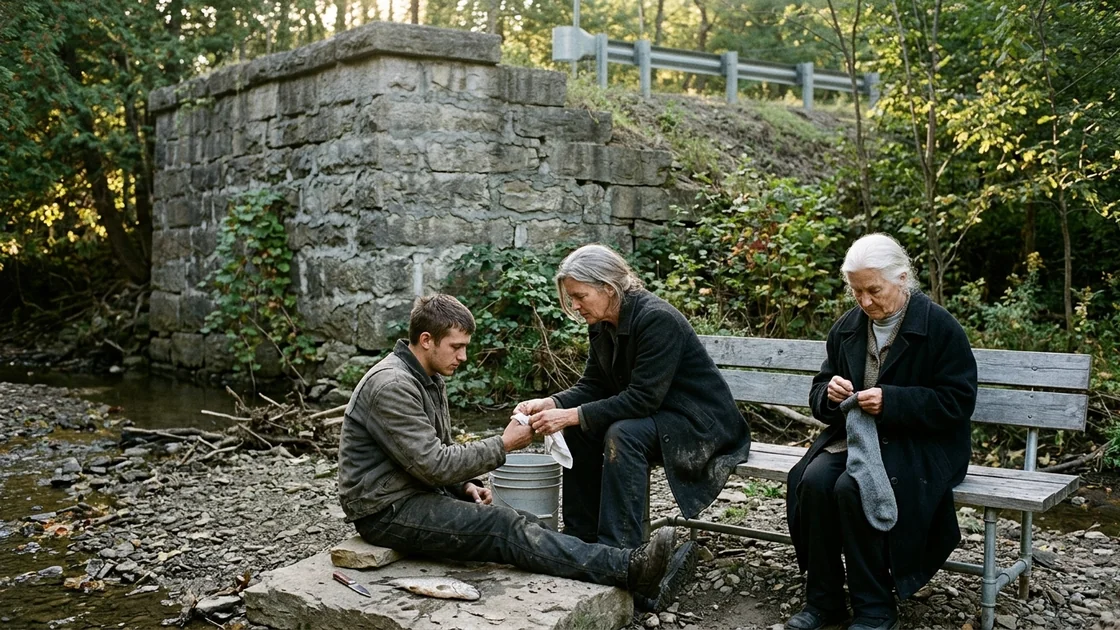
This story follows Nora Davies and Evelyn Cross over the course of nine years in the river valley town of Harrow Creek following a catastrophic automobile collision on a frozen county bridge that claimed the life of Nora seventeen year old son Julian and sent Evelyn son Jesse into state custody and lasting disability. Divided by grief righteous fury and the brutal judgment of a small town the two women endure isolation the collapse of their marriages and the bitter certainty of mutual hatred until an unearthing of hidden truths about that night and an unexpected intersection of their quiet solitary lives forces them to dismantle their barricades and build a fierce necessary alliance on the very ground that broke them.
1. The Geometry of a Sieve
The winter Harrow Creek froze to the bottom of the gravel shoals was the year Nora Davies stopped setting the brass kitchen timer. For two decades the timer had governed the life of the brick two-story on Maple Street: eight minutes for soft eggs, forty-two minutes for a pork loin, twelve minutes of quiet reading before Julian had to take his asthma inhaler and pull on his canvas track shoes.
After the second Tuesday of November, time lost its click and spring. It became an unwashed basin, flat and lukewarm, filling from a dripping tap Nora had neither the strength nor the inclination to pack with fresh washers.
The police report sat in the bottom drawer of the mahogany desk in the den, beneath three years of unopened school district newsletters and a receipt for four cord of seasoned white oak Julian had helped stack three days before the frost set in. Nora did not need to open the drawer. The numbers were burned against the back of her eyelids with the permanence of a zinc stencil: 11:42 p.m.; forty-eight miles per hour in a posted thirty zone; twenty-two feet of lateral skid across the black ice on the deck of the Miller’s Run iron-truss bridge; four-tenths of an inch of reinforced guardrail torn clean from the timber cribbing; zero trace of brake application prior to impact with the weeping-willow trunk on the downstream embankment.
Julian had been dead before the red flashers of the volunteer ambulance crested the orchard ridge. The impact had snapped his neck cleanly at the third vertebra, leaving his face untroubled, almost petulant, as if he had merely fallen asleep with his shoulder pressed against the frost-starred passenger glass while Jesse Cross tried and failed to make the turn.
Jesse had lived. He had lived with six pins in his pelvic cradle, a shattered left elbow, a mild contusion to his frontal lobe that left him with a flat, wandering voice, and an eighteen-month sentence at the juvenile reception center in Elmira for vehicular manslaughter in the second degree.
Nora knew where Jesse’s mother lived. Everyone in Harrow Creek knew where Evelyn Cross lived, because Harrow Creek was six square miles of silt loam wedged between the limestone bluffs and the railway spur, and nobody crossed the river without passing the peeling cedar siding of the Cross farmstead. It sat on the lowland side of the bridge road, three hundred yards from the splintered willow that still bore, two winters later, a scab of gray tarpaper pinned to its wood by the highway department to keep the rot from setting in.
On Mondays, Nora took the long way into town to buy flour, salt, and tea. She drove seven miles out of her way through the upper gap, past the lime kilns and the dairy collective, rather than look down into that bowl of hemlock and switchgrass where Evelyn’s wash hung stiff as sheet metal on clotheslines strung between rusted clothes poles.
Yet Harrow Creek was too narrow for seven miles of detour to keep the edges from grinding.
The first encounter that carried the weight of blood happened outside the county annex in the wet thaw of late March, fifteen months after the funeral. Nora had gone to pay the second installment of her property tax. She came down the limestone steps carrying her stamped receipt, her wool coat buttoned to the chin despite the sudden, muggy warmth that had turned the snowbanks into gray porridge along the gutters.
Evelyn Cross was sitting on the retaining wall by the bicycle racks, waiting for the 1:15 county bus that ran out toward the correctional facility. She wore a men’s chore coat with the cuffs turned back twice to show the yellow fleece lining, her hair pulled back into a clip so tight the skin around her temples looked shiny and white. Her hands were tucked deep into her pockets, her knees pressed together like those of an adolescent girl in a Sunday pew.
Nora saw her three strides before she could turn back. The air went thin and cold in her throat, tasting of old solder.
Evelyn looked up. She did not flinch, which Nora took as an insult of astonishing proportion. Evelyn merely blinked her washed-out, hazel eyes, her mouth dropping open a quarter of an inch, revealing the slight overlap of her front teeth. She looked like a woman who had spent fifteen months standing under an iron roof while someone dropped shovelfuls of wet dirt onto it: not surprised, not defensive, simply dull with the expectation of more weight.
"Nora," Evelyn said. Her voice was rusted out at the bottom, an octave lower than it had been when they both served on the library auxiliary during the flood drive six years before.
Nora stopped. The receipt in her gloved fingers crumpled with the dry sound of a wasp’s nest stepped on in an attic.
"Do not say my name," Nora said. She did not raise her voice; she had no voice to spare for raising. The sound came from behind her ribs, cold and narrow as a skinning knife. "You have no right to the vowels in it. You have no business breathing on the same side of this street."
A clerk coming out of the tax office with a cardboard tray of coffee paused, glanced at them, recognized the coats, and immediately crossed between two parked trucks to avoid the sidewalk between them. The town had learned that particular choreography very early.
Evelyn’s hands moved in her pockets, but she did not pull them out. Her shoulders rose an inch toward her ears. "I have to take the bus, Nora. It stops here."
"Then walk to the crossing," Nora said. "Walk until your heels bleed, Evelyn. That boy is sleeping in a cedar box under three feet of red clay because you gave your son the keys to a three-ton Buick with bald tires and a steering box that had two inches of play in the shaft. David told your husband three times that car wasn't road-safe. He told him at the feed store in October."
"Arthur died four years ago, Nora," Evelyn whispered. Her gaze drifted toward the curb, where the meltwater was carrying grease and cigarette filters toward the storm grate. "Arthur wasn't at the feed store. You’re thinking of someone else."
"I am thinking of the woman who let him drive," Nora hissed. She took one step closer—only one, but the violence in it was so concentrated that Evelyn leaned backward until the rough limestone of the courthouse copestone pressed into the small of her back. "I am thinking of the woman whose kitchen lights are still on at night while mine are dark. Don't look at me. If you see me on this road, you cross it. If you see me in the church, you walk out into the rain. You owe me the decency of being invisible."
The county bus wheezed around the corner, its diesel exhaust smelling of sour cabbage and wet soot. Its pneumatic brakes gave a long, derisive sigh against the curb.
Evelyn stood up. She was four inches shorter than Nora, her shoulders rounded by thirty years of packing apples at the valley co-op and dragging five-gallon buckets of calf mash through the weeds. She looked at Nora’s throat, at the hard pearl button of her coat, unable to lift her eyes to the face.
"He doesn't sleep either, Nora," Evelyn said, barely audible over the clatter of the bus’s idling engine. "If that’s any comfort to you. He doesn't sleep an hour without shouting out."
"It isn't," Nora said, her mouth dry as lime. "It isn't nearly enough."
She did not watch Evelyn climb the three green rubber-treaded steps into the bus. She turned on her heel and walked through the slush to her station wagon, her knuckles so white against her purse handle that the small brass buckle bit into her palm until it drew a dark, round bead of blood through the knit wool of her glove.
2. The Preservation of Vinegar
The third year was the year of the paper divorce.
David Davies did not leave with a shout or the slamming of trunks. He left because the silence in the house had become structural; it had settled into the joists and the floorboards until every step sounded like an accusation. David was an estimator for a regional timber firm; he spent his days measuring the merchantable yield of red oak and sugar maple, calculating how many board feet could be sawn from a stand before the crown rot made it useless.
One evening in October, when the smell of burning leaves drifted down from the hills like wood-smoke from an old war, David sat down at the oilcloth-covered kitchen table and laid his heavy brass watch beside the sugar bowl.
"I can't do the graveyard on Sundays anymore, Nora," he said. His beard, which had been chestnut when they buried Julian, was now the color of wet river slate. "I stand there and I don't think about him. I just think about how much I want to hit something until my hands break. And then I look at you, and you're already broken, and there's nothing to do with it."
"He was seventeen," Nora said. She was paring Bartlett pears for the kettle, dropping the slippery quarters into a bowl of cold water laced with vinegar so they would not turn brown before the sugar was ready. "He didn't have twenty years to give us. He had seventeen. If we don't remember the last sixteen minutes of it, who will?"
"Jesse Cross remembers it," David said, his voice flat with an exhaustion that went deeper than marrow. "The state of New York remembers it. There are sixty pages of court records in the basement. You don't want memory, Nora. You want a grindstone. You want to keep the bevel sharp so you can cut yourself on it every morning when you brush your hair."
He took a small apartment over a hardware outlet in Seneca Falls, thirty-five miles to the west, where the river didn't run and nobody knew who had been sitting on which side of the bench when the Buick hit the willow tree.
Nora did not cry when the red tailgate of his Dodge pickup cleared the mailbox. She finished the pears. She boiled them in the sugar syrup, skimmed the gray froth from the surface with an enameled spoon, packed them into Mason jars, and tightened the zinc rings with a dry kitchen towel until her wrists ached. She labeled them with the date and the year, then carried them down the cellar stairs and set them on the slatted pine shelves beside sixty-four other jars of identical pears, none of which she would ever eat.
Down in the bottoms, Evelyn Cross was learning how to live without the mail.
After Jesse was released from the juvenile facility in Elmira—his limp permanent now, his right leg four inches shorter in the stride because the hip socket had healed with a thick, gristly callus—the mail became a hazard. Three times a week, there would be an envelope without a return address. Inside were newspaper clippings from the Harrow Creek Chronicle with Jesse’s high school track times circled in red grease pencil, or single sheets of lined legal paper bearing verses from Deuteronomy: The murderer shall surely be put to death; the revenger of blood himself shall slay the murderer.
Evelyn did not show them to Jesse. She met the rural carrier at the road every afternoon at two, took the bundle from his leather pouch before he could slide it into the box, and sorted it behind the woodpile. The circulars and the electric bill went into her apron; the unmarked envelopes went into the fifty-five-gallon burn barrel behind the chicken coop, where they curled into blackened, feathery flakes among the dry corn husks.
Jesse stayed in the back bedroom, the one that had belonged to his uncle before the uncle went to the VA hospital in Bath and never came back. The room smelled of menthol rub, damp wool, and the zinc ointment Jesse had to rub into the long, purple scar that ran from his pelvic bone down to his kneecap.
He had a radio—an old Philco with a cracked plastic housing—that he kept tuned to an all-night country station from Wheeling, West Virginia. The music was nothing but a low, metallic hum through the thin drywall, but it never stopped.
"You could come out to the garden," Evelyn said to him one morning in May. The mist was rising off the creek, white and heavy as sheep’s wool, hanging in the alder thickets. "The ground’s warm enough for the early peas. You could sit on the overturned milk crate and just drop the seed in the furrow. You don't have to carry the hoe."
Jesse was sitting on the edge of his cot, pulling his work sock over his bad foot. His fingers were thick and clumsy, his left arm crooked at the elbow where the bone had knitted into an immovable hinge. At nineteen, his neck was thin as an ash sapling, his collarbones visible through the gray weave of his undershirt like two dry sticks.
"People can see the garden from the road," he said. He did not look up. He had not looked straight into his mother’s face for eighteen months; his eyes always hung somewhere between her apron strings and her shoes.
"Let them see," Evelyn said.
"They slow down," he said. "They take the bend in third gear so they can lean across the passenger seat and look through the hedgerow. I can hear the lifters in Mr. Henderson’s truck ticking every time he passes. He goes twenty miles an hour all the way from the culvert to the bridge."
"Henderson’s an old goat who hasn't had anything to think about since his cider press burnt down," Evelyn said, but her hand dropped from the door jamb. She knew the sound of Henderson’s truck. She knew the sound of all twelve vehicles that made the regular morning circuit through the valley. She could tell by the gear shift whether it was young Bobby Miller delivering milk or one of Nora Davies’ cousins coming back from the gravel pit with a bed full of crushed bank run.
"I’ll stay in," Jesse said.
"You can't live like an owl, Jesse. An owl dies in the woodpile if it doesn't get out into the light."
"I’m not an owl," Jesse said, his voice dropping into that thick, flat monotone the doctors called an affective deficit. "Owls don't owe anybody fifty thousand dollars."
That was the figure the county court had entered as restitution for the funeral expenses and the town’s destruction-of-property claim for the iron guardrail and the willow tree. Fifty thousand dollars at five percent interest, entered against Jesse Cross and his mother, jointly and severally, to be paid in monthly increments of one hundred and forty dollars until the year of their Lord two thousand and nineteen.
Evelyn went back to the kitchen, took her lard tin down from the shelf, and counted out eleven one-dollar bills and three rolls of nickels. She had four days to find eighty-six dollars before the certified check had to be mailed to the clerk of the surrogate’s court in Canandaigua.
She did not hate Nora Davies for the restitution order. She did not even hate David Davies for hiring the sharp-nosed lawyer from Syracuse who had spent two days in the deposition proving that Jesse’s headlights had been misaligned by four inches and that Evelyn had known the steering box was loose because her brother had mentioned it while changing the oil eight months before the wreck.
She hated the kitchen floor. It was old linoleum, gray-and-red checkerboard, worn through to the black felt backing in front of the sink where three generations of Cross women had stood while the water boiled. Every time she looked down, she saw the hollow her own slippers had ground into the spruce boards beneath. She felt like a stone in a mill hopper: she wasn't being ground into meal; she was simply being worn smooth by the turn of the iron, smaller and rounder every season until she wouldn't even be big enough to choke a hog.
3. The Anatomy of an Orchard
In the fifth year, the state widened Route 9.
The survey crews appeared in October, wearing blaze-orange vests and carrying yellow tripods that looked like three-legged iron spiders perched on the ditch banks. They drove wooden stakes with ribbons of fluorescent pink plastic into the sod all along the boundary lines between the road and the fields.
One of the stakes was driven precisely sixteen inches from the trunk of the weeping willow where Julian Davies had died.
Nora saw it from her car. She had stopped taking the detour through the upper gap two years before; the station wagon had developed a persistent shudder in the front suspension that made the gravel roads impossible, and her budget—shrunk now to her pension from twenty-eight years as an elementary school librarian and the small, irregular checks David sent from Seneca Falls—did not allow for new tie-rod ends. She drove Route 9 because she had to, her jaw set so hard her rear molars had begun to craze with tiny vertical cracks her dentist warned would eventually split the teeth to the gumline.
When she saw the pink ribbon fluttering against the gray bark of the willow, she stopped on the gravel apron opposite the Cross farm.
The willow had survived the impact, but it was ruined. The collision had sheared off half the crown; the remaining branches hung down toward the water like the greasy, tangled hair of an old woman who had spent the night in an outhouse. A large, dark hollow, rotten with fungus and insect bore-holes, yawned where the Buick’s radiator had crushed the cambium layer.
A state surveyor in a canvas coat was standing by the culvert, looking through the sight-glass of his instrument toward the bridge.
Nora rolled down her window. The air smelled of wet ditch-grass, swamp cabbage, and the faint, sulfurous stink of the paper mill fifteen miles downwind.
"What are you doing to that tree?" she called out.
The young man lifted his head, adjusted his plastic hard hat, and walked over to her car with the slow, heavy stride of someone whose boots were coated in three pounds of river clay.
"Ma'am?"
"The tree," Nora said, pointing a finger that shook despite her effort to keep it flat. "The willow by the cribbing. What is that pink stake for?"
"Clear zone," the young man said cheerfully. He had a pencil behind his ear and teeth so regular and white they looked like bathroom tiles. "We’re widening the shoulders to eight feet and replacing the bridge approaches with corrugated steel rail. Everything within fifteen feet of the pavement edge has to come down. Hazard removal."
"It isn't a hazard," Nora said.
The surveyor blinked. "It’s forty inches in diameter and six feet off the travel lane, ma'am. It’s a Category One fixed-object obstacle. We’ve got the contract let for clearing next month."
"My son died against that bark," Nora said.
The surveyor’s face did not register grief; it registered the immediate, defensive stiffness of a state employee who has inadvertently wandered into someone else’s lawsuit. He stepped back two inches from the door.
"You’d have to talk to the resident engineer in Waterloo, ma'am. The right-of-way map was approved back in June. We’re just shooting the offsets."
Nora did not go to Waterloo. She drove three hundred yards down the lane and turned into the mud driveway of the Cross place.
She had not set foot on that gravel since the summer Julian turned twelve, when Jesse had fallen out of the haymow and Nora had brought over a loaf of zucchini bread and a bag of ice from her deep-freeze.
The yard was full of rusted equipment that looked as though it had grown up through the weeds like burdocks: the carcass of an old McCormick rake, four milk cans with the bottoms rusted out, and an upturned clawfoot tub that Evelyn used for catching rain run-off from the shed roof. A three-legged sheepdog—ancient, gray-faced, with one milky eye—dragged itself out from under the porch steps, gave one dry, wheezing cough that passed for a bark, and lay down again in the dirt.
Nora climbed out of the car, leaving the driver’s door swinging open. Her heart was beating in her tongue; she could taste the iron in it.
She did not go to the kitchen door. She walked around the side of the house toward the garden, where she could see the top of a blue bandanna moving among the rows of late kale.
Evelyn was kneeling on a burlap sack, using an old table fork with two bent tines to scratch around the roots of the greens. Her fingers were blackened with muck, her fingernails split and worn down to the quick. When the shadow of Nora’s coat fell across the row, she did not look up immediately; she finished clearing a chickweed clump, shook the dirt from its fibrous roots, and laid it neatly on the heap between her knees.
"You have to sign the petition," Nora said.
Evelyn looked up then. She had lost two more teeth on the left side, and her cheeks had sunk into the hollows beneath her cheekbones, giving her face the angular, triangular shape of an old fox.
"What petition, Nora?"
"The state is cutting down the willow."
Evelyn sat back on her heels, her knees cracking with the sound of a dry branch snapping underfoot. She wiped her forehead with the back of her dirty wrist, leaving a smudge of peat across her gray temples.
"They're taking the ditch back," Evelyn said. "They told me in August. They took twelve feet off my front pasture. Paid me four hundred and ten dollars for the easement."
"You took their money?"
"I gave it to the court," Evelyn said simply. "It went to your lawyer’s office in Syracuse. You should have had the voucher by now."
Nora felt a sudden, sickening drop in her stomach, as if an elevator floor had yielded an inch beneath her boots. "I don't care about the voucher. The tree is where it happened. If they take the tree down, it’s just road. It’s just forty-five miles an hour and people throwing soda cans into the ditch."
"It’s an ugly old tree, Nora," Evelyn said. Her voice had none of the hardness Nora’s had; it was soft and porous, like dry punky wood that had lain in the grass until it could hold no more dampness. "Half of it died two years ago. The hornets have got the inside of it. In July you can't walk near it for the yellowjackets."
"It’s where he was," Nora said. She took a step closer, her black oxfords sinking into the loose, weed-grown loam between the rows. "Jesse was in the hospital. Jesse had a room with clean sheets and two nurses to turn him every four hours. Julian was under that tree with his ribs crushed against the door post while the water ran through the culvert. That tree is the only thing that knows what the last three minutes of his life sounded like."
Evelyn looked at the table fork in her hand. She turned it over, scraping a bit of dried mud from the handle with her thumb.
"Jesse doesn't sleep in the front room because he can see the leaves moving through the glass," Evelyn said. "Every time the wind comes out of the south, those long branches drag across the corrugated tin of the sheep shed. It sounds like someone scratching on the metal with an old nail. Jesse sits up in bed until three in the morning with his hands over his ears."
"Then he can move," Nora snapped. "He’s nineteen years old. Let him go to Rochester. Let him go to Buffalo."
"He can't walk three miles without his hip slipping, Nora. You know that. The state doctor said he’s thirty percent impaired for the rest of his natural life. Who’s going to hire a boy who can't lift fifty pounds and can't remember what you told him ten minutes ago because his head was cracked against the dashboard?"
"That isn't my debt!"
"No," Evelyn said, standing up slowly, supporting herself with one fist pressed against her left thigh until her back straightened. "It’s mine. It’s Jesse’s and it’s mine. But you come into my garden and tell me I have to keep that tree so you can have something to hate every time you drive to the grocery store. I don't need that tree to remember Julian Davies. I have Julian Davies in my kitchen every time I look at that boy trying to butter a piece of bread with one hand."
The two women stood three feet apart in the pale, cold autumn light. Between them lay the heap of chickweed and two rows of stunted, purple-veined kale that had survived the first three light frosts.
From inside the house, through an open upstairs window, came the faint, nasal sound of a radio: an announcer reading the hog prices from the livestock exchange in Lancaster, followed by the tinny, mechanical chime of a local bank commercial.
"Sign the paper," Nora whispered. Her eyes were wide, glassy, the blue in them faded to the color of skim milk. "If we don't both sign it, the town board won't even look at it. Henderson said if the two families don't agree, the highway department just follows the state map."
Evelyn looked down at her own feet—at the split leather of her work shoes, mended at the welt with three turns of copper wire she had salvaged from an old fence line.
"I won't sign it," she said.
"Why? Because you want to pretend it didn't happen? Because you want to look out your window and see clean grass?"
"Because it’s wood, Nora," Evelyn said, her voice dropping until it was almost lost in the rustle of the dry corn shocks across the lane. "It’s just wood and bark. It doesn't care about Julian, and it doesn't care about Jesse. It’s just growing where the seed dropped sixty years ago. Let the state have it. Let them pave it over. Maybe if there’s eight feet of asphalt there, people will stop looking down into this mud every time they cross the bridge."
Nora turned without another word. She walked back across the yard, her heels clicking sharp and hard against the flat stones by the pump, climbed into her car, and pulled the door shut with a sound that sent the three-legged dog scuttling back under the safety of the porch sill.
The tree came down on a Thursday in mid-November.
Nora stayed in her house with the blinds drawn and the radio playing classical music from the university station in Ithaca as loud as the small walnut speaker could bear without distorting. But at 10:15, she felt the vibration through the sole of her stockinged feet: a single, dull thud that traveled through the bedrock along the river bottom, the shock of forty tons of green timber hitting the limestone ledge where the water was low.
She did not go to look at the stump for seven months.
4. The Archive of the Excluded
The discovery occurred because the roof of the Davies house began to leak around the chimney flashing during the heavy rains of the seventh spring.
The roofer—a young man named Gary Clute whose father had been on the volunteer fire department that cut Jesse Cross out of the Buick—came down the attic stairs with a galvanized wash tub full of ruined paper and waterlogged cedar shingles.
"There’s three boxes of Julian’s school things up by the south gable, Mrs. Davies," he said, wiping mortar dust from his forehead with his sleeve. "The tarpaper rotted out right above them. The top box is pretty well soaked through. If you don't move 'em, the ceiling plaster below is going to come down in the spare room."
Nora spent three days in the attic.
The air smelled of dry rot, bat droppings, and the sweet, greasy odor of eighty-year-old pine rafters baking under a metal roof. She sat on an overturned crate with a pair of kitchen shears, cutting open the swollen, water-stained cardboard boxes she had taped shut seven years before with three layers of reinforced brown paper.
There were notebooks with blue marbled covers: eleventh-grade biology with Julian’s neat, sloping handwriting describing the digestive system of the grasshopper; three track ribbons from the county meet at Canandaigua; a pair of white gym socks that had turned the color of parchment; and a small, green plastic tackle box containing nine lead sinkers, two artificial minnows with rusted treble hooks, and an unopened pack of Lucky Strike cigarettes Julian had hidden inside an empty wool sock.
In the second box, wedged between a collection of paperback hot-rod magazines and an old high school civics textbook, was a five-subject spiral notebook with a water-swollen cardboard back.
Nora opened it, expecting more notes on the Bill of Rights or Julian’s irregular attempts at keeping a log of his car mileage.
The first three pages were torn out. On the fourth page, written in purple ballpoint ink that had run slightly where the roof water had seeped through the edge, was a series of dates starting in September of the year he died.
Sept 14: Jesse took the Buick to Waterloo. Had to pump the pedal four times to stop at the blinker. Told him he was an idiot for driving it. He said his mother needed the shift at the packing plant or they’d lose the electric.
Oct 3: Went down to the flats after practice. Jesse had the front end jacked up on two blocks of green hemlock. The whole right tie-rod is split at the knuckle. He wrapped it with bailing wire and lead solder from the shop. Told him he was going to kill somebody. He laughed and said if he died, the state would have to pay for his funeral because he didn't have enough property to attach.
Nora’s fingers went cold. The paper was stiff and crinkled under her thumb, smelling faintly of cellar mold and old river water.
Oct 28: Stole three cans of beer from Miller’s garage. Jesse drank two. He can't hold his liquor. He gets that look in his eyes where he looks like his uncle after the VA hospital. He told me he was going to take the Buick out to the bypass and see if it would do ninety down the hill.
Nov 8: Jesse’s hip is hurting him again. He took three of those red pills his cousin brought back from Fort Drum. He was so blind by ten o'clock he couldn't find the ignition key with a flashlight. I took the keys and threw them in the sumac by the lane. He cried like a girl until I found them for him.
The last entry was dated November 11—the day before the frost.
10:15 p.m. At the river. I have the keys. Jesse’s too sick to see the center line. He’s sitting on the fender with his head between his knees throwing up that cider. If I leave him here, he’ll freeze before morning. If I take the wheel, my old man will smell the smoke on me and take the truck away until Christmas. Jesse says he’s fine if he just keeps the right tire on the gravel shoulder. He says the gravel will tell him when he’s off the road. I told him he was crazy. But I’m cold. My coat’s in his trunk and the lock is jammed with salt.
Nora sat on the crate until the attic grew dark.
The rain had stopped, but the water was still dripping from the chimney flashing into the galvanized tub: a steady, metallic plink... plink... plink that sounded like the movement of a watch that had only one second left to count.
The deposition had lasted forty hours over four weeks. In that wood-paneled room in Canandaigua, Nora had sat four feet from Evelyn Cross while the Davies family lawyer, Mr. Prothero, had established with absolute, mathematical certainty that Jesse Cross had been the sole operator of the vehicle; that Jesse Cross had been reckless in the management of said vehicle; that Jesse Cross had shown a wanton disregard for the safety of his passenger by operating a vehicle known to have defective steering and deficient brakes upon a public highway under conditions of black ice.
Jesse had said nothing during the deposition. He had sat with his chin against his sternum, his left arm held rigid across his stomach like an injured bird tucked into a hunter’s pocket, answering only with those flat, dead syllables: Yes, sir. No, sir. I don't recall, sir.
The lawyer had asked him: Mr. Cross, did Julian Davies at any point ask you to cease operating the vehicle?
Jesse had paused for nine seconds—the court reporter had noted the duration in the margin of the transcript—and then he had said: I don't recall, sir.
Did Julian Davies attempt to secure the keys from you at the roadhouse on Route 9?
I don't recall, sir.
Did you not boast to the attendant at the Texaco station forty minutes before the collision that you could take the Miller’s Run bridge at fifty miles an hour without touching the brake?
I don't recall, sir.
Nora looked down at the purple ink on the crinkled paper.
I have the keys. Jesse’s too sick to see the center line... If I leave him here, he’ll freeze.
Julian had held the keys in his hand. He had stood in the sumac by the side of the road with the small, notched pieces of brass in his palm, and he had handed them back to a boy who was leaning against a rusted fender, blind with bootleg cider and military painkillers, because he was afraid his father would smell cigarette smoke on his wool coat.
David had been so particular about the smoke. He had beaten Julian once, with the split leather trace from the harness room, when he found three butts in the pocket of Julian’s track jacket. He had told him that a boy who smoked was a boy who lied, and a boy who lied was already halfway to the state farm.
Nora did not tear the page out. She closed the notebook, set it back inside the wet cardboard box, pulled the flaps shut, and sat in the gathering shadows while the attic rafters cooled, clicking like dry teeth in the northern wind.
5. The Mechanics of Salt
The following winter was the winter the salt supply failed.
The county road crews had run out of rock salt by mid-January, following three successive blizzards that had blown down from Lake Ontario and drifted across the river flats four feet deep. By February, the highway department was spreading straight bank-run sand—coarse, brown grit full of pebbles the size of acorns that cracked windshields and did nothing to melt the gray rime that clung to the asphalt like lard in a cold frying pan.
On a Tuesday afternoon at four, Nora’s station wagon finally lost its transmission.
The planetary gears gave out with a dry, mechanical screech two hundred yards north of the Miller’s Run bridge, precisely where the state had erected the new corrugated steel rail. The car coasted fifty feet, its engine revving without purchase, and then rolled backward into the shallow ditch where the old willow stump sat, its top cut off square and sealed with black asphaltum.
The snow was falling in small, hard pellets that sounded like dry rice against the rear quarter-panels. The temperature was eight degrees above zero, falling toward three by sunset.
Nora sat behind the wheel for ten minutes. She had her wool scarf, her heavy boots, and her purse, but she had left her mittens on the hall table, and her fingers were already beginning to ache with that dull, throbbing numbness that precedes frostbite.
She could walk three miles back toward the four corners, against a north wind that was bringing thirty-mile-an-hour gusts off the open alfalfa fields, or she could walk three hundred yards down the lane to the Cross house.
She got out of the car. The wind hit her in the teeth, making her eyes water until her lashes froze together in tiny, crystalline combs.
The lane to the farmstead had not been plowed; it had been driven through twice by a tractor with tire chains, leaving two deep, icy ruts separated by an eighteen-inch ridge of hard-packed crust. Nora walked in the left rut, her boots slipping on the frozen horse manure and crushed gravel, her head down against the drift.
The house was dark except for a single yellow light behind the small, square window of the back pantry.
She did not knock at the front door; she knew from forty years in the valley that nobody in Harrow Creek used the front door between Thanksgiving and Town Meeting day. She went around to the lean-to shed where the firewood was stacked under a blue poly tarp held down with discarded automobile tires.
The kitchen door was spruce, painted dark green fifty years ago, its latch a simple thumb-piece of hammered iron that had worn bright and silver where forty thousand thumbs had pressed it.
Nora did not knock. Her fingers were too stiff to make a fist that could be heard through two inches of seasoned timber. She pressed the thumb-latch with the heel of her hand and leaned her shoulder against the panel.
The door swung inward into the smell of boiled potatoes, kerosene, and the wet, woolly stink of an old dog drying itself near an iron stove.
Evelyn was standing at the cast-iron range, holding a granite-ware saucepan by its wire handle. She was wearing three sweaters—one over the other, the sleeves of the outer two cut off at the elbows with kitchen shears to leave her wrists free—and a pair of men’s felt boots with leather straps across the instep.
She did not drop the saucepan. She turned her head slowly, as if she had been expecting someone to come through that door for seven years and was only mildly curious about which particular ghost it had turned out to be.
"The wagon broke," Nora said. Her jaw was so stiff the words came out thick and slurred, like those of a woman who had taken a toothache drop.
Evelyn set the saucepan down on the cool back corner of the range. "The pump on the well’s froze up," she said, her voice dry as cornmeal. "Jesse’s down in the pit with a blowtorch trying to thaw the leather without setting the casing on fire. You better shut that door before the floor gets cold."
Nora turned and kicked the door shut with her heel. The latch fell into its keeper with a heavy, final thunk.
The kitchen was not warm, but it was ten degrees above the wind. In the corner by the flour bin, a two-burner kerosene heater was burning with a pale, blue flame that had a single yellow tongue licking against the mica window. On the table was a half-loaf of dark bread, a crock of salted lard, and a library book with a red buckram cover: A History of the Sullivan-Clinton Campaign of 1779.
"You got oil on your coat," Evelyn said.
Nora looked down. When she had climbed out of the ditch, her skirt had brushed against the station wagon’s rear hub, where a bad seal had thrown grease across the wheel rim.
"It doesn't matter," Nora said.
"Sit down by the tin," Evelyn said, nodding toward the kerosene heater. "The chair with the rush bottom has got two loose rungs, but the back’s solid. Don't touch the chimney with your sleeve. That wick’s smoking some tonight."
Nora sat down. Her knees were shaking—not from the walk, but from the sudden, intolerable pressure of the ceiling. She had never been in this kitchen when Arthur Cross was alive; she had never seen the cracked willow-ware platter on the dresser or the small, tin clock shaped like an owl whose eyes ticked from side to side with every swing of the escapement.
"David left three years ago," Nora said to the mica window.
"I know," Evelyn said. She took a chipped stoneware mug from the shelf, poured four fingers of hot water from the kettle into it, dropped in a spoonful of instant chicory coffee, and stirred it with a butter knife that had lost its silver plating. "His cousin told the boys down at the lime kiln. Said he was living with a woman who worked in the county clerk’s office."
"She doesn't work in the clerk’s office," Nora said, her voice steadying as the heat reached her shins. "She’s an appraiser for the federal land bank. She has two boys of her own. Both of them play the clarinet."
Evelyn set the mug down on the edge of the table near Nora’s hand. She did not offer sugar; there was no sugar bowl on the table, only the gray crock of lard and a salt shaker made from a small glass mustard jar with holes punched through the tin lid with an eight-penny nail.
"Jesse’s got two years left on the restitution," Evelyn said.
Nora looked at the mug. The steam coming off it smelled of burnt grain and chicory root. "I don't want the money."
"It isn't yours to want," Evelyn said. She sat down opposite Nora, pulling her hands into the cut-off sleeves of her sweaters until her wrists were covered. "The court took it. The court sends forty-two dollars every month to the county treasurer, and the treasurer sends thirty-eight dollars to the state, and whatever’s left goes to that lawyer with the yellow teeth in Canandaigua. We don't write your name on the check. We write the docket number: Civil 74-118."
"I found Julian’s notebook," Nora said.
The clock ticked. The tin owl’s eyes went left, then right, then left again. In the cellar beneath their feet, a pipe groaned—a long, metallic shudder that sounded like an iron gate swinging shut on a rusty pivot—followed by the muffled, hollow whump of a blowtorch being ignited against stone.
Evelyn did not move. Her face was gray in the weak light from the kerosene wick, the lines around her mouth set with the permanence of dry mortar in an old foundation.
"What notebook?"
"The one he had in his track bag," Nora said. "The one where he wrote down how many miles he got to the gallon and who he bought cigarettes from."
"Jesse don't read," Evelyn said. "He hasn't read twenty pages of a book since he came back from Elmira. He looks at the pictures in the farm magazines, but if you ask him what they're selling, he don't know."
"Julian had the keys," Nora said.
The silence came back into the room, not from the corners, but from the space between their two chairs. It was the same silence that had sat on the Miller’s Run bridge while the red lights of the ambulance turned against the snowdrifts seven years before.
"He had them in his hand," Nora repeated. "He was thirty feet from the car. He could have walked up to Miller’s house and called David. He could have thrown the keys into the creek. He knew Jesse was blind with that cider."
Evelyn picked up the butter knife she had used to stir the coffee. She laid it across the mouth of the lard crock, perfectly straight, aligning the blade with the edge of the table.
"Jesse told me," she said.
Nora’s head jerked up. "He told you?"
"He told me the night they brought him back from the hospital in the sheriff’s car," Evelyn said, her voice so low Nora had to lean forward to catch the words over the hiss of the heater. "He was sitting right there where you're sitting now. His leg was in that plaster trough they had him strapped into, and he was smelling of that hospital soap they use for scrub-water. He said, Ma, Julian had the brass key with the red tag on it. He had it in his mittens. He told me if I didn't drive him down to the bridge to see that girl from the creamery, he was going to tell his father about the cider."
"Julian wouldn't do that," Nora said, but the words had no meat in them; they were paper-thin, like the dry skins of onions left in a dark cellar.
"He was seventeen, Nora," Evelyn said. She looked at Nora’s throat again, at the wool scarf that had begun to steam as it thawed. "They were both seventeen. Seventeen is not a man. Seventeen is an idiot with hair on his chin and two dollars in his pocket who thinks he’s going to live until next harvest because nobody’s ever told him that iron is harder than a boy’s ribs."
"Why didn't you tell the lawyer?" Nora’s voice rose, cracking at the edge. "Why did you let that man from Syracuse stand there and make Jesse look like an animal? Why did you let them take fifty thousand dollars off this place?"
"Because Julian was dead," Evelyn said simply.
She stood up, walked to the stove, took a rag from the drying rack, and wiped a speck of grease from the black iron top of the range.
"Julian was in the churchyard," she said. "You were sitting in that front pew with your sister and your husband, and your husband was looking at me like he wanted to take an axe to my kitchen rafters. If I had told that judge that Julian gave him the keys, what would it have bought me? It wouldn't have mended Jesse’s hip. It wouldn't have brought your boy back to eat his breakfast. It just would have meant that people would say Julian Davies died an idiot instead of an angel."
She turned back to Nora, the rag crumpled in her scarred, dirt-lined fingers.
"You had to have an angel, Nora," Evelyn said. "You didn't have anything else left. David was already going sour, and you didn't have no more children coming. If I took Julian’s name and dragged it through the surrogate’s court, you would have died right there on that red carpet. I told Jesse to shut his mouth and take what the judge gave him."
"That was a lie," Nora whispered.
"It was a debt," Evelyn said. "We owed you a boy. We couldn't give you one back. The only thing we had to give was sixty pages of court paper that said it was all our fault. If that wasn't enough to keep you warm, you shouldn't have let the fire go out."
The cellar door opened with a sudden, drafty rattle, and Jesse Cross came up the three steps into the back pantry.
He was twenty-six years old now. His shoulders were wide, but crooked, his left side hanging three inches lower than his right, his hair cut short and jagged as if he had done it himself with a pair of sheep shears in front of a broken mirror. He smelled of propane, damp lime, and cold iron.
He saw Nora Davies sitting in the rush-bottom chair by the kerosene heater.
He did not drop his torch. He did not look at her face. He stood on the bottom step, his bad leg cocked at the knee, his head tilted slightly to the side like a dog listening for a whistle three fields away.
"The leather’s thawed," he said to the wall between Nora and his mother. "I had to replace the lower leather with a piece of horsehide from the shop. It’ll hold about four strokes before it loses the prime. If you want water tonight, you better pump it now before the frost catches the valves again."
"Jesse," Nora said.
The young man did not move. His eyes stayed fixed on the tin owl’s pendulum.
"Jesse, look at me."
"Don't do that, Nora," Evelyn said from the stove. Her voice had no anger in it, only the flat, leaden weight of an old fence rail being dropped into the sod. "He don't look at nobody. He hasn't looked at Henderson since seventy-five. He don't look at the preacher when he comes. Leave him be."
Jesse turned without speaking and went back down the three steps into the dark of the cellar, his bad boot coming down on the second tread with a heavy, wooden clump that Nora felt through the rungs of her chair.
6. The Architecture of Mud
In the eighth year, the town decided to replace the culvert at the Miller’s Run crossing with an eight-foot corrugated steel pipe and backfill the whole approach with sixty loads of bank-run gravel.
The notice came in the legal section of the Harrow Creek Chronicle in the third week of July: a public hearing before the Town Board regarding the abandonment of the old bridge right-of-way and the sale of three-tenths of an acre of surplus roadside to the adjoining property owners.
Nora went to the Grange Hall on a Thursday night.
The hall smelled of floor wax, old coffee urns, and fifty years of farmers’ sweat dried into the pine wainscoting. There were fourteen people in the folding chairs: three dairy farmers who wanted the ditch cleaned so their lower clover wouldn't flood every April; two men from the state highway sub-station in Waterloo; and Henderson, who sat in the front row with his thumbs hooked into his overall straps, his deaf-ear turned toward the supervisor’s table.
Evelyn Cross sat in the last row, next to the emergency exit, wearing the same gray cotton dress she had worn to the deposition seven years before. Her hair was entirely white now, thin and dry as corn-silk, pinned behind her ears with two black bobby pins that had lost their enamel tips.
The supervisor, an insurance agent named Clute whose brother had the tractor dealership, read the description of the parcel from a blue-covered folder.
"...thence south forty-two degrees west along the center line of the abandoned town highway ninety-four feet to an iron pipe; thence south eighty-eight degrees east twenty-two feet to the center of Miller’s Run; thence down the centerline of said run to the point or place of beginning, containing approximately thirty-four hundredths of an acre, more or less."
Clute looked over the top of his horn-rimmed glasses. "The highway superintendent recommends abandonment. It’s an attractive nuisance. Kids go down there in the summer with beer cans, and the abutment on the west side is leaning six inches into the stream. If we fill it and put the pipe in, the state will pick up eighty percent of the paving cost under the farm-to-market program."
He paused, tapped the folder with his pencil, and looked around the room.
"The adjacent owners have the right of first refusal," Clute said. "Mrs. Cross has twenty-two rods of frontage on the south; Mrs. Davies has the reversionary interest from her father’s estate on the north side of the old right-of-way. Either of you ladies have anything you want to enter into the minutes?"
Nora stood up.
Her joints were stiff from three hours of weeding her pole beans, and her lower back gave an audible creak that made Henderson turn his head six inches to the left.
"If you fill that run," she said, her voice clear and hard as a bell in a frost, "you’re covering the abutment where the boys were."
Clute sighed. He had the soft, pink face of a man who spent forty hours a week sitting behind a metal desk explaining to widows why their fire policies didn't cover wind-driven water.
"Mrs. Davies," he said patiently. "That bridge was built in 1894. The timbers are punky, the iron is rusted through at the gusset plates, and the willow tree is already gone. We can't keep an abandoned town road on the county inventory just because something happened there eight years ago."
"It isn't an abandoned road," Nora said. "It’s a grave."
"Julian’s in the cemetery on the hill, Nora," Henderson called out from the front row, not turning around. "We all went to the service. We paid for the spray from the Grange. That ditch down there isn't nothing but gravel and sumac."
Nora’s hand closed over the curved metal back of the folding chair in front of her. "I want the abutment."
Clute frowned. "The abutment is twelve tons of fieldstone laid up in lime mortar, ma'am. You can't put it in your pocket."
"Then sell me the three-tenths of an acre," Nora said. "The notice says adjacent owners can purchase at the appraised agricultural value. The agricultural value of that ditch is thirty-five dollars an acre. I have eleven dollars in my bag."
A laugh started in the back row, near the water cooler, but it died almost immediately.
Evelyn Cross stood up.
She did not use the back of a chair for support; she stood with her hands flat against her apron, her head tilted down, her voice coming up from the gray floorboards like the sound of someone grinding salt between two flat stones.
"The ditch belongs to the farm," Evelyn said.
Nora did not turn around. She kept her eyes on Clute’s horn-rimmed glasses. "The farm has three liens on it, Evelyn. You couldn't buy a wheelbarrow of sand without the bank’s signature."
"I have the milk check from June," Evelyn said to the back of Nora’s head. "It was eighty-two dollars after the hauling was off. I’ll pay the town seventy dollars for the three-tenths of an acre, provided they leave the stone work where it is and don't run the culvert through the lower cellar."
Clute looked from one woman to the other. His pencil stopped tapping. He looked at the highway superintendent, who was cleaning his fingernails with the small blade of a Barlow knife.
"You two want to buy that ditch together?" Clute asked. "Because the board isn't going to split three-tenths of an acre into two deeds. The surveyor’s fee alone would be three hundred dollars. If you want it, you take it as tenants in common or we let the county fill it with sixty loads of bank-run on Monday morning."
The room went very quiet. The only sound was the dry, electric hum of the four fluorescent fixtures on the ceiling, one of which was flickering with a pale, violet light that made everyone’s skin look bruised.
Nora slowly turned her head.
Evelyn was looking straight at her. For the first time in eight years, the two women’s eyes met without a lawyer between them, without a church aisle, without the glass of a court window or the windshield of a car.
Evelyn’s eyes were not washed-out; they were gray as an iron pot that had been scrubbed with river sand until the grease was gone. There was no pity in them, no shame, and no apology. There was only that terrible, patient endurance that Nora had seen in the faces of old work-horses that had been turned out into the pasture to die in the frost and had simply refused to lie down until the snow covered their backs.
"Tenants in common," Nora said to the supervisor.
"Evelyn?" Clute asked, his pencil poised.
"Write it down," Evelyn said.
7. The Clearing of the Run
They started work on the first Saturday in August.
They did not discuss it; they did not telephone one another. At 7:30 in the morning, Nora Davies drove her nephew’s borrowed garden tractor down the lane with an iron chain, two pickaxes, and three five-gallon plastic buckets rattling in the utility cart behind.
Evelyn was already in the ditch.
She had an old spade with a split ash handle that had been mended with three turns of black friction tape, and she was clearing the wild grapevines and poison ivy from the limestone blocks of the north abutment. Jesse was with her, sitting on an overturned nail keg thirty feet away, under the shade of an elderberry bush, his bad leg stretched out straight before him, using a whetstone to put an edge on an old brush hook.
Nora parked the tractor on the gravel shoulder, took her work gloves from the cart, and climbed down the embankment.
The heat was already rising off the creek bed, thick and heavy with the smell of wild mint, mud turtles, and the iron rust of the old bridge floor that had fallen into the water when the county took the timber off.
She did not say good morning. She took one of the pickaxes from the cart, walked to the base of the abutment where the sumac roots had split the bottom two courses of stone, and drove the point into the gravel.
They worked until noon without sixty words between them.
The labor was stupid, repetitive, and heavy. The creek bed was choked with seventy years of valley wash: rusted oil drums, pieces of old horse-drawn mowing machines, automobile tires that had been weighted with concrete to serve as boat anchors, and millions of flat, gray limestone pebbles that had settled between the boulders like lead shot in a bag.
Jesse did not speak to Nora, and Nora did not speak to Jesse. But at ten o'clock, when Nora was trying to pry a two-hundred-pound granite boulder out of the run with an iron crowbar and her boots began to slip in the gray silt, Jesse got up from his nail keg.
He did not look at her face. He limped through the shallow water—his bad leg dragging with a heavy, sucking sound through the mud—took the upper end of the bar from her hands with his good right arm, and set his shoulder against the iron.
"Heave," he said. His voice was cracked, rusty from disuse, but the muscle in his right forearm swelled into a hard, knotty lump like an apple under the skin.
Nora set her boots against the edge of the limestone footing, gripped the bar below his hand, and pulled.
The boulder came out of the muck with a sound like an old boot being pulled from a swamp: a wet, hollow schlupp that sent a cloud of black, sulfurous silt drifting down the current toward the culvert.
Jesse let go of the bar. He did not say there it is; he did not say you're welcome. He limped back to his elderberry bush, sat down on his keg, picked up his brush hook, and began to work the whetstone across the bevel with that steady, rhythmic shick... shick... shick that was the only music the ditch had to offer.
At noon, Evelyn sat down on the bottom course of the abutment and opened a tin lard pail.
Inside were four cold boiled potatoes, three hard-boiled eggs with the shells still on, and a small twist of salt wrapped in a piece of brown greaseproof paper from the butcher’s.
She did not offer Nora an egg. She took one, cracked it against the limestone block, peeled the shell in two large, white halves, and dipped the egg into the twist of salt.
"David called," Nora said. She was sitting six feet away, on a dry drift-log that had jammed against the iron shoe of the bridge eight winters before.
Evelyn chewed the egg slowly, her mouth working with that careful, deliberate rhythm of people who have lost their back teeth and have to manage with the gums.
"What did he want?"
"He wanted to know if I’d sign a quitclaim on the timber lot in Wayne County," Nora said. She took a warm bottle of well water from her basket and drank from the neck. "He wants to sell the hemlock to a pulp mill in Oswego. Said he needed the capital for a new dry-kiln."
"Don't sign it," Evelyn said.
"Why?"
"Because hemlock only grows once every forty years," Evelyn said, wiping a fleck of yellow yolk from her thumb with her skirt. "If he cuts it now, it won't be nothing but blackberry briars and sumac until you're ninety. Tell him if he wants hemlock, he can go cut his own wood on the ridge."
"I signed it yesterday," Nora said.
Evelyn stopped chewing. She looked at the creek—at the two-inch minnows that were darting in and out of the shadow of the abutment where they had cleared the silt away.
"You always were an idiot about David," Evelyn said.
Nora did not get angry. She looked down at her work gloves, which were blackened with the iron-rust from the crowbar and soaked through with creek water until they felt like cold, wet tripe against her fingers.
"He was Julian’s father," Nora said.
"That wasn't no accomplishment," Evelyn said. "A bull can be a father if you leave the gate unlatched. Arthur was Jesse’s father, and the only thing he ever left this valley was forty-two cords of split beech that was too crooked to sell to the bakers and four hundred dollars of debt at the feed mill. Being a father is easy. It’s staying around to carry the buckets when the water goes sour that takes some doing."
She reached into the lard pail, took out one of the cold boiled potatoes, broke it in half with her thumbs, and laid one half on the clean face of the limestone block between them.
She did not say eat it. She simply left it there, white and starchy, with a little river grit clinging to the skin, and picked up her spade.
Nora looked at the potato for three minutes. Then she took off her right glove, picked up the cold, wet lump, dipped it into the twist of salt Evelyn had left on the stone, and put it into her mouth.
It tasted of cellar dust, river iron, and the coarse, gray salt the farmers bought in fifty-pound paper bags to keep their cattle from licking the lime out of the whitewash on the stable walls.
It was the best thing she had eaten in eight years.
8. The Habit of Salt
By the ninth year, the people of Harrow Creek had stopped looking at the ditch.
The state had completed the eight-foot culvert; the sixty loads of bank-run gravel had been graded, rolled, and covered with two inches of dense bituminous concrete that smelled of hot tar for three weeks in July and then faded to the neutral, forgetful gray of all state highways. The new corrugated steel rail was forty feet long, galvanized and bright, with four yellow reflectors at each end that caught the high beams of the trucks coming down from Waterloo and turned them into two pairs of cat’s eyes hanging over the creek.
Nobody stopped at the bridge anymore. There was no place to stop; the highway department had shaped the shoulders with a twelve-to-one slope that dropped straight into the ditch, designed to keep cars from lingering where they might become Category One obstacles.
Down below the grade, fifteen feet beneath the travel lane, the abutment stood clean.
Nora and Evelyn had cleared every willow root, every sumac shoot, and every square yard of wild grape from the limestone faces. They had mixed five bags of Portland cement with creek sand in Nora’s utility cart and repointed the joints between the twelve-ton blocks, using an old mason’s trowel Nora had found in her father’s tool chest.
The work was not pretty. The mortar was too wet in some places and had run down the stone in gray, milky ribbons that had set hard as flint; in other places, where the sand had been coarse, it looked like rough gray oatmeal packed into the crevices with a thumb.
Jesse had built a bench.
He had made it out of three eight-foot lengths of two-by-ten hemlock he had salvaged from the floor of his mother’s sheep shed, bolted to four pieces of two-inch galvanized water pipe he had driven four feet into the creek gravel with a sledgehammer.
He did not paint it. He left the hemlock raw, to turn that soft, silver-gray color that wood gets when it spends three winters under the snow.
On Sunday afternoons in September, when the light came down through the alder leaves in long, yellow poles that smelled of dying ferns and cold shale, Nora Davies would walk down her driveway, cross the new asphalt of Route 9 without looking for Henderson’s truck, and climb down the gravel slope to the bench.
Evelyn Cross would already be there.
She would have her basket with her: three jars of tomato relish she had put up on Thursday, or a bundle of dry catnip she was saving for tea, or simply two pairs of Jesse’s gray work socks that needed the heels turned with a darning egg.
They did not talk about Julian. They did not talk about the night the Buick went into the willow, and they did not talk about the fifty thousand dollars or the sixty pages of paper in the surrogate’s court in Canandaigua.
They talked about the cost of kerosene. They talked about the woman who had bought the old creamery and was trying to turn it into an antique shop with yellow shutters and three wooden geese on the front lawn. They talked about the rot in the lower pasture and whether it was worth four dollars a hundredweight to lime the ground before the frost set in.
Sometimes Jesse would come down from the house, his bad leg swinging wide in that awkward, half-circle stride that had become as familiar to Nora as the click of her own kitchen latch.
He would carry a five-gallon plastic bucket with three inches of cold water in the bottom, containing three or four small rock bass he had caught in the deep pool beneath the new culvert. He would set the bucket down between them, sit on the flat limestone footing with his back against the mortar they had packed with their own fingers, and take a jackknife from his pocket to scale the fish.
The scales would fly from his thumb like small, silver shillings, landing on the hemlock planks of the bench, on the dry hemlock needles, and on the toes of Nora’s black oxfords.
Nora did not brush them off.
Once, when the sun had dropped behind the western bluff and the water had turned the color of lead, Jesse’s knife slipped on a wet fin, and he cut the ball of his thumb—a shallow, red nick that welled up with a dark, round drop of blood that hung for a second before it fell toward the gravel.
Without thinking—without the seven years of court papers, without the mahogany desk, without the sixty loads of bank-run gravel—Nora reached into her pocket, pulled out her clean linen handkerchief, and leaned down.
"Hold your hand up, Jesse," she said.
Her voice was not the voice of the library auxiliary; it was not the voice that had hissed on the limestone steps of the county annex. It was the dry, flat voice of a woman who had lived fifty-six years in a valley where the frost goes four feet deep into the clay every November and doesn't let go until the apples are in petal.
Jesse paused. His left shoulder twitched once—an old, defensive flinch that had died hard in the muscle—and then he held his thumb out.
His skin was rough, yellow with tobacco stains and black with the crankcase oil he used to keep his tractor chains from rusting.
Nora wrapped the linen around the cut. She pressed her thumb against the red spot until the cloth turned pink, then tied the corners with a double knot that sat square and firm against his knuckle.
Jesse looked at the knot. He did not say thank you. He did not look at her eyes.
He picked up his rock bass by the gills, laid it back on the flat stone, and went back to work with the dull back of his knife, his thumb tucked into the white cloth like an apple wrapped in tissue paper for the winter cellar.
Evelyn did not stop darning her sock. Her needle went in, then out, then in again, the gray wool thread following the steel point through the hole in the heel until the gap was closed.
"It’s going to freeze tonight," Evelyn said to the water.
"Yes," Nora said, sitting back against the raw hemlock of the bench. "The wind’s coming out of the north. We’ll have ice on the tubs before daylight."
"We better turn the cabbage," Evelyn said.
"Tomorrow," Nora said. "We can do it tomorrow before the rain starts."
They sat together on the bench while the light died out of the hemlocks, two old women in wool coats with grease on the hems, their feet resting on the same stone, their shadows long and gray across the gravel of the run, watching the water find its way through the iron pipe and out into the valley, where the river was wide and slow and dark as an unread book.