The Memory of Fire
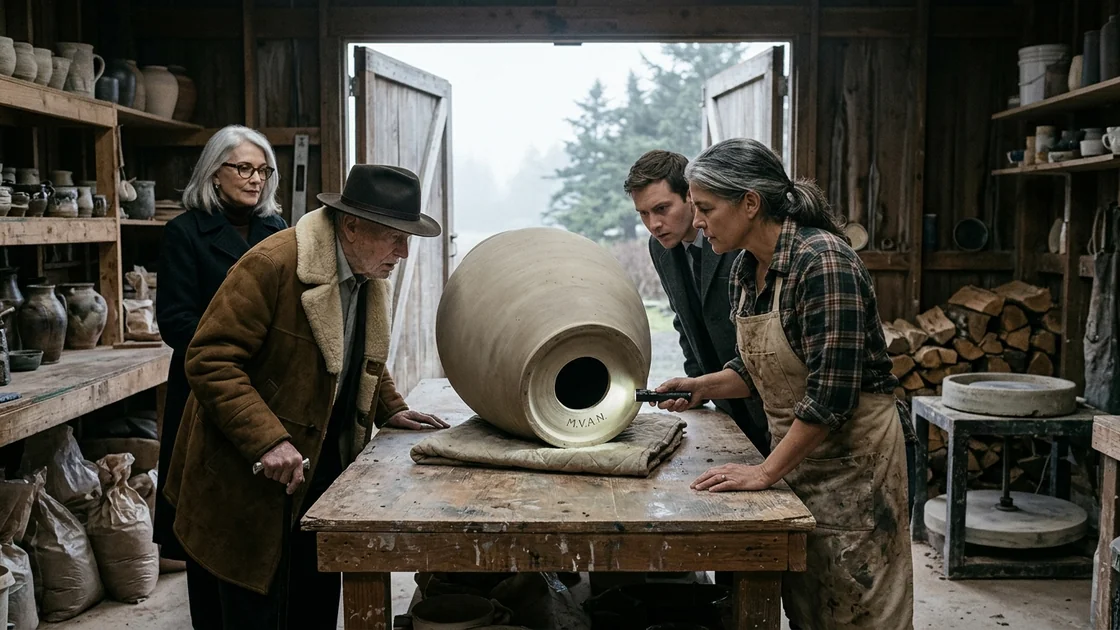
For twenty years, Martha Vance lived in voluntary exile on the foggy edge of the Oregon coast, shaping raw stoneware in absolute obscurity while her former mentor, Julian Cross, reigned over the international art world on the back of techniques he had stolen from her youth. When a serendipitous video of her solitary wood-firing process spreads across the internet overnight, the art world realizes that the enigmatic genius behind Julian Cross’s most celebrated era has resurfaced in a ramshackle coastal barn. Suddenly inundated by museums, collectors, and aggressive legal threats from Cross’s foundation, Martha must choose whether to retreat into the shadows of the kiln once more or finally expose the predatory master who built his empire on her erased life.
The clay had an odor like riverbeds after a spring thaw, mineral-heavy and cold, carrying the damp breath of crushed slate and rotting hemlock needles. It was a dense, iron-rich body that Martha dug herself from the slumped banks of the Nehalem River every September, hauling it back in five-gallon buckets lined with burlap, then slaking, screening, and wedging it until her forearms burned with a low, familiar ache.
Martha Vance was fifty-two years old, and her hands were scarred in the specific manner of wood-firers. The skin across the knuckles of her thumbs was thick and calloused from decades of throwing against abrasive grog; small white crescents marked the spots where blistering embers had popped from the firebox during late-night stoking; and her fingernails were perpetually stained with the pale ghost of silica.
She worked inside an old tractor barn whose cedar shingles had turned the color of drift logs under the relentless salt fog. Her wheel was a heavy, kick-powered treadle built by an eccentric machinist in Astoria back in the nineteen-seventies, weighted with a hundred-pound concrete flywheel that spun with a deep, rhythmic hum. She preferred it to electric wheels. An electric motor dictated its own speed, hummed with an impatient, linear torque that fought the natural resistance of the mud. The flywheel, however, responded to the pulse of her own foot, slowing when she leaned in with the rib to widen the belly of an amphora, yielding to her breath, coasting when she needed silence to listen to the wall thickness.
On a Tuesday in late October, she was finishing a series of broad-shouldered storage jars. The air inside the barn was fifty degrees, cold enough that her breath puffed white in the dim corners, but her skin was warm from the exertion of throwing twenty pounds of mud at a pass. Outside, the Pacific pounded against the headland half a mile through the spruce trees, a low, thundering bassline that vibrated the windowpanes.
Her phone, an outdated flip-phone that sat in a dusty sardine tin on the workbench to keep clay out of its charging port, began to vibrate.
It did not ring often. Occasionally, her grocer in Manzanita called to let her know that salt cod or pickling vinegar had arrived, or the local lumberyard confirmed a delivery of scrap pine offcuts for the kiln. Martha let the phone rattle against the metal tin until it stopped. She dipped her fingers into the slip bucket, smoothed the rim of the jar with a strip of deer leather, and sliced the base from the wheel head with a length of twisted wire.
Two minutes later, the tin rattled again.
Then it rattled a third time.
Wiping her wet palms on her heavy canvas apron, she stepped over the drying racks and pulled the phone from the tin. There were four missed calls from numbers with Manhattan and San Francisco area codes, along with eleven text messages from a girl named Chloe who worked at the bakery down on the highway.
The latest text read: Martha you need to look at the internet right now. People are looking for you. They found the jars.
Martha frowned at the small, pixelated screen. She had no computer in the barn, only an ancient desktop in her living quarters behind the studio that took ten minutes to dial through a noisy satellite connection. She shut the phone, laid it face down on the bench, and looked at the wet pot she had just born into the world. Its shoulders were high, its neck contracted like a resting heron, and its surface was scarred with deliberate, torn facets she had carved with a rusted planer blade.
It was her language. It had always been her language.
She walked out through the double doors into the yard. The salt mist was drifting through the Sitka spruce, fine as sifted flour. At the edge of the clearing stood the dragon: a thirty-foot anagama kiln, a sloping brick tunnel dug into the hillside like a burial mound. For twenty-four years, she had fed that belly with mountain alder, fir, and hemlock, stoking it non-stop for seventy-two hours at a stretch until the internal temperature reached two thousand four hundred degrees Fahrenheit, letting the raging draft deposit wood ash directly onto the bare clay, where it melted into glass.
It was a primitive, punishing way to work. It yielded mostly failures—cracked rims, bloated bellies, pieces glued hopelessly to the kiln floor by excessive slag. But when it succeeded, it produced surfaces that could not be achieved by any modern glaze recipe: flashes of copper-red where the flame had licked the raw earth, surfaces crusted with olive-green ash runs that looked like the backs of ancient snapping turtles, and deep, matte-black fissures where the carbon had buried itself into the cooling body.
She walked to the edge of the road to check the mailbox. A silver sedan with California plates was idling at the junction where her gravel lane met the coastal highway. As she stood by the cedar post, the car turned onto her lane, tires crunching slowly over the crushed river gravel.
A young woman leaned out of the passenger window, holding a modern smartphone like a compass. Her eyes were wide, taking in the sagging barn, the moss-choked woodpiles, the mountainous mound of the kiln.
"Excuse me," the young woman called out, her voice pitched with nervous exhilaration. "Are you Martha Vance? Are you the woman who makes the shoreline vessels?"
Martha felt a sudden, cold constriction in her diaphragm, an animal instinct warning her of an encroaching hound. "I make crocks," she said quietly. "For flour and salt."
The passenger turned to the driver, whispering frantically. She held up the screen of her phone, tilting it toward Martha. On the glass was a video playing on a loop: it showed Martha’s kiln firing from two weeks prior, the chimney belching a pillar of orange sparks into the black coastal night, while Martha herself, backlit by the incandescent glare of the side-stoke hole, hurled a split length of fir into the white-hot inferno with the practiced, violent grace of a stoker on an ironclad steamship.
Overlaid on the video were millions of views and a caption written in bold white typography: The Ghost of the Hudson Valley is alive and living in an Oregon rainforest. We found the real hands behind Julian Cross.
The invasion began in earnest by Thursday morning.
The video, shot surreptitiously by a pair of Portland hikers who had smelled the woodsmoke from the coastal trail and wandered down the logging spur to investigate, had been picked up by an influential design curator on social media. From there, the algorithmic brushfire had consumed the global ceramics and contemporary art communities within eighteen hours.
For forty years, Julian Cross had been the untouchable patriarch of American vessel craft. His works were in the Metropolitan Museum of Art, the Victoria and Albert, the National Museum of Modern Art in Tokyo. In 2004, his breakthrough exhibition, The Shoreline Suite, had redefined contemporary ceramic sculpture. It had fetched record-breaking prices at auction—hundreds of thousands of dollars for a single unglazed, wood-fired vessel that balanced monumental scale with a heartbreaking, fractured fragility. The art world had called it "the reclamation of the earth from industrial cynicism." Julian had claimed the work came to him in a visionary fever following a solitary retreat to the Hudson Highlands after his divorce.
The problem, which only a tiny circle of now-scattered studio apprentices had ever suspected, was that Julian Cross had not thrown a twenty-pound lump of clay in forty years. His hands had developed an aggressive rheumatoid tremor in his late forties, a secret guarded with legal nondisclosure agreements and ferocious studio secrecy.
Martha Vance had thrown every vessel in The Shoreline Suite.
She had formulated the body from local ball clay and river shale. She had spent nineteen days in the freezing winter of 2003 inside his three-chamber climbing kiln in Woodstock, tending the fireboxes until her eyelids were singed hairless, while Julian entertained wealthy patrons in the main farmhouse, pouring bourbon and discussing the "metaphysics of the flame."
When the show opened at the Gagosian in Chelsea in October 2004 to international rapture, Martha’s name was nowhere in the catalog. She was not even listed as an assistant. When she had confronted him in his office above the studio—an airy loft smelling of linseed oil and high-end cigars—he had looked at her with an expression of mild, paternal pity.
"You provided the labor, Martha," he had said, swirling his whiskey with a swollen, stiffened index finger. "The labor is an instrument. A violin does not claim authorship of the partita. The vision was mine. The context was mine. If you leave, you leave with nothing, because outside of this studio, your hands are just mud."
She had left that very night, packing her clothes into a rusting station wagon and driving west until she ran out of continent. She had not signed a nondisclosure agreement; she had simply been too devastated, too young, and too poor to fight his legion of gallery attorneys. For twenty years, she had vanished, deliberately making simple, functional forms, selling them for fifty dollars apiece at local craft fairs under the name "Neahkahnie Pottery," refusing to sign the bottoms of her pots, carving only a blind, unreadable slash into the foot with a splinter of bamboo.
Now, that slash was on the covers of four separate digital art journals.
By noon on Friday, there were seven cars parked along the gravel shoulder of the highway. Journalists from culture blogs, independent collectors who had chartered flights into Portland and rented SUVs, and local gawkers from Tillamook and Astoria were milling around the perimeter of her yard.
They did not dare walk past the sign she had nailed to the gatepost—PRIVATE WORKSHOP. TRESPASSERS WILL BE REMOVED—but their cameras clicked continuously through the wet alder branches.
Martha sat at her kitchen table, sipping chicory coffee from an unglazed mug. The phone on the table rang steadily every eight minutes. Finally, she picked it up.
"Martha?"
The voice was like dried parchment rubbing together. It had lost the rich, theatrical resonance of twenty years ago, thinned out by age and medical frailty, but the cadence—that absolute, aristocratic certainty that the world was an audience waiting for his monologue—was unmistakable.
Julian.
Martha held the plastic receiver against her ear, saying nothing. Through the window, she watched a rain squall sweep across the clearing, darkening the dry bricks of the kiln.
"I see you’ve managed to create a circus," Julian said. There was no greeting, no inquiry after her health, no hesitation. "I suppose congratulations are in order. The internet loves a resurrected hermit. It’s thoroughly sentimental, of course, but effective."
"I didn't invite them," Martha said. Her voice sounded strange to her own ears—raspy from disuse, deep, steady.
"No, you were always passive-aggressive about your reclusion," he replied with a dry cough. "You always imagined that hiding in a swamp was an act of moral superiority. But now you have a situation on your hands, and so do I. We need to manage it before these idiots turn twenty years of history into a tabloid farce."
"There is nothing to manage," Martha said. "They will get wet, they will get bored, and they will go home."
"Don't be a child, Martha!" The old anger flickered through his thin voice, sharp and venomous. "Arthur Cole from the Whitney called me this morning. Three auction houses have suspended sales of my mid-career work pending 'authentication reviews.' Some wretched little blogger has matched the tooling marks on your new work with the photographs of the Broken Horizon urn from 2004. They are claiming fraud. They are using words like forgery and exploitation."
"Are those incorrect words, Julian?"
A pause stretched over the line, heavy with the dead weight of twenty years. Outside, the wind caught the metal roof of the woodshed, making the corrugated tin groan.
"I gave you an education that no university on earth could provide," Julian said, his voice dropping into a low, measured register that Martha remembered with a shudder. It was the voice he used when he was about to excise someone from his life. "I took a feral girl from an Ohio gravel pit and showed her what art was. I gave you the platform, the materials, the context. Without my name, those pots were ballast. With my name, they changed the trajectory of the medium."
"You couldn't even center five pounds of clay when I arrived, Julian. Your fingers were already claws."
"And yet, history remembers the name on the pedestal, not the person who hauled the clay," he retorted. "Listen to me carefully. My lawyers are already drafting a joint statement. We are going to announce that you were my senior associate, that the coastal work is an authorized continuation of the Cross Studio vernacular, produced under an endowment I have established for your benefit. You will receive thirty percent of all future sales through the gallery. You will confirm that all past works were collaborative executions of my conceptual designs. If you do this, you will be wealthy. You will be safe. You can build whatever kiln you want in that miserable rain."
"And if I say no?"
"If you say no," Julian whispered, "I will tie you up in intellectual property litigation until you die in that shed. I will sue you for copyright infringement of the forms I registered in 1998. I will have your kiln dismantled by court order if you attempt to sell another piece using my signature faceting. You don't have the money for a deposition, Martha. You don't have a single gallery behind you. You have a few thousand followers on a phone screen who will forget your name by Tuesday. Don't test me. I am eighty-one years old, and I will burn the entire archive before I let an apprentice rewrite my life."
The line went dead.
Martha held the phone for a long time, listening to the flat, mechanical silence of the disconnect tone. Then she set it down on the table, pulled on her rubber boots and oilskin jacket, and walked out into the rain.
She walked straight past the gate, ignoring the three reporters who rushed forward with microphones and recording devices. She did not run; she walked with the long, slow stride of someone accustomed to carrying fifty-pound bags of feldspar across muddy yards.
"Ms. Vance! Did you throw the Shoreline Suite?"
"Martha! Has Julian Cross reached out to you?"
"Are you planning to file a lawsuit against the Cross Foundation?"
She walked through them as if they were nothing more than the sea fog drifting through the ferns. She crossed the highway and took the narrow path that led down through the spruce trees to the beach.
The tide was low. The Pacific stretched out toward the gray horizon, an immense, leaden plate ruffled by whitecaps. Great heaps of bull kelp lay tangled along the high-tide line, their amber bulbs glistening like blown glass. Martha walked to the edge of the surf, where the sand was packed hard and wet, reflecting the pale sky like an unglazed stoneware plate before firing.
Twenty years.
She looked down at her hands. The joints of her fingers were thick, but they were straight. They did not tremble. When she closed her eyes, she could feel the exact density of twenty-two pounds of damp river mud between her palms. She could feel the precise moment when the centrifugal force of the wheel attempted to tear the wall outward, and she could feel the minute, microscopic pressure required from the fingertips of her left hand to hold that wall true, to guide it upward against gravity, against friction, against the cold physics of the earth.
Julian had never known that feeling. He had been an art historian first, a charming, charismatic theorist who had learned enough hand-building in the nineteen-sixties to talk convincingly about "the vulnerability of the vessel." When his hands failed him, he had not stopped; he had simply hired technical prodigies from the craft schools, paid them meager stipends, and convinced them that their labor was nothing more than an anonymous extension of his intellect.
Martha had been the most pliable of them all. She had been twenty-four, an orphan from a decaying mill town in eastern Ohio, starved for validation, desperate to believe that she was part of something sacred. When Julian had praised her sense of proportion, she would have worked thirty-six hours without food just to see him nod at a rim she had pulled.
She remembered the night the Broken Horizon urn had been fired.
It was three in the morning in the Woodstock studio. The anagama was screaming at cone 11, the draft howling like a jet engine through the flues. Julian had been asleep in the main house for eight hours. Martha had been alone on the stoking deck, blistered, drenched in sweat, her shirt stiff with salt. She had looked through the spy-hole into the first chamber and seen the massive, four-foot vessel sitting directly in the path of the flame.
The draft was too fierce; it was threatening to slag the front face of the pot and melt it into an unrecognizable puddle. Without thinking, she had seized a five-foot iron blowpipe, uncapped a secondary air port, and manipulated the atmosphere, starving the chamber of oxygen to induce a sudden, heavy reduction that lowered the temperature just enough to freeze the running ash in place, leaving a violent, torn scar of iridescent black glass across the waist of the form.
It was an accident of instinct, an act of sheer physical communion with the fire.
When Julian had inspected the kiln after the five-day cooldown, he had stared at that pot for twenty minutes in total silence. Then he had taken his brass monogram stamp, dipped it in red iron oxide, and pressed his initials—JC—deep into the raw, unglazed foot of the jar.
"A masterwork," he had murmured, not looking at her. "My masterwork."
Now, standing on the edge of the Pacific, Martha felt the cold salt water wash over the toes of her boots. The tide was turning. The ocean did not care about signatures. The ocean broke down cliffs of granite into microscopic grains of quartz, tumbled them for ten thousand years, and laid them out in smooth, unblemished plains.
She turned her back on the water and walked up the trail, back toward the barn.
By evening, the crowd at the gate had grown, but someone else had arrived to manage them.
A tall, lean woman in an impeccably cut charcoal wool coat stood in the middle of the gravel lane, speaking in low, commanding tones to the reporters. She had silver hair cropped close to an aristocratic skull, wore heavy tortoiseshell spectacles, and carried an umbrella with a polished bone handle.
When Martha approached the gate, the woman turned. Her expression was not the predatory curiosity of the journalists; it was cool, analytical, and sharp as an obsidian flake.
"Martha Vance," the woman said. It was not a question.
"I don't have anything to sell," Martha said, her hand on the gate latch. "And I don't give interviews."
"I don't want to buy a pot, and I don't write for the magazines," the woman said. She stepped past the gate with an ease that suggested she was accustomed to entering rooms where she had not been invited. "My name is Evelyn Reed. I am the director of the Currier Modern in Chicago."
Martha paused, her hand still resting on the rough cedar wood. The name meant something to her, even after twenty years in the woods. The Currier was one of the few institutions that had consistently refused to show Julian Cross’s work during his zenith in the two-thousands, a quiet defiance that had puzzled the New York critical establishment at the time.
"You're a long way from the Loop, Ms. Reed."
"It takes four hours to fly to Portland, and two hours to drive here through the timber," Evelyn replied, glancing around the yard. Her eyes settled on the wood stacks, categorizing the species with an expert glance: hemlock, alder, split fir. "I would have come twenty years ago if I had known which direction you had driven."
Martha looked at her skeptically. "Why would you care where an apprentice went?"
Evelyn offered a thin, wintry smile. "Because I was at the Gagosian opening in 2004. I stood four inches away from the Broken Horizon urn. I spent two hours examining the wheel marks on the interior neck. Julian Cross never learned how to pull a reverse-spiral collar with his left hand. He threw right-handed his entire life, even before the arthritis crippled his thumbs. The man who supposedly made that vessel was incapable of reaching inside a four-foot cylinder without his elbow collapsing the rim."
Martha let out a breath she hadn't realized she was holding. It came out as a pale wisp in the darkening air.
"Come inside," Martha said. "The tea is hot."
The kitchen behind the studio was furnished with things Martha had made or salvaged. The table was a thick slab of Douglas fir resting on cedar posts; the shelves were filled with rough earthenware bowls, pickling crocks, and rows of dried herbs hanging from strings of jute. A small cast-iron woodstove cast a cherry-red glow through its mica window, filling the room with the dry, resinous scent of burning larch.
Evelyn sat at the table, cradling a bowl of hot water steeped with dried mint. She had laid a leather briefcase on the wood, but had not yet opened it.
"Julian called me three hours ago," Evelyn said, watching the steam rise. "He was frantic. He hasn't spoken to me in fifteen years, not since I called his Venice Biennale installation 'the bloated corpse of late-modern narcissism.' He wanted to know if the Currier would host a joint retrospective. He offered us the entire estate archive."
"He wants to bury me in his tomb," Martha said, sitting down across from her.
"Of course he does," Evelyn said calmly. "If you are his collaborator, his legacy remains intact. He becomes the grand old man who mentored a reclusive genius, an elder statesman who shared the credit with his brilliant pupil. If you are his victim—if it is proven that he was an absolute fraud who stole the work of a young woman and drove her into poverty—every piece bearing his monogram in every museum in North America becomes an embarrassment. Curators will quietly move his vessels into basement storage. Donors will demand refunds. The market value of his foundation will evaporate overnight."
"I don't care about his foundation," Martha said. "I don't care about the market. Look around you, Evelyn. Do you see anything here that requires a hundred thousand dollars?"
Evelyn set her tea bowl down. The ceramic clicked sharply against the fir table.
"You should care, Martha. Not for the money, but for the truth of the medium." Evelyn leaned forward, her eyes behind the tortoiseshell frames burning with an intellectual ferocity that startled Martha. "Ceramics is the oldest material record of human consciousness. When an archaeologist digs up a five-thousand-year-old settlement in the Indus Valley, they don't find the tapestries or the poems or the political speeches. They find the potsherds. They find the thumbprints of the people who shaped the mud. You cannot lie to clay. The clay records the speed of the wheel, the chemistry of the water, the wood ash that fell from the sky, the exact pressure of the hand that held it."
She tapped her knuckles against her briefcase.
"Julian Cross built a mountain of paper," Evelyn continued. "Catalogs, essays, reviews, insurance appraisals, foundation boards. But paper rots. Clay endures. What you made twenty years ago is sitting in museum vaults under his name, but the clay knows who touched it. You have an obligation to set the record straight, if only so that five hundred years from now, the record isn't a lie."
Martha looked down at her fingers. "He threatened to sue me. He said he owns the copyright to the forms."
Evelyn laughed—a short, dry bark of genuine amusement. "Let him sue. Let him file a complaint in federal court. Do you know what happens during discovery in an intellectual property suit concerning visual art, Martha?"
Martha shook her head.
"A demonstration," Evelyn said, her eyes flashing. "The court can order an evidentiary deposition. We will invite the press, the trustees, the entire critical establishment. We will put a wheel in the middle of a gallery, give Julian Cross thirty pounds of Nehalem river clay, and tell him to throw the neck of the Broken Horizon urn. And when his hands fail to center the first two pounds, we will invite you to sit at the wheel."
Martha looked out the small kitchen window. The rain had ceased, replaced by a clearing wind that tore the clouds apart, revealing a sliver of cold, razor-sharp moon hanging above the spruce trees.
"I don't want a circus in a courtroom," Martha said softly.
"Then what do you want?"
Martha was silent for a long time. She listened to the stove, the slow, rhythmic ticking of the metal as it cooled.
"I have sixteen pieces in the barn," she said at last. "I took them out of the kiln three days ago. They were fired with the same river clay, the same wood, the same draft that I used twenty years ago in Woodstock. I haven't ground the feet yet. I haven't washed off the loose fly-ash."
She looked back at Evelyn.
"The Currier has the Broken Horizon urn, doesn't it?"
Evelyn nodded slowly. "On long-term loan from a private foundation in Boston. It sits in our modern wing."
"Bring it here," Martha said.
Evelyn’s eyebrows rose slightly. "Here? To this barn?"
"Bring Julian, bring his foundation lawyers, bring whoever you want," Martha said, her voice dropping into a register of cold, absolute finality. "Put his urn on my workbench next to the jars I pulled on Tuesday. Let him look at them. Let him tell me to my face, with the dust of the kiln on both of them, that he made them."
The logistics took eleven days, orchestrated by Evelyn Reed with the ruthless efficiency of a military campaign.
The art world, hungry for drama and primed by the viral video, treated the impending encounter like a duel between mythical figures. Julian’s public relations team had attempted to reframe the meeting as a "historic summit of reconciliation between master and disciple," but Evelyn had blocked every attempt at stage management. She had made it clear to the board of the Currier that if Julian refused the summons, the museum would immediately initiate a formal provenance review of his entire collection, supported by an affidavit from Martha.
Julian had no choice. To hide in Woodstock would be an admission of guilt; to come to Oregon was his only chance to control the narrative, to play the magnanimous mentor welcoming his prodigal daughter back into the fold of his empire.
On a cold, wind-scoured Tuesday in early November, three black livery towncars wound their way down the gravel lane to the Nehalem barn.
A small crowd of reporters and photographers had gathered outside the gate, kept at bay by two private security guards Evelyn had hired from Astoria. The salt fog was thick, curling in greasy tendrils through the tops of the spruce trees, carrying the bitter scent of wet hemlock and the ocean.
Martha was already inside the barn. She had not dressed up. She wore her usual studio clothes: heavy flannel, patched denim trousers, and her canvas apron, stiff with dried gray slip. She had swept the concrete floor, clearing a wide, open arena around her treadle wheel.
On the long fir workbench running along the east wall, she had lined up the sixteen vessels from her latest firing.
They were magnificent, terrifying things. Having spent seventy-two hours in the white-hot belly of the anagama, they bore the violent marks of their birth. One broad-rimmed bowl had warped slightly under the intense heat, its lip dipping like a wave freezing as it broke; another, a four-foot amphora, was glazed entirely by accidental ash-fall, the surface running in thick, vitreous tears of celadon-green over an iron-black ground that looked like charred bone.
At the far end of the bench, bathed in the gray light from the skylight, sat the Broken Horizon urn.
It had arrived two hours earlier in a climate-controlled, foam-lined crate, escorted by two professional art handlers in white cotton gloves. Seeing it again after twenty years made Martha’s chest ache with a sudden, sharp physical memory. She remembered the blister on her shoulder from the firebox; she remembered the smell of Julian’s cologne when he had entered the kiln shed the morning after the firing; she remembered the precise angle she had held the iron blowpipe to deflect the chimney draft.
The side door of the barn opened, letting in a swirl of damp mist and the low mutter of voices.
Evelyn Reed entered first, her wool coat buttoned to the chin. She held the door open for the entourage.
There were two lawyers in expensive overcoats, clutching leather folios; a younger man who served as Julian’s private curator, looking pale and nervous; and then, moving slowly with the aid of two silver-headed walking sticks, came Julian Cross.
Age had shrunken him, hollowed out the broad, theatrical chest that Martha remembered, but had not diminished his vanity. He wore a heavy shearling coat with a wide collar, a silk scarf knotted artfully around his withered throat, and a wide-brimmed black fedora that cast a dramatic shadow over his sunken, spotted cheeks. His eyes, watery and rimmed with red, darted around the dim interior of the barn, taking in the drying racks, the mounds of raw clay, the kick-wheel, and finally Martha herself.
He stopped ten feet from her. His breathing was labored, a dry, rattling wheeze that whistled through his teeth.
"Martha," he said. He did not smile, but his voice carried that practiced, melancholic warmth that had once held entire lecture halls spellbound. "Look at what you’ve built here. It smells just like the old days in the Highlands."
Martha did not move from behind her wheel. "It smells like clay and woodsmoke, Julian. It smells like that anywhere people actually work."
One of the lawyers, a sharp-featured man with rimless glasses, took a step forward. "Ms. Vance, my name is Harrison Vance—no relation, of course—representing the Julian Cross Foundation. We are delighted that we could arrange this historic meeting to clarify the provenance of—"
"Be quiet, Harrison," Julian snapped, not taking his eyes from Martha. The lawyer instantly shut his mouth and retreated.
Julian leaned heavily on his right walking stick, using the left to gesture toward the bench where the vessels stood.
"They told me you were making crocks," he said, his voice dropping into an intimate, conspiratorial murmur. "They told me you had given up the high work to turn butter pots for tourists. But look at these. You couldn't leave it alone, could you? The flame is still in you."
"The flame was never yours, Julian," Martha said. "You were just the man who bought the wood."
A flicker of cold fury passed behind Julian’s rheumy eyes, but he suppressed it, turning his gaze toward the Broken Horizon urn sitting at the end of the bench. He walked toward it with a slow, deliberate shuffle, his boots scuffing through the dry clay dust on the concrete floor.
He reached out a trembling hand, clad in a thin, deer-leather glove, and hovered it over the rim of the pot.
"Do you remember that night, Martha?" he asked softly. "December of 2003. The blizzard was howling off the mountain. The snow was drifting through the barn doors. We were up until four in the morning, fighting that kiln."
Martha let out a short, quiet laugh.
"You were asleep in your king-sized bed in the farmhouse, Julian. You had taken two sleeping pills and drunk half a bottle of bourbon. I was alone on the stoke deck. When the draft went wild at two in the morning, I had to kick the firebox door open myself because you hadn't cleared the snow from the woodshed."
Julian did not flinch. He slowly pulled off his right glove, exposing his hand.
Martha felt a small shock run through her. The hand was grotesque: the knuckles were swollen to the size of walnuts, the fingers curled inward like the dry claws of a dead raptor, frozen in a permanent, agonized contraction. It was a hand that could not hold a fork, let alone shape a cylinder of spinning mud.
He laid that twisted hand against the cold, scarred flank of the Broken Horizon urn.
"Look at this surface, Martha," he whispered, and for a moment, his voice was stripped of its performance, carrying only the desperate, terrifying hunger of an old man facing the void. "Look at the tension between the shoulder and the belly. Look at the balance of the rim. Who understood that balance? Who spent ten years in Rome studying the Etruscan funerary urns? Who taught you how to read the negative space around a foot?"
He turned back to face her, his withered face pale in the skylight glare.
"You had the muscle, yes. You had the stamina of an ox. You could sit at the wheel for eight hours and pull thirty cylinders without breaking a sweat. But you were blind! You were an Ohio ditch-digger until I opened your eyes. I gave that clay its soul, Martha. Without my mind, that pot would be an oversized pickle jar sitting in a junk shop in Poughkeepsie!"
The barn was dead silent. The wind rattled the loose cedar shingles overhead. Evelyn Reed stood by the door, her arms crossed over her chest, watching Julian with the cold detachment of a naturalist observing a wounded predator.
Martha walked slowly around the wheel. She approached the workbench, stopping three feet from Julian. She was a head taller than him now, her shoulders broad and straight under her flannel shirt, her skin glowing with the coarse health of someone who spent her days in the wind and salt.
"You really believe that, don't you?" she said quietly.
"I know it," Julian rasped. "The world knows it. You can tell the bloggers whatever you like. You can show them your hands, you can show them your wheel. But when the hammer falls at Sotheby’s, it falls on my name. The culture belongs to the mind that conceives it, not the tool that shapes it."
"Then let's look at the conception, Julian," Martha said.
She did not touch the Broken Horizon urn. Instead, she reached into the pocket of her canvas apron and pulled out a small, heavy object wrapped in an oily rag.
She unwrapped it carefully on the workbench.
It was an old, rusted calipers, its brass hinge green with verdigris, alongside a small, rectangular block of dried plaster of Paris, barely two inches long.
Julian frowned at the plaster block. "What is that junk?"
"This," Martha said, "is the mold I carved on December 14th, 2003, while you were in New York having lunch with the director of the Whitney."
She picked up the plaster block. On its face was carved a tiny, microscopic relief—a negative impression of three jagged lines resembling the teeth of a saw, crossed by a single, curving horizon mark.
"Do you know what this is, Julian?"
Julian stared at it, his watery eyes narrowing. "I have no idea what you're talking about."
"Twenty years ago," Martha said, her voice steady and clear, echoing off the wooden rafters of the barn, "I was terrified of you. I knew what you were doing. I knew that every time I pulled a pot, you walked into the drying room with your wooden stamp and stamped JC into the base while the clay was leather-hard. I knew that if I spoke up, you would fire me, take my work, and leave me with nothing."
She reached out and turned the massive Broken Horizon urn on the table, sliding it carefully across the wood until its unglazed base was exposed to the light.
In the center of the foot was the crisp, clean stamp: JC.
"You were so proud of your mark," Martha whispered. "You stamped it right in the center. But you never looked inside the hollow foot-ring. You never looked because you couldn't bend your neck, and you didn't care about the engineering of the foot. You only cared about the signature."
She picked up a small flashlight from the workbench and clicked it on. She angled the beam into the deep, recessed crevice of the vessel's hollow base, an undercut barely an inch wide that served to elevate the massive form off the kiln floor.
"Evelyn," Martha said. "Bring Julian's lawyers. Bring his curator."
The group moved forward, their shoes shuffling nervously on the concrete. The young curator leaned down, squinting into the narrow, shadowed channel illuminated by the flashlight beam.
There, stamped deeply into the raw, unfired clay of the interior recess—a spot physically impossible to reach after the vessel had been centered and fired—was the microscopic impression of the three saw teeth and the curved horizon.
And beneath it, pressed with a metal typing slug into the wet earth twenty years ago, were four letters:
M. V. A. N.
The young curator inhaled sharply, standing up straight as if he had touched an electric wire. The lawyer with the rimless glasses peered into the crevice, his face going completely gray.
"It is on all of them, Julian," Martha said softly, her eyes fixed on the old man's face. "Every single piece from The Shoreline Suite. Every piece from the 2002 gallery show. Every urn, every amphora, every broad-rimmed bowl that sits in the Met, in the Art Institute of Chicago, in the national gallery in Tokyo. I pressed that mark into the interior foot-ring before the clay was dry enough to lift from the bat. I knew you would never see it, because you never touched the bottoms. You only touched the pedestals."
Julian leaned back against his walking sticks, his breath coming in short, ragged gasps. His face had lost all its theatrical color; it looked like gray, dried slip, cracked and crumbling under an unbearable weight.
"You..." he choked out, his swollen hand shaking violently as he raised a walking stick toward her. "You sabotaged me. You... you were an employee! That was studio property! Anything made in my studio belonged to the Cross Foundation!"
"An apprentice is an employee, Julian," Evelyn Reed said, her voice cutting through the damp air like a steel wire. "An artist is an author. In the United States, an author’s signature concealed within the physical body of an artwork prior to firing is prima facie evidence of physical authorship. A court will not find that these were works made for hire, because you never paid her a legal wage, you never filed payroll taxes, and you never executed a work-for-hire agreement."
Evelyn looked at the lawyer with the rimless glasses.
"Isn't that correct, Harrison?"
The lawyer swallowed hard, looked down at his leather folio, and said nothing.
Julian’s stick wavered in the air. For a second, Martha thought the old man was going to strike the Broken Horizon urn, to shatter the forty-thousand-dollar vessel onto the concrete floor in a final, furious spasm of vanity.
Instead, his arm dropped. The silver head of the stick struck the concrete with a dull clack.
He looked at Martha. For the first time in twenty years, he was not looking past her; he was looking directly into her face, and what he saw there was not anger, not vengeance, not the hungry desperation of an apprentice begging for scraps of praise.
He saw absolute, unyielding indifference.
She did not need his name. She did not need his museums. She did not need his money. She had the river clay, she had the wood, she had the wheel, and she had the fire. She had spent twenty years doing the work, while he had spent twenty years curating a ghost.
"Get out of my barn, Julian," she said quietly.
Julian opened his mouth to speak, but no sound came out. He turned slowly, painfully, his sticks dragging through the dust, and shuffled toward the door. His lawyers and his curator followed him in silence, their heads down, their expensive coats trailing the smell of wet wool and defeat into the Oregon rain.
Evelyn Reed did not leave immediately.
She stood by the bench, watching the black towncars turn around in the gravel lane and head back toward the highway, followed by the swarm of reporters who had realized, with the sudden instinct of vultures, that the old titan had fallen.
"The board of trustees meets on Thursday," Evelyn said, turning back toward Martha. "We are going to de-attribute the six pieces in our permanent collection. We will re-catalog them under your name. We want to mount a full-scale retrospective in the spring: thirty years of Martha Vance, from Woodstock to Nehalem."
Martha looked at the Broken Horizon urn sitting on the bench. The skylight was darkening now as the short November afternoon slipped toward dusk.
"What will happen to Julian?" Martha asked.
Evelyn shrugged slightly. "His foundation will dissolve within eighteen months. The collectors will sue for misrepresentation. Some will quietly sell his early pieces at a loss; others will hide them in vaults to avoid the embarrassment. He will spend his remaining years locked in his farmhouse, surrounded by lawyers and catalogs that nobody wants to read anymore."
Evelyn pulled a leather document holder from her bag and laid it on the table.
"The contract is standard," she said. "A solo exhibition, an illustrated monograph, full insurance and transportation for the sixteen pieces here, and an acquisition fund for the museum to purchase three of the new vessels at current market value—roughly seventy-five thousand dollars each."
Martha didn't pick up the document. She walked over to her kick-wheel, picked up a wet sponge from the splash pan, and began to wipe down the steel shaft.
"Take the urn back to Chicago, Evelyn," Martha said.
Evelyn blinked, surprised. "And the exhibition?"
"I don't have time to go to Chicago," Martha replied, her voice soft against the rhythmic squeak of the sponge. "The rainy season has started. If I don't dig another two tons of clay from the riverbanks before the Nehalem floods next week, I won't have enough mud to wedge for the spring firing."
"Martha," Evelyn said, her tone tinged with genuine disbelief. "You are about to be the most celebrated ceramicist in the Western world. You can buy all the clay in North America. You can have it delivered by the freight-car load."
Martha paused, looking down at the heavy concrete flywheel of her wheel.
"Clay from a box has no bone in it," she said. "It has no roots. It has no slate. It has no memory of the river."
She looked up at Evelyn, her eyes clear, gray, and steady as the sea.
"Julian wanted the world to look at him while he held a pot," Martha said. "I only ever wanted to look at the pot. Tell the museums they can put my name on the labels. Tell them the truth, so the sherds aren't a lie five hundred years from now. But leave me my barn, Evelyn. Leave me the wood."
Evelyn Reed stared at her for a long time. The museum director, who had spent forty years navigating the venomous, ego-drenched corridors of the international art establishment, seemed suddenly small against the vast, quiet space of the tractor barn.
Slowly, Evelyn picked up her document holder, unzipped her bag, and slid it inside.
"The monograph will be published in April," Evelyn said quietly. "I will write the introduction myself. We will send you six copies."
"Send two," Martha said. "The mice eat the glue in the bindings out here."
Evelyn offered a faint, respectful nod. She turned and walked toward the door, her boots clicking softly on the floor. At the threshold, she paused and looked back at the woman standing by the wheel.
"You won the war, Martha."
Martha wrung out the wet sponge into the slip bucket. The muddy water splashed with a thick, heavy sound.
"There was no war, Evelyn," Martha said. "There was only the earth, and the fire, and a man who thought he could own them."
By nightfall, the gravel lane was empty.
The reporters, the collectors, the lawyers, and the black towncars had vanished back down the coastal highway toward the airport, rushing to file their stories, to update their databases, to rewrite the auction records of the last two decades. The internet was alight with the news: Julian Cross Exposed: Reclusive Oregon Ceramicist Revealed as the True Hand Behind The Shoreline Suite.
Martha did not know this, because her phone sat uncharged in its sardine tin on the workbench.
The rain had returned, drum-rolling steadily on the corrugated tin roof of the barn. Outside, the spruce trees swayed in the offshore wind, their dark boughs combing the salt mist from the dark sky.
Martha lit an oil lamp and hung it from a beam above the wheel. The yellow flame flickered in the draft, casting long, dynamic shadows across the mounds of bagged river mud and the rows of drying boards.
She took off her oilskin jacket, tied her canvas apron around her waist, and walked over to the slaking bin. She reached down into the deep, cold slurry, feeling the density of the earth she had dug with her own back two months ago. It was stiff, cool, and clean.
She cut off a twenty-pound lump with a wire, hoisted it onto the wedging table, and began to work.
Rams-head wedging. Rhythmic, heavy, deliberate.
Her palms pushed the mass forward, folding the clay back over itself, driving out the tiny pockets of trapped air, aligning the microscopic platelets of silica and alumina into a spiral of internal tension. Her breath fell into time with the work: an exhalation as she leaned her body weight into the table, an inhalation as she pulled the clay back.
One. Two. Three.
Her knuckles did not hurt. Her shoulders were loose and warm. The memory of Julian Cross—the vanity, the lawyers, the stolen years, the bitterness that had lived like an ember in the corner of her heart for twenty winters—was gone, washed away like loose slip off a bat.
She lifted the twenty-pound ball of mud, carried it to the treadle wheel, and slammed it down dead-center onto the dry plaster head.
She sat on the wooden bench. Her right foot reached out, found the iron pedal of the treadle, and began to kick.
The heavy concrete flywheel groaned, began to turn, and gathered momentum. The deep, familiar vibration rose through the wooden frame of the wheel, through the bench, into her hips, into her spine. The hundred-pound wheel spun faster, humming its low, mechanical note that matched the thundering of the surf through the trees.
Martha dipped her hands into the water bucket.
She reached out with both palms, leaning her body weight forward, pressing her thumbs into the center of the spinning mass. The cold mud tore against her skin for a fraction of a second, fighting her, resisting the order she brought to it.
Then, under the steady, unyielding pressure of her calloused hands, the clay yielded.
It smoothed out. It rose into a tall, gleaming tower of gray earth, perfectly true, spinning without a whisper of wobble in the yellow light of the lamp.
She smiled, closed her eyes, and began to pull the wall.